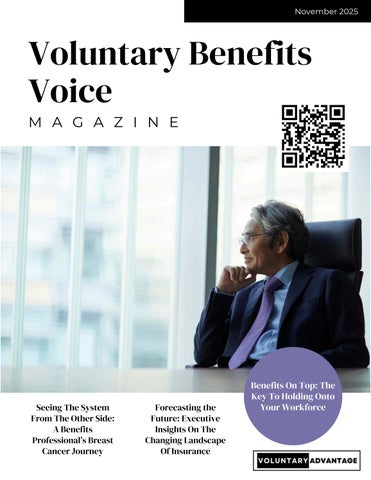
November 2025
Voluntary Benefits Voice M A G A Z I N E
Seeing The System From The Other Side: A Benefits Professional’s Breast Cancer Journey
Forecasting the Future: Executive Insights On The Changing Landscape Of Insurance
Benefits On Top: The Key To Holding Onto Your Workforce
Jennifer Daniel Aflac
Key Contributors
Jack Holder EBIS
Steve Cain
Paul Hummel
Rachel McCarter Mercer
Editorial Staff Editors Heather Garbers | Trevor Garbers For Media and Marketing Requests Contact: Heather@voluntary-advantage.com Trevor@voluntary-advantage.com Mailing Address 10940 S Parker Rd #257 Parker, Colorado 80134
Advisory Board
Steve Clabaugh CLU, ChFC
Mark Rosenthal PwC
Seif Saghri Founder
Tim Schnoor Birch Benefits
Hunter Sexton, JD, MHA Sydney Consulting Group
FEATURED ARTICLES Forecasting The Future: Executive Insights On The Changing Landscape Of Insurance
Seeing The System From The Other Side: A Benefits Professional’s Breast Cancer Journey
Relational Leadership Experience: Trouble! (Part 2)
Executives See Challenges But Have High Expectations For Voluntary/ Worksite Market
Benefits On Top: The Key To Holding Onto Your Workforce
From The Editor... The Current State of the Marketplace As I kick off this month’s publication, I want to open with a quote and a reflection on the current state of our marketplace —one that may make some a bit uncomfortable. As Henry Ford once said, ‘If everyone is moving forward together, then success takes care of itself.’ I would respectfully disagree in some regards. Moving forward together has indeed been a pillar of our past success; however, what we accepted as the status quo in our growth has often prevented us from truly thriving within the evolving employee needs cycle. Over the past couple of years, we’ve finally begun taking the right, collectively aligned action steps to guide the voluntary benefits marketplace toward sustainable growth - anchored by the right principles and focused on elevating our entire industry to better serve the policyholder.
Trevor Garbers
Some may read this and think, ‘We’ve been doing things right for decades.’ The truth is, we have not—and acknowledging that reality is the first step toward real progress. Now, let me be clear: I am not suggesting that our past leaders lacked vision or went down the wrong path. Quite the opposite. Many of our predecessors laid the critical foundation that has enabled the successes we enjoy today, and we owe them great respect and gratitude. That said, I think most would agree that, for decades, our biggest challenge was simply getting an at-bat—with a broker, a consultant, or an employer group. The prevailing mindset became do whatever it takes to win the group, place premium on the books, and compensate the firm to the max. In that pursuit, too often, the needs of the policyholder were not fully considered in the design of plans or programs. Instead, much of the focus shifted toward building compensation models to secure business, while underinvesting in modern onboarding and administration systems that could have improved the employee experience. Let’s be honest—we lost sight of the true purpose of our profession. Somewhere along the way, profit began to outweigh people. It’s time to recalibrate that balance. Today, however, I’m encouraged by the conversations taking place across our industry. I’m hearing top executives begin meetings by leading with their value proposition—centered on employee value, employee experience, integrated claims processes, claims paid per enrollee, and utilization metrics tracked quarterly and annually. Even more promising, I’m seeing these same leaders address the long-avoided “unsaid’s” and begin constructing models that reward those building persistent, sustainable business - through level compensation, without marketing fees or subsidies, and by designing programs that mitigate overall risk while supporting policyholders at the moment that matters most: claim time. Gone are the days of representatives saying, “We’re leaving money on the table.” In are the days of, “Have you seen our new claims tools and partnerships that drive engagement and elevate the employee experience?” This is the era of intentional growth—one defined by transparency, collaboration, and accountability to the people we ultimately serve. As an industry, we have a rare opportunity to redefine what success looks like: not by the size of the premium placed, but by the quality of the protection delivered and the trust we build with every policyholder interaction. If we stay aligned with principles over profit, value over volume, and people over process, our marketplace won’t just move forward together—it will finally move forward the right way.
THE 2025 DEBRIEF: Driving Supplemental Utilization with Survey-less, Silo-less Guidance Discover how to drive supplemental benefit utilization to lower healthcare costs and build long-term financial strength. Join our roundtable to explore strategies for overcoming adoption barriers and driving results for employees, employers, and partners in 2026.
DECEMBER 9, 2025
UPCOMING WEBINAR Roundtable Discussion
Executives See Challenges But Have High Expectations for Voluntary/ Worksite Market By Eastbridge Consulting Group, Inc. The voluntary/worksite market has faced plenty of challenges in recent years, from the pandemic and economic instability to rapid technology changes and more stringent regulatory scrutiny. But the industry also has seen a strong rebound with continued growth in sales and stable returns. Those are reasons enough for a strong majority of industry executives to express confidence about the future of the voluntary benefits market, according to Eastbridge’s latest “The Voluntary/Worksite Market: An Executive Perspective” Spotlight™ Report. The report, based on an online survey and phone interviews with executives representing at least 35 carriers active in the voluntary/worksite industry, shows leaders are optimistic about the industry looking forward.
Challenges & Changes Executives we surveyed aren’t looking at the market through rose-colored glasses: They acknowledge plenty of concerns and potential obstacles to their success. Leading the list is the erosion of profitability due to increasing tech fees and subsidies. This is the top concern for 40% of executives, up from 37% in the previous survey. Interestingly, only 8% of executives surveyed in 2023 expected this to be the most formidable obstacle in the next five years, trailing far behind keeping up with technology at 37%.
Meanwhile, the number expressing concern about regulatory requirements including minimum loss ratios has doubled, from 14% in 2023 to 28% this year. And those naming claims integration at the most formidable obstacle has nearly tripled, from 8% in the previous survey to 23% in 2025. Executives are less concerned this year about keeping up with technology, but it doesn’t exactly get a free pass: It remains the top challenge executives say they’ll face in the next five years, although the number ranking it as the top obstacle is down to 28% from 37% two years ago. Regulatory requirement concerns follow in distant second place at 12%, but are up from 8% in 2023.
Threats On The Horizon Executives we surveyed also say they see several threats to the financial viability of their voluntary business, especially competitors who are willing and able to “buy” business through cross-subsidized sales, less underwriting and underpricing. This concern has been prevalent for several years: It’s number one on the list for nearly one-third of executives this year, and is also one of the top three threats executives foresee in the next few years. Inflation also continues to be a concern for many executives surveyed. About half (52%) say it will have a negative impact on voluntary sales, although nearly as many (48%) say inflation will have a positive or no impact.
Looking ahead, executives say the pressure to increase both commissions and technology fees is by far the biggest threat to the voluntary market, named by 65% of those surveyed. Other threats include pricing pressures due to competition, more intense competition from other carriers for broker business, and growing expectations for transparency and communication about claims and loss ratios. Virtually all executives surveyed anticipate continued growth in voluntary sales. More than that, two-thirds expect their own companies to beat the industry average, with compound average growth rates of 8% or more over the next five years, compared to predicted 4% growth for the industry as a whole — and one-quarter of executives expect their sales to grow more than 10%. And one more note about keeping up with technology: Executives are most likely to list tech innovations as one of the most formidable obstacles they face, but 23% also say they’ll be the most common source of competitive advantage in the next five years.
Thinking Positive Despite the challenges they face now and expect in the future, most executives are optimistic about the growth of the voluntary market — both for the industry and for their own companies. According to the comments of those surveyed, this positive outlook is based on the number of employers that still don’t offer and employees who still don’t own voluntary products. It’s also a reflection of their confidence in their investments in product, technology, service and distribution.
The survey also shows most executives continue to expect the overall persistency of their voluntary business to remain good or improve, although fewer than in previous studies report their participation levels are trending upward.
The Bottom Line The outlook for voluntary business remains lower than before the pandemic, but the survey shows the majority of executives are happy with their company's voluntary growth and profitability and expect voluntary returns to stay strong in the future. Most also say voluntary returns are better than other business lines and they expect that trend to continue.
Eastbridge is the source for research, experience, and advice for companies competing in the voluntary space and for those wishing to enter. For over 25 years, they have built the industry’s leading data warehouse and industry-specific consulting practice. Today, 20 of the 25 largest voluntary/worksite carriers are both consulting and research clients of Eastbridge.
Danielle Lehman Senior Consultant
Benefits On Top: The Key To Holding Onto Your Workforce By PES Benefits It’s no secret that employee retention is a top priority for C-level leaders in 2025. A recent LIMRA study shared by BenefitsPro confirms that benefits really do make a difference: "More than 60% of workers say they are at least somewhat more inclined to stay with their employer because of their benefits package". This kind of data gives brokers a compelling opportunity to step up as strategic advisors.
Why Benefits Matter To Executives Now In today’s tight labor markets and rising competition for talent, executives are under greater pressure than ever to retain employees and minimize turnover costs. The stakes are high: every departure carries a hidden price tag, from lost productivity and recruiting expenses to the time and resources required to train new hires. Beyond dollars, turnover can also weaken team cohesion, disrupt client relationships, and lower overall morale across the organization.
That’s why leaders are rethinking benefits as a strategic lever, not just an HR function. A thoughtfully designed benefits package signals to employees that their employer understands and supports their needs inside and outside of work. From financial stability to mental well-being, these offerings provide reassurance during uncertain times and help reduce the likelihood that employees will look elsewhere. Executives who prioritize benefits as part of their talent strategy not only protect their investment in people but also strengthen loyalty and engagement.
How Brokers Can Support Retention Through Benefits To turn insight into action, brokers can play a vital role in helping clients design benefits strategies that truly resonate with employees. This begins with conducting a clear gap analysis to identify where current offerings fall short of employee needs whether in mental health resources, financial wellness, caregiving support, or access to care.
From there, brokers can recommend modern, relevant offerings such as financial wellness coaching, virtual mental health support, caregiver resources, and telehealth services that align with today’s workforce expectations. Equally important is ongoing communication and education to ensure employees not only understand what benefits are available to them but also know how to use them effectively. By guiding clients in building benefits that matter, brokers move beyond transactional relationships and establish themselves as trusted business partners. This approach directly supports stronger retention and long‑term organizational success.
What The Data Means In Practice Imagine two companies with similar budgets and headcounts. One presents a comprehensive, flexible benefits package that employees find meaningful. The other offers only core health coverage. Over time, the first company consistently sees lower turnover and employees who stick around longer are more engaged and productive. That’s exactly what the figures suggest and it’s why brokers have influence beyond just cost negotiation. They help deliver outcomes that matter where it really counts.
Imagine two companies with similar budgets and headcounts. One presents a comprehensive, flexible benefits package that employees find meaningful. The other offers only core health coverage. Over time, the first company consistently sees lower turnover and employees who stick around longer are more engaged and productive.
The Bottom Line From an executive perspective, retention isn’t just about compensation, it’s about confidence and peace of mind. Benefits make it possible for employees to feel supported through every phase of life. And when those benefits align with their needs, retention improves. For brokers, this is more than an opportunity, it’s a chance to lead with insight and build stronger, more trusting client relationships. As the workforce evolves, the strategic value of benefits only grows.
LIMRA (2025). “More than 60 % of workers say they are at least somewhat more inclined to stay with their employer because of their benefits package.” As reported in BenefitsPro.
PES Benefits is dedicated to revolutionizing the employee benefits landscape with cutting-edge technology, administration, education, and virtual care solutions. Since its inception, PES Benefits has focused on simplifying the benefits experience, making it more accessible and meaningful for all involved.
Forecasting the Future: Executive Insights on the Changing Landscape of Insurance By Heather Garbers & Trevor Garbers At Voluntary Advantage, part of our mission is to share insights from stakeholders across the industry - those shaping the evolution of Voluntary Benefits today and tomorrow. In this feature, we sat down with several of the leading voices in Voluntary Benefits to explore where the industry stands today, what is driving its evolution, and what the future holds. We interviewed Brice Campbell, VP of Distribution Strategy & Growth, Supplemental Health Solutions, U.S. Employer at Cigna Healthcare U.S.; Tim Arnold, CEO & President at Colonial Life; Jimmy Reid, EVP and President of Workplace Solutions at Lincoln Financial; Laura Bongiorno, Head of Voluntary Benefits Sales at The Hartford; and Andrew Stocker, President Employee Benefits at Voya Financial.
They have each shared their unique perspectives on the trends, challenges, and opportunities shaping Voluntary Benefits in 2025 and beyond – here is what they had to share:
How Would You Describe The State Of The Voluntary Benefits Industry In 2025? What Major Trends Or Shifts Stood Out Most To You This Year? Laura: “This year, interest in voluntary benefits has noticeably increased, driven by rising healthcare costs, changing workforce demographics, and higher employee expectations. As both employers and U.S. workers seek smarter ways to manage every dollar, voluntary benefits are being recognized as strategic tools for attracting and retaining talent while supporting overall workforce well-being. Another significant trend is the focus on improving the claims experience for Supplemental Health Insurance. By integrating these claims with leave and disability processes, employees are more likely to use their benefits when they truly need them. Additionally, the adoption of AI and other technologies has gained momentum. Technology is enabling a more proactive approach to plan design, communication, education, enrollment, and claims management.”
Brice: “The voluntary benefits industry is a maturing marketplace that continues to evolve in meaningful ways. Carriers are investing in technology and data integration to enhance the customer experience making it easier for individuals to understand their coverage and use it effectively when they need it most. A key shift this year has been the increased focus on integration. While it’s now an industry expectation, there’s still a lack of shared understanding around what true integration means and how it tangibly benefits employees. Establishing transparency around integration’s impact will be critical to strengthening trust and improving outcomes.”
Jimmy: “Voluntary Benefits are in a state of constant change. These changes and challenges provide a real opportunity for carriers to deliver by focusing on what employers of each size need and developing product bundles and features specific to each market segment. We are also seeing increased adoption by employers of all sizes and industries and a continued focus on holistic health, wellbeing and financial wellness, especially as more employers see the role benefits play in attracting and retaining talent. Among the challenges facing the industry, we are seeing a much bigger focus on claims integration, and the regulatory environment continues to evolve, with an increased focus on loss ratio requirements.” Andrew: “What is exciting about the Voluntary Benefits industry right now is that there is no shortage of creative solutions being brought to market through these products to help with the many challenges today’s employer’s face. Everything from enhancements to critical illness plans, to caregiver and grief support, to a shifting focus on women’s health, childhood conditions, and of course mental health, it’s a heavy time to be in benefits, but with that heaviness comes so much opportunity to help people.” Tim: “What really stands out this year is the shift from simply offering benefits to ensuring employees truly understand and value them. It’s no longer just about having a menu of options – it’s about helping people connect the dots between those benefits and their everyday lives. Personalized education, enrollment support, and clearer, more relatable messaging are making a real difference in how employees engage with and use their benefits.”
What Lessons Did Your Organization Learn Over The Past Year That You Think Will Shape The Way We Approach Voluntary Benefits Going Forward? Jimmy: “The biggest lesson that we’ve learned and continue to solve for, is that one size or solution does not fit all. We need to think about each market segment differently because what makes sense for a large employer with 15k employees doesn’t necessarily make sense for a small business with 100 employees. We need to continue to find and deliver ways to make our offerings easier to understand, leaning into the benefits that matter most, as well as helping brokers, employers and employees understand the value of the products, not just focusing on the cost. The market data shows us that voluntary benefits are continuing to grow. Mental health, financial wellness, family and caregiving support are top priorities. Ultimately, the goal is greater flexibility and personalization – we are not in a one-size-fitsall world anymore. Flexible benefit options allow employees to feel supported, which can improve their overall wellbeing and make them more likely to stay and thrive in their roles.” Laura: “There is strong demand in the market for insights on voluntary benefits, particularly within the Supplemental Health portfolio including data on conditions, enrollment patterns, customer segments, and claims utilization. It is energizing to see this space become increasingly data-driven, much like other areas of our industry. An ongoing challenge and opportunity is to ensure that the collection and application of meaningful data continues to advance rapidly, while remaining within the scope of legal, regulatory, and customer requirements. Another lesson is striking the right balance between digitalization and human contact. When enrolling or while submitting a claim human guidance and contact is equally as important as digitalization. The combination is critical for an optimal customer experience.”
Andrew: “Employees are facing more choices than ever when it comes to benefits, and that level of choice can be overwhelming. Employers continue to expand offerings, and voluntary benefits are becoming a bigger part of the mix. What is clear is that employees aren’t just looking for more options - they’re looking for guidance to help them navigate those options confidently. One of the most telling insights came from this year’s annual enrollment. We observed a significant increase in the use of decisionsupport tools embedded into the enrollment experience. Over 60% of employees chose to use these tools, up from ~45% in previous years, and when claim data was available, more than 90% opted to incorporate that data into personalized recommendations for a benefits bundle that complements their core medical plan. The takeaway is that expanding choice alone isn’t enough. Employees need clarity and personalized guidance. Looking ahead, we expect strategies around voluntary benefits to focus on pairing expanded offerings with tools that simplify decision-making and leverage data to create a more tailored experience. AI will be an important tool in employee's decision-making process moving into the future.”
Brice: “Continued investment in technology is essential to delivering the differentiated customer experience employees now expect. Enhancing ease of use, communication, and claims processes will remain core to our strategy. Rising loss ratios across the industry are putting pressure on the current cost structure for these products. Carriers and brokers must find savings in non-claims expenses and maintain financial sustainability while still advancing innovation and value.”
Have You Seen Any Notable Changes In How Brokers Or Employers Are Positioning Voluntary Benefits Within Their Overall Benefit Strategies? Brice: “There is growing sophistication in how benefits are being sequenced and presented on technology platforms. When education about supplemental health happens at the same time employees are making medical decisions, appreciation and understanding of these benefits rise significantly. From the broker perspective, supplemental health is no longer optional. It’s now seen as an essential complement to medical coverage - and an area where integration and customer experience can be true differentiators. Brokers who help clients understand how these benefits fit together are strengthening their relationships and protecting their core medical business in the process.”
Laura: “We see our brokers and employers working hard on several fronts: balancing cost containment with meaningful benefit offerings, customizing benefits to meet the diverse needs of employees, integrating supplemental health benefits with core platforms for seamless and frictionless administration, and remaining agile in response to regulatory and workforce changes. It’s also notable that supplemental health benefits are transitioning from being sold as a stand-alone portfolio to being integrated with medical, disability, and leave management solutions. This shift is largely attributable to the growing emphasis on an integrated claims model across multiple benefit areas.”
Tim: “Broker engagement in Voluntary Benefits is at an all-time high as more employers recognize these offerings as a key part of a broader wellbeing strategy. What’s especially promising is how the brokeremployer relationship is evolving. We are seeing Brokers stepping into a more consultative role, helping employers move beyond traditional supplemental products and towards more holistic solutions that support employees’ mental, financial, and physical health. We are also seeing growing interest in financial wellbeing benefits, which is driven in part by generational shifts. Younger employees are looking for more guidance and a greater sense of financial security, and employers are responding with solutions – like voluntary benefits – that meet those needs.”
Jimmy: “Yes, and we are excited about the opportunity we are seeing with voluntary benefits becoming a larger area of focus for both brokers and employers in meeting the needs of employees. We recognize the importance of highlighting these benefits not only during open enrollment, but year-round - at claim time and other key moments in an employee’s lifecycle. Brokers and employers alike are prioritizing communication and education campaigns, understanding how vital these efforts are to their overall success. When employers and clients commit to ongoing education and a simplified enrollment experience, we consistently see stronger engagement and more successful benefit programs.”
How Do You See The Voluntary Benefits Market Evolving Over The Next 3–5 Years?
Andrew: “We expect to see continued emphasis on value, as well an evolution of what “voluntary benefits” are. Employees today expect more from their benefits package. The menu has continued to expand over the last ten years, but we believe there is more customization, creative product design, and delivery vehicles to lean into in this category. What we hear from employers is a greater emphasis on providing care for the whole person, which translates to the whole “family” that employee is attached to. And in today’s world, that family looks different for nearly everyone. The sandwich generation, which comprises a large majority of our workforce today, cares for both elderly loved ones and school-age children. The traditional family doesn’t look like it once did, and employers recognize that and are trying to provide a wider array of benefits and customization that fits these needs. Being ‘on the menu’ will be important, but showing meaningful ROI and powerful stories connecting these benefits to real people will be critical.”
Brice: “Customer experience will define the next era of voluntary benefits. Employees will expect personalized, guided interactions that simplify complex processes - from enrollment to claims - and reflect a deeper understanding of their needs. We will also see more continuity between medical and supplemental health products. As integration improves and becomes more transparent, employees will see clearer value in how their benefits work together to manage out-of-pocket costs. Overall, financial pressures will continue to shape the landscape. Sustainable growth will require rethinking non-claims expenses and aligning incentives around experiences that drive value for all stakeholders.”
Laura: “Our benefit offerings help support economic resilience and show employees that their well-being – financial, physical, and mental – is a priority, even in the costpressured environment that we expect to continue into 2026. Key trends that are influencing the short and longer term include: Personalization and employee-centric design, which tailors benefits to employee life stage, lifestyle and financial situation. This includes using data analytics and other tactics to offer benefits that resonate with the demographics we serve. A tightly integrated claim experience between voluntary and absence plans, to simplify and improve usage. Mobile-first enrollment and AI-powered benefits platforms will become even more commonplace. Expansion of lifestyle benefits such as caregiving support.
Jimmy: “We see the voluntary benefits marketplace as a growth vehicle for employers, brokers and carriers. It helps employers to attract and retain high quality employees, brokers to meet the needs of their existing and new customers, and for carriers to continue to deliver value to distribution partners, customers and the members we serve. Our continued focus is going to be on the value of these benefits, and beyond the features offered, how to get benefits into employees’ hands faster and more easily. We are focused on innovation in integration of claims, predictive claims processing and express payment of benefits.”
What Role Do You Believe Technology, AI, And Data Analytics Will Play In Shaping The Next Generation Of Voluntary Benefits? Tim: “Technology, especially AI and data analytics, is reshaping voluntary benefits in exciting ways. What used to be static offerings are now becoming more dynamic and personalized. With AI, employees can get benefit recommendations based on their health data, lifestyle, and demographics that actually reflect their individual needs, so they can make more confident, informed choices. On the employer side, automation is making benefits administration more efficient while also unlocking predictive insights that help with cost control and smarter plan design. We are also seeing AI tools that go beyond the basics, supporting wellness, and keeping employees engaged throughout the year. All of this is helping to shift voluntary benefits from being just a checkbox during open enrollment to something that truly supports employees in their day-to-day lives.” Andrew: “AI is rapidly emerging as the go-to source for answering employee questions, especially with younger population segments. Some forward-thinking employers are leaning into this trend by deploying AIpowered tools that interpret plain language queries and provide timely, accurate responses during enrollment, this means we need to consider not just the documentation and data presented to the employee at benefit fairs and within the enrollment experience, but also what content is fed to the knowledge base that powers the AI agent. Additional opportunities exist for driving real value to the consumer when you connect these AI and machine learning systems to the right data. When integrated effectively, they can streamline complex processes like claims management and leverage engagement tools to help employees truly feel the value of the benefits they elect transforming what was once a cumbersome and transactional experience into a personalized, supportive journey.”
Brice: “AI and data analytics will be central to improving both integration and the customer experience. From simplifying claim intake to proactively identifying potential claims, these tools can make interactions more intuitive and personalized. Equally important is how data is used. Turning insights into actions - such as recommending the right products based on medical history, reminding employees when to file claims, or helping employers refine plan design - will define the next generation of value-added service. “
Jimmy: “Technology has already transformed the way we educate both ourselves and our employees. Looking ahead, I believe the next major shift will come from leveraging AI to enhance employee education through improved communication and personalized decision support. By using data-driven insights, AI can tailor recommendations and provide more meaningful benefit guidance. Technology also expands the range of comprehensive benefits available - such as telehealth, teledentistry, mental health support, and financial planning tools allowing employees to access services conveniently from home. It is clear that AI will play a pivotal role in delivering superior service and maintaining competitiveness as a benefits carrier in the future.”
Laura: “Technology, AI and data analytics will have a significant impact on voluntary benefits. As carriers, brokers and employers invest in AI for data analytics, people will better understand, choose and use their benefits. AI and data will help us shape more meaningful benefits for the future and lead to a more directly personalized experience.”
What Do You Believe Brokers Could Be Doing Today To Prepare For The Future Of Voluntary Benefits? Jimmy: “Brokers have the opportunity to educate on the value of these offerings and to partner with carriers to enhance the products, services, capabilities and communication to meet the specific needs of businesses of all sizes.”
Andrew: “It is important to stay plugged into the broader industry – not just what’s immediately in our focus. Pay attention to societal trends, listen to stories from real people, and don’t be afraid to be bold in asking deeper questions of your clients. Find their pain points, so we can help solve them together.”
Brice: “Brokers should help establish a shared definition of what terms like integration and value really mean - and hold carriers accountable for demonstrating measurable results. Setting those expectations early helps prevent client confusion and ensures that integration drives meaningful outcomes. They can also help address the financial realities of the market. With loss ratios on the rise, savings will need to come from nonclaims areas. Brokers who collaborate with carriers to find efficiencies while maintaining focus on the employee experience will be best positioned to succeed.”
How Can Brokers And Carriers Work Together More Strategically To Drive Meaningful Employee Outcomes And Business Results? Andrew: “We cannot emphasize enough how important it is for us to hear from our brokers, early and often. Share with us what you hear and see and partner with us to find new ways to deliver value to customers. We can’t be successful without you.” Brice: “Strategic collaboration starts with transparency - especially around the “why.” Understanding the motivation behind each client’s request allows brokers and carriers to align on the right solutions, products, and enrollment strategies. Carriers can also do more to explain how integration and experience enhancements directly benefit members, while brokers can provide valuable context on employer objectives and RFP activity. That shared insight drives smarter decisions, stronger partnerships, and better outcomes for employees.”
Laura: “It begins with strong communication between brokers and carriers, particularly during the request for proposals. If there is mutual understanding around the needs the broker is trying to meet for the customer such as enhanced benefits, tech platform needs, enrollment conditions, and financial pressures - we can customize and collaborate on a solution that is optimal for the customer.”
Jimmy: “Brokers and carriers could truly partner to better understand the behaviors within both organizations that may be influencing the future value and delivery of these benefits. Focusing on rates and benefits over things like claims performance and service delivery, prevents carriers from investing in the areas where they can make a difference for the covered participants.”
If You Could Change One Thing About How The Voluntary Benefits Industry Operates Today, What Would It Be And Why? Tim: “While we’ve made progress as an industry with AI-driven personalization and better data connectivity, the overall experience is still too fragmented. Employees are often left navigating multiple websites, enrollment systems, and claims processes. A more unified experience would simplify all of that, making it easier to enroll, understand options and benefit from AI-powered recommendations.” Jimmy: “I would like to see the industry better promote the value of voluntary benefits so they are seen as primary and not secondary benefit options.” Laura: “I would love to simplify the buying and utilization process across carriers and platforms as it relates to enrollment, claims and communication.”
Brice: “We need to shift the focus back to employees. Too often, carrier selection is driven by employer incentives such as bundling discounts or technology credits. While those have their place, success should ultimately be measured by price, benefit, and the customer experience.”
Andrew: “We are always in favor of more education and awareness of what voluntary benefits are and how they make an impact. In many cases, we are still pushing to get shelf space and so we would love for more employees to understand how the right voluntary products can help ease the experience of being sick, injured, or hospitalized.”
What Excites You Most About The Future of Voluntary Benefits? Andrew: “The changing nature of work and the new generations entering the workforce – in 5-10 years, this market won’t look like it does today, and that is incredibly exciting.” Jimmy: “When we think about voluntary benefits, we need to think about the art of the possible. We get to think about the limitless ways these benefits can protect the current and future wealth and health of the American worker. Within the scope of voluntary benefits, we get to innovate and deliver meaningful products and services in a new and innovative way. These benefits are important to the insureds’ financial and physical wellness and there is a huge untapped market to educate and inform. I’m especially excited to see more of a focus on increasing utilization with a strong emphasis on preventive care to promote early detection and reduce long term costs. And last, but not least, the variety of benefits available so that the employee can personalize to fit their needs and wants.”
Brice: “The opportunity to create a simpler, more supportive customer experience continues to motivate us. Voluntary benefits have a profound impact when employees face unexpected or life-changing events, and technology and integration can make those moments easier to navigate. It’s also exciting to see the industry’s growth and recognition. Voluntary benefits are no longer an afterthought – they are an essential part of comprehensive health protection. With that growth comes responsibility: to innovate, to stay transparent about outcomes, and to keep the focus squarely on improving the experience for those we serve.”
Laura: “The move toward personalization and purpose-driven plan designs is a positive development – it’s encouraging to see a landscape where benefits are more meaningful to employees’ life stages, health profiles and financial goals.”
Tim: “What excites me most is the shift toward smarter, more holistic and personalized benefits experiences. When done right, this evolution makes benefits more relevant, more engaging and ultimately more valuable to employees. AI and data integration are at the heart of this transformation, moving Voluntary Benefits from something passive and transactional to something that actively supports people throughout their lives. That’s a big leap, and it holds real promise for both employers and their teams.”
Final Thoughts The leaders we spoke with agree: the future of Voluntary Benefits will be defined by connection between data and decisions, between employers and employees, and between products and purpose. As 2025 draws to a close, the Voluntary Benefits industry stands at an inflection point—defined by innovation, integration, and a renewed focus on personalization. Across every perspective shared, one message is clear: voluntary benefits are no longer a “nice-to-have” but a strategic necessity for employers and an essential layer of protection for employees. Technology, AI, and data analytics are driving smarter plan design, more connected claims experiences, and deeper employee engagement. Yet amid all the digital transformation, the human element remains vital—education, empathy, and connection continue to shape how benefits are understood and used. The future of voluntary benefits lies in collaboration among carriers, brokers, and employers to simplify the experience, demonstrate real value, and deliver benefits that truly matter when people need them most.
Tim Arnold CEO & President of Colonial Life
Laura Bongiorno Head of Voluntary Benefits Sales, The Hartford
Brice Campbell VP Distribution Strategy & Growth, SHS Cigna Healthcare U.S.
Tim Arnold CEO & President of Colonial Life
Jimmy Reid EVP, President of Workplace Solutions, Lincoln Financial
Andrew Stocker President Employee Benefits, Voya Financial
Seeing the System from the Other Side: A Benefits Professional’s Breast Cancer Journey By Kate Genovese When the Professional Becomes the Patient After thirty years of experience as a benefits professional, I’ve spent my career designing, communicating, and improving benefit programs meant to support employees through life’s toughest moments. I’ve explained to countless people how their plans work, how to file claims, and how to get the most from their coverage. But this year, I found myself on the other side of that conversation — facing my own breast cancer diagnosis and learning, firsthand, what it really means to navigate the healthcare and benefits system while you’re sick, scared, and trying to stay employed. I often talk to clients about the value of preventive care. But this time, preventive care found me. My annual mammogram didn’t just reassure me — it found earlystage breast cancer. I had no symptoms. My gynecologist and primary care physician had both done manual exams within weeks of my mammogram and found nothing concerning. But the mammogram saw something else.
Follow-up testing found an enlarged lymph node, and an aspiration confirmed what I never expected to hear: hormone receptor positive, HER2-negative, Stage 2 breast cancer. That moment changed everything — and it reminded me just how important preventive screenings are. Early detection gave me options. It gave me time. And it gave me perspective.
The Personal Becomes Professional Since the diagnosis, I’ve had a lumpectomy with sentinel node removal, a hysterectomy (after a scan found something suspicious that, thankfully, wasn’t cancer), and have started an aggressive chemo regimen: AC-T protocol, every other week. I’m still in active chemo, with breast reconstruction and radiation ahead. My hair is gone, my energy is unpredictable, and my brain sometimes feels foggy — but I’m working intermittently, taking intermittent FMLA for treatment, and finding strength in showing up however I can. The process has taught me that even when benefit programs look good on paper, the real experience can be clunky, fragmented, and emotionally exhausting.
For many people, that check is what bridges the gap between unpaid leave and the next paycheck. Waiting on snail mail updates in 2025 just isn’t acceptable. If there’s one thing we as an industry can fix quickly, it’s this: critical illness carriers must deliver a truly digital, self-service, transparent claims experience. No more paper forms. No more “we’ll mail you an update.” Just fast, clear, compassionate service that gets money into people’s hands when they need it most.
Leave Management: The Waiting Game I’ve always believed in the value of welldesigned programs, but I now see more clearly how critical the process — not just the policy — is for people in crisis.
The Critical Illness Benefit That Wasn’t So Simple One example is my Critical Illness policy — designed to provide a lump-sum payment when a serious diagnosis hits. In theory, it’s a safety net. In practice, it was surprisingly cumbersome. My $10,000 benefit for a cancer diagnosis should have been a straightforward claim. Instead, it was a maze of unclear online forms, paper mail updates, and long wait times. Even as someone who has worked in benefits for decades, I found myself confused by the process and frustrated by the delay.
My experience with leave management wasn’t much better. The reporting process was clunky and paper-heavy, with long delays in decision-making and payment. I had to satisfy a two-week waiting period before my breast surgery. Then, because I chose to return to work briefly between surgeries, each was treated as a separate claim — meaning I had to satisfy another waiting period. I used nearly all of my sick time and vacation just to cover those unpaid periods. The only payment I received during the second week of the waiting periods was from New York State disability — $170 per week — which doesn’t go far. To their credit, my company’s benefits and leave management team was empathetic and genuinely wanted to help. But they, too, were limited by the carrier’s systems and rigid processes. Even well-meaning HR teams can’t overcome an outdated infrastructure that still relies on paper letters and manual approvals.
If there’s one thing we as an industry can fix quickly, it’s this: critical illness carriers must deliver a truly digital, self-service, transparent claims experience. No more paper forms. No more “we’ll mail you an update.” Just fast, clear, compassionate service that gets money into people’s hands when they need it most.
When someone is facing a serious diagnosis, time and clarity matter. The gap between filing a claim and receiving income can create enormous financial stress — at the worst possible moment. As benefits professionals, we have to build systems that move as fast as the people’s needs do.
Emotional Support: The Missing Piece What also struck me was how little emotional support was offered along the way. Maybe people assumed, given my background, that I already knew what to do or where to turn. But knowledge doesn’t shield you from shock. I went to my initial biopsy alone. I didn’t realize that I would receive my results on the spot. When the doctor told me I was “positive,” I had to clarify — “Does that mean I have cancer?” He handed me some post-biopsy care instructions, scribbled “rockstar” at the top, and sent me on my way. No social worker. No follow-up call. No next steps. That moment made me realize how vulnerable patients are — even those who seem confident or capable. Support isn’t just about logistics; it’s about empathy and guidance.
That moment made me realize how vulnerable patients are — even those who seem confident or capable. Support isn’t just about logistics; it’s about empathy and guidance.
Navigating The System Shouldn’t Require Insider Knowledge Because I knew that Memorial Sloan Kettering (MSK) is one of the top cancer centers in the country — and because I live in New York City — I wasted no time reaching out. The day after receiving my biopsy results from NYU, I filled out MSK’s online intake form. Within hours, I received a call back, and within eight business days I had appointments with both an oncologist and a breast surgeon — on the same day, in the same building. To be fair, my NYU primary care physician reached out the next day and made a referral to a breast surgeon. But the process didn’t feel as coordinated or streamlined as what I experienced with MSK. At MSK, I felt like I was in a connected ecosystem — one that anticipated my next move and communicated it clearly. I also asked my primary care physician for a referral for genetic counseling, knowing it could reveal mutations that might influence my treatment plan or screening protocol. It was another moment where my professional background gave me an advantage. Someone without that context might not even know to ask. That experience reinforced how critical it is to understand the healthcare landscape — and how daunting it must be for those who don’t. I knew where to go and what to ask, but many people facing a new diagnosis don’t have that kind of insider knowledge. As benefits professionals, we can’t expect employees to intuitively know how to navigate this system. We need to design communication and advocacy tools that help people connect quickly with highquality care — not just networks and ID cards, but real guidance when it matters most.
Timing Is Everything in Care Coordination Another surprise came from my medical plan administrator. The nurse coordinator didn’t call until after I had already been diagnosed, undergone two surgeries, and was well established within the MSK system. By the time she reached out, the moment when I truly needed guidance had long passed. When I did connect with her, I learned she didn’t have access to my claims information — which meant I couldn’t ask specific questions about my treatments, coverage, or costs. The program felt well-intentioned but shallow, more like a check-the-box outreach than meaningful support.
For someone less familiar with the healthcare system, that call might have been helpful — but only if it had come earlier, when decisions were still being made and emotions were high. For benefits leaders, this is a reminder that timeliness and integration are just as important as empathy. Care coordination programs must meet people where they are, when they need it most.
We need to design communication and advocacy tools that help people connect quickly with high-quality care — not just networks and ID cards, but real guidance when it matters most.
Seeing The Bigger Picture Living through this experience has changed how I see our work as benefits professionals. Programs that look solid in a slide deck can feel maddening in real life. Claim forms, waiting periods, call centers, and outdated systems aren’t just administrative inconveniences — they’re emotional stressors for people already in crisis. We can do better. We need digital-first experiences that are intuitive and fast. We need communication that anticipates questions instead of reacting to confusion. We need empathy built into every step — not just through policy design, but through the process of care and claims. I still believe in the promise of employee benefits. But belief alone doesn’t make the experience better. Understanding the lived reality — the delays, the silos, the fear — is what will make our programs truly supportive.
My mammogram caught my cancer early. That early detection gave me choices and hope. Now, as I continue chemo and prepare for reconstruction and radiation, I carry a new mission: to ensure our systems work better for the next person who faces what I’m facing. We can’t remove the fear of diagnosis — but we can remove the frustration of navigating care. And if sharing my story helps even one person schedule their mammogram, ask for help sooner, or push for a better process — then something good will have come from all of this.
Now, as I continue chemo and prepare for reconstruction and radiation, I carry a new mission: to ensure our systems work better for the next person who faces what I’m facing.
Kate Genovese, National Director, Underwriting & Stop Loss Services at Risk Strategies Company: is a benefits professional with thirty years of experience in employee benefits design, strategy, and consulting. She continues her work in the field while undergoing treatment for breast cancer and advocating for more human, accessible benefit experiences for all employees.
Trouble! (Part 2) By Steve Clabaugh, CLU, ChFC Relational leaders demonstrate that they care for their team members as much as the organization. As a result, they create, build and lead high-performance teams that consistently achieve excellence. Each generation in our history has had to face its own set of cultural upheaval issues and each generation has been required to find its own solutions. This generation is no different – we face a very unique and frankly disturbing set of cultural challenges, and it is apparent to almost everyone that we are responding to them badly. What complicates challenges today is the reality that they aren’t just witnessed in news stories in the media but are present in virtually every region and community across the country. And to compound matters our traditional societal institutions are more often part of the problem than they are helping us find solutions and healing.
Throughout the years past leaders have emerged to provide encouragement, direction and inspiration that helped guide us through the challenges of the times. They came from many different disciplines, skill sets and social standings. Some were well known, even famous, but most were regular men and women who responded to the challenges of the times and set an example for others to follow with no thought for their personal popularity or brand. Many times, these leaders were inspired and supported by the traditional foundational institutions of religion, civic, education, government, etc. This begs the question – Where will we find the right kind of leaders today? The answer is the most critical component that determines our ability to overcome the serious cultural challenges of our current society.
We like to travel quite a bit, resulting in frequent stays at hotels. Of course, we continue our morning mugs time together, which causes us to have a debate to determine who will go downstairs and get the coffee. Over time, this has simply become what you might call an inside joke. In all the years we’ve been together the designated getter of the coffee has always been the same person – me. And I wouldn’t have it any other way.
First, we need to understand that we don’t need a shining knight riding in on a white stallion to save us all. What we do need are men and women who have the ability, whether titled or not, to provide positive motivation, guidance and support to others in the achievement of organizational, community and personal goals creating a positive thriving environment that can expand out to the community, region and nation.
Where Will We Find The Right Kind Of Leaders For Today’s Unique Challenges? The highlight of my day comes early each morning when Gretchen, my wife, and I enjoy what we call “Morning Mugs.” While enjoying our morning coffee, we talk about all types of issues from daily schedules, to current events, to upcoming travels to, well almost any subject from simple to profound. We always end our time together with a brief devotional, scripture reading and prayer. I don’t remember when we started the practice, but it’s been “our thing” for so long I don’t remember ever not doing it.
This story has application to you who are leaders in the workplace today. Because the answer to the question of where we will find the right leaders to help us overcome our current cultural crisis, is you. Since our traditional foundational social institutions aren’t providing what is needed, I believe the best source of generational leadership comes from the workplace leaders across the country. Stated another way, the leadership we desperately need must come from workplace leaders including, but not limited to: corporate executives, department heads, managers, crew leaders, entrepreneurs, business owners, non-profit leaders, coaches, administrators and, in fact, anyone who is responsible for leading a team of workers regardless of position or title.
This story has application to you who are leaders in the workplace today. Because the answer to the question of where we will find the right leaders to help us overcome our current cultural crises is you. Since our traditional foundational social institutions aren’t providing what is needed, I believe the best source of generational leadership comes from the workplace leaders across the country.
In Other words, If You Are In A Leadership Role Of Any Kind, The Answer is YOU! To understand why this is true, it is important to recognize how culture is formed, developed and grown. Over the years I have come to recognize 4 key ingredients that combine to create culture and they are present regardless of whether the resulting culture turns out to be a positive or negative one. This is the recipe for building culture: Connection: Culture is based on mutual understandings or shared experiences among a group of people. Connection provides the foundation for all types of culture. The connection can be based on many things: geography, family, ethnic origin, race, religion, occupation, ideology, tragedy, adversity, opposition and no doubt many more. Connection, by itself, isn’t good or bad, it’s simply the cause of fellow human beings coming together. Each of us can be participants in multiple different cultural connections such as at work, within the family orat the club. Purpose: Purpose describes why we are connected to a particular group of people. For employees of a manufacturing company, the purpose might be to produce and sell widgets earning profits for the company, while providing a livelihood for the employees and their families. Members of a sports team have winning the game or championship as their purpose. A family, or an ethnic group’s purpose might be to pass on the beliefs and traditions of their predecessors to the succeeding generations. It’s generally not difficult to recognize the most logical purpose for any type of connected group.
Environment: Here is where the difference between a positive culture and a negative culture is found. Employees of a company are connected, but that connection can become sidetracked by what employees may come to hate about the organization, its leaders, work conditions, lack of opportunities for advancement or other negative influences. It’s equally true that they might be positively inspired by pride in the organization and its products, leaders, work conditions, community support, etc. It’s important to note that environment is not permanent and can change in either direction with little warning. The same is true for all types of organizations regardless of their purpose. Time: As with any recipe, once you mix the ingredients together, it takes the right amount of time to experience the results. And with culture, you’re never really finished. It takes constant ongoing observation, measurement and work to create, build and maintain a positive culture in any organization
Recipe for building culture Connection Purpose Environment Time I believe the leadership we need today should come from among our workplace leaders because we have the opportunity to impact each area of the culture building recipe. As leaders we are connected to the organization. Of all people, we should clearly understand the purpose; we have the opportunity to influence the culture for positive and we have the time to help new cultural priorities to take hold.
It’s Like Making Barley Burger Stew! By far the favorite dish at our house is Gretchen’s Barley Burger Stew. It is a simple dish that’s easy to understand, made with easy to find ingredients, and is simply delicious - especially on a cool Fall or Winter evening. And best of all, leftovers on the second day are even better than the day before. But it is important that the ingredients be added at the proper point and be cooked for the proper length of time in order to create a Barley Burger feast. The ingredients are simple: Barley, Hamburger, Vegetables, Tomato Juice and Spices. The order of adding them is important: 1st heat the tomato juice; 2nd add the spices; 3rd brown the hamburger with onions; 4th add the hamburger and barley to the juice; 5th let it cook for the right amount of time (even though the awesome smell is driving you crazy).
And finally, you are ready for a feast. But if you mix up the order and timing of any of the steps (like not putting the spices in early enough to be thoroughly mixed in), you might be disappointed with the results. When it comes to building culture, workplace leaders have the opportunity to add the right ingredients, in the proper proportion, in the right order, and at for the right time, to make a positive difference in the life of any organization. And we have some great tools to use: employer paid and voluntary benefits -, policies that demonstrate respect for the needs of employees and their families, opportunities for employees to advance and grow in the organization, and more that I’m sure you can think of. And of course relational leadership – this is a foundational tool that supports all the others.
As we bring about the application of positive culture building principles to our various organizations, I believe two great things will begin to happen:
It’s a real opportunity for us, as workplace leaders, to make a difference in our organizations, our communities and our country. Are you in?
One, we will build successful highperformance organizations, with team members who are valued and who value their work and their team.
If you’d like a copy of the recipe for barley burger stew, drop me an email or text. You will love it – I guarantee.
Two, team members will carry those principles wrapped in their experience into their homes, churches, schools, community organizations and more.
910-977-5934 relational.leadership@yahoo.com
Steve Clabaugh, CLU, ChFC - started his career in insurance as a Field Agent, moving on to Sales Manager, General Manager, Regional Manager, Vice President, Senior Vice President, and President/CEO. A long time student of professional leadership, Steve created the Relational Leadership program that has been used to train home office, field sales associates, mid-level managers, and senior vice presidents.
RELATIONAL LEADERSHIP EXPERIENCE
The Voluntary Benefits Industry is enjoying unprecedented growth. Your products help employers attract and keep the right employees. But Did You Know? More than 90% of the time, the reason employees leave has to do with issues related to CULTURE! Relational Leadership Experience (RLE) can give your clients the tools they need to build or enhance their positive culture. Find out how RLE can help your clients and add a valuable revenue source for you. Request a copy of our report “RLE and You – A Winning Combination.” Call, Text or Email: Steve Clabaugh, CLU, ChFC 910-977-5934 | relational.leadership@yahoo.com https://www.relationalleadershipexperience.com/ Relational Leadership Experience – We Build Championship Culture
Copyright 2025 by Voluntary Advantage, LLC. All rights reserved. No part of this magazine may be reproduced in any form without consent. The Voluntary Benefits Voice is published monthly in digital format only by Voluntary Advantage, LLC. Subscriptions are available at no cost by subscribing at www.voluntary-advantage.com.