Voluntary Benefits Voice

ICHRA: What Is it & How Can I Position VB With It?


ICHRA: What Is it & How Can I Position VB With It?





Editors
Heather Garbers | Trevor Garbers
For Media and Marketing Requests Contact:
Heather@voluntary-advantage com
Trevor@voluntary-advantage.com
Mailing Address
10940 S Parker Rd #257
Parker, Colorado 80134

Jennifer Daniel Aflac

Jack Holder EBIS



Mark Rosenthal PwC

Seif Saghri Founder

Tim Schnoor BusinessSolver
Hunter Sexton, JD, MHA
Sydney Consulting Group


ICHRA: What Is It, What Solutions Does It Provide, and How Can I Strategically Position Voluntary Benefits With It?
ICHRA: An Option Worth Considering Closing the Long-Term Care Preparedness Gap

New and Improved... and Faster?
ICHRA Is Not Just a Funding Strategy, It Is a Placement Opportunity
We Deal With Breakdowns, Not Problems
JULY 14-15, 2026

The voluntary benefits industry is no longer limited by traditional distribution models, legacy enrollment methods, or static products. With new technology, data insights, and partnerships, the future of voluntary benefits is limited only by imagination.
PLATINUM SPONSORS GOLDSPONSORS







"The only constant in voluntary benefits is change and the only question is whether you're ahead of it, alongside it, or catching up to it "
Every edition of the Voluntary Benefits Voice is, in some way, a story about change, and this one is no different
Over the past several years, the voluntary benefits space has experienced more transformation than perhaps any other segment of employee benefits Yet, an unknown still waits on the horizon, one that may bring the most significant shift of all Insurance carriers are constantly rethinking their product portfolios and distribution strategies, all while managing the growing pressures of an increasingly complex total cost of business

Technology firms are being challenged to deliver faster, cleaner integrations and to demonstrate measurable ROI for every stakeholder at the table Benefit communication has evolved from static brochures, and once a year open enrollment windows to year-round, multi-channel, highly personalized employee experiences Brokers and consultants, the professionals who sit at the center of it all, are being asked to do more, know more, and deliver more than ever before
None of this happened overnight Change in this industry rarely does But when you step back and consider where we were even five years ago, versus where we stand today, the pace is undeniable
What strikes me most is not the change itself, but how each corner of our ecosystem is responding to itsometimes in harmony, sometimes in tension. Carriers and technology firms are scrutinizing partnerships with sharper eyes than before, asking the harder questions: Are these the right relationships? Are they moving the needle for all stakeholders involved? Consultants and brokers are redefining their value proposition in a world where data and digital tools are increasingly front and center. And benefit communication specialists are working harder than ever, to close the gap between what employers offer and what employees need - a gap that, as we ' ve seen time and again, remains stubbornly wide.
At Voluntary Advantage, our purpose has always been to advance this industry by bringing these voices together. Not to celebrate change for its own sake, but to make sense of it to assist carriers, technology firms, brokers, consultants, and communicators navigate it with confidence and clarity.
Here is what we know to be true: change, when met with the right knowledge and the right relationships, is not a threat. It is an invitation. An invitation to serve employees better. To build more meaningful carrier partnerships. To leverage technology in ways that feel human, not transactional. Communicating benefits in a language that resonates, not just informs. And to show up as trusted advisors in a moment when trust has never mattered more.
That is the spirit behind every page of this publication. We hope it serves you well.

By Eastbridge Consulting Group, Inc.
The challenge isn’t unique to the voluntary benefits industry: In nearly every marketplace where consumers have choices, companies vying for their business have to stand apart from the competition in some way. That may mean offering better service, lower prices or more valuable products. In the case of voluntary carriers, it can mean all three but increasingly, carriers are expecting innovation to differentiate their new products.
Most carriers we surveyed for our new “Voluntary Product Development Practices Spotlight™ Report” agree, product differentiation is very or somewhat important to their success. Several say it’s extremely important, while just a handful say they don’t try to differentiate their products.
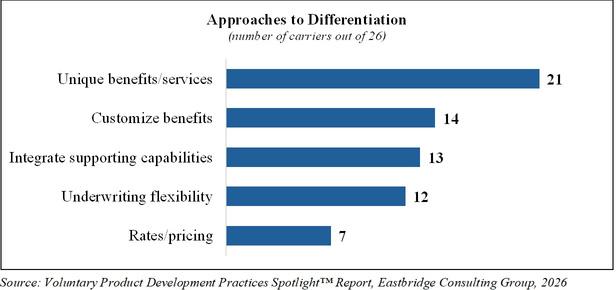
Many carriers rely on customized benefits or underwriting flexibility to differentiate their products, but the majority strive to offer unique benefits or services. In fact, innovation described as offering better or more valuable benefits to consumers or improving the customer experience is a top focus for most carriers when developing new products.
About half of these carriers say their focus on innovation has increased in recent years, thanks to growing competition and a quickly evolving market.
Carriers tap into a variety of sources for ideas on what to change or add to their products. Industry research tops the list, cited by every carrier surveyed. Internal competitive intelligence runs a close second, used by a strong majority of carriers. Interestingly, far fewer ask their own customers for input: A little more than half use customer surveys and fewer than half use customer focus groups.
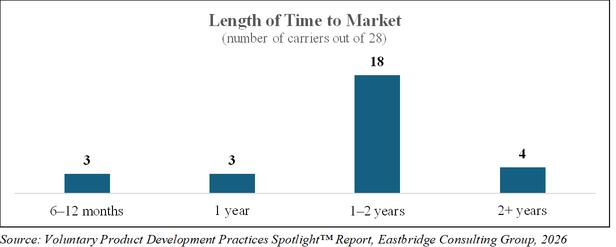
Innovation and differentiation may be the key buzzwords for product development, but it’s not a fast (or easy) process for most carriers. Most of those we surveyed say product updates take one to two years to get to market. A handful say they typically complete this process in a year or less, but several say it takes more than two years.
Accordingly, the product development cycle for most carriers generally involves updates or replacements every two to three years And these time frames haven’t changed over the last few years, despite the expanding role of technology throughout the industry In fact, some carriers report their reliance on technology has actually limited their product development efforts as they try to implement new administrative platforms Others mention greater emphasis on product integration and say their own technology capabilities influence product development
Aligning technology resources and capabilities isn’t the only potential stumbling block for carriers driving new products to market Regulatory changes are a concern for many carriers Other issues carriers frequently mention include the differences in rules by state, the pressure to balance pricing and rates with the need for profitability, and the fast pace of change in the market
What we ’ re seeing is that innovation hasn’t become easier it’s become more compressed,” says Danielle Lehman, Eastbridge Senior Consultant “Carriers are trying to differentiate at a time when technology, regulation and market expectations are all moving faster, which puts real pressure on how quickly products can move from idea to launch ”

Danielle Lehman Senior Consultant
Despite these challenges, carriers seem optimistic about increasing their ability to better meet customer needs and expectations Many carriers we surveyed see a trend toward broadening current benefits and a focus on making benefits easier to use for covered employees. Benefits carriers expect to expand include mental health, fertility, substance abuse and caregiver benefits. Some also mention the need for more flexibility in benefits. While some carriers may continue to pursue truly innovative products and services, others may find their path to success in building on what’s already in place.
Eastbridge is the source for research, experience, and advice for companies competing in the voluntary space and for those wishing to enter. For over 25 years, they have built the industry’s leading data warehouse and industry-specific consulting practice. Today, 20 of the 25 largest voluntary/worksite carriers are both consulting and research clients of Eastbridge.

By PES Benefits
Individual Coverage Health Reimbursement
Arrangements have gained traction as employers look for alternatives to traditional group health plans Much of the discussion has centered on cost predictability and compliance While those factors are important, they do not fully capture the opportunity ICHRA presents for brokers
At its core, ICHRA changes how benefits are selected and experienced That shift opens the door to a more intentional approach to voluntary benefit placement, one that aligns more closely with how employees' access and pay for care
Traditional group plans concentrate on decisionmaking at the employer level
ICHRA changes that by placing more responsibility on employees to select their own coverage
The Internal Revenue Service explains that ICHRAs “allow employers to reimburse employees for the cost of individual health insurance coverage and certain medical expenses on a tax-free basis” [1] This structure gives employers predictable costs while expanding choice for their employees
However, that increased choice introduces variability Employees are now navigating a broader individual market with different networks, pricing structures, and coverage limitations This shift creates a natural need for supplemental support
Individual market plans often come with higher deductibles and out-of-pocket exposure. According to the Kaiser Family Foundation, “deductibles in the individual market are generally higher than those in employer-sponsored plans,” which can lead to greater financial burden for enrollees [2].
These gaps become more apparent in realworld scenarios. Employees managing chronic conditions, unexpected hospital visits, or ongoing mental health needs, may face cost or access limitations that were less visible under group coverage.
In this environment, voluntary benefits take on a different role. They are no longer simply optional enhancements. They become a way to address specific financial and access gaps that individual plans do not fully cover.
Under a traditional group model, voluntary benefits are often positioned as complementary add-ons during enrollment. Participation can vary depending on communication and employee awareness.
With ICHRA, placement becomes more deliberate. Employees are already making individualized decisions about their core coverage. That moment creates an opportunity to introduce benefits that align with those choices.
For example, an employee selecting a highdeductible plan may benefit from accident or hospital indemnity coverage to offset unexpected expenses. Others may prioritize convenience and access, making virtual care services a practical complement.
Research from the Urban Institute supports this complexity, noting that “ consumers often have difficulty understanding plan options and cost-sharing features in the individual market” [3] This reinforces the need for structured guidance around both core coverage and supplemental benefits
For brokers, this is where the opportunity expands The conversation moves from offering products to building a coordinated benefits strategy that reflects how individuals actually use healthcare
As decision-making shifts to employees, education becomes more critical. Selecting individual coverage requires a level of understanding that many employees have not previously needed.
Without clear guidance, employees may prioritize premium cost without fully considering total cost exposure. They may also overlook how voluntary benefits can help manage financial risk.
Providing practical, scenario-based education can improve both plan selection and benefit utilization. Explaining how different coverage options work together helps employees make more informed decisions.
Education also supports stronger participation in voluntary benefits. When employees understand the role these products play, they are more likely to see value and enroll accordingly.
ICHRA introduces a new dynamic for brokers. Instead of focusing solely on employer-level plan placement, there is an opportunity to engage employees more directly.
This can lead to increased voluntary benefit participation, stronger client relationships, and a more diversified revenue model. It also positions brokers as advisors who understand how to navigate the shift from group to individual coverage.
As adoption continues, the brokers who succeed will be those who recognize that ICHRA is more than a funding mechanism It is a platform for more personalized, strategic benefit placement
The opportunity is not just in how benefits are funded, but in how they are structured and delivered.
Sources:
1.Internal Revenue Service. (2024). Individual Coverage Health Reimbursement Arrangements (ICHRA)
2 Kaiser Family Foundation (2024) Employer Health Benefits Survey
3 Urban Institute (2024) Individual Market Coverage and Consumer Decision-Making
PES Benefits is dedicated to revolutionizing the employee benefits landscape with cuttingedge technology, administration, education, and virtual care solutions. Since its inception, PES Benefits has focused on simplifying the benefits experience, making it more accessible and meaningful for all involved.

By David Hoxworth
ICHRA is coming into its own in today’s employee benefits marketplace Broker and employer interest and openness are now at a point where there’s no doubt that ICHRA is moving quickly toward being mainstream - if it’s not already
ICHRA is a type of employer-sponsored group health insurance with a very different underlying structure than traditional group health plans: ICHRA’s foundation is defined contribution, rather than defined benefit
The defined contribution basis of ICHRA means the starting point of the plan is the employer contribution, rather than the health insurance coverage
An ICHRA plan provides pre-tax employer contributions to the employees, who then use their those monthly contribution to purchase the individual health plan of their choice based on the plans available in their residence zip code
The individual health plans that are eligible for ICHRA are both off-exchange and onexchange ACA-qualified plans, as well as Medicare plans
Each employee will typically have some individual health plan options with a low outof-pocket premium for the employeesometimes even $0 out-of-pocket premiums –and they will also typically have individual plan options (with more robust coverage) that could entail significantly higher out-of-pocket premiums Any premiums beyond the employer contribution are the responsibility of the employee
In other words, the employees will sort out their coverage and budget needs in the individual health plan marketplace, and they will have an employer contribution to give them a certain level of buying power to start with
Since the whole thing is built on employer contributions, rather than on the specific coverage, the employer gains control and predictability over their health insurance budget. This is a game changer for the employer.
With ICHRA, the employer is no longer at the mercy of their health insurance carrier’s annual renewal premium increases. They are also not at the mercy of their employee population’s claims – their employees’ claims have no effect on the cost of ICHRA. The employer gets to set their contributions where it makes sense for them, based on what they want to accomplish. (One caveat: for Applicable Large Employers (ALEs), ACA Affordability rules apply, so there will be a minimum threshold required for the employer contributions - employers can set their spend at any point at or above that minimum.)
Individual health plans typically do experience rate increases each year – but because the individual health plan risk pools are massive, the typical annual renewal increase is in the single digits: 3-9% across the vast majority of geographies, in most years. It’s the most stable health insurance risk pool in the U.S., so the renewal increases are low and steady. Also, the individual plans are community rated, which means they are guaranteed issue plans, with no individual health underwriting.
That being said, it’s ultimately very important to emphasize that with ICHRA, the employer is NOT obligated to increase their contributions to keep pace with the individual health plan market rate increases – that’s just a reference point for the employer in making their decisions regarding their contributions No carrier is dictating their health insurance budget increase each year With ICHRA, the employer’s health insurance budget is firmly in the employer’s control
In addition to the defined contribution main feature, there are other strategic advantages that ICHRA brings to the table for employers (and brokers) Cost savings is a big one.
Beyond the budget control, stability, and predictability aspect of ICHRA that’s so key for employers, it’s also very common for employers that move to ICHRA to experience long-term savings – often very significant long-term savings
Approximately 40-50% of the time, that long term savings starts immediately, during the employer’s first year with ICHRA It’s not uncommon for employers with even a modestly sized employee population (for example, 100-300 employees) to experience hundreds of thousands or even millions of dollars in savings in their first year with ICHRA
Speaking of group size, there’s a myth out there that ICHRA is only for small groups; though it certainly can be an excellent solution for small employers, ICHRA actually provides more strategic advantages for larger groups.
In fact, ICHRA is steadily expanding upmarket, being embraced by larger and larger employers.
One major advantage of ICHRA that mainly comes into play with mid-sized and larger employers is that employers can offer it either to all of their benefit-eligible employees, or just to certain allowed employee classes within their overall employee population For example, full ICHRA takeovers are most common, but the second most common is a partial takeover offering ICHRA to all employees in specified states Using the allowed employee classes, employers can strategically tailor ICHRA to solve various challenges they are experiencing with their group health plan, either for their entire employee population or for part of it
The last ICHRA strategic advantage I’ll elaborate on is providing greater plan choice for the employees
With ICHRA, employers no longer need to invest time and energy into plan design or plan selection – that responsibility now shifts to each employee In most geographies, employees will have dozens of individual plans from multiple carriers to choose from, ranging from basic, inexpensive Bronze plans to robust, more expensive Gold plans - and everything in between
Many employee benefit advisors and human resource professionals assume that this amount of plan choice would be overwhelming for employees, and therefore a negative; it turns out that when surveyed after each ICHRA open enrollment, the overwhelming majority (consistently over 90%) of employees say that they strongly prefer having a wide range and a good number of plans to choose from, and that they were able to find a plan that they felt was a better match for their coverage and budget needs than they were previously able to with the group plan.
Something extremely important to mention about ICHRA: there are a lot of moving parts with ICHRA administration – plan modeling, implementation, employee enrollment in individual health plans, individual carrier payment management, customer support for the employees and their individual plans, compliance, and more - so the role of the ICHRA administrator is critical in determining the success of an employer’s ICHRA program
There are over 50 different ICHRA administrators in the market today, with varying service models and different types and levels of support, some actively partnering with the broker, employer, and employees to help navigate all those moving parts With all this in mind, the choice of the ICHRA administrator should be made thoughtfully and intentionally
OnemajoradvantageofICHRAthatmainly
comesintoplaywithmid-sizedandlarger employersisthatemployerscanofferit eithertoalloftheirbenefit-eligible employees,orjusttocertainallowed employeeclasseswithintheiroverall employeepopulation.
As a career VB pro now in the ICHRA space, I can also tell you that there’s plenty of opportunity to strategically position voluntary benefits with ICHRA.
Individual health plans provide coverage that is on par with group plans, but there’s one glaring exception to that, across almost all individual health plans: their out-of-pocket maximums are significantly higher. This means that there is more out-of-pocket exposure for the end users – employees and their families – and that’s concerning.
A great way for employers to address this higher out-of-pocket exposure for their employees is to make sure to offer supplemental health plans – hospital indemnity, accident, critical illness, cancer –and if at all possible, to do so on an employerpaid basis Employers that make the move to ICHRA are often doing so primarily because they are saving a significant amount of money; therefore, there are often some employer funds available for employer-paid supplemental health insurance
A particularly strategic subset of this ICHRA + supplemental health strategy for brokers: proactively offer ICHRA pre-packaged with supplemental health coverage In other words, don’t have the ICHRA conversation with the employer without including the supplemental health piece Present it as a package This shows you are being thoughtful about the big picture, and will differentiate you from the norm
As a way of supporting the ICHRA + supplemental health strategy, some ICHRA administrators are evolving toward being able to accommodate group supplemental health product offerings on the ICHRA enrollment platform, as well as ancillary products like dental and vision No doubt, other product lines like life and disability are also in the works
Another strategy that will strongly resonate with VB practitioners is positioning ICHRA and voluntary benefits together as a way for an employer to offer a very high level of personalization for each employee’s employee benefits – essentially, a “build your own benefits package” message This fits especially well with ICHRA, since in most situations employees will have dozens of individual health plans to choose from in their residence zip code
I want to mention one last idea to round out the ICHRA + VB strategy conversation: we all know how crucial employee engagement and employee education are for the success of VB enrollment and ongoing customer satisfaction – unsurprisingly, they are equally important with ICHRA Since making sure that the employee engagement and education component is strong for both ICHRA and VB is mission critical, you’ll need to make sure that the ICHRA administrator does this very well, or you’ll need to include robust education and communication methods along with 1:1 employee engagement for both, either by utilizing internal resources or by working with a strong employee engagement partner
ICHRA is well on its way to becoming a major player in the employee benefits space – and there’s no doubt that voluntary benefits will be a big part of IC
David Hoxworth, Business Development and National Accounts – Bavvy: David has been in the employee benefits business development game for 20 years, building a deep understanding of voluntary benefits in his time supporting brokers’ business with several VB carriers. Currently, David is in the ICHRA space, serving as Head of National Accounts for Milliman’s ICHRA administration service, Bavvy.

Helpemployeesrefreshtheir digitallivesandreduceeveryday cyberrisks.


Acleanerdigitallifecanalsobeasaferone.Byupdatingpasswords,removingunusedaccounts, andkeepingdevicescurrent,employeescanreduceexposuretocyberthreatsandfeelmore confidentnavigatingtheironlineworld
Startwiththesedigitalspringcleaningbasics
Updateoldpasswordsandenable multi-factorauthentication.

Reviewprivacysettingsandlimit whatʼspubliclyvisible.
Installthelatestupdatestoclose securitygaps.
Deleteoldaccountsandapps thatarenolongerneeded.
PartnerwithNortonLifeLockBenefitSolutionstohelpprotectyouremployeesʼidentities,devices andfinancialwell-beingyear-round

By Heather & Trevor Garbers
Despite widespread concern about aging and dependency, most Americans remain dangerously underprepared for long-term care (LTC) needs. Recent research from LIMRA highlights a significant disconnect between awareness and action, one that has serious implications for consumers, employers, advisors, and carriers alike.
LIMRA’s research paints a stark picture. While most consumers worry about becoming physically dependent on others, fewer than half have ever discussed long-term care planning with a financial professional.
This inaction persists even though the statistics are well known: a 65-year-old has roughly a 70% chance of needing some form of longterm care, yet only about 3% of Americans currently have LTC coverage. Compounding the issue, more than one-third of consumers worry about how they would pay for care if it became necessary
According to Neyer, procrastination is the single biggest barrier. “It’s an unpleasant topic, and it’s human nature to believe it won’t happen to you, ” he explains. Many consumers also don’t know how or when to get started, or they mistakenly assume that health insurance or Medicaid will cover long-term care services. Cost perceptions further stall action, with more than a quarter of consumers believing standalone LTC insurance is simply unaffordable.
While individual LTC adoption remains low, LIMRA is seeing encouraging signs of renewed activity in the workplace A recent LIMRA whitepaper titled Staging a Comeback suggests that the lack of preparedness has become too large to ignore Carriers and policymakers are paying closer attention, and the industry is adapting
Rather than relying solely on traditional standalone LTC products, carriers are increasingly offering newer-generation solutions, including hybrid and enhanced life insurance products with LTC or chronic illness riders These designs better reflect today’s consumer preferences while allowing carriers to manage risk more sustainably
The workplace, Neyer notes, is uniquely positioned to address LTC needs at scale “Individual agents often focus on affluent consumers, but the workplace is where we can reach everyday employees,” he says LIMRA’s research found that 11 of the 40 carriers surveyed are currently marketing some form of LTC solution in the workplace While the standalone LTC market remains small, most activity today centers on hybrid plans
The Policy Effect: Washington Cares as a Catalyst
State-level initiatives have also played a significant role in raising awareness. The Washington Cares Act, in particular, forced many consumers to confront long-term care planning for the first time.
TheWashingtonplaneliminated inertiabyrequiringpeopletoact
“The Washington plan eliminated inertia by requiring people to act,” Neyer explains. In 2021, LIMRA observed a surge in life insurance sales, both in the workplace and retail markets, as individuals purchased hybrid products to opt out of the mandate. While the state’s minimum benefits are likely insufficient for many, the program prompted consumers to further examine their need for protection.
Requiring all Washington residents to secure the mandated coverage levels, some opted to buy more robust solutions which better aligned with their true need for protection
Looking ahead, LIMRA expects continued momentum across carriers, employers, and employees
Carriers are increasingly motivated by the opportunity to fill a real market need. While not all carriers have entered the LTC space yet, many are actively exploring options or closely monitoring market developments. Neyer also points to gaps that still need attention, including solutions tailored for smaller employers and a deeper understanding of caregivers’ challenges.
Employers appear ready to engage. LIMRA research shows that 54% of employers expect their employees to be very interested in LTC benefits within five years. This rate compares favorably to some other well established benefit options. Employers feel that in five years ’ time, their workers will value long-term care as much as critical illness coverage and prioritize it ahead of hospital indemnity insurance. Employers are also expanding caregiving benefits and paid family and medical leave programs to support employees navigating care responsibilities.
Employees, meanwhile, are showing strong interest. More than two in five consider longterm care benefits very important, and LTC consistently ranks among the benefits with the highest unmet demand. LIMRA’s BEAT study also found that LTC benefits tend to have stronger persistency relative to several other types of workplace benefits.
For brokers and benefits advisors, Neyer believes the opportunity is clear. “Be a resource, ” he advises. That means understanding the evolving product landscape, helping employers design effective offerings, and clearing up employee misconceptions.
Education is critical. Advisors can help employers build communication strategies that explain why LTC matters and how it can be offered effectively. They can also help employees understand that long-term care coverage is significantly more affordable when purchased at a younger age.
If Neyer could leave the industry with one takeaway, it would be this: don’t repeat history. The LTC market saw rapid growth in the 1990s, followed by painful corrections as standalone products proved unsustainable
“The industry needs to focus on sustainable growth, not just capturing market share,” he says Carriers should not underestimate the workplace opportunity, especially as interest in bundled life and LTC solutions continues to grow Today’s workforce is uniquely positioned: Baby Boomers and Gen X employees face the most immediate needs, while Millennials many of whom have already experienced caregiving stress have the most to gain from planning early
The preparedness gap is real, but so is the opportunity With thoughtful product design, workplace engagement, and proactive education, the long-term care market may finally be poised for a more sustainable and inclusive future
Ron Neyer, Associate Research Director - LIMRA Workplace Benefits Research: is an experienced and highly respected research professional specializing in workplace insurance distribution and voluntary benefits trends
Since beginning a career with LIMRA and LOMA in 1998, he] has led research initiatives focused on market dynamics, carrier practices, compensation trends, and the evolving perspectives of employers, employees, brokers, and advisors across the U S and Canadian employee benefits markets


By Rob Quell
Health care costs continue to climb, and employers are feeling the pressure. Rising renewal rates, fewer carrier options in some markets, and growing uncertainty are forcing many businesses to rethink how they offer health benefits.
That’s why an Individual Coverage Health Reimbursement Arrangement, or ICHRA, is gaining traction.
With an ICHRA, employers set a defined contribution toward employees’ health insurance instead of sponsoring a traditional group plan Employees then choose individual health coverage that works best for them
This approach is appealing for several reasons: More predictable costs. Employers choose, with compliant guidance, how much to contribute, which can help them manage budgets and reduce exposure to large annual renewal increases.
Greater employee choice. Instead of a onesize-fits-all group plan, employees can select coverage based on their needs, providers, and location.
A growing alternative. As some carriers scale back or exit certain small and midsize group markets, ICHRA offers another path to offering coverage.
Interest is strong, even among employers who do not currently offer health benefits. Many are looking for an option that balances cost control with flexibility for their workforce.
Many employees choose lower-premium individual plans to manage monthly costs, which can mean higher out-of-pocket expenses when care is needed.
That creates a natural opportunity for supplemental benefits.
Voluntary benefits can help employees manage expenses that individual medical plans may not fully cover, while allowing employers to maintain a controlled, predictable contribution strategy. When paired thoughtfully, ICHRA and supplemental benefits can work together to deliver both affordability and protection.
Employers are looking for new ways to provide meaningful, flexible benefits, and brokers are exploring strategies that better align with evolving workforce needs. As healthcare costs and employee expectations continue to shift, ICHRA is becoming an increasingly important part of the broader benefits conversation.
Whether you are just beginning to explore ICHRA, supporting employers currently utilizing these models, or evaluating how supplemental benefits can complement individual coverage strategies, understanding the opportunities, challenges, and long-term implications is essential for making informed decisions in a changing benefits landscape.
Rob Quell, Vice President, Broker and Special Market Development Colonial Life: is responsible for leading Colonial Life's broker distribution strategy team, national broker partnerships, ICHRA solutions team, and resources specializing in key industry segments such as the public sector. Rob has been with Unum and Colonial Life for 16 years and has held various roles in Large Employer Sales, Enrollment Technology, IT Portfolio Management, Underwriting, and Claims


By Steve Clabaugh, CLU, ChFC
Relationalleadersdemonstratethattheycarefortheirteammembersasmuchasthe organization.Asaresult,theycreate,buildandleadhigh-performanceteamsthat consistentlyachieveexcellence.
“Breakitdown Dothenextthing Momentumbeatsperfection” -Unknown
On our journey through the 6 principles of Championship Team Behavior, we ’ ve so far covered:
1 We Work Together as Colleagues;
2 We Don’t Accept Case Building When Planning or Executing Business Plans;
3 We Don’t Tolerate Blaming
This month we’ll examine principle #4.
Principle 4: We Deal with Breakdowns, Not Problems
One of the most important responsibilities of a leader is to protect the team from outside obstacles that can disrupt the team's ability to work together as a high-performance team.
Aproblemneedstobedealtwithby theleader,thuskeepingtheteam’s focusontheirgoals.
Relational leaders define a “problem” as an external obstacle or challenge to the team’s mission that must be addressed and resolved by the manager/leader. A problem can be caused by a particular individual’s malfeasance or incompetence internally or outside the organization. The individual may be someone the team has to interact with, or they may be a member of the team. Either way, a problem needs to be dealt with by the leader (quickly and fairly) thus keeping the team’s focus on their goals.
An employee or vendor who engages in behavior that is inappropriate at the workplace is a problem An employee stealing company property or from fellow employees (which can even happen in the employee break room) is a problem A purchasing agent taking kickbacks to award purchases to a specific vendor is a problem These, and many other problems, are the responsibility of the leader and generally not the team
When something goes wrong within a team’s work or process it is considered a “breakdown in the process ” and not a problem In this case, it is important to locate where in the process the breakdown occurred and what steps need to be taken to correct the cause of the breakdown This is done in a matter of fact, non-accusatory way without resorting to blaming Once the breakdown is identified and located, the team has the responsibility to develop changes and improvements to eliminate, or at least mitigate, the breakdown
Identify the Symptoms:
Frequent stops in the assembly line machine.
Delays in the production schedule. Increased downtime and reduced productivity.
When do the machine stops occur (time of day, frequency, etc.)?
Do the machine operators and maintenance staff have any observations or ideas?
(talking to the people who actually use the equipment is often overlooked)
Review maintenance logs and historical performance.
Contact the manufacturer for information about other users ’ experiences.
Analyze the Problem:
Conduct a root cause analysis using tools like the "5 Whys ”
Example using the "5 Whys":
Why did the machine stop? → Because the conveyor belt jammed
Why did the conveyor belt jam? → Because there was a misalignment in the belt
Why was there a misalignment in the belt?
→ Because the belt tension was incorrect
Why was the belt tension incorrect? →
Because the tension settings were not properly adjusted after maintenance
Why were the tension settings not properly adjusted? → Because there was no standardized procedure for adjusting the belt tension after maintenance
Consider the example of an auto parts manufacturing plant that is experiencing chronic significant delays in production due to a recurring malfunction in one of their assembly line machines. The machine frequently stops in the middle of a production run, causing a bottleneck in the production process and leading to missed delivery deadlines.
4
Standardize the maintenance procedure to include specific steps for adjusting the belt tension.
Train maintenance staff on the new procedure.
Create a checklist to ensure all steps are followed during maintenance.
Schedule regular audits to ensure compliance with the new procedure.
5 6
Track the performance of the machine after implementing the solution
Monitor for any recurrence of the problem
Gather feedback from machine operators and maintenance staff
Use the insights gained to see if there are ways to improve other parts of the production process.
Encourage a culture of continuous improvement by regularly reviewing and updating procedures for this and other equipment.
Recognize important contributions from team members contributing to the improvement results.
This type of approach, rather than resorting to case building or blaming is more likely to achieve a positive outcome After implementing the standardized maintenance procedure and training staff, the frequency of machine stops decrease significantly The production process becomes more reliable, supporting timely deliveries and increased overall productivity Regular audits ensured that the new procedures are followed consistently, preventing similar issues in the future
Resolving a breakdown involves a systematic approach with the entire team: identifying symptoms, gathering data, analyzing the problem, developing and implementing a solution, monitoring results, and continuously improving the process This method ensures that the root cause is addressed, and future occurrences are prevented, leading to a more efficient and reliable process Here, again, is another instance where valuable leadership training skills can be identified, taught, encouraged and enhanced And working together to understand and successfully overcome the breakdown can contribute a great deal to building stronger working relationships among the members of the team
Making the commitment to having the team deal with breakdowns and not problems, along with the three prior principles, enables the successful practice of the 5 principle “We Say the Unsaids,” which we will examine next

Deloitte’s 2025 “Human Capital Trends Report” found that 88% of organizations recognize leadership as a major driver of business results They also found, based on research from nearly 10,000 businesses and extensive interviews with HR leaders from 93 companies, that only 13% are confident in their development programs
This report is available online and I would encourage you to read it To me, the most powerful conclusion based on their research is stated:
“Organizations that successfully increase the capacity of workers to grow personally, use their imaginations and think deeply are: 1 8 times more likely to report better financial results; 1 4 times more likely to say they are creating broad value for customers, community and society; 1 6 times more likely to say they provide workers with meaningful work ”
It has been said that one of the quickest ways to business success is to find a need and fill it For those in the voluntary benefits industry, here is a clear need and, we believe, Relational Leadership Experience is an effective way to meet that need for your clients If you have questions or would like to find out more, feel free to contact me
Steve Clabaugh, CLU, ChFC - started his career in insurance as a Field Agent, moving on to Sales Manager, General Manager, Regional Manager, Vice President, Senior Vice President, and President/CEO. A long time student of professional leadership, Steve created the Relational Leadership program that has been used to train home office, field sales associates, mid-level managers, and senior vice presidents.