2 Summer 2021
Table of Contents
The Volante
TABLE OF CONTENTS
Volume 145, No. 24 Summer Issue 2021 www.volanteonline.com
NEWS 4 — A Year in Review 6 — USD’s COVID-19 Response 7 — Morse’s Farm Market 8 — Communication with masks 9 — Professors prep for fall OPINION 10 — Editorial: Dear Class of `21 11 — Pugs are an absolute disaster VERVE 12 — A Year in Review 14 — Spectrum Drag Show 15 — Northern Plains Indian Artist in Residence 16 — Fine Arts looks forward 17 — Valiant Vineyards SPORTS 18 — A Year in Review 20 — Athletes create FOMENO 21 — “More normal” fall 22 — Fighting stress, anxiety 23 — Leadership from a former walk-on
Al Neuharth Media Center 555 N. Dakota St. University of South Dakota Vermillion, SD 57069 Adviser Kyle Miller
Bailey Zubke editor-in-chief
Madilyn Sindelar managing editor
Jacob Forster news editor
Maddi Kallsen news assistant
Chloe Fullenkamp news designer
Rachel Pechous verve editor
Bennett Clary verve assistant
Alle Anduaga verve designer
Tyler Boyle sports editor
Sydney Johnson sports assistant
Jessie Schneiderman sports designer
Emma Daggett opinion editor
Lauren Johnson opinion designer
Peyton Beyers photo editor
Leah Dusterhoft visual director
Rachel Thompson visual assistant
Miles Amende copy editor
DeAndre Hill social media director
Kaitlyn Kumm social media assistant
Cecilia Gillen advertising manager
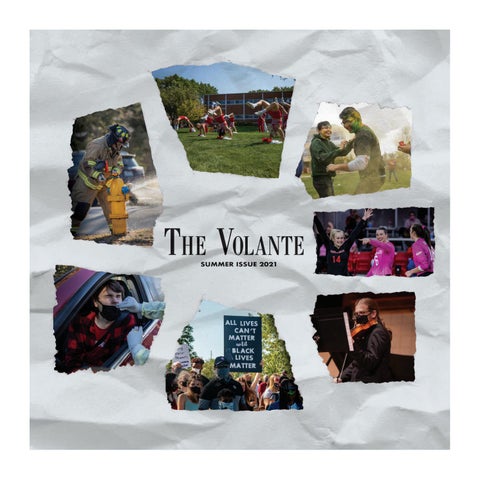
Cover design by Rachel Thompson, Cover photos by Peyton Beyers
The Volante Mission statement The Volante covers issues relevant and interesting to USD students. Faculty, staff and community members are welcome readers, but the newspaper is written and presented for a diverse community of students from the students’ point of view. The paper should provide a variety of information, entertainment and educational opportunities for the readers. The Volante encourages
everyone to write letters to the editor. The Volante wishes to be viewed by students as respectable, objective, accurate, fair and trustworthy. If you have comments, concerns or questions, please contact The Volante at 677-5494. The Volante is distributed Wednesdays during the academic year free of charge locally with the cost of $1 for each additional copy. One year subscription rates are $40, which solely covers the
mailing costs. The Volante does not endorse, promote or encourage the purchase or sale of any production service advertised in this paper. Advertisements are the sole responsibility of the advertiser. The Volante disclaims all liability for any damage suffered as the result of any advertisement in this newspaper. The Volante reserves the right to refuse any advertising.
volanteonline.com
Letters
Summer 2021 3
Letter From The Editor-In-Chief: A Thank You Bailey Zubke
Bailey.Zubke@coyotes.usd.edu
When COVID-19 wiped out the remainder of the 2020 spring semester, we all had a hope that things would return to normal in the fall. A hope that, as a collective, we would be able to beat this virus and be back in-person by August. When we returned to campus in August, things weren’t ‘normal,’ but one thing that didn’t change was The Volante’s dedication to providing the students of USD with a voice and a fresh new newspaper each
week. Despite staff members going in and out of quarantine, The Volante didn’t miss an issue. The Volante found new ways to bring you the coverage it has provided USD and the Vermillion community since 1887. I can’t say thank you enough to each of our staff members who poured everything they had into the countless Zoom interviews, socially distanced meetings and hours spent writing stories each week. I can’t thank our editors enough for making sure there was enough content to fill our 10-page issue each week, and our designers, who spend their Tuesdays bringing the paper
to life with their creative page designs. Most of all, thank you, our loyal readers. Without all of you, who pick up an issue of The Volante every week, none of this is possible. We are beyond blessed to have a campus that supports their student newspaper the way the USD community supports us. I am blessed to be the Editor-in-Chief of this great paper, but our work is not done. The Volante continues to be a voice for all students, and we hope you continue to support us in our mission to provide USD with all of the news, sports, arts and entertainment coverage we can.
Peyton Beyers | The Volante
2021 Spring semester executive staff. Top row (from left to right): Peyton Beyers, Bailey Zubke, Lauren Johnson, Madilyn Sindelar, Jacob Forster. Middle row (from left to right): Rachel Pechous, Rachel Thompson, Kaitlyn Kumm, Leah Dusterhoft, Emma Daggett. Bottom row (from left to right): Sydney Johnson, Chloe Fullenkamp, Alle Anduaga, Bennett Clary, Maddi Kallsen. Not pictured: Miles Amende, Dre Hill, Jessie Schneiderman.
News
4 Summer 2021
A Year in Review
CWC marches for Black Lives Matters USD’s Cultural Wellness Coalition hosted the Justice for Black Lives march on campus. The group, formed in the fall 2020 semester, held the march to protest police violence. The march was part of a nationwide wave of marches, rallies and demonstrations in the months following the murder of George Floyd by then-officer of the Minneapolis Police Department Derek Chauvin, who was eventually convicted for his role in Floyd’s death.
AUGUST
The Volante
2020 - 2021
Unprecedented 2020 election
2020 was a pandemic year, but also an election year. U.S. President Joe Biden was elected on Nov. 3, becoming the first candidate to defeat an incumbent president in 28 years and the eleventh overall. The election was marked by an increase in mail-in voting, in South Dakota increasing by nearly five times from 2016. Rep. Dusty Johnson and Sen. Mike Rounds were re-elected by large margins, as well as an initiated measure to legalize medical marijuana and an amendment to legalize recreational marijuana passing. The amendment was later delayed due to court challenges.
SEPTEMBER
OCTOBER
NOVEMBER
DECEMBER
Charlie’s Cupboard grand opening Charlie’s Cupboard, a student-run food pantry, opened September of 2020. The organization, founded by USD students Carson Zubke and Hannah Booth, provides food and personal hygiene products for all USD students. While initially unable to implement the planned “client choice” model due to COVID-19 restrictions, the cupboard is planning on implementing that model in the fall semester. In its first year, Charlie’s Cupboard served over 1,200 students.
Revitalization efforts of IAIS USD President Sheila Gestring began efforts to revitalize the Institute of American Indian Studies on campus after funding issues in 2008. The institute focuses on the collection of oral histories and establishing relationships with tribal nations in South Dakota.
News
volanteonline.com
Summer 2021 5
Board of Regents announces “normal” fall semester
Willson Florist preps for Valentine’s Day Willson Florist co-owners Emily and Aaron Sudbeck prepared for Valentine’s Day 2021, the busiest time of the year for the Vermillion flower shop. The florist created hundreds of bouquets and gifts for their customers this holiday season.
JANUARY
FEBRUARY
South Dakota’s Board of Regents announced intentions for a “normal” fall semester in March of 2021. The USD campus’s 2020-21 academic year was marked by distanced learning, in addition to fully online Zoom classes and mask-wearing on campus. The fall semester of 2021, however, is intended as a return to pre-COVID-19 operation.
MARCH
APRIL
Health Sciences building groundbreaking USD broke ground on a new health sciences building late in March 2021. The building, whose construction involves the demolition of Julian Hall, was sponsored in the state legislature by Sen. Arthur Rusch, who represents Clay and Turner Counties in the South Dakota state senate. The project will cost $20 million and is projected to be completed in August 2022.
MAY
Trans rights in South Dakota The Transformation Project led marches across the state of South Dakota, including onein Vermillion, to protest South Dakota’s House Bill 1217, which would have prohibited transgender women from participating in women’s sports in the state. The bill, intended to affect all public schools including colleges in the state, was later returned to the legislature by Gov. Kristi Noem with a “style and form revision” asking for changes before being signed into law. The legislature and governor were unable to come to an agreement, and the bill failed to become law.
Leah Dusterhoft | The Volante
Vaccine made available to South Dakotans 16 and up The state of South Dakota’s guidelines opened up vaccination to all residents 16 and up on April 5, 2021. As of print, South Dakota had given at least one vaccine dose to over 325,000 of its residents, amounting to 54% of the adult population.
The Volante News COVID-19 on campus: looking back, looking forward 6 Summer 2021
Jacob Forster
Jacob.R.Forster@coyotes.usd.edu
The tide may be turning on the COVID-19 pandemic in the United States, with a decline in new cases nationally and regionally and with South Dakota’s Board of Regents seeking a more “normal” fall semester on USD’s campus. In response to this, USD student organizations, Vermillion businesses and local government leaders are looking to bring back what they said has been lost in the past year. The local response to the pandemic over the past year has been driven largely by the USD administration and the Vermillion City Council. Kevin O’Kelley, assistant vice president of research compliance at USD and member of USD’s COVID-19 Task Force, said the university’s response over the past year was guided by CDC guidelines and student health. “It was just learning as we went,” O’Kelley said. “We had to wing it a few times.” USD’s initial response to the outbreak of COVID-19 in the US was to extend the 2020 spring break. O’Kelley said the university decided not to bring students back after spring break of 2020 because the administration didn’t feel they could adapt on-campus learning to new CDC guidelines in such a short time. “We didn’t have the resources to bring it back safely last spring, so we spent the entire summer getting ready,” O’Kelley said. Preparing for the fall semester involved reducing seating capacity in the Muenster University Center and moving classes to either larger rooms or online. USD President Sheila Gestring said the challenges of the past year were mainly about trying to maintain traditions and ways to connect students on campus despite of the pandemic. “I think we’ve done a nice job. I’m proud of the campus community, students, faculty, staff,” Gestring said. “Everybody chipped in to give the best in-person experience possible for the students.”
USD “proud” of teamwork on campus
O’Kelley said he’s most proud of the teamwork by groups on USD’s campus in responding to COVID-19, including USD’s Student Government Association, volunteers, the medical school and USD’s marketing and communications departments. “I’d say that our efforts were successful in
that we were able to stay in school all last year,” O’Kelley said. “We had some unexpected numbers of cases last year, last August, but we were prepared enough that we were able to stay in school.” Those preparations included isolation rooms for students who tested positive and contact tracing. “Housing brought (students in isolation) turkey dinner on Thanksgiving, you know, they really stepped up,” O’Kelley said. From the experiences of the past year, O’Kelley said the university has learned what resources are available from the state as well as what measures do and do not help to reduce transmission of COVID-19. “This is our first pandemic, so we had a lot to learn,” O’Kelley said. “We learned to put science first and accept the consequences, even though that’s not what we wanted. We did not want to postpone football, we did not want to cancel the concert, we didn’t want to do any of that.” Gestring said she believes a positive of the past year is that the university was able to work together with other partners in the region to make sure students could remain on campus and progress toward their degrees. “I think if there’s a silver lining to the pandemic at all, it’s that we saw the USD campus community come together. The community of Vermillion, the alumni, donors, faculty, staff, friends of the university, the Board of Regents, the legislature, the Governor, the congressional delegation, everyone came together with a common goal and we were able to accomplish that goal,” Gestring said. “And I just couldn’t be more pleased in a world that oftentimes seems a little bit polarized when it came to this pandemic, there seemed to be a lot of unity.” O’Kelley said the most difficult part of the past year has been learning how to teach classes remotely, as well as understanding how to best communicate risks to young people on campus. “I’m not a healthcare professional, and if I was I would know that 18-year-olds are not as risk averse as a 60-year-old,” O’Kelley said. “So that was a difficult part, getting to understand that
young college students are not as risk-averse as old-timers.” In retrospect, Gestring said the university should not have adjusted the fall semester to remove breaks, which she said caused extra stress for faculty, staff and students. “Having a periodic break is really important to an individual’s mental health, particularly during a pandemic that can add a level of stress,” Gestring said.
USD student organizations prepare for a “normal” semester
USD student organizations were less able to hold in-person meetings and events over the past year at USD. Laura Anderton, director of Sorority and Fraternity Life at USD, said the issues for Greek Life have been the ways in which COVID-19 makes their central mission more difficult. “Fraternities and sororities are social organizations at their roots,” Anderton said. “Having restrictions on the number of people that you can have at an event and the way that we interact with each other, having to wear face masks, having to social distance, having to use hand sanitizer all the time … made it hard to be as social as fraternities and sororities really intend to be.” Anderton said she’s proud of the leadership students in Greek Life have taken over the past year.
Read more about USD’s COVID-19 response. volanteonline.com
Correction:
In the article “Vermillion mayoral election sees five candidates” of the April 21 issue, The Volante mistakenly reported one of the mayoral candidate’s names. Aaron Kerkhove is referred to as Charles on first reference in the article. Aaron Kerkhove is running in the 2021 election for mayor. The Volante regrets this error.
Summer 2021 7 News Morse’s Farm Market brings local flavor to produce volanteonline.com
Jacob Forster
Jacob.R.Forster@coyotes.usd.edu
Morse’s Farm Market, tucked away on Dakota St. on the outskirts of Vermillion, is a smaller operation than the competing Vermillion Area Farmer’s Market, but one that’s been a part of the community for generations. Mitchell Morse, the proprietor and sole operator of the market, has been working at the farmer’s market since he was a small child. The market has been passed through his family for five generations, he said, as far back as the 1890s. “We used to raise about 60 acres of produce,” Morse said. “And I suppose I started working when I was about six or seven years old.” Operating a farmer’s market largely alone, Morse said, can be a challenge. Morse makes produce deliveries without someone watching the market. This, he said, means he could miss customers. Regular customers at the market, however, know how to self-serve. “(Customers) know what the prices are. I leave a price sheet,” Morse said. “They pick out what they want, weigh their stuff, leave the money and go.” In addition to running Morse’s Farm Market, Morse is a custodian at USD’s Beacom Hall, and also sells flowers and Christmas trees seasonally. Morse supplies the seeds for much of his produce to a Hutterite family who raises it for him. Morse then brings the produce back into Vermillion and sells it at his market. The produce he offers varies by season. “We start out in the spring with seeds and plants, and then we go into vegetables —You know, sweet corn, tomatoes, onions and potatoes,” Morse said. “Pumpkin season is the next big season, and then starting about the 20 of November the Christmas trees come in.” Morse said COVID-19 impacted various areas of his business in different ways. Flower sales increased, but he was unable to supply produce to schools due to a decrease in in-person education. “It was a very good year (for flowers) because everybody was stuck at home and they were planting gardens or wanted flower beds,” Morse said. “The downturn was that I lost out on about $5,000 worth of business (because) I provide produce for schools.” In order to maintain a customer base, Morse said it’s important to provide personal service and to guarantee produce. This means that customers should know they’ll get the quality they’re paying
Jacob Forster | The Volante
Morse’s Farm Market has been supplying Vermillion community members with fresh fruits and veggies for three decades. Mitchell Morse said he has been working at the farmer’s market since he was a child. for. “If you get something that don’t taste good, don’t bring it back, just let us know,” Morse said. This time of year is pumpkin season, and Morse said a lot of families bring in young children to get pumpkins for jack-o’-lanterns and want to take pictures at the market. “I say, of course, you take all the pictures you want, because it might be their child’s first pumpkin,” Morse said. “What people say is a
stem sells a pumpkin more than anything.” Steve Mayer, director of USD’s Wellness Center, is a regular customer at Morse’s market. He said the market has reasonable prices and Morse is a friendly face. “Obviously, it’s a long-standing business in Vermillion,” Mayer said. “And it’s just a good place to go to get produce that’s local and right out of the ground.”
The Volante News ‘The eyes say a lot’: Masks change communication between students, faculty 8 Summer 2021
Tyler Boyle
Tyler.Boyle@coyotes.usd.edu
With new procedures and precautions on USD’s campus, wearing a mask at all times in an indoor setting for professors and students has caused communication in the classroom to be different than previous years. Lori Costello, assistant professor of strategic communication, said mask-wearing, muffled voices and a lack of face recognition has been obstacles during class. Costello said wearing a face shield instead of a cloth mask has benefited her ability to communicate while adhering to USD COVID-19 guidelines. “Recently I purchased a face shield and I’ve been wearing it instead of a mask,” Costello said. “I think it’s better for the students who have an easier time understanding me when they can read my lips.” Communication differences due to mask-wearing and social distancing have caused more technology use in the classroom, Kevin Reins, associate professor of mathematics education, said. Additional technology use can cause different problems, Reins said. “Technology in the classroom has had more of an impact on my ability to convey certain messages, or in my case, provide active learning experiences and class discussions in mathematics,” Reins said. “When a student in a face-to-face class shares, Zoom students are incapable of picking up their voices.” Costello said despite challenges like these, the precautions USD is taking, like wearing masks and communicating more with technology, is worth the challenge. “In times when I might get frustrated about the masks, all I have to do is go online and read about what’s happening with the virus, and then it doesn’t seem like such an inconvenience,” Costello said. “I don’t want to get sick, and I certainly don’t want my students to get sick either, so I think wearing the masks is the best protection we have in the classroom.” Costello said she believes positive changes in strategic communication have arisen due to the new guidelines. One of these aspects, Costello said, has been able to learn to communicate and
Leah Dusterhoft | The Volante read students’ eyes more. “The eyes say a lot, and I can usually tell if a student is smiling even when I can’t see their lips because I can see it in their eyes,” Costello said. “I can usually tell if someone is confused, and
if I pick up on that, then I might try to continue to explain a concept or provide an additional example.”
volanteonline.com
News
Summer 2021 9
USD professors prepare for fall semester Maddi Kallsen
Maddilynn.Kallsen@coyotes.usd.edu
Just like students, USD professors have adapted to the changing year, involving hybrid and distanced instruction as the pandemic has played out, and are preparing to return to a normal semester next fall. Lori Costello, assistant professor, said this past year has been tough. These past two and a half semesters, more students have come seeking help with mental health issues than any other time, including when she taught as a graduate student, Costello said. Along with this year being tough, Costello said the year has been a learning experience. “Change is constant; we all have to adapt to change. It’s good for us. Even as professors, we are growing and changing just like the students are growing and changing,” Costello said. Katie Kassin, assistant professor and physician’s assistant, said she’s excited to go back to normal next semester. “I think there’s going to be challenges. I’m excited to get back to relatively normal and then incorporate in a little bit of what we learn from the pandemic,” Kassin said. Todd Mechling, media and journalism instructor, said that video production classes can’t be taught online. “Spring of last year was the most difficult, it got better in the fall but the hybrid classes were not my favorite. And then it got better,” Mechling said. “Spring worked out and I was pretty proud the students did a lot of it on their own.” Kassin said the USD campus had to adapt to changes in instruction and the campus experience. “I think we just really found out how resilient we are. We can roll with the punches, we can be thrown a curveball and we can adjust to that,” Kassin said. “It occurred really really quickly. And not only us as faculty but the students too. They were put into a situation where all of a sudden things change, and they really made the most of it as well.” Kassin said there are a lot of ways to utilize Zoom in the future for class and for medicine. “One of the great things that we found about the Zoom is we can practice telemedicine,” Kassin said. Along with Kassin, Elizabeth Manser Payne, assistant professor of marketing, said they will be utilizing some of the technologies used during the pandemic. “I plan to keep exams on D2L with a lockdown browser and webcam. I like the flexibility of offering
Peyton Beyers | The Volante
Media and journalism instuctor, Todd Mechling, stands behind a plastic screen and wears a face shield as he teaches class. Mechling said some of the classes he teaches are difficult to conduct online. students an extended time period to take an exam. I think it helps students to plan their study and exam time better. This can help to reduce stress and to better demonstrate their knowledge,” Payne said. Student organizations are now able to do more and more as students and faculty members get vaccinated. “I’m fully vaccinated now, so I feel more comfortable taking off the mask in fall. Normal means that student organizations can travel to conferences and be more active on campus,”
Payne said. Costello said communication plays a key role in education, and the course the pandemic has taken has required that communication to adapt. “We’ve learned a lot about communications this past year and how we all communicate over social media, in person and in the classroom” Costello said. “It’s so important to be part of the group and in class to really get all that you can out of it and learn as much as you can.”
Opinion
10 Summer 2021
The Volante
EDITORIAL
Rachel Thompson I The Volante
Dear Class of 2021, Nothing about your senior year was normal. COVID-19 changed so much of the way the school and world operates, but you did it, and if this last year has taught us anything, it’s that we can overcome anything. For the last year, it has been a world of adapting to a new normal. COVID-19 changed everything about the celebration of your senior year. You deserved one more Dakota Days
celebration, one more football game, one more play, one final farewell. And while you will have a graduation ceremony this May, things still won’t feel the same. Despite all that COVID-19 has affected, each of you has become a stronger person for it, and no one will be able to take what you are about to do away from you. You are graduating college during a pandemic.
You are the next class of leaders in the community, and the resiliency you showed through a pandemic- riddled senior year to finish strong makes you all the better. The pandemic is still here, we are still battling COVID-19 every day, but that is no reason to hang your head. When you receive that paper, walk across that stage, start working your dream job or continue into graduate studies, celebrate. Celebrate
everything you went through to get to this point and rejoice that you have made it to where you are today. The Vermillion and USD community is behind you. You spent your senior year helping ‘Protect the Pack,’ now go out into the world and make that same pack proud. Once a Yote, always a Yote.
Deciding on a major or minor? Decision made!
Media & Journalism Sport Marketing & Media Social Media Marketing Contact: mj@usd.edu
Opinion
volanteonline.com
Summer 2021 11
Pugs are an absolute disaster EMMA DAGGETT is a first-year majoring in English.
because of their bug eyes, which
THE STUDENTS’ VOICE SINCE 1887
never seem to close. Someone
EDITORIAL BOARD
mentioned to me that their pug’s eye popped out of its head. I am not
In ancient times, pugs were bred to be companions of Chinese emperors. Pugs are royalty. How could you refuse to love their royal highnesses? Pugs are so cute. They have squishy faces, bug eyes and curly tails. Plus, they are tiny and have floppy ears. Whenever I see a pug, I really want to give them a hug and squish their wrinkly cheeks. All their wrinkles make them look like little old people. All of the reasons for cuteness are why they have so many health issues. They make so many loud breathing noises. My friend once referred to their noises as sounding like a child trying to learn how to drink out of a cup. Dogs don’t really sweat. They have to pant to cool themselves off. Pugs can’t do this because of their squished face. This makes it easy for a pug to overheat. They also get eye infections a lot
The Volante Bailey Zubke, editor-in-chief
Tyler Boyle, sports editor
Madilyn Sindelar, managing editor
Rachel Pechous, verve editor
surprised, because the majority of the eye seems to already be falling out. Almost every pug I have seen is built like a barrel. They are so round. Pugs do not like long walks and just stop when they don’t want to continue. If you aren’t careful, pugs can become overweight very quickly, which just leads to even more health issues. Right now, so many people are being urged to stop buying pugs because they have so many health issues. I want a pug really bad, but I know I couldn’t handle all of
Emma Daggett, opinion editor
CONTACT US The Volante welcomes letters to the editor in regards to campus, local, state and national issues. Letters will be edited for clarity and length and will be printed as space allows. Please limit letters to 300 words or fewer. The Volante reserves the right to hold letters for publication in a later issue. Submissions must include the author’s name, address, telephone number, year in school and major or job title. Letters must be exclusively for The Volante. We will not publish anonymous letters. Send letters to: Al Neuharth Media Center 555 N. Dakota St. Vermillion, S.D. 57069 Fax to: 605.677.5105 Email to: volante@coyotes.usd.edu Via our website: volanteonline.com The deadline for letters is 5 p.m. the Friday prior to publication. Letters must be typed and fewer than 300 words.
the health issues that come with the squishy dog. I must resist the cuteness because it’s what’s harming them.
OVERHEARDS
Here you’ll find the weirdest, funniest and stupidest things we’ve heard during the week. Context is for suckers.
“It doesn’t feel like...actually, you know, I can’t even feel time anymore.” — MUC
“I could never move to Massachusetts, just cause I couldn’t spell it.” — Neuharth
“Excel makes me horny.” — Elm Street
Verve
12 Summer 2021
The Volante
A Year in Review: Diversity Events LGBTQ Spectrum, ICARE and Women, Gender and Sexuality Studies worked to bring LGBTQ history to USD in October, which is LGBTQ History Month. The groups created events and activities to educate students and shed light on the history of the LGBTQ community. ICARE also promoted healthy relationships for all sexualities but especially LGBTQ relationships, both platonic and romantic.
August
September October November December
Senior Art Shows Before graduating in December 2020, six senior art majors showcased their artwork showcased for USD students, staff and faculty. The showcase titled “Here//Gone” consisted of different sections belonging to each artist showcasing things like business promoting and the feeling of waking up on a cozy morning, which included 14 digital illustrations.
Verve
volanteonline.com
Summer 2021 13
Bougie Berries In January 2021, cheerleaders Asiah Jackson, Aliyah Jackson and Kayla Saleem started Bougie Berries. The company sells handmade chocolate covered strawberries to customers in South Dakota, Iowa and Nebraska. Orders are made the same day of the scheduled pickup. Their pricing is five classic strawberries for $8, nine classic or customized strawberries for $15 and 12 classic or customized strawberries for $20. Customers can order through their Instagram, @ bougie_berries_.
January
February
Festival of Nations The International Club hosted its biggest annual event, the Festival of Nations, on March 21. Seating was limited to 100 people due to COVID-19. Festival of Nations serves to embody what the International Club stands for by advocating for international students and spreading awareness of different cultures. They offered food from local restaurants like Silk Road, Café Brule and Hot Plate. They presented prerecordings of past performances.
March
April
Vintage Store In April Vermillion welcomed a new store with a unique style. Nostalgia Vintage and Wellness is a store downtown that sells vintage clothes, pressed juices, vinyl records and even more. The store was started by owner Mattea Scott who was inspired by her time in Southern California and how people can be free to express yourself themselves judgement there. The pressed juices sold at the store are also from a company based in California called Pressed Juicery.
May Anthropology The USD Anthropology and Sociology Department hosts an annual field school opportunity that digs into the history that lies along the Missouri River. The third annual Susan Tuve Archaeology Field School is hosted from May 17 to July 11 for USD students who can also receive up to four academic credits for their transcripts.
Ruby Ball The Union of African American Students (UAAS) hosted their third Annual Ruby Ball March 27. Some of the proceeds from the event went towards Dakotathon. Café Louisiana, a Cajun restaurant in Yankton, catered the event. The Ruby Ball did not have a dance floor and seating was limited to 100 people due to COVID-19. There were live performances by students. This was an opportunity for the UAAS to connect and reach out to more students on campus.
14 Summer 2021
Verve
Rachel Thompson | The Volante
SeniThe Drag Show was hosted by USD’s Spectrum: Gender and Sexuality Alliance on April 24.
The Volante
Rachel Thompson | The Volante
The show featured around a dozen drag preformers in Aalfs Auditorium.
Spectrum hosts Drag Show to celebrate LGBTQ culture Chloe Fullenkamp
Chloe.Fullenkamp@coyotes.usd.edu
USD’s Spectrum: Gender and Sexuality Alliance pulled out all the stops for this year’s Pride Week. From April 19 through the 24, Spectrum hosted a gamut of events at USD such as bingo, movies and the annual drag show. President of Spectrum Isabel Young said because of COVID-19, last year’s festivities were canceled, so Spectrum went above and beyond this year. “Because of COVID-19, last year’s pride week was cancelled and our yearly trip was postponed, so we decided for this Pride Week to go all out, and we made this year one to remember,” Young said.
Hosted in Aalfs Auditorium on April 24, the drag show featured about a dozen performers as they put on a show for students and community members. “Everyone loves to let go and have a fun time, and a drag show is the epitome of that, “Young said, “The queens and kings put so much work and passion into their performance, and the energy they give off.” The Drag Show featured lip syncs, dancing and extravagant fashion. The show is held annually and Young said it is an important part of the LGBTQ community at USD. “Pride Week for me is showing those on and off campus that there is a space where they can be free to live authentically, and that they’re not alone,”
Young said. Andelin Flewelling and Megan Nemmers were in attendance at the show and said it was the first time that they ever had the chance to see drag performers. “This is the first time we have ever been to a drag show and we were really excited about coming to this new opportunity,” Nemmers said. Young said South Dakota doesn’t offer many drag shows which is why it is important for Spectrum to host the show on campus. “For many people in South Dakota, they don’t have a space where they can safely be proud of themselves and they may have never had access to a space or group of people that told them that
they were good enough just the way they were,” Young said. For Young and Spectrum, Pride Week celebrates LGBTQ culture and gives LGBTQ youth a chance to celebrate who they are. “I really appreciate that this week hands the microphone to LGBT+ people so that they can talk about their own experiences, unlike normal where the mainstream heterosexual-cisgender world gets to dictate our own narratives,” Young said. As the school comes to an end, Spectrum plans to continue hosting their Pride Week and celebrating LGBTQ culture at USD in the coming years.
volanteonline.com
Verve
Summer 2021 15
Northern Plains Indian Artist in Residence brings culture to Vermillion community Alle Anduaga
Alle.Anduaga@coyotes.usd.edu
Alle Anduaga | The Volante
“Eu’nkičhetupi,” meaning “to come back to life” or “to be restored” in Lakota, is the first part of the mural.
Alle Anduaga | The Volante The second part of the mural is titled “Wanáȟča,” meaning “to bloom” or “flowers that bloom” in Lakota.
The University of South Dakota Art Galleries announced the 2021 Northern Plains Indian Artist in Residence (NPIAR) to be USD alumnus Reyna Hernandez, member of Yankton Sioux tribe. The NPIAR is part of the USD Contemporary Native Arts Program. The NPIAR program supports emerging and mid-career Native artists with integrating new media and technologies with traditional Native arts practices, history and culture. The NPIAR program compensates the artists for their time and research, which is really important, Hernandez said. Hernandez’s residency will involve a collaboration with her mother, Claire Packard, who has displayed her arts across the country and abroad. “The program is allowing me to explore the concept of working with my mom and seeing what we could create together and how our voices will work together,” Hernandez said. During Hernandez’s residency she plans to incorporate her oil painting skills in collaboration with her mother’s star quilts to create installation artwork. “I think installation artwork is really powerful,” Hernandez said. “I feel like I’m getting some insight into somebody else’s experience like they’re trying to recreate an experience or just create an experience for the people who are entering that space.” Installation artwork allows people to make connections with each other in a way that isn’t through a verbal language but through a visual language, or one that’s about your senses, Hernandez said. Hernandez hopes young indigenous people are able to feel seen through her artwork in a way that doesn’t involve trauma or reductive trails of what indigenous life is like. “The power of representation and what we can do as artists is such a meaningful and unique thing that we’re able to offer to our youth,” Hernandez said. “That you’re allowed
to explore these spaces of identity without being tethered to one reductive narrative.” Indigenous artists as well as Amber Hansen, USD assistant art professor, joined Hernandez in May 2020 for the completion of the two-part mural design located downtown Vermillion. The first part of the mural is titled “Eu’nkičhetupi,” meaning “to come back to life” or “to be restored” in Lakota. Hernandez said this mural was inspired by the community talk about the flooding occurring in the Midwest in 2019. “This
idea
of
powerlessness
kept coming up but also the ability to overcome that, so like triumph over adversity,” Hernandez said. “We started to connect the idea of resilience and triumph over adversity to indigenous people being so strong and able to overcome a lot of horrible things.” The second part of the mural is titled “Wanáȟča,” meaning “to bloom” or “flowers that bloom” in Lakota. This part of the mural was completed during the beginning stages of the pandemic and it really spoke to the very thing they had set out to do to begin with, Hernandez said. “With the pandemic, people were making real connections with one another based on the fact that nobody knew what to do and nobody had
answers,”
Hernandez
said.
“We saw that parallel there and we really wanted to be able to engage that—it was a healing kind of thing for everybody, for the artists and the community.”
Verve
16 Summer 2021
The Volante
Due to COVID-19, USD Chamber Singers had to reduce the number of students from 40 to 32.
Alle Anduaga | The Volante
Fine Arts prepares a return to a “normal” semester Bennett Clary
Bennett.Clary@coyotes.usd.edu
The Fine Arts building has seen many changes during the last year due to COVID19—changes such as smaller ensembles, livestreamed performances and limited audiences. Before COVID-19, Bruce Kelley, dean of the College of Fine Arts, said the building was lively and had frequent performances. Although the departments have tried to continue with performances, Kelley said audiences were the biggest challenge.
“The biggest change was that we had to limit or eliminate audiences, which was a fundamental change in how art happened,” Kelley said. Classes had to be changed to accommodate fewer students while still following social distancing guidelines. Kelley said teachers got creative with how classes and practices were held by being in different rooms or being online. “In ceramics, in a normal year, all the pottery wheels are just kind of lined up next to each other,” Kelley said. “Well, the professor, Michael Hill, had to just look at the room and say ‘Okay, each wheel has to be six
feet away from the next one.’ We had to do the same thing with the room where drawing is taught, they have easels that they use so we had to make sure that there was room for each of the easels to be six feet apart.” Dr. David Holdhusen, the chair of the music department and the director of choral activities, said the teachers will decide what worked specifically for their classes during the pandemic and if those are worth bringing into a normal school environment for next year. “I think our emphasis on excellence on artistic excellence is going to stay the same as it always has,” Kelley said. “I think
the two things that we’re most likely to keep are some type of streaming and the music in the park concert that happened in October.” Returning to normal is what Holdhusen wants, but he said teachers are going to have to find a level they are comfortable with when teaching. He said this will be more of a mental game than anything since the last year has been spent focused on COVID-19. “I think it’s more about finding a comfort level in returning to these more traditional teachings,” Holdhusen said. “I think the majority of what we were doing
was preparing for this year, and I feel like almost on a weekly basis there were things that were changing and that we were trying to adjust and we were adjusting to the science. We were adjusting to the COVID numbers on campus.” Although the college plan on going back to normal next year, they will still follow the regulations of other professional organizations. They will continue to monitor the situation and make decisions based on data to keep students safe.
volatneonline.com
Verve
Summer 2021 17
‘A hobby that got out of hand’: Valiant Vineyards shares Vermillion history through wine Lexi Kerzman
Lexi.Kerzman@coyotes.usd.edu
In 1993, Eldon and Sherry Nygaard moved to the farm Eldon Nygaard grew up on, near Viborg, South Dakota. The farm consists of mainly hay, soybeans and corn. However, two acres of their farm is dedicated to grapes. The couple later decided they wanted to open a winery, but at that time, South Dakota had no legislation to support building a winery. So the couple decided to draft the farm winery bill. This bill, which eventually turned into a law, allows South Dakota farmers to make up to fifty thousand gallons of wine annually. The bill was made into law in 1996. That same year, Valiant Vineyards opened—making it the first established winery in South Dakota. Now, Valiant Vineyards is a full winery and bed and breakfast located near the Missouri River in Vermillion. “It was a hobby that got out of hand,” Eldon Nygaard said. Sherry Nygaard is originally from California. Because of this, Eldon Nygaard said the couple traveled to California to visit family and friends often. Through their visits, they realized the acreage price to grow grapes was much cheaper in South Dakota. In California, acreage was sold for around $1800 Eldon Nygaard said, while in South Dakota land was sold at around $500. “I saw how valuable it was. So, I came back and I didn’t know anything about it,” Eldon Nygaard said. “Many people have bent over backward to help us.” Valiant Vineyard makes wine, bourbon, whiskey and vodka. One of their more unique wines, Vitis Riparia—made of wild grapes grown by the river that are native to South Dakota—is sold in Paris, France for around $100 a bottle. Eldon Nygaard said he enjoys experimenting with new flavors and combinations for wines. One he is currently working on is wild grape wine that is being aged in a Jack Daniels barrel. This, he said, will give the wine an interesting whiskey flavor. “Wine connoisseurs like to try different things, so we try different experiments,” Eldon Nygaard said. “That experiment is going to be an expensive wine. We will probably sell it in a smaller bottle for around
$38.” Valiant Vineyards is a family business. Sherry Nygaard is one of the cooks at the vineyards and their son is their winemaker and distiller. “(Our son) started when he was like 13,” Eldon Nygaard said. “And our daughter was involved when she wasn’t in college or (traveling). It can be a challenge (working with your family). We live together and we work together. But it’s fun.” Having a bed and breakfast and winery, Eldon Nygaard said, gives a different dimension to Vermillion. Each room in the bed and breakfast has a unique theme — one of them being USD themed. Eldon Nygaard said this makes it more than just a hotel, it’s an experience. “It’s brought a little recognition to Vermillion. Besides the university, it is also home of the oldest winery in South Dakota,” Eldon Nygaard said. “I think we brought up a little notoriety and tourism to the city and the state.” In March 2020, Valiant Vineyard switched from making wine to making hand sanitizer while the demand was too high, Eldon Nygaard said, for big companies to keep up with. Now, they have switched back to making wine, but Eldon Nygaard said they were happy to help the state keep up with the high demand and need. The vineyard was able to sell their homemade hand sanitizer to keep up business while they had to have their doors closed for 10 weeks. “We just did as much as we could, we worked seven days a week,” Eldon Nygaard said. “We at one point had up to 300 orders for hand sanitizer a day.” Now, Valiant Vineyards is open again for business with safety regulations in place to keep customers and employees safe, Eldon Nygaard said. The reopening process was slow. At first, Eldon Nygaard said, they only opened on Sundays for their Bloody Mary Sunday special, but now they are fully open. His favorite part of owning Valiant Vineyards, Eldon Nygaard said, is making wine people want to share. He said people come from all over the country and the world and visit their winery and bring bottles home to share with their communities. “It’s a pride in making a wine people enjoy enough to come back and talk about or send home,” Eldon Nygaard said. “I never really quite envision this large of a production.”
Lexi Kerzman | The Volante
Valiant Vineyards makes wine, bourban, whiskey and vodka.
Lexi Kerzman | The Volante
Clay Turner is Valient Vineyard’s specialty bourbon whiskey made from corn, rye and wheat grown in Turner County and fermented, distilled and bottled in Clay County.
18 Summer 2021
Summit League Delay
Sports
Fall sports at USD were postponed until the winter or spring due to COVID-19. Volleyball and soccer had their schedules cut down to little or no non-conference season and schedules were made to limit travel. Both volleyball and soccer made their conference tournaments in the spring season.
AUGUST
The Volante
Coyote men start conference season 9-0
After a rough non-conference slate, the Coyote men’s basketball team started the conference season with nine straight victories, including a Feb. 5 victory against South Dakota State, the first win in Frost Arena since 2000 for the men’s basketball team. The Coyote men finished second the in the conference and lost in the Summit League semifinals to North Dakota State.
SEPTEMBER
OCTOBER
NOVEMBER
DECEMBER
Extra year of eligibility Winter sports joined spring and fall athletes in being eligible for an extra year of competition to allow for students to opt out of the season for COVID-19 concerns if they so chose. Three women’s basketball seniors, one senior volleyball player and other athletes elected to take the extra year of eligibility to compete again during the 2021-22 year.
Coyotes defeat No. 7 Illinois State
After the fall football season moved to the spring and the team had their season opener postponed, the Coyote football team won its season opener against No. 7 Illinois State 27-20 Feb. 27. True freshman quarterback Carson Camp started in his first career game for the Coyotes, and the Coyote defense forced seven Illinois State turnovers. The Coyotes finished the season 1-3 after having their final four games canceled due to COVID-19 precautions.
Sports
volanteonline.com
Summit League Champs
Zach Anderson Olympic Trial jump
Entering the Summit League Tournament as the third seed, the Coyote volleyball team rallied to win two five set matches and the conference title April 3. The Coyotes defeated Denver in the championship game after falling behind two sets in the match. The Coyotes won their second conference championship (2018) and made their second trip to the NCAA Tournament. The Coyotes lost to No. 25 Missouri in the first round of the NCAA Tournament in Omaha April 14.
JANUARY
FEBRUARY
Summit League Champs
The Coyote women’s basketball team won its second straight Summit League Championship, defeating Omaha 66-43 in the championship game March 9. The title is the third in USD history, and gave the Coyotes their third trip to the NCAA Tournament. The Coyotes fell to Oregon in the first round of the NCAA Tournament 67-47 March 22.
MARCH
Soccer qualifies for second Summit League tournament
After an unprecedented spring season, the Coyotes ended the regular season with six straight win, all shutouts to take fourth in the conference and make it to the school’s second Summit League Tournament. The Coyotes fell to conference champion Denver 2-0 in the first round of the tournament.
Summer 2021 19
Competing in the South Dakota Challenge April 10, Coyote senior high jumper Zach Anderson cleared 7-5 on his first attempt to qualify for the Olympic Trials this summer. The jump tied him for the lead in the NCAA, and broke the school record and complex record, both of which he owned previously.
APRIL
MAY
Men’s swim and dive win conference title For the first time in school history, the Coyote men’s swim and dive teams won the conference title. The Coyotes unseated Denver, who has won the conference title seven times. The threeday event in Fargo, North Dakota saw the Coyote men compile 915.5 points to take the title. Coach Jason Mahowald won Men’s Coach of the Year in the conference.
20 Summer 2021
USD athletes create new company; Fomeno, Win $100,000
Sports
The Volante
Sydney Johnson
Sydney.G.Johnson@coyotes.usd.edu
A sustainable business plan that earned three USD students $100,000 was inspired by a t-shirt in the middle of Monte Verde, Costa Rica. USD student athletes Payton Ryz (Ryz writes opinion articles for The Volante) and Brigit Blote, along with USD alumnus Ashlynn Atwood, created a sustainable business centered around the idea of recycling clothes, which they named “Fomeno”. Their business plan won them $100,000 as a part of the Hult Prize. Fomeno was one of 11 teams that won the award internationally. Fomeno is an online platform that allows people to thrift in one easy-to-use place that will connect users to the multitude of online thrifting options that are out there. While Blote was away on a study abroad trip to Costa Rica, the idea for Fomeno came to fruition. In Monte Verde, Costa Rica, many of the students rewore their favorite outfits multiple times, and one of Blote’s friends had a shirt from Brandy Melville that had forget-menot flowers on it. After seeing it day after day, Blote really wanted the shirt. Once back in the U.S., Blote tried looking online for a thrifted version of the shirt because she knew that the company that made the shirt wasn’t very environmentally friendly. “When I got back to the U.S. I jumped online and typed in ‘forget-me-not T-shirt,’” Blote said. “I started finding a bunch on secondhand shops, but there were so many different sizes, shirt prices and different qualities, and I thought, ‘why isn’t there an easier way to
Submitted Photo | The Volante
Hult prize winners Brigit Blote, Payton Ryz and Ashlynn Atwood started Fomeno, a sustainable business centered around recycling clothes, from an idea started during a study abroad trip in Costa Rica. streamline this?’” After Blote explained her new idea to her friends Ryz and Atwood, they also discovered that their business idea fit well with the 2020 Hult Prize challenge. The Hult Prize is a sustainable business competition for students that is globally every year. The winners of the Hult Prize receive $100,000 to put toward their business. Every year, the Hult Prize creates a theme that coincides with the United Nations sustainability goals. The year that Fomeno entered the competition, the theme was to create a sustainable business that impacts the planet in a positive way with every dollar earned. In December of 2019, Fomeno placed first at USD’s Hult Prize Competition. After winning at the university level, the group made their way to Boston, Massachusetts in March of 2020 for the regional level competition where they also placed first and found themselves representing the United States in the World Hult Prize Accelerator. Now that Fomeno has received $100,000 from winning the Hult Prize Global
Competition, the next steps are to work on the app and website to get the company out to the public as soon as possible, Ryz said. Fomeno is also looking to add more individuals to their team that share in their passion for thrifting and fashion by hiring fashion influencers to model clothing to be shared on the app and website upon launch. Ryz, Blote and Atwood have all found themselves drawn to shopping sustainably, which is why Fomeno has become an outlet for them to share this love with others who also want to help the planet, Atwood said. “All of us are very driven towards sustainability, especially within the fashion industry,” Blote said. “The fashion industry is the second dirtiest industry in the world. There are a lot of unethical practices that go on within fashion and there’s so much need for change within the industry. Anytime this gets overwhelming or exhausting, I think about how the end goal is so worth it. There’s so much value, it’s not like ‘oh let’s make an app,’ no it’s ‘let’s find ways to decrease textile waste and play into the circular economy and create something in tech that ultimately does good.”
volanteonline.com
Sports
Summer 2021 21
Coyote fall sports focus on a ‘more normal’ fall
File Photo | The Volante The Coyote fall sports regain their composure and look forward to a ‘more normal’ fall season after a hectic 2021 spring schedule. Many sports saw their most successful seasons during the unconventional year; these teams hope to maintain the success in the coming year. Madilyn Sindelar
Madilyn.Sindelar@coyotes.usd.edu
The Coyotes NCAA fall sports like football, soccer and volleyball underwent a year of confusion and success and now face their shortest off-season schedule yet. After the Summit Leagues announcement to postpone fall sports last August, athletes shifted from preseason training to offseason training of eight hours of practice a week. Normally these sports would be in full competition season with practice, travel, film and team bonding. However, because of the start date being unknown for fall sports in the middle of the pandemic, the student-athletes became mostly students. They adjusted their schedules last-minute to accommodate them for a heavier fall load instead of a light one and shifted their focus on a lighter course load second semester in the hopes of a full slate of spring competition. When the announcement was made that winter sports would continue with a conference only schedule, fall sports were
given the clarity they needed to begin training full time and work toward building their condensed conference only matchups as well. These matchups were back to back in one location. However, volleyball and soccer had some of their most successful seasons yet. Volleyball won the Summit League conference title and received an automatic bid to the NCAA Volleyball Championship in Omaha where they lost to Missouri in the first round. Coyote soccer saw one of their most successful seasons in recent history and they made it as No. 4 seed into the Summit League Conference Tournament. However the Coyotes fell to Denver in the first round. Coyote football, which plays in the Missouri Valley Football Conference, played four games in the spring, where they beat Illinois State. The other three games resulted in Coyote losses and the rest of the season was canceled due to COVID-19. Coyote athletes now look ahead to the upcoming fall season ready to compete in normal conditions.
“I’m honestly just ready to get back into working out,” Abby Ostrem, soccer defensive player, said. “I’m not dreading the fact that I have a short turnaround before my last season because I feel like no season is ever promised. So I’m kind of just excited.” The women’s soccer team faced a season of forming team chemistry on the field instead of off the field like they normally would, Ostrem said. “We weren’t allowed to have any kind of team bonding,” Ostrem said. “We were just able to get to know each other on the field and bond on the field and through the phone basically was kind of all we had. And so I think with the new girls coming in, it’s just gonna be easier.” Similar to the soccer team, Coyote football’s Jakari Starling looks forward to being able to do team activities again during summer and fall training. “We go bowling and have team dinners and it’s always really fun to get to know the guys outside of practice,” Starling said.
22 Summer 2021
Sports
The Volante
‘It is okay not to be okay’: USD helps student-athletes combat stress and anxiety Tyler Boyle
Tyler.Boyle@coyotes.usd.edu
Student-athletes at USD have faced many unforseen changes this year due to the COVID-19 pandemic. As a result, USD’s athletic department is trying to help athletes handle the stress and anxiety that can come along with these changes. Jenna Uher, an athletic trainer for the Coyotes, said this year the trainers have focused on helping student athletes with their mental health in addition to their physical health. “Unfortunately, I don’t think athletes were prepared for how so much change would make them feel because we’ve never had something like this before,” Uher said. “(Student-athletes) are used to having their schedule, they’re used to having their routine, but now it’s been turned upside down and that’s been hard for everyone.” According to a study by the NCAA done in May, a majority of student athletes reported higher levels of stress and anxiety since the beginning of the pandemic. Uher said the trainers recognize these feelings among their athletes and want to focus on making sure athletes understand it’s okay to feel this way. “One phrase we always stick with and try to express is ‘It’s okay not to be okay,’” Uher said. “I think they just need to know someone else believes it’s okay not to be okay as well and they usually will open up about it, which is really important.” Jason Mahowald, the head swim and dive coach at USD, said one strategy he has taken to help his athletes handle change is to have a team group read. “As a team, we read a book at the beginning of the year—Who Moved My Cheese—and it basically talks about being able to adapt to change.” Mahowald said. “We talked a ton to
our kids about being able to adapt to change, because we knew this year would have a lot of it.” One of the hardest things about all of these changes, Uher said, is when athletes have to go into quarantine. She said getting back into shape after 14 days of no practices sometimes frustrates the athletes whether they were sick with the virus or not. Becky Jensen, an athletic-academic advisor at USD, said she also believes quarantining has been really hard on athletes. Jensen said not having face-to-face communication with anyone is hard in itself. “I know one student who has been quarantined three different times and has been quarantined for a total of 42 days, and he has never had the virus himself,” Jensen said. “I don’t know how that couldn’t have an affect on anyone’s psyche.” Mahowald said he has been impressed by his athletes willingness to help their teammates who are in quarantine. He said many of their athletes will get groceries, make goodie baskets and Facetime quarantined student-athletes. Mahowald said his staff has tried to keep his athletes who have been quarantined connected with the team as best they can. “We’ve been able to livestream our intrasquad meets so the kids not there can still see their teammates competing and still feel like a part of the team,” Mahowald said. “Sometimes we send them some movies that the coach thinks are good on Netflix and they quickly respond by saying I’m old and we don’t have the same taste in movies, but we try our best.” Jensen said changes in teaching styles have also played a role in contributing to more stress and anxiety for athletes. “Some students are in online classes that I would have never put in an online class because they don’t learn as well and they see
their grades suffer because of that,” Jensen said. “It creates a lot of anxiety because they are not learning as well as they normally do.” Jensen said because of this the university has made it a priority to make sure students are given resources to reduce stress and anxiety as much as possible. She said the university has a tutoring program and a peer mentorship program which helps a lot of students academically. In addition, Jensen said most studentathletes take a class in their first year on campus that has a day when a mental health professional comes in to talk to the students about stress and mental health resources provided to them at USD. Uher and Jensen said they have both used the mental health services the university provides for students such as the Cook House, Therapy Assistance Online (TAO) and the Psychological Service Center. “I know the counseling center has seen more people than they have ever before,” Jensen said. “I think that is a good and a bad thing, because obviously we want to have our kids as happy as possible here, but if things aren’t going well we have the resources that can help with that.” Uher said she is glad athletes’ mental health has been an issue talked about more in the media and by professional athletes. Uher said she hopes this will lead to athletes knowing it’s okay not to be okay and the most important thing to do is to find someone to talk about it with. “There has been a lot of stigmas in the past that athletes have to be tough and not talk about their feelings, but we now know that talking about it is actually super important,” Uher said. “I want to make sure athletes know we care and help with their health on the field or court but also their mental health too.”
volanteonline.com
Sports
Hard work, leadership drives former walk-on Bailey Zubke
Bailey.Zubke@coyotes.usd.edu
When Tasos Kamateros decided to leave his home country of Greece to walk-on for the USD men’s basketball team, he knew he would have to work to earn his spot, so he put in the work. “He (USD assistant coach Gameli Ahelegbe) basically made me realize that when I come here, I have to work harder than everybody else if I want to achieve something and have a spot on the team,” Kamateros said. “But he was very honest with what I need to do and what I need to improve on to get better and help the team.” Kamateros, a sophomore business major, was given a scholarship after being a walkon athlete who was mostly used for scout team work in practices. He averaged just six minutes per game during his freshman season, but Kamateros said he will never forget receiving his scholarship. “I lost my words. I was so happy,” Kamateros said. “I was expecting it and I wasn’t expecting it at the same time. When I got the message from Coach Lee that he wants to meet with me at his office, I was like okay, maybe he wants to say something different, like maybe he doesn’t say anything about the scholarship. But then he told me about it and I was so happy I called my parents immediately. I was like ‘hey dad, hey mom, like I got a scholarship.’ It’s one of those moments that I’m never going to forget.” Kamateros was brought in knowing that the Coyotes would be looking for a potential
starting big man following Tyler Hagedorn’s graduation after the 2020 season. To prepare for the opportunity to play more, Kamateros said he worked on his conditioning and athleticism. Kamateros and Ahelegbe work out twice a week at 8 a.m., working on individual skills around the basket and building up his shot. Ahelegbe said while the number may not show it, Kamateros can shoot extremely well from distance, something that showed on his visit day. “I will never forget on that visit, he came and I can’t remember who we played that day, but we had a film session,” Ahelegbe recalled. “And so he came to watch our game…. I remember he asked if he could shoot during the film session and I was like ‘yeah you can shoot, it’s not a problem at all.’ I didn’t think anything of it. And so during our film session, he was in there shooting. And then after the film session Sam (a student manager) came up to me and was like ‘gee, that kid can really shoot it.’ I’m like ‘really?’ and he said ‘yeah he’s drilling threes’ I’m like, ‘that’s good to know.’” Kamateros said his mindset has always been focused on how he can help his team win. He said he knew he wouldn’t be playing 20 or more minutes a night, but wanted to make an impact regardless. Kamateros’s season high in minutes last season was 17 against a non-division I opponent in Peru State. Kamateros started this season out on the bench, but after five games, the Coyote coaching staff
Summer 2021 23
Peyton Beyers | The Volante
USD walk-on Tasos Kamateros began this season sitting on the bench, but after putting in work with an assistant coach, Kamateros found his way to the court. noticed how much smoother the offense ran with Kamateros on the floor and inserted him into the starting lineup. Kamateros averaged 19.3 minutes per game, totaling 6.9 points and 4.4 rebounds per game. Ahelegbe said his leadership has also been a huge factor for the Coyotes this season. He scored a career high 22 points Feb. 28 against North Dakota State. “He’s a guy that brings people together,” Ahelegbe said. “Energy is infectious, super positive, teamfirst type of guy. And so it shows, like, we are sitting here talking about how we need him to shoot the ball more, but that kind of goes to his character, where it’s never about Tasos, it’s moreso ‘what do I need to do to help the team?’ Do I need to cheer more guys up, do
I need to talk to players? He’s all about the team and making sure everyone’s in the right state of mind and just bringing a positive energy each and every day.” Coming from Greece to South Dakota is a large commitment, one that Ahelegbe said is not easy, but he is proud of Kamateros and his work. “We’re just super proud that he’s in our program. I think he has a real bright, bright future in our program,” Ahelegbe said. “He’s gonna be a guy who’s gonna help us win a ton of games and I’m just really excited for what he has to bring to the USD community, and so we’re just glad he’s a part and I want nothing but the best for that guy. He’s a true definition of what being a Coyote is all about as far as being a student athlete.”
Have questions?
WE’VE GOT ANSWERS
Get them at Coyote One Stop: https://link.usd.edu/onestop ACTIVATE YOUR
USD ACCOUNT Your account gives you access to
• Office 365 • Self Service • D2L • Wireless • Email
https://link.usd.edu/account
JOIN OUR TEAM
WE ARE HIRING! Information Technology Services is now accepting applications for the 2021–2022 school year. Apply today at
https://www.usd.edu/acpc/coyote-careers
Stay connected with FREE WiFi
CONNECT TO
EDUROAM
Connect your laptop
https://link.usd.edu/wireless
USD SELLS LENOVO LAPTOPS directly to students, faculty and staff https://link.usd.edu/buylaptop Flexible Payment Options: Credit Card • Coyote Cash • Check STUDENTS: Add to bill FACULTY/STAFF: Payroll Deduction