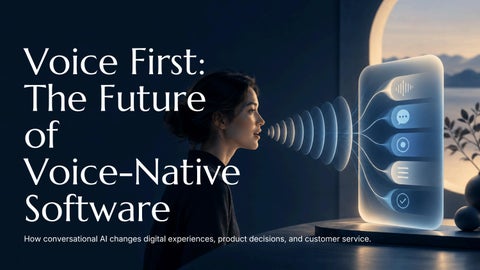
Voice First: The Future of Voice-Native Software How conversational AI changes digital experiences, product decisions, and customer service.
THE SHIFT
Voice First technology turns interface labor into conversation Voice First describes a shift from clicks, taps, menus, and forms toward software that understands how people naturally ask, clarify, decide, and act. Use Voice First technology as the primary topic link, not as a repeated keyword.
What should software do when the best interface is simply asking?
WHY NOW
Why conversational interfaces matter now People bring goals, context, corrections, and follow-up questions to every interaction.
Goals
Context
Start with the outcome, not the screen.
Keep the thread across turns.
Corrections
Follow-up
Make changing course feel natural.
Let the next question refine the work.
Voice can reduce interface labor: the work of navigating screens so people can focus on outcomes. Conversational AI makes software more adaptive, not merely more verbal.
BEYOND COMMANDS
Voice-native software is more than voice commands Ask whether the system can sustain a useful conversation instead of turning a button flow into a spoken script. voice-native software · voice user interface · natural language interaction
Context & memory
Clarification
Know what has already been said and what matters now.
Ask the smallest useful question when intent is unclear.
Permissions
Graceful recovery
Make authority and boundaries explicit before acting.
Explain uncertainty and make correction easy.
FROM INTENT TO ACTION
Conversational AI connects intent to action 1. Listen: capture speech and the user’s goal 2. Understand: parse natural language into structured intent 3. Reason: use context, memory, and permissions 4. Act: call tools, complete work, or ask a focused clarification 5. Recover: explain uncertainty and make correction easy
Link the concept naturally with conversational AI.
Listen
Understand
Reason
Act
CUSTOMER SERVICE
Conversational AI for customer service should remove friction Resolve common questions without forcing customers through rigid menus. Carry context across turns so customers do not repeat themselves. Escalate with a clear summary when a human needs to step in. Explore conversational AI for customer service as a broader approach to helpful support.
VOICE THE RIGHT HANDOFF
Voice is powerful, but hybrid experiences win where visuals matter Design the handoff between voice and screen instead of treating them as competing channels.
When attention is elsewhere Hands-busy moments Eyes-busy moments Exploration and emotional sensitivity
SCREEN
When information needs shape Dense comparison Editing and confirmation Scanning and review
HYBRID BY DESIGN Let voice start the task, let the screen make the state visible, and let either channel hand control back cleanly.
THE SYSTEM BEHIND THE EXPERIENCE
The operating model behind a voice-first experience Voice-native software depends on the whole loop, not a single speech layer. Anchor the technical explanation with voice-native software.
SEARCH STRATEGY
SEO and AEO keyword strategy for Voice First Use each phrase where it answers a real reader question: definition, value, implementation, or use case.
PRIMARY KEYWORD
Voice First SECONDARY
RELATED
Voice First technology
Topic cluster
Conversational AI Conversational AI for customer service
Voice-native software · voice user interface · natural language interaction · AI customer support · voice-enabled applications
INTERNAL LINKING
Build topical authority with useful, natural internal links TOPIC
CONCEPT
USE CASE
Voice First technology
conversational AI
conversational AI for customer service
Place links beside the claim they support, vary anchor text naturally, and avoid repeating the same link in every paragraph. All three links lead to voicefirst.ai.