




Taking the Island’s products straight to the world
Stephanie L. López >WJOURNAL
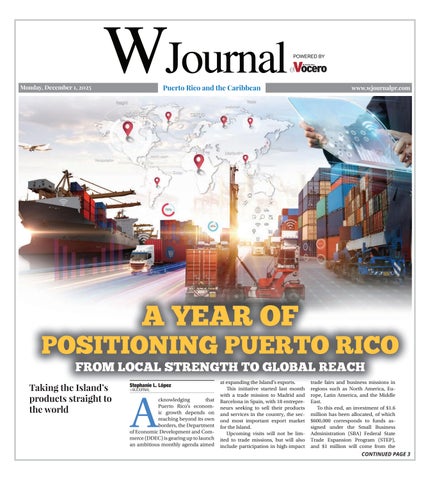
Acknowledging that Puerto Rico’s economic growth depends on reaching beyond its own borders, the Department of Economic Development and Commerce (DDEC) is gearing up to launch an ambitious monthly agenda aimed
at expanding the Island’s exports. is initiative started last month with a trade mission to Madrid and Barcelona in Spain, with 18 entrepreneurs seeking to sell their products and services in the country, the second most important export market for the Island.
Upcoming visits will not be limited to trade missions, but will also include participation in high-impact
trade fairs and business missions in regions such as North America, Europe, Latin America, and the Middle East.
To this end, an investment of $1.6 million has been allocated, of which $600,000 corresponds to funds assigned under the Small Business Administration (SBA) Federal State Trade Expansion Program (STEP), and $1 million will come from the


Tand hope. The return to print of the News Journal has an emphasis on the W in the word “news,” as in the five foundational Ws of journalism—Who?; What?; Why?; When? and Where?
We want to know Who is giving Puerto Rico reason to hope for jobs that drive our economic development, not with empty slogans, but with investments and action—putting money behind endeavors employing the many talented professionals across industries in Puerto Rico. We want to inform readers What makes our “empresarios” so special—is it their belief that new residential development would fit the needs of young families building a future? Repeatedly, we will report on “Why is it worth investing in Puerto Rico?”—because of our talented professionals, federal regulatory compliance, and attractive tax incentives. Admittedly, there is work to be done—on the permits front and so many other works in progress. Our solemn promise is to ask wise questions for essential answers.
As this edition of the News Journal went to print, the following developments took place:
Back to the drawing board
During an omnibus hearing on December 11, U.S. District Judge Laura Taylor Swain again

DDEC budget.
“To promote Puerto Rico, even though digital communications exist, business deals are closed face to face, with people feeling con dent in someone who is giving their word,” said Sebastián Negrón Reichard, secretary of the DDEC, in an interview with e W Journal.
Readers who want to know when meaningful measures are coming down the legislative pike will want to read the News Journal; so, will investors who want to know where to put their money behind the next big thing.
our grandparents, and trying to create as many jobs as possible—I don’t want to put words in [the Governor-elect’s] mouth, but that is my interpretation of what she has said. And, I think the Oversight board has an interest in that because it also has an interest in economic growth in Puerto Rico.”
In 2024, Puerto Rico exported $24.7 billion, making it the 25th largest exporter out of the 54 jurisdictions in the United States.
In this return to a print edition—a momentous occasion in itself—you will read about an exodus of talented physicians who are leaving the island because of the Health Department’s tardiness in paying residents and paltry compensation. The story is not meant as a fire and brimstone indictment,
Pharmaceutical and medical products continue to dominate Puerto Rico’s export pro le, led by vaccines, blood, antisera, toxins, and cultures, which generated $11.1 billion in exports. ese were followed by packaged medicaments ($7.38 billion), hormones ($1.01 billion), orthopedic ap-
At this writing, it seems the Financial Oversight and Management Board is focused on finalizing Puerto Rico’s debt restructuring with PREPA and securing discipline in achieving structurally balanced budgets. However, without much-needed job creation, we will not achieve the economic development that was stripped from this island’s progress. We believe in the foot soldiers of economic development set to thrive in this new era. The possibilities are endless; this W Journal aims to make them a reality.

Every trade mission must demonstrate a positive Return on Investment (ROI) to continue receiving federal STEP funds — meaning each trip is audited and must show measurable sales or business opportunities.
To promote Puerto Rico, even though digital communications exist, business deals are closed face to face, with people feeling confident in someone who is giving their word
Sebastián Negrón Reichard, secretary of the DDEC
President Salvador Hasbún shasbun@elvocero.com
President Salvador Hasbún shasbun@elvocero.com
VP of Editorial Content Carlos Otero cotero@elvocero@com
VP of Accounting Félix A. Rosa frosa@elvocero.com
VP of Marketing and Business Operations Michelle Pérez miperez@elvocero.com
Human Resources Director Arlene Rolón, PHR arolon@elvocero.com
Chief Sale O cer Michelle Pérez miperez@elvocero.com
pliances ($984 million), and medical instruments ($625 million), reinforcing the Island’s role as a key manufacturing hub for the global life sciences industry.
Regarding imports, Puerto Rico imported $25.2 billion in 2024, making it the 26th largest importer out of the 54 jurisdictions in the United States.
electricity is overburdened by regulation. It will take serious work on the legislative front to start our way back to energy transformation.”
Puerto Rico’s import basket remains heavily concentrated in industrial and pharmaceutical inputs, led by nitrogen heterocyclic compounds, which totaled $7.75 billion. Re ned petroleum followed with $2.48 billion, while sulfonamides and cars each accounted for $1.45 billion in imports. Vaccines, blood, antisera, toxins, and cultures rounded out the top ve at $1.22 billion.
“It’s important to go out and promote Puerto
— An expert source with knowledge on energy affairs
CONTINUED PAGE 4
Multi-Platform Graphic and Technology Director Héctor L. Vázquez hvazquez@elvocero.com
Multi-Platform Digital Director Ayeza Díaz adiaz@elvocero.com
Multi-Platform Graphic and Technology Director Héctor L. Vázquez hvazquez@elvocero.com
Puerto Rico’s life sciences sector alone accounted for 45% of all exports in 2024, solidifying the island as one of the United States’ most important pharmaceutical manufacturing hubs.
>MONDAY, DECEMBER 1, 2025

Rico’s proposal and to help companies that may not have the local contacts or perhaps the infrastructure to go to Spain, for example, and right from the start help them have 12 or 15 meetings. e second thing is that these trips are focused, they have speci c goals, and the metrics are measured at the end of each month to see how much has been done in terms of sales,” Negrón Reichard explained.
From the United States as Far as the Middle East
In February of next year, they will embark on a trade mission to the state of Florida, with applications still being processed from companies interested in participating.
In March, they will go to Panama, followed by New York in April. On the other hand, there is still debate about whether they will visit Israel in May. e visit will depend on how the armed con ict there unfolds. Furthermore, Soraya Morón, assistant secretary of Strategic Operations at the DDEC, revealed that Dubai is another option being considered.
Next June, they will hold an event in Puerto Rico, while a visit to Canada is planned for July. In August, they will travel to Texas, and in September, the destination will be Miami. For October and November, a double visit to Chicago is being considered, closing 2026 in December with a mission to El Salvador.
Leonyl Ortiz, director of the PromoExport division of the Trade and Export Program at the DDEC, explained that companies must go through a thorough selection process to guarantee that the company can export its products or services in the destination.
“We want the company to have a certain degree of success and to have the resources to export. In other words, we must identify a real business opportunity,” he said, adding that each company must have at least one year of being established and a demonstrated capacity for exporting.
When asked about sales projections,
Ortiz explained that estimates can begin to be analyzed after the rst two or three weeks of the mission, while noting that the heavy lifting comes from follow-ups after the initial meetings, a requirement for participating in the initiative as well.
“Exporting is a medium- to long-term investment, meaning that the results are not immediately apparent. ere are cases where they are, but generally speaking, it requires follow-up,” Ortiz said.
For example, the trade mission that was held last May in Santo Domingo, Dominican Republic, involved about twenty companies that secured trade agreements which have reported sales of $9.3 million to date.
Although projections in sales can’t be made until after the event takes place, Hilda Santiago, international trade manager at the agency, con rmed it would leave a positive ROI, as it is a requirement for using federal funds.
“If there were no return on investment or if the money were not used correctly, the federal government would not continue to give these funds to Puerto Rico,” she reiterated.
For Margaret Ramirez, president of the Chamber of Commerce of Puerto Rico, exploring more opportunities in the di erent markets is key to growing the economy of the Island, which can’t depend solely on the activity that happens in the territory.
“Right now, we must recognize that Puerto Rico is doing important work, and that this is evident in the increase in foreign investment in Puerto Rico. e Department of Economic Development is doing its job; just being here is already part of that job,” said the entrepreneur to this outlet while on the mission in Spain.

MILLION
investment in Puerto Rico’s new global trade mission agenda
$600,000 from SBA STEP funds
$1 million from the DDEC budget
Participated in the inaugural mission to Madrid & Barcelona, Puerto Rico’s #2 export market
$24.7 BILLION
Total exports in 2024, placing Puerto Rico 25th among U.S. jurisdictions
TOP EXPORTS (2024)
• $11.1B — Vaccines,
BILLION
imports in 2024, ranking Puerto Rico 26th among U.S. jurisdictions
• $7.75B — Nitrogen heterocyclic compounds
• $2.48B — Refined petroleum
• $1.45B — Sulfonamides
• $1.45B — Cars
• $1.22B — Vaccines, blood, antisera,







society being compromised and a substantial number of businesses closing,” said the president.
After a year of economic instability for Puerto Rican companies, the market for Small and Medium Enterprises (SMEs) is entering a period of anxiety due to economic and social pressures.
In the case of Lourdes Aponte Rodríguez, who opened her restaurant Il’Bistro Criollo in Carolina this year, sales have been “very slow,” which she attributes to several social and industry-related factors.
“Obviously, operational expenses are much higher. Pro t margins keep decreasing because costs have skyrocketed, and when you add essential services — speci cally electricity, water, and everything related to insurance — the operation becomes even more expensive,” the businesswoman said.
e challenges faced by Il’Bistro Criollo reect a systemic crisis a ecting the sector. According to Ramón Barquín, president of United Retailers Center (CUD, its Spanish acronym), many SMEs are in a di cult situation, which he attributes to “a mix of situations” that have increased bankruptcies and business closures around the island due to a lack of governmental assistance.
“We have seen how this dynamic of not favoring the productive sector of Puerto Rico — such as the elimination of food taxes and the increasing and highly burdensome state interference — leads to the productive factors of
Barquín added that SMEs represent 95% of business organizations on the island, and in addition are the main creator of employment across all sectors in Puerto Rico. He also noted that their businesses span many of the Island’s economic sectors.
“Eighty-three percent of Puerto Rico’s industrial companies come from the ranks of SMEs. ere is talk of industry and industrialists, but being an industrialist is also being an SME. Being a farmer is also being an SME. ere is talk of the creative industry, where the majority are micro-entrepreneurs or self-employed in one way or another. e vast majority — the near-absolute supermajority — of businesses in Puerto Rico are micro, small, and medium enterprises,” he explained.
According to Barquín, most SMEs are dedicated to individual services, professional services, and commerce.
Elliot Pacheco, president of Entrepreneurs for Puerto Rico, noted that he has seen a government push to promote SMEs on the island.
“ e government has to be an ally of our local businesses because we are also taking a burden o them — a burden in many ways: a burden on employment, as these are not people working for the government, and a burden on subsidies and public welfare, too, because you have productive people, people who are working, and people who are creating balance,” he maintained.
On the other hand, Margaret Ramírez Báez, president of the Puerto Rico Chamber of Commerce, commented that there has been an increase in the number of SMEs on the island, totaling around 8,000 over the past four years.
“In Puerto Rico, we have an active business ecosystem, but at the same time, it is marked by fragility, where despite seeing companies that are active, growing, and transforming, they do so framed by great caution due to the diverse and great challenges they face, in matters such as the cost of energy and operations, as well as over-regulation and the complex, high tax rates, which in the case of many businesses end up forcing them to close,” she explained.
According to Barquín, SMEs are classi ed as businesses with fewer than 50 employees or a business volume lower than $10 million (Law 62-2014), and — speci cally for the purposes of the Incentives Code (Law 60-2019) — those with an average business volume of $3 million or less per year.
Barquín maintained that the use of technologies such as arti cial intelligence in micro, small, and medium enterprises increases their ability to develop the capabilities needed to compete in the market.
“We have been in a very strong e ort to develop capabilities, talks, education, and training to expand the possibilities of success for all micro, small, and medium enterprises through education in Puerto Rico. is is important — not just a trend — since the reality is that it
will determine what truly represents the competitive advantage between East and West,” he said.
For his part, Pacheco added that arti cial intelligence is a useful tool in the operations of many local businesses.
“For example, if you go to the health sector and the supermarket sector, you can make predictions about the things people might buy, want to buy, or the trends they follow. It is a well-used and super useful tool,” he commented.
Aponte Rodríguez mentioned that they have begun to show interest in implementing arti cial intelligence in their operations, but the adoption of other technologies has been very favorable for their business.
“To be able to face all the challenges we encounter and keep every business operationally running, you have to incorporate technology. In this case, we are integrating everything related to having a digital presence at the operational level to facilitate and gain greater control over inventory, daily sales, reports, and records,” she mentioned.
e CUD president pointed out the importance of adopting new technologies in businesses due to the increase in the Island’s economic challenges, emphasizing that the economic situation will not improve in the coming year. He also noted that global competition for industrial niches is increasing and suggests that Puerto Rico should strengthen its distinct niches to compete with other countries.
“Puerto Rico has to nd its niche, strengthen export capacity, strengthen its productive capacity, seek to leverage Caribbean regional relations to set itself apart from the competition, and of course, develop an internal capacity to generate wealth through the service economy, which is none other than the knowledge economy,” he explained.
Meanwhile, Pacheco mentioned that there will always be economic challenges and that as long as the Island depends on what happens in the United States, it must be viewed with “optimism, but cautiously.”
“You have to be very cautious with the things you do and how you do them. You have to be optimistic in the sense that we are moving forward as a country. Numbers have come out, and the numbers are positive. I am of the belief that this optimism will prevail — that will be able to push forward, get up early, and work,” he commented.
e president of the Chamber of Commerce mentioned that her organization focuses on promoting the Island’s SMEs through various projects and federal programs that can bene t them.
“At the Puerto Rico Chamber of Commerce, we promote the growth of the Island’s private sector — which includes small and medium enterprises — in various ways; in particular, acting as interlocutors for the private sector before the government, carrying out lobbying, presenting statements, and appearing at public hearings to in uence economic, scal, and regulatory policies that directly a ect commerce, as well as matters concerning the private sector,” she concluded.
















Lessons Learned from the Federal
Elián Flores García >wjournalpr
The shutdown of the United States federal government, which lasted 43 days, became the longest in history, directly a ecting millions of workers and citizens who depend on federal programs. For Puerto Rico, the situation represented a particular challenge, given that more than 20,000 federal employees on the island were a ected by the temporary interruption of their salaries, and, by extension, the local economy felt the immediate repercussions.
But while many celebrated the reopening, in separate interviews with THE NEWS JOURNAL, Francisco Domenech, chief of sta of Puerto Rico’s government and Executive Director of the Puerto Rico Fiscal Agency and Financial Advisory Authority (AAFAF, its Spanish acronym), and economists José Caraballo Cueto and Chantal Benet agreed on a warning that should guide all public policy moving forward: this shutdown will not be the last, and Puerto Rico must accept that reality as part of its economic planning.
The Island survived the 43-day federal shutdown, but federal employees and the economy still feel the e ects
“It caught them by surprise,” noted Caraballo Cueto. “In other words, federal employees and the families who depend on federal programs could not anticipate it.” However, he warned about the need for ongoing preparedness.
“My recommendation is that they have an alternative plan in case of a new shutdown, which is highly likely, because the federal administration is just beginning and there are still ongoing power struggles in Washington, D.C.,” he added.
e economist explained that this preparation is necessary not only institutionally, but also individually.
“Employees have to save and organize their nances to prepare for any moratorium on expenses or salaries. Now that some will receive retroactive payments or bonuses, they should be cautious with their spending and understand that this was not a one-time
event. It is likely to happen again,” he said.
Meanwhile, economist Chantal Benet contextualized the economic impact in Puerto Rico. Although the ow of federal funds to the island did not stop completely, there were signi cant repercussions for families and for certain economic sectors.
“ e majority of federal employees went more than 50 days without receiving a paycheck. During that period, many families were unable to meet obligations such as mortgage payments, car loans, or rent. is a ected nancial institutions, small businesses, farmers and other sectors that depend on the consistent ow of federal money,” Benet explained.
Additionally, Benet highlighted that the most pressing concern centered on key social programs.
“ e greatest concern was with the Nutritional Assistance Program (PAN) and Section
8, which support thousands of Puerto Ricans. If these programs had stopped, there would have been a ripple e ect impacting the economy at multiple levels,” she indicated.
“There Was No Disruption”
In this context, Domenech argued that Puerto Rico’s preparedness was crucial in minimizing the impact.
“We never allowed the public to lose access to federal programs such as PAN, WIC, and the government health plan card. Eciencies were identi ed within federal funds that allowed these programs to remain operational until the reopening. We even supported federal employees who went without pay during the 43 days,” Domenech told this outlet.
Domenech emphasized that constant communication with the Puerto Rico Federal A airs Administration’s (PRFAA) director in Washington, Gabriella Bo elli, was a key factor.
“We stay in contact almost daily with the agencies that receive the majority of federal funds to ensure programs continue and resources are used e ciently. at visibility al-


lowed us to anticipate challenges before and during the shutdown,” he said.
Despite the local government’s preparedness, Caraballo Cueto warned that the uncertainty generated by federal shutdowns may have long-term e ects on labor mobility in Puerto Rico.
“Depending on the case, some federal employees may consider moving to the private sector if they nd better pay. Others will remain in their positions despite the uncertainty, especially those whose compensation is more competitive than what the private market o ers,” the economist explained.
Benet, meanwhile, highlighted the psychological and nancial effects of the shutdown.
Elián Flores García >wjournalpr
T“We kept ourselves informed practically daily about what was happening in the federal capital, and that allowed us to ensure that programs continued operating normally.
Constant communication with local agencies and PRFAA in Washington was key to managing the crisis,” he noted.
It caught them by surprise. In other words, federal employees and the families who depend on federal programs could not anticipate it.
José Caraballo Cueto, economist
“Exposing the population to the volatility of federal programs a ects their ability to plan and to consume. Although funds are paid retroactively, the temporary interruption generates signi cant economic stress for those who depend on these programs,” she said.
For the experts, the shutdown also o ered lessons about communication between the local and federal governments.
“In the past, there was quite a bit of improvisation, and the Fiscal Oversight Board tried to distance itself from the issue, even though they have the nal say in scal matters. It became evident that more structured planning was necessary,” Caraballo Cueto a rmed.
However, Domenech a rmed that coordination with Washington was e ective and the response was positive.
According to Benet, the federal shutdown also underscored Puerto Rico’s high dependence on federal funds. e economist pointed out that the island relies heavily on federal money for social programs and employee salaries, so any interruption in that ow has an immediate e ect on the local economy. She also explained that, although there was no total cessation of payments this time, there were delays that a ected multiple families and sectors.
Caraballo Cueto stated that the experience of the recent shutdown o ers important lessons for preparation for future contingencies.
“Federal employees must consider the possibility of saving and organizing theirnances. e local government must continue perfecting coordination with Washington and maintain transparency with the public about the availability of funds,” he a rmed.
Domenech emphasized that Governor Jenni er González Colón’s administration managed the crisis e ectively, preventing federal services in Puerto Rico from being affected as severely as in other states.
“ e shutdown taught us to prepare even more and to look for e ciencies within the federal funds assigned to programs. e public can be con dent that, in the face of any future event, essential programs will continue operating,” he assured.
he recent partial federal government shutdown, which left more than 20,000 federal employees in Puerto Rico unpaid for nearly two months, has reopened an old economic debate on the island: How prepared is Puerto Rico’s economy to face abrupt interruptions in public spending? And, above all, what was learned — or not — from the local government shutdown in 2007 under the administration of Aníbal Acevedo Vilá?
For economist José Caraballo Cueto, the initial answer is simple: Puerto Rico was not prepared. He explained that the government’s response demonstrated improvisation.
“It caught them by surprise. ey weren’t clear on what they were supposed to do,” he said.
Caraballo Cueto stated that the local administration — including agencies that rely on federal funds — lacked a contingency plan that would allow for a rapid response to temporary funding cuts.
e economist noted that the Fiscal Oversight Board, despite having accumulated multimillion-dollar reserves during the period when the debt was under Title III of PROMESA, attempted to distance itself from the issue.
“ e Board tried to look the other way, even though they have the nal word in scal matters. e reserves were there to
respond, particularly with the Nutrition Assistance Program (PAN).”
Although di erent in scale and context, the federal shutdown revived memories of Puerto Rico’s 2007 government closure, which paralyzed much of the territorial and municipal operations for more than a week.
For economist Chantal Benet, that shutdown had a more direct e ect on citizens’ daily lives.
“A state-level shutdown has a stronger impact because municipalities and the government are closer to essential services,” she explained in an interview with THE NEWS JOURNAL
At that time, the shutdown resulted from legislative disputes over the implementation of the Sales and Use Tax (IVU).
“It created uncertainty similar to what we are seeing now, but the di erence is that local services like the Aqueduct Authority and other essential agencies were directly a ected,” Benet recalled.
Caraballo Cueto, for his part, emphasized that 2007 left an important lesson regarding the need for scal planning, but it was not necessarily internalized.
Both economists agreed that the main similarity between the 2007 shutdown and the recent federal shutdown is the economic uncertainty it generates for families, municipalities, and businesses.




Mixed projections, but one thing is clear: growth will be limited
Stephanie L. López
>Wjournalpr
In an economic landscape shaped by tari s, the impact of the federal shutdown, and high in ation, economists project more cautious consumers and minimal or no economic growth in Puerto Rico going forward.
As a matter of fact, last October, consumer condence dropped to its lowest level since the survey began in 2021, averaging 33.8%, according to Intelligent Economics (IE) and Retail Group.
is year in general, the consumer con dence index has experienced volatility, starting in January at 51.1%, falling sharply in April to 36.5%, and then rebounded in July to 44.6%. e highest point recorded historically was in January 2024, when
con dence reached 61%.
“I believe it will remain like this; we won’t see numbers above 50%, at least in the short term, unless there is good news or unless we start seeing some normalization in the economic situation rather than the volatility and uncertainty we are currently experiencing,” said Chantal Benet, senior economist at IE.
e top concerns among consumers include the economy (57.2%), crime (54.9%), utility costs (54.7%), mental health (53.5%), and in ation or rising prices (41.8%).
According to Benet, the federal shutdown that lasted 43 days, the longest in United States history, a ected people’s con dence in spending, even those who do not depend on federal bene ts or income.
On the other hand, crime, as the second most concern-
ing issue, was a surprise, as it is usually among the lowest concerns.
At the same time, Benet revealed that the latest data re ects a shift in concerns by gender, where male participants showed less condence than women, an unusual behavior compared to other months.
For economist Leslie Adames, director of the Economic Analysis and Policy Division at Estudios Técnicos, Inc. (ETI), the Financial Fragility Index reveals concerning data, including high dependency on credit usage. In the rst quarter of 2025, the nancial fragility index stood at 0.33, rising slightly to 0.38 in the second quarter.
e index measures consumers’ nancial vulnerability based on four key variables: the delinquency
rate on consumer loans and residential mortgages; the unemployment rate; personal bankruptcies; and the annual income of private sector employees. Its scale ranges from 0 to 1, classi ed into four ranges: 0–0.25 (low fragility); 0.26–0.50 (moderate); 0.51–0.75 (high); and 0.76–1.00 (extreme).
“Mortgage delinquencies are rising, which, of course, is a leading indicator of what could happen. But on the credit side, it should not come as a surprise. Consumers, after all, came from a period of excess liquidity, which was depleted. We estimate that by 2023, that liquidity had already run out, and people began compensating for the loss by using credit cards, to o set the erosion of purchasing power caused by the in ationary environment,” said Adames.
Adames warned that by 2026, Puerto Rico could face a slowdown in personal consumption growth. He
I believe it will remain like this; we won’t see numbers above 50%, at least in the short term, unless there is good news or unless we start seeing some normalization in the economic situation rather than the volatility and uncertainty we are currently experiencing.
Chantal Benet, senior economist at IE
noted that slower economic expansion, combined with heightened credit risk, may lead consumers to limit their borrowing, which in turn could further curb spending. Adames emphasized that this initial indicator will be crucial in shaping the island’s economic trajectory.
According to ETI projections, the growth of the Real Gross National Product (GNP) is estimated to be between -1.0% and -1.3%. Meanwhile, Puerto Rico’s

Planning Board projects a baseline scenario where the real gross domestic product will grow 0.4% in 2026 — an adjustment from the 0.5% preliminarily estimated in March, and 0.3% in 2027.
is scenario re ects a cyclical slowdown due to the dissipation of the expansionary e ects of post-disaster recovery funds and a normalization of public spending.
“Projections indicate that, although we are experiencing a slowdown, growth remains positive in the baseline scenario,” said Héctor Morales Martínez, president of the Planning Board.
While neither the Planning Board nor Adames believe a recession is imminent — but rather a slowdown in the economy — other economists argue that Puerto Rico may be edging closer to one.
According to Juan Lara, professor and economist, signs of a cooling labor market and declining tax revenues are putting Puerto Rico on the brink of a mild recession by late 2025 or early 2026.
Lara’s analysis points to recent indicators, such as a slowdown in employment growth, decreases in motor vehicle excise tax collec-
33.8%
Lowest consumer confidence on record (October 2025 — since the survey began in 2021)
61%
Highest confidence ever recorded (January 2024)
43 days
Length of the federal shutdown, the longest in U.S. history, affecting overall consumer confidence
Men reported lower consumer confidence than women, an unusual reversal compared with prior years — signaling deeper uncertainty among traditionally more optimistic male respondents.
tions and Sales and Use tax (IVU) revenue, and other metrics, signaling a gradual cooling of economic activity on the island.
“We will see a recession, and it will occur at the end of this year and in the rst months of 2026. We are talking about a brief, shortlived recession that will not be severe,” Lara clari ed at a recent event.
He also highlighted the rst scal-year decline in the Economic Activity Index (PREAI) in several years and a slowdown in Treasury revenues, including a 7% drop in collections and a 9% decrease in motor vehicle excise taxes, as clear signs of a cooling economy that could lead the island into a mild recession.
According to the most recent PR-EAI data, the index edged up to 127.6 points in July 2025 and 128.2 in August, marking monthly gains of 0.4% and 0.5%, respectively. However, compared to the same months last year, the index fell 0.7% in July and remained at in August.
On a scal year basis, the PR-EAI expanded 2.4% in FY 2023 and 2.9% in FY 2024, before posting a 0.7% decline in FY 2025 — the rst contraction since a 2.8% drop in FY 2020. Early in FY 2026, from July to August, the index contracted slightly by 0.3%.
57.2%
Top concern: The economy
54.9%
Second top concern: Crime, unusually high this year 0.38 Financial Fragility Index in Q2 2025 — moderate fragility (Scale: 0–1)


Francisco Rodríguez-Castro >President & CEO Birling Capital
Every nation reaches a point at which its future is determined not by external forces but by its own resolve. Puerto Rico has arrived at that pivotal moment. After two decades marked by economic stagnation, population loss, institutional fragility, and a profound erosion of con dence, the Island stands poised for a transformation that has eluded it for generations.
Yet the indicators of possibility are unmistakable. Puerto Rico’s industrial base is among the strongest in the Western Hemisphere. Its pharmaceutical, biotechnology, and medical device clusters are world-class. Its geography positions it at the crossroads of the most essential supply-chain realignment since World War II. Its people are educated, resilient, entrepreneurial, and eager for opportunity.
But potential — as history teaches — is not development. One of the main issues we will discuss here is thatample economic freedomin the United States is a proven engine of prosperity —a system that creates wealth rather than distributes poverty — and its outcomes aremeasurable, transparent, and consistent. Economic freedom is not ideological; it is empirical. It is the di erence between an economy that grows, innovates, and attracts investment, and one that remains constrained by regulation, stagnation, and limited opportunity. Turning potential into progress we can measure.
• Build a high-value industrial knowledge economy contributing 25%+ of GNP
• Create 300,000 high-quality private-sector jobs
• Raise labor participation to 60%
• Reduce unemployment to 4%
• Modernize and streamline government operations and permitting
• Increase median household income by 40%
• Transform the education-to-workforce pipeline
• Increase local agricultural production to 30%+
• Establish a reliable, resilient, a ordable 21st-century energy grid
• Position Puerto Rico as a global strategic hub for life sciences, nearshoring, aerospace, and dual-use innovation
• Achieve real GNP sustained growth above 4% ese goals are not rhetorical aspirations. ey require a structural engine — a foundation of institutional freedom — capable of transforming capacity into performance.
Puerto Rico is often described as a small, struggling economy. e data tells a di erent story.
e island is not structurally weak — it is structurally constrained.
According to Invest Puerto Rico and the Puerto Rico Department of Economic Development, 46.3% of Puerto Rico’s GDPin 2024–2025 came from manufacturing. is single data point places Puerto Rico not among Caribbean economies, nor among lagging U.S. jurisdictions, but among the world’s manufacturing super-performers.
e island exports$63.06 billionin manufactured goods annually, representing 96.5% of all merchandise exports.
is is the productive core of a modern, high-value economy.
Yet this industrial strength has not translated into broad-based prosperity. e reason is not the economy itself — it is the system around it.
If manufacturing is the engine of Puerto Rico’s economy, theManufacturing PMIis its most sensitive diagnostic instrument. It measures the speed and direction of industrial activity — new orders, production, employment,
inventories, and supplier deliveries. roughout 2024 and into 2025, Puerto Rico’s PMI consistentlyoutperformed the United States, often by a wide margin. is divergence reveals several truths:
• Puerto Rico’s industrial base is stronger than widely acknowledged
• Manufacturers on the island rebound faster after shocks
• Order books, employment, and production cycles are healthier than in the mainland
• Puerto Rico has a structural industrial advantage that has yet to be re ected in its overall economic growth
e takeaway is pivotal: Puerto Rico’s problem is not economic capacity — it is institutional friction.
In the2024 edition of the Fraser Institute’s Economic Freedom of North America (EFNA), which measures all 50 U.S. states plus Puerto Rico, the island ranks:
#51 — dead last for the third consecutive year Score: 2.13 (one-third of the U.S. average)
Puerto Rico scoreslast in all three major areas of the subnational index — Government Spending, Taxes, and Labor Market Freedom — and rankslast or tied for last in 7 of the 10 underlying variables.
When the Puerto Rico Institute of Economic Freedom invited economistAxel Kaiser to analyze the results, he summarized them without hesitation: “If Puerto Rico were independent from the United States, it would be a catastrophe. e data is clear — the situation is terrible.”
is is not ideology — it is a structural diagnosis.
e EFNA results re ect long-standing institutional barriers, including:
• Weak and inconsistent property-rights enforcement
• Unpredictable and slowpermitting processes
• Extensive and often unnecessary professional licensing requirements
• Distortionaryprice controls
• Laws and regulations thatrestrict competition
• High tax burdensthat punish work, investment, and entrepreneurship
• Severe bureaucratic ine ciency
• Heavy and overlappinggovernment intervention
• Insu cient regulatory clarity and transparency
ese are not abstract concepts — they shape daily economic reality.
ese institutional failures are directly tied to Puerto Rico’s socioeconomic outcomes:
• Labor participation rate:45.1%, among the lowest in the United States; 28% below the U.S. average
• Per-capita income:$25,096, 60% below the U.S. mean (high-freedom nations average$63,000 and higher)
• Poverty rate:39–45%, depending on the measure (high-freedom nations average6%)
The Data Make the Conclusion Unavoidable Puerto Rico’s economic stagnation is not the result of external forces or temporary cycles.
It is the result ofstructural constraints that discourage investment, limit job creation, deter innovation, and suppress upward mobility.
To change Puerto Rico’s trajectory, the island must change the system that governs its economy.
Until then, the freedom de cit will remain the most critical obstaclebetween Puerto Rico andthe prosperous future its people deserve.










Victoria C. Méndez Delgado >WJOURNAL
After experiencing periods of contraction due to natural disasters and public health emergencies, experts agree that, despite moments of uncertainty, Puerto Rico’s construction industry has rebounded as an economic engine and shows no signs of slowing down.
According to the president of the Puerto Rico Chapter of the Associated General Contractors of America (AGC-PR), engineer José Torrens, the sector is heading toward a “historic moment,” projecting between $12 billion and $15 billion in annual construction investment.
“I expect that next year we will see an increase, that we’ll begin to anchor ourselves at the $10 billion level,” he told WJOURNAL, noting that in the mid-2000s, the volume of construction projects reached $6.6 billion and later dropped to $2.4 billion in the 2017 scal year.
Torrens explained that, following Hurri-
cane Maria in 2017 and the COVID-19 pandemic (2020-2023), the island saw a “large injection” of private and public funds, such as those from the Federal Emergency Management Agency (FEMA) and CDBG-DR programs.
“What’s happening is that most of the major federally funded projects have not been released with the speed and e ciency that we need in Puerto Rico, and those are the projects that will move the needle for the annual construction volume to rise signi cantly,” he emphasized.
Data from the Puerto Rico Planning Board (JP) shows that private and public construction activity during scal year 2024 reached $7.14 billion, an increase of $1.13 billion (18.9%) compared to scal year 2023, when activity stood at $6.0 billion.
It is worth noting that each dollar invested in construction generates an additional $2.34 in economic activity, according to the AGC-PR.
Meanwhile, the president of the Puerto Rico Home Builders Association (ACPR), Agustín Rojo Montilla, highlighted that approximately 6% of the island’s Gross Domes-
I expect that next year we will see an increase, That we’ll begin to anchor ourselves at the $10 billion level.
José Torrens, president of the Puerto Rico Chapter of the Associated General Contractors of America (AGC-PR)
WJOURNAL requested data from the Permits Management O ce regarding the number of construction permits granted to date, but as of press time, the information had not been provided.
e most recent Construction Coincident Index (ICC), however, supports the upward trend, noting that construction during this new scal period was “signicantly higher than in the same period last scal year, which is also true for the average value recorded during the rst eight months of 2025, showing strength in the sector’s performance.”
As of August of this year, the ICC reected a rebound after three consecutive months of decline, with a monthly increase of 0.2%, reaching a preliminary value of 122.7 points.
Meanwhile, the JP’s Monthly Economic Report shows that the value of construction permits rose from $638.8 million in 2017 to $2.16 billion in 2024, growth driven by private projects and reconstruction work.
WJOURNAL reported in October that, according to the most recent U.S. Bureau of Labor Statistics data, as of August of this year, employment in the sector stood at 39,200, a gure that has remained relatively stable throughout the year.
Both interviewees stressed that, to achieve a “signi cant” increase in the annual construction volume, the priority must be addressing the execution of public infrastructure reconstruction and restoration projects.
ey agreed that, for the most part, the delays stem from federal bureaucracy.
According to the O ce for Recovery, Reconstruction and Resiliency (COR3), there are 24,269 projects related to the damage inventory, valued at $12.9 billion. Of these, 8,506 remain in the planning stage and only 4,686 have been completed.
Torrens speci cally pointed to three main factors: slow design approvals, fund allocation, and “getting construction projects out to bid.”
He added that by the time projects nally reach the bidding stage, several years have often passed since their initial budgets were estimated. “ ey generally come in above the budgets determined many years ago or due to the pure e ect of in ation,” the AGCPR president noted.
is mismatch causes proposals to exceed authorized allocations, forcing a request for FEMA review—a process that, he said, can take between three and six months.
“A revolving fund would help because if, in the rst round of bidding, projects can be awarded using funds, then you could go to FEMA for a budget adjustment, and reimbursements would come later,” Torrens explained.
tic Product (GDP) depends on the construction sector.
“In Puerto Rico, you have other industries that may have an even greater share, but not many,” he said, citing manufacturing and the oil industry among them.
e private sector has been the main driver of construction projects on the island, particularly through housing developments and commercial projects tied to tourism and retail, according to ndings
from the JP and experts interviewed by W JOURNAL
Rojo Montilla noted that hotel development “has always been important to the economy,” but in recent years “has gained greater relevance.”
He also reiterated that there is a “tremendous” need for housing, particularly for the professional segment.
Torrens, meanwhile, explained that the remaining projects—those considered permanent works—focus mainly on rebuilding and/or restoring roads, bridges, utilities, government buildings, recreational facilities, and other essential services.
In his view, the priority should be revitalizing the power grid. “Economic development in other sectors depends heavily, if not entirely, on the investment made and on timely execution,” he said.
Although the workforce has doubled— from fewer than 20,000 jobs in 2017 to nearly 40,000 this year—Rojo Montilla and Torrens point to labor availability as another major and persistent challenge facing the construction industry.
“FEMA estimated at one point that reconstruction required 60,000 people working in the construction sector. It may be a bit more or a bit less, but we certainly need more than 40,000,” the ACPR president emphasized.
“Although it’s a challenge, it is not an impediment to achieving the reconstruction of Puerto Rico’s much-needed infrastructure,” added the AGC-PR president.
Likewise, this outlet reported that, despite the momentum, rising construction costs— driven by global factors such as in ation, supply-chain adjustments, and tari policies—threaten the pace of expansion.
In fact, prices of metals, lumber, and cement have posted growth rates between 3%
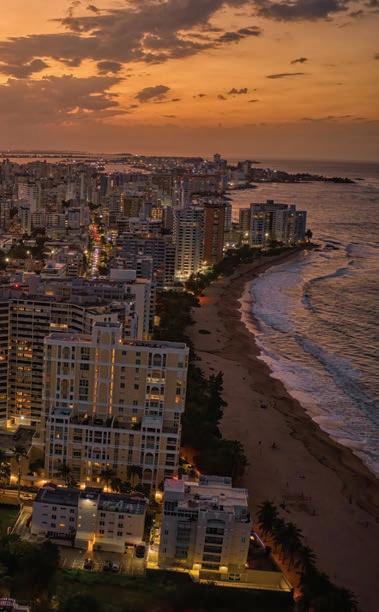
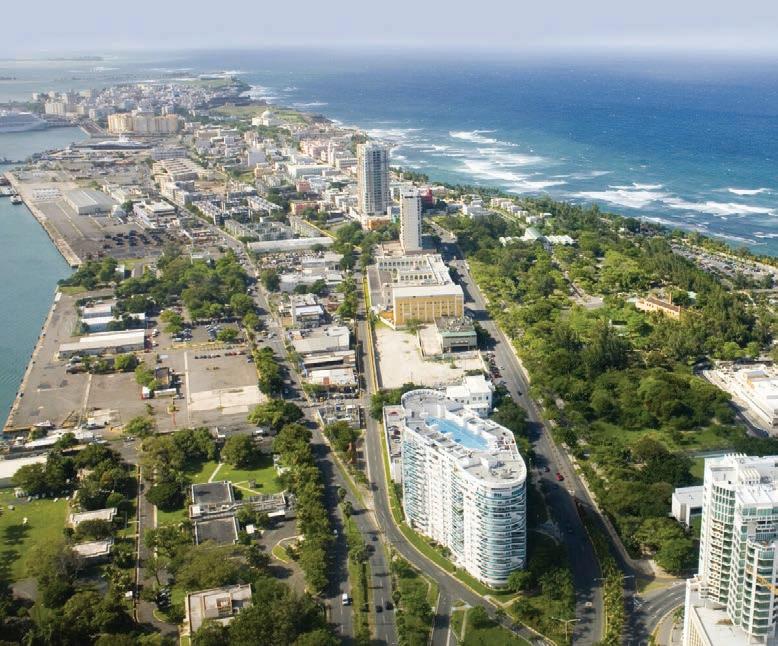
Aerial view of San Juan, where ongoing construction and redevelopment reflect the island’s accelerating economic momentum.
and 7% in recent months, according to the ICC.
Tari s of 50% on steel and aluminum have increased the cost of products derived from these materials, a ecting construction projects and prompting changes in project planning and the execution of strategies to manage cost pressures.
“We’ve had to adjust to that reality, look for e ciencies and absorb some costs; others, unfortunately, have to be passed on to the consumer,” Rojo Montilla said.
INDUSTRY – KEY FACTS 2025
$12–$15 BILLION
PROJECTED ANNUAL CONSTRUCTION INVESTMENT
According to AGC-PR, the island is entering one of the largest investment cycles in its history.
$7.14 BILLION
CONSTRUCTION ACTIVITY FY 2024
$1.13B vs. FY 2023 an 18.9% increase.
$2.34 ECONOMIC IMPACT PER $1 INVESTED IN CONSTRUCTION
Every dollar invested generates $2.34 in economic activity.