Wednesday, September 16, 2026
Puerto Rico and the Caribbean
www.wjournalpr.com
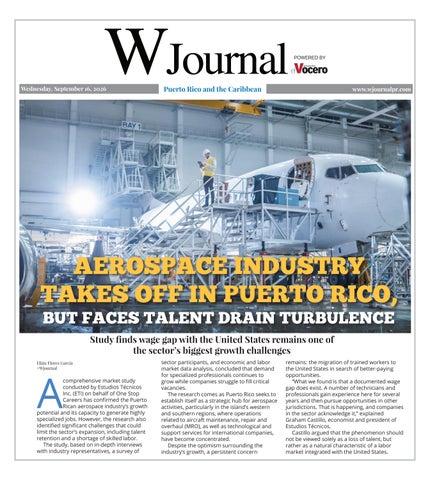
AEROSPACE INDUSTRY TAKES OFF IN PUERTO RICO, BUT FACES TALENT DRAIN TURBULENCE Study finds wage gap with the United States remains one of the sector’s biggest growth challenges Elián Flores García >Wjournal
A
comprehensive market study conducted by Estudios Técnicos Inc. (ETI) on behalf of One Stop Careers has confirmed the Puerto Rican aerospace industry’s growth potential and its capacity to generate highly specialized jobs. However, the research also identified significant challenges that could limit the sector’s expansion, including talent retention and a shortage of skilled labor. The study, based on in-depth interviews with industry representatives, a survey of
sector participants, and economic and labor market data analysis, concluded that demand for specialized professionals continues to grow while companies struggle to fill critical vacancies. The research comes as Puerto Rico seeks to establish itself as a strategic hub for aerospace activities, particularly in the island’s western and southern regions, where operations related to aircraft maintenance, repair and overhaul (MRO), as well as technological and support services for international companies, have become concentrated. Despite the optimism surrounding the industry’s growth, a persistent concern
remains: the migration of trained workers to the United States in search of better-paying opportunities. “What we found is that a documented wage gap does exist. A number of technicians and professionals gain experience here for several years and then pursue opportunities in other jurisdictions. That is happening, and companies in the sector acknowledge it,” explained Graham Castillo, economist and president of Estudios Técnicos. Castillo argued that the phenomenon should not be viewed solely as a loss of talent, but rather as a natural characteristic of a labor market integrated with the United States.
Elevated banking, designed around you. Elevated banking, designed around you. More than standard. A dedicated team focused on you – your vision, your next.
More than standard. A dedicated team focused on your vision, financial needs. We invite youyour to become a client.
Scan the QR code to know more
banescousa.com/select/puerto-rico/
© 2026 Banesco USA. Member FDIC
255 Ponce de León Ave. Hato Rey, Puerto Rico 00917 • ByMore appointment: 787-765-1420 than standard.
A dedicated team focused on you – your vision, your next.
EDITORIAL
PHOTO FINISH As this edition of the News Journal went to print, the following developments took place:
WEDNESDAY, SEPTEMBER 16, 2026
An Ode to Progress & Hope
T
he special publication you but rather as a beginning of dialogue that leads to solutions. are reading is history in the making, an affirmation in reThe pressing concerns over the many sponse to a business commuloose ends—such as creditor constituents nity in Puerto Rico starving for chomping at the bit in Puerto Rico’s energy a new narrative—of progress transformation are discussed with precision. and hope. The return to print of the News And if you want to understand challenges Journal has an emphasis on the W in the coming for the incoming administration word “news,” as in the five foundational Ws of Governor-elect Jennifer González, who of journalism—Who?; What?; Why?; When? takes office with an agenda for progress toand Where? gether with Resident Commissioner-elect We want to know Who is giving Puerto Pablo José Hernández Rivera, hell-bent on Rico reason to hope for jobs that drive our economic development, you will read about economic development, the devil in those details in this edition. not with empty slogans, but with investments and One of our many sources action—putting money beon Capitol Hill with ties to hind endeavors employing the incoming Trump adOur solemn the many talented profesministration put it best sionals across industries this: “The year 2025 promise is to ask with will certainly be an excitin Puerto Rico. We want ing year to look into—you to inform readers What wise questions makes our “empresarios” have new leadership in for essential so special—is it their belief Puerto Rico, somebody that new residential develwho has said, “I am going “Puerto Rico is part of the U.S. labor market. answers.” opment would fit the needs to focus on young people, There always be movement of human capital. of youngwill families building our grandparents, and important thing aThe future? Repeatedly, weis to maintain a strong training trying to create as many andreport workforce development ecosystem capable will on “Why is it jobs as possible—I don’t worth investing in Puerto Rico?”—because of want to put words in [the Governor-elect’s] of continuously meeting industry needs. Some our talented professionals, federal regulatomouth, but that is my interpretation of workers leave, but others return, and many remain ry compliance, and attractive tax incentives. what she has said. And, I think the Overon the island,” he said. Admittedly, there is work to be done—on the sight board has an interest in that because An Industry Different From Public Perception permits front and so many other works in it also has an interest in economic growth Although the term aerospace is ofteninassociated progress. Our solemn promise is to ask wise Puerto Rico.” with aircraft manufacturing questions for essential answers. or space exploration, At this writing, it seems the Financial Puerto reality is quite different. Oversight and Management Board is foReaders Rico’s who want to know when meaningful measures are to coming downthe the legislative cused on finalizing Puerto Rico’s debt reAccording Castillo, island has developed a pike will want ecosystem to read the News Journal; structuring with PREPA and securing disspecialized focused onso, support services, will investors who want to know where to cipline in achieving structurally balanced maintenance operations, and technical activities put their money behind the next big thing. budgets. However, without much-needed that are part of the global aerospace supply chain. In this return to a print edition—a mojob creation, we will not achieve the eco“There is no aircraft manufacturing in Puerto nomic development that was stripped from mentous occasion in itself—you will read Rico.an However, isphysicians an industry provides about exodus of there talented whothat this island’s progress. We believe in the essential services for aviation and aerospace are leaving the island because of the Health foot soldiers of economic development set to thrive in this new era. The possibilities Department’s tardiness in paying residents operations worldwide. We have companies and paltry compensation. The story is not are endless; this W Journal aims to make meant as a fire and brimstone indictment, them a reality.
Back to the drawing board During an omnibus hearing on December 11, U.S. District Judge Laura Taylor Swain again called on all parties in stalled talks over a proposed debt settlement plan for the Puerto Rico Electric Power Authority (Prepa) to continue in the mediation process, despite pessimistic statements made by the mediation team in its latest report to the bankruptcy judge. Judge Swain said that “I have to maintain hope, for the people of Puerto Rico, that a fair and efficient conclusion to this process will be achieved,” urging Puerto Rico’s Financial Oversight and Management Board (FOMB), the Puerto Rico government and utility creditors and bondholders in deadlocked negotiations to use their “imagination” to see beyond the position that they are the only ones with a reasonable position. The report says that “the arrival of the new administration in Puerto Rico as well as the advancement of proceedings in the pending case before the Puerto Rico Energy Bureau relating to PREPA and LUMA’s liquidity and cash flows present additional challenges – and perhaps additional opportunities for progress. FOMB Executive Director Robert F. Mujica, Jr. said during a press conference on Dec. 11 that despite the mediation team’s pessimistic report the oversight board was “hopeful that we can complete the process in 2025,” and that “we
Puerto Rico’s aerospace industry supports approximately 6,330 specialized jobs, including engineers, programmers, avionics technicians, and aircraft mechanics
3
Judge Laura Taylor Swain
will go back into mediation and do what the court asks us to. At the end of the day, as the chairman mentioned, we need a plan that’s feasible and we need a plan that makes sure that Prepa can continue to fund the operations, repair a system that had lack of investment for decades…”
dedicated to aircraft maintenance, specialized Puerto Rico’s technical services, management support, design, documentation, component repair, electricityand is the manufacturing of certain electronic parts,” he overburdened explained. Currently, it is estimated that between 40 by regulation. It and 50 companies maintain significant ties to the will take serious aerospace industry, although not all are formally classified under the sector. work on the The study identified approximately 6,330 jobs legislative associated with occupations relevantfront to this economic activity, including electrical to start ourengineers, way electronics engineers, mechanical engineers, back to avionics energy programmers, systems analysts, technicians, and aircraft mechanics. transformation.” Annual salaries for these occupations in Puerto Rico range from $36,000 to $89,000, depending on — An expert source specialization and experience. with knowledge on energy affairs
CONTINUED PAGE 4 President President Salvador Hasbún Salvador Hasbún shasbun@elvocero.com
shasbun@elvocero.com
Powered by El Vocero de Puerto Rico 1064 Ave. Ponce de León 2nd Floor, San Juan, PR Postal Address: PO Box 15074, San Juan, PR 00902
VP of Editorial Content VP of Editorial Content Carlos Otero Carlos Otero cotero@elvocero.com cotero@elvocero@com
Associate Director of Accounting MariamVP Echevarría Báez Félix A. Rosa mechevarria@elvocero.com
frosa@elvocero.com
Business Editor VP of Marketing Ileanexis Vera Rosado and Business Operations ivera@elvocero.com Michelle Pérez
miperez@elvocero.com
VP of Accounting Félix A. Rosa frosa@elvocero.com Human Resources Director Human Resources Director Arlene Rolón, PHR arolon@elvocero.com Arlene Rolón, PHR arolon@elvocero.com
Multi-Platform Graphic Multi-Platform Graphic and Technology Director and Technology Director Héctor L. Vázquez
Héctor L. Vázquez hvazquez@elvocero.com hvazquez@elvocero.com
Multi-Platform Digital Director
Ayeza Díaz adiaz@elvocero.com
Phone: 787-622-2300 787-721-2300
4 The Wage Gap One of the study’s most significant findings was the salary differential between Puerto Rico and several states where the aerospace industry has a much stronger presence. For example, an electrical engineer in Puerto Rico earns an average annual salary of $74,970. The same position commands approximately $148,390 in California, $112,780 in Florida, and $118,620 in Texas. The gap is also substantial for avionics technicians. While they earn about $36,050 annually in Puerto Rico, salaries can reach $91,110 in California and nearly $78,690 in Texas. Aircraft mechanics face a similar reality. The average local salary is approximately $40,620, compared with $85,750 in California and more than $80,000 in Texas. At first glance, the figures appear to explain the migration of talent on their own. However, economists consulted for the study caution that the comparison requires consideration of additional factors. Economist and professor José Alameda Lozada noted that workers often evaluate job opportunities primarily through the lens of salary without necessarily considering the cost of living in their destination. “It is true that salaries are considerably higher in many states. However, when we talk about economic well-being, we must look at real wages— that is, how much income remains after covering living expenses. In many cases, people see an attractive offer and relocate, only to discover that housing, health insurance, transportation, and other costs consume a significant portion of those earnings,” he explained. Alameda argued that discussions about labor migration are often oversimplified. “People tend to think the equation is simple: I leave because I’ll earn more. But the reality is far more complex. One must consider cost of living, family expenses, cultural adaptation, language, support networks, and professional growth opportunities. All of those factors play a role in the decision,” he said. Beyond Compensation The research also revealed that the talent shortage is not driven exclusively by salary considerations. Among the main obstacles identified by employers is the difficulty of finding candidates with the required technical skills and functional English proficiency. Most participating companies reported that filling entry-level positions takes three months or longer, while nearly half indicated they maintain between one and three permanent vacancies. To address these challenges, the study highlights the importance of Puerto Rico’s educational system. Over the past 16 years, more than 12,300 students have completed programs related to aerospace-associated occupations. In 2023 alone, nearly 900 individuals graduated from technical and
WEDNESDAY, SEPTEMBER 16, 2026
The wage gap with the U.S. mainland remains significant: an electrical engineer earns an average of $74,970 in Puerto Rico, compared with $148,390 in California
associate degree programs connected to the sector. Among the primary sources of talent are the University of Puerto Rico at Mayagüez, Polytechnic University of Puerto Rico, Inter American University’s Bayamón campus, Ana G. Méndez University, and the Pontifical Catholic University of Puerto Rico, along with various specialized technical institutes. Nevertheless, experts agree that academic training must evolve at the same pace as the industry. “I do not believe Puerto Rico faces an impossible talent challenge. What the island needs is to continue strengthening the educational, technical, and university programs that feed this ecosystem. We must keep building that structure because the industry will continue to grow,” Alameda said. A Sector With Strong Prospects Despite the challenges, specialists agree that the aerospace industry represents one of Puerto Rico’s most promising opportunities to diversify its economy. Castillo noted that technological advancements, the growth of drone systems, increased defense investment, and the development of new space-related applications continue to generate opportunities for the island. “Based on the findings of the research and the interviews conducted with industry leaders, growth
expectations are excellent. We are witnessing significant technological transformation in areas such as drones, satellites, and emerging aerospace applications that create opportunities for Puerto Rico,” he said. Alameda shares a similar perspective. “Every new industry that arrives in Puerto Rico opens the door to emerging technologies. The economy needs to integrate itself into these new areas of development. The aerospace industry has the potential to become a major driver of economic growth if the necessary adjustments are made and human capital development is strengthened,” he said. Given this outlook, the study recommends a strategy built around three pillars: strengthening talent development through specialized programs, promoting investment attraction, and consolidating a collaborative ecosystem among government, businesses, universities, and nonprofit organizations. The researchers’ conclusion is clear: Puerto Rico possesses the conditions necessary to continue expanding its presence in the aerospace industry. The challenge now will be ensuring that the sector’s growth is accompanied by a workforce capable of sustaining it and by policies that help retain the talent developed on the island itself.
5
WEDNESDAY, SEPTEMBER 16, 2026
Puerto Rico: Fewer Residents, More Cars As Puerto Rico’s population continues to decline, the number of vehicles with valid registration stickers keeps rising—a contradiction that exposes the island’s dependence on automobiles and raises questions about the future of mobility, infrastructure and public space in a place with limited resources Elián Flores García >Wjournal
F
or the first time since 2010, Puerto Rico has updated data on the number of motor vehicles with valid registration stickers. W Journal requested access to information provided by the Puerto Rico Institute of Statistics and obtained the total number of vehicles with a valid registration sticker as of June 30, 2026, a figure that offers an opportunity, 16 years later, to reassess how Puerto Rico’s vehicle fleet has changed. The last publicly available record of the number of vehicles in Puerto Rico dated back to 2010, when 3,020,455 vehicles were counted. Since then, the resident population has declined, birth rates have reached historically low levels, and yet the number of vehicles continues to grow. That is precisely the paradox: there are fewer people, but more and more cars. The latest population estimates place Puerto Rico
at approximately 3.18 million residents in 2025. By contrast, the data obtained by The News Journal on vehicles with valid registration stickers illustrates the extraordinary size of the island’s vehicle fleet in relation to its population. Economist Juan Castañer conducted an exercise using the population age 16 and older and the number of registered private vehicles. His calculation produced a rate of approximately 1.32 vehicles per person within that population segment. “That gives you a vehicle-per-person ratio. In other words, when you divide the number of privately registered vehicles with valid registration stickers by the population age 16 and older—which represents about 85% of the total population—you get 1.32 vehicles per person. That means each person has one vehicle and a third of another. That is a high rate,” the economist said, noting that the relationship between the two variables will remain important even if vehicle sales decline. “A declining population and an increasing number of vehicles… with a declining population,
there will proportionally be more vehicles on the roads,” he said. The calculation does not mean that every person physically owns one vehicle and a fraction of another. Rather, it is a statistical relationship between the two variables. Castañer himself cautioned that the calculation does not reveal how many households have two or more vehicles. But the figure does place a difficult reality squarely on the table: the automobile occupies a central place in everyday life in Puerto Rico. An Aging Population as More Vehicles Arrive For demographer Raúl Figueroa, declining birth rates and migration will have consequences for consumption and, eventually, for the vehicle market. The share of younger people will continue to decline, while a growing number of older adults will shape the demographic structure in the years ahead. “Low birth rates are going to have an impact
6 because you are going to have fewer people who will be part of the productive workforce, working and buying vehicles… and migration also has an impact. You had 22 million inhabitants, and we now have close to 2.8 million adults,” the demographer said. The demographic shift also raises another question: What will happen to vehicles when their owners age, migrate or stop driving? Figueroa said that, under such a scenario, some vehicles could end up abandoned, while the number of unoccupied households could also increase. “Older people, who are going to dominate the population in the coming years, eventually reach a point where they are no longer going to be buying cars. And if there are no children to take them over afterward, those cars are going to be abandoned, and many homes will be abandoned as well,” Figueroa emphasized. The concern is not only demographic. It also involves urban planning and municipalities’ ability to manage vehicles that are no longer in use. Figueroa said he had even observed an abandoned vehicle in front of his residence that was eventually removed and later replaced by another. The problem, he explained, is also tied to the lack of transportation alternatives for an aging population. A Small Island With So Many Vehicles Doctoral student and researcher Andrea Pimentel Rivera studies precisely how Puerto Rico became so dependent on automobiles. Her doctoral research, titled Archipelagic Automobility: Car Dealers, Shipping Regimes, and Finance in the Making of Puerto Rico’s Car Dependence, examines the relationship among car dealerships, financing, trade and the structures that sustain automobile dependence on the island. For Pimentel, the problem takes on another dimension when Puerto Rico’s physical size is considered. The researcher noted that since the middle of the 20th century, the growing number of automobiles had already begun to be viewed as a problem precisely because of the island’s territorial limitations. “There simply isn’t enough space here for so many cars—for every person to have their own automobile, take up space and all of that.” The researcher also questions whether Puerto Rico should be compared solely with countries that have high levels of motorization. In many of those places, an automotive industry historically drove vehicle consumption. Puerto Rico, by contrast, is fundamentally a consumer territory, where financing and loans have played an important role in making vehicle purchases possible. According to Pimentel Rivera, that economic dimension is essential to understanding why the number of vehicles continues to grow. Car dealerships rank among Puerto Rico’s economically significant sectors, according to the analysis conducted as part of her research. This is compounded by the role of financing and the revenue generated for the government by
WEDNESDAY, SEPTEMBER 16, 2026
consumption associated with automobiles. For that reason, she argues, automobile dependence is not simply an urban-planning issue.
remain as long as vehicles stay on the road longer and the country maintains the same development pattern.
The Environmental Cost The growth of the vehicle fleet does not end when a car leaves the dealership. Every vehicle occupies space, uses roads, requires parking, consumes fuel or energy and eventually becomes waste. Pimentel Rivera identifies carbon emissions as one of the main externalities associated with private transportation, but she also points to other problems that receive less attention: tires, oils, grease, batteries and vehicles that are no longer operational. “I’m not even sure where cars go once they stop working here. Do they end up in junkyards? Because part of your report is thinking about how many vehicles are registered, but how many more are sitting in junkyards,” the researcher said. The problem of abandoned vehicles has already forced municipalities to allocate resources to remove them. The research itself begins with a question that still does not have a complete answer: How many vehicles actually exist in Puerto Rico when those with active registration stickers are added to those that remain registered, abandoned or out of circulation? DTOP maintains information on active vehicles, but The News Journal learned that various organizations have requested additional information about vehicles that do not appear as active. That figure could complete the picture. The millions of vehicles officially reflected in government records do not necessarily represent every automobile physically present on the island. The economist does not foresee an immediate crisis, but he does anticipate an issue that will
A Car Problem or a Country Problem? The central question, then, changes. It is not simply about how many vehicles Puerto Rico has. It is about how much of the country has been built around making those vehicles necessary. Pimentel Rivera believes both factors are part of the problem: the number of automobiles and the design of the island around the automobile. In San Juan, for example, she argues that even in urban areas where distances could make walking feasible, the conditions for pedestrians are not always adequate. The dependence becomes especially evident when looking at the relationship among employment, housing and mobility. San Juan remains an economic and employment center, while people who live outside the metropolitan area must travel to the capital daily. Highways make that movement possible, but they also generate congestion and other externalities. For the researcher, reducing automobile dependence does not simply mean building more roads or expanding a single transportation alternative. While some cars remain stranded, are abandoned, or do not appear in official records, the cycle continues: thousands of vehicles arrive in Puerto Rico, and hundreds of dealerships place them in front of buyers who will take them onto the island’s roads. Some vehicles reach the end of their journey while others are only beginning theirs. And so, on an island with fewer and fewer residents, the movement of automobiles does not stop—and one question remains: What happens to every car when it finally stops moving?
8
WEDNESDAY, SEPTEMBER 16, 2026
Between Opportunity and Reality:
The Debate Over Puerto Rico’s Agricultural Competitiveness Study identifies an opportunity to increase food self-sufficiency, although farmers question costs and the difficulties of consistently supplying the market Carlos Aponte Inostroza >Wjournal
A
new study highlights an opportunity for Puerto Rico to move toward greater food self-sufficiency by identifying local agricultural products that could compete favorably with imports. However, the findings reignite a debate over whether local production actually has the necessary conditions to compete on price and consistently meet market demand. The research, conducted by economist and University of Puerto Rico, Río Piedras Campus professor José Caraballo-Cueto, found that Puerto Rican farmers offer prices lower than import costs for 30 of the 74 products analyzed. The report shows that, although local farmers do not have lower prices than importers when prices are compared overall, they are consistently and statistically significantly lower than supermarket prices (32.9% lower on average), prices at farmers’ markets, and, above all, direct-to-consumer prices (51.8% lower on average). Among the products in which local farmers were more competitive than imports are sweet peppers, basil, eggplant, pumpkin, cauliflower, asparagus, guava, bananas, green bananas, green beans, ginger, corn, mesclun, green and ripe plantains,
radishes, watermelon, various types of mushrooms, tamarind, tarragon, cherry tomatoes, grapefruit, and purple yautía, among others. Caraballo-Cueto said the objective of the research was to go beyond the usual question of whether Puerto Rico is self-sufficient overall and ask a more specific and actionable question: Which products, and at what point in the supply chain, can local farmers compete on price today? “We found that the answer is ‘in many more than people thought,’ especially if the middleman is eliminated,” the economist said. The study also estimates that if Puerto Rico were able to replace imports for just five of these products — corn, peppers, tomatoes, grapefruit, and yautía — which are currently imported in large volumes, it would generate $73.6 million in direct economic impact, and up to $117.8 million when indirect multiplier effects on the economy are taken into account. “These $118 million annually do not replace other economic growth strategies, but they do demonstrate that there is a concrete, measurable, and currently untapped opportunity. It is not a matter of our farmers lacking the capacity to compete on price, but rather market barriers, a lack of information, and the particularities of each stage of the supply chain,”
Likewise, the study identifies structural factors that could be limiting self-sufficiency despite the price competitiveness of local farmers. >>Archivo / EL VOCERO
9
> WEDNESDAY, SEPTEMBER 16, 2026
These $118 million annually do not replace other economic growth strategies, but they do demonstrate that there is a concrete, measurable, and currently untapped opportunity. It is not a matter of our farmers lacking the capacity to compete on price, but rather market barriers, a lack of information, and the particularities of each stage of the supply chain. Jose Caraballo Cueto economist
Caraballo-Cueto emphasized. Likewise, the study identifies structural factors that could be limiting self-sufficiency despite the price competitiveness of local farmers. These include incomplete price information between buyers and sellers, as Puerto Rico lacks an official weekly agricultural price system, unlike countries such as the Dominican Republic. The study also points to the strict purchasing requirements imposed by supermarkets and family traditions that limit crop diversification among farmers. Another factor highlighted by the author was the impact of trade barriers such as the Jones Act of 1920 and agricultural tariffs, which together would increase the cost of imports by approximately 11.9%. This could explain part of the price advantage of local products in at least seven of the
obstacles is the lack of willingness and discipline among farmers. “To produce what you need, or at least to enter the institutional market, whether restaurants or directly into supermarkets, you have to have volume, consistent production, and quality. The only ones who can meet those requirements are large farmers or those with well-structured operations. Most of them go from agricultural production all the way to value-added products and distribution, but there are so few of them that they are basically operating within their own niche, and they are fortunate in how their operations are structured,” Cordero said. The former sector leader questioned how small and average farmers can enter that market. He said this could happen if farmers commit to the effort, develop the willingness to organize and work as a team, and have the discipline to follow both technical guidelines and the requirements established in contracts. “We can do it. The model to follow is cooperatives. There is no other alternative besides cooperatives because when you look at the same agricultural census, it tells you that the average farm size is between 40, 50, and 60 cuerdas. Look, that is a parcel, and producing on a single parcel is too costly for you to supply a certain volume. But if you have a group of 10 farmers with 40 cuerdas of land, you
categories studied. “The central message for the country is that increasing food selfsufficiency does not depend solely on the productive capacity of the land, but on addressing very specific problems involving information, logistics, and commercial relationships between farmers and buyers. With the right data and appropriate policies, Puerto Rico can produce more than it does today,” the economist added. Agricultural Sector Responds Nevertheless, regarding the findings and questions about whether Puerto Rican agriculture is currently capable of competing, cattle farmer and former president of the Puerto Rico Farmers Association Héctor Cordero said that it is, but acknowledged that there are several obstacles to making it happen. Cordero said one of the main
The economist, José Caraballo Cueto >>Suministrada
already have 400 cuerdas available for planting. And if you organize them, especially if they establish crop rotation programs depending on the crop, they can divide all the operating costs among themselves and sell through a cooperative. It is viable, but it definitely requires the willingness of farmers, which is something that, unfortunately, does not exist,” Cordero said. For her part, another agricultural sector leader, who asked not to be identified, said that, in her view, local agriculture cannot compete because producing in Puerto Rico is “extremely costly.” “The serious problem we have with agriculture is really marketing. The way farmers market their products is very complicated. That system is very complicated for farmers, and trying to do it would be even more costly,” the agricultural leader said. Is It Possible to Eliminate Middlemen Meanwhile, when asked whether the option proposed by the study of eliminating middlemen from the sales process between farmers and the supply chain is feasible, CaraballoCueto confirmed that this process has already been implemented in Puerto Rico. “There are already several efforts underway. There are platforms, agricultural fairs, and farmers’ markets where farmers present and provide their products directly to consumers,” Caraballo-Cueto said.
10
WEDNESDAY, SEPTEMBER 16, 2026
Housing Assistance Opens the Door to Homeownership, but Supply Remains a Hurdle
A 28-year-old tells the story of how he was able to purchase his first home through a friend Stephanie L. López
A
>slopez@elvocero.com
lthough government programs have enabled more families to move toward buying a home, purchasing a property remains one of the main obstacles for buyers who rely on financing, given a market with limited supply where cash sales often have the upper hand. “At first, I had found several homes I’d already discussed, but the market is so saturated that now cash purchases really beat out any purchase I’d make through a bank. So really, to buy a house these days, if you’re not paying cash, it’s practically impossible to buy a house,” said Rubén A. Meléndez Veláquez, a 28-year-old in interview with The W Journal. He explained that after nearly five months of searching for a home, when he mentioned his ordeal to one of his friends, the friend told him that his mother was in the process of selling an inherited house, and that if he was interested, he could give him the opportunity to buy it. “Thank God she was a woman of her word; she stuck with me. She needed to sell the house due to personal circumstances, and thank God she stayed with me through it all. The whole process took a couple of months—five months, to be exact—and although we had our ups and downs because it took a little while, she stood firm and gave me what she had initially promised,” he explained. He also explained that he managed to buy the home in Carolina for less than $200,000—a price that was another favorable factor, considering that other properties on the market exceed that amount. According to statistics from the Office of the Commissioner for Financial Institutions (OCIF, in spanish), in 2025 the average price of an existing home was $222,895 an increase of 3.8% from 2024. While the average price for a new home was $418,064, 4.9% more than last year. Government Programs helped him finance Meléndez Veláquez began looking into assistance programs as soon as he started his home search in late 2025. Although he initially considered the
Rubén Meléndez Velázquez, alongside his wife during the closing of his mortgage. >Courtesy
In the end, this turned out to be a stroke of luck because if it weren’t for the fact that my lifelong friends mentioned it to me and he told me that his mom was selling a house— and that she actually agreed to sell it to me—I’d still be in the middle of the process Rubén Meléndez Velázquez Homeowner
benefits of Vivienda Joven—a program that offers mortgage loans at more favorable rates to buyers aged 21 to 35 who have graduated within the last five years—, he opted for the Pronto Pa’ Tu Casa program, which offers a grant of up to $60,000 toward the down payment and closing costs. He said that the process to obtain government assistance took just a few weeks, but completing the mortgage process took several months. According to him, during the mortgage process, a discrepancy
arose between the original property registration documents and the actual measurements of the house. “In the end, this turned out to be a stroke of luck because if it weren’t for the fact that my lifelong friends mentioned it to me and he told me that his mom was selling a house—and that she actually agreed to sell it to me—I’d still be in the middle of the process,” he said. Like his case, many others face the same struggles, and at least two other buyers consulted by this outlet confirmed they were able to buy from friends or family. Impact According to Ricardo Alvarez, executive director of the Housing Finance Authority (AFV, in spanish), the agency has received nearly 250 applications from young people under the Vivienda Joven program, of which approximately 195 have already resulted in mortgage closings. “In recent months, the number of applications we’ve received has increased… As of today, we have received nearly 250 applications from young people. The average mortgage amount is around $179,000, and the average age of these young people is 26,” said Alvarez. The official noted that the program involves some 40 financial institutions, including commercial banks and credit unions. The program functions as a mortgage financing and insurance product and can be combined with “Pronto Pa’ tu Casa,” which offers a grant of up to $60,000 for the down payment and closing costs. According to the executive director, the latter program, launched in January, has accumulated over 800 approved applications, with approximately $40 million disbursed from a fund of about $92 million. With the initial allocation of funds, the program is expected to benefit nearly 2,600 families in total. It is worth noting that on September 6, the agency injected an additional $80 million into the program, for a total of $172 million allocated. How long does it take? When asked about the closing period, he explained that it varies by participant but noted that banks have managed to reduce the closing time, which had been one of the main complaints. “The process is standard for a loan application, which can take between 35 and 45 days. It all depends on three things: how quickly the mortgage lender submits the case, how complete the submission is, and the property itself. In this case, the collateral must not have any legal issues. That’s the second point. And the applicant must meet all the required criteria. Every document submitted when applying for a loan is a combination of these three elements,” the official stated. This was confirmed by Ricardo Negrón, executive director of the Mortgage Bankers Association (MBA), Puerto Rico Chapter, who stated that there is no standard timeframe, as it depends on the characteristics of each buyer, the property, and the type of financing.
12
WEDNESDAY, SEPTEMBER 16, 2026
Most set their business up with personal savings, and 57% find financial skills as a barrier
Entrepreneurship in Puerto Rico:
Between Opportunities and Obstacles P Enrique Muchacho >W Journal
uerto Rico’s entrepreneurial ecosystem continues to be shaped by a combination of opportunities and challenges, as access to capital, operating costs, and structural difficulties remain among the main obstacles for those seeking to establish or expand a business on the island. According to details from the Puerto Rico Department of State, the number of registered small businesses rose 11.3% between 2024 and 2025, with the majority of businesses registered being Limited Liability Corporations (LLC), accounting for over 64% of small businesses in 2025. Meanwhile, the Profile of Entrepreneurs and SMEs (Sales and Marketing Association) in Puerto
Rico study by Colmena66, 31% of the entrepreneurs surveyed financed their businesses with personal savings, while only 4% benefited from a government grant during 2025. The study also found that 57% of entrepreneurs identified financial skills as a barrier. For Alan Taveras Sepúlveda, president of the Center for United Retailers (CUD), although there has been a noticeable transformation in terms of institutional support for the sector, significant obstacles to doing business in Puerto Rico remain. “Although a tremendous effort has been made for Puerto Rico’s business ecosystem, it is still a challenge; entrepreneurship in Puerto Rico is an extreme sport because it is an extremely difficult, expensive and slow place to start a business and launch an idea,” he explained. Among the factors that continue to affect Puerto
Rican entrepreneurs, Taveras Sepúlveda pointed to permitting, high costs, difficulties recruiting and retaining employees, and infrastructure problems. “The list of challenges and threats in Puerto Rico is much longer than the opportunities because of everything we have mentioned. So anyone thinking about starting a business, when they put the list of pros versus cons on paper, there is a very strong balance that leans toward not opening a business,” he said.
Colmena66 as a Driver of Entrepreneurship Despite the challenges related to access to capital, financial preparedness, and infrastructure deficiencies, interest in entrepreneurship in Puerto Rico remains strong among people of different ages. According to Bárbara Figueroa Chinea, executive
WEDNESDAY, SEPTEMBER 16, 2026
director of Colmena66, entrepreneurs continue to seek opportunities to establish their own businesses and turn to support organizations for the information and tools they need to develop their projects. The Colmena66 study found that more than 28% of entrepreneurs identified a market opportunity or need as the starting point for their business. During the 10 years since the organization was founded, entrepreneurs supported by its network have developed solutions aimed at addressing various problems and needs in the local market. “We always see that space for opportunity, and we also see the opportunity and the need for us, as a sector and as support organizations, to constantly remain alert to what is happening in the sector and what is affecting our entrepreneurs, so that we can also bring solutions to the table,” Figueroa Chinea said. Over the past two years, Colmena66 has assisted more than 3,600 entrepreneurs and recorded more than 6,000 interactions. Although it serves business owners from various sectors, the executive director said a significant portion comes from food services, professional services, and creative industries. Regarding the profile of entrepreneurs, the study found that 31.8% are between 35 and 44 years old, while 56.7% own one or more businesses. “In recent years, we have also seen an increase in female participation in the business sector. That is something we have noticed at Colmena and in many of the programs within our support network,” she said. From Support to Business Growth One entrepreneur who has turned to Colmena66 for assistance is Magda Fariñas Cardona, owner of Que Bollo, who sought support in 2024 to launch her artisan bakery business. “When I started with them, I was in the early stages of my venture. The advice, mentors, and workshops they provided helped me tremendously in finding the true direction or niche for my business. That niche was people looking for healthy alternatives at affordable prices, using flours free of bromate and bleaching agents. It helped me identify that market niche and develop a work plan focused on distributing to that particular group,” she said. Fariñas Cardona started the business with just two employees and now has 22. She also said that since March, when she began a new phase of distributing artisan bread to supermarkets in Puerto Rico, the company has generated more than $300,000. However, the growth process has also been accompanied by obstacles. When asked by W Journal about the main challenges she faced when launching her business, she mentioned obtaining permits and difficulties related to water and electricity services. “The lack of water is a major challenge for a small entrepreneur because a small business owner does not have the necessary funds. We are living day by day, looking for the best option to move our
business forward so that our employees can make a living from it,” she said. Meanwhile, Luz Bonilla Rivera, founder of Parques Imaginarios, identified incorporating technology and artificial intelligence into her educational books as one of her main challenges. Ten years after its founding, the company has expanded into markets in Latin America and the United States. “Our books range from newborns to approximately 12 years old, and we have paved the way for our books to become part of school curricula. Some of our versions, as well as other versions, are not only for mothers to purchase. Schools have seen our books as a fun way to encourage reading and foster a love of children through stories,” she said. Community and Networking In addition to providing assistance and resources to entrepreneurs, Colmena66 promotes opportunities for networking and connection through various events, including the Boricua Emprende Fest. The event features educational and business activities, personalized mentoring sessions, and discussions on different aspects of the business world.
13 “This is an event that has always been organized by Colmena66 and by the entrepreneurship pillar within our organization,” she said. Bonilla Rivera, who had previously participated in the event, recalled her experience in last year’s Be Boricua Pitch Competition, where she won and received funding to advance future projects. This year, she participated again in the Boricua Emprende Fest, but through another company where she serves as general manager. “That money allowed us to begin all the efforts to export our storybooks outside Puerto Rico, particularly to the Latin American market,” she said. Meanwhile, Fariñas Cardona emphasized the importance of supporting local products and businesses as a way to promote the growth of Puerto Rican companies. “Entrepreneurs are putting their efforts into creating a better Puerto Rico. I am part of the diaspora because I left Puerto Rico and returned to Puerto Rico to contribute what I earned in the United States. I brought the money I earned working for a corporation and invested it in what is local. I believe entrepreneurs are doing their part,” she concluded. After multiple attempts to request interviews and information, W Journal was unable to obtain a response from the Department of Economic Development and Commerce (DDEC).
14
WEDNESDAY, SEPTEMBER 16, 2026
Puerto Rico’s Global Moment:
What Bad Bunny’s Success Means for Tourism Gabriela Meléndez Rivera >EL VOCERO
The phrase “Puerto Rico is all the rage” is becoming increasingly common in everyday conversations and is usually cited as a widespread result of the musical success of artist Bad Bunny’s latest album, “Debí tirar más fotos”—the first album entirely in Spanish to win a GRAMMY for Album of the Year. The album led to a 31-day residency at the Coliseo de Puerto Rico, a world tour of the same name, the Super Bowl LX halftime show, and the tour’s finale at Hiram Bithorn Stadium. These were events that, as they unfolded, marked historic milestones in the island’s economy, culture, and tourism, as well as in the artistic achievements of Benito Antonio Martínez Ocasio—Bad Bunny’s given name. The ongoing impact of these events is reflected in the global popularity Puerto Rico has achieved as a tourist destination, but the full benefits of that exposure remain to be seen. “Debí tirar más fotos” established itself as a music project deeply rooted in Puerto Rican culture through the integration of Puerto Rican rhythms—such as salsa, plena, and re-
Benito’s unprecedented global success has boosted the island visibility, tourism and cultural profile, but experts say Puerto Rico must turn that attention into sustained growth. ggaeton—in collaboration with other Puerto Rican musicians, as well as constant references to the slang, experiences, and grievances of many Puerto Ricans both on the island and in the diaspora. The artist residency held on the island— featuring 31 concerts at the Coliseo de Puerto Rico between July and September 2025— broke attendance records with nearly 600,000 spectators and generated an estimated economic impact of $713 million, sending searches for flights to Puerto Rico soaring to more than 510,000 in the first week following the event’s announcement and generating an economic impact exceeding $196 million for the hotel industry. As soon as the series of performances on
the island concluded, the “Debí tirar más fotos” world tour kicked off, visiting 22 cities across five continents and selling 3.1 million tickets worldwide with a show deeply rooted in Puerto Rican culture, both musically and symbolically. The same show was presented during the Super Bowl LX halftime show— the fourth-most-watched halftime show in history, with 128.2 million viewers, and the most-awarded in history, with seven Emmy Awards.
“People already know what Puerto Rico is”
According to the philosophy of Jorge Pérez, CEO of Discover Puerto Rico—the island’s official tourism promotion organization—tourism involves a three step process:
awareness, which is identifying the destination and knowing where it is; consideration, when the tourist begins to contemplate a visit to the destination; and, finally, the purchase, which is the moment when the trip is officially booked through a plane ticket. “We at Discover Puerto Rico used to invest a large part of our budget in ‘awareness’—letting the public know where Puerto Rico is, that if they’re coming from the United States they don’t need a passport, that the currency is the U.S. dollar… Now people already know what Puerto Rico is, and (Bad Bunny) has played a significant role in that awareness”, Pérez said. Searches for the term “Puerto Rico” in 2025 increased by 20% compared to 2024, with significant spikes between July and September, the dates of the concert series at Puerto Rico. Meanwhile, searches increased by 30% in 2026 compared to the previous year, with the highest peak occurring between February 7 and 14—dates close to the Super Bowl halftime show. Specifically, Javier Hernández Acosta, dean of Graduate Studies at the University of Sagrado Corazón and an expert in creative
WEDNESDAY, SEPTEMBER 16, 2026
economy, explained that the numerical impact of the residency will be seen in the long term, but its main contribution at present is the establishment of Puerto Rico as a brand. “In terms of brand recognition, the residency must have had a huge impact. I think it’s still too early to see this directly in numbers and to determine that the effect is directly from the residency and not from everything else that’s being done. But the impact will be there; it will be mainly in brand recognition,” Hernández Acosta stated.
Growth in International Tourism
Although most visitors to the island come from the United States, data from the Puerto Rico Tourism Company (CTPR)—drawn from external sources specializing in the industry—show sustained growth in international passenger traffic. In 2025, this segment recorded a 13.4% increase compared to 2024, a trend that has strengthened throughout 2026. Between January and June of this year, growth reached 23.6% compared to the same period last year. Colombia, Mexico, and Spain are among the fastest-growing markets on the island. Arrivals from Spain surged 116% year-overyear in 2025, driven in part by a 57% increase in air traffic between Madrid and San Juan, and preliminary data through October 2025—focusing specifically on Spanish citizens—showed year-over-year growth of 72%. Mexico was part of a broader boom in Latin America, where, like Colombia, it recorded a 54% increase in seat capacity in 2025. According to the Luminate platform’s 2026 music consumption report, after the United States, Mexico and Spain rank second and third, respectively, as the leading importers of Puerto Rican music. CTPR expects this momentum to continue throughout this year, with a projected 11% increase in arrivals from South America and a 46% increase in seating capacity from Spain in 2026.
What remains to be done?
Puerto Rico’s media presence around the world can be seen as a major boost for the local tourism economy, but the Island must know how to capitalize on it. According to Pérez of the DMO, the organization’s efforts are focused on getting people to buy tickets, make reservations, and actually visit the is-
15
land. However, the Caribbean market is one of the most competitive. “People who are considering Puerto Rico are looking at other options in the Caribbean and in the southern United States. The reality is that it’s a highly competitive market,” he said. “There are geopolitical factors at play; consumers are being cautious; oil prices are rising; and airlines are adjusting their prices. So, in that sense, it’s a very competitive market because people have many options,” he emphasized. According to the profile of visitors to Puerto Rico and Bad Bunny’s residence in 2025 developed by Discover Puerto Rico, 97% of people would recommend the destination and 91% would return; however, 32% reported being dissatisfied with the “value for money” during their visit. Thus, the economic challenge continues to take its toll on tourism. For Pérez and the organization he leads, the priority is to establish Puerto Rico as an entertainment destination, featuring cultural and sporting events, to continue driving tourist arrivals. For Hernández Arroyo, that aspect is important, but there are other elements that need to be nurtured to capitalize on the momentum of the Bad Bunny phenomenon. “Yes, there need to be major, iconic annual events that attract a high volume of visitors, but then we must strengthen Puerto Rico’s network of cultural experiences—its network of festivals and events. Things happen here all week long, and the new tourist—the one seeking cultural experiences—will look for cultural programming”, he said. “The tourism agency must prioritize ensuring that this cultural programming is of high quality and well-resourced. The rest involves strengthening local creative talent, because they are the ones who will design that programming. So, it’s a consistent, multi-tiered strategy to enhance the experience for both tourists and locals, because tourists also want to interact with locals. Therefore, there can be no exclusionary dynamics,” he added. Meanwhile, according to Discover Puerto Rico’s hotel reservation projections, 2026 will surpass 2025 in numbers and mark the seventh consecutive year of growth for tourism on the island.
Explore the Popular U.S. Government Money Market Fund
Invest in U.S. government securities with the money market fund available through Popular Securities. The Popular U.S. Government Money Market Fund, designed for residents of Puerto Rico1, is characterized by: Puerto Rico sourced income2 High-quality short-term investment Liquidity: withdraw funds to obtain cash or invest Less prone to market fluctuation
Get more information and start your journey today. Contact Popular Securities at 787-758-7400.
Count on us
Product offered by Popular Securities. Investors should carefully consider the investment objectives, risks, charges, and expenses of the fund before investing. This and other important information are contained in the prospectus and the summary prospectus. You can access the prospectus by visiting www.popularfunds.com/money-market-fund-resources. Please read it carefully before investing. 1The Popular U.S. Government Money Market Fund is not limited exclusively to residents of Puerto Rico and may be available to other investors. Investors who do not qualify as “Qualifying Investors” as described in the Fund’s prospectus, may be subject to a different tax treatment, including potential adverse tax consequences. 2The Popular U.S. Government Money Market Fund has been structured for investors who may benefit from certain tax provisions applicable to bona fide residents of Puerto Rico under the U.S. Internal Revenue Code. In particular, under Section 933, certain dividends from the Fund may not be subject to U.S. federal income tax in the hands of such investors, subject to the satisfaction of applicable requirements. The tax benefits described depend on each investor’s individual circumstances and are not guaranteed. This material does not constitute tax advice. Investors are encouraged to consult their tax and legal advisors prior to investing. You could lose money by investing in the Fund. Although the fund seeks to preserve the value of your investment at $1.00 per share, it cannot guarantee that it will do so. An investment in the Fund is not insured or guaranteed by the FDIC or any other government agency. The fund sponsor has no legal obligation to provide financial support to the Fund, and you should not expect the sponsor to provide financial support at any time. Investment products and services are offered by Popular Securities, LLC, a registered broker/dealer, member of FINRA and SIPC. Investment advisory services are offered through Popular Securities, LLC, an SEC registered investment adviser. Popular Securities, LLC is a subsidiary of Popular, Inc. and an affiliate of Banco Popular de Puerto Rico. Popular, Inc. and Banco Popular de Puerto Rico are not registered broker/dealers or registered investment advisers. Investment products are not insured by the FDIC, are not deposits or obligations of, and are not guaranteed by Banco Popular de Puerto Rico, its affiliates and/or subsidiaries; they involve risk and may lose value, including the possible loss of principal. Banco Popular de Puerto Rico, its subsidiaries, and affiliates do not provide legal, accounting, or tax advice. If you require legal, accounting, or tax advice, you should consult with a qualified professional.