Invest Puerto Rico’s Achievements for FY 2020 P7 Latest on Clash Between FOMB and Creditors P8 Hoteliers’ Optimism Reigns in Old San Juan P9
Puerto Rico and the Caribbean
www.theweeklyjournal.com
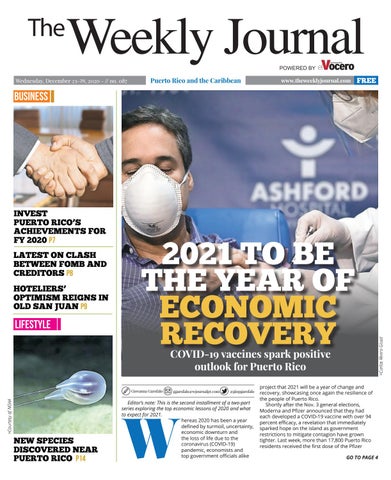
2021 to Be the Year of Economic Recovery COVID-19 vaccines spark positive outlook for Puerto Rico
>Courtesy of NOAA
Giovanna Garofalo
New Species Discovered Near Puerto Rico P14
ggarofalo@wjournalpr.com
@giopgarofalo
Editor’s note: This is the second installment of a two-part series exploring the top economic lessons of 2020 and what to expect for 2021. hereas 2020 has been a year defined by turmoil, uncertainty, economic downturn and the loss of life due to the coronavirus (COVID-19) pandemic, economists and top government officials alike
W
>Carlos Rivera Giusti
Wednesday, December 23-29, 2020 - // no. 087
project that 2021 will be a year of change and recovery, showcasing once again the resilience of the people of Puerto Rico. Shortly after the Nov. 3 general elections, Moderna and Pfizer announced that they had each developed a COVID-19 vaccine with over 94 percent efficacy, a revelation that immediately sparked hope on the island as government restrictions to mitigate contagion have grown tighter. Last week, more than 17,800 Puerto Rico residents received the first dose of the Pfizer GO TO PAGE 4
The Weekly Journal > Wednesday, December 23, 2020 > 2
3
/ Wednesday, December 23, 2020
a week in review Respiratory Therapist Receives Puerto Rico’s First COVID-19 Vaccine
Claro reported it has 1.6 million clients in Puerto Rico and that Internet use in households for remote work and learning increased by double digits in its client base, as well as broadband sales on the island. Claro reported a 46 percent growth in gross sales of mobile and fixed Internet. The company has also invested $161 million in Puerto Rico to expand the coverage of its mobile and fixed network.
>Courtesy of La Marqueta
Claro Puerto Rico Reports 46 Percent Gross Sales Growth
>AP Photo/Carlos Giusti
A respiratory therapist, Yahaira Alicea, who treated the first two COVID-19 patients hospitalized in Puerto Rico became the first person on the island to be vaccinated against the coronavirus. The event was cheered by many on the island of 3.2 million people that recently imposed more severe measures to fight an increase in COVID-19 cases and deaths.
Condado’s La Marqueta Reopens La Marqueta, an innovative gastronomic space facing the sea in Condado, reopened its doors. In a large open and roofed atrium that faces the Atlantic Ocean, the venue features four restaurants (José Enrique, L’Écume, La Taquería, Hen House and Shogun — Sushi & Asian Cuisine) as well as two bars, with ample seating for the public, allowing compliance with security and distancing protocols in the face of the pandemic.
4
/ Wednesday, December 23, 2020
CONTINUED FROM PAGE 1 vaccine, with 21,400 more vaccines to be delivered during the next four weeks. Just two days ago, the government also received 47,500 doses of the Moderna counterpart. As more people get vaccinated, the economic outlook for 2021 gets progressively brighter, several business leaders and top government officials told THE WEEKLY JOURNAL. “The idea is to vaccinate 70 percent of the country as soon as possible; only then will we handle the virus correctly. But I don’t think that closing businesses is the option that the country needs. We must find a way to open them and open them in an orderly fashion, with due consequences if they do not comply,” said Manuel Cidre, founder of Los Cidrines and designated Secretary of Economic Development, calling to reopen the economy gradually as the COVID-19 threat is weakened. Likewise, Juan Lara, economist and professor of Economics at the University of Puerto Rico — Río Piedras Campus, affirmed that the priority for the incoming year should be “reopening the economy and ensuring that the economy can return to normal without the pandemic getting out of control.” Economists and government officials point to pharmaceutical manufacturing as the next big step for jumpstartFor his part, Economic Development Secretary ing Puerto Rico’s economy. >Archive Manuel Laboy — designated by Gov.-elect Pedro Pierluisi to lead COR3 on Recovery, Reconstruction Moreover, Lara pointed to the possibility all of that will be very positive,” Laboy stated. The and Resiliency in the incoming of more federal incentives official also projects a “highly positive” recovery for administration — warned that as initiatives that will allow the construction industry and steady growth for neither businesses nor the businesses to survive and recover cannabis and hemp, which have gained ground general population should let in 2021. “First of all, I believe that since the medicinal use for cannabis was legalized their guard down concerning businesses will need more aid under the Alejandro García Padilla administration. the virus now that the vaccine is and we hope that now with the The secretary also underscored innovative and Last week, being distributed in phases. [Joe] Biden administration and technologically-minded industries. “Add the tech more than 17,800 “I think the subject of the a person like Janet Yellen in the aspect, such as the Internet of Things (IoT), the Puerto Rico vaccine has brought the country a U.S. Treasury, there will come blockchain, everything related to cloud computing; residents received ray of hope, but that ray of hope the second round of pandemic I think those will make a lot of noise. Also, the issue the first dose of cannot be interpreted as [the mitigation and [economic] of renewable energy, which I believe will finally the Pfizer vaccine, coronavirus] being over; that ray stimulus, and that would come take off by provision of public policy because we with 21,400 of hope is precisely the right to relatively soon. I believe that have to achieve goals in this transformation of more vaccines begin,” Cidre stated. businesses must remain vigilant the electric system,” he said, listing eSports and to be delivered to apply to any local or federal fantasy leagues as well. during the next mitigation program set in place,” Additionally, Laboy projects the growth of the Pick-Me-Up for SMEs four weeks. Just he explained. sharing economy, a model defined as collaborative Because of the governmenttwo days ago, consumption whereby consumers rent goods and imposed restrictions, thousands the government services among themselves. “I believe there is of small and mid-size enterprises Industries to Look Out For also received lots of space to boost sectors associated with the (SMEs) are at risk of shutting A new economic landscape will 47,500 doses of sharing economy,” he said. down permanently, Laboy also entail greater opportunities the Moderna Meanwhile, Rosado pointed to Opportunity informed. He estimated that for emerging or underdeveloped counterpart. Zones and the initiative to attract pharmaceuticals at least 25 percent of these industries. For instance, as key developments that — if seized appropriately establishments are in peril. As Agriculture comprises roughly — will bolster the economy. To achieve this, such, economists and business 1 percent of Puerto Rico’s however, he said that the island’s infrastructure is leaders call for an SME-oriented Gross Domestic Product (GDP), in dire need of repair and the costs of water and recovery strategy in 2021. but throughout the pandemic, there has been electricity services must be reduced. Antonio Rosado, economist and president reported interest in consuming locally sourced “As we improve and reduce the infrastructure of VCF Management, Corp., opined that the products and new agribusinesses have sprouted, costs, we become more competitive and we can government must lower the corporate tax rate. such as the island’s first vegan market, produce attract all sorts of companies to Puerto Rico. So, we “That will allow SMEs to have savings to face delivery and curbside pickup services, among must find a way for that to continue and to move the pandemic, the problems with the country’s others. toward that direction and seize the incentives by economy and changes to the cost of energy and “Agriculture is not an emerging industry… but the federal government to maintain Puerto Rico water production… That is definitely what we need I believe that the fact that it contributes only 1 out of the tax system and, in that sense, receive a to be addressing in Puerto Rico’s economy and percent will change and I think that there will be an subsidy,” Rosado explained. what we need to address with public corporations emphasis on value-added agriculture. That is, food Likewise, Lara said that in 2021, the island and the central government,” he said. processing, agri-industry, exportation… I think that
In fact,
5
/ Wednesday, December 23, 2020
“I believe that there will need to be a rescue plan for tourism, a special plan, because we have always said that tourism should play a more important role in Puerto Rico’s economy and we are now in danger of much of that sector being permanently affected by the pandemic.” — Economist Juan Lara
must take charge of the federal government’s intent to reshore pharmaceutical manufacturing. THE WEEKLY JOURNAL asked if an overreliance on foreign companies to boost manufacturing could eventually lead to another financial disaster such as that experienced after the elimination of Section 936 from the U.S. Tax Code. He responded that such an event would be unlikely because the federal government “doesn’t have neither the environment nor disposition to adopt an incentive as strong as the benefit under Section 936,” he affirmed.
Saving Tourism
As discussed in the first installment of this series, tourism has been one of the hardest-hit
Economist Juan Lara is positive that the incoming U.S. presidency of Joe Biden and new leadership in the U.S. Treasury will lead to more financial aid for businesses. >Archive
industries throughout the coronavirus outbreak. General concern among citizens paired with severe restrictions on the governor’s executive orders have critically damaged the multiple sectors that comprise tourism in Puerto Rico and some of these are not expected to take off next year, such as air travel, which is not projected to rebound until 2023, as reported by THE WEEKLY JOURNAL.
Economists argued that SMEs will require lower tax rates and financial stimuli to survive. >Carlos Rivera Giusti, File
“I believe that there will need to be a rescue plan for tourism, a special plan, because we have always said that tourism should play a more important role in Puerto Rico’s economy and we are now in danger of much of that sector being permanently affected by the pandemic,” Lara said. Joaquín Bolívar, president of the Puerto Rico Hotel and Tourism Association (PRHTA) and the San Juan Water & Beach Club in Isla Verde, stated that 2021 will be a year of recovery for the industry, not profits. “There is talk that the vaccine could bring some type of normality by the end of summer next year, but from here till then, that’s nine to 10 months. In these next nine to 10 months, the government — with the significant number of federal funds it has received — must put them to good use. Among those things is compensating for the damages the restrictions caused,” he asserted. Asked how locals and travelers alike could be swayed to visit the island and support its tourism industry, Bolívar bets on Discover Puerto Rico to develop a robust marketing strategy to attract visitors and deliver the message that the industry is enforcing detailed health protocols for customers and employees. As for the Tourism Co. (PRTC) — recently designated under the umbrella of the Department of Economic Development and Commerce — and the central government as a whole, Bolívar urged them to provide economic support to offset the losses. Specifically, he called for the government to distribute the remaining $50 million for tourism under the federal CARES Act. “All hotels must protect one another because, on the contrary, we would all sink,” he said, highlighting unity amid these trying times.
6
/ Wednesday, December 23, 2020
Manuel Cidre
A Businessman at the Helm of Economic Development Prioritizes pharmaceuticals, small and midsize businesses
M Giovanna Garofalo
ggarofalo@wjournalpr.com
@giopgarofalo
ore than 40 years after successfully establishing Los Cidrines, a bread and bakery goods company that recently started exporting its products to the U.S. mainland, Manuel Cidre is ready to take the reins of the Department of Economic Development and Commerce (DDEC by its Spanish acronym), amid Puerto Rico’s most challenging economic scenario in recent history. The private sector has welcomed Cidre’s nomination. As a successful entrepreneur, Cidre knows firsthand what it takes to run a business on the island. Cidre was nominated by Gov.-elect Pedro Pierluisi, of the pro-statehood New Progressive Party (NPP), to succeed DDEC Secretary Manuel Laboy, who will continue to serve as the executive director of the Central Office of Recovery, Reconstruction and Resilience. With the transition hearings currently underway, Cidre has already outlined his goals to lift the island’s economy from its present situation. In a one-on-one with THE WEEKLY JOURNAL, the entrepreneur discussed his proposals to revamp both the government and the economy, and provide a smooth transition from the COVID-19 pandemic to a thriving post-virus Puerto Rico. Cidre asserted that his management will give continuity to the projects established by the present administration. “It doesn’t matter that those were initiatives by Secretary Laboy; my responsibility is to move them forward and with that, we are sending an important message, that we came here with a vision to continue and not to eliminate [initiatives] because somebody else proposed them,” he said. One of these is the goal to reshore pharmaceuticals to the island to bolster the manufacturing sector, which contributes 33 percent of Puerto Rico’s Gross Domestic Product (GDP). While he listed the Dominican Republic, Costa
Mid-size Enterprises (SMEs), which have been some of the hardest-hit establishments during the pandemic, with thousands of businesses at risk of permanent closure. “As soon as January, we will identify the funds — be it from CARES [Act], CDBG or whatever we can find — and we will knock on the [federal] legislature’s door to do whatever needs to be done to design a stimulus package that can provide certain stability and permanence to that affected sector,” he detailed. Through these strategies, Cidre also hopes to retain and regain Puerto Rico’s professional young adults, many of whom have moved stateside to seek better lives. “We must create opportunities … Reshoring offers opportunities, transshipment offers opportunities, and so do incentives to smallbusiness owners,” he added.
Balancing Health and the Economy
THE WEEKLY JOURNAL asked Cidre how his management will harmonize the issues of health and economic recovery, as the first COVID-19 vaccine Manuel Cidre, founder of Los Cidrines, bets on is starting to be distributed among sectors of the transforming Puerto Rico into a manufacturing hub. population. He proposed forging alliances with >Carlos Rivera Giusti “important economic sectors like Plaza Las Américas” to serve as coronavirus vaccination points and Rica and the U.S. mainland as top competitors, focusing on opening businesses in an orderly fashion he underscored that the island as opposed to using closures has advantages over these as a first resource. Moreover, jurisdictions. “Puerto Rico has he acknowledged the executive operations of medical devices, orders’ business restrictions and biopharma and chemical surmised that there could be pharmaceuticals, among others, As to when he changes to the executive order in that are already in place and we expects an uptick in place, which expires less than a could attract production lines,” the economy, Manuel week into Pierluisi’s administration. Cidre explained. Cidre opined that it “I believe that there are To enhance Puerto Rico’s could start regaining many things that can be done attractiveness as a manufacturing ground “by mid-2021 simultaneously before closing hub, the designated official or during the third … I think it is something that we proposes to postpone the U.S. quarter” of next year. should look at from a social and Treasury Department’s decision economic perspective. We must to eliminate the excise tax of 4 find a way for the economy to percent under Act 154-2010 for coexist with the people’s health, three years and use the allocated being the people’s health a priority, but again, we federal funds to improve and repair roads and key must learn to coexist,” he affirmed. infrastructures, like energy, water and technology. As to when he expects an uptick in the economy, The tax is on certain purchases made by American Cidre opined that it could start regaining ground “by Foreign Controlled Corporations (CFC) whose gross mid-2021 or during the third quarter” of next year. receipts exceed $75 million. Cidre also intends to incentivize Small and
In fact,
7
/ Wednesday, December 23, 2020
Rodrick Miller, third from left, is the head of Invest Puerto Rico, the official promotion organization for investment on the island. >Courtesy InvestPR
Invest Puerto Rico Secures $58 Million Commitments in Capital Investment
InvestPR’s pilot marketing campaign, ‘Jot It Down,’ delivered more than 7.3 million impressions over a three-month period through June 15, 2020, across major markets on the East Coast, including Boston, New York City and Washington, D.C. ggarofalo@wjournalpr.com Giovanna Garofalo @giopgarofalo Regarding Sales Key Performing Indicators (KPIs) — which measure how well InvestPR is converting advertising and marketing initiatives into tangible nvest Puerto Rico (InvestPR) CEO Rodrick opportunities — the organization identified 3,100 Miller reported that despite the new leads, 1,861 new opportunities and prospects, challenges caused by the COVID-19 and received 1,485 new incentive applications. pandemic, the organization managed These resulted in the aforementioned secured to achieve some of its goals in fiscal commitments. year 2020. These include a commitment Moreover, amid a 40 percent national and of 3,500 jobs, $58 million in capital global contraction in equity investment and an average investment due to COVID-19, payroll of $51,000 a year for the InvestPR experienced a 30 jobs committed. percent increase in its portfolio of InvestPR, the official promotion opportunities during the fourth organization for investment on quarter of FY 2019-2020. Miller the island, shared the results of InvestPR underscored that these efforts its Annual Report, corresponding is pursuing 50 sow the seeds for the creation of to fiscal year 2020. As submitted prospects in a variety new jobs and future investments, to Gov. Wanda Vázquez, the of economic sectors especially in core sectors such presidents of the legislative that represent $748.9 as bioscience manufacturing, bodies and their board of million in capital technology and innovation firms. directors, the report offers an expenditures and overview of InvestPR’s recent 3,291 full-time jobs. Following Prospects in 2021 operations and their impact on Specifically, when outlining attracting new business and the pipeline summary for FY capital to promote economic 2020-2021, InvestPR is pursuing development on the island. . the following prospects: the Biosciences industry, Miller explained that the entity has bolstered its with 20 prospects amounting to $548.8 million media efforts, resulting in increasing awareness about Puerto Rico’s business opportunities. “Media in capital expenditures and 1,025 full-time jobs; three prospects in the Agriculture, Food and coverage increased by 3,800 percent from the first Beverage Manufacturing industry with $76 million quarter (January to March) to the end of FY 20192020, resulting in over 160 million in earned media in capital expenditures and 265 jobs; Advanced Manufacturing, with nine prospects, $65 million impressions for the island,” he said. In addition,
Outlines accomplishments, prospects in Annual Report
I
In fact,
in capital expenditures and 970 jobs; Information Communication Technology, 12 prospects, $49.5 million in capital expenditures and 982 jobs; the Energy sector, with three prospects, nearly $5.4 million in capital expenditures and 27 jobs; and three prospects in the Aeronautics, Avionics and Defense sectors amounting to roughly $4.3 million in capital expenditures and 22 jobs. In total, InvestPR is pursuing 50 prospects in a variety of economic sectors that represent $748.9 million in capital expenditures and 3,291 full-time jobs. The entity also focused on activities that would fundamentally change Puerto Rico’s competitive position in multiple sectors. This includes highlighting the innovation and resurgence of entrepreneurship taking place across the island, increasing the opportunity for remote work to attract new talent, and taking advantage of the U.S. Department of Transportation’s waiver for air transshipment to build the capacity of the island as a logistics and manufacturing center. As such, Miller affirmed that the island is poised to become a leader in air transshipment; Technology, Innovation & Entrepreneurship, and Biosciences reshoring, the latter of which is heightened by local and federal interest to attract pharmaceutical manufacturers to the island to reduce the U.S. nation’s reliance on foreign countries like China, while boosting Puerto Rico’s economy. “The onset of the pandemic did not stop our promotional plan; it simply led us to turn around and redouble in fulfilling our mission. This is an exciting time for InvestPR and for Puerto Rico,” Rodrick said, adding that 2020 was a year for InvestPR to reflect on its role as an organization committed to the island’s economic development.
8
/ Wednesday, December 23, 2020
FOMB and Creditors Clash on Gov’t Cash Analysis
At issue are the amounts identified as “restricted”
T Rosario Fajardo
rfajardo@wjournalpr.com
@RosarioWJournal
he Financial Oversight and Management Board (FOMB) and the Fiscal Agency and Financial Advisory Authority (Aafaf by its Spanish acronym) have released data on the Puerto Rico government’s cash balance, showing that as of June 30, 2020, total public entity cash and cash equivalent was $24.7 billion. About $15.9 billion of that amount was held by central government agencies. The remaining $8.8 billion belonged to public corporations, including the Puerto Rico Electric Power Authority, the Puerto Rico Aqueduct and Sewer Authority and the University of Puerto Rico.
The Oversight Board’s information illustrates that $5.4 billion of the central government cash is restricted, including about $3.8 billion of COVID-19 related federal funds (CARES Act). After accounting for certain other funds that are potentially unavailable, for example unemployment funds, the Oversight Board estimates that the central government held $10.3 billion of unrestricted cash, as of June 30, 2020. About $6 billion of that unrestricted cash is contemplated as cash to creditors in the latest proposal for an amended Plan of Adjustment; $1.5 billion is allocated to restore payments to retirees who lost their employee contributions in the System 2000 government defined contribution plan; and about $650 million is reserved for unions, retirees and other claims. The FOMB indicated that the remaining funds were the minimum cash balance for government operations and other critical needs, such as interim disaster funding. Restricted cash includes funds received from
SAME DAY DELIVERY
*SUBJECT TO AVAILABILITY
the federal government or restricted by federal law or regulation for specific uses, including CARES Act funds; funds belonging to third parties and held by government entities in custodial or other segregated accounts; and other funds legally restricted. The information was contained in published materials that were exchanged, as required by the federal court, during ongoing mediation related to an amended Plan of Adjustment for the Puerto Rico government. “Initially, creditors of the Government of Puerto Rico had provided an analysis of Puerto Rico’s cash position and cash available for distribution to creditors. Per the mediation procedures, the Oversight Board responded to the creditors’ statements with a detailed cash analysis, including an analysis of Puerto Rico’s total cash, restricted cash, and the minimum cash balances the government needs to maintain,” said the FOMB in a statement.
9
/ Wednesday, December 23, 2020
Hoteliers Bullish on Old San Juan Tourism
Million-dollar investments and new jobs on the way
T Rosario Fajardo
rfajardo@wjournalpr.com
@RosarioWJournal
We are unveiling these projects with optimism and enthusiasm, because we understand that they mark a historic moment for the rebound in tourism in a space as iconic for Puerto Rico as the Islet of San Juan. — Carla Campos, executive director of the Puerto Rico Tourism Company
The Palacio Provincial involves an investment of about $12 million in local capital and the creation of around 50 permanent jobs. “We are committed to preserving and enhancing the historical and cultural heritage of Puerto Rico and Old San Juan, and their economic and touristic development. Our trajectory has been guided by this commitment to El Convento, La Concha Resort and Condado Vanderbilt hotels, located in historic buildings of great cultural value, which are joined
>Courtesy of Discover Puerto Rico
he historic zone of Old San Juan, famous for its Spanish architecture, cobblestone streets and El Morro, will soon see four new hotels in 2021. First up is the Palacio Provincial Hotel, located in front of Plaza de Armas, which is holding its preview this week. The historic building, which has been meticulously restored, originally housed the Provincial Council of Spain (Diputación Provincial de España) in Puerto Rico. The new hotel has 43 rooms, an open-air restaurant, event hall, a library and a rooftop terrace with an infinity pool, Jacuzzi and a bar — with views of the Bay of San Juan and the colonial city.
now by the Hotel Palacio Provincial,” said Arnold Benus, representative of the local group of owners. International Hospitality Enterprises (IHE), led by seasoned hotelier Hugh Andrews, will manage the hotel as a sister property to Hotel El Convento. The historic building belongs to the La Ilustración period, during which the structures were designed as great symbols with architectural elements allegorical to its civic role and as a visual icon of the Spanish Crown. In fact, the hotel’s Bridal Suite, is called Infanta Eulalia in honor of the youngest daughter of Queen Isabel II, who visited the Provincial Council in 1893 together with her husband Antonio de Orléans, representing the Spanish Crown. As a historical fact, the visit was part of the couple’s trip to the World’s Fair in Chicago, in celebration of the 400th anniversary of the arrival of Christopher Columbus to the New World.
Three New Projects En Route
At the same time, three other boutique hotels are on the way, with a total investment of $25 million. The three projects will also create 106 jobs in both the construction and operation phases. Puerto Valdes Hotel, in Puerta de Tierra, near the entrance to Old San Juan, will have 14 rooms, eight parking spaces, an activity room, gym and
Jacuzzi. The new hotel should be open to the public on March 31, 2021. Meanwhile, the former home of the Puerto Rico Chamber of Commerce will be converted into Hotel Tetuán 100. The property will feature 12 rooms, a bar with a view of the bay, a swimming pool, gym and an upscale restaurant. The new hotel should be open to the public by Dec. 31, 2021. Finally, El Plaza Colón Hotel & Suites, located at the entrance to the Old City, will feature 60 rooms, a gym, conference salons, a bar and restaurant and commercial space. The venue should be open by January 2021. Notwithstanding the global crisis that the tourism sector is going through, seeing that “visionary projects” like these are materializing in the middle of the COVID-19 pandemic is testimony that as a destination, the island remains strong despite various setbacks, whether it is natural, health and/or economic in nature, indicated Carla Campos, executive director of the Puerto Rico Tourism Company (PRTC). “We are unveiling these projects with optimism and enthusiasm, because we understand that they mark a historic moment for the rebound in tourism in a space as iconic for Puerto Rico as the Islet of San Juan,” Campos said.
10
/ Wednesday, December 23, 2020
Replacing Tax on Foreign Companies Vital for Puerto Rico’s Economy
Nearly 30 multinationals pay this tax in Puerto Rico, mostly pharmaceutical companies, but fewer than 12 contribute 80 percent of the taxes from foreign corporations. These companies pay two other taxes: income taxes and the tax withheld from nonresidents, which is mainly associated with the royalty tax on manufacturing companies. So far, the federal government has been giving credit for all three taxes.
Tax has generated nearly $18 billion for the island since 2010
A
Brenda Vázquez Colón
bvazquez@elvocero.com
fter Treasury Secretary Francisco Parés informed that Gov.-elect Pedro Pierluisi will request the U.S. Department of the Treasury to eliminate the tax on foreign corporations during a period of three years and implement a new tax that is creditable by the federal government, the manufacturing industry was hopeful about replacing the 4-percent tax, combined with an economic development plan. “The tax represents the income of millions per year, so there are two ways to replace it. The first is the reduction of public spending and the size of the government, together with the second, which is a fiscal adjustment plan with a tax reform as a base, which can compensate the excise tax. There must be a combination of both factors,” said economist Gustavo Vélez. He underscored that Puerto Rico has had a long time to seek alternatives to eliminate the tax after it was reported that the credit would no longer be compatible with federal provisions, after reforms were enacted in 2017 on the way companies with operations outside the U.S. mainland pay their taxes. “The U.S. Treasury Department said that Puerto Rico had to seek a substitute for this tax before Hurricane Maria. We have spent a lot of time and this is a core issue, especially now with the efforts being made to attract pharmaceutical companies to the island. There must be a plan with proeconomic development policies,” he warned. The positive aspect, according to Vélez, is that this is a good time for the island to request a threeyear extension, considering that the United States has been flexible with Puerto Rico in the past years, after the natural disasters and health crises it has
Preference for the Status Quo
Without an alternative to Law 154, the island’s competitiveness to become a manufacturing hub would drop, Iván Lugo warned. >Archive
endured since 2017. “This occurs at an important moment for Puerto Rico’s economy, with the change of the new [U.S.] Treasury secretary who knows the country’s situation well and who has a different vision from the outgoing one that was not aligned to the island’s issues,” he opined, on the ideal moment for the incoming government’s request to be heard and analyzed by a new U.S. administration that seeks to attract pharmaceutical companies to U.S. soil. Act 154 of 2010 temporarily imposed an excise tax on the sales of foreign companies in Puerto Rico — benefiting them with a 100 percent federal tax credit — which generates around $2 billion annually for the government, equivalent to 22 percent of the General Fund’s total income, which fluctuates in the $9 billion range. The elimination of federal accreditation to the excise tax paid by foreign corporations would force the elimination of the tax and with it the milliondollar collections to the local Treasury. Since the approval of Act 154 in January 2010, until June 2020, over $17.8 billion have entered Treasury’s coffers.
On this subject, Puerto Rico Industry University Research Center Inc. (Induniv) opined that achieving the term requested by the governorelect would be good, but the ideal scenario is that the credit and the tax remain as they have been up to now. “I would prefer for the tax to stay permanently and not for three years, because what if they don’t find another alternative? Although for now it would be favorable if the extension is achieved. We must guarantee that 4 percent income for the island,” said Iván Lugo, Induniv’s executive director, for whom the alternative of leaving the tax without the 100 percent federal credit would be negative for the manufacturing industry. “Eliminating the credit and leaving the tax would be catastrophic for the [manufacturing] industry because it would be much more expensive to do business on the island and these investments must be protected, plus the new ones that are going to arrive. The impact would be devastating; it would affect our competitiveness,” Lugo added. Moreover, Carlos Rodríguez, president of the Puerto Rico Manufacturers Association, said that Pierluisi’s decision is positive for the manufacturing sector and there must be alternatives that do not affect the economy of the companies. “The Treasury had already sent warning messages, up until now that they passed the regulation of the law. The governor-elect’s gesture is good, because it gives the private sector time to look for mechanisms that have the least impact on manufacturing. Of an incentive that is creditable in the United States and of which we do not have the uncertainty that it will change,” Rodríguez said.
11 < The Weekly Journal > Wednesday, December 23, 2020
Constant updates online 24/7. TheWeeklyJournal.com
Visit us for updated content on our 24/7 platform.
WeeklyJournal
The
12
/ Wednesday, December 23, 2020
Raquel Velho
Rensselaer Polytechnic Institute
A
Arecibo Telescope’s Fall is Indicative of Global Divide on Funding Science Infrastructure
mere two weeks after the National Science Foundation declared it would close the Arecibo single-dish radio telescope — once the largest in the world — the observatory took a dramatic dying breath and collapsed on Dec. 1, 2020. While drone footage captured the moment in excruciating detail, in truth, the disintegration of the telescope in Arecibo began far before this cinematic end. It is tempting to blame the demise of Arecibo on the physical damage it sustained earlier in 2020, when an auxiliary metal cable snapped — perhaps a delayed consequence of Tropical Storm Isaias or the earthquakes that shook Puerto Rico. But Arecibo’s downfall was, in reality, caused by years of financial struggles. As someone who studies technology and infrastructure development, I see what happened at Arecibo as a classic example of the tension between facility maintenance and scientific progress.
From prominence to ruin
Completed in 1963, Arecibo collected data that led to one Nobel Prize and played a critical role in a second. In 1992, it was the first observatory to spot planets outside Earth’s solar system. In the past decades, it also played a large role in the search for extraterrestrial intelligence, including broadcasting the first terrestrial message to outer space. But for all its achievements, U.S. commitment to Arecibo began to falter in 2006. The NSF, which supported Arecibo, implemented a 15% budget cut that year across its Division of Astronomical Sciences. Arecibo was among the first facilities on the chopping block, despite its continued productivity. The previous year, the NSF had announced it was preparing to reallocate funds between existing facilities in order to initiate “new
The damaged Arecibo telescope before its final collapse. >Courtesy
activities.” These initiatives included the funding and development of the Atacama Large Millimeter Array in Chile, starting in 2003. The decision to cut Arecibo’s funding was met with resistance from the scientific community and beyond, including the then-Gov. Aníbal Acevedo Vilá, who wrote to the NSF requesting reconsideration. But in 2007 Arecibo’s budget was slashed from $10.5 to $8 million. With a second major cut scheduled for four years later, the closure of the facility seemed imminent. Instead, the NSF tasked a new consortium to take over the management of Arecibo in 2011, changing it from a federally funded institution to one that could seek funds from other sources. Optimism about this development soon gave way to pessimism. NSF continued to support Arecibo, with NASA pitching in a third of costs. However, the balancing act of a flat NSF budget and the promise of other new observatory projects once again threatened the observatory. In 2015, Robert Kerr, then facilities director of Arecibo, quit — allegedly over funding clashes. In 2018, the University of Central Florida took over management of Arecibo and helped it recover from damages sustained by Hurricane Maria.
But the end was coming. On Nov. 19, 2020, the NSF finally announced the official end of operations at the telescope.
Pride of place
A community of astronomers and locals are actively mourning the ruins of Arecibo. Beyond its scientific success, Arecibo signified more. #WhatAreciboMeansToMe, a hashtag on Twitter, has collected hundreds of stories from locals and tourists, astronomers and enthusiasts alike. Puerto Rican voices are loud here, many recounting childhood memories of hiking up the trail to the Ángel Ramos Visitors’ Center. The Arecibo Observatory occupied a space of pride for Puerto Rican scientists and the local community. In many ways, it was a symbol of the island. Through this lens, to watch the Arecibo Observatory be allowed to collapse and become rubble is painful for many, especially when contrasted with defunct observatories in the continental United States, where a number are preserved as historical sites. In Latin America, infrastructure projects are often tied to ideas about economic development — a potential answer to solve a country’s ills. In this context, to watch a prized facility
literally crumble, as the United States retracted its financial involvement, seems like nothing less than abandonment. It is interesting to note that controversy has often followed the construction of large astronomy facilities. From the Maunakea Observatories being built on land sacred to Native Hawaiians to labor disputes in the building of the Atacama Large Millimeter Array in Chile, to the seizing of lands and racial tensions surrounding the Square Kilometer Array in the Karoo region of South Africa, a pattern emerges of northern scientific institutions investing in regions with long colonial histories — and stirring up local concern and discontent. In the case of Arecibo, these disputes flared at the end rather than at the beginning. But a similar lack of interest in how scientific research facilities fit the place they inhabit is clear. In my view, it is time to begin discussions beyond the scientific importance of research facilities. Planners must address their full life cycles and their impact on local communities. This article is republished from The Conversation under a Creative Commons license.
10
13
/ Wednesday, December 23, 2020
Tips for Healthier Holiday Cookies
Delicious, guilt-free indulgence
T
Active Aging
he holiday season is here and if you’re anything like us, you’ve been looking forward to baking those holiday cookies all year long. A warm batch of cookies fresh out of the oven is enough to make us race to the grocery store and gather our go-to baking supplies! But this year, we’re doing things a little differently. We’re on a campaign to make our favorite holiday cookies a little bit healthier, so we can indulge freely sans the typical pre-New Year’s guilt. Ready to join us? Here are 10 ways we’re planning to make our holiday cookies healthier this year.
complete sugar replacement, like swerve, or stick to natural sweeteners like honey and maple syrup. We’re totally on board for melt-in-your-mouth maple cookies packed with healthy minerals!
Cut Out Trans Fats
Just say no to that tub of margarine! You don’t want to use any ingredients loaded with trans fats, which are largely responsible for leading to heart disease. That means saying goodbye to vegetable shortenings too.
Use a Fibrous Flour
All-purpose flour might be functional — but it certainly doesn’t do much to improve our health. Instead of reaching for your regular cooking base, opt for whole-wheat flour instead. They’ll still taste delicious, and you’ll get four times the amount of fiber than you would otherwise!
Add Healthy Fats
You can ditch partially hydrogenated oil, but the reality is, fats are a major component of nearly every cookie recipe. And that’s OK! It’s all about making the proper adjustments. We opt for healthy fats in our cookies, like extra-virgin olive oil or coconut oil.
Use Greek yogurt Instead of Butter
Greek yogurt is a fantastic source of calcium, protein and probiotics. So we already included it as a staple in every grocery run. But when we found out we could use it as a butter replacement, it truly became heaven sent! The thick and creamy consistency of Greek yogurt makes it a great substitute in cookie recipes.
Keep Fall Going with Pumpkin Purée
Another wonderful butter substitute? Pumpkin purée! Pumpkin purée is a low-calorie, nutrientdense cooking ingredient, especially for people who need to fit in their daily dose of Vitamin A.
Add a Layer of Dark Chocolate
Dark chocolate is the dessert that keeps on
Make Oatmeal Cookies
giving. It’s loaded with antioxidants that work to keep free radicals at bay and may even help to improve cognitive function. So, replacing those artificial sprinkles with dark chocolate chips sounds like a no-brainer if you ask us!
Add Flaxseeds and Chia Seeds
Flaxseeds and chia seeds add a fantastic texture to Christmas cookies, but they go the extra mile when it comes to health benefits. Not only are they chock-full of fiber, but they also feature an ample dose of Omega-3 fatty acids.
Reel in the Sugar Content
Of course, this list wouldn’t be complete without mentioning the main cookie culprit. Sugar spikes are par for the course during the holidays, but there is a way to keep it under control. You can opt for a
Want another way to get more fiber into your cookies? You can simply swap all-purpose flour for rolled oats that have been finely ground into a powder. Oats pack a one-two punch of nutrients and antioxidants. Plus, their heavy fiber content will keep you feeling fuller longer, so you won’t be as tempted to clear out the cookie jar in one sitting. And even if you do, at least you won’t feel as guilty!
Make Them Keto-Friendly
Committed to stick with your keto diet throughout the months of November and December? We commend you! And thanks to the invention of almond flour, it doesn’t have to be half as hard as you think. Swap all-purpose flour for almond flour in your Christmas cookie batch, and you’ll enjoy a healthy serving of sweet low-carb treats. However you choose to indulge this holiday season, implement one or more of these healthier baking options, and let the baking begin!
14
/ Wednesday, December 23, 2020
An image of the newly discovered ctenophore taken by the Deep Discoverer remotely operated vehicle. >Courtesy of NOAA
Scientists describing the comb jelly species say it resembles a hot air balloon. Illustration by Nicholas Bezio. >Courtesy of NOAA
NOAA Scientists Discover New Species of Comb Jelly Near Puerto Rico
Recorded 2.5 miles below sea level using a remotely operated vehicle
A
The Weekly Journal Staff
National Oceanic and Atmospheric Administration (NOAA) Fisheries research team has discovered Duobrachium sparksae, a new species of ctenophore, or comb jelly, off the coast of Puerto Rico. The discovery was made during an underwater expedition led by the NOAA Office of Ocean Exploration and Research. Most comb jellies have eight rows of comb-like cilia that rhythmically beat, refracting light into colors, as they paddle through the water. Between 100—150 species of comb jellies have been identified and validated. They are all carnivores and many are highly efficient predators that eat small arthropods and many kinds of larvae. Although they look similar, comb jellies and jellyfish are not closely related. Deep Discoverer, a remotely operated vehicle (ROV) captured high-definition video of the new ctenophore species during a 2015 dive off Puerto Rico. NOAA Fisheries scientists Mike Ford and Allen Collins, working shoreside, spotted it and recognized it as novel. This marks the first time NOAA scientists exclusively used high-definition video to describe and annotate a new creature.
“It’s unique because we were able to describe a new species based entirely on high-definition video. The cameras on the Deep Discoverer robot can get high-resolution images and measure structures less than a millimeter. We don’t have the same microscopes as we would in a lab, but the video can give us enough information to understand the morphology in detail, such as the location of their reproductive parts and other aspects,” said Collins. No physical samples were collected, so the videos are our only evidence of the species’ existence. “We didn’t have sample collection capabilities on the ROV at the time. Even if we had the equipment, there would have been very little time to process the animal because gelatinous animals don’t preserve very well; ctenophores are even worse than jellyfish in this regard. Highquality video and photography were crucial for describing this new species,” Collins explained. The scientists made three video observations of the comb jelly from their shoreside control room. “It was a beautiful and unique organism,” said Ford. “We collected high-definition video and described what we saw. We went through the historical knowledge of ctenophores and it seemed clear this was a new species and genus as well. We then worked to place it in the tree of life properly.” “Naming of organisms is guided by international code, but some changes have allowed descriptions of new species based on video — certainly when species are rare and when collection is impossible,” Ford explained. “When we made these observations, we were 4,000 meters down, using a remote vehicle, and we didn’t have the capabilities to take a sample.” “Video identification can be controversial,”
Collins added. “For example, some insect species descriptions have been done with low-quality imagery and some scientists have said they don’t think that’s a good way of doing things. But for this discovery we didn’t get any pushback. It was a really good example of how to do it the right way with video.”
Moving Like a hot-air balloon
Based on the video evidence, the scientists observed some fascinating behavior. “The ctenophore has long tentacles, and we observed some interesting movement. It moved like a hot-air balloon attached to the seafloor on two lines, maintaining a specific altitude above the seafloor,” Ford said. “Whether it’s attached to the seabed, we’re not sure. We did not observe direct attachment during the dive, but it seems like the organism touches the seafloor.” There’s still much to learn about the new species. “We’re not sure of their role in the ecosystem yet,” Ford said. The scientists saw the specimens just long enough to get a visual look and describe the species, but their unknown ecological role is exciting to contemplate. “We can consider that it serves similar roles to other ctenophores near the ocean floor and it also has some similarities to other ctenophores in open ocean areas. We saw the species three times in a relatively small area; hopefully that means they’re not extremely rare.” The videos will now serve as the type material, or “specimens,” upon which the description and name of the species are based for the newly identified ctenophore. The videos are now part of the Smithsonian National Museum of Natural History Collection and publicly accessible.
15
/ Wednesday, December 23, 2020
Macallan Expressions Elevate the Art of Christmas Gifts
The gift of luxury adds more magic to the holidays
E
first fill, provides an exquisite and unmistakably woodsy whiskey with an intense color.
The Macallan Estate
This expression is a tribute to The Macallan’s heritage and home. It is an extremely special new single malt that contains a rare spirit from a proportion of the barley grown on the Easter Elchies farm, distilled only once a year for a week. Created by Whisky Maker Sarah Burgess, The Macallan Estate is a celebration of the unique provenance and heritage of single malt. “The Macallan Estate offers a subtle hint of citrus that balances the traditional richness of sherry, resulting in a complex single malt whiskey with an extraordinarily long finish. This expression offers a unique opportunity to experience a rare spirit made from prized farm-grown barley and honors the birthplace of every bottle of The Macallan,” Cabassa said.
The Weekly Journal Staff
very Christmas many of us purchase our holiday gifts at the last minute, resulting in generic gifts that may not reflect our good intentions or best wishes. Although we settle for the notion of “it’s the thought that counts,” there is a gift alternative that speaks volumes about your choice and appreciation for family and friends. Consider The Macallan line of whiskeys from the renowned and historic Scottish distillery, which offers a wide range of ideas as the perfect gift. During this time of holiday celebration, which takes on greater emotional value in the face of the “new reality,” the expressions of The Macallan Edition No. 6 and The Macallan Rare Cask stand out, both conveying a message of exclusive luxury and esoteric taste as gifts. According to Joe Cabassa, regional leader of Brand Ambassadors and Education for The Macallan, Edition No. 6 and Rare Cask “are excellent representations of the high quality and unique experience that The Macallan provides in every bottle. As one of the oldest distilleries in the world, The Macallan is distinguished by its commitment to making a whiskey that is simply unmatched, the result of more than a century of artisanal processes carefully curated by master distillers who carry excellence in their DNA.”
The Macallan Edition No. 6
Inspired by one of Scotland’s most legendary rivers, the Spey River, and the beauty of its natural surroundings, The Macallan Edition No. 6 is a multifaceted single malt that comes from a combination of American and European oak sherry casks, with flavors of ripe plum, sweet orange and cinnamon and an antique copper color. “This complex single malt gives us the perfect result of the limited editions, as there is much
The Macallan Edition No. 6 >Courtesy
to discover in this whiskey. The natural color of antique copper, derived from the exceptional oak casks of The Macallan, indicates the richness of flavor that it keeps, as well as its structure and depth, which are discovered further with the passage of time,” noted Cabassa.
The Macallan Rare Cask
Rare Cask’s dark mahogany red whiskey demonstrates two of The Macallan’s most important and distinctive strengths: sherryseasoned oak casks and natural color. This special edition is a mastery of wood as part of its essence. Rare Cask combines knowledge, skill, passion, commitment and creativity to create an exceptional whiskey that is worthy of its name. Crafted to showcase complexity and depth, Rare Cask is sourced from the widest range of barrels used for maturation at The Macallan Estate. The combination of American and European oak casks seasoned with sherry, carefully selected by an elite whisky-making team using vessels that are mostly
The Macallan Estate >Courtesy