Puerto Rico and the Caribbean
www.theweeklyjournal.com
>Josian E. Bruno Gómez
Wednesday, November 25 - December 1, 2020 - // no. 083
GAO Concerns on Prepa Long-Term Projects P6 Pravan: Small Business Success Story P8
>Courtesy of Discover Puerto Rico
>Josian E. Bruno Gómez
Gov.-elect Pierluisi’s First 100 Days P9-10
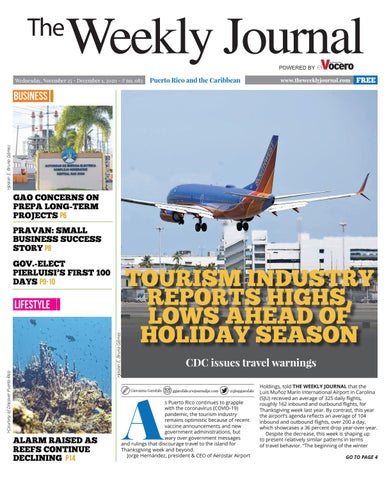
Tourism Industry Reports Highs, Lows Ahead of Holiday Season CDC issues travel warnings
A Giovanna Garofalo
Alarm Raised as Reefs Continue Declining P14
ggarofalo@wjournalpr.com
@giopgarofalo
s Puerto Rico continues to grapple with the coronavirus (COVID-19) pandemic, the tourism industry remains optimistic because of recent vaccine announcements and new government administrations, but wary over government messages and rulings that discourage travel to the island for Thanksgiving week and beyond. Jorge Hernández, president & CEO of Aerostar Airport
Holdings, told THE WEEKLY JOURNAL that the Luis Muñoz Marín International Airport in Carolina (SJU) received an average of 325 daily flights, roughly 162 inbound and outbound flights, for Thanksgiving week last year. By contrast, this year the airport’s agenda reflects an average of 104 inbound and outbound flights, over 200 a day, which showcases a 36 percent drop year-over-year. Despite the decrease, this week is shaping up to present relatively similar patterns in terms of travel behavior. “The beginning of the winter GO TO PAGE 4
The Weekly Journal> Wednesday, November 25, 2020 > 2
3
/ Wednesday, November 25, 2020
a week in review Orange Wednesday Initiative to Help Local Businesses Extended Until January Since this is an atypical year, to say the least, the 2020 edition of Orange Wednesday, the national day of “Buy Local, Ours First,” will be extended from Wednesday, Nov. 25 until Thursday, January 7. The Orange Wednesday initiative encourages the public to sponsor local businesses during the holiday season.
>Carlos Rivera Giusti
>Brandon Cruz González
Walmart Puerto Rico Boosts 45 Local Entrepreneurs
Walmart announced that over 45 local suppliers, including 12 womenled companies, will have the opportunity to sell their merchandise in the chain’s stores around the island as a result of its third edition of the Open Call Puerto Rico, a program that supports the growth of entrepreneurs who grow or manufacture products locally.
Arecibo Radio Telescope to Close in Blow to Science
Due to severe damages after two cables ruptured, the National Science Foundation announced that it will close the Arecibo Observatory in Puerto Rico in a blow to scientists worldwide who depend on it to search for planets, asteroids and extraterrestrial life. The telescope is also considered one of Puerto Rico’s main tourist attractions, drawing some 90,000 visitors a year.
4
/ Wednesday, November 25, 2020
CONTINUED FROM PAGE 1 season and generally that last part of November (Thanksgiving week) traditionally have 20 percent higher passenger volume than what is seen in the first part of that same month (November). For example, if last year we averaged about 12,000 daily passengers arriving in the first 15 days of the month, that translates to a little more than 14,000 in the second part of the month… It would be expected that there will be a behavior quite similar to those we have seen in previous years, but obviously with lower numbers,” Hernández said. Concerning the holiday season, Aerostar projects that there will be a 22 percent or 23 percent drop in capacity compared to 2019. Specifically, “in the month of December we must be at -22 percent to -20 percent in the number of seat capacity,” a trend he said he expects will overlap in January. “This reflects an even greater recovery than what is being reported in other airports.” Meanwhile, Joaquín Bolívar, president-elect of the Puerto Rico Hotel & Tourism Association (PRHTA), said that current Thanksgiving week reservations fluctuate between “teens to 20-something percent.” “Even worse, what worries all of us, is that the week after Thanksgiving, which is typically a very good week, is now registering singles to low-teens occupancy [in percentage points],” he added. “Overall booking of travel is a mixed bag of results, with many consumers holding off making plans or canceling their holiday travel plans as they watch what happens with the pandemic in their own communities and beyond,” said Brad Dean, CEO of Discover Puerto Rico, the island’s Destination Marketing Organization (DMO), although he underscored that recent
Brad Dean, CEO of Discover Puerto Rico >Carlos Rivera Giusti
developments concerning COVID-19 vaccines are “certainly welcome news as we look to 2021.” For his part, Ed Carey, Chief Sales Officer of Discover Puerto Rico, informed that “November has taken off the last several weeks and has shown more and more optimism about travel to Puerto Rico.” In a tourism industry update held last week via Zoom, DMO officials revealed that even though recent surveys show a change in sentiment on future travel, the data shows that there has been an increase in the arrival of passengers since midSeptember, which indicates that consumers are not waiting for an official opening date to arrive. With these arrivals, the island’s hoteliers are being able to hold rates. In fact, right now the revenue per available room (RevPAR) for Puerto Rico hotels is outperforming the rest of the United States.
CDC Issues Travel Warnings
Condado Lagoon in San Juan >Archive
But the glimmer of hope may be dimmed with recent declarations from the federal government. The U.S. Centers for Disease Control and Prevention (CDC) warned last week that “travelers should avoid all travel to Puerto Rico,” after the federal entity labeled the island as a “very high” COVID-19 risk zone. THE WEEKLY JOURNAL asked if this would spark a spike in flight and hotel room cancellations. “The immediate effects have not been seen yet… But it wouldn’t surprise me remotely that people
5
/ Wednesday, November 25, 2020
would take this warning very seriously. Having said that, Puerto Rico is not closed. Hotels continue upholding the protocols to keep their guests and associates safe. We understand that everyone will take into consideration what the government recommends and will make their decision regarding travel as such,” Bolívar replied. Meanwhile, Hernández explained that this classification stems from a new methodology used at the CDC, wherein they originally had three risk levels — low, moderate and high — but they added a fourth label, “very high,” to designate countries and jurisdictions with 100 confirmed COVID-19 cases or more per every 100,000 residents in the past 28 days. “We in Puerto Rico, apparently based on mathematics, fall into this, but it was not only issued for Puerto Rico; it was issued for all destinations that fell under the review,” he said, adding that the SJU was accredited by the Airport Council International, certifying that island’s main airport complies with CDC and World Health Organization hygiene standards and COVID-19 protocols. According to the CDC’s travel guide for Puerto Rico, which was last updated on Nov. 21 as of press time, if a person “must” travel to the island, they must get tested one to three days before their trip and avoid traveling until the test results come back negative; wear a mask and stay at least six
feet apart from people who are not traveling with them; get tested with a viral test while in Puerto Rico one to three days before returning to their destination; and, once they’re back, get tested three to five days after travel and remain isolated for seven days, or 14 if they don’t get tested. The DMO released a statement on Monday, Nov. 23, reacting to this news. “Due to the rising levels of COVID-19 throughout the U.S. mainland and elsewhere, we recognize many travelers should stay home for the upcoming holiday, but research confirms they continue to plan future travel. We are inspiring responsible travelers to keep our Island in mind for their future travel plans while continuing to promote all restrictions and health and safety guidelines currently in place… so that those who choose to travel here in the future will do so responsibly,” the organization wrote.
Executive Order a Deterrent for Some
More so than the CDC’s warning, the PRHTA president-elect lashed out against Gov. Wanda Vázquez’s most recent Executive Order, effective until Dec. 11. EO 2020-080 reduces businesses’ guest capacity to 30 percent and closes off beaches for groups and leisure. Bolívar specifically blamed this government regulation for the further drops in hotel room reservations. Bolívar strongly criticized EO 2020-080, which is stricter than its predecessors in the past few
months, noting that restricting access to beaches strips hotels of some of their primary assets and thus discourages reservations. “We started to see an improvement in September and October, but as soon as that Executive Order passed it was gone,” he said, adding that these provisions create a complicated and unpredictable scenario for the hotel industry ahead of the new year, particularly when travelers are opting for short-term rentals like Airbnb when visiting Puerto Rico. Moreover, he denounced that the government has not provided the PRHTA with scientific data to justify the most recent limitations on their operations and assets. “If the government cannot provide us with the information indicating that we are a problem, then we understand that this is something based on the government’s whim as far as the closures are concerned. Because there is no one who can tell me and convince me that I am safer in a megastore or a supermarket than being on the beach. I don’t have to be a doctor or a scientist to know that being exposed to the open air on a beach is going to be much healthier than being in a closed building,” Bolívar said. Hernández, however, said that the effects of the current Executive Order — effected on Nov. 13 — were probably not noticeable yet because the average traveler “is taking vacations in such a short term. It is very difficult to say that we are seeing cancellations or not because we really are not seeing it yet.” From the SJU airport’s perspective, he doesn’t expect a drastic change because “a big part of our movement” consists of Puerto Ricans who live abroad visiting friends and family on the island or vice versa. He opined that this type of tourist who travels with the express purpose of reuniting with their communities “tends to be more resilient” and their choice to travel would not be affected necessarily, unlike leisure travelers.
Additional CARES Act Funds Pivotal for Hotels
Condado Beach in San Juan >Archive
Bolívar shared findings sent to him from the American Hotel & Lodging Association that revealed “worrisome” trends. According to these results shared by Bolívar, 71 percent of hotels in the U.S. mainland indicated that they could last only six more months at the most with their current occupancy rates. Likewise, 59 percent they are at risk of foreclosure, 52 percent said they would have to close if they don’t receive financial aid, and 98 percent of all hotels surveyed affirmed that if the government releases an additional Payment Protection Program (PPP) they would “request it immediately without thinking twice.” He stated that the central government of Puerto Rico had reassured hoteliers that they would receive a second round of $50 million provided under the federal CARES Act, but they have yet to receive this economic relief. “This is a critical situation. In Puerto Rico [hotels generate] approximately 80,000 jobs. And the problem is that when a hotel closes, it will not open for several years while the infrastructure is set up again,” Bolívar said. Even so, he affirmed that he and his associates are “very hopeful” that the new administrations in the White House and La Fortaleza will release further aid for this sector.
6
/ Wednesday, November 25, 2020
GAO: Delays in Approving Long-Term Prepa Projects
Uncertainty on grid resilience to hurricanes
GAO that additional funding sources could be used for resilience measures but that this would not be determined until specific projects are submitted to FEMA for approval,” according to the November Rosario Fajardo rfajardo@wjournalpr.com @RosarioWJournal 2020 report. “Moreover, although FEMA finalized a $10 he 2020 hurricane season was billion cost estimate for grid repairs in September kind to Puerto Rico, as the island 2020, several steps remain before FEMA approves did not receive the double funding for projects — a process officials said they whammy from two Category were drafting. HUD funding could supplement 4 hurricanes that devastated FEMA funding but, as discussed above, HUD has Honduras, Nicaragua and yet to establish conditions for using these funds Guatemala in and has not established time recent weeks. frames and a plan for issuing A newly released report this information. According from the U.S. Government to HUD officials, they plan Accountability Office (GAO) raises to publish requirements in questions about how Puerto Rico the first quarter of fiscal year According to the could have fared if the island had 2021, but this depends on 42-page GAO report, been hit by strong hurricanes this other factors, such as input during September year. from other federal agencies. 2020, FEMA did The GAO found that as of Further delays in publishing the finalize fixed-cost October 2020, three years since conditions could contribute to estimates on the Hurricanes Irma and Maria delays in Puerto Rico’s ability to aforementioned $10 destroyed much of Puerto Rico’s initiate grid recovery projects,” billion among seven electricity grid, neither the Federal the GAO states. asset categories. Emergency Management Agency According to the 42-page (FEMA) nor the Department of report, during September Housing and Urban Development 2020, FEMA did finalize (HUD) had approved long-term fixed-cost estimates on the grid recovery projects in Puerto aforementioned $10 billion Rico. among seven asset categories. These include “Until HUD and FEMA implement GAO’s $781.9 million to repair the electricity grid’s recommendations, uncertainty will linger about substations; $5.5 billion to repair distribution lines how and when federal funding for long-term grid and streetlights; $2.6 billion for the transmission recovery will proceed. In particular, it is uncertain lines; $686 million for telecommunications across how available funding sources will support the Puerto Rico Electric Power Authority’s (Prepa) measures to enhance grid resilience to hurricanes, assets; $109 million for the generation plants; such as smart grid technology. FEMA officials told $861 million for dams, reservoirs and hydroelectric
T
In fact,
power plants; and $125 million to repair buildings islandwide. The next steps include FEMA approving the “scopes of work” for the individual projects. “According to FEMA officials, the cost estimate of about $10 billion covers potentially hundreds of projects for which FEMA will need to review and make approval decisions,” says the GAO report. To obtain FEMA approval of individual projects, “FEMA and recipients will still need to meet various requirements, such as completing environmental reviews. According to federal and local officials, Prepa began working with FEMA to develop these projects and conduct these reviews prior to FEMA finalizing the fixed-cost estimate.” However, the GAO does not provide timetable estimates for when these reviews could be completed. Neither THE WEEKLY JOURNAL nor its sister publication EL VOCERO could reach officials for comment. However, in statements, federal government and Prepa officials have expressed the positive. “Mitigation is essential for the successful recovery of the island and for facing disasters in the future. These funds help to lessen the effects of natural events that affect our communities,” said Federal Disaster Recovery Coordinator for Puerto Rico and the U.S. Virgin Islands, José Baquero Tirado, after announcing in late October that FEMA had granted $26.2 million for the engineering and design phase of Prepa’s Palo Seco plant and the installation of 11 gas turbines islandwide. “This engineering and design phase allows Prepa to begin the first projects that will lead to a more resilient electrical system against atmospheric events on the island. We continue to work together with our peers to achieve the funding obligations, and more importantly the execution of these for the benefit of our clients,” commented Prepa’s Acting Executive Director, Efran Paredes Maisonet.
/ Wednesday, November 25, 2020
7
Ferries P3 to Bring Economic Development to Vieques, Culebra
Transition with HMS Ferries has begun
N Rosario Fajardo
rfajardo@wjournalpr.com
@RosarioWJournal
oting that the ferry service between Ceiba, Vieques and Culebra is a “vital link” in Puerto Rico’s transportation system, the president of HMS Ferries, Matt Miller, has vowed to bring muchneeded economic activity to the two island municipalities. It is no secret that many of the residents of Vieques and Culebra live below the poverty level and depend on the ferry service to get to and from the main island, but also for vital services, such as
goods, services and medical care. At the same time, there are many local businesses in Vieques and Culebra that are tourism related, whether hotels, small inns, restaurants and shops, that depend on the thousands of annual visitors who go to the two island municipalities for vacation. Many of these visitors come from the main island of Puerto Rico and the U.S. mainland. “We are going to bring the level of service up to par. The current level of service needs to be improved,” said Miller to THE WEEKLY JOURNAL. While he said he did not want to point fingers at anyone, he acknowledged that the ferry service to Vieques and Culebra “has been broken for decades,” with spotty service, chronic delays and ferryboats often out of service. “This impacts everyone,” he said, from local residents and tourists, to local businesses, and has hampered
SAME DAY DELIVERY
*SUBJECT TO AVAILABILITY
economic activity in Vieques and Culebra. HMS Ferries was recently granted a publicprivate partnership (P3) for 23 years to operate the ferry services. As part of the contract, HMS Ferries will receive at least $31 million a year. With the transition process now beginning, Miller said the focus for the next year will be to work with the local government to upgrade the port facilities in Ceiba and repair and maintain the ferryboats. Puerto Rico will receive an indeterminate amount of federal funds for this purpose. “We cannot make the necessary changes overnight; there is a lot of work to be done,” Miller said.
8
/ Wednesday, November 25, 2020
Pravan Health offers personalized health services both in its clinic and through its telemedicine platform. >Courtesy
Pravan Revolutionizing Healthcare with Innovative Business Model
Concierge medicine partially funded by Acts 20/22 investors
S
Giovanna Garofalo
ggarofalo@wjournalpr.com
@giopgarofalo
everal months into the COVID-19 pandemic, more people are looking into improving their bodies’ defense mechanisms to fight off the threat of the coronavirus, as well as to boost their overall health and enhance their physical and mental well-being. Pravan Health, a robust clinic and wellness center in San Juan, offers a long-term solution for people who are interested in healthier lifestyles, as the company gradually revolutionizes the concept of health care. Located in the Ciudadela complex in Santurce, Pravan Health is a concierge medicine clinic that centralizes health and wellness in an innovative space for its members to receive personalized services. David Melchor, co-founder & CEO of Pravan, explained to THE WEEKLY JOURNAL that this concept is making patients and medical professionals rethink how health care is done. Pravan opened in 2017, right before Hurricane Maria, as a response to “the deficiencies in the current health system,” Melchor said. “The current health system is highly segmented, access is not easy, the system is too reactive, people don’t have a preventive focus and so, service isn’t good. When you visit the doctor you don’t get a good experience; you always have to wait, and then that doctor sends you to another doctor but they don’t
speak between themselves,” he opined. As such, Pravan was designed by a team of medical experts, entrepreneurs and local investors to provide a new option that prioritizes access, prevention and service — the three pillars of Pravan Health. With roughly 2,500 square feet in one of Santurce’s most attractive locations, the clinic cost approximately half a million dollars to finance, raised with an initial investment of $2 million to kick-start the project. The entity soon found success with American investors who relocated to Puerto Rico, incentivized by Acts 20/22 (now Act 60). These patients, marveled by the clinic’s in-person and virtual services, detected Pravan’s potential to grow, so they provided a second wave of capital investment. “From an investment standpoint, let’s say that Pravan’s capital is initial-hybrid, where there is local capital and there is also capital from Americans who have moved to the island and who have brought money from abroad and invested it in businesses like ours. It went well and we were lucky because it is not easy to raise capital in Puerto Rico for startups. There is a lot of talent, there are a lot of people with good ideas, but it is not easy to raise the capital that is needed to start a business,” Melchor stated. Since the pandemic began, Pravan has reportedly seen a 35 percent increase in memberships and a 100 percent rise in its website visits, given that citizens are concerned about their physicality and nutrition amid the COVID-19 emergency. “We are seeing that more people are investing in their health with premium, high-quality services like Pravan,” the CEO added.
Innovative Business Model
Pravan requests memberships instead of health insurance, so anybody with the means to pay can have access to quality health care. The membership costs $2,300 a year and can be paid biannually or quarterly, for the equivalent of $190 a month. Pravan counts on a team of more than 15 medical experts, such as primary care physicians, family medicine physicians, gynecologists, infectious disease specialists, nurses and health coordinators. Other staff includes professionals with expertise in nutrition, sports medicine and therapeutic massages, among others. Apart from providing these medical benefits, Pravan connects its members with specialized doctors from a variety of fields — a business model known as concierge medicine, or direct primary care. Pravan keeps digital records of its members and refers the latter to lab exams before connecting them with external doctors for followups. Melchor said that there are an estimated 7,000 clinics with this focus in the U.S. mainland, but Pravan is the first of its kind in Puerto Rico, offering its services both to people who reside near the San Juan area, as well as Ponce, Dorado, Mayagüez. Pravan also has a telemedicine platform that offers 24/7 consulting and prescription services. Because of the pandemic, roughly 70 percent of all member-doctor interactions are conducted virtually.
Constant updates online 24/7. TheWeeklyJournal.com
Visit us for updated content on our 24/7 platform.
WeeklyJournal
The
9 < The Weekly Journal> Wednesday, November 25, 2020
9
/ Wednesday, November 25, 2020
10
/ Wednesday, November 25, 2020
Pierluisi Outlines Agenda for His First 100 Days in Office
Sharp focus on COVID-19, economic development
G Giovanna Garofalo
ggarofalo@wjournalpr.com
@giopgarofalo
ov.-elect Pedro Pierluisi has outlined his agenda for his administration’s first 100 days in office, focusing primarily on the coronavirus (COVID-19) pandemic and Puerto Rico’s economic development. In addition to breaking down his goals for his first 100 days serving as governor, Pierluisi reiterated his commitment to accomplish the 12-point agenda for economic recovery developed by the Puerto Rico Chamber of Commerce (PRCC) in response to the health crisis and the island’s fiscal emergency. With regard to the virus, which has taken about 1,000 lives on the island since the pandemic began in March, Pierluisi affirmed that its management will be central for his administration, in light of the spike reported in recent weeks. “To develop a public policy based on verifiable data and information, I have been in conversations with various health professionals and statisticians, including trustees of the Science and Technology Trust, personnel from the Centers for Disease Control and Prevention... and other worldrenowned experts,” he said. According to the governor-elect, he will create a science coalition composed statisticians, epidemiologists, federal officials and other local experts to provide him guidance on how to integrate a scientifically conscious perspective in his public policies with aims to mitigate the threat of the coronavirus. “My administration will seek to integrate science into decision-making for the benefit of all Puerto Ricans, starting with the pandemic,” he stated. As reported by THE WEEKLY JOURNAL, Puerto Rico Health Secretary Lorenzo González said that the incoming Pierluisi administration needs an additional $300 million to help fight the COVID-19 crisis on the island for 2021. In terms of immediate funds needed, this would be $150 million for the first six months of 2021. The Health chief outlined some of the monthly expenses that the Health Department needs to fight the coronavirus pandemic. These include $12 million a month for COVID-19 tests and municipal contract tracing; $4 million specifically for the
Pierluisi seeks to foster economic growth with faster permits, no inventory tax and by completing the restructuring process of
elderly population; $1.5 million for the Bioportal Dashboard system; $5 million to $6 million for airport and marine port screenings; and $1 million for communication efforts. “We are hopeful that we will get an extension [from the federal government] for the CARES Act funds,” González said. Such an extension would be needed not only from the incoming administration of President-elect Joe Biden, but also from the new Congress that will be installed in January 2021. During testimony before the Puerto Rico government transition committee, he explained that the Health Department has already allocated more than $420 million for hospitals on the island to fight COVID; $20 million for Remdesivir and other medications; and $40 million for telemedicine. Meanwhile, during an activity sponsored by the PRCC, Pierluisi said that both he and Resident
Commissioner Jenniffer González will focus their efforts on ensuring that Puerto Rico is included in any future economic stimulus acts approved by the U.S. Congress. While Pierluisi recognized the risks of COVID-19, he asserted that Puerto Rico must learn to overcome the pandemic, particularly its devastating effects on the economy, stating that “2021 must be the year of returning to normalcy, seizing scientific achievements, improving data and treatments, access to more and better tests, reliably tracing, effective treatments and vaccines.”
Improving Puerto Rico’s Business Environment
To prevail over the pandemic’s financial toll and foster economic development beyond, Pierluisi discussed a series of proposals that he intends
11
/ Wednesday, November 25, 2020
Gov.-elect Pedro Pierluisi said he will create a science coalition to help guide his administration in overcoming COVID-19. >Courtesy PRCC
He claimed that his proposed “digital to set forth from La Fortaleza. The protransformation” for obtaining statehood official seeks to permits would also accelerate complete the restructuring recovery and reconstruction process of Puerto Rico’s projects funded by the Federal multibillion-dollar debt, relax Emergency Management the process to obtain permits, Agency and the CDBGeliminate certain tax burdens Gov.-elect DR federal program. “It is and support the creation of local Pierluisi reaffirmed a unique opportunity to businesses and consumption of his commitment make improvements to our their goods and services. to eliminate the infrastructure, including our “We have to be able to act inventory tax, a quickly in the processes of electrical system, which will have heavily scrutinized a positive effect on the economy restructuring the debt of the tax that affects and will help promote Puerto government of Puerto Rico in small and mid-size Rico as a destination for local order to leave bankruptcy behind enterprises (SMEs) and foreign investment,” Pierluisi and be able to concentrate on the most. However, stated. strengthening our economy, he warned that Meanwhile, he reaffirmed encouraging job creation, and this process would his commitment to eliminate fostering investment and growth take place gradually the inventory tax, a heavily in sectors with potential in Puerto because the tax scrutinized tax that affects small Rico,” he said. Furthermore, his has a “significant and mid-size enterprises (SMEs) administration would implement impact” on some an easier permitting process the most. However, he warned municipalities. through self-certifications and a that this process would take place “single ID so that the government gradually because the tax has does not ask for documents and a “significant impact” on some information that the same government already municipalities. has.” Pierluisi also underscored the need for a
In fact,
“motivated, skilled and well-remunerated” workforce, for which he will use the U.S. government’s Office of Personnel Management model to offer firsthand work experience for the island’s youth in a “merit-based” system. By providing more internship and work opportunities, he hopes to retain more capable professionals while providing them with relevant work experience. In addition, he aims to extend government services to local businesses. “I will promote greater investment in our technological infrastructure to support remote work and education and digital companies, and I will encourage the Department of Economic Development to expand its technical support services to entrepreneurs and microentrepreneurs on the island. This will include strengthening the Federal Contracting Center of Puerto Rico to increase the participation of our companies in the services contracted by the federal government under the [minority-owned] business program that I sponsored together with the SBA (Small Business Administration) during my years as resident commissioner,” he added.
12
/ Wednesday, November 25, 2020
Ricardo Álvarez-Diaz,
Teresita Fuentes,
Licensed Architect and Entrepreneur www.advfirm.com
CPA
It’s the People
I
“
f you make the choice to serve the public, public service, then serve the public, not yourself.” That wasn’t Abraham Lincoln, it was Jack Abramoff, the notorious former lobbyist who served years in prison after scandals broke out in Washington, D.C. regarding his dealings on Capitol Hill. What does this have to do with Puerto Rico you say? OH, EVERYTHING! The past four years have been plagued with public servants who only served themselves — but with them have been quite a few octopuses, ahem sorry, businessmen who have extended their tentacles throughout our government institutions as if we were living 20,000 leagues under the sea. Puerto Rico’s government is large, let’s not sugarcoat that. New governors have taken office on the island approximately every four years, with Luis Muñoz Marín and Ricardo Rosselló breaking that statistic — the former because he held office for 16 years and the latter for a little over two years. This “cambia-cambia” has led to government dis-government, sloppy purchasing practices and ultimately, a gross disregard for the government’s greatest asset, its people. People may say what they will about public servants. Many of the aforementioned octopuses believe that the products and solutions they sell are a replacement for human effort. Institutional memory is often disregarded and employees are disposed of to save “millions” in order to spend “less” (usually millions) in solutions that no one has asked for, to problems that the government doesn’t have. In my second tour in government as Treasury secretary, I interacted, worked with and developed lasting relationships with Treasury employees that truly impressed me. One of them, a “Secretaria 1” (classified as such by our system) had a B.S. and an M.A., both in Business Administration, spent more than a decade in the Treasury Department and knew its
operations inside and out. She had contacts in each regional Hacienda office throughout the island. Needless to say, after a week of knowing her, I made her one of my Special Assistants. What system could provide that type of institutional value? People are an organization’s most important asset and central to any transformation. Human Enterprise — that’s what it’s called. It is built by approaching any situation by upping the humanity, removing friction, implementing value inclusion and working to speed up delivery. They’re all interconnected. Any organization that wants successful technological transformation must place PEOPLE in the driver’s seat. The government and the Fiscal Oversight Board must recognize that people become critically important if they want to drive the change they need. How does that famous speech go “ … government of the people, by the people, for the people, shall not perish from the earth…”? Yep, Honest Abe had it right, it’s the PEOPLE! The need to reduce government expenditures has been mainly focused on payroll. Retirement windows opened to reduce payroll but have served the useless purpose of draining institutional memory, while the government has stayed in the same economic conundrum. Examples of government inefficiency and redundance are plenty. They range from thousands of bank accounts where the government is unable to distinguish federal grant funding from other assets, to disconnects between state and municipal parking and speeding fines, that allow a driver to renew their driver’s license while they owe thousands in fines to municipalities. They’re even more profound, with issues like different payroll systems between agencies, to agencies that keep time reports on paper to this day.
T
Transforming Communities Through Design
he extensive damage and human suffering caused by natural and man-made disasters remind us of the importance of planning and design. The pandemic also has forced us to rethink the importance of human interaction and how we live in a community. Design plays an important role in how we rethink our future and transform our communities. There are several planning concepts that can help us transform communities through design. Smart mobility concepts aim to solve the problems of commuting, traffic and transport development by increasing the safety of commuters, providing non-vehicle commuting paths, improving commute time, reducing pollution and reducing transport costs by making it more affordable. It also encourages more people to go out and walk or bike around their community since it keeps them protected from transit. By designing with smart mobility in mind, both transit passengers and pedestrians can move safely and efficiently around their community. User-centered design starts with people and ends with the solutions that are tailored to their individual needs. Placemaking is a user-centric approach to the planning, design and management of public spaces. It aims to promote health, well-being and happiness. It capitalizes local assets, resources and potential to strengthen communities and improve the resilience of cities. It focuses on the needs of the people that live, work and play in a space, using the public spaces in a development or neighborhood to encourage greater social interaction, foster healthier relationships and improve the economic viability of the community. The creation of urban landscapes, a key element in the
development of a city, includes restoring and preserving urban parks, recreational areas, business parks, nature centers and other green areas. They are much more than pretty plants, charming parks and green roofs. They are the streets, sidewalks, alleys and parking lots that shape a city’s look, its functionality and culture. Sustainable design minimizes our impact on the environment by applying innovative methods involving energy-saving technology, sustainable materials, recycling, repurposing and other elements that support long-term ecological balance. Sustainably designed spaces not only focus on saving energy and natural resources, but also on increasing the well-being of community members, adding to their comfort, enhancing their experience, boosting their productivity and improving the quality of their lives while reducing demand on the environment. Resilient design can adapt to changing conditions and stand the test of time. That is why architects and developers must think long term when aiming to create resilient and sustainable buildings, communities and cities. Resilient spaces can withstand natural disaster, have strong community ties and are sustainable. Design is a transformative tool that facilitates the betterment of individuals, businesses and communities. Each design element serves a specific function. Design can transform communities by developing public spaces, promoting smart mobility, resisting and rapidly recuperating from human, social and environmental risks. Design can minimize the negative impacts and vulnerability of badly planned communities. By careful planning, deep understanding of people’s behavior and implementation of these techniques, design can transform our living environments that can benefit us all.
13
/ Wednesday, November 25, 2020
Enjoying LongDistance Holidays Five Ideas For New Traditions to Start This Year
T
Active Aging
he holiday season usually brings outdoor adventures, time with family and revisiting old traditions. If you can’t travel or host guests this year, you may be wondering how to stay connected across the miles. Fortunately, there are many festive options available to make this year feel cozy and bright. As you head into the holiday season, coordinate some of these ideas with family and friends to fill your home with joy and laughter (even if it’s over the phone).
Read a Book Together
Nothing connects people like the love of a good book. If you have a quieter house than usual this holiday season, consider joining a book club (or start your own) with family and friends. You can each read the selection, then come together for a video chat to discuss your thoughts; find a holidaythemed book (Thanksgiving and Christmas) to get in the spirit. Are you reading with a younger crowd? Look into one of the apps and websites now available for reading to children virtually. There are options for all platforms, paid and free, so plan a weekly bedtime story session with your favorite holiday books.
Take an Online Class Together
If you’re used to enjoying lots of interactive experiences with friends and family, try transitioning the fun online. Many small businesses have joined the bigger companies in offering virtual classes for all ages. Check with your local restaurants, art studios and community theaters — they’re adapting many traditional classes for an online format. Sign up with your family and friends and learn something new together.
Host a Virtual Bake-Off
Baking during the holiday season is a tradition that many families share. This year, being apart doesn’t mean forgoing the culinary fun. Coordinate
a virtual bake-off with your family to try a new recipe together. Browse your favorite cookbooks or online sites (like All recipes) to find the challenge, then designate a competition time. Have one family member be the official videographer to capture the baking process (and make sure to include lots of commentary for the family on the other end); either bake live on FaceTime/Zoom or email the videos once complete. When everything’s out of the oven, conduct a live taste-test at each house and declare yourselves the winners.
Send Interactive Mail
Everyone enjoys getting old-fashioned “snail mail,” so take advantage of the holiday season to make these letters more interactive. Consider sending a small packet of craft supplies to your grandkids; they can make the craft and mail back the finished product. Hobby stores sell craft kits that are ready to go. Scavenger hunts are also a fun way to connect across the miles — send a scavenger hunt to your family and keep a copy for yourself, then coordinate a due date. Mail the
completed list back and have fun comparing notes.
Commit to Outdoor Challenges
While the holiday season has plenty of opportunities for indoor fun, activities outside in the crisp air are also plentiful. Many towns host holiday 5K runs, set up harvest festivals and sponsor community food/toy drives. This year, the events may look a little different, but most places are transitioning to virtual or distanced versions of popular activities. Coordinate with friends and family far and wide to pledge time for outdoor/community fun. Take photos because you complete your outdoor time and share them through text or email. Set a goal with prizes — for example, every hour of outdoor time earns a chance to pick the holiday karaoke song that grandma has to sing over the family Zoom. These festive, socially-distanced ideas prove that family togetherness doesn’t always depend on physical proximity. Fill your holiday calendar now with all of these activities. Who knows — some may stick around long after the pandemic is gone.
14
/ Wednesday, November 25, 2020
Report Sounds Alarm on Ongoing
Decline of U.S. Coral Reefs Reefs in Puerto Rico and the USVI surveyed
ALLAHASSEE, Fla. (AP) — A first of its kind assessment of coral reefs in U.S. waters is again sounding the alarm over the continued decline of these sensitive underwater ecosystems, which scientists deem essential to the health of the world’s oceans amid the environmental effects posed by human activity and climate change. The November 2020 report by the National Oceanic and Atmospheric Administration and the University of Maryland, took stock of the health of coral reefs under U.S. jurisdiction, from Guam and Hawaii in the Pacific to Florida, Puerto Rico and the U.S. Virgin Islands in the Atlantic. “Our work in the Pacific and Atlantic Oceans shows a dire outlook for coral reef ecosystem health, from warming ocean waters, fishing, disease and pollution from the land,” said Heath Kelsey, director of the University of Maryland Center for Environmental Science. The reefs off the Florida coast are the country’s most degraded, with perhaps as little as 2 percent remaining, officials said. When healthy, coral constitute breathtaking underwater colonies of tiny organisms, known as polyps, whose hardened skeletons form clumps or fingerlings of underwater rock known as reefs. The profusion of life they support, including fish and other aquatic creatures, is an important component of the marine ecosystem. The reefs are natural barriers to storm surges, particularly in regions susceptible to hurricanes. And they also are important to coastal economies that depend on tourism, marine aquaculture and commercial fishing — the so-called blue economy that depends on the conservation of ocean resources to help sustain livelihoods from the sea. “The economic impacts of coral reefs in the United States are around $3.4 billion annually. So this is really of great importance to our nation,” said retired Navy Rear Adm. Tim Gallaudet, an assistant secretary at NOAA. Officials said it was the first time that a nationwide assessment was conducted, despite years of concern over the health of coral reefs, not just in the U.S. but around the world. Some studies say more than half of the world’s reefs have been
>Courtesy of Discover Puerto Rico
T
The Associated Press
lost, and that more are in danger. The status report used data collected between 2012 and 2018 and classified regions as “very good,” “good,” “fair,” “impaired” and “critical.” While the report says the condition of most coral reef regions in the United States was “fair,” it added that sewage, lawn chemicals and other pollutants that flow into the oceans pose potentially catastrophic threats to their survival.
Reefs in South Florida the Most Damaged
That threat is most pronounced in waters off South Florida, from the Keys to north of Palm Beach. The regions is one of the country’s densest population centers with a population of more than 9 million. “It shouldn’t be surprising. There’s an immense population of people living in close proximity to those reefs,” said Jennifer Koss, the director of NOAA’s coral reef conservation program. But even in more remote oceans where human interaction is limited, coral reefs remain under threat because of climate change, which has caused oceans to warm and make some coastal areas inhospitable to delicate coral.
“Climate change is the single biggest threat to shallow water coral reefs in the U.S. and worldwide,” said Kelsey of the University of Maryland. The report is meant to be a call to arms. “This report represents a snapshot of reef condition and is a great resource for communities and decisionmakers throughout the nation. We hope the report starts a dialogue about the various factors and potential solutions to the threats affecting coral reefs,” Koss said. Most U.S. territories were designated as “fair,” including those in Hawaii and Puerto Rico. Reefs were in American Samoa and the most remote areas of the Pacific were in “good condition.” Florida reefs were said to be in “impaired” condition. Officials in Florida have become more mindful of the streams of pollution flowing into its coastal waters and the harm they can do to coral. The pollutants also have been blamed for red tides and other ecologically devastating algae blooms. A bipartisan federal bill co-sponsored by lawmakers from Hawaii and Florida — two of the states with the highest stakes on the matter — would provide federal funding to help restore and manage the nation’s reefs.
/ Wednesday, November 25, 2020
15
Singer and UNICEF Goodwill Ambassador Angelique Kidjo and other international musicians are performing for an online fundraising concert called Peace Through Music on Tuesday, Dec. 1. >Chris Pizzello/Invision/ AP, File
Artists Sing Social Anthems for United Nations Anniversary
those barriers or borders.” These musicians are part of an online fundraising concert on Dec. 1 called Peace Through Music: A Global Event For Social Justice, to celebrate the 75th anniversary of the United The Associated Press Nations. The Facebook Live event will also feature performances by Annie Lennox, Becky G, Brandi ASHVILLE, Tenn. (AP) — For Carlile and Mike McCready of Pearl Jam, Carlos Grammy-winning international Santana, Gary Clark Jr., Mavis Staples, Ringo Starr, star Angelique Kidjo, her artistry Run The Jewels, Sheila E, Yo-Yo and her Ma and more. The event will raise activism inform money for the Playing for Change each other Foundation, the United Nations because music Population Fund, Sankofa, has the power to connect beyond Silkroad and the Rock & Roll Hall skin color, language or countries. “Get Up, of Fame Foundation. “Music has that absolutely Stand Up,” a simple Kidjo, who is a UNICEF powerful side to it that sometimes message that has Goodwill Ambassador, is an when I finish a concert, I’m like, become part of Bob outspoken advocate for women’s ‘Why can’t we just live like this?’” Marley’s legacy to rights and education for young said the singer-songwriter from the world, was the women in Africa through her the West African country of Benin. obvious song choice Batonga Foundation. Kidjo has That sentiment is something for his grandson to traveled the world to encourage that Skip Marley, a thirdsing for this online young people to be leaders in generation musician and concert. their own communities because grandson of reggae icon Bob she says that is the leverage Marley, has grown up knowing as needed to address systematic well. issues of poverty and climate “We’re talking to the people, so change. it’s all colors, all religions,” said Marley. “Music is “We’ve created a world with billions of people music. That’s the beauty of it. It cuts through all of
Peace Through Music Concert on Dec. 1
N
In fact,
suffering and a minority of people are living on top of them. And if we want to live in a world of peace, we have to take care of Mother Nature and at the same time take care to get people out of poverty,” said Kidjo, from her home in Paris. For the online concert, Kidjo teamed up remotely with cellist Yo-Yo Ma and Peter Gabriel to sing Gabriel’s anti-apartheid anthem “Biko,” about a South African activist who was killed in detention in the 1970s. Kidjo said the song’s message directly connected to this year’s Black Lives Matter protests over police killings of Black men and women. “Racism is so linked to capitalism and we have failed to address that issue for so many, many, many years and centuries, I think from slavery all the way to today, that it becomes a cancer that is eating our societies,” said Kidjo. “Get Up, Stand Up,” a simple message that has become part of Bob Marley’s legacy to the world, was the obvious song choice for his grandson to sing for this online concert. “Wherever there is a fight, wherever there is oppression, wherever there is wrongdoing, there will always be that anthem,” said Marley, who performed with song with his mother Cedella Marley. It’s a spiritual experience to sing his grandfather’s songs, Marley said. “Those are the songs I first hear and the songs I first sing,” said Marley. “So when I’m singing it, I’m feeling my grandfather.”