Puerto Rico and the Caribbean
www.theweeklyjournal.com
>Brandon Cruz González
Wednesday, November 4-10, 2020 - // no. 080
Banco Popular Moving on Up P6-7 Peterson Upends FOMB Hearing P9 Moonshots Could Transform the Caribbean P10
>Josian E. Bruno Gómez
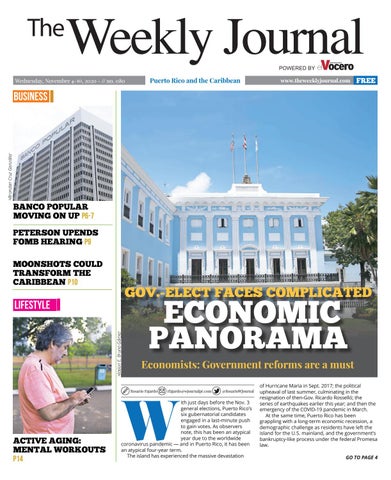
Gov.-Elect Faces Complicated
Economic Panorama
Economists: Government reforms are a must
W Rosario Fajardo
Active Aging: Mental Workouts P14
rfajardo@wjournalpr.com
@RosarioWJournal
ith just days before the Nov. 3 general elections, Puerto Rico’s six gubernatorial candidates engaged in a last-minute push to gain votes. As observers note, this has been an atypical year due to the worldwide coronavirus pandemic — and in Puerto Rico, it has been an atypical four-year term. The island has experienced the massive devastation
of Hurricane Maria in Sept. 2017; the political upheaval of last summer, culminating in the resignation of then-Gov. Ricardo Rosselló; the series of earthquakes earlier this year; and then the emergency of the COVID-19 pandemic in March. At the same time, Puerto Rico has been grappling with a long-term economic recession, a demographic challenge as residents have left the island for the U.S. mainland, and the government’s bankruptcy-like process under the federal Promesa law. GO TO PAGE 4
The Weekly Journal > Wednesday, November 4, 2020 > 2
3
/ Wednesday, November 4, 2020
a week in review FEMA Allocates Over $26 Million to Prepa
>Courtesy
>Courtesy
>Carlos Rivera Giusti
The Federal Emergency Management Agency — in coordination with the Central Office for Recovery, Reconstruction and Resilience — allocated over $26.2 million for the Puerto Rico Electric Power Authority (Prepa) to install a combined cycle generation plant in Palo Seco and acquire 11 gas turbines for five additional facilities islandwide.
Pall Life Sciences Invests in Cogeneration Energy System Pall Life Sciences has invested over $4.5 million in a cogeneration system that produces electrical and thermal energy at its facilities in Fajardo. The project is in addition to the biosciences sector company’s announcement in July about the construction of a new warehouse facility, with an investment of over $10 million.
39 Startups Receive Investment From Parallel18 As part of its mission to support innovative entrepreneurship and impact Puerto Rico’s economy, parallel18 — along with its parent organization, the Puerto Rico Science, Technology and Research Trust — announced that 39 startups will benefit from its $1 million Business Continuity Fund. Each startup will receive $25,000 to $35,000 to support their work.
4
>Josian E. Bruno Gómez
/ Wednesday, November 4, 2020
CONTINUED FROM PAGE 1 There is no doubt that whoever wins La Fortaleza, most likely the New Progressive Party’s Pedro Pierluisi, will inherit a complicated economic panorama. As of press time, and with 95.28 percent of the polling stations reporting, these were the official results from the State Elections Commission: • Pedro Pierluisi (NPP): 381,015 (32.41%) • Carlos Delgado Altieri (PDP): 368,602 (31.36%) • Alexandra Lúgaro (Citizen Victory Movement): 170,757 (14.53%) • Juan Dalmau (P.R. Independence Party): 163,882 (13.94%) • César Vázquez (Dignity Project): 82,963 (7.06%) • Eliezer Molina (Independent): 8,269 (0.70%) Pierluisi has publicly declared victory, but the early voting results are still being tallied. However, the conventional wisdom is that these votes will favor Pierluisi. Faced with the complex economic, health, political and social crisis affecting Puerto Rico, various economists interviewed by THE WEEKLY JOURNAL assure that it is urgent to rethink the government’s institutional structures in order to mitigate the economy’s weaknesses and have an efficient response to future emergencies. According to economist Santos Negrón, the main actor in the economy is the institutional framework of the government, which, in his opinion, has shown serious deficiencies in all its components. He affirmed that if it is not strengthened, the government will never be able to ensure the much-needed economic growth. “It is vital that government institutions — and I mean the courts, regulatory systems, security, public health and essential services — function efficiently. This is necessary for the economy to run and for economic development. When the
After the great challenges we have faced as a country — hurricanes, earthquakes, the pandemic and debt, among others — we deserve more from those who aspire to govern Puerto Rico for the next four years. We deserve something more than being satisfactory or achieving the bare minimum. The country needs real, executable plans with results that are measurable and comparable. We deserve no less.
— Alba Brugueras, the president of the Puerto Rico Economists Association institutional framework weakens, the economy cannot recover,” the economist said. Negrón emphasized that government failures weaken the economy, which in turn, gives way to market failures. “One thing is clearly tied to the other. When the two failures are combined, it is a lousy scenario and not very encouraging. That is what we are experiencing right now,” he added.
The expert attributed the existing institutional stagnation to the de-professionalization of the public system and the weakening of the merit system. “The government has become a reflection of political power. People with the necessary academic training or experience are excluded because they do not share the political ideals [of those in power]. That reduces the productivity and efficiency of the government,” he said. Moreover, Sergio Marxuach, director of Public Policy of the Center for a New Economy (CNE), also agreed that the de-professionalization of the government and the strong political influence in public agencies have weakened the norms that govern these respective operations. He made it clear that for institutions to function, a set of formal and informal rules and trained personnel are required to enforce them. However, he assured that it is necessary that the regulations have the endorsement of the political parties involved. “When the governing rules do not have consensus among political actors, that leads to a system that is dysfunctional. This is exactly what happened with the Electoral Code. They changed the rules of the process without consensus and there was a disaster with the primaries. That is replicated throughout the government,” Marxuach stated. Meanwhile, economist José Alameda argued that economic development, levels of corruption and the government’s response depend on how the institutions are organized and the effectiveness of their work. “Everything is due to the institutional framework. It depends on the laws, incentives, organizational structures, agencies...,” he mentioned. “In 1948, under the mandate of the economist Rexford Tugwell, Puerto Rico benefited from an institutional framework created by the Planning
5
/ Wednesday, November 4, 2020
Board, the Government Development Bank, the Highways Authority, the Electric Power Authority... but corruption, mismanagement and politicking have undermined their base of effectiveness,” Alameda added. Given this, Marxuach underscored that to put the government’s institutional framework to work efficiently, no more money is needed. As detailed, in 1948 the net per capita income in Puerto Rico was $256 per person and the infrastructure was rudimentary, but in that year’s elections the votes were quickly counted despite limitations. “In 1948, we had less money, but better institutions,” he commented. Likewise, Marxuach stressed that without a change in the government’s institutional framework, all the efforts made to resolve the situations that affect Puerto Rico — including the restructuring of the government debt of $72 billion — could be unsuccessful. “Much of what needs to be done to resolve the crises we are going through can be done with legislation, but they are not able to reach political agreements,” he said. According to Alameda, in order to implement a new efficient institutional framework, it is necessary, first of all, to carry out a comprehensive study of the government that reflects what the country’s needs are. “A new framework of agencies and a new government structure are needed to allow Puerto Rico to be extremely depoliticized,” he said. “In security, a structure that combines local and federal government is needed to tackle crime. In education, given the changes, an effective structure adapted to new challenges is needed. And so on, put together a government structure adapted to the new reality,” Alameda stated.
Economists Association: Attracting Capital a Must The Puerto Rico Economists Association conducted an analysis of the economic platforms of the island’s five political parties, noting that for the most part, they were deficient in focus, structure and feasibility, and accountability. In general, the association found that the most important challenges Puerto Rico is facing
Puerto Rico is still recovering from the islandwide devastation of Hurricane Maria in Sept. 2017. >Josian E. Bruno Gómez
are related to education, the environment, demographic changes, government institutions, health, investments, the labor market, poverty and economic inequality, public debt, and physical and technological infrastructure. In terms of specific recommendations to help move the economy forward, the association said the governor-elect must develop a policy of foreign and local capital under equal conditions. This would help attract companies that are dedicated to research, development and innovation. At the same time, the new administration should establish a fund to invest in research with investment from these companies; demand a publicly available audit of Puerto Rico’s debt and negotiate a haircut with creditors. Healthcare should also be a priority during and after the coronavirus pandemic. “After the great challenges we have faced as a country — hurricanes, earthquakes, the pandemic and debt, among others — we deserve more from
As with the rest of the world, Puerto Rico is also grappling with the COVID-19 pandemic.
those who aspire to govern Puerto Rico for the next four years. We deserve something more than being satisfactory or achieving the bare minimum. The country needs real, executable plans with results that are measurable and comparable. We deserve no less,” said Alba Brugueras, the president of the Economists Association. Meanwhile, another economist, Gustavo Vélez, outlined the five economic reforms that urgently needed, starting at the “broken” Puerto Rico Electric Power Authority (Prepa). “Without access to capital markets and outdated infrastructure, the only way to rehabilitate it is through a public-private partnership model. The federal government’s $13 billion injection is conditional on Prepa’s operation passing into private hands,” he said. Second, the permits process for the private sector remains problematic, as it still takes months of jumping through hurdles, he indicated. “Reformulating the permits system is essential to improve the island’s competitiveness and reduce the costs of doing business.” Third, Puerto Rico’s tax system “criminalizes” work and investment, Vélez stated. “High tax rates respond to the model of a large government that spends beyond the true capabilities of the economy. Similarly, the inventory tax is nefarious for merchants, who have to pay a tax without having sold a single product.” Fourth, restructuring the island’s debt has still not been completed, more than three years after the central government declared bankruptcy, he noted. Fifth, corruption must be tackled effectively. “Lack of government transparency and corruption damages the island’s credibility with the local and international business community. It is imperative to restore credibility in institutions and root out public corruption,” he said. — Reporter Christian G. Ramos Segarra contributed to this story.
6
/ Wednesday, November 4, 2020
>Archive
Popular Q3 2020 Reports ‘Rebound’ in Economic Activity Continuing to manage ‘uncertain times’
P Rosario Fajardo
rfajardo@wjournalpr.com
@RosarioWJournal
opular Inc. has reported net income of $168.4 million for the third quarter (Q3) ended Sept. 30, 2020, compared to net income of $127.6 million for Q2 2020, reflecting an economic rebound fueled by the unprecedented level of federal stimulus. “While the economic scenario remains uncertain, the strong results reflect our diversified sources of revenue and prudent risk management. Deposits continued to grow and loan demand remains low as customers are cautious and conserving cash. Our capital and liquidity levels are robust and we are well positioned to continue
to serve our customers as they manage through these uncertain times,” reported Ignacio Álvarez, president and CEO of Popular. During the earnings conference-call, he reported that business activity has revived as Puerto Rico’s economy reopened after the strict lockdown from March to May. “Economic trends and customer activity continued to improve. Employment trends which deteriorated rapidly in April are still down significantly compared to last year, but have also begun to improve,” he said. Popular reported that total nonfarm employment has increased by 7 percent since April, but remained 8 percent below September 2019 levels. New auto sales have rebounded sharply and in the third quarter we’re up 18 percent year-over-year. While demand for automobiles remained strong, lack of inventory may impact sales going forward, Álvarez indicated. Meanwhile, cement sales increased 29 percent in the third quarter, both sequentially and have compared to the year ago period. Debit and credit card sales increased by 32 percent compared to
Q2 2020, and by 27 percent versus the last year’s third quarter. Year-to-date sales are up 7 percent compared to 2019. Similarly, Popular’s third quarter mortgage originations have rebounded, increasing by 69 percent compared to Q3 2019. “[M]ost impressively, given Puerto Rico’s recent demographic trends, our customer base continues to grow, increasing by 41,000 in the third quarter to 1.9 million customers,” the Popular chief said. Still, Álvarez noted that tourism is improving slowly, but continues to lag other areas of the local economy. “Hotel occupancy bottomed at 8.5 percent. However, as restrictions were lifted, occupancy levels increased to 43 percent to the end of July. While airport traffic has been gradually increasing, arrivals during the month of September were still 48 percent lower than the previous year,” he said. Third quarter results were driven by higher revenues and lower provision partially offset by higher operating expenses. The increase in net interest income was driven by an increase in the bank’s investment portfolio and lower deposit costs.
7
/ Wednesday, November 4, 2020
The branch realignment will allow Popular to reduce operating expenses, leverage resources to focus on small and mid-size businesses and enhance its digital offerings to support changing customer behaviors. “We estimate annual savings will be $13 million with an expected payback period of approximately two years,” he said.
First BanCorp’s Q3 2020 Report
In related news, First BanCorp, the bank holding company for FirstBank Puerto Rico, also reported positive numbers: net income of $28.6 million for the third quarter of 2020, compared to $21.3 million for the second quarter of 2020. Additionally, during Q3 2020, First Bancorp incurred merger and restructuring related costs of $10.4 million in connection with the closing of the Banco Santander PR acquisition. The transaction was completed on Sept. 1, 2020. First Bancorp acquired $5.6 billion in total assets, $2.6 billion in gross loans and $4.2 billion in total deposits in the Banco Santander PR acquisition. However, First Bancorp did not acquire any of Banco Santander PR’s nonperforming assets, as established in the stock purchase agreement. Banco Santander had operated 27 banking branches in Puerto Rico.
Ignacio Álvarez, president and CEO of Popular
[M]ost impressively, given Puerto Rico’s recent demographic trends, our customer base continues to grow, increasing by 41,000 in the third quarter to 1.9 million customers. — Ignacio Álvarez, president and CEO of Popular Impact of Federal Aid
During a separate videoconference call with local reporters, Álvarez noted that the recession fueled by the coronavirus pandemic has been very different from others because the general population has had more money in their pockets, thanks to the federal stimulus funds, granted to businesses and residents alike. “The economy went into a depression, but people had cash available, which reflected in our deposits. However, it remains to be seen whether another relief package will come down from the federal government next year, and for how much,” he said. “If there’s a federal stimulus package for the whole country and if we get treated more or less equal to the States as we were in the last one, we can expect a lot more money coming will be coming our way.”
Based on Popular’s numbers, Puerto Rico has been allocated about $62 billion for reconstruction funds after Hurricane Maria in 2017 and to date, some $17 billion has been dispersed. Independent of the hurricane relief, the island has received about $13.9 billion through the CARES Act to help deal with the pandemic. About $9.2 billion of that money has been spent so far. In total, there is an estimated $50 billion of federal aid left to be spent. “These monies, especially the hurricane relief money will not be spent in a year or two years, three years, even four years, I mean, it may take, you know, seven, eight, 10 years to spend this money. So it’ll be there for a while. The COVID [aid] really was a bit different, a lot of that was supposed to be spent by December 31. So we’ll see what happens to that, so that we’ll rush to spend it or we’ll lose some of it or it gets extended,” Álvarez said..
New York Branch Closures
Popular also reported that it is “realigning” its New York Metro branch network, which includes closing 11 of its lower performing branches in the area. The closure should be completed by the end of January, and will impact 83 employees, who will be receiving severance and transition assistance. “Eight of the branches we’re closing are within two miles of another one of our branches. We will continue to operate 27 branches throughout the New York Metro area, our largest retail network in the mainland United States. This difficult decision was made following a detailed review of our current network, including foot traffic, branch proximity, customer needs and accessibility of supplemental services,” Álvarez said.
>Archive
8
/ Wednesday, November 4, 2020
COVID-19 Surveillance Model Urgently Needed
Puerto Rico’s data system lacking efficiency
E
Brenda A. Vázquez Colón
bvazquez@elvocero.com
ight months after COVID-19 was first detected in Puerto Rico, the island still lacks a tracking model that provides accurate numbers and informs the population about the method of making decisions to avoid contagions and that the ailing economy is being affected, despite the recommendations of the working groups and members of the P.R. Business Emergency Operation Center (Pr-beoc). Hope rests with a new government that gives priority to data collection through COVID-19 tests and overdue patient tracking that was first recommended last March and that has not yet been carried out efficiently. The lack of a sense of urgency to improve the data system, — which results in the opening or closing of the economic sector and reducing contagion — worries Pr-beoc, which presented THE WEEKLY JOURNAL with the reopening model, which both the Health and Economic task forces agreed upon, but has not yet been implemented. “The model that we presented to the Health Department in March includes an immediate response, organized opening and stabilization, based chiefly in protecting the health system and addressing the economic impact and jobs. It provides tools to establish efficient mitigation plans,” said Daneris Fernández, advisor to Pr-beoc and member of the Economic Task Force. The model calls for decisions to be made based on metrics and for surveillance data to be constantly published as a way to keep the population informed. The model presents the dangerous phases of the pandemic and the corresponding decisions, according to the level of risk, percentage of positivity, active confirmed cases, level of virus transmission and availability of beds in the intensive care units of hospitals. “The risk index that we present is worked as low, medium, high or critical. It explains what to do at each level. Through this model, entrepreneurs can make decisions in a structured way and people know how to behave. The risk index should be reported weekly, but it is not. Some sectors can sustain long closures, but others can no longer
Experts are proposing a COVID surveillance metrics-based model. >Carlos Rivera Giusti
operate. There is no certainty in the country’s data,” Fernández added. The opinion that the government does not publicize the necessary data to know what criteria is taken into account when closing or opening business sectors is shared by Emilio Colón, president of Pr-beoc. “We have asked for the information that validates the risk index, but we have not received it. We do not know where the data comes from and its validity. We have to move to a plan of openness and adjustments, but based on data, not on personal experiences or perception. This is what other countries have done. The people need to know where we stand,” Colón said.
Prioritizing Intensive Care Beds
The lack of a plan to handle the COVID-19 pandemic includes not prioritizing the addition of beds in Puerto Rico’s intensive care units when the issue was first brought up during the first lockdown in mid-March, Fernández argued. “Puerto Rico has not increased the number of intensive care rooms, which is highly risky. We are not certain if there is a plan to increase the capacity of intensive [care rooms], an element that could bring decisions that impact the economic sector directly,” the advisor said. Regarding hospitals, Eduardo Pagán, VP of Prbeoc, added that there are guides to add beds in intensive care units and that the decisions could
be made for sectors with a higher number of coronavirus cases. “There is a plan in place for the conversion from regular to intensive beds so that if cases skyrocket, rooms can be added in a few days. These decisions can be made at the regional level with data from sectors. It must be done in an organized way to live as normally as possible until the vaccine arrives,” Pagán stated. In relation to the possibility of providing more financial aid for businesses, the outlook remains uncertain since it is unknown when a vaccine will be available and whether the next U.S. federal government will provide new incentives to mitigate the negative economic impact. “With no other agreement for a congressional aid package, the incentive possibilities for businesses are very limited. We must see what happens after the elections because they are discussing how to balance the patient’s health with the economic ‘patient’ and that is not easy. There is no magic recipe, each region and country has its peculiarity,” Colón added. He underscored that although the percentage of intensive care beds is at 9 percent (60 hospitalizations for COVID-19), while hospitalizations have risen to 80 percent, Pr-beoc is concerned that these numbers may rise after the general elections and the festivities to come. For this reason, he said a more specific action plan must be carried out as soon as possible.
/ Wednesday, November 4, 2020
9
Newly appointed FOMB member Justin Peterson abruptly left the board’s public hearing following disagreements on the proposed terms of the new Plan of Adjustment. >Screenshot of the hearing
Oversight Board Does Not Reach Quorum in 21st Public Hearing New member Justin Peterson denounces “unfair” terms in POA proposal Giovanna Garofalo
T
ggarofalo@wjournalpr.com
@giopgarofalo
he Financial Oversight and Management Board for Puerto Rico (FOMB) held last Thursday, Oct. 30, its 21st public meeting, featuring a new president and Board member, to discuss how to improve the island’s fiscal
responsibility. A major highlight at the event, which was livestreamed on the FOMB’s website, was new member Justin Peterson abruptly leaving the hearing over disagreements with the other Board members concerning the new Plan of Adjustment (POA) for the Puerto Rico government. The members of the Oversight Board discussed the terms of a possible amended POA that would reduce Puerto Rico’s debt by roughly $35 billion, as well as other liabilities, based on projections that take into account the effect of the coronavirus (COVID-19) pandemic on the island’s already weakened economy. The proposal was to eliminate the junior bond structure of the Puerto Rico Sales Tax Financing Corp. (Cofina by its Spanish acronym) without consulting creditors. The FOMB began mediating with creditors last August, but to date has not yet reached an agreement to restructure the debt.
Peterson, the only Board member to have been designated under the Donald Trump administration, argued that “this structure is unfair, nonconsensual and was not made responsibly.” In his opinion, the structure would grant more money to bondholders that are already being paid, while affecting those who haven’t been remunerated throughout the fiscal entity’s debt-restructuring process. He even denounced — in a fashion atypical of the Board’s usual proceedings in its hearings — that the other members “have never set their priorities,” soon after storming out of the livestreamed event and leaving the hearing without a quorum. Following his departure, the official took to Twitter to clarify his position in three consecutive tweets. “For the record, my decision to break quorum at today’s Puerto Rico FOMB meeting was entirely based on one member’s decision to dramatically alter the terms of a resolution on a modified plan of adjustment at the last minute. I believe that negotiations should precede [the] filing of any revisions to the Plan of Adjustment. Instead, a fellow Board member was proposing, at the last minute, an amendment to immediately file a proposed plan of adjustment, without first engaging in consensual negotiations. That’s unacceptable,” Peterson wrote. “And unfortunately it is emblematic of the game-playing and secrecy that has plagued these negotiations. I will happily reconvene to vote on the original motion,” he added.
Skeel Responds
David Skeel, the Oversight Board’s recently
appointed chairman, defended the rationale behind the proposed amendment in the new POA. “The effect of the COVID-19 pandemic of Puerto Rico is severe, and the terms of the potential amendments to the Plan reflect a new economic reality that we could not have foreseen in February when the earlier version of the Plan was filed,” he stated. “In my view, a Plan based on the features outlined today is the best hope for bringing the restructuring process to a conclusion and reducing Puerto Rico’s debt to a sustainable level.” According to the other members, the amended POA would provide creditors with roughly $6 billion in cash, approximately $5 billion in general-obligation bonds, and a contingent value instrument (CVI) upward to $1 billion. The CVI is based on a portion of revenue from the island’s Sales & Use Tax (IVU by its Spanish acronym) if the tax collections exceed the estimates of the Fiscal Plan certified in May 2020. The members contended that the CVI works to allay creditor concerns regarding various potential economic upside scenarios not incorporated into the Certified Fiscal Plan, a lesson taken during the pandemic. Despite Peterson’s reluctance to the proposal involving Cofina, the Board did manage to vote and pass several other issues concerning Puerto Rico’s fiscal responsibility. Noticeably, the members voted to approve several reapportionment requests by the government of Puerto Rico, such as the municipal government of Carolina’s request to issue $7 million of general-obligation debt under Section 207 of the Promesa law and to reapportion $4 million of unused loans part of the municipalities’ outstanding loans to build a medical center and a municipal parking building.
10
/ Wednesday, November 4, 2020
>Courtesy of NASA
Moonshots: Innovation to Transform the Caribbean
‘Intergalactic Doctor’ on proposals to revolutionize tourism and commerce in the region
C Giovanna Garofalo
ggarofalo@wjournalpr.com
@giopgarofalo
ulturally, Puerto Ricans have traditionally perceived themselves as a small people due to the relatively small geographical scale of the archipelago compared to the U.S. mainland, or with neighboring Caribbean and/or Hispanic countries. José Morey, known as the Intergalactic Doctor, seeks to change that mentality and encourage both Puerto Rico and the entire Caribbean region to lead the world in STEM industries by organizing themselves in a tech-oriented coalition, in what Morey describes as moonshots. “Moonshots, essentially, are large-scale ideas that are bigger than any one person, any one company, any one country. So, thinking about things that are bigger than oneself that can elevate an entire people or an entire generation to accomplish something that they, individually, would not be able to accomplish. It’s kind of that concept that John F. Kennedy spoke about when he talked about going to the moon, saying that we don’t go to the moon because it is easy; we are going to the moon because it is hard, and these are the kinds of things that we need to be doing. We need to be focusing on big things,” the NASA
advisor told THE WEEKLY JOURNAL. Morey observed how the United States, Middle Eastern countries and the European Union generally act together, with some combining forces and resources to accomplish large-scale goals and projects to transform their respective economies. This is what he envisions for the Caribbean region, for these nations to focus on aspirations that transcend the challenges of one island. “You can really combine things at a global level, and you can really be a global and regional influence for wherever you are,” he said. One “moonshot” proposal he discussed was interconnecting the islands physically through “smart highways” or hyperloops. This, he argued, would provide more means for tourism and commerce, and allow faster natural disaster relief, “so you don’t have a situation like with Hurricane Maria where you can only bring things in by boat or plane and then you’re stuck.” In the immediate aftermath of Hurricane Maria in 2017, access to Puerto Rico’s ports was limited, but Morey argues that if the island had had other means of entry, aid distribution could have flowed faster. Moreover, he envisions hyperloops connecting the Caribbean islands with North and South America to further accelerate economic development in the region. For example, he mentioned that the Bahamas or Cuba could be connected directly to the U.S. mainland with Miami or Key West in Florida; and the countries on the southern tip of the Caribbean could connect to South America via countries like Venezuela or Guyana. “That would completely revolutionize the whole region of the Caribbean to really act as a single region, and this is something that they can focus on together,” Morey said. Another major advancement Morey would like to see Caribbean countries doing together
is developing spaceports for launching and receiving rockets. “People are talking that the space economy will be what the Internet was, but multiply that by a thousand, the way that it’s going to transform countries and regions that are leaders in the space economy; they will be the ones that will lead the world into the future,” he assured.
Eyes on Spaceport Development
Morey explained that Puerto Rico and other Caribbean nations are at a natural advantage over other countries to position themselves at the forefront of spaceport developments because the spin of the Earth is “much faster” at the Equator. Therefore, launching rockets from the Caribbean would require less fuel and would be more costeffective than doing so in countries that are farther from the Equator. “If you have spaceports on the islands of the Caribbean, we will be the future of space launches, we will be the future economy of space,” he said. Morey added that spaceports could also be used to enhance the tourism economy in the Caribbean. “You can travel from somewhere like Beijing to Puerto Rico in a matter of an hour or 30 minutes because you fly up, you use the spin of the Earth, and then you come down. It will completely revolutionize tourism... Anyone from anywhere in the world will be able to reach the Caribbean literally within 30 or 60 minutes, tops. It completely changes tourism and it completely changes international business,” he affirmed. Morey discussed his proposals at a virtual event organized by the Intra-American Development Bank, which focuses on large-scale investments. The seminar focused on ideas to solve problems that are specifically affecting the Caribbean through innovation.
11
TheWeeklyJournal.com Visit us for an updated content of our 24/7 platform.
The
< The Weekly Journal > Wednesday, November 4, 2020
Refreshed online reports every minute of every day.
12
/ Wednesday, November 4, 2020
Manuel Cidre,
Edgardo Vicenty,
Founder of Los Cidrines
Entrepreneur and Financial Analyst
M
What Can We Expect During the Next Four Years?
anolo, on Tuesday we chose who our leaders will be for the next four years. I am genuinely worried because it seems that regardless of who won, we are going to get four more years of the same type of political incompetence we just had. This prediction is ironic because I have no doubt that at least three of the candidates for governor were substantially more prepared to lead the island than Ricardo Rosselló was four years ago. Each of them has over a decade of experience in public service as either mayor, senator or in other non-elected positions, giving them ample experience in how our government works and what the island needs. The other two candidates were just as inexperienced in government and leadership as Rosselló was, but unlike him, they weren’t surrounded by lobbyists and other suspicious characters. The candidate options for the Legislature were even better than for the governor’s position. The new parties have introduced new players into the mix, some very competent and with a wide variety of ideals, which should result in better representation for minority groups on the island. Additionally, traditional parties had better candidates than usual. One example is the PDP, which has Juan Zaragoza running for Senate. Zaragoza is a successful businessman, who
has served twice in important government positions, including as Secretary of Hacienda, where he increased sales tax collections and implemented important technological changes, while dealing with the beginning of the Puerto Rico government’s bankruptcy. It’s almost a certainty that during the next four years, we will have more competent leaders at the helm of the country than what we had during the past four years. The problem, which we have written about multiple times, is that as a country we still don’t have an action plan, which all these new leaders can rally behind to execute. Without a common objective, vision, action plan, however we want to call it, on Nov. 4 we will see the beginning of a political war for power among all these highly competent and ambitious new leaders, each of them trying to place their ideals and interests over their colleagues. The main victim in this war will be the people of Puerto Rico, who will have to suffer through four more years of politicians playing politics instead of working together to execute the economic, health and education reforms the island so desperately needs. Eliminating bipartisanship and electing new, more competent candidates is a solid first step towards reforming our government, but we must understand that our government is going to continue being dysfunctional until as a country, we have a common set of objectives.
E
dgardo, my father used to tell my brothers and me, “you have just earned the right to start.” We heard this phrase from him many times while we were tired from working, and we just didn’t understand what he meant. Over the years we slowly started to grasp the meaning of these wise words. We came to understand that he was saying that simply putting in the work is not enough, that we had to become accountable for the results if we wanted to be successful in the long term. Puerto Rico’s general elections were held on Tuesday, Nov. 3. Today, we, the people, get to enjoy the fact that this political cycle is finally over, because honestly, it’s been exhausting. The losing candidates get to go home and continue with their lives; the winners get to celebrate, but for us, the general population, “we have just earned the right to start.” Selecting a new government was only the beginning, now we have to hold our new leaders accountable for their campaign promises. We must demand the people appointed to lead the Justice Department, the Comptroller and the FEI are independent from government influences so they can investigate and prosecute corrupt officials freely. We must insert
ourselves in the process of revamping our education, security, health system, streets, costs of doing business and economic development, all for the sake of fighting poverty and inequality. Election Day cannot be the end of our political activism, it has to be the beginning; our country needs us to become accountable for our leaders’ actions. Edgardo, my generation gave its back to our country. We put our family’s future in the hands of 27 senators, 52 legislators, a governor and a series of public employees and agency leaders who mostly obtained their positions because of political affiliations and not because of their capability and experience. This method of trusting others with our country’s future was an utter failure, which resulted in our current bankruptcy. Now, my generation stands in the sidelines, watching your generation try to fix the problems you inherited. We need to do better; my generation is part of the problem and we need to become part of the solution. My vote in this election has only earned me the right to start; now I have to join your generation and hold our politicians accountable. I ask my generation to rethink their usual ways; we can’t just conform with having casting our votes. We have to make whoever wins accountable.
13
/ Wednesday, November 4, 2020
Building innovative
container homes for the world Puerto Rican architect’s hurricane-proof designs Hallee Patterson
“Live simply so that others may simply live.” — Saint Elizabeth Ann Seton
D
containers. The containers are eco-friendly, easy to construct and most importantly cost-effective. Did you know there are over 11 million unused shipping containers throughout the world because the insurance companies’ warranties ran out after 25 years of service? The large containers are 40 ft. long, 8 ft. wide, and 8 ft. tall, and can cost between $3500-$4500 each. They are made with industrial-grade steel and will provide airtight, impenetrable solutions for homes. Be aware portable storage containers can be damaged in transport or corroded by rust. A few dents or rust does not necessarily affect the functionality of a storage container, but it is important to pay attention to the condition of the unit and research its history before signing a contract. I learned about Konti Design Build|Studio in Puerto Rico at Kontidesign.com. The word “konti” is a Finnish word meaning: Container. The owner of Konti Design is architect Carla Gautier Castro and her goal is to produce affordable containers homes that will be made in Puerto Rico and can be shipped all over the globe. Carla believes container homes are a worldwide solution to the housing crises caused by natural disasters and refugee influxes. After traveling to Germany and Africa, she realized how other countries were recycling and she wants to bring her knowledge to Puerto Rico. “These homes will be able to stand up to both earthquakes and hurricanes, with winds in excess of 175 miles per hour. They can be completely off the grid, equipped with a solar panel system, rainwater collection tank and a bio-garden septic tank system, and could be portable,” she said. Her philosophy is based on the three “Rs”reduce, reuse and recycle.
>Courtesy of Konti Design
o you dream of owning a sustainable home? A new trend is emerging for affordable housing and the designs are so complex that many times it is hard to believe that these homes are recycled shipping
Costs include:
Permits — Cost will vary based on your area and types of permits required. Site prep — Foundation that is rocky, uneven or prone to flooding will increase the cost. Delivery — Price varies by number of units to be delivered and distance traveled. Availability — This is not a problem. Professional labor — Cost depends on the area. Budget — Find out the legal requirements of your property, including any necessary permits before starting construction. Get an accurate estimate of the cost per square foot to budget appropriately. Planning — Design the floor plan, elevation and any conceptuals. Retrofitting — Set the foundation, interior framing, insulation and drywall (the insulation of a shipping container home can make or break the entire build), plumbing, electrical, mechanical and any additional features.
Financing — This could be a problem because this is basically a new concept in housing, so it can be difficult to obtain a bank loan. Carla told me she hands her prospective buyers a “to do” list. This helps manage the costs, if the buyer participates. She has been offering two custom designed units. The price for the first unit starts at $39,000 and the second at $120,000. Construction can be completed in two or three months. When I was a young girl, Montgomery Wards and Sears, two big mail-order companies, offered kit houses in their catalogs. Today, Amazon is offering container and other pre-fab homes online. Our world is changing rapidly and we really need to learn to recycle. As I looked at the container homes that have been designed, I am inspired. Just like the wish book I received from Montgomery Wards and Sears, I find myself dreaming again of owning a completely selfsustaining, off the grid, safe and green container home in Puerto Rico.
14
/ Wednesday, November 4, 2020
The Six Best Apps For A Mental Workout
Helping to keep your mind sharp
S
Active Aging
taying healthy goes beyond a balanced diet and exercise; your mind needs a workout, too! Fortunately, it’s easy for active adults and seniors to add brain games into their daily routines. With smartphone apps available for both Apple and Android, you can choose from an array of games to meet your brain-training needs. Almost all apps offer free versions (paid plans available as upgrades or to eliminate ads), and with options that range from quick games to more in-depth sessions, you’ll find something that fits into your whole body health and wellness routine. Read on to learn about six apps that will strengthen your mental acuity and engage your senses, all while having fun!
Elevate
If you’re looking for an award-winning experience, try Elevate. Apple’s “App of the Year” in 2014, this app follows a traditional workbookstyle format to strengthen your mental acuity across multiple skills. All you need to do is create a profile to begin and track your progress as you move towards mastery. The games offer realworld applications in vocabulary, math, focus and more. The clean, calm colors and straightforward approach make Elevate a go-to as part of your daily routine.
Lumosity
Lumosity is one of the best-known brain game apps for a reason; the clear instructions, interesting visuals, and engaging games will leave you eager to come back for another round the next day. You’ll need to create an account to begin, and the app will guide you through a Fit Test to determine your starting levels. Lumosity’s customized program is easy to follow, and the scientific explanations along the way (that describe what skill you’re strengthening and why it’s important) are a great addition to the colorful games. As a bonus, Lumosity offers a meditation app: Lumosity Mind. If you’re looking for a way to begin and end your day with peaceful, purposeful focus, add this app to your routine!
Dancing Line
If you’re looking for an app that strengthens your hand-eye coordination, rhythm and timing, then try Dancing Line! With its beautiful music and scenes, this game engages several senses as you navigate a dancing line through a path in time to the music. A wonderful addition to traditional brain game apps, Dancing Line will draw you in day after day — an important component to any braintraining exercise. Make sure you have headphones to hear the music if you’re in a noisy area, find a comfortable chair, and dance your way to a stronger brain! With daily challenges and multiple levels, you’ll be playing this game on repeat.
Brainwell Mind Brain Training
Brainwell offers interactive training for common skill areas such as memory, vocabulary, reflexes and more. You’ll need to create an account to begin and track your progress. The games are varied in both approach and visual interest — build a castle to strengthen your reflex time or sort colored dots for memory-boosting fun! Customize your Brainwell plan by choosing which areas to focus on — or choose them all for a great variety of games!
4 Pics 1 Word
A fun way to focus on quick recall and vocabulary building, 4 Pics 1 Word is popular for a reason. Each round shows four pictures that are somehow related — it’s your job to find the word that unites them all! With enough new images to play something different every day, this game will give you a vocabulary and creativity boost. If you’d like a brain game that’s easy to play in short sessions, 4 Pics 1 Word is for you.
Impulse
Ready to strengthen your recall, focus, reflexes and more? Impulse offers clever and enticing games that target these key areas. After a quick quiz to choose key areas for your training plan, the colorful and modern games will have you enjoying this brain workout from day one. Impulse customizes an introductory 30-day workout plan and has an option to set reminders on your phone for daily play! Unlock achievements along the way to keep you motivated, and track your progress across multiple games and skills. Impulse even offers a colorblind setting so that everyone can challenge their brains!
/ Wednesday, November 4, 2020
15 >All photos courtesy of Steve McCurry/Magnum Photos
The Macallan Whisky Collaborates with Photographer Steve McCurry Prelude to launching The Macallan Double Cask 15 YO and 18 YO in Puerto Rico
T
The Weekly Journal Staff
he artisanal legacy of The Macallan line of premium Scotch whisky has been captured through the lens of famed photographer Steve McCurry, thanks to a collaboration in which the artist documents the incredible wood journey the distillate undertakes to create handmade oak casks seasoned with sherry. McCurry visited two continents and traveled thousands of miles to create his photo journal, documenting with his camera and particular eye the extraordinary details that are an integral part of everything that sets The Macallan apart. With this collaboration, a sample of the people, places and processes involved in the production of the exceptional whiskey oak barrels revealed for the first time. Crafted to unique specifications, The Macallan oak casks are the greatest contributor to the exceptional quality, natural color, and distinctive aromas and flavors of The Macallan’s unmatched single malts. The images also provide a compelling new perspective on the mastery of wood and the spirit for which The Macallan has been renowned since 1824. “What I admire about The Macallan is their passion for craftsmanship, their excellence and their integrity in their processes. Sometimes
you must choose a different path, the one less taken, to go beyond the difficulties and achieve excellence,” said McCurry. As part of the project, McCurry — who is known as one of today’s greatest image makers and synonymous with evocative color photography — traveled to the vast green forests of northern Spain, the source of European oak used in The Macallan barrels. Then he arrived in Jerez, in southern Spain, where The Macallan’s barrels are made by hand and seasoned with sherry, one of the strengths that define The Macallan. The photographer also traveled to Pennsylvania in the USA to discover the influence of the American oak. Grown in the lush forests of the northeast of that country, this wood is key to the unique flavor of The Macallan’s successful Double Cask range, which harmonizes oak barrels
seasoned with American and European sherry. After leaving America, these barrels are also sent to Jerez to be made into barrels and filled with sherry, using the same traditional processes applied to European oak. Once fully seasoned, each cask is transported to The Macallan Estate, home of the award-winning distillery in Speyside, Scotland. It is then filled with the finest quality distillate, ready to mature under the watchful eye of The Macallan’s Master of Whisky. In addition to evoking the sights, sounds and even smells of the forests where the oaks that make up The Macallan barrels are grown, McCurry also reveals the expertise and commitment of those who make The Macallan barrels, including coopers and makers, barrel professionals who spend many years learning and perfecting their art.