Wednesday, September 30 - October 6, 2020 // no. 075
Puerto Rico and the Caribbean
www.theweeklyjournal.com
>Josian E. Bruno Gómez
The Gig Economy a Lifesaver for Many Brewing Success at Ocean Lab P6 Kevane Grant Thornton on PPPs P8 Tourism Six Months After COVID P9-10
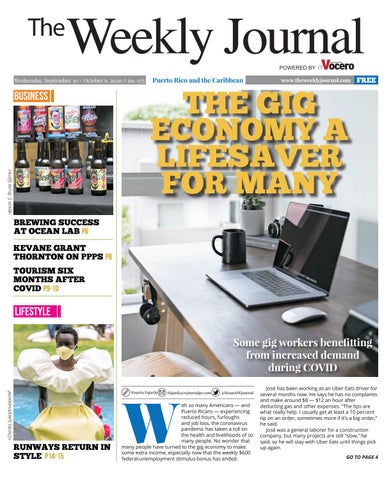
Some gig workers benefitting from increased demand during COVID
W
>Charles Sykes/Invision/AP
Rosario Fajardo
Runways Return in Style P14-15
rfajardo@wjournalpr.com
@RosarioWJournal
ith so many Americans — and Puerto Ricans — experiencing reduced hours, furloughs and job loss, the coronavirus pandemic has taken a toll on the health and livelihoods of so many people. No wonder that many people have turned to the gig economy to make some extra income, especially now that the weekly $600 federal-unemployment stimulus bonus has ended.
José has been working as an Uber Eats driver for several months now. He says he has no complaints and make around $8 — $12 an hour after deducting gas and other expenses. “The tips are what really help. I usually get at least a 10 percent tip on an order, sometimes more if it’s a big order,” he said. José was a general laborer for a construction company, but many projects are still “slow,” he said, so he will stay with Uber Eats until things pick up again. GO TO PAGE 4
The Weekly Journal > Wednesday, September 30, 2020 >
2
Telemaratรณn OCTUBRE
3
8:00PM
TRANSMITIDO POR
A
10:00 PM
HAZ TU DONATIVO HOY
/mdapr
3
/ Wednesday, September 30, 2020
a week in review BEA Releases Prototype GDP for Puerto Rico, 2012—2018
$10.6 Million Investment Announced to Rebuild Ponce’s La Guancha More that three years after Hurricane Maria hit Puerto Rico, the popular tourist spot in Ponce, called “La Guancha,” will be rebuilt in a more resilient manner, with an investment of $10.6 million. Construction will begin in 2021. Pictured is La Guancha after the January 2020 earthquakes.
Powered BY El Vocero de Puerto Rico, 1064 Ave Ponce de León 2nd floor San Juan, PR Postal Address: PO Box 15074, San Juan, PR 00902
>Josian E. Bruno Gómez
>Brandon Cruz González
>Josian E. Bruno Gómez
The Bureau of Economic Analysis (BEA) released prototype annual estimates of gross domestic product (GDP) for Puerto Rico for 2012 to 2018. The estimates showed that the Puerto Rico economy expanded from 2012 to 2014, before turning down in 2015 and continuing to decrease through 2018.
Nearly All Puerto Rico Residents Have Completed the 2020 Census With less than one week left before the U.S. Census Bureau finishes its 2020 Census survey process, the federal entity reported that nearly 100 percent of Puerto Rico residents, including those living in the island municipalities of Vieques and Culebra, have already filled out the decennial document.
President Salvador Hasbún shasbun@elvocero.com
Human Resources Director Arlene Rolón, PHR arolon@elvocero.com
Multi-Platform Digital Director Stephanie Gómez Álvarez sgomez@elvocero.com
Comptroller Félix A. Rosa frosa@elvocero.com
Traffic Director Ilia M. Pérez Centeno iperez@elvocero.com
Multi-Platform Graphic Director Héctor L. Vázquez hvazquez@elvocero.com
Production Director Eligio Dekony edekony@elvocero.com
Editorial Director Juan Miguel Muñiz Guzmán jmuniz@elvocero.com
Assistant Editor/ Reporter Rosario Fajardo rfajardo@wjournal.com
Phone: 787-622-2300, 787-721-2300 Customer Service: 787-622-7480
4
/ Wednesday, September 30, 2020
CONTINUED FROM PAGE 1 Jonathan is an all-around handyman and has seen his work jump in recent months. “More people are calling me to fix things — the toilet, the kitchen sink, the doors… With people mostly at home, I guess these things around the house break down more often,” he said. “I am making more money now than before COVID.” Jenssen has been an Uber driver for about six months and said rides have picked up since the local economy reopened more businesses. “It was so slow before, some days there was nothing. One day I picked up someone in Barrio Obrero and took them to Guaynabo. I only got $5 for that,” he said. Like so many other people, he has survived these tough months, thanks to the federal stimulus payments. Jenssen applied for the Pandemic Unemployment Assistance (PUA) and received about $1,500, plus the $1,200 stimulus payment. “I even got some money for my daughter, who I support… Now I am back at work,” he said. Ana is a teacher and makes extra income these days, working for a call center, with the added advantage that she can work from home. “The pay is fine, $12 an hour; it’s extra income and I can do it from home. I don’t have to leave home, so that’s a plus,” she said. “It’s part time, 20 hours a week, and I have flexible hours.” The only negative she sees are the irate customers that she often has to deal with. “They yell and scream at you. It’s not an easy job.” Miguel — not his real name — was a journalist, working for a local Spanish daily. However, he was laid off not too long ago and is now focusing on freelance work, such as writing news releases for public relations firms. “It is much better to
With so many people working and studying at home, working with delivery companies like Uber Eats have become popular gig jobs. >Archive
say freelancer, or even self-employed, than unemployed. There’s a big difference,” he said. In the long run, he hopes to return to a full-time job in journalism, if not in Puerto Rico, then the mainland U.S., he said.
These are some of the people that THE WEEKLY JOURNAL spoke with about their experiences in the gig economy. They are not alone, as data from stateside firms indicate that more and more people are resorting to self-employment as a way boost their incomes during the coronavirus pandemic.
Higher Unemployment Projected
An all-purpose handyman is much in demand these days.
Recent figures underscore the need for gig employment during these times. With a lower labor-force participation rate and fewer people looking for jobs, the percentage of unemployed workers was 7.3 percent in July, a figure below the 8.8 percent reported in February, the month before the islandwide lockdown due to the coronavirus pandemic, according to the Puerto Rico Labor Department’s August report on Employment. As of press time, the September report had not yet been released. However, the Labor Department warned that if workers who are employed but not working were to be counted as unemployed, the unemployment rate would have doubled and a little more. “If workers who had a job but were not working were classified as unemployed, the unemployment rate would have been higher than reported. Using historical data, an analysis of this context would put the July 2020 unemployment rate at 16.6 percent,” the agency said. Meanwhile, in the case of those who said they were self-employed, in July there were 177,000 people in Puerto Rico, representing an increase of 7,000 from the previous month. The island’s labor-force participation has been stable for years, at roughly 40 percent.
5
/ Wednesday, September 30, 2020
our economy is experiencing during this crisis. In essential businesses like warehouses, the demand for more workers has led to increases According to data sourced from GigSmart, a in their hourly pay,” said Rich Oakes, president staffing company connecting businesses seeking of GigSmart. “We’re also serving labor with available workers, more residential requests as a demand for its gig economy apps result of Americans spending has increased by 25 percent since most of their time at home.” the virus was declared a national Not surprisingly, the skills emergency in the United States experiencing a drastic reduction Gig Jobs With on March 13, 2020. in usage during COVID-19 closely Increased Demand GigSmart’s two apps, Get align with the industries hit Warehouse Labor, Workers and Get Gigs, leverage hardest. The skills with decreased Moving Van Driver, user location data and skills demand include those in the Laborer, Packer matching to connect businesses hospitality industry, such as and Loader with short-term labor needs to Hostess, Food Prep Worker, Gig Jobs With skilled, temporary workers. Bartender, Retail Merchandiser Decreased Since the start of the and Stocker. Demand pandemic, several skills have Hostess, Food experienced significant increases Online Presence is Prep Worker, in their hourly pay rates for Bartender, Retail Important the mainland U.S. Furniture Merchandiser and The experience of GigSmart Movers, Warehouse Laborers Stocker highlights another key change and Handymen all experienced Source: GigSmart in the gig economy: more and pay bumps north of $5 per hour. more people are going online Furniture Movers topped the list, to look for jobs and/or market earning $8.17 more per hour. themselves and their skills. This is Overall, the average Get Gigs particularly important for artists Worker’s hourly pay stateside is and artisans who need public exposure to help sell just shy of $22 per hour, up from $17 per hour their creations. from the period before COVID-19. Taking note of this new phenomenon, the In addition, the top five most requested skills Museum of the Americas has launched an online in GigSmart Gigs during COVID-19 have been store (www.tiendadelmuseo.org) to help promote Warehouse Labor, Moving Van Driver, Laborer, the unique works of local artists and artisans. Packer and Loader. “In these moments when the creative “The increase in hourly pay and skills demand community is adapting to new ways of staying in our apps closely aligns with the overall shifts
Demand for Gig Work Increased by 25 Percent
In fact,
connected to its audience, we want to be an alternative to acquire Puerto Rican creations and other interesting items from the Museum of the Americas that can only be found in its store, without having to leave your home,” said María Ángela López Vilella, executive director of the museum. Among the items that art lovers can find include saint carvings of the Orta family, illustrations, children’s books and one-of-a-kind jewelry. “This is an opportunity for the public to acquire beautiful and nontraditional objects and gifts, while supporting the Museum of the Americas in its continuing cultural work,” she added. Stateside, a low-fee website for independent artists has become a popular website for people who want to support all things local. “Just Artisan” is a global marketplace for independent artists, crafters and makers to sell their handcrafted goods. In order to keep the marketplace truly handmade, the platform has banned all massproduced and resale goods. Fans of one-of-a-kind handmade art, housewares, clothing, and much more will find a robust marketplace for browsing incredible handmade wares from talented makers around the globe. The store features something for every member of a household, from collectible art to everyday items for home and kitchen, food and drink, furniture, apparel, jewelry, and items for kids and pets. “With Just Artisan, I wanted to build a fair, transparent, vendor-centric marketplace with not only the most competitive fees but also a wealth of support resources designed to strengthen each vendor’s business,” said platform founder Marcello De Lio.
The Museum of the Americas has launched an online store to promote the unique works of local artists and artisans. >Courtesy
6
/ Wednesday, September 30, 2020 Ocean Lab Brewing Co. is an asset to VIVO Beach Club, located in Isla Verde, Carolina. >File Photo
Ocean Lab Brewing Co. Boosts Sales During Pandemic
State of Florida a main draw for merchandise orders
D Giovanna Garofalo
ggarofalo@wjournalpr.com
@giopgarofalo
espite the economic crisis exacerbated by the coronavirus (COVID-19) pandemic, Matías Fernández, CEO of VIVO Beach Club, has not only persevered but even boosted sales for the establishment’s Ocean Lab
Brewing Co. In an interview with economist Gustavo Vélez for ‘Emprendedores’ — a web series conducted in collaboration with EL VOCERO, THE WEEKLY JOURNAL’s sister publication — Fernández affirmed that the brewery has helped keep the Carolina-based beach club afloat. “As with other restaurants, we were badly hit by the pandemic … We lowered capacity to the one imposed by the government and thankfully, our restaurants remained open … But surprisingly, the brewery carried the club greatly. The brewery is still producing and actually, it experienced growth during the pandemic. We are selling more beer volume during the pandemic than before,” he said. Faced with on-and-off lockdowns and an ongoing islandwide curfew, the company, an extension of VIVO Beach Club, launched a website where customers can purchase Ocean Lab’s extensive selection of craft beers, as well as clothing apparel and other merchandise, such as T-shirts, hoodies, hats, dog leashes, bottle
openers, glassware and more. Through the website, www.oceanlabbrewery. com, customers can select their products and choose to pick them up at VIVO Beach Club’s establishment in Isla Verde, Carolina, or have them delivered. Moreover, beer lovers can also order these local craft brews through Uva!, a food courier service for mobile devices. “We basically reinvented ourselves. In fact, surprisingly, we learned that we have an outstanding clientele outside Puerto Rico. So, even though we cannot ship beer, we do send out a lot of hats, hoodies, stickers and plethora of other merchandise. The third market that most enters our website is Miami, the fourth is Orlando, and the fifth is Tampa,” Fernández explained, attributing this demand to the estimated 5.8 million Puerto Ricans living stateside. Recently, the brewery has been launching bimonthly experimental craft brews, with only 100 boxes produced with that specific flavor. “You have the Experimental 1, the Experimental 2, the Experimental 3. Generally, we have two monthly experimental brews and the opportunity for the client to see what we are testing … is part of the experience that we want to share with them,” Fernández said, noting that Ocean Lab Brewing Co. already has 22 flavors. Since its inception in 2017, the company is reportedly selling 10 times more volume than it did back then. “Right now, we are no. 1 in the craft beer market [in Puerto Rico]. We have about 20 percent market share in the craft area and the one in second place stands at roughly 9 percent, so we have more than double that number. We are the solid leaders,” Fernández stated.
Amenities for the Entire Family
Beyond producing beers, VIVO Beach Club has diverse amenities, including pools, restaurants, access to the beach, a store, tours for Ocean Lab Brewing Co., a concert venue and an oyster bar that opened roughly three months ago, well into the COVID-19 emergency. The beachfront entertainment complex opened in 2016 with an initial $8 million investment. The original property was part of Tropimar Beach Club, owned by the municipality of Carolina, and it had been abandoned for nearly a decade. The CEO explained that VIVO Beach Club is primarily geared for young professionals and their families. “We have over 2,000 children who are club members and they come here every weekend. So much so, that many of our future projects deal with children’s entertainment,” he said. Moreover, Fernández said that, before the pandemic, the beach club would also welcome approximately 500,000 tourists annually, thanks largely to the establishment’s contracts with various cruise lines. Although tourism has been one of the hardesthit industries during the coronavirus crisis, Fernández is confident that VIVO Beach Club and its primary asset, Ocean Lab Brewing Co. will persist and thrive onward. “The experiences that you get here, you can’t get them anywhere else in Puerto Rico in terms of its proximity to the sea. We have two miles of beach here, including part of the Bandera Azul [program] … which was listed as the Number One Urban Beach in the World in a survey by USA Today, and that is a tremendous achievement,” he said.
7
/ Wednesday, September 30, 2020
YouTube Adopts Firm Anti-Fake News Policies
Fighting misinformation and ‘harmful content’ about COVID-19 and the U.S. elections
A Giovanna Garofalo
ggarofalo@wjournalpr.com
should be taken down. “When it comes to conspiracy theories, there are certain types of content that we do disavow and remove from our platforms through our community guidelines violations. Our community guidelines do focus on this concept of harm and egregiousness and there are conspiracy theories that cross the line… and we do remove those types of content. But it is true that there is conspiracy theory-related content that doesn’t cross that line of harm and egregiousness,” Kim said.
@giopgarofalo
t a time when roughly 4.5 billion people worldwide were active Internet users as of July 2020, according to information gathered by Statista.com, and the coronavirus (COVID-19) pandemic continues to fuel uncertainty, YouTube explained that it has enacted several measures to combat the spread of “harmful” misinformation regarding the virus, the U.S. elections and other types of “fake news.” On Sept. 23, Jennifer O’Connor, director of Product Management, and Woojin Kim, VP of Product Management, held a Zoom meeting with multiple reporters from different countries in Latin America to specify the most recent developments and tools to ensure that YouTube users have access to precise and reliable information from “authoritative sources” first, while reducing certain content deemed “egregious” that goes against the established narrative. While praising the web company’s availability, O’Conner stated that “openness doesn’t mean that anything goes. Certainly, we’re well aware and we take responsibility for the fact that with openness can come things that we don’t like. And so, our approach to managing that realm of controversial content is this responsibility framework.” Specifically, YouTube designed an algorithm that prioritizes content from public health organizations, such as the Centers for Disease Control and Prevention (CDC), and established news media so that these may appear at the top of the query search results in regard to COVID-19 and the elections. Concerning the virus, this effort also includes a box displayed before the search results
The company includes a box with information from health organizations for every COVID-19 query, plus ensures that the first search results come from “authoritative” sources. >Screenshot YouTube.com
with a link to the World Health Organization’s (WHO) page that tracks the coronavirus, as well as a link to Google’s COVID-19 alert page; this feature is available to Puerto Rico-based YouTube users. “This was our way of making sure that the public health authorities in the country could get their message out about the coronavirus,” Kim said. “Overall, we have about 2 billion users coming to YouTube on a monthly basis and we do see that users are becoming increasingly interested in consuming news content on YouTube. We’ve seen a 75 percent increase in watch time coming from authoritative news partners.” The company also crafted new policies around content that tries to suppress voter turnout, content that tries to suppress participation or content that contains false claims about “x” or “y” candidate’s eligibility. “For example, if there was a video that had a call to action to barricade the doors to a polling place or to call a particular line to sort of clog up the help center for voters to ask questions, that would be against our policies,” O’Connor said. Although the executives affirmed that YouTube is working toward reducing misinformation and removing “harmful” content, the company still allows scores of conspiracy theories. Thus, THE WEEKLY JOURNAL asked how does YouTube differentiate misinformation versus conspiracy theories when determining if a particular content
Using a Fact-Checking Panel
Moreover, YouTube also launched a new factchecking information panel that, for the time being, is only available in India, Brazil, and the United States, including Puerto Rico. “We rely on an open ecosystem of third-party fact-checking partners who are already creating fact-checking content and we surface their factchecking articles on relevant search queries. We wanted to make sure that these fact-checks appear only if users are actively seeking out clarity on these topics, so we do look at the search query and we make sure that there is a high match between the query before triggering the fact-checking article,” Kim explained. The initiative is similar to Facebook’s own fact-checking system, which has drawn some criticism from the social media site’s users for being selective against conservative content or misleading. According to Kim, to be part of that factchecking “ecosystem,” the user must be either an authoritative news partner — e.g., Associated Press, Reuters, The Wall Street Journal — or a member of the International Fact-Checking Network (IFCN). “We wanted to make sure that these fact-checks appear only if users are actively seeking out clarity on these topics, so we do look at the search query and we make sure that there is a high match between the query before triggering the factchecking article,” Kim stated.
8
/ Wednesday, September 30, 2020
Protecting Your Business Through the Paycheck Protection Program What employers should know
O
Kevane Grant Thornton
n March 27, 2020, the CARES Act was enacted to assist small businesses that have been economically affected due to COVID-19. Efforts to combat the virus were implemented statewide — which included lockdowns, closures, as well as new regulations that were put in place to protect businesses. Also, federal programs were modified to help businesses weather the current economic situation. The CARES Act provided a new program — the Paycheck Protection Program (PPP), which was focused on encouraging employers to retain employees and maintain salaries during the rest of 2020. This program closed on Aug. 8, 2020, and it is now in its important second phase, the loan forgiveness. To be eligible for forgiveness, the borrower should use the loan proceeds for the payment of payroll, rent, utilities and mortgage interests, as they meet the requirements set forth in the program. These expenses must be paid during the covered period, which began on the date the loan was disbursed and will last for up to 24 weeks, but in no event may the covered period extend beyond Dec. 31, 2020. “It is important to note that the amount forgiven is directly tied to the number of full-time employees, wages and salaries. A reduction in any of these will result in a reduction in the forgiveness amount,” explained Marta Rodríguez, senior advisory manager at Kevane Grant Thornton.
Businesses that familiarize themselves with the PPP forgiveness program and the Coronavirus Relief Funds grants are one step closer to ensuring that their businesses come out of the pandemic as strong as ever.
— Marta Rodríguez, senior advisory manager at Kevane Grant Thornton The borrower has 10 months after the completion of the covered period to file a forgiveness application request with their loan provider. If the loan is fully forgiven, the borrower will not be responsible for payments. Any amount deemed not forgiven will be converted into a fiveyear term loan, bearing interest at 1 percent.
Private Sector Payroll Protection Program On May 14, 2020, Gov. Wanda Vázquez announced the Coronavirus Relief Fund, also known as the “PPP Criollo,” which allotted $350 million in immediate funds accessible to private employers who have operated throughout the COVID-19 pandemic. Since Sept. 14, applicants have been able to submit their applications for the “PPP Criollo” through SURI, where they will also be notified about funding decisions. Grants will be disbursed
in a first-come, first-served basis until fully disbursed. The awards are calculated as the lesser of the total decrease in net income during the second 2020 quarter when compared to the company’s 2019 second quarter, or the number of employees times a specified industry rate (included in the program guidelines). These grants will take into consideration any funds received under other local or federal programs. Companies receiving this grant will similarly need to demonstrate that it kept payrolls at the same levels for at least eight weeks, starting on the date the grant is awarded. Available awards will be distributed to eligible employers that meet the criteria defined in the program.
Eligibility Criteria
— Private employer with 500 employees or fewer — Gross income of $10,000,000 or less — Operating since March 15, 2020 with employees that received payroll — Registered in the Merchants Registry of the Department of the Treasury — Maintain documentation that reliably demonstrates the expenses relating to COVID-19 from March 1, 2020 through Dec. 31, 2020 “Businesses that familiarize themselves with the PPP forgiveness program and the Coronavirus Relief Funds grants are one step closer to ensuring that their businesses come out of the pandemic as strong as ever,” Rodríguez said.
Contact Details:
Marta Rodríguez, CPA, CVA, CGMA Senior Manager | Advisory T 787 754 1915 Ext. 128 E marta.rodriguez@pr.gt.com
9 < The Weekly Journal > Wednesday, September 30, 2020
viernes, 2 de octubre de 2020 a las 9:00pm
Oso Blanco Un hombre cumple injustamente una condena perpetua al ser traicionado por un amigo. Filmada completamente en Las Malvinas, la sección de seguridad máxima de Oso Blanco. Elenco: Jorge Luis Ramos, Jorge Castro, Herber Cruz, Jerry Segarra y Luisa de los Ríos.
El VocEro te trae una colección de las mejores películas boricuas del catálogo de Vicente Castro y Jorge Luis Ramos todas las semanas sin que tengas que salir de tu casa.
10
/ Wednesday, September 30, 2020
Tourism in the Caribbean, Six Months After COVID-19 Crisis Puerto Rico focused on the holidays, while other islands see better numbers
M Rosario Fajardo
rfajardo@wjournalpr.com
@RosarioWJournal
ore than six months ago, the coronavirus pandemic first hit the Caribbean and while Puerto Rico is among those still managing the “new normal,” other smaller islands in the region have seen their tourism numbers improve in recent weeks. According to the Caribbean Tourism Association, the region suffered a 60 percent decline in arrivals from January to June of this year, compared with 2019. However, post-Christmas bookings for the Caribbean are encouraging, with destinations seeing bookings of 40 percent to 70 percent occupancy, as of mid-September. Puerto Rico’s tourism sector remains focused on “future” visitation during the next two to four
months, as the island’s COVID-19 numbers have increased in recent weeks. The priority for Discover Puerto Rico, the official Destination Marketing Organization (DMO), is to position the Island as a premier travel destination, educate potential travelers on current restrictions and guidelines to protect the health and safety of residents and visitors, and generate future demand to accelerate the tourism industry’s economic recovery as the COVID-19 pandemic continues. Social media posts and other marketing messaging shared by Discover Puerto Rico, the island’s destination marketing organization (DMO), are strategically aimed at inspiring future visitation and earn “top-of-mind awareness” with travelers for Puerto Rico to be considered for trips later this year as tourism’s high season approaches. Calls-toaction including, “It’s Time to Plan,” and “It’s Time to Book,” guide consumers to make trip decisions looking to the months ahead. “It is clear that the island is not fully open for immediate leisure travel, but we can remind potential visitors of the beauty of the island and everything it has to offer, to inspire them as they plan future travels — specifically the holiday and winter seasons. The current booking window for
>Archive
The Links Course at Royal Isabela has reopened, as have many other golf courses, resorts and hospitality venues. >Courtesy of Discover Puerto Rico
travelers is between two to four months, meaning that future travelers are planning their trips between 45 to 90+ days before their arrival at the destination,” explained Brad Dean, CEO of Discover Puerto Rico.
11
/ Wednesday, September 30, 2020
upward trend will continue into the traditionally busy tourism period. For the year to August 2020, tourism stayover arrivals show that the destination received 94,810 visitors. Though arrivals dipped drastically in March due to reduced airlift brought on by the global pandemic, as the V.C Bird International Airport reopened to international flights in June, monthly visitor arrivals have more than doubled from then until the end of August. For the month of August, the destination received 4,761 visitors, with 67 percent of these visitors traveling from the mainland United States, followed by 21 percent from the United Kingdom & Europe, 7 percent from the Caribbean and 3 percent from Canada. Presently, American Airlines, Delta, JetBlue, British Airways, Caribbean Airlines, interCaribbean Airlines and Winair are operating flights into the destination. In the next few months, Antigua and Barbuda will welcome Virgin Atlantic, Air Canada, and Sunwing.
USVI, BVI Reopening to Leisure Visitors
The Baths in Virgin Gorda, the BVI >Courtesy of the BVI Tourism Board
an estimated $175 million remodeling plan, Destinations like the Dominican Republic, Aruba, as established by the hotel’s new owner, local the U.S. Virgin Islands (USVI), British Virgin Islands company Royal Blue Hospitality. The resort intends (BVI), and several other Caribbean destinations to open a first phase with 299 rooms, the Water have already begun marketing efforts. Puerto Rico Park, Palomino Island, and five food stations must maintain the same consideration set as those that include two restaurants and a cafe, whose competitive destinations, products will be locally sourced. in order to safeguard the Likewise, the public will be able visitor economy and the to enjoy the 15-hole golf course 86,000 number of jobs at the resort. that depend on it. Discover The hotel currently employs Puerto Rico has developed a 95 workers and management The Caribbean suffered recovery targeting strategy expects to hire roughly 400 a 60 percent decline in upon re-entry into the more to work during the first arrivals from January media marketplace, making phase. In the second phase, to June of this year, changes to demographics estimated to launch in July 2021, compared with 2019, and psychographics focusing the hotel will have 450 rooms according to the on “responsible travelers,” available. The remodeling Caribbean Tourism through custom segmenting, process of the 500-acre hotel Association. However, Dean indicated. complex is expected to be post-Christmas “We must initiate completed by 2022. bookings for the region marketing and promotional Meanwhile, other tourism are encouraging, efforts now, so that potential voices expressed their concerns with destinations travelers will consider Puerto that another lockdown will seeing bookings of 40 Rico as they start to plan be devastating for the sector. percent to 70 percent future trips … We understand The Puerto Rico Hotel and occupancy, as of midthat a balance between public Tourism Association (PRHTA), September. health and the economy is citing government figures, said critical to restart the tourism the tourism sector has lost as engine. We intend to lead much as $231 million in recent the recovery of the tourism months. “Our industry has industry and Puerto Rico, already been affected enough in help restore the many jobs that have been lost and past months. Layoffs have been in the thousands,” save many of those small and medium businesses said PRHTA Board Member Pablo Torres. that have been most heavily affected by the Echoing other leaders in the private sector, COVID-19 pandemic,” Dean added. he called on the government to find a balance between the people’s health and the economy.
In fact,
El Conquistador to Reopen in December
Among the hotels that tourists, both local and off-island, are looking forward to is the reopening of El Conquistador Resort in Fajardo, which intends to reopen its doors by Dec. 15, 2020. The hotel was severely damaged by Hurricane Maria in Sept. 2017 and has been undergoing
The USVI official reopened to tourists on Sept. 19. Restaurants are allowed to return to limited inhouse dining and service, but are prohibited from allowing patrons to congregate around bar counter areas and from serving alcohol at bar counters. In addition, all bars, nightclubs, and cabarets remain closed. USVI Gov. Albert Bryan Jr. also reminded the public that all travelers to the territory, including local Virgin Islanders returning home, are required to provide proof of a negative COVID test taken within five days prior to travel into the territory. “I want to be clear this is all travelers into the territory. It doesn’t matter where you are coming from,” Bryan said. The BVI, on the other hand, will officially reopen on Dec. 1, 2020. The reopening will include an educational campaign for visitors on the government’s plan and safety measures that they must follow to enter the British territory. The “BVILove” campaign launch will kick off the celebration that will welcome tourists back to the BVI, which traditionally coincides with the arrival of high-travel season. “We have two months to prepare and focus our efforts on having a safe reopening process as we launch a campaign that represents the essence of the British Virgin Islands, what we are as a country, and what our culture and hospitality represent,” said Clive McCoy, the BVI’s tourism director.
Antigua and Barbuda See More Tourist Arrivals
For their part, Antigua and Barbuda tourism officials are cautiously optimistic that with arrivals steadily increasing each month since the destination’s reopening in June, that the moderate
St.Thomas, USVI >Courtesy of the USVI Tourism Department
12
/ Wednesday, September 30, 2020
Edgardo Vicenty
Entrepreneur and Financial Analyst
A
Covid19 in Code Orange and the Economy in Code Red
s of Sept. 4, 2020, Puerto Rico’s government had collected 29.31 percent less income than for that same period
in 2019. If things stay the way they are, our government will collect $2.9 billion less this fiscal year than it did the previous one. To put that amount into perspective, it is equivalent to the central government’s annual budget for the Health Department ($1 billion), Public Security ($1.3 billion) and the University of Puerto Rico system ($560 million) combined. Could you imagine having to close down these three public entities in June 2021 because the government has insufficient funds to operate them? The more realistic scenario would be that the government would have to cut $3 out of every $10 in every agency, supplier and pension budget. This would cripple the public sector and greatly affect the lives of hundreds of thousands of government employees, retirees and individuals in need. I am therefore extremely worried when I read comments made by high-ranking officials of the Health Department and the Science Trust supporting another lockdown. Just a couple of days ago, the Secretary of Health told reporters at El Vocero that he would consider a complete closure of the economy if COVID-19 cases on the island continued to increase, because according to their risk model, as things stand, we are already in code orange. I figure the question we must ask ourselves is, what does this model measure and how exactly does it work? One of the four variables used by the model is the percentage of ICU units being utilized. According to the interview in which the Secretary of Health called for a complete lockdown, 66 percent of all ICU units are being used on the island and the model’s limit is 70 percent.
The problem with this data point is that most of the ICU units are being utilized by people with diseases other than COVID-19. In fact, only 73 of the 464 ICU units being utilized are being occupied by COVID-19 patients and this amount has been stable for months. Therefore, the problem isn’t really that COVID-19 cases are increasing, but even under normal circumstances, the island does not have enough reserve ICU units and the government has done nothing over the past six months to fix this.
Another of the variables used by the model is the positivity rate. This rate measures the average number of positive COVID-19 test results over a predetermined period of time. The problem with using this variable to determine when to open or close the economy is that in Puerto Rico, we still have limited testing availability. This means that generally, tests are only performed on symptomatic people or individuals who have been close to someone who has already tested positive. It is more than obvious that if they only test people who have been predetermined to have a high risk of being infected, the average number of positives will be extremely high. For this variable to be effective, testing has to be widely available among the population. In fact, the Health Department should be randomly testing a large sample of the general population in order to obtain an accurate positivity rate measure. This is not merely my interpretation of the data, the World Health Organization has stated that a sustained high positivity rate is a sign that tests are only being performed
on high-risk populations and that testing in other areas (the general population) has to be increased. My point in this Op-Ed is not to fight against all types of controls or even against a possible future lockdown. What I am trying to say is that we have to ask our government officials to be honest with the data they present to the public, that they have to fully understand how their models work and their limitations. Scaring people into believing that the island has to close down because ICUs are close to capacity because of COVID-19 when only 9 percent of beds are occupied by patients with the virus is using data in an irresponsible way. The right thing to do would be for the Health Department to present a plan to increase the amount of ICU units available on the island over the next three months, so that our health system does not collapse if cases slightly increase. We all fear getting infected with this virus or even worse, having a loved one get sick. But we need to learn how to manage and live with this risk. If we don’t, the economy will continue to collapse and in less than a year, we will have even greater suffering because the government won’t have the resources to provide essential services. In March, the government’s income was up 2.24 percent, it went down 7.84 percent in April and has continued to tumble every single month since then. Health officials need to remember that the economy also has an impact over peoples’ mental and fiscal health.
/ Wednesday, September 30, 2020
13
Talented Chefs Featured on Uber Eats is locally sourced, including the lettuce, chicken, cucumber and others. • Chef René Marichal: With no formal training in the culinary arts (he holds a degree in Psychology), Marichal always liked preparing food and as a child he enjoyed being in the kitchen. His culinary proposals act as tributes to his mother and grandmother. With his restaurant Argento, located in Guaynabo, Marichal offers traditional dishes from Argentina and Italy. Puerto Ricans can enjoy exquisite grilled meat (his specialty), delicious pastas, empanadas and pizza. Without a doubt, these dishes and those from other chefs available in the Uber Eats app makes it perfect to enjoy a delicious meal from home. Bon Appétit!
Santaella, Saussy and Marichal tempt the palate
C
The Weekly Journal Staff
ovid-19 has definitely presented a new way of undertaking day-today activities, especially when it comes to eating out. Even though the delivery of prepared foods on the island was already becoming a trend and growing, it has undoubtedly established itself as one of the main ways for Puerto Ricans to enjoy their favorite dishes without having to leave their homes. Supporting local restaurants is also important in these challenging times. Puerto Ricans usually visit restaurants to enjoy gourmet food on special occasions such as birthdays, anniversaries and date night, among others; but the coronavirus pandemic has made this difficult to do. However, with this in mind — and aware of the talent of chefs in Puerto Rico — apps like Uber Eats feature a variety of restaurants with the best chefs for people to enjoy delicious gourmet food from the safety and comfort of home, to celebrate these special occasions.
Some of these chefs are:
• Chef José Santaella: With 20 years of experience, Chef José Santaella owns a restaurant called Santaella, located in the heart of La Placita de Santurce. There he presents the traditions of the island with an evolution of flavors in his authentic dishes and local ingredients. As the
Santaella’s Pastelón Au Gratin >Courtesy
author of the book “Tropical Cuisine: The Classic and Contemporary Flavors of Puerto Rico,” the chef takes advantage of the tropical and rustic heritage of local dishes while showcasing his international experience and the best culinary trends to develop exquisite menu items. • Chef Pierre-Philippe Saussy: After traveling the world working in the best international kitchens, Saussy decided to return to the Island of Enchantment to create his own local project. At Lote 23, located across from Ciudadela in Santurce, Saussy has a food stand called Hen House, with a small menu that only features one main dish, a fried chicken sandwich with sides. It stands apart because each ingredient on the menu
14
/ Wednesday, September 30, 2020
With Picnic Baskets, Christian Siriano Puts on Backyard Show Fashion adapts to the new normal
W
The Associated Press
ESTPORT, Conn. (AP) — Christian Siriano, who turned his atelier into a mask-making machine, took to his Connecticut backyard for a cozy fashion show complete with picnic baskets for his small in-person crowd, masks on the faces of his models and a dip in his pool for pregnant muse Coco Rocha. “We just needed an escape,” he told The Associated Press after his cheery parade of ball gowns, prints that included panels from comic books and looks emblazoned in black and white with a simple message: “VOTE.” For the rest of the fashion industry, Siriano livestreamed the show on a sunny, mild day, with his garden as backdrop and his grass as runway. It was a rare New York Fashion Week show to include physical guests, something he said both he and his clothes sorely required. “I was scared people weren’t going to come all the way out here,” he said. “I just felt like my clothes, they need to be seen, and I’ve been sitting at home depressed. Really, I just wanted to have some fun.” Siriano’s spring-summer collection, not quite as expansive as usual, was inspired in part by some of the things he’s been doing in quarantine, watching movies that he loved as a child (”The Wizard of Oz” and “Clueless” among them), reading old comic books his mom sent, and painting and sketching in the home he moved into in April. His new digs have already made it into Architectural Digest. The daisies in his garden led him to dangle flowers that bounced on a sunny yellow tulle gown. His comic books became gray and black cartoon panes on a trouser and jacket set. Rocha took her dip in a tight red gown with a train after she and the other models walked Siriano’s lawn in a circle wearing spiky heels. One fell, but she gracefully
The Christian Siriano collection is modeled at Christian’s home as part of New York Fashion Week, in Westport, Conn. >All photos by Charles Sykes/Invision/AP
righted herself with a smile on her face. Siriano has been cooking more in quarantine, shopping for produce at a farmer’s stand near home. The ripe heirloom tomatoes he finds there inspired the red of Rocha’s look, along with others. His painting translated to brush strokes of red, yellow, green and blue in one print, while other looks came in a red picnic check. Like so many others in fashion, the pandemic hasn’t been easy for Siriano business wise. He quickly converted his operations to making masks for essential workers (about a million so far) after the pandemic hit, but he had to furlough workers and close a store. So how has he survived in quarantine? “Staying in this house, and just trying to create,” Siriano said. “Doing this, honestly, is what got me
/ Wednesday, September 30, 2020
through it. I was sketching every day, just trying to play around.” Gone this fashion week were the hordes of celebrities and influencers usually seated on front rows. Billy Porter, who sparkled in a silver suit with a huge hat and high black boots, showed up for Siriano. The designer and “Pose” star bonded at last year’s Academy Awards when Porter took to the red carpet in a huge tuxedo gown Siriano designed. Now, Porter is waiting out the 72nd Primetime Emmy Awards after his best actor nomination for his Pray Tell character on the FX series. “I’ll be sitting in my new house on Long Island
15
that I just bought with my husband and enjoying the evening,” Porter told AP of the recent Emmys. “I’m dressing all the way up.” Porter said he’s been keeping busy in quarantine writing his memoir. Celebrating the Emmys and attending a fashion show are both “a little strange,” he said. “It’s a real exercise in learning how to hold space for multiple emotions simultaneously,” he explained. “The world has to continue to move forward and we have to continue to live while dealing with all the stuff that’s happening. This is a breath of fresh air, to be able to safely come in fellowship with people. It’s nice to see human beings gathered.”
Constant updates online 24/7. TheWeeklyJournal.com
Visit us for updated content on our 24/7 platform.
WeeklyJournal
The