Wednesday, September 8-14, 2021 - // no. 124
MultimillionDollar Economic Impact of Miss World P6
Puerto Rico and the Caribbean
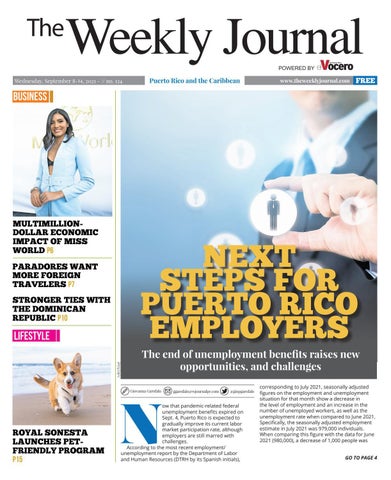
Next Steps for Puerto Rico Employers
Paradores Want More Foreign Travelers P7
>Archive
Stronger Ties With the Dominican Republic P10
The end of unemployment benefits raises new opportunities, and challenges
N Giovanna Garofalo
Royal Sonesta Launches PetFriendly Program P15
www.theweeklyjournal.com
ggarofalo@wjournalpr.com
@giopgarofalo
ow that pandemic-related federal unemployment benefits expired on Sept. 4, Puerto Rico is expected to gradually improve its current labor market participation rate, although employers are still marred with challenges. According to the most recent employment/ unemployment report by the Department of Labor and Human Resources (DTRH by its Spanish initials),
corresponding to July 2021, seasonally adjusted figures on the employment and unemployment situation for that month show a decrease in the level of employment and an increase in the number of unemployed workers, as well as the unemployment rate when compared to June 2021. Specifically, the seasonally adjusted employment estimate in July 2021 was 979,000 individuals. When comparing this figure with the data for June 2021 (980,000), a decrease of 1,000 people was GO TO PAGE 4
The Weekly Journal > Wednesday, September 8, 2021 > 2
3
/ Wednesday, September 8, 2021
a week in review Puerto Del Rey Joins Safe Harbor Marinas Dallas-based Safe Harbor Marinas has acquired Puerto Del Rey in Fajardo, Puerto Rico - the largest marina in the Caribbean. The transaction closed on Sept. 1, 2021, although financial details were not disclosed. Jason Hogg, the chief investment officer of Safe Harbor Marinas, affirmed that “this asset will be a wonderful destination for our boaters” in the Atlantic. “It is wonderful to be able to continue to expand our network for boaters on both coasts with world-class destinations.” Puerto Del Rey can accommodate about 1,750 vessels between its wet slips and dry stack facilities.
La Guancha Receives Hefty Allocation from FEMA An obligation of more than $6.7 million from the Federal Emergency Management Agency (FEMA) was recently assigned for repairs at the Recreational and Cultural Center Enrique “Coco” Vicéns, known as La Guancha. The businesses located there generated around $6.2 million in revenue before the impact of Hurricane Maria in 2017. After the repairs, business opportunities are expected to duplicate, and this amount is projected to increase to $12 million, per municipal data.
Powered BY El Vocero de Puerto Rico, 1064 Ave Ponce de León 2nd floor San Juan, PR Postal Address: PO Box 15074, San Juan, PR 00902
President Salvador Hasbún shasbun@elvocero.com Vp of Marketing and Business Operations Michelle Pérez Miperez@elvocero.com
Island Sea Fest, Royal Caribbean Postpone 2023 Sailing From San Juan Island Sea Fest reported that its cruise sailing in partnership with Royal Caribbean that was scheduled for February next year from San Juan has been postponed to a later date until further notice due to a problem with docking in the Port of Spain around that time. The cruise was scheduled to sail from Puerto Rico on Feb. 15, 2023. The itinerary included three stops in Tobago, Barbados, and Saint Lucia. It would have returned to San Juan on Feb. 26. Although clients were refunded, the company said that the matter could be sorted out in several weeks.
VP of Accounting Félix A. Rosa frosa@elvocero.com
Human Resources Director Arlene Rolón, PHR arolon@elvocero.com
VP of Editorial Content Juan Miguel Muñiz Guzmán jmuniz@elvocero.com
VP of Production Eligio Dekony edekony@elvocero.com
Traffic Director Ilia M. Pérez Centeno iperez@elvocero.com
Managing Editor Rosario Fajardo rfajardo@wjournal.com
Multi-Platform Graphic and Technology Director Héctor L. Vázquez hvazquez@elvocero.com
Phone: 787-622-2300, 787-721-2300
Multi-Plataform Digital Director María Arce marce@elvocero.com
Customer Service: 787-622-7480
4
/ Wednesday, September 8, 2021
PUA benefits ended on Sept. 4. >Josian E. Bruno Gómez
CONTINUED FROM PAGE 1 observed. Compared to July 2020 (973,000), there is an increase of 6,000 people employed. Meanwhile, Puerto Rico Labor Secretary Carlos Rivera Santiago noted that the DTRH has seen upticks in how many people attend its various job fairs. But while he is confident that the people who received federal benefits such as the Pandemic Unemployment Assistance (PUA) will immerse themselves in the workplace, the official observed that this process will occur in a staggered manner. “I know that in the last recruitment fairs that we began to do on June 3, we have seen little by little how the number of people entering the labor market has increased [since the pandemic began]. Perhaps it has not happened at the speed that one would like or that the market needs, but yes, it has been happening and we should see at least an increase in that labor participation,” he told THE WEEKLY JOURNAL. However, “it does not reach the levels of need that the employers may have and that at this moment it is urgent for them to start working in these areas so that their
businesses are not so affected.” Asked if Puerto Rico needs another round of benefits, Rivera said that it was “quite the opposite,” and that instead of unemployment assistance there should be a focus on incentivizing a return to work. “We are trying to find other alternatives precisely so that people can see the labor market as a real alternative and at the moment the social benefits that are received are also being analyzed, in what way people can start working and do not lose some of the benefits, aids such as Nutritional Assistance or those who have a health card - those types of services that they receive, but when they generate a certain income they lose it,” he stated, adding that the island’s labor participation rate has historically ranged between 40 and 41 percent. Among the initiatives that he expects will prompt residents to seek jobs is the recently approved rise in Puerto Rico’s minimum wage. House Bill 338, approved by the Legislature in late August, will increase the current hourly minimum wage of $7.25 an hour to $8.50 starting Jan. 2022, as well as another staggered increase to 9.50
by July 2023, and a third raise to $10.50 by July 1, 2024. “To say that this is going to solve all the problems that Puerto Rico has, no, but we have to move towards that direction, little by little directing that route that we want,” the secretary said. “There is also a work credit approval, in which people who start working or are working and file an income tax return and have a child or two children - depending on their family composition and salary - also receive tax credits when they file that 2021 payroll. All we are doing with this is precisely that, seeking to encourage and that whoever is working also receives the benefit,” Rivera added.
New Attitudes Toward Work
However, Edna Guzmán, president of the Society of Human Resources Management - Puerto Rico Chapter (SHRM-PR), affirmed that beyond financial remuneration, workers seek flexible spaces, a sense of fulfillment, and work-life balance. “Now comes the pandemic and it brings us another model where it is proven that it is possible to work in a hybrid model and that there are other ways of
5
/ Wednesday, September 8, 2021
doing it that force us to move toward technology, and there is little tolerance toward employers or organizations where that vision is not shared. It’s even incentivizing people to leave, and I’ve seen it among my clients,” Guzmán said. On another hand, she observed that employees - especially those from younger generations - are straying away from the mindset of corporate affiliation if the organizational structure or mission of that employer or business does not align with their own. Speaking on Generation Z and younger millennials, she said that “it is a generation that has had quick access to information and for them, it is important to know the jobs that are in and connect with the mission of the organization - what we are here for. If it doesn’t resonate with them, it’s very easy for them to go to another job, which an older generation didn’t.” Guzmán explained “that has some reasons for being - social and political structures have changed, social rather. They don’t necessarily work to get married and have a family and so on, but it’s more of a connection. They like to connect and that what they are doing has a reason or purpose. To the extent that this does not exist, mobility is more agile and quicker.” Alas, the Human Resources expert clarified that this phenomenon is not unique to the youngest workers either. “There is an element of organizational health that we should not neglect and has been neglected, organizational health in every sense. And when we talk about organizational health, it is how we
are taking care of this talent, how we are sharing the results of the organization and how we are promoting its development.” THE WEEKLY JOURNAL asked how businesses can bolster their corporate mission to retain their staff. “I believe that some kind of dynamism has to be created so that the task they perform is not mechanical in the sense that it is repetitive and can make that worker feel bored in some way or that they are not being productive,” Secretary Rivera said. “Here the key is going to be the employer, in how they achieve that motivation, creating either employee service programs, programs that maintain some type of unity in the work area, and another type of service that can be given to these workers so that stay motivated and that they feel that they are part of a work group that is like a family, so to speak.”
Self-Employment on the Rise
While multiple professionals are estimated to seek jobs for other businesses or organizations, others have already established their own, further affecting companies’ chances at regaining their staff numbers. The president of the Economic Development Bank (EDB), Luis Alemañy González, along with the institution’s economist, Gladys Medina, revealed that 15.8 percent of Puerto Rico’s labor market consists of self-employed individuals. The U.S. Internal Revenue Service describes these workers as business owners or independent contractors who provide services
Labor Secretary Carlos Rivera Santiago says there should be a focus on incentivizing a return to work. >Archive
There is an element of organizational health that we should not neglect and has been neglected, organizational health in every sense. - Edna Guzmán, president of SHRM-PR
to other businesses, members of a society that operates a trade or business, or individuals who make business on their own in some other way. “Gov. Pedro Pierluisi, along with our economic team, is ready to deliver strategies to boost and protect employment in this new stage, which we can foresee will be beneficial for the island’s recovery before the pandemic,” Alemañy said. The official specified that the DTRH reported that 169,500 people were self-employed in July of this year, which represents a reduction of 11,000 self-employed workers, or 5.8 percent when compared to the same month last year. However, he underscored that “in accumulated terms, there as in increase in self-employment. Fiscal Year 2021 ended with an average of 173,200 self-employed workers, 5.5 percent less than the 164,300 than during the same period in 2020.” Alemañy said that this employment modality was heightened by the emergence of niche opportunities like the creation, sale, and manufacturing of personal protective gear - such as face masks and plastic face shields -, as well as the manufacture, installation, and maintenance of acrylic, glass, or plexiglass shields for commercial establishments and offices. In addition, he said that employees from other industries like construction, gardening, and decoration decided to work on their own because the high demand for this type of specialized worker made it more lucrative for a self-employed person to set their own rates and hours versus earning a certain salary within a traditional public or private workeremployer structure. Meanwhile, Guzmán pointed out that the reluctance of some businesses to embrace new organizational schemes was also a factor that drove professionals to seek flexible work opportunities, such as self-employment. “What do they seek? They are looking for this place that provides them that freedom, that autonomy, that flexibility and they are moving to be their own business owners. If you take a good look at food trucks, many are run by young and well-prepared people,” she asserted. Despite the end in federal aid, Guzmán said that I don’t think that, even though there are people who are going to look for work, I don’t think it will be matched to prepandemic levels. When I say match, I don’t think that if 100 left, 100 will go looking for work. They searched for a way of life that resonated more with well-being.” - Brenda A. Vázquez contributed to this story.
6
/ Wednesday, September 8, 2021
Vanessa Ponce, Tonie-Anne Singh, and Stephanie Del Valle, Miss World 2018, 2019, and 2016, respectively. >Josian E. Bruno Gómez
Miss World’s Economic Impact Estimated at $100 Million Puerto Rico the first Spanishspeaking country to host the int’l pageant
F
Giovanna Garofalo
ggarofalo@wjournalpr.com
@giopgarofalo
or the first time in its 70-year run, the Miss World international pageant will be held in a Spanishspeaking country, and Puerto Rico was selected to host this event. According to the event’s promoters, Miss World 2021 is projected to have global coverage with roughly two billion viewers through television channels and social networks. The competition will then promote the island’s assets before this ample audience, thus generating ample opportunities for the local tourism industry. “We are ready and eager to begin recording some promotional clips for this great event, which will help further promote Puerto Rico as a first-class tourism destination before the entire world,” said Julia Morley, the CEO of Miss World Ltd. in London during a promotional press wheel at the Atrium of the José Miguel Agrelot Coliseum (Choliseo) in Hato Rey, San Juan. Moreover, the 123 contestants and their respective teams will stay on the island for 28 days at the Hyatt Regency Grand Reserve Puerto Rico in the northern municipality of Río Grande. During their stay, they will explore the island’s diverse destination offer and experience Puerto Rico’s culture firsthand. In addition to the
candidates, thousands of international travelers are expected to visit the island to attend the competition. THE WEEKLY JOURNAL asked what is the immediate economic impact estimated to be generated by the pageant. As informed, by hosting Miss World 2021, Puerto Rico hotels are expected to book 10,000 rooms, translating into an economic impact of over $100 million when paired with visitor spending, as well as more than $3 million in tax collections for the local treasury. “ I don’t like to take something unless I can give it back,” Morley said. “Together, we will build tourism for Puerto Rico in the best possible way.” Likewise, Francisco “Paco” López, the producer of the event, affirmed that “our team is ready for the pageant’s millions of followers worldwide to see the marvels that Puerto Rico has to offer; an island that is rich in culture, gastronomy, beautiful landscapes, beaches, but above all, our human quality as Puerto Ricans. It is time to show the world what we are capable of and we will do it.” For her part, Stephanie Del Valle - who brought Miss World to the island through her Reignite Puerto Rico foundation - said she is “super happy and proud that so many people want to come to Puerto Rico, to enjoy this unique historical experience, which has never been seen in the organization. I am ready for them to come.” Del Valle won the pageant in 2016, being the second Puerto Rican to win this title, and she assured that her predecessor, Wilnelia Merced (1975), will also participate in the event. The celebration was initially reported to be held at the Coca-Cola Music Hall in the T-Mobile District in San Juan. However, increased interest from global audiences to get their tickets led the producers to move the event to the Choliseo,
which will have an approximate capacity of 10,000 people. Tickets will be on sale from Sept. 17, at 10:00 a.m. Upon their arrival to Puerto Rico, all contestants will self-quarantine and they must take frequent tests to detect COVID-19, plus they must use masks and practice social distancing during their stay on the island. Likewise, attendees must conform to the local government’s health protocols concerning the coronavirus.
Broadcast on Channel 11
During the press wheel, it was revealed that Miss World Ltd. signed an agreement with TeleOnce (Channel 11) for it to be the official channel that will feature the live broadcast on the final night of the international pageant in Puerto Rico. As part of the agreement, TeleOnce will show special programming. The 70th edition of the pageant will be broadcast on Dec. 16 at 8:00 p.m., with an approximate duration of two and a half hours. “We are more than happy and proud over this alliance between TeleOnce and Miss World. Being the official channel of this pageant with its history and transcendence is a great honor,” said Lenard Liberman, president of TeleOnce. “For the next months, we have on agenda many plans with this world-class project. We will be bringing new concepts to enjoy every phase of the competition, as well as creating exclusive content, both for television and social media. We want the public to know the candidates of each country and to achieve a successful interaction.” For more information about the pageant or to become a sponsor, call Evelyn Guadalupe at (787) 379-2493 or send an email to evefajardo@aol.com.
7
/ Wednesday, September 8, 2021
Family-Owned Inns Aim to Foster More Tourism in Puerto Rico
Seek to attract more foreign travelers
A
Brenda A. Vázquez
The Weekly Journal
s an economic development strategy, the Paradores de Puerto Rico brand - which celebrates its 48th anniversary will be focused on adding more lodgings and attracting tourists from new international markets. Xavier A. Ramírez, president of the Puerto Parador and Tourism Association (APTPR by its Spanish initials) explained that several decades ago there were more than 40 inns on the island, which gradually decreased over time until there were only 11. Ramírez maintained that the reduction in the number of lodgings was due to their failure to meet the requirements to obtain the endorsement of the Puerto Rico Tourism Co. (PRTC). To operate as a “parador,” or familyowned inn, the facilities cannot have more than 75 rooms, they must be located outside the metropolitan area, and the owner must be from a Puerto Rican family. Presently, there are roughly 700 rooms among the 11 family-owned inns, which generate an average of 300 jobs, so Ramírez understands there is potential for economic growth for merchants who seek to serve domestic tourists, which represent 70 percent of the reservations, or to foreign tourists, which represents 30 percent. This last percentage is the one that they seek to change by attracting visitors from other countries, which they understand would cause a greater flow of guests and result in more jobs and tax collections. These establishments currently generate 2 percent of inn r evenues islandwide, which translates to $2.5 million annually in collections. “We have had tourists from countries like Australia, Tasmania, Patagonia, [and the states of] Hawaii and Alaska, from all continents, but the most we receive are from the east coast of the United States and Europe. Mainly from Spain and Germany, because we have direct flights. We want to diversify that tourist, bring new markets,” Ramírez said. He asserted that having new markets is essential for the “paradores” because they need tourists from abroad to fill the reserves in the low season. “The local tourist visits us between May and August, as well as between November and February. Meanwhile, the foreigner comes from
Paradores generate nearly $2.5 million in tax collections. >Courtesy of Combate Beach Resort
September to December and between March and May, fleeing the cold. Before the pandemic, in Combate Beach Resort the non-resident tourist represented 40 percent and we are already at 32 percent. That shows that we are recovering, “said Ramírez, who is a co-owner of said inn. Moreover, Daphne Barbeito, spokesperson for the Tourism Alliance for Puerto Rico (ATPR, Spanish initials), pointed out that as a strategy, the inns can look at what other countries are doing to renew the concept and attract new visitors. “‘Paradores’ have a value and it must be refreshed, especially at this time of so much competition. See what has worked in other parts of the world - such as Spain - and take advantage of the experience that can be lived around them and the benefits of where they are located,” she affirmed. Barbeito stressed that cruise passengers stay in hotels in the metropolitan area because they usually only stay on the island for one or two days.
The Assets of Paradores
Ramírez reported that a stay in a parador generally fluctuates between $85 and $125 a night, although some have family suites with additional amenities that can cost around $230, which means that they have rates for all types of budgets, and
some include breakfast, lunch, and dinner. “These inns, being familiar and small, are distinguished by personalized customer service and by being located in privileged areas, very close to each region’s places of interest,” he said. “We give them reasons to come multiple times because they cannot see everything in one visit. We have a diverse tourism product. Each parador is different and has its own history and charm. In addition, several of our inns are recognized worldwide for their high quality and service. We are Puerto Rican families serving other families around the world,” Ramírez stated. He added that travelers seek to live an authentic experience at an affordable cost and enjoy nature through outdoor activities, along with the gastronomy, music, history, and culture of the place they visit. From March to August this year, the inns in the association observed a higher occupancy level than during the same period in 2019. They attributed this increase to two main factors: the support they provide to guests in the inns - with high health standards and security -, and the marketing and promotion carried out by the PRTC and Discover Puerto Rico to promote responsible tourism and attract domestic and foreign travelers to the island’s tourist regions.
8
>Archive
/ Wednesday, September 8, 2021
We are Fewer and we are Older
Puerto Rico’s demographic trends require ‘urgent action’
T
The Weekly Journal Staff
he population trends in Puerto Rico reflected in the latest 2020 Census report will require the government to adopt strategies and policies to address a population situation very different from the one that has characterized us. There are fewer of us, and in this reduced population, the older cohorts have assumed greater importance. This situation is reflected in the labor force, whose structure is changing, not only on the demand side, but also due to demographic change. These are some of the conclusions in the recent economic report ETI Trends, by Estudios Técnicos Inc. The report highlights how the Census reported a notable loss of population in Puerto Rico between 2010 and 2020, as well as the aging of the population. “Overall, these trends will require local government to adopt strategies and policies geared towards creating jobs in a changing labor market, as a shrinking workforce will require labor market reforms to ensure that more workers remain and enter the workforce. As women in
general tend to participate less in labor markets ETI Trends suggests that this development has (in P.R. the Labor Force Participation Rate of men serious implications for the economy and society, is 49.5 percent, that of women is 36 percent), in in terms of employment, savings, consumption, order to reduce the gender gap, female labor force economic growth, the value of assets, and the participation needs to be encouraged. If older need and type of social services. For this reason, adults remain in the workforce the demographic transition for longer, a constant updating towards a smaller population and of skills will be necessary in the with a population composition context of accelerated changes in which a greater proportion of in technology and production people are older, requires urgent processes,” states the ETI Trends treatment. An important publication. An example of how the implication is that According to the data revealed demographic transition described each employed in August by the Census, in impacts the economy is the person in Puerto Puerto Rico, there was a decrease fact that the rate of household Rico will have a in the total resident population of formation has decreased from greater burden in 439,915 between 2010 and 2020. about 21,000 annually 20 years supporting older ago to just over 2,000 in 2019. This is in addition to the previous adults who are out That means less need for new population loss of 85,211 people of the workforce (72 homes and fewer expenses that had been registered in percent of employees that these generate, and less Puerto Rico in the 2010 Census. are between the ages expenses in durable goods such The age composition of this of 25 and 54). as cars, household goods and population decline has been given others. less importance than the total The other important loss. About 22.2 percent of the implication is that each employed decrease came from those over person will have a greater burden 18 years of age, and 78 percent in supporting older adults who from minors. Therefore, Puerto are out of the workforce (72 percent of employees Rico now has a population with a much higher are between the ages of 25 and 54). It is not median age than in 2010. In that year, age groups unrealistic to think that in a few years, one in under 18 years old represented 24 percent of the three Puerto Ricans will be over 65 years of age, population; in the 2020 Census, that proportion according to ETI. dropped to 17 percent.
In fact,
/ Wednesday, September 8, 2021
9
Hokali Extending Services to Puerto Rico
Connects users with sports and nature
A Giovanna Garofalo
ggarofalo@wjournalpr.com
@giopgarofalo
n innovative new business is washing ashore in Puerto Rico, eager to connect users with the island’s beaches and promote environmental conservation. Hokali is a California-based platform that provides surfing lessons in individual, pair and group modalities. Launched in May 2020 - right in the middle of the coronavirus pandemic - the novel business employs professional surfers with CPR training and proven dominion of the sport to educate interested parties of all ages with beginner to intermediate expertise levels. After successfully branching out of its San Hokali seeks to empower surfers who want to protect and preserve our coasts and oceans. >Courtesy of Hokali Francisco home base to Los Angeles and San Diego in California, as well as Honolulu, Hawaii and Jacksonville, Florida, the company is eager that is why we need to move fast,” he stated, doing what they love. The community of coaches to extend its services to Puerto Rico as part of adding that the company has reported consecutive that we have behind our platform is amazing its ongoing growth strategy. Ignacio Viau, the revenue growth each month as pandemic they love Hokali and they love being part of this CEO and co-founder of Hokali, explained that the restrictions have loosened and people want to community because they are doing what they love island’s world-renowned beaches and long-time improve their health by exercising outdoors. and the students can feel that. That’s why we have dedication to surfing make it an ideal addition How does Hokali work? On the website, hokali.co, five-star reviews in all the lessons.” to its destination offering. As such, the company users can book lessons in the established locations, expects to hire “at least 30 to 50 coaches” and which can last for one hour and a half, or a more Mission With the Environment officially settle in Puerto Rico by extensive four-hour “surfcamp.” Viau affirmed that Hokali is committed to the end of the year. These may also be coordinated preserving oceanic ecosystems. For this, the “We are not sure yet where individually or in packages of three, company hosts monthly beach cleanups in its our first surfing spot is going to five and 10 classes. The user may multiple locations with both coaches and students. be in Puerto Rico, but I was in then use an online profile that In addition, the entity has partnered with nonprofit Puerto Rico [two months ago] allows them to see the background organizations dedicated to environmental affairs, The company checking out the surf spots. It of their assigned coach, as well such as the Sea-Trees Foundation, which is expects to hire could be in Rincón or it could be as review their calendar, use an restoring kelp in California. “For every lesson, we “at least 30 to in southern Puerto Rico. We need in-platform weather tracker, take are planting a sea tree,” he said, noting that so far, 50 coaches” and to make a final decision. Right virtual exams to increase their Hokali has restored 816 square feet of kelp. officially settle in now we are recruiting the team, knowledge, and monitor their THE WEEKLY JOURNAL asked if, once Puerto Rico by the so they are helping us making the progress. established in Puerto Rico, the company would end of the year. onboarding as soon as possible,” “Hokali is not just a onealso collaborate with local nonprofits with similar Viau told THE WEEKLY JOURNAL time experience lesson. We objectives. “Yes. We really work locally; we really in an interview. really focus on teaching people want to help each local community and that is part Hokali is currently participating the sport; that’s one of our of our mission. The goal of expanding in Puerto in the latest cohort by parallel18, an accelerator differences from our competitors,” Viau said. Rico would be also to help local nonprofits for program that mentors and elevates startups and “Our goal is to connect everybody with the Puerto Rico, where we can help them and they young businesses. After presenting their business ocean and nature - that connection is magical. can help us,” Viau asserted. “Our mission is to model in the program’s Demo Day in December, There are so many people who would love to learn connect people with sports and nature, as well Viau hopes to raise $2 million to continue growing. to surf, but they don’t know that they can,” he as to educate students about how to take care of “We really want to make this business grow and stated. “Hokali enables coaches to make a living nature.”
In fact,
10
/ Wednesday, September 8, 2021
DDEC Seeks to Strengthen Trade, Ties with the Dominican Republic D.R. has been a fast-growing economy since 2010, COVID still a challenge
T
The Weekly Journal Staff
he secretary of the Department of Economic Development and Commerce (DDEC by its Spanish acronym), Manuel Cidre Miranda, recently traveled to the Dominican Republic to strengthen commercial ties and The COVID identify areas of opportunity with pandemic the neighboring country. notwithstanding, Cidre’s first official visit to the since 2010, the Dominican Republic will mark the Puerto Rican and Dominican government officials discussing trade relations between the two Dominican Republic’s basis for the visit of Gov. Pedro Caribbean nations. >Courtesy gross domestic Pierluisi in December, where product (GDP) grew at pharmaceuticals, construction ideas and foster alliances that promote greater important agreements will be an annual average of products, renewable energy economic development opportunities for the signed that will expand relations 5.8 percent, making systems, and equipment for region. Such was the case of Cidre’s visit to the between the two neighboring the country the hotels and restaurants. Santo Domingo Cybernetic Park, a public-private nations. fastest-growing in The COVID pandemic ecosystem that serves as an innovation and The DDEC secretary’s Latin America and the notwithstanding, since 2010, knowledge hub where the educational, business agenda included meetings with Caribbean, according the Dominican Republic’s gross and government sectors join forces to boost representatives of the Dominican to the OECD. domestic product (GDP) grew at the Dominican economy and insert it into the government, education, an annual average of 5.8 percent, global market. According to the secretary, this businesses, unions and medical making the country the fastesttype of project “is a great example of successful device sectors established in the growing in Latin America and alliances between the private sector, academia and country’s free trade zones. the Caribbean, according to the Organization for government in favor of economic development.” In the meeting with the Vice President of the Economic Cooperation and Development (OECD). The agenda also included a visit to the Dominican Republic, Raquel Peña, the two agreed In addition to the meetings with government company Edwards Lifesciences, specialized in to share the strengths of both countries in the the manufacture of medical devices for critical face of the pandemic, the situation in Haiti and the sectors, the DDEC team held meetings with the American Chamber of Commerce of the care monitoring and replacement of heart valves. challenges for the future. The meetings with the Dominican Republic, the National Council of Likewise, Cidre participated in the inauguration Minister of Economy, Trade and Small and Midsize Private Companies, the Association of Industries of of the Visitor Center of the company Cortés Businesses of the Dominican Republic, Víctor the Dominican Republic, and the Center for Export Hermanos, a commercial icon for more than 90 Bisono, as well as with Foreign Minister Roberto and Investment of the Dominican Republic in years in the Dominican market. Cortés Hermanos Álvarez, revolved around uniting both nations order to promote commercial exchange between is the largest cocoa processor in the Caribbean on their respective agendas in Washington, D.C., both markets, identifying areas of real opportunity. basin, with the capacity to process roughly 8,000 aimed at strengthening the region in an integrated “The Caribbean needs and deserves to be more tons of cocoa a year. manner. For his part, Nelson Torres, the executive In general, Puerto Rico maintains a trade surplus relevant in economic and social development - we director of the Office of the Government of Puerto with the Dominican Republic (Puerto Rico’s exports cannot wait any longer. The Dominican Republic and Puerto Rico need to optimize their strengths Rico in the Dominican Republic expressed that are greater than its imports), with the exception in all sectors, from education to the import and the visit was a very productive one because “we of 2020, when Puerto Rico’s imports were more managed to establish a genuine commitment and than exports. By 2020, total trade between the two export of services, technology and investment, as well as sharing best practices so that we make the strengthen commercial ties between both islands, markets was estimated at $858 million, exports region relevant to the whole world,” Cidre stated. while creating alliances with the different business represented about $396 million and imports, $462 Part of the agenda included visits to various associations for the benefit of bilateral economic million. Business opportunities with the Dominican industries and key business projects to exchange development.” Republic include medical supplies and equipment,
In fact,
11
< The Weekly Journal > Wednesday, September 8, 2021
12
/ Wednesday, September 8, 2021
X
Eduardo Hilera, M.P.S.
X
Emergency Management and Homeland Security Expert
The Storms of September
T
he Atlantic hurricane season— the one that impacts Puerto Rico—runs from June 1 to November 30. The peak, however, occurs from midSeptember to mid-October, which has already started, folks. The hurricanes permanently recorded in our memories all made landfall in September. Hugo on September 19, 1988; Hortensia on September 10, 1996; Georges on September 21, 1998; and Maria on September 20, 2017. There is a clear trend here. Abraham Lincoln said: “If I only had one hour to chop down a tree, I would spend 45 minutes sharpening my axe.” Applying Honest Abe’s wise logic to hurricane season, we should do everything possible to get ready before a disaster. All it takes to get ready is a little creativity, logic and a few bucks. Being prepared makes our communities more resilient. The most basic emergency management concept is planning. Emergency managers agree that the first 72 hours after a disaster are crucial— it takes that long for help from first responders to reach those in need. In the spirit of planning, below is a checklist of the steps we can all take to be prepared for those first 72 hours. It doesn’t involve sophisticated equipment, just a few things we can do by ourselves. Inspect Your Home—Look around your home at doors, windows, potentially hazardous objects, and anything easily repairable. Address whatever you find and can fix immediately. Look for loose doors, exposed windows, and non-tempered glass windows or panels. Fix or secure everything you can. Prepare Your Car—If you own a car, keep the tank full. Set a reminder on your phone. In an emergency, a full tank of gas will get you wherever you need to go. In addition, identify a safe spot where you can park your car.
Damage from Hurricane Maria in Sept. 2017 >Carlos Rivera Giusti, Archive
First Aid Kit—Most of us have first aid products but may not keep them all in the same place. Look through your home and store them all together. The Red Cross and others provide recommendations of specific items to have, such as bandages, topical antibiotics The hurricanes and ice packs. permanently recorded
In fact,
in our memories all made landfall in September. Hugo on September 19, 1988; Hortensia on September 10, 1996; Georges on September 21, 1998; and Maria on September 20, 2017. There is a clear trend here.
Medication—If you or your family take medications, make sure you have a full week’s supply.
Emergency Phone Numbers— Modern times have made us drift away from it, but use pen and paper and write down your most important contacts. If your phone dies, this could come in very handy. This list will also serve as a reminder of the folks you should keep in touch with during the emergency.
Cash at Hand—Electronic payment platforms, ATMS and banks can go out of service. Keep enough money on hand to pay for basics following the disaster.
Water—Keep enough drinking water to keep your family hydrated for 72 hours. In addition, keep containers full of tap water for basic household needs. Food—Cook what you can and use perishables first. Make sure to keep non-perishable food as well. Electronics Charging Routine—Make a list of all your electronics and keep them charged. Keep back-up and disposable batteries handy as well. However, the single most important electronic device is the flashlight. Keep it handy. Tool Kit—Just like your first aid kit, make sure your tools are organized and accessible. An all-in-one tool kit, like many retailers carry, is a good idea to keep handy. Stay Tuned—Identify and follow your preferred news sources. Make sure they’re reliable and frequently updated. In addition, pick up a basic battery-powered radio. Stay Calm—You have done the important work of getting ready. Now, the most important part is to remain calm, during and after the storm.
13
/ Wednesday, September 8, 2021
The new season will highlight works by Puerto Rican musicians and composers. >Courtesy of the
Remembering 9/11 Through Music Puerto Rico Symphony Orchestra to hold special concert
T Giovanna Garofalo
ggarofalo@wjournalpr.com
@giopgarofalo
he Puerto Rico Symphony Orchestra (OSPR by its Spanish initials) is pleased to continue with its series of concerts as part of its new season, which resumes in-theater events after spending over a year holding virtual performances due to coronavirus-related restrictions. Maximiliano Valdés, orchestral conductor and Music Director of the OSPR, explained to THE WEEKLY JOURNAL that this anticipated return will prominently feature works by Puerto Rican musicians. Through the different concerts, the OSPR will perform compositions by Angélica Negrón, Roberto Sierra, Héctor Campos Parsi, Ernesto Cordero, Raymond Torres Santos, Alberto Rodríguez, and Alfonso Fuentes. “We don’t have our entire orchestra on stage because we have to keep distances and because we have to maintain plastic panels that separate the wind and wood [instruments] from the bronzes. But it is a very important step compared to what it was last year. At least now we can hear each other on stage, which was very difficult at the time of the pandemic,” the maestro explained, adding that the concerts - per tradition - are being held at the Pablo Casals Symphony Hall in the Luis A. Ferré Fine Arts Theater (Bellas Artes) in Santurce, San Juan. The upcoming concert will take place this
able to enjoy popular music and the soundtrack Saturday, Sept. 11, and it holds special significance of their favorite films as part of the long-awaited because it is designed to remember the 20th anniversary of the tragic terrorist attacks of 9/11 “Pops” concert series. that shook the international community. Speaking on the devastating impact on U.S. soil two decades ‘The Return of a Great Orchestra’ ago, Valdés noted that “it is still so present today The season kicked off on Aug. 28 with a masterly with everything that is happening in Afghanistan. performance by Diana Figueroa, a Puerto Rican So, we chose a piece that is serene, that is not pianist, who mesmerized the audience with tragic or dramatic.” a rendition of classics by “It is a requiem from legendary composers, such [Gabriel] Fauré; it is a serene, as Wolfgang Amadeus Mozart transparent, very beautiful and Antonin Drovak, as well as piece - perhaps the most a new piece by Puerto Rican serene look towards the composer Roberto Sierra. Pops / Special Concerts beyond that exists in music. All the concerts listed below Speaking on this “return of It also has two young Puerto will be held at the Pablo Casals a Great Orchestra,” Valdés Rican soloists: Ricardo Rivera Symphony Hall at 7:00 p.m. affirmed that it consists of “a The Hispanic Heritage (baritone) and Natalia Santaliz program that has to do with Date: Sept. 25, 2021 (soprano). And along with the reasons of music… I hope Director: Rafael Enrique that, we made a piece that that all the public enjoys it.” Irizarry, associate director was written for the occasion “Puerto Rico has a great by a very famous American Symphony Orchestra and it A Light Halloween composer today, Aaron Kernis, was time to meet the public Date: Oct. 30, 2021 which is called Celestis Music,” Director: Rafael Enrique again. For this season, we he stated. “It is made thinking Irizarry, associate director have chosen a great repertoire about how much life changed of symphonies, choral works, Symphonic Christmas after all that - the lack of and concerts, which make it an Date: Dec. 17 and 18, 2021 security, the fear, the lives that extraordinary opportunity to Director emeritus: Roselín were lost, and all this conflict share the experience of music. Pabón that continues so alive to this We look forward to seeing you day.” in the room,” Valdés asserted. ‘Reyando con tu Sinfónica’ In addition to the classical In accordance with the Date: Jan. 4 and 5, 2022 music concerts that will be Director emeritus: Roselín Executive Order in force, presented every Saturday Pabón at each concert, attendees at 7:00 p.m. and the 9/11 must present evidence of remembrance performance, vaccination or negative this season will also COVID-19 test in order to commemorate other special enter the Hall. Tickets are available at Fine Arts dates such as Veterans Day, Halloween, Christmas, Center’s box office and through Ticket Center at and Three Kings Day. Moreover, the public will be https://tcpr.com/.
In fact,
14
/ Wednesday, September 8, 2021
UN: Weather Disasters Soar in Numbers, Cost, but Deaths Fall
Better weather warnings and preparedness are lessening the death toll
G
ENEVA (AP) — Weather disasters are striking the world four to five times more often and causing seven times more damage than in the 1970s, the United Nations weather agency reports. But these disasters are killing far fewer people. In the 1970s and 1980s, they killed an average of about 170 people a day worldwide. In the 2010s, that dropped to about 40 per day, the World Meteorological Organization said in a newly published report that looks at more than 11,000 weather disasters in the past half-century. The report comes during a disaster-filled summer globally, including deadly floods in Germany and a heat wave in the Mediterranean, and with the United States simultaneously struck by powerful Hurricane Ida and an onslaught of drought-worsened wildfires. “The good news is that we have been able to minimize the amount of casualties once we have started having growing amount of disasters: heatwaves, flooding events, drought, and especially ... intense tropical storms like Ida, which has been hitting recently Louisiana and Mississippi in the United States,” Petteri Taalas, WMO’s secretarygeneral, told a news conference. “But the bad news is that the economic losses have been growing very rapidly and this growth is supposed to continue,” he added. “We are going to see more climatic extremes because of climate change, and these negative trends in climate will continue for the coming decades.” In the 1970s, the world averaged about 711 weather disasters a year, but from 2000 to 2009 that was up to 3,536 a year or nearly 10 a day, according to the report, which used data from the Centre for Research on the Epidemiology of Disasters in Belgium. The average number of yearly disasters dropped a bit in the 2010s to 3,165, the report said. Most death and damage during 50 years of weather disasters came from storms, flooding and drought. More than 90 percent of the more than 2 million
>Archive
The Associated Press
deaths are in what the U.N. considers developing nations, while nearly 60 percent of the economic damage occurred in richer countries.
lives, we’re just losing stuff.” Samantha Montano, an emergency management professor at the Massachusetts Maritime Academy and author of the book “Disasterology,” said she worries that death tolls may stop decreasing because Rising Costs of the increase in extreme weather from climate In the 1970s, weather disasters change especially hitting poorer cost about $175 billion globally, nations. when adjusted to 2019 dollars, the “The disparity in which countries U.N. found. That increased to $1.38 have had the resources to dedicate trillion for the period from 2010 to to minimizing disaster deaths is of 2019. huge concern,” particularly due to In the 1970s, weather What’s driving the destruction is climate change, she said. disasters cost about that more people are moving into Hurricane Ida is a good example $175 billion globally, dangerous areas as climate change of heavy damage and what will when adjusted to is making weather disasters probably be less loss of life than 2019 dollars, the stronger and more frequent, U.N. past major hurricanes, Cutter said. U.N. found. That disaster and weather officials This year, she added, weather increased to $1.38 said. Meanwhile, experts said, disasters “seem to be coming trillion for the period better weather warnings and every couple weeks,” with Ida, U.S. from 2010 to 2019. preparedness are lessening the wildfires and floods in Germany, death toll. China and Tennessee. Susan Cutter, director of the The five most expensive Hazards and Vulnerability Research weather disasters since 1970 Institute at the University of South were all storms in the United States, topped by Carolina, noted progress in learning to live with risk 2005’s Hurricane Katrina. The five deadliest weather and protecting ourselves. disasters were in Africa and Asia — topped by the “On the other hand, we’re still making stupid Ethiopian drought and famine in the mid 1980s and decisions about where we’re putting our infrastructure,” she said. “But it’s OK. We’re not losing Cyclone Bhola in Bangladesh in 1970.
In fact,
/ Wednesday, September 8, 2021
15
>All photos courtesy of Royal Sonesta San Juan
Royal Sonesta San Juan Unleashes its Dog-Friendly Rooms Program
Enjoy vacation with your canine best friend
F
THE WEEKLY JOURNAL Staff
or many people, traveling with their furry loved one is a must. Thankfully, more and more dogfriendly hotels are now available, providing guests and their canine companions with a warm welcome and even some perks. One of these dog-friendly hotels is Royal Sonesta San Juan, which recently unleashed its Dog- Friendly Rooms program with an event called a Pawmazing Escape, a fun-filled weekend for guests and their four-legged friends. “Thanks to our Dog-Friendly Rooms program, guests don’t have to hold back from taking a vacation with their dogs. We have an ideal beach to walk your pets and there are plenty of restaurants in the area, including our Ocean Breeze that have patios where dogs are welcomed,” said Michael Herrmann, general manager at Royal Sonesta San Juan. “We are excited to be a dog-friendly hotel so that families can retreat and enjoy our beautiful facilities with their canine friends.” Over the weekend, guests and their dogs participated in a variety of activities co-sponsored by the dog food brand Royal Canin. After being welcomed with Royal Sonesta San Juan and Royal Canin goodie bags, the Pawmazing Escape weekend began with a Yappy Hour, while the canine guests savored Royal Canin food selected specifically for each one, depending on
size, age and breed. Their human caretakers also enjoyed delicious “yappetizers” and specialty drinks created for the occasion. During the rest of the weekend, guests also enjoyed a delicious Barkin Brunch hosted by Royal Sonesta San Juan, and a yoga class also for both dogs and owners, offered by Nayda Marivi Fernandez of Transfórmate con Yoga. The dog-friendly rooms at Royal Sonesta are situated on the first floor with garden and pool views that provide guests easy access to outside through the balcony. The hotel’s dog guests must weigh no more than 35 pounds and there is a maximum of two dogs per room. Pets should never be left alone in room unattended and there is a $75 room cleaning fee that is nonrefundable. Expedia has released the top-12 dog-friendly hotels around the world. The top-three are listed below: • Hotel Normandie Los Angeles, CA As a pet friendly hotel, Hotel Normandie knows the importance of keeping your canine content. Rest assured; at Hotel Normandie, they provide
a multitude of amenities for your dog to enjoy. Guests can contact the property to request a pet friendly room, and they will accommodate accordingly. • Edgewater hotel – a Noble House Hotel Seattle, WA The Edgewater invites four-legged friends to enjoy the ultimate in hosPETality at Seattle’s premier over-water hotel, as part of the Rock the Dog program. There is a one-time fee of $100 per stay, maximum two pets per room. The Rock the Dog program Includes: pet bed for use each night during stay, pet water and food bowl for use during the stay, and special treats upon check-in. • The Standard High Line New York, NY (Manhattan) Good news if you are traveling to New York, The Standard High Line New York is pet friendly! One pet of any size is welcome for no additional fee. Both dogs and cats are permitted, and wellbehaved pets may be left in the room unattended. Additionally, the hotel provides complimentary use of food and water bowls and pet bedding.
Some “yappetizers” for human guests created by the chef of Royal Sonesa San Juan for “Yappy Hour.”