Wednesday, September 2 — September 8, 2020 // no. 071
Puerto Rico and the Caribbean
www.theweeklyjournal.com
LUMA ENERGY RESPONDS TO CNE REPORT P7 GOOD NEWS FOR PUERTO RICO TOURISM SECTOR P8 FIRSTBANK ACQUIRES BANCO SANTANDER PUERTO RICO P9
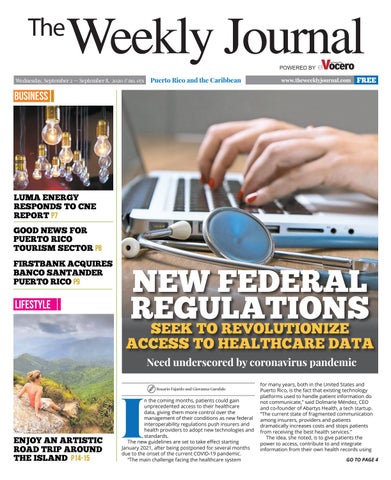
NEW FEDERAL REGULATIONS SEEK TO REVOLUTIONIZE
ACCESS TO HEALTHCARE DATA Need underscored by coronavirus pandemic
ENJOY AN ARTISTIC ROAD TRIP AROUND THE ISLAND P14-15
I
Rosario Fajardo and Giovanna Garofalo
n the coming months, patients could gain unprecedented access to their healthcare data, giving them more control over the management of their conditions as new federal interoperability regulations push insurers and health providers to adopt new technologies and standards. The new guidelines are set to take effect starting January 2021, after being postponed for several months due to the onset of the current COVID-19 pandemic. “The main challenge facing the healthcare system
for many years, both in the United States and Puerto Rico, is the fact that existing technology platforms used to handle patient information do not communicate,” said Dolmarie Méndez, CEO and co-founder of Abartys Health, a tech startup. “The current state of fragmented communication among insurers, providers and patients dramatically increases costs and stops patients from receiving the best health services.” The idea, she noted, is to give patients the power to access, contribute to and integrate information from their own health records using GO TO PAGE 4
The Weekly Journal > Wednesday, September 2, 2020 > 2
3
/ Wednesday, September 2, 2020
A WEEK IN REVIEW ‘MADE IN PUERTO RICO’ ADVIL DUAL ACTION REACHES THE MARKET Advil Dual Action, the first and only FDA approved formulation that combines ibuprofen and acetaminophen, two powerful pain relieving ingredients, is now on the market. The new medication is made in Puerto Rico by GSK Consumer Healthcare at the company’s Guayama facility. >Courtesy
RON DEL BARRILITO MAKES MULTIMILLION-DOLLAR INVESTMENT With an investment of more than $12 million, Edmundo B. Fernández Inc., announced a new expansion plan that will increase the production and export capacity of the well-known brand Ron del Barrilito by 400 percent. The company that produces artisanal rum plans to expand export capacity to the mainland U.S. >Courtesy
Powered BY El Vocero de Puerto Rico, 1064 Ave Ponce de León 2nd floor San Juan, PR Postal Address: PO Box 15074, San Juan, PR 00902
ÁLVAREZ-DÍAZ & VILLALÓN SELECTED AMONG TOP INTERNATIONAL DESIGN FIRMS Architecture and interior design firm Álvarez-Díaz & Villalón, with offices in Puerto Rico and the state of Florida, was recognized among the top international design firms by Engineering News-Record magazine, one of the most important publications in the construction industry. Pictured is the firm’s design for Casa Candina, a residential complex in San Juan. >Courtesy
President Salvador Hasbún shasbun@elvocero.com
Human Resources Director Arlene Rolón, PHR arolon@elvocero.com
Multi-Platform Digital Director Stephanie Gómez Álvarez sgomez@elvocero.com
Comptroller Félix A. Rosa frosa@elvocero.com
Traffic Director Ilia M. Pérez Centeno iperez@elvocero.com
Multi-Platform Graphic Director Héctor L. Vázquez hvazquez@elvocero.com
Production Director Eligio Dekony edekony@elvocero.com
Editorial Director Juan Miguel Muñiz Guzmán jmuniz@elvocero.com
Assistant Editor/ Reporter Rosario Fajardo rfajardo@wjournal.com
Phone: 787-622-2300, 787-721-2300 Customer Service: 787-622-7480
4
/ Wednesday, September 2, 2020
CONTINUED FROM PAGE 1 apps, portals and other software tools, enabling them to set and meet personal health goals. “For example, Abartys is giving patients a centralized data delivery system that functions as a one-stop-shop for personal healthcare records, insurance documents and physician history. For insurers, our patientLynk platform facilitates access to long-term lab results to offer a comprehensive vision of patient health. For labs, the platform increases laboratory diagnostic testing capacity, surveillance system, and routine reporting. “Moreover, the need for universal patient identification and faster lab test response times has been dramatically underscored amidst the current pandemic,” she added. The Centers for Medicare & Medicaid Services (CMS) published in March new guidelines for providers and insurers that require the latter to make available electronically and in a standardized way patient health information as well as medical provider directories. Providers are also required to comply with new electronic notification requirements. The guidelines aim to provide patients better access to their health data. Moreover, states and territories will now be required to improve the coordination of medical care for eligible beneficiaries under Medicare and Medicaid through the daily exchange of data with CMS. Méndez underscored the need for the industry
>Courtesy of Microsoft
to take urgent steps to prepare adequately for the changes and secure compliance with the new guidelines. In Puerto Rico, the new rule applies to medical plans under Medicare Advantage, Medicaid (known as Plan Vital), and the Children’s Health Insurance Program, meaning that the vast majority of insured beneficiaries would be covered.
Insurance Companies React
Iraelia Pernas, executive director of the Insurance Companies Association (Acodese by its Spanish acronym), told THE WEEKLY JOURNAL that the members of the private organization are already working towards complying with the new provisions. “The health insurance members of Acodese are working to faithfully comply with the CMS interoperability requirements that come into effect on Jan. 1, 2021. Many guidelines are already being met and, in other cases, we are currently working in coordination with our providers to be able to comply,” Pernas said in a statement. Meanwhile, Triple-S, the largest health insurance company in Puerto Rico, explained that it has provided its beneficiaries with centralized access to their providers and health information through the ‘Mi Triple-S’ digital app since 2017. For example, beneficiaries who do not have their health insurance ID at hand can access a virtual copy through the app that can be presented at hospitals and clinics. “Mi Triple-S is an important tool for physicians, as it shares information about healthcare and
health events in the recent past and helps them to have a clearer picture of their patients when treating them. This platform was extended this year to Triple-S policyholders in commercial plans and we will soon be taking it to Vital beneficiaries under Triple-S,” said Pedro Aponte Gil de Lamadrid, Chief Investment Officer of Triple-S. In a statement to THE WEEKLY JOURNAL, the insurance company’s CIO explained that the tool has allowed Triple-S to work in advance on interoperability issues. “At this moment, we are developing the specific format (Application Programming Interfaces) required by the CMS regulation and thus be ready for Jan. 1, 2021, the date on which it comes into force,” he added. Moreover, Pernas and Aponte Gil de Lamadrid concurred that the new federal regulations are a step toward improving health services, particularly in the context of the coronavirus (COVID-19) emergency. “In terms of the requirements and the compliance with those requirements, we believe that it will promote a benefit for the patient,” Pernas stated. “The CMS interoperability rule is a positive step that will allow greater access and exchange of health information; this should result in truly coordinated care and better health outcomes for people,” Aponte Gil de Lamadrid affirmed.
Important for Patients With Low Incomes
Héctor García, director of the Puerto Rico Primary Care Association Network, who also works with the Puerto Rico Primary Health Association
/ Wednesday, September 2, 2020
5
>Josian E. Bruno Gómez
(ASSPR by its Spanish acronym), said the initiative is particularly important for patients from lower income groups. For example, he noted that the ASPPR, “as part of its role and support to the 330 Primary Health and Prevention Network, has developed a collaboration with nonprofits whereby it has invested resources to implement platforms with use and access to ‘Telesalud’ (telemedicine). This is to improve the provider’s and patient’s experience at the Primary Health Centers.” Since 2016, the entity has been working on developing user-friendly technologies that streamline information exchange between providers under the Health System, while also enhancing patients’ access to their providers, particularly during the COVID-19 emergency. García also stressed the relevance of the new requirements in the scope of the pandemic. “The final rule of the CARES Act… has facilitated the process to advance interoperability between medical plans and their networks of health providers; the use and access of [telemedicine] for the provider and patient; reducing the burden and fatigue of the provider in medical care; improving the quality of health services; promoting data analysis and statistics processes for decisionmaking, empowerment and commitment of the patient towards their health and medical care; promoting the exchange of health information; [and] avoiding the blocking of information between electronic medical-record systems between providers and patients.”
Compliance with the new CMS guidelines will give us the opportunity to transform health care, as we establish the basis for a robust and secure digital infrastructure that allows for better care management and delivery, as well as handling infectious disease outbreaks, such as the one caused by the SARS-CoV-2 virus. — Dolmarie Méndez, CEO and co-founder of Abartys Health
Improve Efficiencies, Save Money
A 2019 review of published peer-reviewed studies published on JAMA Network last October found that the U.S. healthcare industry loses almost $1 trillion in waste each year, including up to $265.6 billion lost due to administrative complexity, $165.7 billion due to failure of care delivery and $78.2 billion from failure of care
coordination. Study authors expect that the new efforts by the federal government to foster data interoperability will help eliminate inefficiencies as patient “information flows more freely and billing and authorization processes become more automated.” “Beyond the issuance of the new guidelines, the coronavirus pandemic has contributed to push the industry to adopt new technological solutions,” explained Méndez of Abartys. “It has also accelerated the need for the universal identification of patients and the rapid transmission of clinical lab results.” For example, she noted that patientLynk is a tool that works with lab information systems to offer access to data and clinical information results via an online patient portal. Lab results and historical information are hosted on each patient profile, which can then be accessed via smartphone, laptop and SMS, or Short Message Service. The solution allows patients to track, trend and better understand their personal health regardless of the fragmented systems that were involved in creating their health data. Better yet, some receive cheaper insurance premiums for simply using the platform. “Compliance with the new CMS guidelines will give us the opportunity to transform healthcare, as we establish the basis for a robust and secure digital infrastructure that allows for better care management and delivery, as well as handling infectious disease outbreaks, such as the one caused by the SARS-CoV-2 virus,” Méndez said.
6
/ Wednesday, September 2, 2020
98 percent of respondents affirmed that COVID-19 was their biggest concern, while 92 percent feared for their jobs.
Chamber of Commerce Reveals Key Findings on Consumers’ Priorities Top concerns: COVID-19, jobs, energy costs, permits and federal assistance
M Giovanna Garofalo
ggarofalo@wjournalpr.com
@giopgarofalo
ore than five months into the coronavirus pandemic, Puerto Rico residents have not only had to adapt to strict government measures and health protocols, in what some have called the “new normal,” but they are also very concerned about their jobs and sources of income as a result of COVID19’s impact on their finances in an already battered economy. A survey conducted by the Puerto Rico Chamber of Commerce (PRCC) tried to measure if the private sector’s concerns were validated by public opinion, explained Juan Carlos Agosto, the entity’s president. The scientifically based study consisted of surveying 600 people from different backgrounds and municipalities around the island. According to Agosto, the study has a margin of error of 4.2 percent. He noted that one of the primary findings is that 98 percent of participants affirmed that their greatest concern is COVID-19. However, 92 percent said they were concerned about their jobs. In other words, approximately nine out of 10 Puerto Ricans fear for their job stability as a result of the pandemic. “This is very important because Puerto Ricans are starting to see the danger that the COVID-19 illness
who are also recipients of the Nutritional Assistance represents for their economic stability. That point is critical. If I had to summarize the survey in one point, Program are faring worse during the pandemic, even this would be it,” Agosto said. The findings resonate though the U.S. government has approved more with the claims made by economists and officials funds. They used to receive $130 per person monthly that while safeguarding public health should be a and now they receive $200 a month per person to priority, it should not come at the expense of the purchase food, but now many cannot complement economy. that assistance with work due to government-issued “There are 44,000 businesses in Puerto Rico… restrictions to curtail infection. For example, many about 20,000 are companies with five or fewer of these people work in service-related jobs that are employees… As the government continues to do now very limited due to the business restrictions. these lockdowns to try to contain the pandemic, In addition, those with school-aged children must the result will be that also provide for food these small businesses that the latter would — which have very few have otherwise received weeks of cash flow at school cafeterias, so available to support it translates to more their operations — if expenses. they can’t open and “The private sector do their sales, they interprets this data as will have to close,” he this pandemic being added. particularly hard on The survey also found poor people,” Agosto — PRCC President Juan Carlos Agosto that most Puerto Rico lamented. residents stressed the Lastly, the PRCC need for resilient energy president informed that infrastructure that could withstand natural disasters 78 percent of participants, or nearly eight out of 10 and avoid frequent power outages. Moreover, residents, agree that the process to obtain permits is roughly 93 percent of participants affirmed that “a big problem.” energy rates were too high or, in Agosto’s words, “When you ask them specifically about permits, 93 “an incredible problem.” The survey also asked percent want a streamlined permits system because respondents if they would support lower rates if they people are now making the connection between came as a result of privatizing the P.R. Electric Power the business’ permit and employment. In this sense, Authority, to which six out of 10 agreed. that [opinion] wasn’t common, but now people are sophisticated enough to understand those points — that permits are highly important for economic Impact on the Poor activity,” he stated. Agosto underscored that survey participants
Puerto Ricans are starting to see the danger that the COVID-19 illness represents for their economic stability.
/ Wednesday, September 2, 2020
7
LUMA Addressing Red Flags Raised by CNE Analysis Performance metrics and estimated savings among the key issues
L Rosario Fajardo
rfajardo@wjournalpr.com
@RosarioWJournal
UMA Energy said it agrees with several of the main points addressed by the Center for a New Economy (CNE) in the think tank’s analysis of the Public Private Partnership (P3) reached between LUMA and the Puerto Rico Electric Power Authority (Prepa) to operate and manage the public utility’s transmission and distribution system. “We appreciate the effort and thought that CNE put into analyzing the complex Operation and Maintenance Agreement (OMA) negotiated by the Puerto Rico Public-Private Partnerships Authority and LUMA Energy. This agreement was the result of an 18-month competitive process designed to address a transformation of the electric system of considerable scale, maximize the eligibility for federal disaster aid and municipal debt, and consider the continued transformation of Prepa’s generation assets and the impact of emerging technologies. “We understand the overall importance of the OMA for Puerto Rico and the need for such in-depth analysis. As CNE writes in its executive summary: For decades, diverse interests have organized in order to extract undeserved benefits from Prepa at the expense of the rest of the population of Puerto Rico. Thus, Prepa’s transformation is imperative for the future development of the island’s economy. “The issues outlined by CNE are what created the need for a private operator — an operator that can bring world-class expertise and deliver electricity without special interest and political interference. Ultimately the transformation requires some flexibility in order to ensure LUMA can deliver a safer, modern grid at an affordable price in an evolving world,” the company said in a statement sent to THE WEEKLY JOURNAL. In June, the Puerto Rico government awarded LUMA, a consortium of Canadian and U.S. firms, a $1.5 billion contract for 15 years that will allow the island’s power company to retain ownership of the transmission and distribution system.
The company will initially be paid $70 million followed by $90 million the second year and $100 million the third year as part of a contract conditionally approved by the Financial Oversight and Management Board, which oversees Puerto Rico’s finances. LUMA will receive $105 million for each of the remaining years, with a possible $20 million total in bonuses. The contract does not call for an increase in rates, which will still require approval by Puerto Rico’s Energy Bureau (PREB).
CNE’s Red Flags
The CNE analysis includes several areas of “risks and concerns” including: The Supplemental Agreement could be used to force the government of Puerto Rico to accept both an unsustainable Restructuring Support Agreement (RSA) and a Plan of Adjustment that produces rent-like returns for some bondholders and induces a significant increase in electricity rates. “In addition to these critical flaws in the O & M Agreement, we are concerned that Puerto Rico’s government may not have the required capacity to successfully manage this complex multilayered process, with several dimensions that intersect and reinforce each other. Thus, there are no guarantees that the process to modernize and transform Prepa will be successful. A lot depends on the effective execution and implementation of other initiatives, exogenous to the O & M Agreement. “[W]hile we strongly favor the thorough transformation of the PREPA, the proposed O & M Agreement is critically deficient in several key
areas. If that agreement cannot be corrected in a timely manner, then we can only recommend the parties return to the negotiating table. And try again,” said the CNE report. LUMA said it is addressing key issues that were highlighted by CNE. “First, with regard to performance metrics, we wholly agree with the issues raised by CNE and its references to the analysis of Rocky Mountain Institute — the prior performance of Prepa is what led to the need for a private operator, and there are issues with data and consistency. As suggested by CNE’s recommendations, we are in close dialogue with PREB and P3A to develop the performance metrics and will require PREB’s approval. “Second, with respect to financing options, we fully agree on the criticality of the federal funds to the overall transformation and reconstruction of the electrical grid. We believe a significant part of our success will be restoring the credibility of Prepa in order to better enable those funds to flow faster and more effectively. To address this critical need, we brought IEM, a world-class federal funds manager, onto our team. We are working on this area as a top priority. “Third, with respect to estimated savings, we believe in transparency and accountability. The oversight process in the contract allows for the P3A and the PREB to independently review and audit actual savings and performance, as suggested by CNE. The performance metrics — not just on cost, but also on safety, quality of service and the system — create both the transparency and incentive for us to perform,” LUMA said.
8
/ Wednesday, September 2, 2020
Puerto Rico, Punta Cana ‘Trending’ as Top Caribbean Destinations
80 percent of searches from U.S. travelers rfajardo@wjournalpr.com
@RosarioWJournal
lthough Puerto Rico tourism remains officially closed to the foreign market, Expedia Group affirmed that international travel searches for the Caribbean on its websites registered positive growth for the month of July, which was mainly driven by Puerto Rico and the Dominican Republic. According to the company, international searches for the Caribbean were concentrated in August and represented 65 percent of the total searches for travel during the months of August, September and October. Puerto Rico accounted for an estimated 35 percent of searches, while the Dominican Republic, and specifically Punta Cana, tourism from foreign destinations was postponed, registered 30 percent. with no clear date yet. Still, Expedia Group Expedia Group noted that travelers from the reported high search activity for travel to San Juan, United States and Canada led the search for which translated into 15 percent of the July total. Puerto Rico and the Dominican Republic, with 80 A third Caribbean destination that is receiving a percent and 10 percent, respectively. lot of attention is Jamaica, and specifically Montego “Despite the decrease in travel observed in Bay, which has seen a 15 percent increase for recent months due to the coronavirus health travel searches in July. emergency, Caribbean destinations showed All three destinations, Puerto resilience. Travelers from the Rico, the Dominican Republic United States and Canada are and Jamaica, currently require emerging as relevant markets for travelers to present a negative the recovery of the region, “said COVID-19 test taken before the company in a statement. departure. Expedia Group’s travel All three Expedia Group also said that platforms include Expedia, Hotels. destinations, Puerto “the pandemic generated the com, HomeAway, Orbitz and Rico, the Dominican rapid adoption of digitization Travelocity. Republic and and the increase in electronic The Dominican Republic Jamaica, currently commerce,” as consumer officially reopened its borders require travelers to behavior has shifted online. to international travelers on present a negative Mobile searches on Expedia July 1, and — according to COVID-19 test taken Group websites and apps information from Expedia Group before departure. increased by 10 percent in the — the destination has not lost last 12 weeks, from 55 percent popularity among international to 65 percent, showing that the travelers. According to the July popularity of searching and searches, Punta Cana was among booking travel via mobile devices will continue. the most requested Caribbean destinations with “This represents an opportunity for small or 35 percent. In fact, the country has been the independent hoteliers to take advantage of the top Caribbean destination for many years and online experience and travel platform as an competes directly with Puerto Rico and the U.S. effective way to capture such demand if they do Virgin Islands. not have the resources to create their own mobile Meanwhile, Puerto Rico was supposed to receive tourists from abroad as of July 15, but after channels,” said Expedia Group. “We are still learning the true COVID-19 impact an increase in coronavirus infections, reopening
In fact,
>Courtesy of the Puerto Rico Tourism Co.
A Rosario Fajardo
on travel industry. For Expedia Group it was to listen to our travel partners and to build out solutions to address their needs responded. We saw the true meaning of partnership coming through, particularly at the beginning of the pandemic, when we realized the need to support both travelers and our lodging partners,” said Freddy Dominguez, Vice President Market Management Latin America for Expedia Group.
The Dominican Republic’s New Tourism Recovery Plan
With an expected increase in tourists over the next few months, the Dominican Republic has launched a new Tourism Recovery plan, which includes conducting rapid COVID-19 tests on randomly selected travelers, beginning in September. Thereafter, the required negative COVID-19 test taken before departure will be dropped. The country is known for its “all inclusive” resorts and the new plan includes hotel employees staying on hotel grounds as long as possible to create a “sanitary bubble” for visitors and workers alike. “Our goal is to minimize the effects of the pandemic and facilitate a responsible recovery that prioritizes health, maximizes the potential for job creation and economic growth, and promotes the continuing sustainable development of the sector,” said Dominican Republic President Luis Abinader Corona. — Reporter Christian G. Ramos Segarra contributed to this story.
9
/ Wednesday, September 2, 2020
First BanCorp
Aurelio Alemán, president and CEO of First Bancorp >Courtesy
Will expand its earnings power and capital ratios
F
The Weekly Journal Staff
irst BanCorp, the bank holding company for FirstBank Puerto Rico, announced Tuesday the completion of its acquisition of Santander BanCorp and its wholly-owned subsidiary Banco Santander Puerto Rico. As a result, Santander BanCorp and Banco Santander have merged with FirstBank, with FirstBank being the surviving entity. As of July 31, Banco Santander had about $5.5 billion in assets, $2.7 billion in total loans and $4.2 billion in deposits. As part of the acquisition, FirstBank paid cash in the amount of (i) $394.8 million base purchase price for 117.5 percent of Banco Santander’s core tangible common equity, comprised of a $58.8 million premium on $336 million of core tangible common equity, plus (ii) $882.8 million for Santander’s BanCorp excess capital (paid at par). “We completed the acquisition of Banco Santander announced back in October 2019. The completion of this transaction marks a significant milestone in our journey. I want to acknowledge the hard work and dedication of both teams who have worked diligently on integration planning and execution throughout the operational disruption caused by the pandemic,” said Aurelio
Completes Acquisition of Banco Santander Puerto Rico • A network of 73 branches throughout Puerto Alemán, president and CEO of First Bancorp, Rico, significantly expanding FirstBank’s presence in a statement. “We expect that the combined in San Juan, Bayamón, Caguas and Guaynabo, as strength of our franchises will expand our well as in the western and southern regions of earnings power and capital ratios, which already exceed the well-capitalized regulatory guidelines. the island. • More than 445 ATMs throughout Puerto Rico. “We welcome Banco Santander employees Moreover, both FirstBank and Banco Santander and customers and look forward to exceeding customers will be able to use both FirstBank and their expectations with an expanded branch Banco Santander ATMs free of network and service channels charge. Upon the completion of and enhanced technological the system integration process, offerings. This transaction customers will have access significantly improves our to more than 100 ATMs with scale, talent strength and remote deposit capacity. competitiveness in retail, As of July 31, Banco As previously reported by THE commercial and business Santander had WEEKLY JOURNAL, FirstBancorp, banking. Our existing customers about $5.5 billion along with Banco Popular and will also benefit from this in assets, $2.7 OFG Bancorp, bounced back in expanded reach. Furthermore, billion in total loans the second quarter of 2020, after we have and will continue to and $4.2 billion in all three banks — as well as other make considerable investments deposits. financial institutions worldwide — in technological innovations were affected by the coronavirus and talent development to pandemic that began around the enhance our portfolio of product offerings and ability to service world earlier this year. First Bancorp reported net income of $21.3 our customers,” he added. million for the second quarter of 2020, compared The integration process will be carried out to $2.3 million for Q1 2020. Meanwhile, gradually to minimize the impact on FirstBank nonperforming assets decreased by $14.0 million and Banco Santander customers, and should be to $303.8 million as of June 30, 2020, compared completed during the second quarter of 2021. In to $317.8 million as of March 31, 2020. the meantime, all FirstBank and Banco Santander “Deteriorating trends in economic forecasts customers prior to the merger will continue to required an additional reserve build of $29.1 conduct their banking business through their million this quarter, which impacted our bottomexisting relationship branches and corresponding line results. Pretax, preprovision income was $67 bank platforms. million in the second quarter,” Alemán said at the Among the highlights of the acquisition include: time.
In fact,
10
/ Wednesday, September 2, 2020
Puerto Rico Firm Offers
Sustainability Certifications for Businesses CTI Consulting Group committed to accomplishing the UN’s 17 SDGs
P Giovanna Garofalo
ggarofalo@wjournalpr.com
@giopgarofalo
uerto Rico-based CTI Consulting Group recently formed an alliance with SIP Group, an innovation and sustainability consulting firm in the Dominican Republic, to develop a strategy for local companies to obtain a sustainability certification. The International Sustainability Certification is provided by the Center for Sustainability and Excellence in Chicago, and the Chartered Management Institute in London. CTI President Viviane Fortuño explained to THE WEEKLY JOURNAL that the objective is to assist companies and organizations in reshaping their corporate culture in a way that complies with the United Nations’ 17 Sustainable Development Goals (SDGs). As previously reported by your correspondent, the 17 SDGs are categorized under three main branches: protecting the environment, ending poverty and ensuring that everyone can enjoy peace and prosperity by 2030. This mission was approved by nearly 170 countries in 2015, but five years later, many local business owners and workers are not aware of this integrated objective or the consequences to the island’s livelihood and the planet as a whole. Fortuño developed a strategy for CTI to meet those requirements and the firm is now the only one in Puerto Rico that can design sustainability strategies for organizations and professionals so they may receive the international certification. “What we do is we work very closely until we can develop a common project and achieve that certification,” she said. “You have to analyze your business and its area and, within those goals, what are the ones that can be developed and how can they be managed. And that is how you outline the plan; that is how you begin that analysis,” she added. However, she noted that many local businesses are unaware of the full scope of sustainability, believing it to be exclusively related to environmental efforts, so CTI is currently holding panels with companies and associations from the private sector to educate them, such as a recent forum held with the Chamber of Food Marketing,
CTI is the only Puerto Rican firm certified to ensure that local businesses are complying with the 17 SDGs to receive the international certification. >Courtesy
Industry & Distribution. “[For businesses], it’s not easy to understand what this represents and why they should take into consideration what we are presenting in terms of mitigating risks… Here in Puerto Rico, they see sustainability as a climate issue only. They see it as, ‘well, I’m already recycling and we do it at the company.’ There are three areas — environment, social aspect and the economic aspect — in which the 17 goals are developed,” Fortuño explained. She also observed that the coronavirus (COVID-19) pandemic further enhanced conversations on the need to foster resilient business models. “A microscopic virus is testing our entire ability to adapt as a society. It is a new reality that brings both advantages and uncertainties, losses and gains. From the business world, we
are facing an opportunity for reconfiguration that accentuates the need to think about sustainable development by visualizing the resurgence when the crisis passes. In addition to analyzing how we are going to recover the economic losses, the crisis of the pandemic invites us to focus on how to achieve a more sustainable world and thus minimize the possibilities of other eventualities such as that we are experiencing,” she said, adding that all companies, from startups to multinationals, can reap the benefits from sustainability. Regarding specific economic benefits, Fortuño explained that job losses could be offset by the employment generated through implementing a circular economic model with investment in the field of renewable energies. She added that sustainability is a factor that contributes to elevating the corporation’s image, something that at this time is very important and valued by its employees and consumers, particularly by Millennials and Generation Z. “The idea is to take steps forward and to become more innovative in creating joint efforts; create projects that involve the company, organization or agency, as well as individuals. In other words, we cannot rely on a single agency. Here we need to train everyone — communities, individuals and the organizations that coexist in that community. To me, it begins with educating people on the matter. We live on an island, we will live with all the impacts of climate change,” she stated. For more information about the 17 SDGs, visit https:// www.un.org/ Vivian Fortuño, president of CTI Consulting Group >Courtesy
11 < The Weekly Journal > Wednesday, September 2, 2020
Constant updates online 24/7. TheWeeklyJournal.com
Visit us for updated content on our 24/7 platform.
WeeklyJournal
The
12
/ Wednesday, September 2, 2020
Edgardo Vicenty
Manuel Cidre
Entrepreneur and Financial Analyst
M
anolo, like you, I get excited every time a news report detailing an alleged illegal act committed by politicians is published. I fill with hope that cooperation from the criminal in this new case will lead to dozens more and that in a short period of time, we will have cleansed our government of corruption. I was hopeful as recently as Aug. 17, when the FBI brought corruption charges against Tata Charbonier. I got even more hopeful three days later when the FBI arrested Nelson del Valle with similar charges. Two public officials arrested in less than a week; this was definitely the beginning of the end for corruption in the island. Sadly, my excitement didn’t last long; 11 days later ineptitude, dishonesty and corruption took over the country once again. On Aug. 28, the Office of Government Ethics announced it was ending the Ricardo Rosselló “chats” investigation because they hadn’t been able to authenticate the chats. To be more precise, because the individuals being investigated hadn’t voluntarily authenticated the chats. This reasoning is absurd, to say the least. It’s as if a prosecutor dropped the charges on a murder case because the defendant didn’t voluntarily admit he is the individual, clearly seen in a video recording committing the crime. Manolo, in Ayn Rand’s words, our society is doomed. The problem we have isn’t one or
Founder of Los Cidrines
Let’s Fight One Battle at a Time two rotten apples, but that corruption has become a central part of our political system. So much so that Puerto Rico’s newest party, which is running on an anti-corruption campaign platform, plagiarized, without any fear of consequences, an Argentinian political ad. They stole copyrighted material in an effort to rally volunteers for counting votes on election day. In other words, they stole so that the elections wouldn’t be stolen from them. The irony is epic. Obviously, plagiarizing is nowhere near as serious an offense as the acts of corruption we have seen from members of both leading parties over the last two decades. A party that represented a true change in behavior would have immediately announced an internal investigation, made public all the findings and thrown out the people responsible, even if that meant firing their leader. But that is not what happened here, just like with Ricardo Rossello’s chat, impunity is king at Victoria Ciudadana. This plagiarizing event proves that the dishonesty, corruption and incompetence that plague our government won’t be solved by simply changing the governing party’s colors and adding a charismatic new leader with a cool slogan, because the problems are systemic. If we genuinely want to end corruption, we need to make the Justice Department an independent entity. As we have seen during the past four years, Secretaries of Justice don’t investigate or prosecute their boss, the governor, and when they do, they are fired.
E
dgardo, the famous RussianAmerican writer, Ayn Rand wrote the following in the 1950s: “When you see that in order to produce, you need to obtain permission from men who produce nothing — When you see that money is flowing to those who deal, not in goods, but in favors — When you see that men get richer by graft and by pull than by work, and your laws don’t protect you against them, but protect them against you — When you see corruption being rewarded and honesty becoming a self-sacrifice — You may know that your society is doomed.” I confess, each time an act of corruption is uncovered, I am filled with optimism because of the thought that it could be the first domino to fall in the eradication of this great evil. But it never is; corrupt acts keep occurring as if nothing had happened, maybe because like Rand said, corruption is rewarded and honesty becomes selfsacrifice. The same thing happens with the lack of government continuity. The constant change in power because of people who deal in favors has greatly affected our health system, our children’s education, and economic development on the island. Our island can’t progress because those in power get richer by graft instead of through work. The worst part of this is the people have gotten used to it; every four years our agency leaders change, not because of a performance review, but because a new government has been elected. I refuse to believe we are
condemned to this mediocrity. We need strong actions that guarantee our island a better future. I am completely convinced that our civic engagement is not working. Under the guise of grassroots movements, each day we see more incompetent individuals picking up a mic and propagating populist rhetoric. This is true for both the leftwing and the right-wing. It was impressive how speakers in both the Republican and the Democratic Party conventions distorted reality to fit their storylines; they blatantly lie to the public, knowing full well that most of the people watching know for a fact what they are saying is not true. In Trump’s convention, sorry the Republican convention, a famous ex-football coach said “a leader must inspire confidence, commitment, and love.” I wonder, do any of our leaders in the U.S. and Puerto Rico accomplish this? For our country to change, we the people have to step into the playing field and start demanding more from our leaders. We need to end this common hallucination and agree on what metrics and benchmarks we will use to measure their success. Trying to fight the establishment head-on through protests is important, but it’s not enough; we need to get smarter and hold our politicians accountable as a unified group. But in order to do this effectively, we can’t fight 10 battles at a time, we need to choose one or two and stick to them until change is accomplished. For Puerto Rico, I suggest we begin with corruption and continuity.
13
/ Wednesday, September 2, 2020
Kany García is Surprised by Camilo and Evaluna Puerto Rican artist releases ‘Titanic’ video
K
The Associated Press
any García has had several surprises with her song “Titanic.” First, because she left her element when she composed it with Camilo. Then, upon learning that the proposal for the video she liked the most was presented by the wife of the Colombian singer-songwriter, Evaluna Montaner, the singer and actress. “I saw countless proposals for directors’ videos. Evaluna was anonymous. We didn’t have the names of any director... because we didn’t want to have favoritism,” García said in a video call interview from her home in Miami. Montaner has appeared in several series such as “Club 57” and “Grachi,” and appears in Camilo’s videos such as “Don’t Go” and “Favorite” (with images filmed by themselves during their honeymoon), in addition to their collaboration “For the first time” (with clips from their wedding day). During quarantine, she had produced videos for Camilo but in a homemade way. “Titanic” is her first as a director. “She’s the humblest director I’ve ever met. She is a director and did the styling [for Camilo]. He would come in and I would out makeup on him and take away all the shine,” García said. “I think we’ve learned in this pandemic to be multifaceted. Today I had to be my soundman, to be the one who does enlightenment; when I do the songs, all the microphone equipment.” In the video for “Titanic,” García and Camilo are in a mysterious location: a swimming pool with furniture and two chairs where they appear sitting on their backs. The pool is filled with water until they are covered up to their necks. They barely touched their hands, but for that physical contact they had to wait months since they composed the song in May, also at a distance, due to the pandemic. Prior to this, they had last seen each other in person in March. “We were very happy to leave our house, to be able to get out of our four walls, to be able
to hug for the first time in all this time. Imagine! We wrote the song together, brought it to light, the album came out and we still hadn’t been able to even give a hug,” said the performer of hits like “Today I’m leaving” and “It hurts less.” Prior to filming, all personnel involved were tested for the coronavirus. Another detail is that the perfect shot had to be achieved at the first attempt, due to the amount of water and despite the simplicity of the image, considerable
>Josian E. Bruno Gómez
production equipment was required. The melancholy theme about a failed love story is part of García’s duet album “Mesa para dos,” for which she also invited Mon Laferte, Leiva, Carlos Vives, Pedro Capó, Catalina García de Monsieur Periné and Goyo de ChocQuibTown. “Titanic” was composed with a pandemic dynamic through Zoom and audio messages. It was the last song from “Mesa para dos” and was recorded in one weekend. “I think of Kany and I remember a few years ago being in the living room of my house with my guitar taking songs out of it. Kany is a synonym for singer-songwriter and that before and after I met her, I always see her going up,” Camilo wrote in a statement to The Associated Press. García hesitated to include the verse about the Titanic because it seemed to her to be a wellknown image, but after the song’s result, she changed her mind.
Contemplating Relationships and Life
“I realize how sometimes people need references, and references help as photographic elements that you stay with them there,” Camilo said. “It’s very hard not to identify with her because we’ve all been in the situation when we know the other person is going to leave, and we do everything to ignore it by lengthening that farewell because we are sometimes masochists. We lengthen something that we know is over and died because we are terrified of change, we are panicking about what’s coming.” For those in an emotional a torment because of the pandemic, he recommended taking small steps to begin to regain lost normality to avoid uncertainty. “We can’t be in this comfort zone of being locked up, it’s not real, we’ve gotten used to it, but it’s not a real life or a healthy life psychologically or emotionally,” he said. “We must begin to get in the way of being made uncomfortable. Be cautious, but take steps forward, because it really has to happen.” García plans to release other “Table for Two” videos. The next one will be “Let the days go by” with Brazilian singer Gusttavo Lima.
14
/ Wednesday, September 2, 2020
Tribute to the stone craftsman Eduardo Nieves by the artist David Zayas, in Las Piedras >Photo/ Facebook Pintalto
Explore Local Art in This Urban Route
Appreciate these murals and sightings while maintaining health protocols
I
Melissa M. Cruz Ríos
>mcruz@elvocero.com
n recent years, myriad expressions of art have taken over the streets in Puerto Rico, not only to transform marginalized communities, but also to convert unused spaces into tourist attractions of international relevance. In turn, these initiatives have been an important part of the municipalities’ economic development. Even amid the pandemic, when options for internal tourism are limited by the health protocols in place to mitigate the spread of COVID-19, muralist art is an alternative for families who want to explore the island. Yes, leaving their homes with their loved ones to take a trip and alleviate the stress of day-to-day life, but without risking their health, because the idea is to admire the murals from the comfort and safety of their vehicles. Public art movements have always been present
in Puerto Rico. However, the wave of urban art festivals that began in 2011 with “Santurce es Ley” and other initiatives promoted on social media have helped elevate this artistic activity. Although many municipalities in Puerto Rico have an urban art route, at THE WEEKLY JOURNAL, we have taken on the task of designing another as an alternative to making the most of your family road trip, and we share it below:
Loíza is Color
When it comes to urban art, it is impossible not to include the Capital of Tradition. Loíza is a picturesque town where culinary art, painting, crafts and music are part of its flag. Also, for years urban art has adorned the entrance to the town and the different communities. In March 2019, the Miguel Fuentes Pinet Park became the canvas of the Monument Art initiative, with which a dozen Puerto Rican artists of international caliber reflected their works on the entrance and the walls that surround it. The Loiceño artist and creator of the initiative, Celso González, participated in this revitalization project, along with David Zayas, Alejandro Rodríguez, Grace Montalvo, Daniel Lind, Bik Ismo, Don Rimx, Paola
Giant chairs painted with the Puerto Rican flag, located at the entrance to Las Piñones, just outside San Juan >Facebook/Para que no me cuenten
15
/ Wednesday, September 2, 2020 Carrasquillo, Samuel Lind and Kevin The Creator. Among the works that stand out is the image of Miguel Fuentes, who was a Puerto Rican Major League player, in homage to the Cocoteros de Loíza of Double A baseball, among other cultural displays of the town. Another recently acquired work in the town — which is something to talk about and attracting visitors — are the huge chairs painted with the Puerto Rican flag located in the Piñones area. So, in addition to enjoying the good gastronomy of Loíza — with all the precautionary measures of sanitary security — you cannot leave Loíza without delighting in the creations of visual artists such as Samuel Lind. The latter has a workshop described by many as “a mystical place” that contains history, culture and tradition in all its splendor. The place is also home to the painter and sculptor from Loíza, but you must make an appointment to see his work (787876-1040).
‘Tierra y Luz’ at Las Piedras
In December 2019, the Rivera de Las Piedras neighborhood joined the macro-mural project with a mosaic pattern painted in striking colors that the artist Samuel González Rodríguez and the Pintalto initiative started in Manatí, under the name of Color Esperanza in the Tierra Nueva community. In total, there are four macro-murals with this pattern, the remaining two being Brisa Tropical in Yauco — as part of the Yaucromatic 2 project — and Amanecer Borincano in Aguadilla. The Pintalto project in Las Piedras was christened “Tierra Luz.” It includes 35 residences and 14 murals, one of them in homage to the stone craftsman Eduardo Nieves, by the artist David Zayas. All these works are part of the route that begins in the public square of Las Piedras and includes the old Town Hall of the so-called City of Artisans — founded in 1942 — as well as a majestic evangelical church. As in previous macro-murals, the project was led by artists and volunteers from the local community.
‘Fiesta Humacaeña’
The Salvador Abreu Vega building, also known as La Casona, in Humacao exhibits the artistic piece “Fiesta Humacaeña” by artist Ángel Vega Santana. It consists of a mural that highlights
“Mural de Junquito” in Humacao >Courtesy
Image of Miguel Fuentes, who was a Puerto Rican Major League Baseball player, in homage to the Cocoteros de Loíza of Double A baseball, at the Miguel Fuentes Pinet Park >Courtesy/Municipality of Loíza
“Estampas de Yabucoa” >Courtesy
the figure of Cacique Jumacao, the coat of arms of the City Council of the Gray City, among other representative elements of the culture and traditions of Humacao. In addition to this mural, described as a “pictorial poem,” in Humacao, the Junquito mural
also stands out. The latter is a community project that shows prints from the municipality, such as the Dulce Nombre of Jesús Cathedral, Victoria Theater, Angelito Peña Plaza Art Center, images of the countryside, beaches and a variety of other pieces of urban art that have been presented in previous editions of “Humacao Grita,” an urban art event. If you visit Humacao, you can also take a tour of the Efraín Archilla Diez Natural Reserve (along PR-3 road) or the Luis Muñoz Rivera recreation plaza — which dates back to 1963 — and appreciate the local cathedral. You can also visit the Plaza del Bicentenario, where the monument to Cacique Jumacao and the Plaza del Mercado Wilfredo Cuadrado Sánchez are located and, of course, enjoy the tasty products of local businesses.
‘Estampas de Yabucoa’
This is a colorful mural created in 2016 by plastic artists Brenda Montañez and Julio Mojica, which presents the image of the first Catholic church of the town, the Roig Central, the cane chopper, “Ruinas de la Hacienda Lucía,” the Boulevard del Puerto Bandera and the shield, among other prints that present the history of the town of Yabucoa. The mosaic, located on Catalina Morales Street, is one of the largest of its kind in Puerto Rico: it measures 240 feet long by 10 feet high and uses over 13,600 six-inch by six-inch tiles, which were carefully cut. The assembly of the monumental mosaic counted on the collaboration of students and volunteer residents. The Sugar Town also has another variety of murals in the urban area, in the Market Square and in the La Pandora sector. Currently, artist Brenda Montañez is working on a new mural, on a smaller scale, in front of the public square and the town’s Catholic church.