Wednesday, August 26 - September 1, 2020 // no. 070
Puerto Rico and the Caribbean
www.theweeklyjournal.com
Private Sector Pushes Plan to Jumpstart Economy P7
FOMB and Prepa Clash, Again P10
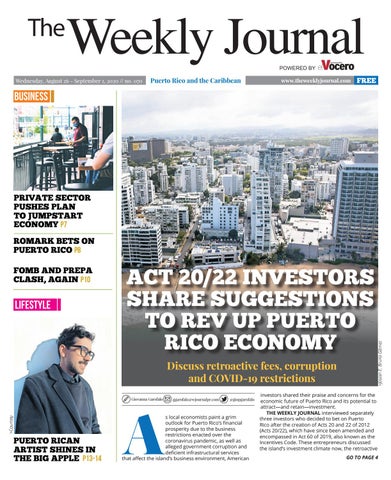
Act 20/22 Investors Share Suggestions to Rev Up Puerto Rico Economy Discuss retroactive fees, corruption and COVID-19 restrictions
>Courtesy
Giovanna Garofalo
Puerto Rican Artist Shines in the Big Apple P13-14
A
ggarofalo@wjournalpr.com
@giopgarofalo
s local economists paint a grim outlook for Puerto Rico’s financial prosperity due to the business restrictions enacted over the coronavirus pandemic, as well as alleged government corruption and deficient infrastructural services that affect the island’s business environment, American
>Josian E. Bruno Gómez
Romark Bets on Puerto Rico P8
investors shared their praise and concerns for the economic future of Puerto Rico and its potential to attract—and retain—investment. THE WEEKLY JOURNAL interviewed separately three investors who decided to bet on Puerto Rico after the creation of Acts 20 and 22 of 2012 (Acts 20/22), which have since been amended and encompassed in Act 60 of 2019, also known as the Incentives Code. These entrepreneurs discussed the island’s investment climate now, the retroactive GO TO PAGE 4
The Weekly Journal > Wednesday, August 26, 2020 > 2
3
/ Wednesday, August 26, 2020
a week in review Tropical Storm Laura Leaves Thousands Without Electricity
>Rosario Fajardo
>Josian E. Bruno Gómez
Tropical Storm Laura’s passage on Aug. 22 mainly affected the eastern region of Puerto Rico, leaving more than 200,000-plus clients in various municipalities without power. By the next day, most power had been restored islandwide.
Drop in Dominican Republic Tourism Affects Puerto Rico During the summer, local travel agencies usually sell vacation packages to the Dominican Republic to over 60,000 Puerto Ricans, but not this year. The coronavirus crisis has caused the local travel industry to lose more than $10 million generated by tourism in the neighboring country. Pictured is Casa de Campo Resort.
Powered BY El Vocero de Puerto Rico, 1064 Ave Ponce de León 2nd floor San Juan, PR Postal Address: PO Box 15074, San Juan, PR 00902
Judge Throws Out Gym Lawsuit Against the Governor Puerto Rico Superior Court Judge Alfonso Martínez dismissed a lawsuit by a group of gym owners against Gov. Wanda Vázquez, which had challenged the constitutionality of an executive order that closed their businesses. Martínez said the government has a “legitimate interest” in taking measures to reduce COVID-19 contagion.
President Salvador Hasbún shasbun@elvocero.com
Human Resources Director Arlene Rolón, PHR arolon@elvocero.com
Multi-Platform Digital Director Stephanie Gómez Álvarez sgomez@elvocero.com
Comptroller Félix A. Rosa frosa@elvocero.com
Traffic Director Ilia M. Pérez Centeno iperez@elvocero.com
Multi-Platform Graphic Director Héctor L. Vázquez hvazquez@elvocero.com
Production Director Eligio Dekony edekony@elvocero.com
Editorial Director Juan Miguel Muñiz Guzmán jmuniz@elvocero.com
Assistant Editor/ Reporter Rosario Fajardo rfajardo@wjournal.com
Phone: 787-622-2300, 787-721-2300 Customer Service: 787-622-7480
4
/ Wednesday, August 26, 2020
CONTINUED FROM PAGE 1 changes made to the laws that drew them to Puerto Rico, the economic impact of the governor’s executive orders, and how to restore investors’ trust on the island. Robb Rill moved to Puerto Rico in 2013 and was one of the first 10 investors to come to the island after the approval of Acts 20/22, founding The Strategic Group PR, a private equity firm, and The Act 20/22 Society, which he presides, to group together the scores of entrepreneurs who settle locally under the premises established in these laws. “For me, [settling] was maybe a little easier than most, but I was still navigating a very foreign space, and I don’t mean this in a negative term, but I was an isolated gringo [and] no one understood why I was here if I wasn’t working for a pharmaceutical company… The people who did understand wanted to be very cooperative and helped me become successful,” Rill said, commenting on the original process of moving to Puerto Rico and starting a new business endeavor. Since Rill made the island his permanent residence, the atmosphere has changed dramatically. In 2015, then-Gov. Alejandro García Padilla declared that Puerto Rico’s multibilliondollar debt was “unpayable”; in 2016, the U.S.
Congress passed the Promesa law and created the Financial Oversight and Management Board; in 2017, Hurricanes Irma and Maria devastated the island and the Zika virus affected the tourism sector; in 2019, consecutive protests ensued over government mishandling of Hurricane Maria relief, resulting in the resignation of then-Gov. Ricardo Rosselló and high-profile members of his Cabinet, as well as other FBI arrests on corruption allegations. And now in 2020, Puerto Rico has been under strict government measures due to COVID-19 that have severely impacted the local economy, the southwestern region was impacted by earthquakes, and the island recently experienced botched primaries and more FBI-ordered arrests of legislators. “All of that affects from an optics point of view the concern of stability and the concern of ‘do we have people running the show that we can have confidence in?’ And the answer is, unfortunately, there is still a big question mark there because Puerto Rico has not one black eye, but multiple black eyes as a result of historical incompetence, corruption, and I would say to some extent, malfeasance. Whenever investors are looking for new areas, these are all critical things to consider, and I think that is in part why there hasn’t been more investment on the island,” Rill explained. By contrast, Sam Blake, founder & CEO of
SB Marketing LLC, came to Puerto Rico in 2017, just a few months after Hurricane Maria, after hearing about the tax exemptions included in Acts 20/22 on a U.S. podcast. Despite being witness to multiple historic events that local economists argue have shattered the island’s business environment, Blake remains optimistic. Businesswise, he said his revenues have doubled, or even quadrupled, from his annual growth projections. In terms of rescuing the island’s attractiveness as an investment destination, he agreed with Rill that the chain of political upheavals and natural disasters have certainly made an impact, but believes that if people vote out what he deemed “corrupt” politicians, confidence will return. “I think that the chaos in Puerto Rico, whether it is in government or the weather, is causing people to not have faith in Puerto Rico as an investment opportunity and that is why I think that within the next five or 10 years we are going to see an increase—because the government is improving and I think that the weather will as well. I think that we’ve just had a bad couple of years, too,” Blake said. Meanwhile, Franklyn Weichselbaum—president of Global Management LLC and member of The Act 20/22 Society—settled in Puerto Rico in 2015, although he used to travel extensively to the island with his family. “The incentive [for which] I came
Robb Rill, founder of The Act 20/22 Society, spoke against the business closures issued throughout the coronavirus emergency. >File Photo
5
/ Wednesday, August 26, 2020
lawsuit claims that these individuals have also contributed $169 million for the local Treasury and municipalities, $678 million of capital investment and $141 million in the consumption of goods and services in Puerto Rico. “If they made the retroactive to $5,000… what stops them from making it $100,000 next year, and what stops it the year after to, ‘let’s make it half whatever their income is?’ Not having certainty about what the program is, is complete craziness,” Weichselbaum added. House Bill 2576 was created and sponsored to address this issue, but it couldn’t make its way to the Senate before the Legislature ended the session. Gov. Wanda Vázquez did call for an Extraordinary Session, but the bill was not included for senators’ consideration. “That was an unresolved issue that we need to take care of before we can truly have more investment on the island,” Rill said.
COVID-19 Restrictions
Sam Blake affirmed that Puerto Rico is the best place to live and invest in, adding that he married a Puerto Rican woman and is raising a family on the island. >Courtesy
here, was simply the tax incentive; it made a lot of sense to me,” he said.
Changes to Act 20/22
More so than political cataclysms, Weichselbaum argued that the biggest hindrance to Puerto Rico’s investment potential is the changes made to Act 20/22. For example, the administrative fee was $300 and now it’s $5,000, under the premise that the additional $4,700 will be destined to the Puerto Rico General Fund. Likewise, Rill noted that the $5,000 annual fee doubles for those with spouses. “I think it’s one of the dumbest moves someone could have done. I know people that wanted to come to Puerto Rico and they decided not to because they thought ‘how do I know what I’m signing up for,’” Weichselbaum stated. Because of this, The Act 20/22 Society filed a lawsuit against the government. Rill noted that while he is “not a fan of making constant change even if it’s going forward, retroactive is a thing that cannot be accepted.” Blake, on the other hand, who is distanced from the membership-based nonprofit, denounced the lawsuit as “the most ridiculous thing in the world.” “For any of us, an extra $5,000 shouldn’t make a difference with the taxes we’re saving, but another thing is, if someone doesn’t feel like they can invest another $5,000 in Puerto Rico, then they shouldn’t be here,” he asserted, adding that he feels “incredibly grateful” to the island he now calls his home. However, Rill affirmed that Act 20/22 investors have impacted the local economy with more than $650 million in real estate, roughly 40,000 jobs and extensive charitable work. Moreover, the
Regarding the months-long restrictions for businesses, residents and visitors to curtail the spread of the coronavirus, Blake opined that the island is handling the situation better than the U.S. mainland, whereas Weichselbaum observes that, despite the greater level of freedom he would have stateside, he’d much rather stay in Puerto Rico. Rill, meanwhile, is a member of the economic task force organized to assist the governor, along with the medical task force, on how to handle the pandemic, and he expressed dissatisfaction over the closures that have affected entire economic
sectors. “A significant portion, or the majority of the economic task force is very frustrated because there’s a health task force and it seems that we are at significant odds and the governor is, not exclusively, but heavily leaning towards what the health task force says and ignores many of our recommendations,” Rill denounced, adding that a task force member even resigned “in disgust.” Rather than more restrictions, he calls for Puerto Rico to apply the “Sweden Model,” which “states that anybody who is at risk needs to remain in place, but they didn’t force anybody to shut down.” As an example, he noted that Georgia has had about 4,000 virus-related deaths out of over 10 million people, which is less than one-tenth of the entire population. “I’m all for protecting people, but you have to balance it and you have to give people freedom of choice, that if I can run my business, I need to try because you are certainly going to kill me financially and ruin my entire life unnecessarily because you are not allowing me to try to support myself and my family,” he stated. The governor has justified the renewed business restrictions and the continuing curfew on the continuing rise of COVID-19 cases on the island, saying that safeguarding public health remains the top priority. As of press time, the P.R. Health Department had reported nearly 14,000 confirmed COVID-19 cases, 395 deaths and probable cases of almost 17,000, accumulated since March, out of an estimated population of roughly 3.1 million people.
Gov. Wanda Vázquez has defended the business closures and restrictions, arguing that the government must safeguard public health. >Brandon Cruz González
6
/ Wednesday, August 26, 2020
With New Restrictions, More Challenges for Puerto Rico Businesses Economic impact of new clampdown could reach $1 billion
A
The Weekly Journal Staff
more restrictive business closure would accelerate the disappearance of thousands of businesses that today are trying to adapt to the new economic reality and a hostile business environment, according to a study commissioned by the United Retailers Center (CUD by its Spanish acronym). Assuming that 10,000 small businesses are affected by a new closure due to COVID-19, from one month and a half to two months, the potential loss would be $212.9 million; and if another 5,000 medium-sized businesses are affected as well— whose potential loss would be $816.4 million— the combined loss would be over $1 billion in that period, a figure similar to the losses recorded in the first closing. According to a survey conducted by Inteligencia Económica, the problem worsens when 43.5 percent of small and midsize businesses (pymes by their Spanish acronym) see bankruptcy as a real option for their businesses if the economy fails to rebound. Economist Gustavo Vélez, the founder of the firm, stated that this trend toward sales drops will result in a weakened ecosystem for retailers, which represent roughly 124,000 direct jobs. He estimated that 25 percent of these businesses, which currently reach 45,000 establishments, could be closed, or roughly 11,250 fewer commercial establishments and approximately 31,000 job losses directly.
New Restrictions for Businesses
Due to the continuing rise of coronavirus cases, new restrictions, which will be in place for at least three weeks, have been imposed by the government, which include the continuing curfew, a full lockdown on Sundays and a more extensive dry law. A curfew is still in place and within the same timeframe. Residents and visitors may only leave their homes from 5 a.m. until 10 p.m. That is, unless they are exempt from this limitation due to work or health reasons, people cannot be outside their residences from 10 p.m. to 5 a.m. On Sundays, everyone must stay home unless
Economist Gustavo Vélez said that by the end of the calendar year, Puerto Rico could have a drop in the economy of 5 percent to 6 percent.
they are essential workers; if they require health services, or if they are going to shop at the exempt businesses, such as drugstores, gas stations and supermarkets. In other words, there will be a 24hour lockdown in place for most residents and activities. Bars and other commercial establishments whose primary business model relies on the sale of alcoholic beverages shall remain closed until further notice. Moreover, a dry law is still in place from Monday to Saturday from 7 p.m. to 5 a.m., and alcoholic beverages or liquors may not be sold anywhere on Sundays.
A second closure would weaken more businesses, causing bankruptcies, job losses and reduced revenues for the treasury and municipalities. -Economist Gustavo Vélez
Retailers Hurting
“The [retail] sector cannot bear another closure. You have to review everything. Many business owners have already exhausted the aid they were provided during the pandemic—such as loans to retain payroll—and many private-sector employees have already exhausted their savings
and the little aid that flowed from the government, especially the $1,200. Thousands of the newly unemployed due to the COVID-19 crisis still try to receive unemployment benefits, since they could not overcome the endless lines to access them,” Vélez said. “A second closure would weaken more businesses, causing bankruptcies, job losses and reduced revenues for the treasury and municipalities, which already face fiscal problems. It would open the space for Amazon and other digital sales companies to displace local commerce and delay the economy’s recovery, which depends more and more on local capital businesses,” he added. For Vélez, the government should not continue to reverse openings with its executive orders because uncertainty is generated and consumer confidence is reduced, especially when the contagion narrative is very pessimistic. “There is no way that the local economy can compensate for the three months that we remained closed. [We will] end this calendar year in negative 5 percent or 6 percent. We must drop the ambivalence. COVID is there and we need to do an intelligent, cooperative effort, not a sensationalist one,” he opined. His statements were echoed by economist José J. Villamil, who believes that as time passes, the sales gaps between big and small businesses will become more apparent, in turn changing the market structure. “We are going to end up with a more concentrated retail market. Pymes do not have the capital capacity or the assured supply chains like the large chains. In the long run, they will not be able to withstand the push, especially when both commercial and personal aid has already reached its end,” Villamil said.
7
/ Wednesday, August 26, 2020
Small businesses make the world go round.
Chamber of Commerce Launches 12-Point Plan to Reboot the Economy
Receives the support of La Fortaleza candidates
W Rosario Fajardo
rfajardo@wjournalpr.com
@RosarioWJournal
ith Puerto Rico mired in economic challenges for more than 10 years, coupled with natural disasters and now the COVID-19 pandemic, the Puerto Rico Chamber of Commerce is going all out to support the private sector and promote “positive change for Puerto Rico.” The Chamber has launched its “12-point Plan to Promote Economic Activity” on the island and has received the support of the gubernatorial candidates vying for La Fortaleza in November’s general elections. During a forum with the gubernatorial hopefuls, the Chamber outlined the main points that will help spur the private sector forward, as well as the rest of Puerto Rico. These initiatives include: • Attend with priority the processes of health prevention and care the presence of COVID-19, maintaining a sensible and effective public policy on economic activity and the protection of jobs. • Promote initiatives that support and stimulate micro, small and midsize businesses. • Accelerate the assignment and investment of federal recuperation funds. • Reduce energy costs and create a more resilient system.
• Reduce the tax burden on individuals and corporations with an integrated, simple and stable system. Other points outlined in the plan include making the permits process more agile, which has been a long standing complaint with entrepreneurs, supporting the U.S. House bills that would declare all of Puerto Rico an Opportunity Zone and establishing the island as important manufacturing hub for the United States; and promoting new economic sectors, such as Start Ups and tech companies. “Puerto Rico needs to focus on strengthening the economy,” said Juan Carlos Agosto Martínez, president of the Chamber. “For this to happen, our political leaders have to commit to developing policies and programs based on a competitive vision of government to foster jobs, development and innovation that contribute to economic growth and sustainable social well-being. “This plan is critical because as we all know, the situation right now is terrible,” he added. According to Agosto, there are around 44,000 businesses on the island, and of these, around 37,000 — or more than 80 percent — are small businesses with fewer than 20 employees. “They are struggling every day to survive. The problems are real and we cannot deny this,” he added. “The difficult economic conditions pose significant challenges, as well as opportunities. As a people, and as a private sector and engine of our economy, we cannot overlook this opportunity to combine our wills and adopt courses of action that favor our greater collective well-being,” Agosto said.
Main Gubernatorial Hopefuls React
The New Progressive Party’s La Fortaleza
hopeful, Pedro Pierluisi, who appeared at the forum via Zoom as was in self-quarantine, said he supports the Chamber’s 12 -point plan, “as it is totally consistent with my vision.” The former Resident Commissioner noted that as part of his gubernatorial campaign, he has visited more than 40 towns in two months and met with many business people, professionals, farmers and nonprofit representatives to receive their points of views and understand their concerns. As governor, Pierluisi said economic development would receive the utmost priority. “The private sector is important to provide opportunities. If the private sector rises, then so does the rest of Puerto Rico,” he added. For his part, Popular Democratic Party gubernatorial candidate Carlos “Charlie” Delgado Altieri also gave the 12-point plan the “thumbs up,” as he stressed that it is central to economic development, as it focuses on seeking agreements that will move Puerto Rico forward. The long-time mayor of Isabela added that he is committed to reforms at the Puerto Rico Electric Power Authority and vowed to carry out audits of the public utility that will include making public the details of its fuel purchases. With regard to small businesses, Delgado said he is focused on the message that Puerto Rico is “open for business.” To facilitate the permits process, he said he would provide provisional permits to entrepreneurs that would then give the business person one year to submit all the required documents to operate. “The government is the one who is impeding the permits process,” either by delays or lack of staff, he said.
8
/ Wednesday, August 26, 2020
Romark Gets FDA Approval
for New Manufacturing Facility in Manatí Investment of more than $80 million, to employ over 400 people
R Rosario Fajardo
rfajardo@wjournalpr.com
@RosarioWJournal
omark, a research-based pharmaceutical company focused on the discovery, development and delivery of innovative new medicines, primarily in the field of infectious diseases, announced that the U.S. Food and Drug Administration (FDA) has approved the company’s manufacturing facility in Manatí, for the production of Alina (nitazoxanide) tablets, 500 mg and Alina (nitazoxanide) for Oral Suspension, 100 mg/5mL in the U.S. market. The new state-of-the-art facility encompasses approximately 35,000 square feet and is equipped with suites and equipment to produce tablets, powders and other oral solid dosage forms. “This is a major milestone for us, as it allows us to expand our capacity to develop and deliver medicines,” said Marc Ayers, president and CEO of Romark. Romark has invested more than $80 million in establishing its Puerto Rico operations and now employs 100 people in the manufacturing facility and an analytical laboratory it acquired in 2018. With a planned expansion of the facility, the company’s Puerto Rico operations are expected to grow to a total of approximately 400 employees over the next three years. The Manatí facility is strategic to the company’s plans to manufacture and distribute its investigational new drug candidate, NT-300 (nitazoxanide extended-release tablets), which is currently undergoing Phase 3 clinical trials for both the prevention and treatment of COVID-19 and other viral respiratory illnesses.
White House delegation visits manufacturing sites
Romark’s announcement came as a White House delegation was visiting the island to look at Puerto Rico’s capacity and infrastructure to host multinationals, and saw firsthand the diversity of established companies in the northern region. Resident Commissioner Jenniffer González toured GK Pharmaceutical’s facilities in Manatí with Rear Admiral Peter Brown, President Trump’s
Special Representative for Puerto Rico; White House Public Policy Advisor Juan Caro; Puerto Rico Secretary of Economic Development Manuel Laboy; as well as other public and private sector officials. GK Pharmaceutical developed a package of molecular tests to detect COVID-19 that already has a PRE-EUA (Pre-Emergency Use Authorization) and an FDA approval was issued by the end of last week. These would be the only PCR tests developed and manufactured in Puerto Rico. The group also visited Honeywell and Lufthansa’s facilities so that the White House delegation could appreciate the island’s aerospace industry. Honeywell’s Research and Technology Center in Moca, built five years ago, is a young company focused on innovation. They work with universities on the island to prepare the workforce to be hired; sponsor programs and competitions; promote aerospace education; and offer internships, retaining roughly 70 percent of interns. Honeywell has 870 employees between the facilities in Moca and Aguadilla. “We do the development, research and testing for military and commercial aircraft navigation systems. The products themselves are manufactured elsewhere. We handle a lot of software work for commercial and military aircraft, and we also do electromagnetic interference tests. These are tests that are required by virtually all space and aeronautical products because these tests ensure that there is no interference, either environmentally or by frequency between the aircraft’s products,” according to Honeywell Aerospace Engineering Operations Site Leader for Moca, Luis Ramos. From these facilities, the company develops applications that NASA uses in its satellite missions. Meanwhile, Lufthansa Technik in Aguadilla is the only installation of this German company in the Americas, focused on airplane maintenance. Since its inception in 2015 to date, the entity has worked with 530 airships for nine airlines. One of the reasons this company chose Puerto Rico was the island’s convenient geographical location. Lufthansa Technik has 330 employees, 95 percent of them being Puerto Rican, and in 2017 they established the first mechanics apprenticeship program with the Puerto Rico Aeronautical and Aerospace Institute. This is the first federally approved program of its kind in the entire nation.
9
/ Wednesday, August 26, 2020
Discover Puerto Rico CEO Brad Dean acknowledged that the DMO’s revenues have contracted significantly. >File Photo
Discover Puerto Rico’s Operations at Risk
Its $25 million budget is based solely on hotel tax collections
T Christian G. Ramos
cramos@elvocero.com
@cramossegarra
he drop in hotel room tax collections caused by the coronavirus (COVID-19) pandemic represents a severe risk for the operations of the island’s destination marketing organization (DMO), Discover Puerto Rico, whose $25 million budget relies on those contributions. According to Discover Puerto Rico, roughly 70 percent of its budget is channeled toward marketing, promotion and sales; 22 percent for its payroll expenses; and 8 percent for the administrative budget. Given the decline
in tax collections due to the severe drop in tourism activity, the entity has been obliged to issue several operational adjustments, including furloughing eight of its employees. In addition to the recent furloughs, the DMO also instituted a compensation reduction affecting several employees that was made at the start of the pandemic, as well as cuts in operational costs. Meanwhile, Discover Puerto Rico has avoided filling open positions, reduced or eliminated several contract services and eliminated all nonessential expenses. The good news is that the organization also received funds from the federal government’s Payroll Protect Program, which has helped to offset a substantial portion of the DMO’s payroll costs. The funds, technically a loan, will eventually be forgiven, as per the federal government regulations. “Our revenues have contracted substantially. We reacted early on by reducing our expenses
by more than 60 percent. This includes reducing our staff, contract services and general and administrative expenses. We have steered from covering vacant positions, and last week we had to temporarily furlough eight employees,” stressed Discover Puerto Rico CEO Brad Dean. “For the destination to maintain a presence with future travelers, meeting planners and travel advisors, among others, our priority has been keeping Puerto Rico top of mind, working towards an Island reopening date of July 15. As this has been postponed indefinitely, we have taken actions to temporarily restructure our internal operations to meet current needs,” he added in a statement concerning the furloughs. According to estimates made by the Puerto Rico Tourism Co. (PRTC)—the public agency in charge of collecting the hotel room tax—from August to December 2020, the industry will experience a drop of 53 percent in hotel room nights and a 60 percent decline in hotel night rooms sold. Up until last July, the pandemic’s direct impact on tourism was over $270 million compared to the revenues reported for the same period last year. In light of this grim scenario, Dean told THE WEEKLY JOURNAL that the measures taken thus far will allow the DMO to preserve resources to tackle the challenging situation. “Our competitors have not stopped promoting and selling their destinations, which is why we must creatively promote future travels to the island, despite the decrease in funding. A smaller budget requires us to adapt and to seek efficiencies, acknowledging the limited reach and the relevance of our promotional efforts,” he stated. Dean added that the DMO will be forced to limit the markets where they promote the island as a destination and that there will be an impact on its capacity to attract meetings and conventions because of a lack of group incentives. “We are optimistic that we will receive access to federal funds that could help complement the reduction in market funds,” he added. However, Dean stressed that once the tourism industry begins to open to foreign markets, expected later this year, Discover Puerto Rico’s marketing and sales expenses will reach approximately $750,000 a month until activity grows and the revenue this generates returns to its normal flow.
In fact, Once the tourism industry begins to open to foreign markets, expected later this year, Discover Puerto Rico’s marketing and sales expenses will reach approximately $750,000 a month until tourism activity grows and the revenues this generates returns to its normal flow.
10
/ Wednesday, August 26, 2020
FOMB and Prepa Clash Over Renewable Energy Agreements
Prepa says the Oversight Board was ‘fully apprised’ of the dealings
T Rosario Fajardo
rfajardo@wjournalpr.com
@RosarioWJournal
he Financial Oversight and Management Board (FOMB) said that after reviewing the Puerto Rico Electric Power Authority’s (Prepa) submission last month of 16 renegotiated non-operational renewable energy powerpurchase and operating agreements (PPOAs), that the proposed contracts would result in higher electricity bills for clients. “Despite achieving improved prices (when compared to original prices) and more favorable contracts terms to Prepa, the approval and development of all 16 Proposed Contracts (representing a total renewable energy capacity of 593 [megawatts] MW), would result in overall retail energy rates that are higher than the average retail energy rates projected in the 2020 Certified Fiscal Plan,” said FOMB Executive Director Natalie Jaresko in a seven-page letter to Prepa’s Governing Board. Prepa must ensure that renewable energy is delivered at a reasonable and affordable price, the FOMB said. However, the sheer scope proposed by Prepa – delivering 593 MW of renewable energy at once through the 16 proposed contracts – would result in electricity rates higher than those projected. Therefore, to ensure consistency with the electricity rate projections included in the 2020 Certified Fiscal Plan, the total renewable energy capacity developed through the proposed contracts should be initially only 150 MW, the Oversight Board indicated. As such, Prepa should pursue an objective assessment of each proponents’ technical and financial qualifications, alongside any additional qualifications Prepa deems relevant, to qualify those proponents with the highest degree of technical and financial capabilities. “It is important for Puerto Rico to start increasing the share of renewable energy as soon as possible, and the shovel ready PPOAs provide a unique opportunity. Prepa should then gradually expand renewable energy to take advantage of technological improvements that increase efficiency even further, a more competitive bidding process, and improved contract pricing once
Puerto Rico emerges from bankruptcy,” the FOMB businesses of Puerto Rico deserve both.” said. In her seven-page missive, Jareksko also said Prepa ‘Perplexed’ by FOMB’s Comments that Prepa needs to do the same with solar Meanwhile, Prepa’s Governing Board said they energy. “Moving forward, Prepa should aim to take were surprised by the FOMB’s reaction, since advantage of decreasing solar equipment prices to Prepa “fully apprised” the Oversight Board of the procure solar energy capacity (at pricing levels that dealings. are aligned with the 2020 Fiscal “Prepa is deeply disappointed Plan). Prepa’s eventual exit from by the Oversight Boards untimely Title III may provide additional and unjustified decision rejecting opportunities to achieve lower the proposed execution and solar generation prices, as approval of the Proposed At issue are reflected in the assessment Contracts. Unfortunately, 16 green energy conducted by New Energy this results in the inevitable agreements Partners and commissioned by trust and deterioration of the that had been Prepa’s Governing Board,” she working relationship between renegotiated. said. our respective organizations. “Puerto Rico’s energy system What makes the letter even needs to change. The people and more perplexing is the overall businesses of Puerto Rico need implication that the Oversight more reliable, more affordable, Board had no knowledge or and cleaner electricity and the Oversight Board will participation whatsoever in the process, which is continue to work with Prepa and the Puerto Rico false,” Prepa said in a response letter to Jaresko. Government on this wholesale transformation. The FOMB’s actions will mean a delayed Increasing renewable energy generation is an transition to renewable energy sources; important part of that transformation, as well as a costly litigation with the proposed contracts’ requirement under Puerto Rico Act 17-2918,” the counterparties - “which will make any additional FOMB added. savings sought by the Oversight Board nonThe Oversight Board noted that it believes existent” - and further deteriorate the confidence renewable energy and more affordable electricity of potential investors in the government of Puerto prices should not be a tradeoff, as “the people and Rico, Prepa indicated.
In fact,
11 < The Weekly Journal > Wednesday, August 26, 2020
Todos aprendemos este
regreso A clases
con la rapidez que solo Liberty te ofrece
TRIPLE PACK ESPAÑOL DE
PRIMERA TV
MEGAS
del Internet más rápido
82
$
POR OR
TELEFONÍA ILIMITADA
99
•SIN PENALIDADES •SIN COMPROMISO •SIN CONTRATO
¡Suscríbete hoy! 787.355.6565
libertypr.com
*Ciertas restricciones aplican. Oferta válida hasta el 30 de septiembre 2020. La oferta de Triple Pack de Español de Primera de 200 Megas (hasta 200mbps download/hasta 20mbps upload) por $82.99, incluyen caja HD, modem WiFi y telefonía ilimitada a P.R. y EE.UU. Por factores externos, la velocidad real de Internet puede variar. Otras restricciones podrían aplicar. Para más información puede visitar nuestra página web https://libertypr.com/internet. Cargos por mal uso/uso abusivo podrían aplicar. Tarifas y servicios aplican a clientes residenciales, solamente donde haya facilidades. Depósito varía dependiendo del índice de crédito. Oferta sin contrato tiene un costo de instalación de $89.99, y con contrato varía dependiendo del índice de crédito. Instalación estándar se dene como 140” del tap de la residencia en donde existan facilidades. Instalación de servicio de tv adicionales conlleva un cargo de $9.99c/u. Liberty se reserva el derecho a negar o terminar los servicios a cualquier cliente que viole las políticas de la compañía o el contrato de servicio residencial. La facturación en papel conlleva un cargo de $3.00 mensuales. Liberty ofrece la opción de facturación electrónica E-Bill, la cual no conlleva cargo alguno. Para acogerse a E-Bill debe registrarse en mi.libertypr.com. Tarifas no incluye impuestos, ni cargos gubernamentales cuyo cómputo podría variar sin previa noticación. Otras restricciones podrían aplicar.
#estevirusloparamosunidos #estamosjuntosenesto #quédateencasa
12
/ Wednesday, August 26, 2020
Jerry Lectora
T
Caribbean Geopolitics and Puerto Rico’s Economic Development
he U.S. government is increasingly becoming aware of the challenges of China’s entrance in the Caribbean with their Belts and Roads Initiative. Some of China’s infrastructure-logistics development projects will be designed with a military/civilian dual-use in strategic areas. Also, China’s economic proposals aim to gain political soft power, in an area that is considered the American south border, also called the nation’s third frontier. This China initiative will eventually affect regional logistics and supply chains. My concern is that the U.S. government in its attempts to counterbalance China’s influence in the area, could negotiate concessions to countries in the Caribbean that could hurt Puerto Rico’s economy, tourism, investment attraction, logistics and air- connectivity development efforts. An example of this is the enactment of the DR- CAFTA Free Trade agreement that did not take into consideration its effects on Puerto Rico. It treated Puerto Rico’s economy as if it was an equivalent to the U.S. mainland economy. Obviously, this is not true; Puerto Rico is an offshore U.S. jurisdiction that is also a geographic, nearby competitor to these countries. The result of this free trade agreement was that some manufacturing left Puerto Rico to the Dominican Republic or Central America. The free trade agreement gave access to the U.S. market to products made in these countries that have lower production costs than in Puerto Rico. While at the same time it opened the P.R. economy to the products of these countries. These unforeseen results hurt local production in Puerto Rico, including the agriculture sector that left many unemployed. Another sample is the designation of Punta Cana and Bogota airports as pre-clearance U.S. entry points. These entry points became magnets for foreign airlines and incentivized
international air connectivity to these locations. This will affect Puerto Rico’s air-connectivity development efforts that should be addressed and balanced out with the appropriate policy that enhances cargo and passenger transfer flexibility on the island. In March 2019, President Donald Trump met with some Caribbean leaders in Mar-a- Largo, Florida to discuss economic cooperation in the area. The real intention of the meeting was to counterbalance China’s influence in the Caribbean. Below is what President Danilo Medina from the Dominican Republic requested to President Trump at the meeting. • The elimination of export taxes on steel to Puerto Rico. • Allow companies established in the Dominican Republic to export U.S. military uniforms and boots, taking advantage of the facilities of the Free Trade Agreement, as it has done with Chile, Canada and Mexico. (This will destroy the Puerto Rico military uniform and boot industry.) • The elimination of a travel warning advisory that the U.S. State Department placed so that U.S. citizens do not travel to the Dominican Republic due to security issues. By “coincidence,” just two days
after this meeting with President Trump in Florida, along with his national security advisor, a large high-level Chinese delegation headed by China Deputy Prime Minister Hu Chunhua arrived in Santo Domingo for diplomatic and economic discussions. It is obvious that there is tit for tat competition between the U.S. and China to cater to the Dominican Republic. Not because of its economic importance, but for its dual-use strategic geographical location in the Caribbean, that is very similar to that of Puerto Rico (only 75 miles separate these two countries). My concern is that history will repeat itself, with negative effects for Puerto Rico. On August 16, 2020, the Dominican Republic swore in a new president. Mr. Luis Abinader, a well-educated economist who has surrounded himself with experienced professionals, some of them with multiple graduate degrees. One of the first foreign leaders to meet with Mr. Abinader after he won the elections in July of this year was Mr. Zhang Run, China’s ambassador to the Dominican Republic. The U.S. government sent a high-level delegation to Mr. Luis Abinader inauguration. Headed by Mr. Mike Pompeo, the ambassador to the Dominican Republic, Robin
S. Bernstein, and the acting undersecretary of the State Department’s Office of Western Hemisphere affairs, Michael G. Kozak. After the swearing-in ceremony, both leaders met “to discuss opportunities to strengthen our alliance and focus on promoting transparency, democracy and security in the region.” The press note adds that “together we will overcome the challenges of the pandemic and reactivate our economies.” The U.S. government in its attempts to counterbalance China’s logistic and soft power influence on the area should not forget that it already has an excellent strategic geographical presence in the Caribbean in Puerto Rico. The aim should be to cooperate in economic development with area countries without affecting the Puerto Rico economy. At the same time, enable the air cargo and passenger transferring flexibility regulations that would make Puerto Rico the defining, dominating logistic center for the Caribbean. It will cost zero dollars to implement this solution. Puerto Rico could be an enabler and a contributor of the U.S. Caribbean strategy. Without this policy coordination, the U.S. government on one hand helps the economies of the countries that Puerto Rico does business, cooperate and competes with, and on the other hand it will have to send more federal monies to mitigate the problems its uncoordinated policies helped to create. Let’s hope history doesn’t repeat itself and this time the story has a happy ending. - Jerry Lectora is an international businessman and writes about transportation and geopolitics.
X
X
13
/ Wednesday, August 26, 2020
Lionel Cruet
Explores Ecological Spaces With Latest NYC Exhibit
‘Dusk/Daybreak’ showcases the Puerto Rican artist’s masterful use of color
A Giovanna Garofalo
ggarofalo@wjournalpr.com
@giopgarofalo
of inspiration and his most recent artistic series. Lionel Cruet was born in San Juan, the island’s capital. When asked about his age, he candidly replied, “I passed 30, but I am younger than 35.” He began to notice his artistic inclination while studying in elementary school, thanks to an observant teacher.
“It really wasn’t until I was in third grade at a public school in Puerto Rico when the art teacher at the time, Mayra Aguilar, became curious about the artistic manifestations I was creating. After referring to various art programs for young people, GO TO PAGE 14
s part of his continuous endeavors and projects, internationally acclaimed Puerto Rican artist Lionel Cruet will present his newest series, “Dusk/ Daybreak,” at the Yi Gallery in Brooklyn, New York City. The exhibition, which began on Aug. 21 and will be available until Sept. 19, is a testament to Cruet’s keen photographic eye and his masterful blend of colors, while also nodding to his Puerto Rican roots. But who is the artist behind the creation? THE WEEKLY JOURNAL spoke with Cruet to discuss his professional development, his passion, his sources
Puerto Rican artist Lionel Cruet explores different elements of nature and space in a variety of artistic media. >Courtesy
DUSKDAYBREAK 4, 2020, archival pigment print on photographic paper >Courtesy
14
/ Wednesday, August 26, 2020
CONTINUED FROM PAGE 13
as well as views of the sky and the sandy ground from different coastal areas of the Caribbean. The images show us the reality of I had people close to me who helped me the waste that I find on the beaches while I formalize and expand my interests, people walk,” he explained. like Daniel Lind Ramos, Rosa Irigiyen, The process to compose the artworks took Zilia Sánchez and Dhara Rivera, who were more than one year. He began with a series important mentors as well as family, which of images and a digital archive, after which has also been something essential in the he did some color samples and ink deposits process,” he affirmed. on paper. In his birthplace, Cruet achieved a Bachelor “Printing on paper has multiplied, achieving of Fine Arts from the School of Plastic Arts and several layers of vertically bled color with a Design of Puerto Rico. In 2011, he received diffuse effect between one and the other. an invitation to continue his academic This alludes to the transitions of daylight development in a professional program of seen in the sky at sunrise and sunset - the Photography at the School of Visual Arts in perceived daily division of time - while the Manhattan. Having been established at the Big details in the image are captured through the Apple, he then went to CUNY - the City College photographic resource. of New York - to take part in a Master of Fine “Symbolically, the change in day and Arts program focused on Interdisciplinary and night offers the most dramatic contrast Digital Art practices. between light and dark, the conscious Throughout his artistic trajectory, he has and unconscious state, the seen and the been featured in multiple museums and unseen, which has a biological effect on the galleries in Puerto Rico, the U.S. mainland environment and on humanity. Each work and abroad. These include the Puerto Rico in this exhibition juxtaposes a complex Museum of Contemporary Art; the Everson system of relationships between its subjects, Museum of Art, Syracuse; the Bronx symbols, visual elements, and the time and Museum of the Arts; Museo del Barrio, New space it represents,” Cruet said, describing York, and a solo exhibition at the Bronx River the process and meaning behind the color Art Center. choices and designs of this series. Moreover, in 2013, he was the recipient When observing the details of each piece, of the Juan Downey Audiovisual Award at it is apparent that the palm tree is heavily the 11th Media Arts Biennale at the National featured. Your correspondent asked if the A painting from the series “Flood Aftermath and Other Hurricane Museum of Fine Arts in Santiago, Chile. inclusion of the palm tree, a common type Stories II,” which alludes to the effects of natural disasters. >Courtesy When presenting his pieces to a variety of of vegetation in Puerto Rico, is the artist’s audiences, rather than alienating them over where the audience finds common representations way of honoring his Caribbean roots. cultural differences, he finds that they can reach that are tied globally,” Cruet said. “The presence of tropical Caribbean vegetation common ground that transcend barriers. “I have Asked about his sources of inspiration, he is present in my work, not only due to its gone through the experience in which works are explained that it varies depending on the project or geographical qualities, but also its condition shown that clash culturally with the ideas of the piece and its specificity. of resilience within the landscape. Something audience, making them see much more, but there “The most important part is the investigation interesting is that the palms are alternate are also times where there is a synchronization process, which begins with questioning a references and not necessarily with the use of the particular situation. The distillation of this results real palm,” he responded. in audiovisual installations, where I use sound and A previous series of his, “Flood Aftermath video equipment displaced in space. Digital prints and Other Hurricane Stories II,” also evidences where I intervene with Cruet’s roots. In his the material in an dossier, he speaks of experimental way to this project: “Floods achieve certain visual Aftermath and Other effects, such as the Hurricane Stories II is a most recent works. series of paintings on Photography that in blue tarps that depict some way or another is vernacular houses in a part of the projects. In landscape where the - Lionel Cruet reality, I use materials atmosphere and the that actually respond ground are treated to to the ideas of each make reference on the project,” he detailed, effect of hurricanes adding that his artistic style could be closest and heavy floods.” described as “provocative.” As for future exhibitions in his homeland, Cruet affirmed that he hopes to expand his creative vision in the island. “I hope that Puerto Rico offers ‘Dusk/Daybreak’ me more opportunities to expand in what is art Cruet’s new exhibition, “Dusk/Daybreak,” follows and culture,” he stated. that line of researching space and environment. Cruet’s trajectory and samples of his artwork The series contains six unique pieces, each one can be appreciated at www.lionelcruet.com. measuring 20 inches by 30 inches. To schedule a visit to Yi Gallery to see Dusk/ “Each piece arises from a photographic source DUSKDAYBREAK 2, 2020, archival pigment print on Daybreak firsthand, visit https://gallery-yi.com/ a diary compiled in coastal areas - that is made up photographic paper >Courtesy of fragmented screenshots from social networks, exhibitions/.
I hope that Puerto Rico offers me more opportunities to expand in what is art and culture.
15
/ Wednesday, August 26, 2020
Ocean Warming Threatens Coral Reefs
Could soon make it harder to restore them
A
Shawna Foo, Arizona State University
nyone who’s tending a garden right now knows what extreme heat can do to plants. Heat is also a concern for an important form of underwater gardening: growing corals and “outplanting,” or transplanting them to restore damaged reefs. The goal of outplanting is to aid coral reefs’ natural recovery process by growing new corals and moving them to the damaged areas. It’s the same idea as replanting forests that have been heavily logged, or depleted farm fields that once were prairie grasslands. I have studied how global stressors such as ocean warming and acidification affect marine invertebrates for more than a decade. In a recently published study, I worked with Gregory Asner to analyze the impacts of temperature on coral reef restoration projects. Our results showed that climate change has raised sea surface temperatures close to a point that will make it very hard for outplanted corals to survive.
Coral reefs at Isla de Mona. >Courtesy of Discover Puerto Rico
upper thermal limit. When reefs experience temperatures only a few degrees above long-term averages for a few weeks, the stress can cause coral bleaching and mortality. Increases of just a few degrees above normal caused three mass bleaching events since 2016 that have devastated Australia’s Great Barrier Reef.
Warmer oceans
Coral gardening
Coral reefs support over 25 percent of marine life by providing food, shelter and a place for fish and other organisms to reproduce and raise young. Today, ocean warming driven by climate change is stressing reefs worldwide. Rising ocean temperatures cause bleaching events – episodes in which corals expel the algae that live inside them and provide the corals with most of their food, as well as their vibrant colors. When corals lose their algae, they become less resistant to stressors such as disease and eventually may die. Hundreds of organizations worldwide are working to restore damaged coral reefs by growing thousands of small coral fragments in nurseries, which may be onshore in laboratories or in the ocean near degraded reefs. Then scuba divers physically plant them at restoration sites. Outplanting coral is expensive: According to one recent study, the median cost is about $160,000 per acre, or $400,000 per hectare. It also is time-consuming, with scuba divers placing each outplanted coral by hand. So it’s important
>Courtesy of Inter News Service
to maximize coral survival by choosing the best locations. We used data from the National Oceanic and Atmosphere Administration’s Coral Reef Watch program, which collects daily satellite-derived measurements of sea surface temperature. We paired this information with survival rates from hundreds of coral outplanting projects worldwide. We found that coral survival was likely to drop below 50 percent if the maximum temperature experienced at the restoration site exceeded 86.9 degrees Fahrenheit (30.5 degrees Celsius). This temperature threshold mirrors the tolerance of natural coral reefs. Globally, coral reefs experience an annual maximum temperature today of 84.9˚F (29.4˚C). This means they already are living close to their
Climate scientists project that the oceans will warm up to 3˚C by the year 2100. Scientists are working to create coral outplants that can better survive increases in temperature, which could help to increase restoration success in the future. When coral restoration experts choose where to outplant, they typically consider what’s on the seafloor, algae that could smother coral, predators that eat coral and the presence of fish. Our study shows that using temperature data and other information collected remotely from airplanes and satellites could help to optimize this process. Remote sensing, which scientists have used to study coral reefs for almost 40 years, can provide information on much larger scales than water surveys. Coral reefs face an uncertain future and may not recover naturally from human-caused climate change. Conserving them will require reducing greenhouse gas emissions, protecting key habitats and actively restoring reefs. I hope that our research on temperature will help increase coral outplant survival and restoration success. -This article is republished from The Conversation under a Creative Commons license.
Refreshed online reports every minute of every day.
TheWeeklyJournal.com Visit us for an updated content of our 24/7 platform.
The