Puerto Rico and the Caribbean
www.theweeklyjournal.com
>Courtesy
Wednesday, August 11-17, 2021 - // no. 120
Uber Celebrates Five Years in Puerto Rico P6 FOMB Touts Success in Past Year P7
>American Honda Motor Co. via AP
>All photos courtesy of Bluetide Puerto Rico
COVID Surge Dampens Travel Plans P9
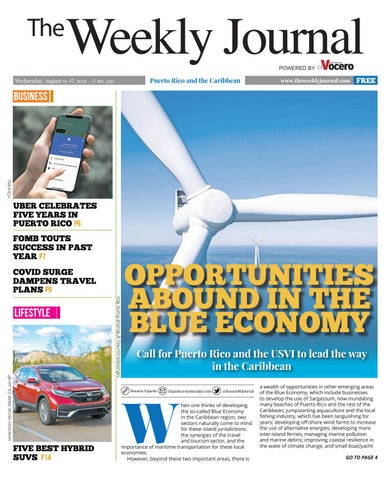
Opportunities Abound in the Blue Economy Call for Puerto Rico and the USVI to lead the way in the Caribbean
W Rosario Fajardo
Five Best Hybrid SUVs P14
rfajardo@wjournalpr.com
@RosarioWJournal
hen one thinks of developing the so-called Blue Economy in the Caribbean region, two sectors naturally come to mind for these island jurisdictions: the synergies of the travel and tourism sector, and the importance of maritime transportation for these local economies. However, beyond these two important areas, there is
a wealth of opportunities in other emerging areas of the Blue Economy, which include businesses to develop the use of Sargassum, now inundating many beaches of Puerto Rico and the rest of the Caribbean; jumpstarting aquaculture and the local fishing industry, which has been languishing for years; developing off-shore wind farms to increase the use of alternative energies; developing more inter-island ferries; managing marine pollution and marine debris; improving coastal resilience in the wake of climate change; and small boat/yacht GO TO PAGE 4
The Weekly Journal > Wednesday, August 11, 2021 >
2
BENEFICIARIO DE MEDICARE
¡Cámbiate hoy!
EL CUIDADO QUE NECESITAS
1.844.885.8885
Los beneficios que buscas
LIBRE DE CARGOS
1.866.620.2520 TTY (AUDIOIMPEDIDOS)
0
$
CONTIGO PLUS (HMO-SNP)
COPAGO1
Medicamentos genéricos Insulinas Laboratorios Rayos X Especialistas
Hasta
600
$
LUNES A DOMINGO 8 AM A 8 PM
al año2
Compra y entrega de alimentos Limpieza y desinfección del hogar por un profesional
¡Y los servicios para hacerte la vida más fácil!
//////////////////////////////////////////////////////////////////////////////////////////////////////////////////////////////////////////////////////////////////////////////
OTC El mismo día en tu farmacia Utiliza el código de barras en tu tarjeta del plan para pagar en la caja registradora. Disponible en 380 farmacias. Escanea el código QR con la cámara de tu celular y conócelas.
Recibe medicamentos recetados y OTC en la puerta de tu hogar, o donde los necesites, sin costo de entrega.
Esta cubierta está disponible para cualquier persona que tenga alguna de las siguientes condiciones: diabetes mellitus, condiciones cardiovasculares o fallo cardíaco crónico. 1. $0 copago en medicamentos genéricos e insulinas en la Red Preferida de Farmacias en los Niveles 1, 2 y 6. Copago en especialistas, laboratorios y Rayos- X en la Red Preferida de Proveedores. 2. $150 cada 3 meses. Para ser elegible a este beneficio, el afiliado debe cumplir con ciertas condiciones de salud.
Triple-S Advantage, Inc. es una Organización de Cuidado Coordinado (HMO, por sus siglas en inglés) con un contrato con Medicare. La afiliación a Triple-S Advantage, Inc. depende de la renovación de contrato. Concesionario independiente de BlueCross BlueShield Association. Triple-S Advantage, Inc. cumple con las leyes federales aplicables de derechos civiles y no discrimina por razón de raza, color, origen de nacionalidad, edad, discapacidad, o sexo. Triple-S Advantage, Inc. complies with applicable Federal civil rights laws and does not discriminate on the basis of race, color, national origin, age, disability, or sex. Triple-S Advantage, Inc., 遵守適用的聯邦民權法 律規定,不因種族、膚色、民族血統、年齡 、殘障或性別而 視任何人ATENCIÓN: Si usted habla español, servicios de asistencia lingüística están disponibles libre de cargo para usted. Llame al: 1-888-620-1919 (TTY: 1-866-620-2520). ATTENTION: If you speak English, language assistance services, free of charge, are available to you. Call: 1-888-620-1919 (TTY: 1-866-620-2520).注意:如果 使用繁體中文, 可以免費獲得語言援助服務。請致電 1-888-620-1919 (TTY: 1-866-620-2520).H5774_400221S437_M
3
/ Wednesday, August 11, 2021
a week in review Puerto Rico Dock Workers End Strike – For Now
Puerto Rico Gov’t Extends Vaccination Requirement to More Sectors Gov. Pedro Pierluisi announced a new executive order to curb COVID-19, which will go into effect on Aug. 16. “Vaccination or weekly negative [COVID-19] test results are required for all employees of health facilities,” he said. Other sectors that must comply with this requirement are Puerto Rico government contractors who work in person or frequently visit offices and premises. Likewise, all guests of hotels, inns and lodges, including short-term rentals such as Airbnb, will be required to be vaccinated or to present a negative test result.
Powered BY El Vocero de Puerto Rico, 1064 Ave Ponce de León 2nd floor San Juan, PR Postal Address: PO Box 15074, San Juan, PR 00902
President Salvador Hasbún shasbun@elvocero.com Vp of Marketing and Business Operations Michelle Pérez Miperez@elvocero.com
>Archive
>Archive
>Josian E. Bruno Gómez
Dock workers who launched a strike that prevented thousands of shipping containers with items including food and medicine from reaching Puerto Rico in recent weeks reached a tentative agreement with their employer. Concerns remain since the deal between Puerto Rico’s Union of Dock Workers and stowage company Luis Ayala Colón Sucrs Inc. is in place for only 45 days. The strike had prevented some 4,500 shipping containers and 13 boats from reaching Puerto Rico and another 5,000 containers from leaving the island.
Puerto Rico is the Filming Location of the New ‘Fantasy Island’ Series The new “Fantasy Island” series, filmed in Puerto Rico, will premiere on Aug. 10 on FOX. According to government figures, the show’s production has contributed to the island’s economy, generating over $54 million in economic impact, creating over 400 jobs for locals, and driving hotel occupancy to more than 2,000 nights for the entire production team, actors and staff.
VP of Accounting Félix A. Rosa frosa@elvocero.com
Human Resources Director Arlene Rolón, PHR arolon@elvocero.com
VP of Editorial Content Juan Miguel Muñiz Guzmán jmuniz@elvocero.com
VP of Production Eligio Dekony edekony@elvocero.com
Traffic Director Ilia M. Pérez Centeno iperez@elvocero.com
Multi-Platform Graphic and Technology Director Héctor L. Vázquez hvazquez@elvocero.com
Multi-Plataform Digital Director María Arce marce@elvocero.com
Phone: 787-622-2300, 787-721-2300
Assistant Editor/ Reporter Rosario Fajardo rfajardo@wjournal.com
Customer Service: 787-622-7480
4
/ Wednesday, August 11, 2021
CONTINUED FROM PAGE 1 maintenance, among others. Managing Sargassum has been a hot topic this summer due to the proliferation of the algae in the region. Yet many people may not realize that Algas Organics, a Sargassum recycling business in Saint Lucia, has been in operation since 2014 and has become a successful company. Meanwhile, a group of students from Ana G. Méndez University, Carolina Campus, recently won the 2021 Enactus Puerto Rico contest for their project that turns Sargassum into a biofertilizer. Aquaculture is also being developed in Puerto Rico and the USVI, for instance, for raising tilapia in ponds, but on a small scale. Opportunities are available for the growing seafood market, not just in the U.S. mainland, but around the world, for such products as the Caribbean or rock lobster, queen conch and sea urchins. These business opportunities were among the main topics of discussion during a threeday summit held by Bluetide Puerto Rico to help develop the Blue Economy on the island and the U.S. Virgin Islands (USVI). Puerto Rico and the USVI have a unique opportunity to lead eco-responsible business innovations in the international market, as well as export services, technology, products and knowledge in Blue Economy solutions that could translate into $82 million annually for the island, according to Bluetide. The World Bank defines the Blue Economy as the “sustainable use of ocean resources for economic growth, improved livelihoods, and jobs while preserving the health of ocean ecosystem.”
The most recognized industries of the Blue company Isla Borinquen LLC will take over the Economy are local or recreational fishing, development and operation of the deteriorated transportation and shipping, hotels, recreation Pier 15 at the Isla Grande Airport in San Juan. As and tourism, construction and boat mechanics, part of the agreement, Isla Borinquen will build a seawater desalination and insurance. According to dry-dock facility that will attract vessels and mega National Ocean Watch statistics, yachts. Economic Development ocean industries represent about Secretary Manuel Cidre said the 7 percent of Puerto Rico’s total company will invest $12 million employment. to build the dry dock and various “It’s important to create a other structures. functional synergy among all Pierluisi also spoke about plans Puerto Rico the industries that belong to to develop the Marine Business, and the USVI have a the Blue Economy so that by Research and Innovation Center, unique opportunity to complementing each other, known as M-BRIC, which is a lead eco-responsible they can develop effectively,” 45,000-square-foot building business innovations said Puerto Rico Gov. Pedro that seeks to become the first in the international Pierluisi. “In the same way, we Oceanographic Institute in the market, as well as must work together with the Caribbean and will be located in export services, USVI, with whom we share many Roosevelt Roads in Ceiba. technology, products development qualities, including Juan Bauzá, representative for and knowledge the same sea and the same Puerto Rico and the Caribbean in Blue Economy ocean. If we focus on the export at the U.S. Department solutions that could of these goods and services, we of Commerce’s Economic translate into $82 would be actively inserting the Development Administration million annually for Caribbean region in the global (EDA), explained that “EDA the island. market projection of $12.4 trillion awarded a $16 million grant by 2030,” he added. to the Local Roosevelt Roads Redevelopment Authority for M-BRIC’s design and construction, Initiatives in Puerto Rico to be complemented with and the USVI investment from the central government, hoping As an example of a public-private partnership that it will generate at — its maximum capacity agreement, the governor mentioned the deal — more than 29,000 jobs.” Once the contract is reached between the Ports Authority and Hall of awarded through a bidding process, it should take Fame baseball star Iván “Pudge” Rodríguez, whose 36 to 48 months to build. For his part, USVI Gov. Albert Bryan Jr. outlined the U.S. sister territory’s efforts in the Blue Economy. “In the USVI, we have traditionally governed and operated with our back to the water. However, we have an opportunity now, as we work to diversify our economy, to take full advantage of what our marine ecosystem has to offer,” he said. Bryan pointed to the increase in vessels registered in the USVI during the coronavirus pandemic as one indicator of the tremendous economic potential that exists in the marine industry and noted recent investments, including the development of an agribusiness aquaponics center on St. Croix as examples of his administration laying the groundwork for the Blue Economy. He also noted a number of capital improvement projects to support the U.S. territory’s fisheries and recreational boating sectors, including improvements to the fishing dock in Hull Bay on St. Thomas, and improvements to the Ann Abramson, Kings Alley and Gallows Bay piers on St. Croix. “Puerto Rico and the U.S. Virgin Islands have a unique opportunity to lead eco-responsible business innovations in the international market, export services, technology, products and knowledge in Blue Economy Solutions for the world… When you live on an island, everything depends on the health, maturity, strength and resilience of the Blue Economy, from importing goods to basic food security,” Bauzá said. “The sea is a territorial extension capable of offering us food, energy and economic
In fact,
5
/ Wednesday, August 11, 2021
When you live on an island, everything depends on the health, maturity, strength and resilience of the Blue Economy, from importing goods to basic food security. -Juan Bauzá, Puerto Rico and the Caribbean representative at the U.S. Department of Commerce’s Economic Development Administration
Local fishermen around the Caribbean depend on the ocean for their livelihood.
development,” according to Guifre Tort, interim executive director of Bluetide. “We want to help companies understand that the ocean is more than a geographical edge and can be a great business opportunity for them.” Having received $9 million from the EDA to assist in the development of the Blue Economy in Puerto Rico and the Caribbean, Bluetide is focused on expanding the region’s maritime opportunities, he said.
Among the projects that Bluetide hopes to continue developing include: • Mariculture and aquaculture (seawater and
freshwater farming) • Molecular Marine Biology • Marine bioprospecting • Fish aggregation devices (used to attract fish) • Management of oceanic space • Blue Technology Sustainable development is particularly important for the region. The costs of inaction in the two dozen island nations and territories of the Caribbean, with its 40 million people, make the region particularly vulnerable to the effects of global warming, according to Bluetide. Studies project losses of $22 billion by 2050 - or 10 percent of the region’s Gross Domestic Product, analyzing average damage from hurricanes, tourism losses and infrastructure damage due to sea level rises.
Acceleration Initiatives for the U.S. Territories
Earlier this year, Bluetide Puerto Rico launched a marine innovation program called, “Blue my Mind,” with more than $400,000 to be distributed for promoting sustainable development projects tied to the ocean. “Blue my Mind” seeks to identify and support innovative initiatives with projects tied to the ocean that help in the creation and development of new industries related to the sea, according to organizers. The chosen initiatives will be provided with logistics, materials and support to promote concepts, prototypes and pilot projects. “We should not see our coasts as a border where Puerto Rico ends. We have to learn to see the sea as an extension of our island towards broader borders that can give us enormous economic development,” Tort said. Blue Economy innovation spans through a broad spectrum of industries and technologies, large and small, which can promote sustainable ocean activities that create a sustainable economy.
As an island, Puerto Rico is highly dependent on container ships to bring in the majority of the island’s needs in terms of goods and other products.
6
/ Wednesday, August 11, 2021
Uber Celebrates Five Years in Puerto Rico
Announces new products and services
A Giovanna Garofalo
ggarofalo@wjournalpr.com
@giopgarofalo
fter a series of trials and lessons, Uber is celebrating its fifth anniversary in Puerto Rico by extending its services to provide a more cohesive experience for its users. When Uber launched its app locally in July 2016, it was met with some resistance from the public sector and the island’s taxi drivers, who called for restrictions on pick-up spots for Uber drivers, even clashing with the latter during the initial months. Since then, Uber has been embraced by residents and tourists alike, allowing the company to diversify its offer. Víctor Jaen, general manager for Uber in Panama and the Caribbean, reported that since 2016, more than 20,000 people in Puerto Rico have registered as driving partners in the app, traveling over 90 million miles in trips. In addition, 1.7 million Puerto Rico residents registered and used the app at least once on the island during the past five years. Of these, 34,000 took their first trip on Uber during the COVID-19 pandemic. Apart from ride-hailing, the brand offers diverse services. For instance, users may order food, groceries, alcohol and convenience items, and have them delivered to their doors through Uber Eats, a separate app. Earlier this year, this extension introduced the Eats Pass subscription, which for $9.99 a month saves users 5 percent on orders worth $15 or more from participating restaurants and allows unlimited deliveries with no transportation fees on orders starting at $15. Likewise, the pass saves users 10 percent on their first three rides each month on Uber’s ride-hailing offers. Last year the company also launched Uber Flash, used by customers to deliver products. According to Jaen, more than 7,000 deliveries were made in Puerto Rico through this extension in its first year, some of these being transactions between business owners and clients. Jaen also announced the start of Uber Rent, a new service that allows users to rent all types of cars from recognized car rental companies in Puerto Rico, such as Avis. The rental can be done by the day or for extended periods. With Uber Rent, users can search and compare the prices
Víctor Jaen said that Puerto Rico, as an avant-garde market, is ideal to launch the new Uber Rent service. >Courtesy
of the major car rental companies; rent the car on the day of their trip or reserve it a month in advance, with cancellations allowed up to 48 hours before the scheduled pick-up time; and includes personalized extras like car seats for babies and children, bicycle racks, child locks for passenger doors, and more. “As a technology-driven company, at Uber, we are always innovating to meet user needs. The app is getting stronger every time, integrating the various Uber products on a single platform. Thus, the user has access to a universe of options for their daily lives, all within an ecosystem that they already know and trust. Puerto Rico is the ideal destination to launch Uber Rent and other innovations, as it is an avant-garde market that is distinguished by its vision of the future,” Jaen said.
Longer Wait Times Explained
As reported by THE WEEKLY JOURNAL, users on the island have reported experiencing longer wait times to secure a driver, or for the driver to reach their destination. Even in tourist zones, where drivers would have normally arrived almost immediately, customers may even wait half an hour. Prompted about this issue, Jaen explained that the catalyst could be attributed to various factors, including greater demand as pandemicrelated restrictions become more flexible. “This is something that we have observed not only
in Puerto Rico but globally. The reality is that restrictions are loosening or tightening - there are many factors that influence how people return. On the one hand, we have seen that demand is perhaps returning faster than we would have expected. So, users are faster to move again,” he stated. He added that there are also other elements that may influence a shortage of drivers, such as fear of COVID-19 and state and federal benefits disbursed throughout the pandemic, which he said may eliminate drivers’ need for additional income. The latter assessment coincides with three different testimonies from local Uber drivers who - speaking to THE WEEKLY JOURNAL on condition of anonymity - suggested that some colleagues have opted to receive federal financial assistance instead. There is a third factor that, according to Jaen, is more specific in Puerto Rico, “which is the validation of an official license, and there are times that it could take a little longer than normal to obtain this license through the corresponding process.” Despite this, Uber has reported a steady recovery worldwide from the pandemic. The company’s ride-hailing revenue more than doubled from last year to $1.62 billion, while it provided 1.51 billion rides during the second quarter of 2021 — a 105 percent increase from the same time last year, as reported by The Associated Press.
7
/ Wednesday, August 11, 2021
FOMB Chairman David A. Skeel >Brandon Cruz González
FOMB: Despite Pandemic, FY2021 Year of ‘Significant Progress’
Highlights Plan of Adjustment and a ‘compliant’ budget Rosario Fajardo
rfajardo@wjournalpr.com
A
@RosarioWJournal
Editor’s note: First in a series on the FOMB’s FY 2021 Annual Report voluminous 232-page document on the Financial Oversight and Management Board’s Fiscal Year (FY) 2021 Annual Report is highlighting two major accomplishments achieved during the so-called “Year of the Pandemic.” Despite the challenges of COVID-19, much was accomplished, according to FOMB Chairman David A. Skeel. “Fiscal Year 2021 was a year of significant progress. The year started in the midst of a global health crisis that further jeopardized Puerto Rico’s recovery from the fiscal and economic crisis that has plagued the island for too long. However, by the time the year ended, the Oversight Board had succeeded in renegotiating the Plan of Adjustment to reduce Puerto Rico’s debt even more than the proposed plan we had filed a year earlier, right before the COVID-19 pandemic began. We also were able for the first time to certify as compliant a budget submitted by the Legislature and signed by the Governor. These two accomplishments are major progress toward fulfilling the Oversight Board’s responsibilities under PROMESA,” Skeel stated. The Oversight Board reached these “milestones” despite considerable obstacles, he noted. “The enormous toll COVID-19 took on the people of
The amended plan reduces Puerto Rico’s annual debt service from as much as $4.2 billion without PROMESA to a maximum of $1.15 billion under the amended plan. -FOMB Chairman David A. Skeel
Puerto Rico and on the economy weighed heavily in our fiscal and debt restructuring decisions, as reflected in the lower annual debt payments in the new proposed Plan of Adjustment. The government still has not pushed hard enough to implement the reforms that would allow Puerto Rico’s economy to grow again. And the Legislature and two Governors’ administrations have enacted fiscally irresponsible laws we had no choice but to fight in court, because the laws violate PROMESA and threatened to lengthen Puerto Rico’s path to recovery,” he added. Regardless, the amended Plan of Adjustment that was submitted in March includes significant amendments to the plan that was filed before the pandemic. “The amended plan reduces Puerto Rico’s annual debt service from as much as $4.2 billion without PROMESA to a maximum of $1.15 billion under the amended plan. The Oversight Board firmly believes this is both sustainable for Puerto Rico and fair for the creditors. Before PROMESA, the Puerto Rico government paid 30
cents of every dollar it collected in taxes and fees to creditors; under this plan it would be 7.5 cents,” Skeel said. On the fiscal side, the “increased fiscal discipline” created by the Certified Fiscal Plans over the last four years has ended the cycle of deficit spending and provided Puerto Rico with an Emergency Reserve, a financial cushion for emergencies like the COVID-19 pandemic and natural disasters. Puerto Rico had no such reserve when Hurricane Maria hit, he noted.
Concerns for the Future
However, going forward, he cited two major areas of concern. “First, we urge the government to focus more vigorously on the pro-growth reforms outlined in the Fiscal Plan. These reforms are critical to creating the conditions for economic growth. Second, significant disagreements remain with both the Governor and the Legislature over the treatment of government pensions. Due to years of neglect by the Puerto Rico government, the pensions were almost completely unfunded by the time PROMESA was enacted. Despite the absence of funding, the Oversight Board has fought to fix the pension systems and to provide government retirees with as much of their pensions as legally and fiscally possible,” according to Skeel. The Oversight Board’s primary goal for Fiscal Year 2022 is to complete the restructuring and to exit bankruptcy. “Until Puerto Rico exits bankruptcy, it cannot move forward. Completing the restructuring is in everyone’s best interests. We hope the Government and Legislature will work with us to make this happen, and that the plan will be confirmed by the U.S. District Court before the new fiscal year comes to a close,” he stated.
>Courtesy
8
/ Wednesday, August 11, 2021
T-Mobile’s Jorge Martel >Courtesy
Liberty and T-Mobile See Continued Growth in Puerto Rico
Innovation and dependability are keys for success
T Rosario Fajardo
rfajardo@wjournalpr.com
@RosarioWJournal
elecom companies are continuing to report strong growth for the year, with Liberty Puerto Rico and T-Mobile showing increases in local subscribers. Liberty reported revenues of $360 million for the second quarter (Q2) 2021. Liberty recorded 22,000 RGU (revenue generation units) fixed net additions for the quarter. Regarding its new build program, Liberty added over 8,000 new homes passed with Fiber-to-theHome technology during 2021. “As we continue the integration process, we are seeing increased customer trust in the form of strong sales and high customer retention,” said Naji Khoury, president and CEO of Liberty Puerto Rico. “Our numbers for this quarter show that our efforts to deliver a first-rate network and drive for innovation are paying off.” As the pandemic continues, with a resurge in various jurisdictions, Khoury told THE WEEKLY JOURNAL that trends will continue. “Internet use is not going to slow down. As a matter of fact, I think it will be just the opposite. Data consumption will increase. People got used to a more digital approach in both their professional and daily lives.
We will continue working on our infrastructure to provide more and faster internet speeds so our customers can work and entertain themselves in this new reality we are living in,” he said. “Data consumption trends such as surging internet use for videoconferencing and streaming for example, are not going to change. That’s a trend that is here to stay. Now that people have discovered the advantages of incorporating the internet into their daily lives at a larger extent, they are not going to go back to the old way of doing things. So it’s even more important for us to be ready and provide our customers with the speed, products and services that will accommodate that demand,” Khoury said. The Liberty executive also reported that with the deployment of 5G service, Liberty continues to expand and upgrade its infrastructure in Puerto Rico and the U.S. Virgin Islands (USVI), with 128 projects launched during Q2. Currently, Liberty’s 5G network is covering 95 percent of population in Puerto Rico and the USVI. Khoury stated that Liberty is delivering “the most reliable and resilient network” during Q2 with 99.6 percent network availability during power outages and blackouts. The executive added that Liberty Mobile’s 5G network traffic doubled quarter over the previous quarter (Q2 versus Q1 2021).
T-Mobile Launching Internet Home Services
Meanwhile, T-Mobile has experienced a 13 percent increase in its customer base in Puerto Rico, while continuing to expand its coverage on
the 5G network. Jorge Martel, vice president and general manager of the company on the island, said they will “soon” offer internet service in homes to thousands of Puerto Ricans. “We want to be very ready and for the network to withstand the demand, but also be extremely superior,” he said. “We can say that our customer base increased over 13 percent versus last year. We continue to see new growth in new clients that join us and also the loyalty that we are seeing from the base,” Martel said. “T-Mobile again won the JD Power (award) for best customer service in the industry… In Puerto Rico, we have the best quality metrics at the level of all of T-Mobile and T-Mobile is the best in the industry. We are proud of the service that we provide here in Puerto Rico,” he said. Locally, he specified that 75 percent of the company’s phones are connected to the 5G network and the remaining 25 percent have 4G. “The closest competitor I think reaches 50 percent, so most of our 5G phones have a 5G connection,” said Martel, adding that they continue to monitor the COVID-19 pandemic and that they have the infrastructure ready in case new restrictions are imposed. . “We are taking the 5G network to the business level, education and various industries so that they can do other things for which they previously depended on fixed band,” he said. “We want to be sure that all areas in Puerto Rico and particularly the areas most in need, such as rural areas, have 5G because the social, economic and educational impact it has is very strong.”
/ Wednesday, August 11, 2021
9
Drop in Travel Confidence Due to Spike in COVID Cases
Mastercard: Experiences and well-being more important than ever
U Rosario Fajardo
rfajardo@wjournalpr.com
@RosarioWJournal
nfortunately, with COVID-19 cases and hospitalizations on the rise, optimism about the pandemic has receded to a level last seen during winter 2020. After months of steady recovery, confidence in travel’s safety now continues to decline, according to the latest report by Destination Analysts. A jump in coronavirus cases in places like Florida, where around 1.2 million Puerto Ricans live, is having a domino effect on the travel industry. Delta variant-related concerns are disrupting trip plans, diminishing travel enthusiasm >Courtesy of Destination Analysts and making it more difficult to market travel right is steady. Male travelers are feeling more positive, now. After hitting a high of 52.9 percent just six weeks exhibiting greater optimism and commitment to their travel future. More vaccinations will come, ago, the percent of American travelers who feel as nearly a quarter of unvaccinated American “confident” or “very confident” travelers say they will get a they can travel safely in the COVID-19 vaccine this year. current environment fell to 36.6 “Despite the lessened percent. Nearly half (48.0%) excitement, many Americans agree that media coverage of are still planning Fall travel. the COVID-19 situation has them According to a Over half of American travelers doubting that it is safe to travel,” Mastercard report, expect to take one or more as per Destination Analysts’ people in Puerto overnight leisure trips in the Aug. 9 Travel Sentiment report. Rico increased next three months, with 23.9 Less than half of Americans now their focus on percent reporting trip plans for consider flying on an airplane, tech enabled wellSeptember, and 26.1 percent visiting a museum or indoor being (27 percent), for October,” said Destination attraction, and riding in an Uber/ rest and balance Analysts. taxi is safe. (35 percent), and “This week, a notable number Importance of Family and soothing activities of American travelers continued (35 percent) during Friends to say the Delta variant had the pandemic. Meanwhile, a new survey by caused trip postponements (27.0 Mastercard has found that the percent, up from 25.4 percent July pandemic has driven people 26th) and even cancellations 23.0 to redefine their expectations percent, up from 18.9 percent). of experiences, whether at home or traveling. Travel enthusiasm overall has certainly been People now prefer experiences that they can do impacted. More than 54 percent say that the Delta with family and friends (89 percent) and want to variant has made them less interested in traveling visit new places so they can see and do things right now,” the report stated. they have never done before (81 percent), while According to the market research firm, there is some good news to report too. Financial sentiment being open to different cultural influences new
In fact,
cultures (75 percent). According to Mastercard, people in Puerto Rico increased their focus on tech enabled wellbeing (27 percent), rest and balance (35 percent), and soothing activities (35 percent) during the pandemic. Their proactive focus on self with an eye toward increased resilience led them to prioritize mental well-being (93 percent), emotional wellbeing (93 percent) and physical wellbeing (91 percent), all to find energy to connect with others. At the same time, nearly half of people surveyed agreed that it is important to spend time unplugged without interruption from any device. In fact, when asked about their preferred unplugged activities, people over index on outdoor adventures. Globally, there is above average interest (Index 100) in using nature and open spaces as an escape from everyday life, preferring road trips (201), exercise (161), remote/secluded getaways (130), and camping and hiking (127). “After a year of lifestyle limitations, consumers have a pent-up demand for experiences that are memorable and shareable,” said Wayne Levings, president of Kantar Global, a consulting company. “Post pandemic, we don’t expect consumers to seek a volume of experiences but rather experiences with perceived longevity—things that they will never forget and that they can relive through stories, personal betterment or community impact.”
10
/ Wednesday, August 11, 2021
Coca-Cola Music Hall Sets the Stage for Premier Entertainment $40 million venue has already confirmed 27 shows for 2021
W Giovanna Garofalo
ggarofalo@wjournalpr.com
@giopgarofalo
ith Puerto Rico hopefully phasing out of the COVID-19 pandemic, the Coca-Cola Music Hall is ready to provide unique entertainment experiences and position the island as a premier destination. Located in the T-Mobile District in San Juan, a one-of-a-kind entertainment hub in the Convention District, the Coca-Cola Music Hall will have its grand inauguration on Aug. 14 with a sold-out concert by Puerto Rican singer Ednita Nazario. Jorge L. Pérez - regional general manager of ASM Global Puerto Rico, which developed the Music Hall in coordination with PRISA Group - reported that, so far, there are 27 concerts lined up for the remainder of 2021, with others more under negotiation. With a private investment of roughly $40 million, the Music Hall can host 4,300 guests in a traditional sitting format and about 5,000 attendees in a “festival” format, where some concertgoers are standing up. Due to COVID-19, the venue is filling its capacity level, but only for people who have proof of vaccination. As such, minors under 12 are not allowed to attend because they are currently ineligible for the vaccines. Pérez affirmed that Health Department inspectors will be validating the vaccine evidence can deny entry, if applicable. The Music Hall has 10 employees working fulltime, but Pérez said that each concert brings up to 250 additional workers. Apart from Nazario’s concert, others have already sold out. For instance, Pérez reported that the venue launched two showings for Colombian pop singer Camilo and these sold out within two hours on Ticketera, the Music Hall’s single ticket office. Likewise, Eladio Carrión, a Kansasborn Puerto Rican urban artist, sold out three performances in 40 minutes. “It is consistent with what we have been seeing with the [José Miguel Agrelot] Coliseum, in which concerts go on sale and in a matter of minutes and hours, tickets run out. More importantly, when the tickets run out, for example in the case of the Coliseum, you still have 50,000 or 60,000 people connected to Ticketera who were waiting to buy tickets,” Pérez explained.
The venue will kick off with a concert by Ednita Nazario on Aug. 14. >Courtesy
theater, the Aloft San Juan hotel, restaurants and “That’s a trend that we expected because we other businesses, the Coca-Cola Music Hall offers a knew that pent-up demand was significant and unique experience for both residents and travelers people were going to want to go out and share at the T-Mobile District. “Our vision is to be the with friends and family. But not even in the best best venue of its kind in the Americas. We want to of projections did we expect that it would be at compete with Radio City Music this level with sold outs in hours Hall; we want to compete with and this reaction that we have other great theaters in the U.S. seen is positive for everyone - for and throughout Latin America,” the producers, artists, for us and Pérez stated. the venue,” he told THE WEEKLY Asked what distinguishes the JOURNAL. Due to Music Hall from other concert Moreover, Pérez said that the COVID-19, the venue venues, he said that in addition Music Hall is attractive for event is filling its capacity to its adjacent assets, the producers because it provides level, but only for establishment offers an “intimate” them with most production people who have experience with “the best sound elements. “For the producer, it is proof of vaccination. equipment.” His goal is for a very easy process in the sense the spot to gain international that we already offer the lighting recognition and cement Puerto system, the sound system, we Rico as a top entertainment have a fixed platform that is the destination. largest in Puerto Rico, we have a “We are going to be working so that huge 44 x 88 screen... In other words, they can add international artists start looking at the Coca-Cola elements, and many producers are going to do it, Music Hall... The industry already knows it and a but you already have 85 percent of the production lot of people are talking about it. Our vision really there,” he said. is on a global level, on an international scale. We want to be recognized internationally because we World-Class Destination have an offer that competes with any destination,” Complemented by the ToroVerde Urban Park, Pérez affirmed. the Medalla Hall, a Caribbean Cinemas VIP movie
In fact,
11
< The Weekly Journal > Wednesday, August 11, 2021
12
/ Wednesday, August 11, 2021
X
Derek Lemoine,
X
Associate Professor of Economics, University of Arizona
Four Ways Extreme Heat Hurts the Economy
S
ummer 2021 will likely be one of the hottest on record as dozens of cities in the West experience all-time high temperatures. The extreme heat being felt throughout many parts of the U.S. is causing hundreds of deaths, sparking wildfires and worsening drought conditions in over a dozen states. How does all this broiling heat affect the broader economy? As an economist who has studied the effects of weather and climate change, I have examined a large body of work that links heat to economic outcomes. Here are four ways extreme heat hurts the economy – and a little good news.
Lost learning results in lower lifetime earnings and hurts future economic growth. The impact of extreme heat on development, in fact, begins before we’re even born. Research has found that adults who were exposed to extreme heat as fetuses earn less during their lifetimes. Each extra day with average temperature above 90 F (32 C) reduces earnings 30 years later by 0.1%.
Air conditioning can help – to a point
1. Growth takes a hit
Research has found that extreme heat can directly hurt economic growth. A 2018 study found that the economies of U.S. states tend to grow at a slower pace during relatively hot summers. The data shows that annual growth falls 0.15 to 0.25 percentage points for every 1 degree F that a state’s average summer temperature was above normal. Laborers in weather-exposed industries such as construction work fewer hours when it’s hotter. But higher summer temperatures reduce growth in many industries that tend to involve indoor work, including retail, services and finance. Workers are less productive when it’s hotter out.
2. Crop yields drop
Agriculture is obviously exposed to weather: After all, crops grow outdoors. While temperatures up to around 85 F to 90 F (29-32 C) can benefit crop growth, yields fall sharply when thermostats rise further. Some of the crops hit hard by extreme heat include corn, soybeans and cotton. These reductions in yields could be costly for U.S. agriculture. A recent study I conducted found that an additional 2 degrees C of
global warming would eliminate profits from an average acre of farmland in the Eastern U.S. A prominent example of this was the collapse of the Russian wheat harvest in response to the country’s 2010 heat wave, which raised wheat prices throughout the world.
3. Energy use soars
Of course, when it’s hot, energy use goes up as people and businesses run their air conditioners and other cooling equipment at full blast. A 2011 study found that just one extra day with temperatures above 90 F increases annual household energy use by 0.4%. More recent research shows that energy use increases the most in places that tend to be hotter, probably because more households have air conditioning. This increase in electricity use on hot days stresses electric grids right when people depend on them most, as seen in California and Texas during recent heat waves. Blackouts can be quite costly for the economy, as inventories of food and other
goods can spoil and many businesses either have to run generators or shut down. For instance, the 2019 California blackouts cost an estimated $10 billion.
4. Education and earnings suffer
A long-term impact of increasingly hotter weather involves how it affects children’s ability to learn – and thus their future earnings. Research has shown that hot weather during the school year reduces test scores. Math scores decrease more and more as the temperature rises beyond 70 F (21 C). Reading scores are more resistant high temperatures, which this research claims is consistent with how different regions of the brain respond to heat. One study suggested that students in schools that lack air conditioning learn 1% less for every 1 degree F increase in the school year’s average temperature. It also found that minority students are especially affected by hotter school years, as their schools are especially likely to lack air conditioning.
Air conditioning can offset some of these effects. Studies have found that having a working air conditioner means fewer people die, student learning isn’t compromised and extreme heat outside during pregnancy doesn’t hurt fetuses. Not everyone has air conditioning, however, especially in normally cooler areas like Oregon, Washington and Canada that have experienced unusually extreme temperatures this year. And many people can’t afford to own or operate them. Survey data from 2017 found that around half of homes in the Pacific Northwest lacked air conditioning. And about 42% of U.S. classrooms lack an air conditioner. While heat waves are shown to induce more households to install air conditioning, it’s hardly a panacea. By 2100, higher use of air conditioning could increase residential energy consumption by 83% globally. If that energy comes from fossil fuels, it could end up amplifying the heat waves that caused the higher demand in the first place. And in the U.S. South, where air conditioning is omnipresent, hotter-than-usual summers take the greatest toll on states’ economic growth. In other words, as temperatures rise, economies will continue to suffer. -This article is republished from The Conversation under a Creative Commons license.
13
/ Wednesday, August 11, 2021
Caring for Your Pets During, and After, a Storm Veterinarian shares his insights and experiences
W
The Weekly Journal Staff
ith a busy 2021 hurricane season forecast for the Atlantic, it is important to take precautionary measures for every family member, including your pets, which are more prone to anxiety during storms due to their enhanced senses. To care for your pet during an emergency, basic tips include having enough food, water and litter (for cats) for a week; making sure your pet has an ID tag; take photos of your pet; and if they take medication, keep a supply for two weeks. Dr. José Arce, a native of San Juan and the first Latino president of the American Veterinary Medical Association, shared some tips on how to keep our furry pals safe during tempestuous weather, based on his experience both as a veterinarian and a dog owner during Hurricane Maria. Throughout the devastating 2017 storm, Arce was able to keep the lights on at his clinic, help his own dog, Flash, as well as pets that were hurt from all around San Juan. Below, insights from a top expert: Did your pets get injured or have anxiety during the hurricane? If so, how did you help them? One of my pets—my dog Flash, a dachshund— deals with a lot of anxiety, so storms such as Maria can be very stressful for him. Not just the storm itself, and the accompanying winds and rain and thunder—but, in the case of Maria, the aftermath, and all of the sounds of generators and heavy equipment. It’s good to be with your pets during these times, comfort them, and try to set up a space for them that’s quiet and feels comforting and safe. For Flash, we also use antianxiety medication in these situations, and that’s an option for anxious pets in these types of situations, and something your veterinarian can talk with you about. What happened to your clinic during and after Hurricane Maria? How did you cope? Our clinic didn’t really suffer any damage, but we did lose power for several weeks, and our home was without power for three months. But we were able to open the clinic the day after the storm, sharing power with neighboring businesses and then using generator power to at
Dr. José Arce, left, kept his clinic open in the aftermath of Hurricane Maria, helping pets in need. >All photos are courtesy
Dr. Arce’s dog, Flash, suffered from anxiety during Maria.
least provide a few hours of veterinary care every day. It was uncomfortable at times without air conditioning and relying on natural light, but we had emergencies, pets that were injured, so we needed to do whatever we could do to deal with those situations. We were able to not only help our
existing clients and patients, but also several other pet owners in the community. Was there a pet patient you remember during that time? I remember in particular a woman in her 90s whose dog suffered some injuries to its paws during the storm, which caused major damage to her house. She wasn’t a client but we were one of the few clinics that were open, so we were able to take care of this woman’s dog, and since she had to evacuate her home, we kept the dog at the clinic for a couple of weeks until her home was fixed up and she was ready to take her dog back. Did you care for many pets post-hurricane? While I don’t have numbers, we did take care of many island pets in the storm’s aftermath, including many pets of people who weren’t existing clients. There was also a worry that so much standing water and infrastructure damage following the storm might lead to an increase in leptospirosis (a bacterial disease), so when we weren’t at the clinic we were out across the island providing vaccinations to hundreds and hundreds of pets to prevent the spread of lepto. And finally, there was a lot of work my staff and I did that was not specifically pet-related but to help the island get back on its feet, including clearing streets of debris and making sure our neighborhoods were safe for people and their pets.
14
/ Wednesday, August 11, 2021
Behind the Wheel: Five Best Hybrid SUVs
Buying a hybrid no longer means sacrificing utility, space for fuel efficiency
B
Edmunds via AP
uying a hybrid vehicle is typically a smart way to help save money on gas and reduce your carbon footprint compared to a conventional gasoline-only vehicle. Not long ago your shopping choices were largely limited to hybrid hatchbacks and sedans, but the hybrid SUV market has expanded considerably the past few years. The latest hybrid SUVs can get impressive fuel economy while providing plenty of cargo space, a higher ride height, available all-wheel drive and cutting-edge technology features. Edmunds’ experts picked five of the best new hybrid SUVs on sale today. They are presented in alphabetical order:
2021 Ford Escape Hybrid
Fuel economy: 40-41 mpg combined The recently redesigned Ford Escape is a fine crossover SUV, but it’s the Escape Hybrid that stands out in Ford’s lineup. It’s also Edmunds’ current topranked hybrid SUV. Available with front- or all-wheel drive, the roomy and comfortable Escape Hybrid offers excellent fuel economy without sacrificing performance. We also like the Ford’s available in-car tech and driver aids as well as the generally smooth ride quality. Ford also offers a plug-in hybrid variant with an estimated 37 miles of electric-only range. The biggest drawback is the Escape’s cargo space, which is slightly less than what some rival small SUVs offer. Standard features on the base Escape Hybrid SE include dual-zone automatic climate control, an 8-inch touchscreen, and Apple CarPlay and Android Auto smartphone integration. Driver aids include blind-spot monitoring and lane departure mitigation.
2021 Honda CR-V Hybrid
Fuel economy: 38 mpg combined The Honda CR-V is one of Edmunds’ favorite small SUVs, and the fuel-efficient hybrid model is no different. While it’s a bit more expensive than some of its competitors, the CR-V Hybrid comes well equipped with lots of standard tech and safety
The 2021 Ford Escape Hybrid >David Westphal/ Ford Motor Co. via AP
features. All-wheel drive — optional on most rivals — is standard here. Edmunds found the CR-V Hybrid comfortable and spacious, with many clever storage bins in the cabin for your phone, drinks and other small items. Notable standard features on the base CR-V Hybrid EX include LED lighting, remote start, keyless entry and ignition, and driver aids such as adaptive cruise control and blind-spot monitoring.
2022 Hyundai Tucson Hybrid
Fuel economy: 37-38 mpg combined The Hyundai Tucson Hybrid is one of the latest hybrid SUVs to hit the market, and it impressed with a comfortable ride, spacious interior and loads of standard tech. An excellent warranty and a relatively low base price make it all the more compelling. The Tucson Hybrid’s interior is handsome and well appointed, offering a slightly more premium feel than some rivals. All-wheel drive is available for drivers who need it, and Hyundai also offers a plug-in hybrid that allows for an estimated 32 miles of electric range. The biggest downside is slightly worse fuel economy than its rivals. Standard features on the base Tucson’s Blue Hybrid trim level include roof rails, tinted rear windows, LED lighting, Apple CarPlay and Android Auto, and driver aids such as blind-spot monitoring and adaptive cruise control.
2021 Toyota Highlander Hybrid
Fuel economy: 35-36 mpg combined
If you need more space, the three-row Toyota Highlander is well worth a look. There are larger three-row SUVs out there, but few can match the Highlander Hybrid’s fuel economy. Like the Toyota RAV4, the Highlander Hybrid doesn’t cost significantly more than the standard model, making it all the more appealing. The Highlander Hybrid is comfortable and well equipped from the get-go with standard features including LED headlights, a power liftgate, Apple CarPlay and Android Auto as well as three-zone climate control. All-wheel drive is available as an option on all Highlander Hybrids.
2021 Toyota RAV4 Hybrid
Fuel economy: 40 mpg combined The Toyota RAV4 is one of America’s bestselling vehicles and, like the Escape, its hybrid version makes a better case for itself than the standard model. For only slightly more money than the standard model, the RAV4 Hybrid offers significantly better fuel economy and quicker acceleration. It’s spacious and comfortable and comes standard with all-wheel drive. There’s also the RAV4 Prime plug-in hybrid that offers 42 miles of all-electric range on a full battery. Toyota also comes with standard driver aids such as adaptive cruise control and lane departure warning as well as features including LED headlights, dual-zone automatic climate control, and a 7-inch touchscreen with Apple CarPlay and Android Auto.
/ Wednesday, August 11, 2021
15
The app allows players to practice virtually and hone their golf skills. >Courtesy
Cutting-Edge Tech at the Bahía Beach Resort & Golf Club Opens the first and only Trackman Range in Puerto Rico
T
The Weekly Journal Staff
he most advanced technology is combined with the sport of golf with the installation and opening of the first and only Trackman Range in Puerto Rico, located at the Bahía Beach Resort & Golf Club in Río Grande. During a launch event with Rolando E. Padua, CEO of Bahía Beach Resort & Golf Club, and Alberto Ríos, general manager of the Golf Club, the new technology was presented, allowing golfers to practice using eight points to capture ultra-precise information from their shots, enjoy a series of fun games, and play virtually on another course with Virtual Golf software. The new Trackman Range involved an investment of more than $250,000. “At Bahía Beach Resort, we always aspire to provide our members, guests and visitors with unique and innovative experiences such as this technology. With the Trackman Range, golfers will be able to choose between playing recreationally, keeping track of their practices, and virtually moving from our course to world-renowned other courses, such as The Old Course at St. Andrews or the TPC Sawgrass. This, in addition, will result in greater recognition for our area and destination, as it is an additional attraction for locals and tourists who love this sport who will now have
more reasons to visit us,” Padua stated. Golf Club members will be able to practice with purpose while gaining valuable insight into their performance. The app collects data from a radar system that allows the player to track and store the most essential data: ball speed, launch angle and direction, carry, total distance and lateral distance from the pin. “With the addition of Trackman Range technology, Bahía Beach Resort & Golf Club elevates the experience of its members and visitors to another level. We congratulate the management and all the staff who, day after day, strive so that this renowned golf course is distinguished among the best in the Caribbean region. Having one of the most innovative tools currently used in golf courses around the world in Puerto Rico definitely reinforces the competitive position of our island as a cutting-edge golf destination,” said Carlos Mercado, executive director of the Puerto Rico Tourism Co. Moreover, Ríos said that “members and visitors of St. Regis, regardless of their level of expertise, will be able to experience a fun and interactive driving range. Trackman Range technology is an exciting way to work on your game or just spend time on the course playing or even a virtual round of golf with family and friends.”
Trackman Range Used Worldwide
The cutting-edge technology is designed both for fun and the practice and development of the sport of golf. Many golf pros, coaches and players, as well as university institutions and national teams - such as those from the U.S. mainland, Australia, Italy, and Germany, among other delegations - have benefited from this powerful
tool that is now in Puerto Rico. The Trackman Range app also allows players to convert basic ball information, which is collected across the field, into superior and specific data, helping them improve their game. In addition, users will be able to play games in the application that not only help their performance but are also very fun and can be for individual players or for groups. Another great component is virtual golf that allows golfers to play a complete virtual round directly from the course at other famous courses around the world. Also, a complete round of the Bahia Beach Golf course can be played virtually or specific holes can be played over and over again until they are mastered. The Trackman Range will be available at no cost to Bahia Beach Resort & Golf Club members and The St. Regis Bahia Beach Resort guests, who will have access to electronic devices (tablets) to be used at the practice center. A Trackman Range Attendant will be in charge of helping players use the app, also providing them with food and beverage services from Cocoteros Grill Bar. Tablet reservations are made in the same way as the golf course, using an exit sheet with a maximum of six reservations per hour, for spaces of one hour from 9:30 a.m. to 4:30 p.m. If a resort tenant who is not a guest of The St. Regis Bahía Beach Resort wishes to reserve a space, the cost will be $50.00 per hour. The Bahía Beach Resort golf course was designed by Robert Trent Jones Jr. It is certified by ‘Silver Signature Sanctuary’ and in Jan. 2020, it was recognized as the best golf course on the island by the prestigious Golfweek’s Ultimate Guide magazine.
Constant updates online 24/7. TheWeeklyJournal.com
Visit us for updated content on our 24/7 platform.
WeeklyJournal
The