Puerto Rico and the Caribbean
Wednesday, August 5-11, 2020 - // no. 067
www.theweeklyjournal.com
FOMB Submits FY 2020 Report P6 Businesses React to Latest Executive Order P7 Report on Prepa’s Excessive Spending P9
>Josian E. Bruno GĂłmez
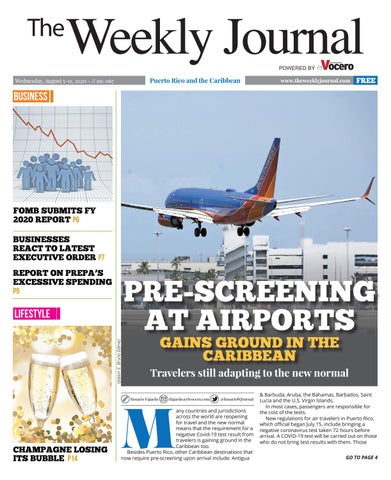
Pre-Screening at Airports Gains Ground in the Caribbean
Travelers still adapting to the new normal
M Rosario Fajardo
Champagne Losing Its Bubble P14
rfajardo@elvocero.com
@RosarioWJournal
any countries and jurisdictions across the world are reopening for travel and the new normal means that the requirement for a negative Covid-19 test result from travelers is gaining ground in the Caribbean too. Besides Puerto Rico, other Caribbean destinations that now require pre-screening upon arrival include: Antigua
& Barbuda, Aruba, the Bahamas, Barbados, Saint Lucia and the U.S. Virgin Islands. In most cases, passengers are responsible for the cost of the tests. New regulations for air travelers in Puerto Rico, which official began July 15, include bringing a negative coronavirus test taken 72 hours before arrival. A COVID-19 test will be carried out on those who do not bring test results with them. Those GO TO PAGE 4
The Weekly Journal > Wednesday, August 5, 2020 >
2
Constant updates online 24/7. TheWeeklyJournal.com
Visit us for updated content on our 24/7 platform.
WeeklyJournal
The
3
/ Wednesday, August 5, 2020
a week in review
>Brandon Cruz González
Nearly 30 Percent of Prepa Clients Lose Power Over Tropical Storm Isaias
>Brandon Cruz González
The Puerto Rico Electric Power Authority (Prepa) reported July 30 that 28.8 percent of its clients did not have electricity, mostly in the Caguas, Mayagüez and Ponce regions, as the island experienced heavy rains over the passage of Tropical Storm Isaias. The figure represents over 400,000 clients around the island.
No Irregularities Found in BDO Government Audits
Prepa Executive Director Resigns José Ortiz resigned as executive director of the Puerto Rico Electric Power Authority (Prepa), effective today, Aug. 5. His resignation occurred when his performance during Tropical Storm Isaias was questioned by Gov. Wanda Vázquez, the utility’s union and several mayors. Isaias arrived on July 29 and unleashed landslides, widespread flooding and power outages on the island.
Powered BY El Vocero de Puerto Rico, 1064 Ave Ponce de León 2nd floor San Juan, PR Postal Address: PO Box 15074, San Juan, PR 00902
Accounting firm UHY Advisors found no irregularities on 2017 audits conducted by BDO Puerto Rico of several government entities, said the Financial Management and Oversight Board. The firm said it “did not note any matters indicating that BDO Puerto Rico’s integrity in any of the audits inspected was impaired or otherwise affected by the alleged activities of its former managing partner or the Commonwealth government’s subsequent actions.”
President Salvador Hasbún shasbun@elvocero.com
Human Resources Director Arlene Rolón, PHR arolon@elvocero.com
Multi-Platform Digital Director Stephanie Gómez Álvarez sgomez@elvocero.com
Comptroller Félix A. Rosa frosa@elvocero.com
Traffic Director Ilia M. Pérez Centeno iperez@elvocero.com
Multi-Platform Graphic Director Héctor L. Vázquez hvazquez@elvocero.com
Production Director Eligio Dekony edekony@elvocero.com
Editorial Director Juan Miguel Muñiz Guzmán jmuniz@elvocero.com
Assistant Editor/ Reporter Rosario Fajardo rfajardo@wjournal.com
Phone: 787-622-2300, 787-721-2300 Customer Service: 787-622-7480
4
/ Wednesday, August 5, 2020
CONTINUED FROM PAGE 1
But you are not required to have the test once you arrive in Puerto Rico because there is no availability of tests for everyone who arrives. If that were so, travelers would be consuming the full capacity [of coronavirus tests] that we have as a country. —Miriam Ramos Colón, epidemiologist in charge of the Epidemiological Surveillance System at LMM Airport
who test positive will be quarantined for 14 days. Visitors will also be required to report where they will be staying and must respond to a tracking app on their health. The Luis Muñoz Marín International (LMM) Airport has remained open and, unlike other Caribbean destinations, Puerto Rico has not closed its borders due to the pandemic. To date, Puerto Rico manages around 200 daily operations, which include cargo, passenger and general aviation
flights, but this figure was ramping up. “Though Luis Muñoz Marín International Airport never officially closed to visitors, there was little activity in April and May. The easing of the coronavirus lockdown on the island in mid-June generated more passenger activity. Though this is still 75 percent lower than a year ago, arrivals increased 175 percent from the previous month,” said Discover Puerto Rico in its latest “Industry Report June 2020.” According to the report, there were 41,159 passenger arrivals at LMM Airport in May. In June, as travel restrictions eased, this number had increased considerably to 113,355 arriving passengers. However, travel has dropped since the latest Executive Order. Aerostar Airport Holdings reports that arriving passengers into LMM fell 28.6 percent the week ending August 2 compared to mid-July. As of last week, though, the majority of travelers arriving at LMM did not present negative test results, indicating that adapting to the new rules takes time. In total, only about 19.5 percent of arriving travelers have presented the required negative results, according to officials. The information was confirmed by the epidemiologist in charge of the Epidemiological Surveillance System at LMM, Miriam Ramos Colón. Detailing the figures, she explained that from July 16 to 26, 47,366 arriving passengers completed the required traveler’s declaration information, but only 9,225 (19.5 percent) arrived with the negative test results. She added that 38,141 travelers (80.5 percent), arrived in Puerto Rico without the required test results taken 72 hours prior to departure, as mandated by Executive Order 2020052.
In addition, from July 15 to 26, she reported that 61 of the serological tests carried out on travelers at the airport have tested positive for COVID-19, so these people have taken a molecular test and are listed as “probable cases” in the Health Department’s database.
Issue of Compliance
As per the Executive Order, the 38,141 travelers who arrived without the negative results were “ordered” to be in quarantine. “But you are not required to have the test once you arrive in Puerto Rico because there is no availability of tests for everyone who arrives. If that were so, travelers would be consuming the full capacity [of coronavirus tests] that we have as a country, “ Ramos explained. She added that conducting the test on all travelers who do not have the negative test results is not the vision of Health Secretary Lorenzo González — or health workers in general — because they need to have enough tests available for people who truly need them. “Our goal is not for people to come to Puerto Rico and take the test in Puerto Rico. The priority is that if you don’t come with the test, by Executive Order you have to be quarantined for 14 days,” Ramos said. This begged the question of how officials can determine if people are really complying with the quarantine orders. “We, through the SARA Alert platform, which is the responsibility of the surveillance system, are monitoring that traveler’s symptoms so that we can promptly identify whether that traveler develops any symptoms that may be compatible with COVID-19,” Ramos explained. She warned that people who do not comply with quarantine orders could be fined or receive other penalties. However, she acknowledged that it is impossible to monitor all travelers arriving on the island, as in just one day alone, 4,137 passengers arrived at LMM Airport. “That number of people continues to accumulate day by day. However, we at the Health Department have adopted an electronic platform that makes it easy for us to monitor travelers so that we can contain in a prompt and effective way if any of them develops symptoms and so, be able to stop a potential chain of transmission,” she said. Ramos added that LMM also monitors arriving passengers’ temperatures, since a fever is one of the symptoms of COVID-19. She said it would not be correct to assume that 100 percent of travelers are sick because they “would be missing the truth or the science.”
Dominican Republic
The Links Course at Royal Isabela has reopened, as have many other Puerto Rico businesses, including 18 golf courses, resorts and other hospitality venues. >Discover Puerto Rico
The Dominican Republic, which is considered a direct competitor with Puerto Rico in terms of tourism, now requires all visitors to present a negative coronavirus test to be able to enter the Caribbean country. The Ministry of the Presidency informed through the High-Level Commission for the Prevention and Control of the Coronavirus COVID-19 that starting July 30, visitors must present a negative result of the polymerase chain reaction (PCR) test made five
5
/ Wednesday, August 5, 2020
Arriving passengers at LMM Airport >Josian E. Bruno Gómez
days before travel. If this result is not available, “The measures contained in the protocols are government personnel will perform a quick test at the result of extensive work and coordination no additional cost to the passenger. between government and private entities,” said The goal of this new Minister of Tourism Francisco requirement is to strengthen the Javier García. “All safety measures preventive actions that have been conform to the recommendations taking place for months to control of the World Health Organization the pandemic’s spread on the and aim to ensure the safety country and to maintain a balance of all those who participate in Besides Puerto between the reactivation of tourism, from service providers to Rico, other Caribbean tourism and the protection of the visitors. Our guiding principle is to destinations that now health of residents and visitors. generate a framework and tools require pre-screening The Dominican Republic’s to offer unforgettable tourist upon arrival include: tourism industry said it is ready experiences in accordance with Antigua & Barbuda, to take on the challenge to the most rigorous standards in Aruba, the Bahamas, keep providing exceptional the industry,” he said. Barbados, Saint Lucia experiences in “the new normal,” All protocols can be found at and the U.S. Virgin so this measure intends to help the website of the Dominican Islands. maintain the climate of trust that Republic Travel Resource Center. has made thousands of travelers choose the country as their The U.S. Virgin Islands vacation destination. The U.S. Virgin Islands (USVI), a sister U.S. The rapid diagnostic tests that are being carried territory and another direct competitor with out at Dominican airports gives reliable results Puerto Rico in terms of tourism, has established a in less than 10 minutes through a blood serology Department of Tourism online portal for arriving analysis. Children under the age of five and crew passengers. members are exempt from this new requirement, Officials said the online portal allows visitors, which is added to a series of previously announced especially those arriving from COVID-19 “hot spots” protocols for the application of preventive on the mainland, to upload their travel health measures in the tourism sector. screenings and COVID-19 test results before they
In fact,
travel. The online portal is at www.usviupdate. com/travelportal. As per the new rules, all travelers from “highly impacted areas” must upload their recent COVID-19 test results taken no more than five days before arriving. Highly impacted areas are defined as states with a COVID-19 positivity rate that is higher than 10 percent, which would currently include Florida, Georgia and Texas, according to the Johns Hopkins University coronavirus website. At the same time, visitors can also submit positive COVID-19 antibody test results taken within four months of travel to the USVI. The USVI government processes the information within 48 hours and a certification code is issued for travelers. “This portal is really the beginning stage of our multitiered plan to improve and make more efficient our health screening protocols for incoming travelers during this pandemic,” said Gov. Albert Bryan Jr. “There is no playbook to this pandemic. We must draw these plays as we are running them, and your input, engagement and, more importantly, your cooperation are what will determine how successful we will be.” All in all, everyone’s goal is the same: containing the spread of COVID-19. - Reporter Yaritza Rivera Clemente contributed to this story.
6
/ Wednesday, August 5, 2020
The Oversight Board submitted its Annual Report to President Donald Trump, the U.S. Congress and the government of Puerto Rico. >Carlos Rivera Giusti
Puerto Rico does not lack talented people, ideas, plans or studies to improve its economy.
Outgoing FOMB Chairman José Carrión III
FOMB Submits its Fiscal Year 2020 Annual Report
Highlights the pandemic’s economic impact, necessary structural reforms
T Giovanna Garofalo
ggarofalo@wjournalpr.com
@giopgarofalo
he Financial Oversight and Management Board (FOMB) has submitted its fiscal year (FY) 2020 Annual Report, which highlights the economic impact of the coronavirus (COVID-19) emergency on Puerto Rico, as well as the local government’s “insufficient” action to transform public services. Regarding COVID-19, the Oversight Board revealed that Puerto Rico’s economy will have contracted by 4 percent for FY 2020. The report indicates that the island’s economy will continue contracting over a period of five years. Specifically, the economy is projected to experience a 6.1 percent drop in the current FY 2020 and another 3.7 percent decline in FY 2021. “This analysis leads the Commonwealth 2020 Fiscal Plan to project a Central Government deficit from FY 2032 onward — six years sooner than the previous certified Fiscal Plan projected. The Commonwealth 2020 Fiscal Plan projects a total budget surplus of about $8 billion between FYs 2020 and 2032 — compared with an approximate $23 billion surplus in the previous certified Fiscal Plan, an almost 65 percent decline,” the report reads. However, FOMB expects a 0.5 percent recovery in FY 2021 propelled by funds under the CARES
Act, the Community Development Block Grant Disaster Relief (CDBG-DR) program and other federal initiatives. The Annual Report details federal funding assumptions, wherein Puerto Rico is expected to receive roughly $83 billion in hurricane-related allocations, approximately $595 million to address the earthquakes’ impact and an estimated $14 billion in coronavirus-related funds. The report also includes criticism of how the island’s government has been unable to implement necessary structural reforms, which has hindered economic growth and a more efficient response to both the pandemic and natural disasters, including earthquakes in the southwestern region and Tropical Storm Isaias this year alone. “Over the last four years, the [Puerto Rico] Government failed to make meaningful efforts at improving economic growth through structural reforms or drive operational change that would deliver better government services to the people of Puerto Rico. The lack of implementation of structural reforms exacerbated the severe effect of the destructive hurricanes, earthquakes and COVID-19. That is why this pandemic should be an incentive to redouble all efforts to reform the economy for the benefit of the people of Puerto Rico,” said FOMB Executive Director Natalie Jaresko. The Commonwealth 2020 Fiscal Plan aims to improve the ease of doing business, public services, labor skills and welfare and education. To achieve this, the entity proposes promoting economic activity and reducing the obstacles to starting and sustaining a business in Puerto Rico, which would reportedly cause 0.3 percent overall growth by FY 2025. The FOMB additionally recommends a power sector reform for 0.3 percent growth by FY 2024; a K-12 education reform to contribute to an effective
workforce, and 0.13 percent growth from FY 2037-2049; infrastructural improvements to boost capital investments; and access to the Earned Income Tax Credit. The 2020 Fiscal Plan also includes investments totaling almost $6 billion from FY 2020-2024 in health care, public education, public safety, broadband technology, and training, a FOMBcommissioned study for the private sector and the government to reactivate pharmaceutical manufacturing on the island, as well as reconstruction efforts. The Oversight Board encourages the U.S. government to support the island by extending COVID-19 unemployment benefits and the Paycheck Protection Program for small businesses; granting a temporary Jones Act waiver for LNG shipment within the U.S.; legislating a long-term Medicaid program solution; extend a federal EITC and Child Tax Credit for Puerto Rico residents; collaborating with the local government to institute a work/volunteer requirement for Nutritional Assistance Program participants; using the Department of Health and Human Services Poverty Guidelines to set the income limits that determine who is eligible for the U.S. Department of Housing and Urban Development’s housing assistance in Puerto Rico. “Puerto Rico does not lack talented people, ideas, plans or studies to improve its economy. We must put our ideas to work, we must commit to changing Puerto Rico. What I hope is that we soon start making real progress in implementing the crucial structural reforms outlined in the Commonwealth’s Certified 2020 Fiscal Plan. I hope that the Governor and Legislature will be more determined to adopt these structural reforms,” said outgoing FOMB Chairman José Carrión III.
7
/ Wednesday, August 5, 2020
Affected Sectors React to New Executive Order
Gyms, casinos, restaurants among the hardest hit
F
Brenda A. Vázquez Colón
bvazquez@elvocero.com
ollowing the new Executive Order 2020-060 mandating that from Aug. 1 to 15, establishments that are considered by health experts as places with a high potential for COVID-19 contagion — such as gyms, casinos and cinemas, among others — remain closed, several leaders of these sectors reiterated that this decision is wrong and will cause the permanent closure of many businesses. This is the case of gyms, whose owners defended the service they provide to their customers, describing it as necessary and beneficial for people’s health, especially during the current crisis. These establishments were open for a few weeks but were then reordered to close to the public, despite many complying with the security protocols that were required to operate. “We had 25 percent occupancy and we were looking to earn the trust of our customers and then came the closure. Now we are in an extremely critical situation, and many will have to close. “Owners can no longer hold on and with the rental demands, we did not even have time during the month we opened to get money and be able to pay. We don’t know how long we’re going to hold out, but the picture is getting more and more critical,” said Pablo Acosta, owner of Crunch Fitness. For his part, Ismael Vega, general manager of Casino Metro, described the decision of the new Executive Order as very unfair and understands that it jeopardizes nearly 3,000 direct jobs. “It is an injustice that we pay justly for sinners. The casino industry had nothing to do with the rise of positive COVID-19 cases in recent months. We were penalized when we did everything right; this is not solved by closing. There can be a balance if everyone does their part. We’re not the problem,” Vega said.
Challenge for Restaurants
The restaurant industry — which had requested to open at a capacity of 75 percent, will continue
situation; you have to see how the industry manages to adapt, but unfortunately, many of the small and mid-size restaurants will not be able to endure this Gyms United for additional time [of closures] Puerto Rico has filed without producing. a lawsuit against “We come from a lacerated Gov. Wanda Vázquez, economy and we have not requesting section been able to bring sales to 19 of Executive more than 25 percent or 30 Order 2020-054, percent. This new closure may on gym closures to sharpen that trend,” said Gadiel help contain the Lebrón, executive director of the virus, be declared Restaurant Association. unconstitutional. Movie theaters will continue to remain closed. Mayra Ramírez, marketing director at Caribbean Cinemas, said they always maintained the necessary health protocols while they were open. “Our hope is that for the next order, we will be taken into consideration. We had no reported cases and our occupancy was maintained at less than 30 percent, a very limited audience. We promote online ticket sales to avoid physical contact and feel that we comply with fairly moderate traffic. They can’t compare us to bars or ‘chinchorros,’ as we don’t sell alcohol. Our operations did not represent a risk, so we are disappointed,” she said. “We hope to be allowed to reopen by Aug. 16 because we are a sector that contributes to the economy and our employees have to work,” Ramírez said.
In fact,
‘Prudent’ Move
to operate at 50 percent capacity and sell alcoholic beverages only until 7 p.m., except on Sundays, when all alcohol sales are banned for the day. This sector will now not be able to open dining rooms on Sundays and can only sell “carry out” or food for “delivery.” “The new order represents a challenge. There are many restaurants that do not have selfservice. We have made numerous investments to be able to comply, but the capacity limitation continues. The order puts us in a complicated
For Puerto Rico Chamber of Commerce President Juan Carlos Agosto, the new executive order is prudent, since he understands that for there to be an economy, there must be controls that make it difficult for the coronavirus to spread on the island to avoid what has happened in the United States. “The action taken is prudent, the order maintains controls and that leads to lowering the contagion. It is a question of all parties doing their part and cooperating to get out of this situation as soon as possible. Yes, it has its economic impact, but it’s about priorities. We understand that the people’s health is important, but many business people are going to suffer great economic consequences,” Agosto said.
8
/ Wednesday, August 5, 2020
Resident Commissioner Candidates Bet on Manufacturing, Outside Investments a means to boost the local economy, reduce dependency on China for medical ingredients and products, and avoid a shortage of these items — particularly with the threat of scarce drug manufacturing experienced throughout the pandemic. In April 2020, González introduced, along with five other representatives, bipartisan legislation to grant fiscal incentives under the federal Internal Revenue Code to attract biopharmaceuticals to U.S. jurisdictions, including Puerto Rico. In a missive, González informed that H.R. 6443, or “Securing the National Supply Chain Act of 2020,” would secure the supply chain nationwide by providing incentives to economically depressed areas, also known as distressed zones, in the nation’s states and territories. “This legislation would prevent shortages of supplies for future events, while at the same time contributing to the economic development of the neediest US jurisdictions,” she stated.
The battle for Congress Giovanna Garofalo
ggarofalo@wjournalpr.com
@giopgarofalo
Less than three months before the Nov. 3 general elections in Puerto Rico, the proposals and financial stances of the main candidates for resident commissioner could be just as important as the gubernatorial candidates’ at a time when the island relies heavily on federal funding for its natural disaster recovery and to mitigate the financial burdens exacerbated by the coronavirus (COVID-19) pandemic. A resident commissioner is, essentially, Puerto Rico’s nonvoting representative in the U.S. Congress. Concerns from the island are channeled through this congressperson, who in turn proposes bills that are beneficial to the Commonwealth’s residents and to its economic development. Resident Commissioner Jenniffer González Colón (R-PR) aims to retain her seat in Washington, D.C. under the New Progressive Party (NPP), Puerto Rico’s pro-statehood collective and the current party in power in the central government. As president of the Puerto Rico Republican Party and chair of the group “Latinos for Trump,” she maintains what she deems a “phenomenal” relationship with both U.S. President Donald Trump and fellow Republicans in Congress, even though Govtrack.us ranked her in 2019 as the 13th most liberal representative compared to other House Republicans. Meanwhile, former Gov. Aníbal Acevedo Vilá (2005-2009) — who also served as resident commissioner from 2001 to 2005 — is challenging González under the Popular Democratic Party (PDP), the island’s pro-Commonwealth party. Contrary to González, he is aligned with the Democrats, even joining the Democratic Governors Association and endorsing the candidacy of former President Barack Obama. Between his tenures as governor and resident commissioner, he has maintained relations with Democrats on the U.S. mainland. Despite these subtle but decisive differences, which could gain or lose relevance depending on the outcome of the U.S. general elections and which national party controls the U.S. House and Senate, the congressional candidates have similar views in attracting investment to the island, with slight disagreements concerning incentives offered to investors. For instance, both González and Acevedo Vilá have echoed economists in Puerto Rico and stateside in the need for the U.S. to bring
A Look at GILTI Resident Commissioner Jenniffer González Colón. >Courtesy
Former Gov. Aníbal Acevedo Vilá. >Josian E. Bruno Gómez
biopharmaceutical manufacturing to the island. As has been debated in local economic circles, both candidates have pleaded to incentivize manufacturing of this kind in Puerto Rico as
For his part, Acevedo Vilá issued in March 2020 a letter to U.S. Senate Finance Committee Chairman Chuck Grassley (R-IA), urging the adoption of a new federal incentive to promote investments in Puerto Rico. In the missive, which he also shared on Twitter, the former governor recommended reducing the Global Intangible Low Tax Income (GILTI) for companies that operate on the island or another U.S. territory. Under GILTI regulations, all CFCs, or controlled foreign corporations, regardless of where they are in the world, are subject to a minimum of 10.5 percent federal tax on their “intangible income.” The corporations also receive a credit of 80 percent of what was paid in corporate income taxes at the foreign jurisdiction, plus some other calculations. “There is no manufacturing jurisdiction under the U.S. flag better poised to ramp up pharmaceutical and medical device production than Puerto Rico… By turning on Puerto Rico’s mighty manufacturing engine, we can solve two critical problems at once — we can provide a secure and reliable source of critical drugs and medical devices under the U.S. flag, and solve in great part Puerto Rico’s socio-economic crisis,” Acevedo Vilá said in the letter to Sen. Grassley. Critics say that creating a new tax regime for the U.S. territories would be tantamount to “Section 936 on steroids” and would cost the U.S. Treasury a “huge amount of money.” Continue reading the full story at www. theweeklyjournal.com.
9
>Josian E. Bruno Gómez
/ Wednesday, August 5, 2020
Report: Excessive Spending at Prepa Utility may not receive all FEMA refunds for Hurricane Maria recovery
A Christian G. Ramos
cramos@elvocero.com
@cramossegarra
mid the recent emergency over Tropical Storm Isaias and the vulnerability of the Puerto Rico Electric Power Authority (Prepa), a report by the Office of the Inspector General (OIG) of the Department of Homeland Security (DHS) revealed that the public corporation overpaid for contracts with Whitefish Energy and Cobra Acquisitions in 2017, even though they did not meet federal requirements. Both contracts — which were signed to repair the island’s electricity system in the aftermath of Hurricane Maria at a cost of $2 billion — did not comply with federal cost principles that the amounts should be reasonable with the funds earmarked for recovery. According to the report, irregularities were identified in the supervision of contracts by Prepa and the Federal Emergency Management Agency (FEMA). As a result of this situation, the public corporation may not be entitled to a full refund through FEMA’s Public Assistance Program. THE WEEKLY JOURNAL contacted Prepa press spokespersons Edith Seda and Jorge Luis Burgos for a reaction, but they did not respond.
Costs were unreasonable
Although the OIG certified that the public corporation met federal requirements to contract Whitefish’s services, the report noted that Prepa failed to determine that the costs were reasonable. Compliance with the provisions occurs after the contract was amended to correct deficiencies. The report further explained that Prepa incurred higher rates than those originally submitted
by Whitefish. “This was because the Authority did not assess the reasonableness of the new higher tariffs. As a result, some of the costs of the Whitefish contract may not be eligible for reimbursement through [Public Assistance]. Prepa is at risk of not receiving a full refund for contract costs,” as per the report. Whitefish’s $300 million contract was terminated after it transcended that the company had only two employees, did not have the equipment to run the jobs, and that the normal bidding process was not followed.
Poor oversight
Regarding the contract with Cobra Acquisitions — which exceeded $1.2 billion — the federal audit reported that the oversight that the corporation carried out did not meet the eligibility requirements of FEMA’s Public Assistance program, which requires them to oversee the agreed work. “The Public Assistance program requires Prepa to provide a high degree of oversight of time and material contracts. However, Prepa did not sufficiently supervise the contract with Cobra. This was because Puerto Rico did not monitor Prepa’s activities to ensure that they complied with the program’s guidelines,” the OIG said. As a result of poor oversight, some of the costs detailed in the contract were also unreasonable and may therefore not be eligible for reimbursement, the report added. The contract with Cobra — which came after the cancellation of the agreement with Whitefish — resulted in the arrest of Ahsha Tribble, FEMA’s deputy regional administrator; Donald Keith Ellison, former president of Cobra Acquisition and Jovanda R. Patterson, a former FEMA staff manager, for fraud of funds for the recovery of the electricity system.
FEMA also failed
The OIG also points to irregularities by FEMA over reimbursements made to Prepa for some expenses incurred under the Cobra contract. FEMA reportedly disbursed $852 million to cover these
expenses without first confirming whether Prepa had adequately overseen the contract. “FEMA reimbursed the money... without first confirming whether Prepa provided a high degree of oversight with compliance with that agreement. FEMA did not determine whether the Cobra contract was reasonable and eligible to receive [Public Assistance] reimbursement,” the OIG said. The report stated that FEMA failed to comply with its own guidelines by failing to determine whether Prepa sought to comply with Cobra on the agreed dates, the materials set out in the contract and the reasonableness of these. The OIG further stated that the payments made are ineligible for the Public Assistance Program.
“Time proves us right”
Electrical Industry & Irrigation Workers Union (Utier by its Spanish acronym) President Ángel Figueroa Jaramillo said the report shows that the union — which has been warning of irregularities in both contracts since 2017 — has spoken the truth. “The arrests that were made for fraud were not the only irregularities in relation to these cases. We never understood how a company that didn’t have electrical linemen available could bill about $1.2 billion for working a year and a half. That’s six years from Prepa’s total payroll,” Figueroa said. The union leader believes that the report could lead to further investigations that could put in check the work of the last two Prepa executive directors and perhaps publicize other irregularities with other contracts. For his part, P.R. Sen. William Villafañe, chairman of the Senate Special Committee on Energy Affairs, said that failures in contract management highlight the need to ensure the proper management of federal funds. “The contract with the LUMA consortium for the [transmission and distribution] of the electricity system is supposed to largely ensure the proper management of federal programs. One component of the consortium is a company specifically dedicated to the management of programs similar to the one in question,” he said.
10
/ Wednesday, August 5, 2020
AI: An Invaluable Tool in Human Resources
that AI will solve and which benefits it can bring you.” In his session at the conference, titled ‘Artificial Intelligence — The Man Next to the Machine,’ he will explain the different ways in which AI can assist with talent recruiting, work performance evaluations, efficiency analysis, improvements in collaborative work, diversity and equality, among ggarofalo@wjournalpr.com Giovanna Garofalo @giopgarofalo others. All of this, he says, are invaluable assets that could drastically improve the work environment and increase the company’s revenues. t a time when many companies Global firms network PricewaterhouseCoopers are venturing into new (PwC) said in its ‘Global Artificial Intelligence Study: production models to mitigate Exploiting the AI Revolution’ report the risk of that the global gross domestic coronavirus product (GDP) could be up to 14 (COVID-19) percent higher in 2030 as a result infection in the of AI. This would be the equivalent workplace, and amid talks of racial Damian Russo, of an additional $15.7 trillion. diversity and inclusion in both an Argentinean The PwC concludes that AI is “the Puerto Rico and the U.S. mainland, media CEO, conceded biggest commercial opportunity in the efficient use of artificial that automation today’s fast-changing economy.” intelligence (AI) has gained more would make some “But while it is indisputable that prevalence than ever during these positions obsolete, AI came to the business world tides of change. but would raise to stay, it is not an easy task to Damian Russo — an demand for job adopt this technology in work Argentinean media CEO and profiles with a relationships. This is because expert in digital strategy, mobile greater knowledge people still have various concerns advertising, display advertising and of information about it. And the main barriers digital marketing — outlined the technology. they encounter are the complexity numerous benefits of intelligently of their use and the logical fear of incorporating AI in businesses, many of effectively being replaced with particular emphasis on by a machine,” Russo argues in his the Human Resources (HR) article, “Demystifying Artificial Intelligence.” department, to increase productivity while meeting Speaking with your correspondent, he conceded the entity’s mission or goal of creating an inclusive that automation would make some positions environment. obsolete, but would raise demand for job Russo is set to discuss these benefits and how profiles with a greater knowledge of information AI is already integrated into workplace culture and technology. routine activities at the upcoming 47th Annual “In the case Conference and Exposition of the Society of Human of the Human Resources Management, Puerto Rico Chapter Resources area, (SHRM-PR). when you “Basically, [AI] consists of tech or a machine that acquire a tool imitates human behavior and based on that, we that makes delegate tasks and hope that these tasks are equal your job easier or superior to a human being’s, which causes a and learns of pretty epic change in our day by day. This forum the day by day intends to imply that this is already part of our day … the everyday by day,” he told THE WEEKLY JOURNAL, using as an workflow in example chatbots and other automated services. a company For Russo, optimizing the benefits of AI is a becomes matter of “common sense,” saying, “common sense more is key and fundamental … Understanding the needs
An expert outlines how this tech can boost productivity and inclusiveness
A
In fact,
efficient with better results and generates more revenue,” Russo stated. For example, in terms of diversity, an AI’s algorithm can correct ingrained biases, even at a subconscious level, in human talent. As such, it can be designed and implemented to seek out the best candidates for a job position, regardless of demographics. “For this reason, and to extract the maximum commercial value from this technology, I propose to organizations to ask themselves, in the first instance, why AI has not been incorporated into the human resources area within their company. And then for them to plan smart strategies to overcome those barriers,” he added in his article. The 47th Annual Conference and Exposition of the SHM-PR will be held virtually on Aug. 12 from 8 a.m. to 5 p.m. Registration is available at https://shrmprconference.org/. Moreover, most of the program content will be available ondemand through Sept. 13.
2020
THE MASTER CLASS 6 de agosto de 2020
9:00 am. - 12:00 pm. Master Class DIGITAL
Evento único en su clase, desde estudio de televisión, en alta definición. Distinto a todo lo que has visto en esta cuarentena-pandemia.
RECURSOS: Lcdo. Jorge Pizarro García Lcdo. Reynaldo Quintana Latorre Lcdo. Víctor Rivera Hernández Wanda Piña Ramírez, CCC Lcdo. Yldefonso López Morales 100% fondos a beneficio de
INVERSIÓN: $99 (más IVU) Incluye acceso a la plataforma virtual y materiales de las presentaciones.
TEMAS: • Se agotaron las licencias locales y bajo el FFCRA: obligaciones, alternativas y controversias legales • ¿Qué dicen las agencias especializadas? • Gerenciando personal a distancia: el nuevo desafío post pandémico • La venganza del COVID – 19: nueva realidad, controversias noveles y litigios creativos • Reinstalación post-cesantía: ¿son empleados nuevos bajo la Ley 4? • Derechos de la mujer trabajadora tras la pandemia • Impacto del Código Civil en el mundo del trabajo Política de cancelación: No se aceptarán cancelaciones.
REGISTRO: 787 287 6161 /conversatorioescape@gmail.com
< The Weekly Journal > Wednesday, August 5, 2020
nueva fecha
11
12
/ Wednesday, August 5, 2020
Gustavo Vélez Inteligencia Económica
T
Puerto Rico Must Think Big Again
he past months have been intense and complex for Puerto Rico. As the last year of the second decade of the 21st century began, we hoped to begin rebuilding the island. However, without properly closing the holiday season, earthquakes shortened our celebrations and placed us in a state of alert. Months later, on March 15, COVID-19 arrived to our shores and changed our lives forever. Since then, we have lived with a new invisible enemy that competes with other great evils, such as the economic depression, the fiscal crisis, bankruptcy and poor government management. Recently we were affected by Tropical Storm Isaias. It appears that we have fallen to a “macacoa,” as they say, which overwhelms us all. Some friends say that we have fallen out of favor with fate and that our bad luck as a people is decided. Personally, I am reluctant to think pessimistically and hand over my personal destiny and that of the island, to something as subjective as “bad luck.” I think we should start thinking big and start a profound change in the way we act and the way we think about Puerto Rico. Countries and humans have the opportunity to design their future if, in effect, they set goals and projects that guide them to success.
provided the experience that, under ideal conditions, Puerto Rico is capable of achieving great things. Between 1950 and 2000, we went from underdevelopment to an accelerated economic growth that was unprecedented in any economy in the region. It was the time of Section 936 and of major investments in infrastructure and biotechnology. Our banks were making their way on Wall Street and their shares were among the most valued. We created an international banking center and a global insurance center. These were times when we projected ourselves as a society capable of thinking big, when we were economic leaders in the region, and we aspired to host the Olympic Games (2004). Sports-wise, culturally and economically, it was a Puerto Rico that achieved great things and there was a hunger and a desire to continue growing in all areas. Culturally, pavilions, museums, cultural festivals were built, and we consolidated the Casals Festival as an important international event. And we also managed to place artists worldwide, including artists in Hollywood. In sports, we managed to place our baseball and basketball teams, respectively, among the best in
From political and business leadership to every ordinary citizen, a radical refocusing of the way we act with respect to the collective challenges we have as a people is urgent. The Aborted Leap Into Thinking big is making ourselves the New Century available to contribute the best of us Between 1990 and 2000, we built in building the solutions that Puerto a large infrastructure to prepare Rico requires. It is to visualize how ourselves for a second leap as a each one of us becomes the leader of society toward the new century the changes that the current state of and millennium. We invested over affairs requires. $10 billion in highways, coliseums, Thinking big is putting Puerto Rico convention centers, and more. first, above all other considerations. But with the arrival of the 21st Thinking big is replacing federal century, we seemed to lose inspiration aid with work and entrepreneurial and the desire to think big. creativity. The political and governmental Thinking big is bringing about fracture of shared government (2005 radical changes from the bottom — 2008) and the emergence of fiscal up, from our communities and our deficits led us to an economic crisis companies to the ideas that we can that continues today. Contrary to the promote in public forums and social previous century, when there was networks to get the island out of the a time when the political class had current impasse. the vocation to agree to solve the Thinking big is turning government most fundamental problems of the back into an instrument of country, in the 21st century, political development and not an end in itself cannibalism emerged as a dangerous of those who administer it and of practice that has weakened the public employees. democratic experiment that began in Thinking big is breaking with 1952. current thinking that fate has brought The government’s bankruptcy and us to the current state of stagnation the eventual government syndication and beginning to devise the type of has consolidated a state of conformity society we aspire to and desire for our and mediocrity in public management, children and grandchildren. which undermines the real possibilities Let’s rescue from history the of emerging from the current great deeds that our parents and crisis, aggravated by the COVID-19 grandparents achieved between the pandemic. decades of 1940 to 1970, and let’s begin to idealize the Puerto Rico Collective Responsibility Toward that we want from now on. Each citizen has the obligation to rethink a Puerto Rico’s Problems better Puerto Rico and begin to act in Given the accumulation of accordance with that vision and with challenges and problems, it is urgent that all sectors of Puerto Rican society the idea that a better society is still possible. resume the ability to think big again. the world. We were able to think and execute great projects that marked a great era.
The Economic Takeoff: 1950 to 2000
When we examine the history of Puerto Rico in the 20th century, between 1900 and 1950, the situation was not very good. Poverty, economic stagnation and social conflicts defined the island at that historical moment. Despite those challenges, Puerto Rican society was able to evolve and begin to build projects and institutions that made the economy and society take off under the tutelage and support of the U.S. government. The spaces of self-government from 1952 and the industrial experiment thereafter under Operation Bootstrap
The economist says Puerto Rico needs a radical refocusing of the way we act with respect to the collective challenges we are facing. >Carlos Rivera Giusti
13
/ Wednesday, August 5, 2020
Enjoying Puerto Rico’s Natural Beauty The island’s native trees
S
“
Hallee Patterson
omeone’s sitting in the shade today because someone planted a tree a long time ago.” ― Warren Buffett, CEO of Berkshire Hathaway As I travel along the highways of Puerto Rico, I always wonder about the many trees we pass. I am familiar with the iconic Flamboyant and the buttresses of the Ceiba. However, I really did not know anything about their history and felt these old trees would have a story to tell. I was lucky to be introduced to Alejandro Cubina, who owns Reforesta, a company that restores native habitats around the island. Cubina’s goal is to teach and reforest Puerto Rico by using native trees.
A little over 300 years old, this Ceiba tree in Vieques Island is one of the most beloved sites for Puerto Rican locals and tourists.
A little history on five native trees
The official tree of Puerto Rico is the Ceiba, pronounced (say-ba), also referred to as the “Tree of Life.” In ancient times, this tree was believed by many to be the Axis Mundi, or center of the earth. The Ceiba was important to the island’s indigenous Taínos because its thick porous trunks were perfect for carving canoes, (some seated over 100 men). Its flower produces a large ellipsoid fruit that, when split open, reveals an abundance of fluffy fibers, called kapok, used to stuff bedding. Other parts of the giant tree are used as medicines. To recognize the Ceiba, look for the thick buttress roots that spread and the dense spiny thorn trunk. The Flamboyant tree also known as Royal Poinciana is an iconic tree that you will see throughout Puerto Rico. Its fiery red blooms are seen in the spring through summer. This fast-growing deciduous tree takes on a natural umbrella shape. They were originally planted along the roadsides to shade people riding the roads on horseback. The Flamboyant is originally from Madagascar. The African Tulip Tree resembles the Flamboyant. You will see it growing along the mountains. This tree was introduced more than 90 years ago and is now the most abundant tree on the island. The roots are not strong; therefore, you will not see them planted near homes or highways. Interesting fact: The unopened flower buds contain
The Flamboyant tree, known colloquially as Flamboyán, is a prominent figure in Puerto Rican art and folklore.
The African Tulip Tree is the most abundant tree species in Puerto Rico.
water. Children used to use these buds as a type of toy water gun. The Guayacan tree has been part of the forest probably since the arrival of the Taínos. The wood is very hard, heavy and dark; it is used for making railway ties, flooring and boats. The selflubricating resinous wood is so valuable that it is sold by weight. This tree also has medicinal properties. Using the leaves as a tea can provide relief for urinary tract and kidney problems, and as a treatment for tuberculosis. The wood is used as a treatment for syphilis, arthritis, rheumatism and gout, and provides relief from toothache. There are many varieties of palm trees on the island.
identifiable tree because of their tall, stately appearance. The tree trunk is widely used for siding and flooring in rural construction. The leaves are used for religious services on Palm Sunday. 2. Coconut palm: This palm tree has become the symbol of the Caribbean and ranks as one of the 10 most important trees because of the coconut it produces. The trunks are often made into walking sticks and posts. 3. Hat palm: As the name suggests, many of the straw hats, baskets, mats and hammocks that we see are made from drying the leaves of this palm. I learned there are over 450-500 native tree species in Puerto Rico. Many of the trees were brought by the Spanish, French, English settlers and the slaves from Africa. The island’s forests are exotic worlds of their own, waiting for us to explore and enjoy.
The three most popular are:
1. Royal palm: The most plentiful and easily
14
/ Wednesday, August 5, 2020
Champagne Losing its Fizz as Global Pandemic Clobbers Sales
Forecast of over 100 million bottles to be unsold
R
The Associated Press
EIMS, France (AP) — Champagne is losing its fizz. For months, lockdown put the cork on weddings, dining out, parties and international travel — all key sales components for the French luxury wine marketed for decades as a sparkling must at any celebration. Producers in France’s eastern Champagne region, headquarters of the global industry, say they’ve lost an estimated 1.7 billion euros ($2 billion) in sales for this year, as turnover fell by a third — a hammering unmatched in living memory, and worse than the Great Depression. They expect about 100 million bottles to be languishing unsold in their cellars by the end of the year. “We are experiencing a crisis that we evaluate to be even worse than the Great Depression” of 1929, said Thibaut Le Mailloux of the Champagne Committee, known by its French acronym CIVC, that represents some 16,000 winemakers. Recognizing the urgency of the problem, the CIVC is launching unprecedented damagelimitation measures. Like oil-producing countries, the committee regulates the size of the harvest each year to avoid the kind of excess production that would cause bottle prices to plummet. At a meeting scheduled for Aug. 18, it’s expected to impose a cap so tight that record quantities of grapes will be destroyed or sold to distilleries at discounted prices. The prospect alarms smaller producers, who are more vulnerable than the big houses. Anselme Selosse, of Jacques Selosse Champagnes, called it “an insult to nature” that champagne’s famous grapes might even be destined to produce alcohol for hand sanitizer, as is happening in other wine-producing regions such as Alsace after demand spiked during the pandemic. “We are to destroy [the grapes] and we pay
for them to be destroyed,” Selosse said, referring quality drink from a historic French region. to the industry as a whole. “It’s nothing but a “Even if the bars and the nightclubs are closed catastrophe.” for five years, we don’t plan on “Champagne has never missing out on customers ... lived through anything like There will be a very big change to this before, even in the World our marketing that highlights the Wars,” Selosse added. “We have grandeur of our wines,” Vranken never experienced ... a sudden said. Industry one-third fall in sales. Over one Selosse, who produces many leaders said the hundred million bottles unsold.” “natural“ champagnes with very essence Major producers such as no added sugar, also hopes of champagne Vranken-Pommery predict that the pandemic will encourage marketing — as a the crisis could last for years. thought about future champagne drink quaffed at “It should not be forgotten marketing and how the parties and weddings that [champagne] has lived multibillion dollar industry is — needs to be rethrough every single war,” said restructured. He would like to evaluated to reflect Paul-Francois Vranken, founder see a more cooperative side to the new normal: of Vranken-Pommery Monopole. production, such as “communal Fewer festivities and “But with the other crises, there wine presses” to help pool the a lack of celebratory was a way out. For now, there is costs for smaller producers. group events. no way out — unless we find a Selosse said adaptability has vaccine.” served champagne well in the Vranken said the very essence past, helping it evolve from a of champagne marketing — as a drink quaffed at dessert wine in the 19th century to the modern parties and weddings — needs to be re-evaluated day dry version named “brut.” to reflect the new normal: Fewer festivities and He even thinks — but this is a minority view a lack of celebratory group events. The new among producers — the industry could move away branding strategy for his, and other champagne from effervescence and be able to produce all companies, will seek to highlight the wine’s status sorts of wine, as it did in the past: red, white or still. as a naturally, and often organically, produced In fact, literally no fizz.
In fact,
15 >AP photo
/ Wednesday, August 5, 2020
Bad Bunny and Dua Lipa Join Forces with J Balvin and Tainy An artistic and emotional release from the pandemic The Associated Press
Editor’s note: Bad Bunny recently canceled two concerts in Puerto Rico that were scheduled on Oct. 30 and 31, due to COVID-19. EXICO CITY (AP) — Puerto Rico’s own Bad Bunny and Dua Lipa have joined forces with J Balvin and Tainy in a new single, “One Day.” The recently released song, about the hope of reconciling with a love, took about a year and a half of work and covered the coronavirus pandemic, but for Balvin, this is the best time to make it known. “Life is perfect, neither before nor after, perfect for sound,” the reggaeton star said in a recent interview via Zoom from his home in Medellin, Colombia. “[The song] feels like a vacation at such a difficult time. I think it’s really going to connect a lot and it’s going to transport people to relax, close their eyes and feel like they’re in a better place,” he said. The respective video, which has also been released, stars Spanish actress Ursula Corberó, famous for her Tokyo role in “La casa de papel.” Balvin and Tainy said they were fans of the Netflix series and thought of Corberó for the video, as they were all already quarantined and could not be reunited to film it. Balvin introduced the song to the actress to see if she liked it, and so she joined the project.
M
Bad Bunny, center, during a 2018 concert in San Juan >Brandon Cruz González
“My utmost respect for her is because she recorded it herself with her boyfriend, there was no way to get production, she was in Argentina,” said the performer of “My People,” “X” and “Azul.” In the black-and-white video, directed by Colombian American artist Stillz, Corberó luxuriates in her expressiveness by moving from sadness, despair and fury to joy, and to a moment of affection in which she reconciles with herself by kissing a mirror. It is the first time that Dua Lipa has participated in a song partially sung in Spanish and for Balvin and Bad Bunny, it is their first collaboration with the London singer of “New Rules,” “Physical” and “Don’t Start Now.” “I’m a super fan of Dua Lipa,” Balvin said. “I think it gives you a very interesting combination and we can do it, thanks to the sound of Tainy, [which] is like the basis of everything.”
Tainy and Balvin also released “Agua,” the first single from the soundtrack to the animated film “The SpongeBob Movie: Sponge on the Run,” which is expected to premiere in 2021. Other international artists such as Tyga, Swae Lee, Weezer, Snoop Dogg, The Flaming Lips, Kenny G and Cyndi Lauper will participate in the soundtrack, produced by Tainy and Lex Borrero of NEON16. “We grew up seeing it and it’s really been a part of most people’s lives,” Tainy said from Miami about this project. “It’s super cool that we can give our grain of sand now for the film, contribute something and that the Latino community also feels like they’re part of that.” Among the diversity of beings living in Bikini Bottom, the fictional city under the sea where “SpongeBob” takes place, Balvin said he would be Bob, while Tainy identifies more with Patrick. And if they were given a chance, they would make another song for the cartoon. Balvin spent the interview working out on a treadmill. He said he usually walks an hour a day to stay in shape: “I have to take care of myself, the defenses are up.” Tainy, for his part, said it’s not that much exercise. He follows an exercise routine on his balcony and occasionally plays basketball as well as video games. Young people eager to party were asked to be patient in the pandemic to avoid crowds and contagions. “The holidays are going to come,” he said. “Let’s hold on.” Balvin further regretted that many people improperly believe that they are immune to COVID-19 or worse, believe it is a political invention. “It’s reality,” he said. “It’s a real virus and it hurts. You have to take care of yourself.”
SUMMER EN CAMP CASA
Este verano el mejor campamento es en casa. Disfruta de aventuras y el mejor entretenimiento junto a toda tu familia.
•SIN PENALIDADES •SIN COMPROMISO •SIN CONTRATO ¡Suscríbete hoy! 787.355.6565
libertypr.com
* Ciertas restricciones aplican. Ofertas válidas hasta el 7 de agosto de 2020. La oferta de Internet de 20Mbps (hasta 20 Mbps download/hasta 2Mbps upload) por $41.99, 70 megas (hasta 70Mbps download/hasta 7Mbps upload) por $56.99 y 200Mbps (hasta 200Mbps download/hasta 20Mbps upload) por $78.99, incluyen modem Wi-Fi. La oferta de Internet de 20Mbps (hasta 20Mbps download/hasta 2Mbps upload) con telefonía ilimitada a PR y EE.UU. por $46.99, el Internet de 70 megas (hasta 70Mbps download/hasta 7Mbps upload) con telefonía ilimitada a PR y EE.UU. por $61.99 y el Internet de 200 megas (hasta 200Mbps download/hasta 20Mbps upload) con telefonía ilimitada por $78.99. Estas incluyen modem Wi-Fi. Las ofertas de Español de Primera TV con Internet de 70Mbps (hasta 70Mbps download/hasta 7Mbps upload) con caja HD por $77.99, UPICK TV con Internet de 70Mbps (hasta 70Mbps download/hasta 7Mbps upload) con caja HD por $90.99, Ultimate TV con Internet de 70Mbps (hasta 70Mbps download/hasta 7Mbps upload) con caja HD por $118.99. La oferta de Español de Primera TV con Internet de 200Mbps (hasta 200Mbps download/hasta 20Mbps upload) HD por $82.99, UPICK TV con Internet de 200Mbps (hasta 200Mbps download/hasta 20Mbps upload) por $95.99 y Ultimate TV con Internet de 200Mbps (hasta 200Mbps download/hasta 20Mbps upload) por $124.99, incluyen caja HD, modem Wi-Fi y llamadas ilimitadas a P.R. y EE.UU. Por factores externos, la velocidad real de Internet puede variar. Para más información puede visitar nuestra página web https://libertypr.com/internet. Cargos por mal uso/uso abusivo podrían aplicar. Tarifas y servicios aplican a clientes residenciales, solamente donde haya facilidades. Costo de instalación y depósito varía dependiendo del índice de crédito. Instalación estándar se define como 140” del tap de la residencia en donde existan facilidades. Instalación de servicio de tv adicionales conlleva un cargo de $9.99c/u. Liberty se reserva el derecho a negar o terminar los servicios a cualquier cliente que viole las políticas de la compañía o el contrato de servicio residencial. La facturación por correo conlleva un cargo de $3.00 mensuales. Liberty ofrece la opción de facturación electrónica E-Bill, la cual no conlleva cargo alguno. Para acogerse a E-Bill debe registrarse en mi.libertypr.com. Tarifas no incluyen impuestos ni cargos gubernamentales cuyo cómputo podría variar sin previa notificación. Oferta de Showtime gratis válida solo por 3 meses. Luego de 3 meses se cobrará mensualidad regular de $6.99. De no querer el servicio de Showtime, el cliente deberá llamar para cancelarlo al 787.355.3535. Otras restricciones podrían aplicar. #LibertySummerCamp #DisfrutaEnCasa