Wednesday, July 8-14, 2020 - // no. 063
Puerto Rico and the Caribbean
www.theweeklyjournal.com
ECONOMIC GROWTH DESPITE LOW-PROFIT MARGINS P7 FY 2021 BUDGET 10 PERCENT HIGHER THAN THE PREVIOUS P9
BUSINESS
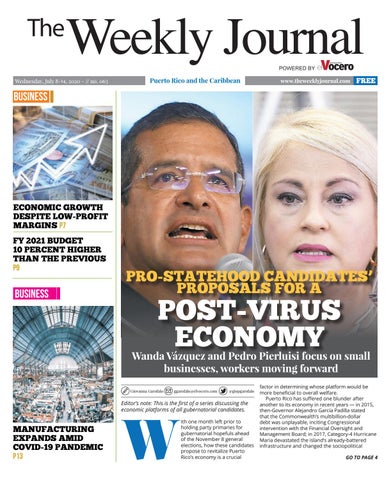
PRO-STATEHOOD CANDIDATES’ PROPOSALS FOR A
POST-VIRUS ECONOMY
Wanda Vázquez and Pedro Pierluisi focus on small businesses, workers moving forward Giovanna Garofalo
ggarofalo@elvocero.com
@giopgarofalo
Editor’s note: This is the first of a series discussing the economic platforms of all gubernatorial candidates.
MANUFACTURING EXPANDS AMID COVID-19 PANDEMIC P13
W
ith one month left prior to holding party primaries for gubernatorial hopefuls ahead of the November 8 general elections, how these candidates propose to revitalize Puerto Rico’s economy is a crucial
factor in determining whose platform would be more beneficial to overall welfare. Puerto Rico has suffered one blunder after another to its economy in recent years — in 2015, then-Governor Alejandro García Padilla stated that the Commonwealth’s multibillion-dollar debt was unplayable, inciting Congressional intervention with the Financial Oversight and Management Board; in 2017, Category-4 Hurricane Maria devastated the island’s already-battered infrastructure and changed the sociopolitical GO TO PAGE 4
The Weekly Journal > Wednesday, July 8, 2020 >
2
2020
THE MASTER CLASS 30 de julio de 2020
9:00 am. - 12:00 pm. Master Class DIGITAL
Evento único en su clase, desde estudio de televisión, en alta definición. Distinto a todo lo que has visto en esta cuarentena-pandemia.
RECURSOS: Lcdo. Jorge Pizarro García Lcdo. Reynaldo Quintana Latorre Lcdo. Víctor Rivera Hernández Wanda Piña Ramírez, CCC Lcdo. Yldefonso López Morales 100% fondos a beneficio de
INVERSIÓN: $99 (más IVU) Incluye acceso a la plataforma virtual y materiales de las presentaciones.
TEMAS: • Se agotaron las licencias locales y bajo el FFCRA: obligaciones, alternativas y controversias legales • ¿Qué dicen las agencias especializadas? • Gerenciando personal a distancia: el nuevo desafío post pandémico • La venganza del COVID – 19: nueva realidad, controversias noveles y litigios creativos • Reinstalación post-cesantía: ¿son empleados nuevos bajo la Ley 4? • Derechos de la mujer trabajadora tras la pandemia • Impacto del Código Civil en el mundo del trabajo Política de cancelación: No se aceptarán cancelaciones.
REGISTRO: 787 287 6161 /conversatorioescape@gmail.com
3
/ Wednesday, July 8, 2020
A WEEK IN REVIEW UNEMPLOYMENT RATE INCREASE According to the Department of Labor and Human Resources (DTRH, for its Spanish acronym), after a decline in the number of people applying for unemployment benefits, the trend seems to be turning negative after an increase of over 10,000 claims was registered last week. In early April claims peaked at more than 66,000. But, after the spike, claims started to reflect a downward trend of -15% per week, on average. However, this changed with the significant increase registered last week.
INSURANCE PREMIUMS EXPECTED TO INCREASE
SHOPPING MALL TENANTS SEEK RENT ADJUSTMENTS Business owners renting space in the island’s shopping malls are facing a difficult economic situation due to the government’s policies and regulations attempting to slowdown the contagion of Covid-19. Many have been forced to apply for various aids in order to continue operating with sales well below minimum average before the Covid-19 pandemic. So far, there have been several mall tenants who have chosen to close operations after failing to reach economic rental agreements with shopping centers, who are demanding payment of the rent for the past three months, which the malls themselves were closed for business.
Powered BY El Vocero de Puerto Rico, 1064 Ave Ponce de León 2nd floor San Juan, PR Postal Address: PO Box 15074, San Juan, PR 00902
The passage several natural phenomena, as well as the crisis caused by the Covid-19 pandemic, is expected to drive insurance policy premiums, mainly commercial and industrial, to increase between 15% to 50%, depending on the sector. Former insurance commissioner Javier Rivera Ríos, and founder of JR Risk Management & Associates, indicated that, according to data from the Insurance Journal and from some professionals in the reinsurance sector, the areas that will experience greater increases, with an average increase between 20% to 50%, will be companies with reasonable losses such as: hotels, shopping malls, hospitals, manufacturing, large restaurant chains, gasoline retailers, and any structure that is facing the sea.
President Salvador Hasbún shasbun@elvocero.com
Human Resources Director Arlene Rolón, PHR arolon@elvocero.com
Multi-Platform Digital Director Stephanie Gómez Álvarez sgomez@elvocero.com
Comptroller Félix A. Rosa frosa@elvocero.com
Traffic Director Ilia M. Pérez Centeno iperez@elvocero.com
Multi-Platform Graphic Director Héctor L. Vázquez hvazquez@elvocero.com
Production Director Eligio Dekony edekony@elvocero.com
Editorial Director Juan Miguel Muñiz Guzmán jmuniz@elvocero.com
Assistant Editor/ Reporter Rosario Fajardo rfajardo@wjournal.com
Phone: 787-622-2300, 787-721-2300 Customer Service: 787-622-7480
4
/ Wednesday, July 8, 2020
CONTINUED FROM PAGE 1 landscape; the last decade saw the emigration of roughly 600,000 Puerto Ricans, and counting; since earlier this year the southwestern region of the island has been severely affected by strong seismic activity, among others. Although some sectors had been experiencing pre-Maria growth, such because Tourism in 2019, the unexpected emergency caused by the coronavirus (COVID-19) pandemic prompted an islandwide lockdown and curfew that undermined previous achievements with effects still present despite an economic reactivation. Ensuring a post-coronavirus recovery and aptly and ethically disbursing federal COVID-19 and natural disaster recovery funds are critical aspects to consider when discussing the island’s socio-economic development. With these and other urgent issues at hand, the island currently has eight contenders for the role of governor, including five total candidates from Puerto Rico’s two main parties, who will face off to secure their respective nominations at the primary election on August 9. Two of the contenders aiming to lead the Executive are Pedro Pierluisi and Gov. Wanda Vázquez, who are battling to secure the nomination for the New Progressive Party (NPP),
Puerto Rico’s pro-statehood party. Below, the NPP candidates’ policies on Puerto Rico’s economic development:
Pedro Pierluisi
Former Resident Commissioner Pedro Pierluisi listed a series of proposals to offset or mitigate the economic impact of COVID-19, available at www. pedropierluisi.com under ‘Propuestas’ (Proposals). One measure is to create an economic council that represents “a great part” of the financial industries that comprise the private sector and labor market, so that they may have active representation in the political sphere. This, he argues, will ensure that their input is considered in “every government effort that affects them.” For Pierluisi, the local government needs to lobby so that the island continues to be eligible for the Small Business Administration’s disaster assistance programs and to increase its own unemployment benefits for Puerto Rico residents. Moreover, he said the government needs to prepare the process to send any tax credit or benefit provided by the U.S. government to employers who retain their employees and increase their workforce. “We have to ensure that the people who are not working due to the curfew have the resources to live, at the same time that we prevent our small
and medium-sized business owners from closing or going bankrupt, thus permanently affecting the jobs on which so many Puerto Ricans rely,” Pierluisi said. Pierluisi, who questionably held office for two days following former Gov. Ricardo Rosselló’s resignation in 2019, also stressed the need to boost the agriculture economy because much because manufacturing. Back in April, THE WEEKLY JOURNAL reported what local farmers denounced was a lack of government response during the pandemic. In his platform, Pierluisi argues that farmers are “key” throughout this emergency. He said the government needs to promote access to initiatives that allows to save their crops, help in animal purchase and care, and provide economic assistance. He also proposes to urge food manufacturers and suppliers to buy more local produce. He has also criticized that Puerto Rico’s Sales & Use Tax (IVU by its Spanish acronym), is the highest of any U.S. jurisdiction. In the list of proposals, he says that the IVU should be lowered from 11.5 percent to 7 percent on prepared goods, but in a separate video, he affirmed that it should be applicable in general. “As soon because we can, we will lower it,” he said in the video titled ‘Enderezar la Deuda’ (Straightening the Debt), in which he reiterated his stance against pension cuts. Pierluisi argued that the debt restructuring
The pre-candidate for governor of the New Progressive Party Pedro Pierluisi participates in a training activity with part of his electoral team. >Brandon Cruz González
5
/ Wednesday, July 8, 2020
Gov. Wanda Vazquez Garced carried out a political caravan over the weekend to Hato Rey to inaugurate her new campaign committee headquarters. >Josian E. Bruno Gomez
process — which he is in favor of — shouldn’t come at the expense of the island’s pensioners, affirming that he is against pension cuts, an issue that has led to feuds between local administrations and the federal Oversight Board. Meanwhile, his proposals, so far, focus primarily on coronavirus-related recovery, but he has voiced his opinion on other platforms on how to disburse federal aid and incentivize economic growth. “We must use federal funds for works that we could not do with our resources — like rehabilitating urban areas and improving water and light systems — because there is money to spare. The vision must be multisectoral, with the areas that represent the spearhead such because housing, agriculture, pharmaceuticals, construction, export, etc. We must create more activity in urban areas, improve the electricity grid and affordable housing projects that are not being built. That is the footing of Puerto Rico’s infrastructure for economic development,” Pierluisi said at an economic forum by GUIAeduca. “To achieve economic growth, it is necessary to lower the costs of doing business on the island, since we compete with the rest of the world.
Conditions must be good and lower the cost of electricity, permits, and contributions... that has to be the focus of the government,” he added.
Wanda Vázquez
At the time of this writing, Gov. Wanda Vázquez has not released an official online platform that encompasses her candidacy’s economic proposals. So far, the governor has documented her campaigning efforts through her social media accounts, including ‘Wanda Vázquez Gobernadora 2020’ on Facebook. THE WEEKLY JOURNAL tried on multiple occasions to contact the governor’s campaign director to no avail, so the following information is based on her statements and initiatives rather than a formal candidacy, which is not necessarily a representation on what her actual campaign policies will include. The former Justice secretary and official successor of Rosselló in 2019 is currently in the midst of reactivating the economy after issuing strict emergency measures to contain the spread of COVID-19. At the beginning of the pandemic, she created an Economic Task Force comprised
of economists and multiple industry leaders in the private sector to recommend how to protect businesses and workers while safeguarding public health amid the health crisis. Through a series of executive orders, in past months she has established a curfew from 7 p.m. to 5 a.m. — presently at 10 p.m. to 5 a.m. until July 22 or further notice — while ordering a cease of operations for most businesses, a process that has been gradually reverted. Back in March, just a few days after implementing the first executive order and islandwide lockdown, she announced an economic stimulus plan that aimed to mitigate the virus’s economic impact. This plan included: an extended date to file the Income Tax Return (July 15, 2020); $500 to the island’s 170,000 self-employed individuals; $1,500 for small and mid-size businesses; up to $190 weekly payments in unemployment benefits; $4,000 bonus to emergency first responders; $50 million to address municipal losses; a 90-day moratorium on bank loans and payments, with no effects on clients’ credits, among others. Her administration, however, has come under fire for delaying the disbursement of unemployment benefits to some residents, leading to the resignation of Labor & Human Resources Secretary Briseida Torres, because well because the $1,200 stimulus contained in the U.S. CARES Act. Meanwhile, the governor has made individual announcements of economic incentives, such because a $200,000 allocation for entities that foster sports activities, including eSports — an emerging sector that accounts for a multimilliondollar industry. She also announced last May a proposal of $107 million to buy produce from local farmers and distribute them among Puerto Rico’s most vulnerable communities. Vázquez has also reaffirmed the importance of federal funds to boost economic recovery. In a recent interview, she said that for the past 10 months, 1,172 projects have received these allocations, which she said represent “an improvement in the island’s infrastructure, jobs, and a boost of more than $95 million.” As with Pierluisi, the governor is against cutting or eliminating pensions. In addition, she said that she will look for ways to pay for this year’s Christmas bonus to central government workers, although this expense is not covered by the Oversight Board’s certified budget. “If the budget does not have the bonus, we’ll make the relevant savings so that employees have the Christmas bonus. The remuneration of public employees is very important, and we will work on it,” she said. As the governor continues to develop her platform, she could be the subject of an investigation by the Office of the Panel of the Independent Special Prosecutor (OPFEI), after former Secretary of Justice Dennise Longo denounced that she would refer Vázquez to the Office prior to being asked to resign. Acting Department of Justice Secretary Wandymar Burgos confirmed Monday she stopped the referrals and ordered an agency official to return the documents to Justice instead of delivering them to OPFEI. Speaking at a news conference Tuesday, Vázquez said she welcomed any investigation.
6
/ Wednesday, July 8, 2020
Vanilla used to be the third most lucrative agricultural product on the island, Vainilla Castañer affirms.
Local Farmers Aim to Revive Puerto Rico’s Vanilla Industry
moment of economic success in that period where grown in Mexico, but the local company seeks there was no advanced technology or social media to produce and export its own label. On June 27, like we have now, yet they managed to achieve it, so Vainilla Castañer held a Facebook Live to unveil why not do it now?,” García said. vanilla beans, which — along with further produce — She noted that one of the benefits of vanilla, are expected to undergo processing in 2021 and be ggarofalo@wjournalpr.com Giovanna Garofalo @giopgarofalo which comes from an orchid, is that the plant sold as gourmet extract and paste in 2022 under the requires minimal space Vainilla Castañer label. ainilla Castañer LLC, located in the to grow and can be Héctor Collazo, municipality Lares, aims to boost co-farmed with other president of Vainilla Puerto Rico’s Farming economy produce. “The space Castañer, said that by reviving vanilla production on required is not very big. each kilogram can be the island. It is a plant that by itself sold for $100 to $250. The entity, founded in 2018 does not stand upright The company will first by a group of nine farmers and needs a place to send their products and local talent, is embarking in a journey called attach to so that it can to be evaluated by the Vanilla Project, which joined various farms in continue growing. It is experts in Germany going to stick to [the several mountainous municipalities in a mission to before focusing on plant] where it is.” bring back what was once Puerto Rico’s third most sales. Specifically, the As such, Vainilla lucrative agricultural product. company seeks to start Castañer is affiliated Millyvette García — secretary of the Board selling its own label in with 15 local farms, of Directors and president of the Committee of Puerto Rico and niche from whom the Marketing and Relations with Farmers at Vainilla markets in Germany and — Millyvette García — secretary of the Board of company will buy the Castañer — explained to THE WEEKLY JOURNAL the states of New York Directors of Farmers at Vainilla Castañer that, throughout the 1930s and 1950s, Puerto Rico vanilla beans they and California, which was a vanilla powerhouse. produce. The company Collazo said are highly “Back then, Puerto Rico was the largest vanilla is also in the process interested in consuming manufacturer in terms of what was consumed of creating the Cooperative of Vanilla Producers gourmet-quality vanilla that is ethically sourced in locally and could be exported to the United States. and Developers in Puerto Rico — awaiting approval Puerto Rico. The vanilla consumed back then in the U.S. was from the Puerto Rico Cooperative Development “We are very optimistic with this project so that grown here, but then, with the industrialization [of Commission — which García said would ensure Puerto Rico can smell like vanilla once more,” García the island] many areas were abandoned, as we all farmer input and representation throughout the affirmed. know, and that was set aside,” she said. entire vanilla production and selling process. To become an affiliate or to learn more “That is why our slogan is ‘reviving history,’ Vainilla Castañer currently sells Vainilla Real, information, call (787) 398-0779 or visit https://www. because we want to bring to the present that pastes and extracts derived from gourmet beans facebook.com/vainillarealpr/.
Vainilla Castañer spearheads the initiative
V
Our slogan is ‘reviving history,’ because we want to bring to the present that moment of economic success from a period where there was no advanced technology or social media like we have now.
7
/ Wednesday, July 8, 2020
Economic Activity Keeps Growing
Consumer trend in hotels, stores, restaurants improved during the weekend of July 4
A
Christian G. Ramos Segarra, The Weekly Journal
fter several weeks operating in a limited capacity and with low-profit margins, Puerto Rico’s commercial sectors experienced an increase in economic activity and the highest customer traffic recorded since they reopened in early June last weekend. One of the most benefited sectors was tourism. Last weekend, the guesthouses endorsed by the Puerto Rico Tourism Co. (PRTC) jointly recorded over 78 percent occupancy. This is the highest figure after the 4.8 percent experienced in April as a result of the commercial paralysis. “A week and a half ago we maintained a projection of 46 percent of occupation and that this would generate an economic impact of $ 3.4 million. To our surprise, when analyzing the real performance during the weekend, we registered an occupation of 78 percent with an economic impact of over $6.5 million. More than 32,000 rooms were sold nightly between Thursday, July 2, and Sunday, July 5,” PRTC Executive Director Carla Campos told THE WEEKLY JOURNAL. Puerto Rico has not yet opened tourism to the foreign market, so 92 percent of the registered occupation responds to the demand of local tourists. According to the PRTC, 653 thousand residents do internal tourism during the summer months, which at the end of the season could represent an economic impact of $135 million, the collection of $12.5 million in taxes, and 47 percent of total registrations in rooms. Meanwhile, Clarisa Jiménez — president and CEO of the Puerto Rico Hotel and Tourism Association (PRHTA) — said that most hotels registered occupancy of nearly 100 percent. However, she said that the trend is usual for this month. “The occupation was very good around the whole Island. Some hostels were at 100 percent, while others were at approximately 80 percent. It was a good weekend, but it is nothing out of the ordinary.
Some hotels registered 100 percent occupancy.
Normally, July is a strong month due to the increase in domestic tourism and this year, despite the pandemic, that trend has been replicated again,” Jiménez told this correspondent. Likewise, Peter Hopgood, vice president of Sales & Marketing at International Hospitality Enterprises (IHE) — which manage La Concha A Renaissance Resort, Condado Vanderbilt Hotel, Best Western Plus Condado Palm Inn & Suites, Courtyard by Marriott Isla Verde, Doubletree by Hilton San Juan, and Hotel El Convento — said that they succeeded expectations over the weekend. “In our six hotels, we have met the occupancy expectations that we had set for ourselves last weekend. The local market successfully embraced the offerings we had and we look forward to continuing to have the same support for the remainder of the season,” Hopgood said.
The same trend was replicated in the island’s inns. Tomás Ramírez, vice president of the Association of Inn Owners and Tourism of Puerto Rico, pointed out that, although there were inns with a limited number of rooms, the occupancy was 100 percent of the planned capacity. Ramírez, who is also the owner of Combate Beach Resort, explained that they decided to operate with 36 rooms out of the 47 that the inn owns and that all were reserved. “It was a very busy weekend. We were at 100 percent of what was planned. If we had wanted to sell more, we could have sold more. We even referred calls to other hotels that were less busy and were also filled,” he stated. To continue reading this story for updates on other industries, visit www.theweeklyjournal.com.
8
/ Wednesday, July 8, 2020
President-Elect: Chamber of Commerce Must Assume Greater Role
Luis Gierbolini shares his plans to improve the nonprofit that represents the island’s entrepreneurs
L Giovanna Garofalo
ggarofalo@wjournalpr.com
@giopgarofalo
uis Gierbolini, the new presidentelect of the Puerto Rico Chamber of Commerce (CofC), outlined his vision to reaffirm the organization’s leadership amid the current outlook of economic uncertainty. Given the island’s economic scenario due to a 16-year recession, a stillongoing natural disaster recovery process, public The Chamber of Commerce has over 700 members, whose concerns are channeled to the government to bankruptcy, mass emigration, and the current improve the way of doing business in Puerto Rico. health crisis in the shape of coronavirus (COVID-19), Gierbolini affirmed that the CofC holds significant that business owners have been quite responsible relevance when assessing Puerto Rico’s economic and quite effective in doing that,” he added. recovery and growth. The CofC is a nonprofit entity Although José Ledesma will continue to serve that represents the island’s entrepreneurs and as the Chamber’s titular president for another business owners. This organization aims to educate year, Gierbolini is already eager on addressing its members on how to do business properly in what he narrowed down to two urgent points Puerto Rico, as well as to lobby for a healthier in the collective’s agenda: retain and attract business environment. members and become more involved in public The president-elect placed keen emphasis on affairs pertaining to economic development and how the PRCC can assist its members in requesting commerce. the government assistance According to the president-elect, programs available throughout who has been an active member Luis Gierbolini, president-elect of the the COVID-19 emergency, which of the organization for 20 years, Puerto Rico Chamber of Commerce. would usher the reactivation of the the CofC has over 700 members, local economy, as well as how to 32 of which belong to the board of reopen establishments by following directors. His goal is to increase the if approved, would increase the cost of doing government-issued health protocols. entity’s membership by 200 annually. business in Puerto Rico, which he says “is already “There are many benefits that “The board of directors of the very high,” citing several state and municipal taxes. the local and federal government Chamber has 32 members and He also wants to develop a compendium for the have been giving to businesses each one seeks 10 new members organization’s main page that can serve as general and the Chamber of Commerce each year. You get one, more or know-how on doing business on the island. has to assume a role of education less, per month — let’s say there Despite the myriad trials ahead, Gierbolini and guidance in relation to those are 10 — then there are 300 new believes that a cohesive, member-focused strategy benefits, which the government has members for the Chamber. The will lift the island and its economy. granted but the business needs to Chamber’s leadership needs to be “I feel slightly anxious because I want to do many make the efforts to get them,” he involved in recruiting new Chamber Luis Gierbolini, the presidentthings and I don’t have much time because I’ll be told THE WEEKLY JOURNAL. members and providing services to elect of the Chamber of president-elect for a year, and then the president “The Chamber of Commerce has retain them,” he stated, pointing to Commerce, is the president for another year… Apart from that, I also have to guide business owners on how initiatives like Business After Six, a of Gierbolini Consulting personal matters to attend to because I have to do that, just like with all the other Group LLC and Luis A. social gathering where members several businesses that I need to keep running. I feel incentives that have been offered. can exchange market info and plan Gierbolini Law Offices, PSC. a great sense of responsibility now… but I know that The Chamber of Commerce must business negotiations. God will help me to lead the Chamber next year as provide guidance on how it will lower costs for Moreover, he seeks to address old and new it should be and in the direction that I want it to go,” business owners in this time of economic hardship. members’ needs by having a more active presence he said. The Chamber of Commerce has to guide on how to in the public sector. Specifically, he affirmed that For more information on the Puerto Rico Chamber comply with the protocols and requirements so that members need the CofC’s leadership to act as you can have your business open, which I believe of Commerce, visit http://www.camarapr.org/. their “effective lobbyists” against legislation that,
The Chamber of Commerce must provide guidance on how it will lower costs for business owners in this time of economic hardship.
9
/ Wednesday, July 8, 2020
FOMB members during a hearing on economic development >Carlos Rivera Giusti
FY 2021 Budget Approved: 10 Percent Higher Than Last Year’s
Bombshell news on two FOMB departures, more expected
A Rosario Fajardo
rfajardo@wjournalpr.com
@RosarioWJournal
fter the Puerto Rico Legislature could not agree on a budget before the June 30 deadline, the Financial Oversight and Management Board (FOMB) approved a $10 billion budget for fiscal year 2021 that largely suspends austerity measures and government cuts for one year. The FOMB rejected a different budget that Gov. Wanda Vázquez recently submitted that contained numerous incentives and spending increases that critics say were unrealistic. Puerto Rico’s 2021 consolidated fiscal year budget of $22.2 billion is 10 percent bigger than last year’s, mainly because it anticipates a 17 percent increase in federal funds. The majority of spending targets health care, education and government pension payments, while areas including housing and agriculture will see cuts. The budget also contains $83 million worth of incentives in the general fund, including awards ranging from $5,000 to $100,000 for schools that meet certain requirements including teacher and student attendance. The governor vowed that Christmas bonuses to central government workers would be paid, even though the approved budget does not contain the allocation. The island is still struggling to recover from an economic depression of more than 10 years, the hurricanes of 2017, recent earthquakes and now,
the coronavirus pandemic.
Key Spending Areas
The most significant spending in the consolidated budget continues to be health care, with $5 billion, or 23 percent of the total budget. Education is the second largest focus, with $3.5 billion, or 16 percent of the total budget. PayGo, the government pension payments, total $2.6 billion, or 12 percent of the total. The fiscal year 2021 budget addresses the COVID-19 crisis with incremental spending in priority areas, despite declining revenue forecasts as a result of the pandemic. The budget includes $314 million in additional health care investments, mainly to public hospitals; $285 million in additional investments in public safety; and $176 million in additional investments in education, mainly to special education and University of Puerto Rico scholarship. José Carrión, the board’s chairman, said it is the fourth consecutive year that Puerto Rico’s government has submitted a budget inconsistent with a fiscal plan that serves as the island’s economic blueprint. “There can’t be spending we can’t afford,” said Carrión, who announced the bombshell news that he is stepping down in early October. Fellow member Carlos García is also resigning, while multiple news reports indicate that more resignations are expected to follow. Puerto Rico remains mired in a deep economic crisis as it restructures a portion of its more than $70 billion public debt load created by decades of mismanagement, corruption and excessive borrowing to balance budgets. The board has said it expects to complete the bankruptcy-like process this year. Board members said they largely suspended
austerity measures and government cuts to allow Puerto Rico’s government to impose long soughtafter reforms, including increasing the local labor participation rate, making it easier to do business on the island and providing cheaper and more reliable electricity.
Frustrations expressed
During a two-hour meeting to talk about the budget, several board members chastised Puerto Rico officials for not presenting audited financial statements since 2017. “It’s really disheartening,” said García, a banker who is widely considered to be an expert on debt issues. For his part, Carrión said that chief among his disappointments was the “lack of commitment and political will” to implement structural reforms necessary to propel Puerto Rico’s economy beyond its dependency on federal transfers. “Puerto Rico doesn’t lack human capital, ideas, plans or studies to improve its economy. What it lacks is the determination to implement these transformative reforms for the benefit of our people,” he said. The federal government established the board in 2016 as part of a law known as Promesa, which a group of Democratic legislators are now pushing to amend, arguing that the board has not done enough to protect Puerto Ricans and improve the island’s economic situation. The announced resignations topped a busy week for the Oversight Board. The FOMB certified a slew of 2020 Fiscal Plans, including those for the Puerto Rico Electric Power Authority, the Puerto Rico Highways and Transportation Authority, and the Puerto Rico Aqueduct and Sewer Authority. The three public corporations have long been subject to infrastructure problems and debt. — The Associated Press contributed to this report.
10
/ Wednesday, July 8, 2020
Gustavo Vélez Inteligencia Económica
A
Citizens’ discipline fundamental for the economy after the pandemic
fter six weeks from the beginning of the gradual opening of the economy, an increase in the cases of Covid-19 began to manifest. It was to be expected that in restoring the normal functioning of the economy and allowing social activities an increase in cases would occur. However, it was hoped that citizens would cooperate, and that they would observe safety measures to prevent a second outbreak. After being locked up for almost three months, citizens are supposed to have understood the seriousness of the health crisis we
are experiencing and its economic repercussions. Understanding the crisis and the collective action to deal with it must be the highest priority at this time to ensure the success of the reopening of Puerto Rico. However, what we are seeing on the street does not reflect the high responsibility citizens should have to avoid a resurgence of Covid-19. Press reports and my own experience show that citizens are not assuming the responsibility that this new stage of the process entails. Failure to follow safety regulations, such as not wearing masks, and not observing social distancing measures, contributes to the reopening not being successful and creates the conditions for a second economic
close down. Before going into the consequences of a second closure, I want to reiterate that citizens must cooperate and strictly follow the safety measures that are also part of the law. The virus is not gone, which implies that we have to act with great judgment and the will to face it as a serious and capable society. A second closure would be deadly for the economy Along with the increase in Covid-19 cases, the same characters that always criticize and do not provide solutions are already emerging. The “prophets of disaster” are beginning to point out that the premature opening of the economy is responsible for the increase in
Brad Dean
CEO of Discover Puerto Rico
A
It’s Time for Another Puerto Rico Comeback Story
s we emerge from the COVID-19 global pandemic, one thing is certain: we will never forget 2020. For our local tourism industry, 2020 was a year of great promise, with early projections for tourism pointing to record performance. Unfortunately, seismic activity and COVID-19 have changed that. So, what must we do to ensure a full recovery in tourism? First, we must continue winning the war against COVID-19. Our government and public health officials reacted quickly and proactively to protect us. As a result, Puerto Rico has fared well. The deaths due to COVID-19 are tragic and the continued infections throughout the world are alarming, but we can be thankful Puerto Rico has performed
better than others. Now, we must fight to revive our economy with the same determination and collaboration we have used to fight the pandemic. Jobs have been lost and many businesses have closed their doors. Recovery from COVID-19 does not end with a vaccination but, rather, with bold, decisive actions that protect our public health and our economy, saving both lives and businesses. This is a delicate balance that must be managed with great precision and teamwork. Some question whether tourism can recover, but current research and data suggest otherwise. While fewer people are traveling and many travelers prefer to stay close to home, Puerto Rico offers several advantages. First, open natural spaces like beaches, forests, and mountains rank high on travelers’ list of desirable experiences after
months of quarantine. Second, many U.S. travelers will not venture outside of the country, so Puerto Rico is an ideal alternative for a unique, cultural experience with easy access to a U.S.-based health care system and no passport required. And, for those looking to unwind from the stress of daily life, what better place to do so than our beaches? Many partners are betting on Puerto Rico’s recovery. Airlines have programmed a solid Fall schedule with many seats available. A record number of travel advisers (17,769) have enrolled in our travel expert program, preparing to sell vacation packages to Puerto Rico. And, in just the past 3 weeks, 21 meeting planners representing $12 Million of potential business have requested proposals from our sales team. This does not suggest the recovery of tourism will be quick or easy.
cases. To these “prophets” I say that the problem was not the opening of the economy but the reality that large sectors are not observing safety protocols to contain the contagion. Puerto Rico was closed for three months, which implied a high cost and sacrifice for all. There are still hundreds of thousands of Puerto Rican brothers unemployed as a result of the closing of the island, and economic indicators suggest that the worst part of the pandemic-related coup has not come. In addition, it is absurd consider as an option leaving the country locked-down while a vaccine against Covid-19 is developed. That premise implies that the federal government would support us indefinitely with unemployment funds, loans, and aid. We all know that this option was not and is not feasible. As long as the virus exists, we will have to learn to live with it responsibly and acting intelligently. As a citizen, I urge everybody to become an ally to the reopening and recovery of the economy, implementing the guidelines promoted by the Department of Health to avoid further contagion. The solution is in our hands. COVID-19 will have 3x the impact on tourism that Hurricane Maria had. Today, many businesses remain closed and thousands of workers are unemployed. And, in 2019 tourism generated $700 Million in tax revenues, money that our government desperately needs to provide essential services. For the benefit of all Puerto Ricans, we must work together to revive our tourism industry. At Discover Puerto Rico, we have activated a comprehensive researchbased recovery plan. We are actively informing travelers of the new entry requirements and inspiring them with relevant content that promotes the rich vibrant culture and natural beauty of our island. We are prepared to do all we can to support local businesses and encourage visitors to travel responsibly. And, with a sensible investment in tourism marketing, Puerto Rico’s tourism industry can fully recover. While 2020 has not been the year we expected, it’s only halfway complete. If this were a baseball game, today is the 5th inning. If this were a soccer match, today is halftime. If this were a Broadway production, today is intermission. Let’s work together to make the second half a success and, once again, show the world how Puerto Rico uses its resiliency and strength to rise above adversity.
< The Weekly Journal > Wednesday, July 8, 2020
11
12
/ Wednesday, July 8, 2020
Renovating a Historic Property in Old San Juan Some guidance for the bold and the brave
A
Hallee Patterson
fter Santo Domingo, Old San Juan is the second oldest city in the New World, and one of the most beautiful and historic. Its romantic charm and sense of community sparked our imagination. Therefore, we started looking for a property here. We discovered that brokers are like used-car salesmen, with their own inventories that they don’t share. To locate a property, use Clasificados Online, Zillow and the websites of various realtors. Be aware that there will be listings that have already been sold. There is no Multiple Listing System in Puerto Rico. After looking at properties for over two years, we found one and put in our offer. We hired an architect to inspect the house, but after we presented the issues, we learned properties are sold “as is.” Two days before closing, the owner fell and changed his mind. His broker, who held our earnest money, did refund it. However, we learned later, it is safer to entrust earnest money to your lawyer. Not deterred, we continued our hunt. We were tenacious in our desire to be part of the community of Old San Juan. Finally, we found a charming ruin. This building had walls, a caved-in roof and wild vegetation growing everywhere. We made our offer and it was accepted. Because the ruin was located in the historic city, we needed to obtain permits from the Municipality of San Juan and the Institute of Puerto Rican Culture. The Institute is the gatekeeper that protects the authenticity and consistency of the appearance of historic buildings, including those in Old San Juan. They will mandate architectural details such as doors, walls and arches and even the color of the house. A historic certification could except the property from real estate taxes for 10 years, but you will need to apply for it. The Institute must certify the property and as a bonus, you will receive a reduction in permit costs. If you are considering restoring a historic property, be aware there are many pit falls you will face. We are restoring a ruin dating back to the
The site of the Old San Juan “villa” >Hallee Patterson
18th century and hope to give you some guidance on your journey. We were told it would take one year to remodel. It has now been three and a half years. The key is patience and a deep pocketbook.
Step by step
1. As you write up the contract, the first difference you will see is that the buyer can chose a lawyer who do real estate closings and the sellers pay him. This lawyer will do a title search and record all documents. You need to be aware of local inheritance laws, as all descendants will need to approve the sale. 2. Hire an architect who works and has experience in Old San Juan. There are many issues in building in the Old City and an experienced architect can save you a lot of time. If you choose to purchase a historic property and intend to keep it historic, arrange a meeting with the Institute to approve your preliminary design. 3. Once you have the preliminary design approved, the architect will prepare construction/ permit drawings and submit them to the San Juan municipality’s Permits Office. There are fees to be paid to the State Insurance Fund Corp. and San Juan’s Finance Office. You will receive an “Approved
Notification for the Construction Permit,” which will state the conditions to get the Final Construction Permit. 4. You may be required to have an Archaeological Evaluation from the Institute. Remember, without their approval, nothing can happen. 5. Some of the fees that you will have to pay include: Contractor Patent, Worker’s Insurance, Construction Taxes and the endorsement from the Institute’s Archaeology Department. 6. Be sure to get your own insurance. 7. The final step is to find a knowledgeable, capable and willing contractor. Then you will need to hire an independent supervisor to file all the necessary reports to the municipality. Wow, you may be wondering, “Why would anyone want to go to this much trouble?” We purchased our property more than three years ago and have had lengthy delays because of Hurricane Maria, the January earthquakes and finally, the quarantine and lockdown due to COVID-19. We hope to move in this August. As we watch the progress building our “villa,” we are grateful to live in this historic city and to be part of its 500 years of history.
13
/ Wednesday, July 8, 2020
Manufacturing
shows signs of expansion Manufacturing is the productive sector that generates the most revenue for the Treasury
D Ileanexis Vera Rosado
ivera@elvocero.com
@iverarosado
espite the fact that manufacturing had shown a slight improvement in March after having remained contracted for 11 months, and falling again in April, the Purchasing Management Index (PMI) for the month of May showed an improvement in the activity generated after reaching 50.4, surpassing April’s 44 mark. With its registered increase, the index exceeds the threshold of 50 — the base of this indicator —,
which suggests that it is leaving the contraction in 69 of the 117 months since the survey was stage to enter the expansion stage of the first conducted. It is currently available only in manufacturing sector, which in non-seasonally adjusted (NSA) turn is positive for the island. form, which means that seasonal Manufacturing is the economic fluctuations can affect its sector that generates the most performance,” the report said. revenue for the Treasury. It In turn, 2019 only registered represents approximately 50% of three months in which the PMI The the gross domestic product (GDP) remained above the threshold of Purchasing 50, given the uncertainty that the and contributes over 57% of the Management Index country was experiencing due to Adjusted Gross Income (IBA, for (PMI) for the month the political crisis that ended with its Spanish acronym). of May showed an the resignation of Gov. Ricardo Most of the subindexes improvement in the Rosselló. increased in May. Production, activity generated In 2020, of the five months employment and new orders after reaching 50.4, evaluated, only March and May increased compared to April, surpassing April’s 44 have exceeded the threshold. but — except for production — mark. For industrialists, these trends remained below the threshold strictly respond to the usual with 43.5 and 47.8, respectively. behavior of manufacturing. They In the case of delivery to suppliers argue that the index is not seasonally adjusted, so and company inventories, they were both below April’s mark, but above the threshold with 54.3. seasonal fluctuations, such as those that occur at Christmastime, affect it. “PMI has been at or above the threshold level
In fact,
14
/ Wednesday, July 8, 2020
Puerto Rican Art: Today and Tomorrow A look at Central Florida’s art scene
A
Jorge Rodriguez
jrodriguez@elvocero.com
n estimated 1.8 million Puerto Ricans live in Florida, many of them in the Central Florida region around Orlando. The art scene in Florida has long been infused with Latino themes, most notably South Florida and the Cuban community living there. Now, Ángel I. Rivera Morales, abstract painter and director of the concept is back with his new exhibition “Borikén Habla: Gráfica de Ayer y Hoy,” (In English: Puerto Rican Artist Collective: Evolving Identities) at the Albin Polasek Museum & Sculpture Gardens in Winter Park, Florida. The exhibit is on view at the gallery, which is open to limited capacity, as well as online. “The Albin Polasek Museum is the former residence and workshop of this sculptor of Czechoslovak origin, who after retiring as a professor at the Chicago Art Institute, settled on this property, located in Florida. Currently, the residence is dedicated to preserving his legacy and it has a sculpture park, as well as three
“Lienzo” by Michael Irizarry Pagán >All photos are courtesy of the Albin Polasek Museum & Sculpture Gardens
“Echoes of a Traveler” by Stanley Coll
rooms that hosts exhibition projects by local and international artists,” said Rivera Morales. “We were given an invitation about two years ago and this was reinforced by our last exhibition at the Crealde School of Art. Simultaneously, we have been working in collaboration with the Orlando History Center, documenting the history of several of our artists, to include them in the historical archive of the city,” he added. The exhibition features several figures of Puerto Rican art from at least three generations, ranging from the 1950s with the Division of Community Education, known as Divedco, to the most contemporary works of art. The list of featured artists includes Domingo García, Valentín Tirado, José Feliciano, Rafael Rivera Rosa, Pablo Rubio, Carmelo Fontánez
15
/ Wednesday, July 8, 2020 Cortijo, Martín García Rivera, Michael IrizarryPagán, Alejandro de Jesús, Francisco García Burgos, Ivonne Galanes Svard, Stanley Coll, Gilbert Salinas, Harak Rubio, Yasir Nieves, Juan Nieves Burgos, Joan Sánchez and Ángel Rivera Morales. The exhibit is also a collaborative work between Puerto Rican collectors Ramón “Papo” Rosario and Ángel Rafael Rosado. For more than three decades, both have created a legacy by collecting works in various graphic areas such as woodcut, lithography, intaglio and serigraphy. The collection includes nearly 40 pieces, from traditional images to works that embrace abstraction as a means of expression. “Borikén Habla” comprises a panoramic view of the contributions that many Puerto Rican Sculpture artists have by been making Rigoberto stateside, Torres both yesterday and
Sculpture by Harak Rubio
“Guarionex Cult of War” by Valentin Tirado
today, with the shared foundation of the island. Selecting the art work fell into the hands of Yasir Nieves and Kathie Elías Pérez. It should also be noted that the contribution of the Albin Polasek Museum’s curator Emily Coughlan embellishes the exhibition with an excellent montage that is a visual delight. “We hope our exhibition at this museum will help to continue opening doors for Puerto Rican and Latino artists in these institutions, so that these spaces know about our history and the work of our artists. Let it be known that our cultural contribution is rich and valuable, so that each space or institution that we conquer with this project is enriched with our mixedrace identity in constant evolution,” said Rivera Morales. “The curators have made an extremely successful selection, considering that this complex task connects works so different and yet they make them work in harmony. Fortunately, the rich color palette that characterizes our artists has been essential to archive visual coherence in the montage. The selected works are like small windows that allow us to look into intimate corners that reveal the identity of each of the artists,” he added. The exhibition will be open until October 5. -Assistant Editor Rosario Fajardo contributed to this story.
El Vocero de Puerto Rico presenta
la nueva producciĂłn de Danilo Beauchamp:
No te lo pierdas todos los miĂŠrcoles a las 8 pm por: