Puerto Rico and the Caribbean
www.theweeklyjournal.com
>Carlos Rivera Giusti
Wednesday, July 3-9, 2019 - // no. 010
INCENTIVE CODE SEEKS TO IMPROVE THE WAY OF DOING BUSINESS P6 NEW SPENDING CURBED BY FOMB P8
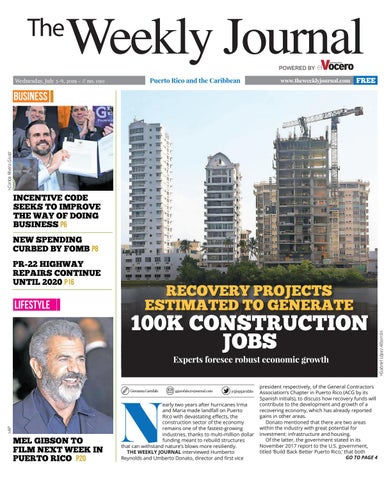
RECOVERY PROJECTS ESTIMATED TO GENERATE
100K CONSTRUCTION JOBS Experts foresee robust economic growth
N
>AP
Giovanna Garofalo
MEL GIBSON TO FILM NEXT WEEK IN PUERTO RICO P20
ggarofalo@wjournal.com
@giopgarofalo
early two years after hurricanes Irma and Maria made landfall on Puerto Rico with devastating effects, the construction sector of the economy remains one of the fastest-growing industries, thanks to multi-million dollar funding meant to rebuild structures that can withstand nature’s blows more resiliently. THE WEEKLY JOURNAL interviewed Humberto Reynolds and Umberto Donato, director and first vice
president respectively, of the General Contractors Association’s Chapter in Puerto Rico (ACG by its Spanish initials), to discuss how recovery funds will contribute to the development and growth of a recovering economy, which has already reported gains in other areas. Donato mentioned that there are two areas within the industry with great potential for investment: infrastructure and housing. Of the latter, the government stated in its November 2017 report to the U.S. government, titled ‘Build Back Better Puerto Rico,’ that both GO TO PAGE 4
>Gabriel López Albarrán
PR-22 HIGHWAY REPAIRS CONTINUE UNTIL 2020 P16
The Weekly Journal > Wednesday, July 3, 2019 > 2
3
/ Wednesday, July 3, 2019
A WEEK IN REVIEW ORIENTAL BANK TO ACQUIRE SCOTIABANK OPERATIONS IN PUERTO RICO, USVI
>Archive
>Archive/Josian Bruno
>Archive
Puerto Rico-based OFG Bancorp and Canadian financial institution Scotiabank announced the signing of an agreement for OFG’s subsidiary, Oriental Bank, to acquire Scotiabank’s Puerto Rico operation for $550 million in cash and Scotiabank’s U.S. Virgin Island (USVI) branch operation for a $10 million. Scotiabank’s Puerto Rico and USVI operations would be merged with Oriental Bank and its related businesses, which would make Oriental the second largest bank in Puerto Rico in terms of “core deposits, branches, automated and interactive teller machines, and mortgage servicing,” according to OFG, which said it would result in a loan portfolio totaling $7.2 billion, “low cost deposits of $7.9 billion” and about half a million customers.
DMO REPORTS HIGHEST TOURISM REVENUE AND VISITORS IN THE ISLAND’S HISTORY Discover Puerto Rico, the Destination Marketing Organization (DMO) for the island, reported that year-to-date revenue is the highest in the Island’s history, with $445M reported through May. The Island has received 1.67 million visitors at the San Juan, Ponce, and Aguadilla airports in the first few months of this year, the highest number reported for the January-April period in the island’s history. “New Orleans took eight years to get back to pre-Katrina levels but we set an aggressive goal to fast-track the visitor economy at a record pace, for the benefit of local communities,” said Brad Dean, CEO of Discover Puerto Rico.
Powered BY El Vocero de Puerto Rico, 1064 Ave Ponce de León 2nd floor San Juan, PR Postal Address: PO Box 15074, San Juan, PR 00902
NEW DEVELOPMENTS FOR ROOSEVELT ROADS IN CEIBA Gov. Ricardo Rosselló announced that IBD Energy will be in charge of managing the electrical distribution system at the former military base. It will also manage the independent microgrid that currently provides power to the 15 tenants on the premises and will be the source of power for any future tenants. Rosselló also announced the completion of the first phase of the Ocean Club complex, which will serve as a short-term rental space with 25 units.
President Salvador Hasbún shasbun@elvocero.com
Human Resources Director Arlene Rolón, PHR arolon@elvocero.com
Managing Editor Yennifer Álvarez yalvarez@wjournalpr.com
Comptroller Félix A. Rosa frosa@elvocero.com
Traffic Director Ilia M. Pérez Centeno iperez@elvocero.com
Multi-Platform Digital Director Stephanie Gómez Álvarez sgomez@elvocero.com
Production Director Eligio Dekony edekony@elvocero.com
Editorial Director Juan Miguel Muñiz Guzmán jmuniz@elvocero.com
Multi-Platform Graphic Director Héctor L. Vázquez hvazquez@elvocero.com
Phone: 787-622-2300, 787-721-2300 Customer Service: 787-622-7480
4
CONTINUED FROM PAGE 1 hurricanes took a “huge and unprecedented toll” on the island’s home and housing stock. “It is estimated that over 472,000 housing units have received major damage or have been destroyed by the hurricanes... Given the extent of housing losses, Puerto Rico is looking to build back a more resilient housing stock that can correct some of the deficiencies and problems that contributed to the massive damages,” the report reads. The government indicated in this initial report that the estimated cost to rebuild and repair the impacted households would be $31,068,532,671. They also proposed that the majority of the funds be assigned through Community Development Block Grants for Disaster Relief (CDBG-DR). The report also listed the Federal Emergency Management Agency, the Small Business Administration, and the Social Services Block Grant programs as other possible funding sources. Tallied up, between the monies provided by
/ Wednesday, July 3, 2019
already in the implementation stage... after the FEMA, and those from other sources, a total of damage caused by the hurricanes there is a lot of $20,409,308,876 were approved in funding to be work to be done concerning design and planning used for public assistance, individual assistance, to perform these risk mitigation projects. We are in assistance, and other that phase,” Reynolds recovery services. So said. far, $13,468,466,620 Moreover, Donato have been disbursed added that this stage and distributed among involves repair, these programs. reconstruction, and Reynolds explained relocation, known as that the CDBGR-DR the R3. includes “great” funding “During this phase, to infrastructure, which many one-family includes repairs to housing units will be bridges, aqueducts rebuilt or repaired in and sewers and flood a more resilient way, control. These, he said, - Humberto Reynolds, General because they currently are being overseen by Contractors Association’s Director do not comply with the U.S. Army Corps of several requirements Engineers (USACE). to be able to withstand “These funds are atmospheric events,” he said. According to Donato, this implementation plan has a preliminary allocation of $1.5 billion, which will be distributed as the plan continues to take shape in those three areas. This, the ACG vice president said, has a direct impact on the construction sector and the general economy as well because it entails a plethora of services from multiple professionals, including legal consultants, engineers, suppliers, contractors, and more. “This economic input provides the benefit of direct investment in Puerto Rican businesses, especially small- and midsize businesses (PyMEs) because, throughout that construction process, local contractors are hired as well,” Donato commented. Reynolds stressed that the recovery works performed with federal funding will have “substantial” impact on employment. “When you combine all civil jobs, including road repairs, flooding preventions and other work areas overseen by USACE in addition to the work on housing that will be done through CDBGR-DR funds, we are saying that we expect that there will be 100,000 direct jobs in construction alone, which is a substantial increase,” the ACG director affirmed.
We expect that for a period of five to ten years the volume of construction will surpass previous volumes that Puerto Rico has seen, even in its highest years of production.
Emphasis on Hiring Local Talent
The president of the Puerto Rico Engineers & Land Surveyors Association (CIAPR by its Spanish initials), Pablo Vázquez, told THE WEEKLY JOURNAL that both the government and his organization promote an open-doors policy for business on the island. However, he affirmed that the CIAPR monitors the companies that come to Puerto Rico so that they comply with all the requirements that apply to local businesses. “They come to work and compete in the industry in Puerto Rico and the important thing is that they come in equal terms as local companies. Likewise, the engineers who come to work here
5
/ Wednesday, July 3, 2019
sponsored by
should comply with the practice laws in the local engineering, architecture, and land surveying industries. As long as they come to work here on equal terms, then there shouldn’t be restrictions for anybody,” Vázquez said. The CIAPR president added that the organization is always reviewing the government’s requests for proposals (RFPs), to ensure that their requirements and conditions concur with the law that establishes the terms for professional services in the aforementioned industries. “In Puerto Rico, the law requires that in every company that provides professional services in engineering, architecture and land surveying, its owners and shareholders must be licensed professionals... You cannot establish an ‘Inc.’ to provide professional services, and that is something that happens that infringes on the law,” Vázquez Humberto Reynolds and Umberto Donato, director and first vice president, respectively of the General Contractors Association’s commented. Chapter in Puerto Rico (ACG by its Spanish initials), discuss how recovery funds will contribute to the development and growth of a Vázquez added, “we are recovering economy, which has already reported gains in other sectors.>Josian Bruno Gómez attentive to every RFP that is announced that involves apprenticeships to individuals who are not Construction Suppliers Act (Act No. 42-2018), engineering or land surveying necessarily integrated in the construction industry which essentially aims to prioritize the hiring of services—because you cannot include both but could gravitate to form part of those estimated local talent for at least 20 percent of contracts engineering and land surveying services... the 100,000 additional jobs. for government or public-private partnership CIAPR’s role is to ensure that the laws are complied Both Donato and Reynolds stressed that they construction works. with.” are also keenly attentive to the compliance with “This law was approved a little while ago and it Meanwhile, the ACG officials stated that the Preference for Local Contractors and Local is a highly useful tool which we use to recommend their organization is involved in providing and encourage local companies to be hired for these jobs,” Reynolds said. Regardless, Reynolds indicated that the recovery projects will open ample opportunities both for Puerto Rican professionals and foreign companies and individuals. He added that once all disaster recovery funds are disbursed, the construction industry will double its capacity and potential. “We expect that for a period of five to ten years the volume of construction will surpass previous volumes that Puerto Rico has seen, even in its highest years of production. We are living in a historic moment where federal funds can align with the need of the people and generate sustainable growth for many families,” Reynolds detailed. María Schell, communications advisor of the ACG, explained that the Chapter ensures that laws and regulations, both local and federal, that are applicable to their industry are enforced in contracting and auctions. “We ensure that the government fulfills its role and that the people participating in the industry comply with these requirements,” she said. Schell added that the organization provides seminars and workshops to the general public, as Pablo Vázquez, president of the Puerto Rico Engineers & Land Surveyors Association. > Josian Bruno Gómez well as additional services to its members.
6
/ Wednesday, July 3, 2019
New Puerto Rico Incentive Code Centralizes Request Processes Includes amendments to Acts 20 and 22 Giovanna Garofalo
O
ggarofalo@wjournal.com
@giopgarofalo
n July 1, Gov. Ricardo Rosselló signed into effect the new amendments to the Puerto Rico Incentive Code, which includes reforms to Acts 20 and 22. The new Incentive Code, titled Act No. 60-2019, renames the Tax Exemptions Office as the Incentive Office and incorporates it to the Department of Economic Development & Commerce (DDEC by its Spanish acronym). The law also creates programs and incentives to help students and the medical community, as well as fomenting creative industries and eSports on the island. “After much debate, by signing this law, we are complying with the programmatic commitment of my administration to create an efficient process that improves the way business is done in Puerto Rico. In addition, we create new incentives that promote the retention of our professionals and the development of emerging industries,” Rosselló affirmed.
Incentives Granted Under Single Business Portal
“As part of the process to implement the Incentive Code, the Puerto Rico Business Incentives
Office is established in the DDEC, and the creation of the Single Business Portal is ordered, which centralizes, standardizes and expedites the processes related to the request and approval of decrees, cash grants, tax credits, subsidies and other incentives,” DDEC Secretary Manuel A. Laboy explained. On the issue of decrees, the secretary of economic development clarified that the new Incentive Code does not impact decrees approved prior to its amendment. “Every entity, individual, company and business that has received a decree to date will have that decree active; that is a contract between the parties. And the law itself establishes a process of transition and validity that allows us to transition toward the new blueprint of the Incentive Code,” Laboy said. Act 60-2019 states that the code will also incorporate provisions to measure the return on investment (ROI) and maintain up-to-date data on the performance of each economic sector. Moreover, the new Incentive Code creates the figures of the Qualified Promoter and the Certified Professional to assist the government in attracting companies to the island and to facilitate application processes. This, it states, to “formally incorporate the participation of the private sector.” Section 2034.01 (a)(8) states that the Qualified Promoter would receive “up to 50 percent of the amount that enters the Economic Incentives Fund and is transferred to Invest Puerto Rico Inc., by means of the income tax that has been paid to the secretary of the treasury through the New Business in Puerto Rico.”
Emphasis on Students and Health Professionals
One of the measures included in the code, is meant to solidify the island’s medical industry while also addressing the islandwide health crisis in the repayment of student loans to doctors, dentists, veterinarians and scientific researchers in the health field, as long as these professionals commit to providing their services in Puerto Rico for seven consecutive years. This amendment was included in an effort to battle the mass exodus of health professionals leaving the island. Last year, it was reported that 6 out of 10 general practitioners left Puerto Rico within the previous three years, as well as other 8,143 medical specialists. Moreover, this year it was reported that most of Puerto Rico’s specialists are part of an aging population with intentions to retire within the next 10 years. The code also grants doctors an extension until September 30 of this year to request the decree under the Incentives for the Retention and Return of Medical Professionals Act. Doctors who are practicing outside of Puerto Rico will have until June 30 of 2020 to return to the island if they wish to benefit from the preferential rates established in this act. “We see this as a great opportunity to retain our doctors,” the governor asserted. The code approved also creates the Savings Plan Program for Students, known as ‘Cuenta Mi Futuro’, which entails creation of an account for every kindergarten student in the public school system in which the government will deposit
7
/ Wednesday, July 3, 2019
“The Incentive Code is in line with the government’s public policy of maximizing the performance of the tools available for Puerto Rico’s economic development,” Gov. Rosselló added.>Carlos Rivera Giusti
$1,000, which will be made available to these students once they graduate from high school.
of approved entities, and the remaining $5,000 to any non-profit organization that is operating under Section 1101.01 of the Puerto Rico Internal Revenue Code; that is, that has been previously Controversy Over Amendments to Acts certified by the Legislature. 20/22 These include childcare centers, farm An issue that has been hotly debated has been organizations, senior nursing homes, resident the amendments to associations, charities, Acts 20 and 22. cultural or theaterAct 20 provides tax oriented entities, incentives for exportorganizations that services companies treat and prevent who serve clients animal cruelty, outside the island, civic organizations, while Act 22 provides educational entities, a zero percent tax sports and recreation rate on dividend and circles, hospitals, and interest income. religious entities. As originally Senator José Nadal introduced, these - Manuel Laboy, Secretary of Economic Power chastised the acts require that Development requirement, stating their respective that it privies selfbeneficiaries issue a sufficient community $5,000 contribution organizations from to organizations that perform different types of receiving donations. services to their communities. “Not all organizations in Puerto Rico solicit This number was increased to $10,000 in the legislative funds. Many want to be autonomous new Incentive Code, but the main dispute before and because of that, now they are denied the the code was signed on Monday was actually possibility for hundreds of investors who reside focused on the fact that the entities protected on the island to send them the donations that are under these acts would not have been able to required by law,” the senator denounced. select the community-oriented organizations that
Every entity, individual, company and business that has received a decree to date will have that decree active; that is a contract between the parties.
would receive their contributions. The new Incentive Code requires beneficiaries to designate 50 percent of the established payment to an organization included in the Legislature’s list
New Treasury Secretary Designated
As he explained the new Incentives Code, the governor also announced that he was nominating
Francisco Parés as the new Secretary of the Treasury. The nomination comes exactly one week after former Secretary Raúl Maldonado was dismissed from his position over an FBI investigation into corruption that allegedly took place in the Treasury and after denouncing the existence of an “institutional mafia” inside the department. Since Maldonado’s ousting, Parés has been the acting treasury secretary and he previously worked as the assistant secretary for internal revenue and tax policy areas in the same department. He is a certified public accountant (CPA) and member of the Puerto Rico CPA Society, and he holds a bachelor’s degree in Business Administration from the University of Puerto Rico, Río Piedras campus, as well as a Master of Science in Taxation from Northeastern University in Boston, Massachusetts. “He is a vanguard professional. He is young, yes, he is, but I bet on the youth of Puerto Rico and its capability. I announce to the people of Puerto Rico that, although he was an intern, I am naming him as secretary of treasury,” Rosselló affirmed. For his part, Parés stated that his administration will prioritize the Treasury’s digitalization, as well as collaborative work with the Fiscal Agency & Financial Advisory Authority to create financial statements. “It is unquestionable that Puerto Rico is going through a historical conjuncture that requires the sacrifice of all of us to achieve the economic and fiscal reconstruction of our governmental apparatus,” the new Treasury Secretary said.
8
/ Wednesday, July 3, 2019
FOMB More Restrictive With P.R. Gov’t Budget for FY 2020 Jaresko firm on no allocations for Christmas bonuses or additional funds for municipalities Rosario Fajardo
F
rfajardo@wjournal.com
@RosarioWJournal
inancial Oversight and Management Board Executive Director Natalie Jaresko has made it clear that the Puerto Rico government will have less leeway in its fiscal year (FY) 2020 budget to reapportion earmarked funds to different areas, as has occurred in the past. “You can’t compare this budget with the previous years because this one is more comprehensive, more transparent… This year there is more details on line items,” she said during a conference call with reporters. Last year, for example, the government paid out Christmas bonuses to public workers, even though the FOMB was against it. The board did not take action against the government. Jaresko said the government was able to do so because in last year’s budget “there was a general line on personnel” rather than specific line items. So, the Christmas bonuses were paid out but there was no hiring or spending in other areas. This year, the FOMB categorically specifies “zero” for Christmas bonuses in the budget, while other line items also received specific amounts, such as healthcare and professional services, she said. “Any movement within these lines requires an appropriation request to ensure any changes are within the certified budget,” she said, indicating that the FOMB would deny requests that are not consistent with the fiscal plan of right-sizing the government and spending limitations. “A spending limit is in place and asking for additional spending does not make sense,” she added. The spending limitation would also hold sway with regard to municipalities, Jaresko said. “The fiscal plan is clear that there will be decreased support for municipalities. I don’t believe there is any way to change that equation- additional spending for municipalities is not consistent with the fiscal plan;” therefore, it would also be rejected,
she indicated. Jaresko spoke with reporters after the FOMB certified its own FY 2020 budget of $20.2 billion in consolidated funds. The board’s budget includes $9.1 billion in the General Fund—less than the $9.6 billion that the Legislature approved, which was similar to the one proposed by -Natalie Jaresko, FOMB Gov. Ricardo Rosselló. The new fiscal year Executive Director began on July 1. All the wrangling with the FOMB seems to have been in vain, as the board eventually certified its own budget, as it did last year. The latest debate sets the stage for yet another confrontation between the board and the government, as the two continue to tussle over which entity has the last word on the budget. The governor has repeatedly said that he will
not support austerity measures, such as cutting Christmas bonuses. He told reporters that he was not surprised by the board’s actions on the budget. “We anticipated something like this would happen,” he said during a press conference. Rosselló added that he also “anticipates getting reapportionments” in a number of areas. “We are working right now, looking at the budget submitted by the Oversight Board and reiterating our commitment to fight for our public policy decisions and areas that we want to push,” he said.
Any movement within these lines requires an appropriation request to ensure any changes are within the certified budget.
FOMB Executive Director Natalie Jaresko. >Josian Bruno Gómez
9
< The Weekly Journal > Wednesday, July 3, 2019
10
/ Wednesday, July 3, 2019
Economists interviewed by THE WEEKLY JOURNAL recognized the differences between Puerto Rico and New Zealand but agreed that a policy that focuses on strengthening social investment rather than on cutting wages, pensions and slashing resources from education or health services, can create the conditions to turn the economy around and back on the track of growth. >Archive
Can Puerto Rico Have a
Well-Being Budget?
At the end of May, New Zealand’s Prime Minister Jacinda Arden presented a budget guided by the concept of “well-being”. Experts consulted encouraged Puerto Rico’s government to follow that lead
I
Cynthia López Cabán
clopez@wjournal.com
@cynthia_lope
t is a bold move. Last month, New Zealand unveiled the first budget that doesn’t focus on traditional measures of economic success like the GDP and makes the well-being of its citizens the core of its entire budget. To achieve this goal, the proposed budget includes billions of dollars for mental health, child poverty, domestic and sexual violence programs. It also supports indigenous people and seeks to grow the economy in a sustainable and environmentally friendly way. In the Caribbean, 8,513 miles away, the government of Puerto Rico battles with the Financial
Oversight and Management Board (FOMB) over the allocations of resources in new fiscal year’s budget, that began on July 1. Gov. Ricardo Rosselló presented a $9.62 billion budget, but the FOMB anticipated it will implement $9.1 billion. At a time of economic uncertainty on the island, the Oversight board insists on austerity as the answer to the U.S. territory’s fiscal crisis and $70 billion-plus debt load. But New Zealand’s new approach raises a question: Can Puerto Rico replicate a model that prioritizes well-being as it tackles dire economic challenges? Economists interviewed by THE WEEKLY JOURNAL recognized the differences between both countries but agreed that a policy focused on strengthening social investment rather than on cutting wages, pensions and slashing resources from education or health services, can create the conditions to turn the economy around and back on the track of growth. “When we look at New Zealand’s spending plan, we have to focus on the allocations for political spending versus social investment,” Puerto Rico Association of Economists’ President Heriberto Martínez Otero said. While New Zealand is emphasizing on policies that improve well-being, the government on the island is doing the opposite and increasing the funds for agencies and consultant contracts that fundamentally serve a political purpose, according to Martínez. For instance, he pointed out the University of
Puerto Rico (UPR) and the Health Department budgets received drastic cuts, but the budgets for the State Elections Commission, the Legislature, La Fortaleza, and the FOMB grew. “To increase the budget in those areas, you have to cut back on social investment and the hardest hit is the UPR,” Martínez indicated. “The other problem is that we are increasing budgetary allocations for political spending, one of the areas most susceptible to corruption.” The former president of the Puerto Rico Association of Economists, José Caraballo-Cueto concurred with the need to curb the government’s superfluous expenses (gastos alegres). “We could benefit from a different paradigm, especially a vision that prioritizes social investment. Some benchmarks already exist.” Along those lines, he noted that countries that lead the Human Development Index like Norway, Switzerland and Australia make a substantial investment in social programs. “It is not a matter of chance.” Amanda Rivera Flores, executive director of the Institute for the Development of Youth, advocated for a budget that uses benchmarks that take into account the welfare of children and young people. She highlighted that 50 percent of the children in Puerto Rico live under poverty levels. “We have to invest in our children as they are the future,” Rivera stated echoing one of the budgetary priorities established by New Zealand’s Primer Minister Jacinda Ardern.
11
/ Wednesday, July 3, 2019
Integrand Assurance Wins a Round The Court of Appeals revoked orders issued by a lower court as the panel of judges concluded that the insurer has a right to question the decisions made in its rehabilitation process
P
Cynthia López Cabán
clopez@wjournal.com
@cynthia_lope
uerto Rico´s Court of Appeals concluded that Integrand Assurance Company has legal standing to oppose the insurance commissioner’s decision to appoint Juan Moldes Rodríguez as the official in charge of its rehabilitation process. In the 31-page decision, the intermediate court revoked orders issued by judge Carmen Merced Torres, from the San Juan Judicial Center, that
validated Moldes’ appointment and ordered the inferior court to hold an evidentiary hearing as soon as possible to listen to arguments from both parties in order to resolve the legal dispute. As this paper went to print, Merced had not scheduled the hearing because the case was still in transit from the Appellate court, according to an annotation of the court’s electronic filing system. On May 30, lawyers for the Insurance Commissioner’s Office filed a motion asking for the mandate to begin the process that gives the agency control over the insurer’s assets and property under the supervision of the court. To lead the process, Insurance Commissioner Javier Rivera Ríos appointed Moldes. After the presiding judge denied their petitions, lawyers for Integrand filed a petition for a writ of certiorari on June 7. They argued, among other things, that Moldes had an evident conflict of interests because he was Real Legacy’s liquidation officer and, in that capacity, sued Integrand. After Hurricane Maria ravaged the island, Real Legacy folded but before going under it settled over 10,000 claims. Other 4,500 claims are being handled in the liquidation process, according to information provided by the Office of the Insurance Commissioner.
Contrary to judge Merced’s ruling, the Appellate court resolved that Integrand had a right to be heard in a formal hearing and to present witnesses and documentary evidence to support its case. Lawyers for the Insurance Commissioner’s Office, on the order hand, have argued that Integrand doesn’t have the authority to intervene in the rehabilitation process, much less in Moldes’ appointment because “this designation is a faculty that belongs solely to the insurance commissioner, under the supervision of the Court of First Instance.” “Under the aforementioned legal provision (Insurance Code), Integrand has the right to challenge the designation of the special assistant commissioner who will be in charge of its rehabilitation process, and both the right to due process of law and the doctrine of legal standing require that it be recognized,” the Courts of Appeals said in an opinion by judge Fernando Bonilla Ortiz. “In concluding otherwise, the Court of First Instance erred as a matter of law.” Integrand found itself in financial distress after Maria slammed the island causing over $100 billion in damages. Unable to pay off claims that could have reached $50 million, it requested that the Insurance Commissioner’s Office initiate rehabilitation proceedings.
Your lifestyle deserves to GO BEYOND. Get to the level you deserve with the exclusive benefits from our Beyond Ultimate credit card.
0
APR on purchases and % introductory balance transfers for the first 15
Purchases and balance transfers must be made during the first 6 months after opening the account.
months after opening your account.
0
$
Afterwards, your APR will be
13.00% - 26.75%
1
Free Rewards Program that allows you to earn 2 points for each $1 spent on purchases.2
introductory annual fee1
Exclusive Services3: • Priority PassTM Airport Lounge Access • Personal Concierge Service • Travel and car rental insurance
Apply Today! 787.827.5382 Member FDIC. Subject to credit approval. Certain restrictions apply. 1. Offer will be valid until July 31, 2019, and is only available for new accounts. It may not be applied in combination with other offers. Introductory APR of 0% for the first 15 months after opening your account for purchases and balance transfers made during the first 6 months after opening the account. After the introductory period, your APR will be 13.00% to 26.75%, based on your creditworthiness at the time you opened your account. The APR for Cash Advances will be 19.50% to 26.75%, based on your creditworthiness at the time you opened your account. These APRs may vary with the market, based on the Prime Rate. Penalty APR of 29.99%. $0 Introductory Annual Fee for the first 12 months. After the introductory period, the Annual Fee will be $150. Minimum Interest Charge: If you are charged interest, the charge will be no less than $1.50. Balance Transfers, Cash Advance and Convenience Checks: 2% of the amount of each transaction with a $2.00 minimum and $10.00 maximum, for each one. Transaction fees for any transaction made in foreign currency or for any transactions made in US dollars processed outside the United States will be of 1.40% of each transaction in US dollars for Mastercard and 1.00% for Visa. This fee will be applied in addition to any other applicable fees. Subject to credit approval, and certain restrictions apply. The account must remain in good standing and be opened during the valid term of the offer in order to obtain these benefits. The introductory offer for balance transfers is subject to availability of funds in your credit line and cannot be used to pay, in full or partially, any debt with FirstBank. There are no grace periods on balance transfers. 2. Visit http://www.rewardsfirstbank.com for rewards program details. 3. The insurance products offered by FirstBank Insurance
Agency LLC. do not represent a bank deposit, are not insured by the FDIC or by any other federal government agency, nor by FirstBank Puerto Rico, or any of its subsidiaries. Obtaining this insurance is optional and is not a condition to determine credit approval. Priority Pass is an independent access program for participating VIP airport lounges.
12
/ Wednesday, July 3, 2019
Former U.S. Treasury Chief Balks at Calling for Austerity Measures for Puerto Rico
Rico. We’re talking about different economies, has not been on the table. different people, different personalities,” Marin When Wilson, a Republican, became California said during a recent investment forum, sponsored governor in 1991, the state had a $49 billion by Bacalia Group, at budget with a $14 the Puerto Rico Art billion deficit, she Museum. indicated. “He made a She added that she Solomonic decision. He Rosario Fajardo rfajardo@wjournal.com @RosarioWJournal had not specifically decreased spending studied Puerto Rico’s by $7 billion and case. increased taxes by ormer U.S. Treasury Secretary The Financial $7 billion. He was the Rosario Marin lauded former Oversight and most hated man in California Gov. Pete Wilson for Management Board, Calif.” Yet he turned taking difficult steps to enact -Former U.S. which has been the state’s finances austerity measures in the Golden Treasury Secretary, Rosario Marin continually tussling around. State in the early 1990s, but she “He had a clear backed away from saying she would with the Puerto Rico government over the vision for California. recommend such policies for Puerto Rico today. budget, has been a proponent of cuts in spending, He communicated this and had a capable team of “It would be presumptuous of me to say that. services and pensions. However, increasing taxes people around him… It was a difficult time because This is not necessarily the right recipe for Puerto basic services were decreased while taxes went up,” Marin said. She added that a team was set up to promote California as “open for business” to attract investment. “Even though it was not easy and [economic] recuperation took time, he was re-elected and when he left office [in 1999], California had a $9 billion budget surplus,” she pointed out. The key for Wilson was a “clear vision” and a capable team “to executive the plan, communicate and get results,” she said. At the time, Marin was serving in the Wilson administration as chief of legislative affairs of the Department of Developmental Services. She later went on to the White House, where she served as the U.S. Treasury secretary between 2001 and 2003, under the George W. Bush administration. Marin, who is originally from Mexico, immigrated to the U.S. with her family at the age of 14. A naturalized citizen, she spoke no English when she arrived and hails from a working-class family. Her father worked as a janitor and her mother as a seamstress. She earned her Bachelor’s degree from California State University, having worked all through college and taking classes at night. Proud of her immigrant and Latino roots, Marin also called on Puerto Rico to take a more active role and voice in the mainland U.S., along with the other 59 million Hispanics living stateside. “Many Americans still don’t know where Puerto Rico is, don’t know that Puerto Rico is part of the United States and that you are U.S. citizens,” she said to Former U.S. Treasury Secretary Rosario Marin speaks at the Bacalia Economic Forum 2019 >Brandon Cruz González the audience.
Says a ‘clear vision and a capable team’ important for success
F
It would be presumptuous of me to say that. This is not necessarily the right recipe for Puerto Rico.
Gana una experiencia en Nueva York Viaja al Salón de la Fama de Béisbol en Nueva York
Sorteo
BÉISBOL
E P
Nombre _______________________________________________________ Teléfono_______________________________________________________ Correo electrónico ______________________________________________ (1) Fechas de viaje: 19 al 22 de julio de 2019. (2) Solo personas mayores de veintiún (21) años de edad residentes legales permanentes de Puerto Rico. No podrán participar empleados de Statewide Local Development Corporation-Oficina de Comercio y Turismo del Estado de Nueva York en Puerto Rico, sus aliados El Vocero, elvocero.com, wapa DEPORTES, WKAQ580, y el Museo del Deporte de Puerto Rico; sus agencias de publicidad y relaciones públicas; los representantes y entidades relacionadas con el desarrollo, producción o distribución de los materiales del sorteo; ni sus familiares. Sorteo limitado al área geográfica de Puerto Rico; (3) El promotor es Statewide Local Development Corporation-Oficina de Comercio y Turismo del Estado de Nueva York en Puerto Rico; (4) No se requiere comprar nada; (5) Reglas del sorteo disponibles en el periódico El Vocero, elvocero.com, wapa.tv/ programas/wapadeportes, wkaq580.com, en redes sociales de Yelp y Trip Advisor bajo Taste NY San Juan y en Statewide Local Development Corporation-Oficina de Comercio y Turismo del Estado de Nueva York en Puerto Rico; (6) Urnas disponibles en Statewide Local Development Corp. (SLDC) - Oficina de Comercio y Turismo del Estado de New York, #260 Calle San Francisco, Viejo San Juan y el Museo del Deporte de Puerto Rico, Boulevard del Deporte # 3, Sector Bello Monte, Guaynabo, P.R. Envía tu boleto a ilovenybeisbol@esd. ny.gov o llama al 787-723-3848 para más información. (7) Sorteo para escoger ganador y ganadores alternos será el 15 de julio de 2019 mediante tómbola. Premio estará disponible en la Oficina de Comercio y Turismo del Estado de Nueva York en Puerto Rico. Ganador tendrá veinticuatro horas de haber sido notificado para reclamar su premio. Premio es insustituible e intransferible, ni reembolsable.
Museo del Deporte de Puerto Rico
Siempre cerca de ti C
Participa y Gana
Dirección ______________________________________________________
Sorteo
ilovenybeisbol@esd.ny.gov
Prepara tu maleta y…
Viaja al Salón de la Fama de Béisbol en NYS A la Ceremonia de Exaltación de Edgar Martínez entre otros...
A la Ceremonia de Exaltación de Edgar Martínez entre otros...
BÉISBOL
Recorta, Envía y Deposítalo
Sorteo del 28 de junio al 14 de julio del 2019
familias militares veteranos niños y niñas
Por todos a quienes ayudamos y por todos los que faltan por ayudar, dona hoy.
ilovenybeisbol@esd.ny.gov
Photo Credit: Milo Stewart Jr./National Baseball Hall of Fame and Museum.
< The Weekly Journal > Wednesday, July 3, 2019
Prepara tu maleta y…
13
14
/ Wednesday, July 3, 2019
PR-22 Undergoing Repairs Until 2020 Rehabilitation of the #2088 bridge entails $8 million investment
D Giovanna Garofalo
ggarofalo@wjournal.com
@giopgarofalo
rivers passing through the De Diego Highway (PR-22) might have noticed heavier traffic in the last few months. This is because Metropistas, the private entity that oversees PR-22 and PR-5, is rehabilitating the #2088 bridge, which spans from the municipality of San Juan to Bayamón. Jorge Veci, the director of operations for Metropistas, explained to THE WEEKLY JOURNAL that although this rehabilitation project originally consisted of seven phases, they managed to fuse phases one and two thus accelerating the process as to reduce its impact on traffic. “When Metropistas took over in 2011, the first thing it did was perform a structural analysis of the 127 bridges that span throughout PR-22 and PR-5. Based on that analysis, we created an investment plan to begin working on those bridges that need it the most,” Veci stated. The rehabilitation process of the #2088 bridge
actually began in 2015, with repairs to its columns; a job that required a $2 million investment. An additional $8 million will be used for renovations which include repairs to the slabs’ depths and beams seats, as well as pouring concrete and replacing reinforcing steel, among others works. Veci explained that the bridge, built in 1980, is roughly 700 meters in length and is one of the most transited routes in all of Puerto Rico, receiving more than 100,000 vehicles on a daily average. “This new investment of an additional $8 million to rehabilitate this vital bridge for traffic in the metropolitan area reaffirms our commitment to the safety of drivers. With this project, we are implementing permanent improvements to a bridge that was built 40 years ago and that requires a complete rehabilitation,” Veci said. This rehabilitation is expected to generate nearly 200 direct and indirect jobs. One of the aspects that Metropistas is most concerned about is determining which other phases of their original plan can be performed conjointly. “At the beginning, we intended to do this in three phases, but we have also been working with the contractor to make improvements to that initial plan... I hope we can improve on that initial plan, but that is left to be seen. We must see how these works evolve and how traffic behaves to see if we
can in some way have less of an impact on traffic,” the operations director said. The Metropistas official stated that the original plan called for the whole process to be completed within 12 months, after starting in mid-May of the present year, although this time frame could be reduced if they manage to fuse other phases. He stressed that out of the original seven phases, five would directly affect traffic flow from the Minillas Tunnel to the municipality of Arecibo. Two other phases, which involve repairs to access ramps from the PR-1 to the bridge, would have “far less impact.” Veci explained that Metropistas’ goal is to complete the first five—now four—phases before the end of 2019 and begin the last two in 2020. Each phase lasts eight weeks, with brief periods in between so the structure settles and remains sound. Although Veci said that Metropistas aims to have a minimal impact on traffic, he urged drivers to be aware of their surroundings. “We urge drivers and the general public to drive with caution and to respect the signage and other devices of traffic control that are going to be installed in the area for your safety and guidance,” he affirmed. For more information about this rehabilitation project and to learn about alternate routes, visit www. metropistas.com
Metropistas, the private entity that oversees PR-22 and PR-5, is conducting a rehabilitation of the #2088 bridge, which spans from the municipality of San Juan to Bayamón. >Screenshot Metropistas
15
/ Wednesday, July 3, 2019
Oversight Board Sues Fuel Suppliers The FOMB said companies Trafigura and Vitol allegedly supplied PREPA with oil that did not meet the applicable contractual or regulatory specifications, but nonetheless received payment from PREPA at the price of the higher quality fuel oil. >Carlos Rivera Giusti
The federal entity alleges that between 2002 and 2015 Prepa made “massive overpayments and other improper compensation”
W Cynthia López Cabán
clopez@wjournal.com
@cynthia_lope
ithout much ado, the Special Claims Committee of the Financial Oversight and Management Board (FOMB) filed a complaint against several fuel suppliers and laboratories potentially seeking to claw back billions of dollars in fraudulent payments made by the Puerto Rico Electric Power Authority (PREPA). The Oversight Board made the announcement last Sunday in a press release, just short of the twoyear prescriptive period to initiate legal proceedings. According to the FOMB, the complaint alleges that between 2002 and 2015 certain fuel suppliers received massive overpayments and other improper compensation from PREPA even though these vendors did not comply with the high-quality standards required by the now bankrupt public corporation. By contract and environmental regulations, the
utility is required to only purchase high-grade fuel oil, which is more expensive and cleaner than lowgrade oil. The press release stated that fuel companies Trafigura and Vitol allegedly supplied PREPA with oil that didn’t meet the applicable contractual or regulatory specifications, but nonetheless received payment from PREPA at the price of the higher quality fuel oil. The complaint also claims that suppliers were aided by the laboratories Carlos R. Mendez & Associates, Inspectorate America Corp., and Altol, who received payments for falsifying test results of the fuel oil supplied to PREPA. These payments, the Oversight board pointed out, contributed to PREPA’s insolvency by increasing the cost of its operations and causing PREPA to slide deeper into debt. As a result, the Special Claims Committee is asking the U.S. District Court for the District of Puerto Rico for authority to recover those fraudulent payments for the benefit of PREPA’s stakeholders. “The Oversight Board has a responsibility to recover payments that were made illegally,” David Skeel, a member of the Oversight Board’s Special Claims Committee said. “Based on the facts known, PREPA’s customers and creditors were harmed and we intend to pursue those claims vigorously.” This is the second legal actions of its kind. A group of PREPA customers already filed a lawsuit against the fuel suppliers and laboratories, as well as PREPA insiders and PREPA itself. That class action litigation is subject to the stay the U.S. District Court placed under the Puerto Rico Oversight, Management, and Economic Stability Act
of 2016. The Special Claims Committee, according to the release, adopted the factual allegations of the Class Complaint in support of the claims of overpayments. The allegations echoed statements made in the past by the outgoing U.S. Attorney for the District of Puerto Rico, Rosa Emilia Rodríguez Vélez, who in 2016 confirmed that federal authorities were investigating the so-called “Cartel del Petróleo” (The Oil Cartel), alluding to the persons involved in PREPA’s crude oil purchasing process. The investigation started after the Federal Prosecutor’s Office received the findings of an investigation conducted by a Special Committee of the Puerto Rican Senate. The Committee uncovered a fraudulent scheme in the analysis of fuel. It had two modalities. In one case, the calibration curves to measure the sulfur content in the fuel were manipulated. In the other, the oil certification process was assigned by favoritism to a laboratory that had not been certified and that was eventually certified due to PREPA’s intervention, among other findings As this paper goes to print, Rodríguez told THE WEEKLY JOURNAL that she had no comment regarding the ongoing investigation. The embattled utility is trying to deal with a mounting debt and the aftermath of Hurricane Maria in 2017, which pummeled the electric grid and left the island in the dark for months. Two months ago, the Oversight Board and PREPA struck a deal with a group of creditors that seeks to restructure more than $8 billion in debt but it was put on hold by the federal judge that oversees the bankruptcy-like process.
16
/ Wednesday, July 3, 2019
Puerto Ricans and Other Hispanics Facing Serious Retirement Savings Crisis
Majority have little or no disposable income for savings Rosario Fajardo
R
rfajardo@wjournal.com
@RosarioWJournal
etirement issues have been widely reported in Puerto Rico, as the island’s fiscal and economic woes have had a dire impact on the pension systems for public retirees. It’s no wonder that private savings have also taken a historic hit, as many Puerto Ricans, like most Hispanics in the mainland U.S., are woefully unprepared for retirement. A major survey of 11,316 respondents nationwide highlighted the problem for many. The Federal Reserve has found that nationwide, 26 percent of American adults do not have any retirement savings, but the problem is worse for Hispanics and blacks. An estimated 39 percent of Hispanic adults, 36 percent of blacks and 21 percent of whites have no retirement savings, according to the Federal Reserve’s May 2019 Report on the Economic WellBeing of U.S. Households. Certainly, income levels are a factor. If faced with an unexpected $400 expense, 25 percent of whites with some college or associate degree could not fully pay their monthly expenses, such as rent or mortgage and credit card payments. For Hispanics, this figure is 41 percent, and for blacks, 46 percent.
Many Puerto Ricans, like most Hispanics in the mainland U.S., are woefully unprepared for retirement >Josian E. Bruno Gomez
According to José Acarón, state director of AARP Another factor, Acarón explained, is that Puerto Rico, the problem is exacerbated locally family ties remain very strong among Hispanics, because of several factors. First, he noted that including Puerto Ricans. “Many of us are financially Puerto Ricans live in a strongly consumersupporting our adult children, as well as oriented society and for whatever our own parents,” he said. In his own reason, many Puerto Ricans have case, he said his elderly mother has negative savings rates. “I know Alzheimer’s disease, lives in her that after Hurricane Maria, it’s own home and requires three been hard. But we need to caretakers to watch over her. learn to save, however much “We help financially with that we can, because it matters,” and it is not cheap. It has he said to THE WEEKLY had an impact on my own JOURNAL. savings,” he said. “Remember too that He added that many income levels in Puerto Rico seniors in Puerto Rico live in are very low,” he added, poverty, as a significant majority especially compared live only on their Social with the national Security benefits, which average. After can be as low as $400 paying monthly bills a month, depending on for housing, food, one’s employment history. transportation, “That’s why many retirees utilities, phone bills, are trying to make ends etc., there is usually meet by baking and selling little left for savings, cakes, driving for Uber he indicated. and the like,” Acarón said. Official figures Nationwide, the average -José Acarón, state director bear him out. Social Security benefit is of AARP Puerto Rico Median household about $1,400 a month. income in Puerto Rico was $19,343 in 2017, according to the U.S. Census Bureau. The poorest state in the union, West Virginia, had a median household income of $43,469, while nationwide it was $61,372, a new high—indicating a positive outlook for the middle class stateside.
I know that after Hurricane Maria, it’s been hard. But we need to learn to save, however much we can, because it matters.
17
/ Wednesday, July 3, 2019
By Ricardo Álvarez-Díaz
By Edgardo Vicenty
Architect & Co-Founder AD&V® Architecture and Design
H
IF YOU BUILD IT, THEY WILL COME
ousing development is a significant indicator of an economic resurgence. It reflects investor confidence and directly benefits other sectors like infrastructure, services, manufacturing and retail. It is a clear reality that housing construction must be an essential part of a sustainable economic strategy that requires both a clear public policy focus and long-term development plan. Since 2006 the Puerto Rican housing sector has been severely affected by a variety of elements that sparked a serious local economic downturn. All were augmented by a global recession, government bankruptcy and an inevitable population decrease. Bank foreclosures, plus a significant amount of vacant homes, have adversely reduced home values and most importantly eroded local consumer confidence. Still, according to a recent study by Estudios Tecnicos, the housing market has dramatically improved. Since September 2017, after hurricanes Maria and Irma, the market registered a staggering 78% increase in new residence sales and a 17 percent increase in resold homes. As we begin to see a slow but steady Puerto Rican housing economic resurgence, this increase, even though positive for the island, is mostly organically fueled by the lack of adequate housing supply and not necessary by a clear housing planning strategy. Although 67 percent of Puerto Rican residents in the island own their properties (which is the highest level of home ownership in the United States) we still have several local industry challenges to address. These include the reality that over 65 percent of housing construction was developed and
built before 1980, and that over 55 percent of home construction has been done informally and organically. Moving forward, it is important that the housing and development industry continues to adapt rapidly to the socioeconomic, construction and demographic needs of today. Therein lies the opportunity, there is a need to change the perception of housing development from house creation to community development. It is both good planning practice and good for business. Standalone properties that are not part of a cohesively planned, existing, redeveloped or newly conceived community, even if remodeled up to code, might still be a danger for most families that invest in them. Resiliency development, forces all of us to rethink our dwelling vision. Anyone might be safe in a property during a hurricane, but not if isolated from other common use areas and communities during the aftermath. This is part of today’s consumers requirements for long term investments. Building for the sake of building might help the economy short term but not long term. A successful housing industry, as part Puerto Rico’s economic growth, reflects investor confidence. If we combine the importance of quality of life, together with job creation, we can create a more sustainable economy for the island. By developing new communities and revitalizing existing ones we will be able to attract individuals to invest during the reconstruction period and keep them in the island after the reconstruction period finalizes. It is easier to walk away from a house than it is to walk away from a community. Remember, if you build it WELL, they will come…and STAY.
Entrepreneur & Financial Analyst
I
Send Us the Immigrants
mmigration policy is poised to be one of the main battlegrounds for the 2020 presidential elections. If our leaders were working for the benefit of the island, Puerto Rico would insert itself into the debate and not just as a supporter of our fellow Latin-Americans, but as part of a policy solution that could work for both Democrats and Republicans. As things stand, a large part of the North American population resent immigrants, either because they feel these people take away jobs from U.S. citizens, they have safety concerns or just because of plain old racism. Another significant part of the U.S. population pro-actively seeks to help out immigrants and some even go as far as wanting to increase the number of immigrants entering the nation. These people might be good-hearted individuals, or they may be analyzing demographic and labor statistics and concluding that immigrants are a long-term net positive for the U.S. The truth is, I am part of the second group. I believe that as a nation we should help immigrants out and not just because it’s the right thing to do, but also because we could benefit greatly from it. I also believe fighting this battle head-on is inefficient, which is why I propose Puerto Rico insert itself into the debate and offer the U.S. government a unconventional bipartisan solution, send us the immigrants. Because of our colonial status, Congress can pass laws that put us at a disadvantage or unfairly benefit us
when compared to states. Therefore, Congress could legislate to make immigration to Puerto Rico easier than to the states; it could even go as far as legislating to allow illegal immigrants who could be deported to voluntarily move to Puerto Rico and start a path to legal citizenship from the island. Those who oppose immigration could see this as a victory as it would incentivize immigrants to move to a faraway island. It would also be a victory for those who support immigrants as it’s a step forward that would create a safe haven for those who live illegally in the country and offer an easier path for those looking to immigrate to the U.S. legally. However, Puerto Rico would be the most significant winner because as the nation’s only “immigration zone,” we would gain relevance in the U.S. political debate. We would also benefit from the influx of reproductive age individuals who could help restore the islands dwindling population. Easier access to H1B visas would also increase investments from tech companies looking to bring large teams of developers closer to their headquarters. I know this issue is exponentially more complex than what I have just stated. But we can’t just ignore the fact that Puerto Rico could help solve these types of issues because it would be hard. Puerto Rico needs to make the most of its colonial status and begin to insert itself into the U.S. political conversation by pro-actively helping solve national issues in creative ways.
18
/ Wednesday, July 3, 2019
SpeedDating
Why Should you Give it a Go? After seven months of the first event and many success stories of love found, Loveshare will hold its eighth Speed Dating event on July 11 in San Juan Génesis Ibarra
T The investor Orban Mendoza, left, and Gabriel Flores, Loveshare CEO. >Gabriel López Albarrán
gibarravz@wjournalpr.com
@gibarravz
oday’s technology driven world has made millions of people all around the world obsess over online dating and take refuge in the ease of swiping right to find someone new. But Loveshare, a mobile application made especially to “keep the spark alive” in relationships, aims to bring back the basics when it comes to human interaction. “We researched the effectiveness of these singles apps —like Tinder and Match— and came across different obstacles,” explained Gabriel Flores, Founder and CEO of Loveshare. “Maybe they ‘match’, but they don’t know what to talk about. How do you ‘match’? By seeing a picture, because many people don’t write a description, so it is superficial,” he added. With that in mind, Flores —along with SkyRocket Development partner Orban Mendoza Valiente— celebrated the first Speed Dating event on the Island, on November 2018. Now, after seven months of that first event and many success stories of love found, Loveshare will
19
/ Wednesday, July 3, 2019
hold its eighth Speed Dating event on July 11 at Amadeus Bistro in San Juan, where Flores expects an attendance of 50 to 70 singles. “We started in Lote 23, everyone was super shy, it was the first time it was done. I had to invite people for free. From then on, every Speed Dating was filled. How long can it take to meet 25 people, that you know are single and looking for a relationship? Speed Dating can save you years of searching,” Flores said.
How Does it Work?
Loveshare announces every Speed Dating event on social media, and everyone —single— can ask to be part of it. All it takes is a $10.00 contribution for the event. Loveshare makes sure to offer a good time to everyone all while protecting their personal information. No one can share their full name or contact details for security reasons, unless there is a match and consent is provided by both parties. For the shy crowd, every table is set with a list of guide questions that serve as icebreakers —“What are you passionate about? What would your ideal first date be like? What do you have pending in your bucket list?” Every conversation lasts 3 minutes. At the end of the night, all participants have the opportunity to choose five singles who caught their attention and write down their identification numbers in a matchmaking form. If there is a match, Loveshare will contact the lucky attendees. “In every Speed Dating, after the rounds of 3 minutes with every single, we encourage participants to socialize, eat, have a drink,” explained Flores. “It is very difficult to find a person that attracts you, that the attraction is mutual, that have similar values. There are many people who repeat, and every time there is a new event, new people sign up. The average of participants of each event is around 50 people,” he added.
Loveshare’s Role
The application, launched in February 2019, is described by its founder as “one of a kind” because it was made to bring couples closer through innovative and memorable experiences that range from a dinner at a new restaurant to a painting session while enjoying a glass of wine. “Our slogan is ‘keep the spark alive.’ That is the purpose of the app, which is something that has never been done before. There are thousands of apps to meet people, but there is nothing to help you stay together and maintain the relationship,” Flores assured. Every Speed Dating participant must sign up on the free app. This way, if they find a partner on a lucky night, Loveshare will provide more than 50 date options for the new couple. “Picture this, they met through Speed Dating, they were attracted to each other… So, now what? Where do we go? That is where Loveshare comes in. Instead of going to the movies, just open the app and you will immediately know what to do,” Flores said.
>Courtesy Loveshare
New Experiences
Last Saturday, Loveshare held its first Speed Dating event for the LGBTQ community on the island, where 30 singles met. “Not everyone has a partner, so we wanted to find a way to create new relationships, to ignite the spark in the first place, rather than just keep it alive,” Flores explained. To register for the next event on agenda, all interested parties must send a message to Loveshare’s inbox on Facebook. The event, to be held at Amadeus Bistro on July 11, will start at 7:00 p.m. and every participant will enjoy a free drink. Asked by THE WEEKLY JOURNAL to give its readers a reason to go Speed Dating, Flores said, “we can save you years of looking for a single person, you can meet them in one night. It is extremely efficient, it is something beautiful and dynamic. It is something that goes far beyond any mobile app, more than a swipe.”
>Gabriel López Albarrán
20
/ Wednesday, July 3, 2019
Force of Nature: Mel Gibson as a resident
of Puerto Rico The film will begin filming the third week of July in Miramar and Guaynabo. Yennifer Álvarez Jaimes
A
yalvarez@wjournal.com
@yalvarezjaimes
residential building in Puerto Rico will serve as the backdrop for Mel Gibson’s newest film: “Forces of Nature”. In the movie, burglars planning a heist during a hurricane run into trouble when a cop (Gibson) tries to help the residents of the building evacuate. Gibson, whose arrival to the island is set for next week, wants to learn about Puerto Rican idiosyncrasy, explained the seasoned Puerto Rican producer Luillo Ruiz to THE WEEKLY JOURNAL. The film, to be directed by Michael Polish (“Falls Idaho”, “Northfork” and “Jackpot”), will also star Emile Hirsch (”Lone Survivor”, “Once Upon a Time in Hollywood”) and Kate Bosworth (”Superman Returns”, “Still Alice”). Filming is set to begin during the third week of July in Miramar and Guaynabo and expected to last four weeks. With a budget nearing $23 million, of which $15 million are set to be invested in Puerto Rican goods and services, the film’s production crew will be 90 percent Puerto Rican, which translates to at least 300 people. Ruiz, owner of Pimienta Films, said that 12 local actors will have secondary roles and that there will be 150 local extras and day players. “The production and costume designers are Puerto Ricans and the majority of the crew is Puerto Rican. I am very proud of that,” Ruiz added. Ruiz went on to explain that, although “Force
Mel Gibson, who is supposed to arrive on the island the next week, wants to learn about Puerto Rican idiosyncrasy. >AP, File
In the past few years, Ruiz and his team have of Nature” will be set in Puerto Rico, it is a work produced other films on the island. Among these of fiction and is not related to the passage and are “Speed Kills”, interpreted by John Travolta; aftermath of Hurricane Maria. “Driven”, a production “We are capitalizing with Jason Sudeikis on the resources that affected by hurricane Puerto Rico has to Maria; and “Primal”, offer us in terms of with Nicolas Cage. Also infrastructure, tax filmed on the island incentives, equipment, earlier this year were the skills of our ‘staff’, “Trauma Center”, the locations, and the starring Bruce Willis, people. There are a and “Axis Sally” with Al lot of film industry Pacino. Both movies professionals on - Luillo Ruiz, producer are currently in the the island who are post-production stage. wonderful and who Ruiz highlighted that can create a complete the excellent work of world of action and the Puerto Rican people in these blockbusters adventure,” the producer said. He also stated that will continue to attract more productions to the they are still working on calculating the tax credits to be received for the film production. island.
The production and costume designers are Puerto Ricans and the majority of the crew is Puerto Rican. I am very proud of that.
21
< The Weekly Journal > Wednesday, July 3, 2019
22
/ Wednesday, July 3, 2019
Ultra
N 1334 Lounge o
A Multisensory Concept
Fashion designer Gustavo Arango opens an “all in one” entertainment venue in San Juan
F Melissa M. Cruz
mcruz@elvocero.com
@mmcruzrios
ashion designer Gustavo Arango recently unveiled his newest venture, No.1334 Ultra Lounge. The concept is that of an “all in one” entertainment center, located at his old Atelier on 1334 Franklin D. Roosevelt Avenue in San Juan. The space, which officially opened doors earlier this month, is meant to make guests feel at home,” said the fashion designer during a tour of the place. The transformation of the premises
began over a year ago with the idea of creating an entertainment space for patrons of all ages and diverse interests. “We do not have an age structure. This place was born from a collaboration of many people hoping to appeal to a varied audience. We wanted to create a space where people could let off steam, feel comfortable and receive excellent service every time, “ said Arango. With this in mind, the team designed a comfortable reception with several lounge areas that create an intimate and cozy atmosphere. No.
1334 Ultra Lounge also has a restaurant, three bar areas, a wine cellar for eight people and a nightclub. The lounge stands out because of its luxurious design, where art and creativity take center stage. Arango’s long-time collaborator, Carlos Mata, who also contributed to the decoration of the atelier about 20 years ago, was in charge of the design of the space. Mata had the responsibility of combining the vision of the talented fashion designer with that
/ Wednesday, July 3, 2019
of his partner, Lino Hernández, whose socalled urban wave vision is meant to make “everyone feel welcome in a space they can share and enjoy,” he said. Those same qualities were also taken into consideration when conjouring the culinary proposal available at No. 1334 Ultra Lounge. The menu was created by chef Carlos Sánchez, who has 20 years of experience, and has worked with renowned local chefs Augusto Schreiner and Chef Marisoll. Sánchez explained that the culinary offers of the place are those of a creative global cuisine with Mediterranean touches, with an integrated ingredients from local and seasonal harvests. He shared with us some of the dishes of his authorship, which will definitely conquer those with demanding palates: Watermelon prosciutto “envoltini” and short-rib sliders, as well as Barramundi tartare— Australian fish served with olive oil and chives, among
others. In fact, the latter dish was one of the signatures options within the “Share or not to share” menu that your correspondent had the opportunity to taste during the visit, along with the artisan pizzas authored by pizza maker Luigui Oliviela. The pizzas are prepared in a rotating stone oven exported from Italy. Among these are: the “Burrata” with Neapolitan sauce, basil, arugula and prosciutto; the Vegetarian with Neapolitan sauce, mushrooms, carrots, peppers and arugula; “A la Diávolo” with spicy salami, caramelized onions, “cantimpalo” chorizo and spicy oil; and the traditional Margherita with Neapolitan sauce, prosciutto di Parma, arugula and locally grown edible flowers. In addition to the options that are available for lunch and dinner, the venue has a wide variety of cocktails, more than 170 wine offerings from various regions and a selection of 20 craft beers.
23
24
/ Wednesday, July 3, 2019
U.S. Gourmet Burger Chain
Set to Launch in Puerto Rico First BurgerFi to open in San Juan area by the end of 2019
M Rosario Fajardo
rfajardo@wjournal.com
@RosarioWJournal
any Puerto Rican residents and companies have been moving to or opening offices in Florida. Now there’s a case of reverse expansion, as South Florida-based BurgerFi, a gourmet burger chain, is entering the Puerto Rico market. The “fast-casual, high-quality food concept” plans to open six locations during the next five years, with the first scheduled to open in the San Juan metro area by the end of the year. In total, the chain plans to create more than 200 jobs. “BurgerFi will hire 15-20 people for their corporate infrastructure to assist in running the six stores. This includes marketing personnel, HR and operations. Each store will hire 25-30 employees,” said Charles Guzzetta, franchise development manager, in a statement to THE WEEKLY JOURNAL. “As BurgerFi continues to expand, many of these positions can lead to management/ leadership positions with plenty of room for growth within the company,” he said. The company is “still negotiating sites/lease terms so all BurgerFi can say at this time is that the initial investment varies by location,” he added. According to BurgerFi’s website, the initial investment to open a franchise ranges from $670,000 to $973,000 per location. At the heart of BurgerFi’s menu is the BurgerFi Cheeseburger, made with the top 1 percent of best-tasting certified, American Black Angus >Courtesy BurgerFi beef from ranches across the
U.S. The company said BurgerFi is the only burger franchise in the industry to serve beef raised without the routine use of antibiotics. BurgerFi was one of only two brands to earn an “A” on the fourth annual Chain Reaction scorecard released by six major consumer and environmental organizations. Other menu options include vegetarian and chicken burgers, Wagyu hot dogs, hand-cut fries, onion rings, creamy shakes and custards, and craft beers. The six Puerto Rico locations will be owned and operated by franchisee Phillip Faigenblat, an entrepreneur who owns 14 Denny’s franchises islandwide. Faigenblat identified the need for a new fast-casual restaurant chain in Puerto Rico and was drawn to BurgerFi because of its reputation for fresh, healthy, high-quality food. “There’s a surging interest in healthy dining in Puerto Rico, as people become more conscious of what they are eating,” Faigenblat said. “Puerto Ricans are also digitally savvy and looking for
alternatives to both fast food and sit-down family dining. BurgerFi’s quick-service combined with quality food that can be ordered online fits perfectly with these needs and is bound to be a hit in Puerto Rico.” Besides its menu options, BurgerFi is also touting its eco-friendly approach to dining. The interiors of each of the six new restaurants will average 3,000 square feet and will feature various eco-friendly elements such as wood-paneled walls made from Number 2 southern pine lumber (the world’s most renewable timber), 10-foot fans that consume 88 percent less energy and 100 percent energy-efficient LED lighting. “The outdoor seating areas, which are perfect for Puerto Rico’s warm, sunny climate, will feature picnic and four-top tables each made from over 700,000 upcycled milk jugs and industrial-style red and gray chairs, each made from 111 upcycled Coca Cola bottles,” the company said.
25 < The Weekly Journal > Wednesday, July 3, 2019
Be on trend... be on trend...
B
www.elvocero.com/revistas/zona
26
/ Wednesday, July 3, 2019
After graduation, most of the students from Saint John’s and Robinson attend some of the best universities in the United States. >Archive
On Finding a Good
Private School
High retention levels and competitive teacher salaries are some of the qualities of the English-instruction institutions that stand out
O Cynthia López Cabán
clopez@wjournal.com
@cynthia_lope
n the corner of Nairn Street in Condado, two schools prepare their students to be college and career-ready. But it’s more than good grades. Saint John’s School and Robinson School teach their pupils the value of curiosity and
the thrill of learning. The results prove it. All their students complete high school equipped with the credentials to do well and dream big. After graduation, all students enroll in 4-year colleges and most of them go on to study at some of the best universities in the United States and abroad. Members of Saint John’s Class of 2019 got accepted into Berkeley College of Music, Boston University, Columbia University, Emory University, University of Pennsylvania, and Universidad Carlos III, in Madrid, just to drop a few names. Before them, others went off to study at Duke, Oxford, Stanford, and Harvard. The story repeats itself at Robinson. These high marks have won both Englishinstruction institutions a spot in all the rankings that grade private school programs on the island. What makes them successful? While Robinson
and Saint John’s follow different academic approaches, they share common traits. Both schools strive to teach their students that learning goes beyond the accumulation of facts. For them, it is a journey that embraces critical thinking, openmindedness, rigor, and a sustainable vision of the planet. Long-time neighbors of this affluent beachfront neighborhood in San Juan, both institutions also offer their teachers competitive salaries and better working conditions than those available in the public school system. While the average salary for a public school teacher with a classroom of 25 to 30 students starts at $21,000 a year, at Robinson and Saint John’s the same teacher earns $32,000 and has less than 20 students in a class. One-third of the student population on the island attends private school. During the 2017-2018, 122,924 students
27
/ Wednesday, July 3, 2019
walked the halls of private schools, in comparison to 346,096 in public school. “One of the things I try to push forward for the school is to make these kids -who have so much privilege- aware of the larger issues of the island and understand that they can promote change,” Lorraine Lago, Head of Saint John’s School, told THE WEEKLY JOURNAL. “It is an open community. Our style of teaching is very rigorous but also very authentic. We also do things have a real result. If you are learning statistics maybe you will go out and do a census on the community about diabetes. We try to make the experiences real, that learning is much deeper,” Lago added. In the beginning, Saint John’s was a school that catered to expats in need of an English immersion school for their children. But with time, its profile changed. Now 82 percent of its students are born in Puerto Rico. The other 18 percent is a mixture of students from the states, from other countries whose parents are working in Puerto Rico or from families that relocated here to benefit from the tax incentives under Acts 20/22. The school will welcome 900 students next semester, with a senior class of 80 students. Before the scourge of Hurricane Maria in 2017, all graduates pursued their college education in the states. After the storm, a few have decided to attend local universities At Robinson, the student profile differs a little. Anya Belaval, head of Institutional Advancement at the school, indicated that 80 percent of its students are from Puerto Rico and 15 percent come from countries like Tortola, Philippines, Argentina, Brazil, Cuba, Mexico, Japan, and Venezuela, to name a few. It also has a boarding school and Pathways, a program for students with mild language-based learning differences. Just as with Saint John’s, education starts at Pre-School until 12th grade. The student enrollment is lower with a population of 633 students and a senior class half the size of Saint John’s. “We follow a project-based learning approach that encourages students to learn and gain skills by applying knowledge in an engaging or lab-like experience. We promote an engaging environment, curiosity, and a deeper learning experience. It is more of a holistic view,” Belaval explained. Robinson is certified as an International Baccalaureate School, which means that it promotes academic achievement and personal development within a perspective of intercultural and international understanding and respect. But it is not just about the students. Saint John’s and Robinson invest in their teachers. “We have the best compensation on the island, so we recruit talent and we keep talent. But it is also about the opportunities that they have. Internal professional development is very strong. We spend a lot of time with teachers working on their practice. Having them look at student data and reflect upon their practice and how it relates to student success,” Lago indicated. “With the increases that we are giving, we are aiming at a mean salary of $45,000 in a couple of years.” The pay scale at Saint John’s oscillates from $32,000 to $60,000, depending on the teacher’s
level of education and experience. Its next door neighbor offers the same working conditions to its teaching staff, said Belaval. The investment in education is also higher. Tuition at Saint John’s fluctuates between $10,000
and $17,000 a year, depending on the grade, and at Robinson, it varies from $7,000 to $13,000. According to the Statistics Institute, the public school system invests between $6,000 and $7,000 per students.
TOP PRIVATE SCHOOLS IN PUERTO RICO 1. Cupeyville School in San Juan
(https://www.cupeyvilleschool.org) An English instruction college prep school from Pre-Pre-Kinder to 12th grade, the school has an advanced placement curriculum and an integrated program called Bridges for students with mild learning differences.
2. Academia del Perpetuo Socorro in Miramar (https://www.aps-pr.org) Perpetuo is a Catholic bilingual prep school from preschool to 12th grade.
3. Baldwin School in Bayamón
(https://www.baldwin-school.org) Baldwin School is an English language non-sectarian college prep school from Pre-Pre-Kinder to 12th grade. It is certified as an International Baccalaureate School.
4. Dorado Academy in Dorado
(https://www.doradoacademy.org) An independent and nonsectarian school, Dorado Academy’s main language is English while promotes a bicultural environment form Pre-Kinder through 12th grade.
5. Saint John’s School in Condado (https://www.sjspr.org)
6. Commonwealth Parkville School in San Juan
(https://www.cpspr.org) A college preparatory school, Commonwealth Parkville teaches in English but has a strong Spanish program. It has two campuses: Parkville for Pre-Kinder to sixth grade and Commonwealth for seventh to 12th grade.
7. Robinson School in Condado https://www.robinsonschool.org
8. Academia Menonita in Guaynabo
(https://academiamenonitasj.org) A college prep school, Academia Menonita teaches in English with an emphasis on Spanish arts and spiritual teaching. Its curriculum starts from Pre-Pre-Kinder through 12th grade.
9. Colegio Católico Notre Dame in Caguas
(https://www.ccnd.org) A Catholic school, Notre Dame is the largest private school on the island. Classes are offered from Pre-Kinder through high school with an intensive English curriculum.
10. Cimatec in Caguas
(https://m.facebook.com/pages/Cimatec) A bilingual school, Cimatec promotes a love of science, math, and technology and preps students for careers in those fields. Its curriculum starts at 7th grade through 12th grade. Source: Topmost10.com
28
/ Wednesday, July 3, 2019
COQUIS AND Tree Frogs of Puerto Rico A conservation talk hosted by the U.S. Forest Service and El Yunque National Forest. Please RSVP through Eventbrite to reserve your space. Check-in is 15 minutes prior to event - the seminar will begin on time. For more info: www. eventbrite.com When: Tuesday, July 9, 2019, 2:00 p.m. Where: Portalito HUB: Palmer, Río Grande
Call for Code Puerto RicO hackathon Enter for a chance to win up to $200k in cash! This Call for Code satellite event is a two day hackathon meant to assist in the development of the best technology solution for reducing the impact of natural disasters. There will also be workshops on cutting edge technology. For more info: https://callforcode.org/challenge/ When: Friday, July 5 to Sunday July 7, 2019, 9:00 a.m. Where: Engine-4 Coworking Space, Bayamón
Learn Spanish in Puerto Rico Lessons range from learning greetings and phrases to basic grammar. It’s a highly participatory course meant to improve your speaking ability and expand your Spanish vocabulary. Hosted by Stonebridge Education and Consulting. For more info: www.eventbrite.com When: Tuesday, July 9, 2019, 5:00 to 6:00 p.m. Where: Mundo Feliz, #1 Calle Hermanos Rodríguez Emma, Carolina
29
/ Wednesday, July 3, 2019
Festival de las Flores de AibonitO 787 Coffee TouR Walk through beautiful mountains and explore a coffee plantation while learning all about the process of growing, processing and roasting Single Origin Specialty Puerto Rican Coffee.
Every year, Puerto Rico’s best growers and landscape artists come together for the “Aibonito Flower Festival.” During this celebration, attendees will be able to appreciate and purchase plants as well as enjoy live music, food kiosks, workshops, and exhibitions. When: Wednesday, July 3, 2019 – Sunday July 07, 2019 Where: Carretera 722, Km 6.7, Aibonito
When: Sunday, July 7, 2019, 11:00 a.m. Where: Hacienda Iluminada, PR 128 Road, Km. 30 Maricao
French Film WORKSHOP If you like French cinema you need to join this Alliance Française workshop. For more info: 787722-3174. When: Monday, July 8, 2019, 5:30 p.m. Where: 206 Rosario Street. San Juan
Vegan WorkshoP Danza para la Diáspora Join Bori Vegan team for a cooking class specializing in the many health benefits of vegan cooking. More info: 787 221-1768.
When: Sunday, July 7, 2019 9:00 a.m. to 1:00 p.m. Where: #610 Figueroa Villamil St. Santurce
Pianist Pablo Cintron alongside other performers will celebrate the traditional music of Puerto Rico at the historic Teatro Tapia in Old San Juan. When: Thursday, July 4, 2019, 4:00 p.m. Where: Teatro Tapia, San Juan
Lancha Planúa FestivaL Enjoy music and local dishes at Punta Santiago beach. When: Thursday, July 4 to Sunday, July 7, 2019 Where: Punta Santiago, Humacao
30
Weather Watch: A Weaker El Niño Predicted For This Year
Blame the recent hot weather on El Niño and climate change
T Rosario Fajardo
rfajardo@wjournal.com
@RosarioWJournal
he World Meteorological Organization (WMO) has updated its forecast for this year’s El Niño, saying a strong event appears unlikely, as “sea surface temperatures in the tropical Pacific Ocean have been at borderline to weak levels.” For the Caribbean, a weak El Niño means below normal rainfall and hotter temperatures in the summer months. “The above-average sea surface temperatures across sizable portions of the globe, both in the tropics (through the weak strength El Niño in the Pacific) and extra-tropics, are expected to contribute toward above-normal land temperatures, particularly in tropical latitudes in June, July and August,” the WMO said in its revised forecast. At the same time, it also means that the forecast for this year’s Atlantic hurricane season, which runs from June 1 to Nov. 30, will be “near normal.” El Niño is a naturally occurring phenomenon involving fluctuations of ocean surface temperatures in the equatorial Pacific, coupled with changes in atmospheric circulation. El Niño
has a major influence on weather and climate than normal conditions in the Caribbean, which patterns over many parts of the world and is linked helps explain why there has been little rainfall this to heavy rains, floods and drought. year, and mild drought conditions in Puerto Rico. El Niño also affects global “But even with a normal temperature and even a weak hurricane season forecast, we event has a warming impact. can’t say where a tropical storm “Thus, 2016 became the warmest could form, how it will develop and year on record because of a where it will go,” Lojero said to THE powerful El Niño in 2015/2016 WEEKLY JOURNAL. “We always Gabriel Lojero, a meteorologist at combined with long-term climate have to be prepared because we the San Juan National change. Climate change has are at risk every year.” Weather Service, increased air and sea surface He noted that in 1992, there explained that a temperatures and also ocean were only seven storms, but one weak El Niño tends heat. More than 90 percent of the was a monster, Hurricane Andrew, to limit tropical energy trapped by greenhouse which hit South Florida hard. hurricane activity gases goes into the ocean, and Meanwhile, 2005 was a record in the Atlantic, as ocean heat content consequently hurricane season, with 28 named strong wind shears reached new record levels in storms, so many that the Greek tend to curb storm formation. 2018,” the WMO said. alphabet had to be used after the May 2019 was also the fourth scheduled list of names ran out. hottest on record for Mother That year, no storm impacted Earth, according to the National Puerto Rico, but Hurricane Katrina Oceanic and Atmospheric Administration devastated New Orleans. (NOAA). The average global temperature in NOAA is predicting a near-normal Atlantic May was 1.53 degrees F above the 20th-century hurricane season this year. For 2019, NOAA average of 58.6 degrees F, making it the fourthpredicts a likely range of nine to 15 named storms, hottest May on record. of which four to eight could become hurricanes Gabriel Lojero, a meteorologist at the San Juan (winds of 74 miles per hour or higher), of which National Weather Service, explained that a weak El two to four could major hurricanes (winds of 111 Niño tends to limit tropical hurricane activity in the mph or higher). Atlantic, as strong wind shears tend to curb storm An average hurricane season produces 12 formation. named storms, of which six become hurricanes, At the same time, a weak El Niño means dryer including three major hurricanes.
In fact,
>Courtesy NOAA
/ Wednesday, July 3, 2019
31
/ Monday, July 1, 2019
NICK PASTRANA, JD
San Juan Realty Group President
How Airbnb Affects Home Prices in Puerto Rico
A
UCLA study named “The Effect of HomeSharing on House Prices and Rents” shows precisely how Airbnb affects home prices and rents. From the years 2012 to 2016, this study found that every 10% increase in the total number of Airbnb rentals led to a 0.42% increase in rent prices and a 0.76% increase in house prices in a given area. Why does Airbnb affect home prices in such a way? It’s simply due to the fundamental laws of supply and demand. Airbnb takes long-term rentals off the market and moves them into the short-term market. When this contraction in long-term rentals supply occurs, tenants are forced to bid higher for the remaining properties, which increases prices and therefore rental yields. This increase in yields incentivizes investors to go into the market for new properties and compete with traditional homeowners, which increases regular housing pricing as well. Is this a good thing? It depends on whether you own or rent and where you live. If you live in an area that is close to being fully developed (Manhattan or Barcelona), this is bad news if you rent and great news if you own.
The reason is simple, since the area is close to being fully developed, no new units can be easily added through construction or rehabilitation, and therefore higher prices will hold. On the other hand, if you are a tenant in an underdeveloped market like most of Puerto Rico, an increase in long-term rent prices will hold only in the short run. The reason for this can once again be explained with basic supply and demand. Higher rent prices will incentivize developers to rehabilitate abandoned properties or build new projects; these new units will help stabilize the market and bring prices back to where they were before the additional demand came in. In Puerto Rico, this impact in prices has been more notable in areas like Old San Juan, Isla Verde, Condado and Rincón due to a stronger demand for shortterm rentals. This demand is currently strong due to several factors. First, there’s a still a significant shortage in available rooms/nights. Second, the Puerto Rico tourism industry continues to grow each year. Third, there’s over 5 million Puerto Ricans living in the States willing to buy properties in Puerto Rico only if they can pay the expenses associated with ownership by renting through Airbnb.
FULLY OPERATING GUESTHOUSE @ CONDADO
ISLA VERDE OCEANFRONT FIXER UPPER
This seven room guesthouse is located in one of the most prestigious streets of Condado. For more information and photos please feel free to contact Nick Pastrana at 787-562-1235
Ocean Front apartment at Isla Verde. 3 bedroom 1,465-square-feet, 2 parking spots. The building has a pool and direct beach access. For more information and photos please feel free to contact Nick Pastrana at 787-562-1235
OLD SAN JUAN REMODELED APARTMENT WITH INTERIOR PATIO Fully remodeled apartment in Calle Caleta Las Monjas, Old San Juan. Only two buildings away from El Convento. 2 bedrooms, 1,390-square-feet with Interior Patio. For more information and photos please feel free to contact Nick Pastrana at 787-562-1235