Puerto Rico and the Caribbean
www.theweeklyjournal.com
>Archive
Wednesday, June 24-30, 2020 - // no. 061
Insurers Lose on Covid Fee Charge P6
P3 Deal for Prepa Approved P9
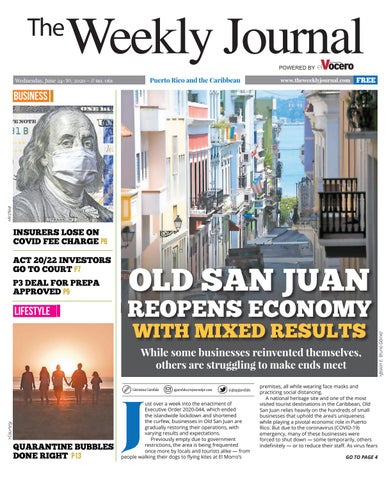
Old San Juan
Reopens Economy With Mixed Results While some businesses reinvented themselves, others are struggling to make ends meet
J
>Courtesy
Giovanna Garofalo
Quarantine Bubbles Done Right P13
ggarofalo@wjournalpr.com
@giopgarofalo
ust over a week into the enactment of Executive Order 2020-044, which ended the islandwide lockdown and shortened the curfew, businesses in Old San Juan are gradually restoring their operations, with varying results and expectations. Previously empty due to government restrictions, the area is being frequented once more by locals and tourists alike — from people walking their dogs to flying kites at El Morro’s
premises, all while wearing face masks and practicing social distancing. A national heritage site and one of the most visited tourist destinations in the Caribbean, Old San Juan relies heavily on the hundreds of small businesses that uphold the area’s uniqueness while playing a pivotal economic role in Puerto Rico. But due to the coronavirus (COVID-19) emergency, many of these businesses were forced to shut down — some temporarily, others indefinitely — or to reduce their staff. As virus fears GO TO PAGE 4
>Josian E. Bruno Gómez
Act 20/22 Investors Go To Court P7
The Weekly Journal > Wednesday, June 24, 2020 >
2
LOS NÚMEROS Y RESULTADOS
NO MIENTEN 80,000 TRABAJADORES DEL TURISMO DEFENDIENDO NUESTRO FUTURO: ¡ABOGAMOS POR DUPLICAR LA PROMOCIÓN DEL DESTINO AHORA! Discover Puerto Rico completó su primer año en 2019 y los resultados hablan por sí solos.
Acceso Aéreo
+12.5%
En San Juan se añadieron 5.4 millones de asientos, sumando un aumentó de +12.5% vs. 2018, récord en los últimos 5 años. Fuente: Aerostar (Ene-Dic 2019)
Turistas
+11%
Puerto Rico recibió 5.2 millones de pasajeros en 2019 (+11% vs. 2018), récord en los últimos 5 años. Fuente: Aerostar, Autoridad de Puertos (Ene-Dic 2019)
Alojamiento
+14%
La demanda total de alojamiento generada en 2019 fue $4.7 millones (+14% vs. 2018), récord en los últimos 5 años. Fuente: STR, AirDNA Incluye demanda generada por trabajadores de recuperación (p.ej. FEMA) (En-Dic 2019)
Gastos de visitantes
+17%
Los visitantes expuestos a la promoción de Discover PR gastaron un +17% más por noche en alojamiento que los no expuestos. Fuente: Arrivalist (Ene-Dic 2019)
Estadías más largas
+25%
Los visitantes expuestos a la promoción de Discover PR tuvieron una estadía 25% (+2.6 días) más larga que los no expuestos. Fuente: Arrivalist (Ene-Dic 2019)
Empleos en turismo
+8%
El turismo generó un aumento de 6,280 empleos (+8% vs. 2018). Fuente: STR, AirDNA (Ene-Dic 2019)
Inversión en promoción del destino menor que otros mercados
$25
$41
$40
$36
MILLONES
Aruba
Bahamas
MILLONES
$68 MILLONES
MILLONES
$93
$188 MILLONES
Hawaii
Florida
MILLONES
MILLONES
Puerto Rico
Caribe Promedio
República Dominicana
Beneficio para Puerto Rico
Por cada $1 invertido por Discover Puerto Rico, se generaron: $7 en ingresos al gobierno y $98 en impacto económico.
UNA INYECCIÓN DE $50 MILLONES A LA PROMOCIÓN DE NUESTRA IMAGEN GENERARÁ:
$350 MILLONES
En recaudos al gobierno
$4,900 MILLONES
en impacto económico para TODOS los puertorriqueños
¡NECESITAMOS DUPLICAR LA INVERSIÓN EN PROMOCIÓN YA!
#SinPromociónNoHayTuristas #SinTuristasNoHayTurismo
3
/ Wednesday, June 24, 2020
a week in review Delta, JetBlue Add More Flights to Puerto Rico, the Caribbean
>Archive
>Brandon Cruz González
As the U.S. continues to reopen after the COVID-19 lockdowns, Delta and JetBlue are adding more flights, including to Puerto Rico and the rest of the Caribbean, to boost air travel among popular summer destinations, such as San Juan and St. Thomas in the U.S. Virgin Islands. JetBlue is also resuming service to Aguadilla.
New Labor Secretary Confirmed With so many people jobless as a result of the COVID-19 crisis, the Labor Secretary’s job has become crucial. After the abrupt departure of Briseida Torres on June 9, the Puerto Rico Senate confirmed Carlos Rivera Santiago as the new Labor chief.
Powered BY El Vocero de Puerto Rico, 1064 Ave Ponce de León 2nd floor San Juan, PR Postal Address: PO Box 15074, San Juan, PR 00902
AES Makes Multimillion-Dollar Investment in Puerto Rico AES Puerto Rico, with a plant in Guayama, will invest $600 million to transform its energy system to begin producing renewable energy on the island. The company — which supplies 25 percent of the energy consumed in Puerto Rico — has a cogeneration contract with the P.R. Electric Power Authority until 2027.
President Salvador Hasbún shasbun@elvocero.com
Human Resources Director Arlene Rolón, PHR arolon@elvocero.com
Multi-Platform Digital Director Stephanie Gómez Álvarez sgomez@elvocero.com
Comptroller Félix A. Rosa frosa@elvocero.com
Traffic Director Ilia M. Pérez Centeno iperez@elvocero.com
Multi-Platform Graphic Director Héctor L. Vázquez hvazquez@elvocero.com
Production Director Eligio Dekony edekony@elvocero.com
Editorial Director Juan Miguel Muñiz Guzmán jmuniz@elvocero.com
Assistant Editor/ Reporter Rosario Fajardo rfajardo@wjournal.com
Phone: 787-622-2300, 787-721-2300 Customer Service: 787-622-7480
4
/ Wednesday, June 24, 2020
Businesses are reinforcing strict disinfection and social distancing protocols. >Brandon Cruz González
CONTINUED FROM PAGE 1 dwindle and Puerto Rico’s economy is opened, however, some of these have managed to reopen their doors and even reinvent their business models. Such was the case of La Factoría, a popular night life establishment on San Sebastián Street that has been repeatedly listed in The World’s 50 Best Bars. Its general manager, Carlos Irizarry, told THE WEEKLY JOURNAL that the initial news of an islandwide quarantine came as a shock. “The first thing we did was send everybody home to see what would happen during those first two weeks. We also took the measures to preserve all the fresh products that we had in many freezers spread throughout every corner,” he said, adding that one of the main challenges when planning to reopen was reconceptualizing La Factoría to open during the day. He decided to start serving coffee — after talking with barista friends for tips — and to design a new daylight cocktail menu. “Truth is, it was a ‘bad trip’ to be closed, but very refreshing to take that time to redefine who we are, analyze our strengths and develop them. We also have coffee offerings and a daytime clientele… And yeah, we had a lot of setbacks and obstacles, but after two, three weeks back in operation, I can say that the path is bright ahead,” Irizarry said. Likewise, Nelson Maldonado — general manager at Urban Tribe, a jewelry and clothing
store on La Fortaleza Street — affirmed that the reopening process has been relatively easy for businesses like his. As with La Factoría, Urban Tribe resumed its operations during the economic reactivation that preceded Executive Order 2020044. Before the government measures that placed the island under lockdown and curfew on March 15, Urban Tribe was shaping up to have one of its best years in sales. “January and February were very good.
It has been a challenging process, but if we overcame Maria, everything will be all right. — Carlos Irizarry, general manager at La Factoría
Everything was going along great and a lot of Americans and foreigners were supporting us… but then coronavirus ruined the party,” Maldonado said. Because he is the only employee at the store, he simply reopened as soon as he established the health and safety protocols outlined by the
Traditionally a nighttime hangout, La Factoría reinvented its business model and designed a new menu of daytime cocktails. >Courtesy of La Factoría
Occupational Safety and Health Administration (OSHA). Since then, he has managed to stay open and even make some sales, though he lamented reduced working hours and noticeably fewer sales. “This has been catastrophic. Do you know how many businesses still haven’t reopened? They
5
/ Wednesday, June 24, 2020
can open, but they don’t want to. I don’t know if it’s a good decision on their part; maybe they are waiting for more movement because operating a small business entails many expenses,” he added. Similarly, Irizarry detailed that La Factoría had to invest in installing multiple hand-sanitizer stations throughout the structure, and bought sanitation equipment, signs to reinforce social distancing and other items, including new menus. While La Factoría and even Urban Tribe can rely on locals for business, other establishments are taking a heavier blow because they depend largely on tourists. Agustina Estevez — co-owner of Family Superstore, a family-owned souvenir shop on San Francisco Street — just reopened last week after months of planning and ensuring that every single item was properly disinfected. “It has been very rough and really sad. It’s unfortunate because it’s a pandemic; not a storm that came and went. But this pandemic has impacted everyone emotionally, spiritually and economically… We are a family and we are here trying to see what will happen and if we can find new employees, which I doubt… But if tourists don’t come, who will we sell to?” Estevez said.
PPP Funds Help Retain Staff
Another issue that affected Estevez was her inability to solicit the Paycheck Protection Program (PPP) loans from the U.S. Small Business Administration (SBA). Unable to secure payroll for her employees, she had to lay off two of them during the lockdown. The PPP initiative, accessible at sba.gov, grants forgivable loans so that businesses can keep their workers employed during the COVID-19 crisis. By contrast, Irizarry’s request for PPP loans was approved and all 27 employees at La Factoría have managed to keep their jobs. “The accountant managed that. We have a big staff; we are 27 workers. That was really the first concern. We have all these people and no way to work. But at least on that aspect, we managed to assure them their salaries,” he stated, adding that, unlike other businesses interviewed for previous editions of this paper, La Factoría has already received this financial aid. Because of limited operations, these workers were assigned different time slots and tasks. For example, the doorman was initially tasked to cut and squeeze lemons. Meanwhile, Estevez affirmed that the local government should offer another economic stimulus package that specifically targets businesses that, like hers, have been unable to secure economic assistance.
Still Waiting for Unemployment Benefits
All interviewees affirmed that their workers and themselves had to apply for local unemployment benefits. Although Irizarry did not share any issues concerning this public assistance, both Maldonado and Estevez denounced that they have yet to receive any sort of compensation, despite meeting the requirements. “My boss did not request [the PPP]. We closed and I requested unemployment, which I am still waiting f or… I am generating an income, but I am working fewer hours, so it’s not like my income is the same as it used to be.
Urban Tribe General Manager Nelson Maldonado designs some of the jewelry sold at this store on La Fortaleza Street. >Giovanna Garofalo
I‘m just waiting for that unemployment check,” Maldonado said. For her part, Estevez urged all workers in similar positions to continue insisting on receiving their unemployment benefits. “Don’t stop insisting because that is a right that applied to everyone because everyone here works and if not, they don’t eat. So, work has stopped and [earning an income] is a human right,” she opined.
Different Outlooks Moving Forward
Regarding how Old San Juan businesses can move forward, the interviewees prioritized different aspects. Estevez, who owns a souvenir shop, stressed that tourism from outside Puerto Rico needs to be reinvigorated. She argued that the historic city is “dead” because of traveling fears caused by the pandemic, which is why she opined there should be an emphasis on assuring visitors that Puerto Rico has the virus contained. Maldonado, on the other hand, thinks that residents need to overcome their fears of COVID-19. Although he acknowledged the necessity of flattening the curve, he said that residents just need to adhere to guidelines from OSHA and the Centers for Disease Control
and Prevention (CDC), and other pertinent risk mitigation strategies. “There are people with irrational, paralyzing fear. So, you will never return to work? We will have to live with the virus; the virus is not going anywhere. The important thing is to take precautions and that’s it, because, yes, it is highly contagious, but it is barely deadly,” he argued. Irizarry did not downplay the threat of the virus, but affirmed that maintaining a curfew at this point is “excessive.” Previously from 7 p.m. to 5 a.m., the current curfew begins at 10 p.m. and ends at 5 a.m., closing down peak business hours for businesses such as La Factoría. “I believe that we should take the necessary precautions and we must be conscious. As in, it’s not just to eliminate the curfew and that’s it. We have to be conscious of which measures we will take to continue complying with health requirements and ensure employee and customer welfare. But yes, I think that a curfew is a little bit extreme and we can move forward to another phase,” Irizarry said. Regarding the road ahead, he commented, “it has been a challenging process, but if we overcame Maria, everything will be all right.”
6
/ Wednesday, June 24, 2020
A Normative Letter issued last week requires insurance providers to pay dentists’ “COVID fees” that are charged to patients, which starts at $35 per visit.
Insurers Must Assume ‘COVID Fee’ Dental Costs, But Warn of ‘Dangerous Precedent’ Dental Surgeons Association demands ‘greater responsibility’ from this sector
T Giovanna Garofalo
ggarofalo@wjournalpr.com
@giopgarofalo
he Puerto Rico House of Representatives has approved H.B. 2537 to ban commercial establishments from imposing a “COVID fee” to consumers to offset the investments incurred to reopen their businesses amid the coronavirus pandemic; insurance companies must now cover these costs for dental patients. As the Senate prepares to evaluate the bill, last week Deputy Insurance Commissioner Rafael Cestero issued Normative Letter CN-2020-279, indicating that health insurers must include the coverage code D1999 of the American Dental Association (ADA). Under this measure, dentists are allowed to include the COVID fee — which starts at $35 per visit — but insurers, not patients, must cover this expense. “The D1999 code must be invoiced by a dentist, under a current contract with an insurer or health services organization, accompanied by the dental procedures performed per day and that are part of the patient’s coverage, after their visit to the dental
office. The insurer or health service organization must establish and notify the participating dentists of the corresponding fee, which should not be less than $35.00 dollars per visit to the dental office,” the letter reads. Dr. David Kerr, president of the Puerto Rico Dental Surgeons Association (CDCPR by its Spanish initials), praised the decision, opining that dentists are the health professionals with the greatest risk of infection. He highlighted the expensive equipment and sanitation tools that this group had to purchase to continue their practices, including hospital surgical grade filters, N95 respirators for the entire staff and antiviral purifiers, among others. However, he affirmed that patients should not face additional charges and that insurers must assume a “greater responsibility” amid the COVID-19 crisis. “The money is available. Insurers have been receiving full payment of their business premiums and funds for their Medicaid [Vital] and Medicare [Advantage] programs during these months. However, the use of health services in all areas has been extremely limited or nonexistent and will continue to be so because patients will not attend medical appointments as frequently for fear of contagion. “The money to cover the D1999 service is in savings and the accumulation of premiums, which they have obtained in these months and the months to come,” Kerr argued, adding that, “Puerto Rico demands greater responsibility from
this sector.”
Insurers React
The president of the Insurance Companies Association (Acodese by its Spanish acronym), Iraelia Pernas, said that the entity has held talks with the Insurance Commissioner’s Office to refute the normative letter, arguing that all sectors have incurred coronavirus-related expenses and that dentists may solicit federal aid or loans. “We believe that it sets a dangerous precedent because if there is a differential for dentists, other sectors may also ask the same thing and the premiums that we charge our beneficiaries do not contemplate that expense,” Pernas told THE WEEKLY JOURNAL. “Besides, there are federal funds that dentists can ask for to subsidize any additional expenses they have had as a result of the pandemic. It is not a sector that has not been attended to.” Moreover, she noted that the D1999 code, as outlined by the ADA, specifies a fee of $10, which is $25 less than the starting point established by the Puerto Rico government. “There’s another argument… the fact that a procedure code exists doesn’t imply that an insurer has to cover it. There are procedural codes for all health services and not all services are covered. That said, as the situation elucidates and because there is that rule from the Commissioner’s Office, we will have to follow it for now,” Pernas said.
7
/ Wednesday, June 24, 2020
Acts 20/22 Investors Fire a Salvo Against the Puerto Rico Gov’t
‘Bad precedent’ could harm Puerto Rico’s investment climate
T Rosario Fajardo
rfajardo@wjournalpr.com
@RosarioWJournal
he 20/22 Act Society — the organization composed of investors who relocated to Puerto Rico under the Acts 20 and 22 tax decrees — has filed a lawsuit against the central government for allegedly breaching the agreements and contracts established when their respective decrees were signed. Robb Hill, founder of The 20/22 Act Society, argued that the entity recurred to legal action after holding several conversations with the government to solve “discrepancies.” He argued that there have been constant changes to the two laws, thus allegedly breaking the agreements that had prompted investors to come to Puerto Rico to live, open businesses and invest. “Given the constant modifications to Acts 20 and 22, which were changed in near totality and are now compiled in the new Act 60 of July 1, 2019, investors are compelled to stop the retroactive implementation, since their initial contracts are being violated. This may result in a bad precedent for investment on the island,” said Pedro Ortiz Álvarez, the legal representative of The 20/22 Act Society. This, in turn, could disrupt the investment climate in Puerto Rico, as new entrepreneurs and investors could perceive that doing business in Puerto Rico is not safe, he indicated in a statement. This is due to the constant changes to the laws made by the government, and this causes them [investors]to withdraw from investing on the island, he said. The Economic Development and Commerce Department (DDEC by its Spanish acronym), which oversees the Acts 20 and 22 programs, have been touting the success of the program. However, they declined to comment when THE WEEKLY
Many of the Act 22 beneficiaries live in Condado, Dorado and Old San Juan. >Josian E. Bruno Gómez
JOURNAL asked for a response to the lawsuit. “This is a legal process that is under consideration by the court and no comments on the matter will be issued,” said Maura Ríos Poll in an email. Act 20, or the Export Services Act, is focused on promoting the island as an export business hub. The law provides incentives to companies that export services, such as a 4 percent corporate tax rate, and 100 percent tax exemption on dividends from business earnings derived from export services. Act 22, or the Act to Promote the Relocation of Individual Investors to Puerto Rico, is focused on promoting wealthy individuals to move to the island, and provides a 100 percent tax exemption on all interest, dividends and long-term capital gains. Under both laws, more than 4,050 decrees have been issued, as of November 2019, according to government figures. Several changes were made over the years to Acts 20 and 22. As part of Act 60, those already included in Acts 20 and 22 fell under a grandfather clause that exclude from certain effects and restrictions of the new law. Investors were also given until Dec. 31, 2019 to apply under Acts 20 and 22, Ortiz Álvarez said.
Regardless, he denounced the retroactive changes. For example, he stated that the administrative fee was originally $300 but it is now $5,000, with the understanding that the additional $4,700 will be destined to the Puerto Rico General Fund. “A decree is a contract and its impairment raises a serious constitutional question. The Society and its members have no problem with possible changes in the law if they are applied only to new applicants. In this way, new investors will know in advance the amount that they will have to pay. Although an increase of such magnitude could be considered poor public policy, this is not being questioned in the lawsuit,” Ortiz Álvarez said. As previously reported by THE WEEKLY JOURNAL, a study by Estudios Técnicos, which was commissioned by DDEC, has portrayed the success of the two initiatives. As of November 2019, the 1,680 decrees granted by DDEC since 2015 for Act 20 companies have generated 8,257 direct jobs on eligible activities and 8,435 in non-eligible activities, for a total of 16,693 direct jobs created. The average salary of these jobs is $35,644 a year. The study estimated that total jobs, direct and indirect, generated by Act 20 companies is 36,222 across the island.
8
/ Wednesday, June 24, 2020
The Nuts and Bolts of Puerto Rico’s FY 2021 Budget
Full of promises to the public sector
G
The Weekly Journal Staff
ov. Wanda Vázquez has unveiled a budget that is similar to the one presented by the Financial Oversight and Management Board (FOMB), the federal entity that oversees the government’s finances. Her budget contains an additional $169 million in spending compared with the FOMB’s $10 billion budget. The additional funds in the government’s budget include money for the Christmas bonus for public sector workers, $15 million to the State Elections Commission and an assignment of $7.5 million for salaries to cover staff at the public WIPR television station. “We will identify the savings so that public workers receive their Christmas bonus,” she said. During her State of the Commonwealth speech before lawmakers, Vázquez also promised wage pandemic. Altogether, these events have caused increases for teachers, police officers, firefighters losses estimated at billions of dollars amid a more and other public workers. than decadelong recession and a bankruptcy-like This was first budget submitted by Vázquez process to restructure a portion of the island’s since the island’s Supreme Court authorized her more than $120 billion public debt and unfunded to lead the U.S. territory last August after former liabilities. Gov. Ricardo Rosselló stepped down amid huge “Rest assured that regardless protests. The unelected Vázquez of where it comes from and no is now seeking to be elected to matter the cost, I will not waver in the governorship in her own right. the fight against corruption,” she Before beginning the annual said. budget address, Vázquez asked Further, Vázquez announced for a minute of silence for those Among other a $314 million increase in the who have died of COVID-19. To promises to the health budget, a $176 million date, the island of 3.2 million public sector, Gov. increase in the education budget residents has reported around Wanda Vázquez and a $285 million increase in 1,540 confirmed coronarivus promised wage the public safety budget. She did cases, with at least 149 deaths. increases for not specify where the additional The governor’s speech teachers, police funds would come from. contained multiple promises of officers, firefighters She also promised to scrap incentives and spending increases and other public an increase in the enrollment that critics said were moot, given workers. fee at the University of Puerto the island’s economic crisis and Rico, the island’s biggest public the Oversight Board’s power over university and award the school Puerto Rico. an additional $55 million to Saying that her hands are offset pandemic losses. She said the government “clean,” Vázquez also vowed to fight corruption would distribute computers to all public school as the U.S. territory awaits millions of dollars in students and teachers by July and give $1,000 to federal funds while struggling to recover from any public and private school student enrolled Hurricane Maria in Sept. 2017, a string of strong in a postsecondary institution so they can buy earthquakes in January and the coronavirus
In fact,
Gov. Wanda Vazquez >Josian E. Bruno Gómez
technological equipment. Other promises include subsidies of up to $150 per farmer, the construction of 300 to 400 housing units a month to help those affected by hurricanes and earthquakes, and $350 million to help subsidize home purchases, with priority given to such workers as police, nurses and firefighters. In addition, Vázquez rejected government pension cuts sought by the Oversight Board. Critics expressed surprise at the numerous pledges, saying the address felt more like a political campaign. They noted Vázquez is running for governor this year and will face Pedro Pierluisi, a seasoned politician, in an Aug. 9 primary of the pro-statehood New Progressive Party. Puerto Rico Sen. Eduardo Bhatia, a member of the opposition pro-commonwealth Popular Democratic Party who is also running for governor, accused Vázquez of not addressing many of the problems facing the island, including the tens of thousands of people still seeking unemployment assistance following a two-month coronavirus lockdown and awaiting new housing following the 2017 hurricanes and earthquakes. Thomas Rivera Schatz, president of Puerto Rico’s Senate and a leading member of the governor’s party, defended her budget. The budget has to be approved by July 1, when the new fiscal year begins. — The Associated Press contributed to this story.
9
/ Wednesday, June 24, 2020
>Courtesy
P3 Approved for Prepa’s Transmission & Distribution System Consortium of Canadian and U.S. firms nabs $1.5 billion contract
P
The Weekly Journal Staff
uerto Rico government officials announced earlier this week that a consortium of Canadian and U.S. firms will take over the transmission and distribution system of the P.R. Electric Power Authority (Prepa) in a longawaited announcement involving one of the largest public utilities in a U.S. jurisdiction. The deal marks the first time those operations will be privately managed since Prepa was founded in 1941 and became a public utility in 1979, raising hopes that a company long accused of corruption, mismanagement and inefficiency could be reformed and modernized, leading to fewer outages and improved service. “You have a titanic challenge before you,” said Omar Marrero, executive director of Puerto Rico’s Fiscal Agency and Financial Advisory Authority. The message was directed to LUMA, a consortium made up of Canadian firm ATCO and U.S.-based companies Quanta Services Inc. and IEM. It was awarded a $1.5 billion contract for 15 years that will allow the island’s power company to retain ownership of the transmission and distribution system as part of a public-private partnership (P3), the third for Puerto Rico in recent years. “We understand the significance of this
announcement,” said Wayne Stensby, LUMA’s president and CEO, who promised to deliver a modern, affordable and reliable system. “This is not our first rodeo.” The company will initially be paid $70 million followed by $90 million the second year and $100 million the third year as part of a contract approved by the Financial Oversight and Management Board (FOMB), which oversees Puerto Rico’s finances. LUMA will receive $105 million for each of the remaining years, with a possible $20 million total in bonuses. The contract does not call for an increase in rates, which will still require approval by Puerto Rico’s Energy Commission, said Fermín Fontanés, executive director of Puerto Rico’s Public-Private Partnerships Authority. For its part, the FOMB gave its “conditional approval” of the deal, subject to the approval of the Puerto Rico governor. LUMA was chosen over Duke Energy and PSEG Services. Aside from transmission and distribution, LUMA also will be responsible for areas including billing and collection, capital improvements and human resources.
Prepa’s Recent History
The public utility serves 1.47 million clients across the island and reports $3.5 billion in customer revenues. However, multiple problems including a lack of maintenance has led to an average of 4.5 interruptions a year for clients, compared with an industry average of 0.98 interruptions. In addition, customers see an average outage time of more than 12 hours a year, compared with a baseline of less than two hours, Fontanés said. In addition, the power company’s infrastructure is three times older
than the industry average. Fontanés acknowledged that many customers see much higher numbers than the averages he presented, especially after Hurricane Maria struck the island in September 2017 as a highend Category 4 storm and shredded the power grid. It took 11 months for the last customers to be reconnected after the storm, outages remain common and reconstruction has yet to start. But problems began even before the storm struck, with an islandwide power outage occurring in September 2016. Fontanés said the P3 will allow Puerto Rico’s government to keep receiving federal funds as it rebuilds from hurricanes Irma and Maria. The announcement came two years after former Gov. Ricardo Rosselló signed a bill that in part allows the government to create public-private partnerships for the transmission and distribution of power. Officials said the deal will help generate money needed for infrastructure projects the government cannot afford amid a deep economic crisis as it restructures a portion of its estimated $120 billion in public debt and unfunded liabilities. Prepa has one of the highest debts of any Puerto Rico government agency at more than $9 billion, leading it to declare bankruptcy in 2017. It is still undergoing a restructuring process. The privatization of the operations of the transmission and distribution system is expected to take up to a year, with LUMA pledging it can reduce annual system energy costs by $150 million. Government officials said Prepa workers will receive priority and that none will be laid off. Puerto Rico’s two other public-private partnerships involve its main international airport in San Juan and its highway tolls.
10
/ Wednesday, June 24, 2020
As a once in a generation federal funding opportunity continues to flow and adequate planning becomes an increasingly important part of Puerto Rico’s redevelopment, a Smart City approach will help optimize infrastructure, mobility, public services and utilities. But what is a Smart City? A Smart City is a framework of mostly Information and Communication Technologies (ICP), that is used to help citizen welfare through development, organization, implementation and data sharing to improve the quality of government services and promote sustainable development practices to address growing urbanization challenges. The concept focuses mainly on several investment targets and addresses the changing role of government from enforcer to enabler. This disruption aims to shift the focus toward citizen participation and civic innovation. The intent is for citizens to engage with all city ecosystems and infrastructure directly- via smartphones, connected vehicles and homes- to reduce costs, improve efficiencies and overall services. Communities will also be able to streamline trash collection, decrease traffic congestion, detect free parking
spaces, efficiently light streets, potentially improve air quality, energy distribution and provide open data. This is done using Cloud-basedInternet of Things (IoT) applications to manage, analyze and receive data in real time, through an intelligent network of connected objects and machines that transmit data using wireless technology. To efficiently invest in a Smart City concept and successfully implement this vision, there are several target areas that need to be attended to. These include the modernization of the existing infrastructure, forward-thinking public policy and implementation, having a clear list of short term project needs, developing business incentives for all to adopt new technologies, improve efficiencies and cyber security standards, develop sustainability strategies and develop strategic partnerships. As we continue to take advantage of all the federal programs available and invest in the future of our cities, it is crucial to consider and implement efficient mechanisms that can enable us to develop our urban centers to be flexible. Smart cities are one of those strategies that should be considered.
penalty for U.S. companies operating in low taxed foreign jurisdictions by taxing global intangible income. CPA Without GILTI, this income would not be subject to U.S. taxes. Section 936 on the other hand provided a significant tax credit on otherwise U.S. source income generated by a U.S. company and subject to U.S. taxes. Both tax provisions provide credits, in different ways. GILTI rules penalize a manufacturer in Puerto Rico by treating the island as a nation that will secure the evolution ormer U.S. Secretary foreign jurisdiction, whereas Section of our nation and ensure our ability of State Colin Powell 936 provided an incentive. The GILTI and agility in protecting ourselves said, “Good leaders rules do not apply to manufacturers delegate and empower from situations such as COVID-19 operating in other states. S 3940 and while we move our society forward. others liberally, but HR 6648 are not another Section 936, Here, in Puerto Rico, the “details” they pay attention to plain and simple. are the legislation of manufacturing details, every day.” A The Plaskett/Wicker bills aim to leader who served as the top military incentives to ensure that companies move drug manufacturing back to officer in the nation and then the top see us as a site for potential the U.S. by establishing an ideal diplomat, recognized the importance investment. environment for the development of Recently, U.S. Sen. Roger Wicker of details in the formation of the big innovative drugs. introduced S 3940, a companion picture. On the other hand, HR 6443, a bill bill to U.S. Rep. Stacey Plaskett’s bill The big picture right now is the introduced by Resident Commissioner HR 6648, to foster manufacturing U.S. economy. The big picture is the Jenniffer González provides tax credits operations in U.S. territories. Both nation’s capacity and preparedness in economically distressed zones. It bills would exempt manufacturers in the face of situations such as sounds like a productive bill, but in COVID-19. The big picture is the from the GILTI rules, providing a reality, it would do very little to attract political and social transformation that beneficial structure that would is occurring in the country right now. incentivize companies to manufacture the manufacturers of innovative drugs that invest significant amounts The “details” are the small policy in U.S. territories. in research. That research turns into changes that will occur across the GILTI rules currently impose a
an intangible asset, the formula that is patented to market leading drugs. Without an incentive that allows that manufacturer to conduct that type of manufacturing on the island without being impacted by unsustainable costs, the math just doesn’t add up. The investment to produce a drug is much larger than the bill considers and is also not sufficiently beneficial to generics manufacturers that are already operating efficiently around the world and do not have a need to relocate operations. It would be policy blind, socially insensitive and economy foolish to fail to look at this legislation through anything other than the lens of current events throughout the nation. In a moment when the United States is fighting a pandemic and millions of minorities are standing up to systemic discrimination, it’s clear that there is something happening here — in the words of Bob Dylan “the times, they’re a changing.” As someone who has always favored statehood, it seems untimely and insensitive to continue to use the Anti-Statehood Boogie Man in the face of all of this.
Ricardo Álvarez-Díaz Licensed Architect and Entrepreneur www.advfirm.com
A
Investing in Smart Cities
s Puerto Rico continues to slowly reopen its doors during the COVID-19 pandemic, we need to focus all our efforts toward an effective, sustainable and rapid economic recovery. Taking advantage of the federal programs available for safe and resilient reconstruction of our urban centers, is one of them. To have a long-term successful plan, as part of the reconstruction efforts in our cities, we need to also focus attention on how they operate. Construction takes a finite amount of time, while operation and management do not. This makes it a much more important, often
forgotten, element of the successful life cycle of a city. However, one cannot operate or successfully manage a city without data. One of the biggest challenges that we have encountered during these trying times, has been the lack of both; reliable data available and adequate systems in place to better manage these adverse situations. Developing a comprehensive Smart City approach will eliminate the traditional “putting out fires approach,” which is not an efficient or effective way to prepare ourselves for any strain in our existing city operational structures. The idea of a Smart City holistic framework will help with all the operational city and urbanization challenges that we continue to face.
Teresita Fuentes
F
The Big Picture, the Details and the Times
www.advfirm.com
11
THE MASTER CLASS 30 de julio de 2020
9:00 am. - 12:00 pm. Master Class DIGITAL
Evento único en su clase, desde estudio de televisión, en alta definición. Distinto a todo lo que has visto en esta cuarentena-pandemia.
RECURSOS: Lcdo. Jorge Pizarro García Lcdo. Reynaldo Quintana Latorre Lcdo. Víctor Rivera Hernández Wanda Piña Ramírez, CCC Lcdo. Yldefonso López Morales 100% fondos a beneficio de
INVERSIÓN: $99 (más IVU) Incluye acceso a la plataforma virtual y materiales de las presentaciones.
TEMAS: • Se agotaron las licencias locales y bajo el FFCRA: obligaciones, alternativas y controversias legales • ¿Qué dicen las agencias especializadas? • Gerenciando personal a distancia: el nuevo desafío post pandémico • La venganza del COVID – 19: nueva realidad, controversias noveles y litigios creativos • Reinstalación post-cesantía: ¿son empleados nuevos bajo la Ley 4? • Derechos de la mujer trabajadora tras la pandemia • Impacto del Código Civil en el mundo del trabajo Política de cancelación: No se aceptarán cancelaciones.
REGISTRO: 787 287 6161 /conversatorioescape@gmail.com
<The Weekly Journal > Wednesday, June 24, 2020
2020
12
/ Wednesday, June 24, 2020
What to Expect if You go to the ER in the Midst of COVID-19
Doctors: Do not avoid needed emergency care
C
Hallee Patterson
oncerns about catching the novel coronavirus (Covid-19) have encouraged people to social distance, frequently wash and sanitize their hands and wear masks in public. However, fears of contagion could be dangerous to our health if these concerns drive ailing people away from hospitals. The American College of Emergency Physicians emphasizes that you should not let concerns of COVID-19 stop you from getting medical care if you are experiencing chest pains or other serious symptoms. Dr. Manny Colón is an Emergency Room doctor with a concierge practice in Santurce. THE WEEKLY JOURNAL (TWJ) contacted him about the situation in Puerto Rico’s ERs and had a quick Q&A session. TWJ: “Doctor, emergencies are not planned. What should patients bring with them to the ER?” Answer: “If you need to go to the ER and anticipate staying, be sure to bring warm clothes, blankets and a pillow. Bring medical reports and a list of medications.“ TWJ: “How many hospitals does Puerto Rico have? How do you know which one to go to?” Answer: “According to the P.R. Hospital Association, there are around 70 hospitals, including several physical rehabilitation and psychiatric hospitals. The only trauma center in Puerto Rico is Centro Médico. There are a few hospitals that specialize in cardiovascular emergencies and stroke. There are fewer than 100 board-certified emergency physicians on the island, with most in the San Juan and Ponce regions. Most ERs are staffed by general practitioners.” TWJ: “ I know to call 911 for an ambulance. Are the ambulances public or private?” Answer: “Yes, the number to dial for an emergency is 9-1-1. The number of ambulances
>Carlos Rivera Giusti
>Josian E. Bruno Gómez
are limited. There are state, municipal and private ambulance services. Municipal ambulances stay within their region. The state EMS [Emergency Medical Services] system often subcontracts some of the private ambulances.” TWJ: “Other than hospitals, are there any other kind of health facilities? Answer: “There are Diagnostic and Treatment Centers and a few ambulatory centers can take care of minor lacerations and upper respiratory infections, but these usually have limited hours of operation and variable access to labs, X-rays, ultrasound or CT [scans]. These are staffed mostly by general practitioners, not by ER doctors. There are a few concierge medical services on the island for those who want to skip the long waits or want the convenience of at-home care. Some of these services require membership and might not accept health insurance.” TWJ: “When you are admitted to an Emergency Room do you wait with possible COVID patients?” Answer: “All ERs have taken precautions to isolate patients with suspected COVID-19. These measures include adding negative pressure rooms, designated COVID rooms, and increased distance between patients. There is no way to
identify 100 percent of the people with COVID, so it is possible you may sit in the waiting room or on a stretcher next to a COVID patient (before he/ she is identified). You and others with you may be screened outside, have your temperatures taken, and provided with hand sanitizer. You will be required to wear a mask. They may allow one family member with the patient and limit the movement in and out of the ER.” TWJ: “Are people with cardiac problems avoiding going to the hospital?” Answer: “All hospitals experienced a significant drop in patients during the pandemic. This includes patients with diabetes complications, strokes, heart attacks, etc. We believe some of these patients stayed at home despite their symptoms due to fear of being exposed to COVID-19. As the curfew has been relaxed, we have seen a significant number of very ill patients coming in. A large percentage of them need admission to the hospital. Some of these admissions might have been prevented had they come in earlier.” TWJ: “Are the hospitals updating safety procedures?” Answer: “I cannot speak for all hospitals but in the hospital where I work, yes!” According to the AARP, some of the safety measures that hospitals are taken to prevent coronavirus contagion include buildings walls, erecting tents and creating isolation wards. Hospitals are also conducting pre-screening of patients upon arrival.
/ Wednesday, June 24, 2020
13
Quarantine Bubbles — When Done Right — Limit Coronavirus Risk
Also help fight loneliness
A
Melissa Hawkins, American University
fter three months of lockdowns, many people in the U.S. and around the world are turning to quarantine bubbles, pandemic pods or quaranteams in an effort to balance the risks of the pandemic with the emotional and social needs of life. When done carefully, the research shows that quarantine bubbles can effectively limit the risk of contracting SARS-CoV-2 while allowing people to have much needed social interactions with their friends and family.
Reduce risk if you can’t eliminate it
A quaranteam is a small group of people who form their own social circle to quarantine together — and a perfect example of a harm reduction strategy. Harm reduction is a pragmatic public health concept that explicitly acknowledges that all risk cannot be eliminated, so it encourages the reduction of risk. Harm reduction approaches also take into consideration the intersection of biological, psychological and social factors that influence both health and behavior. Quarantine bubbles are a way to limit the risk of getting or transmitting SARS-CoV-2 while expanding social interaction.
Mental health matters too
Staying indoors, avoiding all contact with friends
or family and having food and groceries delivered would be the best way to limit your risk of catching SARS-CoV-2. But the risks of the pandemic extend beyond the harm from infection. Health encompasses mental as well as physical well-being. The negative mental health impacts of the pandemic are already starting to become evident. A recent survey of U.S. adults found that 13.6% reported symptoms of serious psychological distress, up from 3.9% in 2018. A quarter of people 18 to 29 years old reported serious psychological distress, the highest levels of all ages groups. Many people are experiencing anxiety and depression due to the pandemic or were already living with these challenges. Loneliness certainly doesn’t help. Loneliness and social isolation increase the risk for depression and anxiety and can also lead to increases in the risk for serious physical diseases like coronary heart disease, stroke and premature death. Quaranteams, therefore, are not simply a convenient idea because they let people see their friends and family. Isolation poses serious health risks — both physically and mentally — that social bubbles can help alleviate while improving social well-being and quality of life.
How to build a quarantine bubble
To make an effective quaranteam, here’s what you need to do. First, everyone must agree to follow the rules and be honest and open about their actions. Individual behavior can put the whole team at risk and the foundation of a quaranteam is trust. Teams should also talk in advance about what to do if someone breaks the rules or is exposed to an infected person. If someone starts to show
symptoms, everyone should agree to self-isolate for 14 days. Second, everyone must decide how much risk is acceptable and establish rules that reflect this decision. For example, some people might feel OK about having a close family member visit but others may not. Our family has agreed that we only visit with friends outside, not inside, and that everyone must wear masks at all times. Finally, people need to actually follow the rules, comply with physical distancing outside of the quaranteam and be forthcoming if they think they may have been exposed. Additionally, communication should be ongoing and dynamic. The realities of the pandemic are changing at a rapid pace and what may be OK one day might be too risky for some the next. One of the greatest difficulties facing both scientists and the public alike is the uncertainty about this virus and what lies ahead. But some things are known. If individuals are informed and sincere in their quaranteam efforts and follow the regular guidance of social distancing, mask wearing and enthusiastic hand-washing, quaranteams can offer a robust and structured middle ground approach to manage risk while experiencing the joy and benefits of friends and family. These are things we could all benefit from these days, and for now, quaranteams may be the best step forward as we emerge from this pandemic together. This article is republished from The Conversation under a Creative Commons license.
14
/ Wednesday, June 24, 2020
The Benefits of the
MINDDiet Helps to reduce the risk of Alzheimer’s disease
A healthy salad with bulgur, avocado, spinach and cherry tomatoes >Courtesy
N
Sandra Ortiz, Licensed Nutritionist and Dietitian
o one wants to be diagnosed with Alzheimer’s disease. The medical community defines Alzheimer’s as a disease that causes significant cognitive impairment and is characterized by memory loss, language disorders, loss of a sense of orientation, and difficulties in planning tasks or problem solving. Sadly, there is no cure for this devastating disease. But there is good news: researchers around the world have identified factors that could help keep the brain stay healthy and reduce the risk of Alzheimer’s. There are two nutrition styles, used as the basis for a hybrid diet, to preserve the brain’s health. They are the DASH and Mediterranean diets. The former is well known for its success on treating hypertension, and the latter is an excellent option for maintaining good cardiovascular health. The hybrid of both diets is known as MIND, the acronym for Mediterranean-DASH Intervention for Neurodegenerative Delay, with a focus on eating more food of plant origin and limiting the consumption of red meat, saturated fat and sweets. Various investigations have revealed that the MIND diet could reduce the risk of developing Alzheimer’s by up to 53 percent, as well as delaying cognitive decline and improving verbal memory. Another important fact is that studies have shown that older adults whose diet was similar to the MIND plan showed the brain function of those seven-anda-half years younger than themselves, resulting in significant benefits. To find out if your regular diet is near or far from the MIND plan, answer the questions elaborated
below. Award one (1) point for each of the “yes” answers that respond to 100 percent of your daily diet routine, up to a maximum of 15 points. In other words, if your answer is not 100 percent “yes,” you cannot give yourself that one (1) point and instead, your score for that question would be zero (0). Adults who have participated in the studies, and whose results were closer to 15 (which means they are closer to the MIND diet, with an average score of 9.6 points out of 15) had the greatest decrease in the risk of Alzheimer’s. Adults who obtained an intermediate score of 7.5 also reduced their risk by more than one-third. You can add health benefits, not just for your brain but also your body, by making just one or two changes at a time to your eating routine, until you can adopt all the MIND recommendations. Answer the following questions to find out how near or far you are from the MIND diet: • Do you consume at least three servings of whole grain cereal daily? • Are green leafy vegetables part of your diet, at
least six times a week? • Do you incorporate berries into your diet, at least twice a week? • Do you eat red meat less than four times a week? • Do you eat fish, at least once a week? • Do you eat other vegetables once a day? • Do you include poultry in your diet, at least twice a week? • Do you eat grains more than three times a week? • Are nuts present in your diet, at least five times a week? • Is fried or fast food part of your diet, but no more than once a week? • Do you use olive oil for cooking or as a dressing? • Do you consume less than a tablespoon of butter or margarine per day? • Do you eat less than one serving of cheese a week? • Do you include no more than five pastry desserts in your weekly diet? • Do you have no more than one glass of wine or another alcoholic drink a day?
Eating certain foods (and avoiding others) has been shown to slow brain aging by 7.5 years, and lessen the chances of developing Alzheimer’s disease. Born as a hybrid of two existing eating styles with decades of research at their backs — the DASH diet and Mediterranean diet — university researchers developed the MIND diet to emphasize foods that impact brain health. — The Mayo Clinic
15
/ Wednesday, June 24, 2020
May 2020 Tied for Hottest on Record on the Planet
Hottest temperature recorded in San Juan
A
lthough nature received a respite from human activity during the recent worldwide lockdowns due to the COVID-19 pandemic, climate change — as many scientists believe — continues to fuel rising temperatures across the globe. According to the local National Weather Service (NWS) office, a new maximum temperature record of 95 degrees Fahrenheit (F) in San Juan was reached on May 24. The NWS said this broke the record of 93 degrees F that was reached for the same day in 2017. In fact, after registering unusually high temperatures across the globe, May 2020 tied with 2016 as the world’s warmest May on record, according to scientists at the National Oceanic and Atmospheric Administration (NOAA). The Caribbean region, meanwhile, recorded the second-warmest May on record. The heat wasn’t just limited to May. The threemonth season (March through May) and the year to date (January through May) ranked as the second-warmest in the 141-year global record. A closer look into NOAA’s latest monthly global climate report shows that: The average global temperature in May was 1.71 degrees F above the 20th-century average, tying with May 2016 as the hottest May on record. For the Northern Hemisphere, it was the hottest May recorded, with a temperature of 2.14 degrees F above average. The average global temperature for the season spanning March through May was 1.91 degrees F above average, making it the second hottest such period on record behind 2016. The Northern Hemisphere had its 2nd-warmest spring, and the Southern Hemisphere had its 3rd-warmest autumn on record. The period from January through May 2020 was
>Courtesy
The Weekly Journal Staff
also the second hottest on record after 2016, with a global temperature of 1.98 degrees F above the 20th-century average of 55.5 degrees F. The record temperatures occurred despite the worldwide economy being virtually shut down since mid-March due to the coronavirus crisis.
Warnings from scientists
Scientists continue to give dire warnings about climate change and a warming planet. A recent study warns that if humans go on burning ever more fossil fuels to put ever higher concentrations of greenhouse gases into the atmosphere, then one-third of the world’s population may face — within 50 years — heat levels that could be all but intolerable. By 2070, 19 percent of the land area of the planet, home to 3.5 billion people, could be faced with a mean annual temperature of 84 degrees F, according to the study published in the Proceedings of the National Academy of Sciences. That is, although there would be seasons in which temperatures fell well below this average, these would be followed by summers in which the thermometer went much higher. Right now, only 0.8 percent of the land surface of the planet experiences such a mean annual temperature, and most of this space is located in the Saharan desert region of North Africa. But population growth — already highest in the
Our computations show that each degree of warming above present levels corresponds to roughly one billion people falling outside of the [preferred] climate niche. — Climate News Network
poorest and hottest parts of the globe — and the projected increases in planetary average temperatures will expand this danger zone to almost one fifth of the planet’s land area, to embrace a third of the world’s people. The authors emphasized that these projections can change depending on humanity’s actions now. According to Chi Xu of Nanjing University in China, who co-authored the study, altering the choices that humanity makes over the course of the halfcentury, especially in terms of reducing carbon dioxide emissions, will be crucial to reduce the number of people who will live in extreme heat conditions.
SUMMER EN CAMP CASA
Este verano el mejor campamento es en casa. Disfruta de aventuras y el mejor entretenimiento junto a toda tu familia.
•SIN PENALIDADES •SIN COMPROMISO •SIN CONTRATO ¡Suscríbete hoy! 787.355.6565
libertypr.com
* Ciertas restricciones aplican. Ofertas válidas hasta el 31 de julio de 2020. La oferta de Internet de 20Mbps (hasta 20 Mbps download/hasta 2Mbps upload) por $41.99, 70 megas (hasta 70Mbps download/hasta 7Mbps upload) por $56.99 y 200Mbps (hasta 200Mbps download/hasta 20Mbps upload) por $78.99, incluyen modem Wi-Fi. La oferta de Internet de 20Mbps (hasta 20Mbps download/hasta 2Mbps upload) con telefonía ilimitada a PR y EE.UU. por $46.99, el Internet de 70 megas (hasta 70Mbps download/hasta 7Mbps upload) con telefonía ilimitada a PR y EE.UU. por $61.99 y el Internet de 200 megas (hasta 200Mbps download/hasta 20Mbps upload) con telefonía ilimitada por $78.99. Estas incluyen modem Wi-Fi. Las ofertas de Español de Primera TV con Internet de 70Mbps (hasta 70Mbps download/hasta 7Mbps upload) con caja HD por $77.99, UPICK TV con Internet de 70Mbps (hasta 70Mbps download/hasta 7Mbps upload) con caja HD por $90.99, Ultimate TV con Internet de 70Mbps (hasta 70Mbps download/hasta 7Mbps upload) con caja HD por $118.99. La oferta de Español de Primera TV con Internet de 200Mbps (hasta 200Mbps download/hasta 20Mbps upload) HD por $82.99, UPICK TV con Internet de 200Mbps (hasta 200Mbps download/hasta 20Mbps upload) por $95.99 y Ultimate TV con Internet de 200Mbps (hasta 200Mbps download/hasta 20Mbps upload) por $124.99, incluyen caja HD, modem Wi-Fi y llamadas ilimitadas a P.R. y EE.UU. Por factores externos, la velocidad real de Internet puede variar. Para más información puede visitar nuestra página web https://libertypr.com/internet. Cargos por mal uso/uso abusivo podrían aplicar. Tarifas y servicios aplican a clientes residenciales, solamente donde haya facilidades. Costo de instalación y depósito varía dependiendo del índice de crédito. Instalación estándar se define como 140” del tap de la residencia en donde existan facilidades. Instalación de servicio de tv adicionales conlleva un cargo de $9.99c/u. Liberty se reserva el derecho a negar o terminar los servicios a cualquier cliente que viole las políticas de la compañía o el contrato de servicio residencial. La facturación por correo conlleva un cargo de $3.00 mensuales. Liberty ofrece la opción de facturación electrónica E-Bill, la cual no conlleva cargo alguno. Para acogerse a E-Bill debe registrarse en mi.libertypr.com. Tarifas no incluyen impuestos ni cargos gubernamentales cuyo cómputo podría variar sin previa notificación. Oferta de Showtime gratis válida solo por 3 meses. Luego de 3 meses se cobrará mensualidad regular de $6.99. De no querer el servicio de Showtime, el cliente deberá llamar para cancelarlo al 787.355.3535. Otras restricciones podrían aplicar.
#LibertySummerCamp #DisfrutaEnCasa