Wednesday, June 5-11, 2019 - // no. 006
Puerto Rico and the Caribbean
www.theweeklyjournal.com
GOV’T SEEKS MORE URBAN TRAIN RIDERS P6 PROMOTING THE SALE OF ABANDONED PROPERTIES P10 INCREASE ON PAYDAY LOANS P15
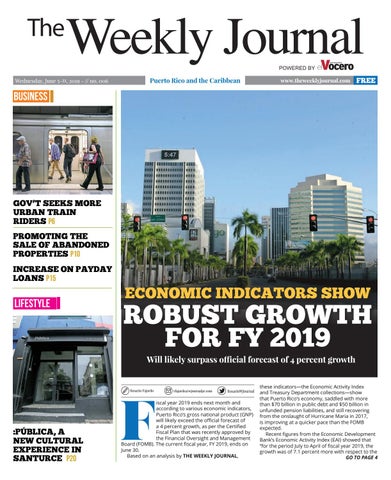
ECONOMIC INDICATORS SHOW
ROBUST GROWTH FOR FY 2019 Will likely surpass official forecast of 4 percent growth
F Rosario Fajardo
:PÚBLICA, A NEW CULTURAL EXPERIENCE IN SANTURCE P20
rfajardo@wjournalpr.com
RosarioWJournal
iscal year 2019 ends next month and according to various economic indicators, Puerto Rico’s gross national product (GNP) will likely exceed the official forecast of a 4 percent growth, as per the Certified Fiscal Plan that was recently approved by the Financial Oversight and Management Board (FOMB). The current fiscal year, FY 2019, ends on June 30. Based on an analysis by THE WEEKLY JOURNAL,
these indicators—the Economic Activity Index and Treasury Department collections—show that Puerto Rico’s economy, saddled with more than $70 billion in public debt and $50 billion in unfunded pension liabilities, and still recovering from the onslaught of Hurricane Maria in 2017, is improving at a quicker pace than the FOMB expected. Recent figures from the Economic Development Bank’s Economic Activity Index (EAI) showed that “for the period July to April of fiscal year 2019, the growth was of 7.1 percent more with respect to the GO TO PAGE 4
The Weekly Journal > Wednesday, June 5, 2019 > 2
3
/ Wednesday, June 5, 2019
A WEEK IN REVIEW RETIRED EMPLOYEES SEEK NEGOTIATION WITH THE OVERSIGHT BOARD The Official Committee of Retired Employees of the Government of Puerto Rico has been involved in negotiations with the Financial Oversight and Management Board (FOMB) in an attempt to determine how retiree benefits will be handled under Puerto Rico’s Plan of Adjustment. The Committee was authorized and appointed by the United States Trustee to represent the collective interests of over 167,000 public retirees from the Employees Retirement System, the Teachers’ Retirement System and the Judiciary Retirement System in Puerto Rico. “We believe that it is in the best interest of all pensioners that we engage in negotiations with the FOMB so that our needs are met. Not negotiating merely benefits other creditor groups that are willing to negotiate with the FOMB,’’said the Committee. According to a letter sent to the retirees, the Committee is quite close to reaching an agreement with the FOMB that would provide significant protection to retiree pensions. >Archive
OVERSIGHT BOARD REFERS ENTITIES TO DEPARTMENT OF JUSTICE José Carrión, president of the Financial Oversight and Management Board for Puerto Rico (FOMB), referred three government entities and 11 municipalities to the Puerto Rico and U.S. Justice Departments for failure to transfer withholdings for defined contribution plans into employee retirement accounts. In total, these entities withheld $4.5 million from their employees, but the money never reached the defined contribution retirement accounts. >Carlos Rivera Giusti
Powered BY El Vocero de Puerto Rico, 1064 Ave Ponce de León 2nd floor San Juan, PR Postal Address: PO Box 15074, San Juan, PR 00902
U.S. HOUSE PASSES $19 BILLION DISASTER AID BILL The U.S. House passed the bill that will send $19.1 billion to states and territories. It now heads to the White House for President Donald Trump’s signature. The legislation languished for months as Trump and Democrats fought over aid to Puerto Rico, which will receive $1.4 billion. >AP
President Salvador Hasbún shasbun@elvocero.com
Human Resources Director Arlene Rolón, PHR arolon@elvocero.com
Managing Editor Yennifer Álvarez yalvarez@wjournalpr.com
Comptroller Félix A. Rosa frosa@elvocero.com
Traffic Director Ilia M. Pérez Centeno iperez@elvocero.com
Multi-Platform Digital Director Stephanie Gómez Álvarez sgomez@elvocero.com
Production Director Eligio Dekony edekony@elvocero.com
Editorial Director Juan Miguel Muñiz Guzmán jmuniz@elvocero.com
Multi-Platform Graphic Director Héctor L. Vázquez hvazquez@elvocero.com
Phone: 787-622-2300, 787-721-2300 Customer Service: 787-622-7480
4
CONTINUED FROM PAGE 1 same period of fiscal year 2018,” said the bank in its April 2019 report. With data from the first 10 months of FY 2019 already in place, Puerto Rico could end the current fiscal year with a growth rate of around 6 percent in the EAI. The bank noted that in this case, the annual comparison is with respect to a period during which the island’s electrical system was still limited, due to the impact of hurricanes Irma and Maria in Sept. 2017. Hence, the island’s economic activity in the immediate months after the storms was quite low, but began to pick up as electricity was slowly restored and federal disaster-relief funds began to trickle in. For calendar year 2019 (January–April), the EAI grew by 3.4 percent. The bank emphasized that “both percent changes are the result of a yearover-year comparison.” The EAI, released every month, measures Puerto Rico’s economic activity, based on four components: non-farm payroll employment, electric power generation, cement sales and gas consumption. The bank emphasizes that the EAI is an “indicator” of general economic activity, but it is not a direct measurement of the island’s real GNP, meaning it has been adjusted for inflation. Nevertheless, the EAI “is highly correlated to Puerto Rico’s real GNP in both level and annual growth rates.” In contrast to the positive economic trends of recent months, Puerto Rico ended FY 2018 with a decline of 6.4 percent in real GNP, “the largest since the 1980s, a drop primarily caused by
/ Wednesday, June 5, 2019
Real GNP Growth Projections for Puerto Rico
2019
2020
Certified Fiscal Plan *
4.0%
1.5%
Estudios Técnicos
3.1%
4.2%
H Calero Consulting Group
0.5%
0.8%
Inteligencia Económica
2.8%
3.4%
*(Assumes austerity measures, structural reforms and disaster relief spending are in place)
the effects of hurricanes Irma and Maria on the island’s economic activity,” the bank said. Meanwhile, the Puerto Rico Treasury Department has reported that fiscal revenues topped forecasts, with nearly $9.3 billion collected from July to April, the first 10 months of fiscal year 2019, due in large part to increases in corporate tax collections. The $9.3 billion figure represents more than $2 billion, or 28.1 percent more, than the same period of the previous year. At the same time, the $9.3 billion in revenues bettered Treasury’s revised forecast of Oct. 2018 by some $919.9 million, while April collections exceeded expectations by about $343.3 million. Taking into consideration “the behavior” of collections in April, Treasury Secretary Raúl Maldonado Gautier was certain that the board’s revenue projections would be exceeded for the third time this year, as he expressed confidence that the local economy’s pace of growth would surpass the government’s goals for this fiscal year. He explained that April is always the month with the highest tax collections, since this is when the yearly income tax returns for individuals and corporations are due. “The total paid by corporations [in April 2019] amounted to $647.9 million, for an increase of $165.3 million compared with April 2018. In addition, this exceeded the month’s expectations by $244.8 million,” Maldonado said. For individual incomes, $432.2 million were collected, which represented an increase of $78.7 million, or 22.3 percent more than April of the previous year. In macroeconomic terms, “the behavior” of these two taxes is the direct result of the economy’s positive performance, the Treasury chief indicated.
Gazing Into a Crystal Ball
Gustavo Vélez, the founder of Inteligencia Económica, said the clash between the government and the board is still creating a lot of uncertainty among stakeholders. >Archive
Economic forecasting is often described as akin to gazing into a crystal ball. It is hardly an exact science, as many economists know. Much depends on various indicators, such as employment, retail sales and worker productivity, and these indicators are often fluid. A case in point is that four economic projections for Puerto Rico for FY 2019 vary widely from an anemic 0.5 percent growth from economist Heidie Calero to a more robust forecast of 4 percent from the Certified Fiscal Plan. The firm Inteligencia Económica projects that FY 2019 will end on a positive note, with a projected growth of 2.8 percent. “Originally we had a higher projection of economic growth, but we redid the numbers two or three months ago and projected growth of 2.8 percent,” said Chantal Benet, senior economist at Inteligencia
5
/ Wednesday, June 5, 2019
sponsored by
Puerto Rico Economic Activity Index
Fiscal 2018 Fiscal 2019
Económica. The revision was due to the fact that federal funds related to the recovery after Maria have been slow to arrive. “We’ve seen how the local economy has behaved in the past seven or eight months, and based on the slow movement of federal funds, this leads to the government halting bids on infrastructure projects,” she said. “There’s also no clear pattern that the government and the Board have plans for future investment. There are no clear investments planned in the short term.” Still, she noted that economic issues are fluid, and if the $600 million comes through for Puerto Rico in additional Supplemental Nutrition Assistance Program, or SNAP, this would be reflected in their economic model. The same would also apply as more federal disaster-relief funds arrive, as the bulk is still pending disbursement. Calero, the president of H Calero Consulting Group, said the FOMB’s economic forecast are not credible because they project a positive change of 8.7 percent between fiscal years 2018 and 2019. “No way,” she said during a recent activity. Her modest projection of 0.8 percent could be the most
off in terms of projections for FY 2019. For Puerto Rico to return to 2006 GNP levels, when the long depression started, it would take a steady and sustained growth of 3.3 percent in the next six years, she indicated.
July Aug. Sept. Oct. Nov. Dec. Jan. Feb. March April May June
121.5 121.3 114.9 104.2 99.0 103.3 113.4 117.5 118.8 119.5 120.2 121.1
121.7 121.8 121.6 121.1 121.4 121.1 121.3 121.1 121.5 121.3 120.2 121.1
AVERAGE
114.6
121.4
Source: Economic Development Bank for Puerto Rico
What Lies Ahead?
Both Calero and Gustavo Vélez, the founder of Inteligencia Económica, were in basic agreement about the economic risks still at play in Puerto Rico, particularly the continuing friction between the Puerto Rico government and the FOMB about who really is in charge. Calero outlined several longterm economicrelated issues that no government administration has been able to resolve. She emphasized the demographic “time bomb” of a population that is not only decreasing but also aging. This has obvious repercussions on economic activity, such as retail and car sales, and healthcare services. She also said that the island’s unemployment rate, pegged at 8.7 percent in April 2019 by the U.S. Bureau of Labor Statistics, was more than
With data from the first 10 months of FY 2019 already in place, Puerto Rico could end the current fiscal year with a growth rate of around 6 percent in the Economic Activity Index
twice that of the U.S., which was at 3.6 percent. Moreover, the labor-force participation rate in Puerto Rico remains among the lowest in the world, at 40 percent, while it hovers around 62 percent in the mainland U.S. For his part, Vélez said the clash between the government and the board is still creating a lot of uncertainty among stakeholders. “The government is unwilling to do what needs to be done, such as the structural reforms and austerity measures [e.g. pension and budget cuts]. This creates uncertainty in Congress, the investment community and creditors. “Nobody will invest in a broken economy like Puerto Rico unless there are concrete answers to these questions: What will happen with debt restructuring? What will happen with energy rates? What kind of business environment will we have?” he asked rhetorically. Vélez said he is neither optimistic or pessimistic. “I am realistic. I do feel optimistic that if the government does what needs to be done, the economy will do well. But the administration is very reluctant to do so, even though they can blame [the board],” he said.
6
/ Wednesday, June 5, 2019
>Carlos Rivera Giusti
Puerto Rico’s Urban Train Seeking More Passengers Several improvements under evaluation
P Giovanna Garofalo
ggarofalo@wjournal.com
@giopgarofalo
uerto Rico’s public train system, Tren Urbano, has several improvement initiatives under consideration, as the government seeks to attract passengers amid revenue losses. As described by the U.S. Department of Transportation, the Tren Urbano is “a single-line, 10.7-mile fixed guide-way rapid transit system” with 16 stations across the metropolitan municipalities of San Juan, Bayamón,
and Guaynabo. With a $2.25 billion investment, the system’s construction began in 1997 and it became operational in December 2004; however, revenue service began in June 2005. But after almost 15 years in operations, the Tren Urbano has failed to uphold revenue expectations and has seen a decline in riders. A report released last May, created with data from the P.R. Department of Public Works & Transportation (DTOP by its Spanish acronym), stated that the train system lost 4.8 million passengers. The report goes on to say that in 2010 the Tren Urbano had an average of 10 million users, but that by 2018 that number had shrunk to 5.1 million users, which resulted in a $1.8 million loss. Josué Menéndez, director of the Integrated
Transit Authority (ATI for its Spanish acronym), which oversees the Tren Urbano, stated that the train tariff increase in 2014 led to decreased interest in that transit system. Initially, a onestop ride cost users $1.50. By 2009, the cost was reduced to 75 cents and by 2014 it had gone back to the original price of $1.50 per ride, except for students and senior citizens who were, and still are, eligible for discounted fares. In an interview with THE WEEKLY JOURNAL, Menéndez explained that the administration is currently debating whether a change in tariffs would lead to new investors in the train system. The issue is still under review and no decisions have been taken as to whether an increase or decrease in fares would, in fact, generate interest among possible investors. The Transportation official went on to note that
7
/ Wednesday, June 5, 2019
infrastructure damages and debris brought on by is exempt from this law geared toward improving hurricanes Irma and Maria in 2017 were the main customer service. cause for the Tren Urbano’s declining number of “That ticketing system will be updated, and we passengers. Menéndez recalled that aside from the will try to address that situation,” Menéndez said. lack of electricity and essential services, the system Another government initiative currently under remained closed for roughly three months. discussion is the creation of a digital platform that When asked if would allow users to passenger numbers stay updated on train had been declining routes and timing. prior to the hurricanes, “We already have Menéndez looked over something we are data from 2015 and working on. The main 2016 and assured that idea is to provide “we have stayed more riders with real or less on average.” time information so “We understand they can schedule that, as of now, we their rides more are seeing an increase accurately and make in revenue and we better use of their believe that with the time,” the official improvements that - David Carrasquillo, president of the explained. this administration has David Carrasquillo, Puerto Rican Society of Planners planned and will be president of the implementing, it will Puerto Rican Society increase further,” of Planners concurred that a Menéndez affirmed. strong digital presence, combined In an effort to attract more with great service, could greatly passengers, the administration improve the train’s reliability and is considering a series of attract more passengers. He also improvements which would be suggested that the digital platform paid for with federal funds. At should give riders the opportunity the top of the list is updating the to create an account in which they train stations’ toll machines, which could deposit money or through Adjusted tariffs currently do not accept credit which they request cards. cards. The machines currently The train operates every day Fixed Ticketing in place can only accept dollars of the week from 5:30 a.m. until Service and coins, some can only handle 11 p.m., though the schedule is exact change and others are extended on special occasions or Digital Platform completely out of service. This large-scale events, such as concerts has drawn criticism because Act in the José Miguel Agrelot Coliseum, No. 42-2015 of the Department known as the “Choliseo,” or during of Consumer Affairs (DACO by the San Sebastián festivities on its Spanish acronym), establishes that every January. business must accept at least two payment Regarding these operating hours, Carrasquillo methods except for the government itself, which said that extending them could result in more revenue, “as long as schedules of commercial activity are consistent with it.” Moreover, Carrasquillo explained that a sure way to increase passengers is to reinvigorate areas within 500 meters of Tren Urbano’s 16 stations. The planner stressed that costly rent prices and mortgages, along with the deteriorating state of some buildings in areas close to the train, drive away potential riders. “Right now there are no offers for affordable housing, so it is far less expensive to live in the suburbs and drive their
Transportation is the soul of every city, especially in disaster recovery processes or when recovering from economic depressions like the one we have had for over 10 years.
cars,” he said. Carrasquillo also highlighted the need for a more buoyant nightlife, and perhaps more largescale events, taking place in areas close to the stations. “We must keep the train current, keep discussing how to improve it; how to make it the best option to reach the businesses along its routes. There are also many abandoned places along its routes that could be turned into new destinations for the train’s riders,” Carrasquillo affirmed. He added, “transportation is the soul of every city, especially in disaster recovery processes or when recovering from economic depressions like the one we have had for over 10 years.”
Government Initiatives Considered
>Carlos Rivera Giusti
As described by the U.S. Department of Transportation, the Tren Urbano is “a single-line, 10.7-mile fixed guide-way rapid transit system” with 16 stations across the metropolitan municipalities of San Juan, Bayamón, and Guaynabo. >Carlos Rivera Giusti
8
/ Wednesday, June 5, 2019
Opportunity Zones
Social Impact Goes Beyond Job Numbers
Framework developed to guide investors on best practices
W Rosario Fajardo
rfajardo@wjournal.com
@RosarioWJournal
ith so much focus in the local economy on Opportunity Zone investments, concerns have been raised in some quarters that the social benefits could be for the fortunate few, leaving the poor behind, which would be against the aims of the initiative. Social impact goes beyond job numbers and people served, but also includes transfer of knowledge, capacity building and community empowerment, said Arnaldo Cruz, director of Research and Analytics at the Foundation for The Opportunity Zone framework includes five core principles: community engagement, equity, transparency, Puerto Rico. measurement and outcomes.>Archive “Outcomes are important and this takes time… The key to measuring and communicating the the market and maintain a focus on the policy’s they don’t happen in a month or a year,” he said positive social impact with local communities is original purpose: achieving positive economic and during a recent forum on Opportunity Zone through community social outcomes in distressed communities. investments in Puerto engagement, “The only way we will know if the Opportunity Rico. “There is a according to Franco. Zones policy is effective is by continuously huge gap in recovery “We want to see measuring and proactively evaluating the long[after Hurricane wealth creation, term outcomes,” said Lisa Hall, fellow in residence Maria] between we want to see at Georgetown University’s Beeck Center. “To truly communities in the growth in assets. be successful, we should see measurable evidence [San Juan] metro area How to do that? of social and economic benefits that accrue to versus those outside. Through community the people who live and work in the Opportunity We need to close that engagement. This is Zones. This framework is meant to guide investors, gap.” not new, but it has fund managers and community stakeholders to For example, to be systematic, make sure that they are contributing to that shared even before Maria, -Jennifer to mitigate risk and goal.” there were plenty promote social The Opportunity Zone framework includes five of opportunities Collins, fellow in residence at Georgetown impact,” he said. core principles: community engagement, equity, to develop multiUniversity’s Beeck Center To help investors transparency, measurement and outcomes (e.g., family, multi-income in this endeavor, jobs created, new businesses formed, affordable housing units in Franco said a housing created or preserved, etc.). Santurce because the framework has been developed by the U.S. Impact “We strongly believe that continued community infrastructure and “economic hubs” were already Investing Alliance and Georgetown University engagement can lead to both better investment there, he indicated. But this is not necessarily the to help investors when making decisions about decisions for investors and better outcomes for case in other places like Loíza, which has very high Opportunity Zones. the residents of these Opportunity Zones,” added poverty and unemployment rates, and lacks the The voluntary guideline is designed to define Jennifer Collins, fellow in residence at Georgetown necessary infrastructure and economic hubs. best practices for Opportunity Fund managers University’s Beeck Center. “This doesn’t mean we don’t give them the seeking to invest in designated Opportunity Zones Opportunity Zones provide tax benefits opportunity. We have to go there too,” said Adrián around the country. Market participants are for those investing in distressed, low-income Franco, director of Community Development encouraged to abide by these best practices and to communities nationwide. About 98 percent of Finance, Federal Reserve Bank of New York, as it is proactively share how and where they will deploy Puerto Rico has been designated as eligible for these distressed communities that really need the capital as part of a collaborative effort to build Opportunity Zone investments. assistance.
We strongly believe that continued community engagement can lead to both better investment decisions for investors and better outcomes for the residents of these Opportunity Zones.
9
< The Weekly Journal > Wednesday, June 5, 2019
23 junio 1 pm coliseo de puerto rico
10
/ Wednesday, June 5, 2019
Opportunity Zones provide tax breaks for investing in low-income areas, while CDBG funds are aimed at helping Puerto Rico and other U.S. jurisdictions recover from disasters such as hurricanes and flooding.>AP
Effort to Fight Urban Blight of Abandoned Commercial Properties Opportunity Zones, CDBG funds should promote property sales
T Rosario Fajardo
rfajardo@wjournal.com
@RosarioWJournal
he Economic Development and Commerce Department (DDEC) has been tasked with compiling a general inventory of abandoned commercial properties around the island, organized by municipality, as part of a study by the House of Representatives. The House Economic Development Committee, chaired by Rep. Víctor Parés Otero, of the New Progressive Party, is analyzing the problem of abandoned commercial properties in many
businesses experience a substantial drop in their sales because of the economic contraction, so then they are obliged to hand over the leased properties.” This phenomenon leads to a domino effect, in which other available commercial space in the affected areas are often not rented out because “potential business owners see the area as deteriorating and decide to open their businesses in other areas, which further aggravates the situation,” Lugo added. Another problem, he indicated is that commercial property owners, “for various reasons, cannot adjust to the reality of the markets, so the properties stay abandoned by owners who are waiting for a new tenant to rehabilitate them.” For his part, DDEC Legal Adviser Carlos Ríos municipalities, often referred to as urban blight. Pierluisi suggested that calls for an inventory Economic should wait for a Development Bank while, until “the (EDB) Legal Adviser implementation Rafael Lugo Guzmán of the recently explained that approved legislation during an “economic and the existing contraction,” such as incentives mature” the one that Puerto Rico because the “closing, has been experiencing abandonment and for more than a decade, deterioration of “the commercial sector commercial spaces is one of the first to will decrease.” feel its direct impact,” According to Ríos -Rafael Lugo Guzmán, Economic the new Opportunity leading to business Development Bank Legal Adviser closures. Zones incentives, “One of these along with Community effects is the excess in Development Block offerings of commercial Grant – Disaster locales… many of which have leases,” he said Recovery (CDBG-DR) program, are focused on during a committee hearing on the matter. “These improving “distressed” communities, and as such,
The combination of incentives and economic assistance to businessowners is key to reactivating the commercial sector of the Puerto Rican economy.
11
/ Wednesday, June 5, 2019
help promote the sale of abandoned commercial properties. Opportunity Zones provide tax breaks for investing in low-income areas, while CDBG funds are aimed at helping Puerto Rico and other U.S. jurisdictions recover from disasters such as hurricanes and flooding. To date, DDEC has $300 million in CDBG funds, of which $200 million are earmarked for financing small businesses and $100 million for loans for construction and commerce, he indicated. Both initiatives are aimed at helping small business owners keep and expand their establishments open, as well as create jobs in low-income and struggling areas. Lugo also said the EDB has various financing tools to support small and midsize business owners who may be interested in leasing or acquiring properties. “At the bank, we are helping business people establish new businesses,” adding that the financing cap “is between $250,000 to half a million dollars.” Meanwhile, the cap for direct loans is $1 million and the EDB has an inventory of commercial properties that have been repossessed and are available for rent. These properties include two buildings on Santurce’s Ave. Fernández Juncos, where a local business newspaper and its sister company were formerly located.
The House Economic Development Committee, chaired by Rep. Víctor Parés Otero, of the New Progressive Party, is analyzing the problem of abandoned commercial properties in many municipalities, often referred to as urban blight. >Carlos Rivera Giusti
Your lifestyle deserves to GO BEYOND. Get to the level you deserve with the exclusive benefits from our Beyond Ultimate credit card.
0
APR on purchases and % introductory balance transfers for the first 15
Purchases and balance transfers must be made during the first 6 months after opening the account.
months after opening your account.
0
$
Afterwards, your APR will be
13.00% - 26.75%
1
Free Rewards Program that allows you to earn 2 points for each $1 spent on purchases.2
introductory annual fee1
Exclusive Services3: • Priority PassTM Airport Lounge Access • Personal Concierge Service • Travel and car rental insurance
Apply Today! 787.827.5382 Member FDIC. Subject to credit approval. Certain restrictions apply. 1. Offer will be valid until July 31, 2019, and is only available for new accounts. It may not be applied in combination with other offers. Introductory APR of 0% for the first 15 months after opening your account for purchases and balance transfers made during the first 6 months after opening the account. After the introductory period, your APR will be 13.00% to 26.75%, based on your creditworthiness at the time you opened your account. The APR for Cash Advances will be 19.50% to 26.75%, based on your creditworthiness at the time you opened your account. These APRs may vary with the market, based on the Prime Rate. Penalty APR of 29.99%. $0 Introductory Annual Fee for the first 12 months. After the introductory period, the Annual Fee will be $150. Minimum Interest Charge: If you are charged interest, the charge will be no less than $1.50. Balance Transfers, Cash Advance and Convenience Checks: 2% of the amount of each transaction with a $2.00 minimum and $10.00 maximum, for each one. Transaction fees for any transaction made in foreign currency or for any transactions made in US dollars processed outside the United States will be of 1.40% of each transaction in US dollars for Mastercard and 1.00% for Visa. This fee will be applied in addition to any other applicable fees. Subject to credit approval, and certain restrictions apply. The account must remain in good standing and be opened during the valid term of the offer in order to obtain these benefits. The introductory offer for balance transfers is subject to availability of funds in your credit line and cannot be used to pay, in full or partially, any debt with FirstBank. There are no grace periods on balance transfers. 2. Visit http://www.rewardsfirstbank.com for rewards program details. 3. The insurance products offered by FirstBank Insurance
Agency LLC. do not represent a bank deposit, are not insured by the FDIC or by any other federal government agency, nor by FirstBank Puerto Rico, or any of its subsidiaries. Obtaining this insurance is optional and is not a condition to determine credit approval. Priority Pass is an independent access program for participating VIP airport lounges.
12
/ Wednesday, June 5, 2019
Tax Exemptions: Community Displacement Tools?
Locals offer solutions to counter gentrification
A Giovanna Garofalo
ggarofalo@wjournal.com
@giopgarofalo
s the government of Puerto Rico continues to implement initiatives to attract foreign investment, some locals fear that these measures will push them out of their homes due to increased rent and mortgage— especially in urban settings—a hotly debated side effect of the process known as gentrification. Due to Puerto Rico’s public debt, which surpasses $70 billion, and the vast infrastructural damages caused by hurricanes Irma and Maria in 2017, the current administration has decided to provide tax exemptions and incentives to foreign businesses in order turn the island into a more attractive destination. This decision goes hand in hand with the one made by Alejandro Garcia Padilla’s administration, when in 2012 they decided to enact Acts 20 and 22. Act 20, known as the Export Services Act, promotes such services by including a 100 percent tax exemption over revenue, a 4 percent tax rate
over personal income generated by means of these activities, and 100 percent exemption on property taxes throughout the first five years of operations. Meanwhile, the Individual Investors Act (Act 22) provides bona fide residents of Puerto Rico 100 percent tax exemptions over interests, dividends, and long-term capital earnings. While economists have argued that these laws require more transparency and are susceptible to money laundering—as was the case with Gopalkrishna Pai of F9 Advertising LLC, who conspired to commit electronic and bank frauds—a pressing debate arises about whether these measures to transform Puerto Rico into a tax haven, labeled “corporate welfare” by the opposition, would potentially favor the rich and harm locals who have lived in urban spaces for generations. “A vision of supposed development and progress that does not include its people is not beneficial for the country... Families will have even less access to capital, less opportunity for social development, and less certainty about their future,” said David Carrasquillo, president of the Puerto Rican Planning Society and employee for the Banco Popular Foundation. María Gordillo, Puerto Rico Planning Board’s president, wrote that this administration’s public policy “seeks to stimulate the redevelopment of
David Carrasquillo, president of the Puerto Rican Planning Society. >Gabriel López Albarrán
urban areas so that cities can meet the needs of the population by reducing urban sprawl.” Moreover, she added, “this exercise is bound to consider the communities that occupy these spaces; hence the need to be involved from the earliest stages of planning process.” However, Carrasquillo said that Acts 20 and 22 in particular, “not only rob the people of capital, income, and real estate, but also of inherence to make decisions about their environment.” In addition to government incentives, there have been a plethora of articles criticizing artists’ role in gentrification. These critics claim that urban revitalization efforts by artistic means, such as murals and street art, contribute to the displacement of middle- and low-class residents by attracting large corporations or big-name investors. In that regard, Carrasquillo stated that foreign investment per se is not the problem. He explained that it is necessary, “as long as they are responsible investments that are made in accordance with the wishes and aspirations of citizens and local institutions.”
Community Involvement Pivotal
Alexis Bousquet, artist and curator of Instituto de Subcultura de Puerto Rico and founder of the project “Santurce es Ley,” which aims to revitalize Cerra Street and other neighborhoods in the city through artistic expression, affirmed that the key to repel the negative side effects from gentrification is to ensure community involvement in resurgence endeavors. “The area of Cerra Street, for example, has been occupied by the same people ever since I’ve lived here. Many of these people have grown with the barrio and, all in all, we are focused on making this a process of growth for the arts and the community,” Bousquet said. Apart from community involvement in these processes, Carrasquillo stressed the need for more options to essential services, especially “dignified, safe, and affordable housing.” The planner said that “many legislations” need to be revised and implemented to protect local residents and to lead community revitalizations responsibly. According to Carrasquillo, “The Land Use Plan and the Municipal Plans of Territorial Ordinance are measures that must be handled with caution and responsibility. In cases like these, public policies exist and have to be made more visible, but there is much more to imagine, build, and implement.” “However, none of that will happen until the people are informed and angry in the streets,” he added.
13
< The Weekly Journal > Wednesday, June 5, 2019
14
/ Wednesday, June 5, 2019
Cost of 2015 Drought,
Water Rationing: Over $23 Million Experts call for resiliency, sustainability measures
T Rosario Fajardo
rfajardo@wjournal.com
@RosarioWJournal
he good news is that Puerto Rico has received ample rain in the past few weeks and water rationing in the western region has ended. Regardless, concerns remain that because of climate change, Puerto Rico, much like the rest of the Caribbean, will likely continue to experience extreme variability in weather conditions, whether it is longer drought conditions or more intense rainfall and storms. Droughts, like hurricanes, have economic costs, such as those related to infrastructure, lost productivity and additional expenses, both for residents and businesses alike. While it is too early to estimate the costs related to the recent water rationing in the west, the 20142015 drought and subsequent water rationing for much of the island that lasted nearly four months, the economic impact was at least $23 million, according to the Planning Board’s newly released 2018 Economic Report to the Governor. This figure includes increasing costs (e.g. buying cisterns or purchasing water) and lost income/productivity. In terms of the breakdown, the agriculture sector was the biggest loser with $13.8 million in losses; followed by manufacturing with $3.9 million in losses; and services of public corporations with $2.8 million. In agriculture, losses in grass sods (e.g. for landscaping) totaled $4.6 million; followed by $3.9 million in pasture and forage for livestock grazing; and $3.1 million in lost plantain production. The Planning Board received incomplete responses from a survey conducted with the Association of Restaurants. The survey of 99 people indicated that 74 percent reported having to pay increased costs in the eating establishments due to the water rationing, but the data did not include any financial estimates. Therefore, the $23 million figure does not include losses incurred by the restaurant industry. The island needs to understand the lessons learned from these two drought experiences, indicated Edwin Almodóvar, the Caribbean Area director of the Natural Resources Conservation Service , as he emphasized resiliency and sustainability.
“Caribbean area farmers and producers face systems to collect rainwater. many climate-related events, making agricultural For Ricardo Fernández president & CEO of operations a continuing challenge. It is very Puerto Rico Farm Credit, water management important that natural resources, such as soil and and preparing for the future are critical for the water, are protected to agriculture sector. adapt to the changes “While most farmers we are facing in our have deep wells that territories (i.e. Puerto help them manage dry Rico and the U.S. Virgin conditions, they rely Islands],” he said. heavily on irrigation,” “Extreme weather he said. “Dairy farmers events like droughts rely more on pastures, challenge farmers and which do not do well in producers to adapt and dry conditions, but hay innovate. Conversely, producers benefit from excessive rainwater dry conditions. For damages soil and dairy farmers, the costs impairs water quality.” go up because they Among the have to pay more for -Edwin Almodóvar, the conservation hay and the yield per Caribbean Area director of the Natural measures that the cow also goes down Resources Conservation Service NRCS recommends because they produce include planting “cover less milk,” he added. crops” such as forage With coffee, grasses in the off-season to slow runoff. The NRCS producers are planting more resilient coffee seeds, also offers technical and financial assistance to as well as more shade trees and plant covers to local farmers, such as installing water catchment lower the soil temps, he indicated.
Living in islands, we are more vulnerable to threats such as unpredictable weather patterns like droughts, stronger weather systems, aquifer issues, plant behavior and sea level rise, to mention a few.
Droughts, like hurricanes, have economic costs, such as those related to infrastructure, lost productivity and additional expenses, both for residents and businesses alike.>Archive
15
/ Wednesday, June 5, 2019
Hike in Payday Loans
Official statistics also show an improvement in consumer credit
T Christian G. Ramos
cramos@elvocero.com
@cramossegarra
he number of small or payday loans granted during the first quarter of 2019 increased by 21 percent in comparison to the same period last year. But the number of borrowers taking loans with the highest interest rates decreased significantly, a sign of improvement in the credit quality of consumers. Statistics from the Office of the Commissioner of Financial Institutions (OCIF by its Spanish acronym) show that 17,539 loans were granted in the first three months of 2019, representing an outlay of approximately $61.8 million. A total of $49.1 million or 21 percent of the loans were granted at an interest rate higher than 30 percent. Specifically, 13,852 were loans were granted during 2018 Q1 or 3,687 less than the credits approved in 2019 Q1. The total amount disbursed in 2018 also shrank when compared to the amount accumulated until March 2017, when these financial institutions lent around $60 million. So far, this year’s data displays a slight improvement for the sector. While 81 percent of the loans handled in 2018 had an interest rate higher than 30 percent, that number dropped sharply to 21 percent during 2019 Q1. This means that the credit score of Puerto Rican consumers is improving, despite a decadelong economic slump and an unprecedented fiscal
crisis. For years, payday loan operators have taken the lead in granting smaller loans to economically distressed communities or lower earning populations, according to the Commissioner of Financial Institutions George Joyner. But they lend money at higher interest rates than traditional banks, cooperatives or credit unions. Payday loan institutions can offer credit lines up to $15,000. Several attempts to establish a limit on these steep interest rates have failed. Joyner said that the industry justified the high fees due to the level of risk involved in lending money to borrowers with poor credit and the fact that other financial institutions refused to lend them money. Since interest rates are not regulated, rates can oscillate from 9 percent to 42 percent. It varies according to the terms, amount of the loan and the applicant’s credit condition. In addition, the amount of small unsecured personal loans fluctuates from $150 to $5,000 and with terms of fixed payments of six to 84 months. Personal loans, between $5,001 and $15,000, are also available. Joyner noted that despite the slight improvement it experienced, this sector has reduced its presence on the island. Information obtained by EL VOCERO indicates that nine institutions with their branches still remain on the island. “The way people consume financial services has changed. That is why they have been forced to reduce their presence. When people need money in a rush, they don’t need to get a loan. They get a cash advance from their credit card or use other lower interest rate options,” the commissioner assured. Joyner pointed out that payday loan institutions were not the only financing source for the lower
For years, payday loan operators have taken the lead in granting smaller loans to economically distressed communities or lower earning populations, according to the Commissioner of Financial Institutions, George Joyner. >Josian Bruno
earning population. He insisted that the 114 cooperatives and credit unions around the island offered a good option for lower interest rate loans. According to the most recent data of the Public Corporation for Supervision and Insurance of Cooperatives (COSSEC by its Spanish acronym), savings and credit cooperatives have a loan portfolio that amounts to more than $4 billion, of which $ 2.2 billion are destined to personal and consumer loans. This represents an increase of 2.67 percent in the category.
16
/ Wednesday, June 5, 2019
Oversight Board’s 2020 Budget
$573 Million Lower Than Governor’s Includes slashes to education, prioritizes pensions
P Giovanna Garofalo
ggarofalo@wjournal.com
@giopgarofalo
uerto Rico’s Financial Oversight & Management Board (FOMB) presented its general fund budget (GFB) on May 29 for the fiscal year 2020 to be evaluated by the island’s legislature. “Pursuant to Section 202(c)(2) of PROMESA [Puerto Rico Oversight, Management & Economic Stability Act], the Oversight Board submitted a compliant fiscal year 2020 Territory Budget. By June 20, the Legislature must submit its adopted budget to FOMB,” the Board affirmed on Twitter, including a letter addressed to the legislative body. FOMB Executive Director Natalie Jaresko gathered a roundtable on May 28 in San Juan’s World Plaza Building to provide an overview of its intended budget, which slashes Gov. Ricardo Rosselló’s budget submission by $573 million. Jaresko explained that the FY 2020 expenditures in the GFB should not exceed $9.1 billion, whilst the governor’s submission exceeded $9.6 billion. “The governor’s budget was incomplete and noncompliant,” Jaresko said. She added that Rosselló’s budget, submitted on May 22, does not include a detailed spending and did not provide budget resolutions. The Board’s executive director emphasized that the fiscal entity’s proposed budget prioritizes public safety, health, and education. However, the assignments for education are $262 million less than the governor’s plan, and $119 million less than its budget for FY 2019. Despite what Jaresko deemed a “slight reduction,” education is one of the sectors that will receive the most funding, trailing only behind the pension system, known as PayGo. The funds meant for education total $1.954 billion, or 21.6 percent of the GFB. The allocation will be divided as follows: $1.322 billion for K-12 education; $560 million for the University of Puerto Rico (UPR); $39 million for UPR scholarships; $14 million to increase teachers’ salaries; $12 million for teachers’ social security; and $7 million for additional education expenses. It is unclear, however, whether FOMB’S budget considers the UPR’s fiscal plan, which has in itself stirred disputes between the federally established
FOMB Executive Director Natalie Jaresko explained that the FY 2020 expenditures in the GFB should not exceed $9.1 billion, whilst the governor’s submission exceeded $9.6 billion. >Josian Bruno
fiscal entity and the higher learning institution’s administration over funding cuts and increased tuition fees. Topping education on FY 2020 expenditures is PayGo, with 22.1 percent of the GFB, or roughly $2 billion. On this matter, Jaresko affirmed that retirees are a “critical priority,” but in order to ensure their pensions, the government must use surpluses to solve deficits projected for later years. “Pensions are at risk. God forbid we have to put government retirees at risk again,” Jaresko declared. Despite the executive director’s statements, Rosselló stated that there are groups negotiating pension cuts with FOMB. “There are groups that allege to be representing retirees but are negotiating pension cuts with the Board that take into consideration everything except pensioners’ [interests]. The time has come to stand united in defense of retirees. They cannot take another hit,” the governor tweeted on May 31.
FY20 EXPENDITURES IN GFB Corrections: 4% Courts & Legislature: 4.1%
OCFO: 3.1% PayGo: 22.1%
Custody Accounts: 7.7%
Public Safety: 11.4%
Other: 11.8%
Education: 21.6% Health: 14.3%
17
/ Wednesday, June 5, 2019
By Edgardo Vicenty
By Inteligencia Económica
Entrepreneur and Financial Analyst
I
Let’s Rebrand Acts 20 & 22
f you walk through the streets of Puerto Rico and ask a random individual what she thinks of Acts 20/22 and the response will most likely be negative even though that person probably knows very little about Acts 20/22 other than the fact that “gringos” use them to pay fewer taxes. Why is this? Why do individuals despise Act 20 even when it’s a fantastic tool that any Puerto Rican could use to grow their business? Why do they dislike Act 22 when it’s a tool our government could use to attract individuals and capital to the island, both things we desperately need? The reason is simple; our government created and executed an incomplete branding and marketing strategy. The branding and marketing efforts for both incentives were understandably focused on foreigners, specifically high net worth individuals in the U.S. However, by leaving Puerto Ricans out of the marketing equation, they opened the door to misinformation, and this opening has started being used by populist groups to promote a message of class warfare. Now, you might be reading this and think it’s an exaggeration; after all, the Puerto Ricans you interact with every day don’t seem angry or hostile towards immigrants or the rich. However, think about it, the locals you interact with continuously are probably the ones who live close to you or work directly with your firm. These individuals have already seen the impact these tax incentives can have on their
communities. They witnessed firsthand the creation of jobs and the influx of capital into real estate. However, these people are a minority. How do you think the average Puerto Rican who hasn’t seen an increase in his income in the past ten years feels when he is told the “gringos” buying up iconic real estate in Condado have tax incentives that allow them to pay 0% on their capital gains? How do you think the struggling, local businessman feels when he reads of new companies moving to the island and how they pay only a 4% tax? It’s simple; they feel betrayed by their government. However, it doesn’t have to be this way; we need to rebrand Acts 20/22 into two standalone economic development tools and demonstrate how they can benefit Puerto Ricans. Local businesspeople need to be shown how tax incentives like Act 22 can be used as a model for creating an efficient tax system for everyone in the island; a system that encourages productivity, investment, and success instead of punishing it. We need to show that the people using these incentives are law-abiding individuals who seek to improve the communities that surround them. If we don’t convince the locals that we are all on the same side, we run the risk of them falling into the populist rhetoric that pins the general population against successful individuals and corporations. It’s up to us to prevent that from happening by changing the message and demonstrating that we are all working toward the goal of making Puerto Rico a better place to live and work in.
A
Economic Impact of The Longevity Economy
s Baby Boomers grow older, experts have started to evaluate the impact that they exert on the economy. As of 2015, older adults, those who are 50 and over, accounted for 37 percent of Puerto Rico’s population and is expected to account for 47 percent by 2040. Research by the local AARP has determined that this population strongly influences the economy. The data uncovered by the AARP may be useful in determining business and consumer opportunities tailored to this population’s needs. According to the study, titled “Economic Impact of The Longevity Economy”, in 2015, older adults contributed $20.7 billion in consumer spending to Puerto Rico’s economy and generated 371,000 jobs, which accounted for 41 percent of jobs created. The report also goes on to state that the total income earned by the employees of these older adults was $14.3 billion and that the amount they paid in local and municipal taxes was $2.3 billion.
The information provided by the AARP may serve to help change the way we view older adults in Puerto Rico. Instead of stigmatizing this population, the local government and the private sector should develop appropriate ways to meet the consumer demands of these people while at the same time fostering their entrepreneurship so that they may continue contributing to the labor force. When affronted with the inevitable reality that the aging population is rapidly becoming the largest group in our society, one realizes that it is time to shift focus and change the way we view this group of people. Recent studies have demonstrated that people over 50 are more careful with their money and wealth management than younger adults. With this in mind, we must begin to break down the barriers that impede the creation of public policies which would maximize the contributions of this age group and turn them into an asset for Puerto Rico. The data provided by the AARP should serve as the starting point to incorporating those over 50 to the task of rebuilding Puerto Rico.
18
/ Wednesday, June 5, 2019
>Courtesy Artist Solutions
With “Calma”
While on tour, the Latin artist is savoring the success of the sultry remix dedicated to his hometown, Puerto Rico
Pedro W Capó Cynthia López
Lands on Top
clopez@wjournal.
@cynthia_
hen Latin artist Pedro Capó wrote “Calma”, he just wanted a feel-good tune that celebrated the essence of his beloved Puerto Rico. It never crossed his mind that the song would break any records, much less that Farruko and Alicia Keys would join him on the sultry track. Co-written by George Noriega and Gabriel González, the video of the first remix of “Calma” featuring Farruko has been viewed more than 1.2 billion times on YouTube, following the steps of Luis Fonsi and Daddy Yankee’s mega-hit “Despacito”. The latest remix with Alicia Keys and Farruko exceeded the 15 million views in just a few weeks after its release in late April. “I felt that I had a special song, but it was dear to me because of my connection to the song, not because I imagined all of this... I am
19
/ Wednesday, June 5, 2019
still assimilating it,” the singer told THE WEEKLY JOURNAL. “We weren’t thinking of a single. We just wanted to write a song for the joy of writing.” For Capó, working with Alicia Keys -a singer whose career he had followed- was an amazing experience. With Farruko, he developed an incredible working chemistry. “I would love to work with him again. He is one of the most versatile and talented artists that I have worked with.” The grandchild of the legendary Puerto Rican composer Bobby Capó, the singer, composer and actor, starred in the Off-Broadway musical hit “Celia: The Life and Music of Celia Cruz” and the films “Shut Up And Do It” and “Paraiso Travel”, with John Leguizamo, among other costars. However, writing or creating music in the studio is where Capó feels at ease. “Music has been my strength and my first
passion,” Capó confessed in a telephone interview during a stop in Washington, D.C. as part of a tour that will end in Puerto Rico next September. While the musician didn’t want to spoil the surprise, he did admit that he planned to share the stage at the Puerto Rico Coliseum with other artists. “You have to come and see,” he responded with naughtiness. Not everything - Pedro Capó was a secret. Capó revealed that he has another single coming out at the end of June or beginning of July and that a song in English would debut in his next studio album due out in August or early September. Other long terms goals: He hopes to write a musical and try duets with other artists like Fito Paéz, Rosalía, Bad Bunny and Draco Rosa. “This has been an incredible journey. Beautiful. I am overjoyed and thankful for the support of the fans,” he said about his first world tour.
We weren’t thinking of a single. We just wanted to write a song for the joy of writing.
Farruko, Alicia Keys and Pedro Capó. >Courtesy Artist Solutions
20
/ Wednesday, June 5, 2019
:Pública Located in the heart of Alto del Cabro in Santurce, this space offers new cultural experiences, while hoping to provoke social changes through a supportive artistic community
A Génesis Ibarra
gibarravz@wjournalpr.com
@gibarravz
fter 13 years with Teatro Breve –a well-known local theater collective– and a lifetime of love for the arts, Puerto Rican producer Naíma Rodríguez found a space in the heart of Alto del Cabro, in Santurce, in
“Oasis of Creation”
which to offer new cultural experiences. She is within them. hoping to shift the social landscape by supporting Curator Natalia Viera and chef Natalia Vallejo the local artistic community in desperate need of —together with a team composed mostly of a place to let creativity women—, help flow in words, colors shape the day to day and forms. activities. :Pública :Pública was born has been open to the out of a wish to give general public since local and international February 2019, when artists an open space it officially opened where they could after a soft opening in exhibit their work. The November 2018. name :Pública, came THE WEEKLY after. JOURNAL spoke with -Naíma Rodríguez, Described by its Rodríguez about producer founder as an “oasis :Pública and what the of creation,” :Pública future holds for her is not meant for new project. commercial art. Here, white walls serve as a canvas What is the meaning behind the name :Pública? for many types of art, and the spacious rooms “I met with the designers in October and we provide a comfortable place in which to open had to open in November. I told them everything ample dialogues about the exhibits contained that was important to me, I wanted it to feel like a
I wanted it to feel like a common space, an open space where people could feel they could come to simply create, work and bring ideas.
21
/ Wednesday, June 5, 2019
common space, an open space where people felt comfortable coming to simply create, work and bring ideas. With that in mind, they suggested Pública. I loved it, because —for example— I used to take a public bus when I went to the university, but public things are no longer in use, and the concept needs to be rescued. And that the word Pública is feminine means even more.”
impact on women? “Pública is a project led by women. I consider myself a feminist and I am very invested in seeing women represented. I want society to get rid of taboos, to talk about the issues that concern us. I love to stir up dialogues because I think that if a problem is brought to the surface, it can break into pieces; we just have to spark the conversation up.”
Who is Welcome?
What’s Next for :Pública?
“It has always had an open door policy. The space has a life of its own, people bring their projects because they understand the concept, what I do is provide the space. We have been approached by people who need the space for different things, like tango and yoga workshops. Things get here magically.” How important is it for you to offer a space to discuss and explore topics that have a direct
Coming in June
“We are very ambitious. There are many ideas we want to bring to :Pública. We would like to have more international collaborations with similar spaces from Mexico, Costa Rica or the Dominican Republic; Latin America in general. Besides that, we want to create a business model that is replicable, so that there can be more of these cultural spaces with a collaborative vision.”
Descúbrete en el Dibujo Every Sunday, June 2 - June 30
Plaza Pública June 15
Kundalini YOGA June 8, 12, 26
Opening for “Resistir el Paraíso” June 8
Illustrated Talk: “What Can We do for Porto Rico?” June 22
Naíma Rodríguez also worked as a theater producer. >Gabriel López Albarrán
:Pública has Cocina al Fondo (Kitchen in the back), a restaurant by chef Natalia Vallejo, open Wednesday to Saturday for lunch and dinner. > Gabriel López Albarrán
22
/ Wednesday, June 5, 2019
CLMDO
Tasty and Surprising Cuisine Ocean Park restaurant offers wonderful “cocina de pobre” Yaira Solís Escudero
ysolis@elvocero.com
@yairasolis
Since the beginning of 2014, Wilson Dávalos Nieves has delighted the Puerto Rican palate with quality food from his culinary corner Clmdo, first in Isabela and now in the Ocean Park area of San Juan. Yes, you read well. Clmdo could also be read as “colmado,” meaning a small corner grocery store. Clmdo’s menu consists of food elaborated with rigorous cooking precepts, based on controlling the time and the temperature to enhance the flavors. But don’t be baffled because we are not referring to extravagant cooking techniques, on the contrary, because what is more important
to Dávalos are the terms and the temperature in which the “cuisine of the poor”, as he likes to call his dishes, is eaten and enjoyed. Of course, there is very little “poor” here, a better name for his concept would be “cuisine of the poor with advanced techniques”. For Dávalos, a technology engineer by training and a cook by choice, the “poor man’s cuisine” includes food that was part of the typical Puerto Rican family’s diet of yesteryears, especially those who had the blessing of harvesting their own root vegetables and other nourishing agricultural products. In Clmdo, the cozy culinary corner of this self-taught cook, a universe of local vegetables takes center stage. “As the engineer that I am, my mind is trained to solve problems. That’s why, when I set out to cook, I identified those things that could destroy a dish and they are three: temperature, time and taste. With that in mind, my next step was to learn
to master those parts of the cooking process so I could be in control of the kitchen and the food we serve,” said Dávalos, who became captain of his kitchen when he could not find chefs who understood the concept of the restaurant he wanted to establish on the island. And why Clmdo as the name? “Because the building I bought in Isabela where I opened the first restaurant had always had a grocery store in it and that was they way the locals always thought of the place, so what I did was to play with the name in terms of making it more modern,” said Dávalos, the eldest of two Puerto Rican brothers who were raised in Isabela. After establishing a busy, jet-setting career outside of Puerto Rico, Dávalos decided to return. “Because I worked in the Latin American market, I spent a lot of time in Brazil. I got used to eating in all kinds of restaurants because I did not have time for anything. The refrigerator in my apartment only
23
/ Wednesday, June 5, 2019
had bottles of water, “ he said. Then, one day, the engineer set out to leave his busy life behind and reinvent himself in Puerto Rico, specifically in the town where he was born and where he now lives happily with his wife and son: Isabela. What can you eat at Clmdo? Well ... tasty, simple and yet complex food like eggplant cooked to its ideal term, neither too soft or too hard, dressed with Greek yogurt and chili sauce, with hot sauce and a sweet touch. There’s also corn with a coffee and pepper sauce; half-moon pumpkin with feta cheese, saffron vinaigrette, a touch of cumin, paprika, vinegar and olive oil; blood sausage with a touch of saffron, cumin, peppers and a poached egg; turkey breast with pieces of garlic, onions, tomatoes, a touch of saffron, cumin, paprika, olive oil and vinegar; filet mignon with cannellini beans and a twist of lemon; and pork tenderloin with plums softened in a pear balsamic vinegar. As you may have noticed, Mediterranean cuisine is the one that catches the attention of this chef who has five years of culinary experience. “I love North African cuisine, as well as Italian, Provençal and Spanish, especially because I like olive oil and vegetables,” Dávalos explained.
However, don’t think for a moment that it’s a vegetarian, vegan or healthy restaurant ... No! he was emphatic in explaining that he does not want labels attached to his dishes, “It’s food and nothing else.” And so it is...made with fresh, local products, with 85 percent of the products being locally grown. Each of his dishes is cooked just right, to their point of perfection, and sold at good, reasonable prices.
Also, do not come to Clmdo in search of dishes with rice or pasta, because they simply do not exist. You will not find an extensive menu here. No! Offerings, which may range anywhere from 16 to 20, are written on blackboards that are on the walls and updated as they sell out. Because everything is made with fresh local ingredients, Dávalos changes the menu with the seasons. This is a detail that he, as well as his regular diners, enjoy very much. His followers have already begun to flock and fill up the new space in Ocean Park after the Clmdo in Isabela had to close its doors because of the destruction caused by the fury of Hurricane Maria in 2017. In short, this chef—who does not want to be identified as a chef—assured us that he is happy when his guests take advantage of his special offers of three courses for $15, or five courses for $25, because he wants them to enjoy the food that he elaborates with passion and love. The restaurant, located at 51 María Moczo Street, is open Tuesdays to Saturdays, from 5:00 p.m. to 10:00 p.m. In addition to the dining room, Clmdo has a bar that specializes in making classic cocktails as well as a comfortable terrace for guests. As they say in Spanish: “¡Buen provecho!”
24
/ Wednesday, June 5, 2019
BY WANDA TROCHE
Strategist, Publicist and Mixology Aficionado
Best summer cocktails in puerto rico
I
t’s that time of year again, the extra hot days are back! Our tropical island is heating up, which means that cooling off with a cocktail is a must if we’re going to survive the next few weeks. After ten years of working with different top brands of liquor, I put myself up to the task of visiting the busiest bars on the island and asking old friends, experts in the world of mixology, to give me their recommendations for the best summer cocktails. Supported by the success of the foodie movement, the mixology trend is a result of consumers’ increased appetite for sophisticated flavors, quality, unique
presentation and varied ingredients. Cocktails continue to carve their own space in restaurants and have become essential in gastronomic events. They are no longer just a simple bar drink; now they can be paired with different foods for lunch or dinner. Many premium bars in Puerto Rico are taking their guests’ drinking preferences to another level. From some of the most classic to more novel ones, here we provide a delicious selection, made with the brands of the moment, sure to quench your thirst. These drinks are just as refreshing as they are beautiful, and will compliment your seasonal fare. Cheers!
MoTito
Maracujack 2 oz of Jack Daniels Tennessee Whiskey Old No.7 6 oz of passion fruit juice ¼ oz of mineral water Lemon juice drops 2 tsp sugar Passion fruit pulp In a cocktail shaker filled with ice, pour all the ingredients. Shake vigorously. Strain into a chilled cocktail glass and garnish with a passion fruit pulp.
pamartini
1 ½ part of PAMA Pomegranate Liqueur 1 ½ parts of Tito’s Handmade Vodka ½ part of orange flavored liqueur Lemon peel
1 ½ parts of Tito’s Handmade Vodka 1 ½ parts of sparkling water ¾ part of fresh lime juice 2 tsp sugar Mint leaves Mint Sprig Lime slice Muddle mint leaves in a shaker. Add Tito’s Handmade Vodka, sugar, fresh lime juice and ice. Shake well and pour everything into a rocks glass. Top with sparkling water and garnish with a mint sprig and slice of lime.
In a cocktail shaker filled with ice, pour all the ingredients. Shake vigorously. Strain into a chilled cocktail glass and garnish with a lemon zest.
London Gin & Tonic
1 part of The London Nº1 1 ½ parts of tonic water Lemon peel Fill a balloon glass with ice. The large diameter rim will bring out all of the nuances of the gin. Put lemon peel in the glass to boost the flavor of the gin. Gently swirl the ice to cool the glass.
malibu piña Colada 2 parts of Malibu Rum 1 part of coconut cream 1 part of pineapple juice Fresh Pineapple Add ice, pineapple juice, crushed pineapple, and coconut cream into a blender. Blend until it is smooth. Garnish with fresh pineapple.
25
< The Weekly Journal > Wednesday, June 5, 2019
26
/ Wednesday, June 5, 2019
FanGig Founded in 2015, this mobilefirst platform was created by Puerto Rican programmers
A Cynthia López
clopez@wjournal.com
@cynthia_lope
message pops up on your phone. You’ve got mail. Tickets are now on sale for Grammy winner Ileana Cabra´s concert “Against Everything” (Contra Todo) on August 17 at the Puerto Rico Art Museum. In a haste, your fingers move across the screen to buy tickets through a blue app and on the day of the show you scan the digital ticket stored in your phone as you walk into the venue. No extra line. No paper ticket. No hassle. FanGig is a Puerto Rican ticket selling digital app and website that allows its users to purchase tickets for concerts and other events with just the stroke of their fingers. Contrary to other platforms, with FanGig the buyer doesn’t need to print or redeem the ticket the old school way: showing an ID or credit card at a selling point or at the box office before the concert. The process is simple. When users enter the app or website, they choose a location: Puerto Rico or Jamaica. Once accessed, they can browse the list of upcoming events. From tickets to the Olimpia Water Park in Salinas in the southern part of the island to Venezuelan duo Mau and Ricky’s concert in Vivo Beach Club in Carolina, buyers can select among a diverse range of activities on this mobilefirst platform. In an interview with THE WEEKLY JOURNAL, FanGig’s Chief Revenue Officer José Villares said that the platform offers advantages to both, users and event producers. For ticket buyers, the service fees are lower than the costs charged by the competition as they go paperless. Villares indicated that the charges oscillate between $3 to $5. For concert or event producers, it means free access to a mailing list comprised of 900,000 subscribers to Gustazos, its popular parent company. “We are not a passive box office. We actively help the producers advertise their events,” Villares pointed out. Founded in 2011, Gustazo is an e-commerce platform that offers customers discounts on a
A Paperless Ticket Buying Option with Fewer Service Fees
wide array of products and services, as well as Panamá, Dominican Republic and Jamaica. Now cost-effective digital marketing tools for companies FanGig is following the steps of its older brother by seeking higher sales expanding operations and business growth. to Jamaica. With hopes “When we started, of continued expansion, eight years ago, FanGig recently started few companies selling tickets in the were advertising on Dominican Republic Facebook and other and it did so with a big digital channels”, bang: offering tickets Villares explained. “We for Bad Bunny’s started with tickets that concert, whose tour -José Villares, were hard to sell in is among the 20 most other places.” lucrative worldwide, chief revenue officer for FanGig With knowledge and according to Pollstar. experience gained, “The code for the app four years later, FanGig was created by Puerto was born to promote ticket sales in what was still Rican programmers. This is the first local digital box considered a nontraditional space. The gamble office to export its operations to countries outside payed-off. of the U.S. border like Jamaica and the Dominican Gustazos expanded to the Canary Islands, Republic,” Villares emphasized.
When we started, eight years ago, few companies were advertising on Facebook and digital channels.
From left to right: José Villares, CRO Social Media Group, Giancarlo Quiñones, GM FanGig Puerto Rico, José Franceschini, CEO FanGig, and Luke Todesco, CEO Social Media Group. >Courtesy FanGig
27 < The Weekly Journal > Wednesday, June 5, 2019
Be on trend... be on trend...
B
www.elvocero.com/revistas/zona
28
/ Wednesday, June 5, 2019
Disney in Concert: Around the World
Puerto Rico Philharmonic Orchestra will play music from Beauty and the Beast, Finding Nemo, Frozen, The Little Mermaid and Aladdin. When: Sunday, June 9, 2:00 p.m. – 5:00 p.m. Where: Luis A. Ferré Performing Arts, Santurce
Boquerón Pride Puerto Rico’s largest Pride Week event is held in the southwestern town of Cabo Rojo— arguably one of the most LGBTQ friendly places in the island. What used to be a single day parade has been transformed into a festival that celebrates and welcomes the island’s LGBTQ community. Festivalgoers are encouraged to enjoy Cabo Rojo’s beaches and unparalleled natural beauty. When: Thursday, June 6 -Sunday, June 9 Where: Margarita Pabón Square, Boquerón, Cabo Rojo
Preliminary Competition Miss Universe Puerto Rico This event is the preliminary competition and fashion show. When: Thursday, June 6, 7:00 PM Where: Puerto Rico Convention Center, San Juan
29
/ Wednesday, June 5, 2019
César Millán LIVE
After more than two decades of experience rehabilitating dogs and changing lives around the world, the legendary expert in canine behavior will bring his show, Once Upon a Dog Tour 2019, the liveliest and most exciting live show he has ever presented, to Puerto Rico.
Full Voice with Sinatra Pop Series 60th Anniversary performed by the Puerto Rico Symphony Orchestra When: Saturday, June 8, 7:00 p.m. Where: Luis A. Ferré Performing Arts, Santurce
When: Saturday, June 8, 8:00 p.m. Where: Coliseo de Puerto Rico, San Juan
Puerto Rico Plural The opening of the Museo de Arte de Puerto Rico’s (MAPR) new permanent exhibition. The event will host activities for the whole family and will feature a great musical closure. Free admission.
When: Sunday, June 9, 11:00 a.m. to 5:00 p.m. Where: Museo de Arte de Puerto Rico, Santurce
Mercado 23
Come to Mercado 23 and find the perfect Father Day’s gift. When: Sunday, June 8, 3:00 p.m. – 9:00 p.m. Where: 1552 Ponce de León Ave. Lote 23, Santurce
Resisting Paradise
Resisting Paradise is an exhibition about the intersection of tourism, sexuality, gender, environmental concern, music and the internet by Jamaican and Dominican artists. When: Saturday, June 8, 7:00 p.m. – 10:00 p.m. Where: Pública, 1057 Ave. Ponce de León, San Juan, Puerto Rico
30
/ Wednesday, June 5, 2019
Are there any baseball players that you admire? Why? “Yadier Molina, because of his achievements as a receiver within the Major Leagues. He has won nine Gold Glove awards and one Silver Slugger award. I also admire his humility, dedication and passion for baseball.” Did anyone ever tell you that as a woman you would not get far in baseball? “Not really, not in the past or in the present. Quite the contrary, I have received words of motivation to continue my sporting career.” How have you been treated by your fellow teammates? “Excellently. We have developed good camaraderie and I have been treated with a lot of respect, both as a person and as a woman.
Diamilette Quiles First woman to play in all-male U.S
What would you say to a girl who wants to be a baseball player? “If you feel passionate about baseball, continue to fight for your dreams. Always give it your all.” Do you know of any other women playing in U.S. men leagues? No, so far there aren’t any women playing within the men’s leagues in the U.S.
and Puerto Rico baseball league
The athlete is one of only four women signed by all-male baseball leagues around the world
the International Women’s Baseball Center, Kat Williams, Quiles is one of only four women around the world signed by an all-male baseball league. THE WEEKLY JOURNAL sat down with the woman who changed Puerto Rico and U.S. baseball history.
D
How old where you when you started playing baseball? “I started playing baseball at 23 years old.”
Yennifer Álvarez
yalvarez@wjournal.com
@yalvarezjaimes
iamilette Quiles made history. The 33-year-old became the first woman to play in Puerto Rico’s Superior Double A League, an all-male league, when she took the field for the Montañeses of Utuado last
month. Quiles’ rise to success includes membership to a five-team women’s league within the Puerto Rico Baseball Federation as well as having played two Women’s Baseball World Cups with the Puerto Rico women’s national team. The athlete knows her achievement will pave the way for other women to get involved in baseball and hopes that other teams feel encouraged to include more female players within their ranks. The Montañeses are a four-time national champion and, according to the president of
How did you get involved with professional baseball? “Ten years ago, when the Women’s Baseball League was founded, engineer César Hernández, manager of Las Lobas of Arecibo, invited me to join them; an offer I accepted because it represented a challenge for me as an athlete. I have been with Las Lobas for 10 years and we have won 9 out of 10 championships. I have also belonged to the Puerto Rico National Baseball Team and we have participated in the 2009 Pan American Games in Venezuela, where we won the silver medal; the 2010 Cuban Olympics where we won the gold medal; the 2015 qualifiers in the Dominican Republic where we won the right to play in the Pan American games in Canada; the 2018 Dominican Republic qualifiers and 2018 World Cup in Viera, Florida.”
Diamilette Quiles, of the Montañeses of Utuado, is the first woman in Puerto Rico’s history to play in Puerto Rico’s Superior Double A League.>AP
31
/ Wednesday, June 5, 2019
ROSI ALONSO, CCIM
ALONSO-MULET COMMERCIAL President, Puerto Rico CCIM Chapter
Buyer / Tenant Representation Agreements
A
re you looking to purchase or lease a property? Are you checking the ads, making calls and working with multiple agents? The whole process can be tiresome, time consuming and even intimidating; it’s best to consider hiring one agent to do the job on your behalf. If you don’t think that you want to be “tied down” to one agent and are better off working with several agents, think again. Brokers in the real estate industry usually have a strong communication network. Even more so in locations such as Puerto Rico where agents often step on each others toes. If a customer is known to be working with several agents he will not be taken too seriously. The terms customer and client are often used interchangeably in real estate but they actually have very different meanings. If you are a customer, the agent offering the property owes no fiduciary duty to you. Although they need to be truthful and provide the material facts, they are under no obligation to look out for your best interests. If you are a client, it means you have signed a Buyer or Tenant Representation Agreement and have become a bona fide client of the agent who now owes
you fiduciary duty. Under a representation agreement your agent must protect your best interests in a real estate transaction, disclosing all relevant information and negotiating on your behalf. Furthermore, an agent with an exclusive representation agreement is going to be more committed to getting the job done. Searching for the right location, demographics and price range for your investment is a time consuming job that requires skill and knowledge of the market. Successful agents value their time and will want to be compensated for their effort. Typically, there is no cost to the buyer or tenant since the agent’s commission usually comes from the seller or landlord. Most buyer/ tenant representatives are willing to end the agreement in the event the client is not satisfied or the relationship isn’t going well. The agent will still be paid a commission if the buyer/tenant ends up buying or leasing a property shown by the agent during the term of the agreement. All in all, hiring one real estate broker to do the job for you will most likely result in finding the property that best fits your wants and needs, in less time and at the best price.
BAHIA DEL SUR, PALMAS DEL MAR
METRO OFFICE PARK 6
Residential lot with private dock. 216 s.m. / 18’ wide dock $220,000 Lic. 16224 Call Rosi @ 787-309-6814
Small, medium or large office spaces with ample parking capacity. Full power generator, security and superb location. From 1,500 up to 9,500 rentable square feet. www.puertoricoproperties101.com 787-309-6814
OFFICE SUITE MOVE IN READY! 1376 sq. ft. $2,850 monthly includes base rent, common area maintenance and utilities. Parking @ $75 each,
ESCUENTODESCUENTODESCUENTODESCUENT ESCUENTODESCUENTODESCUENTODESCUENT ESCUENTODESCUENTODESCUENTODESCUENT ESCUENTODESCUENTODESCUENTODESCUENT ESCUENTODESCUENTODESCUENTODESCUENT ESCUENTODESCUENTODESCUENTODESCUENT ESCUENTODESCUENTODESCUENTODESCUENT ESCUENTODESCUENTODESCUENTODESCUENT ESCUENTODESCUENTODESCUENTODESCUENT
IGUALAMOS
TU
DESCUENTO
¡TRAE TU DESCUENTO Y DISFRUTA DE MÁS Y MEJOR COBERTURA CON T-MOBILE®! SI RECIBES UN DESCUENTO CORPORATIVO O POR AFILIACIÓN, SIMPLEMENTE TRAE TU FACTURA COMO EVIDENCIA Y TE LO IGUALAMOS AL CAMBIARTE.
Luego de créditos a tu factura mensual. Aplica a líneas de voz en planes Magenta®. Crédito de hasta $15/mes para clientes de una línea o de hasta $30/mes para clientes en plan familiar. Solo nuevas activaciones.
LA RED 4G LTE MÁS RÁPIDA EN PUERTO RICO
ACTÍVATE EN TIENDAS O 1-800-TMOBILE Oferta por tiempo limitado; sujeta a cambios. Válida hasta el 10 de junio de 2019. En tiendas participantes solamente. Requiere crédito, portabilidad a plan Magenta® elegible y descuento corporativo, afiliado, senior o militar elegible con AT&T, Sprint, o Claro. Solo cuentas nuevas de la competencia – AT&T, Sprint y Claro. Hasta 12 líneas. Tiene que someter verificación de descuento elegible para recibir créditos. Puede requerir verificación de empleo para mantener descuento. Si cancela líneas, su descuento se puede ver reducido. Cuenta tiene que estar activa y al día para recibir créditos. No se puede combinar con ciertas ofertas y descuentos (e.g., Carrier Freedom). La Red 4G LTE Más Rápida en Puerto Rico: Basado en análisis de Ookla de la data LTE recolectada en Speedtest Intelligence para el periodo Q1 de 2019.