Puerto Rico and the Caribbean
www.theweeklyjournal.com
>Josian E. Bruno Gómez
Wednesday, May 20-26, 2020 - // no. 056
Restaurants Get Creative to Survive P6 Triple-S Reports Mixed Results for Q1 2020 P8 Entrepreneurship Alive and Well P9
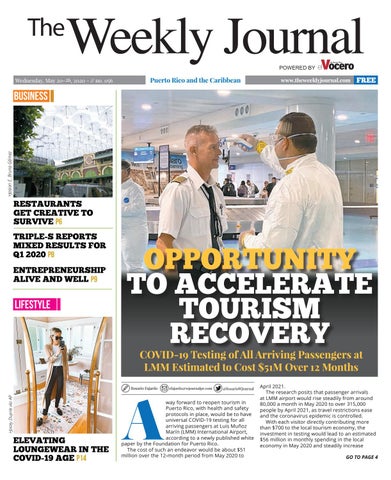
Opportunity to Accelerate Tourism Recovery COVID-19 Testing of All Arriving Passengers at LMM Estimated to Cost $51M Over 12 Months
A
>Jacey Duprie via AP
Rosario Fajardo
Elevating Loungewear in the COVID-19 Age P14
rfajardo@wjournalpr.com
@RosarioWJournal
way forward to reopen tourism in Puerto Rico, with health and safety protocols in place, would be to have universal COVID-19 testing for all arriving passengers at Luis Muñoz Marín (LMM) International Airport, according to a newly published white paper by the Foundation for Puerto Rico. The cost of such an endeavor would be about $51 million over the 12-month period from May 2020 to
April 2021. The research posits that passenger arrivals at LMM airport would rise steadily from around 80,000 a month in May 2020 to over 315,000 people by April 2021, as travel restrictions ease and the coronavirus epidemic is controlled. With each visitor directly contributing more than $700 to the local tourism economy, the investment in testing would lead to an estimated $56 million in monthly spending in the local economy in May 2020 and steadily increase GO TO PAGE 4
The Weekly Journal > Wednesday, May 20, 2020 > 2
3
/ Wednesday, May 20, 2020
a week in review $2.2 Billion Assigned to Tackle COVID-19 in Puerto Rico Puerto Rico has received $2.2 billion in federal funds to fight the coronavirus, including $150 million for private hospitals; $150 million for contact tracing and buying test kits; $40 million for remote work and study; $350 million in aid for small businesses; and $50 million for the tourism industry. >Carlos Rivera Giusti
Municipalities Get $185 Million Short-Term Liquidity to Help With Pandemic The Financial Oversight and Management Board authorized a $185 million short-term liquidity facility to help Puerto Rico’s 78 municipalities offset the timing of expected property tax revenues due to the COVID-19 pandemic. The move came after the south suffered another earthquake on May 2. >Josian E. Bruno Gómez
Powered BY El Vocero de Puerto Rico, 1064 Ave Ponce de León 2nd floor San Juan, PR Postal Address: PO Box 15074, San Juan, PR 00902
$349 Million Allocated for Public and Private Schools Under the CARES Act, Puerto Rico’s public and private schools will receive $349 million in funding so they can help prevent, prepare and respond to the effects of COVID-19. Schools that offer classes from kindergarten to 12th grade can request the funds through the local Education Department. >Carlos Rivera Giusti
President Salvador Hasbún shasbun@elvocero.com
Human Resources Director Arlene Rolón, PHR arolon@elvocero.com
Multi-Platform Digital Director Stephanie Gómez Álvarez sgomez@elvocero.com
Comptroller Félix A. Rosa frosa@elvocero.com
Traffic Director Ilia M. Pérez Centeno iperez@elvocero.com
Multi-Platform Graphic Director Héctor L. Vázquez hvazquez@elvocero.com
Production Director Eligio Dekony edekony@elvocero.com
Editorial Director Juan Miguel Muñiz Guzmán jmuniz@elvocero.com
Assistant Editor/ Reporter Rosario Fajardo rfajardo@wjournal.com
Phone: 787-622-2300, 787-721-2300 Customer Service: 787-622-7480
4
/ Wednesday, May 20, 2020
CONTINUED FROM PAGE 1 to $220.5 million in April 2021, according to calculations by THE WEEKLY JOURNAL. “Testing should be considered as an investment in our citizens’ health and overall economy, not just the visitor economy, but for purposes of comparison, assuming normal travel would not otherwise resume until 2021, as many as 60,000 — 80,000 jobs can be lost. Every arriving visitor directly contributes $700+ to the visitor economy. “Restoring 10,000 daily visitors by the fall of 2020 translates to $200+ million in monthly direct spending. In comparison, the costs of testing arriving passengers at LMM airport are low,” states the white paper, “An Airport Biological Model for Puerto Rico.” The research also assumes that the cost of a COVID-19 test is $20 per unit. According to recent data released by the U.S. Medicare program, the COVID-19 test developed by the Centers for Disease Control and Prevention (CDC) costs $35.92 per unit, while the average price for commercial tests is $51.33 per unit. The white paper posits that “the cost of testing is expected to drop as production scale and availability increase.” As reported by THE WEEKLY JOURNAL, the idea of universal COVID-19 testing at LMM airport is at the core of the Biological Barrier System that the Foundation for Puerto Rico recently proposed. Aware of the need to maintain health controls and at the same time allow an
Restoring 10,000 daily visitors by the fall of 2020 translates to $200+ million in monthly direct spending. In comparison, the costs of testing arriving passengers at LMM airport are low. - An Airport Biological Border Model for Puerto Rico
economic reopening on the island, the nonprofit organization said universal testing at the airport presents a way forward for Puerto Rico. A biological barrier is a system designed to identify and stop the spread and spread of potential viruses at a specific destination. The biological barrier, as defined, consists of a variety of testing methods, contact tracing, quarantine measures and legal or regulatory requirements that travelers arriving in Puerto Rico through the LMM — and at future points of entry and exit — must comply. Puerto Rico has been recognized as an example of prevention by taking the strictest, quickest and earliest health measures, compared to any state in the U.S. mainland. This series of actions has reportedly allowed controlling the
accelerated spread of COVID-19 on the island, indicated the Foundation for Puerto Rico. But because of these strict emergency measures, the already battered local economy has taken another hit and tourism is forecast to be the sector with the highest financial losses and job layoffs due to the coronavirus crisis. However, considering how and when to start reopening Puerto Rico’s tourism-related economy, the same characteristic that has caused complications in the past — being an island — becomes a potential opportunity, according to the Foundation for Puerto Rico. “Given the situation of being an island, we are one of the few places in the world where we do not have vehicular traffic [entering Puerto Rico], and therefore, we have the advantage of being able to control our barriers to ensure that the flow of passengers to Puerto Rico consists of healthy visitors. This is done by requiring that all passengers or residents who enter the island go through a screening protocol from the moment they arrive at the airport,” said Jon Borschow, the CEO of the nonprofit. As such, he recommended that this protocol should include the integration of rapid molecular testing, effective contact tracing using technology support, and an “advanced” quarantine system for infected passengers.
Yearning to Travel Again
Research indicates that many Americans are planning to travel during the summer months, with a focus on domestic travel. This would include staycations and regional travel. Through research conducted by Destination Analysts, consumers said they are looking to relax on a beach or in remote spaces that connect with nature, which positions Puerto Rico in a product advantage. At the same time, the travel industry, including major airlines like JetBlue, which serves Puerto Rico and the rest of the Caribbean, are expecting family visits and leisure travel to bounce back before business travel. Since Puerto Rico is a U.S. territory and considered domestic travel from stateside destinations, Discover Puerto Rico, the island’s destination marketing organization, is projecting the “Enchanted Island” as a safe destination. “What consumers do want to see are reassurances that their health and safety are being taken into consideration. Especially important for a return to travel to Puerto Rico is how consumers feel about safety measures being implemented at airports and by airlines. More than half say temperature checks at airports would make them feel safe, with nearly two-thirds looking for increased disinfecting measures on airplanes,” said Alisha Valentine, director of Research and Analytics at Discover Puerto Rico.
Hotel Safety Also Key Bar service at the Courtyard by Marriott > Courtesy of International Hospitality Enterprises
Safety measures in their accommodations is also important for travelers. “The hotel industry is active and in alliance with international chains that have developed
/ Wednesday, May 20, 2020
The reception area at the Doubletree by Hilton San Juan >Courtesy of International Hospitality Enterprises
and are implementing protection protocols for staff and guests. Some of the measures include COVID-19 testing for employees, stricter, more frequent and more thorough cleaning standards, as well as the reduction of physical contact at check-ins, in purchases at the hotel or when opening room doors. Many of these measures are already part of the hotels’ protocols,” said Federico Sánchez, CEO of Interlink, a hotel and real estate developer. “We are ready to receive visitors when the demand begins to arise,” he added. A case in point is the firm International Hospitality Enterprises (IHE), which manages six hotels and two casinos on the island and recently announced its safety protocols to deal with the Covid-19 pandemic and ease travelers’ concerns. “The health and safety of our employees, customers and suppliers is a priority, and for this reason we are complying with the highest standards that govern our industry. In the face of the Covid-19 pandemic, we created a Working Committee made up of the general managers of our six hotels and two casinos… and developed a comprehensive manual on the protocols to be observed in our hotels and casinos, “ said IHE President José M. Suárez. The manual was developed using the multiple recommendations of international hotel chains such as Marriott International and Hilton, as well as organizations such as the American Hotel & Lodging Association and the CDC, he noted. The safety protocols include: • Noninvasive temperature checks for all guests and employees at all hotel, casino and employee entry points. Anyone with a temperature above 103 degrees Fahrenheit will not be allowed entry.
The Condado Vanderbilt Hotel >Courtesy
5
• Social distancing of people staying at least six feet from each other will be followed on the property, including restaurant tables, slot machines and other public areas. • Hand sanitizer dispensers will be available in key areas such as guest reception, lobby, restaurant entrances, casinos, elevator landings, etc. • All employees are required to wear masks. Guests are required to wear masks “whenever possible,” such as in public areas. • The frequency of cleaning public spaces and common areas has been increased to at least once per hour. • Guest rooms will be thoroughly cleaned, with an emphasis on “high touch” items such as TV remote controls, toilet seats and handles, water faucets and light switches. “These protocols will be carried out with great diligence to provide security and confidence to all our visitors. We cannot allow anyone to relax with these rules and become a risk to our health and that of those who visit us,” Suárez said. The company manages the following hotels on the island: the Condado Vanderbilt Hotel, La Concha A Renaissance Resort and Casino del Mar, El Convento Hotel, Best Western Condado Palm Inn & Suites, Doubletree by Hilton San Juan, Courtyard by Marriott Isla Verde Beach Resort and Casino del Sol, Serafina San Juan and STK San Juan.
6
/ Wednesday, May 20, 2020
La Placita Business Owners Revamp Operations Amid Pandemic
Business limitations have prompted new services, products and concepts
O Giovanna Garofalo
ggarofalo@wjournalpr.com
@giopgarofalo
n a typical weekend evening, “La Placita” in San Juan’s Santurce sector would be buzzing with activity — tourists and residents alike would convene by the masses to enjoy the exquisite gastronomy and vivacious night life that the neighborhood has to offer. But ever since the government issued an islandwide lockdown more than two months ago to curtail the COVID-19 pandemic, local businesses in La Placita have struggled to make ends meet, with some looking for ways to reinvent themselves to survive the crisis. Chef José Santaella, the owner of Santaella Restaurant, said that he decided to close his establishment on March 14, just prior to the enactment of the first Executive Order that restricted business operations for restaurants, despite being exempt from the overall lockdown. Although the government has begun easing limitations on other sectors to gradually reopen the economy, Santaella explained that he hasn’t opened his restaurant’s doors, citing health concerns, but is working on a project to offer alternative services. “We haven’t opened because we believe that now is not the right time, given that there are people still under quarantine and this emergency hasn’t been subdued yet, and we don’t know how the virus will manifest itself,” he told THE WEEKLY JOURNAL. Until it is safe — and legal — for the general public to physically dine at restaurants, Santaella is in the process of establishing takeout and delivery services soon. Meanwhile, Chef Fernando José, owner of Delavida Restobar, is offering food delivery and takeout services but stepped it up a notch by also providing these services for local produce from La Placita’s farmers market. The initiative,
With social distancing orders in place, restaurants have sought new ways to reach customers. >Courtesy Delavida Restobar
called “Delaplaza a tu casa” (From the Plaza to Your Home), allows the restaurant/bar’s customers to purchase fruits, vegetables, root vegetables, natural juices and some alcoholic beverages through an app, available at https:// delaplazaatucasa.ecwid.com. “We also have precooked meals, which include meat or chicken lasagnas, vegetable lasagna, pastelón with stewed chicken, and pionono made with sweet plantains and minced meat… Apart from Delaplaza a tu casa, throughout the entire month of May, we also have tacos, margaritas, nachos, quesadillas — Mexican food,” José said, adding that the delivery services are available in the metro region, including the municipalities of Bayamón, Carolina and Trujillo Alto. While some businesses have had to make some adjustments to carry on their endeavors or are in the process of doing so, others have had to reinvent their entire concept. Aguardiente Bar has been closed throughout the lockdown. Its co-owner, David Acosta, said that it would see between 3,000 and 5,000 clients on an average weekend, many of whom were tourists. With record lows for tourism worldwide, a nighttime curfew and social distancing orders,
the owners of this nightlife-oriented business have had to rethink its concept to survive during the pandemic and its immediate aftermath. “We are preparing ourselves to operate our business responsibly and see how we can make the adjustments for Aguardiente to start selling food. We had to reinvent ourselves completely because we had some types of tapas, but our main business was during the night. In one evening we could sell [tapas] to 400, 500 people. That is impossible now,” Acosta said. Presently, Aguardiente is distributing alcoholic beverages through food delivery apps like Uva and Uber Eats. The goal, however, is to turn the locale into a type of ceviche bar, where customers will be able to eat Peruvian-style dishes. Bracing themselves for a long-term scenario, the co-owners have decided to remodel the establishment to have the necessary cooking equipment, as well as COVID-19 prevention materials. Speaking of reinvention, Santaella commented, “this is a catastrophe that we have to deal with and overcome as best as we can… this has given us all a clearer perspective.” - Continue reading the full story at www. theweeklyjournal.com.
7
/ Wednesday, May 20, 2020
Property and contingency business insurance is activated when the physical establishment is damaged or business is interrupted by natural disasters. >iStock
Property and Contingency Insurance Vital Ahead of Hurricane Season Experts explain coverage, premiums and reimbursement process
B Giovanna Garofalo
ggarofalo@wjournalpr.com
@giopgarofalo
ecause of the financial strain caused by the COVID-19 emergency, some residents of Puerto Rico are looking for new ways to generate income, such as by opening new businesses. But with hurricane season just a few weeks away, these new entrepreneurs must be meticulous in obtaining the appropriate property and contingency business insurance, experts say. These types of insurance are financed through premiums deducted on the basis of the establishment’s economic activity. In the event that a hurricane, earthquake, fire or flooding damages the property and interrupts business flow, the owner would receive money based on the preestablished agreement with the insurance company. Jaime González, president of Antilles Insurance, said that ideally, business owners should insure the property conditioned by the cost of rebuilding or replacing the structure. He noted that the cost is determined by the establishment itself and not on market value. “It doesn’t matter if it’s in Trastalleres in Santurce
or in Ocean Park. it is not about market value, but the cost of replacement. That value is what the owner should use as a basis to insure [the property]… If they don’t insure it by the cost of replacement and insure it for less, they will not receive the same payment,” González said, adding that the property value is determined by an appraiser. Agnes Suárez, president of AIG Insurance, explained that the contingency payment is only activated if prompted by the aforementioned natural disasters. Thus, business interruption caused by the emergency measures enacted during the coronavirus pandemic is not entitled to insurance payments because the health emergency doesn’t have a direct impact on the physical establishment. However, she stressed the importance of obtaining this type of coverage due to the possibility of another natural disaster — be it the looming storm season or the recent earthquakes experienced in the southwest region of the island. “All of this has an impact on companies and having that protection helps. Of course, there is a deductible — some insurers have it at 2 percent while the majority of companies raised it to 5 percent after Hurricane Maria… But it is a policy that every business should have, even more so now that we are facing hurricane season,” Suárez said. Iraelia Pernas, president of the Puerto Rico Insurance Company Association, echoed her colleagues’ statements. “Now is the time to look for an insurance provider that is authorized to provide individual
orientation, and then have that coverage up to date. People are financially limited now, but they must have the mindset that it is better to have the insurance and not have to use it, than to need it and not have it,” Pernas asserted.
Insurance Companies Could Also Face Losses
THE WEEKLY JOURNAL asked the AIG Insurance president if the industry is financially prepared to manage another mass wave of claims, such as the one experienced in the aftermath of Hurricane Maria of Sept. 2017. “The way insurance works is that we assess a risk, we insure it, but immediately after we insure it, we look for reinsurers to share the risk. We can keep roughly 5 percent to 15 percent of the risk and the rest we reinsure. Based on what we retain, we make a reserve and we have the financial capacity to back up this type of risk,” Suárez clarified. However, she noted that large-scale disasters are bound to generate losses for insurance companies. It is estimated that after Maria, insurers paid the equivalent of 20 to 30 years of premiums. “Unfortunately after Maria, we saw some cases where reinsurers were not covering the offers that the insurer had made and when it was time to pay, the insurer — instead of having to pay 10 percent of the losses, in some cases had to pay 100 percent of the losses that the reinsurers did not plan to cover for that particular damage,” she said.
8
/ Wednesday, May 20, 2020
>Brandon Cruz González
Triple-S Reports Mixed Results for Q1 2020
Elective health services deferred, while drug services increased
A Rosario Fajardo
rfajardo@wjournalpr.com
@RosarioWJournal
lthough Triple-S reported a net loss of $26.1 million for the first quarter (Q1) of 2020, the company had an increase in operating revenues of $896.4 million, representing a 13.8 percent jump from the prioryear period, primarily reflecting higher Managed Care net premiums earned. “Overall, we are pleased with the first quarter in which we experienced solid revenue growth across all segments, gaining membership in our Medicare and fully insured commercial businesses, and supported our customers, employees, providers and communities through two 100-year events: the January earthquakes and the coronavirus outbreak,” said Roberto García Rodríguez, president and CEO of Triple-S Management Corp. during the earnings call. “Our community and front-line workers are our backbone, and their resiliency in these challenging times gives us confidence as the economy reopens and we learn to live with COVID-19 in the weeks and months ahead,” he added.
“On the plus side, hospitals have not been overwhelmed with COVID-19 patients nor are they expected to be, based on current numbers and trends. Overall occupancy at hospitals, meaning for all patients, not just those diagnosed with COVID-19, is low,” García noted. As a result of all the health and economic uncertainties around the coronavirus, Triple-S “has decided to suspend its 2020 premium and cost guidance until it has more visibility,” he said. Meanwhile, the company’s consolidated net premiums earned for Q1 2020 were $875.9 million, up 14.0 percent from the prior-year period, primarily reflecting an increase in membership and higher average premium rates within the Managed Care segment. Consolidated claims incurred were $714.5 million, up 14.7 percent compared to the same period last year. Consolidated loss ratio of 81.6 percent rose 50 basis points from the prior-year period, mostly reflecting $5 million in estimated earthquake losses (due to the January tremors) recorded by the Property and Casualty (P&C) segment and increased benefits in the company’s 2020 Medicare product offering, partially offset by lower Managed Care use of services during the last two weeks in March as the result of the government lockdown due to the COVID-19 pandemic. For example, many members and providers have deferred nonemergency or elective health services during this time. However, drug services have been higher than normal due to members
who refilled their prescriptions to ensure they had adequate supply of their medications during the lockdown, said Juan José Román, executive vice president and CFO of Triple-S. “We expect to continue experiencing lower utilization in the second quarter, followed by a period of increased utilization once the lock down has been largely lifted and the demand from previously deferred nonemergent or elective procedures resumes,” he noted. As of March 31, 2020, the company had cash and cash equivalents of $104.6 million, including $9.0 million at the parent company level. Triple-S’ investment portfolio stood at $1.7 billion as of March 31, of which 76 percent where investmentgrade fixed income securities. “The company also believes it would be able to access additional debt, if necessary, to further reinforce its liquidity. In sum, the company believes it is well capitalized to support the fundamental operations of its business throughout the pandemic and beyond,” Triple-S stated in its report. With regard to reserves related to Hurricane Maria of Sept. 2017, Triple-S Propiedad, the company’s P&C subsidiary, has paid a cumulative amount of $745 million in claims and expenses related to the massive storm. Estimated gross losses remain unchanged at $967 million. Triple-S Propiedad received nine new claims, reopened 26 claims and paid 28 claims during the first quarter of 2020. At the same time, 652 claims remain open and of these, the company has been served with process in 361 claims.
9
/ Wednesday, May 20, 2020
Pizza Became His Lifesaver Young entrepreneur triumphs amid the pandemic with a new pizzeria
T Melissa M. Cruz
mcruz@elvocero.com
@mmcruzrios
he last years have been times of need, when many Puerto Ricans have shown their ingenuity and survival spirit; as the popular saying goes, “necessity is the mother of invention.” And, although the emergency sparked by COVID-19 has been an unprecedented event in modern times, it hasn’t been the exception. The pandemic has inspired more than one person to reinvent themselves and even seek new jobs. Such is the case of Bryan Santiago Olavarría, 26, who up until mid-March worked as an installer for a security equipment company. “On a Friday, when I went to work they gave us the sad news that the company — for safety reasons — decided to dispense with our services until everything returns to normal,” Santiago Olavarría told THE WEEKLY JOURNAL. Although he was burdened with anguish over not knowing how he would continue to generate income to support his family, that same day he spoke with his father-in-law, Raúl Ferrer, about the possibility of speeding up the development of the business idea they had in mind for the medium and long term. “Because my father-in-law has experience in food, confectionery and other businesses before all this started, we were talking about my interest in acquiring a food truck to sell pizzas and lasagna. That is how we were gradually acquiring equipment and storing it to buy the vehicle later and proceeding with the installation because I had a job, but when all this arose, the plans changed,” he said. Santiago was never able to purchase the food truck, but seeing his interest in moving forward, his father-in-law suggested that he use an available property instead. “As soon as he (Ferrer) gave me the approval, we moved to the house, we cleaned and painted it to properly prep the place. We had to change the oven because the one we had was small, since it was meant to fit the space of the food truck. Once we got the right oven, we had some signs made and we started working in three days,” Santiago said. That is how Antonio’s Pizza y Algo Más was born on March 31, based in the Buenos Aires neighborhood of Arecibo, becoming his lifesaver in a time of crisis. Given the current situation, the
The pizzeria originally featured only one topping in two sizes, but has gradually added more options. >Courtesy
“When we started, we did not have official social networks or a client list. So, we started to post about our opening and services on the personal social networks of all my family members who work with me at Antonio’s and we sent the menu options to our personal contacts. Little by little, we began to see the support for our product,” Santiago said, adding that the restaurant is named after his three-year-old son.
Pizzas and Something More
After losing his job due to the COVID-19 emergency, Santiago Olavarría opened a pizzeria in Arecibo. >Courtesy
business has adapted within the ‘cloud kitchen’ concept, so it does not have space for a dining room. Antonio’s Pizza y Algo Más offers home delivery and carryout services and will remain this way after the emergency. Orders can be made through www.facebook.com/ AntoniosPizzaArecibo/ or via WhatsApp at 787756-1558, with delivery in Arecibo and nearby areas.
The business expectations were to offer a variety of combinations that pizza allows. However, tempered to the current reality, limitations in raw materials and resources, they had to open with a limited menu. At the beginning, they only offered cheese pizzas in two sizes, based on the materials available. But customers quickly began to request other ingredients and products, and the restaurant expanded its alternatives. “We gradually integrated lasagna, homemade hamburgers, roasted potatoes and pork skewers on the menu, to satisfy those who no longer wanted to eat pizza. We also distribute a pizza kit that allows families to make their own pizzas and participate in a pizza challenge, sharing their creations through social media. We also have frappés, mini doughnuts and ‘limbers’ available for sale,” he said.
10
/ Wednesday, May 20, 2020
Director of Research and Policy at the Financial Oversight and Management Board
A
Weak Public Health Infrastructure Hinders Our Ability to Respond to This and Other Pandemics
s Puerto Rico moves toward reopening the economy, the Government should do whatever it can to avoid or reduce the causes and effects of a second wave of infections by developing smart prevention capabilities. This means being able to keep enough numbers of infected people tightly in isolation to prevent or minimize new outbreaks that would overwhelm the health system. Therefore, it is critical for the Commonwealth to strengthen its public health infrastructure, particularly as it relates to research/ epidemiology, statistics and emergency preparedness/response. Public health information is the essential ingredient of all of its work and the key to effective public-health decision making. The White House recently unveiled Guidelines for Opening Up America Again, a three-phased approach based on the advice of public health experts to help state and local officials when reopening their economies. At the moment, the Commonwealth lacks the data infrastructure to meet most of those conditions. The current Health Secretary has acknowledged many times that the Island’s COVID-19 related data is not entirely accurate. As a result of all these shortcomings, vital information about the scope of the outbreak has been delayed, hindering decision making. Surveillance systems are the backbone of the public health response during emergencies, as they provide national and international public health authorities with information that they need to plan and manage efforts to control these diseases. In Puerto Rico, disease surveillance is constrained by poor coordination of surveillance activities at the Health Department. Many surveillance systems run as
independent instruments, focused on internal data processes instead of being part of a comprehensive public health overview. This prevents the Department from quickly developing disease control and prevention strategies, which are critical in response to pandemics like COVID-19. Surveillance in Puerto Rico is further constrained by uncertain linkages between data collection, analysis and response. Some of the routine reporting systems at the Department are obsolete. They often do not provide data that can be used to make long-term diseasecontrol management decisions, even though they were designed with this purpose. There are also issues with information governance, with units within the Department using different standards, formats and conventions for collecting and
recording data. Multiple reporting systems, unclear lines of authority in the event of an outbreak, poor integration of laboratories into public health systems, and nonparticipation among private health care providers have combined to hamper surveillance efforts in Puerto Rico further. While these problems exist in other places, they are particularly severe in Puerto Rico. Over the last four years, Puerto Rico has faced four public health emergencies; the lack of public health data is one of the causes of poor emergency management. This was made evident during the recent pandemic, where the Commonwealth was unable to produce information that was timely or reliable enough to be useful. In sum, disease surveillance systems are hindered by fragmented and disorganized management
information systems, lack of coordination and inadequate governance over data and statistics at the Department. Consequently, the Commonwealth should transform and modernize the Island’s surveillance systems, demonstrate rapid improvements and inspire trust with surveillance partners in the field and the general public. A few weeks ago, the Oversight Board sent a letter to the Governor encouraging the Commonwealth to be thoughtful and strategic with the $2.2 billion received from Congress to finance unbudgeted expenses related to the coronavirus pandemic. One of the areas suggested by the Oversight Board was around surveillance systems. Last week, the Governor announced a strategic plan for the use of these funds, which included $150 million for more tests and contact tracing technology. Although this decision is encouraging, we should still urge the Commonwealth to invest some of these funds to modernize the entire surveillance infrastructure at the Health Department. Failing to do so risks accidentally perpetuating the very data silos that are causing so many issues during this pandemic. As we work toward a good recovery, we should put in place the foundation to ensure we are stronger, faster and more adaptable for the next pandemic.
>Brandon Cruz González
Arnaldo Cruz
< The Weekly Journal > Wednesday, May 20, 2020
11
12
/ Wednesday, May 20, 2020
The Virtual Traveler:
Dreaming Away
For now, virtual tourism is the way to go
“H Hallee Patterson
ow soon will anybody want to get on an airplane or stay in a hotel, eat in a restaurant or go to a mall?” Yes, I would like to plan an excursion. I dream about seeing and visiting remote areas of the world where I can learn about different people and cultures, history and taste their food. What is more broadening and educational than travel? Still, even though most of us remain in lockdown, we have the world at our fingertips, thanks to the Internet, which offers up a menu of varied interests. Vloggers are making short videos that provide glimpses of life throughout the world. There are now hundreds of sites for us to journey to, all from the comfort of one’s easy chair. I started asking my friends how they cope with being shut in for so long. Each shared their perspective on how to change one’s latitude — and attitude — as they prepare mentally for their future trips, while patiently waiting to resume their travels again. The following are helpful tips for the virtual traveler.
How to Plan an Armchair Travel Activity:
1. Start with a globe or a map. Close your eyes and let your finger fall. Write down the name of the place your finger chose and then look it up. YouTube videos have many sites where you can view different locations. 2. Take a Google Earth virtual tour to a destination of your choice. Use Google Maps “Street View” to explore unknown destinations in a virtual yet intimate way 3. Search for remote places on the web. Cities are interesting but small towns also open up a microcosm of culture, food and people. 4. Visit a particular city, region or country through the Internet. Find museums, historic sites and theaters and click on links to see if they have virtual tours or streaming events.
5. Watch movies filmed in specific locations. For example: “Vicky Christina Barcelona” takes place in Barcelona, “Midnight in Paris” in Paris, “Lost in Translation” in Tokyo, “Rich Crazy Asians” in Singapore, and “My Brilliant Friend” in Naples, but be aware of the time frames of when the movies take place. 6. Google Chrome extension’s Netflix Party lets you watch shows with your friends on line. Just click the extension button to create a virtual “party.” You can also group chat in real time. 7. If you know someone who has video recordings from interesting locations, request they share their experiences with you (for example, via iCloud storage links). Plan a virtual gathering with your friends, making travel the topic of conversation. 8. Create a destination theme. By decorating your home, finding different recipes to prepare and playing music videos, you can create the illusion of travel. 9. Remember the trips you have taken in the past and reflect on them. 10. Open up your box of old photos and arrange
It’s important to remember that travel is also a state of mind, and that you don’t necessarily have to go far away to feel far away. - Jesse Ashlock in Condé Nast Traveler
them as a travel log. 11. The old stand by: Books! The best part of armchair traveling is its unparalleled convenience and price. There is no need to pack, locate your passport or get a visa. There is no need to understand the foreign currency exchange and no security screening required — the luxury of armchair travel is attainable to us all. Bon Voyage!
Dreaming of the Alhambra... We shall return. >Archive
13
/ Wednesday, May 20, 2020
If only we could sleep as well as our pets. Pictured is Leylo, sleeping without a care in the world. >Rosario Fajardo
Can’t Sleep Because of COVID-19?
Tips for a better night in dreamland
W
The Weekly Journal Staff
>Rosario Fajardo
ith the world still reeling from the coronavirus crisis, many of us are feeling anxious and stressed out — not only about the present circumstances, but also about the future. Unfortunately, sleepless nights have become the encouraging people to practice and share these norm for many people. recommendations to maintain a restful and fluid Besides the health concerns of COVID-19, the sleep in times of COVID-19,” explained Dr. Bárbara stay-at-home orders, strict lockdowns, job layoffs and Segarra, dean of the School of Health Professions at furloughs, and an uncertain future are also weighing the UPR’s Medical Sciences Campus. heavy on the minds of many Among the sleep deprivation people. symptoms people can experience To help promote the include fatigue, decreased attention importance of resting and sleeping and concentration, changes in well during these challenging their mood, irritation, confusion, times, the University of Puerto hallucinations and even depression. Sleep Rico’s (UPR) Medical Sciences The guide also includes a series empowers an Campus has shared their guide of recommendations to improve effective immune with useful tips to improve our the quality of rest, such as those system. Solid nightly quality of rest and sleep. described below. rest strengthens our “We are going through irregular To achieve improvements in your body’s defenses and times and it is very possible rest and sleep, they recommend the studies have even that rest and sleep are being following: found that lack of affected after all the changes in • Limit your daytime naps to 20-30 sleep can make some our routines due to COVID-19. It minutes maximum. vaccines less effective. is important to understand that • Follow an evening routine. For these activities [rest and sleep] example, take a bath, brush your are fundamental in our lives, teeth before bed, go to bed and get since they keep us healthy, both up at the same time in the morning. physically and emotionally. • Regular exercise is important. Do physical “For this reason, it is vital to stay healthy and activities during the day, but not before going to sleep. do everything in our power to achieve it. We are • Avoid digesting food 1-2 hours before sleeping
In fact,
and, in turn, avoid substances such as coffee, alcohol and tobacco, which could keep you awake. • Avoid certain activities before bedtime such as working, studying, watching television or using electronic equipment in your room. These activities can stimulate your brain rather than help you relax. Instead, opt for that old-time favorite: read a good book before bedtime. • To help you unwind, practice relaxing activities such as meditation, listening to soft music or doing yoga and stretches. • Control the environment in your bedroom with low lighting, minimal noise and good ventilation.
Connection Between Sleep and Immune Health
Sleep is critical to physical health and effective functioning of the immune system. It’s also a key promoter of emotional wellness and mental health, helping to beat back stress, depression and anxiety, according to the Sleep Foundation. Why is sleep so important, especially during these times of pandemic? As reported by the Sleep Foundation: Sleep empowers an effective immune system. Solid nightly rest strengthens our body’s defenses and studies have even found that lack of sleep can make some vaccines less effective. Sleep heightens brain function. Our minds work better when we get good sleep, contributing to complex thinking, learning, memory and decisionmaking. For adults and children adapting to work and school at home, good sleep can help them stay sharp. Sleep enhances mood. Lack of sleep can make a person irritable, drag down their energy level and cause or worsen feelings of depression. Sleep improves mental health. Besides depression, studies have found that a lack of sleep is linked with mental health conditions like anxiety disorder, bipolar disorder and Post-Traumatic Stress Disorder.
14
/ Wednesday, May 20, 2020
Quarantine Fashion: Buyers Ditch PJs for Elevated Loungewear Stylish couch potatoes for the new normal
In fact, Edited, a retail data company, said tracksuits and matching sweatsuit sell outs were up 70 percent in April compared to February. And sweatpants were up almost 80 percent in April. Sell outs are when a product is out of stock and unavailable for purchase for at least five consecutive days.
The Associated Press
W
hen Los Angeles-based fashion blogger Jacey Duprie finally emerged from days in sweats, changing into black jeans, an ankle-length camel sweater and Gucci loafers, she counted it as one of those “very big victories that used to be small victories.” Since people have spent weeks stuck in isolation, their bodies molded into beds and couches with little to delineate weekends from weekdays, a fashion trend is emerging. Loungewear is comfy, everyday clothing with just a bit of refinement. Unfussy and minimal, but pulled together enough for a video conference call with your boss. The trend has tapped into something deeper, revealing that even the slightest effort at putting together “an outfit” during quarantine can provide a mental boost and a sense of normalcy. Loungewear had been quietly seeping into mainstream fashion even before the coronavirus outbreak’s stay-at-home orders. It is similar to athleisurewear, but takes casual comfort up a notch beyond platform sneakers, athletic Ts and oversize hoodies. It’s less about sporty separates and yoga pants. Think relaxed tailoring, slouchy trousers, soft, silky fabrics, cropped sweatshirts with something special like a puffed sleeve or floral embroidery, or drawstring tassels on baggy linen pants. “People are getting a little more creative with how they’re interpreting loungewear,” said Goop fashion director Ali Pew. “They want to feel pulled together.” The Goop wellness empire, run by Gwyneth Paltrow, recently advertised a “stay home” sale
>Jacey Duprie via AP
that was heavy on flowy, maxi dresses in fun prints by Ulla Johnson and Natalie Martin, cozy jumpsuits with a bit of flair, and lots of wide-leg culottes. The company’s own brand, G. Label, offers clothes for off hours like weekends and vacations. “It’s something you would traditionally wear on vacation at the beach, but now it translates to something that’s easy to wear around the house or on an afternoon walk,” said Pew. Trendy online retailer ASOS said sales of its not-so basic tracksuits in premium fabrics, special washes and with elevated sleeve details are up 200% compared to the same time last year. The brand’s $35 oversize joggers have sold out in five colors. Cardigans — in bright colors and neutrals — are also having a moment, according to a company spokesman. At the luxury online retailer Net-a-Porter, lingerie and loungewear had the largest sales increase worldwide of any category besides beauty products. Track pants were again a key driver, up more than 1,300% compared to last year, the company said. Edited, a retail data company, said tracksuits and matching sweatsuit sell outs were up 70 percent in April compared to February. And sweatpants were up almost 80 percent in April, the company said. Sell outs are when a product is out of stock and unavailable for purchase for
/ Wednesday, May 20, 2020
15
The customer is not just buying these for practical use, but also for the purpose of looking on trend, whether it be for social media or just because they want to feel cute in the house. — Krista Corrigan, an analyst at Edited
at least five consecutive days. “Retailers are really pushing it in communications on Instagram and on emails,’’ said Krista Corrigan, an analyst at Edited. ``We are just seeing massive, massive spikes from brands in athleisure and loungewear right now.” Matching sweatsuits, especially monochromatic muted colors like nudes and blush, are trending, as well as tie dye and utility trends like dressy sweatpants with pockets — a new take on cargo pants. “The customer is not just buying these for practical use, but also for the purpose of looking on trend, whether it be for social media or just because they want to feel cute in the house,”
>Oliver Clark via AP
>Archive
said Corrigan. And it’s not just basics. Couture designers, too, are taking cues from stylish couch potatoes. Christy Rilling, who has designed gowns for Michelle Obama and Jennifer Lawrence, created “Stay Home Robes” using silky remnants from couture gowns. The $1,280 gold, patterned robe made from the lining of the Narciso Rodriguez dress that Obama wore to the 2016 State of the Union address sold out, along with several others, she said. Beyond fashion, the trend reflects a sense
that daily routines once taken for granted, like getting dressed, also serve an emotional purpose. A psychological shift occurs when we change clothes, said Damsel in Dior blogger Duprie. “It’s kind of like dress for the job you want. In this case, it’s dress for the mood you want to have all day,” she said. “Even if you only have a few minutes to spare in the morning ... having that one thing that is a constant in your life can really offer stability and consistency in a very unstable environment.”
¿TIENES NEGOCIO PROPIO? Recibe hasta $100 de crédito Por cada línea de voz al cambiar tu cuenta de negocios a T-Mobile For Business, en un plan elegible. Luego de créditos a tu factura.
Solo con T-Mobile disfrutarás de la Primera y Única Red en áreas de todos los pueblos.
ACTÍVATE LLAMANDO AL
1-877-774-3550
5G: Requiere equipo compatible; cobertura no disponible en ciertas áreas. Si bien el acceso a 5G no requerirá de ciertos planes o funciones, algunos usos/servicios pueden requerirlo. Vea detalles de Cobertura, Términos y Condiciones e información de Internet Abierta para detalles sobre manejo de la red (como optimización de video). Oferta de $100 de descuento al portar tu línea de Negocios: Oferta por tiempo limitado, sujeta a cambios. Válida hasta el 26 de mayo de 2020. Req. cuenta de negocios elegible, servicio, crédito y portabilidad de línea de voz de compañía elegible (Sprint no es elegible; 6+ líneas para la equivalencia a 90 días gratis). La portabilidad se debe completar dentro de los 60 días de activación. Si has cancelado líneas de voz en los pasados 90 días, deberás reactivarlas primero. La cuenta deberá estar activa y al corriente para recibir el crédito a tu factura; puede demorar 3-4 ciclos de facturación. Puede req. tarjeta SIM o cargo por asistencia o actualización. Términos Generales del Plan Magenta®: Plan ilimitado en nuestra red. Puede requerirse aprobación de crédito, depósito y tarjeta SIM de $10 o, en tiendas y llamadas de servicio al cliente, un cargo por asistencia o actualización de $20. Streaming de video en smartphone/tableta típicamente en calidad de DVD (480p). Las asignaciones de data para roaming en EE.UU. y dentro de la red varían; se incluyen 200MB para roaming. Las funciones de llamadas y textos ilimitados solo son para la comunicación directa entre dos personas; otros servicios (por ejemplo, redes de conferencias, líneas de chat, etc.) podrían tener un costo adicional. Data de alta velocidad solo en los Estados Unidos; en Canadá/México, hasta 5GB de data de alta velocidad, luego ilimitada hasta 128 Kbps. No disponible para hotspots o ciertos otros equipos de data. Streaming de Video hasta 1.5 Mbps. La optimización puede afectar la velocidad de descarga de video; no aplica a la carga de videos. Para obtener el mejor rendimiento, deja las aplicaciones de streaming de video en su configuración de resolución automática predeterminada. Como en todos los planes, las características pueden variar o suspenderse en cualquier momento, consulta los Términos y condiciones de T-Mobile® en t-mobile.com para detalles. Enlace: 3GB de data de alta velocidad, luego ilimitada en nuestra red a velocidad máxima de 3G. Para la pequeña fracción de clientes que usen >50 GB/mes, el uso primario de data debe ser en un smartphone o tableta. Uso en el equipo tiene prioridad sobre uso de Mobile Hotspot (enlace), lo que puede resultar en velocidades mayores para la data cuando es utilizada en un smartphone/tableta. Precios de AutoPago: solo para las líneas 1-8; sin AutoPago, $5 más por línea. Es posible que no esté reflejado en la 1ra factura. Manejo de la red: el servicio puede ponerse lento, suspenderse, cancelarse o restringirse por mal uso, uso anormal, interferencia con nuestra red, o con nuestra capacidad de brindar un servicio de calidad a otros usuarios, o por uso inmoderado de roaming. Durante congestión, los clientes que usen 50GB o más al mes pueden notar velocidades reducidas hasta el próximo ciclo de facturación debido a priorización. Sujeto a los Términos y Condiciones (incluyendo cláusula de arbitraje) de T-Mobile® disponibles en www.t-mobilepr.com. T-Mobile® y el color magenta son marcas comerciales registradas federalmente de Deutsche Telekom AG. ©2020 T-Mobile Puerto Rico, LLC