Wednesday, May 6-12, 2020 - // no. 54
Puerto Rico and the Caribbean
www.theweeklyjournal.com
Uncertain Futures for Many Workers P6 Banking in the Time of Covid-19 P8 Cannabis Industry in Hiring Mode P9
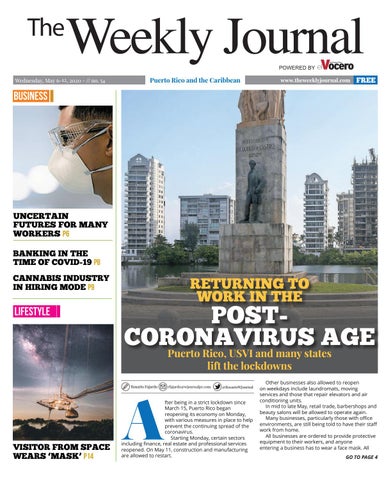
Returning to Work in the
PostCoronavirus Age Puerto Rico, USVI and many states lift the lockdowns
A Rosario Fajardo
Visitor from Space Wears ‘Mask’ P14
rfajardo@wjournalpr.com
@RosarioWJournal
fter being in a strict lockdown since March 15, Puerto Rico began reopening its economy on Monday, with various measures in place to help prevent the continuing spread of the coronavirus. Starting Monday, certain sectors including finance, real estate and professional services reopened. On May 11, construction and manufacturing are allowed to restart.
Other businesses also allowed to reopen on weekdays include laundromats, moving services and those that repair elevators and air conditioning units. In mid to late May, retail trade, barbershops and beauty salons will be allowed to operate again. Many businesses, particularly those with office environments, are still being told to have their staff work from home. All businesses are ordered to provide protective equipment to their workers, and anyone entering a business has to wear a face mask. All GO TO PAGE 4
The Weekly Journal > Wednesday, May 6, 2020 <
2
No es suficiente señora Gobernadora La decisión del gobierno de iniciar la reapertura de la economía de manera gradual es, a todas luces, incompleta. Todos estamos de acuerdo en que la salud es primordial y son obligatorias todas las medidas encaminadas a proteger la misma. Sin embargo, la salud tiene un ingrediente emocional atado a la seguridad familiar que va de la mano del ingreso económico para el hogar, por lo que es necesario encontrar el balance adecuado y poder permitir que la economía inicie un proceso de recuperación que repercuta directamente en los ciudadanos. Iniciar la reapertura de forma más completa permitirá que miles de empleados puedan volver a recibir sus salarios y llevar a sus hogares el sustento, para así no tener que vivir con las serias limitaciones en que la actual cuarentena los coloca. Esto es una parte importantísima del proceso de rehabilitación que todos necesitan. La Isla lleva más de una década en insolvencia económica, situación que permea a la sociedad completa. Además, para ahondar más la crisis, la pandemia del Covid-19 ha venido a darle una estocada casi mortal a la maltrecha economía. Si no logramos un balance adecuado entre la protección a la salud y la reactivación del proceso económico, el daño será irreparable y al final los perjudicados serán siempre los mismos; los que se quedarán desempleados, los que verán sus ingresos disminuidos, los que vivirán con limitaciones y su calidad de vida desmejorada, y a los que el gobierno, por más que trate, nunca podrá ayudar de manera efectiva y eficiente. Señora Gobernadora, usted tomó una acción valerosa y atinada cuando decidió el pasado 15 de marzo cerrar a Puerto Rico para disminuir la propagación del peligroso virus. Todo lo que ha sucedido posteriormente -la publicación de datos imprecisos, procesos de compras cuestionados y reclamos de falta de transparencia- no le quitan el mérito a esa iniciativa suya. Por lo cual, le solicitamos respetuosamente que atienda los reclamos de las miles de personas actualmente desempleadas y de las miles más que pronto lo estarán, así como también escuche el compromiso de la mayoría de los empresarios del sector privado, y reconsidere su plan de reapertura. Al final, recuerde que usted mantiene el control. Si no funciona, siempre podrá modificar e iniciar otro proceso de cierre parcial, pero por lo menos dé la oportunidad de que se demuestre si se puede o no trabajar con los protocolos que se están recomendando. Amplíe más el plan de reapertura, manteniendo todas las restricciones sanitarias y distanciamiento que sean necesarios. Agradecemos su consideración.
Junta de Directores de El Vocero de Puerto Rico
3
/ Wednesday, May 6, 2020
a week in review More Than Half of Small Businesses in Puerto Rico Get PPP Funds As of May 1, during the second round of funding, the Small Business Administration reported that 19,961 small businesses in Puerto Rico had been approved for the Paycheck Protection Program (PPP) forgivable loans, for a total amount of $987.68 million. The average loan amount was $50,158. The numbers show that more small businesses have benefited, which was the aim of the federal program. In total, 22,547 businesses, representing more than half of small businesses on the island, have benefited from the PPP funds, with the total granted at $1.65 billion. >Archive
FEMA Obligates $6.8 Million to Repair the Performing Arts Center in San Juan
US Treasury Approves $1,200 Distribution Plan for Puerto Rico The U.S. Department of Treasury approved the guidelines submitted by the local Treasury, also known as Hacienda, to distribute the Economic Impact Payment of $1,200 for most Puerto Rico residents, to help mitigate the fallout of the coronavirus crisis. The deposits began arriving in residents’ bank accounts over the weekend. >Josian E. Bruno Gómez
Powered BY El Vocero de Puerto Rico, 1064 Ave Ponce de León 2nd floor San Juan, PR Postal Address: PO Box 15074, San Juan, PR 00902
Repairs to the Luis A. Ferré Performing Arts Center in San Juan, an important symbol of Puerto Rican culture, will be possible with a FEMA grant of over $6.8 million. Some 96 staff work at the arts and cultural institution that generates over $10 million a year for the island’s economy. The facility had been damaged by Hurricane Maria in Sept. 2017. >Carlos Rivera Giusti
President Salvador Hasbún shasbun@elvocero.com
Human Resources Director Arlene Rolón, PHR arolon@elvocero.com
Multi-Platform Digital Director Stephanie Gómez Álvarez sgomez@elvocero.com
Comptroller Félix A. Rosa frosa@elvocero.com
Traffic Director Ilia M. Pérez Centeno iperez@elvocero.com
Multi-Platform Graphic Director Héctor L. Vázquez hvazquez@elvocero.com
Production Director Eligio Dekony edekony@elvocero.com
Editorial Director Juan Miguel Muñiz Guzmán jmuniz@elvocero.com
Assistant Editor/ Reporter Rosario Fajardo rfajardo@wjournal.com
Phone: 787-622-2300, 787-721-2300 Customer Service: 787-622-7480
4
/ Wednesday, May 6, 2020
CONTINUED FROM PAGE 1 establishments are required to follow social distancing rules. This is the reality of our postcoronavirus world. In order to reopen, businesses must submit various documents to the Puerto Rico Labor Department on the measures they will follow to help prevent the spread of COVID-19. “If businesses do not help with carrying out the [new] order, they cannot request to reopen. This is a serious matter, the economy cannot prevail over the aspirations of the people to be healthy and alive,” said Gov. Wanda Vázquez. Officials with the Police, Treasury, Labor and Consumer Affairs departments are in charge of conducting inspections to make sure businesses are complying with the regulations. If not, these businesses will be closed. The lockdown for everyone else was extended until May 25, with some exceptions. People are now allowed outside to run, bike and walk their dogs from 5 a.m. to 3 p.m. Parks, gyms and beaches remain closed, and everyone except essential workers are ordered to stay inside from 7 p.m. to 5 a.m.
The decision to resume operations of new economic activities [as part of the government’s phased-in plan], must be based on data that is as accurate as possible, always safeguarding everyone’s health. — Economic Development and Commerce Secretary Manuel Laboy
Health Concerns Remain
Still, health experts continue to warn that a second wave of infections could hit unless testing for the virus is expanded dramatically. Jorge Argüelles, president of the United Retailers Association (CUD by its Spanish acronym) said that although he recognizes the importance of
Gov. Wanda Vázquez >Carlos Rivera Giusti
reopening the economy, he is concerned that it is being done prior to the expected peak period of the coronavirus epidemic. According to the Department of Health, the peak of infections in
Puerto Rico is projected to be around May 8 and “normality” will begin to be seen in June. “As long as hundreds of cases continue to be reported, we are obviously not at the peak of the pandemic. What the World Health Organization indicates is that once that peak is reached, it takes 14 days of a decrease to then consider reopening operations, “said Argüelles, who is also a medical doctor. With that in mind, the governor warned that the reopening could be revoked, as necessary. “If the evaluation of the medical advisory team and the secretaries of Health and Economic Development point to a higher incidence of contagion that represents a risk, we will return to [the lockdown]. We are not going to put at risk what we have advanced in these week,” Vázquez said. Economic Development and Commerce Secretary Manuel Laboy said the Puerto Rico Statistics Institute would be involved in data collection on coronavirus cases so that the local government has all the necessary tools to make informed decisions about future reopenings and making the “necessary adjustments.” The Health Department has been severely criticized for overcounting confirmed coronavirus cases and has had to revise its official numbers in recent weeks. “The decision to resume operations of new economic activities [as part of the government’s phased-in plan], must be based on data that is as accurate as possible, always safeguarding everyone’s health,” Laboy said.
Others Voice Support
Retail stores should be reopened in mid to late May. >Carlos Rivera Giusti
The multisector group “Estamos Listos Puerto Rico Nos Toca a Todos” recently met with mayors about the government’s reopening plans, which received wide support. “We agree with this gradual reopening of the economy and it is the responsibility of Puerto Ricans to implement the protocols in their respective companies, businesses or entities so that this reopening is successful,” said Ramón Luis Rivera, the mayor of Bayamón. “We are pursuing a balance with the corresponding protocols. Each industry has to submit and comply with the protocols that adapt to our new reality. The government will evaluate
5
/ Wednesday, May 6, 2020
Many businesses, particularly those with office environments, are still being told to have their staff work from home. >Brandon Cruz González
and have confidence that citizens adopt this new scenario to protect us and our families. We will be monitoring [the situation] every day so that this is accomplished,” he added. Carlos López-Lay, president and CEO of Bella Group, remarked that the multisector effort is seeking to “create a balance without downplaying the importance of health. We understand the magnitude of the situation, it is not a competition, it is an integration; work and health cannot coexist separately. We want to carry a sensible, responsible and prudent message.” The new business regulations to follow, he added, are available on the group’s website at nostocaatodos.com.
More Than 12 States, USVI Also Reopen
More than a dozen states, along with the U.S. Virgin Islands (USVI) have also let stores, restaurants and other businesses reopen in the biggest push yet to get their local economies up and running again, acting at their own speed and with their own restrictions to make sure the coronavirus doesn’t come storming back. It is a brave new world today, as businesses nationwide must now follow strict health and cleaning measures, as well as social distancing regulations. Many businesses are staggering work hours and shifts to cut the number of people on-site. They are also redoing floor plans and operations to minimize contact — a step that also helps keep
again but had to sit outside at tables 10 feet apart customers safe. with no waiter service. Maine residents could The steps businesses are taking are in line with recent guidance from the Centers for attend church services as long as they stayed in their cars. And a Nebraska mall Disease Control and Prevention reopened with plexiglass barriers (CDC). Monitoring employees’ and hand-sanitizing stations but symptoms, which can include few shoppers. taking temperatures, is In much of Colorado, people also something the CDC is could get their hair cut and shop encouraging employers to do. More than a at stores again, though stay-atIn the USVI, a sister U.S. dozen states, along home orders remained in place territory of Puerto Rico, which with Puerto Rico in Denver and surrounding is highly dependent on tourism, and the U.S. Virgin counties. Wyoming let many businesses have reopened, Islands, have let barbershops, nail salons, gyms with certain caveats. All patrons stores, restaurants and day care centers reopen. In are required to wear a face and other businesses Maine, golf courses, hairdressers mask when entering a business reopen in the biggest and dentists opened. and recreation facilities, such push yet to get their Hotels near South Carolina as gyms, tennis courts and golf local economies up beaches opened and state parks courses may reopen as long as and running again, unlocked their gates for the first they maintain social distancing. acting at their own time in more than a month. But Bowling alleys and movie theaters speed and with their in Myrtle Beach, the state’s most may reopen if they practice social own restrictions popular tourist destination, hotel distancing, but they may not sell to make sure the elevators will be restricted to one food and drink or host parties. coronavirus doesn’t person or one family. Meanwhile, private offices may come storming back. Texas’ reopening got underway reopen, but all employees not with sparse crowds at shopping critical to in-person services are malls and restaurants allowing encouraged to work from home. customers to dine in, though only However, restaurants continue at 25 person capacity in most places. to be restricted to takeout, delivery or drive-thru service. People in Louisiana could eat at restaurants — The Associated Press contributed to this story.
In fact,
6
/ Wednesday, May 6, 2020
Although many companies are working remotely, the global economic environment has raised concerns about the future among most workers. >iStock
Uncertainty Looms Over Many Workers Amid the Pandemic
While some adapt, others are struggling to make ends meet
N Giovanna Garofalo
ggarofalo@wjournalpr.com
@giopgarofalo
early two months after Puerto Rico was put under lockdown to mitigate the spread of coronavirus (COVID-19), the local government decided to implement a plan that would gradually reinstate the economy while placing a keen emphasis on public health. In light of the uncertainty shrouding government processes and the preciseness of COVID-19 data on the island, some businesses that are not or were not exempt from the restrictions in multiple executive orders that banned on-site work have had to look for ways to reconcile the need to keep the economic gear running and safeguarding workers’ well-being, with differing outcomes. Bea Riefkohl, an English teacher to middle and high school students at Colegio Adianez in Guaynabo, resorted to online classroom tools to maintain the academic flow amid the pandemic. “It was an easy transition for me. I have coworkers who did not find it easy. I love change, I love challenges, and I saw it as a challenge. How can I engage my students as I teach them in the [virtual] classroom and keep the classes dynamic
even if it is through Zoom and other platforms,” she told THE WEEKLY JOURNAL, adding that the key to a successful virtual teaching/learning experience is to maintain constant communication. Prior to the quarantine, Riefkohl would typically punch the clock at 7:30 a.m. and 3:30 p.m. Now, she starts reading every email and message at roughly 6:30 a.m. and continues working until 7:30 p.m. onward, trying to come up with new ways to diversify the class dynamic while following up on her students’ questions and concerns. She affirmed that her supervisor, the school principal, upholds an open communication channel that allows her to remain confident despite the overall ambiguity experienced islandwide. But many workers are not at ease. Iancarlo Maraver, who has been working in the Claims Department at Optum PR for five months, saw his workflow interrupted because of the COVID-19 emergency measures, but is currently working from home because the company provided its employees with hardware to perform their duties remotely. Although he is able to generate income, Maraver stated that the global scope of the virus makes his future in the company uncertain. “A main personal concern is losing my job. If the company decides that they can no longer operate on the island because of the situation, hundreds of people would be left in the streets. I can help my family in the meantime because I am the only one working right now,” he said. Meanwhile, an employee at a bank’s call
center department, who spoke on the condition of anonymity, said that he is currently not working. The financial institution faced some initial struggles in setting up a system so that staff can work remotely while keeping the offices open for others who choose not to or can’t work from home, as the company reportedly does not provide equipment, like computers, to take home. With no equipment that could facilitate working remotely, the employee bemoaned that he is at odds between returning to the office or continuing to postpone his labor until the virus threat is controlled because he is a patient of chronic disease. “I’m very anxious. Living with a compromised immune system has been challenging during this whole period. My job has been understanding of my situation for the most part, but there’s always this lingering uncertainty that I won’t have a job to go back to once things get back to normal, if they ever do,” he said, adding that his employer’s health insurance is critical for his treatment. Although the P.R. Department of Labor recently approved unemployment benefits for him, the $190 he will receive weekly is just over half the amount he regularly earns and he has not yet received the $1,200 federal stimulus. The local Labor Department is still in the process of starting the transfers for the temporary $600 a week in unemployment benefits that was granted under the CARES coronavirus aid package, which would be retroactive.
7
/ Wednesday, May 6, 2020
Mother’s Day Under Lockdown: Zoom Get Togethers, Online Shopping More modest celebrations, lost revenues for local businesses
W Giovanna Garofalo
ggarofalo@wjournalpr.com
@giopgarofalo
hen Yamile Pérez gave birth for the first time five months ago to Eva Carolina, she never would have imagined that her first Mother’s Day would be spent under
quarantine. “It feels odd… Usually, my husband and I would gather with my mother, my grandmother… siblings and each of their spouses at my parents’ house and we would have a party. We always have a blast whenever we get together [for Mother’s Day],” said Pérez, a Vega Alta resident. Activities associated with celebrating Mother’s Day — such as going to shopping malls to buy gifts, visiting restaurants or holding family gatherings — will not be possible this year, which means lost revenues for many local businesses. “Mother’s [Day] will not have a significant seasonal effect. Sales are difficult because uncertainty is high regarding incomes and from here to May, there will not be a significant change in people who are unemployed,” said economist Santos Negrón. He said that it is a difficult time for commerce because “there are two big peaks in sales in Puerto Rico: Mother’s Day and Christmas,” and its effect this time will not be felt. As such, people are finding new ways to remain connected with their loved ones while safeguarding public health and their finances. THE WEEKLY JOURNAL interviewed three mothers to discuss how they intend to spend the celebration in their honor. To maintain a sense of togetherness amid the islandwide lockdown, both Pérez and Rosa Cruz intend to video conference their respective families via Zoom, a popular app. For Cruz, digital technology is the only tool she
Some families are resorting to video conferences to keep a sense of togetherness amid the COVID-19 emergency.
has to keep in touch with her family. Cruz lives by herself in Trujillo Alto, with family dispersed in other areas and municipalities, and her son, Jorge, serves in the U.S. military and is stationed in Tennessee with his wife and daughter. On a regular Mother’s Day celebration, Cruz, whose own mother passed away, would convene with her sister and niece or at her uncle’s farm in Canóvanas with the rest of the family, including aunts, cousins and other extended family members. Because she lives alone, Cruz doesn’t foresee any self-made activities that would differentiate the upcoming holiday from an average day under quarantine beyond “Zooming” her son and his family, which she already does regularly. Pérez, on the other hand, is considering dressing up with her husband and daughter to do a homemade photo shoot to commemorate her first year celebrating the holiday as a mother and to update her family on Eva Carolina’s growth through their WhatsApp group. Regarding presents, Pérez, a self-proclaimed Marshall’s enthusiast, had bought Mother’s Day gifts in March and intends to deliver them by mail.
Meanwhile, Nellys Ríos has not been able to buy these as of yet, but affirmed that from now on, she would rely on online shopping for these particulars. Ríos lives with her husband and two collegeaged daughters in Bayamón. Unlike Cruz and Pérez, Ríos lives just above her own mother, so she is able to visit her frequently while adhering to social distancing measures to prevent infecting her progenitor. She said that both her and her husband’s dayto-day schedules prior to the lockdown was rather hectic, especially because she is pursuing her doctoral studies in addition to working. A hindrance to most, life under quarantine has allowed her to spend more time with her immediate family. However, health precautions impede her from seeing her in-laws, whom she is “crazy” to see again once family gatherings stop posing a risk. “Normally I would have seen my siblings and my in-laws… perhaps it will be the same with my inlaws. Maybe I’ll bring them a gift, but maintaining social distancing,” she said. — Reporter Brenda A. Vázquez Colón contributed to this story.
8
/ Wednesday, May 6, 2020
COVID-19 Takes a Bite Out of Banks’ Earnings
Puerto Rico banks report Q1 2020 results
P Rosario Fajardo
rfajardo@wjournalpr.com
@RosarioWJournal
uerto Rico’s two main banks reported lower earnings for first quarter (Q1) 2020, as the coronavirus crisis impacted the financial sector and the wider economy. Banco Popular reported net income of $34.3 million in Q1 2020, compared to net income of $166.8 million in Q4 2019. First Bank’s figures were $2.3 million net income for the first quarter of 2020, compared with $36.4 million for the fourth quarter of 2019. Meanwhile, OFG Bancorp reported net income of $1.8 million in Q1 2020, according to The Associated Press. The company had reported a net loss to shareholders of $2.3 million in Q4 2019, which included $21.5 million in acquisition-related merger and restructuring charges due to the Scotiabank purchase. “The COVID-19 global pandemic has exposed the fragility of our economic and social systems and the need for greater collaboration between all sectors,” said Ignacio Alvarez, president and CEO of Banco Popular. “Our net income for the quarter was significantly lower than the fourth quarter of 2019 and the same period last year. The primary driver of this decrease was a large increase in our provision expense, reflecting the newly adopted CECL [current expected credit losses] methodology and the most recent postCOVID macroeconomic forecast for Puerto Rico and the U.S.,” he added.
The bank’s provision for credit losses for its loans and investments portfolios, which reflects the adoption of CECL, was $189.7 million, including $134 million in incremental reserves due to the expected economic impact of COVID-19. Banco Popular noted that its operating results for the first quarter were solid, considering the extent of the economic deceleration experienced during the second half of March. The bank’s net interest income, net interest margin as well as its net charge-off ratio improved compared to the fourth quarter. The bank’s revenue streams were impacted in the form of reduced consumer transaction activity, the waiver of certain late fees and service charges, including ATM transaction fees, as well as the suspension in mortgage origination and related securitization and loan sale activities. These revenue captions resulted in a decrease in income of about $6.8 million when compared to the previous quarter, reflecting the impact of the COVID-19 disruptions.
PPP Program Funding
“We have submitted more than $1.2 billion in loans, representing more than 15,000 small and medium-size businesses, under the SBA’s [Small Business Administration] Payroll Protection Program [PPP]. To date [April 30], we have received confirmation of SBA approval of $819 million of those submissions,” Alvarez said. First Bancorp, the bank holding company for FirstBank, noted that since the islandwide lockdown began March 15, only some functions within the financial sector were considered essential and as a result, there have been limited loan originations since that date and the institution has experienced significant reductions in transaction volume due to business closures. “We are entering this crisis from a position of institutional strength to support our people, clients
The COVID-19 global pandemic has exposed the fragility of our economic and social systems and the need for greater collaboration between all sectors. - Ignacio Alvarez, president and CEO of Banco Popular
and shareholders. We are extremely well-capitalized, with a total risk-based capital ratio of 25.4 percent, among the best capitalized banks in the U.S.,” said Aurelio Alemán, president and CEO of First Bancorp. As of April 30, FirstBank received approval from the SBA for 2,576 applications received since April 3, 2020, the first date on which small business customers could apply for the PPP forgivable loans, totaling approximately $319.5 million, of which an estimated $208 million has already been funded. José Rafael Fernández, president and CEO of OFG Bancorp, the bank holding company for Oriental Bank, echoed the reassuring words of his counterparts. “We believe we are in a strong position going forward. In addition to closing the Scotiabank acquisition last year, we significantly reduced highercost noncore funding and sold a large portion of nonperforming loans. During the first quarter, we increased our allowance for loan losses by $114 million, to a total of $231 million, equal to 3.41 percent of loans,” he said. In the first round of PPP funding, Oriental Bank processed around 900 small business loans, totaling more than $140 million, he indicated.
9
/ Wednesday, May 6, 2020
Tropizen Sees Dramatic Increase in Medical Cannabis Sales
Hiring underway for the next few months rfajardo@wjournalpr.com
@RosarioWJournal
ropizen, a licensed local cultivator and manufacturer of medical cannabis products, has seen sales in its dispensaries increase by 100 percent in March, compared with the previous month. As a result, the company has been hiring more staff. Medical cannabis dispensaries remain open in Puerto Rico, as they are deemed essential services under the government’s regulations on the islandwide lockdown, which began on March 15. During this time, patients have been making more frequent visits but smaller purchases per visit, indicated a Tropizen press official. The company hired two people in March and on May 1, another four new employees started working. Tropizen, which is based in Canóvanas, currently has 30 employees and is expected to have 35 staff members by the end of May. A new round of hiring is expected in July. The company has also invested more than $1 million in a significant expansion of its cultivation facilities and production capacity on the island. Tropizen said it successfully completed its first harvest from its expanded facilities, as it continues to operate under the coronavirus pandemic. “We are proud to announce that as a result of the expansion of our cultivation and manufacturing facilities, Tropizen will be better equipped to meet the strong patient demand for our products,” said company co-founder Marni Meistrell. “Our goal is not to be the biggest grower. It’s to create innovative, world-class products that are the best in Puerto Rico.” Tropizen has increased its cannabis-flower production capability to 400 percent of its original capacity. The recently completed 16,000-square-feet expansion project included the construction of both indoor and outdoor cultivation capacity, as well as
>Courtesy of Tropizen
T Rosario Fajardo
the addition of manufacturing space. The current harvest stems from the new indoor facilities, while the outdoor cultivation area is projected to produce its first harvest in July of this year. Meistrell explained that the company completes a cannabis harvest every three weeks. For each one, Tropizen will be rotating eight primary strains with six additional secondary strains. “We are taking advantage of our newly expanded cultivation capacity to launch new strains, which will allow us to continue diversifying our product offerings for patients,” she said, while adding that Tropizen continues to move forward with its aggressive product development program. Meanwhile, the company continues to enforce strict COVID-19 protocols covering areas such as cleaning and employee management. For instance, while new employees have been hired to rampup production levels, a number of employees from other functions are now working from their homes. In terms of the current state of the cannabis industry, Meistrell noted that producers face a series of challenges to maintain production. “As a result of the pandemic, we now have to deal with scarce supplies, employee absenteeism, logistical
delays, increased production time and increased cost of goods,” she said. “There is also the concern that at some point we might see dispensary sales slow down due to patients not having enough money to buy their medicine.” As previously reported by THE WEEKLY JOURNAL, other medical cannabis dispensaries have also reported a boom in sales. Giovanni Alemán, owner of Cannacity Clinic, which has establishments in Bayamón and Manatí, said that the dispensary saw a sales boost of 20 percent from March 15 to March 31 compared to preceding sales earlier that month. He added that the company has also seen a “slight increase” in new patients. Vanessa Álvarez, a member of the Puerto Rican Dispensary Collective and owner of the Faro Dispensary & Wellness Center in Ponce, has also seen an increase in sales. “We are receiving patients who come, above all, due to anxiety. We work with gloves, masks and social distancing between patients,” said Goodwin Aldarondo, legal adviser of Puerto Rico Legal Marijuana, an organization aimed at educating the public on the legal and scientific aspects of medical cannabis.
10
/ Wedne
10
/ Wednesday, May 6, 2020
3
experience once th . Maximize social networks to be seen whether this aid will in- reduX Among them, to keep your company in Gustavo Vélez deed arrive as quickly as it is needpopulation and thX the public eye and explore Economist ed and whether it will be enough to Inteligencia Económica in the co advertising options. The business’s mitigate the impactreduction of the current gas and transporta presence, leadership and brand crisis. Clearly, federal aid played an tohas financing. will be essential during the important social role, allowing vul- anal For further recovery process. nerable sectors to support themyou can access Int . Use economic indicators to selves. Federal aid has also made Económica’s make short and medium-term it possible to stabilize the economywebs projections. It is estimated and prevent social www.economiapr. and economic through a collectio that the economy could face a as a result imbalances of the weakof the and economic model itself. articles on finance contraction between 6ness percent Today, amid the COVID-19 crisis, Look for us on T 8 percent during 2020. Inteligencia the dependency on federal funds gustavovelezpr, an Power the economy.Económica offers Microsoft erhaps due to hisicaid, the Special Supplemental Nuhas created a false sense of comasthe gustavovelez20 BI as an accessible business toricalside from circumtrition clients Programare: for Women, Infants fort on the capacity of local govstances or theto deand Children (WIC) and each Pell Grants your to solve all problems. This . Evaluate business, looking Aid after intelligence Hurricane platform Maria for ernment sign of themultiple political for college students. attitude does not contribute to the taking into account how thebillion)company. the ($12 process itself, the The federal government also correct decision making in seeking In the following months afterof commercial, . Refinancing company was doing in 2018 incentives development and sends over $3 billion annually to a balance between the need to reHurricane Maria in Sept. 2017, personal or mortgage loans and 2019, and make projections enacted by thesupport operation of Puerprograms in the Health, turn to work and take care of the nearly $12 billion in federal aid enusing the new interest rates using Fall scenarios due local federal to Rico has depended on and federal Education anddifferent Labor departments. island’s productive base. tered the island. The expectation that have been lowered After to almost aid. This practice comes from our of crisis, such during to the impact of as COVID-19. governments, it In times COVID-19, the federal govwas that an additional $40 billion business’ period under the of Spain andthehurricane season, FEMA funds are zero. This would allow you to fiscal capacityThe is imperative torule think outside . Explore the various ernment’s will be sewould come, but corruption cases has until amid the like a kind oftechnological manna that falls from leadership verely affected and I foresee that an capital costs. box extended and begin to now, outline strategies platforms that and political reduce instability on the iscoronavirus crisis. the sky, allowing the local governwillcuts be essent soon, theyplan must implement to land created doubts in the federal . Develop a new business that will allow you to keep your ment to respond mayto enable you to keep Federal aid has created a desuch natural dicontrol the deficit and avoid major capital. Trump sent us a kind of tuthe recovery for when the island’s situation company from viablethe andgovernment, profitable in sastersoperating during the quarantine. pendency and finance reconstruction problems. tor-coordinator to control the efnormalizes. This business these difficult times. Tools like Microsoft Teams and numerous civic sectors and some efforts. Puerto Rico could be affected in fective use of these funds. plan must incorporatemany different commercial from coming Some of sectors the ideas and strategies Zoom let merchants interact with ways, by having too much exup own solutions and changes that the economy ARRAtheir funds ($7 billion) thatwith we their are sharing with our customers. posuremay to federal funds. The COVID-19 crisis ($6 bilan alternative economic plan that During the 2008 financial crisis, In summary, you must start credoes not depend on resources that lion) Puerto Rico received $7 billion from ating your own solutions and break
By Gustavo Vélez
P A
Tips toCannot ProtectLive Forever Puerto Rico Your Company in 4 on Federal Funds Times of Crisis
1
2
5
In f
6
are out of our control. Once again, amid the COVID-19 ARRA funds, which were key to mitthe culture of anddependency. science, as wel that President Trump’s with tax reform The island’s history with external crisis, the federal aid tap is opened, igate the effects of the economic Work and production are the best the trend of import succeeds in bringing jobs to U.S. soil. aid began in the 16th century with with the expectation of receiving and fiscal crisis (2009 — 2012). This tools we have to create wealth and the “Situado,” a Mexican subsidy. choosing instead to past couple years, Puerto up and to $6 billionIninthe direct and indi- ofsupport financial injection prevented Managing Partner Colectivo360, RealanEstate the long-term developThis aid financed the defense line rect aid for the government, house- demonstrated economic collapse and created the production. Let us Rico has continually ment of the economy in the postBusinessconditions Consultant of the Spanish empire, in which holds and businesses. It remains for a modest recovery in world. be an uphill battle its resilience, and todayCOVID-19 the stakes Puerto Rico played an important around the world, P are higher than ever. There are role due to its location in the Caribno exception. We m reasons to be optimistic, Puerto bean. The “Situado” funded the miland swiftly to overc Rico has unique competitive itarization of the island by building fortifications and financing troops. challenges and em advantages. Tax incentives enacted
By Richard Santana Villanueva
The first U.S. federal aid
J
Pivoting in Times of Crisis
By the 20th century, aid and incentives began flowing in the 1930s through the Puerto Rico Emergency ust one month ago, an Relief Administration (PRERA, 1935 all-star speakers — 1955), an initiativeroster by theof Roosgathered at La Concha evelt administration to mitigate the effects of theResort Great Depression to discussand Puerto battle poverty on the island. Rico’s unique investments During theopportunities previous century, andthe economic and industrial developtrending global topics. ment of the island was funded by Hosting ICON in the various programs and incentives, aftermath series of such as Section 936 (1976of—a1996).
earthquakes that rattled Puerto Rico Food stamps and aidsof the and weakened theother economy In 1977,part Puerto Rico entered southern of the island was quite the Food Stamp Program, better a challenge. known as the Supplemental NutriToday, we face a bigger obstacle, tion Assistance Program (SNAP). In a globalthe pandemic that has parallel, island partakes of put oththe world on pause. Priorities er federal programs such as Medhave changed, there are plenty of questions but very few answers. We
but, at the same time, others will be strengthened and able to pivot towards new opportunities. While many countries will follow the same path, the United States will certainly rethink its supply chain and will no longer look at China as its premier sourcing partner. Because the U.S. imports around $34 billion dollars worth of products from China, many countries in the LATAM region will seek to capitalize on this opportunity. Puerto Rico has the pharmaceutical infrastructure to pick up some of the slack and, ironically, Mexico should be a preferred destination for a cheap labor force. President Trump has made it very
in recent years have certainly turned the island into a hot commodity, however, as we re-evaluate our economy in these uncertain times, perhaps we should start focusing on manufacturing and human resources as well. Replacing China will not be an easy task, as they possess the technology and cheap labor force. We do have available infrastructure that would allow us to become a reliable manufacturing resource for the United States and Latin America. While China gets its bearings, let’s demonstrate what we have to offer and establish ourselves as leaders in the industry. Puerto Rico can provide a rich and able workforce, and we should begin to focus on reshaping the way we look at human resources and employment, the way
in this global race. We can longer be the magic wand for economic developm natural disasters ha of the vulnerability we need to diversify streams for sustain centers and teleme some of the industr flourish under Puer tax incentive for exp To all my fellow P let’s use the lockdow opportunity for dee and deciding how w into opportunity. Le into hope, history h that adversity has a catalyst for great in today’s leaders and to lead our society i
#abrazoa Hoy más que nunca necesitamos tu AYUDA En MDA queremos agradecer el respaldo que nos has brindado a través de los años. Este apoyo ha sido muy valioso para las familias a las que servimos y reciben los servicios clínicos que proveemos para las condiciones de distrofia muscular. Pero hoy, más que nunca, estas familias necesitan de ti. El riesgo de contraer COVID-19 es una realidad mundial y debido a su vulnerabilidad respiratoria nuestros amigos con distrofia muscular pertenecen a la población de alto riesgo. Conscientes de esto, y a pesar de los grandes retos y la posposición de nuestros eventos de recaudación, MDA se ha adaptado para ofrecer servicios a nuestras familias. Sin embargo, la condición de distrofia muscular no se detiene con esta crisis y es indispensable que podamos continuar ofreciendo los servicios de forma completa luego de esta pandemia. Por esto, MDA mantiene su compromiso de no detenerse y para lograrlo necesitamos tu ayuda a través de una aportación especial. Tu donativo será instrumental y representará un apoyo directo a cientos de familias puertorriqueñas.
haz tu donativo HOY 787.751.4088
/mdapr
síguenos en
Carlos
Yohannies
MDA Puerto Rico
Gretchen
Yavier
< The Weekly Journal > Wednesday, May 6, 2020
11
12
/ Wednesday, May 6, 2020
The collaboration resulted in donated medical supplies worth $3 million. >Courtesy of the Carlos Correa Foundation
MLB Star Carlos Correa Sends Aid to Puerto Rico Hospitals Donates three containers full of medical equipment through his foundation
P Jorge Torres Ayala
jtorres@elvocero.com
JorgeTorresJr27
uerto Rican baseball superstar Carlos Correa keeps scoring home runs outside the stadium. The first of three containers containing medical supplies began to be distributed in recent days to hospitals in the southern and western parts of the island as part of his efforts to help amid the global coronavirus emergency (COVID-19). Through the Carlos Correa Foundation, the shortstop for the Houston Astros of Major League Baseball was supported by the owner of the franchise, Jim Crane, who donated air and ocean transportation. Likewise, baseball players such as Francisco Lindor, Martín “Machete” Maldonado, and Christian Vázquez joined these efforts, along with singers Many García, Pedro Capó, Tommy Torres and several artists from the urban
The Puerto Rican shortstop and MLB star wants to use his platform to do good and help others. >AP photo
genre. The combined effort resulted in $3 million of donated medical supplies, including thousands of respirators, 118,000 gallons of disinfectant, ventilators and equipment to care for patients suffering respiratory problems, the elderly and those who remain bedridden. “We have begun the distribution of medical products. The hospitals with the greatest needs have been identified and we are giving them as much attention as possible to serve as immediate help,” Correa told THE WEEKLY JOURNAL via a
telephone interview from Houston, Texas. The president of the foundation, Dr. Ricardo “Ricky” Flores, explained that the containers consist of 23 pallets. “The containers have mixed medical supplies for respiratory care, wound care and for bedridden patients. In the next one or two weeks, the next two containers are expected to be delivered to the north and south,” said Flores, a pediatric hematologist-oncologist and medical director of the Texas Children’s Cancer Center. Correa, who won the 2015 American League Rookie of the Year Award, also helped Puerto Rico during the immediate aftermath of Hurricane Maria in Sept. 2017 and the January earthquakes, which were centered in the southern parts of the island. As part of his humanitarian work, he has also donated beds to pediatric patients in Houston. “This means everything to me. One has to use one’s platform to do good and help other people. That’s what I’ve been doing since I made it to the Big Leagues. I have looked for ways to do something positive in society — especially for Puerto Rico, where I was born and raised, and my people need a lot of help,” Correa said. The athlete, who grew up in Santa Isabela, added, “thanks to the foundation and to all the people who work at the foundation, we have achieved a historic union to help our island.”
13
/ Wednesday, May 6, 2020
$1 Million Emergency Relief Fund Established for Arts and Culture
Help for artists and cultural organizations in COVID-19 crisis
T
The Weekly Journal Staff
o help mitigate the devastating impact of the COVID-19 pandemic on the arts and culture sector in Puerto Rico, the Flamboyan Arts Fund has joined forces with The Andrew W. Mellon Foundation, with additional support from Broadway Cares, to launch a $1 million emergency relief fund to support individual artists and cultural organizations. To document the impact of the crisis on the island’s arts and culture sector, the Flamboyan Arts Fund conducted a needs assessment survey among organizations currently supported by the Fund. Across 44 arts organizations in Puerto Rico, organizations reported $1.8 million in economic losses since the beginning of March, with projected losses reaching $2.5 million by June. The most pressing needs reported were funds for staff salaries, technology and infrastructure, and funds for operations. “The COVID-19 emergency represents a serious risk to artists and arts organizations, most of whom were already in a precarious economic situation after a decade of economic crisis, significant declines in government funding and three years of natural disasters such as the 2017 hurricanes and 2020 earthquakes on the southeast coast. That’s why this Emergency Relief Fund is a crucial measure to protect our arts and cultural sector,” said Carlos Rodríguez, executive director of Flamboyan Puerto Rico. “These grants are designed to ensure that we have strong arts programming to come back to post-pandemic. Our commitment to our grantees -and the larger arts community- is unwavering and these funds will ensure that organizations cannot only take their programming virtual during
Lin-Manuel Miranda in his famous Broadway musical, “Hamilton” >Carlos Rivera Giusti
Arts and culture are vital for our souls. >Archive
this time, but also ensure they can operationally survive this unprecedented health crisis,” he added. The Flamboyan Arts Fund is a partnership
between Flamboyan Foundation, composer and artist Lin-Manuel Miranda, his family and the “Hamilton” musical. “In these times of crisis, we have turned to the arts as a source of entertainment, comfort and education. This Emergency Relief Fund will provide much-needed help for the arts and culture sector, which is suffering from a dramatic loss of income due to canceled events, closure of venues and inability to sell goods and services,” Miranda said. Emergency relief funds will be made available to support arts organizations and individual artists. These arts organizations can apply through a very flexible process for grants of $5,000 to $20,000 each to use toward covering staff salaries, rent and other basic needs during the emergency. Organizations can also use grant funds to cover the cost of creating or expanding virtual programming, including staffing and technology equipment and services. Grant sizes will be determined based on the need and size of the organization. The Emergency Relief Fund will also partner with local organizations Museo de Arte Contemporáneo de Puerto Rico and Km 0.2 to deploy grants of $600 to over 200 individual artists. These organizations previously launched efforts to provide microgrants to artists, which received overwhelming demand. These additional funds from the Emergency Relief Fund will match these microgrants and provide funding to even more artists impacted by the emergency who had previously applied. There will also be limited funding available for artists who did not previously apply. Artists of all disciplines can apply for funding through either Museo de Arte Contemporáneo or Km 0.2. “As Puerto Rican artists and arts organizations confront these challenging times... they continue to remind us of the unique power of the arts to cultivate hope, process collective trauma and grief, create light and imagine new possibilities,” said Mellon Foundation President Elizabeth Alexander. Arts organizations can submit applications for these funds online. No clear deadline has been announced. While the priority deadline was May 5, applications received after that date will continue to be reviewed and evaluated, officials said.
14
/ Wednesday, May 6, 2020
Asteroid Visits Earth’s Neighborhood, Brings its Own Protective Mask poses a threat of impact on Earth, knowing those characteristics would be important in planning a response.
Puerto Rico’s Arecibo Observatory monitoring the minor planet
Starry Nights
T
The Weekly Journal Staff
he Arecibo Observatory has been monitoring an asteroid close to Earth to help scientists brace for a closer approach in the future. While the asteroid — named 1998 OR2 — did not represent a threat, it appears to know that our planet is going through a pandemic. “Small-scale topographic features, such as the hills and ridges at one end of the 1998 OR2 asteroid, are scientifically fascinating,” said Anne Vicki, head of the Puerto Rican observatory’s planetary radar team. “But because we are all thinking about COVID-19, these features make it seem like OR2 1998 remembered to wear a mask,” she added. The installations of the National Science Foundation, which is managed by the University of Central Florida, has a team of experts that monitor asteroids that are near Earth. This asteroid belongs to a special class of near-Earth asteroids called Potentially Dangerous Objects (PHOs). PHOs are over 140 meters (about 500 feet) in diameter and are less than 5 million miles away from Earth’s orbit. No known PHOs represent an immediate danger to Earth, but observations such as those made at the Arecibo Observatory are used to determine their future trajectories. “Radar measurements allow us to know more precisely where the asteroid will be in the future, including its future approaches to Earth,” said Flaviane Venditti, a research scientist at the observatory. “In 2079, the 1998 asteroid OR2 will pass approximately 3.5 times closer to Earth than this year, so it is important to know its orbit with precision,” she explained. According to Virkki, although this asteroid is not projected to impact Earth, “it is important to
The “masked” asteroid >Courtesy of the Arecibo Observatory
Meanwhile, social distancing measures and business closures implemented to curtail the spread of coronavirus continue highlighting impressive aspects of nature. More crystal-clear waters in the sea have been observed recently, while many people are noticing a more starry-night sky. “The significant reduction in all pollution, as well as the lighting of thousands of vehicles and other emissions generated by human activity, is remarkable when looking at the sky,” the Caribbean Astronomy Society (SAC by its Spanish acronym) said, adding that these days, people are appreciating the sight of nature. The educational entity affirmed that “SAC’s network followers, both from multiple countries and on the island, have noticed the change. Obviously, the transparency of the night sky is even more noticeable in less lit areas.” Starry nights are thrilling people the world over, from the Caribbean to Australia. Last week it was the Lyrid meteor shower. This week, it will be the Eta Aquarid meteor shower’s turn.
A scientist tracking the “masked” asteroid >Courtesy of the Arecibo Observatory
understand the characteristics of these types of objects to improve impact risk-mitigation policies.” The Arecibo Observatory’s data confirms that the 1998 OR2 measures roughly 2 kilometers (1.2 miles) in width and rotates every 4.1 hours, as suggested by observations made with optical telescopes. If scientists discover an asteroid that
Starry nights > Courtesy of the Caribbean Astronomy Society
15
>Courtesy
>Courtesy
/ Wednesday, May 6, 2020
The Coconut Hunter Life in the Isla del Encanto
O
Damian La Placa
n an early morning, sanitypreserving coffee walk to the beach’s edge, I was treated to a visual spectacle. I saw coconuts flying from the peak of a coconut palm that stands in the parking lot of a beachside condominium. High above in the tree and hidden among the fronds and coconuts, a little man was throwing mature coconuts to the ground, passing them over a stone wall and hitting the sand on each one-armed throw. Let’s call him Rafael, because I like the name Rafael. Rafael had climbed up the tree without a harness. As I watched, I thought the condominium hired him to protect cars from falling coconuts. I had also assumed Rafael would make good commercial use of the coconuts. Wearing jeans but shirtless and shoeless, Rafael shimmied down the tree with his arms and legs carefully surrounding the trunk. The
tree angled up at about 70 degrees, making his body hang outstretched by gravity with nothing below to break a fall. The condominium paid him nothing, but selling coconuts is part of his scrappy livelihood. I watched Rafael place fallen fronds and unusable coconuts in a neat pile on the sand. How he knew which coconuts were good and which were not, I could not tell and did not ask. Rafael has an aging dark beard tinged with white hair, is wiry, fit and thin, has zero body fat and a waist to be envied at any age. I asked him the height of the tree. Rafael placed a palm frond like a yardstick against the lower trunk of the tree. He silently nodded his head as he counted, mentally moving the frond up the tree. “I’d say 35-40 feet.” He underestimated; the peak of the tree rises to the fifth floor of the condominium. Prior to the lockdown, Rafael would sell coconuts for $3 dollars on the beach. Now he sells them to La Placita Mercado in Santurce for 75 cents each. “It’s better than nothing,” Rafael said. His take from this one tree: 12 coconuts neatly arranged in his Pueblo shopping cart comes out to $9 in profit. Nine dollars to risk a five-story climb. Rafael does not fit the Governor’s Executive Order exceptions. Rafael is not a bank, gas station, pharmacy, takeout restaurant or grocery store. Just
a guy trying to survive extraordinary times. Rafael will assuredly make no unemployment claim or file an application for the U.S. government’s Payment Protection Program. Rafael will never see a dollar of government money when large public companies, whose shares are traded on stock markets and major U.S. universities with billion-dollar endowments are masquerading as small businesses and taking millions from the government. Not finished, Rafael ducked under the police tape to climb trees on the beach. He found a mostly vertical tree with promising looking coconuts. As he climbed, Rafael looked like a dark silhouette against the background of the rising morning sun. One by one, coconuts began to hit the beach below. I scanned the vacant beach and I thought about the night before. Prior to curfew, at the same beach where I had just met Rafael, I watched for at least a half an hour while more than 25 pelicans dive-fished into the ocean. At times, they began their vertical descents from the same heights as the peaks of the trees that Rafael climbed. I looked back at Rafael in the tree dropping coconuts. My coffee was finished, and it was time to go home.