Puerto Rico and the Caribbean
www.theweeklyjournal.com
>Brandon Cruz González
Wednesday, April 28-May 5 , 2021 - // no. 105
FOMB CERTIFIES 2021 FISCAL PLAN P6 WHAT WORKERS WANT, POSTPANDEMIC P7 BACALIA GROUP STILL BULLISH ON PUERTO RICO P9
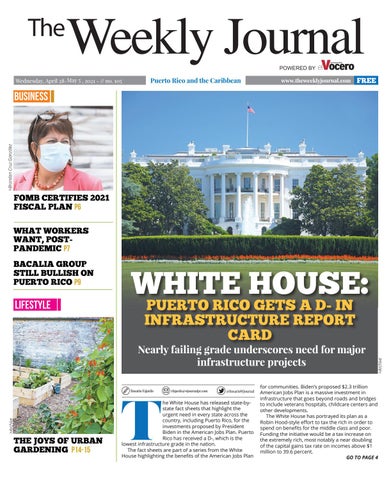
WHITE HOUSE: Nearly failing grade underscores need for major infrastructure projects
T
>Archive
Rosario Fajardo
THE JOYS OF URBAN GARDENING P14-15
rfajardo@wjournalpr.com
@RosarioWJournal
he White House has released state-bystate fact sheets that highlight the urgent need in every state across the country, including Puerto Rico, for the investments proposed by President Biden in the American Jobs Plan. Puerto Rico has received a D-, which is the lowest infrastructure grade in the nation. The fact sheets are part of a series from the White House highlighting the benefits of the American Jobs Plan
>Archive
PUERTO RICO GETS A D- IN INFRASTRUCTURE REPORT CARD
for communities. Biden’s proposed $2.3 trillion American Jobs Plan is a massive investment in infrastructure that goes beyond roads and bridges to include veterans hospitals, childcare centers and other developments. The White House has portrayed its plan as a Robin Hood-style effort to tax the rich in order to spend on benefits for the middle class and poor. Funding the initiative would be a tax increase on the extremely rich, most notably a near doubling of the capital gains tax rate on incomes above $1 million to 39.6 percent. GO TO PAGE 4
The Weekly Journal > Wednesday, April 28, 2021 > 2
3
/ Wednesday, April 28, 2021
A WEEK IN REVIEW GENERAL FUND NET REVENUES FOR FEBRUARY EXCEED PROJECTIONS
>Archive
>Josian E. Bruno Gómez
>Josian E. Bruno Gómez
Puerto Rico Treasury Secretary Francisco Parés Alicea reported that the General Fund’s net revenues throughout February 2021, the eighth month of the current fiscal year, totaled $714.8 million. Collections accumulated to February totaled $6.7 billion or $122.5 million more, compared to the same period in fiscal year 2020, when collections reached $6.6 billion. This represents an increase of 1.8 percent between the two periods.
PUERTO RICO LEGISLATORS AIM TO BAN SINGLE-USE PLASTICS Puerto Rico Reps. Joel Franqui Atiles and José “Che” Pérez Cordero, of the New Progressive Party, submitted once again a bill that seeks to ban the sale and use of single-use plastics in all authorized commercial, sales and distribution establishments. House Bill 668 contemplates a transition period for compliance and establishes fines of $250, $500 and $1,000 to businesses for noncompliance.
Powered BY El Vocero de Puerto Rico, 1064 Ave Ponce de León 2nd floor San Juan, PR Postal Address: PO Box 15074, San Juan, PR 00902
President Salvador Hasbún shasbun@elvocero.com Vp of Marketing and Business Operations Michelle Pérez Miperez@elvocero.com
$300 FINE FOR TRAVELERS WITHOUT NEGATIVE COVID RESULTS Puerto Rico Health Secretary Carlos Mellado López signed Administrative Order 2021-499 to establish new requirements to travel to the island. Per the order, travelers are subject to a $300 fine if they do not present a negative PCR COVID-19 test result, taken within three days or 72 hours before their arrival. However, the fine will be dismissed if travelers present their results in the BioPortal system within 48 hours of their arrival. The new order goes into effect today, April 28.
VP of Accounting Félix A. Rosa frosa@elvocero.com
Human Resources Director Arlene Rolón, PHR arolon@elvocero.com
VP of Editorial Content Juan Miguel Muñiz Guzmán jmuniz@elvocero.com
VP of Production Eligio Dekony edekony@elvocero.com
Traffic Director Ilia M. Pérez Centeno iperez@elvocero.com
Multi-Platform Graphic Director Héctor L. Vázquez hvazquez@elvocero.com
Assistant Editor/ Reporter Rosario Fajardo rfajardo@wjournal.com
Phone: 787-622-2300, 787-721-2300 Customer Service: 787-622-7480
4
/ Wednesday, April 28, 2021
Puerto Rico has outsized potential for innovative energy technologies including carbon capture and sequestration and geothermal energy generation, that create good paying union jobs. -White House report card on the island’s infrastructure
Republicans have pushed back and unveiled their own proposal of $568 billion that is focused on more traditional highway and bridge investments that would be one-fourth the cost, paid for by tolls and other user fees. Puerto Rico’s Report Card As per the White House report card, the need for action in Puerto Rico is clear, as for decades, infrastructure on the island has suffered from a systemic lack of investment. • Roads and Bridges: In Puerto Rico there are 282 bridges and over 1,492 miles of highway in poor condition. The American Jobs Plan will devote more than $600 billion to transform our nations’ Road damaged in Utuado after Hurricane Maria in Sept. 2017 >Carlos Rivera Giusti transportation infrastructure and make it more resilient, including $115 billion repairing roads and reach. Nearly 40% of Puerto Rico households do them more energy efficient through a historic bridges. not have an internet subscription. The American investment in the Weatherization Assistance • Public Transportation: Nearly 5% of trains Jobs Plan will invest $100 billion to bring universal, Program, a new Clean Energy and Sustainability and other transit vehicles in Puerto Rico are past reliable, high-speed, and affordable coverage to Accelerator to finance building improvements, useful life. The American Jobs Plan will modernize every family in America. and expanded tax credits to support home energy public transit with an $85 billion investment. • Caregiving: Across the country, hundreds upgrades. • Resilient Infrastructure: From 2010 to 2020, of thousands of older adults and people with • Clean Energy Jobs: Puerto Rico has outsized Puerto Rico has experienced disabilities are in need of home potential for innovative energy technologies several extreme weather events, and community-based services. including carbon capture and sequestration and costing Puerto Rico tens of The President’s plan will invest geothermal energy generation, that create good billions of dollars in damages. $400 billion to help more people paying union jobs. The American Jobs Plan invests The President is calling for $50 access care and improve the in building that industry through a reformed and billion to improve the resiliency quality of caregiving jobs. expended Section 45Q tax credit and extending of our infrastructure and support There are 282 • Childcare: In Puerto renewable energy tax credits. communities’ recovery from bridges and Rico, there is an enormous • Veterans Health: Puerto Rico is home to over disaster. over 1,492 miles gap in what schools need to 79,000 veterans, 5.5% of who are women and • Drinking Water: Over the of highway in do maintenance and make 63.9% who are over the age of 65. The President is next 20 years, Puerto Rico’s poor condition improvements and far too many calling for $18 billion to improve the infrastructure drinking water infrastructure will in Puerto Rico, residents live in a childcare of VA health care facilities to ensure the delivery require $3.7 billion in additional according to desert. The American Jobs Plan of world-class, state of the art care to veterans funding. The American Jobs the White House will modernize our nation’s enrolled in the VA health care system. This includes Plan includes a $111 billion report card schools and early learning improvements to ensure appropriate care for investment to ensure clean, safe on the island’s facilities and build new ones in women and older veterans. drinking water is a right in all infrastructure. neighborhoods across Puerto Initiatives by Pierluisi Administration communities. Rico and the country. As reported by THE WEEKLY JOURNAL, Gov. • Housing: To help with the • Manufacturing: The Pedro Pierluisi, who recently completed his first rent burden Puerto Ricans are American Jobs Plan will invest 100 days in office has recognized the need for facing, the President proposes $300 billion to retool and Puerto Rico to improve its infrastructure on all investing over $200 billion to increase housing revitalize American manufacturers, including fronts. supply and address the affordable housing crisis. providing incentives for manufacturers to invest in With hundreds of pending projects and • Broadband: Over 13% of Puerto Ricans live innovative energy projects in coal communities. billions in federal funds waiting to be used, he in areas where, by one definition, there is no • Home Energy: In Puerto Rico, an average declared a “state of emergency” last month on the broadband infrastructure that provides minimally low-income family spends far too much of their island’s infrastructure, with the aim of expediting acceptable speeds. And 68.8% of Puerto Ricans income on home energy costs forcing tough “priority” projects by streamlining permits and live in areas where there is only one such provider. choices between paying energy bills and buying other government requirements. Similar moves Moreover, even where infrastructure is available, food, medicine or other essentials. The American were also made by former Gov. Ricardo Rosselló broadband may be too expensive to be within Jobs Plan will upgrade low-income homes to make when he was in power, after Hurricane Maria in
In fact,
5
/ Wednesday, April 28, 2021
Sept. 2017. “We are going to focus our energy on achieving good management to properly disburse these funds,” Pierluisi said. The governor has underscored Puerto Rico’s need before Congress. “Since Puerto Rico’s infrastructure has endured years of limited investment, which harms our potential for economic growth and development, we need to work together with Congress and the [Biden] Administration to ensure that Puerto Rico’s critical infrastructure and coastal habitats are rebuilt in ways that increase our capacity and resiliency to withstand any future natural disasters, in particular, promoting the transformation of our electric grid and power generation structure,” he said during a U.S. House Natural Resources hearing. The Central Office for Recovery, Reconstruction and Resilience (COR3) is also streamlining the recovery processes led by municipal and state governments, as well as nonprofit organizations. “To achieve the recovery of Puerto Rico, teamwork is essential. As part of these efforts in recent months, the State Cost Share Fund was implemented, together with the Office of Management and Budget, to advance the money corresponding to the matching funds required for the reconstruction projects, due to disasters, approved under the Public Assistance grants from the Federal Emergency Management Agency (FEMA), available to agencies that are funded by the General Fund of the government of Puerto
Gov. Pedro Pierluisi >Carlos Rivera Giusti
Rico,” said COR3 Executive Director Manuel A. Laboy Rivera. “Meanwhile, the Financial Oversight and Board Management Board approved the guidelines that define the use of the State Revolving Fund of
$750 million, as part of the work we are carrying out with the Fiscal Agency and Financial Advisory Authority, which will serve to advance funds to municipalities, agencies and public corporations, with special emphasis on our municipalities,” Laboy explained. He said the goal is to disburse Requests for Reimbursements within 60 days and 21 days in the case of Requests for Advancements, which will help speed up reconstruction at the municipal level. Earlier this week, THE WEEKLY JOURNAL reported that the Public Private Partnership Authority (P3A) has awarded global consulting and digital services provider ICF a $46 million contract to provide project formulation services to support long-term disaster recovery from hurricanes Irma and Maria and hazard mitigation efforts to protect against future disasters. The company will review inspection, scope and cost estimate documentation prepared by FEMA and COR3’s subrecipients, as well as assist with environmental and historical preservation and insurance reviews. Once these reviews are approved, funding for these projects can be obligated and processed to proceed. According to Puerto Rico’s 2021 Fiscal Plan, the island will receive some $120 billion in federal disaster funds, to be disbursed over several years, related to COVID-19 pandemic support and Hurricane Maria damages. - The Associated Press contributed to this report.
Electrical repair work after Tropical Storm Laura affected southern Puerto Rico in Aug. 2020 >Josian E. Bruno Gómez
6
/ Wednesday, April 28, 2021
The Nuts and Bolts of
Puerto Rico’s 2021 Fiscal Plan
The FOMB’s Natalie Jaresko >Brandon Cruz González
Billions of dollars in federal aid buy the island time Rosario Fajardo
rfajardo@wjournalpr.com
@RosarioWJournal
The Financial Oversight and Management Board (FOMB) unanimously approved the 2021 Fiscal Plan for the Puerto Rico government, which shows that billions of dollars of federal funds have improved the island’s short-term economic outlook. However, the long-term challenges remain for structural reforms and investments in healthcare continue, especially in light of a U.S. Census report that Puerto Rico’s population has dropped by nearly 12 percent in the past decade, to 3.2 million residents in April 2020. The 2021 Fiscal Plan outlines government actions necessary to ignite long term economic growth, while improving fiscal responsibility. As outlined by the FOMB’s Executive Director Natalie Jaresko, the 2021 Fiscal Plan is the road map for Puerto Rico’s recovery and prosperity. Puerto Rico’s economy is benefiting from substantial federal funds related to COVID-19 pandemic support and Hurricane Maria-related disaster funds: some $120 billion to be disbursed over several years. “This is an opportunity to build a stronger economy with greater growth to benefit all residents, while building a more resilient infrastructure,” Jaresko said. “If we use this time and the resources wisely, we can put Puerto Rico on a path towards a better, more prosperous future.” However, the long-term economic outlook remains challenged in the absence of incremental structural reforms to improve Puerto Rico’s competitiveness and its ability to attract greater levels of investments in quality job creation for its residents.
The 2021 Fiscal Plan projects the government budget to fall into deficit by 2036 without incremental actions or policy changes. The 2021 Fiscal Plan includes significant investments into healthcare, broadband coverage, and civil service reform, and continues to prioritize government spending so the size of government both reflects the population changes and meets the needs of the people for effective services.
Economic Analysis
The Oversight Board projects that the Puerto Rico economy will grow 1 percent in this current fiscal year 2021, following a 3 percent decline in the previous fiscal year 2020. Real gross national product (GNP), however, does not fully reflect the effect on household income from the unprecedented COVID-19 related federal government stimulus. Because of the federal government support and its expected impact on household income and consumer spending, the 2021 Fiscal Plan uses an adjusted growth series which includes these income effects for the purposes of forecasting government revenues. By this measure, the decline in fiscal year 2020 is only 1.1 percent and the growth in fiscal year 2021 is a “robust” 3.8 percent. The recovery will continue in the coming fiscal year 2022. In fiscal year 2023, economic growth will contract following the end of stimulus. This decline will be offset in fiscal years 2024 to 2026 by FEMA and CDBG funding from the U.S. Housing Department, and by the government’s implementation of the structural reforms defined in the 2021 Fiscal Plan. As the effect of those structural reforms and federal recovery funds level off, growth is projected to return to its historic negative trend starting in fiscal year 2030.
Details on Necessary Reforms
To ensure the Puerto Rico government can provide quality services to residents, the 2021 Fiscal Plan includes almost $800 million for comprehensive civil service reform between fiscal years 2022 and 2051, starting with a pilot program for financial management personnel. The 2021 Fiscal Plans structural reforms remain an essential element of Puerto Rico’s long-term recovery, Jaresko noted. These reforms include providing access to reliable broadband across Puerto Rico; providing comprehensive development opportunities for adults; dramatically improving K-12 education; improving the competitiveness and attractiveness of Puerto Rico’s economy by reducing the obstacles to starting and sustaining a business through improvements to the processes to obtain permits, register property, and pay taxes; and providing lower cost and more reliable energy through the transformation of PREPA, the island’s public electrical utility. The 2021 Fiscal Plan also includes the recommended transformation of Puerto Rico’s transportation system with the goal to reduce traffic congestion, increase access to public transportation, improve the governance of transportation entities and the fiscal sustainability of public transportation agencies, and promote economic development. Agency efficiency requirements continue to be an important part of the 2021 Fiscal Plan: consolidating agencies to reduce administrative costs and bureaucracy; centralizing procurement to achieve savings; delivering better governmental services for substantially lower cost; reducing fraud, waste, and abuse in the healthcare system; improving health outcomes; and enhancing tax compliance – not increasing taxes– to ensure everybody pays their fair share in taxes and the government receives the revenue it needs to provide needed services.
7
/ Wednesday, April 28, 2021
Flexible Work, Gradual Office Reintegration a Must-Do for Businesses Expert discusses recurring office issues in the new ‘normal’
A Giovanna Garofalo
ggarofalo@wjournalpr.com
@giopgarofalo
head of her presentation for a virtual event organized by the Puerto Rico Chapter of the Society for Human Resource Management (SHRM-PR), THE WEEKLY JOURNAL had a oneon-one with keynote speaker Alicia Figueroa Llinás —counsel for the law firm Pietrantoni Méndez & Álvarez LLC— to discuss the most frequent work-related inquiries by employers and workers, and how to return to a pre-pandemic corporate environment. According to Figueroa, the most recurrent concern she has faced has come from clients who have grown used to working remotely and wish to continue doing so from home. “This issue has arisen where employees say that they have been working from home for a year, they have been even more productive, they can perform more functions, they comply with everything, they are available if they have to go, and therefore, they request to stay at home. So, if the employer says no, there is this sort of tension as to why they are not being allowed because they forget that the employer has a right and prerogative to determine from where [employee] will do their jobs,” she explained. However, studies throughout the pandemic have shown that the majority of employees prefer flexible work opportunities, whether that is working from home full-time or adopting a hybrid schedule in which they alternate between going to the office and working remotely. A 2020 report by Leadership IQ, for example, found that only 9 percent of the study’s participants want to work in an office all the time, while the other 91 percent would like at least some time of remote work, with 39 percent saying they would like to work from home about three to four days a week. Moreover, in the same study, 59 percent of
In a post-pandemic world, many employees want the flexibility of working remotely. >Archive
participants said their work-life balance had improved since doing their jobs from home, 53 percent said their productivity is better working remotely, and 49 percent noticed an improvement in their mental health. Although 54 percent said their relationships with their colleagues are better working from an office, only 27 percent said their relationships with their bosses were better in that same environment. With this in mind, THE WEEKLY JOURNAL asked if employers who refuse to offer remote or hybrid work models were at risk of losing staff to competitors with flexible work opportunities. “I believe that we are living in a moment in which to attract the best resources, employers must give the best offer and the best working condition,” she said. “I believe that employers cannot be left behind and to the extent that my competition is offering hybrid models or models with greater flexibility, I believe that these companies will be able to attract and retain the best and most productive employees. Flexibility will be crucial,” Figueroa said.
Vaccines and the Return to ‘Normal’
Regarding vaccines, she observed that the Equal Opportunity Commission ruled that bosses may require their employees to be vaccinated to return to work in the office and/or resume business operations. Unless a worker is exempt by a medical reason or “bona fide” religious belief
against vaccines, they would be expected to comply with this work requirement. “If an employee is forced by their boss to get the shot and they develop an adverse medical complication as a result, would they be entitled to monetary compensation?” your correspondent asked. “My opinion is that the employer will not be or should not be found responsible for these damages because what the employers who demand the vaccine are doing is nothing more than following the recommendations of the CDC, following recommendations of the medical community and the government in general, and to exercise your duty of care in the midst of a pandemic,” Figueroa affirmed. As for how employers should encourage a return to the company’s pre-pandemic work environment, Figueroa underscored the need for a gradual reintegration into the workspace. “This is a process that must be done in an organized and consistent way. You won’t tell an employee who has been working one year from home on Friday to return to the office on Monday from 8 a.m. to 5 p.m. the entire week,” she said. Rather, she pointed to options such as working part-time from the office or every other day of the week, for example. However, she urged bosses and employees to keep enforcing health protocols, such as mask use and disinfection, even if the workforce has been vaccinated.
8
>Archive
/ Wednesday, April 28, 2021
Banks Benefit from $45B in Federal Pandemic Aid to Puerto Rico FirstBank and Oriental release Q1 2021 Results
B Rosario Fajardo
rfajardo@wjournalpr.com
@RosarioWJournal
anks in Puerto Rico are continuing to benefit from the federal government’s massive stimulus packages to help individuals and businesses afloat during the coronavirus pandemic. As a result, FirstBank and Oriental are reporting strong numbers for the first quarter (Q1) of 2021, continuing trends in the latter half of 2020. First BanCorp reported net income of $61.2 million for Q1 2021, compared to $50.1 million for Q4 2020, and $2.3 million for Q1 2020, a marked improvement year-over-year when the pandemic first began. Financial results for the first quarter of 2021 include a net benefit of $15.3 million recorded to the provision for credit losses, primarily related to an improving macroeconomic outlook during the quarter. In addition, during Q1 2021, First BanCorp recorded merger and restructuring costs of $11.3 million related to the Banco Santander Puerto Rico integration process and related restructuring initiatives, compared to $12.3 million for Q4 2020. The bank said improving macroeconomic forecasts also led to a reserve release of $15 million in the first quarter of 2021. Core operating performance was strong with pre-tax pre-provision income of $86 million. Loan origination activity was solid, reaching $1.2 billion in the first quarter. The bank also issued an additional $209 million of new Small Business Administration (SBA) Paycheck Protection Program (PPP) loans disbursed during the quarter. FirstBank’s total loan portfolio declined slightly by 1 percent, or $130 million, in the first quarter. “A portion of this reduction is tied to strategies to reduce the residential mortgage loan portfolio, which
declined $135 million, as well as repayments on manufacturing and cement sales all showing commercial lines due to the improved liquidity of improving trends. our borrowers. The consumer portfolio increased Meanwhile, OFG Bancorp, reported that its total $47 million, largely driven by continued growth in core revenues were $127.7 million compared to the auto and lease finance segment,” said $132.8 million in Q4 2020. Performance Aurelio Alemán, president and CEO of metrics improved with a loan yield First BanCorp. of 6.61 percent, return on average “We expect to see a pick-up in assets of 1.21 percent, return commercial and construction on average tangible common activity over the next few stockholders’ equity of 13.11 quarters as projects underway percent, and an efficiency are gaining traction. Our teams ratio of 60.84 percent. Credit are focused on driving growth metrics also improved as net in the loan portfolio and the charge-offs, delinquency rates commercial pipeline continues and loan deferrals all fell. to build. The geographic diversity “First quarter results of our franchise, reflected strong core specifically the Florida performance based on region, continues to the continued success of provide additional our strategies focusing opportunities for loan on agility and service. We benefitted from strong new growth,” he added. Our results also reflected Total pandemic relief the federal stimulus, loan generation and deposit funding designated increased liquidity, and growth, significantly reduced for Puerto Rico is an improving Puerto Rico currently estimated at economy as more people cost of funds, a more efficient $45 billion, equivalent get vaccinated,” said José operating structure, and the to 63 percent of fiscal Rafael Fernández, CEO of year 2019 GNP or Oriental Bank. release of some COVID-related 4.5 times the Puerto “Our capital strategies loan reserves. Rico government’s are working well. In budget for fiscal year January, we increased the -José Rafael Fernández, CEO of 2021, according to the regular quarterly cash OFG Bancorp bank executive. “This dividend 14 percent. In significant amount of March, we announced stimulus continues the redemption of all to strengthen our customers, driving growth in three outstanding series of preferred stock, which deposits and also softening in loan demand in the will improve our capital structure, enable us to near term. Deposits, excluding government and effectively deploy excess liquidity, and increase brokered, increased $472 million this quarter, which net income available to shareholders. As of Q1 continues to enhance our liquidity profile.” 2021, we more than earned back all the tangible Alemán also pointed out that the Puerto Rico book value per common share dilution involved in economy continues to show signs of recovery, the Scotiabank acquisition significantly ahead of with tourism, hotel occupancy, airline passengers, schedule,” he added.
9
/ Wednesday, April 28, 2021
Grand Caribbean Marinas acquires Villa Marina in Fajardo Part of five year, up to $100 million investment on the island rfajardo@wjournalpr.com
@RosarioWJournal
rand Caribbean Marinas has consolidated itself as the largest marina company in Puerto Rico with the acquisition of Villa Marina in Fajardo for an estimated cost of $25 million, which includes
renovations. With this purchase, Grand Caribbean Marinas, part of the Bacalia Group, will control more than 2,200 slips and will complete an investment of $50 million to $100 million in the next five years, the company said. The company now owns four marinas on the island: Puerto Chico, The Reserve, Sardineras and Renaissance Villa Marina. Rebranded as Renaissance Villa Marina, it has the only covered dry stack in Puerto Rico as part of its facilities; counts on an exclusive VIP service for customers. Grand Caribbean Marinas, belonging to the Bacalia Group holding, completed the acquisition of Villa Marina last week, accumulating more than 2,200 spaces (between wetslips and dry storage) on the Fajardo coasts, thus becoming the largest marina owner and operator in Puerto Rico and the Caribbean. Additionally, this investment consolidates Grand Caribbean Marinas among the top five marina groups with the most slips within the United States. As part of its commitment to the island, the development of Grand Caribbean Marinas plans to diversify its offerings during the next five years and implement a series of experiences that enrich the tourism and recreational offerings in Puerto Rico, the company said. The president and founder of Bacalia Group, Italian businessman Giuseppe Cicatelli said that Renaissance Villa Marina has great advantages for the company, such as “obtaining not only a dominant position at the state and Caribbean level, but also at the federal level of the United States, where we have become a relevant company. The scale and unique positioning of Grand Caribbean Marinas further highlights the importance of Puerto Rico in the nautical industry. “Puerto Rico is critically important to the rest of the American marinas, because the vast majority
>Courtesy
G Rosario Fajardo
Something very interesting is the explosion of boat buyers to develop nautical tourism and operate them as charters… Demand has transformed nautical tourism into a very attractive and safe business in this pandemic. -Giuseppe Cicatelli, president and founder of Bacalia Group
of the vessels that come from other states towards the Caribbean, pass through Puerto Rico, and it’s a trend that grows every day,” he said. Cicatelli told THE WEEKLY JOURNAL that despite the coronavirus pandemic, the boating and yacht industry on the island has been booming. “Last year was one of the best years, dare I even say, of the last 50 years. This was mainly due to the type of activity involved, which does not agglomerate large crowds; they are always small groups and it is done outdoors. Families have opted for this type of recreation, as they are less exposed and away from crowds,” he said. Cicatelli also told your correspondent that boat owners are a mix of locals and “foreigners… and
something very interesting is the explosion of boat buyers to develop nautical tourism and operate them as charters… Demand has transformed nautical tourism into a very attractive and safe business in this pandemic.”
Plans Underway
Villa Marina, now renamed Renaissance Villa Marina, has the only covered dry stack in Puerto Rico, which will be completely remodeled. The facilities will have a private entrance and an exclusive VIP service to take the boat owner experience to the “next level,” the company said. The marina also has its own boatyard, which will operate the maintenance and repair of ships up to 100 feet for the entire Grand Caribbean Marinas complex. In addition, a complete modernization of its security systems will be carried out in all the marina facilities to give greater peace of mind to residents. Marlon Mellado, CEO of Grand Caribbean Marinas, adds that “one of the main benefits of Renaissance Villa Marina is that it offers maximum protection during hurricane season.” In addition, Mellado emphasized how Grand Caribbean Marinas has encouraged tourism in the Fajardo area, since “we are not only promoting nautical activity and raising quality standards for our clients, but we are also strengthening the offer of activities for the general public, with high quality touristic and gastronomical developments.” And that gastronomical offering is also expanding, he noted. The founders of El Makito de Naguabo restaurant will develop a gastronomical venue on the grounds of the marina called SeaSide Grill.
10
/ Wednesday, April 28, 2021
The Importance of Education, Technical Training
Private sector jobs in utilities report highest average salary
T Rosario Fajardo
rfajardo@wjournalpr.com
@RosarioWJournal
he Census Information Center (CIC) of the University of Puerto Rico in Cayey has released a snapshot of private sector salaries in Puerto Rico, based on data published in the economic census with respect to U.S. Census Bureau information in 2017. The economic census is conducted every five years, so the next one will be released in 2022. According to the report, obtained by THE WEEKLY JOURNAL, in terms of average annual wages, there is a great disparity between economic sectors and professions, highlighting the importance of education and technical training. The average private-sector wage for all of Puerto Rico was $25,332 a year, but the hospitality and food service sector had a very low average of $13,097 annually, well below the equivalent of a full-time job at the federal minimum wage of $7.25 an hour. Calculating a full-time federal minimum job at 40 hours a week, this would amount to a yearly salary of $15,080 for a worker. While some states have legislated higher minimum wages, Puerto Rico has not. Meanwhile, the water and electricity services sector reported the highest average wage of $62,400 a year, followed by business management ($51,122), finance and insurance ($45,248). Among the biggest sectors on the island, only manufacturing and information technology (IT) have average yearly salaries that exceed the average for Puerto Rico, at $37,073 and $42,370 respectively. “We see that the largest sectors in terms of sales are manufacturing, retail, wholesale and IT, in that order. However, in terms of employment, the largest sectors are retail, health and welfare, hospitality and food services, and manufacturing. In other words, if we study our economy from a sales point, manufacturing is the largest sector, but if we look at it from the employment side, retail is the largest. This cannot be confused with the contribution of each sector to the economy because the manufacturing sector generates jobs in its sector and in other sectors,” explained José Caraballo Cueto, director of the study and the CIC. He agreed with a question from your
Maria, the pandemic and other disasters pushed workers to move from one sector to the other. For instance, after Maria, the construction sector grew but agriculture declined. Growing sectors generally have growing wages, while declining sectors generally have declining salaries. Economist José Caraballo Cueto
correspondent about the direct correlation between education and professions and wages. THE WEEKLY JOURNAL also asked the impact of Hurricane Maria in 2017, and now the coronavirus pandemic, on Puerto Rico’s labor market. “Maria, the pandemic and other disasters pushed workers
to move from one sector to the other. For instance, after Maria, the construction sector grew but agriculture declined. Growing sectors generally have growing wages, while declining sectors generally have declining salaries,” Caraballo responded. “Thousands of jobs have been lost in the aggregate but again, some sectors have won while others lost.” Your correspondent also asked how Puerto Rico compares with the poorest state, for example, Mississippi. “Generally, Puerto Rico has lower salaries and lower employment to population ratio than the states. I don’t think this is a good comparison because Puerto Rico does not have the same production levels as the states. That’s why we need economic tools to grow this economy,” Caraballo said. The private sector snapshot includes a list of sales generated, wages and employment for each economic sector from 2017 to the present. It also addresses data on the different sectors, such as annual sales, proportion of the local economy, average annual wages and proportion of jobs. It includes all economic sectors except for agriculture. In terms of private sector jobs, retail leads with 132,033, followed by health and social assistance with 84,933 and hospitality and food services with 82,815 jobs.
11
< The Weekly Journal > Wednesday, April 28, 2021
12
/ Wednesday, April 28, 2021
X
Michelle Vilas Pica,
X
Marketing Director of Discover Puerto Rico
My Happy Homecoming to Puerto Rico
S
oon after I moved back home to Puerto Rico in 2017, after Hurricane Maria struck… I knew I had made the right choice to return. Seeing the widespread devastation throughout the Island I love, I felt I had found a purpose: to be part of a community devoted to rebuilding and restoring Puerto Rico. And I’m proud to be playing a role that matters in that regard, with the Island’s destination marketing organization, Discover Puerto Rico. My family made its own “discovery” of Puerto Rico in 1965, when my parents immigrated to this Island from their native Cuba. As a firstgeneration Puerto Rican, I grew up in – and continually embrace – our unique culture, one that I believe distinguishes us from other Caribbean destinations. Still, as a teenager about to embark on adulthood, I wanted to spend time soaking up other cultures, too. After graduating from a local high school, I chose to go stateside for college in Washington, D.C., and then enjoyed a five-year career in brand marketing with global beauty brand L’Oreal in the marketing capital of the world: New York City. As much as I reveled in those experiences and grew confidently in my chosen profession, I never wavered from the belief that I would someday return to my Island. Of course, I missed being with my parents and siblings, but I also yearned for the charms that make Puerto Rico so special – like journeys with my family to the islands of Culebra and Vieques; early morning runs to Old San Juan, or dining on “frituras” at local restaurants in San Juan. Still, when the hurricane wreaked havoc on the Island, I temporarily wondered if I’d been wise to move back. But those doubts didn’t last long. Seeing our citizens, of all ages
The Condado area of San Juan >Archive
and backgrounds, joining together to pick up Puerto Rico’s broken pieces and put it back together again, I had to be part of the solution. And – happily – Discover Puerto Rico, which officially opened its doors in July 2018, needed someone with my skills and experience to serve as marketing director. I believe it was the perfect job for me, at the perfect time – for my career and for the Island I so desperately love. Created and funded by the government, but operated as an independent organization, Discover Puerto Rico has one primary purpose – to encourage visits to the Island. Tourism has always been a vital part of Puerto Rico’s economy, and it continues to grow in importance – providing about 7 percent of our gross domestic product (GDP).
In the wake of the deadly hurricanes, and through civil unrest and even earthquakes, interest in Puerto Rico as a destination has grown internationally, and Discover Puerto Rico is a key reason why. I’m thrilled that my area of expertise – marketing – has been instrumental in that growth, as our organization worked diligently to create a brand identity and positioning for Puerto Rico that has resonated with consumers and the travel industry experts who influence them. 2019 was one of Puerto Rico’s best years for tourism ever, and we were positioned to do even better in 2020 … and then COVID-19 shut down our Island, and indeed most of the world. Our challenge evolved from encouraging visitors to come now, to keeping Puerto Rico top-of-mind for
people when they are able to travel responsibly. That has sparked all of us at Discover Puerto Rico to exercise our marketing muscles in new ways, such as creating more than 20 virtual tours of the Island so that curiosityseekers can still experience our wonders, even when they couldn’t be here in person. As Broadway star and activist for Puerto Rico, Lin-Manuel Miranda, once said, “Nothing is better for your soul than to visit Puerto Rico.” He’s right. But, naturally, I believe with all my heart that there is one thing better for your soul – and that is to live in Puerto Rico. Through my work, and my private life as a proud resident of beautiful San Juan, I’ve never been more optimistic about the Island’s future. And my future, too.
13
/ Wednesday, April 28, 2021
Be Good To Your Joints With These Active Aging Tips Help prevent joint pain, improve mobility and enhance flexibility
of arthritis. Therefore, protecting your joints as early as possible can prevent these issues and enhance mobility as you age. Follow these tips to get started!
O
Staying well-hydrated is essential to your overall health. Water regulates body temperature, helps stave off infection, helps kidneys eliminate toxins, lubricates joints and so much more! For good joint health, you should replace the water your body loses. If it recognizes a shortage, your body will try to pull the water it needs from other places – including your cartilage. When your cartilage loses water, there is less synovial fluid in your joints. Without proper lubrication, joints stiffen, become hard to move, and might cause pain. To stay properly hydrated, men need to take in about 3.7 liters of fluids, and women need about 2.7 liters per day. Under these guidelines, 20 percent of fluids can come from food and the rest from water and other drinks. Drinking a lot of sugary beverages like soda or energy boosters is discouraged.
Active Aging
ur joints connect our bones and keep them from knocking together. Some joints – like hinge joints – help us move in different ways. For example, knee joints enable us to bend our legs to sit down or squat, and shoulder joints allow us to raise our arms to take something out of a cupboard. As we get older, the cartilage that cushions our joints becomes thin or wears out. This deterioration causes inflammation and pain that’s generally associated with different kinds
Stay Hydrated
Do Regular Exercise and Include Warm-Ups and Cool Downs
Staying physically active is a great way to prevent stiff, painful joints and doing low-impact exercises like walking, swimming and biking helps keep them lubricated. Muscles push on bones and contract to help joints bend and straighten. Therefore, strengthening muscles by lifting weights can improve functionality and provide better joint support. As with any exercise plan, discuss restrictions and recommendations with your doctor before starting a weightlifting routine. Stretching before and after a regular exercise routine helps prevent joint strain. In a warm-up, slowly work the muscles you’re planning to use. You can even try mimicking specific movements from your workout in a set of dynamic warm-up stretches to prep your muscles and increase joint flexibility. Cooling down after exercising is equally important to get your body back to baseline and prevent injuries. Doing a slow, gentle set of stretches for five to 10 minutes that target the muscles you worked out should do the trick.
Don’t Tax Your Joints
Walking is a great low-impact exercise.
“No pain, no gain!” is a common mantra when starting a new exercise routine. Staying motivated is great – but you should never push your body beyond its limits. If something hurts, don’t ignore
>Courtesy of adamkaz via gettyimages.com
the pain. Muscle soreness will happen – especially if you haven’t worked out in a long time or are new to doing any kind of exercise. This feeling, however, should ease up in time. On the other hand, if a joint starts hurting and doesn’t stop, quit working out and address the issue as soon as possible with your doctor. Ignoring nagging pain and taxing an aggravated joint can lead to injuries and recovery time that you didn’t expect. As always, slow and steady wins the race. If your joints feel extra stiff one morning, take it easy! Do simple stretches to help maintain flexibility, but don’t do anything that could potentially make it worse. At the end of the day, get up and get moving in one way or another! Overall, proactively protecting your joints as early as possible can help prevent joint pain, improve mobility and enhance flexibility as you age.
14
/ Wednesday, April 28, 2021 There are different farming styles and techniques to optimize your space and “go green.”
Give Your Roof and Walls Another Use: Urban Agriculture Fresh ideas on ‘going green’
I
Melissa M. Cruz
mcruz@elvocero.com
@mmcruzrios
n recent years, the repercussions that human activity has had on the environment have been palpable, such as excessive deforestation, continuous abuse and contamination of natural resources, among others. Likewise, a year ago —because of the pandemic— an immediate positive effect was seen in the atmosphere when human beings took a break from polluting and damaging the environment. That moment showed that small changes can have a big impact if we all do our part. Cultivating the land more is one of the activities that have a positive impact on the environment, as well as in our direct surroundings and at home, whether you live in rural or urban areas.
If your patio is not large or you do not have land to create a planting area, you can create planting boxes, which you can place where they are best suited.
“Urban farming is an infrastructure in the city that synchronizes an agricultural system in terms of production and consumption. An example of this are the agricultural markets that are being seen in different regions of the island, such as in
Placita Roosevelt,” said architect Juan Carlos Gallisá Becerra, who presented the virtual talk ‘Agriculture Integrated to Buildings’ during a recent conference by the College of Architects and Landscape Architects, which were held in commemoration of Landscape Architecture Month. Gallisá also mentioned that establishing gardens in buildings, condominiums, schools and urbanizations, in addition to being a source of healthier food for communities, also provides a cleaner and fresher environment. The architect pointed out that space should not be a limitation when gardening, and urged the public to incorporate agriculture in the city through different techniques that can be adjusted to the abilities and budget of individuals and communities. “In a first conference, we addressed the issue of agriculture at the urban level. You can create a garden with food input both at home, schools or workplaces, taking advantage of the back, side or front patios of a house or buildings using different
15
/ Wednesday, April 28, 2021
plants of vegetables and fruits, among other strategies,” said the self-proclaimed urban farmer. As Gallisá described, the ways in which agriculture can be incorporated into an urban environment are:
Farming in Patios
This is similar to conventional agriculture, where fruits and vegetables are grown on existing land. But if the land is in the city —which is often impacted, polluted or heavily compacted—box containers with good soil can be used.
recycled containers such as plastic bottles, paint pails and car tires, which are a series of resources and waste from the city that can be reused for planting and are the most basic, economical and effective. In fact, these techniques are very common in community gardens that are done with few resources. There are also individuals or higherbudget facilities that make their natural ceilings with expensive and elegant materials, such as restaurants with their own gardens that offer tours as an added value to the diner experience,” Gallisá stated.
Farming on Rooftops
Plants grown on a rooftop.
This strategy is known as a “natural roof.” It is basically a waterproofed roof in layers, where a minimum of eight inches of soil or peat moss is added, and covered with the desired planting. Although this technology is more expensive, there are simple alternatives to achieve it. For example, placing traditional three- or five-gallon pots on tables or creating concrete, wood, metal or plastic containers.
Vertical Farming
This technique is also known as “green walls.” Commonly, creeper plants are placed that create a kind of mesh to cover the surface. It can also be done by creating a structure for placing pots on walls.
Vertical farming can be used to grow a variety of fruits.
Hydroponic farming entails a more elaborate process.
Hydroponic Farming
This is another more elaborate form of urban gardening by using mineral solutions instead of agricultural soil or land. Gallisá underscored that, in general, and before starting a project in any of these types of gardening, it is important to know the type of plant to be used and how they grow, to determine maintenance and sunshine needs, among others, so they can thrive. “There are plants that are biannual, they give you fruit twice and then you must replace the entire plant. There are others that last for years. These are important details to know in terms of what to plant, in what area of the house or structure it can be placed and harvested,” he explained. Another important aspect to consider is the interaction that the garden will have with the structure where it will be placed. “Gardening on a roof that is quite covered with vegetation is a strategy that serves as thermal insulation. This will help the building to be cooler and more energy efficient. But it is necessary to consider the resistance of the surface and to know the humidity that these techniques will contribute to the structure,” specified Gallisá, who is certified in green and sustainable buildings and supports ecological agriculture that is free of agrochemicals or products that can be considered dangerous to human beings.
Time and Cost Effectiveness
It is important to keep plants in good condition so they will thrive.
The architect mentioned that the time it will take to achieve an urban gardening project and its cost will depend on the expectations, resources and technology that each individual or community has. “There are people who choose to plant in
I don’t think there are people with a good or bad hand for farming; what I do understand is that it is important to have knowledge. Architect Juan C. Gallisá
The Magic of the Garden
Considering that some plants require more care than others and their care may vary from the moment the seed is sown and the daily maintenance needed, he urges garden lovers to talk to a professional on the alternatives that fit their specific realities to avoid frustrations in the process. “I don’t think there are people with a good or bad hand for farming; what I do understand is that it is important to have knowledge. The success of a project also depends on the care taken on the tasks to avoid mistakes in the planting and harvesting process. If you have the knowledge, due care and time, you will be productive,” said Gallisá, who has three decades worth of experience in architecture and 10 years as an urban farmer. As alternatives for those who are not very skilled in gardening and wish to practice with resistant options from the environmental point of view, whether in a patio or in containers, Gallisá recommended starting with succulent plants. “They are pretty and they re-green although they don’t produce any kind of food. From the food point of view, lettuce is easy to harvest, eggplant is very resistant and withstands sun and drought, just like pineapple, which can endure a lot of lack of water. However, the latter tolerates very little excess water and can rot. In contrast, citrus trees are quite hardy, but when they are small, beetles tend to make nests in their roots and eat them. They require a mesh and thus beetles can’t eat them,” he said. For those who prefer a vertical or wall garden, he suggested planting cherry tomatoes, spinach and passion fruit, which are vine-type plants that cover walls easily and will bear good fruit. As additional advice, he stressed the importance of measuring moisture in the traditional way (by pressing your finger on the soil) or using available electronic tools, as well as monitoring the acid or alkaline levels of the soil.
Subscribe Here TheWeeklyJournal.com
Visit us for updated content on our 24/7 platform.
WeeklyJournal
The