Puerto Rico and the Caribbean
www.theweeklyjournal.com
>Josian E. Bruno Gómez
Wednesday, February 17-23, 2021 - // no. x095
Concerns Raised Over IRS Act 22 Audits P6 CBO Report on Raising Minimum Wage P7
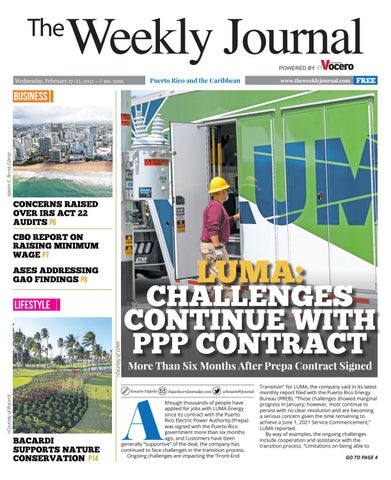
LUMA:
>Courtesy of LUMA
ASES Addressing GAO Findings P8
Challenges Continue With PPP Contract More Than Six Months After Prepa Contract Signed
A
>Courtesy of Bacardi
Rosario Fajardo
Bacardi Supports Nature Conservation P14
rfajardo@wjournalpr.com
@RosarioWJournal
lthough thousands of people have applied for jobs with LUMA Energy since its contract with the Puerto Rico Electric Power Authority (Prepa) was signed with the Puerto Rico government more than six months ago, and customers have been generally “supportive” of the deal, the company has continued to face challenges in the transition process. Ongoing challenges are impacting the “Front-End
Transition” for LUMA, the company said in its latest monthly report filed with the Puerto Rico Energy Bureau (PREB). “These challenges showed marginal progress in January; however, most continue to persist with no clear resolution and are becoming a serious concern given the time remaining to achieve a June 1, 2021 Service Commencement,” LUMA reported. By way of examples, the ongoing challenges include cooperation and assistance with the transition process. “Limitations on being able to GO TO PAGE 4
The Weekly Journal > Wednesday, February 17, 2021 >
2
2
Constant updates online 24/7. TheWeeklyJournal.com
Visit us for updated content on our 24/7 platform.
WeeklyJournal
The
3
/ Wednesday, February 17, 2021
a week in review San Juan to Receive $20.8 Million in CDBG-DR Funds
>Brandon Cruz González
>Josian E. Bruno Gómez
The Municipality of San Juan will receive $20.8 million in Community Development Block Grant for Disaster Recovery (CDBGDR) funds from the City Revitalization Program. The funds, which promote the rehabilitation of urban areas for the social and economic improvement of local communities, will be delivered in three rounds. The disbursement of nearly $4.2 million was approved in the first round for preconstruction works.
More Than 10,000 Auto Units Sold in January 2021 The United Group of Automobile Importers reported the new-car sales results for January 2021, showing that 10,085 units were sold in Puerto Rico. This is in contrast to January 2020 sales of 6,653, which represents an increase of 51.6 percent. Three segments that had significant increases in January were minivans, with an increase of 99.1 percent compared with last year; followed by vans with 85 percent; and sedans with 81.1 percent.
Powered BY El Vocero de Puerto Rico, 1064 Ave Ponce de León 2nd floor San Juan, PR Postal Address: PO Box 15074, San Juan, PR 00902
President Salvador Hasbún shasbun@elvocero.com Vp of Marketing and Business Operations Michelle Pérez Miperez@elvocero.com
Aguadilla, Ponce Airports to Reopen on April 1 The airports in the municipalities of Aguadilla and Ponce, whose operations with commercial airlines have been paralyzed since the start of the pandemic in March 2020, will resume flights on April 1. As part of the initiative, the Mercedita airport was expanded with an investment of more than $860,000. The investment to comply with COVID-19 protocols in these airports was $2.6 million. Meanwhile, the Rafael Hernández airport in Aguadilla has a new runway at a cost of $135 million.
VP of Accounting Félix A. Rosa frosa@elvocero.com
Human Resources Director Arlene Rolón, PHR arolon@elvocero.com
VP of Editorial Content Juan Miguel Muñiz Guzmán jmuniz@elvocero.com
Assistant Editor/ Reporter Rosario Fajardo rfajardo@wjournal.com
VP of Production Eligio Dekony edekony@elvocero.com
Traffic Director Ilia M. Pérez Centeno iperez@elvocero.com
Multi-Platform Graphic Director Héctor L. Vázquez hvazquez@elvocero.com
Multi-Platform Digital Director Stephanie Gómez Álvarez sgomez@elvocero.com
Phone: 787-622-2300, 787-721-2300 Customer Service: 787-622-7480
4
/ Wednesday, February 17, 2021
CONTINUED FROM PAGE 1
access field employees to create relationships, observe work, inquire about issues, has created a challenge for LUMA and Prepa Management. In many cases Prepa employees have been unwilling to cooperate with any requests from LUMA. Minimal action has been taken to rectify this situation,” the company said in the 38-page report. Meanwhile, the lack of information continues to hinder LUMA’s progress. “The lack and untimely response to RFIs [request for information] continues to be an issue impacting LUMA’s ability to form a complete understanding of operations, formulate comprehensive budgets and establish seamless cutover workplans.” Another issue of concern is FEMA funding management, which LUMA noted has improved in recent weeks. “However, we remain early in the implementation of capital works. This item is noted here given its criticality. As previously noted, it is imperative that significant focus by Prepa and LUMA be expended on ensuring complete transparency of all work activities to ensure a seamless transition to LUMA commencement,” stated the report. LUMA Energy, a private consortium, signed an agreement in June 2020 with the Puerto Rico government for a private-public partnership (PPP) to operate, maintain and modernize the Prepa’s transmission and distribution system. The 15-year contract, along with a 12-month transition process, includes an annual fee that starts at $70 million and increases to $105 million over time, plus a yearly incentive fee that starts at $13 million and increases to $20 million over time.
Prepa’s thermoelectric plant known as Central San Juan >Josian E. Bruno Gómez
Sectors Remain Against the Contract
LUMA’s challenges highlight the battle that the company faces with sectors that are against the contract, some of which want to cancel the entire deal. These include the Electrical Industry
& Irrigation Workers Union (Utier by its Spanish acronym), which charges that the deal will lead to higher electricity costs and violate some employees’ contracts. LUMA has denied the charges.
According to Tomás Torres Placa, the consumer representative in Prepa’s board of governors, a $9 million contract with the law firm Burns & McDonnell was recently increased to $30 million.
Utier holds a 24-hour strike in July 2020 to protest the LUMA contract. >Josian E. Bruno Gómez
Utier President Ángel Figueroa Jaramillo also went to La Fortaleza to state his case before Gov. Pedro Pierluisi. “This contract clearly does not benefit the people of Puerto Rico. There has been no public discussion of the contract. It is a leonine contract that will increase the [electricity]rate to the people,” Jaramillo said. He has also questioned some of the expenses the LUMA has billed, including claims that law firms have billed “millions of dollars at $1,000 an hour.”
5
/ Wednesday, February 17, 2021
The battle with Utier underlines LUMA’s challenges with a lack of cooperation from Prepa employees. Tomás Torres Placa, the consumer representative in Prepa’s board of governors, has echoed Jaramillo’s criticisms. He said that recently, a $9 million contract with the law firm Burns & McDonnell was increased to $30 million. “This type of action did not have and does not have my support, since a change of such magnitude requires the development of a separate competitive process, in order to obtain better costs for the benefit of consumers,” Torres said. At the same time, he charged that in November, LUMA billed total reimbursable employee expenses for $3.49 million. “This billing not only raises serious questions, but it does not reflect the efficiency that this contract would generate. Therefore, it is evident that it is necessary to review the concept of this contract that clearly goes beyond the duties of a transmission and distribution system operator,” he said.
LUMA Goes on the Offensive
On this front, LUMA has taken the public relations offensive in recent weeks, with a slew of statements and reports, and is also planning to hold a roundtable discussion with reporters, according to a company spokesperson. As part as of its ongoing Front-End transition work, LUMA Energy has filed with PREB an assessment of Prepa’s performance metrics against recognized utility industry benchmarks. The data obtained through independent, third party sources places Prepa’s overall customer satisfaction at the very bottom of all North American electric utilities, and with a large gap between Prepa and the next lowest-ranking utility. “Puerto Ricans deserve much better. LUMA is listening to Puerto Ricans and leveraging experienced and knowledgeable resources to accomplish the urgent transformation that this electric power system needs to support improved quality of life and increased economic development in Puerto Rico for years to come,” said LUMA President and CEO Wayne Stensby. Part of the data included in the assessment was drawn from a J.D. Power survey of Prepa customers conducted in December 2020. The survey ranks 144 utilities based on six criteria that include power quality & reliability, price, customer care and communication. Prepa’s score is almost 50 percent lower than the average utility, 47 percent worse than the second worst comparable utility and the lowest of the group of 144 utilities ranked in the survey. Filed documents also report the Prepa rate for 2019 of OSHA Recordable Incidents, which measure worker safety, was close to five times higher than the industry average. This incident rate is again almost 200 percent higher than the worst reported utility in the industry. OSHA is the Occupational Safety and Health Administration. “A robust and resilient energy system is the backbone for economic development and Puerto Ricans overwhelmingly support a transformation of their broken energy system. Every day this transformation is delayed makes the system
LUMA President and CEO Wayne Stensby >Brandon Cruz González
weaker and more vulnerable to powerful achieve the transformation, it is LUMA’s priority hurricanes and other natural disasters, placing to recruit within Prepa. Prepa employees’ talent, lives at risk,” said LUMA in a statement sent to THE historical knowledge and specific expertise is WEEKLY JOURNAL. vital to achieving our shared goal of recovery and With Prepa in bankruptcy, the transformation of the electric critical federal funds needed sector in Puerto Rico. This is for this transformation will where we continue to focus, but not be deployed into Puerto the significant influx of external Rico’s electric system “without candidates shows us that Puerto a credible, capable, competent Rican are excited about the The company operator that has the expertise opportunity to play a role in the has posted and experience to manage and transformation.” nearly 1,100 job administer those funds. According to LUMA’s recent positions and has “LUMA is preparing to monthly report, the company received more than transform the energy system has posted nearly 1,100 job 17,500 applications for the benefit of all Puerto positions and has received more from an estimated Ricans, through a contract that than 17,500 applications from an 7,500 applicants. is the result of a year and a half estimated 7,500 applicants. LUMA -LUMA’s most recent long process and was ratified is conducting interviews right monthly report by the Prepa Governing Board, now and is expected to continue and approved by the Financial with this effort throughout Oversight Board and the Puerto February. LUMA will also continue Rico Energy Bureau,” the to provide pension information company went on to say. to Prepa employees to support recruitment. “This Once LUMA begins to operate the electric remains the most significant issue for current power transmission and distribution system in employees as they consider career options,” LUMA June 2021, the company “will introduce efficiencies said. into the system that should produce savings LUMA emphasized the following: “No Prepa over the course of the contract. However, LUMA employees will lose their jobs as a result of this does not have the legal authority to determine transformation. Those who choose not to apply electricity rates. The Puerto Rico Energy Bureau is for employment with LUMA will stay with Prepa or the only entity authorized by Puerto Rico laws to will be transferred to other government agencies, evaluate, determine and approve rates.” LUMA has as established by Law 120 of 2018. The LUMA underscored this point on many occasions. Energy contract does not and cannot attempt to change that law. Further, Prepa employees who decide to accept positions at LUMA will have the Focus on Employee Recruitment option of continuing to contribute to their existing At the same time, LUMA continues to highlight retirement plans or enroll in LUMA’s 401K plan.” employee recruitment from present staff. “To
In fact,
6
/ Wednesday, February 17, 2021
The IRS found that Act 22 beneficiaries in Puerto Rico stopped contributing millions of dollars to the U.S. Treasury.
Act 20/22 Society Concerned Over IRS Mass Audits
Says it would discourage investment in Puerto Rico
I
Giovanna Garofalo
ggarofalo@wjournalpr.com
@giopgarofalo
n light of reports that beneficiaries under Act 22 of 2012, now encompassed in Act 60-2019, along with Act 20-2012, will be subject to scrutiny by the Internal Revenue Service (IRS), The Act 20/22 Society warned that mass audits endanger the island’s economic selfdetermination. “I have warned about this possibility [of audits] for years now. If the program was not more selective in attracting recipients that could make a meaningful contribution from a jobs and economic contribution perspective, we ran the risk of additional unwanted scrutiny based solely on the massive growth of the program, which now includes thousands of companies and even more individual recipients,” Robb Rill, head of The Act 20/22 Society, said to THE WEEKLY JOURNAL. Last week, it was revealed that the IRS will audit the tax obligations of Act 22 beneficiaries to verify if their financial statements are in compliance with federal tax laws. The news came after the federal entity concluded that the hundreds of Americans who had relocated in Puerto Rico had stopped contributing millions of dollars to the U.S. Treasury, per a report published in October 2020 that was based on a study that began in December 2019.
Rill pointed to the Economic Development Commission program in the U.S. Virgin Islands (USVI) to foster investment through tax benefits, akin to the intention behind Act 60. Due to mass audits by the IRS to prosecute individuals for tax evasion, the program was effectively shut down, he explained, adding that the audits are anathema to Puerto Rico’s financial sovereignty. “The problem is this seems to be right out of the playbook of how the program in the USVI was destroyed by mass audits, some of which are ongoing 10 years later, because the Treasury did not seem to like the program, [which] was specifically authorized by Congress to give the territories some autonomy in economic development, so they were less reliant on the [federal] government. The Puerto Rico government is simply following their mandate to encourage economic development, so the mass audits are quite a paradox and contrary to the rights and directive to the Commonwealth to use its tools to be more self-reliant,” he opined. Moreover, he stated that the mass audits could establish a negative precedent that could deter investment. He said that if the local government does not defend its self-determination to offer economic incentives, “the outcome is a foregone conclusion regardless of the status of audits.” According to Rill, there are over 2,500 companies registered as beneficiaries of this law and roughly 1,500 more on the pipeline, “with perhaps double that amount for individual recipients.” Although he was cautious to make assertions on these businesses or individuals, Rill said he believes most of them comply with U.S. tax laws.
“While I cannot speak for everyone because that would be rampant speculation, targeting people exclusively because they are a recipient, even through initial ‘soft letters,’ is a concern because you are sending a message that anyone who comes to the island and participates in the program is a target at some level, which will only serve to discourage investment on the island from quality recipients and a program which has created over 40,000 jobs and brought billions in collective investment to the island, and many hundreds of millions to the local Treasury,” he affirmed.
Denounces ‘Politicized Narrative’
Rill expressed concern that the IRS may have been weaponized by “certain politicians and political parties” to fuel what he deemed to be a “politicized narrative.” He pointed to the targeting of Tea Party members as an example, in which they were denied tax exemptions over their political affiliations. “The [Act 60] program was specifically targeted in the U.S. appropriations bill that funds the IRS by [U.S. Rep.] Alexandria Ocasio and her associates who clearly are against the program, despite the fantastic economic development it has brought to the island. It seems it furthers class warfare regardless of the positive results,” the investor opined. “The same issue occurred in the USVI and those targeted paid a much higher price than anyone else despite being complaint. I would like to think one won’t be targeted just for stating a position, but it’s a real concern, and I would think problematic from a legal and ethical perspective.”
/ Wednesday, February 17, 2021
7
CBO: Raising the Minimum Wage is a Double-Edged Sword Puerto Rico measure would raise it gradually every year
W Rosario Fajardo
rfajardo@wjournalpr.com
@RosarioWJournal
hile the debate on raising the minimum wage continues in Puerto Rico, the Congressional Budget Office (CBO) has released a report on the issue, stating that the impact of raising the federal minimum wage incrementally every year from $7.25 an hour to $15 an hour by 2025, would be a double-edged sword on the economy. “In an average week in 2025, the year when the minimum wage would reach $15 per hour, 17 million workers whose wages would otherwise be below $15 per hour would be directly affected, and many of the 10 million workers whose wages would otherwise be slightly above that wage rate would also be affected. At that time, the effects on workers and their families would include the following: Employment would be reduced by 1.4 million workers, or 0.9 percent, according to CBO’s average estimate; and the number of people in poverty would be reduced by 0.9 million,” according to the federal agency. Other impacts as per the CBO: • The cumulative budget deficit over the 2021–2031 period would increase by $54 billion. Increases in annual deficits would be smaller before 2025, as the minimum-wage increases were being phased in, than in later years. • Higher prices for goods and services— stemming from the higher wages of workers paid at or near the minimum wage, such as those providing long-term health care—would contribute to increases in federal spending. • Changes in employment and in the distribution of income would increase spending for some programs (such as unemployment compensation), reduce spending for others (such as nutrition programs), and boost federal revenues (on net). • From 2021 to 2031, the cumulative pay of affected people would increase, on net, by $333 billion—an increased labor cost for firms considerably larger than the net effect on the budget deficit during that period. • That net increase would result from higher pay ($509 billion) for people who were employed at higher hourly wages under the bill, offset
Small businesses make the world go ‘round. >Archive
by lower pay ($175 billion) because of reduced employment under the bill. Meanwhile, in Puerto Rico, Rep. Edgardo Feliciano, of the Popular Democratic Party, filed a bill that seeks to increase the minimum wage gradually. He explained that companies that have a gross income greater than $1 million must make a first adjustment of $2.25 an hour on Dec. 1, 2021, until their workers reach a base salary of $15 an hour in 2025. Companies that have a gross income of $500,000 to $1 million must make a first adjustment of $1.25 per hour on Dec. 1, 2021 and successively, until reaching $15 an hour in 2028. Feliciano acknowledged that an increase of the minimum wage would negatively affect small and midsize businesses, which is why he proposes a gradual raise. “We are filing this measure in the hope of doing justice to our workers. After the approval of the labor reform, the working class suffered a mortal blow to their labor rights. We have been talking and analyzing the issue of increasing the minimum wage for years and we understand that it is time to take action,” he said.
Cidre: Complex Issue, Local Businesses Hit Hard Designated Economic Development Secretary
Manuel Cidre remains cautious on the complex issue and said it must be handled in a sustainable manner. “Raising the minimum wage to $12 or $15 an hour would spell the end of many small and midsize businesses, the vast majority of which are locally owned. You don’t have to develop an economic model to know this. Are we all willing to sacrifice to provide a decent wage for the workforce? “The gradual increase in salary will mean that employees will have to have more skills to be hired. Although we are going to demand more skills from employees, it is important that employers invest in training and providing the necessary tools so that this employee can fulfill his role. Quite simply, the entire population will not be able to adapt to these changes. “The minimum wage must be one that allows workers to live in society and that automatically adjusts for inflation so that it does not depend on political ups and downs, and does not put empathetic companies at a disadvantage with their competitors. But increasing it in a sustainable way is not as simple as signing a law. For this to work, it must be a gradual increase and we have to reform our educational institutions, business models, urban centers, social aid programs and retrain an entire workforce to produce at the level that this new world requires,” Cidre said.
8
/ Wednesday, February 17, 2021
ASES Addressing Contract Reforms on Medicaid Program
Response to GAO report on oversight of procurement process
T Rosario Fajardo
rfajardo@wjournalpr.com
@RosarioWJournal
he Health Insurance Administration (ASES by its Spanish acronym) has been aware of the issues regarding contract reforms on Puerto Rico’s Medicaid spending and reforms have been underway even before a February 2021 report by the Government Accountability Office (GAO), said Jorge Galva, executive director of ASES. Public Law (P.L.) 116-94 [passed by Congress] provided Puerto Rico with additional funding for its Medicaid program, he indicated. In addition, the law provided for strict oversight and accountability measures designed to prevent waste, fraud and abuse. Among these measures are improved contracting practices and contracting oversight. “P.L. 116-94 mandated the performance of audits to the Medicaid program. Consequently, the GAO performed an audit for the 2018-2019 period. GAO found areas of opportunity, including the need for substantive changes to contracting practices. Since GAO had to present its report to Congress expeditiously, GAO timely advised Medicaid and ASES that there would be no opportunity for comments on the report,” Galva said to THE WEEKLY JOURNAL. Since the GAO report addressed the 20182019 period, and there was no opportunity for comments, ASES and Medicaid were unable to clarify that contracting practices amendment and improvement in line with P.L. 116-94 had already started even before GAO commenced the audit, Galva explained. “These amendments to contracting practices are detailed extensively in the report to Congress filed on Dec. 20, 2020, which can be accessed at ASES’s website. Included is a complete chapter devoted to contracting reform, which, as indicated, had started even before the GAO audit took place,” he added. Among the reforms, request for proposal (RFP) for all major services providers will be required. ASES’ Pharmacy Benefit Manager and Pharmacy Program Administrator will start RFPs as early as the end of the first quarter of 2021. “Thereafter, all major contracts will be subjected to RFPs or RFIs [request for information] as provided by the contract practices matrix,” Galva said. “ASES is entirely confident that it has gone
Jorge Galva, the executive director of ASES >Carlos Rivera Giusti
ASES is entirely confident that it has gone above and beyond the requirements of P.L. 11694 and that it will be able to ensure Congress that all federal monies provided to Puerto Rico‘s Medicaid program will be scrupulously safeguarded and accounted for. - Jorge Galva, executive director of ASES
above and beyond the requirements of P.L. 116-94 and that it will be able to ensure Congress that all federal monies provided to Puerto Rico‘s Medicaid program will be scrupulously safeguarded and accounted for,” he noted.
What the GAO Found
Galva was responding to a GAO report that raised concerns on the island’s Medicaid
procurement process. The GAO found that in 2018, Puerto Rico paid contractors almost all of its Medicaid spending—97 percent of $2.5 billion. “We found that the Centers for Medicare & Medicaid Services (CMS) does not oversee contracting in Puerto Rico, where former officials face allegations of contract fraud. We found that Puerto Rico did not always take steps to ensure competition or to lower the risk of fraud, waste and abuse. We recommend CMS begin risk-based oversight of contracting in Puerto Rico,” said the GAO. CMS is responsible for overseeing the Medicaid program and requires states and territories to use the same process for Medicaid procurements as they do for their non-federal procurements. “However, CMS has not taken steps to ensure Puerto Rico has met this requirement. Instead, CMS has relied on Puerto Rico to oversee the territory’s procurement process and to attest to its compliance. CMS approved Puerto Rico’s attestation of compliance in 2004 and has not required subsequent updates. CMS officials told GAO that states and territories are in the best position to ensure compliance with their respective procurement laws,” said the GAO. GAO also found that “seven of the eight selected Puerto Rico procurements did not include important steps to promote competition and mitigate the risk for fraud, waste and abuse, underscoring the need for federal oversight.”
9
/ Wednesday, February 17, 2021
FOMB Executive Director Natalie Jaresko reported that the entity reached a tentative agreement with creditors on $7 billion of debt. >Carlos Rivera Giusti
Plan of Adjustment Subject to ‘Unreliable’ Economic Projections Economists encourage a more conservative approach
E Giovanna Garofalo
ggarofalo@wjournalpr.com
@giopgarofalo
conomists warn that the Plan of Adjustment (POA) for Puerto Rico, to be presented by the Financial Oversight and Management Board (FOMB) on March 8, needs to be based on conservative economic projections for it to be feasible. As part of the framework, the FOMB seeks to settle an estimated $35 billion general obligation (GO) debt load by reaching agreements with bondholders and creditors. A tentative deal has already been reached on $7 billion of GO and Public Buildings Authority debt. The new, unofficial POA also includes annual payments of $1.15 billion to $1.3 billion from the central government. Annual payments must also be paid out through Cofina, or the Sales Tax Financing Corp., until 2058, which reaches almost $1 billion a year. Gov. Pedro Pierluisi has said that he would support the POA so long as it does not “contain cuts or adjustments to our pensioners.” However, the provisions must factor in the uncertainty of experiencing large-scale natural disasters or health concerns that could dismantle the basis of the POA. “The unprecedented level of uncertainty in modern times makes long-term economic and financial projections essentially unreliable,” said Sergio Marxuach, Policy Director at the Center for a New Economy (CNE).
Marxuach argued that although the influx of federal funding for disaster recovery and COVID-19 relief portrays a “modest” economic rebound, the macroeconomic scenario is complicated. “The economic stimulus will largely depend on the availability of federal funds, which in turn is subject to political and bureaucratic ups and downs in Washington, D.C. and the (in)capacity of the Puerto Rican government to execute complex operations. In addition, much of that spending will be on goods and services produced by foreign entities and individuals, which reduces the multiplier effect on the local economy,” he stated. Moreover, Espacios Abiertos - a nonprofit that promotes government transparency and accountability - affirmed that the FOMB’s debt repayment plan is unsustainable because even if its growth projections come through, Puerto Rico would run out of cash by 2029. “This new proposal, still unofficial, would entail annual payments of between $1.15 billion to $1.3 billion (from the central government plus the Cofina payment) for 20 years (until 2041) and annual payments of $991 million (rest of Cofina) between 2042 and 2058 With the new payment of $2.3 billion per year in pensions (‘PayGo’), the General Fund is left in a stressful situation similar to the period before the restructuring,” said Daniel Santamaría Ots, senior analyst of Public Policy at Espacios Abiertos. He added that the Board has already proposed a cut of $23.5 million from the certified General Fund budget in Fiscal Year 2021.
Ensuring Medium-Term Growth
The FOMB bases a portion of its medium-term projections on the impact of federal funding in
boosting a number of industries. Meanwhile, Heriberto Martínez, economist and head of the House Treasury and Budget Committee, underscored that once the island stops receiving federal funding, it will experience a decline in economic development. “The point here is that once this money stops reaching Puerto Rico in multimillion-dollar amounts, what must be happening then is that we have an institutional structural solidity that allows for moderate growth in the medium term,” he told THE WEEKLY JOURNAL. As such, he asserted that the government should allocate the money it is currently assigned on key infrastructure. Specifically, he listed energy, roads, the University of Puerto Rico (UPR) and the education system, and public health, such as institutions like the Medical Center and the UPR Medical Sciences Campus.“For the economy to grow steadily in the medium term, there must be transparency in government boards. Number two, you have to donate money directly to families and the Puerto Rican business ecosystem. Number three, money has to get to the municipalities for everything that has to do with infrastructure, roads... If these things happen, we will have an institutional model that can at least grow moderately in the medium term once those funds stop coming,” he affirmed. Regarding long-term growth, he agreed with Marxuach that the high level of uncertainty makes it virtually impossible to make reliable projections. -Journalist Rosario Fajardo contributed to this story.
10
/ Wednesday, February 17, 2021
Ensuring Capital Access
a Top Priority for SBA Director for Puerto Rico, USVI Urges businesses to apply for all eligible programs
S
Giovanna Garofalo
ggarofalo@wjournalpr.com
@giopgarofalo
ince taking office last month, Josué E. Rivera Castro, the new Acting District Director for Puerto Rico and the U.S. Virgin Islands (USVI) of the U.S. Small Business Administration (SBA), has been focusing on helping local businesses overcome the financial crisis caused by the COVID-19 pandemic by gaining access to capital. However, he said during an interview with THE WEEKLY JOURNAL that he has observed that businesses are not overly “enthusiastic” to apply for the second round of Paycheck Protection Program (PPP) loans. “It could be for several factors, such as lack of knowledge of these funds… or the fact that the professionals who offer support to businesses and individuals in applying for these funds are relatively overworked right now,” Rivera said. As an example, he noted that CPAs are simultaneously bracing for tax season, while offering their services to apply for a variety of state and federal programs for financial relief. The official noted that while the PPP relaunch establishes that companies with more than 300 employees are not eligible, the program opened new categories and reduced limitations on certain sectors, such as media and nonprofits. Rivera urged all eligible businesses to apply for the PPP and Economic Injury Disaster Recovery Loans (EIDL), another program by the SBA. “At the end of the day, what are the PPP and EIDL looking for? Keeping businesses afloat, for employees to keep their jobs, for those unemployment numbers to go down. And while these funds are available - which they are until March 31 or until the money runs out - we must promote and carry the message that we must request the funds,” he asserted. Having operated a small business in Cataño
Josué Rivera, left, assumed office in January after serving at the USDA. >Courtesy
before holding public office, Rivera acknowledged the numerous obstacles and bureaucracies that may hinder the development of small businesses. He said he wants to help businesses “create local wealth and capital to expand, to provide better pay and jobs, and lift Puerto Rico from this economic and fiscal crisis that has haunted us for some time now. It is a simple goal: access to capital, increase federal contracting in local firms and companies, strengthen businesses with continuity plans... increase exports from Puerto Rico, increase the production of those small businesses, and encourage consumers to buy local products.” Rivera has extensive background in government processes. Before his current position, he served for nearly three years as the State director for Puerto Rico in the U.S. Department of Agriculture’s Rural Development division, right after the island faced some of the worst natural disasters in its modern history due to Hurricane Maria in 2017.
Recent PPP Numbers
In the newest round of funding, the SBA has approved more than $171.2 million PPPs for
Puerto Rico and nearly $10. 9 million for the USVI, representing about $88 million more than the week prior. As of last week, 4,740 PPP loans had been approved for Puerto Rico and 96 for the USVI. On the latter, Rivera highlighted that this represents a sharp increase from the Jan. 24 report, which showcased that the USVI had zero approved loans and 46 loans by Jan. 31. Nationwide, the SBA reported that over 82 percent of PPP loans were approved for $100,000 or less and almost 70 percent were approved for $50,000 or less. “The average PPP loan size is now $78,000... [down] from $82,000 last week. This is demonstrable proof that this economic aid is going to those small businesses needing it the most,” the entity stated. The top five industries to receive approvals are the Accommodation and Food Service Industry, 18 percent; Construction, 14 percent; Manufacturing, 11 percent; Professional, Scientific and Professional Services, also 11 percent; and Health Care & Social Assistance with 10 percent. Rivera has been in constant talks with financial institutions, underscoring that it is important for cooperatives to participate in this process.
11
< The Weekly Journal > February, 17 2021
12
/ Wednesday, February 17, 2021
Ricardo Álvarez-Díaz
X
Licensed Architect and Entrepreneur www.advfirm.com
X
We Need a Functional Permit System you comply and get an automatic self-certification via the Single Business Portal via the internet. This must be accompanied, of course, with random inspections and audits to identify and avoid fraud, corruption and irregularities. The Government should provide a unique digital identity system to consolidate and digitize all documentation and certifications that are requested by agencies for government procedures. It should be the same Government that can provide the information to the citizen or company so that they do not have to search and submit said documents that are already in the possession of the state, facilitating the process to complete the necessary requirements. With a potential simplification of the permitting processes and its shifting responsibilities, it will be necessary to ensure compliance with all regulations and building codes to guarantee the health and safety of citizens and have consequences where false or fraudulent information is provided.
One of the biggest challenges is how to help people with limited resources and give them access to designs, permits and formal construction so the system does not encourage informal construction. To address this there should be a Social Justice Program for anyone in need (as occurs in the legal profession). The intent is to give the low-income population access to the best practices in sustainable, resilient design and construction against natural disasters, through consultancies covered by the Good Samaritan Law. A permit system where economic activity is facilitated to build, expand and create new businesses, with oversite and safety, is a crucial tool for economic growth. It requires training, certainty, an educational campaign, an entrepreneurial vision and a culture of oversight. A shifting in mindset and implementation of the process will ultimately allow us to improve the experience of doing business in Puerto Rico and make us competitive on the global stage.
>Archive
O
ne of the most crucial aspects for competitiveness and economic growth in Puerto Rico is the permitting process. Unfortunately, it has negatively affected all aspects of doing business on the Island. For years, governments have been recreating laws, adding multiple layers of compliance, and making changes to the rules that result in greater economic instability. Procedures are complex, unpredictable and therefore, inefficient. Sadly, permitting reforms have mostly focused on creating more and more layers and regulations without considering functionality and effectiveness. This excess in government regulation has produced an increase to the cost of doing business on the Island, which has and will continue to hinder sustainable investments. Worse still, it has forced a dependency on non-regulated third-party permit “experts,” which ultimately contributes to more informal construction, corruption and legal noncompliance. The permit system must focus on a process that is agile, simple, digitized, accurate and most importantly, a process with clear oversight where fraudulent information can and will be held accountable. Here are some recommendations for an agile, accurate and functional permit system: Optimize the permits office’s (OGPe) processes in the Single Business Portal, to increase user satisfaction and make it an affordable and easyto-use tool. Improve the system by making it citizen-centric so that it is simple and intuitive. The platform must be uniform and fully integrated with all municipalities. It should provide a clear and standardized set of fees, be robust, transparent, efficient and functional, so that all procedures can be executed in one place. The portal must integrate a measurement dashboard that can be used to streamline the permitting and accountability processes and measure permit award times. The portal should also provide several automatic permits by self-certification, when there is no environmental impact or dangerous activity, holding the business owner responsible for complying with the requirements and subject to inspections under penalty of cancellation of the permit and imposition of fines. For example, if you need a use permit on a new restaurant, you should be able to submit all the information including health and fire requirements. Certify that
/ Wednesday, February 17, 2021
13
Bacardi Doubles Pollinator Gardens for Bats, Bees and Butterflies in Cataño
Scientists concerned about worldwide insect loss
W Rosario Fajardo
rfajardo@wjournalpr.com
@RosarioWJournal
ith scientists fearing a worldwide “insect apocalypse,” Bacardi in Puerto Rico has received a Wildlife Habitat Council certification for expanding its pollinator garden at the company’s facilities in Cataño. Thanks to a newly expanded pollinator garden, the home of the world’s most awarded rum is welcoming increased numbers of butterflies, bees and, of course, bats. In 2019, the Puerto Rico team launched an ongoing restoration of the natural grounds near the front of the campus, which is now home to four of the eight bat houses on the property. The efforts resulted in the addition of six pollinator gardens covering 38,535 square feet or double the original size. The pollinator garden serves as a year-round food source to monarch butterflies, honeybees, native bees and seven species of bats, including the Antillean fruit bat, minor red bat, red fruit bat and Mexican free-tailed bat. Bacardi said the “all-employee volunteer team” is committed to this landscape-level conservation by diversifying the flowering plants while also encouraging the growth of native species to the island, creating an abundance of access to the nectar, pollen, cover and larval host plants needed by pollinators to feed and reproduce. “As a family-owned company, Bacardi, we take great pride in our efforts to build a sustainable future that will continue for generations to come. At Bacardi Corporation in Puerto Rico, we are making a positive impact in our work environment and getting our teams involved in learning more about their role in protecting the environment – at home and at work,” said Edwin Zayas, Bacardi Corporation vice president of Operations. “As leaders in the spirits industry, we feel a tremendous responsibility to protect natural resources and reduce our environmental footprint with the hope to inspire others to do the same.” While visits are currently limited to the Cataño campus, those on site are encouraged to explore the pollinator garden as an effort
Bacardi’s campus in Cataño >All photos courtesy of Bacardi
to raise awareness about the importance of pollinator habitats. Housed in between the operations site and Casa Bacardi – one of the most visited tourist sites on the island – the garden is visible to employees and tourists alike. Before lockdowns, Bacardi hosted its annual community event and focused part of the programming on educating guests about the role of pollinators in island’s ecosystem.
Call to Save Insects
Climate change, insecticides, herbicides, light pollution, invasive species and changes in agriculture and land use are causing Earth to lose probably 1 percent to 2 percent of its insects each year, said University of Connecticut entomologist David Wagner, lead author in a special package of 12 studies written by 56 scientists from around the globe. The problem, sometimes called the insect apocalypse, is like a jigsaw puzzle. And scientists say they still don’t have all the pieces, so they have trouble grasping its enormity and complexity and getting the world to notice and do something. Wagner said scientists need to figure out if the rate of the insect loss is bigger than with other species. “There is some reason to worry more,” he added, “because they are the target of attack” with insecticides, herbicides and light pollution. Co-author and University of Illinois entomologist
May Berenbaum said, “Insect decline is kind of comparable to climate change 30 years ago because the methods to assess the extent, the rate (of loss) were difficult.” Making matters worse is that in many cases, people hate bugs, even though they pollinate the world’s foods, are crucial to the food chain and get rid of waste, she said. Insects “are absolutely the fabric by which Mother Nature and the tree of life are built,” Wagner added. -The Associated Press contributed to this story.
14
/ Wednesday, February 17, 2021
Meat Replacement - What to Know and What to Try
Veggie burgers are all the rage these days.
Kickstart your own Meatless Mondays
M
Active Aging
eat substitutes are more popular now than ever. You might even be considering eating less meat yourself but don’t know how to get started. We’re here to help! We’ve put together all the details on what meat replacement options are out there, whether they’re good for you, and what you might want to try.
Why Meat Replacement?
First off, why are so many people choosing meat replacements? For some, it might be an animal issue. For others, meat replacement is an environmental consideration. And, there are people who may be seeking meat substitutes for health reasons, particularly for a lower risk of heart disease. Reducing meat consumption tends to have a positive impact on weight management and heart health, and reduces the risk for a number of chronic diseases. Whatever your reason for exploring the world of meat substitutes and imitation meat may be, it can be a delicious new adventure, and we’re here to
Try a tofu and avocado sandwich.
give you some pointers on what to try!
Meat Replacement Options
Let’s start by looking at meat replacement options from the most natural to the most processed. • Natural Plant Proteins Here are a few natural meat replacement options that vegetarians and vegans have long used to round out their diets. These whole food options include: • Beans • Lentils • Mushrooms • Jackfruit Maybe you’ve seen black bean or portobello tacos on the menu at your favorite restaurant. That’s because these natural foods are filling, are relatively high in protein, and have a nice texture to substitute for meat. • Tofu, Tempeh and Seitan Both tofu and tempeh are made from processed soybeans. Tofu is smooth and varies in texture - from firm cubes that you may have seen in a stir fry to a silken variety that makes a smooth base for mousse or smoothies. The soybeans used to make tempeh are fermented, and the result is a firmer, chunkier texture with a slightly nutty flavor. Tempeh is perfect for recipes like “meatballs” and “ribs.” On the other hand, seitan is made from vital wheat gluten, which means it’s packed with protein and has a chewy texture very similar to meat. You
can use seitan to make “hot dogs,” “burgers” or even “pepperoni.” • Imitation Meats You can find these meat replacements in the refrigerated or frozen sections of your local supermarkets. They’re designed to make an easy sub-in for your usual meat dishes, and most people find them tasty even if they don’t taste exactly like meat. Popular imitation meat brands and the products they offer: • Beyond Meat - plant-based sausages, meatballs, burgers and ground crumbles • Boca - veggie burgers, chik’n patties and chik’n nuggets • Gardein - a huge selection of chick’n, turk’y and beefless, porkless, fishless products • MorningStar Farms - veggie burgers, dogs, chik’n patties and nuggets, and chorizo • Quorn - veggie patties, meatless meatballs, roasts, fillets and nuggets • Tofurky - chick’n, deli slices, burgers, sausages & dogs, grounds, pockets and roasts As with any processed meat, these imitation meats contain more sodium than natural plant proteins or unseasoned soybean products like tofu - so it may be a good idea to include them in your diet in moderation. Hopefully, this introduction has taken some of the mystery out of meat substitutes and imitation meat. Now you can kickstart your own Meatless Mondays, or maybe even give it a whole Meatless Month!
15
/ Wednesday, February 17, 2021
Jack Daniel’s Launches Global Campaign to ‘Make It Count’
Encourages consumers to live boldly
W
The Weekly Journal Staff
ith a historic move, the legendary whiskey brand Jack Daniel’s has launched its new and first global creative campaign, “Make It Count.” The campaign highlights a new way of thinking for the 154-yearold brand, celebrating the people who consume it. The innovative content of this campaign is now available on television, digital, social, out-of-home and print media platforms in more than 100 countries. As a global brand that wanted to boost its Jack Daniel’s urges consumers to fulfill their dreams. iconic status, it was time for Jack Daniel’s to >All photos are courtesy show its unique vision of the world. “Make It Count” focuses on the impact on people’s lives The multinational and creative agency Energy when they choose to live boldly and with purpose BBDO was in charge of the campaign. The every day, just as Mr. Jack did inspiration for the campaign comes throughout his own life. from an old Jack Daniel’s ad that “At Jack Daniel’s we have a read “Served with pride in fine saying that Mr. Jack himself was establishments and questionable known for: ‘Every day we do locations.” It served as a reminder it, we will do the best we can.’ that Jack is for everyone 18 years Our new slogan, ‘Make every or older (drinking ages vary per moment count,’ is the modern country). As a result, “Make It version of communicating Count” invites fans to take life by the exactly that same philosophy of horns and enjoy every experience to life to the whole world. Today we the fullest. are here and tomorrow we may “With ‘Make It Count,’ we have a not be; we must enjoy the good long-term platform, which impacts things in life and, of course, with and creates a connection with the a Jack in hand we start with the consumer, especially in today’s right foot to do everything to environment, and carries the bold make our dreams come true. message of Jack’s independent Responsibly, of course,” said spirit,” said Matías Bentel, BrownJames Minier, Jack Daniel’s brand Forman brand director, Jack Daniel’s ambassador in Puerto Rico. parent company. “We know that this The new ad campaign follows The 60-second “First Timers” world-class creativity will continue to Jack Daniel’s motto of living ad kicked off the global drive the successful globalization of large and with purpose. campaign. This audiovisual our Jack Daniel’s brand.” piece showcases Jack Daniel’s “To relaunch an iconic brand like consumers who choose to live boldly and doing Jack Daniel’s? Of course, we have always wanted something they’ve always wanted to do. to do it. It has been a wonderful collaboration
with our clients and partners; we are very excited about what is happening,” said Josh Gross and Pedro Pérez, co-creative directors of Energy BBDO. “First Timers” was filmed in Kyiv, Ukraine, following all social distancing protocols. Director Ian Pons Jewell directed the shoot that lasted five days. It was supervised by the brand’s team and the creative agency, through the Zoom digital platform, with members from all possible time zones, tuning in until the final product was obtained. Jack Daniel’s is distributed in Puerto Rico by V. Suárez & Co.
The campaign is available in 100 countries.