Puerto Rico and the Caribbean
www.theweeklyjournal.com
>Brandon Cruz González
Wednesday, February 3-9, 2021 - // no. 093
Full Speed Ahead for Popular P6 FirstBank’s ‘Transformational Year’ P7 FOMB Approves $69M in Reapportionments P8
>Courtesy of the PRTC
>Archive
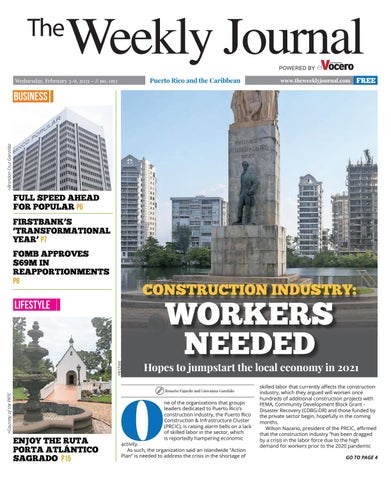
Construction Industry:
Enjoy the Ruta Porta Atlántico Sagrado P15
Workers Needed
Hopes to jumpstart the local economy in 2021
O
Rosario Fajardo and Giovanna Garofalo
ne of the organizations that groups leaders dedicated to Puerto Rico’s construction industry, the Puerto Rico Construction & Infrastructure Cluster (PRCIC), is raising alarm bells on a lack of skilled labor in the sector, which is reportedly hampering economic
activity. As such, the organization said an islandwide “Action Plan” is needed to address the crisis in the shortage of
skilled labor that currently affects the construction industry, which they argued will worsen once hundreds of additional construction projects with FEMA, Community Development Block Grant Disaster Recovery (CDBG-DR) and those funded by the private sector begin, hopefully in the coming months. Wilson Nazario, president of the PRCIC, affirmed that the construction industry “has been dragged by a crisis in the labor force due to the high demand for workers prior to the 2020 pandemic GO TO PAGE 4
TORIUM RA
The Weekly Journal > Wednesday, February 3, 2021 >
2
MO
United Way de Puerto Rico y la organizaciรณn sin fines de lucro Consumer Credit Counseling pueden ayudarte. Llama ahora al Centro de Informaciรณn y Referido 2-1-1 de United Way de Puerto Rico, te podemos empezar a ayudar.
United Way de Puerto Rico
3
/ Wednesday, February 3, 2021
a week in review Puerto Rico Treasury Has Disbursed $960 Million in Federal Stimulus Checks
>Courtesy
>The Weekly Journal
>Josian E. Bruno Gómez
The Treasury Department has disbursed over $960 million in federal stimulus checks of $600 each to qualified individuals in Puerto Rico. The incentives, approved by Congress to mitigate the economic impact of the coronavirus pandemic, has so far benefited more than 1 million Puerto Rico residents. The total disbursement of the $1.7 billion approved for the island should be completed by Feb. 15. The program will benefit 2.8 million local residents.
Puerto Rico Airport Opens COVID-19 Testing Centers
65 Percent of Restaurants Need at Least One Year to Recover
The Luis Muñoz Marín International Airport, Puerto Rico’s main airport, has opened COVID-19 testing centers in Terminals A and C, enabling passengers entering and leaving the island to comply with the travel regulations of the Puerto Rico government and other jurisdictions, announced Aerostar, the facility’s private operator. The results of the molecular tests will be provided in less than 48 hours, while those of antigen tests will take 30 minutes to an hour. The cost of each test is $110.
A survey of the local restaurant industry has found that 65 percent will take between one and two years to recover their pre-pandemic sales. Moreover, 38 percent of participants said their revenues have dropped by more than 50 percent since the beginning of the lockdown in March 2020, while 27 percent said theirs has dropped between 30 percent and 50 percent. The survey was commissioned by the Puerto Rico Restaurants Association.
Powered BY El Vocero de Puerto Rico, 1064 Ave Ponce de León 2nd floor San Juan, PR Postal Address: PO Box 15074, San Juan, PR 00902
President Salvador Hasbún shasbun@elvocero.com VP of Marketing and Business Operations Michelle Pérez Miperez@elvocero.com
VP of Accounting Félix A. Rosa frosa@elvocero.com
Human Resources Director Arlene Rolón, PHR arolon@elvocero.com
VP of Editorial Content Juan Miguel Muñiz Guzmán jmuniz@elvocero.com
Assistant Editor/ Reporter Rosario Fajardo rfajardo@wjournal.com
VP of Production Eligio Dekony edekony@elvocero.com
Traffic Director Ilia M. Pérez Centeno iperez@elvocero.com
Multi-Platform Graphic Director Héctor L. Vázquez hvazquez@elvocero.com
Multi-Platform Digital Director Stephanie Gómez Álvarez sgomez@elvocero.com
Phone: 787-622-2300, 787-721-2300 Customer Service: 787-622-7480
4
/ Wednesday, February 3, 2021
CONTINUED FROM PAGE 1 because of the onslaught of hurricanes Irma and Maria. Right now, we have serious problems with the recruitment of skilled construction workers. Although we support the [Pandemic] Unemployment Assistance programs [PUA], which include the provision of PUA funds and all kinds of assistance necessary for citizens, it is no less true that this further aggravated the situation for the recruitment of skilled construction workers.” According to Nazario, despite an abundance of work available for construction workers, thanks to new and upcoming construction projects, the industry faces a grim outlook due to the “automatic flow” of these economic stimuli, “which causes thousands of workers to opt for staying in their homes without working. Many contractors, developers and construction workers are urging the [new] government to set forth a plan that allows addressing the crisis concerning the lack of workforce.” Experts on the matter affirm that this situation has a double impact on the government. First, many projects could be stopped or delayed, and second, the Treasury’s collections could drop each day as thousands of workers who contributed taxes with their salaries are not incorporated into the labor force, he indicated.
Right now, we have serious problems with the recruitment of skilled construction workers. Although we support the [Pandemic] Unemployment Assistance programs [PUA], which include the provision of PUA funds and all kinds of assistance necessary for citizens, it is no less true that this further aggravated the situation for the recruitment of skilled construction workers.” - Wilson Nazario, president of the PRCIC
Nazario pointed out that while the government consistently provides updates on federal funding allocated or obliged for construction projects on the island, there is “no real statistic” on how many skilled workers are available to begin the projects. The most in-demand construction jobs include carpenters, rod holders (”varilleros”), bricklayers (”albañiles), and heavy equipment operators. In general, salaries in the construction sector vary
from $9 to $10 an hour, a bit higher than the island’s minimum wage of $7.25 an hour, which is the federal minimum wage. “It is imperative to reengineer the aid programs for workers and citizens so that they can be combined with work experience, which would give manpower capacity immediately available for the construction industry and other lines for the country’s development. It is important to note that the government must create an education and publicity program that encourages work, instead of staying at home waiting for aid that often does not arrive or, in other cases, the amount received does not compensate for their families’ needs,” he argued.
Doesn’t Recommend Importing Workforce
Despite underscoring the urgency in attracting or encouraging manual labor, the PRCIC president dismissed the idea of importing skilled construction workers to develop pending projects. “The current and future crisis of shortage in skilled workers and workforce for construction projects is not something that is magically resolved overnight. We recommend the creation of multiple Workforce Training programs with the help of the government and private companies. We do not recommend that labor be imported from neighboring countries, as long as we have thousands of workers available on the island,” Nazario affirmed. He added that the PRCIC began a pilot program last year to establish the Construction Industry Training and Laboratory Center, which provided “punctual and short intensive training” that allowed workers to have quick access to jobs in this economic sector. “The program works hand in hand with construction companies across the entire country so that these companies building
are the ones that will determine which highdemand work positions are required in their current projects. “In this way, the newly trained worker is effectively trained in areas of greatest need, and once the course is completed, the newly trained worker is assisted in obtaining employment immediately. Through this type of dynamic initiative, of courses taught by construction companies, which know the correct areas to train this personnel, the educational and technical part for the necessary personnel required in construction projects is effectively addressed,” he explained. “Every day in Puerto Rico, it is necessary to formally create the Construction Industry Training and Laboratory Center that will immediately be in charge of preparing those interested in working in our industry. We urge the new administration of Pedro Pierluisi to approve the creation of Workforce Training programs such as the one that we have managed to develop privately, and thus immediately address this serious crisis that affects Puerto Rico,” Nazario stated.
Construction Industry Shows Contraction
Despite the current need in Puerto Rico to rebuild following the hurricanes in 2017 and the earthquakes in 2020, which impacted the southwestern region of the island, the pause on commercial activities in place last year to mitigate the spread of COVID-19 (coronavirus) has affected this industry’s economic activity. Specifically, the sector experienced a 15 percent drop in construction permits expedited in the past fiscal year. According to the most recent Economic Summary by the Planning Board, throughout the span of fiscal year 2020, a total 3,094 construction
/ Wednesday, February 3, 2021
permits were awarded, which reflects a decline the private sector, in which only 917 construction of 525 permits compared to the 3,619 permits permits were awarded. The number, according to expedited in fiscal year 2019. In the Planning Board, represents percentage points, this showcases a decline of 2,519 permits a drop of roughly 15 percent. equivalent to 73.3 percent Humberto Reynolds, director compared to fiscal year 2019. of the Associated General The permits in the private sector Contractors of America - Puerto represented 29.6 percent of the The most Rico Chapter (AGCPR), told EL total permits, while in 2019 they in-demand VOCERO, the sister publication represented 94.9 percent of all construction jobs of THE WEEKLY JOURNAL, permits. include carpenters, that the crisis propelled by Umberto Donato, president rod holders the coronavirus impacted the of the AGCPR, informed that (”varilleros”), programming and planning of private construction projects had bricklayers construction works that were already been impacted before the (”albañiles), and scheduled for last year, which pandemic, due in part to the “30 heavy equipment gave way to the slump in the percent inflation” prompted by operators. In general, number of permits processed. the increase to $15 an hour in the salaries in the “2020 was a complicated minimum wage for construction construction sector year for the industry. In March, workers working on federally vary from $9 to $10 because of the pandemic, all funded projects. This figure is an hour, a bit higher construction works were banned. more than double the island’s than the island’s This set us back because there minimum wage. minimum wage of were several months without “The increase of the $7.25 an hour. working. All programming and [minimum] wage to $15 an hour planning of projects in the generated an indirect pressure pipeline were affected, which in the construction market and impacted construction permits,” other areas in the industry that Reynolds explained. caused many of the construction estimates to be The most dramatic downturn was registered in drafted once again. This paused the beginning
In fact,
5
of many public projects and completely stopped many private projects,” Donato said. The Planning Board indicated that the number of construction permits in the public sector for fiscal year 2020 registered an uptick of 1,994 permits compared to fiscal year 2019. The public construction permits constituted 70.2 percent and 4.9 percent of the total tally of construction permits for fiscal years 2020 and 2019, respectively. Donato was more optimistic in his outlook for the industry. He affirmed that “general contractors in Puerto Rico have the capacity to do the work expected with the arrival of federal funds from FEMA and CDBG… In the past, the local industry has demonstrated its ability to handle the forecasted work volumes. It is important to emphasize that capacity expansion, at the end of the day, is an equation of supply and demand. To increase capacity, there has to be an increase in demand, which has not happened yet.” He stressed that if the funds do not begin to be disbursed gradually —generating a steady, wellpaid volume of work— they cannot expect local construction companies and workers to increase their capacity at the expected rate. “When there is a constant demand that provides confidence and certainty, we will once again demonstrate our ability to execute the projects,” Donato asserted.
6
>Brandon Cruz González
/ Wednesday, February 3, 2021
Full Steam Ahead for Banco Popular
Q4 2020 one of the bank’s ‘best quarters’ in its history
D Rosario Fajardo
rfajardo@wjournalpr.com
@RosarioWJournal
espite the challenging economic environment, Banco Popular generated $507 million in earnings during 2020, even after recognizing $293 million in provision for credit losses, largely driven by the impact of the coronavirus pandemic, reported Ignacio Álvarez, president and CEO of the bank. During an earnings call and videoconference with local reporters, he highlighted Banco Popular’s strong performance, as the bank ended the fourth quarter (Q4) 2020 with $176 million in earnings. “This was one of our best quarters in our history. These results reflect the ongoing rebound in economic activity experienced during the second half of the year and the unprecedented level of federal stimulus. Our strong results also reflect our diversified sources of revenue and prudent risk management,” he said. The annual net income of $507 million reflects a decrease of about 24 percent from Banco Popular’s 2019 annual record net income of $671 million. “The decrease was largely driven by higher provision expense, lower fees and lower net interest income related to the economic disruption caused by the pandemic. 2020 results benefited from strong deposit growth and a higher level
of earning assets in both Puerto Rico and the increased by 32 percent in 2020 as compared to U.S. However, both of our brands have lower net 2019,” Álvarez said. interest margins during the year,” Álvarez said. With respect to the federal Payment Protection Meanwhile, the bank’s quarterly net income Program (PPP) program, he reported that $544 of $176 million was $8 million higher than Q3 million of the loans originated by Popular were 2020 and $9 million higher than under $150,000. “We have the same quarter last year. deployed an online platform “These results were driven for customers to request loan by higher revenues, partially forgiveness and have submitted offset by higher provision in approximately $500 million and operating expenses including forgiveness request to the Small Within pre-tax expenses of $23 million Business Administration,” he Popular’s clientele, related to our New York branch added. Leveraging this online debit and credit realignment program” that closed platform, the bank has begun card sales in dollars 11 branches, he explained. “The accepting applications for increased by 18 increase in net interest income the second phase of the PPP percent compared was driven by an increase in our program. to last year’s fourth investment portfolio and lower “To date, we have received more quarter. For the full deposit costs. Credit quality than 3,200 applications totaling year, sales increased trends were solid in the quarter.” approximately $234 million. On by 10 percent. the digital front, we continue to have more than one million Q4 2020 Highlights monthly active users on our Mi Within Popular’s clientele, debit Banco platform in Puerto Rico. We and credit card sales in dollars captured 71 percent of deposits in the fourth quarter increased by 18 percent compared to last year’s through digital channels. For the full year, 67 percent fourth quarter. For the full year, sales increased by of deposits at Banco Popular were captured digitally 10 percent. compared to 52 percent in 2019. Finally, our customer Auto loan and lease originations at Banco base in Puerto Rico continues to grow, increasing by Popular increased by 11 percent compared to the 6,000 in the fourth quarter to reach more than 1.9 year-ago quarter and “were only down 5 percent million unique customers,” Álvarez outlined. for the full year, notwithstanding the pandemicrelated disruptions. Similarly, we saw continued strength in the dollar value of mortgage durations at [the bank], which were up 20 percent in the fourth quarter versus the third quarter and
In fact,
7
/ Wednesday, February 3, 2021
First BanCorp Reports Net Income of $50.1 Million for Q4 2020 Expanded market share with Banco Santander acquisition
F Rosario Fajardo
rfajardo@wjournalpr.com
@RosarioWJournal
irst BanCorp, the bank holding company for FirstBank Puerto Rico, has reported net income of $50.1 million, for the fourth quarter (Q4) of 2020, compared to $36.4 million for the same time period in 2019. The financial results for Q4 2020 reflected the effect of the acquisition of Banco Santander Puerto Rico, completed on Sept, 1, 2020 for an entire quarter, and included merger and restructuring costs of $12.3 million. For the year ended Dec. 31, 2020, FirstBank reported net income of $102.3 million, compared to $167.4 million for the year ended Dec. 31, 2019, primarily reflecting in part the effect of the increase in credit loss reserves due to the adverse economic impact of the COVID-19 pandemic, especially during the first half of 2020. “We are very pleased with our operational and strategic results for 2020. I am proud of what our team has accomplished, despite the many challenges posed by the global pandemic,” Aurelio Alemán, president and CEO of First BanCorp. Calling it a “transformational year,” he added that the acquisition of Banco Santander Puerto Rico “has expanded our market share and solidified our market position in Puerto Rico. The results of the fourth quarter reflect the first full quarter of operation of the combined franchise. We are diligently working on the integration, which is progressing as planned, and is expected to be completed by the end of summer.” Loan origination activity was robust during the quarter at $1.4 billion, with growth in commercial and consumer portfolios. Total loan originations and renewals for the year reached $4.4 billion, and organic core deposits, which excludes brokered deposits, grew a record of $2.0 billion; the acquisition contributed an additional $4.1 billion in core deposits. At the same time, FirstBank provided extensive moratoriums programs to its borrowers and generating over $450 million of Small Business Administration Paycheck Protection Program loans. Meanwhile, as of Dec. 31, 2020, total nonperforming assets decreased by $23.9 million, or -7.5 percent compared to the previous year.
“Our clients’ adoption of digital channels during 2020 is driving our technological transformation with login activity up over 33 percent and digital transactions increasing over 55 percent for the year. Technology infrastructure projects initiated this year will drive future efficiencies and support our growing customer base.
An improving geopolitical environment in Puerto Rico and economic measures stemming from additional stimulus and disaster relief funding should provide additional support to those impacted by the pandemic. - Aurelio Alemán of FirstBank
“With over 30 percent growth in our customer base, to now approximately 675,000 banking customers, our enhanced market penetration should drive profitability as we progress on the integration and rationalization of our expense base,” Alemán added.
Optimistic Banking Outlook
An “improving geopolitical environment” in Puerto Rico and economic measures stemming from additional stimulus and disaster relief funding should provide additional support to those impacted by the pandemic, indicated the FirstBank chief. “Our fortress balance sheet, with liquidity, reserve coverage, and capital ratios above peers, will continue to support loan growth initiatives and capital deployment strategies. I am proud and grateful for what we have accomplished and the obstacles we have overcome during 2020, and we look to the future with great optimism.” According to Deloitte Insights, banks played a crucial part in stabilizing the economy and transmitting government stimulus and relief programs in the United States, Canada, the United Kingdom, Japan and many European countries. “Banks’ healthy capital levels before the pandemic also helped mitigate the negative impacts from
Aurelio Alemán, president and CEO of First BanCorp >Courtesy
the crisis and should pave the way for the global economy to thrive in the future. “For the banking industry, the economic consequences of the pandemic are not on the same scale as those during the Global Financial Crisis of 2008–2010, but they are still notable,” said Deloitte Insights, which provides business analysis and perspectives. In addition to the financial fallout, “COVID-19 is reshaping the global banking industry on a number of dimensions, ushering in a new competitive landscape, stifling growth in some traditional product areas, prompting a new wave of innovation, recasting the role of branches, and of course, accelerating digitization in almost every sphere of banking and capital markets,” said the company.
8
/ Wednesday, February 3, 2021
FOMB Approves Over
$69 Million in Govt Reapportionments Also focuses on improving the transportation system
T Rosario Fajardo
rfajardo@wjournalpr.com
@RosarioWJournal
he Financial Oversight and Management Board (FOMB) has approved an estimated $60 million in reapportionment requests by the Puerto Rico government for various education, health, the musical arts and gender violence services. During the 24th public board meeting, the first with the all newly appointed FOMB members, as well as Gov. Pedro Pierluisi, the Oversight Board approved reapportionment requests for such projects: • The Education Department ($9 million) to fund therapies and related services to special education students. • The Health Department ($1.64 million) for the construction of a hybrid cardiovascular operating room. • The Medical Services Administration ($5.85 million) to fund the construction and operation of a new Rehabilitation Center within the Trauma Hospital. • The Musical Arts Corp. ($854,000), as well as additional funding for the Casals Festival, Symphony Orchestra and Institute of Puerto Rican Culture. • The Office of the Women’s Advocate ($654,000) for prevention and education campaigns. • The Puerto Rico National Guard ($1.46 million) for the relocation of the Puerto Rico Youth Challenge Academy.
Improving the Transportation System
The FOMB also approved recommendations for the government to transform Puerto Rico’s “underperforming” transportation system. The island’s main mass-transit systems are the Metropolitan Bus Authority and the Urban Train, both of which operate in the San Juan metro area. The goal “is a unified, well-performing transportation system, which will reduce traffic congestion, increase access to public transportation, improve the governance of transportation entities and the fiscal sustainability of public transportation agencies, and promote
Several musical arts entities in Puerto Rico have received much-needed funding. >Archive
economic development and growth in Puerto Rico,” according to the FOMB. The recommendations include that the government: • Restructure its transportation agencies into three specialized entities that align assets to the agency’s mandate: non-toll roads, toll roads and mass transit. • Create an independent Transportation Policy Board and empower it to set and execute an islandwide transportation strategy. • Maximize funding through a more aggressive federal grants strategy and by attracting private capital.
Education Strongly Rebuked
As reported by THE WEEKLY JOURNAL, the Education Department was clearly in the proverbial hot seat during the meeting, as the FOMB clawed back $30 million in payroll funds.
According to the Oversight Board, Puerto Rico paid more than $28 million in salaries in recent months to people who no longer work for the Education Department, even after officials last year flagged the practice as a problem. “This is total outrage,” said board member Antonio Medina. “It’s the worst kind of corruption. It’s stealing the future of our children.” The FOMB first publicly flagged the problem in late September, announcing it had contacted federal and local law enforcement agencies after discovering that Education paid more than $84 million in salaries to some 17,500 people from 2007 to 2020 who no longer worked there. The Oversight Board said the department failed to meet its requirement to implement a time and attendance system by mid-December. “I don’t feel surprised,” said board member Andrew Biggs. “After four years of observing the government of Puerto Rico in action, this doesn’t shock me at all.” He noted that the government years ago had invested $33 million in a time and attendance software system that is not used, leading to the loss of more than $84 million over more than a decade. The department has one of the largest government budgets, with $1.36 billion allocated in fiscal year 2021, and the board called for the budget to be adjusted if the more than $28 million is not recovered. Education has struggled in recent years with millions of dollars in damage caused by hurricanes Irma and Maria in 2017 and a series of strong earthquakes that began in late 2019 that led to the permanent closure of several schools along the island’s south coast. Pierluisi, who assumed office last month and is the first governor to sit in on such meetings, said he was not aware of the recent payments. He pledged that implementing a time and attendance system will be a priority, adding that those who collected pay without working for the government will be held accountable. “They’ll have to pay one way or another,” he said. “Rest assured that we’ll deal with this.” The ongoing issue comes as Puerto Rico continues to restructure a portion of its more than $70 billion public debt load, accumulated from decades of unchecked borrowing of millions of dollars to cover ballooning deficits. In 2015, Puerto Rico announced it was unable to pay its public debt. Two years later, it filed for the biggest U.S. municipal bankruptcy in history. - The Associated Press contributed to this story.
9
/ Wednesday, February 3, 2021
re:3D’s newly designed coffee picking basket >Courtesy
re:3D Startup Wins Nationwide Tech Innovation Award
Puerto Rican company focuses on large scale, affordable 3D printing
T Rosario Fajardo
rfajardo@wjournalpr.com
@RosarioWJournal
he Puerto Rico Science Technology and Research Trust, along with its SBIR/STTR (Small Business Innovation Research/ Small Business Technology Transfer) Program, have been focused on promoting the development of startup companies on the island. Their efforts are being rewarded as one of its own startups, re:3D Inc., has been awarded the 2020 Tibbetts Award for their substantial economic and social benefits contributions. Re:3D is the program’s most recent success story, having participated in parallel18, the Trust’s startup accelerator, and obtaining a Phase I and Phase II NSF (National Science Foundation) SBIR grant. “Our SBIR journey and investigations into how 3D printing could be used to create functional objects on demand and/or from recyclables could not have happened without support from the Trust. The Phase I match helped us investigate functional objects that might be made to create value locally from waste using Gigabot X. As part of the Phase II match from the Trust, we will be implementing hardware in Puerto Rico to process and print 3D products to trial the commercialized solution in different applications and settings needed on the island, with local hires in hope of supporting new jobs,” said Samantha Snabes co-founder and “catalyst” of re:3D.
She explained that the SBIR support provided the necessary resources for this “socially driven, open-source, bootstrapped hardware company” to complete the significant research required to modify its existing large-scale 3D printers. The modification allowed the 3D printers to accept shredded plastic water bottles and other recyclables as a feedstock. SBIR funding also enabled re:3D to investigate applications of the hardware to create functional goods from trash – which led to their exploration of opportunities to design and print functional objects from discarded water bottles – such as creating new jobs by those displaced by last year’s earthquakes.
A Better Coffee Picking Basket
A recent example to determine the practicality of using recycled plastic to create real-world, functional objects is Sandra Farms – a coffee and chocolate farm in Adjuntas – that collaborated with re:3D on a solution to make improved coffee picking baskets. “Most agricultural workers in Puerto Rico traditionally are the forgotten people here, and that’s reinforced through what they use to pick coffee with, which is mostly just fertilizer bags, or really uncomfortable, five-gallon buckets that are not at all made for coffee picking,” said Dominico Celli, who works with Sandra Farms on sustainability practices. “The five-gallon plastic bucket… It’s functional, it works, cheap – but not ideal, not ergonomic,” he added. After several rounds of the design and testing process, developed with local designers and mechanical engineers, the crescent moon design for a new basket on which they settled, curves around the front of the waist, with a wide profile so a picker’s hands don’t have to travel far to drop
Samantha Snabes co-founder and “catalyst” of re:3D >Courtesy
in coffee cherries. It’s manageable enough to strap over one’s shoulders and carry through the field, yet sturdy enough to haul over 15 pounds of coffee. The award is named after Roland Tibbetts, who is credited with developing the SBIR program, and is presented annually to those who are models of excellence in how they leveraged the SBIR or STTR programs. Since 1987 Puerto Rico’s SBIR/STTR program has impacted the growth of the island’s economy by achieving 43 winning proposals and by raising more than $9.2 million in funds, according to the Trust. Since the third quarter of 2015, 16 additional awards have been awarded to researchers and entrepreneurs in Puerto Rico.
10
/ Wednesday, February 3, 2021
New Blood to Revitalize the Casino Industry
Foxwoods brand takes over El San Juan Casino
T Giovanna Garofalo
ggarofalo@wjournalpr.com
@giopgarofalo
he iconic casino at the Fairmont El San Juan Hotel in Isla Verde will reopen later this year as the Foxwoods El San Juan Casino, following a $12.5 million investment to renovate the historic establishment, which has featured legendary celebrities from around the world for more than six decades. The new brand stems from a partnership between the Mashantucket Pequot Tribal Nation and LionGrove. Between their investment to bring new life to the casino and recently completed renovations to the hotel, the Fairmont El San Juan has had $137.5 million in resort enhancements. The two partners announced that they will also reopen the renowned Tropicoro entertainment venue, welcoming From left: Rodney Butler, chairman of the board of Foxwoods Resort Casino; Gov. Pedro Pierluisi, and Andro back performers, artists, live entertainment and Nodarse-León, co-owner of Fairmont El San Juan Hotel >Courtesy events once again to its stage. Between the investments and the reopening of once more. LionGrove in 2015 and was temporarily closed the casino and Tropicoro, the partners anticipated Rodney Butler, chairman of the Mashantucket from 2016 to 2017 due to $65 million in generating an estimated economic impact of $22 Pequot Tribal Nation, is confident that with their renovations. After sustaining damages due to million, creating a projected 360 ample experience operating Hurricane Maria in 2017, management restored new jobs, of which more than 150 casinos, the development will the hotel with a $60 million investment and would be at the casino alone. The allow the Foxwoods brand to rebranded it as the Fairmont El San Juan Hotel in partnership was announced after “bring award-winning gaming January 2020. the new administration eased experiences to Puerto Rico.” The “Currently, the Fairmont El San Juan Hotel is COVID-19 restrictions, giving Mashantucket Pequot people more accommodating and exciting than ever, and Located in the some relief to the casino sector, are a Connecticut-based Native with this great partnership, we are bringing one of beachfront Fairmont which generates $250 million in American tribe that owns and has the strongest casino brands in the world to Puerto El San Juan Hotel sales and employs 3,000 workers operated the Foxwoods Resort Rico with plans to launch the most exciting and along Isla Verde, directly. Casino for nearly 30 years. innovative casino on the island at Puerto Rico’s the approximately According to Miguel Vega, “We’re teaming up with most legendary address,” said Andro Nodarse 15,000-square-foot chairman of the Casino one of the most sophisticated León, LionGrove founder and CEO. casino will feature Committee of the Puerto Rico players in the market. Bringing Gov. Pedro Pierluisi affirmed that the island’s 15 table games and Hotel and Tourism Association, together our resort experience tourism sector “represents a great opportunity for 300 slot machines the island’s 16 casinos have and expertise with Fairmont our economic development and my commitment is to complement reopened since the ban on El San Juan’s renowned brand, to enhance it. The pandemic has seriously affected the resort’s luxury operations was lifted and are we believe we can bring real tourism on our island, as well as around the world, accommodations and experiencing gradual recovery, economic and employment but with the advent of vaccines, better treatments amenities. adding that the industry has growth to Puerto Rico. In addition and security measures, we are preparing so that remained stable “within the to offering guests a one-of-a-kind Puerto Rico can receive visitors and safely enjoy parameters” of the executive luxury resort destination, the all that our beautiful island has to offer. I am order. With the Foxwood El San development will bring revenue, confident the coming months will be crucial and Juan Casino expected to open its doors by the value and tourism to the area,” Butler affirmed. we will position ourselves positively to resume end of the year, the sector is expected to thrive The El San Juan Casino was acquired by tourism activity.”
In fact,
11
Usar mascarilla dice mucho de ti.
Pero sobre todo, previene la transmisión de miles de partículas que se esparcen en el aire cuando hablamos, tosemos, estornudamos o nos reímos.
Prevén el contagio y usa la tuya. #MiMascarillaDice
< The Weekly Journal > Wednesday, February 3, 2021
TU SALUD VA ANTES QUE MI JANGUEO
12
/ Wednesday, February 3, 2021
Fernando Rodríguez
Discover Puerto Rico’s Chief Financial Officer
A
Transparent in Everything We Do for Our Beloved Island
t Discover Puerto Rico, our mission is to make Puerto Rico visible to the world as a premier travel destination. As the Island’s nonprofit destination marketing organization (DMO), we take great pride in our work. During the past several years, Puerto Rico has faced many challenges such as hurricanes, bankruptcy, political unrest, earthquakes and – for a year now -- the COVID-19 pandemic. These disastrous events have had a negative effect on the Island’s economy, especially the Tourism industry. The people of Puerto Rico are resilient, however, and have battled back from these crises; indeed, we’re seeing high levels of pent-up demand from responsible travelers eager to return to our Caribbean oasis, in great numbers when COVID-19 is under control. Unfortunately, though, Discover Puerto Rico has faced another foe – unwarranted and false accusations from select individuals whose goal is to dismantle our organization as a personal vendetta. However, we will continue to focus on our work and welcome collaborative conversation, as we are a nonpartisan organization set on operating transparently and as approved by Law 17. As a native Puerto Rican and Discover Puerto Rico’s Chief Financial Officer, it is my duty and obligation to conduct our financial affairs legally, ethically and with one purpose: to encourage tourism by promoting our Island’s many natural wonders and attractions. And that’s exactly what we’re doing and have always done since the organization was created by legislation in 2017. In all situations – in good times and bad – Discover Puerto Rico is extremely cautious in the use of public funds and mindful of our accountability to the people. That means being transparent in
everything we do. But when we talk about transparency, what do we mean? The dictionary defines transparency as “operating in such a way that it is easy for others to see what actions are performed… through openness, communication and accountability.” Discover Puerto Rico is committed to transparency, in countless ways. Our doors are always open for dialogue to those interested in learning about our role, mission, goals and achievements. We have adhered to this since the organization’s inception, making our industry website accessible through registration and holding public, open forums, quarterly (and now monthly) industry updates to share the latest from our organization. All of our processes, documents, events calendars, annual reports, contracts, audited financial
statements, salary information, job openings and more are posted on the industry website for public knowledge. We strongly believe that by sharing relevant information, we help our important stakeholders understand our impact on Puerto Rico’s visitor economy and promote collaboration, reinforcing our commitment to accountability when managing public funds.
Current Budget of $25 Million
And, importantly, our impact has been significant, even during trying times. In our first full year of advertising (2019), we had a record economic impact of $2.3 billion, which is a return of investment of $98, for $1 spent by Discover Puerto Rico. Since our opening in July 2018, we’ve had a total of $586 million of positive publicity earned for the Island and a total of $95 million of
Puerto Rico’s natural wonders are “first class.” >Courtesy of Discover Puerto Rico
economic impact at the meeting and convention sales (MICE). The current future sales pipeline is 79 percent greater than what we began with in 2018, despite the pandemic. The hotel tax provides our annual budget of about $25 million; however, this revenue was severely impacted when tourism everywhere came to a halt due to the global pandemic. Given this, we applied for and received CARES Act funding (as did other U.S. destinations), and those additional funds have enabled us to continue our marketing efforts – which include inspiring future travel, encouraging responsible travel and health and safety guidelines. These funds are not used for salaries, administration or overhead operational costs. The people of Puerto Rico are as resilient as ever, and we are committed to supporting our local partners at a time when they need it most. As we kick off 2021, we will continue to prioritize transparency and maintain an open line of communication with our stakeholders during this critical time for the Island as we prepare for a great tourism recovery. To learn more about Discover Puerto Rico, and to view any of the information mentioned above, visit www.discoverpuertorico.com/ industry.
X
X
13
/ Wednesday, February 3, 2021
Smart Home Tech Trends for Refreshing Updates
Making life a little bit easier
Y
Home Sweet Home
ou’ve spent so much time at home in 2020, you’re probably ready for a refresh to kick off 2021. Update your “home sweet home” with these smart tech additions to make life just a little bit easier. Because after this crazy year, we all deserve a break. We’ve organized these 10 smart home trends by living area, so you can find the items that are perfect for you and your family.
Kitchen
• WiFi Instant Pot The Smart WiFi Instant Pot allows you to schedule, monitor, and adjust your slow cooker or pressure cooker meals from your smartphone. And it’s not just for making chili! You can use the Smart WiFi Instant Pot to make rice, yogurt, steamed veggies, and even cake! • Ninja Hot and Cold Brew System Not only does this coffee maker brew 6 different cup sizes of smooth, delicious coffee, it also boasts a separate tea basket and intelligent brewer for
time and temperature based on the type of tea you’re drinking. And there’s more! Make hot, foamy lattes with its fold-away frother, or set your coffee to brew over ice, and you’ll have a cup of naturally sweet cold brew in ten to fifteen minutes. • GeniCan Scanner GeniCan attaches directly to your garbage can and automatically scans the barcode of the item you’re throwing away to add it to your smart grocery list. Out of ketchup? No need to make a mental note for later - GeniCan already put it on your list! Need more bananas? Just hold the peel over the scanner until GeniCan asks you what item you want to add.
Living Room
• iRobot Roomba S9+ Sure, Roomba has been around for a while now, but this is the new generation of smart vacuums. The iRobot Roomba has 40x the suction power of its predecessors, and it can empty itself. No more dumping out that tiny dustbin every two days - this robot vacuum can go up to sixty days emptying itself into its Clean Base® Automatic Dirt Disposal. Not to mention, its navigation technology has improved to the point that if it runs out of charge, it will charge itself then come back to pick up where it left off. • Sobro Coffee Table Let’s talk luxury for a moment - this Sobro
Coffee Table is the ultimate for a connected smart home lifestyle. The table itself houses 2 USB ports and 4 outlets, Bluetooth speakers on either end, LED lights underneath, and a touchscreen on top. There’s also a refrigerated drawer to keep all your favorite beverages chilled to a perfectly controlled temperature.
Master Bedroom
• Daqiconcept Chirp Alarm Clock This sleek alarm clock has the look of a modern art bird on a perch. You’ll wake up to a gentle light that gradually increases in brightness over twenty minutes and the tranquil sound of birds chirping. You can adjust to your preferred nature sound and alarm timing from the Daqi app and use easy touch controls at the clock’s base to change volume and light settings. • BedJet 3 BedJet has been helping us sleep for years with its patented, precision cooling and heating technology for under the covers. But BedJet 2021 is rolling out SmartHome features so staying warm or cool at night will be easier than ever!
Bathroom
• LIFX Clean Lights These antibacterial and germicidal light bulbs connect with your smart home automation and can be used as regular LED lighting or set to HEV lighting to rid surfaces (perhaps your smartphone or the bathroom or kitchen counters) of bacteria. Their first pre-order batch has already sold out, so put your name on the list for 2021! • Euroto Smart Toilet Bidet You may have heard that bidets were all the rage with this year’s toilet paper fiascos - but this is a bidet you’ll want in 2021 and for many years to come! Use the wireless remote control for its various spray features, water pressure, temp, warm air dryer, and LED nightlight. It also allows different users to save their preferred settings.
>Courtesy of Airbnb
Kids’ Rooms
• Codi the Storytelling Robot The top smart home trend for kids is still Pillar Learning’s Codi Robot. Codi tells over 100 classic stories and sings songs to entertain and educate children without using a screen. You can select which stories and songs you want him to play (or not) from the parent app, set volume controls, and set routines, so Codi knows when to guide your children through clean up time. Give yourself the gift of ease in 2021 with these smart home tech trends that will make your life just that much easier.
14
/ Wednesday, February 3, 2021
This undated photo provided by Dr. Greg Skomal shows a shortfin mako shark. In a study published on Jan. 27, 2021, researchers found the abundance of oceanic sharks and rays has dropped more than 70 percent between 1970 and 2018. >Greg Skomal via AP
Empty Seas: Oceanic Shark Populations Dropped 71 Percent Since 1970 Threatened with extinction on several fronts
W
The Associated Press
ASHINGTON (AP) — When marine biologist Stuart Sandin talks about sharks, it sounds like he’s describing Jedis of the ocean. “They are terrific predators, fast swimmers and they have amazing senses — they can detect any disturbance in the ocean from great distance,” such as smells or tiny changes in water currents. Their ability to quickly sense anything outside the norm in their environment helps them find prey in the vastness of the open ocean. But it also makes them especially vulnerable in the face of increased international fishing pressure, as global fishing fleets have doubled since 1950. “You drop a fishing line in the open ocean, and often it’s sharks that are there first — whether or not they’re the primary target,” said Sandin, who works at the Scripps Institution of Oceanography. Scientists have known for decades that individual shark species are declining, but a new
A manta ray >Courtesy
study drawing on 57 global datasets underscores just how dramatically worldwide populations have collapsed in the past half century. Globally, the abundance of oceanic sharks and rays, which are closely related to sharks, dropped more than 70 percent between 1970 and 2018, according to a study published Jan. 27, 2021 in the journal Nature. And 24 of the 31 species of sharks and rays are threatened with extinction, while three species — oceanic whitetip sharks, scalloped hammerhead sharks and great hammerhead sharks — are
considered critically endangered. “The last 50 years have been pretty devastating for global shark populations,” said Nathan Pacoureau, a biologist at Simon Fraser University in Canada and a co-author of the study. Sometimes sharks are intentionally caught by fishing fleets, but more often they are reeled in incidentally as “ bycatch,” in the course of fishing for other species such as tuna and swordfish. Sharks and rays are both fish with skeletons made of cartilage, not bone. In contrast to most other kinds of fish, they generally take several years to reach sexual maturity, and they produce fewer offspring. “In terms of timing, they reproduce more like mammals – and that makes them especially vulnerable,” said Pacoureau. “Their populations cannot replenish as quickly as many other kinds of fish.” The number of fishing vessels trolling the open ocean has risen steeply since the 1950s, as engine power expanded ships’ range. And while climate change and pollution also imperil shark survival, increased fishing pressure is the greatest threat for every oceanic shark species. “When you remove top predators of the ocean, it impacts every part of the marine food web,” said Stuart Pimm, an ecologist at Duke University, who was not involved in the study. “Sharks are like the lions, tigers and bears of the ocean world, and they help keep the rest of the ecosystem in balance.”
15
/ Wednesday, February 3, 2021
Take a Day Trip to the Porta Atlántico Sagrado
Tour places of high cultural, religious and architectural value in northern municipalities
T
The Weekly Journal Staff
he Puerto Rico Tourism Co. (PRTC) is continuing to encourage visitors to tour the island, this time with the launch of the Ruta Porta Atlántico Sagrado, a cultural-religious experience that allows you to discover the historical-religious and multicultural heritage in the municipalities of the northern region of Puerto Rico called Porta Atlántico. The project is the result of a collaboration between the Planning and Development Division of the PRTC, together with the Tourism Offices of the municipalities of Toa Baja, Dorado, Toa Alta, Vega Alta, Vega Baja, Manatí, Arecibo, Hatillo and Camuy, and the contribution of archaeologist Carlos Ayes. “With the launch of the Ruta de Porta Atlántico Sagrado, the Tourism Co. continues to diversify the destination’s offerings, decentralize the economic activity of the industry and promote safe and responsible options so that the island’s residents can enjoy [various] activities of internal tourism,” said the PRTC in a statement. “We recognize the work of our Planning and Development Division to elevate our cultural heritage and the Puerto Rican traditions that distinguish us in a region as competitive as the Caribbean. The creation of this and other thematic routes is part of the strategies in which the PRTC is focusing its efforts to maximize the potential of our destination,” said the government agency. Among the places that are included in the Porta Atlántico Sagrado Route are: the centennial Stone Church in Camuy; the San Felipe de Arecibo Cathedral; the ruins of the Hermitage of the Virgen
Nuestra Señora de la Candelaria Church in Manatí >Photos courtesy of the PRTC
The Shoensttat Sanctuary in Hatillo
de la Candelaria in Toa Baja; the Santo Cristo de la Reconciliación monument in Dorado; the most important municipal collection of carvings of ancient saints on the island in the municipality of Manatí; the historic San Fernando Rey church in Toa Alta; the Schoenstatt Sanctuary in Hatillo and the Al Faruq Mosque in Vega Alta. Through the Route, participants will be able to learn details about these and other important historical monuments, art, architecture, historical characters, traditions and the origin of traditions and values that define Puerto Rico’s multicultural identity. The Porta Atlántico Sagrado Route can be enjoyed in a self-directed way, but visitors are recommended to contact a certified tour guide to make the experience even more enriching. The PRTC-endorsed operators offering these tours adhere to strict health and safety protocols required by the Tourism Co. to be an industry member. Those who wish to travel the route on their own should know that some of the places require an appointment to visit them, so it is recommended to contact each entity. For more information about the Porta Atlántico
Sagrado Route, you can write to info@dtonline. tours; or contact the following municipal tourist offices: · Municipality of Toa Baja: 787-261.0202, ext. 2606 · Municipality of Dorado: 787-796.1230, ext. 4300 · Municipality of Vega Alta: 787-883.5900, ext. 2201 · Municipality of Vega Baja: 787-858.5801 · Municipality of Manatí: 787.854.2024, ext.2062 · Municipality of Arecibo: 787-879.8021 · Municipality of Hatillo: 787-262.3561 · Municipality of Camuy: 787-898.1556 In addition to the Porta Atlántico Sagrado Route, similar routes can be planned on other routes with a cultural/religious theme endorsed by the PRTC, namely the Route of Blessed Carlos Manuel in Caguas; the Route of San Juan Bautista in Old San Juan; and the Ruta de Porta del Sol Sagrado in the western region. For information about offers of stays, attractions, excursions and other options to enjoy your vacation in a safe and responsible way, visit VoyTuristeando.com.
Constant updates online 24/7. TheWeeklyJournal.com
Visit us for updated content on our 24/7 platform.
WeeklyJournal
The