Wednesday, January 20-26, 2021 - // no. 091
Puerto Rico and the Caribbean
www.theweeklyjournal.com
Great Expectations from President Biden P6 New DDEC Secretary is thinking outside the box P8 Prepa Selects Program Management Provider P9
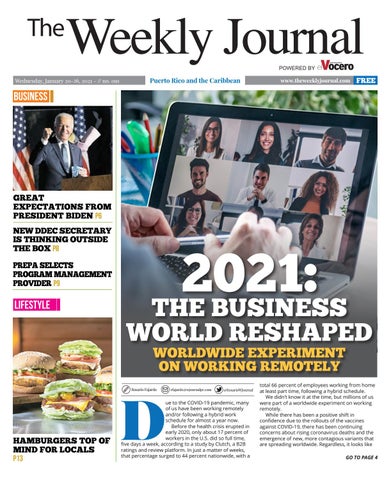
2021: The Business
World Reshaped Worldwide experiment on working remotely
D Rosario Fajardo
Hamburgers Top of Mind for Locals P13
rfajardo@wjournalpr.com
@RosarioWJournal
ue to the COVID-19 pandemic, many of us have been working remotely and/or following a hybrid work schedule for almost a year now. Before the health crisis erupted in early 2020, only about 17 percent of workers in the U.S. did so full time, five days a week, according to a study by Clutch, a B2B ratings and review platform. In just a matter of weeks, that percentage surged to 44 percent nationwide, with a
total 66 percent of employees working from home at least part time, following a hybrid schedule. We didn’t know it at the time, but millions of us were part of a worldwide experiment on working remotely. While there has been a positive shift in confidence due to the rollouts of the vaccines against COVID-19, there has been continuing concerns about rising coronavirus deaths and the emergence of new, more contagious variants that are spreading worldwide. Regardless, it looks like GO TO PAGE 4
The Weekly Journal > Wednesday, January 20, 2021 >
2
•Selectos Aguadilla •Selectos Aibonito •Selectos Añasco •Selectos Bayamón •Selectos Gurabo •Selectos Isabela •Selectos Moca •Selectos Morovis •Selectos San Sebastián •Selectos Toa Alta •Selectos Los Prados
•Selectos Corozal •Selectos Orocovis
3
/ Wednesday, January 20, 2021
a week in review Puerto Rico to Disburse $600 Incentives by February
>Archive
>Courtesy of the SBA
The $600 federal stimulus checks are already being disbursed in the U.S. mainland and Puerto Rico after the island’s disbursement plan was just recently approved. An estimated 2.8 million Puerto Rico residents, out of a total 3.1 million people, are eligible for the $1.7 billion that will be injected into the local economy by the incentives.
SBA Reopens Paycheck Protection Program for Businesses
The U.S. Small Business Administration (SBA) reopened the Paycheck Protection Program (PPP) loan portal to PPP-eligible lenders with $1 billion or less in assets for First and Second Draw applications on Jan. 15, 2021. The portal fully opened on Jan. 19, 2021 to all participating PPP lenders to submit First and Second Draw loan applications to the SBA. An effort is being made to reach smaller lenders and businesses by opening the process to 5,000 more lenders, including community banks, credit unions and farm credit institutions.
Powered BY El Vocero de Puerto Rico, 1064 Ave Ponce de León 2nd floor San Juan, PR Postal Address: PO Box 15074, San Juan, PR 00902
President Salvador Hasbún shasbun@elvocero.com
VP of Accounting Félix A. Rosa frosa@elvocero.com
Vp of Marketing and Business Operations Michelle Pérez Miperez@elvocero.com
VP of Production Eligio Dekony edekony@elvocero.com
Puerto Rico Gov’t Entities Owe Prepa an Estimated $245 Million
Numerous Puerto Rico government entities owe the Puerto Rico Electric Power Authority (Prepa) around $245 million for electricity services. The estimate was revealed by Prepa’s Customer Service Director Noriette Figueroa. The list of government clients that have “past due” accounts include central government agencies, public corporations and municipalities. The Legislature reportedly owes $2.5 million. Pictured is the Puerto Rico Legislature.
Human Resources Director Arlene Rolón, PHR arolon@elvocero.com
VP of Editorial Content Juan Miguel Muñiz Guzmán jmuniz@elvocero.com
Assistant Editor/ Reporter Rosario Fajardo rfajardo@wjournal.com
Traffic Director Ilia M. Pérez Centeno iperez@elvocero.com
Multi-Platform Graphic Director Héctor L. Vázquez hvazquez@elvocero.com
Multi-Platform Digital Director Stephanie Gómez Álvarez sgomez@elvocero.com
Phone: 787-622-2300, 787-721-2300 Customer Service: 787-622-7480
4
/ Wednesday, January 20, 2021
CONTINUED FROM PAGE 1 working remotely has become a permanent fixture in the business world. Now, separate studies have highlighted the benefits and challenges surrounding the new normal of the workplace, with a particular emphasis on the continuing need for flexible and hybrid schedules, even after the health crisis abates. The studies show that working remotely has overwhelmingly worked for both companies and their employees. According to a study by Chubb, the world’s largest publicly traded property and liability insurance company, most of the people who have worked from home since the beginning of the pandemic are managing it well. In fact, of the 1,202 people surveyed, 74 percent would prefer to work from home more frequently, once the pandemic ends. For Nelmarie Monge, director of Human Resources for Puerto Rico and Central America at Chubb Insurance, “the findings of the survey have helped us in our operation on the island to adjust our support plans for our employees, according to their concerns and needs. Now more than ever, it is important to maintain the employees’ commitment as well as the staff’s unity of purpose and direction.” Among the findings of the Chubb survey is that 37 percent reported being more productive from home and another third indicated that they are being just as productive as at their office. The Chubb survey of U.S. residents examined how employees in general are handling working remotely, to which many were assigned literally overnight. Among the issues that the study examined include productivity levels, the balance between personal life and work, and physical wellbeing.
Stressors and Challenges Continue
However, “significant stressors” have contributed to employees’ concerns, such as enduring financial concerns about their future wellbeing; as well as handling childcare and educational responsibilities, with many kids still taking classes at home; and finding the right balance between their personal and professional lives, as the two lines have become increasingly blurred. According to the Chubb study, about 7 in 10 employees (68 percent) say they are still concerned about their financial health and that of their families. This concern is common among all income and age groups. “This data has prompted us to strengthen our financial orientation program for employees, obtaining more resources to provide us with virtual seminars on savings, retirement, etc., adjusted to what we are experiencing,” Monge explained. Half of respondents also said they schedule time off from work to help maintain a healthy work-life balance. At the same time, 60 percent reported that distractions from other family members or pets sometimes make working from home a bit difficult. Meanwhile, 43 percent indicated that they are being successful with keeping work and family-
Among the Chubb Survey Results: • 37 percent reported being more productive from home and another third indicated that they are being just as productive as at their office • 60 percent reported that distractions from other family members or pets sometimes make working from home a bit difficult • 74 percent would prefer to work from home more frequently, once the pandemic ends
Don’t let working remotely overload you. Try disconnecting from work after office hours to decrease your stress load.
related activities separate. “In light of these findings, we constantly send our employees lists of resources that can help keep their children busy and entertained [while at home]... This type of initiative is very simple, inexpensive and can be implemented by any employer,” Monge added. Another interesting piece of data indicates that employees working from home stay connected and virtually socialize with their family, friends and co-workers. Almost 80 percent of those surveyed indicated that they are having the same
or more contact with their friends than when working in their offices. More than 20 percent have participated in virtual “Happy Hours” with colleagues, 36 percent said they are eating more, 46 percent indicated that they are “snacking” more between meals and 26 percent that they are drinking more. Only 5 percent indicated that they are eating less while working from home. Although the risk of a cyber attack is higher when working from home, less than half (46 percent) of employees expressed concerns about the risk of a cyber attack when working remotely.
/ Wednesday, January 20, 2021
5
Finding the right work-life balance remains a top concern for many people, especially during these challenging times.
employees tips on how to keep their home office as ergonomic as possible, with items like chair backs and exercises they can perform to stretch and keep their bodies moving and healthy,” Monge indicated. The Chubb survey also revealed that working from home hasn’t stopped workers from doing things they enjoy, such as 56 percent said they watch more TV now; 82 percent said they are exercising the same or more; 34 percent are reading more; and 23 percent said they are playing more video games.
The Pros and Cons
Nearly 50 percent also said they sometimes manage work through a personal email device or account. Regarding their physical well-being, 41 percent said they are feeling “new pain” in their shoulders, back or wrists since they have been working at home and 63 percent are being more careful at home, trying to avoid injuries for which they could need attention in a hospital. At the same time, 77 percent are concerned about business trips because of the continuing health risks involved. “Following these results, we’ve also sent our
The Clutch study found that the six benefits from working at home most often mentioned by employees are: no commute (47 percent); more flexible schedule (43 percent); no need to dress up (33 percent); fewer distractions/quieter space (28 percent); more time with roommates/family/pets (25 percent); and ability to personalize workspace (14 percent). On the down side, one-third of workers (33 percent) said it’s harder to collaborate with coworkers while working remotely. To reduce communication issues, however, many companies are turning to collaboration tools such as Zoom (36 percent), Microsoft Teams (19 percent), and Skype (17 percent). More than one-quarter (27 percent) also said interruptions and distractions are a challenge of remote work. A case in point is Miriam Rodríguez, an administrative assistant who lives in Caguas
but works in San Juan. She now follows a hybrid work schedule. “Commuting in the mornings was always difficult because I have two kids. I would take them to school and then drive to San Juan. Depending on traffic, that could have taken an hour, each way,” she said, adding that returning home in the evenings almost always took longer. “I don’t miss the commuting, but sometimes it gets hectic at home, with the kids also studying remotely. I need some down time, which isn’t easy these days.” Communication can also be a problem, she said, as sometimes messages between staff get crossed, whether it’s by email, text or phone calls. “Before, I would just go to someone in the office, ask a question and get an answer right away. If someone had a problem on the computer, staff was there to provide immediate help,” she said. “If I needed to print a document, it was so easy at the office. I don’t have a printer at home.” Some technical glitches also have occurred when holding Zoom meetings with clients, which has caused frustration among her fellow workers, she said. “Not everyone is tech savvy, so these meetings can be difficult. I prefer one-on-one meetings, or even phone calls.” Once the coronavirus crisis ends, Rodríguez said she would like to continue following a hybrid schedule. “Working completely from home doesn’t work for me. I would like the flexibility. I need to be at the office, at least part-time, to connect and work with my colleagues. I can focus more because the kids aren’t around me all the time. Right now, there are too many distractions at home,” she said.
6
/ Wednesday, January 20, 2021
The millions of Puerto Ricans living in the mainland have shown that Puerto Rico is a political force in U.S. politics. >Archive
Organizations Press U.S. Dems
to Fulfill Promises to Puerto Rico
Local issues must be addressed by the Biden administration
T Giovanna Garofalo
ggarofalo@wjournalpr.com
@giopgarofalo
oday marks the beginning of a new U.S. government, with President Joe Biden working alongside a Democrat-controlled Congress, and after vowing to include Puerto Rico’s welfare and recovery in their public policies, these elected officials must show that the island’s issues are top concerns for the new administration and not just mere promises to secure votes from Puerto Ricans living on the mainland. Julio López, of the Center for Popular Democracy, believes that the impact of Puerto Rican voters on the stateside general elections showcase “ there are real consequences to not listening to the Puerto Rican community.” He is optimistic - albeit reserved - that strong voices in Congress with Puerto Rican roots, such as Rep. Alexandria Ocasio Cortez (D-NY 14th District) and Rep. Nydia Velázquez (D-Brooklyn) will push the Biden administration to fulfill its promises to the island. “What we saw when [Biden] made his proposal around Puerto Rico [some] months ago, was that there was strong recognition about the demands that many community groups have with stuff like auditing the debt, the cancellation of the debt, fund parity on Medicaid. So, if anything, we can safely say that they are listening to the demands. The question is, are they going to do something?
We’ll see,” he told THE WEEKLY JOURNAL. Asked to elaborate on the local issues that should be attended from the mainland, López opined that the Puerto Rico Oversight, Management and Economic Stability Act (Promesa), which created the Financial Oversight and Management Board to scrutinize the island’s budget and oversee the bankruptcy process, has had a “dire impact” on the island’s residents and must be repealed. Likewise, in an open letter to Biden penned last December by the Center for Democracy and a number of other progressive and Latino-oriented organizations, the groups argued that the law signed by then-President Obama has “not achieved its intended purpose of paving the way for longterm recovery and fiscal health” for Puerto Rico. They urged Biden to repeal Promesa, cancel the island’s debt and “order a comprehensive study of the distorting, opaque, and anti-democratic effects of hedge funds in the restructuring of Puerto Rico’s debt with the goal of designing and enacting policies to achieve long-term economic recovery for Puerto Rico and ensure the integrity of the municipal bond market and future public debt restructuring.” They added that to ensure a “just recovery” for Puerto Rico, the U.S. government must release all disaster relief funding through the pertinent federal agencies; issue a permanent waiver that exempts Puerto Rico from the Jones Act; establish a victims’ compensation fund for residents of Vieques and Culebra affected by the U.S. Navy’s former presence in these island municipalities; and work with local governments to ensure the adequate distribution of federal funds, among others. A tall order, indeed. Meanwhile, the Center for a New Economy
(CNE) pressed the new administration through a Transition Memo to focus on providing Puerto Rico residents with equal access to federal programs, such as Medicaid, the Supplemental Nutrition Assistance Program, Earned Income Tax Credit and Supplemental Security Income. “In Puerto Rico, the magnitude and depth of issues are even more daunting, and could instinctively move officials to tackle everything at once. However, in order to avoid some of the mistakes of the past, it is our recommendation that officials instead opt for a more targeted and strategic approach – one that provides Puerto Rico access to the federal safety net programs that benefit millions of Americans every year,” wrote Rosanna Torres, director of the CNE’s office in Washington, D.C.
Reshoring Takes Backseat
Meanwhile, López believes that the topic of reshoring biopharmaceuticals from foreign markets to Puerto Rico, which gained momentum in local and federal spheres during the past administration, would not be a priority for the White House and Congress. This, given the fact that it was former President Trump who popularized the idea by asserting “fire China, hire Puerto Rico,” then echoed by local politicians. “The fact that the conversation was started by the Trump administration means that Democrats don’t take it as seriously… There is a real concern about bringing jobs back to Puerto Rico and there is a real understanding that Puerto Ricans have levels of skills that could be useful when it comes to bringing back those jobs and supporting the U.S… I don’t think that Democrats have been as vocal as the Trump administration on that versus other topics they have discussed,” he explained.
7
/ Wednesday, January 20, 2021
Artisans at the Center of Reenvisioned SanSe Festivities Institute of Puerto Rican Culture bolsters this sector with crafts fair, mobile app
T Giovanna Garofalo
ggarofalo@wjournalpr.com
@giopgarofalo
he San Sebastián Street Festival, known colloquially as SanSe, is the most important annual event for Puerto Rico’s artisans and plastic artists, where they take center stage during the activities and sell their products to thousands of visitors in Old San Juan. While COVID-19 forced the municipal authorities to cancel the event for 2021, artisans will get much-needed support through the Crafts and Plastic Arts Fair to be held in late January. As reported by THE WEEKLY JOURNAL, this economic sector has been among the most affected by the coronavirus pandemic, with only 45 percent of entrepreneurs receiving the Pandemic Unemployment Assistance, according to the president of the Puerto Rico Artisans Federation, Daniel Rosa. With this in mind, the Institute of Puerto Rican Culture (ICP by its Spanish acronym) will hold the Fair on Jan. 30 and 31 to showcase a variety of artists in an open-spaced environment, to encourage financial support of this economic class and local tourism, while safeguarding public health through COVID-19 protocols. “We are using all the open-spaced plazas in Ballajá, and we are designating between 20 to 25 participants in each plaza. Also, each one of them will have their own tent… This will help us maintain separation not only between participants, but also between the public,” said Jessabet Vivas, director of the ICP’s Popular Arts Program. Vivas explained that the fair will host different artists each day, rather than featuring the same craftspersons, with aims to endorse a greater number of small businesses and provide more diversity. “We will feature [artists specialized in] leather, Puerto Rican sweets, clay, carving, tobacco… goldsmith, everything. We are looking for different types of areas. There will be different artisans and plastic artists every day. In that sense, if a person wants to visit us both days of the fair, they will be more than welcome because they will enjoy a different diversity of artistic products,” she stated.
In December, the ICP hosted an artisan market to assist this sector, while following COVID-19 protocols. >All photos courtesy of the ICP
App to Support Local Artisans
ArtesaníasICP allows users to connect with Puerto Rico artists from anywhere in the world.
This latest effort mirrors the Christmas Market held last month in Old San Juan to bolster Puerto Rico’s artisan sector. “Not only did we not have a single problem then, but it was also highly praised by the public; the plastic artists and artisans sold really well, and both the public and artisans wrote in their evaluations that they appreciated the event; it was incredible in economic terms as well as emotionally,” Vivas said. ICP Executive Director Carlos Ruiz Cortés said the general population “is very grateful because they were eager to finally have an activity like that and to go out and enjoy our architectural heritage with their families in their safe environment, and enjoy crafts and popular arts.” As has been customary throughout the pandemic, the ICP is outlining musical and educational programming to broadcast on its Facebook page throughout the Fair.
Asked if the ICP will offer contact information about the artists participating in the event, Ruiz Cortés informed that the ICP launched a mobile app where people in Puerto Rico and abroad can connect with local artisans and buy their products. The app, called ArtesaníasICP, is available to download on the Apple and Google stores, free of charge. “This is a project that is aligned with our work plan to continue providing access to the arts and culture, incorporating technology. With this app, people from anywhere in the world can contact our artisans directly to purchase their pieces and coordinate the shipment,” Ruiz explained. People can search for contact information according to the type of artisan work they want, by municipality, the name of the person or any word related to their search. The results include a directory with the artisans’ contact information, social media, location and art medium. Each time the user enters the app, an educational note about Puerto Rican crafts or a short biography of a master artisan will randomly appear. A tab also redirects the user to the platform with information about Puerto Rico’s cultural and creative offerings. “We are constantly receiving requests for contact information from artisans who work a specific type of craft. With this platform, we facilitate the search for the information the public needs so that even those artisans without a digital presence can be searched through the platform. It’s a tool to strengthen the presence of artisans and artists in the digital world while we educate about our crafts,” Vivas affirmed.
8
/ Wednesday, January 20, 2021
Cidre Proposes Alternative to Minimum Wage Hike Affirms SMEs cannot afford to pay higher salaries
M Giovanna Garofalo
ggarofalo@wjournalpr.com
@giopgarofalo
anuel Cidre, the newly tapped secretary of Economic Development and Commerce (DDEC by its Spanish acronym), affirmed that small and midsize enterprises (SMEs) in Puerto Rico would not be able to withstand a minimum wage hike, as proposed by Rep. Héctor Ferrer Jr. of the Popular Democratic Party. The federal minimum wage is currently $7.25 an hour, but some members of Congress, such as Rep. Alexandria Ocasio Cortez (D-NY 14th District), are also pushing to increase it to $15. Cidre, an entrepreneur himself with decades involved in Puerto Rico’s private sector, explained that large corporations may be able to absorb that big increase, but SMEs - with drastically lower revenues - would take a severe hit, resulting in many closures and/or high levels of unemployment. “The topic of the federal minimum wage would be much more bearable if it allowed for exemptions to some industries that are more sensitive than others… So, the same way that an exemption was made recently when they tried to raise wages for exempt workers - they did an exception for Puerto Rico -, I believe that it would be beneficial for us to study the different sectors and which sectors would be able to absorb [the increase] and which sectors would have to apply it gradually. That is our projection and I want to be thorough with this issue of the minimum wage,” the secretary told THE WEEKLY JOURNAL. As reported by this newspaper, small-business owners acknowledge that $7.25 an hour does not suffice to cover the cost of living, but they noted that raising the minimum salary during the economic distress caused by the coronavirus (COVID-19) pandemic and the resulting business restrictions would be dire for this financial sector. Cidre, for his part, asserted that labor laws are often the “social burden” that impedes workers from earning “dignified wages.” Some of these include measures in the Labor Transformation and Flexibility Act of 2017, known as Labor Reform, as well as slow or outdated processes and systems that hinder the ease of doing business in Puerto
DDEC Secretary Manuel Cidre affirmed that a wage hike would negatively impact SMEs the most. >Josian E. Bruno Gómez
Rico, such as high operational costs, a decaying energy infrastructure and the process to obtain permits, among others. “These are social burdens that on many occasions are guided by other interests that are not necessarily related to the people’s well-being. It seems to me that in the face of the labor justice that Puerto Rican employees deserve, labor reform must be thorough enough to ensure wage justice without neglecting the economic development of Puerto Rico,” he stated. To illustrate the damage that the minimum salary hike would have on SMEs, Cidre said that, for example, a business with one owner and one employee that earns $100,000 a year in revenues and uses 40 percent of that income to buy the materials or products it sells would only have $60,000 left. “Say the owner gets $40,000, then there would be only $20,000,” which would not be enough to cover the employee’s salary under the proposed rise, he indicated. “It takes away the desire to employ because [business owners] cannot offer jobs. And what this does is that it raises the salaries for some, but creates a higher level of unemployment, which is what traditionally happens. The burden, unfortunately, falls on the employee and that is who ends up unemployed, with reduced work
hours or in the unemployment lines, causing a higher social burden that wounds up being paid by workers via taxes,” he explained.
Incentivizing Work
What Cidre proposes to reconcile the need for living wages with business interests is to revolutionize social welfare in a way that incentivizes work. With exceptions when applicable, he said that rather than distributing federal funds through diverse aid programs, people who are able to work have their salaries paired with incentives. For example, if a person who works full time earns $8 an hour, they could receive an additional $320 a week from the government, although they would have to finance their own expenses like groceries and electricity, Cidre said. He affirmed that this way, residents who earn a certain income would see their salaries doubled without financially harming their employers. “What would that achieve? First of all, it would incentivize work. Second, it would capitalize on social aid in employment. Third, it would foster a greater awareness of responsibility. And four, the country would rather have people work than [receive aid while unemployed],” Cidre underscored.
9
/ Wednesday, January 20, 2021
Prepa Selects Burns & McDonnell to Provide Program Management Services
For work on electrical grid revitalization
B
The Weekly Journal Staff
urns & McDonnell, a U.S. construction and engineering company, has been awarded a contract for program management services to support the Puerto Rico Electric Power Authority (Prepa) with the revitalization of Puerto Rico’s electrical grid. The work will be primarily funded by the U.S. Federal Emergency Management Agency (FEMA) and Community Development Block Grant-Disaster Relief (CDBG-DR) funds from the U.S. Department of Housing. The financial details of the contract have not been disclosed. In Sept. 2017, Hurricane Maria hit Puerto Rico and caused catastrophic damage to the electricity grid. Much of the island’s transmission and distribution infrastructure was severely damaged by the storm and there was a complete loss of power in all 78 municipalities for a number of weeks. “The sheer scale and widespread devastation and destruction caused by Hurricane Maria on the power grid has created an opportunity to completely rebuild it in a resilient and modern way,” said Efran Paredes, CEO of Prepa. “We are working
to reduce energy costs, promote smart energy consumption and protect the environment. And ultimately and most importantly, we want to deliver a grid to the people of Puerto Rico that is resilient to severe weather conditions in the future.” Burns & McDonnell, based in Kansas City, Mo., is widely recognized to be a leader in electrical transmission and distribution. The firm’s contract for program management services will include: project formulation and funding, project management, design management services, environmental and historic preservation services, construction management services, accounting services, procurement management services, program administration, and other business office functions. The company said its first priority, in collaboration with key stakeholders and advisers, is to create a portfolio of projects to be executed over the next 10 years. The plan includes projects to not only revitalize the power grid but also provide the level of modernization that is required to implement Puerto Rico’s new energy policy as set forth by the Integrated Resource Plan and other regulations approved by the Puerto Rico Energy Bureau. Other initial priorities will include strengthening the island’s transmission backbone, hardening or relocation of electric substations in flood areas, and strategic distribution underground. The Puerto Rico Public-Private Partnership Authority has awarded Luma Energy the contract for operations and maintenance (O&M) for Puerto Rico’s transmission and distribution system. As
program manager, Burns & McDonnell will also coordinate with Luma to identify and prioritize projects that will lead to greater O&M “efficiency.”
Committed to Hiring Locally
A team of employee-owners from Burns & McDonnell, including several from Puerto Rico, were deployed to the island immediately after the hurricane to support grid restoration activities. “Many of these employees will leverage knowledge gained about Puerto Rico’s power grid during the restoration work to also support various program management activities,” the company said, adding that it is committed to investing in the community, with plans to hire local employees and engage local companies to support the multiyear project. For the past year, Burns & McDonnell has also been collaborating with Prepa to provide training for its engineering group in the areas of grid modernization technologies and seismic design. “This has helped to fill a knowledge gap that was created by the loss of nearly 40 percent of Prepa’s highly skilled operational workforce,” the company indicated. “The entire electric system of the island will be rebuilt with more reliable and resilient standards,” said Gabriel Hernandez, general manager, Burns & McDonnell Caribbean. “Hurricane Maria was a disaster no one wants to experience again. We know the island will likely be hit with another powerful storm sometime in the future. We want to make sure Puerto Rico is resilient when the next storm strikes.”
10
/ Wednesday, January 20, 2021
Auto Industry Expects Solid 2021
forecast, is that most local residents will receive the new round of $600 federal stimulus checks; the rollout of the latest Paycheck Protection Program to help small businesses; interest rates continue to be low; and the positive impact to economic activity, as the vaccines against COVID-19 continue Rosario Fajardo rfajardo@wjournalpr.com @RosarioWJournal to be given to residents in the U.S. mainland and hile the coronavirus Puerto Rico. pandemic impacted “The reality is that we are surprised with sales of new vehicles the results for 2020 because we thought that in Puerto Rico during when we closed our sales operations for 10 2020, the United Group weeks due to the pandemic, the impact would of Automobile Importers be much worse. These results were achieved (GUIA by its Spanish in nine-and-a-half months. It’s true that the acronym), the organization that represents the drop [in sales] was double digits, but since June auto industry in Puerto Rico, expects a solid and thanks to the injection of federal funds to rebound in 2021. the island, the aggressiveness of dealers and In 2020, local auto dealers distributors, and the support sold 95,019 new units in Puerto of the bank in financing the Rico, compared to 106,624 units sale of new vehicles, we have sold in 2019, which represented been exceeding the same a decrease of 10.9 percent. month of the previous year Fleet sales corresponded to for seven consecutive months. Some segments 8.4 percent of total sales with For the month of December, do remain subdued, 7,976 units sold in 2020, which for example, 13,983 units including fleet represented a “higher” fall of 37.6 were sold and that total for demand, due to percent over 2019. a December did not happen sluggish airline and Among the segments most 15 years ago. Therefore, we tourism-related affected by a drop in sales see how that momentum activities. were mini compact sedans with could continue in 2021,” GUIA a decrease of 30.7 percent, President Ricardo M. García followed by compact sedans said. with -24.1 percent and finally, by “We have learned from subcompact sedans with a drop of 22.7 percent. the great challenges of this year and we have However, GUIA is projecting that 2021 will be adapted, always thinking about how to take solid for the industry, forecasting that new car care of our employees and customers. The sales will increase to 104,000 units this year, which industry’s resilience is evident and I rely on the would be an increase of 9.5 percent. customary support of government entities and Among the factors that were considered for this financial institutions to continue facilitating the
Projects sales increase of nearly 10 percent
W
In fact,
country’s economic growth through an industry that impacts over 30,000 jobs. However, the industry can grow even more and we will be working for the benefit of our customers with more strength and determination than ever,” he said during a forum in San Juan.
U.S. Auto Industry Projects a V-Shaped Recovery
According to a report by BBVA Research, vehicle sales in the U.S. have experienced a V-shaped recovery, increasing 36 percent in the third quarter of 2020 from the previous quarter. However, sales were still 10 percent below levels compared with year-over-year. Total new vehicle sales were expected to reach 14.5 million units in 2020, the lowest since 2012. “Low interest rates, extended loan terms, higher personal savings and solid residential construction have all contributed to the resiliency of new vehicle sales, as have the rebound in the stock market and an increasing preference for car ownership,” said BBVA Research. Some segments do remain subdued, including fleet demand, due to sluggish airline and tourismrelated activities. “Government support has helped consumers repay auto loans, containing pressures on delinquency rates, though credit standards have tightened nonetheless. There has also been an increased demand for used vehicles, which are better supplied than new units due to pandemicinduced disruptions in new vehicle production,” according to the report. However, auto sales could be affected in the long run by changes in consumer behavior resulting from the pandemic, including people relocating away from urban areas and the increasing rate of remote work among employees across the U.S.
11 < The Weekly Journal > Wednesday, January 20, 2021
Constant updates online 24/7. TheWeeklyJournal.com
Visit us for updated content on our 24/7 platform.
WeeklyJournal
The
12
/ Wednesday, January 20, 2021
Ricardo Alvarez-Diaz Licensed Architect and Entrepreneur www.advfirm.com
The Workplace After COVID
C
OVID-19 has forever changed the way we look at work, and how we behave and interact in our workspaces. Because of the pandemic, business owners have had to rethink their real estate and how their employees will continue to work in the future. While a lot of work can and will be done from anywhere, the office continues to bear relevance as employees crave social interactions and boundaries from home responsibilities. Here are some of the changes that have impacted and will continue to impact the future of work. • Virtual Meetings are Here to Stay: Virtual meetings are still going to be held over in-person meetings even after COVID. Offices will need to be equipped and tech ready to allow employees to participate in virtual meetings and events. • Continued Remote Work: More and more businesses will continue to invest in the necessary technologies for their employees to be able to keep working remotely. Investing in the right technologies and providing team members with the necessary software, computers and cellphones is a must. • Virtual Office Culture: Since many employees are working remotely, efforts need to be made to keep the team engaged and connected to one another. Having a virtual office culture brings the team together and helps them stay connected to each other, even if it is online. • Flexible Work Hours: More companies will continue to allow their employees to have flexible work hours. By focusing on outputs rather than inputs, flexible working hours encourage a culture of accountability and teamwork.
• More Communication: With so many employees working remotely, communication can become challenging. That is why consistent communication will be essential to managing employees remotely. It is important for companies to frequently check in with team members and project teams through chats, message postings, calls or video conferences to talk about work progress and answer questions. • Online Feedback: Similarly, businesses will be taking more time to listen to their employees’ feedback and suggestions to solve and address any questions, problems or concerns that team members may have. • More Focus on Technology Support: Companies will make technology support available to every employee by having a dedicated team assigned exclusively to assisting in potential technology issues. Facilitating technology support will increase team morale by decreasing frustrations and tech issues that will inevitably arise. This allows team members to focus on the work, instead of wasting productive time looking for solutions to technological problems. • Cyber Security: Unfortunately, the more businesses rely on technologies, the more vulnerable company data becomes to cyber attacks. The International Associate of IT Asset Managers (IAITAM), warned government agencies and businesses about the risks involved with allowing employees to work from home without secure devices. Therefore, companies need to have strong and reliable cyber security. • Focus on Wellness: With all that has happened in 2020, businesses have taken notice of how important their employees’ mental health and overall wellness is. Expect to see more companies providing employees with virtual workout
Working remotely will continue for the foreseeable future.
classes of their choosing and online workshops for mental health like mindfulness and meditation. If employees are feeling healthy and well, they will feel part of a larger calling, be more comfortable and produce better work! • Outside Spaces: Employers will look to create spaces for their teams outside. Outdoor spaces for eating, in-person meetings, and office events will be designed to help keep your team safe, while also boosting the team’s productivity. Connecting
with the natural environment helps recharge us and regenerate our minds and bodies. Current events resulting from the pandemic have forced businesses to change how they operate both inside and outside of the office. Companies have realized that business survival depends on the implementation of effective flexible tools. Even though 2020 has been a challenging and difficult year for all businesses, it has made businesses more resilient and stronger for the future ahead.
13
/ Wednesday, January 20, 2021
Uber Reveals Puerto Rico
Consumer Trends in 2020 Plaza Las Américas the most selected travel destination
T
The Weekly Journal Staff
here is no doubt that 2020 was an atypical year, as mobility stopped for several months due to the COVID-19 pandemic, but the gradual return to activities allowed the Uber app to support the mobility of millions of people around the world, including Puerto Rico. Reviewing the trends of the year in the Uber Puerto Rico app, it stands out that the most popular travel destination among Puerto Ricans was the Plaza Las Américas shopping mall in San Juan. “At Uber we want to continue being part of the economic reactivation; we support companies, collaborating partners, delivery partners, as well as the initiatives of local entrepreneurs, who found an ally in the Uber and Uber Eats apps that allowed them to generate additional profits in times of social distancing and without them having to leave their homes or offices,” said Carolina Coto, Communications leader for Central America and the Caribbean. The app stands out for its response during the pandemic, especially with new products such as Uber Flash, an option that makes it easier for users to send articles from home. In addition, the app launched Uber Shopping, an option that supports
In fact, During 2020, Uber Eats gave way to new business segments such as supermarkets, pharmacies, florists and liquor stores among others; closing the year with more than 600 local business partners in the app.
San Juan’s Plaza Las Américas has been the most frequented destination on the island through Uber. >Brandon Cruz González
the delivery efforts of supermarkets, pharmacies and other establishments, and at the same time provides more travel opportunities for driving partners. Meanwhile, the app entered into an alliance with Puma Energy where the drivers and delivery partners receive discounts on the purchase of gasoline at service stations.
preferences of Puerto Ricans, who saw the Uber Eats app as the perfect alternative to access their favorite food in the midst of the COVID-19 crisis. It is worth mentioning that during 2020, the Uber Eats app gave diners the opportunity to thank the efforts of the delivery partners and also of the restaurants through an extra [tip],” Coto said.
Uber Eats Reveals Consumer Trends
Uber Eats has not stopped its operations during the COVID-19 crisis; rather, in Puerto Rico the app became the perfect ally for businesses that kept their home services active. Users also enjoyed their favorite food even during social distancing, by requesting their orders through the app. In Puerto Rico, the most requested menu items on the Uber Eats app in 2020 were hamburgers and nuggets. The app’s data also revealed that Puerto Rico residents are partial to American and Mexican cuisines. During 2020, Uber Eats gave way to new business segments such as supermarkets, pharmacies, florists and liquor stores among others; closing the year with more than 600 local business partners in the app. “The data shows us the evolution in the
In Puerto Rico, burgers and nuggets have been the most requested menu items on Uber Eats.
14
/ Wednesday, January 20, 2021
Study: In Pandemic Era, Older Adults Isolated but Resilient
Electronic communication vital for contact with family, friends
S
The Associated Press
ince the pandemic’s descent, they have generally been viewed as among those at higher risk — older Americans, some of them medically vulnerable, figuring out how to navigate life in a COVID-saturated, increasingly isolated world. That’s one type of health — physical. When it comes to mental and emotional health, older adults in the United States are showing resilience and persevering despite struggles with loneliness and isolation, the latest self-reported results in an ongoing study suggest. The latest data from the National Social Life, Health and Aging Project, conducted by the social research organization NORC at the University of Chicago, is part of a longer-term study designed to track the physical and emotional well-being of older Americans over time. Only 9 percent of older adults reported having “fair or poor overall mental health” during the pandemic, similar to their previous answers and an indication of what the study calls “some signs of resilience.” Nevertheless, the study found that general happiness has declined. About half as many older adults now report they are very happy or extremely happy, and an increasing number report occasional feelings of depression or isolation. “It should sensitize everyone to the reality of isolation’s impact but also the reality that people are resilient — and maybe even more so older adults than younger adults,” said Louise Hawkley, principal research scientist at NORC and the lead researcher on the study. “This isn’t their first show. They’ve been through things already. They know how to handle stress,” Hawkley said. “This is something we can learn from them — that there is survival.” The information comes from 1,284 respondents
An ongoing study suggests that older American adults are showing resilience and perseverance despite struggles with loneliness and isolation during the pandemic. >AP Photo/Lynne Sladky, File
In fact, Active living involves all the ways you fill your time with friends, family, entertainment and hobbies. While travel and large gatherings are restricted at the moment due to the COVID-19 pandemic, the changes are allowing for new experiences, whether online or outdoors. For example, host a Zoom party with your loved ones, or enjoy al fresco dining with family and friends, while supporting local businesses. Source: Active Aging
between the ages of 55 and 99, interviewed in September and October — all of them participants in a longer-term study that also collected data in person in 2015-2016. No margin of error was provided. Other interesting findings from the responses: —About one-fifth of older adults in the study
said they’d had no in-person contact with family and friends outside their own households during the pandemic. —At the same time, at least half of older adults “have not reduced their frequency of in-person contact with friends and family not living with them” since the pandemic began. —Where in-person interaction faded, the study showed that electronic communication stepped in — but, perhaps unexpectedly in this demographic, the use of phone conversations (32 percent) lagged behind messaging (37 percent) and video calls (42 percent). Taken together, the responses form what Hawkley calls a portrait of a demographic that crosses generations, is persevering under challenging circumstances and — pivotally — whose members need more engagement about isolation and emotional health even after the pandemic wanes. “There’s a lot we don’t appreciate about how well people do cope with age,” said Hawkley, who specializes in researching loneliness and social isolation in older adults. She said arrangements are being made to obtain physical data from the participants as soon as the pandemic ebbs. “We’re learning painfully how real a risk social isolation is to our mental health,” she said. “And I think we need to learn how it affects physical health.”
15
/ Wednesday, January 20, 2021
Sunblock is a year-round must.
Healthier Skin:
Six Expert Tips Easy steps for feeling and looking radiant
fragrance-free, natural versions will help pamper your skin.
A
You’ve probably already stepped up your moisturizing routine as dry, warm air begins to take its toll. But when and how you moisturize is just as important as frequency. For example, lotions are thinner and tend to work best when the air is more humid. Also worth trying is a thicker cream and apply it right after the shower or immediately after washing your hands. Applying cream when your skin is still damp helps to trap that moisture and give it time to absorb. If you have particular trouble spots where your skin is extra dry, try using ointment or cream with hyaluronic acid.
Women’s Wellness
s we settle into the new year, many of us may be spending more time inside with dry air, so our skin can take some damage. As your body’s largest organ, your skin’s health can impact your overall wellness, so take extra care to invest in a good skincare routine. The most important parts of a basic routine are to be gentle and focus on moisturizing. Read ahead for six tips that will help you pamper your skin all winter long.
Go Fragrance-Free & Skip Harsh Exfoliation
The new year is a great time to reassess your skincare routine and make some adjustments. During colder seasons, our skin is not only drier but more sensitive, too. If you’re used to harsh physical exfoliants during the summer, it’s best to skip that step and opt for a gentler approach during the colder months. Similarly, your sensitive skin may react poorly to fragrances in skincare products. Swapping some of your products for
Moisturize, Moisturize, Moisturize!
Sunscreen is Always a Must
Sunscreen is always essential, any time of the year. While you don’t necessarily need a separate sunscreen for daily outings, choosing a foundation or moisturizer with SPF 15 or 20 will help keep your skin healthy year-round. Don’t forget about your lips, either. Invest in a chapstick that has built-in SPF.
Limit Hot Showers
Hot showers are often tempting in the morning, but be careful not to overdo it. Prolonged use of hot water on your skin can cause it to dry out more! If you need that burst of hot to help you
wake up, limit the highest temperatures to no more than five minutes, and then turn the water lukewarm for the remainder of the shower. If your skin is turning bright red, then the water is too hot. Also, remember to moisturize immediately after getting out.
Drink Water and Eat Right
While it might be easy to think that skincare is all external, what you eat and drink has a significant effect on your skin’s health. Staying well-hydrated is one of the most important things you can do for your overall wellness, and that includes healthy skin. If you notice that your skin feels dry or irritated, opt for foods with extra omega fatty acids (like fish, seeds, and nuts) to help restore some moisture from the outside-in!
Invest in a Home Humidifier
Investing in a home humidifier can help keep you healthy throughout the year by maintaining an ideal relative humidity inside your home (aim for 40 percent -50 percent). Look for a large enough unit for your bedroom or living area and has features to make automation easier (like the option to switch between cool and warm mist, a timer, and a built-in humidity gauge). These tips will help keep your skin healthy and glowing all year long, but remember, consistency is key with any wellness routine, so make sure to map out your plan and stick to it!