Wednesday, May 8-14, 2019 - // no. 002
Puerto Rico and the Caribbean
www.theweeklyjournal.com
Business
Puerto Rico Auto Sales Rise P14 Expected Increase in Construction Jobs P6 Government bets on P3s P10
lifestyle
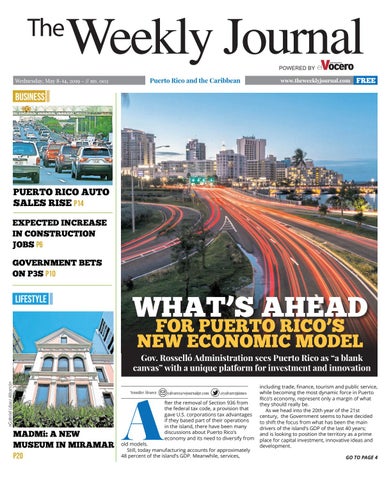
What’s ahead for Puerto Rico’s New Economic Model
>Gabriel López Albarrán
Gov. Rosselló Administration sees Puerto Rico as “a blank canvas” with a unique platform for investment and innovation
A Yennifer Álvarez
MADMi: A New Museum in Miramar P20
yalvarez@wjournalpr.com
@yalvarezjaimes
fter the removal of Section 936 from the federal tax code, a provision that gave U.S. corporations tax advantages if they based part of their operations in the island, there have been many discussions about Puerto Rico’s economy and its need to diversify from
old models. Still, today manufacturing accounts for approximately 48 percent of the island’s GDP. Meanwhile, services,
including trade, finance, tourism and public service, while becoming the most dynamic force in Puerto Rico’s economy, represent only a margin of what they should really be. As we head into the 20th year of the 21st century, the Government seems to have decided to shift the focus from what has been the main drivers of the island’s GDP of the last 40 years; and is looking to position the territory as a prime place for capital investment, innovative ideas and development. GO TO PAGE 4
THE WEEKLY JOURNAL > WEDNESDAY, MAY 8, 2019 >
2
An organization is only as strong as its telecommunications provider That’s why so many businesses trust Claro, the leading provider in Puerto Rico, with their mobile telephony, internet and cloud services.
IMAGINE WHAT WE CAN DO FOR YOUR BUSINESS.
Claropr.com (787) 792 6262
The most powerful network
3
/ Wednesday, May 8, 2019
a week in review Former Gov. Rafael Hernández colón died at 82
>Josian Bruno
Rafael Hernández Colón, the threeterm governor of Puerto Rico, died on Thursday. He was 82. On December 6, 2018, Hernández Colon announced he was battling Leukemia. Hernández Colón was the island’s fourth and sixth governor during 1973-1977 and later in 1984-1993. He supported the current political status of the island and promoted the autonomous development of Puerto Rico political system within the framework of the U.S. Constitution. Hernández Colón was buried in his hometown Ponce. To honor his memory, and as an expression of public sorrow, Gov. Ricardo Rosselló ordered that both the flags of Puerto Rico and the United States be at half-staff on all public buildings for 30 days.
Warren Wants ‘Comprehensive Debt Relief’ for Puerto Rico U.S. Democratic presidential candidate Elizabeth Warren has reintroduced the U.S. Territorial Relief Act, legislation that would provide Puerto Rico with a path to comprehensive debt relief. The legislation would give U.S. territories like Puerto Rico the option to terminate their debt if they meet certain criteria, like being struck by a disaster, suffering major population loss and staggering under overwhelming debt.> AP
Powered BY El Vocero de Puerto Rico, 1064 Ave Ponce de León 2nd floor San Juan, PR Postal Address: PO Box 15074, San Juan, PR 00902
Trump will Maintain Jones Law for Natural Gas President Donald Trump promised a group of Republican lawmakers he would not suspend shipping restrictions on natural gas, which would have allowed foreign tankers to transport fuel and energy supplies to Puerto Rico and the Northeast.“The president gave his word,” said Sen. Bill Cassidy. Trump had considered waiving the requirements of the Jones Act, a nearly century-old federal law that dictates only U.S.-flagged vessels can transport fuel between U.S. coasts.>AP
President Salvador Hasbún shasbun@elvocero.com
Human Resources Director Arlene Rolón, PHR arolon@elvocero.com
Managing Editor Yennifer Álvarez yalvarez@wjournalpr.com
Comptroller Félix A. Rosa frosa@elvocero.com
Traffic Director Ilia M. Pérez Centeno iperez@elvocero.com
Multi-Platform Digital Director Stephanie Gómez Álvarez sgomez@elvocero.com
Production Director Eligio Dekony edekony@elvocero.com
Editorial Director Juan Miguel Muñiz Guzmán jmuniz@elvocero.com
Multi-Platform Graphic Director Héctor L. Vázquez hvazquez@elvocero.com
Phone: 787-622-2300, 787-721-2300 Customer Service: 787-622-7480
4
/ Wednesday, May 8, 2019
>Source: La Fortaleza
FROM PAGE 1 After the struggles of the past, that include the fiscal debacle and the disaster caused by the hurricanes of 2017, Gov. Ricardo Rosselló believes Puerto Rico should be seen as “a blank canvas”, a place of opportunities, “with a unique platform for investment and innovation”. “Puerto Rico has a well-educated, bilingual workforce. Roughly 30 percent of the population considers themselves fluently bilingual—far higher than the US national average. Aside from South Korea, Puerto Rico has one of the strongest records of educational development in recent history. Between 1960 and 2000, the average education of Puerto Rican workers doubled from 6.2 to 12.2 years, a record that no other country has attained,” said Rosselló. Also, the Govenor stated that “Puerto Rico has a unique geographical advantage to become the connector of the Americas. We are dead smack in the middle of North, South, and Central
America, with strong cultural ties to each region, plus our A+ human resource, makes us the ideal headquarter location for businesses with operations and sales throughout the hemisphere to meet and create platforms that can connect the Americas.” “I would like to see Puerto Rico become a place where businesses serve customers and coordinate operations throughout the Americas and the world, what I like to think of as a ‘human cloud,’ where workers spread across the island, handle tasks remotely for businesses around the world”, he added. “Most jobs are geographically independent. People are looking for places where they want to live and from where they can export their services. Puerto Rico has the natural beauty and assets that make the island an ideal place for people to come, establish their home and work remotely around the world. The island is the most exciting place
in the world for those who want to rebuild and innovate,” Rosselló pointed out. Manuel Laboy, secretary of the Economic Development and Commerce Department (DDEC by its Spanish acronym), and executive director of the Puerto Rico Industrial Development Company (Pridco), agrees with the Governor. “I think opportunities outweigh the obstacles,” Laboy said. And it seems the Government has already taken the first steps to create that “human cloud”. In March 2018, Laboy announced a financial incentive for small and midsize enterprises (SMEs) with business models based on science and technology. Pridco granted up to $100,000 per company to operate, market and export their innovations, in order to encourage investments and the creation of products that can be commercialized, both in Puerto Rico and abroad. Meanwhile, in Puerto Rico, numerous
/ Wednesday, May 8, 2019
People are looking for places where they want to live and from where they can export their services. Puerto Rico has the natural beauty and assets that make the island an ideal place for people to come, establish their home and work remotely around the world. -Gov. Ricardo Rosselló
5 sponsored by entrepreneurial groups promote the collaborative development of science and technology, such as Parallel18, Piloto 151, Colmena66, Grupo Guayacán and SBTDC, among others. Giancarlo González, Giancarlo González, entrepreneur, entrepreneur.>Courtesy investor and advisor who also served as Chief Information Officer from January 2013 through May 2015, said that “the innovation grant it is to learn the skills needed a great starting point for for those jobs. We are entrepreneurs to find a making progress but we source of funding at a very need more. Beyond the early stage; usually venture engineering programs capitals don’t take so much in the universities, we risk, they are not willing to need boot camps, more invest that early, so the fact that support for code trotters, the Government is stepping in to for alternative education to invest in potential innovative business teach the skills without necessarily solutions in a very early stage provides spending four years in a college opportunities to develop innovation companies.” degree,” González added. As González explained, this could entice González pointed out the importance of people entrepreneurs from different parts of the world to adopting the use of technology in their daily lives. move to the island to start their businesses. “Because if they don’t, people here working in Although the “human cloud” combines the innovation are not going to be able to test their knowledge economy with exporting services, and products.” the idea is that programmers –who can benefit of “It is great that the Government released the tax advantages as Act 20 –can work in Puerto Rico CESCO digital application, because it is the most and export services to anywhere in the world, still visited Government service. If our citizens start González thinks the island needs more than grants. to use the CESCO app they will be more willing to Act 20 provides tax incentives for exporttry Apps for other services such as transportation, services companies who serve clients outside telemedicine. The Government can be a promoter Puerto Rico. Act 20 businesses are subject to a 4 of the adoption of new technologies to make sure percent income tax rate. The law originally had that these services are provided massively to a requirement that Act 20 companies create five everyone,” the entrepreneur said. jobs within two years of starting operations, but González thinks the environment to develop the Puerto Rican government eliminated this these projects is mature. “We have coworking requirement in 2017. spaces. Everyone who Today, there is no wants to start a project minimum number of will find the mentors,” he employees required. added. Exceptions to the new Finally, the rule include call centers entrepreneur thinks and telemedicine firms. the Government must González stated that demand from these to be effective Puerto technology companies Rico also needs top that they hire local notch infrastructure as talent. broadband, high speed “Sometimes connectivity, and the companies outsource plan launched on 2012 the programing and needs to be updated. development talent Today, the main spots to India, Perú, to the with connectivity are in Dominican Republic, Santurce, Hato Rey, and and I get it, maybe Ocean Park. A study from programmers in India 2014 reflected that only are cheaper, but I am 12 percent of businesses willing to bet that the in the island have a best talent is here, they high-speed fiber optic haven’t looked enough connection. or they want to make The entrepreneur a better margin on also mentioned the the contracts, but the necessity of capital Government should access and education reinforce that if you have as key elements for a contract with them, development of the sothose programmers called ‘human cloud’. should work in Puerto “We need programing Rico, that the money boot camps, we need spent in those contracts Secretary Manuel A. Laboy, Department of Economic to continue educating is not being sent out,” Development and Commerce of Puerto Rico. the pipeline of workers González concluded. >The Weekly Journal
6
/ Wednesday, May 8, 2019
business
Boom
in Construction-sector
Jobs
>File/The Weekly Journal
Expected
To date, construction employment has already increased by 18.5 percent, as another 5,000 jobs have been added in the sector for fiscal year 2019, evidence of the positive impact of the federalfund transfers
7
/ Wednesday, May 8, 2019
W Rosario Fajardo
rfajardo@wjournal.com
@RosarioWJournal
ith Community Development Block Grant–Disaster Recovery (CDBG-DR) federal funds expected to begin flowing into Puerto Rico in the next month or two, the island’s construction industry has been gearing up for the expected surge in the industry. “The priority is housing as 87.5 percent of all estimated damages from Hurricane Maria were to housing,” said Emilio Colón Zavala, Puerto Rico Builders Association chairman of the board. “This will include the repair and reconstruction of homes that are in areas that are at low risk of flooding and earthquakes.” For homes that are in “high risk” areas, Colón said homeowners can receive a
If the numbers from the recovery funds detailed in the Fiscal Plan of March 2019 are indeed concrete, it is estimated that construction employment will increase approximately to 50,000 [in 2022]. -Banco Popular’s Progreso Económico report
myriad of federal assistance, such as the so-called Safe Home vouchers so families can move to safe housing. Noting that some 35,000 homes were “destroyed” and another 180,000 homes partially destroyed by Maria, “the need for remediation was clearly evident,” he added. Related work includes resiliency measures in many communities, such as installing stronger windows and putting in renewable-energy systems in homes and buildings. Other priorities include infrastructure work on roads, highways and ports; mitigation work and rebuilding the utilities network for electricity and water; and renovating primary healthcare and wellness centers. According to the central government’s March 2019 fiscal plan, the main federal funds earmarked for construction disaster-recovery projects in Puerto Rico for FY 2020 include an estimated $42 billion from the Federal Emergency Management Agency (FEMA) and $16 billion from the CDBG-DR program. While the reconstruction recovery effort is an obvious windfall for the construction sector, which has been ailing for more than 10 years, Colón acknowledged there are challenges. For starters, while jobs are increasing in construction, it is unclear if the available labor pool and in particular, those with the appropriate skills, can be expanded relatively quickly.
To help resolve this issue, Colón said the industry is working with public schools to graduate high school students with the adequate training and required certificates in such areas as carpentry, masonry, electrical work and HVAC (heating, ventilation and air conditioning) systems, which are the most needed trades right now. Under this new program, at least 1,000 students will graduate in June and the program will continue to be expanded. “They are also getting training in following building codes properly, OSHA [Occupational Safety & Health Administration] certification,” he said.
Expected 85 percent increase in jobs
billion as of FY 2017, 32% of that in-vestment was public. In all probability, construction public investment will come mostly from the recovery funds. Also, private investments for housing will be replaced by recovery-funds financed investments. “Certainly, if the funds do not progress at the magnitude and velocity that the Fiscal Plan indicates, construction employment will not be able to reach its projections. In the case of CDBG-DR, the recovery funds projected in the March 2019 Fiscal Plan are anticipated to be more aggressive, contrary to the U.S. Department of Housing’s November 2018 projections,” the report said. In a previous Progreso Económico report (Aug. 2018), concerns were raised about the challenge of how quickly the local economy can absorb and effectively use the funds. “The first step is the federal administrative process. After the contracting, the Jones Act limits the speed with which construction materials arrive on the island. In addition, after a decade of contraction, greater narrowness is observed in terms of skilled personnel in the construction industry,” the report stated. “Ultimately, it is up to Puerto Ricans to guarantee the effective use of the funds that are being received. The transfers of funds offer us a great opportunity; we must wait to see if they are properly channeled.”
If Puerto Rico is receiving the $15 billion disaster recovery funds that the central government outlined in its aforementioned fiscal plan, this would translate to a huge boom for the construction industry, with jobs in the sector surging up by some 85 percent in the next three years. “If the numbers from the recovery funds detailed in the Fiscal Plan of March 2019 are indeed concrete, it is estimated that construction employment [in Puerto Rico] will increase approximately to 50,000 [in 2022] compared with the 27,000 current construction employment,” according to the latest issue of Banco Popular’s Progreso Económico report. Data from the U.S. Bureau of Labor Statistics shows that construction-sector employment reached a low of 21,700 in 2017, before climbing slowly back up. To date, construction employment has already increased by 18.5 percent, as another 5,000 jobs have been added in the sector for fiscal year 2019, evidence of the positive impact of the federal-fund transfers. Notably, this represents the first job increase reported in the construction industry since the island received $7 billion in federal American Recovery & Reinvestment Act (ARRA) funds during fiscal years (FY) 2012 and 2013. The April 2019 Progreso Económico report indicated that since Hurricane Maria devasted Puerto Rico in Sept. 2017, about $15 billion in disaster recovery funds “have been passing throughout the economy among individual emergency transfers, emergency construction work, payments to private insurance and other funds. “In the following years, it should be expected that the recovery funds will have the effect of replacing the construction investments that would normally occur in the absence of the recovery funds. For example, total Emilio Colón Zavala, Puerto Rico Builders Association chairman of the board.>Courtesy construction investment was $2.4
8
/ Wednesday, May 8, 2019
business
Ongoing: Government-owned Facilities the Inventory of
The exercise could become a central component of the new program and lead to a much-needed investment push that could help the U.S. territory find its way out of recession and its fiscal woes
T Cynthia López
clopez@wjournal.com
@cynthia_lope
he task is daunting. For the first time, the Department of Economic Development and Commerce of Puerto Rico (DDEC by its Spanish acronym) has set out to compile an inventory of all public installations and lands available for rent or sale on the island. At first, the initiative was conceived as a general planning tool to advance economic development and encourage job creation on the island, while it simplified the process of doing business in Puerto Rico. Later, with the advent of the Opportunity Zones (OZ), the possibilities for real estate investment sparked and the project’s potential blossomed. In the eyes of government’s officials, the mapping exercise could become a central component of the new program and lead to a much-needed investment push that could help the U.S. territory find its way out of recession and its fiscal woes. “We still don’t have the government’s official inventory,” the DDEC’s Secretary and Executive Director of the Puerto Rico Industrial Development Company (Pridco) Manuel A. Laboy said. “But we have agencies that already have their inventory. The Planning Board already had a georeference map with hospitals, schools, infrastructure, etc.” On December 14, 2017, nine days before President Donald Trump signed into law the Tax Cuts and Jobs Act that created the OZ, Laboy unveiled Puerto Rico’s Assets Map version 1.0. The map sketches out properties from Pridco, the Trade and Export Company, the Tourism Company,
and the Land’s Administration. Besides the location, the map offers flood, zoning, and classification information. It also identifies the nearest airport, university, and water plant, among other details. During the presentation, Laboy announced that the second phase of the Assets Map would chart all government properties available and would provide information on existing incentives and local economic activities. This way investors -from both sides of the Atlantic- would find in one spot the information needed to evaluate the prospects of doing business with the government. “We are increasing the pace of the work to include schools, municipal properties and other assets that can be redeveloped,” Laboy explained in a recent interview with THE WEEKLY JOURNAL. While all the government real estate would be housed in one platform, the agency that owns the property will handle the sale or rental process. For instance, in the last two years, the Department of Education closed 438 schools, as published for EL VOCERO. Half of the empty structures (245) were rented to municipalities and private organizations that do social and community work. Five schools were also sold between $260,000 and $710,000. A special committee created by Gov. Ricardo Rosselló handles the management and disposition of the discarded schools. Initially, Laboy announced that the second phase of the Assets Map would be ready last year, but due to the magnitude of the job and the government´s critical economic situation, the project is moving at a slower speed. “The second phase of the Assets Map project will depend on several factors: availability of funds, the
cooperation of the various agencies, sponsorship of the Chief of Staff’s Office and the Puerto Rico Innovation and Technology Service. Given the nature of the project, it will be constantly updated with the available data,” Laboy insisted. Undeterred by the technical and budgetary hurdles, the government has moved actively to promote its real estate in the context of the OZ. “Puerto Rico is ahead of the curb (when compared to other jurisdictions). The government has moved intensively to connect with the financial world, for example in New York and in different parts of the United States to highlight that Puerto Rico has advantages over other zones and, at the same time, we are working to gather the inventory,” Laboy pointed out. “We have a lot of opportunities that match the Opportunity Zones,” Laboy said. “We’ve been in an economic and fiscal crisis for many years, a situation that was exacerbated by the hurricane. As a result, there are investment opportunities in the energy sector, infrastructure, housing, and in areas created by Hurricane Maria.” OZ is a federal incentives program that seeks to trigger economic development in distressed areas by encouraging long-term investments through significant tax breaks. As part of this legislation, 98 percent of Puerto Rico was designated as an OZ. The only areas not included are the former Roosevelt Roads Naval Station in Ceiba, El Yunque National Rain Forest in Río Grande, and parts of Dorado and Condado in San Juan.
9
< THE WEEKLY JOURNAL > WEDNESDAY, MAY 8, 2019
10
/ Wednesday, May 8, 2019
business
P3 Closing in
On Cornerstone
Projects Executive Director Omar Marrero Dismisses Privatization Claims
A Giovanna Garofalo
ggarofalo@wjournal.com
@giopgarofalo
s the general public debates privatization and the concession of government entities and services, the Puerto Rico PublicPrivate Partnerships Authority (P3) confirmed that eight key contracts will be consummated
throughout 2019. P3 Executive Director Omar J. Marrero detailed that these projects are chiefly focused on infrastructure, maintenance, and provisions for essential services. Of these, six are already in the stage of request for proposal (RFP), while the other two are in the request for qualifications (RFQ) phase. The first deal underway is the Student Housing Project in the University of Puerto Rico’s Mayagüez campus (RUM). The RUM currently lacks student housing inside college grounds. According to Marrero, the publicprivate partnership model has been successfully applied to student housing in both mainland U.S. and Canada. In addition, there are two energy-related initiatives under consideration. The first one—proposed by Tesla, not the local
government—intends to install a “black start” energy storage system, in order to provide this basic service in the event of a large-scale disaster, such as 2017’s hurricanes Irma and Maria. Marrero affirms this project is “at a very advanced stage.” Moreover, another P3 aims to concede electric energy transmission and distribution, presently managed by the Electric Power Authority (PREPA). The RFP has not been released yet, but Marrero expects to have selected the consortium by August or September. The P3 is also in the RFP phase to improve the island’s cruise ports and boost tourism by relieving responsibilities from the Ports Authority. Marrero listed this “highly complex, highly ambitious” project as one of his favorites, likening it to the consortium for the Luis Muñoz Marín International Airport to Aerostar Airport Holdings, LLC in 2013. “It is a full concession, where we concede the right to repair, design, build, operate, and maintain finance as well. That is the full P3 cycle,” the executive director said. Along that line, the P3 also aims to establish consortia with the island’s regional airports, located in Aguadilla, Arecibo, Ceiba, Culebra, Humacao, Mayagüez, Ponce, and Vieques. Under this project, the government would only transfer operations and maintenance.
“Concession isn’t Privatization”
A P3 to create the Public Safety Training Center, currently past RFQ stage, has drawn criticism from individuals and organizations who perceive it as an initial attempt to privatize the Police Department. Similar remarks have been made concerning the project to delegate to a private entity the task of operating the ferries that travel to and from the main island and the island-municipalities of Vieques and Culebra. This initiative, which is in its RFP phase, also includes repairs and maintenance of the ferries’ terminals. These responsibilities are carried out presently by the Maritime Transportation Authority (ATM, by its Spanish initials). However, Marrero opined that the private sector is better equipped to perform necessary improvements in these transportation services. Moreover, he clarified that the Authority’s projects are not privatization attempts. “Concession to the private sector is achieved through a P3 contract, but it isn’t privatization because we don’t transfer ownership, quality levels or tariff control,” the official said.
Trabaja para ti
RADICA FÁCIL
TU PLANILLA MUEBLE EMUEBLECRIMPR.NET 787 625 CRIM
E-MUEBLE
Ahorra tiempo, esfuerzo y ahora es más directo
11
Get to the level you deserve with the exclusive benefits from our Beyond Ultimate credit card.
0
Purchases and balance transfers must be made during the first 6 months after opening the account.
APR on purchases and % introductory balance transfers for the first 15
months after opening your account.
0
Afterwards, your APR will be
$
13.00% - 26.75%
1
Free Rewards Program that allows you to earn 2 points for each $1 spent on purchases.2
introductory annual fee1
Exclusive Services3: • Priority PassTM Airport Lounge Access • Personal Concierge Service • Travel and car rental insurance
Apply Today! 787.827.5382 Member FDIC. Subject to credit approval. Certain restrictions apply. 1. Offer will be valid until July 31, 2019, and is only available for new accounts. It may not be applied in combination with other offers. Introductory APR of 0% for the first 15 months after opening your account for purchases and balance transfers made during the first 6 months after opening the account. After the introductory period, your APR will be 13.00% to 26.75%, based on your creditworthiness at the time you opened your account. The APR for Cash Advances will be 19.50% to 26.75%, based on your creditworthiness at the time you opened your account. These APRs may vary with the market, based on the Prime Rate. Penalty APR of 29.99%. $0 Introductory Annual Fee for the first 12 months. After the introductory period, the Annual Fee will be $150. Minimum Interest Charge: If you are charged interest, the charge will be no less than $1.50. Balance Transfers, Cash Advance and Convenience Checks: 2% of the amount of each transaction with a $2.00 minimum and $10.00 maximum, for each one. Transaction fees for any transaction made in foreign currency or for any transactions made in US dollars processed outside the United States will be of 1.40% of each transaction in US dollars for Mastercard and 1.00% for Visa. This fee will be applied in addition to any other applicable fees. Subject to credit approval, and certain restrictions apply. The account must remain in good standing and be opened during the valid term of the offer in order to obtain these benefits. The introductory offer for balance transfers is subject to availability of funds in your credit line and cannot be used to pay, in full or partially, any debt with FirstBank. There are no grace periods on balance transfers. 2. Visit http://www.rewardsfirstbank.com for rewards program details. 3. The insurance products offered by FirstBank Insurance
Agency LLC. do not represent a bank deposit, are not insured by the FDIC or by any other federal government agency, nor by FirstBank Puerto Rico, or any of its subsidiaries. Obtaining this insurance is optional and is not a condition to determine credit approval. Priority Pass is an independent access program for participating VIP airport lounges.
EL PODER DE NUESTRO LEGADO Un legado que se ve y se siente en los líderes de nuestra organización, en nuestras comunidades y en las historias de éxito de miles de niños, niñas y jóvenes que hemos impactado en los pasados 50 años. Es un legado que, a través de nuestros programas de educación, apoyo postsecundario, desarrollo de carreras, empresarismo y fortalecimiento familiar, genera un beneficio social y económico al país. Cada $1 invertido en la organización genera $3 de beneficios económicos para Puerto Rico.*
Sé parte de nuestro legado. Invierte hoy. 787-728-4040 www.bgcpr.org facebook/BGCPR Conoce más sobre nuestras 50 historias de éxito en:
Beraliz Germocén Participante del Club del Res. Luis Llorens Torres.
*Estudio de Impacto Económico de Boys & Girls Clubs de Puerto Rico, 2017. Realizado por Estudios Técnicos, Inc.
< THE WEEKLY JOURNAL > WEDNESDAY, MAY 8, 2019
Your lifestyle deserves to GO BEYOND.
12
/ Wednesday, May 8, 2019
business
Opportunity Zone Project Unveiled in Old San Juan
Lifeafar will soon begin construction work to renovate a building in Old San Juan and turn it into a boutique hotel/ residence called the Plaza Colón Hotel & Suites
and there is a pro-business government. There investors, the project also received tourism tax are $80 billion in federal funds coming in for credits through Act 74. “We raised equity for the reconstruction. There’s better [tourism] branding project quicker than any other project. We raised and improved infrastructure,” said Rich Holman, $10 million in less than four months. Puerto Rico founder and chairman has been on our radar of Lifeafar. even before Hurricane In fact, the P.R. Maria,” Berman said. Tourism Company has Of the investors in the extolled the industry’s project, he said about quick recovery 50 percent will receive after Maria, noting Opportunity Zone significant increases benefits. in hotel registrations, While he pointed out Rosario Fajardo rfajardo@wjournal.com @RosarioWJournal cruise trips and air that the project was passenger traffic. “very viable” on its own, Puerto Rico receives the Opportunity Zone ifeafar, an investment firm more than 3.3 million benefits were a bonus. focusing on opportunities in the visitors a year, and “We have many more - Rich Holman, hotel and real-estate industry, is of these, more than deals in the pipeline betting on Puerto Rico. founder and chairman of Lifeafar. 1.5 million are cruise that we have been The company has announced passengers. analyzing and doing that it will soon begin construction An Opportunity our due diligence on. work to renovate a building in Zone is an economically-distressed community Our plan is to launch a second project soon, with Old San Juan and turn it into a boutique hotel/ where new investments, “under certain more to follow,” he said. residence called the Plaza Colón Hotel & Suites, as conditions, may be eligible for preferential tax Why Puerto Rico? “There are 12 major business part of an Opportunity Zone project. tax incentives here. Tourism is strong and growing, treatment,” according to the IRS. The projects The $16.5 million initiative could involve investing will feature 61 rooms and a in new development or a rooftop bar at a prime location property upgrade, funding right on Plaza Colón, at the a startup business or entrance to the historic Old City. financing any other local “We are very excited initiative. about Puerto Rico and the In Puerto Rico, almost the opportunities here,” said Eric entire island—about 98%— Berman, the chief investment has been designated as a officer of Lifeafar. He spoke to Qualified Opportunity Zone. THE WEEKLY JOURNAL during Exceptions include Condado, an investment conference that parts of Dorado, the former the firm was sponsoring on the Roosevelt Roads Naval Base investment and tax incentives and El Yunque National available in Puerto Rico, such as Forest. those of Opportunity Zones. According to the U.S. “The location is perfect, right Treasury Department: at the entrance to Old San Juan, “Investment benefits include so traffic won’t be an issue. deferral of tax on prior gains From the rooftop, you can see as late as 2026 if the amount the ocean, the cruiseship area of the gain is invested in and Castillo San Cristóbal,” he an Opportunity Fund. The said. benefits also include tax With construction set to forgiveness on gains on that begin in about two weeks, the investment if the investor property should be ready for holds the investment for at guests in December 2020. >Gabriel López Albarrán. least 10 years.” Besides Opportunity Zone
L
Tourism is strong and growing, and there is a pro-business government. There are $80 billion in federal funds coming in for reconstruction. There’s better [tourism] branding and improved infrastructure.
14
/ Wednesday, May 8, 2019
Auto Sales Remain
on a High Tide T
percent, Pick-Ups 19.8 percent, Mini-Compacts 20.2 percent, and Fleets 21.2 percent in contrast to the same period last year. he car industry is still riding on Ricardo García, GUIA’s president, explained that the crest of the wave. Two the increase in sales is due to the traffic of people months after Hurricane Maria generated by the stream of disaster aid and more slammed the island, auto sales recently to a boost in tourism. “We had workers began to swell steadily, an arriving to participate in the recuperation efforts upsurge that is still going on in that were renting cars and creating a demand for 2019. more vehicles.” Last year, 107,941 new cars were sold. This is Bigger and stronger vehicles like Pick-Ups and the highest peak since 2013, when dealers sold SUV’s cars were also purchased for construction 102,641 vehicles and represents an increase of work or to get around the island that saw its 28 percent, compared to the 84,080 units sold streets and roads decay after the hurricane. in 2017, according to the United Automobile At the same time, money began to flow into the Importers Group (GUIA by its Spanish acronym). economy from insurance companies. Some 10,000 While sales of European luxury cars grew 38.2 units were also sold to replace cars that suffered percent in 2018, they decreased 6.1 percent damage as a consequence of the deadliest during the first trimester of 2019. BMW, Porsche, hurricane that banged the island in almost a Mercedes Benz, Maserati, and Lamborghini are century. among the pricey brands purchased in recent Other factors helped. García mentioned that months. low-interest rates and cheap gasoline prices also encouraged car sales. He said that 90 percent of the cars sold in Puerto Rico are financed through banks or other financial institutions, while 10 percent are paid in cash. “After Maria money was injected into the economy, stimulating consumption. People are leaving, but others are arriving occupying that market space,” said the economist and researcher of Economic Intelligence, Chantal On the left, Ricardo García, GUIA’s president, along with economist Gustavo Vélez. Benet Arbona. >Submitted Analyzing the rise in luxury cars, Benet Aside from that glitch, the general market rose hypothesized that it could be liked to the arrival 11.6 percent from January to March of this year, of investors, lured to the island by Acts 20 and compared to the same period in 2018. This means 22, that offers attractive tax incentives to new that 25,204 new cars are cruising around an island residents. that nearly lost 4% of its population after Maria, The increase in car sales came with a surge in the greatest drop in the recorded history of Puerto excise taxes. Statistics from Puerto Rico’s Treasury Rico. Department reveal that during the fiscal year In March, specifically, sales of SUV’s grew 24.8 2015-2016 import taxes grew from $273,660,135 Cynthia López
clopez@wjournal.com
@cynthia_lope
Almost two years after Hurricane Maria hit the Island, the demand for vehicles keeps rising, specially for SUV’s, PickUps, Mini-Compacts, and Fleets to $349,976,437 during fiscal year 2017-2018. This number does not include tariffs for motorcycles, trucks, and buses. Repossessions also rose. Data from the Office of the Commissioner of Financial Institutions shows that the category of repossessed units increased from 14,254 in 2017 to 17,017 in 2018.
Top 10 Cars Sold in Puerto Rico
1
Toyota Rav 4
2
Toyota Yaris
3
Toyota Tacoma
4
Hyundai Tucson
5
Toyota C-HR
6 7 8
Hyundai Accent
9
Kia Soul
10
Toyota Corolla
Nissan Mirage Kia Forte
Source: United Automobile Importers Group (GUIA by its Spanish acronym)
15
/ Wednesday, May 8, 2019
Jaresko Sets the Record Straight on FOMB’s Achievements
Natalie Jaresko, Executive Director of the Financial Oversight & Management Board.> Carlos Rivera Giusti.
On June 30, Promesa will celebrate its third anniversary
T Rosario Fajardo
rfajardo@wjournal.com
@RosarioWJournal
he Puerto Rico Oversight, Management & Economic Stability Act (Promesa) will soon celebrate its third anniversary, but with some critics giving the federal initiative a nearly failing grade, the woman leading the federal oversight board says they have made “substantial progress” in both the fiscal and debt sides of the island’s economic crisis. “We are changing the fiscal culture of Puerto Rico, implementing fiscally responsible budgets and ensuring transparency of financial data. This process requires the government to make hard choices to balance the budget and while improving the quality and efficiency of public services for the people of Puerto Rico,” said Financial Oversight & Management Board (FOMB) Executive Director Natalie Jaresko to THE WEEKLY JOURNAL.
“To date, two significant debt restructurings have been completed and a third is well under way. Taken together, the three deals would represent nearly 47% of the public debt of the Commonwealth and its various corporations,” she added. Jaresko was referring to the debt-restructuring deals on the Government Development Bank’s $4 billion debt and $8 billion in liabilities, and the Sales Tax Financing Corp.’s (Cofina by its Spanish acronym) $18 billion debt load. The third deal involves the negotiated preliminary agreement on the Puerto Rico Electric Power Authority’s (Prepa) $9 billion debt. “Promesa gave the Oversight Board a critical mandate: to set the critical fiscal building blocks for economic success. Since its creation in 2016 by Promesa, the Oversight Board has made substantial progress on both, improving fiscal responsibility and ensuring a fair and sustainable exit from bankruptcy,” she said. On the fiscal side, Jaresko said among the FOMB’s accomplishments “within the certified
budget” include: Allocated funds to pay debts owed for some 10 years to police officers for overtime and backpay; enabled reapportionments to ensure badly needed funding to improve the operations of the Forensic Sciences Institute; and enabled pay increases for teachers and polices, to begin a path toward restoring compensation packages that are competitive with the mainland U.S. Other FOMB achievements pointed out by Jaresko include: Assured that all tax initiatives are revenue neutral, including spending on up to $200 million for an Earned Income Tax Credit to support labor participation on the island… and ensured over $40 million in funds for a needs-based scholarship program for the University of Puerto Rico (UPR) so no student lacks the chance to attend the public university. As previously reported by The WEEKLY JOURNAL, two local economists, Juan Lara and José Caraballo Cueto, have given Promesa poor marks in such areas as economic development initiatives and reforms, and achieving a balanced budget.
16
/ Wednesday, May 8, 2019
business
Rosselló reaffirms priority of pensions over debt
Gov. and FOMB still at odds over the fiscal board’s mandate
I
Rosario Fajardo
rfajardo@wjournal.com
@RosarioWJournal
ndicating that his administration’s hands are often tied by the Financial Oversight and Management Board’s (FOMB) “micromanaging” of the government budget, Gov. Ricardo Rosselló has reaffirmed that his priority remains paying pensions over debt payments. “The policy decisions belong to the government of Puerto Rico, not the Oversight Board,” he said during the U.S. House Committee on Natural Resources Hearing on the “Lessons Learned” from Promesa. “Let us define what those priorities are, and one of those priorities would be paying pensions. I know that there will be differences, but we have a limited budget—at least let us have a discussion on the policy basis of it,” he said. Rosselló has often butted heads with the FOMB over its efforts to enact austerity measures that included furloughs for government workers and canceling the mandatory Christmas bonus for workers. Furloughs have not been carried out, while Christmas bonuses have been paid. The FOMB was created under the Puerto Rico Oversight, Management and Economic Stability Act (Promesa) to deal with the island’s fiscal and economic crisis. Puerto Rico’s fiscal crisis includes a debt load of more than $70 billion,
Natural Resources committee Chairman Raúl Grijalva talks with Puerto Rico’s Resident Commissioner Jenniffer González.>Courtesy of U.S. House
plus around $60 billion in unfunded pension liabilities. If the Detroit bankruptcy case is any indication, pension claims will prevail over bond creditors, indicated Alex Pollock, a senior fellow at the R Street Institute and the former president & CEO of the Federal Home Loan Bank of Chicago. “How are the competing claims of bondholders and pensioners equitably to be settled? This is Gov. Rosselló said the FOMB repeatedly overstepping its boundaries has been his an ever-growing issue greatest challenge under Promesa.>Submitted by La Fortaleza. in municipal and state ensuring a 10 percent savings of total pension finances—very notably costs,” she said. “Teachers and police officers will in Illinois and Chicago, for example, as well as also be enrolled in Social Security to increase their plainly in Puerto Rico. security and retirement benefits.” “The bankruptcy settlement of the City of The governor and Detroit did give haircuts to pensions—a very Jaresko were clearly important precedent, at odds about the in which the state challenges they constitution of are both facing. Michigan was Rosselló said the trumped by federal FOMB repeatedly bankruptcy law. But overstepping its the pensions turned boundaries has out in Detroit, as been his greatest elsewhere, to be challenge under de facto senior to Alex Pollock, Promesa. As an all unsecured bond senior fellow at the R Street Institute example, he cited debt. This reflects the the FOMB’s failed political force of the attempt to take pensioners’ claims over the bankrupt Puerto Rico Electric Power and needs, “ Pollock said in his testimony. Authority and the Oversight Board continually In the Detroit case, pension cuts were relatively “striking out” allocations for such necessary small compared to the big haircuts that creditors work as rebuilding roads. received. As a result, some creditors said that “it For Jaresko, the Puerto Rico government’s was a hold up.” “failure to act” has been a primary hindrance in Natalie Jaresko, FOMB executive director, enacting important reforms. “Just this week, the indicated that the claims of retirees in the governor announced he no longer intends to enact Title III process of debt restructuring are being the healthcare reforms he proposed in the fiscal handled responsibly. “The board developed a plan… The fiscal plans are not a selective menu pension policy that ensures adequate funding from which options can be selected, rejected or for pensions and guarantees that those with the ignored,” she said. lowest pensions are protected from any cut, while
Pensions as a huge component of municipal insolvencies will continue to be a tough issue for the Oversight Board. -
17
/ Wednesday, May 8, 2019
opinion By Edgardo Vicenty
By Inteligencia Económica
Entrepreneur and Financial Analyst
Property Taxes are the Problem
A
t first sight, Puerto Rico’s real estate market appears to be an investor’s dream. Identifying possible investment properties in prime locations is as easy as walking through the streets of Santurce, Calle Loíza, and Old San Juan because there are hundreds of unused structures, many of them visibly falling apart. But investors soon find out the dream market is just an illusion. Many of these properties are either not for sale or priced too high for a sound investment, even when taking into consideration tax breaks and incentives. The reason for this market dislocation is simple; Puerto Rico’s property tax system (CRIM) is broken. Property taxes in the island have two major flaws; first price appraisals are sometimes decades old which results in trivial tax bills for many of these underutilized properties. Second, there is no lien market so property owners can go for years without paying a cent in taxes while holding on to their assets and waiting for an overly optimistic investor to come and pay their inflated prices. In other words, this broken tax system is one of the main factors preventing more investments from flowing into the island’s real estate market. I know for a fact some of the most iconic abandoned properties in Santurce haven’t paid taxes in 10 to 20 years and owe hundreds of thousands of dollars to the government even though their yearly tax bill is only a fraction of what it would
be if their appraisals were up to date. In total, property owners in Puerto Rico owe the government over $2.3 billion in unpaid taxes. If a transparent lien market were set up, the government could recuperate a large portion of this debt in a short period. But more importantly for the Puerto Rican economy, developers would get access to thousands of abandoned properties in prime locations across the island at reasonable prices. Rosselló’s Administration has publicly entertained the idea of selling a portion of this debt to private investors in order to raise funds for the government and municipalities. But previous efforts involved private deals instead of creating a permanent and transparent lien market. If this administration truly wants to bring investments into the island, it has to strive for a permanent solution to this issue, not one-off deals. It has to recognize that property taxes and lien markets aren’t just a mechanism to increase government revenues, but also a tool that can be used to curve real estate speculation and promote owners to develop their properties or sell them at a reasonable price to someone who will. I know many will scoff at the idea of using taxes to fix anything, I usually would as well, but private markets are clearly not working in this situation. The government needs to implement a system that systematically reappraises properties and create a mechanism for private markets to deal with assets that are being used so inefficiently their owners can’t pay their taxes.
D
Puerto Rico Population Loss is Exacerbated
ata published by the U.S. Census Bureau shows that the migratory pattern of Puerto Rico residents continues to rise. Between June 2017 and July 2018, an estimated 129,848 people emigrated from the island, representing 4 percent of the population, which is now about 3.1 million. The Census estimates indicate that the urban centers of the metropolitan areas of San Juan, Caguas and Carolina experienced a population loss of 81,087 people, while Ponce experienced a loss of 13,707 residents. Demographers and other scholars of the subject associate this migratory pattern with the impact of Hurricane Maria. The devastation caused by the deadly hurricane, which hit the island on Sept. 20, 2017, caused thousands of Puerto Ricans to leave for the United States. An uncertain number have still not returned, and in the face of doubts with the process of the island’s
reconstruction, it is speculated that many other Puerto Ricans have decided to leave to seek a better quality of life in the north. The injection of federal funds to rehabilitate Puerto Rico continues to be halted by the battles between the island’s political leadership and the Trump administration. Prior to Maria’s impact, residents were already leaving the island at a rate of about 60,000 per year. This hemorrhage of people leaving Puerto Rico has caused the population to have fallen from 3.7 million to 3.1 million in a decade. The long economic depression, central government bankruptcy and the impact of Hurricane Maria have combined to create an economic and fiscal situation, unprecedented in the modern history of the island. If this pattern continues, some estimates indicate that the total population of the island could drop even further to 2.6 million by the end of the 2020 decade. To read more economic and financial data and content, visit: www.economiapr.com
18
/ Wednesday, May 8, 2019
Left to right: Violinists Ilmar Galiván and Melissa White, cellist Felix Umanski, and violist Jaime Amador.
The Harlem Quartet
Brings Magic to San Juan Renowned ensemble performed at Luis A. Ferré Fine Arts Center
T Giovanna Garofalo
ggarofalo@elvocero.com
@giopgarofalo
he Harlem Quartet graced the stage of the Symphony Hall of the Luis A. Ferré Fine Arts Center in Santurce last Sunday, in a spellbinding concert full of passion and devotion to the fourth art. To celebrate the fifth concert of its 2018-2019 season, Pro Arte Musical, Puerto Rico’s oldest musical society, invited the distinguished musical group. Its members are violinists and original founders Ilmar Gavilán and Melissa White, violist Jaime Amador, and cellist Felix Umansky. After a heartfelt introduction, The Harlem Quartet took the stage and proceeded to play
their first arrangement—a rendition of ‘My Funny Valentine,’ composed by Richard Rodgers, as arranged by Calvin Custer. This piece felt slightly morose at its earliest notes, and then ultimately assumes a more erratic flow—akin to a descension into madness. The second arrangement, Claude Debussy’s ‘String Quartet in G Minor, Op. 10,’ filled the entire room with an air of whimsy. At this point, a small choir of oohs and ahs could be heard among the lower seating area. In striking contrast to the first two compositions, the third piece was ‘A Night in Tunisia,’ by AfricanAmerican icon John Birks “Gizzy” Gillespie, as arranged by Dave Glenn. The shock among the audience was almost tangible: how can four musicians evoke the same rhythm and soul as a full-on jazz orchestra?
Naturally, the arrangement was met with a standing ovation. After a brief interlude, the ensemble resumed the stage, this time with Anton Weber’s ‘Langsamer Satz,’ but not before Amador dedicated the piece to fellow Puerto Rican artist Eva de la O, who passed away the evening prior. The last arrangement on the program was Béla Bartók’s ‘String Quartet No. 1.’ The time-stopping performance elicited yet another standing ovation, with the enchanted audience clamoring for more. The evening ended with an encore: a breathtaking rendition of ‘Take the A Train,’ a jazz composition by Billy Strayhorn that was the signature tune of the Duke Ellington Orchestra. Being one of the first jazz pieces in The Harlem Quartet’s repertoire, the song brought a string of emotions both in the artists and the audience.
19
/ Wednesday, May 8, 2019
Ilmar Gavilán emphasizes the importance of representation and diversity in classical music.>Gabriel López Albarrán / The Weekly Journal
A Style of Its Own
To attract younger generations and deviate from monotony, The Harlem Quartet plays short and diverse pieces—from romanticism to Latin jazz. The group’s unique style and meticulous attention to detail have earned it critical acclaim. Renowned music critic Julian Haylock described The Harlem Quartet as “a formidable ensemble whose members play highly demanding scores with infectious vitality, breezy confidence, and (most importantly), affectionate warmth.” In 2009, the quartet was hosted by thenPresident Barack Obama in the White House. That same year, they made their European debut and proceeded to act as faculty members of Belgium’s Musica Mundi International Chamber Music Course & Festival. Since then, The Harlem Quartet has captivated audiences in 47 states, as well as the United
The diverse arrangements elicited standing ovations and clamors for an encore. >Gabriel López Albarrán / The Weekly Journal
Kingdom, France, Belgium, Panama, Canada, Venezuela, and South Africa. When they aren’t touring, they are educating. Every last week of July the group holds a workshop, called Music Mountain. In it, they focus on chamber music and improvisation, with emphasis on individual technique classes. “Individual technique classes are extremely important because without individual technique we can’t have an ensemble. A good ensemble is the sum of excellent individual musicians,” Gavilán said.
‘Representation is Important’
In an exclusive with THE WEEKLY JOURNAL, Gavilán, one of The Harlem Quartet’s founding members, discussed the role of minorities in classical music. The Cuban violinist and educator stated that black and Latin American children generally
“Our mission is to bring music to sectors that don’t feel represented”
Violist Jaime Amador dedicated the fourth arrangement to fellow Puerto Rican artist Eva de la O. >Gabriel López Albarrán / The Weekly Journal
shy away from this sector of the music industry because it is perceived as a predominantly white space. Since its conception in 2006, The Harlem Quartet has promoted diversity in music, both in repertoires and in human talent. “Our mission is to bring classical music to children who do not feel identified with that genre, because they nearly always see musicians who do not look like them, so they perceive it as a foreign concept that is apart from their culture. Our mission is to erase that myth... it’s to bring music to sectors that don’t feel represented,” he affirmed.
Emotional Tribute to Eva De La O
A teary-eyed Myrna Rivera, president of Pro Arte Musical, preceded the introduction with an emotive homage to Puerto Rican soprano Eva de la O, who passed away on May 4 after a lengthy battle with cancer. De La O was the first Puerto Rican lyric singer to enthrall an audience in the coveted Teatro alla Scala in Milan. Graduated from the distinguished and highly sought Juilliard School, the world-renowned soprano acclaimed praise for her work in the Puerto Rico Symphony Orchestra, In 1980 she founded Música de Cámara, a nonprofit organization that served as a platform for Puerto Rican and Latin American musicians in New York City. With her support, these artists proceeded to perform in prestigious theaters, such as the Alice Tully Hall, the Carnegie Hall, the St. Patrick Cathedral, and the Metropolitan Museum of Art. In her adulation, Rivera, who was a close friend of De La O, declared: “Eva’s passing leaves a gap that will be difficult to fill, but it also leaves us with an enormous legacy that will serve us as a guide and light in defense and promotion of our music.” “Eva was not only a special human being, but also a committed patroness and visionary,” she added. The Great Hall of the Terence Cardinal Cook Center in New York will hold a concert on May 17 at 7 p.m., to celebrate De La O’s life and works. To honor the late Puerto Rican artist and her devotion to cultural enrichment, Pro Arte Musical and The Harlem Quartet dedicated the concert to her memory.
20
/ Wednesday, May 8, 2019
MADMi
Designed to Provoke
The Museum of Art and Design in Miramar opened its doors six months ago, using bold shapes and color to create a new space for artistic expression in the historic neighborhood
I
Cynthia López
clopez@wjournal.com
@cynthia_lope
n the historic neighborhood of Miramar, a pink house stands out: Rosey Pepto Bismol facade, sleek white trimmings, and lush vegetation. But it’s more than an ephemeral glance. The name on the wall: MADMi, invites to peek, to explore, and to walk in. Maybe the name evokes the long history between art and madness or hints at the artistic energy that guided the transformation of the old residence on 607 Cuevillas St. into a joyful tribute to contemporary art and design. Or, maybe the five letters are just the acronym for Museum of Art and Design in Miramar. It doesn’t matter. The name of the museum -that opened its doors six months ago- embodies the hallucinating
experience of finding “the modernist emphasis beauty and new on interdisciplinary meaning in the most projects”. mundane artifacts, from “Art is a human a potting pot to a chair, expression. It is a means from a desk to a coffee of communication. mug. It also proposes You have to begin to another approach to art, understand it without life, and aesthetics. thinking that it is so MADMi’s Program complicated; particularly Director Nicole Pietri the design, that is a tool and curator Marilú to improve the quality of Purcell Villafañe teamed life,” Purcell stated. Marilú Purcell, curator and Nicole Pietri, MADMi’s to create a habitat that The sensuous voyage director.> Gabriel López Albarrán. celebrates creativity, continues as you wander openness, diversity, and through the halls of connectedness through the use of space, color, the structure carefully decorated with paintings lines, patterns, and bold shapes. that highlight the simplicity and functionality of “We felt that the moment was right to create a industrial design like the “Bici Criolla” (Native space where the protagonist was the design,” Pietri Bicycle) by Bobby Cruz López or “Negro Puya” explained. “We have a lot of designers producing (Black with little Sugar) by Carlos Dávila Rinaldi a work and we didn’t have a place exclusively recreation of a coffee maker. dedicated to design, so it made sense to fill that Once the atelier of artists Lorenzo Homar, Juan void.” Ramón Velázquez, The duo also Ada Bobonis and wanted to dissipate Aaron Salabarrías, the that air of formality house built in 1913 in and elitism that reigns a French Neo-Classical over some museums style now showcases and art. an eye-popping They nailed it. fuschia tridimensional The starting point front desk. Designed for the sensuous by Vladimir García, voyage was the natural the piece redefines grace of the house classical notions of Marilú Purcell Villafañe, itself bequeathed to space, color, and MADMi’s Curator become a museum pattern. by Eduardo Méndez The house also Bagur -a resident and lodges the collections diehard fan of his Miramar neighborhood- and “Lorenzo Homar: Acróbata del Diseño” (Acrobat of his collection of objects and furniture emblematic Design ) and Charles Juhasz-Alvarado “Y” (And) until of the middle and upper-middle class lifestyle of May and June respectively. the Puerto Rico from the early twentieth to midAcrobat of Design offers a window into Homar’s century. work as a designer. Particularly catchy are his A bright red Apple recreation of his 1949 pickup sketches of a ring and a necklace for the French Studebaker that stands proud in the deck, a Royal luxury brand Cartier. typewriter or the pottery from Caribe China, not “Y” presents three series of sculptural furniture only examples of great design, but organized in pieces built and designed by Juhasz. The their historical context to reveal their evolution. unexpected surprise: Juhasz personal brand of In another room, the silkscreen portfolio “Tres percussion instruments, chairs, and bridges. Estrofas de Amor” (Three Stanzas of Love), with illustrations by painter and graphic artist Lorenzo Homar, musical scores by composer Pablo Casals, and a poem by writer Tomás Blanco underscores
The design not only solves problems of utility, but it can also be beautiful and improve your space and your quality of life -
The museum opened its doors six months ago and embodies the hallucinating experience of finding beauty and new meaning in the most mundane artifacts. >Gabriel López Albarrán
21
Hoy, que celebramos el Día Mundial de la Cruz Roja, presentamos los grandes resultados de nuestro trabajo colaborativo en la Isla.
Instalación de fuentes de ENERGÍA constante • 77 de 100 escuelas que sirven como refugio, ya están en diseño, construcción o finalizada la instalación de micro redes solares que energizarán áreas esenciales como cocina, baños y salones que se utilizarán como refugios Más opciones de SALUD para las comunidades • Sobre 50,000 personas recibieron servicios de salud física y mental a través de 17 organizaciones; 14 de ellas son clínicas de salud conocidas como Centros 330 • 10,500 niños y niñas se beneficiaron de talleres educativos y actividades sobre preparación ante desastres Sistemas de AGUA comunitarios • 12 de 20 acueductos comunitarios ya cuentan con micro redes solares que les permiten extraer agua sin interrupciones • Sobre 130 líderes comunitarios adiestrados en talleres sobre desarrollo financiero sostenible, operación de sistemas y conservación de agua RESILIENCIA individual y comunitaria • Programa de ayuda financiera para el mejoramiento de las fincas de 450 agricultores que sufrieron pérdidas luego del huracán y proyecto de seguridad alimentaria en 25 escuelas que impactará a 750 niños y adultos • Sobre 8,600 estudiantes del semestre escolar, programa de horario extendido y campamentos de verano recibieron educación sobre preparación ante desastres Gracias a nuestros colaboradores, a más de un año y medio del huracán María, continuamos firmes para fortalecer las comunidades de Puerto Rico.
Conoce más en cruzrojapr.net
< THE WEEKLY JOURNAL > WEDNESDAY, MAY 8, 2019
Sin pausa hacia la recuperación
22
/ Wednesday, May 8, 2019
Wilo’s
Perfect
LIFESTYLE
Recipe
The well-known chef found in Wilo Eatery & Bar the flexibility and quality with a very broad menu in content and pricing
O Génesis Ibarra
gibarravz@wjournalpr.com
@gibarravz
bistec encebollado available to mix with a variety of add-on ingredients. For a cup of hot and sweet, Kafé serves premium Puerto Rican Alto Grande coffee and hot chocolate with a selection of house made tarts, petit creme brûlée, pastries and quiches. At the Premium Causal Restaurant, the menu combines local and global flavors under one roof. The number one seller, Tuna Tartar and Chipotle Pegao, gives the customer a crunchy delicacy with a subtle touch of spice. Other best sellers are Beef or Salmorejo Alcapurrias, Gandules Risotto with Crispy Chicharrón, Cod Croquettes and Spanish Octopus Escabeche. “Sometimes you need to come and eat something from my Bowl Bar. You have rice, beans between A Taste of the $8, $10 or $14. Menu Maybe you are From Yuca in a rush, or Chips ($8) to you want coffee Foie Gras, Ripe or you want Plantain, Truffle to go to the Honey & Micro restaurant. You Cilantro ($30), can snack, you more than 50 can eat dinner, plates shape you can have a the menu with combination of options for all both,” the chef -Chef Wilo Benet tastes and all said. purchasing The bar — power. simulating a W, Rush day? one could say — offers artisanal cocktails Payevar offers fully cooked and chilled and a modern wine list to compliment packaged foods in a variety of sizes. The Grab the “comfort focused” gastronomy of the & Go concept includes meats, seafood, rices, restaurant. pastas, dips, chips, vegetables and soups for La Mula de Wilo’s — with Tito’s Vodka, all occasions. orange marmalade, sesame oil and top house At Mixta, Wilo offers a personalized ginger beer — is the number one selling experience in a Quick Service Bowl Food mixology cocktail. The signature cocktail concept, with everyday staples like corned Flores y Tequila — with Tequila 1800, lime beef brisket stew, picadillo and chopped juice, hibiscus tea syrup and Germain — is a ne of Puerto Rico’s most revered chefs, Wilo Benet, is back in business with a unique concept born from his desire to please different gastronomic needs in a single space. After five years of research, the chef with 28 years of experience found in Wilo Eatery & Bar the perfect recipe to offer comfort, flexibility, quality and service with a very broad menu in content and pricing. “You make of it whatever you need to make of it right in the moment. It is about whatever you want and however you want to do it, more than what my menu is going to constrain you, or drive you or steer you to do as we have in the past,” he explained.
There is nothing on the shelves or in the menu that I have not tried and I have not approved. Whether it is a packaged food or something, I need to like it, I need to approve it.
Photos by Gabriel López Albarrán
23
/ Wednesday, May 8, 2019
bitter and refreshing option with a savory after taste. “On a busy dinner night, you have a full terrace, the store is full, everything is full. There is no limit, everything that is served (in the dining area) you can eat here or on the terrace when we have an overspill,” Wilo added.
Local Touch
At Wilo Eatery & Bar, Puerto Rican flavors await in every corner. Art made by local hands — including Wilo’s — decorate the space to complement the luscious menu with a vibrant visual experience.
For the menu, Wilo incorporates as many local agricultural produce as an operation of such magnitude allows for. That goes from viandas, microgreens, lettuce and plantains to goat cheese, seafood and a variety of fruits. “I have a tremendous amount of respect for farmers. We buy as much as we can on a weekly basis, but that exercise can be difficult for an operation of the volume that we handle. For example, I can buy 800 pounds of potatoes all at once or 400 pounds of celery. There is no one who can supply that. It is a challenge,” Benet said. But his support for the local market does not end there. In the store, Puerto Rican options are the main actors on the shelves — craft beers, Chocolate Cortés, Forteza, Pinta Gelato, Pique Don Bori and Poskón, among many other products made by local entrepreneurs. “There is nothing on the shelves or in the menu that I have not tried and I have not approved. Whether it is a packaged food or something, I need to like it, I need to approve it. From what perspective? From the perspective of quality. I want to make sure that things taste correctly,” he added.
What’s Next?
Wilo has no plans to expand his restaurant out of Galería San Patricio, but assured the concept will evolve. Next in the agenda is the inclusion of gyros in
the menu. “We are going to have the gyro everyone knows, with lettuce, tomato, onion and tzatziki sauce. But we are going to have another one with fillet steak, caramelized onions and cheese sauce. Another will be the Gyro Tripleta,” he said.
24
/ Wednesday, May 8, 2019
RONPON:
Nightlife and Convenience Delivered to Your Doorstep
Receive groceries and refreshments in less than an hour old, Porrata has managed to build a successful business in less than two years, inspired after reading about fellow youth who had successfully t is evening on a weekday, and you are in become entrepreneurs thanks to the vast opportunities offered by ecommerce. dire need of refreshments, but not quite “I wanted to start my own business and I liked in the mood to leave the comfort of ecommerce because I was reading about young your home. You gaze at the ceiling and people who did it and they were very successful, groan audibly as you feel compelled to so I looked for a way to innovate within that sector decide between two equally hedonistic to make it feasible here in Puerto Rico,” he said. pursuits—satiate your longing for an Porrata, who studied Finance in the School of ice-cold drink or continue your binge-watching Business Administration at the University of Puerto session without pesky interruptions. Now, you can Rico, Mayagüez campus, got the idea for RONPON do both. while working towards achieving his bachelor’s RONPON is a Puerto Rican delivery service degree. He decided he wanted to combine his two App and website that allows its users to choose passions, business management and alcoholic convenience store items and have them delivered beverages, while satisfying straight to their home in a lack of services in the local less than an hour. market. When users enter the In order to provide App or website, they 30,000+ users these services, RONPON is are greeted by five main partnered with To Go Stores, categories: beers, liquors, which are open 24 hours wines, extras, and colmado, 100+ drivers every day, and it amasses or convenience products. earnings through the From Pinot Noir to HäagenApp’s delivery fee and split Dazs—a highly requested 100+ daily commissions with the store item—each of these transactions chain. features a broad array of Porrata informed selections to satisfy even that ecommerce’s the most finicky demands. user demographic THE WEEKLY JOURNAL is comprised mainly of “young sat down with RONPON co-founder and CEO, professionals,” aged between 25 to Javier Porrata, at the company’s headquarters 35. The number of users between in San Juan’s Río Piedras sector. At just 22 years both platforms surpasses 30,000. According to the CEO, the company performs hundreds of transactions on a daily basis. Originally, the company had two employees—Porrata, and his sister and RONPON co-founder Camelia Porrata. Now, there are eight office employees and more than 100 registered drivers. Because they have plans for expansion, individuals interested in becoming drivers for RONPON may contact the company directly by accessing the website. “We are always receiving résumés,” the CEO said. Porrata hopes that his success story can inspire other Puerto Ricans to remain on the island and start their own businesses. Regarding the importance
I
Giovanna Garofalo
ggarofalo@wjournal.com
@giopgarofalo
of consuming local products and services, he said: “it is money that stays here, and we are capable of providing superior service because we can deliver a more personalized approach.” RONPON is currently available in San Juan, Isla Verde, Trujillo Alto, and Guaynabo. However, Porrata affirmed that they have their eyes rooted on expanding to other municipalities, starting with Caguas, Carolina, and Bayamón. Services are provided Wednesday to Saturday from 12:00 p.m. until 1:00 a.m., and Sundays from 12:00 p.m. until 8:00 p.m. To experience RONPON firsthand, download the App on the App Store or Google Play, or visit the website at www.ronponpr.com.
25
19
19
convierte tu carro en un SUPER AUTO A BENEICIO DE
AUSPICIADORES PRINCIPALES
UI Q A e t e b à r c Ins
www.mdaevent.org/superheroes2019 Info (787) 597-0824
BUSCANOS EN
< THE WEEKLY JOURNAL > WEDNESDAY, MAY 8, 2019
5
26
/ Wednesday, May 8, 2019
Vieques and Culebra Gems of Puerto Rico Investors and entrepreneurs are betting on islands’ tourism sector
27
/ Wednesday, May 8, 2019
A Giovanna Garofalo
ggarofalo@elvocero.com
@giopgarofalo
s the main island of Puerto Rico experiences growth in the tourism sector, the islandmunicipalities of Vieques and Culebra are gradually recovering from the impact of Hurricane Maria, thanks to capital investments by entrepreneurs and volunteers from non-governmental organizations (NGOs). In the case of Vieques, investors and entrepreneurs have noticed the island’s staggering potential in the tourism and service industries. Manfred Markoff and Marcelino Álvarez, of Advanced Construction Development, partnered up with British investor Keith St. Clair to build a green-certified timeshare hotel in Vieques’ Esperanza sector, facing the Caribbean Sea. The hotel, Zafira St. Clair will feature 11 villas with 66 suites and 54 apartments in the main building. The premises will be a three-minute walk away from El Malecón, the main tourist area, so guests can have the full tourist experience while feeling a sense of intimacy with Vieques. The construction experts affirmed that they intend to develop other projects to complement the hotel and to lift the island-municipality’s tourism economy. Some of these projects in mind are nautical activities, such as kayaking and scuba diving, and a higher learning institution focused on the tourism and service industries. Both Markoff and Álvarez agreed that the tourism sector is key to ensure Vieques’ economic development, and emphasized that there is ample opportunity for investment in the sector. “Vieques will become a gem because of its potential... Because it is a U.S. jurisdiction, Vieques provides investors economic stability,” Álvarez said. To this, Markoff pointed to Acts No. 20 and 22, which, complemented by Act No. 74-2010 and the U.S. Tax Cuts and Jobs Act of 2017, provide tax exemptions to promote capital investments. Another duo betting on Vieques are José Víctor Morales and David De La Rosa, founders and - David De Rosa proprietors of El Local 00765. This restaurant, located in the area of Santa Isabel II, serves modernized concoctions of traditional Puerto Rican dishes. One such example is ‘El Chuletón 1843,’ which consists of pork chops—a local favorite—with a twist: backyard honey glaze and red pepper coulis served along chickpea, or gandul risotto. The owners were inspired to invest in Vieques while pondering how to contribute to Puerto Rico’s recovery from Hurricane Maria. “The two of us came to the conclusion that municipal economic development was going to be the type of investment that would directly impact the economy while supporting our culture. From there, we said: ‘what type of project would do that?’ And that’s how we came up with the restaurant,” De La Rosa explained.
Manfred Markoff and Marcelino Álvarez, of Advanced Construction Development.>Gabriel López Albarrán.
They both acknowledged that recovery in Vieques has been a gradual process, but stressed upon the importance of capital investment, while praising the island’s business environment. “Puerto Rico is open for business, so just go ahead and have fun,” De La Rosa said.
Flamenco Beach Critical to Culebra’s Recovery
Foundation for a Better Puerto Rico (FBPR) is a Culebra nonprofit that is actively involved in issues regarding health, education, community partnerships, disaster preparedness and response, environment, and economic development. Presently, its main concern has been rebuilding worldrenowned Flamenco Beach, which used to receive roughly 700,000 visitors every year before Hurricane Maria’s impact on September 2017. In addition to the storm’s toll on the beach’s facilities, the Authority for the Conservation and Economic Development of Culebra (ACDEC), responsible for Flamenco Beach’s administration, lacks the financial resources to oversee maintenance and conduct improvements. Between these issues and decaying ferry services from the main island of Puerto Rico, residents are concerned for Culebra’s economic development. The NGO collaborated with the ACDEC to raise the $2.2 million for Flamenco Beach’s recovery, as well as to lend a hand in reconstructing its facilities. Of these, $1.6 million have been achieved at the time of this writing. Efforts include debris removal; reforestation; construction of public bathrooms, showers and
Puerto Rico is open for business, so just go ahead and have fun
new kiosks; improvements to camping areas and road and parking spaces; renewable energy use; rain water collection; and renovations to the ACDEC administration office, visitors center, first aid station and recycling center. “The restoration of Flamenco Beach is essential if Culebra is going to once again be a destination that both residents and tourists from around the world will want to visit,” the organization affirms. Individuals who are interested in registering or donating can do so by visiting www. betterpuertorico.org. Moreover, proud Culebra resident Juan Garavito, creator of ABC of Culebra—an alphabetized photobook of the municipality’s treasures— highlighted residents’ hospitality and the island’s solid eco-conscious stance. This, he noted, creates an idyllic environment for Culebra’s tourism sector. “We love nature, nature is maintained at optimal levels and we strive for tourists to feel that way. We are naturally hospitable. Culebra is the ideal place to vacation, live and enjoy life to the fullest,” Garavito said.
Ferry Services Undergoing Renovations
Both Vieques and Culebra rely on ferry services provided by the Maritime Transportation Authority (ATM by its Spanish initials) as its main source of transportation to and from the main island. Traditionally, the only terminal in the island of Puerto Rico was located in Fajardo, but in recent months operations were relocated to the municipality of Ceiba. A longstanding criticism of these services have centered on insufficient trips and room for occupancy, as well as the terminals’ organization and decaying infrastructure.
28
/ Wednesday, May 8, 2019
Things to Do
A Night of Jazz and Cocktails When: May 8 at 7 p.m. Where: Azabache Restaurant in Metro Plaza Towers, Santurce Latin jazz sensation Charlie Sepúlveda enlivens Azabache’s Silencio Bar as guests sip on craft cocktails and wine. Admission is free of charge. For more information, call 939-400-0392.
Beer and Jazz Jam Sessions When: May 14 at 7 p.m., every Tuesday Where: La Esquinita in Bayamón Enjoy local and international beers to the sound of Latin jazz performed by Norberto “Tiko” Ortiz and the San Juan Collective, in a casual, familyfriendly environment. For more information, call 787-903-5715.
Concert for MOM When: May 10 at 7 p.m. Where: La Concha Acústica in Guaynabo Aidita Encarnación and her orchestra render a tribute to ABBA, while DIVACÚSTICA performs acoustic covers of famous pop and rock songs. Attendees can also indulge in food, beverages, and art. Free entry and parking available.
29
/ Wednesday, May 8, 2019
WOMEN Empowering in the Insurance Industry
Bohemian Night by St. Clair Foundation
When: May 8 at 4 p.m. Where: Los Chavales Rest., Roosevelt Ave., San Juan The Professional Insurance Agents of P.R. and the Caribbean brings together panelists geared toward providing tools for women to advance in the insurance industry. RSVP by calling 787-410-7110.
When: May 11 at 8:30 p.m. Where: St. Clair Foundation, Carolina Singer Nydia Caro charms attendees in a fundraiser to support musical therapy groups. The St. Clair Foundation is a nonprofit whose mission is to impact health, education and the well-being of Puerto Rico’s youth through music. For more information, visit www. stclairfoundationpr.org.
When: May 14 at 8 a.m. Where: Convention Center in San Juan Investors are welcome to learn about Puerto Rico’s Opportunity Zones, with first-hand accounts from current investors, as well as local and U.S. business and government leaders. Tickets available on www.ticketera.com.
Spring Concert Tango Time When: May 8 at 6:30 p.m. Where: Emilio S. Belaval Theater at the University of the Sacred Heart The university’s Musical Arts Institute performs a series of sets that capture the intricate sensations of the season. For more information, call 787-728-1515.
Puerto Rico: A Paradise of Opportunities
When: May 11 at 8 p.m. Where: Musas & Eventos Café Concert in Santurce Tango dancing, singing, acting and live acoustic music take the center stage in this multifaceted event. Tickets available on www. tcpr.com.
Pantry & Food Prep
for a Hurricane
When: May 9 at 2 p.m. Where: #54 Main Street, Palmer, Río Grande In commemoration of the National Hurricane Preparedness Week, Alana Sauer and personnel from El Yunque National Rainforest explain strategies, tips, and tricks on how to prepare your food supply for an emergency. Free tickets available on the event’s Facebook page.
A Look at the World: Chante ton bac d’abord When: May 15 at 7 p.m. Where: Alliance Française Puerto Rico The Alliance Française of Puerto Rico presents a series of documentaries by French director David André that showcase harsh realities around the world—from testimonies by working-class youths, to anecdotes by filmmakers explaining women’s roles in the industry. Free tickets available on the Alliance’s Facebook page.
30
/ Wednesday, May 8, 2019
Movies Under the Stars in Arecibo Auto Cine Santana is the only Drive-in Cinema in the Caribbean
L Yennifer Álvarez
yalvarez@wjournal.com
@yalvarezjaimes
ess than an hour from San Juan, Drive-in Santana in Arecibo offers a cinema experience under the stars that evokes romantic scenes of the 70s classic Grease starring John Travolta and Olivia Newton-John. This cinema, located in the town also known as ‘La Villa del Capitan Correa’, is one of its kind, not only in Puerto Rico, but in the entire Caribbean. Established in 1957 by Elías Llerandi, the place is managed by his grandchildren, as it maintains the family legacy offering their clients an old time feeling, secure and fun experience at a very low cost. People sit on the trunk lid of their vehicles while others install chairs in front of the cars to enjoy the movies. The night I went to the Drive-in they were showing The Avengers: Endgame. For only $3.50 a ticket, I did not have to make the long line in a movie theater to see this blockbuster. I arrived 10 minutes before the movie started, the lot was packed with cars, with people sitting in the hood of their cars or outside around the parking lot. Even though I made it just in time, I was able to find a good place to park and enjoy the movie inside my Volkswagen Beetle. Customers are asked to tune in 107.9 FM
on their car radio, to listen to the movie audio, giving the viewer a chance to enjoy a great oneon-one listening experience from their own car sound system. The Drive-in also has two screens, each showing a different movie, all of them blockbusters. Also, the place provides outside seating on concrete benches and all the movies are shown in English with Spanish subtitles. Drive-in Santana, named for the neighborhood where it is located, has a small concessionary with sweets, popcorn, soft drinks and even Puerto Rican fritters such as alcapurrias and empanadillas. If you do not want to buy the cinema’s food, you are allowed to bring your own snacks. “Even if you are not from the area, I recommend you visit Autocine Santana. You can put quilts on the grass, share with your family and friends in a different way than in a traditional movie theater, “ said Francisco Domínguez Llerandi, the founder’s grandson who at 37 years old recalls how he started working as a child in the drive-in cinema. Today, Drive-In Santana has 12 employees, many of them family members. Show times are Monday, Wednesday and Thursday at 8:00 p.m. Friday, Saturday and Sunday at 7:30 p.m. and 9:30 p.m. Check the Auto-Cine Santana Facebook page to see what is currently playing.
31
/ Wednesday, May 8, 2019
Rosi Alonso, CCIM
ALONSO-MULET COMMERCIAL President, Puerto Rico CCIM Chapter
Trends in Commercial Leasing
A
lthough national real estate trends have a direct impact on commercial leasing, local markets are more susceptible to the needs of users and the owners in their particular area. The demand for space, inventory, vacancy and rental rates are all factors that help define the local market. The commercial lease market is comprised of three main types - office, industrial and retail. All have undergone significant changes in the recent past and continue to evolve to meet market and user demands. Without doubt the retail category is undergoing the greatest transformation. Growing access to the Internet, the evolution of ecommerce and changes in the way consumers prefer to shop have led to closings of major store chains. Nationally, some 6,000 closings were reported last year, and the trend does not appear to be slowing down. Even though store performance of major retailers in Puerto Rico have frequently surpassed national averages, this has not been enough to avoid local closings of giants such as Toys “R� Us, Sears, Kmart, Borders and Payless. Retailers are having to reinvent themselves and seek ways to adapt to new trends in consumer preferences, behaviors and demographics. To attract customers to the stores, retail spaces are shifting to provide venues for entertainment, dining and services. In regard to the office space market, tenants are reducing their footprint and requiring
more efficient use of their spaces. The tendency is towards fewer private offices and more open shared work space, effectively reducing the ratio of square feet per employee. Downsizing is also a result of the growing acceptance of telecommuting with more and more employees working at least part of the time from home. In Puerto Rico, Hurricane Maria was a gamechanger. Demand for prime office space increased. Companies who were unable to operate for weeks or even months due to the lack of electricity, telecommunication service and/or property damage to the place of work are now demanding full power generators, redundancy and reliable technology and infrastructure to guarantee continuity of operation. The influx of firms and individuals relocating to Puerto Rico to take advantage of the various tax incentive programs, as well as space needs of federal agencies and private entities that have opened shop on the Island for the post hurricane reconstruction work have all contributed to the increase in demand for office space, offsetting the effect of office downsizing and significantly reduced the vacancy rate in many office buildings. The industrial space market was also significantly impacted by the hurricane. The loss of thousands of square feet of space damaged by the hurricane, added to increased demand, has led to a shortage of inventory. After a decade of struggling, the local commercial lease market seems to be picking up.Â
Fisa Office Building,
Guayama
Metro Office Park,
Guaynabo
1,225 - 26,000 RSF/ Generator / Ideal for call center rosi@puertoricoproperties101.com (787)309-6814 / Lic. 16224
Spaces from 900 up to 10,970 RSF / Full Service / Generator rosi@puertoricoproperties101.com / (787)309-6814 / Lic. 16224
Americo Salas Building, Santurce 4,254 SF / Rent or Buy / Generator / Shell Space (787)309-6814 Lic. 16224