VETERANS LEGAL TRAINING
Virtual

May 28, 2026
10:00 am - 12:00 pm
In-Person

Virtual
May 28, 2026
10:00 am - 12:00 pm
In-Person
May 28, 2026 | 10am -12:00pm
In-Person
This training will provide an overview of the legal issues commonly seen at the Veterans Legal Wellness Clinic, as well as the clinic procedures. The training includes best practices for interviewing veteran clients, as well as a detailed overview of the legal questionnaires and assessments most frequently used at the clinic. This training will also provide a brief overview regarding Expungement and Child Support Assessments. At the conclusion of the training volunteers should have increased confidence interviewing clients and providing legal advice on issues most commonly faced by our veteran clients including determining eligibility for expungement filings and child support modification.
• Alexandra Bravo, Esq. Volunteer Lawyers for Justice
AGEND A
10:00 Welcome and Introductions (5 minutes)
10:05 Clinic Overview and Working with Veteran Clients (35 minutes)
Alexandra C. Bravo, Esq., Volunteer Lawyers for Justice
10:40 Expungement Overview (40minutes)
Alexandra C. Bravo, Esq. Volunteer Lawyers for Justice
11:20 Child Support Modification Overview (35 minutes)
Alexandra C. Bravo, Esq., Volunteer Lawyers for Justice
11:55 Q&A Wrap Up (5 minutes)
Alexandra Bravo is a Senior Staff Attorney who oversees the Veterans Legal Program and handles issues relating to child support as they arise in other programs. Prior to joining VLJ, Alexandra was an associate at Bastarrika, Soto, Gonzalez, & Somohano, LLP where she practiced family law. Alexandra previously clerked for the Hon. Yolanda Adrianzen, J.S.C. Alexandra received her bachelor’s degree from Seton Hall University and her law degree from Rutgers Law School, where she was a managing editor of the Rutgers Law Journal. Alexandra is also fluent in Spanish.



• The primary goal of the clinic is to provide a holistic assessment and help veterans access civil legal services within VLJ’s expertise in order to help them achieve long term stability.
• VLJ assists with the following civil legal issues:
• Children’s representation
• Criminal record expungement (NJ charges only)
• Debt Relief/ Bankruptcy (for example, pending lawsuit, overwhelming debt, or judgment)
• Divorce
• Eviction Defense
• Additional services for Veterans
• Child support modification (NJ orders only)
• Suspended NJ driver’s license
• Estate planning (Drafting a Simple Will, Power of Attorney, and/or Medical Directive)

• Volunteers will receive an e mail with the Zoom link and the Veterans Clinic Resource link : https://www.vljnj.org/veterans - volunteer - resources

• Volunteers will receive a brief huddle to review general reminders
• Volunteers split into teams and placed in separate break out roo ms
• Teams generally consist of 2 - 3 voluntee rs
• Teams receive client’s intake and eligibility via email
• During Appointments:
• Identify any/all legal issues VLJ can assist with
• P rovide advice and conduct assessments
• Help prioritize next step s
• Internal Referrals to other VLJ Progra ms
• R eferrals to other organizations
• For issues not handled by VLJ/VLJ’s pro bono panel, or for non- legal issues, refer to
• https://www.vljnj.org/veterans-volunteer-resources
• look online for meaningful referrals to provide to the veteran.
• If questions arise, volunteer should discuss with staff during the clinic
• A volunteer from the team can discuss with VLJ staff or flag us over to your team
• Veteran client should not be left alone in Zoom room
• Volunteer teams to complete all clinic forms and email back to VLJ team (abravo@vljnj.org and kguerrier@vljnj.org).
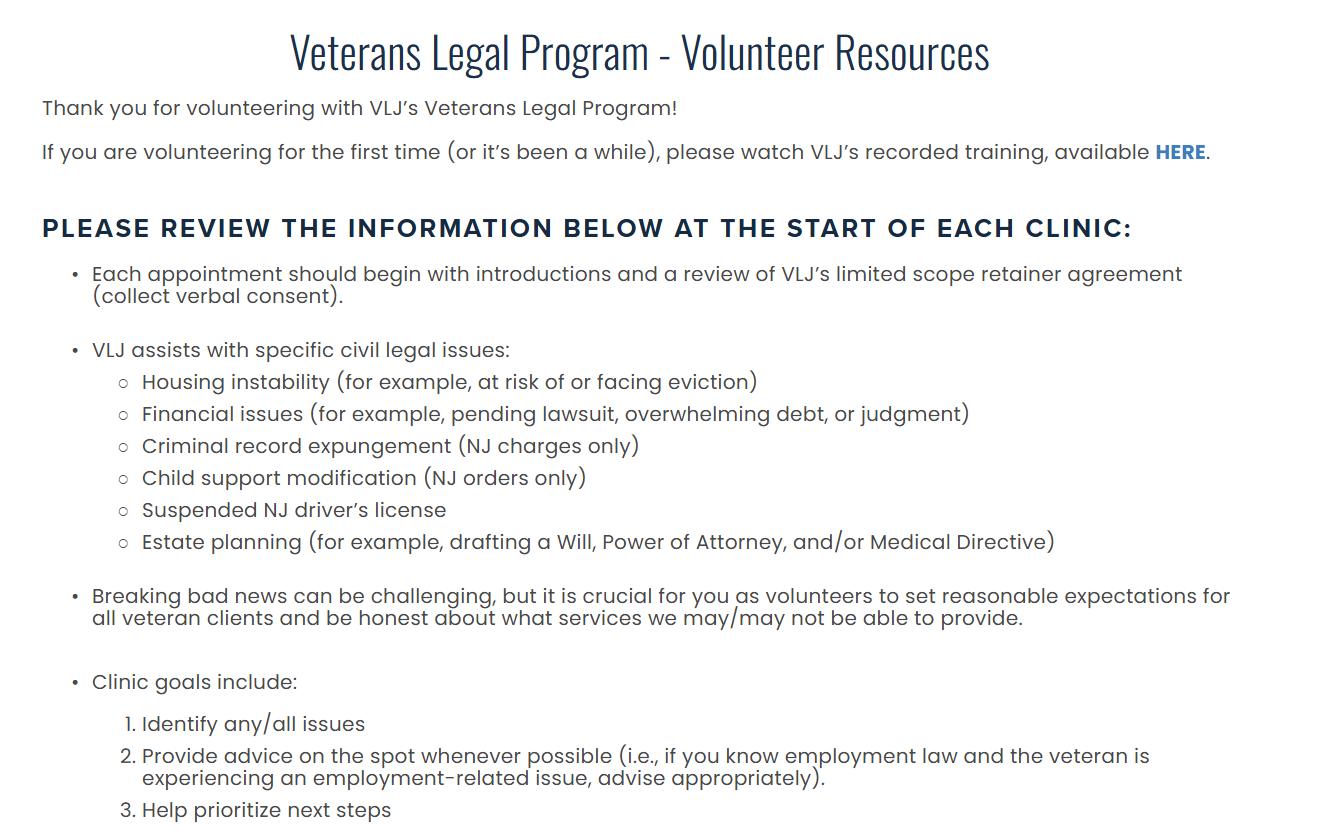
•Refer to VLJ Veterans Legal Clinic - Volunteer packet
•Review first page with important information
•Meet client / Make Introductions
•PART 1: Limited-scope Retainer Agreement
•Review with veteran client and obtain verbal consent
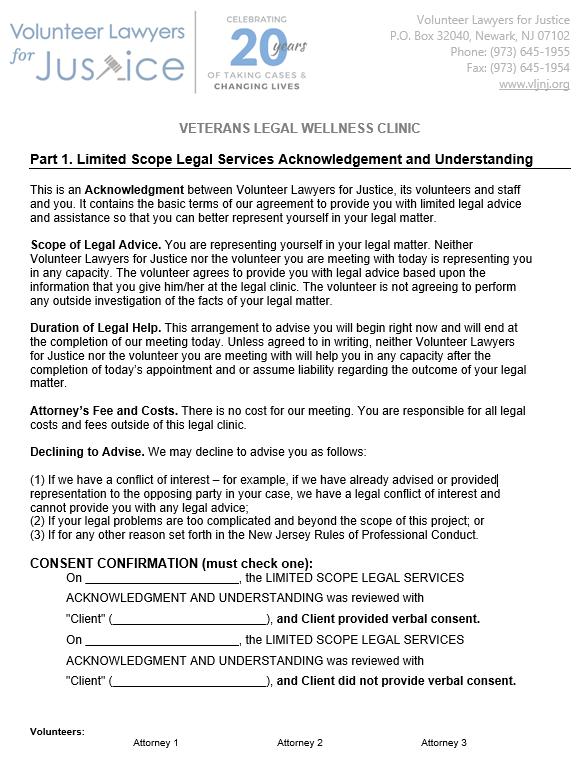
•PART 2: Wellness Questionnaire
• Explaining the goals and procedures of the clinic
• Interview to identify legal issues VLJ can assist with
• Collect information, provide advice and make assessment
• Complete additional relevant questionnaires
• Manage expectations / Prioritize next steps

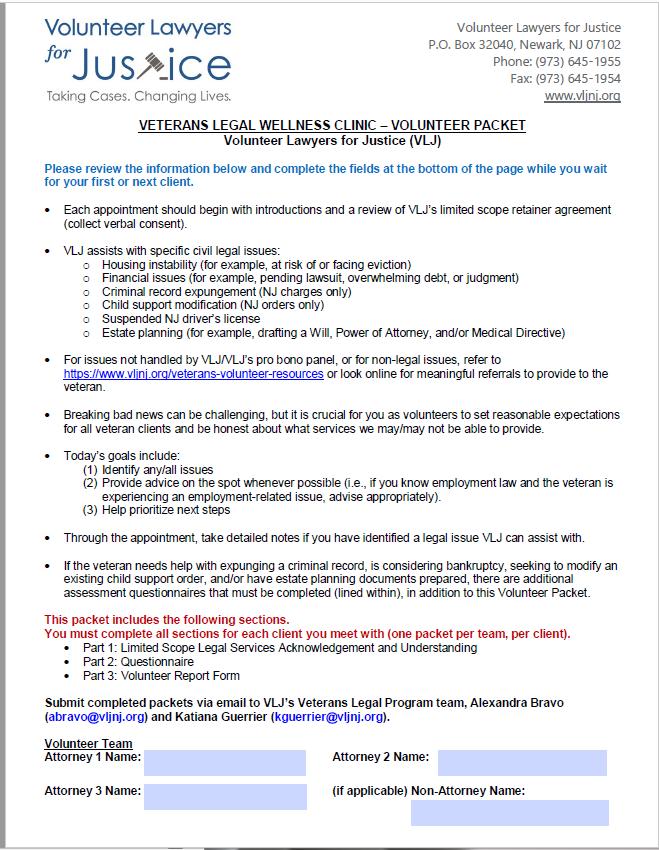
• Part 3: Volunteer Report Form
• Highlight deadlines, assessment results and next steps
• Identify which additional forms or questionnaires were completed
• Confirm pro bono time spent with client
• Note if any volunteer from the team would like to continue to assist the client outside the clinic.

• Provide notes regarding referrals Fill everything out, we appreciated it!
Start appointment by obtaining consent

Identify volunteers meeting with client


Summarize information for client
Gather a full picture of the client’s situation
Begin Assessment of relevant legal issues
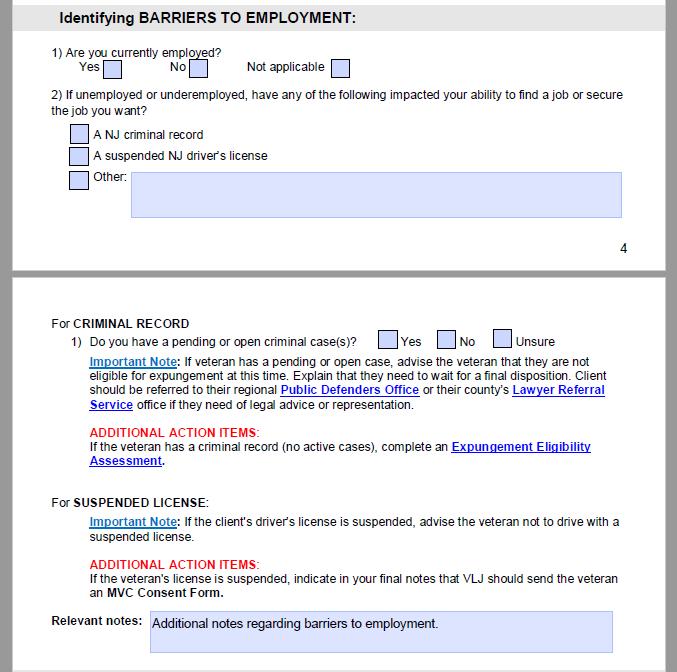
Check the applicable box
Expungement
• Preliminary question
• Expungement Assessment is a separate form (hyperlink)
Items for volunteers

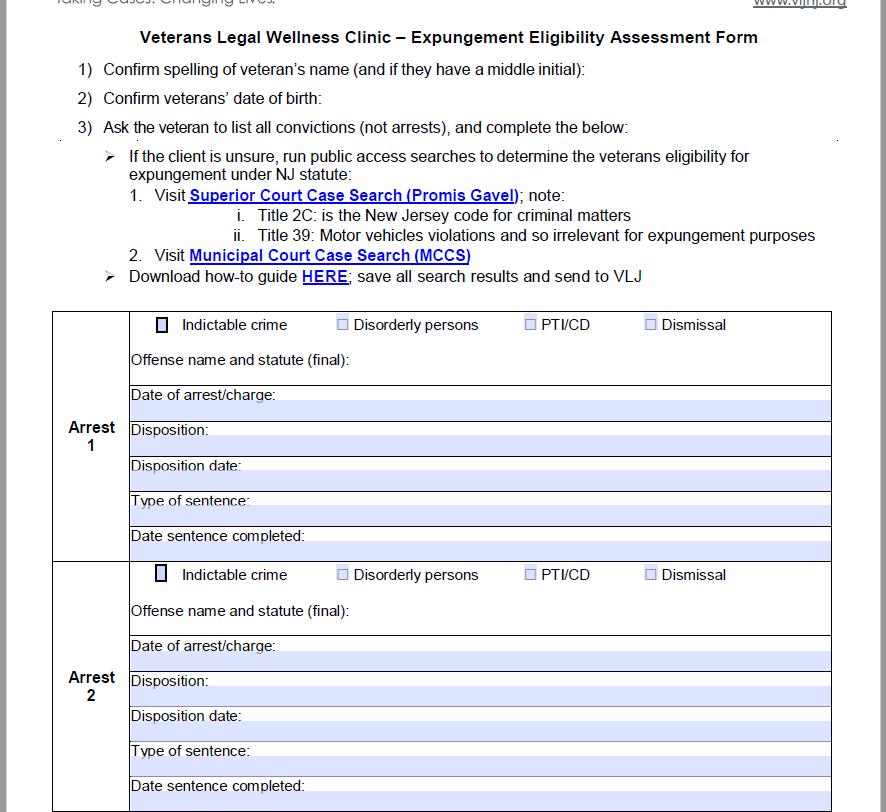
Confirm Client’s name and DOB
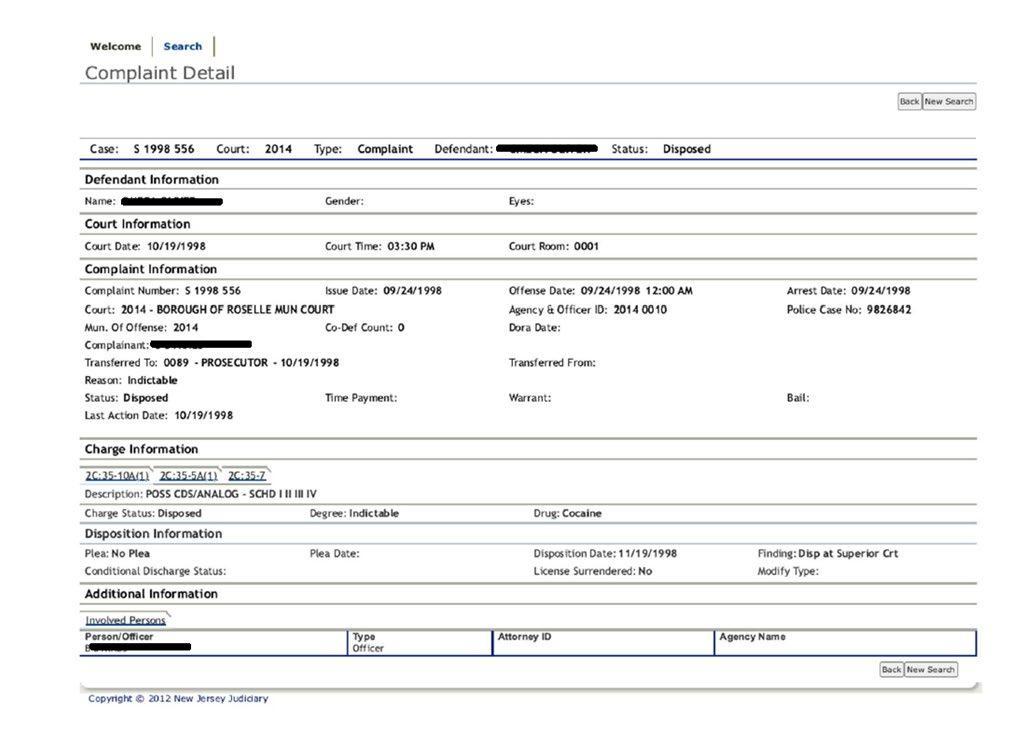
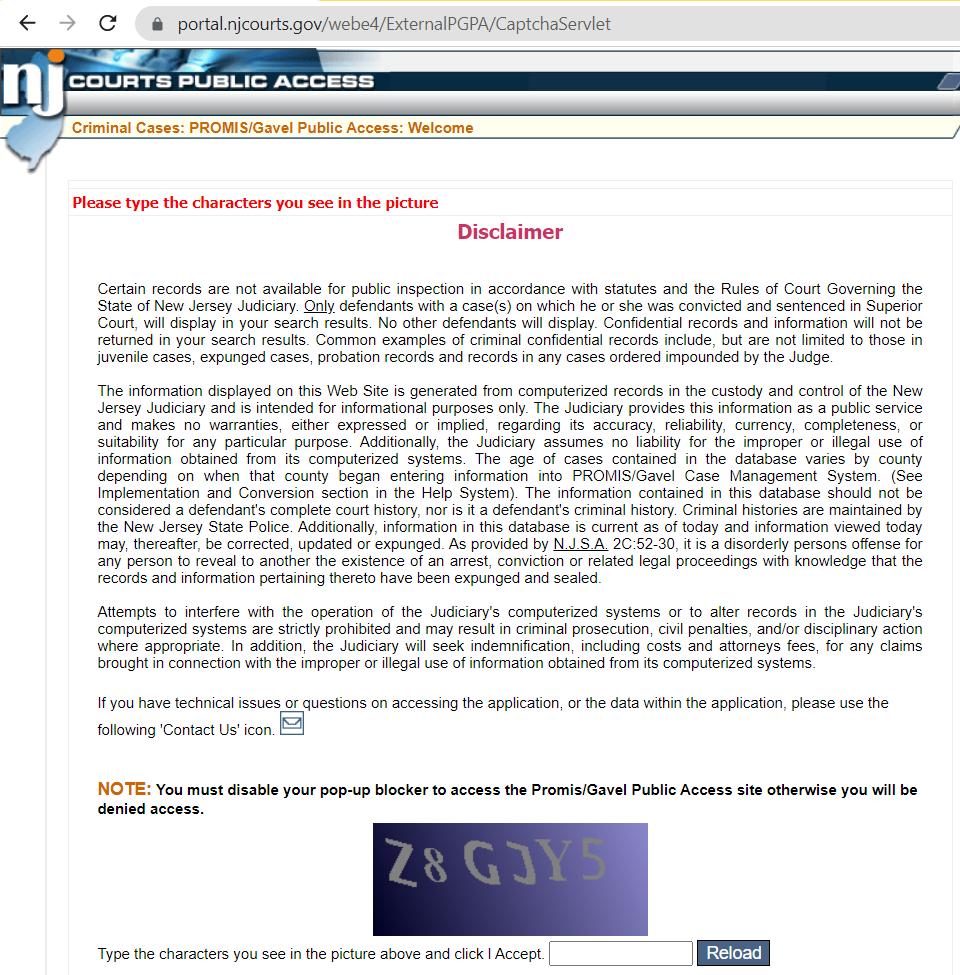
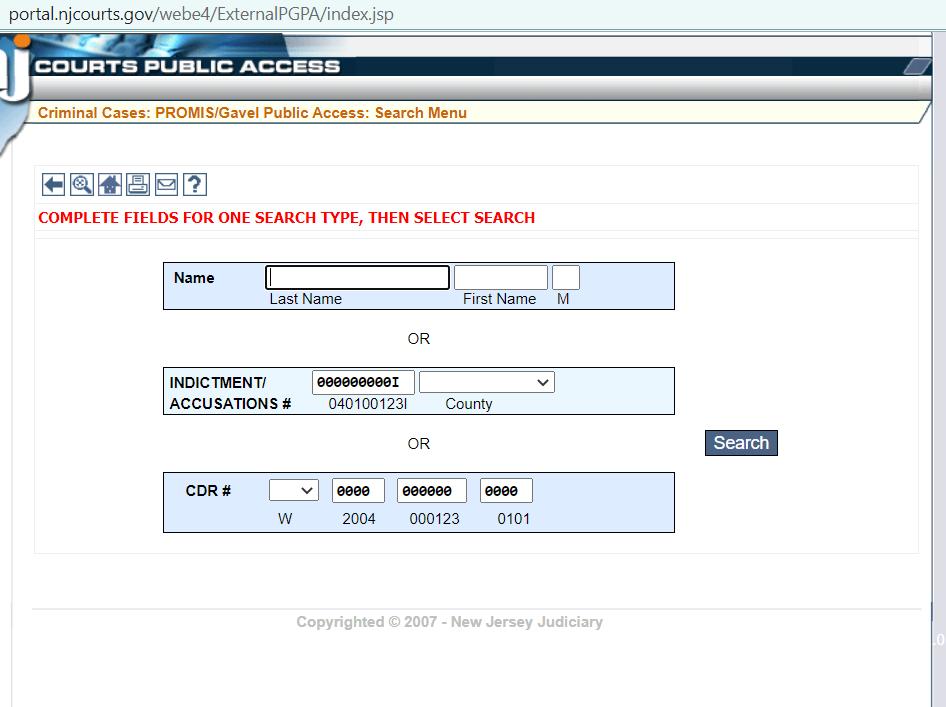
Run Public Access searches and save to send to VLJ
Note the Arrest information

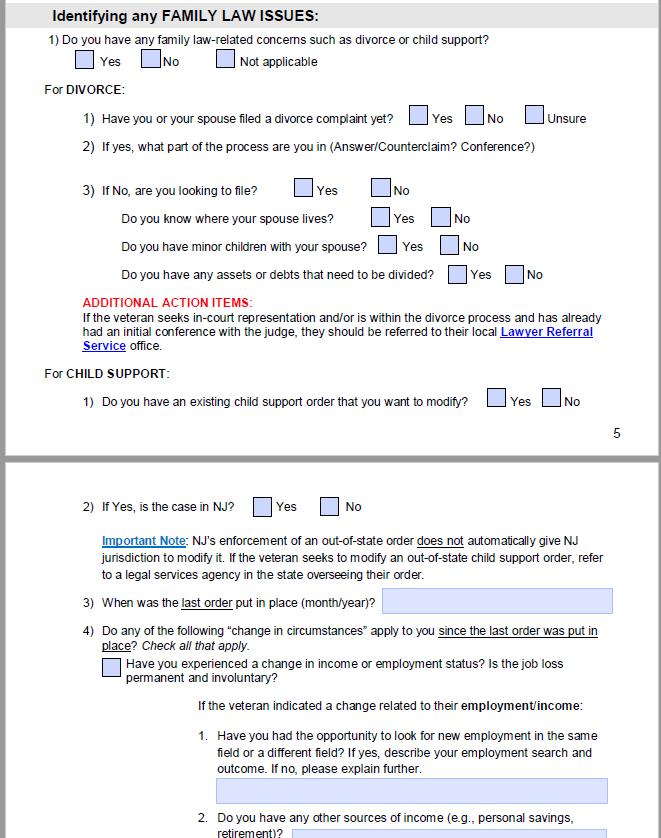

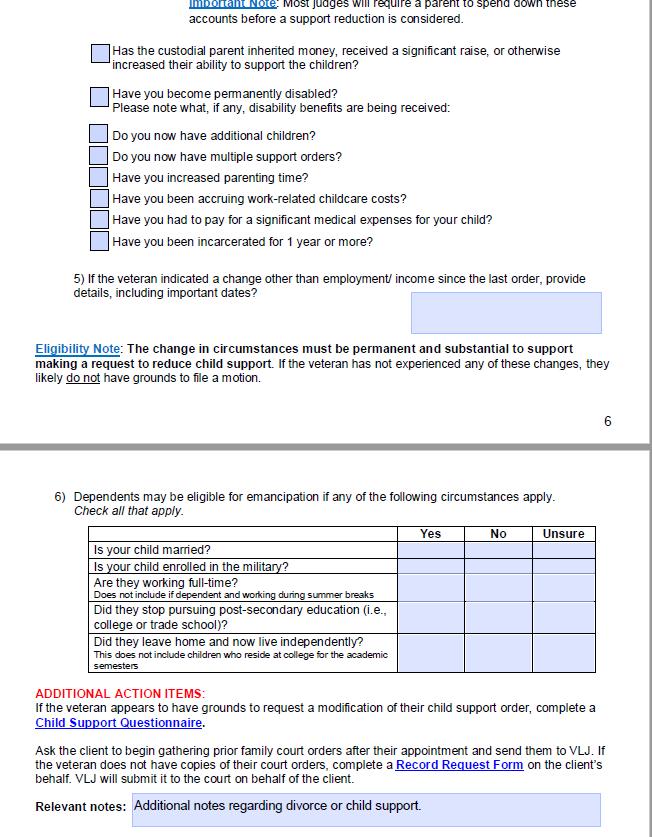

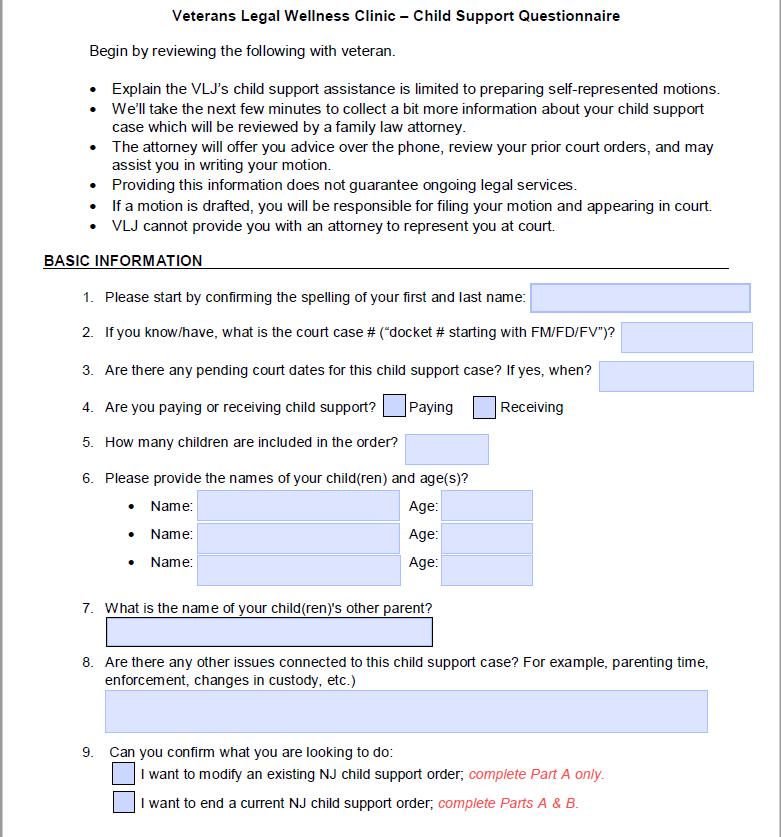
Review Scope of Child Support
Services VLJ offers
Collect Basic Information
Review the applicable section
• Part A: Modification
• Part A and B : Modification and Emancipation
After completing the Wellness Interview:
• Confirm all relevant forms and questionnaires are completed
• Bankruptcy
• Child support
• Estate Planning
• Expungement
• Tenancy
• If your team is running short on time, please have one volunteer from your team stay with the client to finish up the additional forms*

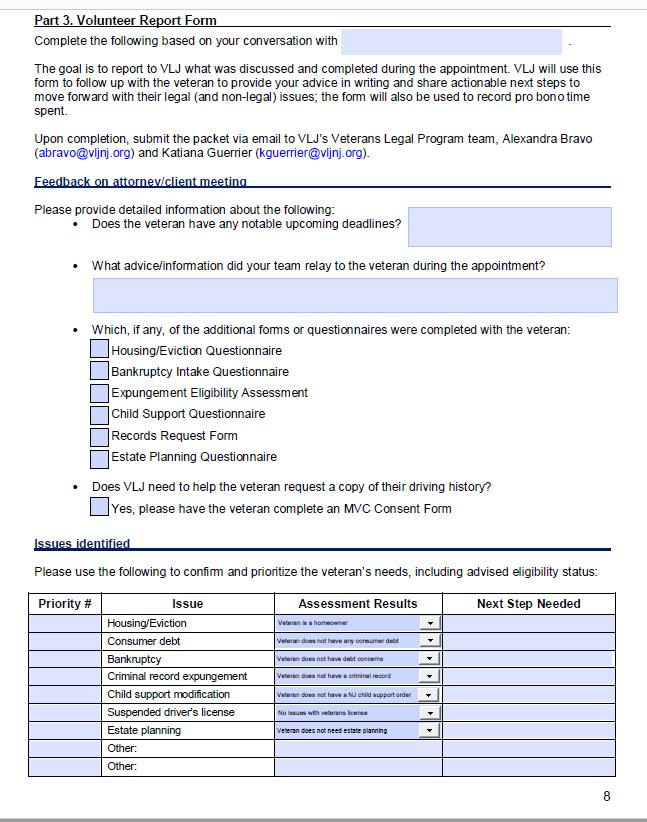
Highlight any notable deadlines
Check which additional form or questionnaire was completed
Priority, assessment and next steps for the relevant legal issues

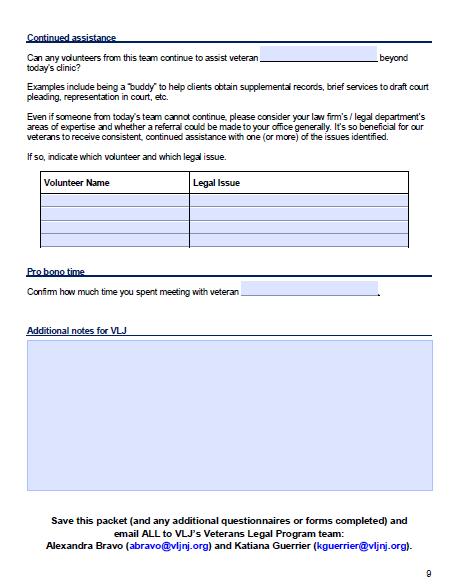
Note if you or someone from your office would like to continue assisting the veteran outside the clinic setting
Confirm Pro Bono time
Additional notes: referrals, advice, etc




• Some experience trauma related to:
• Military service and experiences
• Sexual assaul t
• Poverty
• Others
• Traum a’s effect on assisting client:
• Client may have issues with memory
• Client may have felt unheard in past and may need to vent
• Client may have trouble telling his/her story in a narrative, linear fashion
• Client may be focused on one issue when the real priority may be another
• Do
• Use open ended questions to get the client’s general story
• Use the Volunteer packet to guide conversation toward individual issues VLJ can assist with
• Find out which issues are priorities to the client and/or time sensitive (court dates, responsive p leadin g s due, etc.)
• Listen carefully and pick up on key words
• Ex. “ I’m having a trouble with money.” – ask abou t d ebts, housing, etc.
• Give the best, most definitive advice you can
• Be clear about the legal issues VLJ cannot assist with
• If unsure, ask VLJ staff
• Do Not:
• Ask Questions that suggest judgment
• Ex “ Why did/didn’t you..”
• Overly react to statements made by the clients
• This can include facial expressions
• Let the client lose sight of the legal issues VLJ can assist with
• Gently remind the client of what VLJ can assist with and redirect the client as needed
• Make promises or give false hope

Federal and out - of - state conv ictions are NOT eligible
Motor vehicle violations are NOT eligible
Domestic violence charges are NOT eligible
1.What type of convictions?
Any barred offenses?
2. How many convictions?
3. Has the waiting period elapsed?


Indictable Crime Disorderly & Petty Disorderly Persons and Local Ordinance Violations
AKA Felony
Superior Court
Degree
Promis G avel


AKA misdemeanor

Municipal Court
No degree
Municipal Court Case Search (MCCS)


• To expunge disorderly persons convictions ONLY:
• Up to 5
• Certain marijuana convictions will be treated as disorderly persons and not count towards the allotted 5.
• To expunge indictable crimes convictions ONLY:
• Generally one unless all crimes are listed on a single judgment of conviction OR were interdependent or closely related in time and circumstance.
• May expunge the most recent one (if not a barred offense) after waiting period elapses.
• To expunge indictable crimes AND disorderly persons convictions:
• 1 indictable and up to 3 disorderly persons
• “Clean Slate”
• No limit on number of convictions (excluding barred offenses)
Indictable Crime Conviction 5 years (4 years for early pathway)
Disorderly Persons Conviction 5 years (3 years for early pathways)
Municipal Ordinance Conviction 2 years
PTI or Diversionary Dismissal 6 months
Dismissal Automatic and no waiting period
Clean Slate 10 years and will eventually be automatic
Waiting period begins from completion of sentence: release from jail or prison, completion of probation or parole, or fine payment, whichever is later.
•Early pathway
•At least 4 years have elapsed since sentence completion for an indictable offense and 3 years for disorderly persons
•No subsequent convictions
•Court finds in its discretion “compelling circumstances” exist to grant the expungement
•Substantial compliance
•Waiting period has elapsed since custodial sentence, probation or parole completion BUT not the fine payment
•Substantially complied with any payment plan or could not do so due to compelling circumstances
•Young drug offender
•N.J.S.A. 2C: 52-5: If 21 years of age or younger at time of offense, may apply after 1 year
N.J.S.A.2C:52-2,N.J.S.A.2C:52-3andP.L.2019,c.269 .
•Flexible Filing
•Petitioners may file in the county in which they reside or ANY county with a conviction.
•Exceptions
•Applies to traditional and Clean Slate expungements
•Clean Slate includes local ordinances
https://portal.njcourts.gov/webe5/MPAWeb/index.jsp

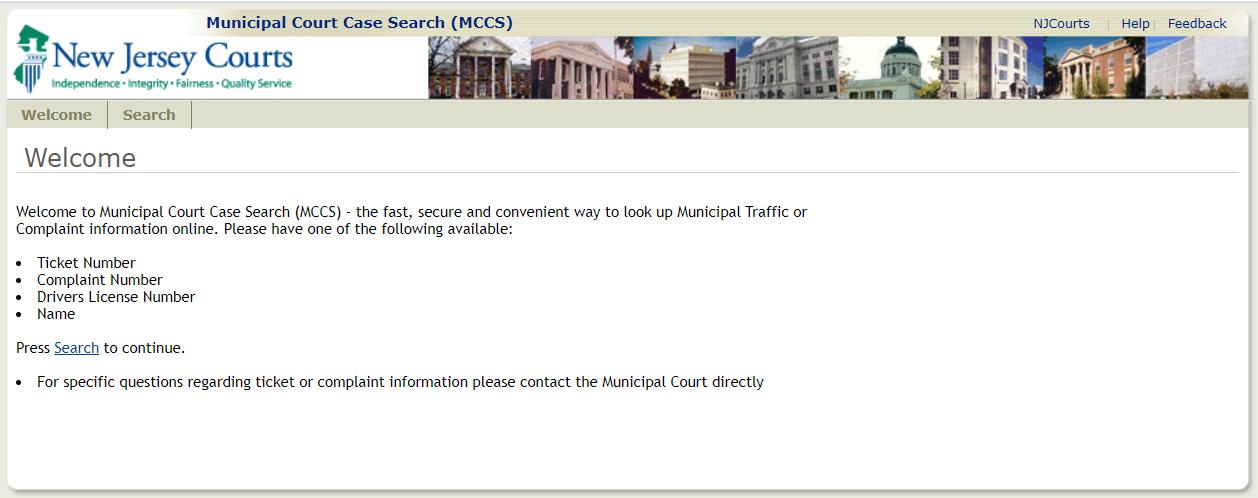
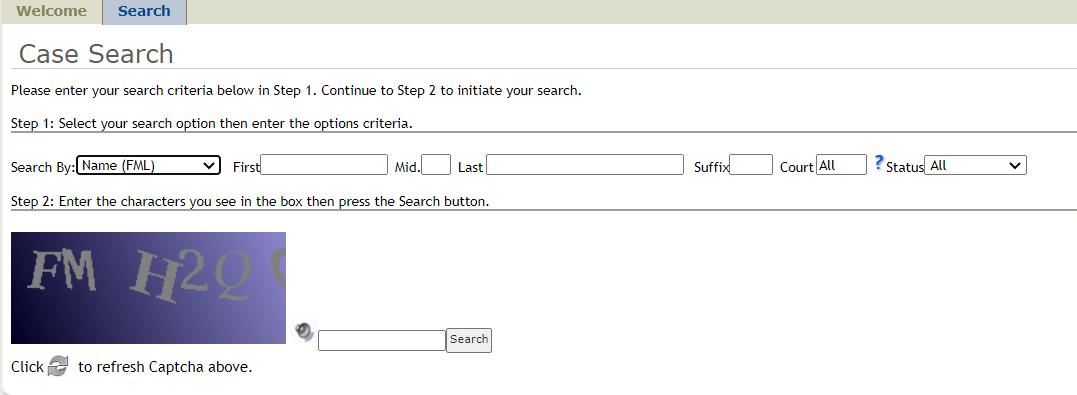


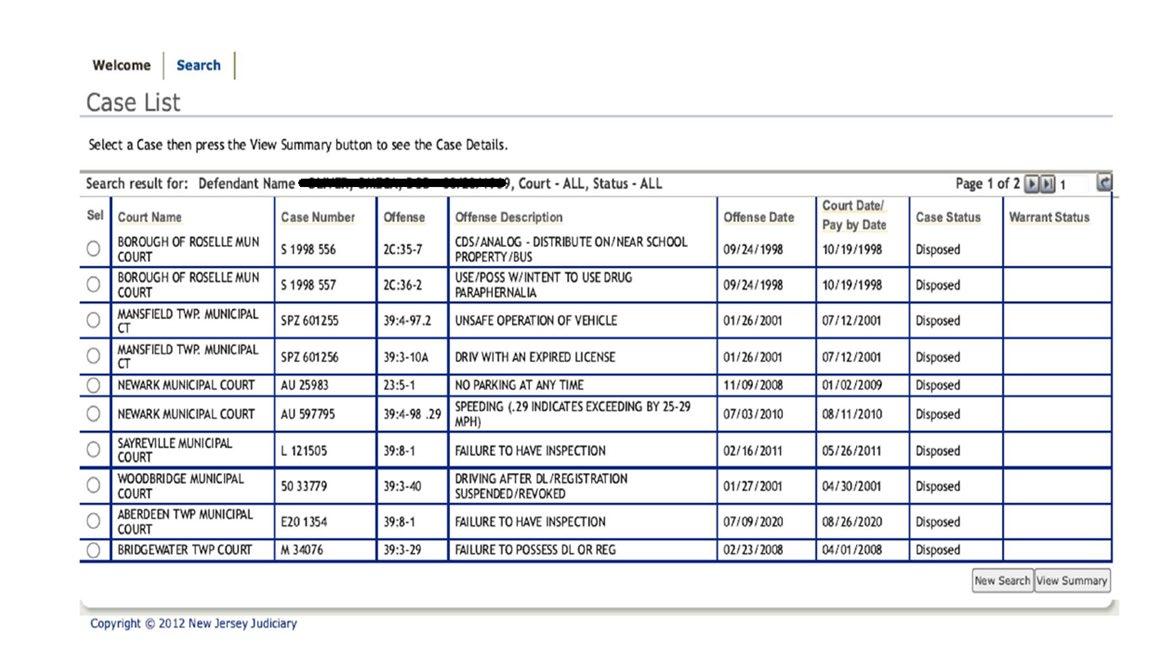
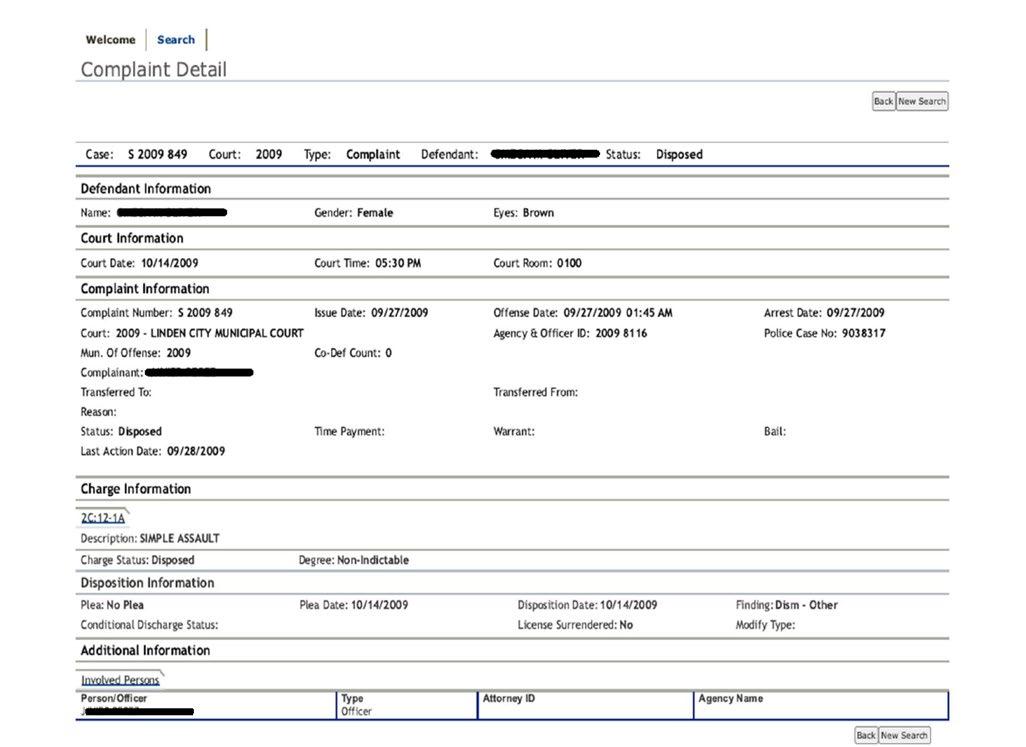


https://portal.njcourts.gov/ExternalPGPA/home.jsp



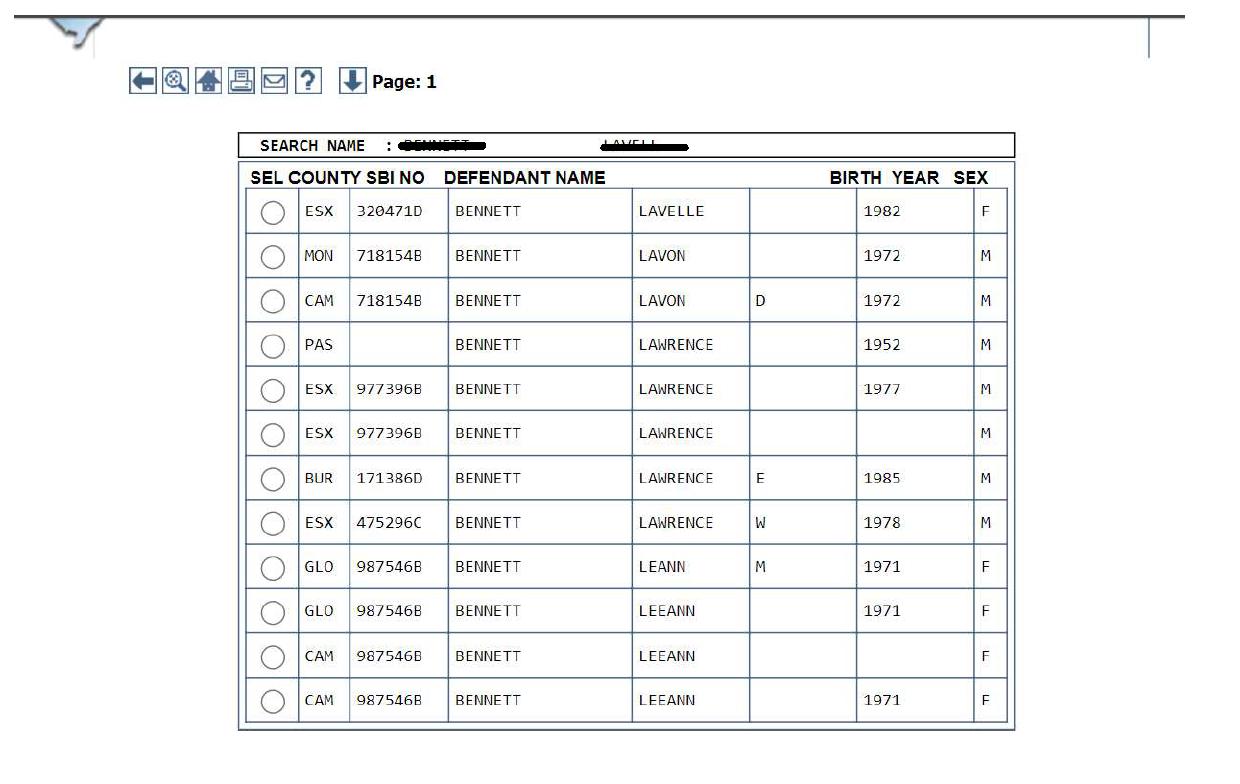

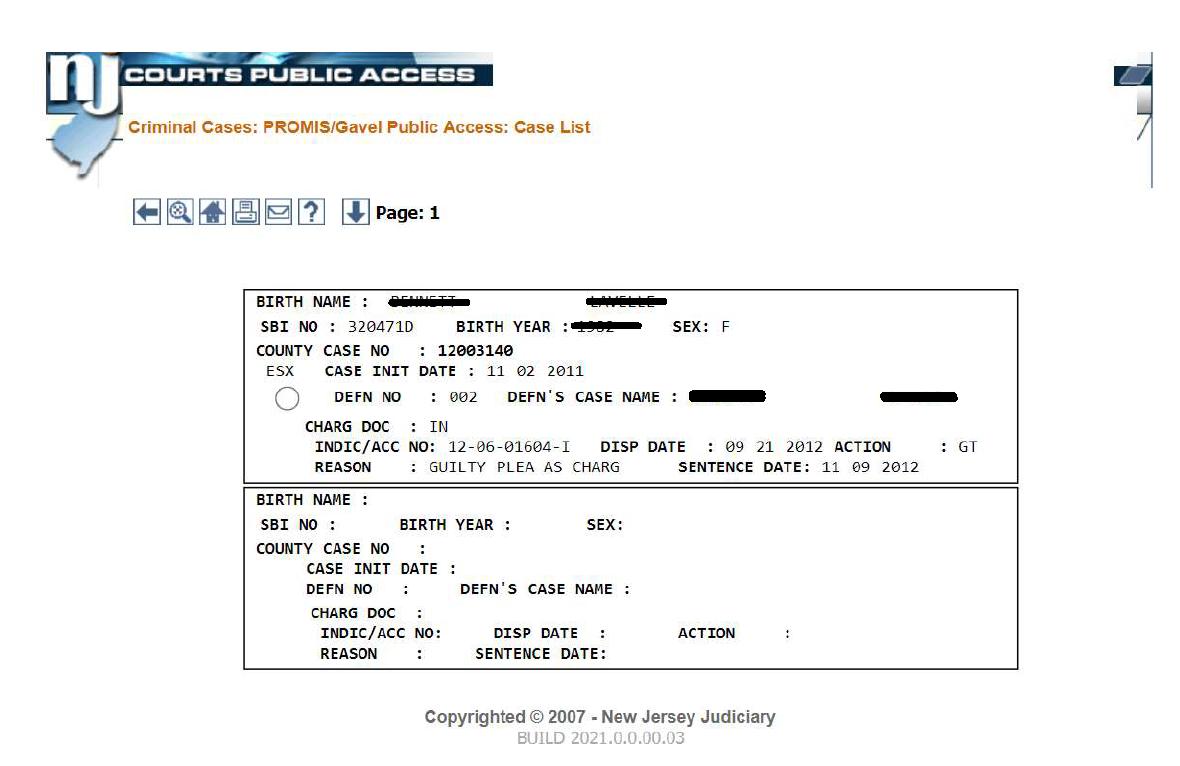

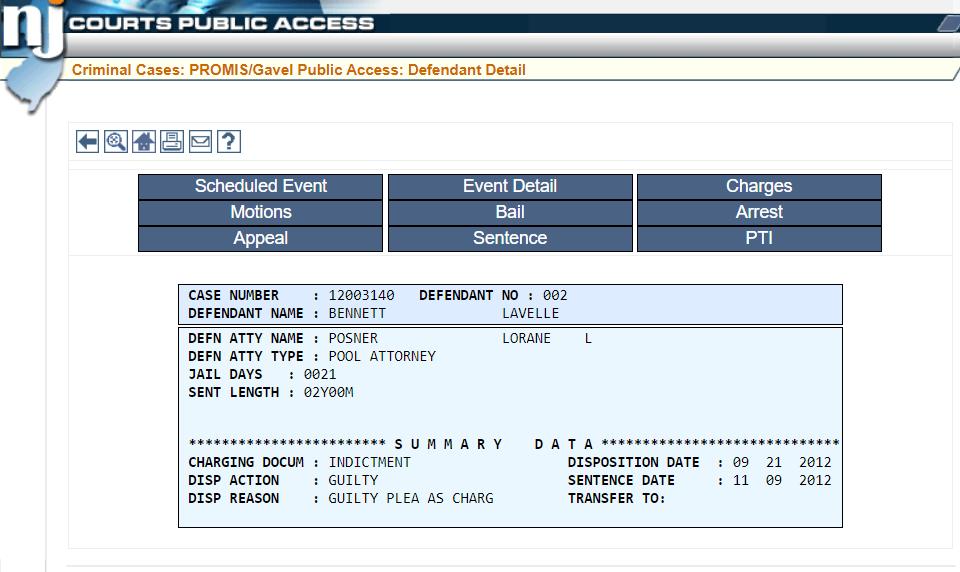

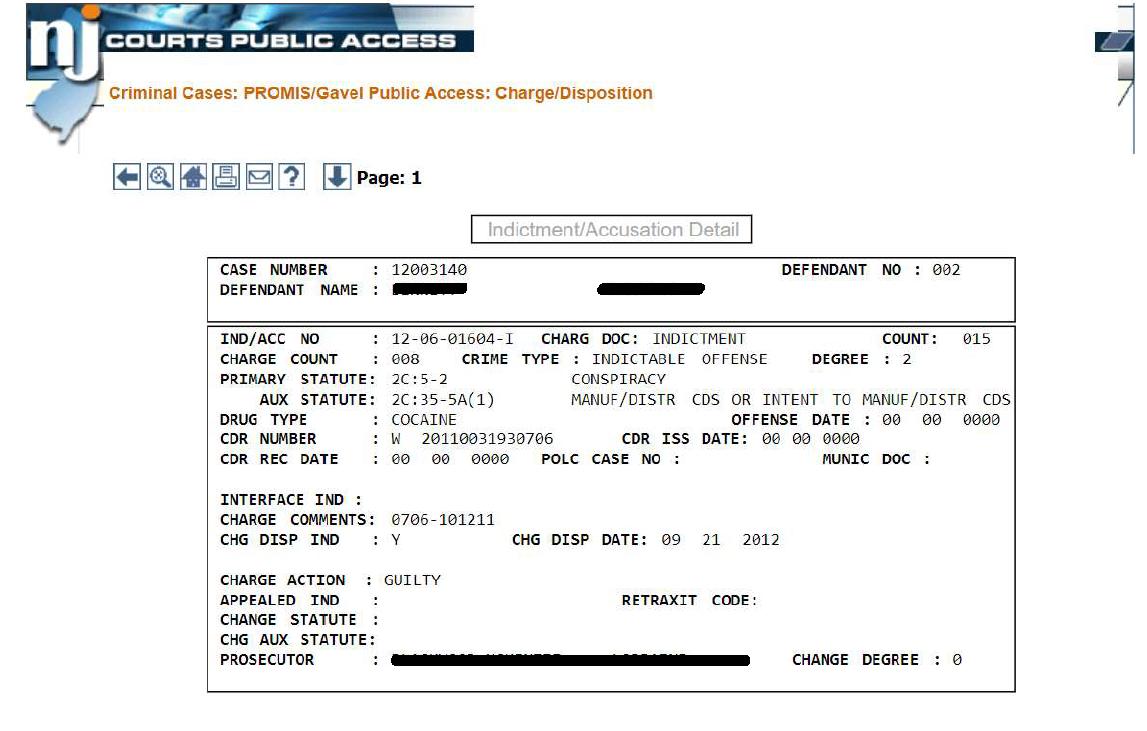

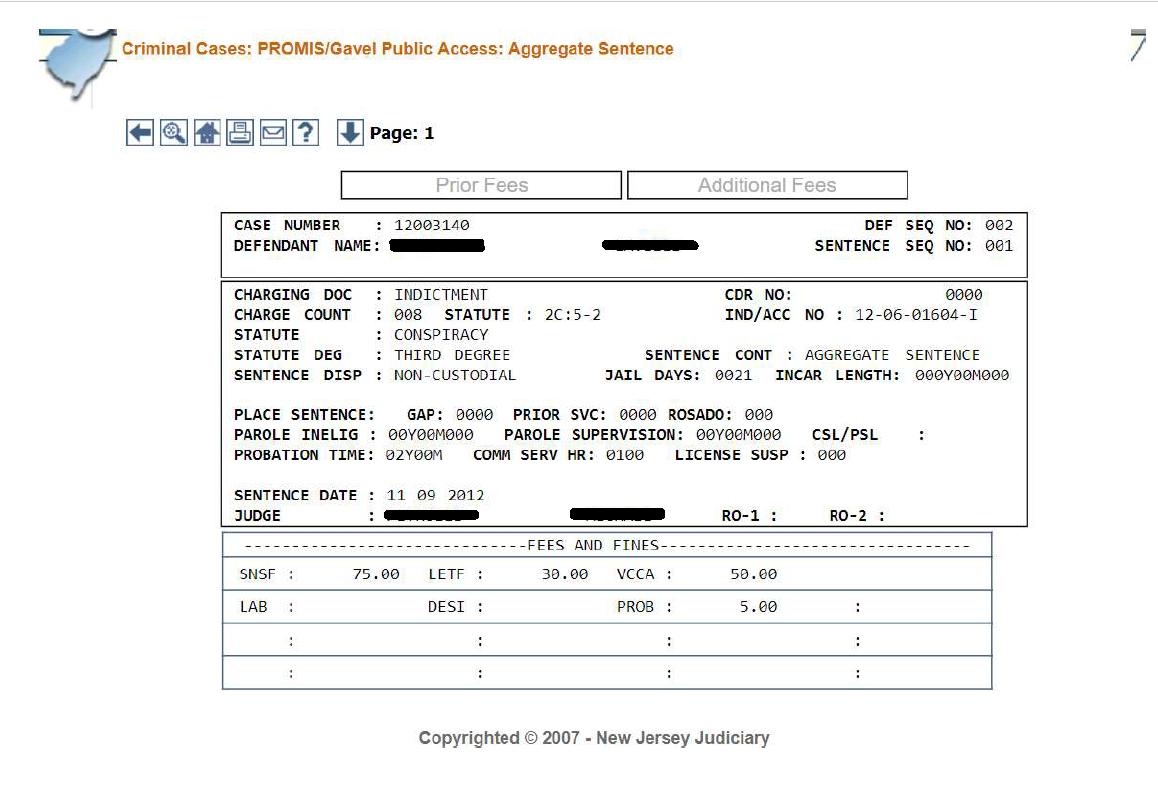
Confirm Client’s name and DOB
Run Public Access searches and save to send to VLJ
Note the Arrest information

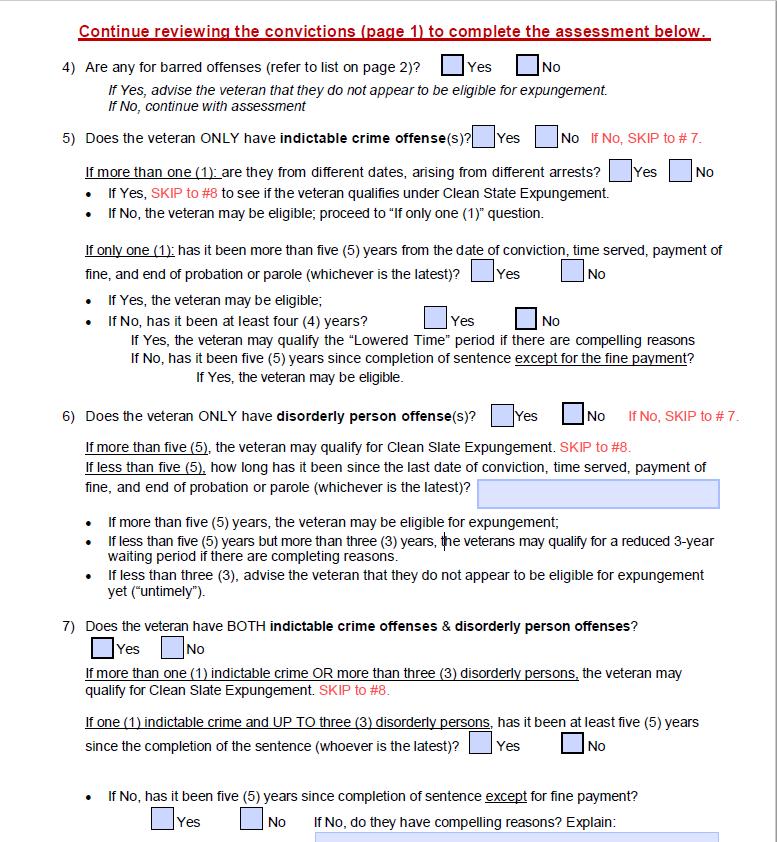
Confirm there are no barred offenses
Review the applicable section
• Section 5: Indictable convictions only
• Section 6: Disorderly Persons convictions only
• Section 7: Both Indictable and Disorderly person’s offense
• Section 8: Clean Slate
Additional eligibility notes

Expungement Eligibility
Determination to be selected
Other Important information
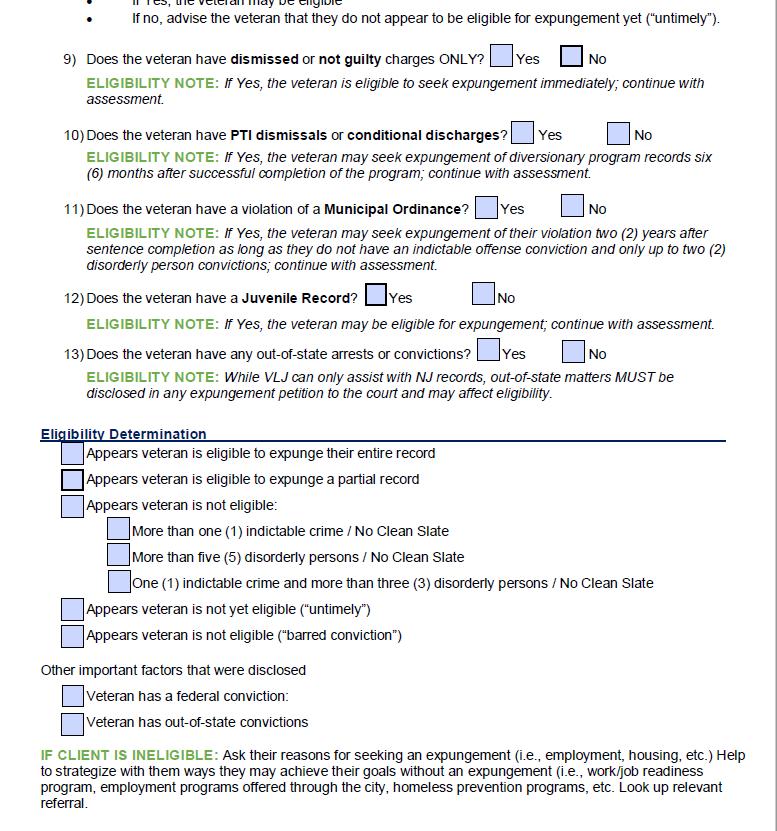

• Dispositions
– Records Request Form - complete during clinic
• submitted via JEDS: https://www.njcourts.gov/selfhelp/jeds.html
– Contact court and request a disposition letter, Judgment of Conviction and/or Final Order
• Criminal Case History (CCH)
– Requires fingerprinting appointment (fee: $40-$50)
• Sentence Completion
– Contact municipal court or county probation office
– Request letter confirming sentence completion Next steps should be listed in the client’s
Clinic Eligibility and Assessment Form
• After expungement petition has been filed, State has 60 days to schedule hearing date
– There is currently a delay in the scheduling of hearing dates within most counties
– Often time the hearing date passes without the need for an appearance
• Petition will be reviewed by Prosecutor’s office to see if there is an objection
– If objection is received, petitioner will need to respond addressing the objection
• If no further objections, Judge will sign the Order which must then be served on all parties including the New Jersey State Police ( NJSP)
• Parties are required to process the Order and remove the expunged records from their files
– There is currently a backlog in NJSP process Expungement Orders
– Link for petitioner to register for the Expungement Status Portal and follow the progress of the processing of Final Orders:
https://expungement.njsp.gov/EXPG_Portal/Default.aspx
Current through New Jersey 220th Second Annual Session, L. 2023, c. 228 and J.R. 15
LexisNexis® New Jersey Annotated Statutes > Title 2C. The New Jersey Code of Criminal Justice (Subts. 1 — 3) > Subtitle 3. Sentencing (Chs. 43 — 104) > Chapter 52. Expungement (§§ 2C:52-1 — 2C:52-32.1)
History
L.1978, c. 95.
LexisNexis® New Jersey Annotated Statutes
Copyright © 2024 All rights reserved.
End of Document
Current through New Jersey 220th Second Annual Session, L. 2023, c. 228 and J.R. 15
LexisNexis® New Jersey Annotated Statutes > Title 2C. The New Jersey Code of Criminal Justice (Subts. 1 — 3) > Subtitle 3. Sentencing (Chs. 43 — 104) > Chapter 52. Expungement (§§ 2C:52-1 — 2C:52-32.1)
Definition of Expungement. a. Except as otherwise provided in this chapter, expungement shall mean the extraction, sealing, impounding, or isolation of all records on file within any court, detention or correctional facility, law enforcement or criminal justice agency concerning a person’s detection, apprehension, arrest, detention, trial or disposition of an offense within the criminal justice system.
b. Expunged records shall include complaints, warrants, arrests, commitments, processing records, fingerprints, photographs, index cards, “rap sheets” and judicial docket records.
L.1979, c. 178, § 108; amended by 2019, c. 269, § 1, effective June 15, 2020.
LexisNexis® New Jersey Annotated Statutes Copyright © 2024 All rights reserved.
End of Document
Current through New Jersey 220th Second Annual Session, L. 2023, c. 228 and J.R. 15
LexisNexis® New Jersey Annotated Statutes > Title 2C. The New Jersey Code of Criminal Justice (Subts. 1 — 3) > Subtitle 3. Sentencing (Chs. 43 — 104) > Chapter 52. Expungement (§§ 2C:52-1 — 2C:52-32.1)
a. In all cases, except as herein provided, a person may present an expungement application to the Superior Court pursuant to this section if:
the person has been convicted of one crime under the laws of this State, and does not otherwise have any subsequent conviction for another crime, whether within this State or any other jurisdiction. Subject to the provision of subsection e. of N.J.S.2C:52-14 requiring denial of an expungement petition when a person has had a previous criminal conviction expunged, a prior conviction for another crime shall not bar presenting an application seeking expungement relief for the criminal conviction that is the subject of the application; or the person has been convicted of one crime and no more than three disorderly persons or petty disorderly persons offenses under the laws of this State, and does not otherwise have any subsequent conviction for another crime, or any subsequent conviction for another disorderly persons or petty disorderly persons offense such that the total number of convictions for disorderly persons and petty disorderly persons offenses would exceed three, whether any such crime or offense conviction was within this State or any other jurisdiction. Subject to the provision of subsection e. of N.J.S.2C:52-14 requiring denial of an expungement petition when a person has had a previous criminal conviction expunged, a prior conviction for another crime, disorderly persons offense, or petty disorderly persons offense shall not bar presenting an application seeking expungement relief for the one criminal conviction and no more than three convictions for disorderly persons or petty disorderly persons offenses that are the subject of the application; or
the person has been convicted of multiple crimes or a combination of one or more crimes and one or more disorderly persons or petty disorderly persons offenses under the laws of this State, all of which are listed in a single judgment of conviction, and does not otherwise have any subsequent conviction for another crime or offense in addition to those convictions included in the expungement application, whether any such conviction was within this State or any other jurisdiction. Subject to the provision of subsection e. of N.J.S.2C:52-14 requiring denial of an expungement petition when a person has had a previous criminal conviction expunged, a prior conviction for another crime, disorderly persons offense, or petty disorderly persons offense that is not listed in a single judgment of conviction shall not bar presenting an application seeking expungement relief for the convictions listed in a single judgment of conviction that are the subject of the application; or
the person has been convicted of multiple crimes or a combination of one or more crimes and one or more disorderly persons or petty disorderly persons offenses under the laws of this State, which crimes or combination of crimes and offenses were interdependent or closely related in circumstances and were committed as part of a sequence of events that took place within a comparatively short period of time, regardless of the date of conviction or sentencing for each individual crime or offense, and the person does not otherwise have any subsequent conviction for another crime or offense in addition to those convictions included in the expungement application, whether any such conviction was within this State or any other jurisdiction. Subject to the provision of subsection e. of N.J.S.2C:52-14 requiring denial of an expungement petition when a person has had a previous criminal conviction expunged, a prior conviction for another crime, disorderly persons offense, or petty disorderly persons offense that was not interdependent or closely related in circumstances and was not committed within a comparatively short period of time as described above shall not bar presenting an application seeking expungement relief for the convictions of crimes or crimes and offenses that were interdependent or closely related and committed within a comparatively short period of time, and that are the subject of the application.
For purposes of determining eligibility to present an expungement application to the Superior Court pursuant to this section, a conviction for unlawful distribution of, or possessing or having under control with intent to distribute, marijuana or hashish in violation of paragraph (11) of subsection b. of N.J.S.2C:35-5,or a lesser amount of marijuana or hashish in violation of paragraph (12) of subsection b. of that section, or a violation of either of those paragraphs and a violation of subsection a. of section 1 of P.L.1987, c.101 (C.2C:35-7) or subsection a. of section 1 of P.L.1997, c.327 (C.2C:35-7.1), for distributing, or possessing or having under control with intent to distribute, on or within 1,000 feet of any school property, or on or within 500 feet of the real property comprising a public housing facility, public park, or public building, or for obtaining or possessing marijuana or hashish in violation of paragraph (3) of subsection a. of N.J.S.2C:35-10, or for an equivalent crime in another jurisdiction, regardless of when the conviction occurred, shall not be considered a conviction of a crime within this State or any other jurisdiction but shall instead be considered a conviction of a disorderly persons offense within this State or an equivalent category of offense within the other jurisdiction, and a conviction for obtaining, possessing, using, being under the influence of, or failing to make lawful disposition of marijuana or hashish in violation of paragraph (4) of subsection a., or subsection b., or subsection c. of N.J.S.2C:35-10, or a violation involving marijuana or hashish as described herein and using or possessing with intent to use drug paraphernalia with that marijuana or hashish in violation of N.J.S.2C:36-2, or for an equivalent crime or offense in another jurisdiction, regardless of when the conviction occurred, shall not be considered a conviction within this State or any other jurisdiction.
The person, if eligible, may present the expungement application after the expiration of a period of five years from the date of his most recent conviction, payment of any court-ordered financial assessment, satisfactory completion of probation or parole, or release from incarceration, whichever is later. The term “court-ordered financial assessment” as used herein and throughout this section means and includes any fine, fee, penalty, restitution, and other form of financial assessment imposed by the court as part of the sentence for the conviction or convictions that are the subject of the application, for which payment of restitution takes precedence in accordance with chapter 46 of Title 2C of the New Jersey Statutes. The person shall submit the expungement application to the Superior Court in the county in which the most recent conviction for a crime was adjudged, which includes a duly verified petition as provided in N.J.S.2C:52-7 praying that the conviction, or convictions if applicable, and all records and information pertaining thereto be expunged. The petition appended to an application shall comply with the requirements set forth in N.J.S.2C:52-1 et seq.
Notwithstanding the provisions concerning the five-year time requirement, if, at the time of application, a courtordered financial assessment subject to collection under the comprehensive enforcement program established pursuant to P.L.1995, c.9 (C.2B:19-1 et al.) is not yet satisfied due to reasons other than willful noncompliance, but the time requirement of five years is otherwise satisfied, the person may submit the expungement application and the court may grant an expungement; provided, however, that if expungement is granted the court shall enter a civil judgment for the unpaid portion of the court-ordered financial assessment in the name of the Treasurer, State of New Jersey and transfer collections and disbursement responsibility to the State Treasurer for the outstanding amount in accordance with section 8 of P.L.2017, c.244 (C.2C:52-23.1). The Treasurer may specify, and the Administrative Office of the Courts shall collaborate with, the technical and informational standards required to effectuate the transfer of the collection and disbursement responsibilities. Notwithstanding any provision in this law or any other law to the contrary, the court shall have sole discretion to amend the judgment.
Additionally, an application may be filed and presented, and the court may grant an expungement pursuant to this section, although less than five years have expired in accordance with the time requirements when the court finds:
(1) the court-ordered financial assessment is satisfied but less than five years have expired from the date of satisfaction, and the time requirement of five years is otherwise satisfied, and the court finds that the person substantially complied with any payment plan ordered pursuant to N.J.S.2C:46-1 et seq., or could not do so due to compelling circumstances affecting his ability to satisfy the assessment; or
(2) at least four but less than five years have expired from the date of the most recent conviction, payment of any court-ordered financial assessment, satisfactory completion of probation or parole, or release from incarceration, whichever is later; and the person has not been otherwise convicted of a crime, disorderly persons offense, or petty disorderly persons offense since the time of the most recent conviction; and the court finds in its discretion
§2C:52-2. Indictable Offenses
that compelling circumstances exist to grant the expungement. The prosecutor may object pursuant to section 11 of P.L.2019, c.269 (C.2C:52-10.1), N.J.S.2C:52-11, N.J.S.2C:52-14, or N.J.S.2C:52-24.
In determining whether compelling circumstances exist for the purposes of paragraph (1) of this subsection, a court may consider the amount of any court-ordered financial assessment imposed, the person’s age at the time of the offense or offenses, the person’s financial condition and other relevant circumstances regarding the person’s ability to pay.
b. Records of conviction pursuant to statutes repealed by this Code for the crimes of murder, manslaughter, treason, anarchy, kidnapping, rape, forcible sodomy, arson, perjury, false swearing, robbery, embracery, or a conspiracy or any attempt to commit any of the foregoing, or aiding, assisting or concealing persons accused of the foregoing crimes, shall not be expunged.
Records of conviction for the following crimes specified in the New Jersey Code of Criminal Justice shall not be subject to expungement: N.J.S.2C:11-1 et seq. (Criminal Homicide), except death by auto as specified in N.J.S.2C:115 and strict liability vehicular homicide as specified in section 1 of P.L.2017, c.165 (C.2C:11-5.3); N.J.S.2C:13-1 (Kidnapping); section 1 of P.L.1993, c.291 (C.2C:13-6) (Luring or Enticing); section 1 of P.L.2005, c.77 (C.2C:13-8) (Human Trafficking); N.J.S.2C:14-2 (Sexual Assault or Aggravated Sexual Assault); subsection a. of N.J.S.2C:14-3 (Aggravated Criminal Sexual Contact); if the victim is a minor, subsection b. of N.J.S.2C:14-3 (Criminal Sexual Contact); if the victim is a minor and the offender is not the parent of the victim, N.J.S.2C:13-2 (Criminal Restraint) or N.J.S.2C:13-3 (False Imprisonment); N.J.S.2C:15-1 (Robbery); N.J.S.2C:17-1 (Arson and Related Offenses); subsection a. of N.J.S.2C:24-4 (Endangering the welfare of a child by engaging in sexual conduct which would impair or debauch the morals of the child, or causing the child other harm); paragraph (4) of subsection b. of N.J.S.2C:24-4 (Photographing or filming a child in a prohibited sexual act or for portrayal in a sexually suggestive manner); paragraph (3) of subsection b. of N.J.S.2C:24-4 (Causing or permitting a child to engage in a prohibited sexual act or the simulation of an act, or to be portrayed in a sexually suggestive manner); subparagraph (a) of paragraph (5) of subsection b. of N.J.S.2C:24-4 (Distributing, possessing with intent to distribute or using a file-sharing program to store items depicting the sexual exploitation or abuse of a child); subparagraph (b) of paragraph (5) of subsection b. of N.J.S.2C:24-4 (Possessing or viewing items depicting the sexual exploitation or abuse of a child); section 8 of P.L.2017, c.141 (C.2C:24-4.1) (Leader of a child pornography network); N.J.S.2C:28-1 (Perjury); N.J.S.2C:28-2 (False Swearing); paragraph (4) of subsection b. of N.J.S.2C:34-1 (Knowingly promoting the prostitution of the actor’s child); section 2 of P.L.2002, c.26 (C.2C:38-2) (Terrorism); subsection a. of section 3 of P.L.2002, c.26 (C.2C:38-3) (Producing or Possessing Chemical Weapons, Biological Agents or Nuclear or Radiological Devices); and conspiracies or attempts to commit such crimes.
Records of conviction for any crime committed by a person holding any public office, position or employment, elective or appointive, under the government of this State or any agency or political subdivision thereof and any conspiracy or attempt to commit such a crime shall not be subject to expungement if the crime involved or touched such office, position or employment.
c. In the case of conviction for the sale or distribution of a controlled dangerous substance or possession thereof with intent to sell, expungement shall be denied except where the crimes involve:
(1) Marijuana, where the total quantity sold, distributed or possessed with intent to sell was less than one ounce;
(2) Hashish, where the total quantity sold, distributed or possessed with intent to sell was less than five grams; or
(3) Any controlled dangerous substance provided that the conviction is of the third or fourth degree, where the court finds that compelling circumstances exist to grant the expungement. The prosecutor may object pursuant to section 11 of P.L.2019, c.269 (C.2C:52-10.1), N.J.S.2C:52-11, N.J.S.2C:52-14, .J.S.2C:52-24.
d. In the case of a State licensed physician or podiatrist convicted of an offense involving drugs or alcohol or pursuant to section 14 or 15 of P.L.1989, c.300 (C.2C:21-20 or 2C:21-4.1), the petitioner shall notify the State Board of Medical Examiners upon filing an application for expungement and provide the board with a copy thereof. The petitioner shall also provide to the court a certification attesting that the requirements of this subsection were satisfied. Failure to satisfy the requirements of this subsection shall be grounds for denial of the expungement application and, if applicable, administrative discipline by the board.
L.1979, c. 178, § 109; Amended 1989, c. 300, § 23; 1993, c. 301, § 1; 1994, c. 133, § 6; 2009, c. 188, § 1, eff. Mar. 13, 2010; 2013, c. 136, § 3, eff. Aug. 14, 2013; 2015, c. 261, § 2, effective April 18, 2016; 2017, c. 141, § 7, effective February 1, 2018; 2017, c. 165, § 9, effective July 21, 2017; 2017, c. 244, § 1, effective October 1, 2018; 2019, c. 269, § 2, effective June 15, 2020.
LexisNexis® New Jersey Annotated Statutes Copyright © 2024 All rights reserved.
Current through New Jersey 220th Second Annual Session, L. 2023, c. 228 and J.R. 15
LexisNexis® New Jersey Annotated Statutes > Title 2C. The New Jersey Code of Criminal Justice (Subts. 1 — 3) > Subtitle 3. Sentencing (Chs. 43 — 104) > Chapter 52. Expungement (§§ 2C:52-1 — 2C:52-32.1)
a. Any person who has been convicted of one or more disorderly persons or petty disorderly persons offenses under the laws of this State who has not been convicted of any crime, whether within this State or any other jurisdiction, may present an expungement application to a court pursuant to this section. Any person who has been convicted of one or more disorderly persons or petty disorderly persons offenses under the laws of this State who has also been convicted of one or more crimes shall not be eligible to apply for an expungement pursuant to this section, but may present an expungement application to the Superior Court pursuant to N.J.S.2C:52-2.
b. Any person who has been convicted of one or more disorderly persons or petty disorderly persons offenses under the laws of this State who has not been convicted of any crime, whether within this State or any other jurisdiction, may present an expungement application pursuant to this section to any court designated by the Rules of Court if:
the person has been convicted, under the laws of this State, on the same or separate occasions of no more than five disorderly persons offenses, no more than five petty disorderly persons offenses, or a combination of no more than five disorderly persons and petty disorderly persons offenses, and the person does not otherwise have any subsequent conviction for a disorderly persons or petty disorderly persons offense, whether within this State or any other jurisdiction, such that the total number of convictions for disorderly persons and petty disorderly persons offenses would exceed five. Subject to the provision of subsection e. of N.J.S.2C:52-14 requiring denial of an expungement petition when a person has had a previous criminal conviction expunged, a prior conviction for another disorderly persons offense or petty disorderly persons offense shall not bar presenting an application seeking expungement relief for the convictions that are the subject of the application, which may include convictions for no more than five disorderly persons or petty disorderly persons offenses, or combination thereof; or
the person has been convicted of multiple disorderly persons offenses or multiple petty disorderly persons offenses under the laws of this State, or a combination of multiple disorderly persons and petty disorderly persons offenses under the laws of this State, which convictions were entered on the same day, and does not otherwise have any subsequent conviction for another offense in addition to those convictions included in the expungement application, whether any such conviction was within this State or any other jurisdiction. Subject to the provision of subsection e. of N.J.S.2C:52-14 requiring denial of an expungement petition when a person has had a previous criminal conviction expunged, a prior conviction for another disorderly persons or petty disorderly persons offense that was not entered on the same day shall not bar presenting an application seeking expungement relief for the convictions entered on the same day that are the subject of the application; or
the person has been convicted of multiple disorderly persons offenses or multiple petty disorderly persons offenses under the laws of this State, or a combination of multiple disorderly persons and petty disorderly persons offenses under the laws of this State, which offenses or combination of offenses were interdependent or closely related in circumstances and were committed as part of a sequence of events that took place within a comparatively short period of time, regardless of the date of conviction or sentencing for each individual offense, and the person does not otherwise have any subsequent conviction for another offense in addition to those convictions included in the expungement application, whether within this State or any other jurisdiction. Subject to the provision of subsection e. of N.J.S.2C:52-14 requiring denial of an expungement petition when a person has had a previous criminal conviction expunged, a prior conviction for another disorderly persons offense or petty disorderly persons offense that was not interdependent or closely related in circumstances and was not committed
§2C:52-3. Disorderly persons offenses and petty disorderly persons offenses
within a comparatively short period of time as described above shall not bar presenting an application seeking expungement relief for the convictions of offenses that were interdependent or closely related and committed within a comparatively short period of time, and that are the subject of the application.
For purposes of determining eligibility to present an expungement application to the court pursuant to this section, a conviction for unlawful distribution of, or possessing or having under control with intent to distribute, marijuana or hashish in violation of paragraph (11) of subsection b. of N.J.S.2C:35-5, or a lesser amount of marijuana or hashish in violation of paragraph (12) of subsection b. of that section, or a violation of either of those paragraphs and a violation of subsection a. of section 1 of P.L.1987, c.101 (C.2C:35-7) or subsection a. of section 1 of P.L.1997, c.327 (C.2C:35-7.1), for distributing, or possessing or having under control with intent to distribute, on or within 1,000 feet of any school property, or on or within 500 feet of the real property comprising a public housing facility, public park, or public building, or for obtaining or possessing marijuana or hashish in violation of paragraph (3) of subsection a. of N.J.S.2C:35-10, or for an equivalent crime in another jurisdiction, regardless of when the conviction occurred, shall not be considered a conviction of a crime within this State or any other jurisdiction but shall instead be considered a conviction of a disorderly persons offense within this State or an equivalent category of offense within the other jurisdiction, and a conviction for obtaining, possessing, using, being under the influence of, or failing to make lawful disposition of marijuana or hashish in violation of paragraph (4) of subsection a., or subsection b., or subsection c. of N.J.S.2C:35-10, or a violation involving marijuana or hashish as described herein and using or possessing with intent to use drug paraphernalia with that marijuana or hashish in violation of N.J.S.2C:36-2, or for an equivalent crime or offense in another jurisdiction, regardless of when the conviction occurred, shall not be considered a conviction within this State or any other jurisdiction.
Additionally, for purposes of determining eligibility to present an expungement application to the court pursuant to this section, a conviction for unlawful distribution or dispensing of, possession with intent to distribute or dispense, or manufacture with intent to distribute or dispense, drug paraphernalia in violation of N.J.S.2C:36-3 when the paraphernalia is a hypodermic syringe or needle, or for an equivalent crime involving a hypodermic syringe or needle in another jurisdiction, regardless of when the conviction occurred, shall not be considered a conviction of a crime within this State or any other jurisdiction but shall instead be considered a conviction of a disorderly persons offense within this State or an equivalent category of offense within the other jurisdiction, and a conviction for using or possessing with intent to use drug paraphernalia in violation of N.J.S.2C:36-2 when the paraphernalia is a hypodermic syringe or needle, or possession with intent to use or to distribute a hypodermic syringe or needle in violation of N.J.S.2C:36-6, of for an equivalent crime or offense in another jurisdiction, regardless of when the conviction occurred, shall not be considered a conviction within this State or any other jurisdiction.
The person, if eligible, may present the expungement application after the expiration of a period of five years from the date of his most recent conviction, payment of any court-ordered financial assessment, satisfactory completion of probation or parole, or release from incarceration, whichever is later. The term “court-ordered financial assessment” as used herein and throughout this section means and includes any fine, fee, penalty, restitution, and other form of financial assessment imposed by the court as part of the sentence for the conviction or convictions that are the subject of the application, for which payment of restitution takes precedence in accordance with chapter 46 of Title 2C of the New Jersey Statutes. The person shall submit the expungement application to a court in the county in which the most recent conviction for a disorderly persons or petty disorderly persons offense was adjudged, which includes a duly verified petition as provided in N.J.S.2C:52-7 praying that the conviction, or convictions if applicable, and all records and information pertaining thereto be expunged. The petition appended to an application shall comply with the requirements of N.J.S.2C:52-1 et seq.
Notwithstanding the provisions of the five-year time requirement, if, at the time of application, a court-ordered financial assessment subject to collection under the comprehensive enforcement program established pursuant to P.L.1995, c.9 (C.2B:19-1 et al.) is not yet satisfied due to reasons other than willful noncompliance, but the time requirement of five years is otherwise satisfied, the person may submit the expungement application and the court may grant an expungement; provided, however, that the court shall enter a civil judgment for the unpaid portion of the court-ordered financial assessment in the name of the Treasurer, State of New Jersey and transfer collections and disbursement responsibility to the State Treasurer for the outstanding amount in accordance with
§2C:52-3. Disorderly persons offenses and petty disorderly persons offenses
section 8 of P.L.2017, c.244 (C.2C:52-23.1). The Treasurer may specify, and the Administrative Office of the Courts shall collaborate with, the technical and informational standards required to effectuate the transfer of the collection and disbursement responsibilities. Notwithstanding any provision in this law or any other law to the contrary, the court shall have sole discretion to amend the judgment.
Additionally, an application may be filed and presented, and the court may grant an expungement pursuant to this section, although less than five years have expired in accordance with the time requirements when the court finds:
(1) the court-ordered financial assessment is satisfied but less than five years have expired from the date of satisfaction, and the five-year time requirement is otherwise satisfied, and the court finds that the person substantially complied with any payment plan ordered pursuant to N.J.S.2C:46-1 et seq., or could not do so due to compelling circumstances affecting his ability to satisfy the assessment; or
(2) at least three but less than five years have expired from the date of the most recent conviction, payment of any court-ordered financial assessment, satisfactory completion of probation or parole, or release from incarceration, whichever is later; and the person has not been otherwise convicted of a crime, disorderly persons offense, or petty disorderly persons offense since the time of the most recent conviction; and the court finds in its discretion that compelling circumstances exist to grant the expungement. The prosecutor may object pursuant to section 11 of P.L.2019, c.269 (C.2C:52-10.1), N.J.S.2C:52-11, N.J.S.2C:52-14, or N.J.S.2C:52-24.
In determining whether compelling circumstances exist for the purposes of paragraph (1) of this subsection, a court may consider the amount of any court-ordered financial assessment imposed, the person’s age at the time of the offense or offenses, the person’s financial condition and other relevant circumstances regarding the person’s ability to pay.
L.1979, c. 178, § 110; amended by L. 1981, c. 290, § 43; 2015, c. 261, § 3, effective April 18, 2016; 2017, c. 244, § 2, effective October 1, 2018; 2019, c. 269, § 3, effective June 15, 2020; 2021, c. 403, § 1, effective January 18, 2022.
LexisNexis® New Jersey Annotated Statutes Copyright © 2024 All rights reserved. End of Document
Current through New Jersey 220th Second Annual Session, L. 2023, c. 228 and J.R. 15
LexisNexis® New Jersey Annotated Statutes > Title 2C. The New Jersey Code of Criminal Justice (Subts. 1 — 3) > Subtitle 3. Sentencing (Chs. 43 — 104) > Chapter 52. Expungement (§§ 2C:52-1 — 2C:52-32.1)
In all cases wherein a person has been found guilty of violating a municipal ordinance of any governmental entity of this State and who has not been convicted of any prior or subsequent crime, whether within this State or any other jurisdiction, and who has not been adjudged a disorderly person or petty disorderly person on more than two occasions, may, after the expiration of a period of 2 years from the date of his conviction, payment of fine, satisfactory completion of probation or release from incarceration, whichever is later, present a duly verified petition as provided in section 2C:52-7 herein to the Superior Court in the county in which the violation occurred praying that such conviction and all records and information pertaining thereto be expunged.
L.1979, c. 178, § 111.
LexisNexis® New Jersey Annotated Statutes Copyright © 2024 All rights reserved.
End of Document
Current through New Jersey 220th Second Annual Session, L. 2023, c. 228 and J.R. 15
LexisNexis® New Jersey Annotated Statutes > Title 2C. The New Jersey Code of Criminal Justice (Subts. 1 — 3) > Subtitle 3. Sentencing (Chs. 43 — 104) > Chapter 52. Expungement (§§ 2C:52-1 — 2C:52-32.1)
a. Any person adjudged a juvenile delinquent may have such adjudication expunged as follows:
(1) Pursuant to N.J.S.2C:52-2, if the act committed by the juvenile would have constituted a crime if committed by an adult;
(2) Pursuant to N.J.S.2C:52-3, if the act committed by the juvenile would have constituted a disorderly or petty disorderly persons offense if committed by an adult; or
(3) Pursuant to N.J.S.2C:52-4, if the act committed by the juvenile would have constituted an ordinance violation if committed by an adult.
For purposes of expungement, any act which resulted in a juvenile being adjudged a delinquent shall be classified as if that act had been committed by an adult.
b. Additionally, any person who has been adjudged a juvenile delinquent may have his entire record of delinquency adjudications expunged if:
(1) Three years have elapsed since the final discharge of the person from legal custody or supervision or three years have elapsed after the entry of any other court order not involving custody or supervision, except that periods of post-incarceration supervision pursuant to section 25 of P.L.1982, c.77 (C.2A:4A-44), shall not be considered in calculating the three-year period for purposes of this paragraph;
(2) He has not been convicted of a crime, or a disorderly or petty disorderly persons offense, or adjudged a delinquent, or in need of supervision, during the three years prior to the filing of the petition, and no proceeding or complaint is pending seeking such a conviction or adjudication, except that periods of post-incarceration supervision pursuant to section 25 of P.L.1982, c.77 (C.2A:4A-44), shall not be considered in calculating the three-year period for purposes of this paragraph;
(3) He was never adjudged a juvenile delinquent on the basis of an act which if committed by an adult would constitute a crime not subject to expungement under N.J.S.2C:52-2;
(4) He has never had an adult conviction expunged; and
(5) He has never had adult criminal charges dismissed following completion of a supervisory treatment or other diversion program.
c. Any person who has been charged with an act of delinquency and against whom proceedings were dismissed may have the filing of those charges expunged pursuant to the provisions of N.J.S.2C:52-6.
L.1980, c. 163, § 1; amended by L. 1981, c. 290, § 44; 2009, c. 188, § 2, eff. Mar. 13, 2010; 2017, c. 245, § 1, effective April 1, 2018.
End of Document
§2C:52-4.1. Juvenile delinquent; expungement of adjudications and charges
Current through New Jersey 220th Second Annual Session, L. 2023, c. 228 and J.R. 15
LexisNexis® New Jersey Annotated Statutes > Title 2C. The New Jersey Code of Criminal Justice (Subts. 1 — 3) > Subtitle 3. Sentencing (Chs. 43 — 104) > Chapter 52. Expungement (§§ 2C:52-1 — 2C:52-32.1)
Notwithstanding the provisions of N.J.S.2C:52-2 and N.J.S.2C:52-3, after a period of not less than one year following conviction, termination of probation or parole or discharge from custody, whichever is later, any person convicted of an offense under chapter 35 or 36 of this title for the possession or use of a controlled dangerous substance, convicted of violating P.L.1955, c.77, s.3 (C.2A:170-77.5), or convicted of violating P.L.1962, c.113, s.1 (C.2A:170-77.8), and who at the time of the offense was 21 years of age or younger, may apply to the Superior Court in the county wherein the matter was disposed of for the expungement of such person’s conviction and all records pertaining thereto. The relief of expungement under this section shall be granted only if said person has not, prior to the time of hearing, violated any of the conditions of his probation or parole, albeit subsequent to discharge from probation or parole, has not been convicted of any previous or subsequent criminal act or any subsequent or previous violation of chapter 35 or 36 of this title or of P.L.1955, c.277, s.3 (C.2A:170-77.5) or of P.L.1962, c.113, s.1 (C.2A:170-77.8), or who has not had a prior or subsequent criminal matter dismissed because of acceptance into a supervisory treatment or other diversion program.
This section shall not apply to any person who has been convicted of the sale or distribution of a controlled dangerous substance or possession with the intent to sell any controlled dangerous substance except:
(1) Marihuana, where the total sold, distributed or possessed with intent to sell was less than one ounce, or
(2) Hashish, where the total amount sold, distributed or possessed with intent to sell was less than five grams.
History
L.1979, c. 178, § 112; amended by L. 1987, c. 106, § 16; 2017, c. 244, § 3, effective October 1, 2018.
LexisNexis® New Jersey Annotated Statutes Copyright © 2024 All rights reserved.
End of Document
Current through New Jersey 220th Second Annual Session, L. 2023, c. 228 and J.R. 15
LexisNexis® New Jersey Annotated Statutes > Title 2C. The New Jersey Code of Criminal Justice (Subts. 1 — 3) > Subtitle 3. Sentencing (Chs. 43 — 104) > Chapter 52. Expungement (§§ 2C:52-1 — 2C:52-32.1)
(1) Notwithstanding the requirements of N.J.S.2C:52-2 and N.J.S.2C:52-3 or any other provision of law to the contrary, beginning on the effective date of this section, the following persons may file a an expungement with any court designated by the Rules of Court at any time, provided they have satisfied, except as otherwise set forth in this subsection, payment of any court-ordered financial assessment as defined in section 8 of P.L.2017, c.244 (C.2C:52-23.1), satisfactorily completed probation or parole, been released from incarceration, or been discharged from legal custody or supervision at the time of application:
(a) any person who, prior to the development of a system for sealing records from the public pursuant to section 6 of P.L.2019, c.269 (C.2C:52-5.2), was charged with, convicted of, or adjudicated delinquent for, any number of offenses for, or delinquent acts which if committed by an adult would constitute, unlawful distribution of, or possessing or having under control with intent to distribute, marijuana or hashish in violation of paragraph (12) of subsection b. of N.J.S.2C:35-5, or a violation of that paragraph and a violation of subsection a. of section 1 of P.L.1987, c.101 (C.2C:35-7) or subsection a. of section 1 of P.L.1997, c.327 (C.2C:35-7.1) for distributing, or possessing or having under control with intent to distribute, on or within 1,000 feet of any school property, or on or within 500 feet of the real property comprising a public housing facility, public park, or public building; or
(b) any person who, prior to the development of a system for sealing records from the public pursuant to section 6 of P.L.2019, c.269 (C.2C:52-5.2), was charged with, convicted of, or adjudicated delinquent for, any number of offenses for, or delinquent acts which if committed by an adult would constitute, obtaining, possessing, using, being under the influence of, or failing to make lawful marijuana or hashish in violation of paragraph (3) or (4) of subsection a., or subsection b., or subsection c. of N.J.S.2C:35-10; or
(c) any person who, prior to the development of a system for sealing records from the public pursuant to section 6 of P.L.2019, c.269 (C.2C:52-5.2), was charged with, convicted of, or adjudicated delinquent for, any number of offenses for, or delinquent acts which if committed by an adult would constitute, a violation involving marijuana or hashish as described in subparagraph (a) or (b) of this paragraph and using or possessing with intent to use drug paraphernalia with that marijuana or hashish in violation of N.J.S.2C:36-2.
(2) If, at the time of application, a court-ordered financial assessment subject to collection under the comprehensive enforcement program established pursuant to P.L.1995, c.9 (C.2B:19-1 et al.) is not yet satisfied due to reasons other than willful noncompliance, but the provisions of paragraph (1) of this subsection are otherwise satisfied, the person may submit the expungement application and the court shall grant an expungement in accordance with subsection c. of this section; provided, however, that at the time the expungement is granted the court shall enter a civil judgment for the unpaid portion of the court-ordered financial assessment in the name of the Treasurer, State of New Jersey and transfer collection and disbursement responsibility to the State Treasurer for the outstanding amount in accordance with section 8 of P.L.2017, c.244 (C.2C:52:23.1). The Treasurer may specify, and the Administrative Office of the Courts shall collaborate with, the technical and informational standards required to effectuate the transfer of the collection and disbursement responsibilities. Notwithstanding any provision in this law or any other law to the contrary, the court shall have sole discretion to amend the judgment.
b.
c.
§2C:52-5.1. Eligibility to file petition for expungement
(1) Notwithstanding the requirements of N.J.S.2C:52-2 and N.J.S.2C:52-3 or any other provision of law to the contrary, beginning on the effective date of this section, a person who, prior, on, or after that effective date is charged with, convicted of, or adjudicated delinquent for, any number of offenses for, or delinquent acts which if committed by an adult would constitute, unlawful distribution of, or possessing or having under control with intent to distribute, marijuana or hashish in violation of paragraph (11) of subsection b. of N.J.S.2C:35-5, may file a an expungement with a court after the expiration of three years from the date of the most recent conviction, payment of any court-ordered financial assessment as defined in section 8 of P.L.2017, c.244 (C.2C:52-23.1), satisfactory completion of probation or parole, release from incarceration, or discharge from legal custody or supervision, whichever is later.
(2)
(a) Notwithstanding the provisions concerning the three-year time requirement set forth in paragraph (1) of this subsection, if, at the time of application, a court-ordered financial assessment subject to collection under the comprehensive enforcement program established pursuant to P.L.1995, c.9 (C.2B:19-1 et al.) is not yet satisfied due to reasons other than willful noncompliance, but the time requirement is otherwise satisfied, the person may submit the expungement application and the court shall grant an expungement in accordance with subsection c. of this section; provided, however, that at the time the expungement is granted the court shall enter a civil judgment for the unpaid portion of the court-ordered financial assessment in the name of the Treasurer, State of New Jersey and transfer collection and disbursement responsibility to the State Treasurer for the outstanding amount in accordance with section 8 of P.L.2017, c.244 (C.2C:52:23.1). The Treasurer may specify, and the Administrative Office of the Courts shall collaborate with, the technical and informational standards required to effectuate the transfer of the collection and disbursement responsibilities. Notwithstanding any provision in this law or any other law to the contrary, the court shall have sole discretion to amend the judgment.
(b) Additionally, an application may be filed and presented, and an expungement granted pursuant to subsection c. of this section, although less than three years have expired in accordance with the time requirement set forth in paragraph (1) of this subsection, when the court finds that the court-ordered financial assessment is satisfied but less than three years have expired from the date of satisfaction, and the time requirement of three years is otherwise satisfied, and the court finds that the person substantially complied with any payment plan ordered pursuant to N.J.S.2C:46-1 et seq., or could not do so due to compelling circumstances affecting the person’s ability to satisfy the financial assessment.
(1) The provisions of N.J.S.2C:52-8 through N.J.S.2C:52-14 shall not apply to an expungement as set forth in this section.
(2) Upon review of the petition, the court shall immediately grant an expungement for each arrest, conviction, or adjudication of delinquency as described in subsection a. or b. of this section, as applicable. The court shall provide copies of the expungement order to the person who is the subject of the petition or that person’s representative.
(3) A court order vacating an expungement that is granted to a person pursuant to this subsection may be issued upon an action filed by a county prosecutor with the court that granted the expungement, if filed no later than 30 days after the expungement order was issued, with notice to the person, and a hearing is scheduled at which the county prosecutor shows proof that the expungement was granted in error due to a statutory disqualification to expungement that existed at the time the relief was initially granted.
d. Any public employee or public agency that provides information or records pursuant to this section shall be immune from criminal and civil liability as a result of an act of commission or omission by that person or entity arising out of and in the course of participation in, or assistance with, in good faith, an expungement. The immunity shall be in addition to and not in limitation of any other immunity provided by law.
§2C:52-5.1. Eligibility to file petition for expungement
L.2019, c. 269, § 5, effective June 15, 2020.
LexisNexis® New Jersey Annotated Statutes Copyright © 2024 All rights reserved.
End of Document
N.J. Stat. § 2C:52-5.2
Current through New Jersey 220th Second Annual Session, L. 2023, c. 228 and J.R. 15
LexisNexis® New Jersey Annotated Statutes > Title 2C. The New Jersey Code of Criminal Justice (Subts. 1 — 3) > Subtitle 3. Sentencing (Chs. 43 — 104) > Chapter 52. Expungement (§§ 2C:52-1 — 2C:52-32.1)
§2C:52-5.2. System for sealing records from the public [Effective on date stated in L. 2021, c. 19, § 21]
a.
(1) No later than three months after the effective date of this section, the Administrative Office of the Courts shall develop and maintain a system for sealing records from the public, upon order of a court, pertaining to offenses or delinquent acts involving marijuana or hashish as described in this section. Once the system is developed, unless otherwise provided by law, a court shall order the nondisclosure to the public of the records of the court and probation services, and records of law enforcement agencies with respect to any arrest, conviction, or adjudication of delinquency, and any proceedings related thereto, upon disposition of any case occurring on or after the development of the system for sealing records that solely includes the following convictions or adjudications of delinquency:
(a) any number of offenses for, or delinquent acts which if committed by an adult would constitute, manufacturing, distributing, or dispensing, or possessing or having under control with intent to manufacture, distribute, or dispense, marijuana or hashish in violation of paragraph (12) of subsection b. of N.J.S.2C:35-5, or a violation of that paragraph and a violation of subsection a. of section 1 of P.L.1987, c.101 (C.2C:35-7) or subsection a. of section 1 of P.L.1997, c.327 (C.2C:35-7.1) for distributing, or possessing or having under control with intent to distribute, on or within 1,000 feet of any school property, or on or within 500 feet of the real property comprising a public housing facility, public park, or public building; or
(b) any number of offenses for, or delinquent acts which if committed by an adult would constitute, obtaining or possessing marijuana or hashish in violation of paragraph (3) of subsection a. of N.J.S.2C:35-10. (c) (Deleted by amendment, P.L.2021, c.19)
(2) If the disposition of the case includes a court-ordered financial assessment subject to collection under the comprehensive enforcement program established pursuant to P.L.1995, c.9 (C.2B:19-1 et al.), then at the time of issuing the sealing order, the court shall also enter a civil judgment for the unpaid portion of the court-ordered financial assessment in the name of the Treasurer, State of New Jersey and transfer collections and disbursement responsibility to the State Treasurer for the outstanding amount in accordance with section 8 of P.L.2017, c.244 (C.2C:52-23.1). The term “court-ordered financial assessment” as used herein means and includes any fine, fee, penalty, restitution, and other form of financial assessment imposed by the court as part of the sentence for the conviction or convictions that are the subject of the sealing order, for which payment of restitution takes precedence in accordance with chapter 46 of Title 2C of the New Jersey Statutes. The Treasurer may specify, and the Administrative Office of the Courts shall collaborate with, the technical and informational standards required to effectuate the transfer of the collection and disbursement responsibilities. Notwithstanding any provision in this law or any other law to the contrary, the court shall have sole discretion to amend the judgment.
b. Notice of the sealing order issued pursuant to subsection a. of this section shall be provided to:
(1) The Attorney General, county prosecutor, or municipal prosecutor handling the case; and
(2) The State Police and any local law enforcement agency having custody of the files and records.
§2C:52-5.2. System for sealing records from the public [Effective on date stated in L. 2021, c. 19, § 21]
c. Upon the entry of a sealing order issued pursuant to subsection a. of this section, the proceedings in the case shall be sealed and all index references shall be marked “not available” or “no record.” Law enforcement agencies shall reply to requests for information or records of a person subject to a sealing order that there is no information or records. The person may also reply to any inquiry that there is no information or record, except that information subject to a sealing order shall be revealed by that person if seeking employment within the judicial branch or with a law enforcement or corrections agency, and the information shall continue to provide a disability to the extent provided by law.
d. Records subject to a sealing order issued pursuant to subsection a. of this section may be maintained for purposes of prior offender status, identification, and law enforcement purposes, provided that the records shall not be considered whenever the Pretrial Services Program established by the Administrative Office of the Courts pursuant to section 11 of P.L.2014, c.31 (C.2A:162-25) conducts a risk assessment on an eligible defendant for the purpose of making recommendations to the court concerning an appropriate pretrial release decision in accordance with sections 1 through 11 of P.L.2014, c.31 (C.2A:162-15 et seq.) or used for sentencing purposes in any other case.
L.2019, c. 269, § 6, effective June 15, 2020; amended by 2021, c. 19, § 6.
LexisNexis® New Jersey Annotated Statutes Copyright © 2024 All rights reserved.
End of Document
Current through New Jersey 220th Second Annual Session, L. 2023, c. 228 and J.R. 15
LexisNexis® New Jersey Annotated Statutes > Title 2C. The New Jersey Code of Criminal Justice (Subts. 1 — 3) > Subtitle 3. Sentencing (Chs. 43 — 104) > Chapter 52. Expungement (§§ 2C:52-1 — 2C:52-32.1)
“Clean slate” expungement by petition. a. A person, who is not otherwise eligible to present an expungement application pursuant to any other section of chapter 52 of Title 2C of the New Jersey Statutes or other section of law, may present an expungement application to the Superior Court pursuant to this section if the person has been convicted of one or more crimes, one or more disorderly persons or petty disorderly persons offenses, or a combination of one or more crimes and offenses under the laws of this State, unless the person has a conviction for a crime which is not subject to expungement pursuant to subsection b. or c. of N.J.S.2C:52-2. The person may present an application pursuant to this section regardless of whether the person would otherwise be ineligible pursuant to subsection e. of N.J.S.2C:52-14 for having had a previous criminal conviction expunged, or due to having been granted an expungement pursuant to this or any other provision of law.
b. The person, if eligible, may present the expungement application after the expiration of a period of ten years from the date of the person’s most recent conviction, payment of any court-ordered financial assessment, satisfactory completion of probation or parole, or release from incarceration, whichever is later. The term “courtordered financial assessment” as used herein and throughout this section means and includes any fine, fee, penalty, restitution, and other form of financial assessment imposed by the court as part of the sentence for the conviction or convictions that are the subject of the application, for which payment of restitution takes precedence in accordance with chapter 46 of Title 2C of the New Jersey Statutes. The person shall submit the expungement application to the Superior Court in the county in which the most recent conviction for a crime or offense was adjudged, which includes a duly verified petition as provided in N.J.S.2C:52-7 praying that all the person’s convictions, and all records and information pertaining thereto, be expunged. The petition appended to an application shall comply with the requirements set forth in N.J.S.2C:52-1 et seq.
c. Notwithstanding the provisions concerning the ten-year time requirement, if, at the time of application, a courtordered financial assessment subject to collection under the comprehensive enforcement program established pursuant to P.L.1995, c.9 (C.2B:19-1 et al.) is not yet satisfied due to reasons other than willful noncompliance, but the time requirement of ten years is otherwise satisfied, the person may submit the expungement application and the court shall grant an expungement in accordance with this section; provided, however, that at the time of the expungement the court shall enter a civil judgment for the unpaid portion of the court-ordered financial assessment in the name of the Treasurer, State of New Jersey and transfer collection and disbursement responsibility to the State Treasurer for the outstanding amount in accordance with section 8 of P.L.2017, c.244 (C.2C:52-23.1). The Treasurer may specify, and the Administrative Office of the Courts shall collaborate with, the technical and informational standards required to effectuate the transfer of the collection and disbursement responsibilities. Notwithstanding any provision in this law or any other law to the contrary, the court shall have sole discretion to amend the judgment.
d. No expungement applications may be filed pursuant to this section after the establishment of the automated clean slate” process pursuant to subsection a. of section 8 of P.L.2019, c.269 (C.2C:52-5.4).
L.2019, c. 269, § 7, effective June 15, 2020.
LexisNexis® New Jersey Annotated Statutes
Copyright © 2024 All rights reserved.
End of Document
§2C:52-5.3. “Clean slate” expungement by petition
Current through New Jersey 220th Second Annual Session, L. 2023, c. 228 and J.R. 15
LexisNexis® New Jersey Annotated Statutes > Title 2C. The New Jersey Code of Criminal Justice (Subts. 1 — 3) > Subtitle 3. Sentencing (Chs. 43 — 104) > Chapter 52. Expungement (§§ 2C:52-1 — 2C:52-32.1)
(1) The State shall develop and implement an automated process, based, to the greatest extent practicable, on the recommendations of the task force established pursuant to subsection b. of this section, by which all convictions, and all records and information pertaining thereto, shall be rendered inaccessible to the public, through sealing, expungement, or some equivalent process, for any person who has been convicted of one or more crimes, one or more disorderly persons or petty disorderly persons offenses, or a combination of one or more crimes and offenses under the laws of this State, unless the person has a conviction for a crime which is not subject to expungement pursuant to subsection b. or c. of N.J.S.2C:52-2, upon the expiration of a period of ten years from the date of the person’s most recent conviction, payment of any court-ordered financial assessment, satisfactory completion of probation or parole, or release from incarceration, whichever is later. The term “court-ordered financial assessment” as used herein means and includes any fine, fee, penalty, restitution, and other form of financial assessment imposed by the court as part of the sentence for the conviction or convictions that are subject to being rendered inaccessible to the public, for which payment of restitution takes precedence in accordance with chapter 46 of Title 2C of the New Jersey Statutes.
(2) The automated process shall be designed to restore a person’s convictions and other information contained in the person’s criminal history record information files if the person is subsequently convicted of a crime, for which the conviction is not subject to expungement pursuant to subsection b. or c. of N.J.S.2C:52-2. A prosecutor may submit the restored criminal history record information to the court for consideration at sentencing for the subsequent conviction.
(3) Upon establishment of the automated process pursuant to this subsection, any pending “clean slate” expungement petitions filed pursuant to section 7 of P.L.2019, c.269 (C.2C:52-5.3) shall be rendered moot and shall be withdrawn or dismissed in accordance with procedures established by the Supreme Court. b.
(1)
(a) There is established a task force for the purpose of examining, evaluating, and making recommendations regarding the development and implementation of the automated process described in subsection a. of this section, by which all of a person’s convictions, and all records and information pertaining thereto, shall be rendered inaccessible to the public.
(b) The task force shall consist of at least the following members:
The Chief Technology Officer of the Office of Information Technology, or a designee or designees;
The Attorney General, or a designee or designees, one or more of whom may be members of the State Bureau of Identification and the Information Technology Bureau in the Division of State Police designated by the Superintendent of the State Police;
The Administrative Director of the Courts, or a designee or designees;
The Director of Information Technology for the Administrative Office of the Courts, or a designee or designees;
The Commissioner of the Department of Corrections, or a designee or designees;
The President of the New Jersey County Jail Wardens Association, or a designee or designees;
The President of the New Jersey State Association of Chiefs of Police, or a designee or designees;
Two members of the Senate, who shall each be of different political parties, appointed by the Governor upon the recommendation of the Senate President;
Two members of the General Assembly, who shall each be of different political parties, appointed by the Governor upon the recommendation of the Speaker of the General Assembly;
Two members of academic institutions or non-profit entities appointed by the Governor who each have a background in, or special knowledge of, computer technology, database management, or recordkeeping processes; and
Four members of the public appointed by the Governor who each have a background in, or special knowledge of, the technological, criminal record or legal processes of expungement, or criminal history recordkeeping, of which two of whom shall be appointed by the Governor upon recommendation of the Senate President and two of whom shall be appointed by the Governor upon recommendation of the Speaker of the General Assembly.
(c) Appointments to the task force shall be made within 30 days of the effective date of this section. Vacancies in the membership of the task force shall be filled in the same manner as the original appointments were made.
(d) Members of the task force shall serve without compensation, but shall be reimbursed for necessary expenditures incurred in the performance of their duties as members of the task force within the limits of funds appropriated or otherwise made available to the task force for its purposes.
(e) The task force shall organize as soon as practicable, but no later than 30 days following the appointment of its members. The task force shall choose a chairperson from among its members and shall appoint a secretary who need not be a member of the task force.
(f) The Department of Law and Public Safety shall provide such stenographic, clerical, and other administrative assistants, and such professional staff as the task force requires to carry out its work. The task force shall also be entitled to call to its assistance and avail itself of the services of the employees of any State, county, or municipal department, board, bureau, commission, or agency as it may require and as may be available for its purposes.
(2) It shall be the duty of the task force to identify, analyze and recommend solutions to any technological, fiscal, resource, and practical issues that may arise in the development and implementation of the automated process described in subsection a. of this section. In carrying out these responsibilities, the task force shall to the extent feasible:
(a) examine and evaluate the effectiveness of the design and implementation of automated processes in Pennsylvania and California and other jurisdictions that have implemented similar programs, and consult with officials in those jurisdictions concerning their processes and any technological, fiscal, resource, and practical issues that they may have encountered, contemplated, or addressed in developing and implementing those systems; and
(b) consult with non-profit computer programming organizations such as “Code for America” with expertise in assisting in the implementation of automated processes and expungement processing generally, to the extent those organizations make themselves available for this purpose; and
(c) identify the necessary systemic changes, required technology, cost estimates, and possible sources of funding for developing and implementing the automated process described in subsection a. of this section.
(3)
§2C:52-5.4. Automated “clean slate” process
(a) The task force shall issue a final report of its findings and recommendations to the Governor, and to the Legislature pursuant to section 2 of P.L.1991, c.164 (C.52:14-19.1), no later than 180 days after the task force organizes.
(b) The task force shall expire 30 days after the issuance of its report.
L.2019, c. 269, § 8, effective December 18, 2019.
LexisNexis® New Jersey Annotated Statutes
Copyright © 2024 All rights reserved.
End of Document
Current through New Jersey 220th Second Annual Session, L. 2023, c. 228 and J.R. 15
LexisNexis® New Jersey Annotated Statutes > Title 2C. The New Jersey Code of Criminal Justice (Subts. 1 — 3) > Subtitle 3. Sentencing (Chs. 43 — 104) > Chapter 52. Expungement (§§ 2C:52-1 — 2C:52-32.1)
Notice
This section has more than one version with varying effective dates.
§2C:52-6. Arrests not resulting in conviction [Effective until July 1, 2024]
a. When a person has been arrested or held to answer for a crime, disorderly persons offense, petty disorderly persons offense, or municipal ordinance violation under the laws of this State or of any governmental entity thereof and proceedings against the person were dismissed, the person was acquitted, or the person was discharged without a conviction or finding of guilt, the Superior Court shall, at the time of dismissal, acquittal, or discharge, or, in any case set forth in paragraph (1) of this subsection, order the expungement of all records and information relating to the arrest.
(1) If proceedings took place in municipal court, the municipal court shall follow procedures developed by the Administrative Director of the Courts.
(2) The provisions of N.J.S.2C:52-7 through N.J.S.2C:52-14 shall not apply to an expungement pursuant to this subsection.
(3) An expungement under this subsection shall not be ordered where the dismissal, acquittal, or discharge resulted from a plea bargaining agreement involving the conviction of other charges. This bar, however, shall not apply once the conviction is itself expunged.
(4) The court shall forward a copy of the expungement order to the county prosecutor. The county prosecutor shall promptly distribute copies of the expungement order to appropriate law enforcement agencies and correctional institutions who have custody and control of the records specified in the order so that they may comply with the requirements of N.J.S.2C:52-15.
(5) An expungement related to a dismissal, acquittal, or discharge ordered pursuant to this subsection shall not bar any future expungement.
(6) Where a dismissal of an offense is based on an eligible servicemember’s successful participation in a Veterans Diversion Program pursuant to P.L.2017, c.42 (C.2C:43-23 et al.), the county prosecutor, on behalf of the eligible servicemember, may move before the court for the expungement of all records and information relating to the arrest and the diversion at the time of dismissal pursuant to this section.
b. When a person did not apply or a prosecutor did not move on behalf of an eligible servicemember for an expungement of an arrest not resulting in a conviction pursuant to subsection a. of this section, the person may at any time following the disposition of proceedings, present a duly verified petition as provided in N.J.S.2C:52-7 to the Superior Court in the county in which the disposition occurred praying that records of such arrest and all records and information pertaining thereto be expunged.
c.
§2C:52-6. Arrests not resulting in conviction [Effective until July 1, 2024]
(1) Any person who has had charges dismissed against him pursuant to a program of supervisory treatment pursuant to N.J.S.2C:43-12, or conditional discharge pursuant to N.J.S.2C:36A-1, or conditional dismissal pursuant to P.L.2013, c.158 (C.2C:43-13.1 et al.), shall be barred from the relief provided in this section until six months after the entry of the order of dismissal.
(2) A servicemember who has successfully participated in a Veterans Diversion Program pursuant to P.L.2017, c.42 (C.2C:43-23 et al.) may apply for expungement pursuant to this section at any time following the order of dismissal if an expungement was not granted at the time of dismissal.
d. Any person who has been arrested or held to answer for a crime shall be barred from the relief provided in this section where the dismissal, discharge, or acquittal resulted from a determination that the person was insane or lacked the mental capacity to commit the crime charged.
L.1979, c. 178, § 113; amended 2013, c. 158, § 13, eff. Jan. 4, 2014; amended by 2015, c. 261, § 4, effective April 18, 2016; 2017, c. 42, § 7, effective December 1, 2017; 2019, c. 269, § 4, effective June 15, 2020; 2023, c. 188, § 9, effective July 1, 2024.
LexisNexis® New Jersey Annotated Statutes Copyright © 2024 All rights reserved.
of Document
Current through New Jersey 220th Second Annual Session, L. 2023, c. 228 and J.R. 15
LexisNexis® New Jersey Annotated Statutes > Title 2C. The New Jersey Code of Criminal Justice (Subts. 1 — 3) > Subtitle 3. Sentencing (Chs. 43 — 104) > Chapter 52. Expungement (§§ 2C:52-1 — 2C:52-32.1)
Notice
This section has more than one version with varying effective dates.
§2C:52-6. Arrests not resulting in conviction [Effective July 1, 2024]
a. When a person has been arrested or held to answer for a crime, disorderly persons offense, petty disorderly persons offense, or municipal ordinance violation under the laws of this State or of any governmental entity thereof and proceedings against the person were dismissed, the person was acquitted, or the person was discharged without a conviction or finding of guilt, the Superior Court shall, at the time of dismissal, acquittal, or discharge, or, in any case set forth in paragraph (1) of this subsection, order the expungement of all records and information relating to the arrest.
(1) If proceedings took place in municipal court, the municipal court shall follow procedures developed by the Administrative Director of the Courts.
(2) The provisions of N.J.S.2C:52-7 through N.J.S.2C:52-14 shall not apply to an expungement pursuant to this subsection.
(3) An expungement under this subsection shall not be ordered where the dismissal, acquittal, or discharge resulted from a plea bargaining agreement involving the conviction of other charges. This bar, however, shall not apply once the conviction is itself expunged.
(4) The court shall forward a copy of the expungement order to the county prosecutor. The county prosecutor shall promptly distribute copies of the expungement order to appropriate law enforcement agencies and correctional institutions who have custody and control of the records specified in the order so that they may comply with the requirements of N.J.S.2C:52-15.
(5) An expungement related to a dismissal, acquittal, or discharge ordered pursuant to this subsection shall not bar any future expungement.
(6) Where a dismissal of an offense is based on an eligible servicemember’s successful participation in a Veterans Diversion Program pursuant to P.L.2017, c.42 (C.2C:43-23 et al.), the county prosecutor, on behalf of the eligible servicemember, may move before the court for the expungement of all records and information relating to the arrest and the diversion at the time of dismissal pursuant to this section.
(7) Where a dismissal of an offense is based on an eligible person’s successful participation in a Mental Health Diversion Program pursuant to P.L.2023 c.188 (C.2C:43-32 et al.), the eligible person may make a motion before the court for the expungement of all records and information relating to the arrest or charge and the diversion at the time of dismissal pursuant to this section.
b. When a person did not apply or a prosecutor did not move on behalf of an eligible servicemember for an expungement of an arrest not resulting in a conviction pursuant to subsection a. of this section, the person may at any time following the disposition of proceedings, present a duly verified petition as provided in N.J.S.2C:52-7 to the
§2C:52-6. Arrests not resulting in conviction [Effective July 1, 2024]
Superior Court in the county in which the disposition occurred praying that records of such arrest and all records and information pertaining thereto be expunged.
c.
(1) Any person who has had charges dismissed against him pursuant to a program of supervisory treatment pursuant to N.J.S.2C:43-12, or conditional discharge pursuant to N.J.S.2C:36A-1, or conditional dismissal pursuant to P.L.2013, c.158 (C.2C:43-13.1 et al.), shall be barred from the relief provided in this section until six months after the entry of the order of dismissal.
(2) A servicemember who has successfully participated in a Veterans Diversion Program pursuant to P.L.2017, c.42 (C.2C:43-23 et al.) may apply for expungement pursuant to this section at any time following the order of dismissal if an expungement was not granted at the time of dismissal.
(3) An eligible person who has successfully participated in the Mental Health Diversion Program pursuant to P.L.2023 c.188 (C.2C:43-32 et al.), may apply for expungement pursuant to this section at any time following the order of dismissal if an expungement was not granted at the time of dismissal.
d. Any person who has been arrested or held to answer for a crime shall be barred from the relief provided in this section where the dismissal, discharge, or acquittal resulted from a determination that the person was insane or lacked the mental capacity to commit the crime charged.
L.1979, c. 178, § 113; amended 2013, c. 158, § 13, eff. Jan. 4, 2014; amended by 2015, c. 261, § 4, effective April 18, 2016; 2017, c. 42, § 7, effective December 1, 2017; 2019, c. 269, § 4, effective June 15, 2020; 2023, c. 188, § 9, effective July 1, 2024.
LexisNexis® New Jersey Annotated Statutes Copyright © 2024 All rights reserved.
End of Document
Current through New Jersey 220th Second Annual Session, L. 2023, c. 228 and J.R. 15
LexisNexis® New Jersey Annotated Statutes > Title 2C. The New Jersey Code of Criminal Justice (Subts. 1 — 3) > Subtitle 3. Sentencing (Chs. 43 — 104) > Chapter 52. Expungement (§§ 2C:52-1 — 2C:52-32.1)
On the first day of the fifth month next following the effective date of P.L.2021, c.16 (C.24:6I-31 et al.), any case that, prior to that effective date, includes a conviction or adjudication of delinquency solely for one or more crimes or offenses involving manufacturing, distributing, or dispensing, or possessing or having under control with intent to manufacture, distribute, or dispense, marijuana or hashish in violation of paragraph (12) of subsection b. of N.J.S.2C:35-5, or obtaining, possessing, using, being under the influence of, or failing to make lawful disposition of marijuana or hashish in violation of paragraph (3) or (4) of subsection a., or subsection b., or subsection c. of N.J.S.2C:35-10, or a violation involving marijuana or hashish as described herein and a violation of N.J.S.2C:36-2 for using or possessing with intent to use drug paraphernalia with that marijuana or hashish, alone or in combination with each other, or any disorderly persons offense or petty disorderly persons offense subject to conditional discharge pursuant to N.J.S.2C:36A-1, shall be expunged by operation of law, and any remaining sentence, ongoing supervision, or unpaid court-ordered financial assessment as defined in section 8 of P.L.2017, c.244 (C.2C:52-23.1) shall be vacated by operation of law. The Administrative Director of the Courts, in consultation with the Attorney General, may take any administrative action as may be necessary to expeditiously effectuate the expungement of records associated with any expunged matter.
L.2021, c. 16, § 60, effective February 22, 2021; L. 2021, c. 19, § 5, effective February 22, 2021.
LexisNexis® New Jersey Annotated Statutes Copyright © 2024 All rights reserved.
Current through New Jersey 220th Second Annual Session, L. 2023, c. 228 and J.R. 15
LexisNexis® New Jersey Annotated Statutes > Title 2C. The New Jersey Code of Criminal Justice (Subts. 1 — 3) > Subtitle 3. Sentencing (Chs. 43 — 104) > Chapter 52. Expungement (§§ 2C:52-1 — 2C:52-32.1)
Every petition for expungement filed pursuant to this chapter shall be verified and include:
a. Petitioner’s date of birth.
b. Petitioner’s date of arrest.
c. The statute or statutes and offense or offenses for which petitioner was arrested and of which petitioner was convicted.
d. The original indictment, summons or complaint number.
e. Petitioner’s date of conviction, or date of disposition of the matter if no conviction resulted.
f. The court’s disposition of the matter and the punishment imposed, if any.
L.1979, c. 178, § 114.
LexisNexis® New Jersey Annotated Statutes Copyright © 2024 All rights reserved.
End of Document
Current through New Jersey 220th Second Annual Session, L. 2023, c. 228 and J.R. 15
LexisNexis® New Jersey Annotated Statutes > Title 2C. The New Jersey Code of Criminal Justice (Subts. 1 — 3) > Subtitle 3. Sentencing (Chs. 43 — 104) > Chapter 52. Expungement (§§ 2C:52-1 — 2C:52-32.1)
There shall be attached to a petition for expungement:
a. A statement with the affidavit or verification that there are no disorderly persons, petty disorderly persons or criminal charges pending against the petitioner at the time of filing of the petition for expungement.
b. In those instances where the petitioner is seeking the expungement of a criminal conviction pursuant to N.J.S.2C:52-2, a statement with affidavit or verification that he has never been granted expungement, sealing or similar relief regarding a criminal conviction by any court in this State or other state or by any Federal court. “Sealing” refers to the relief previously granted pursuant to P.L.1973, c.191 (C.2A:85-15 et seq.).
c. In those instances where a person has received a dismissal of a criminal charge because of acceptance into a supervisory treatment or any other diversion program, a statement with affidavit or verification setting forth the nature of the original charge, the court of disposition and date of disposition.
d. A statement as to whether the petitioner has legally changed the petitioner’s name, the date of judgment of name change, and the previous legal name. If applicable, the petitioner shall provide a copy of the order for name change.
L.1979, c. 178, § 115; amended by 2017, c. 244, § 4, effective October 1, 2018; 2019, c. 269, § 9, effective June 15, 2020.
LexisNexis® New Jersey Annotated Statutes Copyright © 2024 All rights reserved. End of Document
Current through New Jersey 220th Second Annual Session, L. 2023, c. 228 and J.R. 15
LexisNexis® New Jersey Annotated Statutes > Title 2C. The New Jersey Code of Criminal Justice (Subts. 1 — 3) > Subtitle 3. Sentencing (Chs. 43 — 104) > Chapter 52. Expungement (§§ 2C:52-1 — 2C:52-32.1)
Upon the filing of a petition for relief pursuant to this chapter, the court shall, by order, fix a time not less than 35 nor more than 60 days thereafter for hearing of the matter.
L.1979, c. 178, § 116.
LexisNexis® New Jersey Annotated Statutes Copyright © 2024 All rights reserved.
End of Document
Current through New Jersey 220th Second Annual Session, L. 2023, c. 228 and J.R. 15
LexisNexis® New Jersey Annotated Statutes > Title 2C. The New Jersey Code of Criminal Justice (Subts. 1 — 3) > Subtitle 3. Sentencing (Chs. 43 — 104) > Chapter 52. Expungement (§§ 2C:52-1 — 2C:52-32.1)
a. Until the date that the e-filing system is established by the Administrative Office of the Courts pursuant to section 11 of P.L.2019, c.269 (C.2C:52-10.1), a copy of each petition, together with a copy of all supporting documents, shall be served pursuant to the rules of court upon the Superintendent of State Police; the Attorney General; the county prosecutor of the county wherein the court is located; the chief of police or other executive head of the police department of the municipality wherein the offense was committed; the chief law enforcement officer of any other law enforcement agency of this State which participated in the arrest of the individual; the superintendent or warden of any institution in which the petitioner was confined; and, if a disposition was made by a municipal court, upon the magistrate of that court. Service shall be made within 5 days from the date of the order setting the date for the hearing upon the matter.
b. On and after the date that the e-filing system is established pursuant to section 11 of P.L.2019, c.269 (C.2C:5210.1), a copy of each petition, together with a copy of all supporting documents, shall, upon their filing, be served electronically pursuant to the rules of court upon the Superintendent of State Police, the Attorney General, the county prosecutor of the county wherein the court is located, and the county prosecutor of any county in which the petitioner was convicted, using the e-filing system.
L.1979, c. 178, 117; amended by 2019, c. 269, § 10, effective June 15, 2020.
LexisNexis® New Jersey Annotated Statutes Copyright © 2024 All rights reserved.
N.J. Stat. § 2C:52-10.1
Current through New Jersey 220th Second Annual Session, L. 2023, c. 228 and J.R. 15
LexisNexis® New Jersey Annotated Statutes > Title 2C. The New Jersey Code of Criminal Justice (Subts. 1 — 3) > Subtitle 3. Sentencing (Chs. 43 — 104) > Chapter 52. Expungement (§§ 2C:52-1 — 2C:52-32.1)
a.
(1) No later than twelve months after the effective date of this section, the Administrative Office of the Courts shall develop and maintain a system for petitioners to electronically file expungement applications pursuant to N.J.S.2C:52-1 et seq. The e-filing system shall be available Statewide and include electronic filing, electronic service of process, and electronic document management.
(2) The system shall, in accordance with N.J.S.2C:52-10, electronically notify and serve copies of the petition and all supporting documents upon the Superintendent of State Police, the Attorney General, and each county prosecutor as described in that section.
(3) The system shall electronically compile a listing of all possibly relevant Judiciary records for an expungement petitioner and transmit this information to all parties served with copies of the petition and all supporting documents in accordance with paragraph (2) of this subsection.
b. Upon receipt of the information from the court pursuant to paragraphs (2) and (3) of subsection a. of this section, the Superintendent of State Police, the Attorney General, and the county prosecutor of any county in which the person was convicted shall, within 60 days, review and confirm, as appropriate, the information against the person’s criminal history record information files and notify the court of any inaccurate or incomplete data contained in the information files, or of any other basis for ineligibility, if applicable, pursuant to N.J.S.2C:52-14.
c. The court shall provide copies of an expungement order to the person who is the subject of the petition and electronically transmit the order to the law enforcement and criminal justice agencies which, at the time of the hearing on the petition, possess any records specified in the order in accordance with N.J.S.2C:52-15.
History
L.2019, c. 269, § 11, effective June 15, 2020.
LexisNexis® New Jersey Annotated Statutes
Copyright © 2024 All rights reserved.
End of Document
Current through New Jersey 220th Second Annual Session, L. 2023, c. 228 and J.R. 15
LexisNexis® New Jersey Annotated Statutes > Title 2C. The New Jersey Code of Criminal Justice (Subts. 1 — 3) > Subtitle 3. Sentencing (Chs. 43 — 104) > Chapter 52. Expungement (§§ 2C:52-1 — 2C:52-32.1)
§2C:52-11. Order directing expungement where no objection prior to hearing
If, prior to the hearing, there is no objection from those law enforcement agencies notified or from those offices or agencies which are required to be served under 2C:52-10, and no reason, as provided in section 2C:52-14, appears to the contrary, the court may, without a hearing, grant an order directing the clerk of the court and all relevant criminal justice and law enforcement agencies to expunge records of said disposition including evidence of arrest, detention, conviction and proceedings related thereto.
L.1979, c. 178, § 118.
LexisNexis® New Jersey Annotated Statutes Copyright © 2024 All rights reserved.
End of Document
Current through New Jersey 220th Second Annual Session, L. 2023, c. 228 and J.R. 15
LexisNexis® New Jersey Annotated Statutes > Title 2C. The New Jersey Code of Criminal Justice (Subts. 1 — 3) > Subtitle 3. Sentencing (Chs. 43 — 104) > Chapter 52. Expungement (§§ 2C:52-1 — 2C:52-32.1)
§2C:52-12. Denial of relief although no objection entered
In the event that none of the persons or agencies required to be noticed under 2C:52-10 has entered any objection to the relief being sought, the court may nevertheless deny the relief sought if it concludes that petitioner is not entitled to relief for the reasons provided in section 2C:52-14.
History
L.1979, c. 178, § 119.
LexisNexis® New Jersey Annotated Statutes Copyright © 2024 All rights reserved.
End of Document
Current through New Jersey 220th Second Annual Session, L. 2023, c. 228 and J.R. 15
LexisNexis® New Jersey Annotated Statutes > Title 2C. The New Jersey Code of Criminal Justice (Subts. 1 — 3) > Subtitle 3. Sentencing (Chs. 43 — 104) > Chapter 52. Expungement (§§ 2C:52-1 — 2C:52-32.1)
§2C:52-13. When hearing on petition for expungement shall not be held
No petition for relief made pursuant to this section shall be heard by any court if the petitioner, at the time of filing or date of hearing, has a charge or charges pending against him which allege the commission of a crime, disorderly persons offense or petty disorderly persons offense. Such petition shall not be heard until such times as all pending criminal and or disorderly persons charges are adjudicated to finality.
History
L.1979, c. 178, § 120.
LexisNexis® New Jersey Annotated Statutes Copyright © 2024 All rights reserved.
End of Document
Current through New Jersey 220th Second Annual Session, L. 2023, c. 228 and J.R. 15
LexisNexis® New Jersey Annotated Statutes > Title 2C. The New Jersey Code of Criminal Justice (Subts. 1 — 3) > Subtitle 3. Sentencing (Chs. 43 — 104) > Chapter 52. Expungement (§§ 2C:52-1 — 2C:52-32.1)
A petition for expungement filed pursuant to this chapter shall be denied when:
a. Any statutory prerequisite, including any provision of this chapter, is not fulfilled or there is any other statutory basis for denying relief.
b. The need for the availability of the records outweighs the desirability of having a person freed from any disabilities as otherwise provided in this chapter. An application may be denied under this subsection only following objection of a party given notice pursuant to N.J.S.2C:52-10 and the burden of asserting such grounds shall be on the objector.
c. In connection with a petition under N.J.S.2C:52-6, the acquittal, discharge or dismissal of charges resulted from a plea bargaining agreement involving the conviction of other charges. This bar, however, shall not apply once the conviction is itself expunged.
d. The arrest or conviction sought to be expunged is, at the time of hearing, the subject matter of civil litigation between the petitioner or his legal representative and the State, any governmental entity thereof or any State agency and the representatives or employees of any such body.
e. Except as set forth in subsection a. of section 7 of P.L.2019, c.269 (C.2C:52-5.3) concerning a “clean slate” expungement petition, the person has had a previous criminal conviction expunged regardless of the lapse of time between the prior expungement, or sealing under prior law, and the present petition. This provision shall not apply:
(1) When the person is seeking the expungement of a municipal ordinance violation,
(2) When the person is seeking the expungement of records pursuant to N.J.S.2C:52-6, or
(3) When the person is seeking the expungement of records of conviction for possession with intent to use drug paraphernalia pursuant to N.J.S.2C:36-2, when same is a hypodermic syringe or needle; possession with the intent to distribute drug paraphernalia pursuant to N.J.S.2C:36-3, when same is a hypodermic syringe or needle; or possession or distribution of hypodermic syringe or needle pursuant to N.J.S.2C:36-6.
f. (Deleted by amendment, P.L.2017, c.244)
L.1979, c. 178, § 121; amended 2009, c. 188, § 3, eff. Mar. 13, 2010; 2017, c. 244, § 5, effective October 1, 2018; 2019, c. 269, § 12, effective June 15, 2020; 2021, c. 403, § 2, effective January 18, 2022.
LexisNexis® New Jersey Annotated Statutes
Copyright © 2024 All rights reserved.
End of Document
Current through New Jersey 220th Second Annual Session, L. 2023, c. 228 and J.R. 15
LexisNexis® New Jersey Annotated Statutes > Title 2C. The New Jersey Code of Criminal Justice (Subts. 1 — 3) > Subtitle 3. Sentencing (Chs. 43 — 104) > Chapter 52. Expungement (§§ 2C:52-1 — 2C:52-32.1)
a. Except as provided in subsection b. of this section, if an order of expungement of records of arrest or conviction under this chapter is granted by the court, all the records specified in said order shall be removed from the files of the law enforcement and criminal justice agencies which, at the time of the hearing of the petition, possess the records and shall be placed in the control of a person who has been designated by the head of each such agency. That designated person shall, except as otherwise provided in this chapter, ensure that such records or the information contained therein are not released for any reason and are not utilized or referred to for any purpose. In response to requests for information or records of the person who was arrested or convicted, all officers, departments and agencies shall reply, with respect to the arrest, conviction or related proceedings which are the subject of the order, that there is no record information. The court shall provide proof of expungement to the person whose records have been expunged or to that person’s representative.
b. Records of the Probation Division of the Superior Court related to any court-ordered financial assessment that remains due at the time the court grants an expungement or sealing of records shall be transferred to the New Jersey Department of Treasury for the collection and disbursement of future payments and satisfaction of judgments in accordance with section 8 of P.L.2017, c.244 (C.2C:52-23.1). The term “court-ordered financial assessment” as used herein and throughout this section means and includes any fine, fee, penalty, restitution, and other form of financial assessment imposed by the court as part of the sentence for the conviction or convictions that are the subject of the expungement or sealing order, for which payment of restitution takes precedence in accordance with chapter 46 of Title 2C of the New Jersey Statutes. The Treasurer may specify, and the Administrative Office of the Courts shall collaborate with, the technical and informational standards required to effectuate the transfer of the collection and disbursement responsibilities. Notwithstanding any provision in this law or any other law to the contrary, the court shall have sole authority to amend the judgment concerning the amount of any court-ordered financial assessment that remains due at the time the court grants an expungement or sealing of records.
L.1979, c. 178, § 122; amended by 2017, c. 244, § 6, effective October 1, 2018; 2019, c. 269, § 13, effective June 15, 2020.
LexisNexis® New Jersey Annotated Statutes
Copyright © 2024 All rights reserved.
End of Document
Current through New Jersey 220th Second Annual Session, L. 2023, c. 228 and J.R. 15
LexisNexis® New Jersey Annotated Statutes > Title 2C. The New Jersey Code of Criminal Justice (Subts. 1 — 3) > Subtitle 3. Sentencing (Chs. 43 — 104) > Chapter 52. Expungement (§§ 2C:52-1 — 2C:52-32.1)
Any record or file which is maintained by a judicial or law enforcement agency, or agency in the criminal justice system, which is the subject of an order of expungement which includes the name or names of persons other than that of the petitioner need not be isolated from the general files of the agency retaining same if the other persons named in said record or file have not been granted an order of expungement of said record, provided that a copy of the record shall be given to the person designated in 2C:52-15 and the original shall remain in the agency’s general files with the petitioner’s name and other personal identifiers obliterated and deleted.
L.1979, c. 178, § 123.
LexisNexis® New Jersey Annotated Statutes Copyright © 2024 All rights reserved.
End of Document
Current through New Jersey 220th Second Annual Session, L. 2023, c. 228 and J.R. 15
LexisNexis® New Jersey Annotated Statutes > Title 2C. The New Jersey Code of Criminal Justice (Subts. 1 — 3) > Subtitle 3. Sentencing (Chs. 43 — 104) > Chapter 52. Expungement (§§ 2C:52-1 — 2C:52-32.1)
§2C:52-17. Use of expunged records by agencies on pending petition for expungement
Expunged records may be used by the agencies that possess same to ascertain whether a person has had prior conviction expunged, or sealed under prior law, when the agency possessing the record is noticed of a pending petition for the expungement of a conviction. Any such agency may supply information to the court wherein the motion is pending and to the other parties who are entitled to notice pursuant to 2C:52-10.
L.1979, c. 178, § 124.
LexisNexis® New Jersey Annotated Statutes Copyright © 2024 All rights reserved.
of Document
Current through New Jersey 220th Second Annual Session, L. 2023, c. 228 and J.R. 15
LexisNexis® New Jersey Annotated Statutes > Title 2C. The New Jersey Code of Criminal Justice (Subts. 1 — 3) > Subtitle 3. Sentencing (Chs. 43 — 104) > Chapter 52. Expungement (§§ 2C:52-1 — 2C:52-32.1)
Information contained in expunged records may be supplied to the Violent Crimes Compensation Office, in conjunction with any claim which has been filed with said office.
L.1979, c. 178, § 125; amended by 2017, c. 244, § 7, effective October 1, 2018.
LexisNexis® New Jersey Annotated Statutes Copyright © 2024 All rights reserved.
End of Document
Current through New Jersey 220th Second Annual Session, L. 2023, c. 228 and J.R. 15
LexisNexis® New Jersey Annotated Statutes > Title 2C. The New Jersey Code of Criminal Justice (Subts. 1 — 3) > Subtitle 3. Sentencing (Chs. 43 — 104) > Chapter 52. Expungement (§§ 2C:52-1 — 2C:52-32.1)
§2C:52-19. Order of superior court permitting inspection of records or release of information; limitations
Inspection of the files and records, or release of the information contained therein, which are the subject of an order of expungement, or sealing under prior law, may be permitted by the Superior Court upon motion for good cause shown and compelling need based on specific facts. The motion or any order granted pursuant thereto shall specify the person or persons to whom the records and information are to be shown and the purpose for which they are to be utilized. Leave to inspect shall be granted by the court only in those instances where the subject matter of the records of arrest or conviction is the object of litigation or judicial proceedings. Such records may not be inspected or utilized in any subsequent civil or criminal proceeding for the purposes of impeachment or otherwise but may be used for purposes of sentencing on a subsequent offense after guilt has been established.
L.1979, c. 178, § 126.
LexisNexis® New Jersey Annotated Statutes Copyright © 2024 All rights reserved.
of Document
Current through New Jersey 220th Second Annual Session, L. 2023, c. 228 and J.R. 15
LexisNexis® New Jersey Annotated Statutes > Title 2C. The New Jersey Code of Criminal Justice (Subts. 1 — 3) > Subtitle 3. Sentencing (Chs. 43 — 104) > Chapter 52. Expungement (§§ 2C:52-1 — 2C:52-32.1)
§2C:52-20. Use of expunged records in conjunction with supervisory treatment or diversion programs
Expunged records may be used by the court in determining whether to grant or deny the person’s application for acceptance into a supervisory treatment or diversion program for subsequent charges. Any expunged records which are possessed by any law enforcement agency may be supplied to the Attorney General, any county prosecutor, or court of this State when same are requested and are to be used for the purpose of determining whether or not to accept a person into a supervisory treatment or diversion program for subsequent charges.
L.1979, c. 178, § 127; amended by 2015, c. 261, § 5, effective April 18, 2016.
LexisNexis® New Jersey Annotated Statutes Copyright © 2024 All rights reserved.
End of Document
Current through New Jersey 220th Second Annual Session, L. 2023, c. 228 and J.R. 15
LexisNexis® New Jersey Annotated Statutes > Title 2C. The New Jersey Code of Criminal Justice (Subts. 1 — 3) > Subtitle 3. Sentencing (Chs. 43 — 104) > Chapter 52. Expungement (§§ 2C:52-1 — 2C:52-32.1)
§2C:52-21. Use of expunged records in conjunction with setting bail or authorizing pretrial release, presentence report, or sentencing
Expunged records, or sealed records under prior law, of prior arrests or convictions shall be provided to any court, county prosecutor, the Probation Division of the Superior Court, the pretrial services agency, or the Attorney General when same are requested for use in conjunction with a bail hearing, pretrial release determination pursuant to sections 1 through 11 of P.L.2014, c.31 (C.2A:162-15 et seq.), for the preparation of a presentence report, or for purpose of sentencing.
L.1979, c. 178, § 128; amended by 2015, c. 261, § 6, effective April 18, 2016.
LexisNexis® New Jersey Annotated Statutes Copyright © 2024 All rights reserved.
End of Document
Current through New Jersey 220th Second Annual Session, L. 2023, c. 228 and J.R. 15
LexisNexis® New Jersey Annotated Statutes > Title 2C. The New Jersey Code of Criminal Justice (Subts. 1 — 3) > Subtitle 3. Sentencing (Chs. 43 — 104) > Chapter 52. Expungement (§§ 2C:52-1 — 2C:52-32.1)
Expunged records, or sealed records under prior law, of prior disorderly persons, petty disorderly persons and criminal convictions shall be provided to the Parole Board when same are requested for the purpose of evaluating the granting of parole to the person who is the subject of said records. Such sealed or expunged records may be used by the Parole Board in the same manner and given the same weight in its considerations as if the records had not been expunged or sealed.
L.1979, c. 178, § 129.
LexisNexis® New Jersey Annotated Statutes Copyright © 2024 All rights reserved.
End of Document
Current through New Jersey 220th Second Annual Session, L. 2023, c. 228 and J.R. 15
LexisNexis® New Jersey Annotated Statutes > Title 2C. The New Jersey Code of Criminal Justice (Subts. 1 — 3) > Subtitle 3. Sentencing (Chs. 43 — 104) > Chapter 52. Expungement (§§ 2C:52-1 — 2C:52-32.1)
§2C:52-23.
Expunged records, and records sealed under prior law, shall be provided to the Department of Corrections for its use solely in the classification, evaluation and assignment to correctional and penal institutions of persons placed in its custody.
History
L.1979, c. 178, § 130.
LexisNexis® New Jersey Annotated Statutes Copyright © 2024 All rights reserved.
End of Document
Current through New Jersey 220th Second Annual Session, L. 2023, c. 228 and J.R. 15
LexisNexis® New Jersey Annotated Statutes > Title 2C. The New Jersey Code of Criminal Justice (Subts. 1 — 3) > Subtitle 3. Sentencing (Chs. 43 — 104) > Chapter 52. Expungement (§§ 2C:52-1 — 2C:52-32.1)
a. Notwithstanding any provision in this act to the contrary, expunged or sealed records may be used to facilitate the State Treasurer’s collection of any court-ordered financial assessments that remain due at the time an expungement or sealing of records is granted by the court. The term “court-ordered financial assessment” as used herein and throughout this section means and includes any fine, fee, penalty, restitution, and other form of financial assessment imposed by the court as part of the sentence for the conviction or convictions that are the subject of the expungement or sealing order, for which payment of restitution takes precedence in accordance with chapter 46 of Title 2C of the New Jersey Statutes. Information regarding the nature of such financial assessments or their derivation from expunged or sealed records shall not be disclosed to the public. Any record of a civil judgment for the unpaid portion of any court-ordered financial assessment that may be docketed after the court has granted an expungement or sealing of records shall be entered in the name of the Treasurer, State of New Jersey. The State Treasurer shall thereafter administer such judgments without disclosure of any information related to the underlying nature of the assessments.
b. (Deleted by amendment, P.L.2019, c.269)
L.2017, c. 244, § 8, effective October 1, 2018; amended by 2019, c. 269, § 14, effective June 15, 2020.
LexisNexis® New Jersey Annotated Statutes Copyright © 2024 All rights reserved.
Current through New Jersey 220th Second Annual Session, L. 2023, c. 228 and J.R. 15
LexisNexis® New Jersey Annotated Statutes > Title 2C. The New Jersey Code of Criminal Justice (Subts. 1 — 3) > Subtitle 3. Sentencing (Chs. 43 — 104) > Chapter 52. Expungement (§§ 2C:52-1 — 2C:52-32.1)
Notwithstanding the notice requirements provided herein, it shall be the obligation of the county prosecutor of the county wherein any petition for expungement is filed to verify the accuracy of the allegations contained in the petition for expungement and to bring to the court’s attention any facts which may be a bar to, or which may make inappropriate the granting of, such relief. If no disabling, adverse or relevant information is ascertained other than that as included in the petitioner’s affidavit, such facts shall be communicated by the prosecutor to the court.
L.1979, c. 178, § 131; amended by 2015, c. 261, § 7, effective April 18, 2016.
LexisNexis® New Jersey Annotated Statutes Copyright © 2024 All rights reserved.
End of Document
Current through New Jersey 220th Second Annual Session, L. 2023, c. 228 and J.R. 15
LexisNexis® New Jersey Annotated Statutes > Title 2C. The New Jersey Code of Criminal Justice (Subts. 1 — 3) > Subtitle 3. Sentencing (Chs. 43 — 104) > Chapter 52. Expungement (§§ 2C:52-1 — 2C:52-32.1)
§2C:52-25.
This chapter shall apply to arrests and convictions which occurred prior to, and which occur subsequent to, the effective date of this act.
L.1979, c. 178, § 132.
LexisNexis® New Jersey Annotated Statutes Copyright © 2024 All rights reserved.
End of Document
Current through New Jersey 220th Second Annual Session, L. 2023, c. 228 and J.R. 15
LexisNexis® New Jersey Annotated Statutes > Title 2C. The New Jersey Code of Criminal Justice (Subts. 1 — 3) > Subtitle 3. Sentencing (Chs. 43 — 104) > Chapter 52. Expungement (§§ 2C:52-1 — 2C:52-32.1)
If, within 5 years of the entry of an expungement order, any party to whom notice is required to be given pursuant to section 2C:52-10 notifies the court which issued the order that at the time of the petition or hearing there were criminal, disorderly persons or petty disorderly persons charges pending against the person to whom the court granted such order, which charges were not revealed to the court at the time of hearing of the original motion or that there was some other statutory disqualification, said court shall vacate the expungement order in question and reconsider the original motion in conjunction with the previously undisclosed information.
L.1979, c. 178, § 133.
LexisNexis® New Jersey Annotated Statutes Copyright © 2024 All rights reserved.
End of Document
Current through New Jersey 220th Second Annual Session, L. 2023, c. 228 and J.R. 15
LexisNexis® New Jersey Annotated Statutes > Title 2C. The New Jersey Code of Criminal Justice (Subts. 1 — 3) > Subtitle 3. Sentencing (Chs. 43 — 104) > Chapter 52. Expungement (§§ 2C:52-1 — 2C:52-32.1)
Unless otherwise provided by law, if an order of expungement is granted, the arrest, conviction and any proceedings related thereto shall be deemed not to have occurred, and the petitioner may answer any questions relating to their occurrence accordingly, except as follows:
a. The fact of an expungement, sealing or similar relief shall be disclosed as provided in section 2C:52-8 b.
b. The fact of an expungement of prior charges which were dismissed because of the person’s acceptance into and successful completion of a supervisory treatment or other diversion program shall be disclosed by said person to any court that is determining the propriety of accepting said person into a supervisory treatment or other diversion program for subsequent criminal charges; and
c. Information divulged on expunged records shall be revealed by a petitioner seeking employment within the judicial branch or with a law enforcement or corrections agency and such information shall continue to provide a disability as otherwise provided by law.
L.1979, c. 178, § 134; amended by L. 1981, c. 290, § 45; 2015, c. 261, § 8, effective April 18, 2016.
LexisNexis® New Jersey Annotated Statutes Copyright © 2024 All rights reserved.
End of Document
N.J. Stat. § 2C:52-27.1
Current through New Jersey 220th Second Annual Session, L. 2023, c. 228 and J.R. 15
LexisNexis® New Jersey Annotated Statutes > Title 2C. The New Jersey Code of Criminal Justice (Subts. 1 — 3) > Subtitle 3. Sentencing (Chs. 43 — 104) > Chapter 52. Expungement (§§ 2C:52-1 — 2C:52-32.1)
§2C:52-27.1. Petition to rescind order of debarment for health care claims fraud; restoration
a. If an order of expungement of records of conviction under the provisions of chapter 52 of Title 2C of the New Jersey Statutes is granted by the court to a person convicted of health care claims fraud in which the court had ordered the offender’s professional license or certificate be forfeited and the person be forever barred from the practice of the profession, occupation, trade, vocation or business pursuant to subsection a. of section 4 of P.L. 1997, c. 353 (C. 2C:51-5), the person may petition the court for an order to rescind the court’s order of debarment if the person can demonstrate that the person is sufficiently rehabilitated.
b. If an order to rescind the court’s order of debarment is granted, the person granted the order may apply to be licensed or certified to practice the profession, occupation, trade, vocation or business from which the offender was barred.
L.1997, c. 353, § 5; amended 2003, c. 89, § 77.
LexisNexis® New Jersey Annotated Statutes Copyright © 2024 All rights reserved.
of Document
Current through New Jersey 220th Second Annual Session, L. 2023, c. 228 and J.R. 15
LexisNexis® New Jersey Annotated Statutes > Title 2C. The New Jersey Code of Criminal Justice (Subts. 1 — 3) > Subtitle 3. Sentencing (Chs. 43 — 104) > Chapter 52. Expungement (§§ 2C:52-1 — 2C:52-32.1)
Nothing contained in this chapter shall apply to arrests or conviction for motor vehicle offenses contained in Title 39.
L.1979, c. 178, § 135.
LexisNexis® New Jersey Annotated Statutes Copyright © 2024 All rights reserved.
End of Document
Current through New Jersey 220th Second Annual Session, L. 2023, c. 228 and J.R. 15
LexisNexis® New Jersey Annotated Statutes > Title 2C. The New Jersey Code of Criminal Justice (Subts. 1 — 3) > Subtitle 3. Sentencing (Chs. 43 — 104) > Chapter 52. Expungement (§§ 2C:52-1 — 2C:52-32.1)
Any person who files an application pursuant to this chapter shall not be charged a fee for applying for an expungement, and any fee set forth in the Rules of Court, which was, based on the Supreme Court’s temporary authority pursuant to sections 12 through 15, and 17 through 19 of P.L.2014, c.31 (C.2B:1-7 through C.2B:1-13), a revision or supplement by the Supreme Court to the fee charged pursuant to this section prior to its amendment by P.L.2019, c.269 (C.2C:52-5.1 et al.), is void.
L.1979, c. 178, § 136; amended by 2019, c. 269, § 16, effective December 18, 2019.
LexisNexis® New Jersey Annotated Statutes Copyright © 2024 All rights reserved.
End of Document
Current through New Jersey 220th Second Annual Session, L. 2023, c. 228 and J.R. 15
LexisNexis® New Jersey Annotated Statutes > Title 2C. The New Jersey Code of Criminal Justice (Subts. 1 — 3) > Subtitle 3. Sentencing (Chs. 43 — 104) > Chapter 52. Expungement (§§ 2C:52-1 — 2C:52-32.1)
Except as otherwise provided in this chapter, any person who reveals to another the existence of an arrest, conviction or related legal proceeding with knowledge that the records and information pertaining thereto have been expunged or sealed is a disorderly person. Notwithstanding the provisions of section 2C:43-3, the maximum fine which can be imposed for violation of this section is $200.00.
History
L.1979, c. 178, § 137.
LexisNexis® New Jersey Annotated Statutes Copyright © 2024 All rights reserved.
End of Document
Current through New Jersey 220th Second Annual Session, L. 2023, c. 228 and J.R. 15
LexisNexis® New Jersey Annotated Statutes > Title 2C. The New Jersey Code of Criminal Justice (Subts. 1 — 3) > Subtitle 3. Sentencing (Chs. 43 — 104) > Chapter 52. Expungement (§§ 2C:52-1 — 2C:52-32.1)
Nothing provided in this chapter shall be interpreted to permit the expungement of records contained in the Controlled Dangerous Substances Registry created pursuant to P.L.1970, c. 227 (C. 26:2G-17 et seq.), or the registry created by the Administrative Office of the Courts pursuant to section 2C:43-21.
L.1979, c. 178, § 138.
LexisNexis® New Jersey Annotated Statutes Copyright © 2024 All rights reserved.
End of Document
Current through New Jersey 220th Second Annual Session, L. 2023, c. 228 and J.R. 15
LexisNexis® New Jersey Annotated Statutes > Title 2C. The New Jersey Code of Criminal Justice (Subts. 1 — 3) > Subtitle 3. Sentencing (Chs. 43 — 104) > Chapter 52. Expungement (§§ 2C:52-1 — 2C:52-32.1)
This chapter shall be construed with the primary objective of providing relief to the reformed offender who has led a life of rectitude and disassociated himself with unlawful activity, but not to create a system whereby persistent violators of the law or those who associate themselves with continuing criminal activity have a regular means of expunging their police and criminal records.
History
L.1979, c. 178, § 139; amended by 2015, c. 261, § 9, effective April 18, 2016.
LexisNexis® New Jersey Annotated Statutes Copyright © 2024 All rights reserved.
End of Document
N.J. Stat. § 2C:52-32.1
Current through New Jersey 220th Second Annual Session, L. 2023, c. 228 and J.R. 15
LexisNexis® New Jersey Annotated Statutes > Title 2C. The New Jersey Code of Criminal Justice (Subts. 1 — 3) > Subtitle 3. Sentencing (Chs. 43 — 104) > Chapter 52. Expungement (§§ 2C:52-1 — 2C:52-32.1)
§2C:52-32.1.
a. Notwithstanding any other provision of law to the contrary, a person who reasonably believes that he is the victim of identity theft based on the commission of an offense under N.J.S.2C:21-1, section 1 of P.L.1983, c.565 (C.2C:212.1), N.J.S.2C:21-17, or section 5 or 6 of P.L.2003, c.184 (C.2C:21-17.2 or C.2C:21-17.3) may petition the court where the charge is pending or where the conviction was entered for a judicial determination of the victim’s factual innocence, when:
(1) the perpetrator of the identity theft was arrested for, cited for, or convicted of a crime, offense, or violation of law under the victim’s identity;
(2) a complaint for a crime, offense, or violation has been filed against the perpetrator in the victim’s name; or
(3) the victim’s identity has been mistakenly associated with a record of conviction.
If a charge is pending, the prosecutor may petition the court for a determination of factual innocence on behalf of the victim. Any judicial determination of factual innocence made pursuant to this section may be determined, with or without a hearing, upon declarations, affidavits, police reports, or other material, relevant, and reliable information submitted by the parties or ordered to be part of the record by the court. Where the court determines that the petition is meritorious and that there is no reasonable cause to believe that the victim committed the crime, offense, or violation for which the perpetrator of the identity theft was arrested, cited, convicted, or subject to a complaint for a crime, offense, or violation in the victim’s name, or that the victim’s identity has been mistakenly associated with a record of conviction, the court shall order that the victim’s name and associated personal identifying information contained in the records, files, and indexes of relevant courts, law enforcement agencies, correctional institutions, and administrative agencies which are accessible to the public be deleted, sealed, labeled to show that such data is impersonated and does not reflect the defendant’s identity, or corrected by inserting in the records the name of the perpetrator, if known or ascertainable, in lieu of the victim’s name.
The court shall distribute such order or other appropriate notice to the prosecutor and administrative agencies to which a record of conviction may have been transmitted. The prosecutor shall distribute the order or notice to the relevant law enforcement agencies and correctional institutions so that they may comply with its provisions. The court shall provide the victim with a copy of the order or other appropriate documentation to aid in the resolution of any disabilities that may result from the arrest, charge, or conviction.
b. A victim seeking relief under this section shall not be required to comply with the requirements of chapter 52 of Title 2C of the New Jersey Statutes, but shall proceed in accordance with the rules and procedures promulgated by the Supreme Court.
c. A court that determines a victim’s factual innocence pursuant to this section may at any time vacate that determination if the petition, or information submitted in support of the petition, contains material misrepresentation or fraud. If the court vacates such a determination, it shall issue an order rescinding any orders made pursuant to this section.
d. Any relief granted pursuant to this section shall not affect a victim’s eligibility to apply for an expungement for any other offense pursuant to chapter 52 of Title 2C of the New Jersey Statutes.
§2C:52-32.1. Petition for judicial determination of factual innocence for certain victims of identity theft
e. Notwithstanding any other provision of law to the contrary, a petition for relief made pursuant to the provisions of this section shall not require the payment of any fee by the victim.
f. The Supreme Court may adopt rules and the Administrative Director of the Courts may issue directives to effectuate the purposes of this act.
g. The Attorney General may issue guidelines which may be necessary concerning procedures for law enforcement agencies or any other agencies in the criminal justice system to effectuate the purposes of this act.
L.2015, c. 126, § 1, effective March 1, 2016.
LexisNexis® New Jersey Annotated Statutes
Copyright © 2024 All rights reserved.
End of Document



• Docket types
• Parties
• Modifying child support
– Factors
– Income
– Emancipation

• FD (non-dissolution cases)
• Unmarried parties
• Married parties who have not filed for divorce
• Non-parent relatives (i.e., grandparents)
• FM (dissolution cases)
• Married parties who are divorced, or in the process of getting divorced
• FV (domestic violence cases)
• Married or unmarried parties
• Restraining order (temporary or final) is in effect
• CS Number
• Any child support order enforced through Probation
• Not a Docket Number
• Cannot be used for Record Request
• Obligee/payee
• “CP” or custodial parent
• “PPR” or parent of primary residence
• Obligor/payor
• “NCP” or non-custodial parent
• “PAR” or parent of alternate residence
• Division of Human Services
• Child Support Enforcement Unit – Probation
• New Jersey Probation office can enforce out-of- state child support obligation
• Enforcement in NJ does not guarantee the obligation can be modified in New Jersey
• Lepis v. Lepis, 83 N.J. 139 – party requesting modification must make a prima facie showing of changed circumstances that are permanent, substantial and involuntary*. This includes:
• Changes in income, including disability, or permanent injury
• Changes to child care costs
• Changes to child’s health insurance costs
• Changes in parenting time ( overnights)
• New other dependent deductions (ODD)
• Incarceration
• Emancipation
• Other
• COLA adjustments
• Rule 5:6B –all support orders entered after Sept. 1, 1998 are automatically reviewed for a cost of living adjustment every 3 years
• Effective date of child support modification is the filing date**
Factors to consider :
• What was the income at the time child support was calculated/ last modified ?
• What is the actual income of both parties currently ?
• If more than when the last child support order was put in place -likely not a good candidate for modification
• If less than when the last child support order was last put in place- continue conversation
• What caused the income change?
• Employment change
• Disability
• Etc.
• Does income need to be imputed to one or both parties?
• Unemployment – voluntary or involuntary
• Underemployment- voluntary
Factors to consider :
• Self-support reserve/ Poverty Threshold – 150% of the 2025 Federal Poverty Guidelines
• Subtract the child support obligation from obligor ’s income
• If obligor ’s income falls below the poverty threshold, then the obligation amount must be adjusted*
• Income to children ( i.e. derivative benefits)
• Establishes 19 as the age when a child support and/or medical support obligation will end unless otherwise ordered by the Court.
• Both parents receive written notice of proposed termination:
• First at least 180 days prior
• Second at least 90 days prior
• Custodial parent files an application for an extension before the child’s 19th birthday.
• If extension is granted, child support and/or medical support may continue up to the age 23 for cases in which:
• Dependent is still in high school
• Dependent is attending full-time college
• Dependent is vocational or graduate school
• Dependent is disabled
• The parties reach a separate agreement; or,
• Continued child support was granted by the court
• If child support was extend, Obligor must file a motion for emancipation to notify the court if an emancipating event took place
• Emancipating events include:
• Child is enrolled for less than 12 credits per semester
• Child is employed full time
• Marriage
• Child enlists in the military
• Emancipation does not relieve obligor from payment of arrears or solve overpayment issues unless specified in the order
• Events that do not support emancipation:
• Child is away at college as a full-time student
• Child has summer and winter breaks from college
• Child has a baby out of wedlock
• Child has a severe mental or physical incapacity that causes him/her to be financially dependent upon a parent
• Request that child support is retroactively modified as of the emancipation date determined by the court (i.e., 18th birthday, date the child last attended school, etc.)
Common points raised that are NOT grounds for modification
• New Relationships
– Ex-partner has a new partner who earns a lot of money
– Veteran is now providing financial support to step-children
• Parenting time
– Seeing the children a couple hours more per week
– Not seeing the children at all ( negative impact on child support obligation)
• Benefits
– if client is now receiving VA benefits, while non-taxable, they do count as income for child support purposes.
Most Importantly, these factors only apply to NJ Child Support Obligations. VLJ cannot assist with out of state child support orders
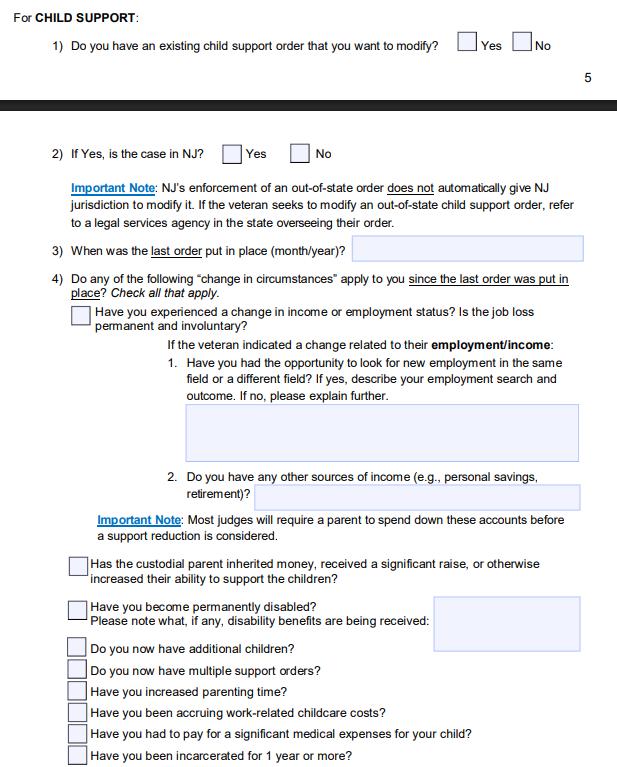
Confirm the case is in NJ
Review the grounds for modification
- Select the factors that are applicable
- If none are applicable, no grounds for modification
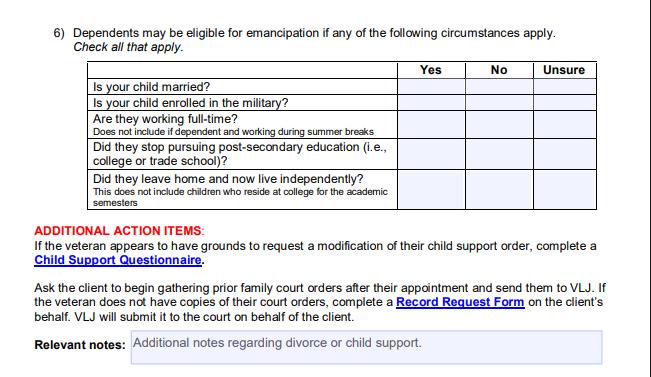
If client is seeking emancipation, complete chart to determine if eligible
If client is eligible for modification/ emancipation, complete the Child Support Questionnaire.

WELCOME to the Child Support Enforcement Program of the New Jersey Judiciary. The purpose of this guide is to provide information to you about the child support program.
Each support case is identified with a unique number that begins with the letters CS. This number is very important and you will need it whenever you contact probation child support enforcement staff.
Write your case number here:
You will also receive a pin that will allow you to access your account at njchildsupport.org. To access the information, you are required to enter your case number and your personal identification number. A variety of forms also are available on this site, including an online child support application for services.
Arrears – Past due, unpaid child support owed by the person ordered to pay support.
Assignment of Support Rights – People who receive public assistance agree to turn over their right to child support to the state in exchange for cash assistance and other benefits. In order to receive public assistance, you must agree to the assignment of your support.
Bench Warrant – An order from the court giving legal authority to law enforcement to arrest a person for failure to appear for a court hearing or failure to comply with a court order.
Child Support Number (also referred to as “CS Number”) – This is the identifying number assigned to your child support case.
Cost of Living Adjustment (COLA) – Any child support order entered on or after Sept. 1, 1998, is automatically adjusted every two years. The adjustment is based on the consumer price index.
Complaint – A formal document filed in court that starts a case. It typically includes the names of the parties, the issues and what you are asking the court to do.
Court Order – The written decision issued by a court of law. A child support court order sets forth how often, how much, and what kind of support is to be paid.
Docket Number – The identifying number assigned to every case filed in the court.
Emancipation- The age when a child reaches financial independence.
Genetic Testing (DNA Testing) – A test used to determine the genetic makeup of the mother, father and child to establish legal paternity.
Income Withholding/Wage Withholding/Garnishment – A process in which automatic deductions are made from wages or other income to pay a child support obligation. Income withholding has been mandatory since the enactment of the Family Support Act of 1988.
Jurisdiction – The legal authority which a court or administrative agency has over particular persons and types of cases, usually in a defined geographical area.
Your Guide to the New Jersey Judiciary Child Support Enforcement Program 1
Modification of a Court Order – Any change or adjustment to a previous support order.
New Jersey Child Support Guidelines – A standard method for calculating child support based on the income of the parents and other factors. The full set of guidelines is contained in Rule 5:6A of the New Jersey Court Rules.
NJKiDS – The New Jersey Child Support Program automated computer system that tracks child support accounts.
Obligation – The amount of money to be paid as support and the frequency it is to be paid.
Obligee/Payee/CP – An individual or agency to whom support is owed. Also known as the custodial parent (CP) or payee.
Obligor/Payor/NCP – An individual who owes a financial and/or medical obligation. Also known as the non-custodial parent (NCP) or payor.
Offset – The amount of money taken from an obligor’s State or Federal income tax refund to satisfy a child support debt.
Public Assistance – See Temporary Assistance to Needy Families.
Temporary Assistance to Needy Families (TANF) – Time-limited public assistance, also known as welfare payments, made to low income families that provide parents with job preparation, work, and support services to help them become self-sufficient. It was formerly known as Aid to Families with Dependent Children (AFDC).
Termination of Support – New Jersey law establishes 19 as the age when a child support and/or medical support obligation will end. Support may continue beyond 19 due to certain circumstances, however cannot exceed the child’s 23rd birthday.
Triennial Review – Support orders are eligible for review and possible modification every three years by the county welfare agency.
Venue – The court in which the original case was brought.
2 Your Guide to the New Jersey Judiciary Child Support Enforcement Program
New Jersey follows strict laws that keep child support cases private and confidential. Personal information collected and kept by the Child Support Program is not public record. All child support staff is bound to keep the obligor and obligee matters confidential and to protect privacy.
The New Jersey Child Support Enforcement Program locates obligors, also known as persons ordered to pay support, establishes paternity, establishes and enforces support and medical orders, and collects support payments.
There are a number of organizations that work together to maintain the child support program. Each serves a different function in the process. For example:
The New Jersey Department of Human Services, Division of Family Development, is the state agency responsible for state oversight of the child support program.
The family division of the Superior Court is responsible for the establishment of paternity, support, medical, and modification orders.
The county welfare agency locates obligors and files complaints with the family division when Temporary Assistance for Needy Families (TANF) is being provided.
The Probation Child Support Enforcement (PCSE) Unit monitors and enforces support orders. This unit is responsible for taking action when support is not being paid.
Call this telephone number to access the Interactive Voice Response (IVR) system or speak to a representative and get answers to commonly asked questions as well as information about your case such as payment details, court hearings and account balances.
The IVR can be used by the custodial party, noncustodial party, or agencies and is available 24 hours a day, seven days a week. Customer service representatives are available to speak to you Monday through Friday 8am to 6:45pm.
To access the IVR, you must use a touch-tone telephone and have your case number available. If you would like help navigating the IVR, visit njchildsupport.org.
Under N.J.S.A. 2A:17-56.7a et seq. all child support payments are subject to income withholding from the obligor’s paycheck, unless the court order says otherwise. Income withholding can also be applied to unemployment benefits, Social Security disability, disability payments, and other income the obligor receives. This makes it easier for the obligee to receive timely, regular payments, and is more convenient for the obligor to pay support.
If the obligor changes employers, he/she must notify the probation division so that income withholding can be arranged with the new employer.
Other Payment Options: Make check or money order payable to NJFSPC and mail to: NJFSPC, PO Box 4880, Trenton, NJ 08650-4880.
Cash payments are accepted at all county child support offices in New Jersey.
Payment options are available online. For more information, go to njchildsupport.org.
In accordance with N.J.S.A. 2A:17-56.53, if support is not paid, an additional amount may be added to the original amount of support to pay off the past due amount. This is commonly known as an arrears payback amount.
Support payments are distributed either through the Direct Deposit Program or the New Jersey Debit Card. Both programs provide a safe,
4 Your Guide to the New Jersey Judiciary Child Support Enforcement Program
easy and convenient way for obligees to receive payments.
Through direct deposit support payments are electronically deposited into the obligee’s bank account. To be eligible for direct deposit, you must have a bank account. To sign up for direct deposit, an authorization form must be completed which is available at the local child support office or it can be downloaded at njchildsupport.org.
With a New Jersey Debit Card, obligees can obtain cash at banks and ATMs and make purchases at most stores. If the obligee does not wish to receive payments on the New Jersey Debit Card, they must sign up for direct deposit.
Obligors are required within 10 days to notify the probation division enforcing the case of any change in their address or employment status either through letter, telephone call or by logging into their online account at www.njchildsupport.org. Failure to comply constitutes a violation of the court order.
Obligees must notify the probation division within 10 days of any change of address. The obligee can update their address by submitting a notarized letter, contacting the New Jersey Family Support Services Center or logging into their online account at www.njchildsupport.org. A standard address change form, which can be obtained at njchildsupport.org or by contacting the local probation division, can also be used.
The obligee must present any one of the following forms of identification: a notarized letter to the court, or notarized Obligee Address Change Form certifying the change; passport; photo driver’s license or any other government-issued photo identification card.
If the above forms of identification are not available, then the obligee must use two of the following: a non-photo driver’s license; property lease; utility bill or any other government-issued non-photo identification card.
Address changes received by mail may be in the form of a letter or an Address Change Form. If the written letter or form is not notarized, it must be accompanied by a photocopy of identification document(s), consistent with the requirements for in-person changes set forth above.
Your Guide to the New Jersey Judiciary Child Support Enforcement Program 5
Address Change by Telephone or Web
Either party can contact the New Jersey Family Support Services Center for address changes by calling: 1-877-655-4371 or visiting njchildsupport.org.
Social Security numbers are collected and used in accordance with section 205 of the Social Security Act (42 U.S.C. 405). Disclosure of the individual’s Social Security number is mandatory. Social Security numbers are used to obtain income, employment and benefit information through computer matching programs with federal and state agencies. This information is used to establish and enforce child support under Title IV-D of the Social Security Act and to record child support judgments.
The National Medical Support Notice is a federally required form. It was designed to provide employers and plan administrators with a standardized set of forms, processes and timeframes to streamline the work to enroll dependent children in employer-sponsored health care plans. The NMSN is a Qualified Medical Child Support Order under section 609 (a) (3) and (4) of the Employee Retirement Income Security Act (ERISA), 29 U.S.C. 1169.
The NMSN form is issued at the same time a notice to withhold child support is sent to the employer. Employers who fail to respond to the NMSN in a timely manner could be subject to court action. The employer must comply with the NMSN requirements even if the obligor does not agree with the requirements. If the obligor wants to contest the issuance of a NMSN, he/she should contact the local probation division.
The probation division is required to enforce court orders that call for the following:
Collection of current child support
Collection of past-due child support
Court ordered health care coverage
Collection of spousal support/alimony
6 Your Guide to the New Jersey Judiciary Child Support Enforcement Program
Enforcement hearings are scheduled to address issues of non-payment of child support, failure to obtain health insurance coverage for dependent children, or other related issues. Enforcement hearings are scheduled by the probation division and are formal court hearings with sworn testimony before a judge or hearing officer.
Obligors must appear for enforcement hearings. Obligees could be required to appear based upon the nature of the case. At the hearing, probation division staff presents the facts of the case but do not represent either party. You can have an attorney at an enforcement hearing.
If the case is being heard by a hearing officer, he or she will make recommendations regarding the outcome of the hearing. Either party has the right to object to the recommendations. If either party objects, the matter will be referred to a judge. If there is no objection, the hearing officer’s recommendations are referred to a judge for review. If the judge approves the recommendations, they become a binding court order.
Modifications of support orders should not occur during enforcement hearings. Instead, modification requests should be filed and heard in the family court.
Bench warrants may be issued in child support and spousal support cases. There are two types of support warrants:
1. Failure to Appear – When the person ordered to pay support fails to appear for a hearing.
2. Failure to Pay – When the person ordered to pay support does not pay and there is bench warrant status provision in the court order, a warrant could be issued for failure to comply with the court order.
Note: If a bench warrant is issued by the court, it will automatically result in a driver’s license suspension. This does not apply in alimony only cases.
If the amount of unpaid child support meets or exceeds a specific threshold and the obligor is entitled to a federal or state tax refund or homestead rebate, the refund(s) could be applied to pay unpaid child support.
Your Guide to the New Jersey Judiciary Child Support Enforcement Program 7
When child support is unpaid, a judgment is recorded by the clerk of the Superior Court. This creates a claim against the obligor and could appear on a credit report and prevent the sale or transfer of real property. Unpaid or past due amounts of child support are automatic judgments.
Past due child support can be reported to credit agencies if the obligor owes $1,000 or more in unpaid support. This could affect the obligor’s credit rating when buying a home, car or applying for a credit card.
The Financial Institution Data Match is a federally mandated program that enables states to freeze and seize money in accounts belonging to obligors who have not paid support in 35 days or owe three months’ arrears (minimum $200).
The Child Support Lien Network was developed to levy insurance claims such as personal injury and worker’s compensation awarded to obligors.
An obligor owing more than $2,500 in past due child support will be denied the issuance or renewal of a United States passport.
Obligors who have not paid child support or provided court ordered health care coverage in six months or who have had a bench warrant issued for their arrest could have their driver’s license suspended. Other professional or recreational licenses also could be suspended.
The New Jersey Division of Family Development and the New Jersey State Lottery have initiated a process in which lottery winnings are seized if the winnings are at least $600 and the obligor owes more than $1,000 in past due child support.
Project Save Our Children was passed by Congress to address the issue of obligors who flee to other states to avoid paying child support. PSOC provides for federal criminal misdemeanor and felony charges
8 Your Guide to the New Jersey Judiciary Child Support Enforcement Program
for the willful nonpayment of child support. The U.S. Attorney’s Office is responsible for prosecuting these cases.
For specific information about enforcement options, refer to N.J.S.A. 2A:17, N.J.S.A. 2C:13, N.J.S.A. 5:9, R. 5:6B, P.L. 102 AND 104, 42 U.S.C. 405, 408(7).
New Jersey adopted the federal Uniform Interstate Family Support Act (UIFSA) in March 1998. UIFSA applies in a case when the parties live in more than one state.
This law requires employers to comply with other states’ income withholding orders and places limits on where orders can be changed. It also protects the obligor by making sure that only one order for support is in effect at a time and establishes rules for creating only one controlling order when there are multiple orders.
If an obligor moves out of state and stops paying child support, the probation division can send a UIFSA request to have the New Jersey child support order registered in the state where the obligor lives. As long as one party continues to live in New Jersey, New Jersey continues to have exclusive jurisdiction over the case.
If an obligee moves to New Jersey and has a child support order in another state under UIFSA, the New Jersey probation child support staff will monitor the case and request enforcement from the out-ofstate court.
Note: New Jersey also will enforce alimony or spousal support obligations. Other states might not enforce alimony or spousal support. Depending on the state, the obligee could consider hiring an attorney to have the spousal support registered and enforced as a foreign judgment in the obligor’s state of residence.
On March 23, 2016, the 2008 amendments to the Uniform Interstate Family Support Act (UIFSA), N.J.S.A. 2A:4-30.124 et seq. were approved and became law effective April 1, 2016. The “Instrument of Ratification for The Hague Convention on International Recovery of Child Support and Other Forms of Family Maintenance” became effective Jan. 1, 2017.
Your Guide to the New Jersey Judiciary Child Support Enforcement Program 9
Two requirements under UIFSA and The Hague Convention result in a change to the following statewide practices in New Jersey: All child support orders must be translated into the language of the country where the order is being registered for enforcement and states shall permit litigants residing outside the state to participate by telephone, audiovisual or other electronic means.
Any modification or changes to a support order are processed through the family division of the Superior Court. Obligors and obligees are instructed to file with the family division in the county of venue.
Rule 5:6B of the New Jersey Court Rules requires that all child support orders entered, modified or enforced on or after Sept. 1, 1998 be reviewed every two years to reflect changes in the cost of living. The Cost of Living Adjustment (COLA) is an automatic review and adjustment of child support orders enforced by probation. The COLA is based on the average monthly change in the consumer price index (CPI) for the New Jersey metropolitan area. The COLA is not considered a modification.
Note: If an order is modified, the next COLA date will be adjusted to two years from the date of the modification.
States are required to have a process by which child support orders are reviewed and, if appropriate, adjusted at least once every three years. In cases where a family is receiving TANF, a triennial review must be conducted. States also are required to conduct triennial reviews in nonTANF cases if either parent so requests. There does not need to be a substantial change of circumstances, only the passage of three or more years since the order was last reviewed. The parties can request the triennial review through the county welfare agency (CWA).
The CWA will review the financial situation of both parties and determine if, based on the New Jersey child support guidelines, the order should be adjusted. The review also determines if a health care provision should be added to the order.
10 Your Guide to the New Jersey Judiciary Child Support Enforcement Program
Under New Jersey law, 18 is the age of majority. N.J.S.A. 9:17B-3 notwithstanding, there is no fixed age of emancipation. A child who attains the age of 18 or graduates from high school is not automatically emancipated. Emancipation of a child requires an order from the court. The party seeking emancipation of a child must file a modification motion with the family division of the Superior Court in the county of venue. The Court examines the facts of each case to determine if the age or circumstances allows for emancipation of the child. If the court enters an order of emancipation, the emancipation does not relieve the obligor from the payment of arrears or resolve any overpayments unless specifically addressed in the order.
Effective Feb. 1, 2017, New Jersey law establishes 19 as the age when a child support and or medical support obligation will end through probation. The new law allows for child and or medical support to continue up to age 23 through probation for cases in which the dependent is in high school, attending full-time college, vocational or graduate school, is disabled or if the parties reach a separate agreement or if continued support through probation was granted by the court. However, child support, except for arrearages, cannot be collected through probation beyond the child’s 23rd birthday. Parties that want current child support to be collected beyond the 23rd birthday must file with the court for other financial maintenance or reimbursement. For specific information about enforcement options, refer to N.J.S.A. 2A:17 -56.67 et seq
How is child support paid?
Your child support case has been assigned a case number that begins with “CS” followed by eight numbers and a letter. This number must be clearly indicated when making payments to ensure that your account is properly credited. Support is processed through the New Jersey Family Support Payment Center, P. O. Box 4880, Trenton, N.J. 08650.
What if either party moves?
Both parties must provide all address changes to PCSE staff within 10 days of the change.
Your Guide to the New Jersey Judiciary Child Support Enforcement Program 11
What if the obligor changes employment?
The obligor is required to report any employment changes to the PCSE staff within 10 days of the change.
Can payments be made directly to the obligee?
No. The order requires that support payments be made through the New Jersey Family Support Payment Center (NJFSPC). Support payments made outside of the probation division cannot be credited without a court order. Additionally, the probation division records serve as documentation to both parties and the court of the amount of support paid. Purchase of goods such as clothing or disposable diapers do not count as child support.
Does child support automatically terminate when the child reaches 18?
In New Jersey, effective Feb. 1, 2017 N.J.S.A . 2A:17-56.67 et seq. establishes 19 as the age when a child support and or medical support obligation will end through probation. The law allows for child and or medical support to continue up to age 23 through probation for cases in which the dependent is in high school, attending full-time college, vocational or graduate school, is disabled if the parties reach a separate agreement, or if continued support through probation was granted by the court. However, child support, except for arrearages, cannot be collected through probation beyond the child’s 23rd birthday. Parties that want current child support to be collected beyond the 23rd birthday must file with the court for other financial maintenance or reimbursement.
What can happen if support payments are not made?
An enforcement hearing, which is also called enforcement of litigant’s rights, could be scheduled. The amount of support should not be changed at this hearing. In addition, all child support debts become judgments by operation of law and could adversely affect an obligor’s credit rating and ability to buy or sell real property. Child support arrears also can be subject to income tax refund intercept, credit bureau reporting, seizure of assets and other enforcement actions. Additionally, failure to pay support as directed could result in professional and driver’s license revocation, further court proceedings, and possible arrest and incarceration.
If an enforcement hearing is scheduled, who must attend?
The obligor must attend the hearing. It can be in the best interest of the obligee to attend, however the obligee is likely not required to attend. Failure of the obligor to appear can result in a default order being entered or a warrant for arrest being issued.
12 Your Guide to the New Jersey Judiciary Child Support Enforcement Program
Is a lawyer needed for the enforcement hearing?
You can bring an attorney, although one is not required.
What does the obligor need to do to prepare for the court hearing?
Be prepared to document facts such as earnings and deductions from earnings by bringing current pay stubs, income tax returns and employer’s address and telephone number. If there are child support arrears owed, you could be required to make a payment in court.
Can child support be deducted from wages and other sources of income?
Yes. Federal and state laws require that child support be deducted from wages and other forms of income for any new or modified support order. Income means, but is not limited to, the obligor’s commissions; salaries; earnings; wages; rent monies; unemployment compensation; any legal or equitable interest or entitlement owed that was acquired by a cause of action; suit; claim or counterclaim; insurance benefits; claims for assets of estates; trusts; federal and state income tax refunds; homestead rebates; state lottery winnings; annuities; retirement benefits; veterans benefits; union benefits or other sources that could be deemed as income.
An employer could withhold only a certain percentage from wages. If an order exceeds the maximum amount the employer could deduct, the obligor is responsible for paying the difference to the NJFSPC. The obligor is responsible for verifying that the deduction is being made and is in the correct amount.
The obligor should retain all pay stubs for his/her records. The obligor also can call the New Jersey Family Support Services Center or login to the child support web site to ensure that the withholding payment is posted to the account. It is the obligor’s responsibility to make sure the child support is paid.
Is there a way to check what support payments have posted to the account?
Yes. Call 1-877-655-4371. Payment and case information also can be accessed at njchildsupport.org.
If the obligor is unemployed, disabled or has other changes of circumstances, does child support have to be paid?
Yes. Child support payments must be made in accordance with the existing court order. The obligor is responsible for payments even during periods of unemployment and disability. The obligor can file a motion in the family division requesting that the court review the child
Your Guide to the New Jersey Judiciary Child Support Enforcement Program 13
support order. Unless the court rules otherwise, enforcement actions will continue. Unemployment and some disability benefits are considered available income for supporting children. An order to withhold child support from unemployment benefits will be sent to the New Jersey Department of Labor and Industry, Division of Unemployment Insurance. Withheld support will then be sent to the NJFSPC for distribution.
What happens if either parent moves out of the county, state or the country?
The rules vary depending on the individual situation. Contact the PCSE staff that handles your case for more information.
What happens if support is collected through another state?
The other state is responsible for direct enforcement and forwards collections to New Jersey for disbursement. If you fall behind in your payments, PCSE staff will request that the other state enforce the order. The child support enforcement agency in the other state should not be contacted directly by the parties. Contact the PCSE staff currently handling the child support case.
Can the child support amount ever be changed?
Possibly, provided that the requesting party can demonstrate a valid reason to the court for an increase or decrease in support. A motion requesting a hearing must be filed with the family division of Superior Court. Motions must be filed in the county of venue, which is the county in which the support order was originally entered. The parties can obtain an attorney or represent themselves. Information about selfrepresentation can be obtained at njcourts.gov or at the local family division.
What should the obligee bring to the court hearing?
Any and all information the obligee has regarding the obligor’s finances would be helpful. The obligor’s Social Security number, date of birth and address could be needed. Information about the obligor’s source of income could be helpful to the case. Any information about the obligor’s assets, such as property, bank accounts, and other assets, could help the judge or hearing officer determine enforcement of the case. Information about lawsuits, perhaps resulting from an accident, also could be important.
Before the court date, support is paid in full. Will a hearing still be held?
Yes. There will be a hearing unless it is cancelled in advance by PCSE staff. Generally, despite the pre-court payment, there could still be
14 Your Guide to the New Jersey Judiciary Child Support Enforcement Program
issues that need to be addressed, such as making sure that regular payments are made in the future and that medical coverage is provided.
If the obligee receives public assistance for a child or children, is a hearing necessary?
Yes, the obligor still must pay child support. The money is collected from the obligor and disbursed to the county welfare agency to reimburse the monthly grant. A hearing could be necessary if the obligor is not paying support as ordered or has not provided medical coverage for the children.
The obligor was ordered to provide medical coverage for the child but has not. What can be done?
The obligee should contact the probation division that handles the case. The probation division could schedule a hearing to enforce the court order that deals with medical coverage.
What if an interpreter is needed in court?
If a party requires interpreting services, he or she must contact PCSE staff before the hearing to let them know that a court interpreter is needed. This will allow PCSE staff time to make arrangements in advance instead of rescheduling the hearing.
njcourts.gov
This site is maintained by the Judiciary and provides office locations, mailing addresses, fax numbers, office hours and services provided.
njchildsupport.org
This site is maintained by the New Jersey Department of Human Services and provides important information regarding the child support program as well as specific case information, such as account balance, court hearings and last payment information.
acf.hhs.gov/programs/cse
This site provides extensive information about the federal child support program and individual state information.
16 Your Guide to the New Jersey Judiciary Child Support Enforcement Program
Atlantic Atlantic County Civil Court Building 1201 Bacharach Blvd Atlantic City, NJ 08401
Bergen
Bergen County Superior Court Family Part 10 Main St., Room 163
Bergen County Courthouse Hackensack, NJ 07601
Burlington
Burlington County Courts Facility
49 Rancocas Road, 3rd Floor Mount Holly, NJ 08060
Camden
Camden County Hall of Justice
101 S.5th St. Camden, NJ 08103-4001
Cape May
Cape May County Family Division, Court Complex 4 Moore Road Cape May Courthouse, NJ 08210
Cumberland
Cumberland County Family Division Courthouse
Broad and Fayette streets PO Box 866 Bridgeton, NJ 08302
Essex
Essex County Family Division Central Intake Unit
212 Washington St. Newark, NJ 07102
Atlantic County Child Support 1201 Bacharach Blvd. PO Box 5129 Atlantic City, NJ 08401
Bergen County Child Support 10 Main St., Bldg. 39 Hackensack, NJ 07601
Atlantic County Department of Family & Community Development
1333 Atlantic Ave, 3rd Floor PO Box 869
Atlantic City, NJ 08401
Bergen County Board of Social Services
218 Route 17 North Rochelle Park, NJ 07662
Burlington County Child Support Enforcement Services
50 Rancocas Road, 2nd Floor PO Box 6555 Mount Holly, NJ 08060
Camden County Child Support Probation
5 Executive Campus, Suite 200 PO Box 8107 Cherry Hill, NJ 08002
Cape May County Probation Enforcement Court Complex 9 N.Main St., Cape May Courthouse, NJ 08210
Cumberland County Child Support
60 W. Broad St. Bridgeton, NJ 08302
Essex County Child Support 212 Washington St., 11th Floor Newark, NJ 07102
Burlington County Board of Social Services
Burlington County Human Services Facility 795 Woodlane Road Mount Holly, NJ 08060
Camden County Board of Social Services County Administration Bldg. 600 Market St. Camden, NJ 08102-1255
Cape May County Board of Social Services Social Services Bldg. 4005 Route 9 South Rio Grande, NJ 08242-1911
Cumberland County Board of Social Services
275 N. Delsea Drive Vineland, NJ 08360-3607
Essex County Div. of Welfare 18 Rector St., 9th floor Newark, NJ 07102
Gloucester
Gloucester County Family Div. 70 Hunter St. Woodbury, NJ 08096
Hudson
Hudson County Family Division Administration Building 595 Newark Ave, Room 203 Jersey City, NJ 07306
Gloucester County Child Support 1893 Hurffville Road Sewell, NJ 08080
Gloucester County Board of Social Services 400 Hollydell Dr. Sewell, NJ 08080
Hudson County Child Support Child Support Enforcement Unit 595 Newark Ave, Room 301, 3rd floor Jersey City, NJ 07306
Hudson County Department of Social Services Division of Welfare JFK Office Bldg. 257 Cornelison Ave. Jersey City, NJ 07302
Hunterdon
Hunterdon County Justice Center 65 Park Ave., PO Box 578 Flemington, NJ 08822
Hunterdon County Child Support 65 Park Ave. Flemington, NJ 08822
Hunterdon County Division of Social Services, Community Services Center
6 Gauntt Place PO Box 2900 Flemington, NJ 08822
Mercer
Mercer County Family Court
175 S. Broad St. PO Box 8068 Trenton, NJ 08650
Middlesex
Middlesex County Family Courthouse
120 New St. PO Box 2691 New Brunswick, NJ 08903
Monmouth
Monmouth County Courthouse
71 Monument Park P.O. Box 1252 Freehold, NJ 07728-1252
Morris
Morris County Courthouse Washington Street PO Box 910 Morristown, NJ 07963-0910
Mercer County Child Support 175 S. Broad St. PO Box 8068 Trenton, NJ 08650
Middlesex County Child Support
189 New St PO Box 789 New Brunswick, NJ 08901
Monmouth County Probation
30 Mechanic St. PO Box 1259 Freehold, NJ 07728-1259
Morris County Child Support Administration & Records Bldg. 10 Court St., PO Box 910 Morristown, NJ 07963-0910
Mercer County Board of Social Services
200 Woolverton St. PO Box 1450 Trenton, NJ 08650
Middlesex County Board of Social Services
181 How Lane PO Box 509 New Brunswick, NJ 08903
Monmouth County Division of Social Services PO Box 3000 Kozlowski Road Freehold, NJ 07728
Morris County Office of Temporary Assistance
340 W. Hanover St. PO Box 900 Morristown, NJ 07963-9904
Client Information
Name
Date of Birth, Age
What is your Gender Identity?
What is your preferred Language?
Interpreter Needed
What is your Racial Identity?
Are you a veterans or current service member?

John Miller 05/01/1970 , 54 Male English N/A
Black/African American Yes
Contact information
Address
Preferred Phone
Mobile Phone
Email Address
123 Main Street, Newark, New Jersey Home Phone 973-123-4567
j.miller@gmail.com
Adverse Party Information
Adverse Party Summary
Adverse Party Name: Adverse Party Address: State: NJ Relationship Type: N/A
Please review the information below and complete the fields at the bottom of the page while you wait for your first or next client.
• Each appointment should begin with introductions and a review of VLJ’s limited scope retainer agreement (collect verbal consent).
• VLJ assists with specific civil legal issues:
o Housing instability (for example, at risk of or facing eviction)
o Financial issues (for example, pending lawsuit, overwhelming debt, or judgment)
o Criminal record expungement (NJ charges only)
o Child support modification (NJ orders only)
o Suspended NJ driver’s license
o Estate planning (for example, drafting a Will, Power of Attorney, and/or Medical Directive)
• For issues not handled by VLJ/VLJ’s pro bono panel, or for non-legal issues, refer to https://www.vljnj.org/veterans-volunteer-resources or look online for meaningful referrals to provide to the veteran.
• Breaking bad news can be challenging, but it is crucial for you as volunteers to set reasonable expectations for all veteran clients and be honest about what services we may/may not be able to provide.
• Today’s goals include:
(1) Identify any/all issues
(2) Provide advice on the spot whenever possible (i.e., if you know employment law and the veteran is experiencing an employment-related issue, advise appropriately).
(3) Help prioritize next steps
• Through the appointment, take detailed notes if you have identified a legal issue VLJ can assist with
• If the veteran needs help with expunging a criminal record, is considering bankruptcy, seeking to modify an existing child support order, and/or have estate planning documents prepared, there are additional assessment questionnaires that must be completed (lined within), in addition to this Volunteer Packet
This packet includes the following sections. You must complete all sections for each client you meet with (one packet per team, per client).
• Part 1: Limited Scope Legal Services Acknowledgement and Understanding
• Part 2: Questionnaire
• Part 3: Volunteer Report Form
Submit completed packets via email to VLJ’s Veterans Legal Program team, Alexandra Bravo (abravo@vljnj.org) and Katiana Guerrier (kguerrier@vljnj.org).
Volunteer Team
Attorney 1 Name:
Attorney 3 Name:
Attorney 2 Name: (if applicable) Non-Attorney Name:

P.O. Box 32040, Newark, NJ
Phone: (973) 645-1955
Fax: (973) 645-1954
www.vljnj.org
Veteran Name: Today’s Date:
This is an Acknowledgment between Volunteer Lawyers for Justice, its volunteers and staff and you. It contains the basic terms of our agreement to provide you with limited legal advice and assistance so that you can better represent yourself in your legal matter.
Scope of Legal Advice. You are representing yourself in your legal matter. Neither Volunteer Lawyers for Justice nor the volunteer you are meeting with today is representing you in any capacity. The volunteer agrees to provide you with legal advice based upon the information that you give him/her at the legal clinic. The volunteer is not agreeing to perform any outside investigation of the facts of your legal matter.
Duration of Legal Help. This arrangement to advise you will begin right now and will end at the completion of our meeti ng today. Unless agreed to in writing, neither Volunteer Lawyers for Justice nor the volunteer you are meeting with will help you in any capacity after the completion of today’s appointment and or assume liability regarding the outcome of your legal matter
Attorney’s Fee and Costs. There is no cost for our meeting. You are responsible for all legal costs and fees outside of this legal clinic.
Declining to Advise. We may decline to advise you as follows:
(1) If we have a conflict of interest – for example, if we have already advised or provided representation to the opposing party in your case, we have a legal conflict of interest and cannot provide you with any legal advice;
(2) If your legal problems are too complicated and beyond the scope of this project; or
(3) If for any other reason set forth in the New Jersey Rules of Professional Conduct.
(must check one):
Veteran Client Name:
Please read to veteran client after introductions so they know what to expect from their meeting with you.
I am a volunteer attorney partnering with Volunteer Lawyers for Justice. Today’s appointment aims to identify areas where you might need additional legal advice or help. While we won’t resolve the issues in our time today, you will get advice on how to tackle the problems you face .
As we go through this interview, we will ask some questions to help identify any issues that might have legal relief options. Our questions are not intended to embarrass you or make you feel uncomfortable. If you would rather not talk about a particular subject, let me/us know , and we will move on. Before we start going through my questions:
• Is there a particular issue bringing you to see us today?
• Have you or anyone else in your home recently spoken to an attorney about any issues?
• Are there any upcoming court dates?
Notes from the initial discussion with the veteran client:
1) What is your living situation?
Renting
Homeowner
Unh oused / without permanent hou sing
Supportive housing (e.g., SSVF housing, Community Hope)
If renting:
1) Are you up -to- date on rent payments? Yes No
If NO, How far behind:
Has your landlord filed an eviction proceeding against you in court?
Yes No Unsure
Do you rent fr om a private landlord or have subsidized housing (Section 8)?
Private landlord Subsidized housing
2) Are you having any of the following problems?
Repairs not bei ng done
Heat doesn’t work
Mold, bugs, or rodents
Unsafe conditions
Other:
ADDITIONAL ACTION ITEMS:
If the veteran is facing eviction or at risk of eviction, complete a Housing/Eviction Questionnaire.
1) Are you concerned with any debts? No Yes, credit card debt Yes, medical debt Yes, other debts
2) Are you getting phone calls and/or letters about outstanding bills? No Yes
3) Have you been su ed by any companies (or people) you owe money to? No Yes If yes, can you provide the court case (“docket”) number (e.g., “ESX-DC- 0000- 25):
4) Are your wag es being garnished/has your bank account been levied?
No Yes If yes, can you provide any more details:
5) Do you have any other debt (i.e., owe money to family or friends)? No Yes
6) Have you ever considered bankruptcy or want to see if that may be an option for you? No Yes
7)Have you had a bankruptcy discharge in the last eight (8) years? No Yes If “Yes” advise that they are not yet eligible to file for Chapter 7 bankruptcy again.
ADDITIONAL ACTION ITEMS:
If the veteran has significant d ebt and/or is interested in seeing if they are a good candidate for Chapter 7 bankruptcy, complete a Bankruptcy Intake Questionnaire.
Relevant notes:
1)Are you currently employed? Yes No Not applicable
2) If unemployed or underemployed, have any of the following impacted your ability to find a job or secure the job you want?
A NJ criminal record
A suspend ed NJ driver’s license
Other:
1) Do you have a pending or open criminal case(s)? Yes No Unsur e
Important Note: If veteran has a pending or open case, advise the veteran that they are not eligible for expungement at this time. Explain that they need to wait for a final disposition. Client should be referred to their regional Public Defenders Office or their county’s Lawyer Referral Service office if they need of legal advice or representation.
ADD ITIONAL ACTION ITEMS:
If the veteran has a criminal record (no active cases), complete an Expungement Eligibility Assessment.
For SUSPENDED LICENSE:
Important Note: If the client's driver’s license is suspended, advise the veteran not to drive wit h a suspended license.
ADDITIONAL ACTION ITEMS:
If the veteran's license is suspended, indicate in your final notes that VLJ should send the veteran an MVC Consent Form.
Relevant notes:
1) Do you have any family law - related concerns such as divorce or child support? Yes No Not applicabl e
For DIVORCE:
1) Have you or your spouse filed a divorce complaint yet? Yes No Unsure
2) If yes, what part of the process are you in (Answer/C ounterclaim? Conference? )
3) If No, are you looking to file? Yes No
Do you know w here your spouse lives? Yes No No
Do you have minor children with your spouse? Yes
Do you have any assets or debts that need to be divided? Yes No
ADDITIONAL ACTION ITEMS:
If the veteran seeks in -court representation and/or is within the divorce process and has already had an initial conference with the judge, they should be referred to their local Lawyer Referral Service office.
For CHILD SUPPORT :
1) Do you have an existing child support order that you want to modify? Yes No
2) If Yes, is the case in NJ? Yes No
Important Note: NJ’s enforcement of an out-of-state order does not automatically give NJ jurisdiction to modify it. If the veteran seeks to modify an out-of-state child support order, refer to a legal services agency in the state overseeing their order.
3) When was the last order put in place (month/year)?
4) Do any of the following “change in circumstances” apply to you since the last order was put in place? Check all that apply.
Have you experienced a change in income or employment status? Is the job loss permanent and involuntary?
If the veteran indicated a change related to their employment/income:
1. Have you had the opportunity to look for new employment in the same field or a different field? If yes, describe your employment search and outcome. If no, please explain further.
2. Do you have any other sources of income (e.g., personal savings, retirement)?
Important Note: Most judges will require a parent to spend down these accounts before a support reduction is considered.
Has the custodial par ent inherited money, received a significant raise, or otherwise increased their ability to support the children?
Have you become permanently disabled?
Please note what, if any, disability benefits are being received:
Do you now have additional children?
Do you now have multiple support orders?
Have you increased parenting time?
Have you been accruing work-related childcare costs?
Have you had to pay for a significant medical expenses for your child?
Have you been incarcerated for 1 year or more?
5) If the veteran indicated a change other than employment/ income since the last order, provide details, including important dates?
Eligibility Note: The change in circumstances must be permanent and substantial to support making a request to reduce child support If the veteran has not experienced any of these changes, they likely do not have grounds to file a motion.
6) Dependents may be eligible for emancipation if any of the following circumstanc es apply. Check all that apply. Yes No
Is your child married?
Is your child enrolled in the military?
Are they working full-time?
Does not include if dependent and working during summer breaks
Did they stop pursuing post- secondary education (i.e., college or trade school)?
Did they leave home and now live independently?
This does not include children who reside at college for the academic semesters
ADDITIONAL ACTION ITEMS:
If th e veteran appears to have grounds to request a modification of their child support order, complete a Child Support Questionnaire.
Ask the client to begin gathering prior family court orders after their appointment and send them to VLJ. If the veteran does not have copies of their court orders, com plete a Record Request Form on the client’s behalf. VLJ will submit it to the court on behalf of the client.
Relevant note s:
1)Do you have a will, medical directive, and power of attorney? Yes No Unsure
2) If No or Unsure, are you interested in having any of the documents prepared? Will Medical Directive Power of Attorney
Important Note If the client is seeking a divorce, it may be advisable to wait until after the divorce is finalized to prepare a Will. Discuss options with VLJ staff.
ADDITIONAL ACTION ITEMS:
If the veteran is interested in having estate planning documents prepared, complete an Estate Planning Questionnaire --- for Married Veterans, for Single Veterans.
Relevant note s:
Are there any other issues that you would like to discu ss?
Complete the following based on your conversation with
The goal is to report to VLJ what was discussed and completed during the appointment. VLJ will use this form to follow up with the veteran to provide your advice in writing and share actionable next steps to move forward with their legal (and non-legal) issues; the form will also be used to record pro bono time spent.
Upon completion, submit the packet via email to VLJ’s Veterans Legal Program team, Alexandra Bravo ( abravo@vljnj.org) and Katiana Guerrier (kguerrier@vljnj.org).
Please provide d etailed information about the following:
• Does the veteran have any notable upcoming deadlines?
• What advice/information did your team relay to the veteran during the appointment?
• Which, if any, of the additional forms or questionnaires were completed wi th the veteran:
Housing/Eviction Questionnaire
Bankruptcy Intake Questionnaire
Expungement Eligibility Assessment
Child Support Questionnaire
Records Request Form
Estate Planning Questionnaire
• Does VLJ need to help the veteran request a copy of their dri ving history?
Yes, please have the veteran complete an MVC Consent Form
Issues identified
Please use the following to confirm and prioritize the veteran’s needs, including advised eligibility status: Priority
Housing/Eviction
Consumer debt
Bankruptcy
Criminal record expungement
Child support modification
Suspended driver’s license
Estate planning
Other:
Other:
assistance
Can any volunteers from this team continue to assist veteran beyond today’s clinic?
Examples include being a “buddy” to help clients obtain supplemental records, brief services to draft court pleading, representation in court, etc.
Even if som eone from today’s team cannot continue, please consider your law firm’s / legal department’s areas of expertise and whether a referral could be made to your office generally. It’s so beneficial for our veterans to receive consistent, continued assistance with one (or more) of the issues identified.
If so, indicate which volunteer and which legal issue.
Pro bono time
Confirm how much time you spent meeting with veteran
Additional notes for VLJ
Save this packet (and any additional questionnaires or forms completed) and email ALL to VLJ’s Veterans Legal Program team: Alexandra Bravo ( abravo@vljnj.org) and Katiana Guerrier (kguerrier@vljnj.org).


Criminal Cases: PROMIS/Gavel PublicAccess: AggregateSentence
�___PriorFees ___��___AdditionalFees__�
CASE NUMBER : 99000148

DEF SEQ NO: 001
DEFENDANT NAME: SOTO NELSON A SENTENCE SEQ NO: 001
CHARGING DOC : INDICTMENT
CDR NO: 0000
CHARGE COUNT : 001 STATUTE : 2C:39-5B IND/ACC NO : 99-05-00895-I STATUTE : UNLAWFUL POSSESSION OF WEAPONS - AIR/SPRING PISTOL
STATUTE DEG : THIRD DEGREE
SENTENCE CONT : AGGREGATE SENTENCE
SENTENCE DISP : NON-CUSTODIAL JAIL DAYS: 0003 INCAR LENGTH: 000Y00M000
PLACE SENTENCE: GAP: 0000 PRIOR SVC: 0000 ROSADO: 000 PAROLE INELIG : 00V00M000 PAROLE SUPERVISION: 00V00M000 CSL/PSL : PROBATION TIME: 02V00M COMM SERV HR: 0050 LICENSE SUSP : 000
SENTENCE DATE : 10 08 1999 JUDGE : CALLAHAN KEVIN G RO-1 : RO-2 : FEES AND FINES
Copyrighted©2007 - NewJerseyJudiciary BUILD 2024.0.12.02.01 : : :

1) Confirm spelling of veteran’s name (and if they have a middle initial):
2) Confirm veterans’ date of birth:
3) Ask the veteran to list all convictions (not arrests), and complete the below:
If the client is unsure, run public access searches to determine the veterans eligibility for expungement under NJ statute:
1. Visit Superior Court Case Search (Promis Gavel); note: i. Title 2C: is the New Jersey code for criminal matters ii. Title 39: Motor vehicles violations and so not relevant for expungement purposes
2. Visit Municipal Court Case Search (MCCS)
Download how-to guide HERE; save all search results and send to VLJ
Indictable crime
Offense name and statute (final):
Date of arrest/charge:
Arrest 1
Disposition:
Disposition date:
Type of sentence:
Date sentence completed:
Arrest 2
Offense name and statute (final):
Date of arrest/charge:
Disposition:
Disposition date:
Type of sentence:
Date sentence completed: Arrest 3
Offense name and statute (final):
Date of arrest/charge:
Disposition:
Arrest 4
Disposition date:
Type of sentence:
Date sentence completed:
Indictable crime ☐ Disorderly persons ☐ PTI/CD ☐ Dismissal
Offense name and statute (final):
Date of arrest/charge:
Disposition:
Disposition date:
Type of the sentence:
Date sentence completed:
Indictable crime ☐ Disorderly persons
Offense name and statute (final):
Date of arrest/charge:
Arrest 5
PTI/CD ☐ Dismissal
Disposition:
Disposition date:
Type of sentence:
Date sentence completed:
Barred Offenses (not an exhaustive list)
• Robbery
• Kidnapping
• Human Trafficking
• Luring or Enticing
• Aggravated Sexual Assault
• Aggravated Criminal Sexual Contact
• Criminal Sexual Contact (if the victim is a minor)
• Arson and related offenses
• Terrorism
• Selling or Manufacturing Child Pornography
• Knowingly Promoting the Prostitution of the Actor’s Child
• Perjury
• Criminal Homicide (except death by auto as specified in N.J.S.A. 2C:11-5)
• False Swearing Conspiracies or Attempts and to Attempt Such Crimes
• Criminal Restraint (if the victim is a minor and the offender is not the parent of the victim)
• False Imprisonment (if the victim is a minor and the offender is not the parent of the victim)
• Producing or Possessing Chemical Weapons, Biological Agents, or Nuclear or Radiological Device
•1st or 2nd-degree controlled substances – sale or distribution of CDS or possession with intent to sell 4rd and 4th degree may be eligible where the court finds that compelling circumstances exist to grant the expungement
• Endangering the Welfare of a Child by Engaging in Sexual Conduct that would Impair or Debauch the morals of the Child
• Endangering the Welfare of a Child by Photographing or Filming a Child in a Prohibited Sex Act or Simulated Sex Act, or
• Reproducing or Reconstructing such an Image Causing or Permitting a Child to Engage in a Prohibited Sexual Act
4) Are any for barred offenses (refer to list on pag e 2)? Yes No If Yes, advise the veteran that they do not appear to be eligible for expungement. If No, continue with assessment
5) D oes the veteran ONLY have indictable crime offense (s)? Yes No If No, SKIP to # 7
If more than one (1): are they from different dates, arising from different arrests? Yes No
• If Yes, SKIP to #8 to see if the veteran qualifies under Clean State Expungement
• If No, the veteran may be eligible; proceed to “If only one (1)” question.
If only one (1): has it been more than five (5) years from the date of conviction, time served, payment of fine, and end of probation or parole (whichever is the latest)? Yes No
• If Yes, the veteran may be eligible;
• If No, has it been at least four (4) years? Yes No
If Yes, the veteran may qualify the “Lowered Time” period if there are compelling reasons If No, has it been five (5) years since completion of sentence except for the fine payment? If Yes, the veteran may be eligible
6) Does the veteran ONLY have disorderly person offense(s)? Yes No If No, SKIP to # 7
If more than five (5), the veteran may qualify for Clean Slate Expungement. SKIP to #8.
If less than five (5), how long has it been since the last date of conviction, time served, payment of fine, and end of probation or parole (whichever is the latest)?
• If more than five (5) years, the veteran may be eligible for expungement;
• If less than five (5) years but more than three (3) years, the veterans may qualify for a reduced 3-year waiting period if there are completing reasons.
• If less than three (3), advise the veteran that they do not appear to be eligible for expungement yet (“untimely”).
7) Does the veteran have BOTH indictable crime offenses & disorderly person offenses? Yes No
If more than one (1) indictable crime OR more than three (3) disorderly persons, the veteran may qualify for Clean Slate Expungement. SKIP to #8.
If one (1) indictable crime and UP TO three (3) disorderly persons, has it been at least five (5) years since the completion of the sentence (whoever is the latest)? Yes No
• If No, has it been five (5) years since completion of sentence except for fine payment? Yes No If No, do they have compelling reasons? Explain:
• If less than five (5), advise the veteran that they do not appear to be eligible for expungement yet (“untimely”).
8) Clean Slate Expungement: has been at least ten (10) years since the last date of conviction or payment of fine or end date of probation or parole (whichever is the latest).
If more than ten (10) years have passed, or more, the veteran may submit a petition to the court for an expungement until an automated system is developed. If less than ten (10) years have passed, has it been ten (10) years since completion of sentence except for the fine payment.
• If Yes, the veteran may be eligible
• If no, advise the veteran that they do not appear to be eligible for expungement yet (“untimely”).
9) Does the veteran have dismissed or not guilty charges ONLY? Yes No
ELIGIBILITY NOTE: If Yes, the veteran is eligible to seek expungement immediately; continue with assessment.
10) Does the veteran have PTI dismissals or conditional discharges? Yes No
ELIGIBILITY NOTE: If Yes, the veteran may seek expungement of diversionary program records six (6)months after successful completion of the program; continue with assessment.
11) Does the veteran have a violation of a Municipal Ordinance? Yes No
ELIGIBILITY NOTE: If Yes, the veteran may seek expungement of their violation two (2) years after sentence completion as long as they do not have an indictable offense conviction and only up to two (2) disorderly person convictions; continue with assessment.
12) Does the veteran have a Juvenile Record? Yes No
ELIGIBILITY NOTE: If Yes, the veteran may be eligible for expungement; continue with assessment.
13) Does the veteran have any out- of-state arrests or convictions? Yes No
ELIGIBILITY NOTE: While VLJ can only assist with NJ records, out-of-state matters MUST be disclosed in any expungement petition to the court and may affect eligibility.
Eligibility Determination
Appears veteran is eligible to expunge their entire record
Appears veteran is eligible to expunge a partial record
Appears veteran is not eligible:
More than one (1) indictable crime / No Clean Slate
More than five (5) disorderly persons / No Clean Slate
One (1) indictable crime and more than three (3) disorderly persons / No Clean Slate
Appears veteran is not yet eligible (“untimely”)
Appears veteran is not eligible (“barred conviction”)
Other important factors that were disclosed
Veteran has a federal conviction:
Veteran has out- of-state convictions
IF CLIENT IS INELIGIBLE: Ask their reasons for seeking an expungement (i.e., employment, housing, etc.) Help to strategize with them ways they may achieve their goals without an expungement (i.e., work/job readiness program, employment programs offered through the city, homeless prevention programs, etc. Look up relevant referral.

Phone: (973) 645-1955
Fax: (973) 645-1954
www.vljnj.org
Veterans Name: Date:
1. Have you lived in the county you currently live in for at least 90 of the past 180 days?
Yes No If "Yes", which county:
2. Have you (and/or your spouse) filed for bankruptcy before?
Yes No
If "Yes," a. When:
b. What type:
Chapter 7 (total discharge)
Chapter 13 (repayment plan)
c. Was your debt discharged? Yes No
3. Have any of your creditors taken money directly out of your paycheck or out of your bank account, frozen your bank account, or placed a lien on your property?
Yes No
4. What is the source and amount of your income?
5. Estimated Monthly Expenses:
Rent or home mortgage payments (include real estate taxes and insurance, if applicable)
(electricity/heating fuel, water, sewage, telephone)
(including purchase of clothes, laundry, dry cleaning)
Insurance (e.g., homeowner/rental, life, health, auto)
Family support paid to others (e.g., you pay child support)
Other regular monthly expenses:
Total estimated expenses
6. Let’s talk about your debt; we need to know approximately how much you owe (NOTE: ALL of your debt will need to be listed on a bankruptcy filing, even if you wish to pay it back, so please do not skip anything): DEBT TYPE
Credit cards (including store credit)
Medical bills (already received and anticipated)
Auto loans (including repossessions & co-signs)
Utilities
Lawsuits or judgments
Alimony or child support
Student loans
IRS debt
MVC surcharges
Personal loans (including to family/ friends)
Co-signs
Other
Total Estimated Debt
*indicate tax years, if known
7. Is there anything I have not asked you that you feel would be relevant to your bankruptcy case?
ADDITIONAL NOTES:
New volunteers should register online at http://www.vljnj.org/become-a-pro-bono-volunteer/.
Go to the “Volunteer” tab of the website and follow steps to view VLJ’s brief informational video. When complete, you will be directed to fill out VLJ’s Volunteer Form. Upon submission of the form, you will receive a link to VLJ’s Volunteer Handbook which should be reviewed, and you will be contacted by a VLJ representative within 2 weeks about your interests and how to get started.
As a registered volunteer, you will be able to access VLJ’s list of available volunteer opportunities, login to VLJ’s Volunteer Resources portal and added to our listserv to receive updates regarding trainings, events, and more.
Website: www.vljnj.org
Volunteer Form: http://www.vljnj.org/become-a-pro-bono-volunteer/
Staff contacts: Alexandra Bravo, Staff Attorney abravo@vljnj.org or (973) 645-1951, ext.124
Katianna Guerrier, Legal Assistant kgurrier@vljnj.org or (973) 645-1951, ext. 103
Additional Resources
VETERANS:
Veteran’s Administration: https://www.va.gov/
To check a claim: https://www.va.gov/claim-or-appeal-status/
To check Post-9/11 GI Bill, education benefits: https://www.va.gov/education/gi-bill/post9-11/ch-33-benefit
To access military discharge upgrade application portal: https://www.va.gov/dischargeupgrade-instructions
NJ COURTS:
New Jersey Courts: http://www.judiciary.state.nj.us/
EXPUNGEMENT:
NJ Courts, PROMISGavel search: https://portal.njcourts.gov/webe4/ExternalPGPA/
Municipal Court Case Search (MCCS): https://portal.njcourts.gov/webe5/MPAWeb/index.jsp
CHILD SUPPORT:
NJ Child Support Enforcement: http://www.judiciary.state.nj.us/probchild
NJ Child Support, Department of Human Services, NJKIDS: http://njchildsupport.org
NJ Child Support Guidelines: http://www.judiciary.state.nj.us/csguide
NJ Department of Labor and Workforce Development, Occupational Employment Statistics Wage Survey: http://lwd.state.nj.us/labor/lpa/employ/oeswage_index.html