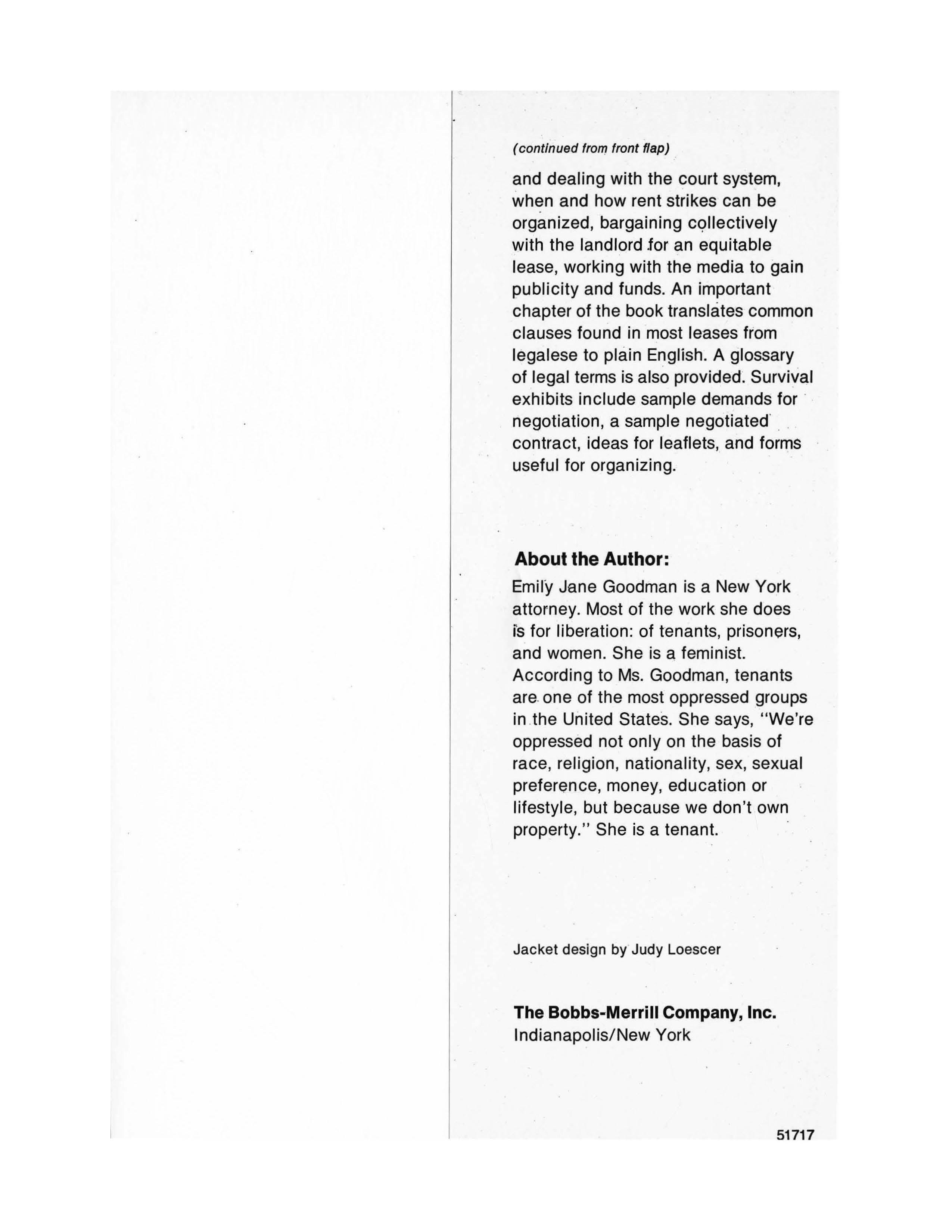
• How the economics of real estate benefit your landlord at your expense
• Organizing the t~nants in your building
• Understanding laws, lawyers, courts
• Bargaining collectively with your landlord
• When and how rent strikes can be organized
• Finding support for your tenant organization
• Using the media
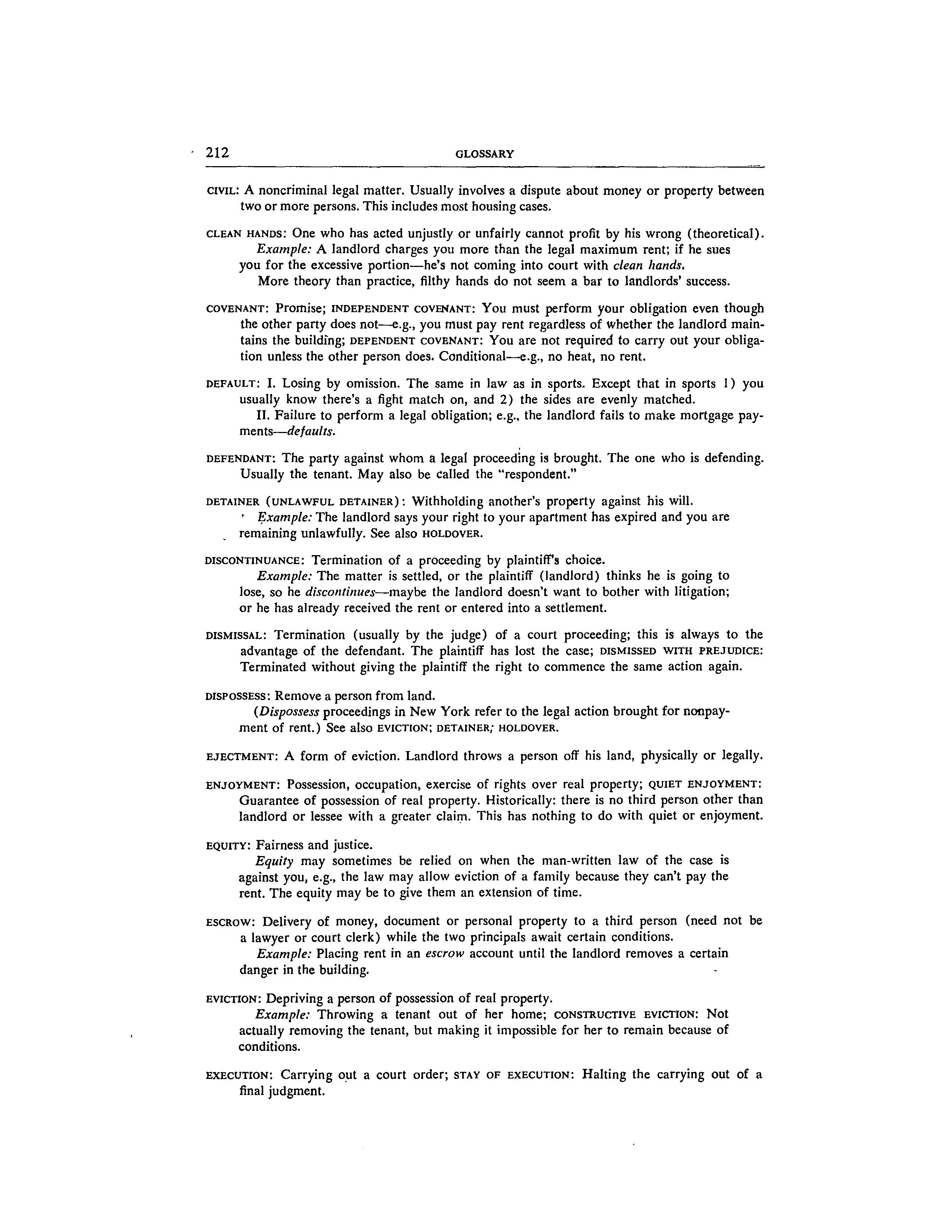
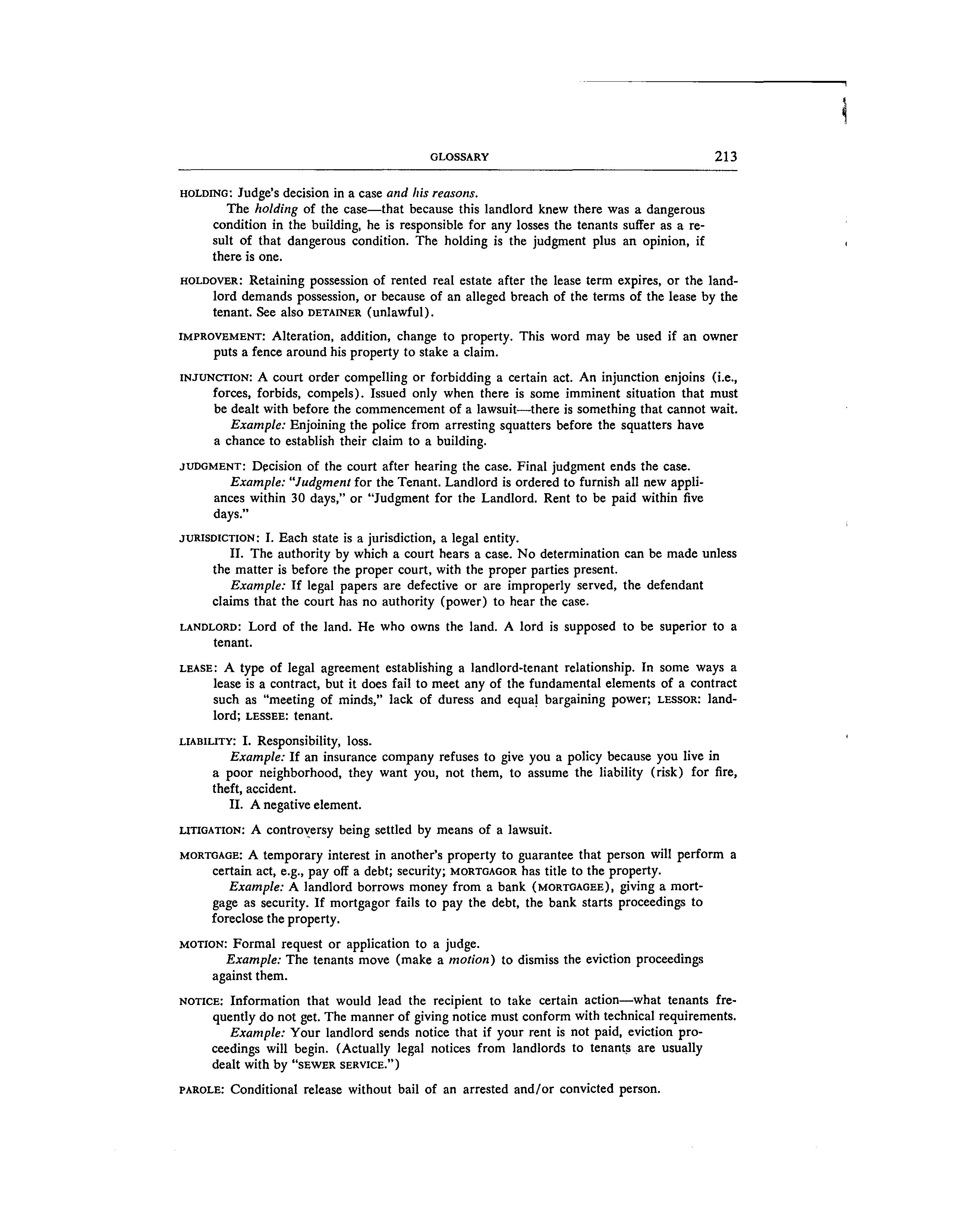
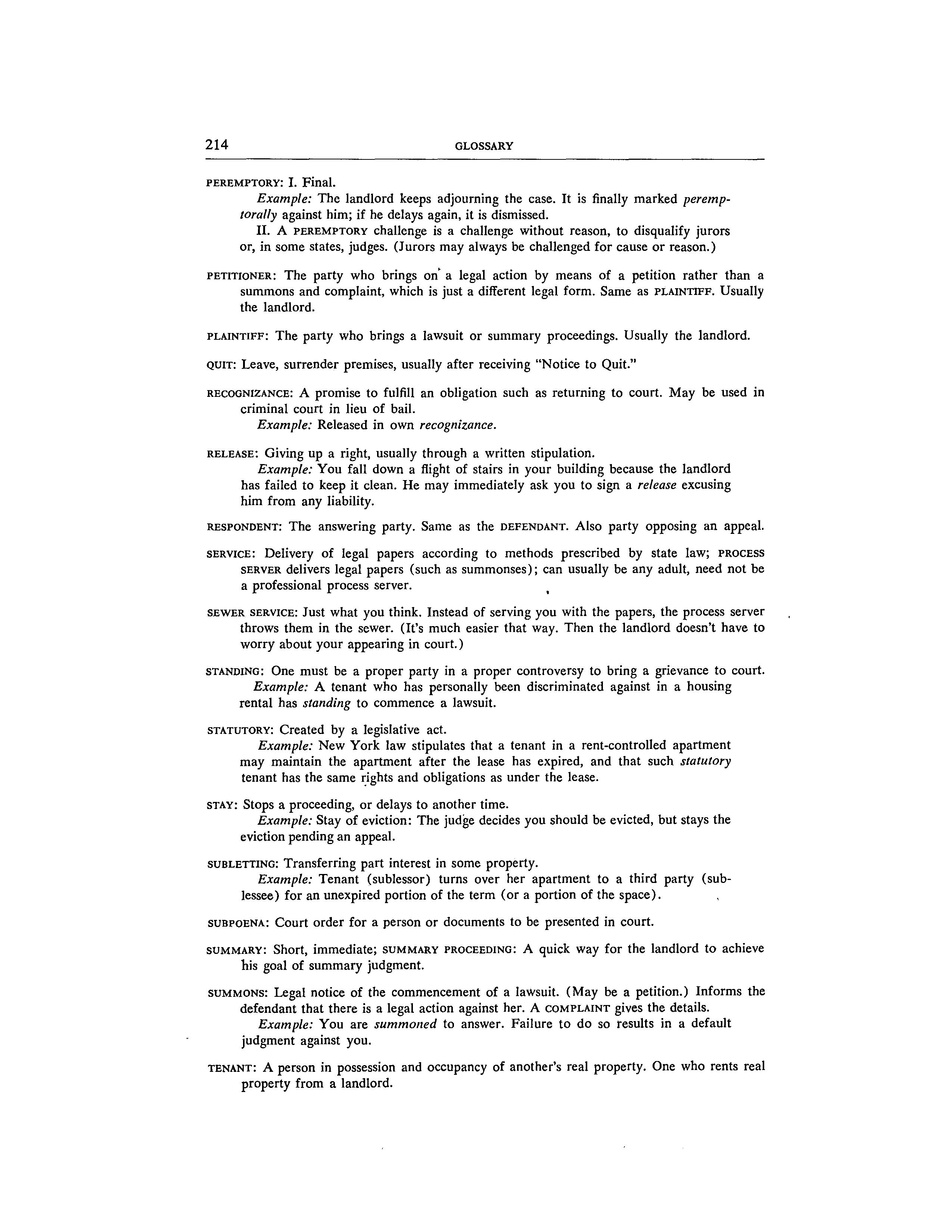
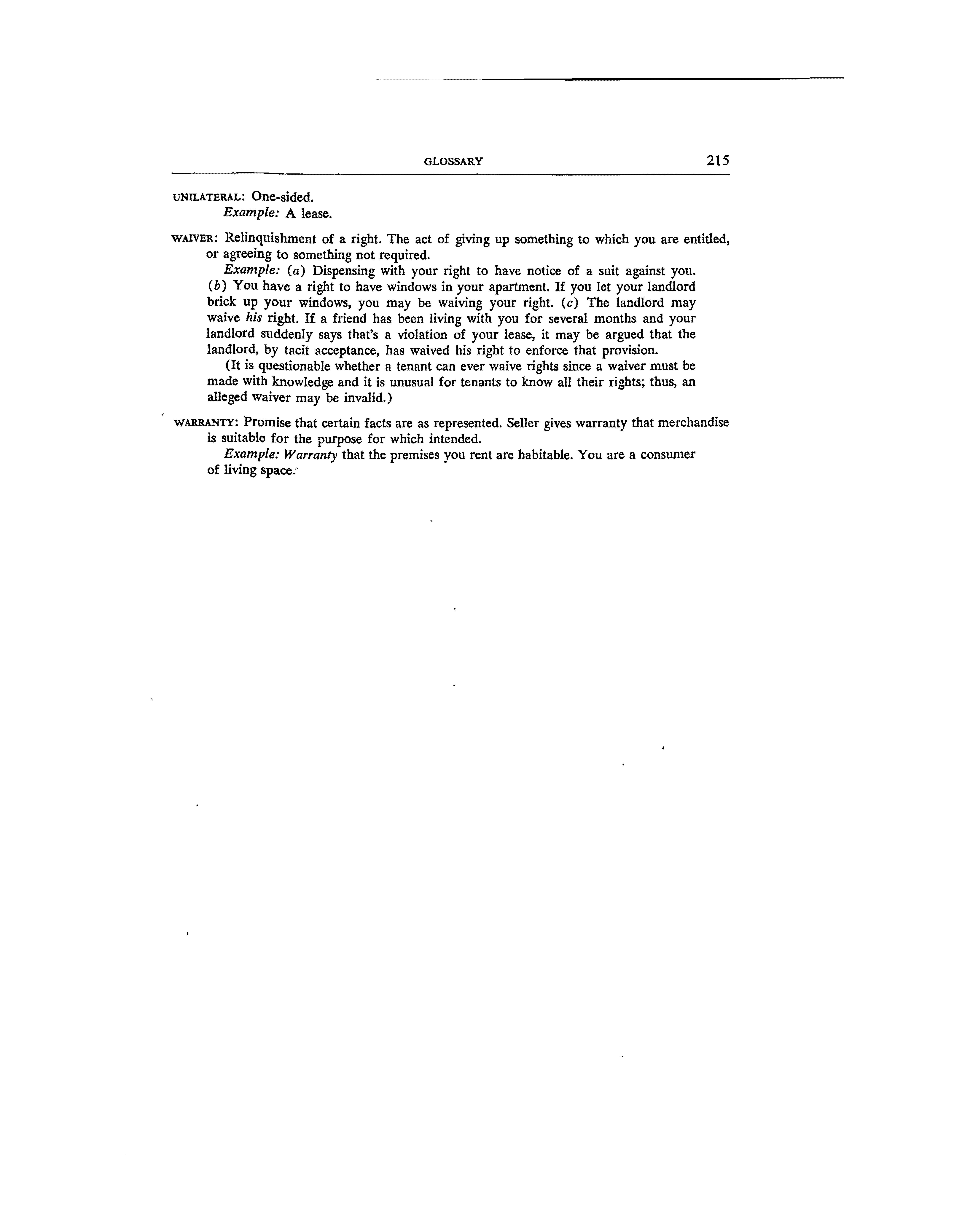
• The meaning of legal language
THE
IE ANT SURVIVAL BOOK is for every tenant tired of no heat • rising rents • falling plaster rats • evictions • no security
$8.50
The Tenant Survivcil Book
•by Emily Jane Goodman
More than seventy million people in this country live in homes owned by someone else. Rich, poor, middleclass; living in public projects, singlefamily houses, or luxury high-rise apartments-these people all have one thing in common. They are _tenants .j and they face the same enemy: the Real-Estate System.
In Berkeley, Ann Arbor, New Orleans, New York, Boston, and Chicago tenants are organizing for power to gain the rights they do not now have.
THE TENANT SURVIVAL BOOK is a valuable tool for the mushrooming tenants movement. In· this comprehensive guide, Emily Jane Goodman explains why tenants must organize, how.Jo go about organizing, and what results organizing can accomplish.
THE TENANT SURVIVAL BOOK • . I describes how the economics of real l estate has led to the current housing crisis and details the traditional landlord/tenant relationship in which the landlord has all the rights and the tenant none. The book then sets forth the practicalities of .organizing: calling a meeting, confronting the landlord, finding the proper organizer
Library of Congress catalog card number 70-713 215
Designed by A. Christopher Simon
Manufactured in the United States of America
DEDICATION
To the homeless. In the richest society known to civilization.
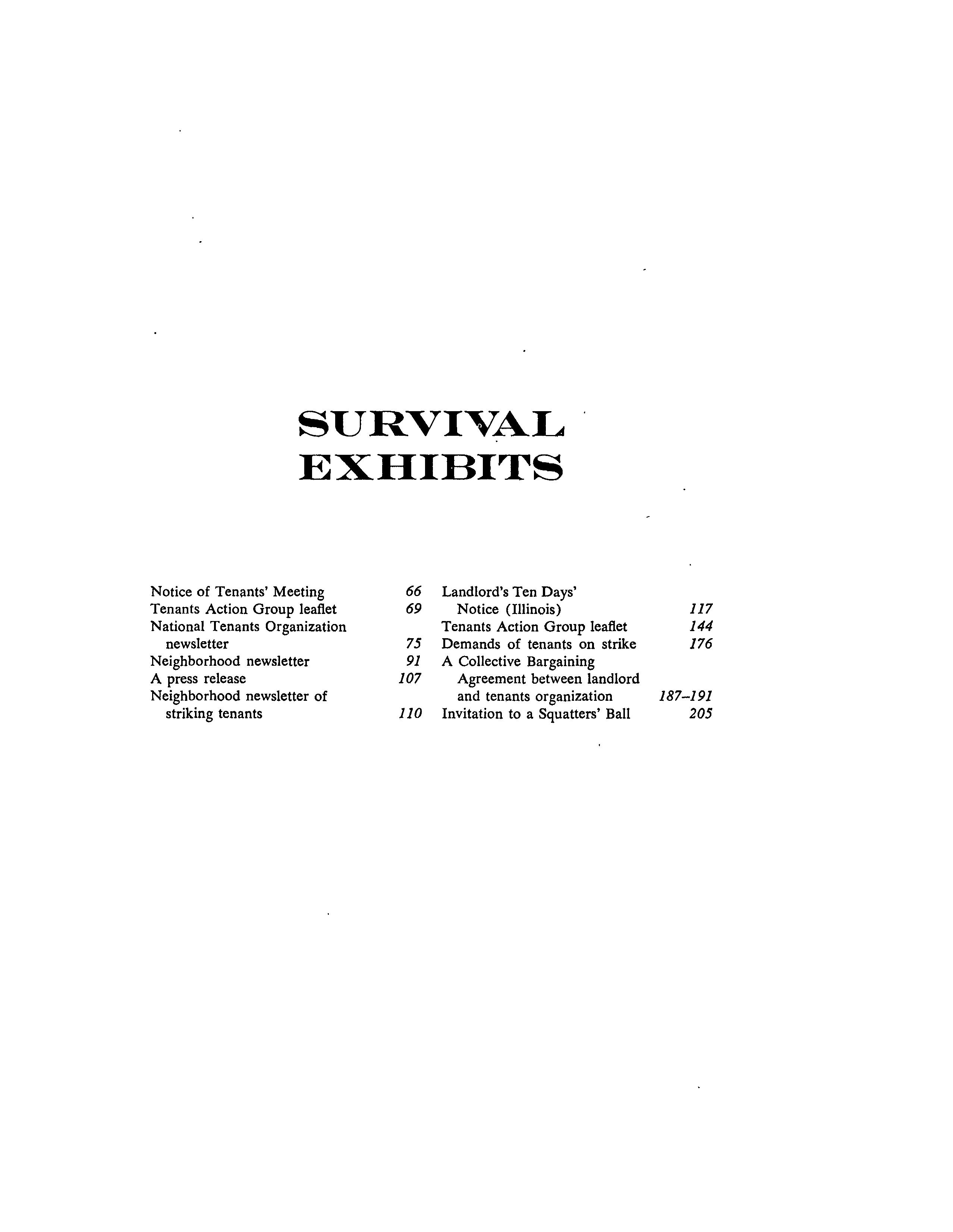
SURVIVAL EXHIBITS ;xiii ACKNOWLEDGMENTS xv
Chapter 1 WHY A TENANT SURVIVAL BOOK? 1
Chapter 2 TENANTS AND THE REAL-ESTATE -SYSTEM 7
Who Is the Landlord? 11 Institutional Expansion 13 • The Tactics of Institutions 15 Landlord Vandalism 16 How Tenants View Themselves 18 Who Is Organizing? 18 What Do Tenant Organizations Do? 19 What Are the Common Problems? 19 What Experiences Have Groups Had? 20 Organization Is Not Limited to a Building 20 Organizing Goals and Techniques Are Similar 21 What Are the Fears? 22 How Do Tenants React to Organizing? 23 Chapter 3
Chapter 4 E_CONOMICS
Profits and the Real-Estate System 31 Tax 32 Tax on What? 33 • Landlord's Tax Benefits 33 Depreciation • 34 Local Real-Estate Taxes 36 Banks, Interests, Financing 36 "Weaving" 36 Cities 38 Summary 40
Chapter 5 LEASES 41 Take It or Leave It? 44
Chapter 6 ORGANIZING 63
Starting Small 64 How Do You Get Started? 64 The Meeting 65 Announcing the Meeting 65 Will Your Neighbors Attend? 66 What Happens at the Meeting? 67 Structuring an Organization 68 What if the Landlord Shows Up? 70 Future Plans 71 Door-to-Door Campaign 71 How Much 'Can You Do? 72 Don't Be Divided 73 Money 74 Information You Will Need 76 Finding Your Landlord 76 Your Relations ix 31
with Other Tenant Organizations 76 What Are Possible Structures? 77 Who Else Will Support You? 78 Organizing Youth 80 Some Other Methods of Organizing 84 What About the Individual? 84 Organizing Tactics to Avoid 86 How You Can Help Others Organize 86 Dilemma 87
Chapter 7 ACTIONS 89
Display Actions 90 Learning Law 90 Tenant Patrols and Stopping Evictions 93 Communication 95 Information 95 Fund Raising 95 Boycotts 96 Banks 96 Before the Action 97 When the Property Owner Is an Institution 97 Actions Around Legislation 100 Media IOI
Chapter 8 MEDIA 103
Tenants and News J 03 Exposure Works 104 WhatYouHaveToDo 104 Fund Raising 104 Media Contact List 105 News Releases 106 What Should Your Timing Be? 106 At the Event 106 Which News Tactics? 108 Press Conference 108 • Television 108 News Statement 109 Interviews 109 Your Own Publications 109 Making News 111 Using the Coverage You Get 111
Chapter 9 LAWYERS 113
The Legal Profession 1/ 3 Choosing a Lawyer 115 Working with Lawyers 117 Arrests 119 Self-Representation and Community Advocates 121 Legal Fees-Lawyers for Landlords 122 Legal Fees for Tenants 122 Summary 123
Chapter 10 COURTS 125
In God We Trust 125 Going to Court 126 ·Who Are the Judges? 131 The
Judgemakers 132 The Reality 133 Summary 134
Chapter 11 LAW 137
What Is "Legal"? 137 How Does the Law Work? 138 Legal Problems 141 How Lawsuits Are Commenced 142 What To Do When You Hear from Your Landlord 143 Evictions 145 The Sound of One Hand Clapping 145 The Legal Questions 146 Withholding Statutes 146 Defenses to Nonpayment 147 Eviction 148 Legal Fictions 149 Actual Partial Eviction 149 Constructive Eviction 149 Failure of Consideration 149 Unconscionable Leases 149 Clean Hands 150 Warranty of Habitability 150 Recent Developments 151 Repair and Deduct 152 Evictions for Other Than Nonpayment 152 Waiver 154 Other Remedies 154 Criminal Courts 154 Small Claims Court 155 Injunctions 156 Administrators and Receivers 15 6 Damages 15 6 Summary 157
Chapter 12 STRIKES 159
What Are Tenant Strikes? 159 Background • 159 Theory and Goals 160 Know What You Are Striking For 161 How a Strike Works 162 Withholding Rent 163 Effects on the Landlord 165 Effects on the Tenants 165 The Withheld Money 166 Results of Striking 166 Legislation 168 Summary 169
Chapter 13 COLLECTIVE BARGAINING 171
Is There a Right to Collective Bargaining? 173 Getting Started 174 The Threat 174 Bargaining and Strikes 174 Internal Ground Rules 175 ~emands 176 External Ground Rules 178 The Landlord's Bargaining Tactics 179 Bargaining in Action 181 After Bargaining 183 Contracts 183 After the Contract 184 Enforcement
Machinery Within the Contract 185 Grievances 185 Summary 186
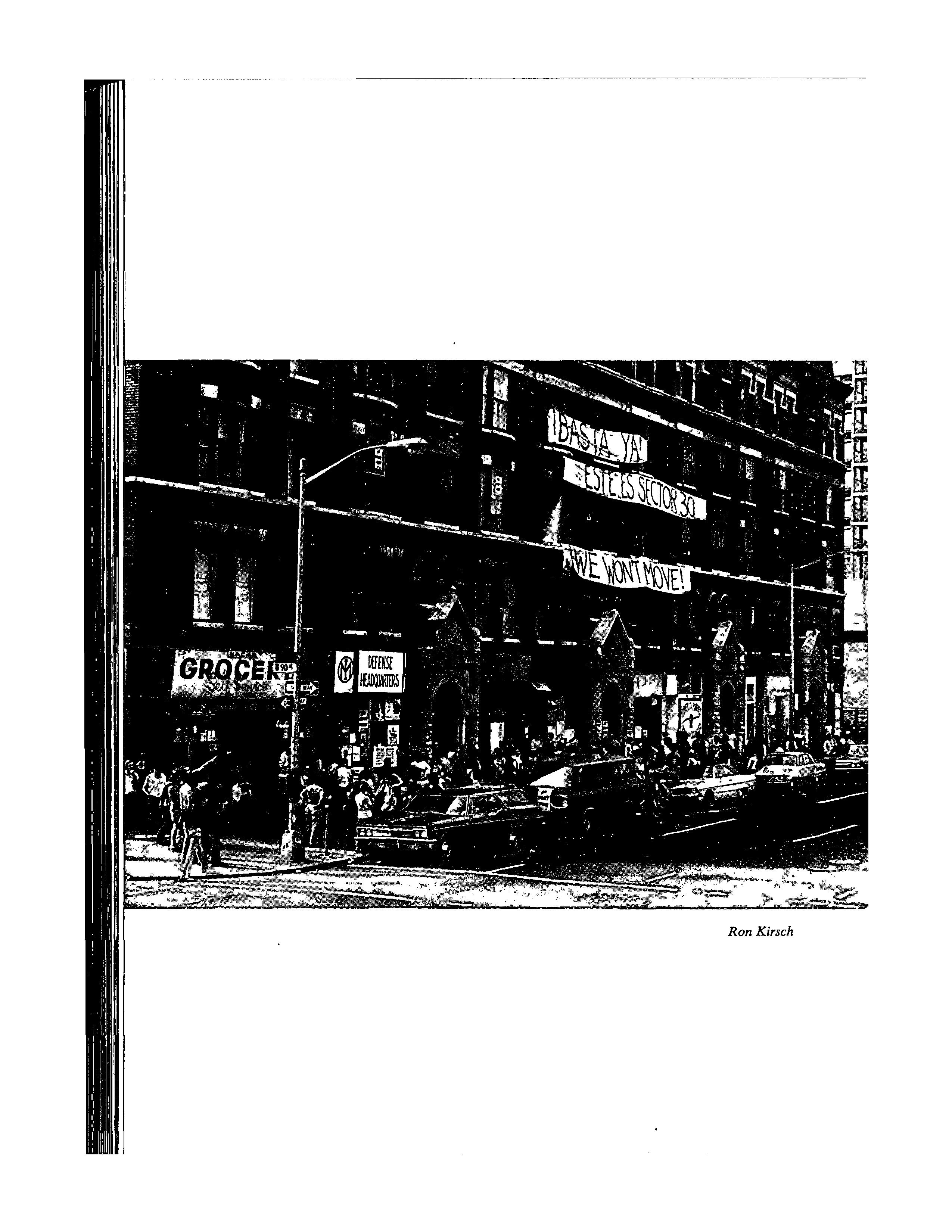
Chaptet-14 SQUATIERS 193
What Are "Squatters"? 194 What Is the Squatter Movement? 194 Who Are the Squatters? 195 How It Starts
195 How They Organize 197 The Tactics They Use 198 Paying Rent 200 Community Support 201 Courts, Arrests, Evictions 202 One Case Study 203 Squatters' Rap 204 Interviews with Squatter Children 207
211
SURVIVAL EXHIBITS
ACKNOWLEDGMENTS
In the course of writing this book, I spoke to tenant organizers, lawyers and tenants frofll all around the country. Many are mentioned and quoted throughout the pages of the book. My thanks to all the organizations and individuals whose cooperation was invaluable.
A few people must be thanked particularly for the work they did. For research: Vickie Morgan, Mindy Backer. For some early conversations: Richard Levenson. For keeping my office going: Margot Karle and Mardi Steinau. For keeping my home going: Alberta Lomax, and the staff of the apartment building in which l am a tenant. For transcribing tape. recordings: Sandy Wiener. For reading and commenting on portions of the manuscript: Alan Bell, Peter Goodman, Rubin Gorewitz, Alvin Kabot, Charles R. Novitz, the late Bill Rowe, John E. Sands, Napoleon B. Williams, Jr. For legal counsel: Kenneth Lapatine. For editing: Sonia Robbins. For new-found support: Sally Goodman. For disagreeing with me: Martin Goodman. For learning more about tenant survival than she wanted to know-and for being-Joanne Goodman. For everything, Leonard N. Cohen.
New York, December 1971 EJG
THE TENANT SURVIVAL BOOK
WHYATENANT SURVIVAL BOOK?
This is a book for tenants: people whose homes---,-23 million homes-are owned by someone else. It is a book for the benefit of tenants only.
There is a housing crisis across the country. Unlike most American crises, this one has a direct effect on virtually the entire population. Everyone has a right to decent shelter, because we are human beings. Our nation, the richest in the world, denies us this right.
Hardly any housing is being built in our country. The housing that exists is deteriorating, being abandoned or demolished. The controlling laws are archaic. The crisis is being experienced by all races, religions, nationalities and income groups and by people of all ages and sexes. The common denominator is that all are tenants.
Wherever people meet they talk about housing. "Can you get me an apartment?" "The city hasn't built any housing." "The rezoning is a clear race issue." "What do you think about the rent strike?" "I can't afford the rents they're asking."
If you are a tenant on Telegraph Hill in San Francisco, Massachusetts A venue in Washington, D.C., Eastern Parkway in Brooklyn, Woodward Avenue in Detroit, the details may be different, but the basic problem is reduced to one common factor: as a tenant you have no power. You, as a tenant, do not control the place in which you live.
Regardless of wealth, job, education or type of car, all tenants, because they do not own property, are second-class citizens. Within the landlord-tenant relationship, tenants-the people who live in the buildings-are powerless compared to the person, corporation, institution or government that owns the building.
WHY A TENANT SURVIVAL BOOK?
We may question the right of the landlord-tenant relationship to exist. We can and should attack it as being unnatural, inequitable, unworkable and archaic. During the 1960s-a decade of turbulence, domestic violence and war, of polarization -and massive confrontation between blacks and whites, the poor and the affluent; the blue-collar worker and the Ph.D., construction workers and students, govemment and people, the dichotomy between the property-owning landlord and the propertyless tenant was unquestioned and rarely at issue.
Tenants are oppressed people. Like women, despite their numbers, they have had no power. This is very difficult for. most of us to accept. We don't like to recognize ourselves as victims.
The landlord does not stand alone. H~ is not the only enemy. He is part of a tight network of various tiers of government, banks and institutions. It is easier to relate to the problems with a landlord because he is (sometimes) more tangible. He is more visible than the unconscionable mortgagee, whose rates are impose4 by faceless banks or life-insurance companies, or the general economic rules and disasters wrought by government b~reaucracies. An isolated, individual small landlord may be a mere front man for the real but hidden moneylenders and the big realestate interests. Each facet of the real-estate system is a special interest group, but they· all work together.
A "landlord" is any person or legal entity, including institutions and governments, that owns and therefore controls the shelter of other human beings. Landlord-tenant problems include all situations where the issue is shelter, private or public. Landlord may mean not only the lord of the land, but the real-estate system of which the building owner is a part: the banks, the insurance companies, big business and government.
Tenants are people who do not own their own homes and who rent from the owner ( or an authorized representative of the owner). Actually very few people "own their own homes," for most housing is really owned by the banks, insurance companies and· other lending institutions that finance them. The great American dream of owning a place of one's own is in that sense a myth. We include as tenants those who do not o~n the deed, or the mortgage, who are clearly not homeowners, but are nevertheless consumers of living space.
If basically you feel that the landlord is "right," but you just wish that your apartment were a little better, you are overlooking the politics of landlord-tenant relationships. Your landlord is years--centuries-ahead of you in organizing. A big landlord has or is a well-organized computerized corporate machine. He is a member of all sorts of real-estate boards, some of which, such as the Metropolitan Fair Housing Council, sound as if they exist for the common good. These bodies are very smooth machines and they have all the weapons: speakers, lawyers, lobbies, political power, media contacts, accountants, computers, prestige, property and money. They constitute a powerful army.
Any challenge by tenants is immediately and accurately viewed by landlords as a threat to their system and attracts organized protection. The landlord armies are redoubling efforts to form a united front against ·you. The few real-estate entrepreneurs in any city may appear to be competitors, but they know when to work together-even at the expense of life and shelter. Yours.
You will see throughout this book the word "organize." As an individual, your
WHY
chances of success against the real-estate army are minimal. You must have organization, power-bargaining, struggling and fighting-to achieve a change in existing landlord-tenant relationships.
The techniques and principles of organizing ( or of using the media or collective bargaining) are the same no matter what the issue; therefore, the application may be made to any group. But they are offered here only_ to those who would use them well. The middle-income tenant who waiked out of a neighborhood meeting because he didn't want to be in an organization open to low-income tenants was making a mistake.
In New York, Boston, Washington, Chicago, Detroit, Miami, Newark, Baltimore, San Francisco, Ann Arbor, Madison, New Orleans, Philadelphia, Hartford, Denver-an endless list-tenants are on the move. They are organizing to protest lack of housing, lack of services, rent increases and evictions.
Tenants are active in low- and middle-income housing in the private and public sectors; in student housing; and now even in luxury apartment buildings. The affluent are learning what the poor have always known: what it is like to be powerless, that organizing is the only means of gaining control, that there is no human dignity without control over one's own environment.
The acceptability of a particular tactic depends on which side is using it. The real-estate system has been destroying tenants for years. The system is aggressive; it is oppressive. It does not care that shelter is the first need of civilization.
Landlords have now become very concerned about the tactics of their tenants (which is not to say they have become very concerned about their tenants-only the tenants' potential power). They are concerned enough to have sought permission to reprint portions of this book in their trade publications. Permission was denied. A real~estate outfit has also gone into court stating that publication of this book is against certain interests. That is true; it is not in the best interests of the real-estate industry. Prior to publication of this book the author was visited in her home by police wanting to know if she was the lawyer in a certain landlord-tenant case and what the status of the matter was; they then questioned employees in her apartment building about her personal life. The desired effect of such acts is clearly harassment and intimidation. Real-estate people have issued "tenant manuals" actually designed for the protection of landlords. They have disrupted government (in Washington, D.C.) and private meetings in countless cities where their power was threatened. They hold seminars on the "tenant movement." They read, write, buy books that tell "how to pyramid real-estate profits into a tax-free fortune."
It is essential that Americans become involved in the housing issue, an issue that has great potential for making change: change in our landlord-tenant ·relationship and _change in our lives and in our society.
The book has been written to add perspective to the situations tenants are in and how they arose; tq give some perspective of what tenant organizations are doing around the country; to help individuals and groups function in the landlord-tenant struggle; and to raise the questions of what changes should be made, how some of them can be made, and whether others·can be accomplished at all. This is a book of how you as a tenant can try to resist the immediate oppression at_1d power of landlords and to move toward achieving basic changes in the landlord-tenant relationship.
WHY A TENANT SURVIVAL BOOK?
Perhaps most important, this book has been written to help tenants change their attitudes, toward themselves, their landlords, their problems, and the realestate system.
I realize this book is something of a ·contradiction. That is, it deals with the very different problems of the rich and the poor, and at the same time recognizes that in relation to the real-estate system all but the very rich are in trouble. There should }>e equality in housing for all people, meaning that the rich and the poor must be equal not only to the landlord, but to each other.
Certain fundamentals governing the landlord-tenant relationship, the laws, lawyers, courts, economics, and principles of organizing are the same whether applied to the poor, the middle class or the affluent. The ability to effect change is different, and the degrees of the problem are very different. But the types of problems are often the same because of the lack of power among tenants as tenants. Nevertheless, survival for some may mean maintaining luxury status; for others survival means staying alive and having shelter.
For example, one day, when first doing this book, I spent the morning working wi~h tenants on Central Park West in Manhattan. That afternoon I visited tenants on East 111th Street in El Barrio, New York's poverty-stricken East Harlem, to talk about their housing problems.
The difference in living conditions was astounding. The problems in the first building, where rents averaged 500 dollars a month, were "luxury problems." They were not frivolous because they made life for the residents uncomfortable. The elevators weren't operating properly, air conditioners could not be used and the hallways were infrequently washed. The tenants resented not getting what they paid for. The situation uptown in El Barrio was different. Large families were crowded into two-room apartments. People slept in shifts. Many had no electricity or toilet seats.
The common denominator was that neither group knew how to tackle its problems. They both wanted to know: How do we organize? Doesn't the landlord have any obligations? How do we get our landlord to negotiate? How do we have a rent strike? How do we change the condition of. our lives?
Both tenant groups were faced with the problems of one-sided laws, inadequate legal procedures. One group (Central Park West) believed that they had all the rights in the world including rights that are in fact nonexistent; the other (El Barrio), that they had no rights at all.
For the middle class, change is easier to effect, because the change is limited. They can bring pressure and remedy their 9wn situations. They have city hall or media contacts; they find the economic-political system reachable. For poor people change is far more difficult. It is not simply a matter of securing more heat in the winter but of changing systems, and that involves much deeper challenges--challenges to our economic and political system and structure.
The thrust of this book is to present organizing techniques as applied to landlord-tenant problems; to give the experiences of some groups; to give an overview of the status of the law, information usually reserved for lawyers. But this book cannot anticipate every step of the way, nor can it prove that your organizing efforts will work.
Because of the wide variation of laws and procedures from state to state and city to city, any book of this scope and purpose must be supplemented by advice
WHY A TENANT SURVIVAL BOOK?
from local lawyers committed to tenant rights and community action groups as guides to the situation in a particular city.
THIS BOOK, THEN, IS NOT INTENDED AS LEGAL ADVICE AND IS NOT A SUBSTITUTE FOR LOCAL COUNSEL.
My own point of view should be very clear. I am concerned with the problems of the poor, which is most of. America. The affluent can make an impact on the tenant movement since they have some power, although until mobilized it is nothing compared to the power of the real-estate system.
This book gives you background as well as "how to"; it will take you through the steps. In this way you may gain courage, take heart and become more aware of your rights, lack of rights and potential for exercising greater power over your own home and community life. Your home is your home even though you don't own it. It may be that little or no change will be made by your efforts. You may feel that making the efforts is dangerous. But so is the way'you are living now. Hopefully, as your attitudes change so will your housing conditions. The prime movers of change are those who take risks, realizing the inherent dangers, but also realizing that without risk there can be no change. Law is often changed by treading along its edges.
Some of the points emphasized here may seem terribly obvious to you. Good.
TENANTS AND THE REAL-ESTATE SYSTEM
"Hello, Earth, this is God! I want all you people to clear out before the end of the month. I have a client who's interested in the property."
We know that a consumer movement exists and that there is an ecology movement. Is there such a thing as a "tenant movement"?
The concept of a "movement" does not refer to a hierarchy or a particular body, but to a power, a presence, a force. It means 70 million tenants declaring, "There are 70 million of us!" Actually, 70 million, the currently accepted figure, is a very conservative estimate of the number of- tenants. Generaliy figures reveal that one-third of the nation lives in rented housing or that one-third of the housing units are rented. This yields 23 million homes. However, this figure must be con.:. sidered low because it does not accurately reflect the larger families among the poor, the failure to include all poor families in census reports and the failure to account for families doubling up for lack of housing.
Tenant organizing is initially directed at the landlord but never overlooks the banks, the institutions, the cities. Readers may ask: "Are all landlords bad?" Well, some are worse than others. If you think you have a great landlord,. okay. There may be some individual landlords who .are "nice guys." Still, their tenants have no power.
TENANTS AND THE REAL-ESTATE SYSTEM
Tenants around· the country have been organizing to solve immediate difficulties with their landlord. There have been successes. Any victory you gain is important and should be valued. The question that comes on the heels of each victory is: Is this enough? You have to decide whether each step is an end in itself or part of a larger plan.
When individual complaints become group complaints, when groups organize themselves in a larger effort, and when isolated landlord-tenant problems are related to part of a larger social, economic, political picture, then there is a tenant movement.
A movement does not necessarily mean armed revolution or even rebellion. It can mean reeducation, awareness of rights, awareness of absence of rights and changes in attitude. For example, the women's movement has been far ahead of legislation or judicial decisions on women's rights because laws have not kept up with attitudes. When your _action becomes part of a larger effort, it becomes a movement.
There is a continuum of activity, and each tenant decides where to start and where to stop.
,Tenant organizing has had periods of sporadic activity in the twentieth century. Activity recurred in the early 1960s and has erupted in the 1970s. The participants have been groups isolated from one another. Tenants have never joined together on the basis of their common crisis without respect to the other differences in their lives. If they ever do, there will be a real "tenant movement." Such a movement could not fail.
The burden of changing the landlord-tenant relationship is on the tenants. Businessmen and politicians have refused by both omission and commission to alter the system -that now prevails. It is therefore up to the rest of us. Without change now we don't stand a chance.
At a San Francisco residential hotel, The Westchester, tenants signed a petition demanding better security ( there had been an increase of thefts and assaults since the Redevelopment Agency had taken over). One of the signatories was soon gagged, bound, robbed and· murdered. He choked on his own false teeth. The agency replied to the petition that they had investigated all complaints and found no problems. The victim was seventy-five-year-old pensioner James Gregory. •
Tenant·activity can produce major changes; it can also be dangerous. People can lose their homes, jobs, lives, so entrenched is our society's commitment to the classifications of owner and tenant. The victims must decide if loss of dignity, health, safety-the present conditions-is not more dangerous.
Although consumer affairs have attracted a large, devoted and thus far sustained attention and following in a few years, the tenant movement has not to the same extent: Consumerism holds no threats to the individual. An automobile owner says t~at he has nothing to lose by favoring Ralph Nader in a battle against General
Motors. Maybe he'll get a safer vehicle. Maybe there will be fewer accidents. Maybe he will live longer. So he writes, protests. Perhaps he will decide never to drive a particular make. But nobody is going to come and take away his car as a result. In other words, he's safe.
Our sense of justice is intertwined with our respect for property and commercial transactions. We all become irate when a product we have bought and paid for does not live up to its advertising, does not have a warranty, falls apart. We are really cheated. As to our housing we say, "Well, the landlord does own the building, after all." Shouldn't we expect that our homes would have a warranty of suitability to be lived in, a warranty of habitability?
There are at least 70 million tenants in the United States. Their lives as tenants are getting better and worse. The actual living conditions, the housing crisis are worsening. But as conditions get worse, more tenants are getting together. As conditions get worse and people organize, repression of them (by the owners and frequently by courts and legislatures) may become greater. •
People must know what rights they have. Knowing rights is the beginning of exercising them. Knowing what they are not is the beginning of demanding them.
Tenants are becoming more and more aware that the whole system is inequitable. As activist Ollie Rosengart says, "Tenants used to believe in the system and now they are finding out that the system is outrageous. It's like a man in the desert being caught without water and a guy offers him polluted water at five dollars an ounce."
People are now saying: "It's more than·just the rights of tenants. It has affected the quality of life in general; it's made them live in a transient society, making people not care about their own situation, about their fellowman. People really can't live."
Housing is a special kind of need. People will do anything, however desperate, to secure the best shelter they possibly can, and people are willing to put up with a lot before they will act in a way that might jeopardize their housing, however wretched.
Tenants themselves are a very disparate group; in any one building the residents may have varied backgrounds, interests, work, education, "status," so they don't act together as in a union of people in the same work place who have a lot more in common. People do not view housing as less important; on the contrary, it is so important they are willing to put up with more.
Hunger cannot be overlooked. But of housing conditions we tend to say: "This
A Colorado mother took her three-year-old child home from the hospital in a January snowstorm. She found her apartment door padlocked. Ten days earlier she had told the landlord she was going to withhold her rent and use it to repair severe code violations.
is the way I'm forced to live, I'll adjust." People in America are adapting to conditions they shouJdn't be adapting to. One New Yorlc tenant says: "I remember when the oil burner broke down. I put the oven on, left the door open and put a fan next
TENANTS AND THE REAL-ESTATE SYSTEM
to it so the heat would circulate. It worked. I adapted." Others say, "Of course, we knew the condition of this apartment, but we had to move somewhere."
Few are idealistic enough to think that the rich and the poor will ever really work together to cure their common problems. What the middle-income people and the affluent do to satisfy their needs will have a major effect on where the tenant movement goes. Most housing activists are pessimistic about what the relatively powerful tenants-the middle class-will do. If changing the situation with one's landlord is ultimately going to require a change in the tenant's relationship with his corporation, he may feel something of a conflict. For example, many people don't want to challenge the landlord's tax schemes because they are enjoying related advantages in their own businesses.
Thus, just as one of the great strengths of the tenant movement is its ability to cut across lines and apply equally to 70 million people, that diversity sometimes becomes a handicap. The common denominator may not be enough.
Much of the potential of the tenant movement depends on the middle class's acknowledging that their troubles have the same roots as those of the poor. It is the degree that varies.
Be.rkeley lawyer Steve Bingham, when talking about the role of the middle class, said: "I think it's key. Tenant organizing is really an opportunity for people who lead individualized, isolated lives to get together in a common struggle with people who have nothing else in common with them exc~pt the fact. that they are also tenants and probably getting screwed."
But many organizers, political scientists, sociologists say, "The middle class will solve its own problems. It won't mean anything for the poor. Middle-income people act only in their own interests." Others say: "Poor people piggybacking on the muscle <?f the middle class can accomplish a hell of a lot. The affluent can be helpful allies if we keep their consciousness high."
. The movement, despite its spurts of activism, has been easily "turned off." The battle subsides, •and tenants have been mollified whenever a few crumbs were thrown to them by either an individual landlord, a benevolent legislature or a wellmotivated judge.
A young woman notified her landlord that there was a broken window that made her apartment dangerous and easily broken into. The landlord ignored her and failed to make the repairs.
One night, while Ms. Janet Smith, the tenant, was asleep, a man came in through just that window and raped her at knifepoint.
The struggle cannot be short or fast or easy. There may be broken heads, threats, beatings, deaths. This should not be shocking. As tenant activist Jesse Grey said years after the Harlem rent strikes, "Why should organizing tenants be easier than organizing auto workers?"
The tenant movement has grown slowly, partially because movement organizers and community leaders have c<'mcentrated their efforts in areas other than housing. This has been a very serious mistake. Lawyers are not usually interested in
WHO IS THE LANDLORD?
problems of housing from the tenants' viewpoint. Most lawyers involved in civilrights struggles, antiwar activities or the "radical movement" do not do work in housing. This error is being committed not by lawyers alone. Groups actively involved in community control of schools, breakfast programs and health care have focused on housing only very recently. People don't seem to believe there is a right to housing; many have lost sight of the problems and goals by being promised more public housing, or rent control, a paint job or other artificial respiration.
Some activists say that the lack of interest in housing stems from its not being "glamorous," the people one works with not being "militant" and people's preference for movements where they can see immediate success.
None of this will be simple. As landlords are fond of saying to their tenants, "You are not up against children." No matter how mild and reasonable your demands may seem, and in fact may be, you are challenging power, and that can never be easy.
The last thing your landlord wants is for you to escape isolation. He can deal with fragmented, unconnected rent payers or even nonpayers. But organized forces are something else. Your landlord may be more sensitive to your group's collective power than you, its members, are.
Tenants should never forget the facts and conditions of their lives. Refusal to fight to change them should be unthinkable. The difference between their lives and homes and their landlords' or the banker-mortgagees' historically has been enough to impel some to true revolution, not to mention tenant organizing:
Property owners have been known to panic at the mere rumor that they will soon be confronted by a united tenants' front. But most of them will not shrink upon being attacked.
The tenant movement may be regarded by some as nonpolitical, by others as "reformist," i.e., not really making any change. But it is a challenge to the system.
Ms. Feliciano and her children have moved six times in the last eight years. Everytime her family expands she is evicted for overcrowding. After being told to leave her last apartment she moved into her mother's home. Complaints by the authorities compel her to leave because the public-housing ap~rtment cannot accommodate three generations of homeless people.
Who Is the Landlord?
Landlords function on two levels: as building owners and as an integral part of the real-estate system. Landlords must be viewed as the real culprits-in-interest, but also as the front men for the industry.
There are different types of landlords. There is the small landlord-he owns one building which he lives in and which has one or more apartments he rents out. He is often the least troublesome and the least affluent.
Then there is the small-time landlord who owns a number of small buildings; he may be the "slumlord."
Next comes the owner of one or more large apartment buildings; this type of
TENANTS
SYSTEM
landlord may be visible or invisible. The landlord may be a corporation or. a syndicate. Tenants may have dealings only with an agent, superintendent or management company. How much authority these people have varies. The one constant is that they are seeking and making profit, although they do not have the same economic advantages as the actual owner.
The landlord may also be a government or governmental agency. This is clearly the case in public housing and government-financed housing. This is also the case where a unit of government takes title to private housing in order to convert it or the land it is on to public use, or takes over property after tax default.
You must identify the enemy and how he functions. You must know who your landlord is. The landlord may not be human at all. Literally. Your building may be owned by a corporation, partnership, institution, university, hospital, church, public utility, public corporation, bank, insurance _company or goyernment agency. The most complex and elusive landlord is the institution. Hospitals, churches, universities do not fit our image of the "villainous landlord."
It is important to know what category your landlord fits into because that will determine his tactics, and in part will determine your organization and your strategy. You will have to know if the building is part of a larger real-estate scheme, how much economic pressure can be withstood, how vulnerable the owner may be to publicity, and what risks tenants can anticipate, such as building abandonment.
For example, if you live in a large apartment building and the owners are major investors, their reaction to a strike would be very different from the reaction of a single-building owner whose resources are more limited. In negotiations what you actually achieve may be governed by the landlord's status.
When talking about the landlord we must often include the management that may stand in' the place of the true "phantom" landlord. When dealing with management in collective bargaining, for example, you must know what its authority is. The building superintendent is generally a "tool" of management; it may use him against you. But he is not part of the system. You should know his authority, too. For example, does he have the right to approve new tenants?
Like the landlord, the r~al-estate management company he hires to run interference for him is interested in profit, not people. Management works for profit.
Assuming management has no direct interest in the ownership, there are several different schemes by which rent may be paid. The management may have a retainer arrangement whereby it receives a certain fee annually. It may or may not be its responsibility to pay maintenance costs: fuel, utilities, salaries. If it does assume the costs, any service not provided is, as they say, money in its pocket.
It is also .common for the management fee to be a percentage of the rents or a percentage of the profits. You can see why either of these works against the tenants. Although the managers may be a step removed from ownership of the property, they are still making money from your living quarters.
Landlords own land for profitable venture. Whether through inheritance or manipulation, modern landlords assemble properties for development of shopping centers, construction of racially and economically segregated communities, prestigious office towers and luxury residences, expansion of monolithic educational and health institutions, aerospace and military-industrial complexes.
Government entities are landlords, if not the biggest landlords, yet their relationship with tenants is no different than in the private sector, and often much worse.
In fact the government landlord often imposes more restrictive rules on tenant rights and treats tenants as recipients of privileges rather than as holders of rights. No national administration, no state or local government recognizes a right to housing.
Institutional Expansion
"Institutional expansion" describes those "public" facilities which "assemble parcels" of land with or without dwellings on them. They intend to expand and develop new facilities, new structures for their staffs, for research and for their business activity by demolishing the existing housing for dormitories, laboratories or parking lots.
Obviously the problem is worse where there is a shortage of land and a high concentration of this type of landlord. The situation is acute in Manhattan, with a population of one and a half million, scarce land and a dense concentration of hospitals and educational institutions. The problem is significant in Denver, where the number of federal office buildings is second only to Washington. Certainly the problem exists in Cambridge, where Harvard and MIT are large landlords, and in Philadelphia, where the University of Pennsylvania has had serious expansion problems with the neighboring community.
Institutional expansion has raised serious conflicts in recent years as the institutional appetites grow. Low-income, moderate-middle-income and even highincome tenants have been faced with mass evictions, dislocation and the destruction of neighborhoods. The community is not consulted concerning the plans of the institution and whether they coincide with the needs and desires of the community. An eighty-two-year-old displaced person said, "We have everything here. If we had to move from our homes, where would we eat? There would be no community."
No adequate control or legislation exists in major American cities over such expansion plans, other than elusive, flexible zoning laws. No effective mechanism of government control or guidelines exists. The courts, most elected officials and governmental bodies and the law have shown themselves to be immune to the pleas of tenants facing eviction. In fact, they have, in some cases, been openly on the side of the institution. For example, in California's TOOR (Tenants and Owners in Opposition to Renewal) case the mayor of San Francisco, Josepb Alioto, actually appeared in court on behalf of the expanding institution and relocation agency and against the tenants.
Governments confer enormous benefits and encouragement on institutions to expand whenever the institutions deem it necessary regardless of the hardships on tenants who are to be displaced. Most of these institutions are tax-exempt and also receive substantial direct funds for expansion from government sources. Zoning changes and legislation are "freely" granted to such institutions, so powerful are their connections and friends. The thousands of tenants who must be forced to leave are left adrift without any protection or opportunity to be consulted on their fate. Institutions conduct their expansion business in a manner that puts individual corporate power to shame. These so-called nonprofit institutions themselves are big business: higher education, health care and utility service. They are supersecretive; they consult no one but themselves and their inner circle and deny the community directly affected any involvement with their plans. (Bellevue Hospital in New York,
SYSTEM
for example, has a "twenty-year master plan.") They rely on powerful contributing benefactors, trustees, contractors, famous architects, re3:l-estate organizers and government officials, elected leaders, public-relations specialists and big corporate lawyers to shield their business activities and to guide them swiftly and -efficiently. When they move, big money is moving and at your expense as a taxpayer or consumer.
Leonard N. Cohen, Deputy President of the Borough of Manhattan, says: "We don't even have an inventory of the property owned by the various educational, hospital and private institutions, or the tax benefits and government funding conferred upon them. No one knows what properties they may be holding for later expansion, or how many families or individuals live there, or the condition of these properties. Only they know! Based on the concept of private pr~perty-which really shouldn't apply to institutions-an owner can do pretty much anything he wants with his building. There should be no zoning ~hanges and no government aid until the institutions consult with the community regarding the physical ownership of property, projected plans and programs, analysis of services, sources of funding, interinstitution consultation."
No one knows what the needs and the efficiency of a public utility are because it is a monopoly in operating and expanding without any accountability to anyone but itself or some vague state authority that may do nothing but publish less-thanmeaningful reports. A tenant who faces eviction as a result of this unilateral display of power must cope with an established pattern of nonaccountability.
The institutions are largely dependent on private and public donations. The college or hospital you support may be plotting right now to increase your rent or throw you out!
It is common for religious institutions to be in the real-estate business. Tax laws are always more favorable to landlords than to tenants; this is all the more true where the property owner is a tax-exempt institution. In the case of religious institutions there is not at this time a tax on income-producing property. A VISTA volunteer in Tennessee came upon some of the city's more wretched housing. Through tax-assessment records he ascertained who owned the property-a church. Without revealing that he· knew who the landlord was, he approached the church and requested the space for a Sunday display of photos of local housing conditions. The church recognized its own slums and said, "Maybe something else can be worked out." Repairs were made.
Where you know or discover that you are the victim of an ·institutional landlord, organization may be easier than in the case of a private realty company. People are more irate. They will find it impossible to understand the notion that an institutional property owner should make such large profits on or be so unresponsive to members of the community.
Your problems with your landlord, then, may be because of institutional expansion. The hospital wants your home for its staff; the university wants to tear down your block to build a gymnasium; the telephone· company wants to build a switching station tower. You must get out. Or the city itself wants to build a new civic center. Even if your landlord is not an institution, if his land is in an area that is being "assembled" for institutional expansion, he will surely be able to get a better price without you in the building. -
People are forced out or move out "voluntarily," and no one knows where they go. They are rarely heard from again.
Dear Eye and Ear Hospital:
My name is Delia Rodriguez, my husband's name is Luis. We have a one year old baby named Annette. We are one of the families who moved into the buildings on 13th Street. Our apartment is in 325 E. 13 Street. Before this happened, I used to live in a horrible building in Brooklyn, and the building was private. Then the city bought the building and it was no longer private and I got robbed out of every little thing I owned, while the city told me they were getting me an apartment in the pr6jects. But everytime I go to see about this matter, they tell me to wait one month. It is more than a year since the city said wait a month. When this happened I had to move in with my mother-in-law to a three room apartment. My husband, baby and me had to sleep on the floor like animals. We are humans. We want to live like people. Even though we are poor. We want a place that we could call home. We just found the place at 325 East 13 Street. This apartment is so full of warmth that we are very happy here. There is a back yard we could use for the baby to play in. If you were here you could see how happy the baby is. Please don't throw us out. This is the only place we could call home. Please let us stay. We feel safe here. Let us call this home. Please listen.
DELIA RODRIGUEZ
All America is familiar with the massive confrontation in 1968 between students, faculty and the community, and a private institution of higher educationColumbia University. It resulted in mass arrests and the fall of the president, and served as a prelude to a wave of college and university protests across the nation. The seeds of this discontent were sown much earlier. Columbia and its chain of associated institutions on Morningside Heights and Washington Heights had been engaged in surreptitious acquisitions of multiple dwellings, housing thousands of poor and moderate middle-income families in the neighborhood where Columbia corporate institutions were planning a 250-million-dollar expansion plan.
It has been estimated that almost 10,000 apartments in structurally sound, lowrental and rent-controlled housing were systematically demolished over the years to make room for the Columbia complex. The scheme needed only the catalyst of the infamous gymnasium to set off a community-backed confrontation with the educational authorities.
The board of trustees of a university or hospital is a powerful, select group, some of whom may financially benefit by expansion programs or who have other potential conflicts of interest. There are builders who do construction work, bankers who finance the building. They share in the profits of institutional expansion. The trustees may include district attorneys who arrest and prosecute the protesters and judges who may eventually hear the case.
The Tactics of Institutions
The thing to remember about expanding institutions is that, if you live in a building that is in the way of their "progress," they want you out and the building down. You are in their way. You may not even know what is happening. You may live in a building owned by a hospital or in a privately owned building that the hospital wishes to acquire to "build" a parking lot. If the hospital already owns the
property, they may send you a letter and notify you to move out. The procedures that follow are a question of local laws.
Where the building is privately owned the steps to get rid of you may be taken by your present landlord, who realizes, or has been made to realize, that his empty building would be worth more to a potential buyer than one burdened with people. Your landlord may or may not know who the potential buyer is. The institution will work through a web of "dummy corporations" and a mercenary army. Different landlords on the block may be approached by different buyers in the hope that prices won't be driven up by sellers who realize that they have a valuable product. So the landlord tries to evict you before selling. Otherwise the landlord may make his deal on the condition that he deliver title to an empty building.
If the hospital takes the building with the encumbrance of human beings, or has owned it before, they will have to execute the evictions themselves.·
Well, almost by themselves. What they do lo keep their own hands clean is to hire "relocation" companies to do the dirty work. Although there have been cases where the government as landlord has sent army bulldozers in to destroy homes without any court order (for example, Shawnee-on-the-Delaware, Pennsylvania), the usual pattern is somewhat more subtle. The government, usually a city, though it may be using federal funds, establishes a separate corporation, a "redevelopment agency," an "urban-development" or relocation corporation charged with the responsibility of getting tenants out. These groups are working for the government and have governmental authority behind them. Still they can protect the government, because the city disclaims knowledge or approval of any vandalism committed by the agency. In the case of private housing being evacuated, the landlord may hire a private corporation that has no official status whatever but cloaks itself with the appearance of authority. That is, they take on names that sound like municipal agencies (Urban Relocation Management), and the tenants are misled. New York now requires such "agencies" to state in bold letters: "Not a Government Agency." Tenants think these private corporations have great power, that it is wrong to resist them and, worse, that they are really on the side of the tenants.
In any event these groups act as buffers so that the institution maintains its good image.
Landlord Vandalism
Landlord vandalism is the most common means of harassing tenants out. It's what landlords do wheh they decide to empty their building. Small-time operators may undertake the destruction campaign themselves; the institutions bring in help. Heat stops, windows are boarded or tinned; the building becomes a physical and psychological hazard.
Next come the "relocation" letters, offering to "help" tenants move and in some cases to pay bonuses. Apartments are "volu~tarily" vacated this way by tenants who do not know they have another choice.
As soon as an apartment becomes vacated, wrecking crews come in and destroy it. Sledge hammers are used to smash walls, plumbing, wires, pipes, windows. This destruction is typical. It is designed to protect the apartments from squatters (who may have been forced out of their pi;evious homes the same way) and to harass the re~aining tenants into leaving.
LANDLORD VANDALISM
Some of the worst harassing of tenants, particularly for the purposes of eviction, is done by or on behalf of institutional landlords. The names change: Columbus Hospital, Mount Sinai, The Florence Nightingale Nursing Home. The patterns are identical. The people who are hired to evict the tenants are the same ones the institution hires to manage the building. The money is in evictions, not management. These bizarre and grotesque patterns are not limited to institutions but they seem to be the worst offenders. It doesn't seem to fit the image they 'display.
Granville Cherry, an unemployed shipping clerk on welfare, began organizing a tenants' council. His welfare rent allowance was discontinued because "the building in which you live has been certified as having hazardous and dangerous violations."
Possessions disappear or are destroyed. One woman came home and found her mother's dishes broken, but no salable items missing. "Why would they do this to me?" she asked. Tenants, organizers and lawyers have been beaten in the course of institutional expansion.
At 210-21 East 19th Street in Manhattan, where residential dwellings were to be torn down for a 27-car parking lot, tenants were menaced by a German shepherd dog. In a city inspection of the building no violations were found. A second inspection of the buildings by another inspector yielded more than 70 violations. People in the area say the second inspector "probably wasn't on the take."
An example of extraordinary harassment for institutional expansion resulted in impressive tenant organization and legal work in San Francisco's Yerba Buena project. Amanda Fisher, lawyer for the tenants, described what happened when the Redevelopment Agency took over the residential hotels in which 4,000 people lived. "When the agency takes over the building they put in their own staff. Suddenly people are robbed, beaten up, even murdered. The police are not interested and say, 'It's just Skid Row.' The people think they have no rights and they are encouraged to think that. The city says we'll give you 50 dollars to move, just so you get your body out of here. Then they move into another hotel for the same rent, but a week later it's raised by 20 dollars or you get thrown out of there, too. But the agency washes its hands of you.
"When a resident finally moves, you find in his room 25 letters from the Agency saying: 'Mr. Smith: I've-been-trying-to-see-you-I-have-all-these-things-I want-to-tell-you-about-your-benefits-IF-YOU-MOVE-into-a-nice-place-but-don'tforget-time-is-running-out-this-is-the-last-day-you're-really-a-hard-guy-to-get-to.' They just kept that up, telling people the hotel was shutting down, the doors would be closed and presumably Mr. Smith wound up at the Veterans' Administration."
One of the hotel residents adds: "It's a program of harassment, nuisance to get us out of the area. All the families had to leave. There's not a playground in this area. Not a playground. And children are people, too, aren't they? People have to have shelter. You can be arrested for vagrancy if you're homeless. There's regular reign of terror: people being assaulted, knocked down, but we raised so much devilry that eventually it stopped.
TENANTS
"I love San Francisco; I've been here over 70 years, and I don't like to see a city demolished. I was here in 1906 when we had the fire and earthquake, and all of this area was destroyed and now it looks as if another earthquake and fire had hit it."
How Tenants View Themselves
Where the analogy is drawn between tenants and preunion workers on one hand and management on the other, middle-class people may tend to identify with management. This is the problem of not seeing ourselves as victims. Tenants whose instincts draw them to identify with the property owner have the choice of either recognizing that they have no greater strength, vis-a-vis the owner, than their nonunionized employees have against them, or of withdrawing from the tenant movement. Tenants do not want to see themselves as oppressed.
Malcolm X once asked a group, "How many of you want to be free?" All hands went up. Next he asked, "How many of ·you would die to be free?" Some hands were raised. Finally, "How many of you would kill to be free?" The same hands went ~P. for the last two questions. Malcolm X then said: "Those of you who said yes, you want to be free, go and stand along the wall. The rest stand along the opposite wall." Then to the ones who were ready to kill or be killed for freedom he said: "You see the people standing opposite you? They're the ones you're going to have to kill."
In every group that claims to want liberty (in the case of tenants, liberty means control over their own homes) there are some who want it more than others. There may be tenants whose relationships with each other are worse than each of their relationships with the landlord. We must all learn to see ourselves as being with the real-estate system or against it. We are tenants or we are part of the real-estate system. Tenants as tenants are the largest disfranchised group in the country.
In a New York tenement some rooms have no ceilings (meaning apartment above has no floor), no toilet seat, a rotted bathtub in the kitchen, rats, no electricity, no heat, no hot water. The conditions have been the same for five years. The landlord collects 240 dollars per month for the apartment (from the Department of Social Services). A tenant tells the landlord her stove doesn't work. The answer: "YOU didn't pay the connection charge!"
What must be done is to raise issues and offer to help in taking control of your own lives. Then the decision is yours.
Who Is Organizing?
Tenant organizing efforts doubled in the year from 1969 to 1970, according to the Urban Research Corporation of Chicago. Participants in organizing and in strikes have included a judge, a congressman, a government mathematician, a district attorney.
WHAT ARE THE COMMON PROBLEMS?
Myron Moscovitz of the National Housing and Economic Development Law Project at Berkeley says: "There is a general mood of activism coming on the heels of the civil-rights movement and the war on poverty. My mail and phone calls are increasing daily from people wanting to start tenant organizations, or not knowing what to do, but generally concerned. Something sets people off, usually a rent increase. Then they really get angry, and what happens depends on their consciences and exposure to organizational ideas. It generally starts in the places where the housing crisis is worst. Most often organizational efforts fail; those that succeed, succeed only in getting specific complaints taken care of. The movement is still very young and weak but it's getting a lot of attention. Very few actually go beyond that and institutionalize their gains. The only way we're going to have any effect is to get the people affected-the tenants-power over the policies."
What Do Tenant Organizations Do?
All tenant organizations want to achieve victories over their immediate problems. Beyond that they may concentrate on negotiating a contract or a new lease. They may see themselves functioning as a community group and thereby get involved in working with other tenants or helping them get organized. Sometimes they expand and get into other problem areas: health, consumerism, ecology, for example.
Even if the controversy is not actually in your building, but in your neighborhood, or even in another part of the city, you will be needed to take positions in support of those more directly affected. Tenants' organizations should not limit their work to direct problems only with their landlords. But at the beginning you may find that necessary.
You must think of yourselves as a powerful lobby, without devoting yourself to the legislative procedures. If city officials are considering a plan to rezone your community, for example, your group must learn as much as possible about the facts, the issues, the options. One municipal official said, "When you show us your power, we love to help you."
In the Bronx "lead belt" two-year-old Janet Scurry died. She didn't know that the colorful little chips that fell off the wall were poisoning her. Lead-base paint is now illegal, but for years it wasn't. There were ancient layers that were lawful when applied. And the landlord doesn't remove the paint from the walls. Little by little generations of children are doing it for him.
Janet's mother used the rent money for the funeral. When welfare wouldn't give her rent money, she was threatened with eviction and had to move out.
What Are the Common Problems?
In rented one-family or multiple dwellings the problems of tenants fall into several major categories: lack of service, rent increase, eviction. Each of these may be classified in some cases as a "luxury problem," in others as a habitability problem. Erratic doorman service is harassing and constitutes a failure of what you thought
you were getting if. you moved into a building with doorman service. This is a luxury problem when compared with lack of services that arises from the fact that no landlord, superintendent or agent has been around the building for months. But neither of these should be fought less vigorously than the other if that is what your immediate community is dissatisfied with. In fact, much of the recent tenant organizing has been among the middle class and the affluent.
Danger to health and safety has a wide range qf degree. A rat-infested apartment is a distinct danger; so is an elevator that gets stuck between floors. Problems that are identical in various housing stocks include unsightly or unhealthful paint, lack of heat, broken windows. Still the variations in degree make all the difference in the world. If babies are being poisoned because of lead paint, the problem is more critical than if you want a cosmetic paint job. In either case you want the landlord to paint the apartment. There are apartments that, in the winter, are filled with ice because the rain and snow come in through holes in the windows and l'ack of heat allows it to freeze; the problem is somewhat different when cracks in windows are. obliterating an attractive view, but the problem is no less serious to the occupant. B_oth require the same techniques to get satisfaction.
T.he problems may be categorized as: danger to health or life; failure to provide services you anticipated when you rented the place; bad faith by the owner; and evictions. Evictions may be for nonpayment, for rehabilitation or demolition, for harassment, for rent increases.
What Experiences Have Groups Had?
A number of the tenant organizing efforts that have missed their mark of, for example, preventing demolition or getting landlord compliance with a collectivebargaining contract, may not have failed. On the other hand, groups that have had all their demands met and then have fallen apart have not really succeeded as tenant organizations.
There have been groups that ultimately did not accomplish what they set out to do, or did not have a long-term goal, but they have nonetheless had an impact ' on tenant organizing and on law. Sometimes there is a Pyrrhic victory that could have been a real victory had organizing been started earlier.
For example, describing the South of Mar.\cet-Yerba Buena downtown area in San Francisco, where 12 blocks of low-rental residental hotels are being demolished to make way for a garage, a cultural center, a hotel, a sports arena, a convention center and the world headquarters of Del Monte Foods, but no housing, the eightythree-year-old organizer George Woolfe says: "We've had some success, but there was too much demolition before we got organized. If we had organized earlier, we could have probably stopped a lot of this. But what actually happened, you find an excavation cre'f, demolition in your backyard, then you say, 'What goes?' You start to take action. It only takes a couple of days, you know, to raze a building. The time to start would have been before they got moving."
Organization Is Not Limited to a Building
Tenant organizing almost always takes place on a building-by-building basis. The reasons are, first, that the building is a workable and logical unit and, second, that most people organize around crises or conditions in the building.
ORGANIZING GOALS AND TECHNIQUES ARE SIMILAR
Such need not be the case. Since we know that the landlord-tenant relationship is a symptom of the problem, i.e., the real-estate system, organizing efforts with a view toward a tenant-political movement need not treat the building as the basic unit. For example, the real organizing basis may be poverty.
A sixty-three-year-old physician is evicted from his luxury apartment on the basis of a fine-print lease clause saying the apartment was to be occupied only by the tenant and members of his immediate family. The doctor was married before the Great Depression, but has been separated from his wife for the last nine years. There is another woman whom he wishes to marry, but because of archaic divorce laws, he remains legally married. However, since 1964 the doctor and the middle-aged woman whom the state forbids him from marrying have lived together.
The couple is threatened with eviction.
Ideally perhaps a city-wide movement should exist before there can be significant activity among the buildings. It would be easier to organize a building if a movement already existed than it would be to say to the tenants of an isolated building: "We will form a city-wide organization."
However, since tenants do not generally view their problems as endemic, political problems arising out of present dissatisfactions, most will probably organize on a building basis.
In cities where people find it difficult to meet even their neighbors, tenant or~anizing takes them out of isolation, ends "urban atomization" and puts people in touch with one another. Where there are large numbers of young people living in concentrated areas, tenant organizing has the effect of getting them together to fight their common problems against the landlord and also involving them in the community; in other words, organizing around people's identity.
But never, never just go in as a complete outsider and try to organize somebody else's community.
If you are in a city or a community where many tenants rent single-family dwellings, organizing will obviously not be on a building basis. And it will be more difficult. In such a situation organizing can be done on a block basis, or by making contact with many scattered tenants of the same landlord, or by some other common denominator, such as poverty.
Organizing Goals and Techniques Are Similar
Remarkably, on fashionable Central Park West and in El Barrio (Spanish Harlem) tactics are the same. The long-term goals are not the same, but the immediate ones are. In both neighborhoods people want to solve their housing problems. Those with luxury problems have their lives (but not their homes) fairly well under control. In El Barrio it may take a total social restructuring before the people can achieve decent housing.
Neither group knows who the true landlord is. Neither group has adequate electricity. Both lack heat, hot water, garbage collection; both have an abundance of
rodents,· burglaries and insects. Both groups can be hit by evictions, abandonment, institutional expansion, discrimination ( race, sex, age)
In El Barrio people in some of the worst buildings want to stop paying their rent. "Mostly everybody wants to stop paying rent. We wanted to do it before this, but we didn't know how." On Central Park West lawyers and architects were hired, and a rent strike got underway. • In the "luxury" building tenants were complaining of mice in their apartments. In East Harlem there were rats.
A thirteen-year-old boy whose family occupies a sprawling apartment with a view of the park hit his head against the wall over his bed. The paint fell off in fourinch discs. Thirty-five blocks away an eighty-year-old man was painting his own apartment. He was seventy-two when he started asking the landlord to do it.
Knowing who the landlord is became a problem for the Central Park West tenants when they wanted to sue him. They know that he is a wealthy industrialist and is in Europe. The Latin tenants had to know who the landlord was because different people came to collect the rent. "When we have a complaint, the rent men say you got to talk to the landlord. But we never saw the landlord." "If we give one man th~ rent, someone else comes for it the next day. One guy came and told us not to pay the rent, and· just ignore any notices we get." Their landlord was in Puerto Rico.
On East 121st Street in a building occupied almost exclusively by women and children, there is a three-sided dumbwaiter; the fourth side is completely open and exposed. At the park-side building elevators get stuck, fall and entrap tenants. One ten-year-old girl was the only passenger once when that happened.
Uptown there is no electricity, or sometimes only one outlet or one working light. Downtown there is electricity but not enough for air conditioning.
In both buildings the tenants are trapped in the sense that there is no place to move, though the owners· would love to see them leave for purposes of demolition or rent increases·.
As long as the powerless are fighting one another, they cannot turn against the real-estate system.
What Are the Fears?
In tenant organizing people have to confront themselves and their own conflicts. Americans are tom by their own doubts· as to what they deserve and their schoolbook learning as to their rights. They are then tom between their own rights and somebody else's rights. We are taught that we don't have to pay for what we don't get, and we are also taught that private property is sacred. There is further conflict between our acceptance of what is, and the belief that somehow we can make changes. Also we want to be able to resolve our disputes through reason and fairness, which is not necessarily compatible with the violent and illegal approach of some landlords.
In large cities we become conditioned to minding our own business, letting others solve their own problems and generally not working together. Such an approach is impossible when we attempt to solve landlord-tenant problems.
For most of the residents of your building, deciding to get together with neighbors is really a very big step. Nobody trusts anybody else; everybody is afraid
HOW DO TENANTS REACT TO ORGANIZING?
of the landlord. And our ingrained pattern is to approach problem-solving as each person for himself.
That approach has obviously not worked. People now form tenant committees, tenant unions, tenant councils. Somebody has to start it. Either you get a commitment of help fron;i a more experienced person, or you alone or with some other beginners call a meeting of your neighbors. When you tell people there's going to be a tenant committee, they are usually delighted.
How Do Tenants React to Organizing?
People really get excited about the possibil~ty of tackling problems, they like , the idea of community activity and they have been hearing that tenant groups work.
·"Our tenant organization" seems to be the phrase everybody is using. In a Greek restaurant an elderly woman introduces herself to the restaurant owner. She tells him that although they have never met, they live in the same apartment building and they have to work together or they will be evicted. At a taxi station in Washington a group of drivers talk about how they are going to get more heat from the landlord this winter. At a women's health club in Manhattan four young executives are planning an open house in their apartment to start a tenant union.
A lot of the things that have to be done are alien to city dwellers: ringing a neighbor's· doorbell; inviting the whole building to an apartment; publicly, honestly expressing dissatisfaction with the man who owns the building.
When tenants have an informal, almost friendly agreement with the landlord or his representative, organizing is impeded. Despite their dissatisfaction, people don't want to appear "ungrateful." Many peopl 7 feel that it is somehow disloyal to organize against the landlord. Although y~u cannot force people to take uncomfortable positions, you may have to point out that "it's nothing personal between you and the landlord." No more or less personal than his evictions, harassment, rent increases.
This, then, is who the owners are and who the tenants are, where they are and where they are going.
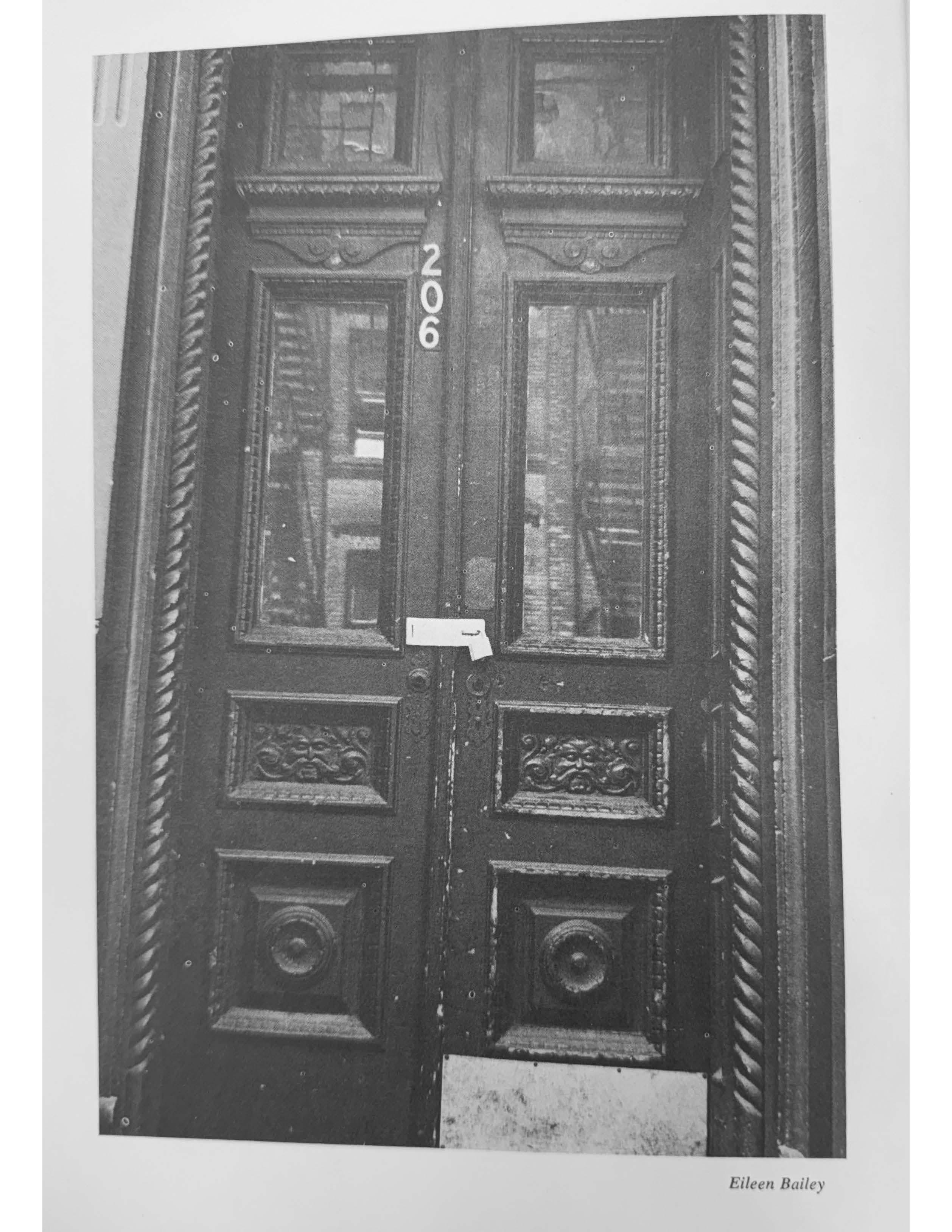
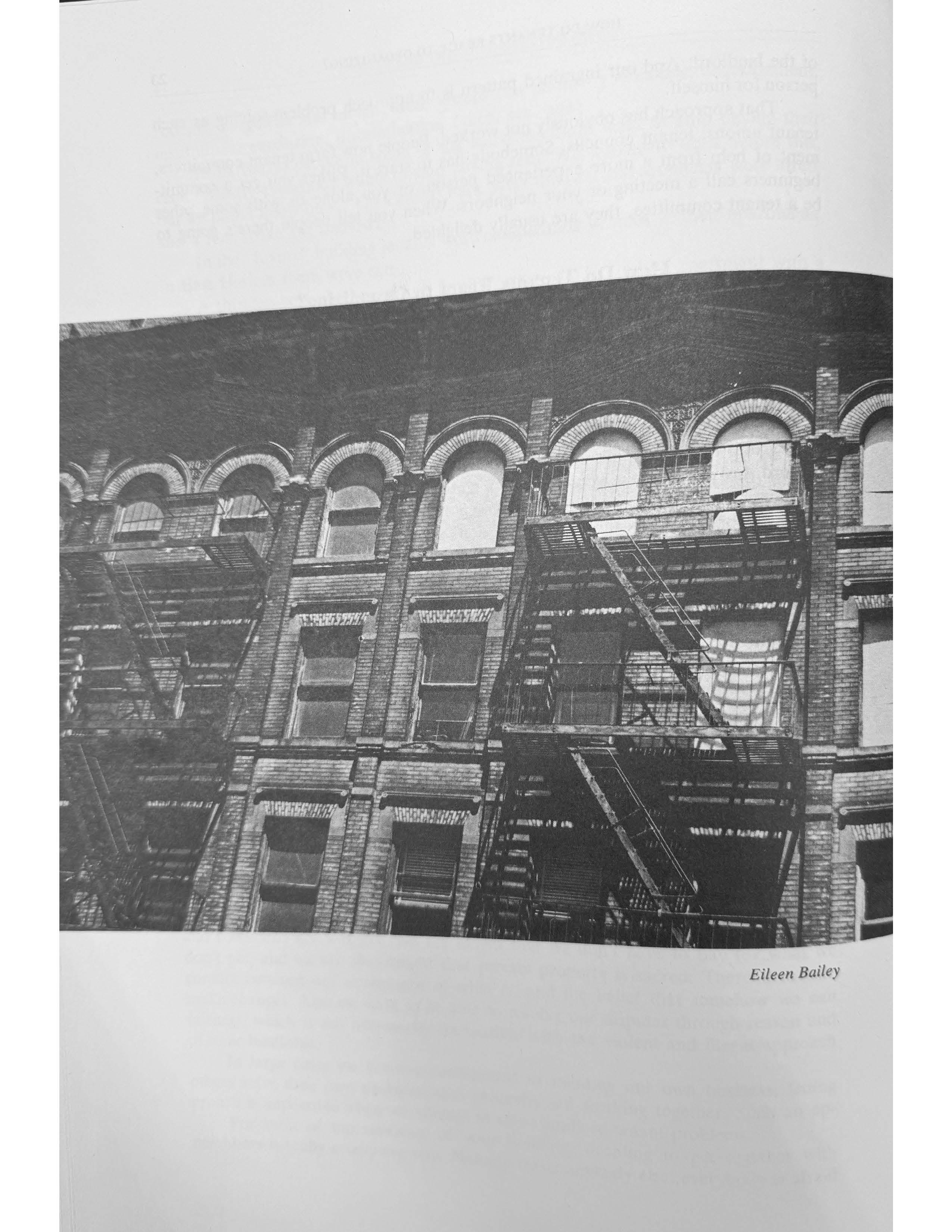
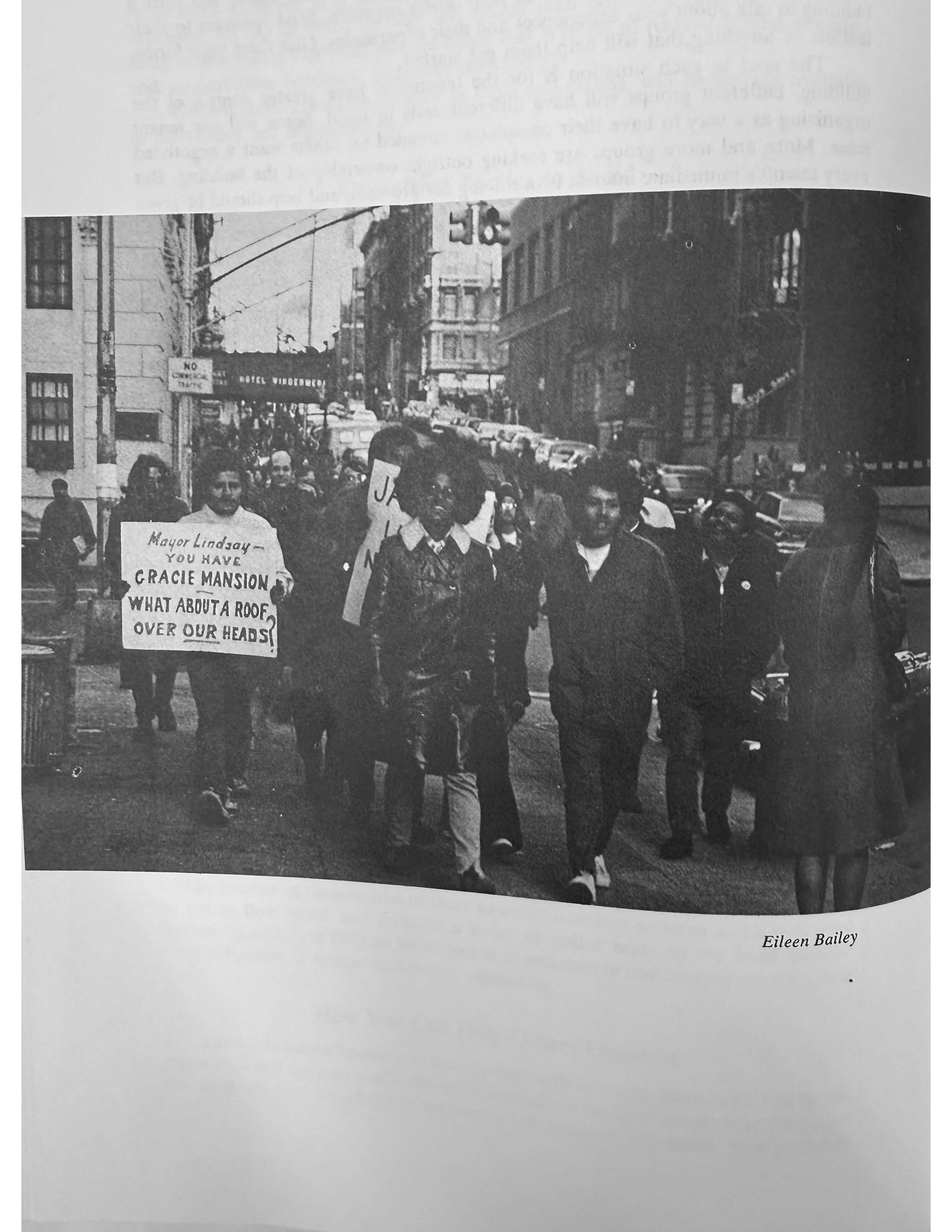
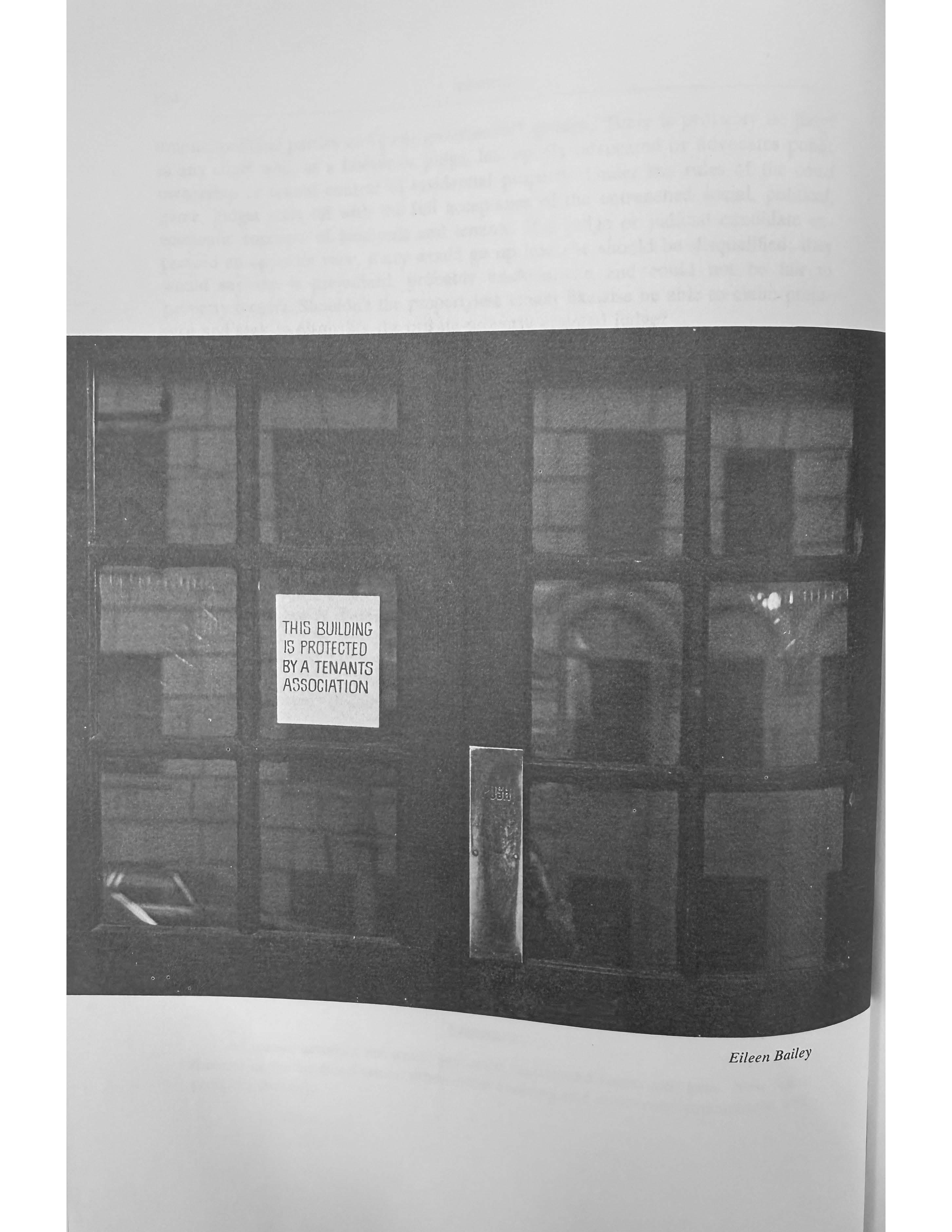
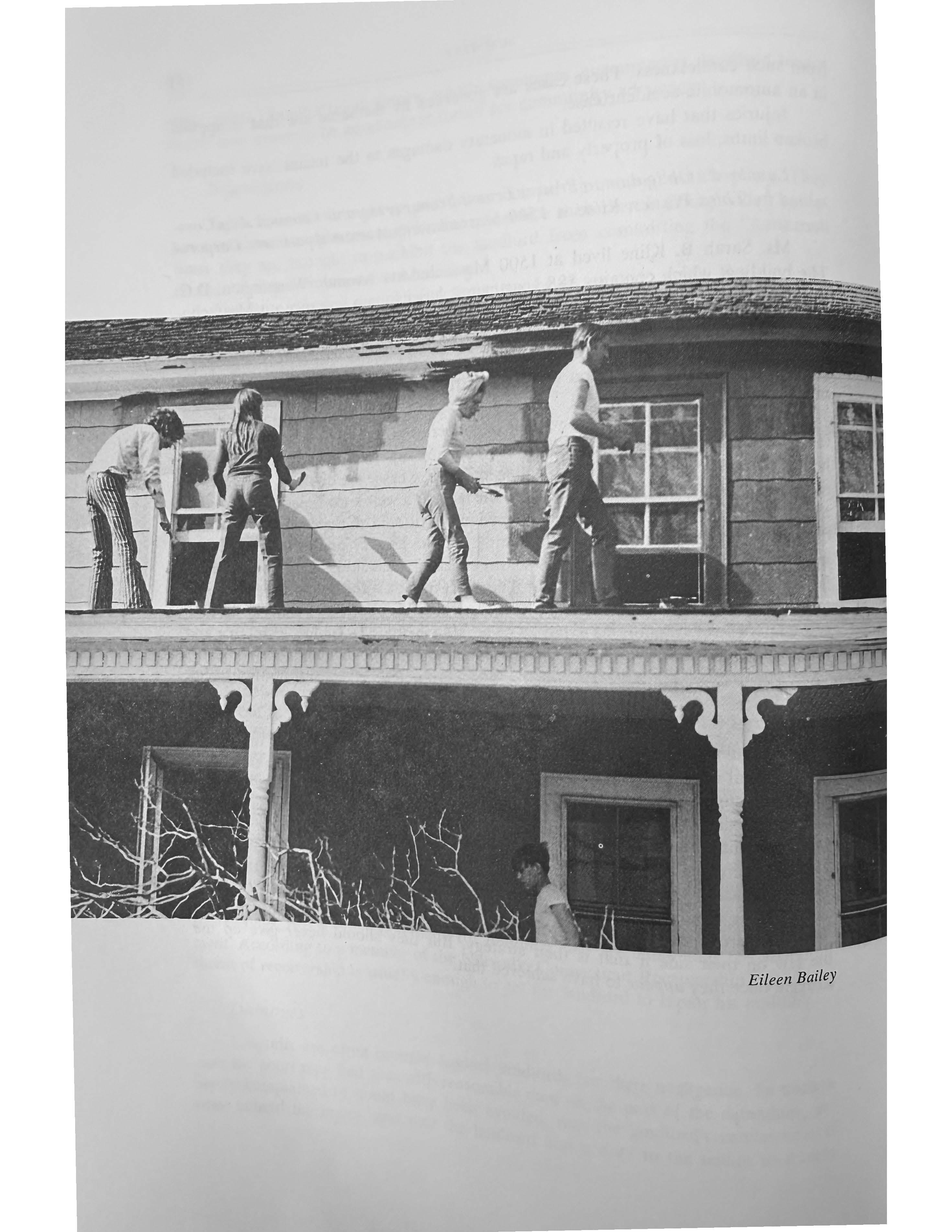
Eileen Bailey
HISTORY
"The need and social durability of adequate housing for people in this era of rapid population increases is too important to be rebuffed by that obnoxious legal cliche, caveat emptor."
PINES V. PERSSION
Modern American landlord-tenant relationships are descended from a feudal AngloSaxon agrarian system. That system may have been satisfactory in the 1400s, but it is unworkable in modern urban and rural areas. The feudal system was part of an agrarian economy in which tenants were tied to the land for life, and even generations, but is wholly irrelevant to our society. .
In feudal times the tenant was totally subservient to the landlord. Every aspect of life, from cradle to grave, was dominated absolutely by the landlord as master of his serf. It was not simply a case of one man owning property and another renting it from him. (Women, of course, were "incompetent" to hold real property.) The concept of landowner domination flourished in our own nation, where slavery was firmly established. We do not expect such a society to prevail today in America. Yet the landlord-tenant relationship, cutting across all class and economic lines, is still chained to history. Power and status are still defined by property holdings. In feudal times the lord of the manor allotted portions of his holdings to serfs and vassals. They were the peasants who worked the lord's land, raised the crops, cared for the property and in return earned a place where they could live and be
IDSTORY
protQCted. The relationship went far beyond that of landlord-tenant or employeremployee. The land was the backbone of economic, social and political life. In later times farmers were. still reliant upon cultivating the land of another. The growth of mercantilism and finance replaced a9rarianism, but the early industrial exploitation of cheap fabor did nothing to lessen the gap between landowner and tenant. We still have tenant farmers and, of course, migrant workers. •
Urban tenants, unlike tena~f farmers, dq not work directly for the landlord but work to pay the landlord his rent for possessipn of living space. Poor people in the slums of all towns a1:1d cities have long known the real-estate system as an el!-emy. The situation of the poor;• and_ now lfiat of the not so poor, is no more equitable than the landlord-tenant relationship was for their ~enant ancestors.
The American political philosophy is rooted in the fundamental concept of protecting private property rights whether real or personal, agricultural, industrial or manufacturing, and then balancing these groups' economic interests within a system of government. The comparison of landlord-tenant relationships to those of feudal times is not remote.
For three days a man in New Orleans wandered around hungry. He was indigent and apparently eligible for food stamps. These were denied, however, because of his housing conditions. "Unless you have a stove and a refrigerator, you won't be able to cook anyway."
The prevailing laws of landlord-tenant relations still reflect the feudal economy • of medieval Britain.
As has been the case throughout history, the landlord makes no promises to the tenant except possession of the apartment. In the 1400s any conveyance of property by an owner was treated as the same whether a sale or a rental. The important element was possession, passing from one to another. Once the landlord conveyed possession to the tenant he could wash his hands of the responsibilities and obligations.
The buyer took at his own risk and had to beware ( of the seller); so did the tenant. This rule of caveat emptor (buyer beware) prevailed as the chief principle of landlord-tenant relations. Both the buyer and the tenant were considered to have an "estate interest"-i.e., the interest was either permanent or for a specified period-the only significant difference between buyer and tenant being the time element. With the doctrine of caveat emptor applying, the tenant, like the buyer, took the premises "as is" and with no representation or expectations as to their habitability.
Recent efforts have been made in the consumer field to police the abuses of caveat emptor, but we are still confronted by dangerous and unwholesome products. There is public protest over the need for protection against the unsafe and poor quality of consumer products, sales misrepresentations, fraudulent advertising; there is no comparable concentrated effort to protect tenants as consumers of space for shelter. But tenants have not yet recognized themselves as consumers of living space and certainly the laws have not recognized tenants as-consumers. The centuries-old
and barely eroded laws relating to tenancy also carry over into the inaintenance and care of rented property. Historically tenants have had the burden of maintaining the land they lived on and tpe dwelling they occupied. There was total economic dependence upon the landlord. Landlor<ls today often refuse to maintain their property though maintenance theoretically is required of them. Moreover, state and city statutes and the appropriate courts do not in any meaningful way assist tenants in requiring the landlord to assume this obligation.
At common law the owner had no obligation other than to turn over the land upon renting it and not attempt to retake it or evict the tenant during a specified time. Agricultural tenancies contemplated use and possession of the land and not safe, adequate and habitable dwellings. If there was a house on the land, it was unimportant compared to the earth. What the tenant got was the absolute right of exclusive possession against all the world, including the landlord. From this right to possession grew the tenant's obligation to pay rent. And when the landlord demanded rent, it was payment for something sold and delivered.
At the end of the nineteenth century in the United States courts and state and city legislatures assigned to the landlord the affirmative duty of repairing the tenants' premises. But no adequate provision was made for enforcing this obligation. That is, residential tenants could not sue anyone in the event the landlord failed to make repairs. As the laws were construed, they gave the tenants_ no "standing" in court. In the paternalistic tradition of feudalism, slavery and white male supremacy, tenants were another g·roup of people who, in legal contemplation, were unable to protect themselves.
Throughout civilization the landlord has been free to do whatever he- liked with his land: he could convey it with any conditions he chose. Today there may be some ("too much," real estate says) intervention by government through zoning and legislation that affects the use of land, its development, air, light, space and other aesthetic and environmental factors. But competing property interests and financial factors are far more significant than human interests of shelter in the exercise of such town and city zoning powers and legislation. Moreover, these same real-estate interests are the first to seek zoning variances to" increase the value of their land. In those cases they use the government and don't complain about its interference.
In the apartment of' a famous concert pianist the roof was leaking. The tenant called the landlord. "The rain is coming in five inches from my concert piano." The landlord's solution: "Move the piano."
With a few statutory and judicial exceptions any present-day right to withhold rent is derived from the historical legal theory of eviction, or deprivation of possession or breach of quiet enjoyment. When the landlord actually interfered with the tenant's "quiet enjoyment," i.e., possession of the land, it constituted an eviction. As early as the fifteenth century, even if a landlord did not state, "I own this property and have the right to rent it," the fact that he did rent it implied the state~ent, i.e., there was an implied covenant of title. This meant that by the act of conveying his property to another the landlord represented that he actually owned it and that
there was no one with a superior claim who could interfere with the tenant's right of possession.
Thus, the tenap.t was expressly or implicitly guaranteed "quiet enjoyment." Without this he would be getting nothing and would have no remedy at law if he was thrown off the land.
Where there was no express covenant, the implied covenant of "quiet enjoyment" could sometimes be found by interpretation of the fact that the landlordtenant relationship apparently existed. This relationship would have to be breached by the landlord before the tenant could end his obligations. Again, "breach" did not mean failure of service, but loss of possession.
What the tenant then got was the express or implied right of possession. For this right and the fact of possession, the tenant owed rent. The obligation to pay rent ended if the landlord interfered with or terminated possession.
Through the :fifteenth, sixteenth and seventeenth centuries tenants had to show that their interest, i.e., possession, was actually disturbed, whereupon the landlordtenant relationship died, and with it the tenant's obligations.
Any abatement of rent grew from the landlord's actual interference with the tenant's· quiet enjoyment, or possession of the land. There was a failure of "consideration," i.e., the thing "bargained" for was not delivered. In other words, the reduction of or ceasing to pay rent flowed from the fact that there was nothing to pay rent for; the landlord had destroyed the tenant's possessory interest.
In order for the. withholding of rent to be justified, courts look for some sort of eviction. Unless the tenant has been physically and forever removed from the premises, legal fictions have sometimes been imposed.
When leases came into use, rent was made payable in advance. The lessee's obligation to pay rent was paramount to everything. If the land turned out to be unsuitable for the purpose for which it was rented, that was the tenant's problem. It still is.
The obligation to pay rent is rooted mthe land itself; possession is the controlling element in creating the tenant's rental debt for use of land. But as leases developed, rent payment was considered to arise from a contractual relationship. The principle of lease as contract, however, was never fully accepted and still is not, in terms of obligations to the tenant.
The contract view made the tenant's position worse; the judge could always say, "You had the opportunity to negotiate terms." Then, as now, courts agreed with that reasoning, overlooking the reality that residential tenants have no bargaining power, let alone power equal to that of the landlord, to "negotiate" a contract or lease.
Because lease contents have been completely controlled by real-estate interests they have not contained warranties of fitness. In this way they are unlike sales contracts, in which a warranty of suitability or fitness exists expressly or implicitly. In purchasing a single-family dwelling, the buyer receives a homebuilder's warranty; a tenant receives nothing except the privilege of paying rent.
In 1843 an English court said: "The principles of the common law do-not warrant [ finding an implied warranty of fitness] and though, in the case of a dwelling house for habitation, there is no apparent injustice in inferring a contract of this nature, if the same rule was applied to land taken for other purposes for building upon, or for cultivation, there would be no limit to the inconvenience which
would ensue." That is, unless the landlord had specifically said, "This property is fit for human habitation," a court would not find that habitability was part of the agreement. The English court conceded that there would be no harm in finding such an implied warranty, but it would be "inconvenient."
The failure of our courts and legal system to adjust to a changed society is the result of our society's determination to protect landlord property rights regardless of the equities and needs of the basic human right to decent shelter. Courts rely on ancient, obsolete rules and precedent as binding on them. They invoke these ritualistic myths, which maintain the status quo. In fact, our law, based on the concept of stare decisis, requires that judicial decisions follow and be based upon previous judicial decision as binding precedent.
Judging by our history it is apparent that the position of tenants has been and still is unequal and inequitable. Our heritage is in a feudal, medieval, agrarian philosophy, and its continuation is not out of ignorance, but as justification to protect real-property rights. Law in America has drawn upon historical roots to perpetuate a landlord-tenant system that has become intolerable and inequitable. What may have been responsive to an economy centuries ago is not responsive to our population. It becomes more devastating as the freedom of choice in the housing marketplace disappears. The harshness of this condition may appear softened by the distraction of consumer production, which q.oes not in fact change the quality of living. The availability of television sets, hairpieces, and clothing sometimes distracts from the abysmal quality of life.
It is one thing to draw from the experience of the past in relation to the present, but it is another thing to be governed by the past in solving the challenges of the present. Landlordism has no place in our society.
Ann Wilson, the mother of three grown children now living on their own, maintains a 350-dollar-a-month middle luxury apartment with an extra room so her children can visit. She advised the management of her apartment building that a niece would be staying with her for six months and to please add her name to the mailbox. The next day the landlord himself called and said, "No guests are permitted to stay with you." The tenant protested, saying it was her apartment and that he was invading her privacy. The landlord was adamant. "It's in your lease. No guests!"
Eileen Bailey
ECONOMICS
"Why did you shoot your grandmother?"
"She had three dollars in her pocket."
"You shot your grandmother for three dollars?"
"Three dollars here, three dollars there, it all adds up."
Profits and the Real-Estate System
Housing in the United States is not being provided by free enterprise or by the government. The government has defaulted in its obligations to provide people with housing; the real-estate industry is willing to come to the rescue but only if it is profitable and requires little of them. Profit through the renting of shelter is extracted at the expense of another person's life and human dignity. The "free-enterprise" system might work if there were equality of bargaining power and an 1:1,dequate supply of housing, i.e., if a free housing market existed.
The landlord complains that he's not making money. Does he mean he's not making any money? Or does he mean he's not making enough money? Does he mean he's not making enough money on rental income? Or does he mean he's exhausted his tax advantages? Does he mean that the building never yielded a profit? Or does he mean it no longer yields a profit?
Whatever his answer is, let's see his books. Will he-will they--open their books ·for inspection? Unlikely. (In New York under the new "Rent Control" law, which in effect abolishes rent control, landlords will begin opening their books in 1974; they need time to prepare, one would assume.)
ECONOMICS
What the real-estate people, the landowners, builders and mortgagees, want is risk-free, guaranteed iricome and profit. No businessman in a free enterprise system c;an expect this. In fact, it's what landlords ( especially those whose rental income is coming from welfare) accuse welfare recipients of: private landlords in New York City received 240 million dollars from welfare in 1969. When welfare allotments increase, they increase for the benefit of lafdlords. Fifteen percent of all New York private housing is supported by welfare.
Unlike other necessities that are ·offered by a few monopolistic sellers ( telephone, gas, electricity), real estate is not a public utility. There are no serious controls on what an owner can do to make his property more profitable. There is no ceiling on profit. The tenant is at the mercy, at the feet, of the man who, through inheritance or investment, owns the land, the roof, the walls.
. A real-estate investor's ·profit can arise from several sources. There may be profit from rental income ( operating profit). Profit can al:;o be realized on future disposition of the building after the market value has risen and far exceeds the original investment ( capital gain). The greatest landlord incentives and subsidies are to be found in the tax laws.
Tax
The only shelter the real-estate.system is interested in is "tax shelter."
The Constitution of the United States, Amendment XVI, provides that all persons shall pay a tax on income. In theory, the internal revenue laws contemplate a graduated tax. The application, however, is quite different.
Despite our "graduated income tax," which in theory taxes people according to their income, some of.America's wealthiest citizens pay no income tax. Law, accounting and investment firms have specialists counseling high-paying clients in tax avoidance. In spite of the tax theory, it is interesting to note that the laws contain opportunities for tax deduction, avoidance and deferral that are available to all (again, in theory) but useful only to those.with large incomes. The tax laws do not necessarily work to the· advantage of the middle-class family, the wage earner, the single person, or the tenant.
The tax privileges availaQle to real-estate investors, and not to their tenants, are part of our law. Availing one's self of the tax laws is completely legal. There is a fine line between tax avoidance and tax evasion. Evasion is simply not declaring or paying taxes. Avoidance is the same thing, but based on a complicated scheme whereby one's would-be taxable income evaporates into a legal and patriotic pile of "deductions," "depreciations," "exemptions."
Indiviqual taxpayers may be assessed at completely different rates from businesses or from one another. On a graduated scale, let us say a married person earning 100,000 dollars a year gross is in the 62 percent bracket, and another married person earning 10,000 dollars is in the 22 percent bracket. Often, however, the high-income person pays much less in taxes. It is quite possible for a secretary making 7,500 dollars a year to pay more in taxes than her employer, who is earning ten times more.
A surgeon states, "I made 100,000 dollars last year and gave none of it to the government." He adds: "I'm in oil [depletion allowances] •and I'm getting into housing [government subsidized and middle income] ."
Tax on What?
Income is derived f;om various sources. The total yields a gross figure that, when taken alone, should place one in a certain "tax bracket." Tl}e tax bracket determines what portion of each dollar of the gross must be paid in taxes. The smaller the bracket, the smaller the amount of tax one must pay out of each dollar.
But the gross is not used to determine the bracket. And it is not true that.the greater the income the greater the taxes.
Deducted from the gross figure are countless items. The more deductions you have, the less tax you pay, because the figure owed the government is a percentage of the net income: the gross figure minus all the deductions. The system is circular, be~ause you must have sufficient income from which to subtract deductions.
In the case of a business such as real estate the gross figure is not used as the basis for determining the tax bracket. The tax laws allow this gross figure to be reduced by countless business deductions. The more such deductions one shows, the less tax one pays ( dollars and percentage) on the gross figure. This is because the amount ( tax liability) owed to the government is based on the net figure, i.e., the gross reduced by all the business deductions.
To be able to even make use of tax deductions (beyond thirteen percent or fifteen hundred dollars) the taxpayer must be an itemizer. This means that for the person who takes a "standard deduction'' the maximum she can subtract is thirteen percent. The person with more significant income, investments, deductions, accounting advice can deduct enough to put his taxable income at zero.
Sources of income, as well as dollar amount, are, of course, greater for some people than for others; the same is true of deductions. Since he has greater tax options, the wealthy person's income can be reduced to poverty level. Due to deductions, someone with a high income can pay lower taxes than a low-income person.
Landlord's Tax Benefits
There are benefits related to the property where you reside that are available to your landlord but not to you as a tenant.
First, the building you live in is the landlord's business; for you expenditures are personal. You cannot deduct the cost of a major improvement such as a clotheswasher, but the landlord can deduct th~ cost of a laundry room installed in the basement as a major capital expenditure.
The landlord can invest and reinvest monies realized from your building, generating additional income, while you just keep on paying rent.
In addition to deductions for ordinary expenses of day-to-day operati9n of the building, the landlord is allowed deductions for interest paid on loans, including mortgages, as well as for "depreciation" of the property. The more sizable the debt, the greater the interest and the greater the tax savings. Of course, this is of greater value to the person able to secure large amounts of credit. This means that owning property provides collateral for obtaining loans that can be used for additional investments; and although it requires paying interest, tax relief is realizable by allowing such interest payments as deductions in arriving at taxable income.
At the same time that the landlord is making an improvement to the building (such as a new boiler), he may raise the rents to pay for _it, but he also gets a tax abatement for making major capital improvements.
ECONOMICS
In New York City it has been estimated that over a period of 12 years the city forgoes taxes roughly equal to 110 percent of the actual cost of the capital improvements made by the landlord. Under New York's "rent control" tenants must absorb increased maintenance costs ("pass-along") and pay another increase for landlord profit.
Depreciation
The biggest tax factor· is depreciation. Depreciation, under the law, was intended to encourage replacement of equipment, thereby circulating more money in the economy and generally encouraging investment and business activity. In fact, the depreciation allowance can exceed the landlord's cash investment. .
The "paper" expense called "depreciation" serves as a tax benefit and is in fact cash flow since it is included among the total ordinary business expenses allowed as deductions .from rent, in arriving at the property owner's "taxable income." It is the taxable income that determines the tax bracket. This same figure determines the owner's income-tax liability for the building.
The investor is allowed a deduction for the paper expense, depreciation, on the theory that the deduction is a recovery of the cost and of the actual value of ·the building, which is "declining" due to use. But the actual_ value of the land portion of the investment does not depreciate for tax purposes or in fact. In addition, the landlord pockets the rental income, putting little back in. This is known as "milking" the property. T~is in effect allows for tax-deduction ben~fits at ordinary tax rates, while permitting a tax-income benefit at capital gains rates.
The landlord thus saves income-tax money on the depreciation deduction. The tenant, however, is not allowed a deduction for the depreciation of her apartment. And her rent is increasing while the building is aging. The tenant has no reason to think that the increased rent is being put back into the building.
A deteriorating building may still be increasing in value in a rising market. In any case, when the landlord sells, taking his capital gain, it may be appreciably more than his initial investment, and the way real-estate accounting works, depreciation may be deducted as an expense, whereas in reality it is a bonus to the property owner. The landlord may defer tax payments by writing them off against income. When he does pay it's at the lower capital gain rate.
The lawyer for a major real-estate syndicate says, "We buy real estate for the depreciation. And for the eventual equity when we sell it off. Once it's written off, we can sell. Our clients are tax-free millionaires because of tax-depreciating real property which they own."
Assume the real-estate investor earns disposable cash income of a quarter of a million dollars from real estate and other sources before depreciation deduction. Let's say he appears only to be "breaking even." Further assuming that the depreciation is also a quarter of a million dollars, it will offset income and result in a zero tax liability. The same lawyer adds: "My clients take home a quarter million in cash, tax free, and they can look forward to disposing of their real-estate holdings at a handsome gain in the future. If a guy owns 20, 30 buildings, even if he's losing money, he's made it in the past, and he can sell for capital gains. That's a real luxury problem."
After one owner takes depreciation and sells, a new purchaser starts the cycle all over again. While a particular landlord may not be showing a tremendous profit
DEPRECIATION
on a given building, that building has paid its way over and over to previous landlords. The condition of the building is ~eclining, rents are being taken out of it and nothing goes back in. The same building may be depreciated countless times. The fact that the building is later sold and resold at a profit shows that the depreciation allowance is a pure fiction.
The National Commission on Urban Problems: The Federal Income Tax in Relation to Housing ( 1968) says: "Depreciation, in contrast with other expenses of operating real estate such as utilities, state and local property taxes and janitorial services, is a deduction for tax purposes but is not an out-of-pocket expense constituting an actual cash outflow from the operation. Consequently, depreciation deductions, and particularly those in excess of any current actual loss of the property's value, serve to provide a tax-exemption cover for cash flow which can be withdrawn by the investor without being subject to individual income tax. Cash flow of this type is far more attractive to the high-bracket investor than ordinary dividends or profits."
A person making money from a return on investment, rather than salary, is taxed at a lower rate than the wage earner. The purpose is to encourage investment of capital. Therefore only part of his profit is taxed. The untaxed portion is money in his pocket.
·The commission report contains proposals for using federal tax-depreciation rules to compel compliance with local housing codes: "Slum landlords make profits, these profits are in part due to the income-tax savings from depreciation allowance on the depreciable cost of the slum property. Tax depreciation is not closely in step with year-to-year falloff in resale value, and that tax depreciation may be claimed no matter how miserable the housing, no matter how rundown the property, and no matter how gross the operator's violation of local housing ordinances, has led to suggestions to use the federal tax system to help enforce the local housing code or support its purposes."
•
The commission's report, however, goes on to reject the idea of using tax benefits as a means of enforcing code compliance on the grounds of impracticability, and the assumption that the real-estate system ( of which they are a part) could circumvent the plan, anyhow. "If one examines proposals such as that involving some kind of certification by local housing officials to accompany the federal tax-return claim for depreciation, a few practical administrative realities first need to be taken into account. Under the conditions of inadequate enforcement implicitly assumed, the effectiveness of the proposal would appear to be not much greater than the willingness of local housing-code officials to deny federal tax certification. If housing-code violators can resist enforcement or avoid local fines or penalties, one might expect that they would be able to secure certification where substantial federal tax penalties were at stake. The shift of onus from local housing-code officials to the federal tax collector for code enforcement may be more apparent than real."
The commission compares owners of unsafe buildings to other types of criminals: "The analogy with illegal business may be instructive. Income from illegal business operations is taxable. The ordinary and necessary expenses of an illegal business are deductible unless contrary to an expressed federal or state policy or unless the deduction would amount to avoiding the consequences of violating the law. Certain types of payments associated with illegal business activities are not considered essential operating expenses and are thus not deductible: 'Protection'
payments, bribes, blackmail or extortion payments to avoid exposure, ,etc." (This has been somewhat modified by the Tax Reform Act under which certain of these payments may be deducted.)
In other words, according to the President's Commission, running a dangerous building is illegal in the sense of violating housing codes and is the same as running an illegal business.
Local Real-Estate Taxes
City and state real-estate taxes can go unpaid for several years without the government's taking legal action against the owner of the building. There may be or may not be a penalty for nonpayment, but if there is, it takes the form of a lowinterest loan. However, you the tenant have been paying the landlord rent, part of which was to go for taxes that h~ has not paid. T:\}en, while that money has been going right into the owner's pocket rather than to the city, and with little or none of Jt going back into the building, the tenants are stuck in an "abandoned" building if the landlord decides to skip the mortgage and tax payments. The building may be "liable,:' and not the landlord.
Even if your landlord has been paying his local taxes, they are deductible from his federal tax. However, the portion of your rent that he has used to pay the tax is not deducted from your personal income t;ax.
Banks, Interest, Financing
It is part of the American dream to own one's home. Most Americans, while passionately hating their landlords, may "secretly" hope that someday they, too, will have tenants of their own. It is the story of the couple, he a sanitation man and she a building janitor, who after 40 years were able to buy a small building in the East New York section of Brooklyn and soon announced: "We landlords have to stick together." (Though it should be remembered that we are not including owners of single-family dwellings in which they live, as landlords.) But people don't "own" their own homes for the most part. Most private homes are mortgaged. The legal title may vest in the "owner," but his interes,t is subordinate to that of the mortgagee. Individuals do not buy homes, they buy mortgages.
Never, never overlook the role of the bank in your housing problems. The image that they convey as your friendly local banker is a front. The venerable banking institutions have one function and that is making money.
Do not be taken in by their gimmickry. When they offer you a two-dollar alarm clock in exchange for being the depository of your savings, think about the real role they play in your life. Even if the government guarantees a loan or a mortgage, or even red\lces interest rates through subsidy, the real financing is banks and insurance companies.
The bank "built" your house, finances it and demands that your landlord get more from you so the bank can, in turn, get more.
"Weaving"
Ownership of buildings is woven through webs of individual ownership, partnerships, corporations. Banks want to do business with corporations. This is for the sake of avoiding usury laws. That is, it is illegal to lend money to individuals at
interest above a certain percentage. Corporations can be charged interest at a higher rate than individuals. For example, if the legal rate of interest is six percent, corporations can be charged, let us say, 16 or 20 percent. Twenty-four percent might become criminal 'usury. A corporation defaulting on the loan could not claim that the higher interest rate-e.g., 16 percent-is usurious and therefore is unenforceable.
Banks, therefore, given a choice, do not like to lend money to individuals. They tell the real-estate developer to form a "dummy" corporation, but still retain the property individually for tax-depreciation purposes. This is known as "weaving the property." Title is conveyed to a corporation; the next day the corporation transfers title back to the principal. This is one of the reasons it can be difficult to ascertain who actually owns a building.
In the case of multiple dwellings, the bank does not usually want to foreclose on a mortgage. This is not out of morality, but profit. The banks want to be in real estate, but behind the scenes, not as management. It is more lucrative and far easier to collect one monthly mortgage payment from the landlord than actually to be the "rent man" vis-a-vis the tenants.
Rarely is a building undermortgaged. The landlord usually has first and second mortgages outstanding on the same property.
The banks don't look at the tax aspect, the depreciation, but the rent roll and the landlord's return on investment. The bank asks, "If we foreclose and have to maintain the building, can we show a profit?" The fact that they may say, "No," does not mean the landlord made no profit, because he won tax advantages.
We have seen that under our country's tax laws advantages are available to the professional real-estate operator, or even the owner of one building, that are not offered apartment dwellers, such as deduction for interest on loans. The interest the mortgagor (landlord) gives the mortgagee (bank) is tax deductible, but the portion of your rent paid to the mortgagor in order for him to pay that interest is not deductible by you, even though you are in fact paying interest on a loan.
Landlords say: "The game is to invest as little as possible of your own money and as much as possible of the banks' or insurance companies'. You can get into a middle-income housing project for no cash at all, but just front money for architects, land, lawyers, etc., but you get that back in the mortgage. You get a 90 percent mortgage and float a bond for ten percent."
The corpora!ion gives the promissory note to the bank at the commercial rate of, let us say, 12 percent, which the bank could not legally get from an individual. The next day the property is woven back and recorded as being owned by the individual, subject to the mortgage, which is the security for the debt. In the event of a default, the bank does·not want to look to a dummy corporation, but apparently is willing to risk it for the higher interest rate.
The real-estate system is fond of financing and refinancing the same piece of property, taking mortgage after mortgage. Some of these inflated "balloon" mortgages allow low payments for perhaps five years and then suddenly the balance of the loan is due. This is the time when the landlord, having "milked" the building, taken rents, depreciation, and write-off, may walk away. The building then may be profitable even without a resale and capital gain.
If he does walk away, this is the point when no one wants the building. It may be offered to the tenants so they can get all of the burdens. Some tenants have been able to get financing and take over ownership of their buildings. Banks and real-
ECONOMICS
estate owners sometimes attempt to promote tenant takeover of abandoned buildings. What it really means is that tenants should "bail out property owners and mortgagees who are conferring on inexperienced tenants the dubious benefits of bearing the costs and burdens of management, maintenance and improvements." Naturally under such a scheme the tenants are left with buildings nobody else wants. There is great potential for these buildings to be taken over and run by the tenants .as true cooperatives. Unfortunately, the amount of government funding allotted to this type of rehabilitation project is very small. Some tenants have secured funds from foundations or other priv~te sources, but these are experimental and infrequent. In no case is the landlord's tax saving turned over to the tenants.to restore the building.
Interest rates on mortgages are determined by the broader financial picture in the country. War, then, is being paid for not only by your taxes, but by yqur rent.
Cities
In addition to cities' obvious acts in their various roles as slumlord and landlord, municipal administrations, like state governments, are adept at using finances and economics to the advantage of the campaign-contributing real-estate lobby and to the disadvantage of tenants.
New York realtors view "rent control" as their greatest enemy. Actually, New York's rents have not lagged under rent control because rents in the noncontrolled sector have risen astronomically. Rent control has never applied to buildings constructed after 194 7, and in those buildings built before there are so many exceptions that the number of "controlled" housing units decreases every year. As to units under "Rent Stabilization," this is simply a way of institutionalizing increases.
In addition to the state's "Vacancy Decontrol Law" of 1971, under which all apartments previously controlled or stabilized become decontrolled upon vacancy, all New York tenants who remain in their present "controlled" or "stabilized" apartments must look forward to continued rent.increases.
The New York City Council passed, with administration support, Local Law 30, under which all rent-controlled apartments (with a few very limited, short-lived and almost meaningless exceptions, such as one for a small group of elderly people) would receive increases varying in amount based on how many increases the apartment has had since 1953 (the last time there were across-the-board increases).
Following the increases in 1970, the law calls for the city to calculate a "fair rent" for each apartment now under rent control. This rent is to be known as the "Maximum Base Rent" (MBR) and is calculated with many crucial input factors (such as room count) coming from unaudited landlord-fed data. Under the law, "fair" is a rent sufficient to cover operation and maintenance, direct and indirect labor costs, real-estate taxes, sewer and water charges, an allowance for vacancies ( though virtually nonexistent), collection losses, and an eight and one-half percent return-not on assessed value, which is what the landlord is taxed on, but on equalized assessed value (E.A.V.). (The eight and one-half percent return was the interest on bonds during a brief period when, due to federal money policies, interest rates were at their highest level since the Civil War.)
Property is taxed on its assessed value, which in many cities is its actual market
value. New York, by contrast, currently assesses property for tax purposes at only 57 percent of its market value. To obtain the true market value, the assessed value is multiplied by 1. 73 ( or 173 percent), producing a figure 73 percent higher than assessed value. Thus, the E.A.V. multiplies an eight and one-half percent return by 1.73 and obtains a 14.3 percent return. The real value increases without the assessed value doing so. Real-estate men find the New York real-estate tax rate of five and one-half percent of assessed value outrageous, but their spokesmen claim that a 14.3 percent return on assessed value is still inadequate.
The question is often posed, "If a man can get eight percent on his money just buying bonds and sitting home, why should he take risks in real estate to get the same thing?"
The catch is that he's getting a 14 percent return, and it is not even on his money; it's on the assessed value of which only a small portion is his money. This is what is known as "leverage." The guaranteed profit is not on investment or equity (what the landlord actually owns), but on the assessed value. An example:
• A man buys a four-story eight-apartment brownstone house in Brooklyn for 50,000 dollars. He invests 8,000 dollars and gets a 25-year mortgage at six percent (interest.rates are now about seven percent, but in the early sixties they were five percent). Of the 42,000 dollars he has borrowed, he pays approximately 3,200 dollars per year in carrying charges (part of this is interest which is tax deductible, and part goes to building his equity in the building). Since the building is worth 50,000 dollars, it is assessed at slightly under 30,000 dollars and his costs for taxes, water and sewerage are about 1,700 dollars. His operating and main.tenance expenses, if he maintains the building properly, might be 4,300 dollars.
For an average building of the type described, the annual rent roll is approximately one-fifth (20 percent) of the market value of the building. Thus he receives 10,000 dollars (more than 100 dollars per month per apartment), pays 9,200 dollars and is left with 800 dollars.
This, the real-estate industry argues, is less than two percent return. However, on his investment of 8,000 dollars it is a ten percent return. Additionally, at the end of 25 years, those carrying charges will result in ownership of a building which with normal appreciation will be worth considerable more than 50,000 dollars. Under the new law his rent roll will be increased to provide him with a return of approximately 4,000 dollars ( 8 percent of 50,000 dollars). This means his rent roll will be 13,200 dollars (9,200 dollars plus 4,000 dollars). On the assessed value (used for taxes) of less than 30,000 dollars it is more than a 13 percent return. On his equity of 8,000 dollars this is a 50 percent return. Of course, he does not even have to pay taxes on all of the return since fictitious "charges" such as depreciation would allow a large portion of his return to go untaxed.
The New York City law increases rents ;•only" seven and one-half percent a year until MBR is reached. As we go to press it appears it will be at least this amount notwithstanding the fact that many wage increases are frozen at five and one-half percent. Cities without any form of rent control will temporarily have their rents frozen at two to three percent, while New York's are escalated seven and onehalf percent in the case of rent-controlled apartments, as much as 13 percent in the case of rent-stabilized units and an apparently indefinite amount in certain other units.
The process is unending. MBR is recalculated every two years, providing an
ECONOMICS
infinite upward spiral. A ceiling is set. When that ceiling is reached it can be raised again. Rents don't just go up for two or three years and then level off, because they are recalculated. The market value of the building will increase due to the increased rent roll provided by the law and the rents go up again. Property, even if reassessed, would still not be taxed at the same percentage at which profit is calculated.
The politics of the situation defeats tenant interests at every tum. Alan Bell, formerly a Senior Quantitative Analyst specializing in Statistics and Operations Research, who was hired by the city specifically to work on the rent control formula, was transferred out of the department and subsequently fired aft~r he was critical of some of the formula's input. Mr. Bell states that he was told by a senior administrator hired by the head of the Housing and Development Administration, "We don't need any in-house rabble-rousers representing tenant interests. We have implementation deadlines and we don't have time to worry about equity."
"The formula is the thing," says one housing expert, "but it does not take into account the many variables of location, neighborhood, size of rooms, exposures, age of appliances, closet space." Certainly they do not take into account the tenants'
•
0 The effect of the formula is to guarantee the landlord's profit. (In the event, however, that the owner is still not receiving his guaranteed profit, he may still apply for "hardship" increases.) As has been pointed out, few other businessmen get guaranteed profit. And those who do are often the leading critics of guaranteed income for the poor.
,
The effects of the law are not limited to individual tenant budgets, but the city welfare budget. At a time when inflation has greatly increased basic costs, and welfare benefits to people are being cut back (90 cents a day for food), the seven and one-half percent per year increases on estimated welfare rents of 240 million dollars represents landlord income of an additional 18 million welfare dollars annually. This results in 18 million dollars in year one, 36 more than the original figure the next year, and so on. If the current figure is 240 million, year one is 258 million, year two 277, representing in the first two years an additional outlay of 55 million dollars to the landlords.
As a dissident city official says, "Seven and one-half percent increased welfare, not because women are having babies, or guys are home drinking beer, but because the policy decision is to give it to the landlord."
Summary
When we talk about private housing it is a total misconception. The real-estate people cheerfully accept rents paid to them by welfare departments; they gladly accept federal mortgage guarantees,.tax abatements, zoning variances, and tax depreciation and deductions. Is there anything private about the building that is being subsidized by public tax money?
It is the businessman's appeal to free enterprise that is in fact a myth. If we accept the free-enterprise theory, then why should government and tenants be forced to guarantee landlords and banks a profit? Obviously housing is not a free-enterprise business and should not yield a profit to the real-estate system. Not at the price of human dignity.
LEASES
''The
Last Outpost of Feudalism"
Not everyone has a lease. All leases are not the same. All leases, however, share one characteristic: they are all one-sided. You should know what is in the "standard lease." Nonlawyers cannot (and should not have to) understand "legalese"-which is one of the reasons the real-estate industry uses it. In this chapter is a composite of standard lease forms, translated, clause by clause, into plain English. Many of the clauses here may be in your lease in one form or another. The translations are a guide to what you may have already signed or can be expected to sign in the future. Leases are often "liberally construed," meaning that the provisions can be interpreted somewhat less harshly than what the language actually means. State or city legislation and court interpretations can modify the clauses that actually appear in your lease. In addition, causes of action may exist that are simply not dealt with in the lease.
It is of the utmost importance that you know what your lease says. If there comes a time when the landlord attempts to enforce a provision against you, the lease is completely on his side. A lawyer in your city will be able to tell you how the provisions are actually executed and whether they are liberally construed. For example, when you sign your name to a paper waiving your right to a jury trial, how do judges in your state interpret the provision?
Agreements to rent real property can take one of three forms: oral, simple written agreements, or printed lease forms. Each type is popular in different localities and under certain circumstances. New York City apartments almost always have
leases (at least at the initial renting); Bay Area, California, apartments often do not. In most states oral leases are valid for short terms ( less than a year), though the agreement can be renewed at the end of each year. The tenant, however, cannot rely on a five-year oral lease. Written agreements that are not leases establish month-tomonth tenancies which are easily canceled by either party. In a month-to-month tenancy, each month you can receive notice that your rent is to be raised the next month.
The standard apartment lease is as one-sided as any document has eyer been. All of the burdens are on the tenant. The landlord need give only possession of the premises. The forms may differ from city to city but the substance is the same. Traditionally the tenant's obligation to pay rent is independent of the landlord's obligation to maintain tl).e building. Therefore, you pay regardless of what he does or doesn't do.
You may not realize what you are giving away when you sign the lease, but you probably don't have any choice. This is not wholly because of the housing famine. Even if there is no acute housing shortage and you have some choice of apartments, you are still not free, because when you find one, if you are given a written· lease, it will bear the same obnoxious terms as your present lease. Because the demand for housing exceeds the supply, tenants have no power. Without economic power, no group can have bargaining power. Economic power in this sense does not refer to how much money you have, but how much leverage.
In commercial and industrial leases where tl:ze parties have equal bargaining power, the lease frequently places the duty to repair on the landlord. It may also include the right to sue for breach of lease and collect damages, or for the tenant to make repairs and deduct the expense from rent.
The small family or neighborhood store is in almost the same position as the current residential tenants. Small shopkeepers have lost their economic bargaining power as massive landlord property ownership and monopolistic chain stores, banks and other big retailers have shut out the small entrepreneur.
The lease extracts from you a lot of promises, and guarantees the landlord the right to sit back and collect the rent. He can, like his feudal ancestor, literally live off the land. The terms are the same ones that have governed conveyances of real property for centuries. In 1906 a Mr. Menocin, lawyer for a landlord whose building was on strike, stated to a reporter for The New York Times, "They have a lease that gives them the right to breathe."
Legally it is doubtful whether the. standard lease constitutes a contract. However, tenants are caught in the worst of both worlds. You are bound by the terms of the "contract," but enjoy none of the legal benefits of a contract. This is because a contract requires a certain meeting of the minds, free of coercion or duress, with certain warranties, representation and exchanges being made. The landlord owns the building. Other landlords own other buildings. You have to live somewhere. It is a landlord's market. You have to sign a take-it-or-leave-it lease, if any. As long as you are dependent upon somebody else's property for your shelter, you are never free of coercion or duress. Whenever and wherever there is a housing shortage, tenants are at the landlord's mercy.
Do not be deceived by thinking that the lease is fair and just because of the endorsements it carries. The printed form may say "approved by the Chicago Real Estate Board" or "the Bar Association of the City of Springfield" or "Boston Prop-
erty Owners Association." These endorsements mean that the document has been approved by the professional real-estate people; it also gives the utmost protection to the landlord. These endorsements often convey to the tenant the erroneous impression that the association is objective and fair and that the lease is a document t protecting tenants and landlords alike.
The lease conforms to what our law requires a lease to be. It is often hard to f tell which came first: the law or the lease. It is the absence of tenant power that makes the standard leases so unconscionable.
However, most tenants do not even have leases. In some cities leases are rarely offered. When they are, the tenant sometimes feels it is disadvantageous to have a lease that will bind her to a longer term than she desires. Where a lease is in effect, the option to renew is usually the landlord's, and not the tenant's.
Perhaps more dangerous than the body of the lease are "riders." These are clauses that are added to the document and become a part of it. Riders relate to some point not covered in the form (the real-estate industry may not have thought of it at the time of printing or your landlord may be innovative). But never overlook riders when signing a lease. For example:
During the term of this lease the Tenant shall, in addition to the rent and any and all other rental increments and charges as herein provided, also pay, as further rent to the landlord, a pro rata percentage of any cost or expense incurred by the Landlord, not to exceed $5.00 per month, for any installations, improvements, additional equipment or otherwise, as the same may be required or otherwise, as the same may be required and done pursuant to governmental laws, ordinances, rules and regulations, with respect to air pollution, incinerators and/or oil burners."
TRANSLATION: If the landlord is polluting the air and is required to cease, you· must pay for any equipment he may be required to install. (And it's his tax deduction, not yours.)
It is rare that a leasi! gives the tenant any rights beyond possession. Some rights may be derived through municipal codes. The catch here is that there is little or no code enforcement and tenants may not be able to compel any. A 1938 court decision put it concisely: "The controversy is between the landlord and the public authorities." The same is true in criminal prosecutions against landlords. If a building condition exists which constitutes a criminal violation the tenant cannot simply prosecute as a citizen, b1;1t must count on state or city employees (including judges) deciding to do so for him. Tenants are in the position of slaves or children or incompetents, unable to exercise any rights on their own.
If you try to read the lease offered, you may be thoroughly confused. Even if you're not, chances are any modifications you request will be denied. The landlord or his agent will say, "Take it or leave it." Because you are relieved finally to have found an apartment, you think, "Oh, I'll sign this and work it out with my landlord later." Your only mistake is in thinking you'll work it out later. You really could not reject the lease, because people are probably lining up to take the apartment should you refuse.
However, if the tenants of the building had a tenant-negotiated contract, a negotiated lease or even a new standard lease ( or if buildings were tenant-owned and operated), the objectionable clauses in the present lease would be replaced by terms that are fair to the people living on the premises and not just to the owner. It
should be noted that a new standard lease is not the most desirable achievement, because it would merely represent the real-estate industry slightly reforming its own ways without meaningful change in the landlord-tenant relationship.
If you have occupancy under an oral agreement, and want to vacate the apartment, you will have to give written notice. Most states require 30 days or a full rent period.
Where there is a leas~ in effect, getting out of it will depend on what's written into it and how eager the 'landlord is to have his apartment back: If you are a New York City statutory tenant (you once had a lease and under rent control you still have the protection of that lease), you must give 30 days' written notice ( certified or registered mail) to cancel. If, in New York City, you are under a current lease, "rent-controlled" or "rent-stabilized," as a practical matter the landlord will probably be delighted to get rid of you so that he can raise the rent astronomically. Even though he's drooling for the vacant apartment, the owner will probably bargain with you as to what a proper "penalty" for vacating would be.
Under sublet or assignment clauses, you have to find a suitable replacement and also ge~ landlord approval, if that was the agreement. It is possible that, knowing you have tliis right, the landlord will release you so he can give the apartment to someone he wants.
Keep written records of your efforts to rent the apartment so you cannot later· be charged with breach of lease. That is, if the apartment remains vacant through the landlord's own doing, be prepared. to present evidence to that effect. • When you move into an apartment, take photos of the ·condition. Do the same when you move out, particularly if the landlord is holding a security or damage deposit.
Take It or Leave It?
Following are translations of clauses taken from various standard leases.
Landlord covenants and agrees with Tenant that upon Tenant paying said rent, and performing all the covenants and conditions aforesaid, on Tenant's part to be observed and performed, Tenant shall and may peaceably and quietly have, hold and enjoy the premises hereby demised, for the term aforesaid, subject, however, to the terms of the lease and of the ground leases, underlying leases and mortgages hereinbefore mentioned.
TRANSLATION: This is the landlord's only promise: If you pay your rent and keep all your promises, you may have possession of the apartment (subject to any superior interests).
As long as Tenant is not in default under any of the provisions of this lease Landlord covenants to furnish, insofar as the existing facilities provide, the following services: (a) elevator service; (b) hot and cold water in reasonable quantities at all times; (c) heat at reasonable hours during the cold seasons of the year. Interruption or curtailment of any such services shall not constitute a constructive or partial eviction nor, unless caused by the gross negligence of Landlord, entitle Tenant to any compensation to abatement of rent. Mechanical refrigeration equipment, if provided, is for the accommodation of Tenant and Landlord shall not be responsible for any failure of refrigeration or for leakage or damage caused by or as the result of such mechanical refrigeration or failure thereof for any reasons whatsoever.
TRANSLATION: If the tenant's rent is paid, and the tenant has lived up to all her obligations, the landlord promises to provide elevator service (if there's an ele-
vator); hot and cold water in "reasonable" quantities (if facilities exist); heat at reasonable hours during winter. However, failure to provide these services is excused ( unless the landlord has, for example, smashed the oil burner with an axe) and rent must be paid as usual. Refrigerators are, of course, a "luxury" and any failure in operation will not result in landlord liability. The landlord's failure does not relieve the tenant of her obligation to coQtinue paying rent.
The Apartment shall be occupied solely for residence purposes by Tenant, those other persons listed in the application for this Lease, and any children which may be born or legally adopted by Tenant during the Term. Neither Tenant nor any of these persons shall perform or permit any practice that may damage the reputation or otherwise be injurious to the Building or the neighborhood, or be disturbing to other tenants or increase the rate of insurance on the Building.
TRANSLATION: You cannot live here with anyone other than immediate family unless that person is named on the lease. The apartment may not be used for "illegal or immoral" purposes. Generally this has meant gambling and prostitution. (It has been the practice of some police departments to report to the landlord arrests of tenants, particularly on marijuana charges; such arrest has often led to the tenant's eviction. While this practice has been declared unconstitutional in some federal districts, it apparently continues with some frequency.)
Tenant shall pay owner all owner's costs, expenses and attorney's fees in and about the enforcement of covenants and agreements of this Lease.
TRANSLATION: Not only does the lease disregard all of your rights, but you agree to compensate the landlord for enforcing it against you. Although a judge would have to order you to pay before the landlord could enforce this clause, the tenant is afraid to tangle with the landlord. The first thing the landlord and his attorney point out is that the expense to you will be great. Whether or not court cos~ and attorneys' fees are imposed on tenants depends on state practice and the discretion of the court.
The term "Landlord" as used in this lease means only the owner or the mortgagee in possession for the time being of the land and building (or the owner of a lease of the building) of which the demised premises form a part so that in the event of any sale or sales of said land and building or of said lease, or in the event of a lease of said building, the said Landlord shall be and hereby is entirely freed and relieved of all covenants and obligations of Landlord hereunder, and it shall be deemed and construed without further agreement between the parties or their successors in interest, or between the parties and the purchaser, at any such sale, or the said lessee of the building, that the purchaser or the lessee of the building has assumed and agreed to carry out any and all covenants and obligations of Landlord hereunder. The words "reenter" and "reentry" as used in this lease are not restricted to their technical legal meaning.
TRANSLATION: "Landlord" means owner or mortgagee. If the landlord sells or• leases the property, he is relieved of all obligations under the lease and they are passed on to the new owner.
This lease and the obligation of Tenant to pay rent hereunder and perform all of the other covenants and agreements hereunder on part of Tenant to be performed shall in nowise be affected, impaired or excused because Landlord is unable to supply or is delayed in supplying
LEASES
any service expressly or impliedly to be supplied or is unable to make, or is delayed in making any repairs, additions, alterations or decorations or is unable to supply or is delaying in supplying any equipment or fixtures if Landlord is prevented or delayed from so doing by reasod of • governmental preemption in connection with the National Emergency declared by the President of the United States or in connection with any rule, order or regulation of any department or subdivision thereof of any governmental agency or by reason of the conditions of supply and demand which have been or are affected by the war.
TRANSLATION: Even though the landlord fails to perform any or all of his obligations under the lease, the tenant can never be excused from carrying out her obligations.
The covenants, conditions and agreements contained in this lease shall bind and inure to the benefit of Landlord and Tenant and their respective heirs, distributees, executors, administrators, successors, and, except as otherwise provided in this lease, their assigns.
TRANSLATION: Both parties enter into the agreement on behalf of themselves, those who succeed them upon death or incompetence, those to whom they assign, if assignment is permitted under this lease.
It is mutually agreed by and between Landlord and Tenant that the respective parties hereto shall and they hereby do waive trial by jury in any action, proceeding or counterclaim brought by either of the parties hereto against the other on any matters whatsoever arising out of or in any way connected with this lease, the Tenant's use or occupancy of said premises, and/ or any claim of injury or damage.
TRANSLATION: Despite constitutional guarantees, the tenant gives up the right to a jury trial.
Except as otherwise in this lease provided, a bill, statement, notice or communication, which Landlord may desire or be required to give to Tenant, including any notice of expiration, shall be deemed sufficiently given or rendered if, in writing, delivered to Tenant personally or sent by registered mail addressed to Tenant at the building of which the demised premises are a part or left at said premises addressed to Tenant, and the time of the rendition of such bill or statement and of the giving of such notice or communication shall be deemed io be the time when the same is delivered to Tenant, mailed, or left at the premises as herein provided. Any notice by Tenant to Landlord must be served by registered mail addressed to Landlord at the address where the last previous rental hereunder was paid.
TRANSLATION: Even if the law o{the state requires personal service, the landlord can, according to the lease, communicate with you by mail if he chooses. You must communicate by Registered Mail.
Tenant shall neither sublet the Apartment or any part thereof nor assign this Lease nor permit by any act of default of himself or any person any transfer of Tenant's interest by operation of law, nor offer the Apartment or any part thereof for lease or sublease without, in each case, the written consent of Owner. If Tenant vacates or abandons the Apartment, ten (10) days' nonoccupation being deemed an abandonment, or breaches any covenant or agree•ment in this Lease, Tenant's right to possession of the Apartment shall immediately terminate. The mere retention of possession thereafter by Tenant shall constitute a forcible detainer and if Owner so elects, but not otherwise, this Lease shall thereupon terminate, but this Lease shall automatically terminate without need of an election by Owner on any transfer of Tenant's interest by operation of law such as Tenant's bankruptcy or insolvency. In any such event the Apartment or any part of it may be relet by Owner for such rent and such terms and such period as Owner may elect without releasing Tenant from any liability under this Lease. On
such termination Tenant shall surrender possession of the Apartment immediately and Owner or Owner's agent shall have full and free license, with or without process of law, to enter and take possession of the Apartment and expel and remove Tenant or any other person who may , be occupying the Apartment and to repossess himself of the Apartment as of his former estate. Such entry by Owner or Owner's agent shall not constitute trespass or forcible entry and detainer and shall not cause a forfeiture of rents due by virtue thereof nor a waiver of Tenant's covenants or agreements in this Lease. Owner may let other vacancies in the Building first before reletting or attempting to relet the Apartment. Tenant shall on demand pay all other deficiencies if the rent on reletting is not sufficient to satisfy the rent provided in this Lease and in addition shall pay all expenses of reletting, including decorating, repairs, replacements and brokerage commissions at rates recommended by the Real Estate Board.
TRANSLATION: You cannot keep an apartment empty or sublet it without written consent. If you become bankrupt your lease is terminated; if your landlord becomes bankrupt, someone else may appear in his place, or he may just walk away and abandon the building. If you are the insolvent party, the landlord can, without using legal proceedings, use self-help to evict you. Of course, you would still be liable for the rent even if the landlord doesn't attempt to rerent. If the landlord retakes possession of the apartment by physically reentering, he is not guilty of trespass and_ you are still obligated under the lease. Furthermore, you will reimburse the landlord for any loss of rent and expenses in rerenting.
(a) Tenant's obligation to pay rent during the Term or any extension thereof or any holdover tenancy shall not be waived, released or terminated, nor shall the right and power to confess judgment be waived or terminated by the service of any five-day notice, demand for possession, notice of termination of tenancy, institution of any action of forcible detainer, ejectment or for any judgment for possession, or any other act or acts resulting in termination of Tenant's right of possession.
(
b) The payment or receipt of rent due shall not waive or affect any such notice, de' mand, suit or judgment or in any manner waive, affect, change, modify or alter Owner's rights or remedies.
(c) The acceptance of liquidated damages shall not be a waiver by Owner of the right of reentry nor shall any other act in the apparent affirmance of the tenancy at the termination of this Lease operate as a waiver of the right to terminate this Lease or operate as an extension thereof, nor shall the provisions affect Owner's right, at his election, to treat Tenant as a holdover tenant under the terms of this Lease.
(d) Tenant hereby waives any. and all notices, elections, demands and termination by or from Owner whether or not provided for by ·statute, except only if waiver is specifically prohibited by statute.
(e) The acceptance by Owner of rent after it falls due or after knowledge of any breach of this Lease by Tenant, or the giving of any notice or making of any demand or any other act or waiver by Owner other than a specific written waiver or election, shall not be construed as a waiver of any rights of Owner under this Lease or as an election not to proceed under provisions of this Lease.
(!) Owner's rights and remedies under this Lease are cumulative. The use of one or more thereof shall not exclude or waive any other right or remedy.
(g) Except only as otherwise specifically provided by statute, neither Owner nor Owner's agents shall be liable for damages to Tenant or to any persons claiming through Tenant (nor shall rent be abated) for damage to or loss of property wherever located from any cause whatever.
(h) Tenant's rights under this Lease and any extensions thereof shall be and are subordinated at all times to any present or future mortgages on the real estate (or any part of it) on which the Building is situated and to all advances upon the security of such mortgages. Tenant shall execute any further instruments required by Owner to effect such subordination and hereby irrevocably appoints Owner (and, if more than one person's name appears as
LEASES
Owner, any one of them) as attorney-in-fact to execute and deliver such instruments in Tenant's name.
TRANSLATION: (a) You are always obligated to pay rent, no matter what. If you don't, the landlord maintains the right to appoint an attorney to represent you, which attorney would in effect be working for the landlord, and therefore have a certain conflict of interests.
(b) Even if you pay the money, the landlord doesn't ha~e to abandon his eviction suit.
(
c) If you breach the lease, the landlord can elect •to sue you or evict you or both.
(d) Unless waivers are specifically prohibited by statutes, you relinquish your right to be informed of anything affecting your tenancy. You give up your right to know anything ..
(e) Same as (b) above.
(f) If the landlord successfully sues you for the rent allegedly owed him, his next step may be to sue to evict you.
(g) The landlord is not liable to the tenant or guests of the tenant for damaged or lost property. If the landlord's refusal to keep the front door locked results in the theft of your property, it's your problem. .
(
h) If there is a mortgage foreclosure or the landlord becomes insolvent, you agree that mortgage payments come before repairs. Again you appoint the landlord as your legal representative.
To pay (in addition to the rents above specified) all water taxes and gas bills, levied or charged on said demised premises, for and during the time for which this lease is granted and in case no water taxes are levied specifically upon said premises, to pay the---part of all water taxes levied or charged upon the building in which said demised premises are situated; and in case said water taxes and gas bills shall not be paid when due, the lessor shall have' the right to pay the same, which amount so paid, together with any sums paid by the lessor to keep said premises and their appurtenances in good condition as hereinbefore specified, shall be due and payable with the next installment of rent due thereafter under this lease.
TRANSLATION: The tenant agrees to pay for ~ater and gas whether as taxes or utility bills. (These taxes are deductible for property owners, but not for tenants.)
Owner shall furnish to and for the use of Tenant, in fixtures provided for such purpose by Owner and no other fixtures, hot and cold water during the Term and, in radiators or other heating fixtures in the Apartment, a reasonable amount of heat at reasonable hours from September 15 to June 1, as required by the applicable Municipal Code, except when prevented by causes beyond the control or prevention of Owner, or except during the repair of the apparatus provided in the Building for the furnishing of water and heat.
TRANSLATION: The landlord must provide heat and water except if there are conditions beyond his control or when equipment is being repaired.
If Tenant shall default in the performance of any covenant on Tenant's part to be performed by virtue of any provision in any article in this lease contained, Landlord may immediately, or at any time thereafter, without notice, perform the same for the account of Tenant. If Landlord at any time is compelled to pay or elects to pay any sum of_ money, or do any act which will require the payment of any sum of money by reason of the failure of Tenant to comply with any provision hereof, or, if Landlord is compelled to incur any expense including reasonable attorney's fees in instituting, prosecuting and/or defending any action or
proceeding instituted by reason of any default of Tenant hereunder, the sum or sums so paid by Landlord with all interest, costs and damages, shall be deemed to be additional rent hereunder and shall be due from Tenant to Landlord on the first day of ·the month following the incurring of such respective expenses.
TRANSLATION: If the landlord incurs any expense because of the alleged failure of the tenant to keep her promises, the landlord may bill these expenses to the tenant. If landlord' incurs attorney's fees, they, along with interest, costs and damages, will be added to the tenant's due rent on the first of the following month.
In case of any such default, reentry, expiration and/or dispossess by summary proceedings or otherwise, (a) the rent shall become due thereupon and be paid up to the time of such reentry, dispossess and/or expiration, together with such expenses as Landlord may incur for legal expenses, attorneys' fees, brokerage and/or putting the demised premises in good order, or for preparing the same for rerental; (b) Landlord may relet the premises or any part or parts thereof, either in the name of Landlord or otherwise, for a term or terms which may at Landlord's option be less than or exceed the period which would otherwise have constituted the balance of the term of this lease and may grant c9ncessions or free rent; and/or (c) Tenant or the legal representatives of Tenant shall also pay Landlord as liquidated damages for the failure of Tenant to observe and perform said Tenant's covenants herein contained, any deficiency between the rent hereby reserved and/ or covena~ted to be paid and the net amount, if any of the rents collected on account of the lease or leases of the demised premises for each month of the period which would otherwise have constituted the balance of the term of this lease. In computing such liquidated damages there shall be added to the said deficiency such expenses as Landlord may incur in connection with reletting such as legal expenses, attorneys' fees, brokerage and for keeping the demised premises in good order or for preparing the same for reletting. Any such liquidated damages shall be paid in monthly installments by Tenant on the rent day specified in this lease and any suit brought to collect the amount of the deficiency for any month shall not prejudice in any way the rights of Landlord to collect the deficiency for any subsequent month by a similar proceeding. Landlord at Landlord's option may make such alteration and/or decorations in the demised premises as Landlord in Landlord's sole judgment considers advisable and necessary for the purpose of reletting the demised premises; and the making of such alterations and/or decorations shall not operate or be construed to release Tenant from liability hereunder as aforesaid. Landlord shall in no event be liable in any way whatsoever for failure to relet the demised premises, or in the event that the demised premises are relet for failure to collect the rent thereof under such reletting. In the event of a breach or threatened breach by Tenant of any of the covenants or provisions hereof, Landlord shall have the right of injunction and the right to invoke any remedy allowed at law or in equity as if reentry, summary proceedings and other remedies were not herein provided for. Mention in this lease of any particular remedy shall not preclude Landlord from any other remedy, in law or equity. Tenant hereby expressly waives any and all rights of redemption granted by or under any present or future laws in the event of Tenant being evicted or dispossessed for any cause, or in the event of Landlord obtaining possession of demised premises, by reason of the violation by Tenant of any of the covenants and conditions of this lease or otherwise.
TRANSLATION: If the landlord notifies you that you have breached your lease, or if he institutes court proceedings against you, your rent up to that moment becomes due along with landlord's legal expenses, his costs for fixing up the apartment for the next tenant, advertising the vacancy, etc. Landlord may then rerent the apartment. You may then be sued for any loss of rent the landlord suffers if he receives less rent than you would have paid ( even if he willfully holds the apartment instead of rerenting it) . Ev~n if he remodels the apartment, you are still liable. The landlord can also sue you to prevent a future breach. You expressly waive your right to recover the apartment if the landlord gains possession of it through lawsuit or your breach.
Tenant shall permit Landlord to erect, use and maintain pipes and conduits in and through the demised premises. 4ndlord or Landlord's agents shall have the right to enter the demised premises during reasonable hours, to examine the same, and to show them to prospective purchasers or lessees of the building, and to make such decorations, repairs, alterations, improvements or additions as Landlord may deem necessary or desirable, and Landlord shall be allowed to take all material into and upon said premises that may be required therefor without the same constituting an eviction in whole or in part and the rent reserved shall in nowise abate while said decorations, repairs, alterations, improvement or additions are being made, because of the prosecution of any such work, or otherwise. For a period of seven months prior to the termination of this lease, Landlord shall have the right, during reasonable hours, to enter said premises for the purpose of exhibiting the same to persons desiring to rent or buy the same. If, during the last month of the term, Tenant shall have removed all or substantially all of Tenant's property therefrom, Landlord may immediately enter and alter, renovate and redecorate the demised premises, without elimination or abatement of rent, or other compensation, and such acts shall have no effect upon this lease. If Tenant shall not be personally present to open and permit an entry into said premises, at any time, when for any reason an entry therein shall be necessary or permissible hereunder, Landlord or Landlord's agents may enter the same by a master key, or may forcibly enter the same, without rendering Landlord or such agents liable therefor (if during such entry Landlord or Landlord's agents shall accord reasonable care to Tenant's property), and without in any manner affecting the obligations and covenants of this lease.
TRANSLATION: Your landlord is claiming through the lease a right to enter your apartment, to look around, to do work (probably not the work you've been requesting he do) and to be a nuisance. Further, if your lease runs, for example, from January 1972 through December 1972, the landlord is claiming that starting June 1 he has a right to enter your apartment to show it to other tenants who may succeed you. If in the first week of December you move most of your things out to a new apartment, the landlord can completely take over your apartment as if you had an 11-month lease, but you must pay for 12 months. Incidentally, the landlord and his agents can, under this lease, enter in your absence with or without your permission.
Or in the alternative:
Owner, Owner's agents and any other person authorized by the same shall at any time have the right of free access during the Term to exhibit the Apartment for rent and to affix "For Rent" signs in such places as Owner or Owner's agent shall determine, all without interference of any kind and regardless of consent by Tenant or others. Tenant shall pay Owner one ( 1) month's rent as liquidated damages for each interference with the rights set forth in this paragraph.
TRANSLATION: For 90 days-three months-before your lease expires your landlord can enter your apartment at any time to show the apartment to prospective tenants; and if he rents it, he claims under this clause the right to alter your apartment while you're still in it, to suit the new tenant.
Furthermore, the owner claims you owe him one month's rent every time you slam the door in his face.
Tenant shall reimburse Landlord as additional rent for all expenses, da1t1ages or fines incurred or suffered by Landlord by reason of any breach, violation or nonperformance by Tenant, or Tenant's family, servants, employees, agents, visitors or licensees of any covenant or provision of this lease, or by reasons of damage to persons or property caused by moving property in and/ or out of the building or by the installation or removal of furniture or other
property of or for Tenant, or by reason of or arising out of the occupancy or use by Tenant of demised premises or of the Building of which demised premises form a part or any part of either thereof, or from any other cause due to the carelessness, negligence or improper conduct of the Tenant, of the Tenant's family, servants, employees, agents, visitors or licensees. Tenant shall give immediate notice to Landlord in case of fire or accidents to or defects in any fixtures or equipment of the building.
TRANSLATION: If you or anyone you know causes damage to the property intentionally or otherwise, the landlord can add charges to your rent. Naturally you still cannot make deductions from the rent for similar acts by the landlord or anyone he may invite in. Also you must give notice to the landlord of any problem, but again the lease does not specify what, if anything, he must do about them.
If Tenant shall make default in fulfilling any of the covenants of this lease other than the covenants for .the payment of rent or additional rent, or if the demised premises become vacant or deserted, Landlord may give Tenant three days' notice of intention to end the term of this lease and thereupon, at the expiration of said three days (if said default continues to exist) the term under this lease shall expire as fully and completely as if that day were the day herein definitely fixed for the expiration of the term, and Tenant will then quit and surrender the demised premises to Landlord but Tenant shall remain liable as hereinafter provided; or if Landlord or Land.lord's agents shall deem objectionable or improper any conduct on the part of Tenant or occupants, or visi_tors or licensees, or shall deem Tenant or occupants, or visitors or licensees objectionable, Landlord may in like manner give to Tenant three days' notice of intention to end the term of this lease and tender therewith or offer to tender the rent paid on accoµnt of the unexpired, term, and thereupon at the expiration of said three days the term under this lease shall expire as fully and completely as if that day were the day herein definitely fixed for the expiration of the term, and Tenant will then quit and surrender the demised premises to Landlord.
•
TRANSLATION: If Tenant breaches any promises (of course the landlord has made only one promise: possession) apart from payment of rent, the landlord may tell you that in three days your lease is terminated. He may do the same if he or any of his "agents" disapproves of the conduct of you or any person who visits you.
If the notice provided for herein to terminate for breach of Tellant's Covenants hereunder, or if Tenant shall make default in the payment of rent or if any execution or attachment shall be issued against Tenant or any of Tenant's property whereupon the demised premises shall be taken or occupied or attempted to be taken or occupied by someone other than Tenant or if Tenant shall make default with respect to any other leases between Landlord and Tenant; or if Tenant shall fail to move into or take possession of the premises within fifteen days after commencement of the term of this lease of which fact Landlord shall be the sole judge; then and in any of such events Landlord may without notice reenter the demised premises, either by force or otherwise, and dispossess Tenant by summary proceedings or otherwise, and the legal representative of Tenant or other occupant of demised premises, and remove their effects and hold the premises as if this lease had not been made, and Tenant hereby waives the service of notice of intention to reenter or to institute legal proceedings to that end. If Tenant shall make default hereunder prior to the date fixed as the commencement of any renewal or extension of this lease, Landlord may cancel and terminate such renewal or extension agreement by written notice.
TRANSLATION: The landlord may without notice, through court proceedings or by force, enter "your" home and legally and physically evict you if: the tenant has been notified of the landlord's intent to consider the lease breached by the tenant following a three-day notice; there has been a default in rent; there is a lien against
tenant or her property; the landlord decides in the first two weeks of the lease that the tenant isn't really living in the apartment.
Tenant and Tenant's family, servants, employees, agents, visitors, and licensees shall observe faithfully and comply strictly with the Rules and Regulations set forth on back of this lease, and such other and further reasonable Rules and Regulations as Landlord or Landlord's agents may from time to time adopt. Notice of any additional rules or regulations shall be given in such manner as Landlord may elect. In case Tenant disputes the reasonableness of any Rule or Regulation hereafter made or adopted by Landlord or Landlord's agents, the parties hereto agree to submit the question of the reasonableness of such Rule or Regulation for arbitration to the Chairman for the time being of the Board of Directors of the Management Division of the Real Estate Board or to such person or persons as he may designate, whose determination shall be final and conclusive upon the parties hereto. No dispute of the reasonableness of any rule or regulation shall be deemed a compliance upon Tenant's part with the foregoing provisions of this article unless the same shall have been raised by service of a notice in writing upon Landlord within ten days after the adoption of any such rule or regulation. Landlord shall not be liable to Tenant for violation of any of said Rules and Regulations, or the breach of any covenant or condition in any lease, by any other tenant in the building.
TRANSLATION: As if it isn't enough that you are signing the lease, you also promise that you and everyone you know will comply with the rules and regulations printed below your signature and those which don't appear anywhere. You also agree to be bound by any other rules and regulations which the landlord may impose an~ of which he will advise you in any way he decides. Furthermore, you agree to submit any question to the local real-estate board for a decision that you agree in advance to comply with. Although you have no idea of how you would even be informed that a rule exists, you agree to file any protest by service of your written complaint upon the landlord within ten days after it comes into existence-not ten days after you learn of it. The last sentence probably means that the landlord is not responsible for any other tenants, but if read carefully (i.e., as a landlord would), it may simply say, "Landlord shall not be Hable to Tenant for violation of any of said Rules and Regulations."
Landlord or Landlord's agents shall not be liable for any damage to property entrusted to employees of the building, nor for the loss of any property by theft or otherwise. Landlord or Landlord's agents shall not be liable for any injury or damage to persons or property resulting from falling plaster, steam, gas, electricity, water, rain or snow which may leak from any part of said building or from the pipes, appliances or plumbing works of the same or from the street or subsurf~ce or from any other place or by dampness or any other cause of whatsoever nature, unless caused by or due to the negligence of Landlord, Landlord's agents, servants or employees.
TRANSLATION: If any of the above happens to you, your lease specifically releases your landlord from liability growing out of the fact that he rented you the apartment. You would have to bring a lawsuit and prove that that occurrence was caused by the landlord's negligence and would put the same type of burden on you as if you were the plaintiff in a case evolving out of an automobile accident.
If the demised premises shall be partially damaged by fire or other cause without the fault or neglect of Tenant, Tenant's servants, employees, agents, visitors or licensees, the damages shall be repaired by and at the expense of Landlord, and the rent until such repairs shall be made shall be apportioned according to the part of the demised premises which is usable by Tenant. No penalty shall accrue for reasonable delay which may arise by reasons
of adjustment of fire insurance on the part of Landlord and/or Tenant, and for reasonable delay on acc;ount of "labor troubles," or any other cause beyond Landlord's control. But if the demised premises are totally damaged or are rendered wholly untenantable by fire or other cause, and Landlord shall decide not to rebuild the same, or if the building shall be so damaged that Landlord shall decide to demolish it or to rebuild it, then or in any of ~uch events Landlord may, within ninety (90) days after such fire or other cause, give Tenant a notice in writing of such decision, which notice shall be given as in Article 25 hereof provided, and thereupon the term of this lease shall expire by lapse of time upon the third day after such notice is given, and Tenant shall vacate the demised premises and surrender the same to Landlord.
TRANSLATION: If a fire occurs that is not caused by the tenant or those for whom the tenant is responsible, the landlord must make repairs at his own expense. No rent is to be charged for any portion of the premises that is unusable. This is constructive eviction. Depending on how eager the landlord is to harass the tenant, he may take his time with this. Also if the landlord decides not to restore the building after the fire, the tenant, of course, is out.
If the whole or any part of demised, premises shall be taken or condemned by any competent authority for any public or quasi public use or purpose, then, and in that event, the term of this lease shall cease and terminate from the date when the possession of the part so taken shall be required for such use or purpose, and without apportionment of the award. The current rental, however, shall in any case be apportioned.
TRANSLATION: This is eminent domain and provides for the property owner to be reimbursed for loss of his property. No compensation is given to the tenant for loss of her home ( though relocation may be required).
If at any time any windows of the demised premises become closed or darkened, for any reasons what~ver, Landlord shall not be liable for any damage that Tenant may sustain thereby and Tenant shall not be entitled to any compensation or abatement rent or release from any of the obligations of Tenant hereunder because of such closing or darkening.
TRANSLATION: Based on this clause, you have no right to windows, air, light or a relief from rent in their absence.
There shall be no allowance to Tenant for a diminution of rental value, and no liability on the part of Landlord by reason of inconvenience, or annoyance arising from the asking of any repairs, alterations, additions or improvements in or to any portion of the building or demised premises, or in or to fixtures, appurtenances or equipment, and no liability upon Landlord for failure to make any repairs, alterations, add{tions, or improvements in or to any portion of the building or demised premises, or in or to fixtures, appurtenances or equipment.
TRANSLATION: The tenant cannot reduce her rent to compensate for the harm she suffers from the landlord's method of making repairs, or upon the landlord's failure (or refusal) to make repairs to the apartment, the building, or anything included in it, such as stove, toilet or air conditioner.
This Lease is subject and subordinate to all ground or underlying leases and mortgages which may now or hereafter affect the real property, of which demised premises form a part, and to all renewals, modifications, consolidations, replacements and extension thereof. In confirmation of such subordination, Tenant shall execute promptly any certificate that Landlord may request. Tenant hereby constitutes and appoints Landlord the Tenant's attorney in fact to execute any such certificate or certificates for and on behalf of Tenant.
LEASES
TRANSLATION: The tenant agrees that, if ther¢ is a prior lease on the land itself or if there is a mortgage, the holders of those documents have better rights than the tenant has. Moreover, the tenant gives the landlord the right to stipulate on her behalf that her claims are subordinate to certain other interests, and to represent her.
Tenant has examined the Apartment and acknowledges that except for the work Owner has agreed to do in the application or otherwise in writing, Tenant is satisfied with the present physical condition of the Apartment and that neither Owner nor Owner's agent have made any representations or promises concerning the physical condition except those specifically set forth in this Lease. Upon reasonable notice from Tenant, Owner shall keep in repair the following property (except if repair is necessitated by Tenant's negligence or willful acts): (a) if furnished by Owner, the refrigerator, stove, air conditioning units and dishwasher; (b) the plumbing and electrical pipes, wiring and related facilities; and (c) the floor, interior and exterior walls, supports, ceiling and roof. The failure to keep any of the foregoing in repair shalf not affect the obligation of Tenant to pay rent, and Tenant's sole remedy therefor shall be recovery of damages from Owner. In the event any repair or replacement is necessitated by negligence or willful act of Tenant, Tenant shall on demand reimburse Owner for the cost thereof. Tenant shall comply with all responsibilities imposed on tenants by the applicable Municipal Code and other regulations. Tenant shall not suffer or commit any waste in and about the Apartment or the Building and shall at Tenant's expense keep the Apartment in good order and repair (except to the extent Owner has in this Lease agreed to make repairs). On termination of the Lease Tenant shall return the Apartment to Owner in like condition, reasonable wear excepted. If Tenant fails to keep the Apartment in such condition and repair, Owner or Owner's agent may enter and put the-Apartment in good condition and repair. On demand Tenant shall pay Owner the cost of such work. '
TRANSLATION: IF IT'S NOT IN WRITING, FORGET IT. This type of clause is one of the most dangerous to tenants. If the landlord says: "Oh, don't worry, I'll have the apartment painted for you, and you can even choose the 'colors!" but doesn't put it in the lease, he can always point to the clause above and say: ( 1) "I didn't promise colors"; (2) "I didn't even promise to paint"; (3) "You even agreed that no promises were made."
Courts have upheld this agreement by the Jandlords, so don't ever rely on his oral word. If he says he's going to do something but is \lnwilling to put it in writing, there must be a reason. And that reason probably is that he has no intention of doing what he said and probably never had. Also he's familiar with the lease and with the protection the law gives him. The law and the lease were written by and for him.
Since the landlord has never really promised to do anything, according to the lease, once he fails to provide services, that does not relieve you of your promise to pay the rent.
Tenant has deposited with Owner the security deposit set forth above for the performance of each and every covenant and agreement of this Lease. Owner shall have the right, but not the obligation to apply the security deposit in whole or in part in payment of any unpaid rent or other amount due because of any unperformed covenant or agreement by Tenant. Owner's right to possession of the premises for nonpayment of rent or for any other reasons shall not be affected by the fact that Owner holds security. Tenant's liability is not limited to the amount of the security deposit. On termination of the Lease and full payment of all amounts due and performance of all Tenant's covenants and agreements (including surrender of Apartment in accordance with paragraph 12), the security deposit or any portion thereof remaining unapplied shall be returned without interest to Tenant.
• TAKE IT OR LEAVE IT?
TRANSLATION: If your rent is late, the landlord can commence legal action against you without first exhausting the one month's security he holds. Even though your landlord is holding your money and perhaps collecting interest on it, you can't count on ever seeing it again. (Tenants have learned not to pay their last month's rent when moving and to let their deposit cover them, or to negotiate use for the security money.)
Some states require that the landlord inform the tenants as to where the money is being held and that it is being held without the landlord's receiving interest. However, this still benefits the owner, because he can use the noninterest-bearing account as collateral for a bank loan or to obtain favors from the bank, such as preferable mortgage terms to build more luxury buildings to collect higher rents to heighten his profit.
Some states, including New York, now require that the tenant receive interest on the security deposit.
If you move out at the end of the month and the landlord enters the apartment, makes an inspection and decides that you have damaged the apartment, he can arbitrarily calculate what he thinks you owe him and simply keep that amount of money.
But once you've moved out without having paid that last month's rent, it is unlikely that your landlord will go through legal proceedings ( unless there is, in fact, serious damage to the premises). The reasons that he won't bother are that he can't evict you from an apartment that you've already moved out of and, unless there is really damage, there's nothing to sue you for. He has gotten your last month's rent through your security.
You should arrange to be present when any inspection is made of the apartment you vacate. If possible, also arrange to have witnesses present and take photos of the condition of the apartment.
That the party of the first part shall not be liable for any damage occasioned by failure to keep said premises in repair, and shall not be liable for any damage done or occasioned by or from plumbing, gas, water, steam or other pipes, sewerage, or the bursting, leaking or running from any cistern, tank, washstand, water closet or waste pipe in, above, upon or about said building or premises, nor for damage occasioned by water, snow or ice, being upon or coming through the roof, skylight, trapdoor or otherwise, nor for any damage arising from acts or neglect of any owners or· occupants of adjacent or contiguous property.
TRANSLATION: THE LANDLORD JS NOT RESPONSIBLE FOR ANYTHING. This vitiates his liability to you for failure to maintain his end of the bargain. This means that, if he fails to repair faulty toilet lines and a pipe bursts expelling sundry matter through your apartment, the landlord is not responsible for the damage caused.
Likewise, if the owner fails to repair the roof and rain or snow leaks into your bedroom soaking your possessions and your children, the owner disclaims any liability for the damage.
The landlord's failure to do his duty has traditionally not excused the tenant from paying the rent.
Tenant (and if more than one person's name appears as Tenant, each of them jointly and severally) irrevocably authorizes any attorney of any court of record in any State of the United States from time to time to appear for Tenant (and each of them) in such court, to waive proc-
ess, service and trial by jury, to confess judgment in favor of Owner, Owner's. heirs, executors, administrators, successors, or assigns and against Tenant (and each of them) for any rent and interest due hereunder from Tenant to Owner and for Owner's costs and reasonable attorney's fees, to waive and release all errors in such proceedings and all right of appeal and to consent to an immediate execution upon the judgment,
TRANSLATION: Any attorney, including one hired by the landlord, is given the right (by your signature on the lease) to represent you in court, to waive all of your rights, to make promises to your landlord on your behalf and to obligate you to pay his fee. This stipulation is one of the more outrageous ones.
Tenant shall make no alterations or additions, nor install nor maintain in the Apartment or any part of the Building, interior o~ exterior, major appliances or devices of any kind without in each case the written consent of Owner and on the terms and conditions specified in such written consent. All alterations, additions and fixtures (including locks and bolts) shall remain as part of the Apartment unless Owner otherwise elects. '
TRANSLATION: If you want to purchase laundry machines, dishwashers, air conditi(?ners, safety locks, etc., it is not simply a matter between you and your finances. 'Your landlord is included. With his permission you ,,may install equipment -and with his permission you may remove it when you leave. While the landlord may not necessarily force you to leave all your purchases, he probably will use this clause against you in regard to door locks and electrical wiring.
If the wiring in your apartment is so inadequate that you can't use your_ toaster ( much less air conditioning or electric heaters), the owner .may give you .permission to install new wiring using a licensed electrician and at your own expense. However, once you do make this improvement, it, like everything else, belongs to the owner. (You may have no use for the wiring elsewhere, but still you may not be eager to make a gift to the landlord.) You are improving the landlord's building so he can , charge the next tenant more.
H Landlord shall be unable to give possession of the demised premises on the date of the commencement of the term hereof by reason of the fact that the premises are located in a building being constructed and which has not been sufficiently completed to make the premises ready for occupancy or by reason of the fact that a certificate of occupancy has not been procured or for any other reason, Landlord shall not be subject to any liability for the failure to give possession on said date. Under such circumstances the rent reserved and covenanted to be paid herein shall not commence.until the possession of demised premises is given or the premises are available for occupancy by Tenant, and no such failure to give possession on the date of commencement of the term shall in any wise affect the validity of this lease or the obligations of Tenant hereunder, nor shall same be construed in any wise to extend the term of this lease. H the building in which the demised premises are located is not in course of construction, and Landlord is unable to give possession of the demised premises on the date of the commencement of the term hereof by reason of the holding over of any tenant or tenants or for any other reason; or if repairs, improvements or decorations of the demised premises or of the building in which said premises are located, are not completed, no abatement or diminution of the rent to be paid hereunder shall be allowed to Tenant under such circumstances. If permission is given to Tenant to enter into the possession of the demised premises or to occupy premises other than the demised premises prior to the date specified as the commencement of the term of this lease, Tenant covenants and agrees that such occupancy shall be deemed to be under all the terms, covenants, ·conditions and provisions of this lease, except as to the covenant to pay rent. In either case rent shall commence on the date specified in this lease. •
TRANSLATION: If for any reason the landlord fails to give tenant possession of the apartment, the landlord is not liable, nor does it relieve tenant of the lease or its obligations.
If there be any agreement between Landlord and Tenant providing for the cancellation of this lease upon certain provisions or contingencies, and/or an agreement for the renewal hereof at the expiration of the term first above mentioned, the right to such renewal or the execution of a renewal agreement between Landlord and Tenant prior to the expiration of such first mentioned term shall not be considered an extension thereof or a vested right in Tenant to such further term, so as to prevent Landlord from canceling this lease and any such extension thereof during the remainder of the original term hereby granted; such privilege, if and when so exercis~d by Landlord, shall cancel and terminate this lease and any such renewal or extension previously entered into between said Landlord and Tenant or the right of Tenant to any such renewal; any right herein contained on the part of Landlord to cancel this lease shall continue during any extension or renewal hereof; any option on the part of Tenant herein contained for an extension or renewal hereof shall not be deemed to give Tenant any option for a further extension beyond-the first renewal or extended term. No act or thing done by Landlord or Landlord's agents during the term hereby demised shall constitute an eviction by Landlord, nor shall be deemed an acceptance of a surrender of said premises, and no agreement to accept such surrender shall be valid unless in writing signed 9y Landlord. No employee of Landlord or of Landlord's agents shall have any power to accept the keys of said premises prior to the termination of the lease. The delivery of keys to any employee of Landlord or of Landlord's agents shall not operate as a termination of the lease or a surrender of the premises. In the event of Tenant at any time desiring to have Landlord sublet the premises for Tenant's account, Landlord or Landlord's agents shall not operate as a termination of the lease or a surrender of the premises. In the event of Tenant at any time desiring to have Landlord sublet the premises for Tenant's account, Landlord or Landlord's agents are authorized to receive said keys for such purposes without releasing Tenant from any of the obligations under this lease. Tenant hereby relieves Landlord of any liability for loss of any of Tenant's effects or the happening of any other event in connection with such subletting. The failure of Landlord to seek redress for violation of, or to insist upon the strict performance of any covenant or condition of this lease, or any of the rules and regulations set forth on the back of this lease or hereafter adopted by Landlord, shall not prevent a subsequent act, which would have originally constituted a violation, from having all the force and effect of an original violation. The receipt by Landlord of rent with knowledge of the breach of any covenant of this lease, shall not be deemed a waiver of such breach. The failure of Landlord to enforce any of the Rules and Regulations set forth on the back of this lease, or hereafter adopted, against Tenant and/or any other tenant in the building shall not be deemed a waiver of any such Rules and Regulations. No provisions of this lease shall be deemed to have been waived by Landlord, unless such waiver be in writing signed by Landlord. No payment by Tenant or receipt by Landlord of a lesser amount than the monthly r(lnt herein stipulated shall be deemed to be other than on account of the earliest stipulated rent, nor shall any endorsement or statement on any check nor any letter accompanying any check or payment as rent be deemed an accord and satisfaction, and Landlord may accept such check or payment without prejudice to Landlord's right to recover the balance of such rent or pursue any other remedy in this lease provided. This lease contains the entire agreement between the parties, and any executory agreement hereafter made shall be ineffective to change, modify or discharge it in whole or in part unless such executory agreement is in writing and signed by the party against whom enforcement of the change, modification is sought.
TRANSLATION: If the lease contains an agreement providing for cancellation or renewal, the landlord can still cancel the present lease and any extension of it. No termination of lease is valid (for the purpose of relieving the tenant) unless signed by the landlord. If the landlord's agents accept the tenant's keys for the purpose of subletting the apartment, the tenant is not relieved from responsibility under the lease.
LEASES
Any act by the tenant that the landlord deems a breach of the lease is not accepted simply because the landlord does not take immediate action or because the landlord accepts rent, Writing "paid in full" pn the back of your rent check has no meaning. There is no agreement" in existence between the parties unless it appears on the face of the lease or in another writing signed by the appropriate party ( the landlord)
Landlord or Landlord's agents have made no representations or promises with respect to the said building, the land upon which it is erected or demised premises except as herein expressly set forth and no rights, easements or licenses are acquired by Tenant by implication or otherwise except as expressly set forth in the provisions of this lease. The taking possession of the demised premises by Tenant shall be conclusive evidence, as against Tenant, that Tenant accepts same "as is" and that said premises and the building of which the same form a part were in good and satisfactory condition at the time such possession was so taken.
TRANSLATION: IF AN AGREEMENT IS NOT IN THE LEASE, FORGET IT. Your mere presence in the premises conclusively establishes that you were aware of the condition of the apartment, found that condition satisfactory and accepted the premises "as is."
Tenant agrees to pay in lawful money of the United States without any set-off or deduction whatsoever.
TRANSLATION: If you claim that the landlord really owes you money, or that you owe him less because of lack of services, you are not complying with the terms of the lease. You cannot deduct money for heatless days.
The parties hereto, for themselves, their heirs, distributees, executors, administrators, legal representatives, successors and assigns, hereby covenant. . . .
TRANSLATION: Both the landlord and the tenant, when they sign the lease, are acting not only for themselves, but their survivors in the case of death, their substitute in case of legal incompetency, their successors in the event of a sublet or assignment of the lease.
The party of the second part hereby irrevocably constitutes ___ or any attorney of any court of this state, attorney for said lessee in lessee's name, on default by lessee of any of the covenants herein, and upon complaint made by said first party, his agent or assigns, and filed in any such court to enter fessee's appearance in any such court of record, waive process and service thereof, and trial by jury, and confess judgment against lessee in favor of said party of the first part, or lessor's assigns, for forcible detainer of said premises, with cost of said suit, and also to enter lessee's appearance in such court, waive process and service thereof, and confess judgment, from time to time, for any rent which may be due to said party of the first part, or the assignees of said party by the terms of this lease, with costs and a reasonable sum, but at no time less than Ten Dollars, for attorney's fees, and to waive all errors and all right of appeal from said judgment and judgments, and to file a consent in writing that a writ of restitution or other proper writ of execution may be issued immediately.
TRANSLATION: The tenant agrees that Jane Smith, Esq., or any attorney the landlord chooses can represent the tenant for the purpose of waiving tenant's legal rights, and that tenant will pay for this service.
TAKE IT OR LEAVE IT?
Rules and regulations for tenants to follow. (There are none for landlords.)
1. Laundry and drying apparatus shall be used in such a manner and at such times as the Owner or the Owner's agent may direct. Washers and dryers cannot be kept in the Apartment.
2. No waste receptacles, supplies, footwear, umbrellas, or other articles shall be placed in the halls, on the staircase landings, nor shall anything be hung or shaken from the windows or balconies or placed upon the outside windowsills.
3. No spikes, hooks or nails shall be driven into the walls or woodwork of the Apartment without first obtaining the written consent of the Owner or the Owner's agent.
4. There shall be no cooking or baking done in or about the Apartment except in the kitchen. Cooking on a barbecue or other similar equipment on a porch or the balcony is expressly forbidden.
TRANSLATION:
1. No washers or dryers in the apartment.
2. No umbrella stand or "welcome" mat outside your door.
3. No pictures to be hung without written permission.
4. No outdoor cooking on porch or balcony.
1. The sidewalks, entrances, passages, courts, elevators, vestibules, stairways, corridors and halls must not be obstructed or encumbered or used for any purpose other than ingress and egress to and from the demised premises.
2. No sign, advertisement, notice or other lettering shall be exhibited, inscribed, painted or affixed by any Tenant on any part of the outside or inside of the demised premises or building without the prior written consent of the Landlord.
3. No awnings or other projections shall be attached to the outside walls of the building, and no blinds, shades or screens shall be attached to or hung in or used in connection with any window or door of the demised premises, without the prior written consent of the Landlord.
4. No baby carriages, velocipedes, or bicycles shall be allowed in passenger elevators, if service elevator is provided, nor allowed to stand in the halls, passageways, areas or courts of the building.
5. Unless automatic, the passenger and service elevators, if any, shall be operated only by employees of the Landlord, and must not in any event be interfered with by the Tenant, his family, servants, employees, agents, visitors or licensees. Elevators will be operated only during such hours as the Landlord may from time to time determine.
6. Children shall not play in the public halls, stairways, or elevators, if any, nor be permitted in the service elevators.
7. The service elevators, if any, shall be used by servants, messengers and trades people for ingress and egress, and the passenger elevators, if any, shall not be used by them for that purpose, if service elevator is provided, except that nurses with children may use the passenger elevators, if any.
8. Supplies, goods and packages of every kind are to be delivered at the entrance provided therefor, through service elevators, or dumbwaiters, to the Tenant, or in such manner as the Landlord.may provide and the Landlord is not responsible for the loss or damage of any such property, notwithstanding such loss or damage may occur through the carelessness or negligence of the employees of the building.
9. Unless the building is equipped with an incinerator, all garbage and refuse must be sent down to the basement in such manner and at such times as the superintendent may direct.
10. The laundry and drying apparatus, if any, shall be used in such manner and at such times as the superintendent may direct. If the Landlord provides clothes dryers in other parts of the premises, the Tenant shall not dry or air clothes on the roof.
TRANSLATION:
1. Tenants must not use any part of the building except to enter and depart from their apartments.
2. You cannot hang any sign or notice in the building or in your apartment without prior written consent of the landlord.
3. No sqades, blinds, screens on doors or windows of your apartment without prior written consent.
4. No carriages, two- or three-wheel vehicles, or bicycles may stand in common areas of the building.
5, Only elevator operators may run elevators and only at hours designated by landlord.
6. Children may not play in public areas of the building.
7. People who work for tenants may not ride in p~senger elevators if there is a service elevator. However, since children of tenants may ride in passenger elevators, their nurses may accompany them.
8. Deliveries must be made at service door and on the service elevator. If any merchandise is lost even through the. negligence of building employees, the landlord is not responsible.
9. The superintendent may set hours and procedures for collection of garbage.
10:· No hanging of laundry on roof if other facilities are provided. Superintendent may set hours for use of drying equipment. •
11. The Landlord may retain a pass key to the premises. No Tenant shall alter any lock or install a new lock or a knocker on any door of the demised premises without the written consent of the Landlord, or the Landlord's agent. In case such consent is given the Tenant shall provide the Landlord with an additional key for the use of the Landlord pursuant to the Landlord's right of access to the demised premises.
12. No servants or employees of the Landlord shall be sent out of the building by any Tenant at any time for any purpose.
13. No Tenant shall allow anything whatever to fall from the windows or doors of the demised premises, nor shall he sweep or throw from the demised premises any dirt or other substance into any of the corridors, or halls, elevators, light shafts, dumbwaiter shafts, ventilators or elsewhere in the building.
14. No garbage cans, coal holder, woodbox, supplies, ice, milk bottles, or other articles shall be placed in the halls, or on the staircase landings, nor shall anything be hung from the windows, or balconies, or placed upon the windowsills. Neither shall any linens, cloths, clothing, curtains, rugs or mops be shaken or hung from any of the windows or doors. No fire escapes shall be obstructed in any manner.
15. No Tenant shall make or permit any disturbing noises in the building by himself, his family, servants, employees, agents, visitors and licensees, nor do or permit anrthing by such persons that will interfere with the rights, comforts or convenience of other Tenants. No Tenant shall play upon, or suffer to be played upon, any musical instrument or operate or suffer to be operated a phonograph or radio in the demised premises between the hours of eleven o'clock P.M. and the following eight o'clock A.M., if the same shall disturb or annoy other occupants of the building. No Tenant shall conduct or permit to be conducted, vocal or instrumental practice, nor give nor permit to be given vocal or instrumental instruction at any time.
16. No radio installation shall be made without the written consent of the Landlord. Any aerial erected on the roof or exterior walls of the building without the consent of the Landlord, in writing, is liable to removal without notice.
17. No animals of any kind shall be kept or harbored in the demised premises, unless the same in each instance be expressly permitted in writing by the Landlord, and such consent, if given, shall be revocable by the Landlord at any time. In no event shall any dog be permitted on any passenger elevator or in any public portion of the building unless carried or on leash, nor in any grass or garden plot under any condition.
TRANSLATION:
11. You cannot lock the landlord out of the apartment.
12. No matter what the reason, you cannot tell an employee of the landlord to leave the building.
13. Nothing is to be thrown out of windows or into halls, etc.
14. Nothing may be placed by the tenant in halls or windows (Christmas lights?).
15. No noise by tenant.
16. No radio or television aerial without consent.
17. No pets without landlord's consent, and consent, if given, can be withdrawn at any time.
All of the lease clauses may be modified by law. The point, however, is that you had to sign a totally unfair document.
ORGANIZING
I once received a French cookbook as a gift. The chapter on desserts said: "Begin with a basic Meringue." My reaction was what yours might be if this book simply said: "Organize" or "Begin with a rent strike" or "Begin with a press conference," and didn't tell you how.
You, as a tenant, are dissatisfied with the relationship you have with your landlord. You are displeased with the conditions of your building or your apartment; service is unsatisfactory. You have been complaining for day's, weeks or years to your landlord and to the city. Still the conditions remain the same or get worse. You are expending more and more energy in fighting alone. The landlord, being part of the real-estate system, is already organized. Fighting you is part of his business. For him it's all in a day's work.
You have got to get together with other tenants and fight back. You already know from experience that you cannot make effective change on an individual basis. It is obvious that on a one-to-one basis it is impossible to compete with, much less change, t~e power and organization of the real-estate system.
Organizing begins with holding meetings, planning action, getting publicity, spreading information. It is an entirely new experience for most tenants, not because organizing is new, but because people who would not- previously haye identified with such a move~ent are now fee1ing the urgency of survival.
ORGANIZING
You will need to know about "getting it together": what to do and what not to do; calling meetings, raising funds, struct1:1ring a "union," the classifications of problems; possible "action" tenants can take, the dangers and risks.
If you are undertaking the actual organization of a tenant group, or even participation in a group, th~ commitment requireq of you will be extraordinary. You will know that you are in a struggle. The demands made upon you will be frustrating, perhaps risky, frequently exhausting. Depending upon the particular circumstances surrounding your struggle, you may be exposing yourself to litigation, harassment, arrest. But any movement that seriously intends to create change must not be intimidated by the price of effecting that change. For many tenants the legal consequences of their organizing activities will be no harsher than the penalties they have been forced to pay and the indignities they have been forced to suffer as tenants.
You have decided to fight for control of the home where you spend an estimated 30 years of your life. It is never too soon to start organizing. Do it now before you feel the crisis. Tenants at 11 Riverside Drive in New York started organizing years ago about elevators, and were really together when a crisis arose in the form of the owners' scheme to convert the building into a cooperative at enormous landlord profit.
Starting Small
We talk,primarily about organizing on a building-wide basis, which is a starting point. The building may be a modern high-rise or a single-family home subdivided into 15 apartments. Short-range goals can be self-defeating. On the other hand, you don't have enough power to have an overall plan. If the landlord's compliance with one demand results in a toppling of your organization, you will have done yourselves a great disservice. Unless you see yourselves as a long-term organization, you are perpetuating the landlord's control over your existence. That is, anytime he wants your group to crumble, he has only to throw you a few bones. Anytime your landlord says he'll take care of one of the items the group is demanding, get his offer in writing, take it back to the general membership and keep organizing.
If you cannot organize more than a handful of your neighbors, start with that core. Take actions that the few feel comfortable with and that have a good chance of success. The smaller group can get things going. When other tenants see that you have survived, perhaps even succeeded, they will begin to join with you.
How Do You Get Started?
In building any organization your strongest weapon is people. United. It is better to have many people than few, but you needn't start out playing a numbers game.
Enlist friends, neighbors or other organizers to help you get started. But it is you and your neighbors who will carry this off. Tenants are potentially very powerful. The organizers ~an never guarantee success. The organizer who undertakes to bring the tenants together, whether experienced or not, becomes the target of hostility if supporters are disappointed. Therefore, the organizer •must not make any promises. The only guarantee that can safely be made is that without organizing you will not succeed. One organizer says:· "When I work with a group, I tell them there
is a good chance they will be evicted but there are certain things I can do to try to stop it."
To get help, seek housing workers in antipoverty agencies, or storefront law • offices,' or local groups specifically involved with housing or activist politics. It may sound circuitous, but you will find these people by being in places where tenant activities are taking place. It's good to start with a group, but if necessary, start on your own and build the organization. Do not allow outsiders to take over.
The Meeting
Select a time and place for the first meeting. Try to hold the meetings in one of the apartments so as to begin to make the building and your homes the center of your focus. If that is impossible, use a nearby church, school, community room or storefront. The lobby would ordinarily make an excellent meeting place. One building with rents up to 1,000 dollars per month used the extravagant lobby for their first tenant meeting; the landlord came and threw pails of water on them.
The hour of the meeting depends on the people. If the tenants are working people, the meeting should probably be in the evening. If many of the residents are retired, elderly people, a daytime meeting would be preferable. If the Iesidents have small children, plan the meeting when they can most easily attend. If the tenants are students, find out when the greatest number would be available.
In addition to the tenants, invite someone who has done organizing before but have that person help, not take over. Do not invite someone who is running for elected office or who works for the government or real-estate system in any way. People should hear the experiences of others like themselves, to see that they are still alive. It is not recommended that you have a lawyer at the first meeting or at any meeting until specific legal advice is needed. The only exception would be a lawyer who is functioning as an organizer. If there is to be a guest who has done tenant organizing, ask her to bring photos or leaflets she may have. This helps make tenant organizing less abstract and more real to the new group.
If you do not intend to function as the "organizer," you can contact a housing group that will send an organizer to the building for the first meeting and perhaps to work with you on a long-term basis.
Announcing the Meeting
Distribute a notice to every tenant in the building or on the block, if you have the same landlord. If you are going to try to organize tenants of different landlords, distribute your announcements accordingly. If notices are posted in lobbies or elevators, the landlord, superintendent or agent will tear them down. Put the notice under each door or in each mailbox. (Remember later to demand a tenants' bulletin board, a seemingly mild demand that invariably frightens landlords.)
The announcement should give the time and place of the meeting. Depending on where the meeting is being held and the number of people expected, the announcement can call for each person to bring a folding chair. You might mention some of the problems common to the people "in the group, such as no heat or "Stop Evictions." Avoid large general issues such as the "housing crisis," since that will not get people to the meeting. If there is to be a speaker or slide show or something
IMPORTANT!
TENANTS' MEETING
Time: _
Place:
DISCUSSION OF BUILDING CONDITIONS
that will attract people to the meeting, mention that in the announcement. This first notice should be neit}ler abstract nor controversial. If the latter, people will be afraid to get "involved."
If your building or community has a multilingual population, all of your communications must be in every language. People in the community will surely work on translations.
Will Your Neighbors Attend?
People may not be responsive to an announcement only, or they may feel uncomfortable showing up at a meeting. If you think this may be the case, visit them in person before the meeting and encourage them to attend at least to find out what is happening. Involve tenants by having them voice their complaints. If possible spend a few minutes with each person before the meeting. To get the maximum attendance in a building with young families, either provide child-care facilities at the meeting place or at one apartment, or find baby-sitters.
Some tenants will be afraid to attend because promises were extracted from them when they acquired their apartments that they wouldn't join tenant committees. Whether or not these "agreements" were in writing, they may wrongfully interfere with constitutional rights. They have a "chilling effect" because they intimidate people. Apartments are difficult to find and tenants are uncertain as to what their rights are; the tendency of the victims of this type of coercion is to refrain from joining with other tenants. It is important to point out that the landlord who extracted such a promise was attempting to deprive his tenants of their rights, and that the promise may be meaningless.
Since you have taken the initial steps toward organizing people, it is fair to assume that either you are more disgusted than the others or you saw earlier the need for organized struggles against the landlord. It is possible that once you make the first effort, everybody else will jump right in. On the other hand, your neighbors (unless they are students) may be reticent. You are asking people to resist what is
being done to them and to make change. This often contradicts a lifetime of shrinking from confrontation; though it may not be recognized as such from the beginning, tenant organizing is still a radical departure for most people. You are asking people to reject the subservience they've been conditioned to accept for years. You are also raising a major contradiction: that a mark of American success-real property holdings-is not necessarily worthy of respect and is exploitive of tenants. Naturally the more people who turn up, the better; but if one-third of your neighbors attend, you are off to an excellent start. Even if there are only two, that's twice as many as each of you was before. As John Hampton of the National Tenants Organization says, "Two people are enough if the two people are together."
What Happens at the Meeting?
People may seem confused, excited or grateful that someone called such a meeting. Before the meeting gets underway, people may want to spend a few minutes getting acquainted with each other and with the situation (in large buildings this may be the first chance they've had to meet). While you're waiting, distribute something to read on the housing situation or the neighborhood or tenant organizing. Distribute a sign-in sheet, and if it seems appropriate, have people introduce themselves. The meeting should begin no later than 15 minutes beyond the time it was called for. Waiting around has a very discouraging effect on those who have arrived. If the meeting is in an apartment, soft drinks or coffee might be available, but are not expected; they may be an unnecessary expense.
If your meeting has not been called in response to a crisis, the meeting can start with everybody talking about her housing problems. Depending on your numbe~, about one-half hour can be spent having people express their dissatisfaction with their living conditions. It helps to realize from the beginning that no one is alone in this. For many this will be the first time really to express years of frustration and complaints.
Although you will want to concentrate on the problems affecting most of the tenants, at the first meeting people should be encouraged to express whatever has been troubling them about their apartments or the building. What are the complaints people have against the building owner?·
Ask people what they think of the situation. This question may be used as a "consciousness-raising" technique; some tenants will not answer this question, but it's all right if they just think about it. Here are answers that were given in one unorganized building:
"The agent here is a liar. He has lied to everyone. He has promised us things. If the promises are something in exchange for something else, I kept my half of the bargain, he doesn't."
•
"This building is the worst."
"Landlords are just people who will lie, steal, cheat. There's no point in talking to them. The landlord says he will do things, but he never does them. He promises when.he's scared, but that's all."
"You wouldn't believe what the owner of this building has done to us."
"I've lived in the same apartment for 29 years. We never had any problem.
ORGANIZING
It was beautiful. Until the new landlord took over. Now I'd move out in a minute. But where are you going to go?"
"I'm so afraid of him, I have nightmares."
If everybody has come to the meeting because of a particular problem on which all are agreed and around which the meeting has been called, it is better to get right to the point and not raise extraneous issues.
At the first meeting get everybody's name, address ( if not all the same), apartment and telephone number, and work phone (if possible). If it appears that mere attendance at the meeting might result in "retaliatory eviction," some tenants may not want to give their names and should not be pressured to do so. The list of names should be duplicated and distributed to all members. Other useful information that should be gathered when people are willing to give it out is: how many children? how long on the premises? rent? receiving public assistance? income? lease? dates of lease? This type of information is useful if your lawyers plan to bring a lawsuit. They may not have time to do both legal research and a study of the family composition of the tenants on the site.
The agenda for the first meeting might include: why the meeting has been called; what is a tenant organization; generally, what are some of the possible accomplishments; what are the immediate critical problems, e.g., rent increases, maintenance decreases; forming committees.
Some of the early committees might take responsibility for ascertaining what other properties the landlord owns; what housing groups you can make contact with; preparing a building-wide questionnaire; collating the information from the questionnaire; obtaining municipal forms for filing complaints. • From the beginning avoid "centralization" of power and responsibility. There's a lot of work ahead. The tenants at the meeting probably have a variety of skills. Are there typists, printers, drivers, artists? Who has access to a mimeograph machine? Photocopy? Who can do research? Baby-sitting? Everybody should take some responsibility. Every single person should be involved. Being in charge of collecting mimeograph paper for leaflets is an involvement. Everyone should be encouraged to participate in any phase that interests her, with or without experience. It is unfair to expect one or two people to do all the work. Women who are home during the day should not have a greater burden or responsibility than others. You should try not to eliminate from the activity those with less free time. Where one or two people run the show, everybody else is left out and an undesirable bureaucratic structure develops.
Structuring an Organization
If possible, avoid setting up a permanent structure at this point. But a question may arise at the first meeting as to what kind of structure, if any, to establish.
Some groups operate with a system of elected officers and delegates. Others have a central committee within the organization that is more or less in charge. The tenants must decide on what the internal structure should be. It is recommended that any "steering committee" be on a rotating basis and that all meetings be open to all tenants ( except those whose identification with management is known).
The first meeting should not be used to plan long-term strategy. You are not
come
TENANTS
1310 HAIGHT STREET SAN FRANCISCO 94117
Hours: lpm-6pm weekdays
552-1741 10am -4pm saturdays
ready for this. You are having a purely organizational meeting. Don't talk about organizing city-wide or about the general exploitation of tenants. Deal with specific issues that are directly affecting this particular group: rents, repairs, rats, roaches, lead poisoning, elevator breakdowns, no heat. As a West Coast organizer says: "You can't go into a building where the toilets aren't working and the boiler isn't working and tell all the people to come help lobby at Congress." On the other hand, don't just talk and plan no action. Set some goals that can result in early victories. You want to attract more members and build the morale as well as the organization. Do not lose track of the ultimate objective: changing the landlord-tenant relationship. Unless this is reached, the important but small successes will be mere first-aid. It is difficult, to say the least, to make changes in the concept of landlord-
ORGANIZING
ship. But it will not come any faster by forcing on people demands that they are not ready for. No one can ever decide that another person's demands .are too insignificant. The demands are too great if people don't want to carry them out.
Any goal you achieve is an accomplishment in and of itself and must be used to develop the group's strength.
Give your group a name: Ann Arbor Tenants Union, Capitol Hill Tenants Union, Tenants Against Demolition, We Will Not Be Moved, West Side Tenants Union, Genesee Avenue Tenants Committee, RDOT-Residents Doing Our Thing. Or, to start, just the address of the building. This will help everybody to establish a new identity and will make ea!i:h person feel that she is more than one victimized tenant-she is part of a group of victimized, but vocal and organized, tenants.
Try to establish a "headquarters" or "defense center'' or "war room" if this is at all feasible. Headquarters need not be anything more than one apartment where people direct communication and call with questions. The headquarters need not have a staff, but people may schedule time when they can really work at this thing. If people are at home a great deal, this room may become a nucleus of community life. However, until you become a community organization, you will probably ope!'8.te out of one or several apartments.
If a delegate structure is decided on, you may choose floor captains. This has certain advantages of expedience, but tends to centralize. If there are floor captains, they must never have a monopoly on information or have any greater voice, control or authority than other members. If the tenants decide on "officers," it is recommended that fairly frequent rotation be used.
In addition to some person or persons chairing meetings, you will need notes taken for minutes or a newsletter ( this can easily be a rotating job, changing with each meeting), one or more co-treasurers, legal coordinators and press officers. All of these can be in a rotating steering committee that could be formed through the use of a system of lots. Again, there should be no monopolies of function or information. Don't establish jobs or committees that have no useful purpose at an early stage. They can always be established later. •
If there is to be a system of voting, you will all have to decide if each apartment gets one vote, or if each member of the tenants' organization, which may include several persons in one apartment, has a vote. Remember that every person living in ·the building is a tenant. Don't give preferential treatment to "heads of households."
The most "progressive" way of proceeding is with no hierarchy and no vertical structure, but with a rotating steering committee keeping some continuity of membership. This can be done by staggering dates "in office" so every time a new committee takes over, there are a couple of members from the previous committee who are up to date on what has happened.
What if the Landlord Shows Up?
A situation that should be anticipated is what to do if the landlord shows up at the meeting. (He will surely know about it.) The options are to have him leave, to allow him to remain but not to participate, to allow him to speak.
Your landlord or his agent has probably been approached by the tenants numerous times, but were told he was "unavailable." "He'll call you back," "We're
doing the best we can, miss." Or you may never have gotten that far. Perhaps you had to register your complaints with an answering service, which didn't help much when water was pouring in through the ceiling. Perhaps you have spoken to management and were informed that there would be no meetings or negotiations with tenants.
Now the landlord has found out his tenants are organizing, and he is at least smart enough to try to head it off. He may want to stop tenant momentum by co. operating, fighting or manipulating the situation. Any of these attempts can be destructive to your effort.
Your landlord has had more than ample opportunities to hear your complaints and satisfy your grievances. He didn't choose to until he saw a show of power.
Don't give that up quickly. It is not recommended that you permit the landlord to speak at your meeting. Should he attempt to, set up another time and place (in the building) and tell him to appear then, and not at his own whim. The landlord must not have even that much control over the organizing effort.
Although some city-wide or community-wide tenant organizations do open their memberships to landlords and will give advice to landlords on the proper legal method of evicting tenants, you are urged to avoid this practice.
Future Plans
At the end of the first meeting some plan should be put into effect. Plan either future meetings or some definite preliminary action by the committees. The specifics will depend on the attitude at the first meeting. Right at that point people may say: ''Let's go on strike," "Let's get together with other tenant organizations," ''Let's just get some of the facts." The urgency of the conditions in the building, the reaction of the tenants and the types of tenants will determine what the next step will be. Don't lose much time between the first meeting and your next step. Send out an immediate bulletin announcing that the tenants are together. Do this among the tenants themselves or as a press tactic. Make your organization real and viable at the beginning. Deal in terms of goals that are common to all the tenants rather than specific ones until the organization has solid support from its members.
Door-to-Door Campaign
Before or after the first meeting, a door-to-door campaign may begin. This is done before, if it appears that it is the only way to get tenants to the meeting. Do it after the first meeting, or between subsequent meetings. This is an organizing tool that works on several levels. First, the meeting extends into an immediate and ongoing activity. Neighbors need not wonder, "Whatever happened to that tenant committee?" Second, a team of people actually making the door-to-door calls becomes involved and committed to organizing. The work and the activity are spread out. Third, this is a good time to gather information on C')mplaints, duration of tenancy, rent and any other data that seem relevant. When ringing doorbells you may find some neighbors hostile to what you are doing. Doors may be slammed in your face; people may walk away from you. Others may tell you that you have no right to be "stirring up trouble." Some people will be very passive. They may be satisfied with the plac~on't criticize them for that
ORGANIZING
right away-or they don't believe they could succeed in effecting any change, or they may actually believe that they have no rights, or they feel "the landlord cannot do this" to them.
The tenants who say, "I'll have to think about it," "Our complaints really aren't serious," or the ones who simply won't talk to the organizers should be encouraged but not badgered. Several attempts may be needed to reach these people. Perhaps they will never join with you; perhaps it will take a long time. Send notices to them, asking for their complaints in person or signatures on a petition. Go back a few times. If they really seem annoyed, leave leaflets for them or keep inviting them to meetings.
People will ask, and properly so, about the risks. Many will not join the effort until they see some sigris of success, or at least no disaster. People know that nothing is free. Many tenants will not be willing to move so swiftly as the situation demands; don't write them off.
Depending on what type of reception you anticipate, how much data you need and the personalities of your neighbors, you can prepare questionnaires.
Before distributing complaint forms, you should have some sense of the mood of the tenants. Everybody will want to know where these forms came from and what you intend to do with them. Don't polarize the tenants by presenting a form on which the questions are so broad that people will simply say "no complaints." You don't want to get back complaints saying, "My only complaint is against tenants who form tenant committees." If it's going to be difficult to draw people out, visit and ask how they rate each of several items. Prepare a checklist of possible bad conditions. Those who consider you just an "agitator" may change their minds when they see others joining and some success being achieved. Many hostile tenants will be carefully observing the moves you make. They may hope you fail. They may become ambivalent if you succeed. They may develop quiet admiration when they see someone actually stand up to the landlord. Someday they may join the other tenants. Many never will. It's their lives and their homes that are being fought for, but people are frightened.
Hopefully you will have a positive reaction. If you have problems within the building, the great likelihood is that your neighbors do, too. Even if people don't attend, unless you feel it will be detrimental even to communicate with them, keep them on your list for bulletins and announcements.
If you leave a form to be filled out and returned, it is unlikely they'll ever be completed. This can be tried, however. Don't forget to use all relevant languages and if necessary provide assistance in completing the form. Even if people don't want to commit themselves, seeing a list of complaints will help them articulate their grievances.
Or you can interview the tenants, get their answers and complete the forms. This will be much easier if you are in a building or on a block where you are known. Understandably tenants may be reluctant to reveal their complaints against the landlord since you might be from the landlord's office.
How Much Can You Do?
You will not be able to force tenants to see more than they want to see or to take greater action than they are prepared for. Confidence in the group will have to be built up and nurtured. People have accepted ·bad and worsening conditions for
so many years that they cannot suddenly become aggressive in their attitudes toward the landlord. A few will make a commitment to tenant organization, a few will absolutely refuse and will probably never join the group. Most of your neighbors will watch to see what llappens and slowly will get involved.
A lot depends on who the tenants are. If the tenant population is used to being beaten down, they will be frightened here, too, or so hopeless it doesn't matter. If the tenants are used to having some power (if they are middle class or upper class), they will be extraordinarily security-conscious, but more irate. "What do you mean, I have no rights!"
When people see that they cannot negotiate with the landlord at all, they learn that they have to act.
Don't Be Divided
Try not to divide at the beginning into camps of militants and pacifists, or along any other lines. This may happen at some point. The more active tenants may belong to other groups but they should use their experience and patience in the tenant group, if indeed that is required. Without becoming paranoid, consider the possibility that not all tenants are on the same side, and certainly they do not all have the same goals.
At one tenant meeting at which 42 out of 70 families were prepared to go on strike, a meeting of these 42 was attended by one person from the other side (who might have been from the landlord's office).,He was successful in confusing and dividing the group, telling them he knew absolutely-since he worked for a lawyer -that they would be evicted. (No one was.)
Meetings and plans can be interrupted by people who intentionally or innocently ask very divisive questions, or who insist on giving their own needs priority. Such divisive tactics might be challenging decisions that have already been made, defending the landlord or using scare techniques on neighbors. This can work on different levels. There may be people who are actually in the employ of the landlord and are ·sent to get information, or are willing to put their boss (sometimes, understandably, their. job) before their neighbors.
Professionals in the building who speak witli some authority because as lawyers, architects, doctors, engineers, they command a certain following, shoulq be particularly sensitive and not try to take over.
It is extraordinarily destructive for tenants to begin to blame one another instead of the landlord for what's happened. You are uniting to fight a common enemy, the real-estate system. Do not diffuse this effort by blaming one another for what has happened. Attacking one another does the landlord's work for him. Neighbors saying, "It's your children that keep the halls dirty." or, "You immigrants do not know how to live in a large city," or, "Why don't you go back where they speak your language?"-all remarks that have been heard at tenant meetings-will destroy your effort.
It is the story that Representative Ron Dellums of the Congressional Black Caucus tells of the poor white tenant farmer who asks why the plantation owner has so much money, and the tenant farmer doesn't have a decent home for his children. The landowner says, "It's all because of the colored!"
Naturally your landlord has a vested interest in dividing and thereby conquering, so he could not be more pleased than wh~n his victimized tenants are unable to
OROANIZINO
get together. By morning the landlord will know everything that has happened at your meeting and will be able to break up your efforts. He will know who is vulnerable, and on what issue and how the sides line up on every controversy.
The problem is controlling the place you live in. Don't let it be undercut by all the differences among you.
A serious problem is the tenant who sells out, what the labor movement calls a "fink." He may start out with you, he may voice complaints, attend meetings, even offer to negotiate with the landlord. At some point when he's really angry he'll be effective in agitating others, but he will drop out. At a certain point either he may try· to placate everyone or he may announce that he's going to work out his-own problems. That is a euphemism for saying he's made his own deal. The landlord has probably agreed to take care of this individual's complaints, and perhaps give him a bonus such as a favorable extension of his lease in exchange for his withdrawal from tenant activism. He might give him some other consideration for each tenant-union member he can take with him.
Do n~t give such a person too much responsibility. He is not, for example, the person you would want to have make initial contact with management. This type of individual exemplifies why you should not ever have any one tenant meet privately with the landlord on behalf of the group. The landlord should be apprised of the fact that anyone meeting with him privately does not speak for the tenants at large and has no authority to act for them. •
Though this may offend the sensibilities of some, do not give free rein to those who are against the group effort. It is important that you not allow your meetings to be divided by people who are opposed to what the group is doing. People who defend the landlord or oppose organizing cannot be given a chance to break up the meeting or the group.
Money
There will be operating costs, so if it is at all possible, some dues should be established. The amount depends on what expenses are anticipated and what the tenants can afford. Initial contributions may range from one dollar to 50 dollars. Some luxury buildings have assessed members 75 dollars or more. Try to start out with a treasury to cover at least mailing, mimeographing and similar expenses. Unless everyone agrees on a set fee, you shoutd have a sliding sch~dule of dues depending on size of family and income. Dues may be a percentage of the rent but that is not a valid standard, since it implies that rent is in some way an accurate reflection of the tenant's ability to pay it. Clearly this is not the case. Once people agree on what the amount is, that contribution should be compulsory and will reinforce the commitment. But in the process of organizing do not alienate members by imposing requirements that cannot be met. Some tenants simply cannot afford. to pay anything and must not be ostracized from the group because of that. If money is a problem you anticipate at the outset, you will have to seek support from outside sources, via contributions, benefits or free services.
It is not a good idea to raise the money issue at the very first meeting. This seems to be universally true among the poor and the rich. People immediately get the notion that it is some sort of "hustle" and they back away.
Start out with what the people feel comfortable doing. Let the landlord know
3, NUMBER 6
The Struggle Spans the Continent
Canadian Tenants Hold Meeting
Public Housing tenants from all the provinces of Canada held a meeting May 23rd at the University of Ottawa, Ottawa, Ontario.
One hundred and twenty-three delegates, sixty-two observers and thirteen resource persons attended the meeting. The main objective for the conference was to consider ways and means where• by public housing projects across Canada might be improved with the active parti~ipation of tenants.
The conference set up a steering committee with a representative from each province to make plans for a "National (Canadian) Tenants Association."
Several resolutions were adopted by the conference. Some are:
I. Tenants compose at least 60% of all public housing governing boards.
2. The adoption of a Canadian-wide rent scale for public housing. (Rent scales vary greatly from province to province,)
3. Tenant participation in the design and location of new public housing.
4. The Canadian Government to institute a crash program to train tenants in management, so that tenants can manage their own projects.
5. A maximum rent of no more than 15% of income for senior citizens.
6. A rent scale based on gross income Jess medical expenses, unemployment insurance, et al.
Speakers at the Conference included the Honourable Robert Andras, Federal Canadian Minister responsible for Housing; The Honourable Stanley Rundall, Ontario Minister of Trade and Development; Anthony Henry, then the Director of the NTO (USA), and Edward White, Executive Director of the New Haven Housing Authority.
The Tenants Outlook is widely quoted.
Oakland Tenants on Modernization
The Tenant Modernization Committee (TMC), a branch committee of the Oakland Housing Tenant Union, has requested that all Federal monies be stopped immediately for the Modernization Program of the Oakland Housing Authority (OHA).
In a letter to James Price, the Department of Housing and Urban Development (HUD) Area Director for the San Francisco-Oakland area, the tenants stated:
"We are hoping that within the period of the modernization monies being upheld that representatives from HUD would audit all monies that have been spent out of the Modernization Program and will be able to give the tenants an exact figure of monies left within the Program. We have asked to have an up-to-date expenditure report of the monies now left in Modernization Funds and an explanation of where the monies have been used. To this date we have received a report informing us that the money has been spent but where the monies have gone has not been clarified to the satisfaction of the tenants.
"We also request that monies be withheld from the Program until tenants are fully involved within the Modernization Program as designated within the HUD guidelines. We request that the OHA be advised to use tenants in every aspect of the Modernization Program (as specified in the) HUD Handbook (RHA 7485.I ).
"Neither OHTU nor TMC are being recognized in matters where decision and policy are being carried out. All input into meeting, resolutions adopted, request for information, are being totally overruled by the OHA Executive Official. A petition will follow this letter very shortly asking that the con(S e e TMC p. 3)
NYC Tenants on De-Control
[Editor's Notation: The following is a statement from the Harlem Tenants Union {HTU} on Governor Rockefeller's Rent De-Control Measures.]
In 1942 when World War II was raging, New York City was on the verge of creating a crisis due to a shortage of housing. The tenants were the victims of mass, illegal conviction by landlords, so that they could raise rent beyond the reach of the tenants without any guarantee of service. The public then reacted against the City Council, forcing them to grapple' with the illegal eviction and, therefore, they had to do something about it with the public and City Council working together towards the unification of rent enabling legislation to propose a bill for local rent control and rent stabilization in New York. Years of fraudulence and frustration forced on the tenants in Harlem and other areas make it impossible for them to accept a Vacancy Decontrol Bill.
The ten an ts see no justification for the Governor's report and don'r feel that he should "level" with t}' .,ty rent control Jaw. Tenants have been paying (more) rent for many years without services; and to add increases by Vacancy Decontrol by law would be disastrous. The Harlem Tenants Union, which has been concerned with tenants and housing conditions for low income families over the past 21 years is opposed to the Governor's Vacancy Decontrol Bill. It will not only force families to leave the city but will provoke unconscionable (financial) harrassment of those tenants who do remain.
We have seen terrible conditions in apartment after apartment and it is uncertain whether tenants will be paying any kind of increase or any rent at all. In our opinion, the exodus of the (See HTU p. 3)
there is some motion, activity, unity; however he reacts, the organization will derive strength.
Information You Will Need
Ideally you should know as much as your landlord does about the building. You will also have to know how your city works.
Research will be extremely important to your effort and should be done before anything else. You will need facts to be able to respond to the landlord's claims of poverty; you will have to know who the true owners are, who holds the mortgages, what taxes are paid.
As soon as your organization comes into being, find out what the relevant offices are in your city, exactly (street, floor, room) where they are located and what hours they are open to the public. The best sources for this information are other tenant organizations, legal services offices, or city directories.
Finding Your Landlord
It is possible to track down building ownership through various city offices, e.g., Tax Assessor, Building Department, Hall of Records. But you may still come up with corporations that show as their officers no one you've heard of before; in fact these people are probably "dummies" or "fronts." The superintendent is not the landlord, nor is the agent. They are ordered by the landlord to run interference for him. The landlord probably treats the superintendent as badly as he treats you.
If funds are available, you can hire a title insurance company to give you a report on who owns what interest in the property. City records are not particularly accurate or up-to-date. They frequently show as owners persons who are dead. Some cities require only an "owner of record," who may not be the "true owner." Some cities do not even require this. Tax-assessment records may be more reliable. Contact lawyers, a "legal services" attorney or housing workers to learn how the record system works in your city. The method and complexity vary from place to place. In New York a member of the City Council says: "We can't even find out who, for example, owns the building. The true owner is 3-4-5 times removed."
If you are facing a zoning issue, know what government body will have to hear arguments, how to appear before it, how and when issues get on its calendar or agenda. Know where and when it meets, and what type of notice it is required to give before holding public hearings.
Your Relations with Other Tenant 01'.ganizations
A question likely to arise is how your group functions in relation to other tenant organizations. There are a number of possible arrangements, all of which are now at work in various cities.
The most important thing is for your group not to lose its own identity. Be extremely wary when a "city-wide" tenants' organization approaches you a:nd says: "We already have all the facilities, organization, people. Why don't you just join with us instead of duplicating the same efforts on your own?" You can and perhaps should work with such a group, but not if you are to be subsumed. Don't run, just be
WHAT ARE POSSIBLE STRUCTURES?
wary. It's useful to have a clearinghouse where groups can look to one another for support ("You tum out for our demonstration and we'll be at yours"), can lend each other essential equipment (mimeograph machine, sound equipment) and, most important, get information, legal assistance, experience, all adding up to greater power. This is workable provided, say, a group from the north side and a group from the south side don't get together and work out compromises that destroy the needs of each other's community.
What Are Possible Structures?
Coalition? Federation? City-wide? Union?
There may be "unions" that other groups, individual locals or "units" affiliate with. These may be similar to labor unions but should attempt to avoid the bureau- • cratic and powerful leadership roles common to labor unions.
Another possible group would be a community tenants' council that groups or individuals can turn to for help in either organizing or individual problems. These may be for "preventive help" or "crisis intervention." One group says, "We stand by to get emergency housing the same night. We've had calls at 11 o'clock to find a place for somebody that's been kicked out of their house by the police that night." These are usually in community storefronts. Unlike unions, these are not umbrella organizations of smaller units.
Another might be a "city-wide" organization that goes around to buildings as needed and helps people organize. It may also deal with individual problems. The newly organized groups remain independent associations.
Another form would be a coalition around a particular identity, such as all the tenants of an individual Boston landlord who is said to own two hundred fifteen multiple dwellings.
Another organizational alternative is a coalition of neighborhood groups that break up into committees, e.g., housing, to help people to organize. Then the tenants' group (new) becomes part of the larger group.
Another organizing form is the block association. This would be particularly useful where a number of small buildings on a block are owned by the same landlord. The residents of these buildings would then be in approximately the same position as tenants of large multiple dwellings. Even if houses are owned by different landlords, the block association is the most viable form of organizing for tenants living in small buildings. Their organizing efforts should follow the same procedures as for larger apartment buildings.
Do not simply become part of a structured organization; a coalition is a more effective structure. It has the power of numbers without losing individual commitments. These coalitions may be of many housing groups, or many groups of different interests with housing as one of them. The latter is probably the most "political" type because it recognizes the connection between the various aspects of the realestate system.
Do not get involved in a situation with a controlling hierarchy that cannot be cracked by newcomers. As soon as you see that there is a clique in control, be careful. Insist on a rotating leadership. If tenant organizations allow power bases to become entrenched, new bureaucracies are created that procedurally and politically can become just like the ones you are fighting.
Dues structures vary with the type of organization. There may be individual dues or membership for a building. Some tenant organizations charge "fees" for services, or there may be no assessments at all.
Who Else Will Support You?
To be as effective as you possibly can be, find and utilize all of your resources. What supplies of energy, talent, ideas, work, money does your group have access to? Try to involve everybody. We know that the same or similar housing problems are being felt by everyone. Organizing must really become part of your life. Surely the people at your job are having as much trouble as you are. Talk to them. Tell them what you are doing. Offer to help them organize.
If you belong to a labor union, try to approach other members about the housing problem. After all, your identity of interests doesn't work on a pup.ch clock. Labor unions themselves may want to give assistance. Try to involve the union on the tenants' terms. This means that the union does not take over but helps organize people and makes equipment available (mimeographing, telephone, typewriter, SOUil;d,truck). The union may also be willing to give financial support. Labor unions could be very helpful in collective bargaining. Ask them to help draw up demands and advise you on negotiating techniques. The Teamsters were instrumental in the successful nine-month strike of public-housing tenants in St. Louis. The United Auto Workers International cooperated with the Ann Arbor Tenant Union. Particularly where union members are being hurt by a landlord who refuses to negotiate, the labor union might take an active role in pickets, strikes, or boycotts. In this, caution is required. First the legal status of this type• of boycott is unclear. But practically you don't want a situation where union labor won't deliver oil to your building because there is a strike and they are honoring the picket line. Labor lawyers have been extremely helpful to the tenant movement and where available should be consulted. Another important source of organizational support is small business. If there are shops within your building or on your block, they are often dealing with the same landlords as the residential tenants are. They may not wish to identify with the housing movement, but they may realize that your problems, defeats and successes will have substantial effect on them. Many small business people are suffering because of building abandonment, neighborhood abandonment, urban renewal. They share tenant complaints about high rents anq building maintenance.
If the business people in your community are willing to work with you, the mutual support can be valuable. Since commercial tenants are using the premises for income production, even if they are not doing too well they should certainly be able to contribute money to the tenant organization. Or they may prefer to donate goods. For example, if there is a block party or a fund-raising party, a grocer may be able to supply some food items or beverages. A cleaning store can help finance your newspaper by paying for a one-page ad. In exchange, when and if you enter collective bargaining, negotiations can be on behalf of commercial tenants as well as residential.
Take advantage of whatever resources you can bring to .the movement. If you happen to be a business person, investor, corporate officer, you can disassociate your business from banks that hold mortgages on particular residential properties.
WHO ELSE WILL SUPPORT YOU?
You may have the resources to research and reveal interlocking directorates of ~urance companies, construction corporations and "public" institutions. You can organize and activate the alumni of and contributors to your university to force your alma mater to stop expansion at the cost of other people's homes. This is the time to demand that your law firm not process any evictions. In other words, you use those areas in which you do have power to build up the one in which you do not.
In addition to the resources that the tenants in the building can mobilize among themselves, contact outsiders with special skills or sensitive jobs who will work with you. Just as you have to develop relationships with lawyers, you also need, for example, architects, city planners and engineers who are on your side.
When you need support for your position that your building should be rehabilitated instead of demolished, your group will have to find its own experts to supply certified reports of their findings. If you are in court using building conditions as a defense to nonpayment proceedings, your position may need the support of licensed engineers and architects.
It's important to build up relationships with the experts so that they really work with you. This is true even if the architects or engineers are being paid. Since you are involved not in ordinary commercial transactions but political-social commitments, relationships are quite important.
It is important, if possible, to have on your side city employees in the relevant agencies. Almost every profession now has a core of undercover workers, that is, young employees who have taken jobs with municipal agencies or commercial firms because they need the salary and because they believe they can use their jobs to further their true desires to serve the people. Of course, they are taking risks such as loss of job for engaging in "political" activity apart from the ordinary municipal politics. You are not asking civil servants to perform illegal acts for the benefit of the tenant movement. You are, however, enlisting their aid.
The value of a network of city personnel is obvious. Without even discussing their access to "secret" information ( as if a municipal government can appropriately and lawfully possess secret information), people in the various agencies can simply help cut through a lot of red tape. For example, someone who works in the appropriate city agency can get a record of building violations faster than anyone else; the same employee can, perhaps, get a swift inspection of the building. They'll have a better idea of whom to call, where to file complaints, how to get fast answers, what meetings are scheduled and when. In addition they can be very useful in presenting points of view or getting facts before a decision maker that would otherwise be ignored.
An outstanding example of cooperation from an expert and city employee occurred in New York when Christopher Chadbourne, an architect and city planner, became interested in the West Side squatters. Chris Chadbourne first met the squatters by coming to their fund-raising party, the Squatters Ball. He maintained that apart from his job, he had a qght to work with the squatters on his own time, to speak on their behalf. He did, and helped them remain in residence. A scheduled public hearing headed off a June eviction, split the Planning Commission and happily kept the matter from going to the Board of Estimate through August, then September, when it was adjourn,ed to mid-October and then November. Through other sources the tenants were advised of meeting dates, agenda and other quasi-
public information of the City Planning Commission. The tenant participation had the effect of gaining legal recognition for the squatters, and also forcing the city to adopt a plan of low- rather than middle-income housing. .
On the other hand, people in positions of power can be very dangerous. Therefore, before you enlist their help or share any confidences with them be sure of their respective loyalty to you on one hand, their agency on the other, and their views as to what you are undertaking.
Try to have your own photographers. In addition to whatever press coverage you get for a particular event, there will be many "non-nows" situations that should be photographed. For example, a mouse went scampering through a building lobby just when the tenants were complaining about rodents to the disbelieving superintendent. "That mouse isn't from this building!" exclaimed the superintendent.
A photographer need not be professional nor have sophisticated equipment. Any camera that can be used indoors and outdoors will do. If you ever go to court and have to prove building conditions, photographs will be useful.
If you have sufficient financial resources, establish a relationship with a freelance court reporter. There may be out-of-court hearings of which you will want verbatim transcriptions; the best way to ensure an accurate record is to· have your own stenographer. It is not uncommon for official transcripts to differ from what actually took place.
Organizing Youth
An ideal source of organizing energy is children and young students. Many people will oppose this and reject the notion on the basis that children should not be exposed to problems or politics or realities. Nevertheless, children live in tbe building and are tenants, too; they are aware of the conditions. They are being taught problems and politics by activity or passivity. If they are kept in the dark, they are learning to remain that way and to accept what happens to them. Kids should be permitted to testify at public hearings, to appear as witnesses, to help in every phase of the struggle. Adult tenants are now beginning to take actions they would not have been party to a few years ago. The effect of tenant momentum on children is very clear.
There is a new experience in growing up in the middle of tenant strikes, organizing, and demands for control of the home. The effect on children means chil- • dren of different backgrounds. At ten years of age they are not shocked by actions their parents need to be coaxed into. For example, a man who pays his rent for years despite building deterioration withdraws when the suggestion is made that he not pay his rent. However, his daughter, a junior high school student who has been exposed to the same housing problems, immediately rejects the notion of payment for nothing.
The youngsters seem to apply a test of "fundamental fairness" and are not inhibited by years of conditioning and misplaced respect for the landlord and his property.
During a neighborhood crisis when 3 5 families were threatened with arrest, all available people power was needed. It was the day on which the buildings were to be evacuated and the occupants were threatened with eviction. All the children were given assignments. Robert, ten, was to man the phone at Defense Headquarters.
For months he had heard the phone being answered: "We won't move." When he answered his first call, he automatically shifted gears. and said: "We're still here!" Not all tenants are adults. Every person living in rented housing is a tenant. Young tenants--children-have the most interesting perspective. Here are some interviews with children on the rent strike.
Rachel, eight:
Q: Did you ever go to court before?
A: No.
Q: Did you see the judge?
A: Some things. I heard the judge yelling.
Q: Was it the way you thought court would be?
A: No.
Q: What did you think court would be like?
A: Well, I didn't think it would be so big. I didn't know it would be in a big building like that. I thought it would be in a small building like one house.
Q: Were you surprised to see so many people?
A: Yes.
Q: Who did you think the people were?
A: The people who had to go to court.
Q: Why did you go to court?
A: Because we're on rent strike.
Q: What's a rent strike?
A: It's when people in the building don't pay the rent.
Q: What's their reason for not paying rent?
A: Because the building is not the way it's supposed to be.
Q: What would you like changed in this building?
A: Well, I think there should be an exterminator. •
Q: Have you seen any insects?
A: I saw a mouse in my room when I was getting dressed for school.
Q: Supposing you go to court and the judge asks you what's wrong with your house, what would you say?
A: I'd say that there are mice in the building, and most of the time you can't hll.ve more than three things running at one time.
Q: Which three things?
A: Well, lots of times, in the kitchen, the toaster, and the washing machine and dryer. If you use them you have no lights.
Q: Did you know who all the people in the court were?
A: People from this building and people who had to be in a trial.
Q: Did you think it was all about their landlords?
A: Yes, 'cause that's what it said before the courtroom on the door.
Q: Do you think rent strikes are a good idea?
A: Only if there's some reason.
Q: Are you glad that your parents are not paying the rent?
A: Yes.
Q: How long do you think they should refuse to pay the rent?
A: It depends on how the building is.
Q: Do you think you'd like to go to court again?
A: A little. He's kind of mean, the judge.
Q: Tell me what you mean.
A: I think the judge lost his temper very easily.
Q: What did you think a judge would be like?
A: Notmean.
Q: Do you think he would listen to you?
A: Maybe.
Q: What do you think people should do if they can't find a place to live?
A: Maybe they can move in with friends or something. Or ask the man who owns the building. •
Q: What if they just move in without permission?
A: Then they should be taken out and helped to find a house.
Q: Who will find it?
A: Maybe the landlord.
Q: Do you think the landlord would help them if they didn't have money to pay the rent?
A: It depends on the landlord. Some would.
Eric, thirteen:
Q: What's your reaction to the rent strike so far?
A: Well, the rent strike I think has been going pretty well. The landlord said, "I need the. money." I think the court will work, because when the guy told the judge, ''There's a bunch of tenants back there," the judge changed. We had 50 people there.
Q: What's your reaction to court?
A: Divorce Court on TV is more exciting.
Q: What did you think of the judge?
A: He was very grouchy.
Q: How do you feel now about the idea of the rent strike?
A: I think we ought to continue because until we get good service on the elevator, get the basement fixed, get the water pipe in the basement fixed and paint-my room is falling apart-last night I hit my head on the wall and half the paint fell off.
Q: Do you think the rent strike is the best way to get anything done?
A: Yes, because if you speak to the landlord, he's an absolute jerk! And you can't talk to him. And I think we've inspired some other buildings, because my friend John's mom said they're going to start one in their building. You ought to see their basement. It's absolutely terrible. There's rats around and everything.
Q: Do you know about the squatters?
A: I've heard about them.
Q: What do you think about it?
A: Well, in the evacuated buildings I think they have a right to squat. Because if no one else is using them, why shouldn't they?
Q: What do you think about the city planning to arrest them?
A: It's absolutely stupid. Because if no one else is using them, we have a housing shortage already, and if we can't house them anywhere else, they've got to have somewhere to stay.
Meg, eleven:
Q: This is your first rent strike, right? What do you think about it?
A: I think it's working out better than I expected because I thought that we'd start getting eviction notices before this.
Q: Were you scared?
A: No, not really.
Q: You didn't think you'd get evicted?
A: No.
Q: What was the worst thing you thought might happen?
A: Get evicted!
Q: Why do you think now that it's a good idea?
A: Well, there's so many things wrong with this building, you know before this we didn't really notice anything, but like the elevators, before this they were dropping.
Q: You were in it once when something happened, weren't you? What happened?
A: Well, it started making funny noises, slowed down, starte_d to fall
Q: Would you be willing to tell that in court?
A: Yes.
Q: Okay, tell me about it.
A: Well, I was going to school late, and I was going down in the elevator and it made this funny noise. I can't explain the noise.
Q: Were you alone? ,
A: Me and the elevator man. And it stopped in between the fourth and fifth floor and there was just enough room to open the door and the man leaned out the open elevator shaft and rang the buzzer and a man came with a ladder and helped us get out.
Q: How did you feel?
A: Scared! There was an open elevator shaft in back of me when I was getting on the ladder. It was pretty far-about five floors!
Q: What do you think the rent strike will accomplish?
A: Well, I think if they do not get our rent, then the official owners of our building will not get their rent and will start looking into the problems and maybe fix them so we will start paying back our rent.
Q: So you don't mind paying rent?
A: I don't want to pay it until the people start fixing things.
Q: Do you have any idea who the real owners are?
A: No.
Q: Why do you think they don't want us to know?
A: I think maybe because then we'll start writing them and tell them about all the problems in their building. From what I've heard they are in Europe right now. When they start not getting their rent, then they'll start worrying. And if we start inspiring other buildings that are run by the same people, then if they go on a rent strike, it will be a lot of money and they'll have to start fixing it if they want to get the money.
Q: How can we find out which are their other buildings?
A: Well, you can ask the people you know if they know who their landlords are and if it is the same, you can ask ~hem if they have any problems in the building.
Q: Could we do that through other kids?
A: We could ask them: Do you know what's happening in your building? Are there a lot of problems? You have to give it a little thought and I can do it with some of my friends from school.
Q: Do you think anything could have been accomplished without the rent strike? Do you think it's worth doing even if ultimately we lose, but try?
A: Yes, I do. Because already we've had our hall out there painted-that's getting somewhere! You know we've had a building inspector-that's at least getting something out of the rent strike even if we don't get any more, I think it's well worth it that we got those things. They've rewired the fire escapes.
Q: Did you hear anything about court?
A: Yes, I did and I saw the bus on television. From most people's opinions I think the judge must have been a real grouch. They said he yelled at people. From the picture I get of judges, I didn't think they were the type to yell at people.
Q: What do you think judges are like?
ORGANIZING
A: You know, fairly quiet while court is in session and while the lawyer talks and. then if the lawyers object, the judge says something. I picture a pretty quiet judge, just sitting and taking notes through the entire thing. But I heard he wasn't like that.
Q: What about the landlord?
A: WeU, I was there when he asked my mother about having a meeting which he later canceled. He wanted it to seem as if she had canceled it. But he had called earlier in the day and canceled the meeting.
Q: Do you think he's at all reliable?
A: No. If you make an appointment, you can't expect him to be there. He's canceled two meetings now, just the same day or a day before. That's very irresponsible.
Q: What can we do about the landlord being irresponsible and the judges being mean?
A: Well, there's nothing you can do about mean judges. You can't go up and say, "Hey, Judge, you're mean." You can complain to somebody-but there's nobody to complain to. I don't know who is the boss of the judges. I don't see why the judges don't allow younger people--younger than the regular voting age-to go in the courts as a witness or something. I was in the elevator when it got stuck. No kid would really tell a lie. That's perjury! If the kid did something like that, they'd be very, very scared, because the kid wouldn't know what they're going to do with him. Kids find it very exciting to be a ;witness.
Q: What does it mean: if you take an oath?
A: Well, you get a charge for perjury, which is not telling the truth, and that's a sentence in jail. You have to tell the truth.
Q: Do you think the landlord's nervous?
A: Yes! The New York Times is writing all about this building!
Some Other Methods of Organizing
In addition to the building or the block, organizing can also take place along class lines and other broad-based common denominators. For example, artists have organized as tenants with problems because they are denied their right to work and live in the place where they work; women organize around the obnoxious discriminations of landlords who won't rent to single women, landlords who don't allow children, landlords who don't allow divorced women, landlords who don't accept welfare recipients, landlords who don't allow roommates. It is important to organize around poverty. Organizing at the unemployment-insurance office, at the welfare center, at the urban-renewal office. One group, for example, spoke to applicants for unemployment insurance and informed them of their right to welfare. Similarly, this is an ideal place to organize people about their homes. Patients waiting in hospital clinics are also victims of ·some of the worst housing. You can even organize after the fact. If there is a building or a block that has not been organized, and somebody gets evicted, you have an opportunity to get the remaining neighborhood together. The most important thing is organizing around self-interest. Attempt to involve people on the basis of what is important to them.
What About the Individual?
Although a movement needs many people joining together to fight their common or similar problems, and although major successes and major changes cannot be accomplished by an individual tenant working alone, you may find it impossible to organize with others. There may be no other tenants (unlikely) or no other
WHAT ABOUT THE INDIVIDUAL?
tenants who are interested in getting together ( unlikely but conceivable). To such a person a significant achievement might be recovering damages after an unlawful eviction, signing a negotiated lease, recovering a security deposit.
For the person acting alone the first problem to be analyzed is whether there is any possibility of working with others. If the answer is no, what are the reasons? The overwhelming likelihood is that you are not so alone as you think. If you are having or are anticipating problems with your landlord, so are your neighbors or . other, albeit scattered, tenants of the same landlord, or any other tenants in the community. They may be interested in working with you or at least telling you the experiences they've already gone through. Therefore, unless you are the only living soul for miles, your first thought should be to contact other people
. You will have to begin with steps similar to those taken by organized tenants.
, Depending on how imminent your problem is, you will have to make contact with housing workers and/or tenant lawyers. The steps to take to find them are the same as for organizers or groups. Tenant unions and housing councils in your city may well be experienced with a problem like yours even if it seems unique to you. Ascertain whether their membership is open to individuals. If possible, join and receive their publicatiqns.
•
H there is a legal problem, consult a tenant lawyer. Unless you really know what you are doing, or are working with a housing group, it is dangerous to assume that you can handle it yourself. Without training (formal or community) you can do irreparable harm to your case. Never attempt to answer any legal papers on your own, to act on your interpretation of a law, to appear in court on your own behalf if you are the defendant, or to sign anything. (Some tenants report having been threatened with eviction if they consult a lawyer.)
On a somewhat modified scale your actions will be the same as those of. a group of tenants. •Whatever your complaints are, you should notify the landlord in writing by certified or registered mail. Certified mail is less expensive, but statutes and leases sometimes require registered mail. •
Whenever you have verbal communications with your landlord, note the date, time, place and substance of the conversation. For example, if your state requires • . that before the landlord can commence nonpayment proceedings he must make a demand for the rent, it will be useful to know if he did, when and how, or if he did not.
Anytime you are served with legal papers you need a lawyer ( or housing worker qualified to help you respond to the 'papers without practicing law) to explain the papers to you. What exactly constitutes a "legal" paper is another question. The landlord may send you official-looking documents that have absolutely no legal value. But you won't know that, at least not the first time. Don't take the chance of assuming or deciding that the paper you receive is meaningless. That is one way of being evicted or having your rent raised, or something else you don't expect.
Many group tactics are, by definition, unavailable to the organization of one. Demonstrations and collective bargaining require supporters. Whether you can have your own rent strike has to be considered legally and pragmatically. Since the vast majority of states do not provide for withholding rent under any circumstances, your legal position may not be any worse than if you are part of a larger strike. But, 'as a practical matter, you must analyze the effect of your individual stand. First, is your landlord seriously affected economically by your rent withholding? Probably
ORGANIZING
not. Secondly, what pressure can you exert to bring the landlord into negotiations or to meet whatever your demands happen to be? Thirdly, is it easier and less expensive for the landlord to evict one tenant than not to? Fourth, is there anything in who you are or what you are doing that is likely to receive special attention and support from outsiders, including the media? •
Certain court proceedings, such as filing complaints, will be equally available to indiyiduals and organizations.
Organizing Tactics to Avoid
Government officials have recognized the "trend" to tenant organizing. At this point they often say to the tenants: "What you have to do is organize and here we are to help you do it."
This type of help can be accepted only with gre~t trepidation. This is classic "co-optation" designed to take the steam out of what you are doing and the pressure off the landlord or the city or the housing authority. It is paternalism and is used to encourage helplessness and dependency. These are the same people who never .helped you before. The technique is frequently used when people start demanding rights. The result is a company union.
It is obvious that your interest cannot be the same as theirs. When, for example, New York City's <;ommissioner of Rent and Housing Maintenance starts telling tenants to organize against the big, bad state, what he means is that, since tenants are organizing and a target of that organization will be his administration, the smart thing to do is work with the tenants, steer the p.ostility in other directions, reduce people's anger, render the movement impotent and take over. Moreover, in New York the suggestion is not even made until after the city allows tenants to be put in a situation that is bad beyond precedent.
One West Coast consulting firm with a 300,000-dollar contract to study "negative tenant behavior" and involve tenants very heavily in research development and "implementation of plans" was interested in generating "conflict which would never result in deadlocks, and which coul~ be worked out."
Whenever the landlord or an agency in the position of landlord establishes procedures for the tenants and "encourages the tenants to tell us their feelings to see what we can do for them," you have to begin peeling away the "good master" myth.
In 1919 New York's Mayor's Committee on Rent Profiteering, "organized to arbitrate disputes between te.nants and landlords, opened an investigation of the tenants' movement with the warning that 'Bolshevism and anarchy are increasing rapidly because of the activities of these so-called anti-rent societies and a stop must be put to their work' and initiated a series of police raids on the local tenants' leagues." Similarly in 1971 an investigation of practices in one housing court became an investigation of tenants and tenant organizing.
How You Can Help Others Organize
Once it becomes known you are involved with housing, there is no end to the phone calls and requests you'll receive. The situation for most people is so desperate that they will tum for advice to any interested group or individual. You probably
DILEMMA
won't be able to deal with each problem on a one-to-one basis unless you start a community-counseling service. But do help others organize. Send speakers to their building to talk about your experiences and their experiences. Give them your forms, leaflets or anything that will help them get started.
The goal in each situation is for the tenants to have greater control of the building. Different groups will have different ends in mind. Some will use tenant organizing as a way to have their complaints attended to; others want a negotiated lease. More and more groups are seeking outright ownership of the building. But every tenant's immediate interest is in solving her problem, and help should be given when possible.
Dilemma
Active housing organizers are caught in an interesting dilemma. As eager as they are for successes they also realize that minor victories can impede the struggle because people think they have won and give up the fight. However, it is not recommended that you burden people with this possibility at the beginning. The individual's interest is her apartment. The group's first interest is probably in tenant power in the building.
Nayor L,ndw'(-. YOU HAV£. Cff A CJ E MANSIONHAT ABOUTA R ER OUR H
Eileen Bailey
7 ACTIONS
Organizing and actions are inseparable. Each is a part of the other. Each leads to intensifying the other. They are both tools, means to an end. You are organizing and using actions to gain power in your reJationship with your landlord.
Know in advance what you hope to accomplish by each act-although not necessarily ultimately. In entering an abandoned building, for example, do you actually intend to hold the building or are you trying to publicize the issue of the housing shortage?
In addition, weigh very carefully what support you actually have prior to the action. Don't call for a demonstration unless you are confident of the size of the crowd· you can get. Don't hold legal clinics without the express support of your lawyers.
Actions can be broken down into display (picketing and demonstrating), economics (boycotts), service (people's law school), fund-raising (block party) and information ( research, leaflets). These are examples. Some more examples follow. You will think of many more. .
Everything you do should be an action or an end in itself, as well as leading up to other actions and events. They can and should be used to involve more people in tenant organizing. Every action should be viewed on two levels: as an organizing _tool, and for the value of the action itself.
At each step of the way goals must be defined. The people must know why they are taking each action, what the risks are and what they hope to gain from it. Also each step must be taken with a view toward how you will respond to each of the possible results. If writing the landlord a joint letter is ~he action decided upon, consider in advance what your next step will be if (a) he ignores your letter or (b)
answers it in (i) a satisfactory manner or (ii) an unsatisfactory manner. If an abandoned building is to be taken over, is the goal symbolic, or is it to keep the building?
Display Actions
What you are trying to display publicly is your strength and unity. Some people may consider deip.onstrations or rallies too radical, others not radical enough. Begin with a plan that the largest number of people feel comfortable with. Try to focus on something you think would succeed in terms of turnout and publicity.
A tenant who maintains his medical practice in an apartment building joined with other tenants in protests against the landlord. He said: "Four years ago this could not have happened. But we've all been so radicalized a demonstration is nothing." When a hotel occupied mainly by "senior citizens" was imposing exorbitant rent increases, a demonstration was staged, with the elderly picketing. The press liked it.
Peaceful picketing in front of a city agency or the landlord's home or office (he'll be terribly embarrassed to have his neighbors, customers, or clients find out what his tenants think of him) are good actions to take, although in some cities they are now old-hat.
If there is to be a rally with sound equipment or if you intend to close public streets, local government will probably require you to bave a permit. The mechanics for obtaining it depend on local police regulations; learn how far in advance your permit is issued and make application.
Tenants in public housing have set up their own housing authority and declared that their board had jurisdiction over tenants' rights. In such an action be sure that people know your powers are only symbolic. You don't ever want to put yourselves in the position of being landlords unless tenants do actually control the building. Nor do you want the tenants to think that you already have the power to solve their grievances. However, announcing your decision in contrast to the housing authority's has enormous dramatic value. A similar tactic used in New York by a coalition of groups was a day-long trial of Mayor Lindsay and other officials at which all members of the public were invited to bring their case before the people's court.
In organizing, the use of "gimmicks" is valuable. These may increase press coverage, can be actions in their own right or can become part of another action. For example, you can exhibit at a meeting with the landlord the dead rats people have caught, or sign a rent-strike pledge in "blood." One group in New York had fake checks printed that said, "This building is on rent strike." These were handed to the rental agent one by one when he came around for the rent. In another city a ceremony was held in which people burned their leases. In Boston a group of tenants brought their landlord up on charges before a rabbinical court. Tenants of Columbus Hospital of the Missionary Sisters of the Sacred Heart in New York souglit papal intervention with the "landlord" by telegraphing Pope Paul in Rome. Banners almost always fly from windows.
Learning Law
There are certain areas in which tenants require hard, substantive information. The most critical of these is law. Therefore, an action that is always key in terms of both organizing "pull" and actual results is information about the laws.
SLUM CoN.DtTioNS-EVICTI0NS-J)EMDLITION OF SOUND HOMES-SOARING RENTSCRIMINAL NEGLJGENC£-at a Tm jf//l)GJES: Black ?.inther Party • Otv-Wide Coordinatin.CJ CDmm·,ttee of Welfare Ri_ghts Grol.lps • r Wor Kuen • MeEropolitan Q)uncil on Housin_g • Movement- for Fuerlb Ric,m lndependence.(MPO _. Llnil!a fuerto k'!can Students of Columb",a University • Young Lords UJJ11e festify •Come listen • Comejudfle For more info mi a lion I call: METROPOLITAN COUNCIL ON HOUSING .2. West- 31 Srrtet, NYC 10001. WI 7•!,02.7 fn,m l:30·5':30p.ffl. (Monday Hint Friday)
ACTIONS
Once organizing begins, people want to know what their rights are, w~at the law says, how court cases are begun, how to respond to legal papers, how to deal with lawyers, what to do if they are in_ court. People know little of these situations until they have gone through them. One of the reasons for the lack of knowledge is that we tend to think only lawyers need to know about legal question~. People should learn at the outset the significance of various legal forms, how to respond to them, how to use them.
Therefore, as soon as you have made contact with lawyers you feel comfortable with, talk about setting up legal workshops, people's courses or training in the law. Hold a legal clinic, to teach the law to the people in your building or for the community.
One tenant union had a counseling service run completely by tenants and law students. It was run with law-school cooperation and the students received credit for their time and work. For two hours each evening the staff dealt with people's housing problems and questions. After the clients had left, the students or tenant volunteers presented facts to the lawyers, got the answers and contacted the clients with them.. •
The People's Law School, or Community Law School, now in at least six cities, offers courses in Landlord-Tenant Law. According to Sharon Gold of the National Lawyers Guild which sponsors the People's Law School in the San Francisco Bay Area, the courses in Landlord-Tenant Law attract many people at the outset. Unfortunately, however, according to Ms. Gold, "they split when they've got the answer to their own question."
A landlord is usually shocked when he finds tenants know their legal rights. When a building owner asked a tenant, "Aren't you going to pay the rent?" the tenant simply quoted the appropriate section of the Civil Code and said, "I'I?- exercising my right under the Code."
This is the time for people to acquaint themselves with the legal forms they are likely to be seeing in the next few months. Kits with copies of court papers should be supplied to everybody. Nobody should see, for example, "THREE-DAY NOTICE" for the first time when it's actually served on her. Even if the people in your community have legal workers _whom they will contact as soon as they are served with legal papers ( or legal-looking papers), they should know something about them. There may be no lawyer available and there won't be time to wait until Monday morning. Much of this can be anticipated and planned for in advance. You can have forms ready to go so that only names, dates, addresses, amount of money need be added.
This organizing tool may not appeal to the middle class, affluent or professional people. Tenants' learning law, however, is the crucial area for buildings that cannot afford to hire private lawyers, who may be represented by legal services or who may be interested in self-representation from a political point of view.
The tenants may begin to function as their own legal team. They will be able to pass on information learned from lawyers, -do research, prepare papers and represent one another at administrative hearings.
Remember that only a licensed attorney can practice law or say she is a lawyer. These sessions can explore both "substantive" and "procedural" law. Know what the landlord-tenant laws of your state and city are. And learn what the various
papers are, what they do and what to do with them. Learn to check court and city records; it's the only way you will get certain information.
Legal papers cannot be ignored. Even a slight delay is dangerous. Whatever procedure is set up for dealing with papers cannot be set in motion unless the people respond to them immediately. It is possible that an eviction won't take place at the earliest moment it could. As one marshal stated, "We've executed so many evictions the warehouses are full [of people's furniture]. We have to hold off for a while."
If you have the proper forms and have learned how to prepare them, where to file them, how to serve them, what court fees are involved at the outset ( in some cities a fee averaging seven dollars must be paid by the tenant who wishes to file an answer; in other cities the court has discretion to impose fees and may do so based on the case and financial ability), even without a lawyer you may be able to secure a court order that will stop an eviction, at least until there has been a hearing. The hearing may be on the substance, the merits, or may be to determine the question of whether you were properly notified ( or notified at all) that there was, let us say, a nonpayment proceeding commenced against you several weeks before and that you lost by default, i.e., since you were not summoned to court, you did not appear.
In some cities potential evictees are contacted by a volunteer tenant squad that checks the city's court records daily to obtain the names of tenants against whom eviction proceedings have been commenced. When the organizer gets in touch with the tenant, it may well be the first time the tenant hears of the matter. This is because of the popular practice by marshals, sheriffs, constables or other professional process servers, of "sewer service," or not properly notifying the tenant there is a s1:1mmons or petition against her. . • Organizing these tenants cannot initially be with a view toward confronting a common landlord. But, in addition to rescuing these people from default judgments, you may be able to involve them in the housing movement. Depending upon their own personal availability, they may be willing to spend a day alerting other unaware evictees. Or they may want to begin organizing their own buildings or blocks.
Tenant Patrols and Stopping Evictions
Stopping evictions is an action. There have bee11 cases of evictions being halted because of the sheer number of people who turned out to block the marshal, sheriff, constable or whoever was going to execute the eviction. In a public-housing project in northern Florida more than 100 sympathetic tenants moved into the apartment and physically protected a family from eviction. In Berkeley for dramatic effect a foghorn was sounded when the sheriff was in sight and supporters descended on the apartment. Ann Arbor, Michigan, had a "Tactical Mobile Defense Unit" to protect and defend tenants.
In tenant matters it is ordinarily a waste of time to ask the police to protect you as a tenant. They know little about the rights of tenants ( though they themselves may be tenants) and they probably have no authority over the situation unless it's a criminal· matter. Frequently when warming up for an eviction, the marshal
will bring police with him, The police are often unsympathetic to your situation and their position is "We have a job to do and he has a right to evict you." They will not usually aid in the eviction except to see that it does take place.
There have been instances of friends, neighbors, community people, strangers, coming in with sleeping bags and remaining on the premises so the tenant is not. alone. In Los Angeles a tenant with a lease would not move unless the landlord compensated him. Friends and neighbors "sat in" with the tenant when the bulldozers came. As a result the landlord agreed to pay the tenant to move.
Chicago attorney Susan Strong says of the striking South Shore building she lives in, "We have no laws on our side, but we will not allow anyb(?dy to evict us. We will not permit anybody to be evicted."
Brian Murtagh, assistant to a New York City Councilman, says: "I know of upper-income people who have vowed to defend their buildings with bricks and bats. 'Let 'em come, let 'em try to evict all 80 of us.' And these are the people the system is made for."
In one public-housing project in San Francisco the more popular form of patrols is being rejected (by the government-landlord Housing Authority) in favor of creating a network of tenants informing on one another. Since one problem in the project seems to be vandalism when an apartment is vacated but before the new family moves in, the tenants are to be awarded five dollars for reporting information about apartments that are empty or about to be. The government-employed consulting firm that devised this scheme claims that the cost of establishing a tenant patrol would be greater than the expenses of vandalism. However, this should be seen as as effort to divide tenants and to keep them from joining forces.
The rise of "tenant patrols" h~s become a valuable means of organizing and of community control. Patrols are used for protection of tenants against criminal acts by strangers and against vandalism agents of the landlord. In the Woodlawn area of Chicago volunteer tenant patrols were activated when building after building was burned out under suspicious circumstances. Tenant patrols formed in New York report severe police brutality against them.
. When a fire occurred at 226 East 12th Street in Manhattan, several apartments were still livable but had had their doors removed by firemen. In addition, the building's front door was lost. Informed that the landlord would not rush to make repairs, tenants themselves guarded the premises through the first night. On the second day every woman, man, child who could walk appeared at the police station and demanded that patrolmen be assigned tb the building. The demand was met. Although the protection given was inadequate, police did cover the building for three days. Tenants assigned themselves hours during which they would take turns guarding the front door. Since many residents were elderly and could not do guard duty, money was collected to pay slight salaries to those tenants and community people who would spend their .nights in the lobby.
Once you are viewed as a housing group, people will come to you seeking apartments. Legal and other practical problems preclude your starting an apartmentlocating service. But you can encourage tenants to notify the organization when they are moving or know of an apartment about to become vacant. If you are operating out of a storefront or other central location, apartment hunters can come and check the "listings." There is little you can do to find homes for people, but this is a
way of expanding your organizational attraction at the same time that you provide an information center for possible apartments.
Communication
As will be discussed in Chapter 8, Media, communicating news is an essential action. For the sake of communicating information, for organizing and publicly to establish the existence of your tenant group, an uncontroversial early activity is a bulletin or newsletter. This can be simply a report on the latest meetings and _activities of your group and other groups. The newsletter is an excellent vehicle for tenants to express their grievances. Frustrations become real in print. They also become real to the landlord.
A basic tool of any organization is access to a mimeograph or other duplicating machine. This does not mean that you have to buy one, but look for community groups that will lend you theirs. Or find tenants who can use reproducing machines where they work.
Begin with limited circulation (the building itself) but try to spread to other buildings in the neighborhood or to other buildings with the same management. Reach out to merchants who are tenants in the neighborhood and to whatever other common interest groups are being developed.
Information
If a team of five is doing research on the building's history and has to visit various city agencies to learn the tax history, the chain of ownership, the existing violations, it is gathering vital information. At the same time, the team is becoming a carrier of information to the people. When the team brings the data back, tenants who were not part of the research work will be interested in the information that has been found and they will be more enthusiastic as they see that something is beiJ;tg accomplished.
A visit to the Hall of Records can lead to another activity: communication. Others can take the "raw data," write it up and prepare a tenant bulletin letting ,everyone know research has turned up how often the deed has been conveyed, to whom, whether the same names keep appearing. Some of this will be very interesting. The only time you would not distribute this information is if part of the strategy is not to let the landlord know how much you are doing and how much you know.
Fund Raising
Excellent early activities that are useful on many levels involve fund raising: block parties, solicitations, sale of buttons, posters, banners, screening of films. Look upon every contributor as a supporter in terms of commitment and involvement, in addition to money. You should always be organizing.
If the people working in your organization are affluent, they may not care much about raising funds for their own tenant union. However, if their involvement
heightens their awareness of the landlord struggle, they may be willing to help raise funds for a tenant group that has no resources of its own.
No matter what form your tenant organizing has taken, get together with other groups (or people) and have a block party. (A permit may be required.) If well publicized, it will attract neighbors on the block and in the community. Booths can be set up to sell various things (some related to the tenant movement), guessing weights or whatever seems amusing. By having merchandise donated as prizes, by selling items and services, you can raise some money.
There need be no speeches at the block party, but you can deliver a message through the use of guerrilla theatre. Skits can be performed right in the street, in the middle of the crowd, \vith the intent of highlighting a political issue.
Boycotts
You may be able to exert economic influence on your landlord in ways os_tensibly unrelated to the building. You may learn, for example, that your landlord is also the manufacturer of product "x." If the people in your community learn this, they may find it convenient and effective to buy product "y." The size of the landlord's business will determine how much economic pressure he can withstand. If his product is widely distributed, you may have to reach out for a large circle .of support of your boycott. This could be like the now-famous grape boycott led by Cesar Chavez. If your building is being demolished in order to build corporate headquarters for the manufacturer of some popular product, such as Del Monte foods in San Francisco, expose that.
The same is true if the landlord owns a store, garage or service business. You must look for all possible areas of vulnerability. A businessman is sensitive to image and public relations; he may have partners who do not own real estate and who do not wish to be harmed by his investments.
You may discover that the landlord is a doctor, dentist or other professional. Such a person is more difficult to boycott but may be more sensitive to public opinion.
Tenant boycotts and their legal status· are not as clear as labor boycotts.
Banks
When you have learned who the mortgagee is and who holds the insurance, you can undertake a campaign of calling to their attention the conditions in your building. The bank should know, for example, that a rent strike is being undertaken. What this means to the banker is that the landlord may default on his payments to the bank and the bank, in turn, will have to foreclose on the mortgage.
For several reasons, the bank is not eager to take over your building. First, it is not interested in running the place; that's not the bank's business. Second, bankers are concerned with public opinion. They are not eager to be in the position of slumlords. Nor are they happy about demonstrations outside their bank. A New York housing worker organized a picket line outside a bank that was making loans to real-estate speculators who made a practice of evicting the tenants and creating new apartments at much higher rents.
Another interested party is the insurance company. They will not be too happy about fires, falls, injuries to persons and possessions on property they insure. If
there is abroken sidewalk around your building or dangerous elevators or faulty wiring, the insurance company should know it. Any conditions that could result in claims against their policy should be brought to their attention. They can force the owners to make repairs.
When dealing with banks and insurance companies, don't get the idea that they are really on your side or that they favor tenant organizing. The Berkeley experience showed that banks would always stand behind private property. According to Steve Bingham, during the Berkeley tenant strike there was collusion between loan companies and property owners. There were no foreclosures. In fact, the banks threatened to cut off loans to landlords who did make agreements with tenant unions. They would also help landlords by allowing payments to slide while the owners were battling tenants. The experience was similar in Ann Arbor. If banks do cooperate, it is because they think it will be profitable to them or that it will help them avoid an unpleasant situation. But they are certainly not interested in changing the balance of power.
After you investigate which bank holds the mortgage on your building or several buildings in your community, use whatever leverage you can to show them that they need the little people, too. If people have any accounts in that bank, savings or checking or any business, make an organized effort to have them withdrawn. It is true that ultimately you will go to some bank, but you can get the message across.
The people in the worst housing dilemmas usually do not have bank accounts or any other kind of traditional leverage. But if you find that people do business with banks, bank actions can have some effect. Even if the result is only symbolic, withdraw all accounts from that bank including more active commercial accounts. Inform the press of this act. Depending on how many banks are in your city, you will have other choices or bank out of town.
One bank is not better than another bank, but you have selected one as a first target. Unless your landlord is a real power, the bank will in some way respond to your protest. The response may be to protect their investment.
Before the Action
Anytime there is a possibility that the police will intervene in your activities, you should arrange legal help in advance. If arrests are possible, contact lawyers in advance ( the National Lawyers Guild, for example) and have observers present.
Peacefully walking on the sidewalk is within your constitutional rights. Concerning passing out leaflets and the use of sound equipment, you should check with local lawyers, particularly the Civil Liberties Union. As a general rule picketing and leafleting are constitutionally protected activities.
Your own creativity is limitless. A small, early victory will either further your movement or, if people think their problems are then solved, end it.
When the Property Owner Is an Institution
Organizing efforts and actions themselves may be even more successful when undertaken by the tenants of institutional landlords. The tenants of these institutions are often in a stronger position than tenants of privately owned buildings. Organizing, publicity, negotiation and legal action can be used more effectively here.
Residents of buildings owned by a hospital, a public utility or a university are more easily organized than tenants in "private property." They do not have the same attitude toward the institution that they have toward Mr. Landlord. Once people know that the real landlord is a massive institution, they appear to be less frightened than they are of an individual owner. A typical reaction is "I pay taxes, don't I?" The common bond of the tenants seems clearer.
Depending on the procedures used in your city for ascertaining ownership, you would probably have to make a building-by-building survey of what the hospital, for example, owns. If, in your city, ownership is recorded according to landlord, you may, after going through several links of dummy corporations, find the institution. In a university town the school's ownership of residential property may be common knowledge. You can probably get a good response by calling a meeting of all "Columbia-Presbyterian Tenants." 'This was done with a noninstitutional landlord, and representatives of 19 buildings attended.
More nonresident supporters respond to tenants being victimized by an institution. You can attract the support of people who would not ordinarily pay much attention to your struggle with a landlord. An institution's peculiar vulnerability can be the strength of the tenants, provided the tenants have the determination to resist, organize and survive.
•
Institutions and government landlords are more vulnerable than out-and~out real-estate operators. They have an investment in their image. It does not look good when a nursing home evicts the same people whose health and well-being they're supposed to care about.
When you fight an institutional landlord, interesting situations arise in terms of media response. You may get better coverage because of the sense of indignation engendered by a public trust's victimizing the public. Or it may be that the same individuals who are trustees of a university also sit on the editorial boards of influential newspapers or their advertisers. .
Even if you don't get great coverage, you can do a really good public-relations job. You should be able to get wider community support than you do when challenging private landlords. This occurred on Manhattan's Upper East Side, where there is a conglomerate of institutional landlords, hospitals, all trying to get tenants out. A campaign evolved around the theme of "Bedpan Alley" and was successful in attracting support and defeating the hospital's plans.
An excellent organizing action for tenants, which serves a direct function in the fight against institutional landlords, is finding conflicts of interest and interlocking directorates among boards of trustees. If the hospital director is a big builder, there is a conflict of interest. Expose this. The names are available through the institutions themselves. University catalogues publish the names of the trustees. If the institution is a public corporation, the directors are a matter of public record.
This type of information can be used for publicity, boycotts and lawsuits to stop institutions from taking over cities. Tenants have defeated institutions. It may take a long time, but where eviction is being fought, the longer the struggle lasts, the longer the home is occupied. New York tenants took 15 months to defeat Columbus Hospital's parking lot. But the people eventually won.
Next, you may get good coverage in the "establishment" media and have wider publicity resources than in a private landlord-tenant dispute. You might get the sup-
WHEN THE PROPERTY OWNER IS AN INSTITUTION
port of the union of hospital workers. They could be interested in working with another group having problems with the hospital. Or if you have the resources, you can do a letter campaign to university alumni.
An institutional l/1fldlord may be hard-pressed to refuse to negotiate. It will usually meet with a delegation from a neighborhood group. If the institution does meet with its tenants, it is not out of concern for the tenants, but its own vulnerability. Institutions rely on government favors, government tax advantages, private contributions, which other landlords do not. If a public utility or a civic project that relies on federal funding becomes a defendant in a lawsuit and if it is in any way failing to comply with federal regulation, funds can be cut off.
Urban renewal is in many ways similar to institutional expansion. The common factor is that tenants are bulldozed out of the way. Where the expanding institution was the New York Telephone Company, tenants discussed the possibility of a stockholder lawsuit. Or where housing"was being tom down to make way for corporate headquarters, a national boycott of that company's products was proposed.
. In San Francisco's TOOR case, in which 4,000 housing units were to be demolished to make viay for a sports arena, civic center and other business interests including the world headquarters of Del Monte foods, a meeting was held with Del Monte's lawyer at the tenants' lawyers' office (San Francisco Neighborhood Legal Assistance). The corporation's position was "We spent 100,000 dollars on preliminary plans; we caq't stop now." The tenants told them, "If you tear down a building people live in,' put up a building for people!" This was not urban renewal in the sense of building new housing. The syndrome was the same, though: using government money to ~lear out tenants and make profit for private investors.
Institutions do not seem willing to abide by municipal controls. Nor do the municipalities seem de!ermined to stop their practices. Tenants are caught in the middle, while the institutions go ahead with their requisitions, evictions, demolitions.
I , Because of the uniqueness of institutional landlords ( their being for the public good), limitations can be put on them that governments, legislators and courts are not willing to apply to private property. For example, instead of allowing institutional landlords to evict tenants through legal proceedings or harassment and to provide them with no alternative or poor alternative housing, institutions could be required to build new 'housing. Institutional and government landlords should be required to advise tenants of their rights. Naturally such a standard should be imposed on private landlords as well, though it would be more bitterly fought. If Columbia University, for example, decides to evict a family, it should be required to advise the tenants of their rights. Columbia, prior to commencing legal proceedings to evict tenants from apartments the university wants, sends a letter telling the tenant to move. A reason may be given such as the tenant is no longer affiliated with the institution.
As in ihe private sector, tenants frequently obey and move. Potential evictees should be advised of their right to counsel, and counsel should be provided, as in the case of criminal suspects. The tenant should be informed in the very first communications from the institution that she does not have to move, that there is no court order to evict and that anything she signs can and will be used against her.
Of course, local government will say, "That is something for the courts to decide," and judges will say, "That is a matter for the legislature."
But when a tenant is being evicted by her landlord, she is in approximately the same position as a person arrested, brought into the police station and coerced, physically or mentally, to make statements against her own interests.
The issue of institutional expansion was faced on a small scale, but squarely, when the Margaret Sanger Clinic sought to evict a widow who had occupied the premises for 28 years. The clinic claimed it needed her apartment for laboratory space. Women's groups supported the tenant. Although 'the mass circulation press did not cover the story, Nanette Rainone of radio station WBAI did on her show, Womankind, and Rat, an underground woman's paper, did. Feminists Florynce Kennedy and Robin Morgan spoke on behalf of the tenant. In both cases the interest was in the tenant as a woman. Leaflets were passed out in the street in front of the Sanger Clinic and at New York's Wom~n's Center. This is a good example of analyzing the issues and synthes,izing some of them.
While the eviction application was pending an attorney for the landlord kept calling the tenant allegedly to offer her alternative apartments if only she would move: She rejected them and eventually won her case. It should be pointed out that this tenant had additional protection under New York's rent control. (Under "vacancy decontrol" of 1971 this would not have been the case, and in most other cities, unless there was a lease or violation of a law, the tenant is not well protected.) It cost the tenant numerous days off from her job. and it cost her legal fees to keep her apartment, plus the harassment she had to bear.
Actions Around Legislation
If tenants wait for laws to protect them or put their destiny entirely in the hands of others, there will never be a movement, but, at best, a lobby. This does not mean that legislation is unimportant. It does mean that the steam will be taken out of the tenant movement in going through the electoral procedures of primaries, campaigns, identification with candidates and then repeating the effort to pass new laws. Even if tenants are successful in electing some legislators who will fight for improved-even drastically changed-housing laws, the bills they introduce will still be voted ori by the representatives of real property owners. If the bills ever become laws, they will still be interpreted by the courts.
Legislation is sometimes passed in anticipation of court ~ecisions. That is, if the legislature knows there will be a certain court decision, it may pass a new law taking the effect out of the decision. The new law is then given the stamp of ap'proval of the lawmakers and real-estate industry, who had no other choice anyway.
There have been some recent outstanding examples of tenant groups getting effective legislation passed and also of legislators introducing innovative tenantoriented bills. But it is a mistake to believe that working for legislation by itself is enough. Although the need for protective laws is obvious, tenants do not have time to wait for a body of law to be revised in their favor. This must be balanced against the possibility that the tenant movement will be impeded by "liberal" co-opting laws. That is, the organization will fall apart because of some legislative first-aid.
When you vote in any election, vote as a tenant!
Media
When planning any activity be sure to include as part of the strategy leaflets and media tactics. Remember that in every step of tenant activity you want to call att~ntion to the situation, the problem and your efforts to solve it. One of the most effective ways of changing tenant attitudes is through publicity and news coverage. Whenever you plan an action you will have to think in terms of media coverage. Leaflets should almost always be used and must be prepared in advance. Decisions must be made as to what media you are going after, whether there will be news releases, statements, conferences.
cf MEDIA
No matter what forms your tenant activities take, you must have press coverage and publicity. You will, therefore, need to know how and when to hold a press conference, how to prepare a press release, what to do with a press release, how to deal with reporters, what to expect from reporters, who should be on your media contact list, when to hold your events, and how to make the most of any coverage you do get.
Tenants and News
Exposure-publicity, news coverage-is vital. The power of the media-press, . radio and television-can be made to work for you. From its inception your tenant group should keep the media in mind. But be careful of actions taken or statements made just for the sake of pres§ coverage. This can be compromising and dangerous. It is essential to attempt to work with the media. It is more difficult to get media coverage on a regular basis than for a particular event. If the story is big enough, the news media will have to cover it. They must cover news that relates to the people, for without readers, viewers and listeners, they can sell no advertising. But the tenant story is not one that the media always feel compelled to cover. Nevertheless, Jeffrey Schwartz, counsel to the National Tenants Organization, a center of tenant activity, says, "In the past two years newspapers in every major city have carried tenant stories on their first five pages."
You can never expect full coverage by the commercial media, although in major cities tenant news is being reported. Newspaper publishers and the officers of
the networks may be landlords; at the very least, their orientation is toward property owners. Like your landlord, the newspaper publisher is interested in profit, which is derived from advertising and which the real-estate people could cut off. This is not necessarily true of reporters.
Exposure Works
You are trying to impress the local politicians with your strength. You want the real-estate people to know how well organized you are. You want to make contact with other tenants-to inspire them, give them confidence and ideas, and provide a frame of reference. In addition, your own group will feel different when they know the press is interested in them. Coverage in the media makes the story much more real to everybody. Your calling the owner of your building a slumlord is entirely different from a_story in the papers in which his friends read that ilie tenants charge him with being a slumlord. A strike reported in the press has greater authenticity and impact than one not covered. So even if a story is not too favorab\e to you, it is important that people know what's happening:
What You Have To Do
To get the cooperation of the media, most of the work must be done in advance. Depending on how your group is structured, you should have a press officer or a press team. These can be rotating jobs. The press officer should be authorized to make statements to the media. Her telephone number is the one reporters call to check facts, get interviews and statements. This person will often be quoted and should not take this responsibility without realizing it can worsen her particular situation with the landlord. If the group is functioning as a collective, you may decide that no statements ~re to be made by individuals. An individual may do the press work, but speak only as the group without giving individual names.
For your newsletter or bulletin, you might want to design a logo, or trademark. Certainly you should have a slogan, such as "Hudson Tower Tenant Power"; "TRASH-Tenants Rebelling Against Slum Housing"; or Denver's Capitol Hill Tenant Union's "Something's Moying," or "There's Power in the Mountains." Your group's name or slogan should appear on everything it circulates, along with some address and phone number where you can be reached.
If you can begin by circulating a one-page summary of what's happening, you've got a newspaper. Depending on your resources, you can circulate your paper on a regular basis, making it a real link between the members. Invite everyone to contribute stories of what happened at the last meeting, any action the landlord has taken, news of other groups. Develop communication! Never spend m(?ney on paid advertising. Major newspapers have been known to reject the ads of tenant organizations. What you are interested in is news coverage and publicity.
Fund Raising
Publicity and fund-raising efforts are inseparable. Anytime you plan a fundraising activity, invite the press. And remember that the working press corps never pays.
Media Contact List.
Prepare a list of media contacts. This list will receive all your mailings of news, announcements, bulletins and news releases. (The news release is a press release, but encompasses the broadcast media.)
You know the major papers, radio and television stations in your area. Add names suggested by other housing groups. The basic list is easy to formulate; later you will expand it with contacts you establish. Your list should include the general mass-circulation newspapers, community papers, ethnic publications and those of special interest; "underground" publications, wire services, radio and television networks and stations.
Generally individual reporters do not have their own choice of story. They are assigned by editors. Therefore, address the envelope to "City Desk," in the case of a paper, and "Assignment Editor" in radio and TV. Where you know of an interested or sympathetic reporter include her in your mailing. If there is regular coverage on urban news or housing, send the release to the specific reporter as well as to the editor. If there is some other special interest, try for appropriate coverage. Is there a story with particular ethnic interest? If the tenant victims are Mexican, try to develop that. Or looking at the story from the journalist's point of view, should there be women's coverage? If so, send releases to the reporters who cover these specialties.
Send a release to the nearest Bureau of the Associated Press or United Press International. Send the release addressed care of Day Book;·this may put you on the wire service's list of daily news events which they will transmit to all their subscribers, i.e., all the papers and stations. If this happens, with or without your release, most of the media will know of the event, although they will not have all the details which your news release would contain.
There is a growing underground press ( not to be confused with sex sheets) that always supports the tenant movement. Underground papers are noncommercial. That is, even though they are sold and may accept a few ads, their main purpose is not to make a profit and certainly not from the real-estate industry, but honestly to disseminate i!1formation that people need but may not be able to get through normal channels. The underground papers and "people's news services" publish what the mass-circulation press would never print. You'll find a variety of underground publications by visiting a newsstand near a university or college. There are also underground wire services, such as Liberation News Service, which should be on your mailing list.
You can g.lso start your own paper, as tenants have in New York City. Lawyers in San Francisco, California, circulate information on tenant law through ..Street Sheets." You can produce tenant news on mimeographed sheets and circulate them. It is possible that the smaller local papers or stations will give you time and space. Community and underground papers may give you space for a housing column on a regular basis. An example is the "Dear Landlord" column in Denver's Chinook, a community underground paper. Try to get this in addition to spot or feature coverage of isolated events. Again, this may depend on whether the publication is in the news business or the real-estate business.
Contact the local talk shows and network editorials. Try a saturation campaign on the radio-telephone talk shows. If there is a campus station or listener-sponsored network, they might give you air time.
There is no harm in keeping the national publications (newsmagazines) on your mailing list, but they probably will not cover your story unless they are doing a feature on the tenant movement.
News Releases
An announcement of your new tenants organization deserves a press release that could develop into a story without a particular action. The release should be duplicated, double-spaced, and should have at the top the time, place and whom to contact (with phone number) for further information. It should be sent to all the news people on your media list whom you want to cover the story. Send the release even if you don't think the media will respond. On the other hand, send the release even though you've already been assured of coverage. Often an article will be written just on the basis of your release whether or not a reporter attends the event. It is very common for reporters to go around looking for releases to use in their story or even to build the story around. Some news people do all original writing ( ~his does not mean they originate facts). At one city-hall hearing, a reporter from a large daily newspaper kept asking, "What are you going to do if you don't get what you want? How far are you prepared to fight?" prodding group "spokesmen" to threaten violence if the tenants didn't win. It was clear that this was what he was looking for. As soon as he heard one tenant testify that "we will save our homes by any means necessary"-that was it; he had his story.
What Should Your Timing Be?
Your mailing should arrive one or two days before the event. When planning the time of your action, if you have any choice, try for the morning; that way you can make the afternoon papers and evening broadcasts without conflicting with their deadlines. Also consider that there are fewer news people available on weekends, but that there is also much less competing news on weekends than on weekdays. Charles R. Novitz of ABC says that in the early 1960s almost all surprise Soviet space launchings were on Saturdays or Sundays. Mr. Novitz sardonically points out, "They got international front-page coverage."
On the day before the event call everyone you have sent a mailing to. They may not sound too receptive on the phone, but don't be intimidated or discouraged. Briefly give them the facts again. Speak to the assignment editor. "I'm. calling to remind you about the tenant demonstration at City Hall." The editor may hang up on you, or he may ask who, what, where, when, why. Make sure the caller is ready with answers. Journalists may also ask whom to seek out if they warit an interview.
At the Event
There should be someone at the scene who will deal with the press, or you may have made the decision not to have one spokesman, but rather for everyone to speak to the news people. There may be someone in your group who has had some experience in public relations or journalism who is familiar with interviewing techniques. Or encourage everybody to get involved with the press committee and learn how to speak to the media.
• PRESS RELEASE
• >Contact: (Name) (Teleohone)
WOMEN FRIENDS OF WOMEN TENANTS PROTEST
METROPOLITAN HOSPITAL POLICIES
For "RElease: Wednesday, June 24, 1970, Noon
Place: Clinic Entrance, ·~~tropolitan Hos!)i tal, 16th Street
Time: Noon to 2 P.M.
Press Conference at Noon
WOMEN FRIENDS OF WOMEN TENANTS will demonstrate on Wednesday, June 24 in front of the Women's Clinic of Metronolitan Hospital, to nrotest eviction tactics of the Hosoital which seeks institutional exnansion while pretending friendship to women and tenants.
Sl)okeswomen state, "The Metropolitan Hoi:mital is being challenged bv women who may soon be forced out of their homes to make way for high naid office staff of the Women's Clinic administration. The Clinic, contrarv to.its nublic image, is unfriendly both to tenants and to women. This hypocritical, false friendshin of the Hosnital as the defender and liberator of women's ri~hts will be exnosed by the protest of women protecting the right to housing." r:ernonstrators will include the tenants, their children and their many supnorters. ~etronolitan Hosoital is trying to destroy our community. We live across the street in housing they own, and thev want us out!
The "Clinic" tries to force sterilization on women who are poor and in need of its services.
The "Clinic" receives millions of tax-free dollars to exneriment on the bodies of women in our community.
The "Clinic" hires $100 an hour attorneys to evict people from their homes.
The "Clinic" collects rent but allows our buildings to be filled with rats and mice.
THE DEMONSTRATION AGAINST THE WOMEN'S CLINIC OF METROPOLITAN HOSPITAL WILL PROTEST THEIR FALSE FRIENDSHIP TO THE COMMUNITY, PARTICULARLY WOMEN IN THE ROW HOUSES STARING AT THE HOSPITAL. WE WILL BEFRIEND TENANTS FACING THE THREAT OF EVICTION UNDER TACTICS TYPICAL OF LARGE REAL ESTATE SPECULATORS, SLUMLORDS AND EDUCATIONAL AND HOSPITAL INSTITUTIONS IN OUR CITY.
women friends of women tenants telephone:
It's possible that reporters will at random interview tenants who are not working on press relations. A reporter may walk over, microphone or pad in hand, and say, ''Why are you on a rent strike?" People should have some idea of how they will respond. Is there certain information everyone's agreed on releasing, or holding back, or emphasizing? Don't give contradictory interviews.
Which News Tactics?
Once the press committee is fully familiar with the facts, times, places involved in your action and has decided to try for coverage, you can determine whether the situation warrants a press release or a press conference. If the action will speak for itself-for example, dumping trash in front of the building because the landlord doesn't have it collected, or if you are picketing or leafleting-you would probably not need a news conference. If the point you are trying to make requires explanation beyond what the reporters can see or fill in with a few questions and answers-for example, a rent strike or a lawsuit or a collective-bargaining demand-then you shou~d hold a press conference.
Press Conference
If you've decided to hold a press conference, you will have to select a place. You can always rent a hotel suite or room in a civic center. However, rent and coffee or drinks or food for the press are expensive.
Invite to your conference all the members of your group plus other organizations and individual tenant activists. You may have several speakers including guests.
Instead of spending money, think of some location relevant to what you're doing. Decide on whether you're going to be indoors or out. What is the weather,? Can television cameras be carried in? Possible locations are your building or block itself, some appropriate city building or church, your landlord's home if you can find out where he lives, in front of the bank that holds the mortgage. The press conference is then an action, too ( and you need not provide beverages).
If there's a press conference, a press kit is invaluable. This involves work and some expense, but since it makes the reporters' jobs eas"ier, you have a better chance of coverage. The press kit should contain your press release, press statement, background information (studies, statistics), charts, leaflets and photos if you have them. It has everything you would want a published story to contain.
Television
Television seems to give greater coverage to the housing story than newspapers do. This may be because it is a very visual story. If your story relates to building conditions, don't clean up the hallways the day the cameras come. The film crew would like nothing better than rats charging across garbage cans. But if you are emphasizing how improved the building is since the tenants took over, you will want it to look perfect on the eleven-o'clock news.
News Statement
Whether you are holding a news conference or not, prepare a statement to distribute to the members of the press who appear on the scene. This statement should in effect be a news report of what happened ( even though it's written before the fact). For example, if a speech is to be made, distribute the text as if it has already taken place. Or describe the story in journalistic style and supply quotations. " 'One hundred tenants can't be wrong,' a spokesman said." "The tenants circulated a petition which, according to their lawyer, they will attempt to file in Superior Court on Monday." This is valuable because it gives the busy reporter a starting point for her story.
Interviews
At a news conference, or simply a news event, be prepared for difficult questions. One tenant activist in New York was asked during a news conference: "How many people do you represent?" Answer: "Six million." She said this witq a completely straight face and added: "There are six million tenants in this city ~d not one of them wants to pay more rent, so I know I am speaking for all of them."
Remember, tell the news people only what you want to be publicly k11own. Although many reporters are "on the side of the tenants," their job is not to take sides. In any case, don't assume that they are sympathetic just by the tone of their voice, their questions or their apparent attitude until you have some evidence. Their job is reporting what you've told them. Spend some time rehearsing what you will say to the press if they ask you times, dates, names, places, numbers, plans, opinions. It is not inappropriate to ask reporters for credentials or press cards if you have • some question about them.
When you see a news person taking ·a particular interest in your story, it may be worthwhile to give advance information.
In talking to the media people remember that as individuals they have their own prejudices. A legal services attorney in New Orleans•·was chatting with two local reporters. When he asked them why they didn't do a story on the conditions in the Desire housing project, one said, "I wouldn't go near that place." The reporter had heard about the problems in the Desire housing project, but he was unwilling to see the news value in reporting the problems and using the media, ''the power of the press," to make change. • •
Your Own Publications
Some of the best coverage you'll get will be in your own media using the mimeograph machine and the leaflet. You must be able to get leaflets out quickly. A leaflet states the issue you are raising, e.g., "We pay rent, the landlord makes no repairs." They should not be too wordy; tell the story quickly. If there are any writers or artists, try to get them to work on leaflets ..
If there's been any recent publicity, reproduce the story and incorporate it into your leaflet or make a leaflet of the clipping itself, adding some interpretive remarks and identifying your group.
VoL 1, No. 5
E N R A G E D
June 24, 1971
SEE YOU IN COURT!
Tomorrow we go to court! Eleven of us appear in Landlord and Tenant Court Friday morning to answer charges that we•ve committed the most unforgivable sin of aJ.l: Not Paying The Rent. That's what we stand accused of; we in turn will attempt to counter the accusation with the list of defects, dangers, lies and· damages that are by now so familiar around the Armidale and in all Walter Scott buildings. (The last time we went to court, in May, one other striking Scott building was there; maybe tomoITow there will be more.)
We don•t know if we'll win. Very often tenants lose in court simply because they are tenants and the judge (sworn to be fair) is a landlord.
But it doesn•t matter much whether we win or lose. The strike will continue until we get the decent housing we are being asked to pay for, and a negotiated agreement that it will stay that way. No more. And no less.
We will gather in the Armidale lobby at 8:30 a.m. shar~ for the trip to court. Wear your Tenant Strike buttons and be prepare for another interesting morning in court. The more of us appear together in court, the better are our chances. Even if you aren't the lucky holder of a dispossess, we need your support tomorrow morning.
R~member, whatever happens Friday, the strike continues.
Making News
Sometimes you will create news events. You will also have opportunities to make news out of events that are happening anyway. Use events prepared by the city, state or real-estate industry to get coverage for what you are saying. Or issue statements in response to legislation introduced or passed, positions by public officials, or tenant events. '
If there is a hearing on an issue your group is involved with, go to the hearing with as many people as possible and testify or demonstrate, and take with you copies of any release you sent out or any statement you wish to issue to the press at the hearing. The statement may be excerpted from a speech someone in your group intends to make, or just announce your group's position on the proposed action. The statement should be in the same form as a press release. This is the same type of statement you would distribute at a news conference.
Using 'the Coverage You Get
Once you have the exposure, you can use it to generate excitement and more news. Of course, unlike print media, broadcasts are not usually rerun and should therefore havt? the largest possible audience the first time around. If someone from your group or anyone identified with the tenant struggle appears on radio or television to talk about tenant problems and action, alert everyone to tune in. Many news shows are taped or incorporate "actualities," so you will have some advance warning. Send a bulletin around announcing the time and station.
One of the great problems of tenants has been that each thinks of herself as solitary. It can come as a great surprise that there are others with the same or similar problems. Or different problems but with the same causes. So you really want to communicate what's happening. Tenants compare stories to show how bad their living conditions are. "I have the world's worst landlord" is a common statement. They are now beginning to add, "Do you know how we got our building fixed up?"
Don't become victims of the media and compromise your efforts. Be careful not to lose sight of your aims by playing to the cameras. When planning for news coverage; remember that you are not seeking to p_lease the media. You can't tailor your activities or statements so they will receive favorable coverage. The press may not like your group or individuals or your politics. Don't make significant changes in what you are doing just for the sake of the press. If you can make nonsubstantive changes in your plans to accommodate them, do. For example, a late-morning story can be covered much more easily than one at night.
To let the greatest number of tenants, landlords, real-estate investors and politicians know that there are people fighting back is one of the keys to the movement. Increasing the number of tenants who will join that fight and who will begin to believe that they don't have to accept an inferior position takes information and inspiration by ways of news coverage.
Michael Malone
LAWYERS
"Young people who decide to go into law primarily on the theory that they can change the world by litigation in the courts I think may be in for some disappointment. It is not the right way to make the decision to go into the law, and that is not the route by which basic changes in a country like ours should be made. That is a legislature and policy process, part of the political process. And there is a very limited role for courts in this respect. But if they see that as lawyers they may exert great influence on the whole system, then they may not be disappointed."
Mr. Chief Justice Warren Burger
Tenants in conflict with landlords are unable to avoid lawyers. It is essential, therefore, for you to know how to find a lawyer, what to look for in her, what to expect from lawyers; also how not to find a lawyer, what not to look for; what not to expect; how you may be charged; when to call a lawyer. You should also know about self-representation, lay advocacy and legal clinics.
There are situations when consultation with lawyers, practicing law students or "legal workers" involved in housing is essential.
The Legal Profession
Lawyers traditionally have been looked upon as an American aristocracy. Lawyers have not been viewed simply as craftsmen and -women, skilled in the intricacies of law. The bar is treated as an elite profession.
American law is based on the "adversary system"-two opposing sides with one ultimately prevailing. A particular lawyer may be retained by either side in a dispute. It is professional and ethical for lawyers to represent whichever client comes to them without adopting the client's position.
The profession at the bar wields enormous influence and power in the politicaleconomic scheme in America, as lawyers, as businessmen, as judges, as legislators. Twenty-four of our Presidents have been lawyers; 60 percent of the members of Congress have been lawyers.
The practice of law is a business, and the practitioners, naturally, are concerned with making money. Lawyers, therefore, are pleased to represent clients who can afford to pay large fees. As the 'System works, the party able to pay the most for legal representation frequently gets the best representation in terms of interest and time. Businessmen can more easily afford to retain lawyers than the consumer they may be suing or are being sued by; a wealthy husband has greater access to matrimonial attorneys than does the wife who has no independent income. Similarly, it is more advantageous for a law firm to represent real-estate interests than tenants. The tenant who wishes to dispute a five-dollar increase in rent will hardly pay legal fees of several hundred dollars.
In the past five years some young lawyers have attempted to change the values of the profession. Volunteer and "legal service" lawyers usually represent the "little" people; usually they believe in their clients. But the Chief Justice of the Supreme Court of the United States, Warren Burger, has stated that he could accomplish more by working through the American Bar Association than through court decision. The Chief Justice's view has been echoed by lower court judges whose effect on the public is immediate and direct. Mr. Chief Justice Burger's remarks appeared in The New York Times of July 4, 1971. On the same page was a story about the American Bar Association headlined: "ABA Board Opposes Plan to Expand U.S. Legal Aid to the Poor."
Tenants and young progressive lawyers complain of extraordinary opposition by the bar; they are frequently the objects of judicial criticism and ill treatment. Recently contempt citations have been levied against lawyers representing "political clients" and lawyers who cannot control the courtroom conduct of those they represent. On the one hand, our laws are thought to be the bulwark of individual freedom and civil liberties. Yet the legal profession is larg~ly representative of the corporate power of its clients, which is not primarily concerned with individual rights.
Our legal system works where the opposing sides are of equal bargaining power vying with each other over property and money. If this is the case, lawyers are really unnecessary. Commercial disputes can be, and often are, resolved by arbitrators who are peers of the equal adversaries.
The law student, in the preprofessional experience, takes course after course in the rights and history of owning property. Law school curriculum and faculty may be directed by trustees and financial .benefactors of the school. Interlocking directorships of government property owners, established professionals and lawyers representing the corporate monopolies play a significant role in law school policy decisions. There are very few law school courses on protecting the rights of tenants; certainly no information of the law or rights of tenants has been available to lay or community people through public-school education. When a law student, enrolled
CHOOSING A LAWYER
in a required course in "Creditors' Rights," asked her professor, "What about debtors' rights?" she was told: "This is not a course in s~ciology."
Choosing a Lawyer
It is essential that, once you've arrived at the point where you decide to use a lawyer, you find one who knows her way around the appropriate landlord-tenant or housing courts, is familiar with the laws and rules of landlord-tenant law and, most important, is concerned with the problems of tenants. In urban areas it is possible to find an attorney who specializes not in landlord-tenant work, but in tenant law. If you don't find one, your demand can create a supply.
Law is specialized. If you are to be represented by an attorney, it should be someone who specializes in the area of the law that is involved. If you want a will drafted, you would see an attorney who does estate work. A lawyer experienced in labor, the lawyer who represents your company, an immigration expert-although all qualified, licensed lawyers-may know less than you do about housing.
Lawyers are licensed to practice in only one state, unless they wish to take more than one bar examination, or unless an adoptive state gives reciprocity to the licensing state or shares a common bar examination, or the attorney is permitted to practice for a particular case only. Consequently, one licensed to practice in New York cannot give legal advice in New Jersey. Attorneys can also be admitted to practice in federal courts without regard to which state has licensed them. No one may practice law without being licensed.
Unlike a doctor, a lawyer is not confronted by the same body of science when she approaches a problem. A doctor from one state may not be permitted to practice medicine in another; nevertheless, if one did, the laws of medicine and the subject would be the same. An identical legal question will draw entirely different answers from various states. This means that in addition to a variety of opinions within a state, the actual law is different when you cross a state's borders. Asking a Chicago attorney about a legal problem in Boston is the same as asking a London barrister. When tenant lawyers from various states get together, the conversation is: "Oh, in Atlanta, must the landlord accept late rent?" "What is the Colorado law on refunding deposits?" "Is there any chance of strikers not being evicted in your state?"
Legal training can result in a similar analysis of the problem, but the conclusions will depend on where y9u are standing. A lawyer in any state could check the statutes and case law in another by simply reading -books in a law library. But she will riot know the procedures or most recent interpretations applied in lower courts as a local tenant lawyer would.
Then, too, the law can change with a court opinion or legislative enactment that may not be reported in the law books for months. Some cases are never reported in legal records, except in the court and perhaps in a newspaper for lawyers.
A lawyer "in the area" means both geographical, i.e., your state or jurisdiction, and legal area, i.e., the subject matter at hand. A negligence lawyer knows how to ascertain the state's latest laws of real property, but they are not her specialty.
As a group you should establish relationships with lawyers whom you can call as soon as someone receives a Notice to Quit, or Petition to Dispossess, or 30-Day Notice, or even a letter from the landlord. Frequently by the time you receive some
LAWYERS
legal communication from the landlord it will be too late to look around for help. In a city where Three-Day Notice To Quit is sufficient for eviction, if you are served on a Friday you are going to need a lawyer immediately because you may be on the street Monday. Or in a city where 72-Hour Notice can be served only after lengthy proceedings, the landlord may have simply omitted all but the 72-Hour Notice and you will need help right away. It has been observed that if one has an attack of appendicitis on Saturday morning, it is somewhat difficult to get a doctor off tbe golf course without being a regular patient of his.
Most lawyers do not represent tenants. First, it doesn't seem glamorous. Second, it's not lucrative. Third, they have no commitment to tenants. Fourth, they like their status and the status quo. Any or all of these factors may apply.
To track down attorneys, contact other housing groups, antipoverty law offices, even VISTA. If you ,don't qualify financially for "legal services" (neighborhood law offices funded by the federal Office of Economic Opportunity), they'll know where to send you. Even if these offices do not have available attorneys on staff, and cannot refer you to private practitioners, they will know what groups are doing work in the field. Those groups may in turn know of lawyers and recommend several to you. Bar associations also have lists of available lawyers and what their specialties are. Recently, the real-estate industry has, in some areas, begun organized attacks on federally funded legal services for their representation of tenants.
Tenants frequently say, "I checked with my lawyer," or "my union lawyer," or "a. lawyer who is a landlord himself," and they all say, "It is illegal to withhold your rent, no matter what." Yet this is not always true or sound advice. Still, even in states where rent withholding is permitted by law, attorneys may be unaware of, or ignore, the statutes. Their own legislatures may have provided for rent strikes under certain circumstances although the ominous word "strike" never appears. But because a lawyer is telling a tenant that she must pay her rent, the tenant believes that there are no other options.
Before you rely too heavily on a lawyer's opinion, you must ascertain the basis of that opinion. When you are considering a lawyer, do not be afraid to ask questions that will help you make an intelligent choice. You must know whom you're hiring. It is irrelevant to ask what schools the lawyer went to and when.
It is worthwhile to ask your potential lawyer:
Do you represent any landlords?
Who are they?
Do you represent any banks, insurance companies, hospitals, universities? Which ones are they?
What s_ort of cases do you handle for them?
Are you a landlord? (This must be asked even of legal-aid attorneys, some of whom turn out to be landlords.)
What multiple dwellings do you own?
Will you· help us go on a rent strike?
Will you represent people if they are arrested?
Would you represent us negotiating a contract with the landlord?
Will you help us represent ourselves?
Of course, you should also discuss the substantive issues. When you go to see a lawyer, don't bring shopping bags full of every paper and document you've collected over the years and expect the lawyer to read them while you're there ( or after you've left) and give you an analysis of the case.
WORKING WITH LAWYERS
NO. 35P
GEORGE E. COLE•
LANDLORD'S TEN DAYS' NOTICE July, 1968 LEGAL FORMS
LANDLORD'S TEN DAYS' NOTICE
To _
You are hereby notified that there is now due me the sum of _ ________________ Dollars an.~ Cents,
being the rent at the rate of $ per month as follows:
Rent due fro to. _
for the premises situated in the City o._ County of _ and State of Illinois, and known and described as follows, to-wit: _
together with all buildings, sheds, closets, out-buildings, garages and barns used in connection with said premises.
And you are further notified that payment of said sum so due has been and is hereby demanded of you, and that unless payment thereof is made on or before the expiration of ten days after date of service of this notice, your lease of said premises will be terminated and you are further notified that unless payment is made you will be required to vacate o.~ or suit to recover possession of said premises will be instituted at that date, because of said nonpayment of rent.
________________ ---~·.s hereby authorized to receive said rent so due for me.
Dated thi~ day o~-------- 19 __
LANDLORD
AGENT OR ATTORNEY
Working with Lawyers
Because of the shortage of available, reliable lawyers, and, more importantly, because you are the principal person in a case involving your life or your home, you should never become totally dependent on a lawyer. If, for example, negotiations take place or if there is a courtroom appearance, the landlord and/or his lawyer would always prefer to talk to your lawyer than to you, once a lawyer's in the picture. They want to deal with professionals only, as if you, a mere tenant, are too inept to speak on your own behalf. As an ethical matter, once a lawyer is retained (with or without a fee) no direct contract should be made with the client, by the other side. However, you can instruct your lawyer to include the tenants at all meetings and in all conversations.
No matter what the problem is, you must know the options and possibilities. Find out what the lawyer perceives them to be. Weighing the factors, the people themselves must decide what to do. Lawyers should not make your decisions. Try to convince lawyers in your area to do tenant work, to become part of the. community. Have them teach you the law. At the same time, they can learn from
tenants what the actual housing problems are. Do not be shy about asking the lawyer to come to the building; that is the center of the controversy. Invite your lawyer to group tenant meetings but don't put the burden of the meeting on her or expect her to make your decisions.
Rarely can your lawyer give any definitive answers. Your lawyer is being fair to you if she tells you when she doesn't know the answers. The law is often unclear. And every case is different. So is every judge. Don't be annoyed when your lawyer says, "I don't know what will happen."
There may be times when a lawyer's presence is not necessarily to your ad- • vantage. For example, if your lawyer is present during collective bargaining, your landlord, if he's at all serious about entering good-faith negotiations, will want counsel too. The major danger is that the tenants themselves will not participate fully.
Because you are engaged in a group effort, the lawyer cannot deal with individual problems. The whole is larger than the sum of its parts. This is difficult to handle because your neighbors will be saying, "What about my leak?" "I have to give up my cat," and "The landlord promised me a paint job."
The lawyer may be interested in developing the strength of the clients. This is a tremendous departure from ordinary attorney-client relationships, where dependence is common. Alert the group so tenants will not be surprised when the lawyer refuses to make their decisions. Instead, everybody must be involved in the decision making.
Your lawyer should work closely with the organizer whether that is an inbuilding person or a volunteer from a tenant union elsewhere in the city. The organizer should not separate the tenants from the lawyer. However, there may be meetings the lawyer cannot attend. Or while the lawyer is arguing in court, there will be questions that a legal worker or organizer sitting next to the tenants can deal with.
It should be remembered that an attorney is an officer of the court and cannot· commit or counsel illegal acts. The legal profession is not expected to identify with clients' causes or cases.
Your cooperation with the legal staff is extremely important. Without certain data from the client, lawbooks and law degrees are useless. If information is needed about, let's say, the early maintenance of the building, the organization will have to get the answers from the tenants who were around when the building was new. If the basis of the lawsuit is going to be that the tenants cannot afford a rent increase, unless the lawyer has a large investigative staff, which is unlikely, your group will have to make a chart of everyone's income, family description, age and whatever data the lawyers anticipate needing. Tenants can take on a large part of this "legal work."
It will help if the lawyer spells out the options as she sees them, and the possible resuits of each. Then the tenants decide. You may not even want to give the lawyer a vote, because people do have a tendency to be influenced by professional opinions.
There will be times when a lawyer can accomplish things a nonlawyer could not, or when a lawyer can produce a faster result. Sometimes a lawyer can get information from a court faster than her client can, or get an appointment, or reach the landlord by telephone. While this type of advantage is not to be relied on excessively, it should also not be overlooked. The most expedient ~ombination is
for the lawyer to teach the tenants how to take certain procedural steps and at the same time to try to get court clerks and others to deal with the tenants concerning their own cases.
An example took place in July of 1971, when a tenant was moving out of a Denver apartment owned by the Western Development Insurance Company. According to the Capitol Hill Tenant Union, Western Development's pattern was to move into town, attract investors, buy up buildings, raise rents, evict, harass and lock out tenants. When a tenant tried to remove her possessions, the landlord claimed a Hen. The woman called the tenant union. The tenant union checked with its lawyer. The lawyer said they would seek an injunction against the landlord. Western Development then reversed its position and permitted the tenant to move her belongings.
There are times when only a lawyer can be effective. Often, even though selfrepresentation may be useful, lawyers do have "status," particularly in court. A real political decision is involved each time tenants represent themselves.
In a case brought by tenants against the City of New York, a court appearance was scheduled for a Thursday. On Wednesday an Assistant Corporation Counsel (attorney for the city) called the tenants' lawyer and said the city wanted to adjourn the case for a week. That was fine, because the tenants could not be evicted during that period, and, as one of them said, "For my children to have a place to sleep for another week is a long time."
•
On Thursday Jesse Berman, one of the tenants' volunteer lawyers, went to the State Supreme Court just to be sure the case was adjourned. Had he not been there, the lawyers' and the tenants' case would have been successfully destroyed by the city, because a lawyer other than the one who sought the adjournment appeared in court, denied knowledge of the stipulated change and insisted on pro~eedi_ng. The tenants were not prepared, because the case was to be adjourned, and were thus denied a hearing. Through a series of phone calls, hand-delivered correspondence and many hours of extra, unnecessary work the tenants' lawyers ~ad gotten the right to a hearing reinstated by the end of that week.
It is still unusual for people to be arrested because of tenant activities per se but it is becoming less unusual, particularly among squatters and those who physically resist eviction. Landlords are also said to have had organizers of their tenants beaten up by hired hands or arrested by the police.
Anytime arrests can be anticipated lawyers must be contacted. This is one of the situations where only lawyers will do. Also when you want to ascertain your legal rights with respect to picketing, demonstrating, leafleting, check with lawyers.
Arrests
• If there are arrests, depending on the state, the judge, the landlord, the police, you may or may not have to post bail. In "criminal" cases arising out of landlordtenant disputes people are usually released on their own recognizance. (When the landlord is the defendant he is usually not arrested but summoned to appear.) Nevertheless, while working up community support, a defense fund is often established.
Even if arrests are not anticipated, and a sit-in, for example, is peaceful, there
LAWYERS
is the possibility of arrest. As in other situations when you are exposed to arrest there are certain guidelines to follow. These will apply whether it's a demonstration, a rally, or any similar activity, even though the participants view their activities as lawful.
You must have lawyers and legal observers who will work with you. Lawyers can talk to the police and point out that this is really not a criminal matter but a landlord-tenant case and the people have rights to the apartments. They must be provided with certain information about all the people who are exposing themselves to arrest. (In a street action this is sometimes unworkable, but for people inside a building it is not.)
Have the names and numbers of lawyers and doctors who are standing by. If you observe anyone being arrested, find out who she is and get a lawyer.
Do not carry drugs of any sort, not even aspirin, vitamins, tranquilizers, unless they are' in the druggist's vial with your name ( even that may not prevent you from being charged with possession of drugs) .
Do -not carry anything that could be considered a dangerous weapon, not even a pocket knife or a nail file. If there is any sort of confrontation with the police, arrests arising out of the pretest will be minor compared to weapons charges.
If you are privy to any strategy or tactic, do not discuss it with any strangers in the crowd or elsewhere unless and until it is to become public information. Should you witness or experience any police brutality, it is probably best not to raise an issue at the moment ( the cop will have to bust you to protect himself). But be sure to note the badge number and details so that you can file a complaint and testify.
If you are ever arrested, no matter how innocuous the charge ( an exception might be a' traffic violation), do not vo.lunteer any explanation or give any when asked. No matter how friendly you think the cop is being when he says, "I can't understand why you went into that crummy building," do not discuss it with him. There is no way you can help yourself and your remarks may be very harmful.
In the event of arrests the lawyers will have to know at least the names, addresses and telephone numbers of the "criminals." Not knowing this can be, and has been, a real problem for the lawyer appearing at the precinct. When an attorney shows up and asks to see clients whose names she doesn't even know, the police will not be too cooperative. This happened in one demonstration case and the lawyer was arrested on the. spot. Also the arrested persons should know in advance which lawyers are on call. The police will sometimes ask the arrestees, "Do you have a lawyer? What's his name?" The people should know who their lawyers are.
When a group of welfare mothers and their supporters were arrested when they protested housing conditions, lawyers answered a general call for help. At the police station the names of the arrestees were unavailable. Lawyers were not permitted in. When one lawyer told this to a reporter from The New York Times (reporters did get in), he asked the commanding officer, "Why aren't lawyers being allowed to see their clients?" Sergeant: "They're allowed. -They don't want to!"
Some central number must be used for getting legal help if the action is diffuse. If there's a demonstration and you can't tell where people will get arrested, they must be provided with a phone number to call. S_omeone at that number will in turn contact lawyers who have agreed to be available.
Other preparations that must be made in anticipation of arrests are different
here than in the usual criminal matters. For example, there are bound to be many children around, and arrangements should be made for their care.
Self-Representation and Community Advocates.
Tenants may want to learn to represent themselves where possible. This is not possible or wise in every situation. It is also likely 1ha1'the bar in some states will raise strong objections and obstacles to self-representation and lay advocacy. There is generally a right to represent one's self, but courts may insist on professional representation.
Tenants should learn the law that affects them. The words "self-representation" or self-defense refer to the tenant's representing herself; "lay advocacy" or community advocacy refers to representation by a third person who is not a lawyer. This practice makes sense only when the tenants have been well trained and have all or enough of the information, facts, law and procedures to conduct a court case. The same applies to affirmative cases brought by tenants, in which the landlord or a government agency is the defendant. Self-representation does not necessarily mean that in all matters nonlawyers do the legal work. It may, for example, be limited to pretrial motions.
It should be made very clear that self-representation or lay advocacy does not refer to untrained people just going into court on their own and undertaking their own cases without lawyers. The pattern of unaware, victimized tenants trying to defend themselves in court is one that tenant lawyers are trying to reverse. Tenant lawyers, particularly through legal services, are trying to ensure that their clients do avail themselves of counsel. At this time, a very high percentage of tenant defendants do represent themselves. But "represent" may not be an accurate word. Tenants now appear in court or file some sort of answer but in no way present a defense or a case through applications to the court, motions, demands for jury trials or other. legal steps that lawyers use.
Remember, you cannot practice law without a license.
Lay advocacy can refer to court appearances or administrative hearings ( this is especially useful in situations involving public housing), where the tenant would appear as counsel for herself or as co-counsel. As co-counsel, she would appear with a lawyer and they would function as partners. This gives the tenant the opportunity to cross-examine, witnesses and to make statements and arguments with or without taking the witness stand in her own behalf, although in almost all cases tenants want to testify. All public-housing tenants are now entitled to a hearing as a matter of right, under federal regulations, in any eviction proceeding. This is an excellent opportunity for tenants to represent one .another. Unlike courtroom appearances, where only a licensed member of the bar can represent a client, an individual need not be licensed to practice law in order to present another person's case at administrative hearings. Despite the prohibition against lay persons arguing at the bar, some small claims courts, for example, are now permitting community advocacy.
If there is a jury ( a formal court proceeding, not administrative), self-representation could have an important impact because the jurors would not be evaluating the lawyer. Rather they would be hearing from the party directly concerned. If there are tenants on the jury, they will be judging one of their peers.
The advantages of a jury trial in a landlord-tenant case are obvious. A trial can also be futile and expensive if the judge simply instructs the jury, "If you find, based on the evidence, that the tenant did not pay rent, then you must decide in favor of the landlord."
Even if· there is no jury, the concept of self-representation is extremely important, because it is a first step toward telling the court that it is time to make departure from the traditions it has been enforcing. You are announcing your right to defend your home. Lay advocacy and self-representation mean total tenant involvement in their cases.
Most Americans shun jury duty like a plague. This is a mistake. As has become obvious in recent major political criminal trials, jurors can effect an outcome that neither of the opposing sides ( or the judge) possibly could. If you have an opportunity to sit on a jury, do. You may get to decide whether a tenant gets thrown out of her home or not.
Legal Fees-Lawyers for Landlords
There are different methods by which attorneys are paid. A landlord may have two sets of lawyers. This is not the same as "two sets of books." One attorney represents the property owner in summary proceedings, such as evictions or unlawful detainer actions. Another deals with other legal and business questions. In a corporate setup, or partnership, the lawyer may actually be an officer, director or principal. That is, apart from his legal fees he has a direct interest in the income ( and outcome) of the property.
Another possibility is that the landlord has house counsel, a lawyer employed by the real-estate company who works out of their office. When you receive threat-. ening letters from your landlord and _they are signed by a lawyer, at the same address, he is· probably house counsel, meaning not yQur house but theirs.
The building's owners may retain a law firm, paying an annual fee for all representation regarding your buildipg or various properties owned. Beyond that there may or may not be billing on an hourly basis.
A small landlord may not have an established relationship with attorneys, but may simply hire them for a particular case. There may be a group of landlord lawyers who handle a volume of eviction cases. They may charge very low fees but represent dozens of landlords every day. Many tenant groups feel they obtain some leverage against eviction when the landlord does not wish to incur the expense of legal fees.
Legal Fees for Tenants
What you should expect to pay a lawyer varies. Inquire when you make your initial appointment as to whether there will be a consultation fee. A private lawyer can often tell you at the first meeting what her fee will be for the case, plus disbursements (expenses), unless for some reason billing is to be done on an hourly basis (for example, there is a lot of research or perhaps traveling). Billing may also be done based on each appearance in court or at meetings. .
If a private attorney is taking the case, the fee may depend on her needs, your ability to pay, and the time involved, or on standard fees charged by the firm.
The lawyer naturally will be influenced by how interesting the case is, how widespread its effects may be and the questions it raises. The work may be done on a volunteer basis, or if it appears that your group can afford legal fees, you should expect to be charged. Ideally, then, you will be supporting other tenant clients who need legal help but cannot absorb any of the expense.
If you are going to be represented by volunteer private counsel, you should plan to raise money for a legal defense fund for expenses such as phone calls, telegrams, photocopying, court costs. In a large firm this may not be a problem, but chances are your lawyer is not part of a large firm.
If you are being represented by legal services, there's usually no fee to you, although you may be asked to pay the filing fees and court costs if you can.
Summary
Although you must not become overly dependent on your lawyer, it is imperative that once having selected a lawyer, you develop a relationship of trust, confidence in and cooperation with one another. You have a right to question every single thing your lawyer does 1 but don't make the lawyer your adversary. Don't put your lawyer in the position of having to fight you and the landlord. Although there have been bad experiences, if you are really working with a tenants' lawyer, chances are you will not be "sold out."
Lawyers may not be able to solve even your immediate problem. They are limited to working with tools that are ultimately against your interests.
THE BALLAD OF THE LANDLORD
Landlord, landlord
My roof has sprung a leak. Don't you 'member I told you about it Way last week?
Landlord, landlord
These steps is broken down. When you come up yourself It's a wonder you don't fall down.
Ten bucks you say I owe you? Ten bucks you say is due? Well, that's Ten Bucks more'n I'll pay you Till you fix this house up new.
What? You gonna get eviction orders? You gonna cut off my heat? You gonna take my furniture arid Throw it in the street?
Um-huh! You talking high and mighty. Talk on-till you get through. 'Y;ou ain't gonna be able to say a word If I land my fist on you.
Police! Police!
Come and get this man! He's trying to ruin the government And overturn the land!
Copper's whistle! Patrol bell! Arrest.
Precinct station! Iron cell Headlines in Press!
Man Threatens Landlord Tenant Held; No Bail
Judge Gives Negro 30 Days in County Jail
HUGHES
LANGSTON
COURTS
We do not denigrate the importanc<. of decent, safe and sanitary housing. But the Constitution does not provide judicial remedies for every social and economic ill .... Supreme Court of the United States LINDSEY V. NORMET (1972)
In God We Trust
The judicial system is one of the critical elements in landlord-tenant relations. Judges and courts must be understood by tenants, because many disputes with landlords will be brought to court for resolution. Most actions are instituted by landlords, although suits are being brought now by tenants with some frequency. For the most part your housing problems will remain unresolved in courts. As one tenant said, "Court is just a stop you make on the way to being thrown out."
When going to court, Americans cling to the dream that an appearance in court is similar to the classic field sport: there is an impartial umpire whom equal competitors can count on to observe carefully, to listen, and then objectively to call the shots as he sees them. Most of us believe that all we really have to do is tell our stories in court. Our problems will be solved when the man in the black robe hears both sides. "He will see that I am right and the landlord is wrong." People believe that justice always prevails, or will in their case.
Tenants should know that their impressions, though deeply ingrained, are often incorrect. Justice does not always triumph. Court is not necessarily a forum where
you simply tell a story and get a successful or even fair result. In some jurisdictions there will not be even the pretense of a hearing. The judge may say, "Did you pay your rent? Yes or no, that's all!"
Many cases do not always reach the courts; many people are psychologically evicted, harassed into leaving without any legal procedure; the family is told to go and does; they just submit and leave without any battle whatsoever. Or the landlord uses the court as a "collection agency" and does not really intend to pursue the case. Where nonpayment is not the issue and eviction is not the goal, but there is some other dispute, it is often solved by an out-of-court agreement, or a in-court stipulation, but without a trial.
Landlords hold all the weapons-money, legal advice, time, profit incentives, organization and relationships with politicians. Tenants must ponder whether judges, who have "come up through the system," have been appointed by politicians or elected through the joint efforts of the political clubhouse and wealthy contributors (who may well be in the real-estate business) can tum their backs on all that has gone before. No matter how competent and fair the judge, whether he can suddenly become attuned to the plight of the tenant is problematical.
Judges may not be "against" tenants. But their job is not to make changes in "the system." That is not viewed as their function under our system of government. One does not know if a judge himself is a landlord, directly or indirectly. That, too, is a problem. Generally we know very little about the decision makers. One appellate court judge in the East succinctly stated his personal views on how to solve his city's housing crisis. "Don't build at all. If there's no housing for those immigrants, they won't come here. Let 'em go to Utah."
There are so many cases brought against tenants that you must be sophisticated about courts and judges. You may also wish to bring suits against landlords and must therefore know how effectively to cope with courts.
There may be times when court is your only possible choice or when it is the best you can do. For example, when trying to stop an urban-renewal project and its massive displacement of current residents, the tenants may have to or want to resort to court. You must know what to expect and not to expect from courts.
Going to Court
Most Americans never see the inside of a courtroom. If you have, the chances are it was as a witness, a juror or a party to an automobile accident, or you are in an area where the courthouse is the center of all official business. If you have ever been involved in a landlord-tenant case, more than likely you were the defendant. You were being sued and you were on the defensive.
Tenants go to court if they have to; ordinarily they have not taken the initiative of bringing an action for violations of laws, building codes, nonhabitability. Though this is changing, there are many reasons for the lack of affirmative actions.
It is too costly for most tenants to afford legal fees and to take time off from work. There is no accessible effective legal service available to all tenints so they can obtain competent advice at fees they can afford to pay. There is no free or lowcost legal representation for the middle class; nor can they always pay the fees private lawy.ers demand.
Landlords, on the other hand, have all the lawyers that money can buy.
It is also too inconvenient, time-consuming and frustrating to undertake the complexities of litigation and the unfamiliar territory of court. This compounds the fear of retaliation by eviction, rent increase, harassment. Intimidation, further diminution of services by the landlord or his agent or employees are additional reasons for tenant reluctance to become involved in litigation.
Interestingly, people who have not had much exposure to court feel that that is the only place where they will be helped. The judicial and legal system is a total mystery to all but a few. And those few generally prefer it that way. Most people are unaware of, and unfamiliar with, the rights and obligations of each party (in this case, the landlord and the tenant). Tenants don't know what rights exist, and what rights do not exist, but should be fought for.
Judges, as lawyers, understand from training and experience that one of the prime functions of all the branches of U.S. government and political power, including the judiciary, is the protection and balance of conflicting property rights-both land and personalty ( including bonds, stocks, goods). The U nitect States Supreme Court itself has said: "The body of private property law , more than almost any other branch of law, has been shaped by distinctions whose validity is largely historical."
The United States Constitution and all the early state constitutions were framed in favor of property rights. America has had no nobility as such, but there have been landed gentry, slaveholders, farmers, traders and merchants. The historic sanctity of government secures private ·property rights as the underpinning of all other rights and freedoms. This is deeply imbedded in the laws of our land and the structure of our political and judicial power. The rise of mercantilism, the freeing of the slave and the exploitation of cheap working-class labor did not change the landlordtenant relationship, but reinforced the oppression of the propertyless.
Judges today are largely arbiters in the balancing of adversary interests in disputes over types of property rights ancl duties. This is almost always in the civil arena. Misfeasance (wrongdoing) in maintaining property which often results in injuries and even death--certainly undignified or unacceptable living conditions-is rarely prosecuted as the criminal misdemeanor it may constitute.
This must be contrasted with "law and order" and prosecution for the theft of merchandise. Our criminal law fails to prosecute property owners for their blatant disregard of not only human rights but also man-made laws. Propertyless tenants then face psychological, historical and practical barriers, placing them at a distinct disadvantage in the courts in relation to landlords. •
When you are involved in litigation, let us say, a rent strike, you are in unfamiliar waters. Your training to look to the courts for protection is being reinforced, but the courts are not going to make any real changes in the relationship with your landlord. The court is not going to take power away from your landlord and give it to you. This is not the function of courts. Courts are empowered to apply law, not change it. Since the laws that apply to tenants are rarely in their favor, courts cannot be expected to make a great deal of difference for tenants.
As a tenant in court for your own trial, you will not reflect on such philosophical or political concepts. But do understand the training, experience and ethical values that have already conditioned and influenced the court. Deeply imbedded in our system is a mystique about the protection of P\ivate property that most lawyers feel bound to defend or at least to defend in their clients' interest. Judges are bound
legally and through their personal convictions to defend this system, for better or for worse, for "rich or for poor."
The complexity of statutes, codes, court practices and interpretations are privileged, professional information. Part of tenant reeducation is to get an honest picture of what court is really like. In most cities there is no separate court or even courtroom for cases brought by or against tenants. The courtroom setting and physical environment are awesome and uncomfortable. Visit the court where landlord and tenant cases are heard before you are actually required to appear.
Tenants must obtain a clear understanding of who all the players are. Tenants have been heard asking the landlord's lawyer for advice. "You're a lawyer, sir. What do you think I should do?"
The internal workings must be understood to prevent misconceptions about the tenant's chances in court, and also. so you will not be taken in around election time by political sloganeering promising court reform.
Some groups of tenants have hired .buses to take them downtown to court. They get a lot of publicity and so does the tenants movement. Some groups fly banners from the bus window saying: "RENT STRIKE!" The mood may be one of frivoli.ty, like an outing. This extra expense (actually it may be cheaper than public transportation) may be worthwhile if it gets the people to court (particularly the elderly and the very young) and if it reinforces community unity. The purpose is not fun but to enforce organizing and united strength. One old man said, "We can hardly hear what's going on there-even the court reporter can't. But we get our people there·every time."
People, especially the middle class, say they are "shocked" when they first go to court. Poor people are used to this type of treatment in court. A woman who describes herself as "pretty sophisticated" said, "I was shocked at the way people are treated." Her neighbor added: "They don't care who you are. They just scream at people." One of the other tenants in the same group said, "If they treated us that way, you can just imagine what goes on with other people."
Once in a courtroom; the tenant as the defendant sees imposed on her the legal system and the rules of the game; it is then that tenants begin to see themselves as the victims of a system.
You might ask yourself:
Who is the person swaddled in black robes?
Why is he half concealed in an enclosed box peering down on us?
How did he get there?
Why am I in his courtroom and not that of some other judge?
Where do I go if he decides against me?
Who pays this man to decide my fate?
Are the cards of the legal deck stacked against me?
What does the judge think of the law he has to follow?
Where and how does this person live?
As a lawyer whom did he represent?
Do all judges follow the same rules?
What are this person's views and opinions on housing?
What does he think of tenants?
What does he think of landlords?
Will he listen to me?
Will he be fair?
Is this person a landlord?
Does his family own real estate?
How was he chosen for this job?
Does this person know the landlord's lawyer or the landlord?
Is the judge involved in political parties?
Can he speak and understand my language?
Will this man discriminate against my sex? My race? My religion? Nationality? My clothing? My hairdo?
Here are actual scenes from a landlord-tenant court. Young lawyers working for tenants (respondents) are all around. They are employed primarily by antipoverty programs, "legal services." A group of attorneys who regularly represent landlords are clustered in the front of the courtroom. There are uniformed court officers around.
The clerk calls out the name of the case, landlord v. tenant: "The Trustees of State University v. Martinez" or "The Housing Authority v. Johnson," "1471 Corp. v. Sirota."
The clock on the wall works efficiently. It is noon. Many cases have already been "sent out" for trials. About a third of the people are still sitting in the large courtroom, waiting to be told where to go.
Scene 1
In one of the smaller courtrooms a case is being heard in which the tenant is representing himself but does not seem to have any-community law training. When the tenant tries to ask the judge a question, the judge answers, "You're your own lawyer, you tell me." Needless to say, judges have a vested interest in the legal profession. A tenant who represents himself is taking over the role that society insists can be played only by a "professional." Lawyers and judges have an instinctive resistance to and resentment of anyone who is not a lawyer being so presumptuous as to play the lawyer's role or even to make the decisions in his own case. And the undefended tenant is very vulnerable.
Scene 2
The tenant representing herself is complaining about her lease. The judge asks, "Why did you sign this lease?" Within the context of the critical housing situation, the question may be gratuitous. The tenant is wise enough to claim that she had signed the lease under "duress," she was desperate for a place to live and therefore was not in any position to bargain with the landlord about the details of the lease. The tenant's answer to the judge's questions is direct. "Either I sign it or I'm out on the street." No one dares to challenge her logic.
Scene3
A tenant testifies that he had refused to pay his rent for a year because he had no refrigerator. His rent was 90 dollars a month.
TENANT [to judge]: Why doesn't the landlord send a new refrigerator?
LANDLORD'S LAWYER: Of course he can have a new refrigerator. Four dollars a month. in rent, plus the back rent due.
TENANT: Why should I pay the back 90 dollars a month when I had no refrigerator for a year?-Your Honor, I used to pay my rent on time. I used to have a steady job. But this year I have had to take eight days off to come to court and my boss laid me off.
JUDGE: You might as well settle because you have done everything you can do.
LANDLORD'S LAWYER [ as though he's giving the tenant a gift]: Without even asking my client, I offer you a new refrigerator for four dollars a month.
Finally the parties "settle," they agree that the tenant will pay 90 dollars a month minus four dollars a month for the last year ( during which time he had no refrigerator) and that his new rent (because he would now be getting a refrigerator) would be 90 dollars plus four dollars or 94 dollars per month. The tenant, who lost his job in an effort to fight for his rights as a tenant, was credited 48 dollars for not having had a refrigerator for one whole year. Having then settled the case, the tenant is obliged to pay the landlord's lawyer 400 dollars before leaving the courtroom.
' The landlord's lawyer expresses concern for the beaten tenant. "He happens to be a decent sort-I've never had any trouble with him." As he leaves the court, the attorney turns to the judge and says, "I'm sorry we had to stis:k you with this case, Judge."
Scene4
An elderly black woman appears in court with her nineteen-year-old son, who is attempting to "represent" his mother . .
LANDLORD'S LAWYER [demanding of the young man]: What do you know about it all?
TENANT'S SON: I experienced the ceiling falling down; and I experienced my mother being. robbed in the hallway.
JUDGE [ to the woman] : Didn't I send you to one of your kind? What are you doing back here without a lawyer?
The courtroom is filled with black people. The only whites that day are lawyers and landlords. A lot of these tenants are "representing" themselves. (In Detroit, for example, 98 percent of the tenants appear without lawyers.) It must be emphasized that lay advocacy and self-representation do not now meai:i untrained tenants doing court battle on their own. Over the noise of the courtroom the self-assured voice of a landlord's lawyer can be heard: "If we get the money-the withheld rent, that is-we agree that every cent will be spent on the building." Famous last words.
Scene5
TENANT: I told the landlord he better take care of business!
JUDGE: When you earn a salary and get a robe, you can give orders like me.
Scene6
JUDGE: When are you going to pay the rent?
TENANT: I'll pay when I get service-that's only fair.
WHO ARE THE JUDGES?
JUDGE: Judgment for landlord!•
LANDLORD'S LAWYER: God bless you, Judge.
Scene7
COURT OFFICER: State your name.
TENANT: Mrs. Wilson.
JUDGE: Mrs.? Are you legally married?
Scene 8
TENANT: My apartment is full of rats.
JUDGE: How many times did you see these rats? What did you do when you saw them? Did you try to catch the rats? Speak up!
Scene9
TENANT'S LAWYER: Your Honor, the service was improper and this court does not have jurisdiction of the case.
JUDGE: I am interested in justice, not technicalities. These tactics in the courtroom do not lead to the proper administration of justice. The courtroom is crowded and you are keeping all these tenants waiting!
Judges frequently make efforts to "settle" disputes before them. This means • that at any stage of the proceedings the court may say, "Can't this thing be worked out?" The clients and the lawyers may then be called into chambers (the judge's office). Where cases are identical-for instance, 25 tenants participating in one strike-the judge may permit only a representative or two to come in. If you expect to rely on any statement made in that room (or in the courtroom), make sure everything is on the record.
The judge may tell the parties, "Go out into the hall and discuss what you want to do." At this point, without having a real •chance to think about new offers, the landlord's lawyer may offer to settle; the compromise may be good or bad. You should·know in advance if you will negotiate this way rather than at regular bargaining sessions in the building. At this point your lawyer can be bound only by your decision. If you are represented by counsel, enter agreements only with the lawyer's knowledge and that of the other members of your group. And don't let your lawyer do it without you.
• Your lawyer should not make any commitments to the court without consulting you, the clients. If all of you do go out into the corridor, the lawyer can only report back to the judge the clients' response to the settlement.
Settlements can be very good or very bad. Tenants-particularly those representing themselves-must be sensitive to the pressure under which they are acting.
A tenant in awe of the court, the judge, the lawyers, uniforms may be sufficiently beaten down to make an agreement she would not otherwise make.
Who Are the Judges?
Out of a political-judicial-real-estate system, judges are not born, but made. How judges are made is of crucial concern to you on both philosophical and practical grounds. You must realize that judgeships are political notwithstanding that
every candidate for judicial office decries politics in the courts. You must also realize the extent of their involvement, even where entirely ethical, with the real-estate system. The slogan of "keeping politics out of the courtroom" should be watched for at election time.
Chances are the judge is a lawyer. The judge is a male (99 per~ent) and probably white (99 percent). He is probably from a middle-class background that educated him in its values. After a stint in, let us say, the prose~utor's office, he moves into a law office involved with real estate for its bread-and-butter cases.
Occasionally there is a judge whose background is in representing the poor.
Judges are lawyers (although this requirement is waived on some juricial levels such as justices of the peace, and could be on the Supreme Court) (:;nd, therefore, are an integral part of a specialized profession. They are often former legislators. To be eligible to be a judge, one is required to be a graduate of a Jaw school, pass the state bar examination, receive some sort of certificate and stay alive for perhaps ten years thereafter. Sometimes he need only be alive, politically and biologically. That's it. Period. There need not be any other qualifications or guidelines or. conditions under law to be eligible to be a judge.
Everybody wants the judiciary to be an objective and pure institution, detached from pressure, economics, politics. Obviously, totally fair and objective minds are not easily found in the real world and are no more easily found among survivors of local political wars. "Everybody would like to have the power to name all or some of the judges. It's a choice piece of patronage. Everybody has personal favorites whom they would like to place on the bench. Picking judges is a white male lawyer's business," said one survivor of local politics.
There has been much public discussion and criticism of the "bench," as the institution of the courts is called. This controversy always involves an analysis of appointive, elective and some form of professional nonpartisan method of electing judges. All these discussions and proposals advance the proposition that "politics" should be removed from the courts. Editorials on radio, television.and in the press, and the bar associations echo this point. Bar associations, reform-minded civic groups and the media demand the removal of politics from the courts. But our judges and our courts are not political abstractions. The Supreme Court of the United States is so much a part of government, its political role is institutionalized in the Constitution. The federal judges, including the nine on the United States Supreme Court, are politically nominated by the President ( a politician) and under the Constitution the nbminees' names are submitted to the political bodies known as the United States Senate and its Judiciary Committee for ratification.
On the local level appointments to fill judicial vacancies can be made by governors or mayors (also politicians) or they may be elected. Governors and mayors can appoint judges to fill unexpired terms, and these appointed judges can • run in the next election as incumbents. When the executive of a state or city makes an appointment to the bench, it is after consultation with the politicians.
The J udgemakers
Behind every judge, elected or appointed, there are supporters, campaigns, backers, "sponsors," who in one way or another may be part of the real-estate system. These judgemakers on the top level are primarily lawyers or politicians.
Lawyers judge one another in legal, financial and political terms. Thus, someone who has worked to perpetuate the legal concepts will certainly be preferred by a bar committee for filling judgeships over a lawyer or lay person who represents voices for change.
•
The public is not encouraged to question whether lawyers in major law firms or prosecutors' offices are somehow more qualified to serve as judges than are other lawyers or nonlawyers. There is little discussion of whether other people (like you), nonlawyers, are more qualified to select or recommend for appointment judges or judicial candidates. Where "blue-ribbon" panels are convened to select or recommend judges, they may be motivated by wealthy lawyers whose success and fortune are derived from their involvement in real estate, or reputable firms that are not known for their representation of the victimized poor or moderate middle classes including the individual tenant or tenant groups. They may include "citizens" who are in some way tied to local politicians.
In New York City Civil Court, which includes the landlord-tenant part, judges are elected but must be nominated by large district conventions of delegates who are designated by party petitions and the party primary-election process. Intermediate appellate courts are appointive, but the state's highest appellate court is elected statewide.
The legislators who are often looking toward judgeships for themselves in their home districts work out deals together to create additional judgeships. This is known as "whacking it up."
If there are several districts or counties within a city that elect a judge, the judicial representation is not based on any national population formula-only political expediency by a remote state legislative body. The "one man, one vote" principle is not the law of the land regarding the popular election of judges. Despite drastic population shifts that have occurred within the counties during the past <lecades, some districts with a small population may have more judges than other districts with a much larger population.
For example, the eighth judicial district in Manhattan has twice as many elected civil-court judges as the fifth judicial district, which has a larger population. Tenants should not allow their organizing efforts to be totally channeled into judicial contests. Nor should they waste their votes (if they are going to vote for judges anyhow). But tenant groups can demand a voice in judicial selection. Certainly if an appointive system is used, organizations can demand to know how the choice is being made, who is on the "blue-ribbon committee," what the interests of those persons may be, what tenant "spokesmen" are involved, what the views of the would-be judges are with respect to housing, landlord, tenants. In an effort to avoid the last point, the potential judge will question the propriety of his speaking out, in advance, on issues that may come before him. But he is not being asked to comment on specific cases, just social values and general attitudes.
The Reality
If a lawyer today actively advocated peaceful, constitutional, legal change of all residential property (multiple dwellings) from private ownership to public ownership or direct tenant ownership, it would be virtually impossible for her or him to be found qualified as a judge by the media, the bar associations, labor
unions, political parties or "good government" groups. There is probably no judge in any court who, as a lawyer or judge, has openly advocated or advocates public ownership or tenant control of residential property. Under the rules of the court game, judges start off with the full acceptance of the entrenched social, political, economic concepts of landlords and tenants. If a judge or judicial candidate expressed an opposite view, a cry would go up that she should be disqualified; they would say she is prejudiced, probably un-Americ~n and could not be fair to property owners. Shouldn't the propertyless tenant likewise be able to claim prejudice and seek to disqualify the private-property-oriented judge?
The acquisition of real estate is a mark of success in our society; it is reasonable to think that the people who had the resources to become judges may also have achieved another type of success, i.e., land. Unlike Supreme Court justices, judges do not generally have to disclose their personal assets or interests. We do not know what they own. Those who do own real estate may do so indirectly under names of relatives_ or through partnerships or corporations or law firms in which they are interested. Still, one of the most frequently heard remarks from the bench is, "I'm a tenant myself."
It is impossible to have a body of laws made by lawyer legislators who may be or represent landlords and decided in courts by judges wlio are also lawyers and sometimes former legislators, an~xpect that law to turn itself away from landlords. At the same time, realize the inherent problems in the court. Courts deal with what the law is. Through interpretation, judges can apply what they think the law is or should be. But interpretation that in any way deviates from precedent is usually reserved for courts of appeal. The judge on the local level, the trial judge, is the only one you will have any direct contact with. Yet, according to practicing attorneys in some jurisdictions, "If you want to be heard at all, you have to appeal."
The judges do not hold court locally in a district convenient to the urban population they serve, but convene at a central point, convenient to the judges, lawyers and court personnel. The theory is that-judges should be immune from neighborhood pressures in order to ensure objectivity and fairness and that centralization is more efficient in use of judicial manpower.
If you decide to use the courtroom as your forum or the landlord makes this choice, or if there is a situation where a legal battle could be useful, you should use every conceivable legal tool. This means that whatever procedural and substantive laws are available in your state and city by which you can try to protect your rights or challenge the landlord should be considered. Many of them will be rejected by tenants. Remember, landlords use all the weapons; they use courts if that is where they anticipate greatest success.
Summary
As tenant activism increases, you must understand courts and laws. New legal theories of the landlord-tenant relation are evolving and courtroom appearances will probably multiply.
TH IS BUILDING IS PROTECTED BY A TENANTS A5SOCIATION
Eileen Bailey
LAW
"Land: A part of the earth's surface, considered as property. The theory that land is property subject to private ownership and control is the foundation of modern society, and is eminently worthy of the superstructure. Carried to its logical conclusion, it means that some have the right to prevent others from living; for the right to own implies the right exclusively to occupy; and in fact laws of trespass are enacted wherever property in land is recognized. It follows that if the whole area of terra firma is owned by A, B and C, there will be no place for D, E, F and G to be born, or born as trespassers, to exist."
AMBROSE BIERCE
What Is "Legal"?
When people think in terms of tenant actions, their first question is: "Is it legal?" The question cannot always be answered. Laws and crimes are only what certain bodies define them to be. There is no absolute right-only a created right-for a man (bank) to profit by being able to lend money so that another man (landlord) may profit by building on his land (which he inherited) and renting a home to another (tenant). It is, for example, "legal" for the wealthy to "avoid" paying· taxes. If the legislature makes murder legal, murder then is also legal. Everything that is permitted or prohibited by law is subject to legal challenge.
How Does the Law Work?
Test-case litigation an~ affirmative lawsuits are brought to test the constitutionality and validity of statutes. But until struck down, legislative enactments carry a presumption of regularity and reasonableness. Affirmative lawsuits are brought as tests of governmental acts or laws. But once a legislative body passes a iaw, it is presumed to be valid until declareq otherwise in the courts.
The state's political body, the legislature, establishes the law, including the landlord-tenant legal relationships and the court system undei: which you live. Cities may, under state enabling acts, adopt legislation not enacted statewide. For example, the state may draft a rent-control law ·that the cities may adopt if. they choose to. Cities may also adopt ordinances. The legislators, the people you elect, make the laws (with a little help from their friends). Judges interpret and may say, "We find no such right in the law."
The laws and rules of landlord-tenant relationships are rooted in conditions that existed before the turn of the century when the city and its population and problems were radically different from what they are now and what they will be in the future. The judicial system that the tenant must work in is shaped by the powerful state legislative political body. A majority of legislators are lawyers. As lawyers they are engaged in private practice on behalf of corporate or propertyowning clients, where they earn their real livelihood. Conflicts of interest are "frowned upon" ( though not always within the legislature itself), but disclosure is not necessarily required. In fact, lawmakers can be landlords. State legislatures have always been proportionately misrepresentative of cities and, therefore, the interests ·of tenants. Legislators with constituencies of single-family homes or farms or having traditional rural and suburban fears of the inner city can hardly be expected to champion the cause of city-dwelling tenants.
Tenants know that at the present time they have few legal rights. Assertion of rights can be risky. There are no firmly entrenched and enforced tenant rights on federal or local level~. Questions of what rights exist often bring only vague answers. Lawyers and organizers often tell you only: "Maybe." "Possibly." "I think so." "The law is unclear." Very few tenant rights are clear. Some rights are indirect or are developing by analogy with another branch of law. Lawyers can feel certain, and argue, that tenant activities are permitted by a variety of constitutional amendments or feel certain that actions taken by the landlord would be proscribed by the same or other amendments. For example, by analogy the facts in your rent strike might be governed by a pro-union labor case decided by the Supreme Court before World War II. But battles won by the labor movement cannot be said to be binding automatically on similar issues in landlord-tenant disputes. When a New York lawyer was actually served with a criminal summons for attending a tenantorganizing meeting, neon lights might have been flashing "first amendment," but a judge would have to interpret such a right. (The case against the lawyer was dismissed, but the tenant organizers, who were not lawyers, were prosecuted for criminal trespass. They were, however, acquitted.)
An example of how the classification of "legal" and "illegal" can be illogical is a statement made against squatters in Housing and Planning News of October 1970: "Priority should be given to those who can rationally be determined to be undergoing the greatest hardship. Allowing illegal [emphasis added] action to establish
priorities merely encourages others to take similar action." What this means is, instead of taking control of your own life, to improve your own position, get into the worst possible position, which they will judge, and then just wait for them to rescue you. That would be acting legally!
If you reject your city's musical-chairs approach to planning, you may be exposing yourself to arrest. If you do not act in the expected, accepted mannerpay rent, respect private property-you may be committing an "illegal" act. You will then have the burden of showing that you are lawful or at least justified. (In criminal proceedings, notwithstanding that the theoretical burden of proof is on the prosecution, as a practical matter defendants may have to establish their innocence.)
• Law evolves from a system of ethics, social values and morals. Thus an act is considered criminal because it is somehow antisocial or against the public good. But the "public" good may mean, "What is good for General Motors is good for America."
There are many more tenants than landlords. But people without power are not the ones who make and interpret law. Laws have been made by a privileged class whose personal interests may well be in conflict with the general public's. Most people do not own apartment buildings. What becomes law, however, may represent a limited public good.
Nowhere in our laws is there an enunciated right to housing. Our Constitution prohibits a denial of life, liberty or property.without due process of law. Still as we approach the bicentennial of American independence, people are dragged from their homes or simply told to get out. This is not what is known as due process of law or equal protection.
Only recently have Supreme Court decisions held that there is a right to a hearing before eviction from public housing; there is no blanket assurance in the so-called private sector.
Since there is no clear legal right to housing and shelter, the right to shelter must be a moral right. Although theoretically legal rights and social rights are one and the same, such is not the case. When we claim a right to housing, it can be asked, "Under what law?" And, of course, within the existing system of laws we are hard-pressed to find an answer. Somehow moral· and human rights are not necessarily the same as legal rights. Dr. Frank Michaelman suggests in his essay "Is There a Legal Right to Housing?" published in Norman Dorsen's Rights of Americans that a second question is, "What quality of housing?" If we concede we are asking for a basic minimum standard of decent housing ( what the Rand Institute in its study Decent Housing for New York's People contemptuously calls "the floor"), we are also conceding that some are entitled to more or less than others. On this point there will be disagreement. In any event, the first argument on the right to some shelter has not been won.
It is imperative to know what can happen in your state and, more specifically, in your city. Remember that the laws vary from place to place and what may not be a protected activity in California may be perfectly safe in Michigan. Furthermore, laws vary not only among states, but from city to city within a state.
This results from different housing codes. ·It can also result from enabling acts under which the state legislature creates the authority for individual cities to adopt certain laws. An example is Massachusetts, where a number of municipalities in the Greater Boston area have, under enabling acts, adopted forms of rent control.
The local board that governs what properties become rent-controlled includes representatives of the various institutional landlords. Predictably, certain residential property owned by Harvard and the Massachusetts Institute of Technology is exempt from rent control, although other rysidential housing is not.
Laws can change rapidly, although not rapidly enough for tenants. As a general rule, laws that are passed swiftly are against tenants. In New York on both city and state levels rent control was effectively terminated before people knew what had happened. No state legislature has enacted laws that adequately protect tenants or recognize a right to shelter.
With or without the legislature, there may be a new judicial decision that, if affirmed, becomes as legally binding as a statute. For example, a woman is robbed at knifepoint in the doorway of her building. The landlord has ignored seven complaints about the broken lock. A tenant strike is begun and the tenants use as their defense, a new statute that says where conditions are dangerous to health, life, safety, tenants may withhold rent. The tenants claim that failure to keep the front door in good repair is within the contemplation of the statute and therefore they withhold rent. If and when the case gets to court, a judge will have to decide whether the situation is covered. If he rules that it is covered by the statute, until and unless a higher court rules that it is not, the law of the case is that where a landlord fails to keep the front door locked, that condition is sufficiently unsafe for tenants to withhold rent.
Thus, by judicial interpretation, the court has established new law. The judge's decision, however, may be binding only on the case before him, or a certain narrow geographical unit. It would not become the law of the state until affirmed by the higher courts. In the interim, it is possible that the legislature will change the law and specifically exclude the situation.
Or, instead of deciding in your favor, the court may rule that it is a question for the legislature to decide, and unless the legislators expressly include your type of situation, he will consider himself bound by centuries of law and decide against you.
The legal group you are working with should know the current statutory and case law. They can then present the trends to the people. Then you can decide if you want to go ahead even if the law is not clearly in your favor but is ambiguous. Rarely will the law be clearly on your side.
• Know what the risks are of a particular course. That is, if you lose at a trial, can you still keep your apartment by paying the rent? Or are things so stacked against you that even to exercise your rights, you have to be willing to risk eviction?
In both public and private housing there are procedures for landlords to follow if they intend to evict you or take other action against you. It is extremely important for you to know what those procedures are locally, because you may be able to head off an eviction, at least temporarily, by pointing out the flaws in the way the landlord proceeded. If notice must be served by the landlord that the rent is due or that the premises are to be vacated, the requirements as to how this notice must be received (in person or by mail or perhaps by telephone) may vary; but it is essential that you know what the specific requirements are in your city. Investigate this through your lawyer or housing groups. The organized group should know in advance the times within which the tenant must act. Know these
for your protection. Your failure to respond within a certain number of days may actually lead to your eviction, whereas answering the notice either by payment or by a legal answer may satisfy the situation.
In every state failure to reply to a com~encement of any type of legal action will result in a default judgment's being entered against you. In some states filing an answer will be sufficient to head off an eviction even if you haven't paid your rent; in other states nothing can save you if the rent is due. The number of hours allowed for eviction after a default judgment-i.e., you have ignored the process or were never served-and the questions of whether you can legally stop the sheriff or marshal or constable from evicting you even at the zero hour vary from state to state. In some localities, even if your rent is paid, the landlord can evict you. ' If you are in an area where the landlord can evict you for·no reason whatsoever or for any reason, there will be a requirement that he give you a certain number of days' notice and if he fails to allow that time, you might be able to gain another month.
Legal Problems •
The legal problems of tenants involve the laws themselves, enforcement of laws by and against tenants, courts, maintenance and maintenance codes, leases, evictions, rent withholding.
The problems concerning laws themselves are the historical background, the attitudes, the power that makes laws (including the real-estate lobby), the power that interprets them and the powerlessness of those who suffer under them.
There are no national laws directly governing housing except public and subsidized housing and, theoretically, the presidential rent freeze. There may be government intervention or application of federal laws where local governments are ' interfering or allowing interference with now-recognized legal rights. Therefore federal law may be looked to where discrimination exists in public or private housing, or where government action is involved in funding or any other way.
Federal issues and therefore federal courts may be involved where constitutional questions are raised ( or in any case arising in Washington, D.C.). Civil rights may certainly be involved in housing cases, the rights to organize, picket, leaflet or demonstrate. Questions of invasion of privacy, denial of equal protection, denial of due process of law are all federal questions. As an example, if only property owners were eligible to serve on juries, tenants would have a federal question. The state of Georgia until recently required the posting of a bond before being able to appeal. This had widespread ramifications for tenants. When the statute was being challenged before the Supreme Court of the United States and was in danger of being declared unconstitutional, the legislature repealed it. The Supreme Court did not strike down this type of requirement until it considered it in a later Oregon case.
Any case will be in federal court rather than state or city courts if the rules of a federal agency al.'e relevant. For instance if there is a rent strike, and banks in the city systematically refuse to make loans to tenants who are participating in the strike, it may be a federal matter and the parties might argue that federal court has jurisdiction to decide the case.
Unlike the laws of commercial transactions·, i.e., sale of goods, where 49 states follow identical or substantially similar laws under the Uniform Commercial Code,
the law of real property is not comparable. Most of our state real-property laws have similar historical backgrounds, but the present provisions can vary greatly from one jurisdiction to another. The variations are not so much in theory as in procedure.
If you have been involved in a lawsuit arising out of an auto accident, you know that the case can be open and pending for several years. However, landlordtenant disputes, particularly actions for nonpayment or eviction, are "summary proceedings." This means that fewer legal steps are available to the tenant than there are in almost any other type of lawsuit and the landlord's remedy is swift because fewer legal steps are required of him.
Standard leases extract from the tenant a commitment to pay legal costs if any procee<;Iing is commenced against her. How this actually works depends on the state, the city and the judge, who may use his own discretion. For example, the judge may have the power to determine that court costs will be determined by the outcome of the case or by ability to assume them. •
How Lawsuits Are Commenced
Methods of serving legal notices on tenants are often unscrupulous. The landlord .and his lawyer, of course, disclaim any knowledge of unfair or illegal practices the process server may engage in and, in fact, may be unaware of them. What happens is that the person who makes a business of serving legal papers picks up a bunch of them each day from the various lawyers he services. It is then his job to "serve" them on the defendants or respondents, the tenants.
Each state has its own laws~regarding how notices must be served and by whom. Failure to comply with these requirements when commencing a lawsuit results in a failure to give proper notice and a denial of due process of law. You still have to convince a judge that you were improperly served, and then convince him that he therefore has no jurisdiction and must dismiss the case.
After service has been made ( or has allegedly been made), the process server signs a sworn statement that is filed in court, saying that the tenant has been duly and properly served. That is the end of it unless service is challenged. The problem is whether the sworn statement is true. Often it is not.
If the tenant knows nothing about the proceeding until after there's a default judgment against her and her furniture and clothing are being put out on the street or into a moving van, she has very little opportunity to challenge the service. If the requirements of service have been only partially complied with, the tenant's knowledge of the proceeding is not technically sufficient to validate the service and the court does not have jurisdiction over the case. Of course, the tenant's lawyer still has_ to convince the judge that there is an absolute right to challenge these procedures and that attacks on service are not frivolous. Lawyers in some states say this type of challenge is never successful, except perhaps on appeal. In others it is.
Mobilization for Youth legal service attorneys and law workers in New York are often successful in their challenges on service in showing that the witness's (the process server's) testimony is impossible as well as false. If a petition or summons has to be personally served on the tenant, that means in person, but subject to exceptions in the law. For example, if an attempt to do this is made, but is unsuccessful, substitute service may be made by "nail and mail" ("posting" or "tacking").
WHAT TO DO WHEN YOU HEAR FROM YOUR LANDLORD
The process server may attach the paper to the door without even knowing if anybody is home to accept personal service. Or he may mail without nailing, following the legal requirement only in part. Frequently he does none of the above.
Now if he signs an affidavit that he was on the premises in Greenwich Village at 12:01 in the afternoon, of course he will stick to that story in court. But by checking affidavits the same server has filed in other cases it may be ascertained that his logistics are impossible and untrue. If he's filed affidavits in another eviction and claims to have visited a second tenant at 12: 10 in the Bronx, his story is suspect. Similarly, one person cannot be at an apartment near the University of Chicago at 3:00 P.M. and on the near North Side at 3:03.
New Orleans lawyer Jim Broadstreet says that in 1969 of 7,000 evictions • brought, every one had "tacking." In other words, in the 7,000 cases he researched, no personal service was made. Mr. Broadstreet conducted an investigation and, in cross-examining the servers, was told that in ten percent of the cases they make personal service and endorse the papers "personal." But when the papers were checked they all said "tacking." Asked how many attempts he makes at personal service before tacking, one server said: "Two. I knock two times."
The details of how you learn of a proceeding brought against you are of critical importance. Depending on state law and judicial "discretion," you and your lawyer may be able to use various defects to get the case dismissed even if it simply means the landlord will start all over again.
What To Do When You Hear from, Your Landlord
Anytime you receive any legal or legal-type notice you must immediately contact experienced housing workers or tenants' lawyers. Do not expect a lawyer to drop everything to deal with your "emergency," if you yourself have ignored it for ten days. If you call a lawyer and say, "I have to be in court tomorrow," the lawyer may say, "You should have contacted me when you first learned of the proceeding." Hopefully the lawyer will represent you if it is at all possible. No tenant should ever move out without first having ascertained that she is legally required to do so, and that the landlord is acting within the law that was designed for him. Tenants frequently say, "I was evicted." What they may mean is that the landlord simply told them to move and they moved.
The fact that you receive a lawyer's letter, or a landlord's letter, or a letter from the city or hospital that owns your building, telling you they want your apartment may mean nothing. While in most states no reason need be given to throw tenants out, and the landlord's whim will do, don't just follow the instructions given you in an official-looking letter without consulting a tenants' lawyer and other tenants who may have received the same letter. There may be a defense to the eviction; such as retaliation, failure to relocate, a lease in effect or a collectivebargaining agreement, or condition of the premises. Furthermore, circumstances may exist for an organized struggle. For example, your home may be wanted to make way for "urban renewal." Yet the project may be legally defective and subject to court challenge. Or if your building is being emptied for the sake of institutional expansion, the tenants will have to organize and need not simply move out because they have received a letter telling them to. When the landlord is trying to force you
WHAT
IT!S
TIME TO FIGHT BACK!
TO DO ABOUT EVICTIONS:
Real evictions are rare. Landlords usually try to scare people out. Donftt let this happen to you. Evictions are legal court actions. Any kind of letter from a landlord, or real estate company, or lawye~, or anything your landlord says is not an eviction. BE COOL!
Many landlords tell their tenants to "GET OUT". Don't pay any attention until he gives you a WRITTEN NOTICE. This can be either a 3-day notice (if he has a complaint against you) or a 30 day notice (no complaint necessary.)
The 3 day notice gives you 4 choice--get rid of the complaint or get out. THe 30 day notice just says get out. If you ret one of these notices, and pay rent afterwards, the notice is cancelled.
After the 3 or 30 days is up, if you have not moved THEN the landlord can begin evicting you. (And he might not, or he might wait a week or a mqnth.) If he is going to evict you, you will receive a court notice called a NOTICE OF UNLAWFUL DETAINER. Call a lawyer right away. (EMERGENCY LEGAL AID, 721 Webster, 567-2804) RIGHT AWAY!, DON'T WASTE TIME! If you haven't made a legal response in three days you lose the case. If you respond, it might be several weeks before the case comes to court. If you lose, you will get a notice from the Sheriff's Office to get out. In five days, the Sheriff will come and throw you out.
So--if you handle it right--you can hold out a long time, before you'have to get out. In that time you can plan a rent strike or other actions. If you want to find out more, like how to organize a rent strike or how to join a Tenant's Union, or how to take your landlord to small ciaims court, then call.
TENANTS ACTION GROUP
1310 Haight Street, SF 552-1741
out, you needn't feel conciliatory toward him. Use every legal weapon at your disposal to fight to keep your home.
Even if your landlord does not evict you and even if you have a lease, you still cannot be secure in your home. Unless there is local law to the contrary (very rare) or a lease provision to the contrary ( also rare), you have no rights once that lease expires. Tenants in New York's rent-controlled apartments have had statutory protection in that even when their leases expired they retained the status of lease tenants. This is no longer true under the "Vacancy Decontrol" law of 1971, under which a new tenant's right to possession terminates with her lease (if any). Whether there is express language to the effect or none at all, the option to renew is in most cases reserved for the landlord.
You find an apartment, incur moving expenses, spend money fixing it up (how much does the landlord do?), decorate it, have a telephone installed, change your address on all your records. If you have no lease, as is common, you could be going through this experience again in six weeks.
Evictions
The law prescribes certain formalities for eviction; they may be fairly complex or truly summary. They do not interfere with the owner's right to do as he pleases with his property.
Most eviction proceedings are brought for nonpayment of rent. If you are late, som,e jurisdictions stop the eviction if you do pay, and permit "redemption." What can happen is: Rent is due on the first of March. The tenant pays on the fifth. The landlord does not attempt to evict that month but waits until the first of April and serves a 30-day notice. Or, if permitted under local law, the landlord may accept rent on the fifth and then serve a three-day notice to evict.
Even if payment saves you, the landlord may tell you to move just because he owns the building and he wants you out. This can happen even if you have never been late with your rent. In some states lateness is permitted once. True, the owner will have to comply with formalities, but they are not serious.
A favorite device of some landlords ( there seem to be a few in every city) is locking the tenants out. Literally. You come home from work or from a weekend in the country. You put your key in your lock, or you try to. It doesn't fit, because the lock has been changed. Or there is a padlock on the door. As long as you have legal possession of the apartment, you cannot be locked out. This is of little comfort when you come home and can't get in. You will have to break the lock to get in or have it broken. The police will not usually help you.
A woman in New York came home and found that her apartment of 25 years had been rented to another tenant. She has successfully sued the landlord and recovered 12,000 dollars.
In some states landlords are entitled to "self-help." For example, where there has been a nonpayment, the landlord can enter and take virtually all possessions except "orthopedic appliances and professional, unusual instruments and after sixty days, sell." This includes the tenant's food and clothing.
Whichever way a tenant turns she may be blocked by another law. For example, recent "landmark" cases in Washington, D.C., federal courts have held that a proper defense in nonpayment proceedings is that housing-code violations exist, and the landlord knew that, when he entered into the lease; therefore the "contract" is void. It is not clear what type of violations must exist and how blatant they must be. The catch is that once the contract fails, the tenant may also lose whatever protection the lease did afford. The lease no longer exists and the tenant can be evicted. If there is no lease, where can the tenant go? The courts and legislators anticipated this, however, and said an eviction following enforcement of codes, if it is retaliatory, would ·not be tolerated. However, the next problem is proving that eviction is indeed in retaliation for enforcing laws. (There may be a presumption of retaliation.)
The Sound of One Hand Clapping
What the landlord does or doesn't do has nothing to do with the tenant's obligation to pay rent. Our laws are truly the sound of one hand clapping. The realestate system and the courts have always accepted the notioD" that mere possession of property is sufficient to require the tenant to pay rent regardless of whether the premises are really suitable for the purpose for which rented-i.e., human habita-
tion. As Professor Milton Friedman, an expert on real-property law, puts it, "From very early times, all the landlord had to do was convey possession. From then on the tenant could go to the devil."
It is still unusual for courts to hold that, if the landlord fails to maintain the building, the tenants need not pay rent some of the time, all of the time, none of the time. Most standard leases say something to the effect that "the tenant agrees to pay rent without any setoff or deduction whatsoever."
Wfi.at has been required throughout history for an abatement of rent is that the tenant be evicted; this would stop the rent debt when even the house's burning down would not. However, tenants have found that denial of possession is not the only impetus to denial of rent.
The Legal Questions
The legal cases brought against present-day tenants divide into nonpayment situations and all others. In terms of tenant organizing, the questions regarding nonpayment are: Can you refuse to pay rent? Under what circumstances? And what portions? Where the issue is eviction for a reason other than nonpayment, the key question ( a question that will become more significant as the tenant movement grows) is retaliatory eviction and nonretaliatory eviction statutes.
Assuming you are not paying your rent because you're on strike for lack of services, you may be sued for nonpayment of rent. That is, your landlord will seek to recover money and to recover possession of the apartment.
Laws vary from state to state, city to city, court to court. You must know the statutes and case law in your state. For example, what, if any, rent-withholding statutes have been enacted? Judicial decisions are made every day; it is imperative that you know what the law is in your state at the moment.
When rent is not paid, the landlord usually commences some proceeding against the tenant. The tenant then either pays (if "redemption" is permitted) or defends the nonpayment action. Whether you can still pay if you lose at trial is, again, a question of state law.
Of course, because it is a departure from centuries of real-estate law, the first problem is convincing a court that the landlord has a responsib'ility to you without which he is not entitled to the rent. •
Withholding Statutes
Most jurisdictions have no statutes providing for rent withholding. Where nonpayment proceedings are brought, the defense must be based on a s!atute or on some nonstatutory legal theory. The laws that do authorize the withholding of rent vary enormously from one another. The variations are both in procedure and in substance.
Rent-withholding laws impose a variety of obligations upon the tenant ranging from giving the city formal notice of the complaint to spending a specified maximum amount on tenant-made repairs to depositing funds in an escrow account in court.
The states that do allow nonpayment based on pooF-housing maintenance require that there be violations of record or conditions that are dangerous to health, life, safety, essentially uninhabitable or untenantable.
WITHHOLDING STATUTES
Then another bag of problems spills open. What is a violation? How does a tenant get a violation recorded? You are up against bureaucratic code enforcement. The tenant has few rights here and must rely on the paternalism of the city government. Most tenants acknowledge that the cities are not on their side. Most cities likewise agree that they have not been very effective. The tenant can also be caught by a requirement such as that the violation be one that can be remedied without the tenant's having to vacate, or that the condition render the premises uninhabitable.
Once a negative condition exists, the question is, by whose standards is it intolerable or dangerous? Is a broken window in a cold climate dangerous to life? The freezing tenant certainly thinks so. If the law requires that there be a violation of record, an inspector will have to consider the condition to be a violation of the housing code and record it as such. And a judge must later decide the question.
Rent abatement goes into effect where certain violations are an absolute defense to nonpayment. While the proscribed conditions exist, no rent is owed.
Rent withholding statutes may authorize nonpayment to the landlord, but then require payment to the court. When repairs are made, the landlord gets his money, or a receiver or administrator, a third party appointed under court procedures (where laws exist) who collects rent and takes over management of a building, may get the money to carry the expenses of the building. The tenants are not compensated for the period when services were nonexistent.
Some states also have "repair and deduct" statutes which in a very limited way permit the tenant to spend rent on maintenance.
The standards under which rent can be withheld are vague and subject to judicial interpretation.
It has been the law that only if the landlord evicts or deprives the tenant of possession is that tenant entitled to abate or withhold rent. The vestiges of this ancient, agrarian, common-law right still prevail in our legal system. Some courts are now wavering in their insistence that only an eviction or deprivation of possession lays the legal basis for a tenant's right to withhold rent. Historically nonpayment did not lead to eviction but to a lawsuit for the money.
In the past few years some courts have resorted to a variety of "evictionfiction" theories, entitling the tenant to withhold rent; they must resort to legal fiction to remain within the historical precedents of an agrarian economy. These few exceptional judges are forced to fit needed equitable change into a framework of rural, agrarian heritage. Therefore, in almost all landlord-tenant cases today, obsolete legal form triumphs over the substance of doing equitable justice and dealing with the urban realities.
Following are some of the leading theories that have been used as defenses in nonpayment proceedings (strikes or otherwise), even where there is no statute. It should be noted that it is a landmark when one of these theories is applied and upheld.
Defenses to Non-Payment
Eviction
Constructive eviction
Actual partial eviction
Equity ("clean hands")
Void contract
Consideration failing
Unconscionable lease (signed under the duress of the housing crisis)
Repair and deduct • Warranty
Illegal performance
Bear in mind that court decisions bind only the area over which they have jurisdiction. Therefore the case may have no effect on the courts where you live.
Brown v. Southall Realty Co.: Ms. Brown is a tenant in Washington, D.C. She rented an apartment that had numerous conditions in violation of that city's housing codes. Ms. Brown at the time the landlord sues for possession "owes" 230 dollars. Her argument, however, is that she owes nothing, because the landlord entered into an illegal contract. Among the violations were an obstructed commode, a broken rail, insufficient ceiling light in the basement. It was also a violation to rent a basement as a dwelling. Washington law is unusual; a landlord may not rent property that has violations. The court held on appeal (long after Ms. Brown had vacated) that where an owner does knowingly lease such property, the contract entered into is illegal.
The courts have not clarified how serious the violation must be, the effect of the tenant knowingly renting an apartment with the violation, how termination of the lease (if any) affects the tenancy.
Saunders v. First National Realty: The tenants lived in a large apartment complex in which they claimed there were 1,500 separate building violations. The lower court found for the landlord, saying: "the long-established rule in this jurisdiction, following the common law, is that in the absence of statute or express covenant in the lease, a landlord does not impliedly covenant or warrant that the leased premises are in habitable condition and the landlord is not obligated to make ordinary repairs to the leased premises in the exclusive control of the tenant."
Javins v. First National Realty: The now famous Javins case incorporated a group of cases including Saunders (above), which it reversed, and is discussed under warranty of habitability.
Eviction
Historically, rent abatement could only follow interference with the tenant's possession. Example: a seventeenth-century gentleman leases 20 acres of land to Farmer Jones. However, along comes the gentleman's brother, who proves that he owns the land and does not want to rent it. Jones is evicted. He need not pay rent.
Modern example: The building is condemned and the tenants removed. They are excused from paying rent. It should be noted that throughout real-estate history and at least theoretically including the present, if a house burned down the lease continued with the tenant remaining liable for rent.
Legal Fictions
Courts, not wishing to upset history, have been known to impose legal fictions to produce a certain outcome. Theories, phrases, new law are created this way.
Actual Partial Eviction
This is where you are actually denied partial use of the premises. You continue to occupy the apartment, but some portion of it is unusable. Example: a family occupies a five-room apartment: two bedrooms and two bathrooms. The common wall separating one of the bedrooms and bathrooms collapses. It is dangerous to use either of those rooms. The tenants need that space but cannot use it. Nor can they find another apartment. They remain on the premises but are actually evicted from two of the rooms.
Constructive Eviction
1'Constructive," in the law, means "as if." A constructive eviction is a fiction, meaning that the result is as if you were evicted. You lose the use and enjoyment of your premises though you are still physically in possession. Example: the Rose family occupies an apartment in a small multiple dwelling. The building is old and in bad repair. All the pipes have been patched and repatched. Finally one winter they burst. They cannot be repaired again. The water is shut off. The Roses remain on the premises, but with no running water. It's as if t~ey were out on the street. They are constructively evicted.
Failure of Consideration
Law students spend months finding out what "consideration•~ means. In contract terms, it's what is exchanged. "In consideration of ten dollars in hand paid, I transfer (sell) my radio to you." Treating a lease as a contract, the rent you pay is in consideration of, in exchange for, living quarters.
Two problems arise. The first is that modern-day tenants do not want mere possession of space. We expect something else to go with it, such as service that the owner is uniquely suited to provide because of his long-term interest in the building. The second problem is that lease clauses have always been considered "independent covenants." The landlord says, "I will do this; you will do that." You do that, but the landlord does not do this. In other words, you owe rent for your apartment, but this is in no way dependent upon what the landlord does to earn it. His failure to provide heat does not, under this theory, terminate your obligation to pay rent.
Urging a "failure of consideration" as a defense to nonpayment assumes, first, a contractual-lease theory and, second, that the clauses are dependent or mutual, i.e., you pay if, and only if (and when) the landlord delivers.
Unconscionable Leases
A companion to the failure-of-consideration theory is ·a legal attack on the one-sidedness, or unconscionability, of the lease. This is not an easy theory to apply
because courts go on the assumption, however erroneous, that leases and contracts have been negotiated and that if one party reaps greater advantages than the other, that's their own decision. We know, of course, that this is not true.
The theory is sometimes applied in the law of sales, as when a giant food manufacturing company compelled (by contract) a single farmer to sell it all his produce, forever, at a particular price. Unconscionability is one of the obvious descriptions of leases and the theory has been urged upon courts.
Clean Hands
The doctrine of "clean hands" is an "equitable" concept in that A should not be allowed to use courts to invoke remedies against B unless A comes into court having acted fairly, legally and in good faith.
Thus, invoking the clean-hands doctrine, a landlord would not be able to come into court and accuse his tenant of wrongdoing (e.g., withholding rent), when it is the owner who has violated the law in his failure to maintain the building.
Warranty of Habitability
In the laws of sales the buyer hs1s at least a theoretical right to receive working merchandise. The purchase of a watch carries a warranty, express or implied, that the item is suitable for the purpose for which sold and fit for the purpose for which intended. Inadequate though it may be since the warranty may be short-lived, there is a time when the consumer has some rights.
An individual may have a house full of merchandise and possessions that in some way obligate the seller; the individual may also have parked in front of the house an automobile that the manufacturer says is suitable to be operated as a motor vehicle. •
But the landlord, also a businessman, need not take on any such burden. He still says, in effect, "Buyer beware!"
The consumer of living space needs some warranty that the rented space is suitable for human habitation. Indeed the buyer of housing receives a builder's warranty. A warranty of habitability might be expressed in a lease or a contract negotiated between the two sides, or in law. Or the warranty might be "implied." An implied warranty of habitability means that by the mere renting of the premises the law finds that the landlord made a tacit ,representation that the dwelling is suitable for human habitation and that 'the tenant had a right to assume that such a warranty existed.
On the theory that a modern lease is really a purchase of shelter for a specified time, and therefore more of a contract than a conveyance of land, courts are beginning to find such warranties, and to follow the leading case of Javins v. First National Realty Corp.
All the tenants in the companion cases now known as Javins lived in the same apartment complex; all offered proof of violations existing during their tenancy. They stopped paying rent in April 1966.
The Circuit Court of Appeals held that a lease is a contract!
Judge Skelly Wright held that there was no evidence of violations existing at - the time the leases were entered into (distinguishing this from Brown v. Southall),
but "since the lessees continue to pay the same rent, they were entitled to expect that the landlord would continue to keep the premises in their beginning condition during the lease term We therefore hold that the Housing Regulations imply a warranty of habitability, measured by the standards which they set out, into leases of all housing that they cover Under contract principles, however, the tenant's obligation to pay rent is dependent upon the landlord's performance of his obligations, including his warranty to maintain the premises in habitable condition."
Recent Developments
Amanuensis, Ltd., v. Brown et al. is a New York case in which Judge Leonard , Sandler had before him the question of whether a landlord could evict tenants whose rent had not been paid because of conditions in the building. In other words, are code violations a defense in nonpayment proceedings?
"The most urgent question is whether this court is required to issue certificates of eviction for nonpayment at the instance of a landlord who has flagrantly and systematically refused to operate the building from which it derives rent in accordance with the minimum standards of decency prescribed by the Multiple Dwelling Law and the Housing Maintenance Code. Differently phrased, the question is whether there is fixed in the law of this state, so firmly that this court is bound to follow it, a system of values that regards the right of the landlord to receive rent as infinitely more important than, and wholly independent of, either his obligation to obey the law or the corresponding right of the tenant to live in a decent apartment maintained in substantial compliance with law." (Emphasis added.)
The judge in this case held that building violations are a good defense to nonpayment (in whole or in part) "where the landlord has not made good faith effort to comply with the law"; substantial violations exist; code enforcement is ineffective; the violations amount to tenant harassment, but the tenant cannot move.
Judge Sandler wrote: "Suggesting that tenants could simply move ... has a nostalgic flavor today."
In a decision handed down on February 23, 1972, the Supreme Court of the United States held, in Lindsey v. Normet, an Oregon case in which the tenant brought a class action seeki!}g to have the state eviction law declared unconstitutional on three separate grounds, that except for one provision, the law was constitutional.
The court upheld the Oregon provision that where the tenant is sued for eviction as a result of nonpayment of rent, a trial must be held ( under the state law) within two to six days. The court also upheld that the only triable issues are the tenant's default, i.e., was the rent paid or not? The decision was that the state law, in which the landlord's failure to perform services has no effect on the tenant's duty to pay rent, is constitutional, and the tenant cannot even introduce housing conditions as defenses to nonpayment. The court did, however, knock out the provision which required the posting of a double bond ( twice the amount of the rent) in order to appeal.
The significance of this decision will be felt where there are state laws holding that lease provisions are independent; that rent is due no matter what the landlord does or doesn't do. In the Lindsey case, the rented premises were declared, by the
Portland City Bureau of Buildings, unfit for habitation due to substandard conditions. State law provided for the commencement of an eviction proceeding by the landlord.
In holding terms of a lease independent, the Supreme Court wrote: "Tenants can be expected to know the terms of the lease, whether they have paid their rent, whether they are in possession of the premises, and whether they have received a proper notice to quit, if one is necessary." The court reiterated that although the Constitution does not guarantee shelter, it "expressly protects against confiscation of private property or the income therefrom."
Justice Douglas dissented, writing: "In the setting of modern urban life, the home, even though it be in the slums, is where man's roots are. To put him in the street when the slum landlord, not the slum tenant, is the real culprit, deprives the tenant of a fundamental right without a real opportunity to defend."
Repair and Deduct
A few states have "repair and deduct" statutes. In those states you can make repairs and deduct the cost from your rent. However, the maximum deductible amount is so limited as to be ineffective, for example, one month's rent; an additional provision may be that such a deduction can be made only once in a year. Thus you might be able to repair a broken window but not a boiler. Still, depending on the size of the building and the nature of the urgent repairs, everybody's rent in one month could add up.
Lack of communication about the tenant movement makes every idea sound new or revolutionary. Tenants applying their rents to repairs is a sound but not "revolutionary" idea. Some states ha".e such laws, some for almost 20 years, but provisions are inadequate. "Repair and deduct" is one of the necessary "teeth" behind collective bargaining and striking. It is a painful decision for tenants to have to decide whether to make repairs with their rent money and then either be evicted or be sued for the rent, or both.
If repair-and-deduct statutes require first that the money sit in a court escrow fund for some time, the courts are no better able to administer and check repairs than they would have been prior to authorized rent withholding.
Some states permit redemption. That is, if there is a nonpayment action instituted, the tenant may pay the rent anytime prior to actual eviction. This is extremely valuable because it reduces the "chilling effect," the inhibiting of the tenants' assertion of their rights. The problem can be faced again months later in trying to show that a new eviction proceeding was retaliatory.
Evictions for Other Than Nonpayment
In landlord-tenant relationships the continuation of the relationship is usually at the option of one party: the landlord. If the tenant has no lease, she may face summary eviction. There are certain requirements of notice and procedure, but, having complied with those (perhaps), the landlord can easily regain possession of the apartment.
If there is a lease or lease agreement, what ordinarily happens when it expires?
EVICTIONS FOR OTHER THAN NONPAYMENT
There is usually nothing in these documents that gives the tenant any right of renewal. Unless there is rent control, when the term expires there is simply no more landlord-tenant relationship. A new lease may be negotiated with' the same or new terms. Or the landlord may say, "Move."
Tenants are fearful that where no lease exists, or at the termination of one that does exist, the landlord who is dissatisfied with his tenant will, in fact, say, "Move." Since in the usual situation the landlord need not have a reason for his refusal to continue the tenancy, the lessee fears that any act on her part that does not meet with the landlord's favor will rysult in her expulsion. This, of course, is the main reason tenants are fearful of organizing or even complaining!
If a tenant has been active in organizing her neighbors or has filed complaints with the authorities, if eviction proceedings are commenced against her, she may in some states raise the defense of.retaliation. However, retaliation must be proved. If the statute says an eviction within 30 days or 90 days or six months is rebuttably presumed to be retaliatory, the landlord can wait till the expiration of that period before doing the dirty deed. It is not clear how an eviction after ·that period would be interpreted. What is retaliatory becomes a question of fact, or the laws against such evictions usually have a built-in time during which an eviction is presumed to be retaliatory.
Edwards v. Habib: In March 1965, Ms. Yvonne Edwards rented an apartment rrom a Mr. Habib on a month-to-month basis. She complained to the Department of Licenses and Inspections of housing-code violations. More than 40 were found to exist. Then the landlord gave the tenant 30-day notice to vacate.
Ms. Edwards alleged a defense of "retaliation." The issue decided on appeal was that she had a right even to raise such a defense. The lower court was, however, reluctant to infringe on a landlord's right to evict peop~e for any reason or for no reason at all.
On appeal Judge Skelly Wright decided that retaliation is a defense (i.e., Ms. Edwards should have been allowed to try to prove it) even though the landlord needs no reason to evict. But the eviction of one for having reported violations is against public policy and interferes with the intent of housing codes. The court said: "In light of the appalling condition and shortage of housing the expense in moving, the inequality of bargaining power between tenant and landlord, and the social and economic importance of assuring at least minimum standards in housing conditions, we do not hesitate to declare that retaliatory eviction cannot be tolerated.
The notion that the effectiveness of remedial legislation will be inhibited is so fundamental that a presumption against the legality of such intimidation can be inferred." Citing the Report of the National Capitol Planning Commission, Problems of Housing People in Washington, D.C., the court says: "Poor families are responding to Washington's housing shortage by douJ:,ling and overcrowding; by living in structurally substandard or other hazardous housing; by sharing or doing without hot water, heat, light, or kitchen or bathroom facilities; by farming out their children wherever they can; by denying their children exist to landlords and public officials; by paying rents which are high compared to incom~s so they must sacrifice other living necessities; and by living without dignity or privacy."
The unclear points in anti_retaliatory eviction statutes are whet~er the condition complained of must actually exist, whether the landlord had other grounds for eviction, whether the landlord must have knowledge that the tenant complained (is
he notified by the city?), what happens if the landlord waits until the prescribed period has expired, the protection given where the tenants' act is organizing rather than reporting violations. In fact, courts may be more amenable to upholding evictions when the question is organizing. One court has allowed a retaliatory eviction where the owner showed that his tenants were trying to gain control of his property through economic means.
Waiver
As tenant victories and rights expand, so will the "waivers," of rights which the real-estate system will devise. A waiver is the giving up of a "right." For example, just as your lease may now give up (waive) notice of any action pending against you, a new form lease prepared by your local real-estate b'oard (they know the court decisions, too) could be revised to incorporate a waiver of such rights as pleading the defense of retaliatory eviction.
In order to be waived, rights must be known. If a policy is enunciated for the protection of tenants ( e.g., antiretaliatory eviction), it is illogical to allow tenants to relinquish a measure provided for their own protection. It would seem that since a waiver requires an understanding of all that is involved, the tenant would first have to know or be informed of the rights and laws involved.
In the present development of landlord-tenant law, as in the criminal law, there would appear to be very little protection from waivers. A tenant, like a suspect in a police station, is under a certain compulsion. The arrestee is in a hostile atmosphere and is being told, "Sign this statement. Sign this statement. Sign this statement." The applicant for an apartment is informed that she can take it or leave it. "But, if you want the apartment, sign this lease." As discussed in the chapter on leases, the typical apartment hunter is in no position to read the lease, understand what it says or modify its provisions.
Unlike the criminal law, civil law (and therefore landlord-tenant law) does not even contain the appearance of advising the vulnerable of their rights or of the rights they are about to waive. No landlord is required to state to the tenant who is about to enter into a lease, "This document is against your interests. It can and will be used against you. You have certain rights ... but you are giving them up."
Laws that exist for the benefit of the tenant should not be waivable via leases or any other means.
Other Remedies
Criminal Courts
Housing-code violations and landlord failure to repair may be crimes, not merely from the tenant point of view, but in law. Tenants find, however, that the experience and results are not worth the trouble. A common pattern is that tenants seek to have criminal charges imposed on the landlord because there are conditions in existence that are misdemeanors or criminal violations. The tenant goes to court over and over again and may not even succeed in having the case prosecuted because the judge may just dismiss it.
Where the landlord is found guilty, ·his "sentence" is rarely confinement. If
there is any penalty at all, a fine is imposed. In New York City the average fine according to the Rand Report is $12.62. But that is the average of all fines imposed and does not include the cases brought in which no fine was imposed. Certainly it does not include the cases which were not brought to court.
The tenant is caught in the middle. The court's slapping the landlord on the wrist is insufficient to get repairs made, since after years of neglect they would cost more than the price of the fine. On the other hand, if codes are stringently enforced and violations heavily penalized, buildings may be condemned or abandoned. There is no reason why, under certain circumstances, fines could not be more costly than repairs.
Enforcement here depends on bureaucracies of the cities and not on the tenants, the truly interested parties. Enforcement often relies on the same agencies that keep the landlord in business through licensing and certificates of occupancy. Big-city tenants have had to rely on municipal agencies to enforce their rights. The aggrieved tenant has not been considered a proper party to a lawsuit. The tenant only lives in the apartment. If there is an unsafe or unsuitable condition, the dispute, if any, has traditionally been between the protector-city and the building's owner. Tenants had to rely on municipal enforcement of civil and penal laws to protect their rights.
Municipal agencies and courts were and still are ill-equipped to inspect, administer and compel compliance by the landlords of legislative or court-imposed duties to make repairs. The penal sanctions imposed upon slumlords are useless, since criminal courts and judges are reluctant to impose fines and loath to imprison criminal landlords. Today cities are seeking to remove penal sanctions from landlord failure to make repairs and treat such duties as civil in nature only.
Affirmative statutory protection has been enacted and does depart from the common law, but enforcement with "teeth" in it is still lacking, thus rendering meaningless the statutory protection. Municipal administrative mechanisms for protecting tenants have been meaningless.
Small Claims Court
Small Claims Court in most cities is useful for tenants who wish to sue their landlords for small amounts of money. The maximum varies but in several major cities it is 300-500 dollars. •
The advantage of Small Claims Court is that you can (sometimes must) represent yourself. If your landlord is a corporation, state law may require professional representation on his side. Although you are pitted against a lawyer, your chances of success here are greater than they would be in the regular civil court, particularly if you had no lawyer in the main court.
If your landlord is suing you and uses the Small Claims Court, you may want to seek legal help and, if permitted, transfer to the main court. At this point you may be trapped unless you can get free legal assistance; legal fees may run to more than the amount in question. The landlord has retained lawyers either who get paid no matter what they do or who get paid very little; in any event he can afford their fees.
In many cities Small Claims Court is held at night. The logic of this is apparent and should also be applied to landlord-tenant court. In addition these courts should be decentralized and convened in various communities, as is now being done in
some areas. Small Claims Court, which sometimes encompasses landlord-tenant cases, may prove to be an excellent forum for community advocacy.
Injunctions
Injunctions are brought to prohibit or compel an act by another party. They are sometimes brought to compel cities to enforce their own building codes; sometimes they are brought to prohibit the landlord from committing the "nuisance" of maintaining a violation-filled building.
The more effective use of injunctions may be in noncode areas. For example, where there is a violation of a Housing and Urban Development regulation with respect to urban-renewal plans, an injunction may be sought against demolition of present housing until there is a viable relocation plan.
Administrators and Receivers
In some states "receivers" may be appointed to collect rents and administer the running of a building. This may, but need not, be in conjunction with a rent-withholding statute. The statutes specify who may be a receiver (such as an accountant, lawyer, mortgagee). There have also been cases of tenants being appointed as receivers. Some states permit the tenants of a building to commence proceedings to have a "receiver" appointed for a building. The receiver is then in the position of the landlord but has the obligation of trying to rescue the building the owner has neglected.
The problem is that by the time a building reaches this stage, its condition has deteriorated so badly that the receiver cannot make repairs out of rental income any more than the landlord could.
Receiverships are held in particular disfavor by mortgagees and any other creditor of the landlord because they are first in line for use of rental income. The effect is that the receiver uses rental income to repair and maintain the building before any other payments are made ( except taxes). At this point, some will say that if there is nothing left for the receiver to pay the bank, this proves the landlord's argument that he couldn't make money on the building. Nothing of this sort is ,proved. By the time a receiver comes into the picture, the building is in a total state of disrepair, after years of landlord neglect. Expenses will be much greater than if repairs had been made as needed, instead of the landlord's taking money out of the building and never putting any in. '
Although putting a building into receivership requires going through court proceedings, it is a possible remedy for buildings that are candidates for abandonment. According to a member of the Norwalk, Connecticut Receivership Board, the threat of receivership is usually enough to get the landlor? to repair his building.
Damages
Lawsuits are often brought against landlords for their negligence. In such a case the court may find that with reasonable care on the part of the defendant, the injury complained of could have been avoided, that the landlord's carelessness is what caused the injury, and that the landlord had a duty to the tenant t~ refrain
from such carelessness. These cases are governed by the same law that is applied in an automobile-accident case.
Injuries that have resulted in monetary damages to the tenant have included broken limbs, loss of property and rapes.
Landlord's Obligatfon to Protect Tenant From Foreseeable Criminal Acts Committed by Third Parties. Kline v. 1500 Massachusetts Avenue Apartment Corporation:
Ms. Sarah B. Kline lived at 1500 Massachusetts Avenue, Washington, D.C. The building, which contains 588 apartments, has·its main entrance on Massachusetts Avenue, with side entrances on 15th and 16th Streets.·
When Ms. Kline leased the apartment in October 1959, there was 24-hour doorman and reception service at the front door; side doors were kept locked. By mid-1966 there was no one on duty in the front lobby; side doors were often left unlocked.
Because of the increasing number of robberies in hallways, tenants had registered complaints with the agent for the building and the police. They went unheeded. Ms. Kline was assaulted. Citing the Javins case, the court in Kline wrote that the value of the lease is that it gives the tenant "a well-known package of goods and services .... It does not give him the land itself, and to the tenant as a practical matter that is supremely unimportant." "In the area of predictable risk which materialized in this case, only the landlord could have taken measures which might have prevented the injuries suffered." The court held that the landlord's "duty is ·to take those measures of protection which are within his power and capacity to take and which can reasonably be expected to negate the risk of intruders assaulting and robbing tenants."
Summary
It is still the exception for laws to be enacted or interpreted in favor of tenants. But it is vital that new laws be written and new arguments raised. At the same time the tenant movement must be extremely sensitive to the possibility of co-optation, that is, legislation that gives tenants some rights and has the effect of taking a lot of the steam out of people. This has been the effect of statutes that seemed to favor tenants. There have been similar experiences in every quarter-civil rights, antipoverty, housing-where the passage of a superficially valuable act has the effect of destroying a .movement. Frequently that is its purpose.
The hardest thing for any political group including tenants is to struggle to get the law on their side if that is their strategy. But they should never give up the struggle once they appear to have achieved that.
Eileen Bailey
STRIKES
What Are Tenant Strikes?
A tenant strike is the organized withholding of rent by the tenants of a building from the owner of the building. Strikes are usually in response to poor building maintenance ( or no building maintenance) or to rent increases. Tenant strikes can be enormously effective tools but they should not be viewed as more than implements. Strikes by tenants are not a totally new phenomenon, but their frequency, intensity and geographical spread are greater now than ever before.
Background
Strikes have taken place in New York throughout this century. Major longterm strikes have been carried on during the 1960s in St. Louis, Pittsburgh, Chicago, Harlem, Berkeley, Ann Arbor. By now almost every American city has been hit by rent strikes. Jeffrey Schwartz, counsel to the National Tenants Organization, says he learns of a new action every day.
In 1906 Brooklyn tenants went on strike, picketing, chanting, carrying signs reading, "We'll fight to the end!" "To hell with landlords!" "Don't try to rent rooms here if you know what's good for you!" "Down with the landlord trust!" As reported in The New York Times, March 5, 1906, Mrs. Nettie Singer, chairman of a tenants organization, said, "We are all in this fight together. No one is going to back out now. People may think we are going to get licked, but if you all stick together we'll fool them. On Tuesday, every mother here should bring her children and join
in the procession to the Lee Avenue Court, where our dispossess cases are to be tried. There should be at least 400 persons in this procession. Don't let the threats of the landlords frighten you. They can't do what they said they will. Let our motto be: 'One for all, all for one!' "
Tenants had gone on strike because the landlord had tried to "trick" them. They said that when the receipts for the February rents were returned to them, the amounts in every case were raised two to three dollars and that the change was not noticed by anyone. When the March bills were presented and denounced as excessive, the collectors called for the receipts for the previous month, and said there had been no change. Thus, according to The Times, "the landlord tried to make a man who had paid the 15 dollars the month before believe that he had really paid 18 dollars."
In 1919 a landlord charged tenants of his two six-story tenements at 115 and 117 East 104th Street with not paying him the rent and collecting it from all the tenants themselves. The landlord brought into court eight women he'd selected from the 44 tenants who had been on a three-week rent strike. New York City Magistrate Schwab said: "This appears to be nothing more than a case of Bolshevism such as seems to be running riot over the city at the present time. You have no right to prevent the landlord from running his houses or to prevent him from collecting his rents. He is a taxpayer and through his paying taxes you are afforded police protection and a good many other things. If I am informed by him that you interfere with him in the slightest degree I will issue a warrant for you and put you in jail. I am a tenant myself." (Emphasis added.)
In 1919 the owner of 1264 Park Avenue charged that three women prevented him from collecting rents, collected the rents themselves and placarded the building with strike notices. The women were charged with "obstructing an eviction." The judge promised them lenient treatment if they would disclose the names of the organizers and members of the tenants' league to which they belonged.
In the famous rent strikes in Harlem in the winter of 1963-64, tenants in 500 buildings, according to Jesse Grey, refused to pay rent because their homes were unfit for human habitation.
Rent strikes in 1969 in Ann Arbor, Michigan, Washington, D.C., and St. Louis, Missouri, were all in protest of unconscionable rents or rent increases. The categories of housing involved were ·diverse: public housing, middle-luxury housing and student housing.
Theory and Goals
Landlords, like factory owners ( they often are the same people), are afraid of strikes. The threat of a strike is sometimes as effective as if not more effective than the strike itself.
In any labor action strikes are part of a larger plan. The strike is not an end in itself; the point is to accomplish an end by means of a strike. That end may be higher wages, shorter hours, better working conditions--or better living conditions. Before a strike is called strategy and tactics must be planned. Don't let the strike become an end in itself. •
Just as the landlord is inflexible about when the rent is due, the tenants must be inflexible about when their demands are met, although tactics can change. Time limits are important in negotiations and the organization should stick with the es-
KNOW WHAT YOU ARE STRIKING FOR
tablished deadlines-set by the tenants and the landlord. If you tell the landlord that certain repairs must be made by next Friday-or strike-it would be a defeat if you backed down on Thursday night when he calls you and asks for more time ( unless at that time he is prepared to make a major concession to some of your demands).
Know What You Are Striking For
Tenant strikes may be for the purpose of getting repairs, heat, hot water. If the strike accomplishes only a painting, toilet repair, some heat, although you may feel grateful for having gotten anything, you will not have gotten so much as you might have. At the beginning you may think that that is all you want, but chances are the risks are taken with the hope of achieving much more.
The pattern of tenant strikes is that tenants organize and eventually reach the point of striking, or that a few people begin withholding rent and later others join with them. Alternatively, the tenant organization may be formed around the immediate goal of a strike, as in Ann Arbor, where tenant-union organizers went out recruiting strikers, or at least tenants who pledged themselves to withhold rent.
If you are working your way up to a strike, the participating tenants may inform the landlord of their complaints and may later inform him that they will use their rent money to make repairs or that, in th~ absence of services, they are withholding rent. Or they may simply withhold the rent and expect that the landlord will figure out what is happening.
Laws of individual states must be checked. You must know whether your state has any defenses to nonpayment, whether the withholding of rent is authorized under any circumstances, whether your state allows tenants to "repair and deduct" (that is, apply rents to repairs), whether "redemption" is permitted whereby tenants can make late payment of rent without being evicted. Your group must have full knowledge of the options and possibilities.
Contemplating a strike means that the situation has deteriorated to a point where you feel you have no choice. Balancing all the factors, it appears to you that you shouldn't pay your rent, because the landlord has not earned the money he is demanding of you. There will be people who tell you the landlord owns the building and you must pay the rent no matter what. These people may be your neighbors, lawyers, city officials or your landlord. In some states this will be true. So you must find out the local laws and then determine the risks.
It is not universally agreed that rent strikes should be held off until there is some security in the laws. Legislative protection is not always desirable, because of its tendency to end movements and also to tie up people in statutory procedures. Most people respond to the security of having the law on their side, for which they cannot be criticized. However, the laws are so far from being on the tenant side that even with the problem of co-optation, they are not, at the moment, the greatest danger tenants face, though they may be destructive to the tenant movement. In jurisdictions where there are no defenses to nonpayment it is possible that the tenants will decide to strike in an effort to change their housing situation. They may also defy the landlord, believing that he will not process mass evictions, or that if he does, tenants will have the opportunity to prove their power. If the situation in your city makes it safe to strike, or even if it's hazardous, you may decide to proceed, taking a chance that you may or may not be evicted.
Has your organization been re'cognized as the representative of the tenants?
If recognition is not forthcoming, you may have to strike for recognition. Those tenants joining in the struggle may be seeking not only a solution of maintenance problems, but also to be acknowledged by the landlord as a tenant group he will have to deal with.
For practical as well as possible legal reasons you may want to record joint complaints before going on a rent strike. In all probability you have been trying for years to get tp.e city to place violations on the building. A letter can be sent to the landlord "calling to his attention" the problems on the premises and the importance of immediate action. The law may require that the city be made aware of the alleged violations and in fact certify the condition. If your state has a "repair and deduct" statute, you will have to advise the landlord of your intent to invoke that law.
At this point some people may want to back out. They are being asked to sign a letter to the landlord. Understandably people fear retaliatory eviction. Know whether your state has an antiretaliatory-eviction statute. If so, what protection does it offer? (Actually, if such a statute exists, the tenant's signature on the letter may serve as evidence that an eviction coming soon after is, in fact, retaliatory.)
Naturally the greater the number of strikers, the more effective you will be. This is true out of sheer economic bargaining power. It is also true if there is ever a court appearance. If five out of 25 tenants are claiming that their building is in a total state of disrepair, the judge will wonder how bad it can be if the other 20 don't agree-even though the explanation may be that the others are fearful. Everyone should expect to make numerous court appearances. Court activity is a hardship for most tenants, since it involves losing time from work. There is really no way of avoiding this and at the same time operate within a legal framework.
Nevertheless, if people are not going to sign a letter, it is better to know that before you announce a rent strike which you can be sure they will have no part of.
Whenever you communicate with your landlord, do so by certified mail ( even your rent checks, if you want to be cautious). People have been evicted because the landlord claimed not to have received the rent. Even if you could not immediately produce your check stub, a canceled check or money-o_rder receipt would serve as some evidence of your having paid your rent.
Certified mail is expensive and it is more expensive for you than for the landlord, who as a businessman gets a tax deduction, which you don't. But this type of caution is particularly necessary when there is a strike in progress.
Very few states have statutes that actually authorize rent withholding. Although you may want to take organized risks, know in advance what those risks are.
In New York City it is possible to conduct a rent strike with reasonable confidence that no one will be evicted. Of course, it is difficult to convince people of this in advance; and even once they strike they are shocked that they are not actually evicted.
How a Strike Works
When organization has reached the point of strike, there will be apprehension, anxiety, excitement. Your machine must be very smooth-running.
If your state has rent-withholding laws, you must all be thoroughly familiar with them and must know whether you are following the provisions in whole, in part or not at all, and what the possible results are.
WITHHOLDING RENT
If there is no statute, you will have to know as a legal and practical matter whether you intend to notify the landlord of your strike before it gets underway, or just count on his realizing it when the rent checks are not forthcoming. As noted earlier, provisions in the law that the city must be notified of the conditions and of the strike should be complied with, unless there is a decision to ignore thought-out bureaucratic procedures and take the risks. Moreover, there may be a requirement that the city has certified the existing violations. There may be a law as to when these violations must have arisen. There may be a distinction as to whether violations are in the individual apartments or in the common areas (hallways, elevators, lobby). Know all these points and cover yourselves on them.
Withholding Rent
The withholding of rent means, of course, that rent is not paid to the landlord. Beyond that, procedures must be clear. Is each tenant to keep her own rent? If so, is she advised to save it, bank it or spend it? Does the law provide that the money must immediately be deposited in an escrow account either in the court or elsewhere?
Does the law provide for affirmative or defensive action? In other words, once you have refrained from paying rent, do you wait to be sued in nonpayment proceedings, or are there "affirmative" lawsuits the tenants can bring? If so, have the tenants decide, after discussing the options with their lawyers, whether rents are to be collected and deposited in the escrow accounts, or whether each tenant is to keep her own money.
If the decision is to deposit all of the monies in court, or in a bank account or safe deposit box, a decision will have to be made about those tenants who do not wish to follow this procedure. Can they go along on their own basis, or is unity demanded? Unless everybody is in agreement to hold their individual rent ( or to spend it), it may be dangerous for those who have deposited their funds in a bank when one or two others have not, and through that get evicted. Depending on which city you are in an eviction can break a strike. It is interesting to note that this is truer in states that have rent-withholding statutes than those which don't. Where there is not even the guise of statutory protection, the people are not boxed in by a false sense of security and lines of demarcation as to what they can do.
If individual tenants are being advised to deal with their own rent money, there must also be clear policy on whether people are to save their own money or spend it. Saving it, of course, means that if they are ordered to pay that rent and if it is going to be accepted, they will still have it. If people are encouraged to spend the rent, that means that everyone is aware that mass evictions are being courted, and that is considered desirable from the point of view of the tenants and the tenants movemen!. (In any case, mass evictions are rare.)
A danger of people holding their own rent is that the strike can be broken by the landlord encouraging and then spreading the word that some tenants are paying the rent without telling the group. In the lengthy rent strikes in Northern Ireland, the government has encouraged strikers to pay their rent in secret. In fact, the government offers to arrange taking the money out of pension plans and other funds so neighbors have no way of knowing.
STRIKES
If rent is going to be jointly deposited somewhere, mechanics must be established for collecting and depositing the money. A rent collector is somewhat in the position of the landlord. But some person or persons must get the money. Otherwise, there is always danger that a holdout will have spent it or will not really participate, and if evicted, will have a seriously negative effect on everybody else. The latter possibilities have been deliberately employed as greater challenges to the system, bµt should not happen by accident. ,
Another strike tactic being used is a hybrid strike, in which the tenants do not really follow statutory procedure but establish their own escrow account-a safedeposit box in which is placed each tenant's certified check made out to herself. That way the tenant need not fear that the committee will turn checks over to the landlord without collective authorization, and the committee need not fear that the tenant has privately paid the landlord or otherwise spent the money. And most important, the money does not leave the control of the tenants as happens when it is paid into court.
Different rent strikes have incorporated the various possibilities of escrow arrangements. The Washington, D.C., rent strikes carried out by the Tiber IslandCarro1lsburg Square Tenants Council in protest of rent increases had each tenant make out two separate checks. One check was sent to the landlord in the amount of the rent before the increase and the other check was made out in the amount of the increase, to "Tenant Council Escrow Act." The 1969 strike by the Ann Arbor Tenants Union, which was also in protest of high rents, established an escrow account in a Canadian bank in order to keep the funds out of the legal reach of the landlords in Michigan. :
The St. Louis Igoe-Pruitt public housing rent strike, which lasted for nine months, began with an escrow account but gave the funds back to the tenants, who were told to spend their rent on other items. The theory was to keep the funds from the Public Housing Authority, to make sure the tenants would never have it, and to defy mass evictions. Many people mov~d out owing money; but since they had no assets, they were judgment-proof, and the local Housing Authority never did get a significant portion of the money. The famous Harlem rent strike of 1963 and 1964 required tenants to deposit their money if they wished to participate in the rent strike. One outcome of the strike was New York's so-called legal-rent-strike legislation. However, many observers as well as participants are now severely critical of the resulting legislation, arguing that the real aim of the strike was diverted by court proceedings and laws that seemed valuable but, as the Association of the Bar of the City of New York said in supporting this legislation, "(it is) likely to pro_vide the least radical change in existing law."
Those who oppose depositing of rent in court do so on several grounds. Most important, they say, is that there is no strike unless the tenants have control of the money. Then too, they ask, what do freezing tenants accomplish if "rent is in escrow all winter, the boiler is repaired in spring, the landlord claims the strike fund, and has avoided the cost of winter fuel?" If they begin the strike in the spring again, a court will probably find that they have no "standing" and that there really is no controversy. ("Standing" means that one is a proper party in a case only when there is a current grievance of which the person has a right to complain.)
Strikes in luxury buildings follow approximately the same lines as any others. The differences are they may not have conditions that are actually dangerous or
EFFECTS ON THE TENANTS
unhealthful, but that luxury tenants nevertheless wish to protest. The affluent have much more power in terms of votes, connections, media, money. They do not necessarily have access to services that others cannot get, but they can obtain them with greater ease. For example, hiring architects who are paid as much as 100 dollars per day in court, plus hourly fees for inspections. Also, even if the tenants don't place their money in escrow, they may feel confident that they will always have the assets to pay rent if it is ordered by a court.
Once there is a strike, the landlord, if he's at all smart, will begin to comply quietly with some of your demands. He will, how.ever, deny that any of his work is being done as a result of tenant demands or pressure. He will not want it to appear as if he were doing it because you have actually-forced him to. Don't be fooled. The people who would then abandon the strike must realize that it is succeeding. Nothing would have been done without it, just as nothing was before. Yet, any moves by the landlord will have the effect of making some of your people drop out. They will think the landlord is really trying, "so we ought to give him his money." Whereupon the landlord can relax again. The tenants should not overlook that it was their show of power that moved the landlord at all, even if he says, "I decided to do this on my own, not because you forced me." '
But for some the strike may be over; some people will take the repairs as a sign of the landlord's good faith. Perhaps in a rare case it is. But look at what items the owner is attending to. Is he installing a new boiler? Having the building rewired? Are any of the major problems being taken care of, or is it a whitewashing? Tenants must realize that the only reason that the landlord is moving is that there is a strike on.
In the event that people wish to back out, there must be some clear policy established for returning their rent money if it is being held by the committee. While the strike is on it is essential to be more conscious than ever of communications from management. You must cover yourselves in terms of "sewer service" and the filing of the proceedings against you (though you may not know about them). A nucleus of people may have to go to landlord-tenant court each day to be certain that tenants haven't been "served" with legal papers they never received. By checking court records, they will pick up affidavits that state the tenant was duly served. This type of research may prevent the entry of default judgment.
Effects on the Landlord
Your landlord's wealth and holdings will determin~ how soon he will feel the effect of a strike. Analyze the category of landlord involved and what his reactions will be. You should assemble facts about the landlord beginning with who he is and where he lives, what else he owns, other businesses he is in, boards he is on, banks and insurance companies he deals with, and, i~ your judgment, how much pressure he will be under to get the rent even if it means complying with some tenant demands. If your analysis reveals that he can easily withstand a strike and therefore will not negotiate, you should hold out the threat of strike as long as possible.
Effects on the Tenants
During the strike you may find that you are suffering as much as the landlord or more. You are still in possession of your apartment, but s~rvices may have been
further reduced. Some cities and some courts hold that essential services (heat, water, sanitation) must be provided even in the course of a strike, but there is bound to be some diminution of service. However, if you end the strike without some victory, your tenant organization is finished for the present time.
Labor often suffers through strikes. Lack of employment means no income, and the union members have to decide how much they're willing to give up for a greater gain. The same applies to tenants. As city planner Tova Indritz has pointed out in her article, "The Tenants' Rights Movement," published in the New Mexico Law ~eview, unlike the striking workets, whose total connection with the work plaq~ is cut off by loss of income, striking tenants are still in possession.
The Withheld Money
Some jurisdictions allow tenants to use a portion of their rents ( usually an insignificantly small percentage) to make the repairs the landlord refuses to do. Assuming such a provision does not exist or is inadequate, as, let us say, one month's rent would be, the tenants must then decide if they are willing to take their chances and use the money to make the repairs. The repairs will at least be made (if the landlord does not try to block deliveries). Typically, however, by the time the tenants are ready for rent withholding, the building is so deteriorated that the strike fund can't even begin to make the repairs. Tenants can also anticipate conditions' worsening during a strike. For example, the landlord will say he can't pay the oil bill. The landlord may try to recover the rent from you, or he may try to evict you. Perhaps he will succeed in one or both. Or neither. Any agreement negotiated must specify "No reprisals."
Unions often have a strike fund to support partially members who are out on the picket line. Tenants in city-wide coalitions that are functioning as unions might be able to do the same thing. There may be a strike fund that member buildings could draw from to make immediate and essential repairs that the landlord ignored before and is surely ignoring now. Money would have to be raised through all possible resources, including unions and perhaps foundations.
If 25 out of 40 people are on strike, and those 25 are withholding rent of 100 dollars per month, you have, of course, 2,500 dollars per month. It might be many months before you accumulate enough funds to make meaningful repairs to the building. At this point it should be noted that the landlord will say: "If you can't afford to repair the building-and you've got all the rent-how did you expect me to do it?" The answer is that the landlord presumably bought the building as an investment; he's gotten tax advantages through his purchase, bought a dilapidated building in the first place and has been "milking" it ever since.
However, be aware that the landlord may abandon the building to the tenants, who would have either to vacate or to raise funds (possibly out of federal funds earmarked for rehabilitation). The city could also condemn the building, and the tenants would be stuck.
Results of Striking
What is successful in terms of a rent strike depends on what the tenants want from it and the surrounding circumstances. What is the condition of the building?
RESULTS OF STRIKING
What is the landlord's economic strength? How much money is being withheld each month? Is the money being put back into the building?
~at can you anticipate from the real-estate system? Will the landlord default on his mortgage? Will the bank foreclose? What will tenants do if that happens? Experiences in Berkeley and Ann Arbor show that banks stood behind landlords and did not accelerate loans or press property owners for mortgage payments as they became due. Nevertheless, f-0reclosures, which mean that the bank will step in or the building will be sold, are always a possibility. If the strike does force foreclosure, the tenants may then attempt to take over the building through legal proceedings.
A group of tenants in Brooklyn living in four buildings owned by the same landlord forced foreclosure when they were able to sustain a successful rent strike , without depositing their money into court. According to their lawyer, Don Adler, the bank foreclosed the landlord's mortgages when he couldn't make payments and, apparently recognizing the value of tenant stability through organization, agreed to negotiate with the tenants and to involve them in the selection of a new landlord to whom the properties would be sold.
A recent example: The tenant strike at 300 West 17th Street, New York City, has been one of the most successful in the country. Attorney Richard Chused, a tenant, described the strike, which began in July of 1970 when two tenants stopped paying their rent: •
"People were hesitant about joining the strike at first because the issue presented to them was too abstract (i.e., repealing New York's amended rent-control law), and because people were afraid of being evicted. The focus later shifted to internal building problems and conditions. The composition of the building was typical of any inner city. Old, young, black, white, Spanish-speaking, middle class, working class."
Right from the beginning the younger people were more enthusiastic, less fearful of repercussions. But others joined. By September eight tenants were on strike; one more joined in December. In January ten were withholding rent. The number was up to 14 in February when collective bargaining began and had reached 18 in March, when 23 signed a preliminary agreement as members of the association. Five tenants comprising the negotiating committee met with the landlord. Earlier, there had been attempts by the tenants to negotiate with the managing agent, who made no efforts at maintaining the building. The tenants, however, decided they would negotiate with no one other than the landlord since no agent had the authority to enter into any agreement. The landlord was willing to negotiate. It was also decided by the tenants that they would never negotiate off their own territory.
All tenants were invited, but only the five-person negotiating committee actually participated in the negotiations. One demand was for the owner to fire the managing agent. This was granted, but the superintendent had since died. Services were nonexistent, and the tenants began to do the work themselves. As they withheld rents they paid themselves for the work done.
At the first session there was no writing, but after this meeting the tenants drew up a tentative contract. The parties kept negotiating this agreement by separating the demands on which the parties substantially agreed from those on which they disagreed. In addition, there were certain nonnegotiable demands such as the right to strike and a nondiscrimination clause.
The first agreement proposed (by the tenants) was worked and reworked.
Aftet the seventh session, in February, the tenants thought there was an agreement. But the landlord returned the next day, with the contract "reorganized." The tenants addpted the reorganization but altered the substance and told the landlord to return Saturday m~rning.
During the month of January, prior to negotiations, dispossess proceedings were brought against the original two striking tenants. The judge allowed the rents to be applied to repairs.
At this point the strike really picked up when other tenants saw that they wouldn't be evicted. Eight other eviction proceedings were put off when bargaining began.
Including 11,000 dollars rent for three stores, the rent roll of the building is 44,000 dollars per year. The residential rent roll is 33,000 dollars, a high of 135 dollars and low of 50 dollars.
The contract was really never lived up to by the landlord, but the tenants kept depositing rents into their own strike fund and therefore _controlled the money.
The first tenant expense paid out of withheld rent was $193.12 for a toilet and to repair a front door.
Legislation
Rent strikes have frequently been followed by legislation. In 1919 Fiorello La Guardia, then a New York state legislator, declared: "Unless rapid relief legislation is passed when the hot days of August have exhausted the people's patience, the great body of citizens of New York will refuse to pay any rent whatsoever. Then what can you do? You can't dispossess every tenant in New York."
Mark Naison has written in Radical America, "The rechanneling of discontent into a legal framework seemed to undermine the power of the organized tenants movement. The local tenants leagues suffered a rapid loss of membership once rent laws were passed and the city-wide coalition fell apart, entirely in the face of widespread tenant apathy to develop a workable program for the achievement of its legislative goals."
Liberalizing the laws tends to destroy the movement by making people feel victorious, and also by creating procedures and methods that can tie people up in bureaucratic systems in and out of the courts and require time, legal assistance, forms. As Mr. Naison has said, "They made of the rent strikes an elaborate form of social work."
It would appear that legislative and court intervention are valuable for single buildings, but not, in a political sense, for the tenant movement.
The value of "liberalized legislation" must be looked at from several points of view. A "legal" rent strike is legal only in the sense that there is a statutory mechanism for trying to have rent abated. Actually, however, to accomplish this requires a judge's ruling in favor of the tenants.
The standards in the laws are very vague. They don't say: "If certain specified conditions exist irt the building or in individual apartments, you need not pay rent." The court instead may make the decision as to whether there are adequate grounds for the withholding of rent, whether rent is to be deposited in court, what, if anything, will be done to ensure that repairs are made, whether rent is abated (completely excused during the period of the violations), or whether it must be paid retroactively once the repairs are made. •
Op the one hand, legislation is destructive of a tenant movement because people are sidetracked, made to feel victorious and secure. On the other hand, people depend upon it, organize around it and can actually gain some security. It would appear that as valuable as rent-!ltrike legislation would be widespread antiretaliatory evictio_n statutes.
Following the Harlem rent strike& of 1963-64 and those on the Lower East Side, political scientists Frances Piven and Richard Cloward wrote in The New Republic: "That public agencies were dictating the tactics of the ·movement struck no one as anomalous." Crisis has a potential political force far greater than the number of citizens, organized or not, who participate in the disruptive action itself. The legalistic tactics of 1963-64 did not generate a public crisis, as other, more disruptive rent-strike tactics might have. Thus Piven and Cloward believe it is disruption that causes change, not organization. If you use legal means, accordi~g to the writers, your strike will fail just &S surely as if someone is evicted. Asked in August 1971 if she still felt that disruption was the key, Frances Piven replied, "More so."
Summary
Tenant strikes are gaining wider acceptance as tenants realize how few options they really have. Owners and courts will perhaps realize, too, that there are times when tenants simply have no choice but to strike, and that striking is a symptom of a very desperate situation.
Young Lords Party
COLLECTIVE BARGAINING
Organized labor uses the strike to force collective bargaining, and to produce certain results at the bargaining table. Strikes may be used to enforce demands, but not necessarily. Collective bargaining is aimed at negotiating a contractual relationship.
Collective bargaining is now being used by tenants and landlords. The idea is still quite new and is not yet widespread. There have been a few negotiated agreements around the country, and there are indications that collective bargaining will be used more and more. Some landlords recognize the value of bargaining with their tenants and welcome doing so. The term contemplates full-scale negotiations with a view toward writing a contract between the two sides, or negotiating a totally new lease for a building or for all the tenants of a particular landlord. You will accomplish much more this way than by concentrating on a new "reformed standard lease" which would probably be prepared or at least approved by the real-estate industry. You should know how collective bargaining evolves, how it can be used, what to expect when and if you enter into negotiations with the landlord. You will have to know the details and procedures of "demands," negotiation, formulating a contract and the problems of collective bargaining.
Collective bargaining for a lease or contract may be one of the high points of your tenant activities. It is one step closer to resident control over housing.
Collective bargaining between landlords and tenants has its origins in the labor movement and is analogous to bargaining between workers and employers. It stems from collective power. By definition there is no individual collective bargaining. All those with common objectives join together in an effort to gain certain advantages
from the other side. The assumption is that each person on her own could not achieve as much as many standing together. Landlord recognition of the tenant union or tenant committee as a bargaining unit or agent is an acknowledgment of power. Recognition may be harder to win than the contract itself.
In the tenant movement and in the labor movement, the first major impasse may be the question of "recognition." The union may have to go on strike simply to get management to recognize it as the proper bargaining agent and then to begin negotiation.
Collective bargaining is not an end in itself. Like the demonstration, publicity, or strike, it is a tactic to achieve greater "tenant control.
Whether the field is housing or industry, the two opposing interests are involved with one another in a particular undertaking-the employer and his employee, the landlord and the tenant. Each party has different ends in view but must deal with the other in order to achieve disparate and yet complementary goals. Each party begins negotiating at the extreme point ·of her own satisfaction and bargains with the other until some mutually agreeable point is re?ched. It is not a tactic that can result in a total victory for one side, except that in the case of tenants and landlords there is tenant victory in even negotiating.
The sweatshop boss was interested in profit through the manufacture and sale of, let us say, shirts. The workers were interested in payment for the work of producing those shirts. The goods produced were important to both insofar as the desired erid of each group could be realized only through the production of the shirts. Similarly, your landlord is interested in owning your building for profit (rent or tax) or status; you are interested in your ·building as a place to live. Your interests in the building are not the same; that is, you don't care if your landlord makes more money, and he doesn't care if you are comfortable in your apartment, When workers or tenants gain the strength to cut off management's desired end, there may be revolution or negotiation. The parties often choose bargaining. Like the employer who goes out of business rather than negotiate, the landlord may choose to abandon or sell the building.
Approaching the bargaining table requires a high degree of organization. The tenants must be sure of one another, of mutual needs, problems and demands. You must have a clear idea of your own procedures, of what you want, what you will accept, what the goals of negotiation are, whether you are seeking a contract or a negotiated lease. It must be clear to everyone on the tenant side what threats you are prepared to make and what threats you will carry out if the landlord doesn't agree.
Collective bargaining involves a contest of economic power. If two sides involved in a dispute are not equal, the terms of the relationship are usually mandated by the controlling party. That is now the case between landlord and tenant, the landlord being the controlling party. The concept of collective bargaining applied to landlord-tenant relationships cannot be meaningful if the landlord is more powerful than the tenants. Tenants who reach the point of collective bargaining will have come a long way in redefining their own role in the landlord-tenant relationship. They are saying in effect, "We are a force to be dealt with. Your failure, as a landlord, to meet with us across the bargaining table will result in serious repercussions. You no longer have the power to control our lives by ignoring our demands as tenants, by endangering the health and well-being of our children, by neglecting the
IS THERE A RIGHT TO COLLECTIVE BARGAINING?
property which you own, but which we live in." Realistically, the tenants have to be in a position to establish their force, to convince the landlord that his position will be weakened by his failure to negotiate, and moreover that he stands to gain from bargaining.
Is There a Right to Collective Bargaining?
The law does not require that your landlord bargain with you collectively or otherwise. Some lawyers and politicians, in the wake of the increasing housing crisis and tenant activism, are drafting and introducing legislation in their home states providing for collective bargaining and other protections for tenants. Myron Moskovitz and Peter Honigsberg of the National Housing and Economic Development Law Project of the University of California at Berkeley have drafted a model Landlord-Tenant ~elations Act, originally published in the Georgetown Law Review, which attempts to do for tenants what the Wagner Act did for labor; that is, create a statutory right to recognition, to collective bargain!ng and the right to employ the tactics necessary to ensure recognition and negotiation. The act would prohibit reprisals such as evictions in retaliation for organizing. Landlords would be required by statute to negotiate in good faith with their tenants. Unlike some tactics, collective bargaining gains strength by being imposed by law.
The federal laws establishing and protecting the rights of workers to unionize were enacted in the 1930s. It has taken 40 more years for serious discussions of similar rights for tenants even to begin.
There is no state law and no federal law giving tenants the right to unionize, negotiate or be recognized for purposes o~ bargaining collectively. This is an area where it does make sense for tenants to support legislation.
The parallel between collective bargaining for tenants and collective bargaining for labor is inescapable. Although organized labor is no longer in the weak-butfighting position of tenants, they derive their strength from their right to collective bargaining. That is, federal legislation compels management to negotiate with employees, if the employees have unionized and wish to be recognized as collectivebargaining units.
• Collective bargaining is not going to solve all the problems that tenants have with their landlords. It is another tool, another tactic, and should be treated as such.
The history of labor changed (some say adversely) with the 1930s' enactment of federal legislation. Compelling management to bargain with the wage-earners cast an entirely new light on economics. However, it also froze the division between labor and management and ensured that one would never become the other.
What did emerge was the guarantee of collective bargaining. Tenants do not now have a comparable right. There is economic coercion, public pressure and other tactics, but there are no statutory procedures for forcing the landlord to the bargaining table.
With or without such a law, the first struggle is recognition of the union or tenants committee as the proper collective-bargaining agent. Seek recognition when the membership is willing to fight for it. If the tenants are unwilling to strike for recognition, it will be obvious to the landlord that he need never bargain with his tenants.
The labor movement didn't always have the "right" to negotiate collectively or
the right to strike. When building management says: "I don't have to speak to you people. There's no law that says I have to negotiate. And I won't," they're right. Nor did a sweatshop operator of the 1920s have to deal with his employees. Nor did the California grapegrowers, until 1970. If the workers don't like their employers' treatment of them, they can leave. And starve. This is precisely what today's landlords say: "Move." Of course, most tenants would be unable to find suitable alternative housing.
Getting Started
The decision as to when to enter into collective bargaining will be dictated by the circumstances of your organizing efforts. It is unlikely that you will enter into negotiations with your landlord in an atmosphere of relative calm, that is, before it becomes necessary for you to employ pressure tactics or threaten to resort to strike action. You will have to lay the foundation and let your landlord know that one of your aims is collective bargaining. He, however, will undoubtedly refuse to negotiate with you, unless he is convinced of your power. If you succeed in executing a contract, you will have, as Chicago tenant organizer Al Raby says, "protection once the initial intensity of organizing wears off."
The Threat
Frequently the threat of a strike or similar aggressive action on the part of the tenants will provide enough impact on the landlord to force him to agree to bargain. If this sounds like intimidation, it is. All collective bargaining is based on power and economic intimidation. These are not dirty words.
Once your landlord has actually refused to bargain with you, you must begin to exert pressure on him to make clear your position that if he fails to bargain in good faith with the tenants, you will be forced to take matters into your own hands. Depending on local law and the risks you are willing to take, this can be in the form of a rent reduction on your part, applying all or a percentage of withheld rents to needed repairs, or paying only what the apartment is worth; it may be in the form of a rent strike or merely a picket line in front of his place of business. The "legality" and constitutionality of picket lines and leafleting is established, but if there is a question on this point, you should contact civil liberties lawyers in your area. In any event, the goal is to get to the bargaining table so you can begin to negotiate with the owner.
At one luxury building a committee was authorized by the general membership to make contact with the landlord's agent and to present their grievances. The majority of the tenants had decided that they would go on rent strike but only if their ends could not be accomplished through talk. For an entire month they planned meetings with the agent, which he kept canceling. Finally, at the end of the month, the elevator dropped to the bottom of its shaft, and the tenants decided to go on strike without having a discussion with the agent.
Bargaining and Strikes
Which comes first, collective bargaining or the strike, is of course decided by the group. The strike, however, is a tactic within the collective bargaining process. Labor, now having statutes that provide for collective bargaining, usually resorts
INTERNAL GROUND RULES
to strike when negotiations break down. Tenants, however, may have to use the strike just to get the landlord to the negotiating table. Always remember that as a tactic the strike or its threat may be the most powerful weapon now available. Rarely have tenants achieved collective bargaining without striking.
Depending on your landlord's response to the existence of a tenant organization, try to hold out the threat of a strike as long as possible. In other words, if the threat of strike is getting demands met, the strike may be unnecessary. If you are making no headway in communicating with the landlord, you will have to strike. It is in this sense that people say, "Landlords are our best organizers."
The group may decide to make contact with the landlord before taking other action. If so, try to make that communication with the landlord an action in itself, one that will involve people. Interest could be built around simply delivering the first letter to the landlord. ~,
Internal Ground Rules
You must set up internal and external ground rules. Internal ground rules are how the members of your organization function among themselves with respect to collective bargaining. External ground rules are those governing how the organization functions in relation to the landlord.
The group must establish a negotiating committee and its powers, how demands and priorities are to be established, how pegotiated agreements are to be ratified by the tenants and how grievances will be. handled.
It is imperative that the rules of the negotiating sessions be rigid and that the members of the tenant side who attend not give in to the temptation to voice their own personal complaints to the landlord once he seems to be a captive.
In negotiations you must act as a team, and your team must never, never back down from any position without first having a caucus of the tenants' negotiating committee (in another room) and returning to the table with a firm joint decision.
The demands that are to become the subject of negotiation may be arrived at by having every tenant submit to the negotiating committee her demands or the terms that she would like to see in a contract.
A procedure should be established for dividing the demands into several • categories. Although when prepared in written form the demands will be integrated (you do not want to let the landlord know what you are prepared to back down on), the tenants should know that some are "negotiable," some "nonnegotiable," some unobtainable. Although the labels differ, •this is the procedure in labor law, maritalseparation agreements and landlord-tenant bargaining.
You must begin with knowledge of which points you are prepared to yield on
and which are your basic minimum demands. You begin by asking for much more than you ever expect to get. The landlord begins by offering nothing; you begin by demanding everything. What would actually be accepted need not be a middle point, but will involve some compromise-that is why you have negotiable and unobtainable demands.
The negotiating committee must know what the general membership is willing to accept, and what concessions would make them give up the strike--threatened or actual. As to the powers of the negotiating committee, the ground rules must specify what commitments the committee is empowered to make.
Demands
Demands
This is an abbreviated sample and should be adapted to your particular building. General Demands:
1. Proof of True Ownership of Building.
2. Inspection of landlord books.
Repairs to Building
3. All broken windows to be repaired within 10 days of---.
4. Elevators will be repaired immediately.
5. Refuse will be put into sanitary containers and collected daily.
6. 50% of all rents will be applied directly to repairs, having been deposited in a fund specifically established for that purpose.
7. Tenants will have jurisdiction over establishing priorities for schedule of necessary repairs.
Rights Within Apartments
8. All tenants shall have the right to maintain pets within their apartments.
9. Security deposits shall not exceed one month's rent and shall be refunded within 5 days of tenant vacating.
10. All tenants shall have the right to sublet their apartments. Common Facilities '
11. The landlord will provide space for a day care center for use of tenant families.
12. A bulletin board will be provided for use of the tenant committee. Security
13. Front door to be kept locked at all times (or 24 hour-doorman to be provided).
The subject of the negotiations will be dealt with at the bargaining table through your demands. The demands are prepared by having every tenant submit a list to the negotiating committee. Everyone sees the demands before they are presented to the landlord. The major nonnegotiable demands will be those which probably show up on everybody's list. The committee should be empowered to negotiate, to yield on certain points and not on others. Negotiable or unobtainable demands are eventually traded off or given up. The landlord should not know right off which items are negotiable.
Nonnegotiable demands are those demands around which your fight probably began. They warrant top priority. They ·focus on those aspects of your tenancy which clearly present a danger to the health, welfare and safety of the tenants. They are the items about which the tenants are most angry or irate, the ones they are most willing to fight about. Elevators must be repaired, faulty wiring must be corrected, lead-based paints must be removed. These are demands over which you are willing to assert whatever powers you hold as a tenant organization. Built into these demands must be deadlines. The landlord cannot simply agree to install new staircases. He must agree to install them within 30 days or by the fifteenth of the next month or by some specified time. The failure to comply results in the breach of the negotiated agreement.
Negotiable demands are demands. that have some flexibility ~uilt into them. Some of them might be sacrificed to establish the atmosphere of "give and take."
As long as the landlord feels he is still recognized as the boss, it may be worth his while to give in on certain points. In the labor movement the size of salary increment is a negotiable demand though the fact that there will be an increment is nonnegotiable. The union always demands significantly higher wage increases than they expect to win. Similarly a negotiable demand from your group might be that "no less than 50 percent of all rents will be applied to repairs on the building." What is negotiable is the percentage of rents to be applied to repairs. You are not, however, willing to agree to the status quo that no percentage of the rents is applied to repairs. (This is really a double demand because it requires inspection of the books.)
A third category of demands important to every collective-bargaining situation is the unobtainable or the "absurd" demands, although they are not known by these labels. Unobtainable demands are made by unions in every comer of the labor market. Generally union and other representatives for the employees are prepared, at some point in the bargaining, to concede that these were not serious demands to begin with. Absurd demands are not really absurd. Each one is very real to somebody. These may be the complaints of individual tenants without being identified as such. Absurd demands have a place in landlord-tenant negotiations and should not be overlooked. The most important function is to provide you with a lever with which you can force the landlord seriously to consider some of the negotiable demands he might otherwise attempt to get you to drop. That's what bargaining is. You might, for example, be willing to drop your demand for one item in exchange for the inclusion of another.
Another point about unobtainable demands is that you have nothing to lose by including them in your list. This is particularly true when a large number of tenants have individual complaints that apply only to their tenancy. You must be cautious, however, to avoid informing the landlord that any of your demands come from an individual tenant. He must be made to think that each and every demand comes from the group and that he cannot buy off individual tenants by contacting them and satisfying their complaints.
Once the list of combined negotiable/nonnegotiable demands has been drawn up based on everybody's suggestions, they should be made known to all the tenants. But lists of them should not be distributed prior to presentation to the landlord at a formal negotiation session. Alf items are treated as subjects of negotiations, but some are rock bottom. The landlord should not know which points you are prepared to yield on.
•
Nonnegotiable demands must be surrounded by precontract time bounds, i.e., "Heat within the next 24 hours, or strike!" And you cannot back down. Don't use a time limit that is impossible for the landlord to meet unless your intent is to strike no matter what. Once having set the time, don't postpone it without some major concession or serious negotiations. For example, if you say, "Heat within 24 hours," and at the twentieth hour the landlord says: "But I fixed the sidewalk," that's not good enough. These are demands that cannot wait until an agreement is arrived at.
If the demand is nonnegotiable but not so urgent as heat, there may be another approach. Let's say a nonnegotiable demand is monthly extermination "commencing in 36 hours." It is possible that with really meaningful negotiations going on, you won't stick to that deadline. But this is if, and only if, negotiations are proceeding smoothly and you don't want to interrupt them.
COLLECTIVE BARGAINING
If negotiations break down or are not going well for the tenants, your position may be too weak to begin a strike. Therefore, depending on state law, you might do an action similar to a work slowdown. Jointly everybody sends in rent late--not late enough to be in default, but to convey the message of your unity and your dissatisfaction. Economically the landlord can probably withstand the tactic, but he will get the message. In another variation tenants have paid only what their apartments were worth.
The purpose of a negotiated contract is for the parties to write their own terms -a well-drafted agreement that is self-implementing and clearly expresses the interest of two sides that have equal bargaining power. Once the two sides sit doWI). at the negotiating table they can work out or fight out an agreement that would either be incorporated into the present lease, stand separate from it or replace it.
External Ground Rules
Psychologically, it is imperative that the landlord come to the building and not force you to meet at his office, his agent's office or his lawyer's office. The issue is the building; don't help its owner avoid the unpleasantness of facing that he is an absentee slumlord. Would he live in the place? (Even if he would, you don't have to be satisfied.) Even if the building is not a slum, the issue is still the building; make him come to it.
You should also refuse from the very beginning to negotiate with anyone but the landlord or an agent who is authorized in writing to negotiate, on behalf of the landlord, a contract with the tenants. This is very important, because you don't want to find out after meetings and agreements that you've been duped again, and the landlord has no intention of being bound by the agreement.
This happened at one point in one of New York's longest rent strikes, out of which a collective-bargaining agreement did evolve. Signed by one landlord partner, the other later claimed not to be bound.under the relevant partnership-law.
The real problem is the point at which the landlord refuses to negotiate. You must "escalate your tactics" and do whatever.you have been threatening.
Presumably you will not even attempt collective bargaining until you have let your landlord know your strength. If you have notified management jointly of your complaints, your unity and your desire to negotiate: this will be either agreed to or rejected. If rejected, you will probably begin your strike. Do not make the offer of negotiating unless, upon refusal by the landlord, the tenant membership is ready to intensify the struggle with new actions. Bluffing is an acceptable negotiating technique if it works. But there must be some credibility among the tenants themselves and some way of communicating to the landlord that you are very believable.
Getting to this point can be done through a pledge system such as was used at the beginning of the Ann Arbor Tenants Union. People were asked to sign a petition that if x number of other tenants withhold rent, they will, too. This is not legally binding, but it is psychologically helpful.
Have clearly defined whether lawyers are to be present, whether notes will be taken and by whom, how many people each side will have present. This is no time to rely on equal numbers. There should be as many of you as you decide on, and as few of him as possible.
In establishing the ground rules for your collective bargaining, be certai_n that
THB LANDLORD'S BARGAINING TACTICS
everyone on your side is in agreement as to what points are to be raised and what positions will be taken. Know down to each detail who sits where, and structure this arrangement not for the landlord's comfort, but for your psychological control of the situation. Presumably, by the time you have reached this point in your organizing efforts you will know who your landlord is and how to reach him. It may be difficult to locate the true owner of your building, but it is important that this be done.
The,Landlord's Bargaining Tactics
The landlord's reaction to your demands for collective bargaining and then to your actual efforts depend on his personality, his attitude toward the people and the building, how much money and property he has, whether he sees good tenant relations as having any value to him (many do). There are certain patterns of landlord behavior that can be anticipated. Since people going into collective bargaining are usually very concerned about procedure and substance, the details of both must be well prepared.
People feel more comfortable if they have some clear idea of what to expect, and know that their landlord's techniques are not original or unique. Employers and landlords have used the same tricks for years. The lines are the same; the style is the same. Whether the style is passive or aggressive, or some psychological combination, your landlord is squirming because you are l~tting him know that he cannot do whatever he likes with his property-not if it is the place you live in.
On the side of substance, it is extremely important that you be prepared with well-researched evidence to challenge statements management will make. You can learn through various city offices his mortgages, how much tax he pays on the building, whether there are any judgments against the building.
Negotiating with the landlord is a traumatic experience. Some tenants will consider collective bargaining as the ultimate goal. Others will see it as a step toward tenant control and ownership of buildings they live in. If you don't consistently confront the landlord with a united front, he will quickly gain control of the situation. If he observes any conflicts among you, he will use them to split and divide your group. Furthermore, he already assumes that as the landlord he is in a superior position, and he will therefore try to act like the chairman of the board.
Dop.'t fall into his traps; this is not a social meeting. There is no need to joke or try to be friends, unless that is the way everybody, including the landlord, really feels. And if that were the case, you probably would not have arrived at this point.
The landlord attempts to eliminate the leaders of the group or its weakest members in an effort to undermine your movement.
He may take the paternalistic, benevolent slavemaster approach that really no other landlord is so good to his tenants as he is to you. You should be grateful and apologize for all your wrongdoings. He may be offensive and attack you with such devices as "When I came up here tpday I noticed children ( or dogs) playing in the lobby. I don't allow that." He will try to throw you off balance.
Depending on either how big a landlord he is or how good a bluffer, he may sit back, put the entire burden on you, deflate your demands into requests.
Also, he may refuse to negotiate. Then you are faced with the labor situation. How far are the workers or tenants willing to go to get what they want? Is a job worth more of a fight than a home? If you are on the management end of the eco-
nomic spectrum in your job, you may have a problem reorienting yourself as a tenant.
Though the landlord may try through flattery or other devices, do not give him any voice in who sits on the tenants' committee. As long as the committee has the authority to bargain for the larger group, subject to general approval, the landlord can be given no choice as to whom he negotiates with.
The landlord may say he thinks talks could be made more productive by inincluding a broader base of tenants. This means tenants who are hand-picked by him, are not part of the collective action, and are _probably hostile to it.
The landlord may attempt to confuse matters with statistics, numbers, figures, and you will have to have the greatest possible command of the facts.
He may use a disarming tactic: "Do you tenants definitely intend to have an illegal rent strike?" This is meant to intimidate you and offend your conditioned respect for the "legal." (Remember who makes the laws.) He'll say: "You probably don't know it, but I was a labor organizer, and you are going about this all wrong." Or, "Rudeness will get you nowhere. You should at least treat me with respect." Or, "Of course, I'm thoroughly familiar with the law, and I should advise you of Section 1234 of the Code; you know that I can sue you for all you are worth!"
Neither side needs an attorney present at this point, but this must be established in your external ground rules. In the prenegotiation establishment of ground rules try to stipulate no attorneys at collective-bargaining sessions unless you feel the attorneys would refrain from dominating the situation or unless you really want them to be dominant. (Attorneys present as tenants are an exception.) One of the advantages to the landlord of permitting him to have an attorney present is that when in a corner he may say, "I'm not an attorney and I don't know the answer to that right now and I can't make any commitments."
Another tactic the landlord may use is shifting the burden of knowledge to the tenants. For example, if you say, "We were told the boiler had to be replaced," he'll answer: "Who said it and when? Tell me exactly." Or when you tell him there are rats in the building: "Which apartments? What day did you see them?" Anytime you ask him a question that really gets down to business, he'll say: "I have no answer to that. I will make no commitment. I am not willing to negotiate."
Don't get sidetracked by the landlord's demanding more facts than he needs to know. If you say, "The street in front of the house was icy," his saying when or what date may be either irrelevant or information you are saving for a lawsuit; in either case you should not answer his questions at this point. He must be made to understand that he has little choice but to accept your word as fact.
Your landlord will want an opportunity to blame all problems on the tenants and say that he is the one being persec11ted. "Why do you attack me?" After all, he just wants to make a dollar.
If a rent strike is underway, in order to break it he'll say, "We would do what you want, if you pay the rent." The point is he never did it anytime before-that's why you are on strike. •
You must never allow emotions, personal feelings, manners to get in the way of bargaining. Don't feel guilty just because the landlord says, "It's hard for me to understand all this: English is not my mother tongue."
Of course, you are up against the wall 'when you ask the landlord, "Is there anything you are willing to do?" and he says, "I cannot answer that question." You
have then got your answer. All you can do at that point is call upon your reserve tactics.
Although it may offend your sensibilities, let's face it-more than one tenant negotiator has said, "The landlord is a liar." If he weren't, you probably would not ·be meeting across a bargaining table.
Another landlord devic~ most effective when used on "liberals" is to personalize. He'll say, "You are calling me a liar?" Don't say, "Well, it's nothing personal."
A subtle but pointed device one landlord used was to bring his secretary to negotiations to take notes. Whenever she began to write something a tenant said, the landlord would say, "You don't have to bother with that."
You should never allow the landlord to monopolize the situation.
Bargaining in Action
In May 1971 the National Tenants Organization met in Mobile, Alabama. During a workshop on how to organize, a spontaneous example of confrontation arose. The dialogue is offered here as an example of how management responds.
JOHN HAMPTON: A problem that we have here at the conference is the rates at this hotel. It's supposed to be ten dollars for a single; a lot of folks got set down for 11 dollars for a single. Let's solve that problem right here. You and you are our organization. We're going to do a real confrontation. We have this problem. You have been giving out leaflets to this group, saying that you're only supposed to pay ten dollars for a single room. You're not supposed to pay 11 dollars for your single room. We want everybody in this room right this very minute to get up, go down to the front desk, line up and ask the man if the room rate is ten dollars or 11 dollars. After you all do that, you who are the last folks in line say, "We want to meet with the man up here in this part of the sitting room and when he comes up we're going to negotiate." You watch for that. Now go ahead. Lay it on.
[ Lobby action. Confrontation.]
DELEGATE FROM BRAHWAY COUNTY, FLORIDA: Now we understand that some of the people here are being victimized in single rooms by having to pay 11 dollars. We would like to know what you have to say about that.
MANAGER: Whoever made the quotation, I have no knowledge of this I have the power, I did not make the quotation .... I make the reservations .... You were given registration cards, which list rooms: 11, 13, 14, 15 .... But ten dollars is a special rate, there was never any question
DELEGATE: All these people in this room here understood that this hotel had rooms for singles for ten dollars.
MANAGER: If you would tell me who made this quotation or who is saying
MEMBERS: Some are paying ten dollars and some are paying 11 dollars!
MANAGER: Well, you see, rooms are not always equal in their prices because this depends on where they are located.
DELEGATE: Well, this was not made clear to me. As a group of delegates, we came here for a conference and it was made plain to each person who came here that room rates were ten dollars for a single and 14 dollars for a double There was no mention about any 11, 12, or 14 or 15 dollars. We are going to hold you to the agreement that we have of ten dollars.
MANAGER: You make the agreement; I should be the one which makes the agreement.
COLLECTIVE BARGAINING
I did not want to be pushed to a definite answer on that because the delegates who made arrangements with me did not mention to me that there is any special price at all.
DELEGATE: Now, wait a minute, this is your hotel; the delegates can't ten you what to charge. You must have told them that the room was ten dollars, and that's what they told us. I don't have to tell you anything because your hotel sent each one a card to register for the room according to the price which is listed on the ticket.
ANOTHER DELEGATE: No, no, that didn't happen. We were quoted a flat rate for a room, a flat rate versus the escalating rate. Ten dollars for a single room. Fourteen dollars for a double.
MANAGER: I don't know of any such arrangement. Is Mr. King here, present? I am the last one to not hold my word. This is for sure. I have no interest in imposing different charges. I recall the incident two months ago when I got together with this group for the first time and no one knew what direction to go, how to handle it. I was the one to tell them how to proceed with it. To get in touch with the chapters. And then you requested of me to get all mailing cards, registration cards in order to be sure that we have a way of telling how big the delegation will be. And then at the first meeting in order to know what's really going on, I had three days ago with John, who came from Washington. [His tactics: pleading ignorance to the accusation; he had nothing to do with it; no one knew what to do and he had to show the way; he had to take charge because the conference's affairs were chaotic, and the delegates are to blame. "It's not my fault, it's yours."]
DELEGATE: So the delegates from the different states were informed before we came here that the room rates were for a single ten dollars, for a double 14 dollars, which had been negotiated by the local conference here and they sent out this information to us and we came up here with that impression and so what it boils down toI don't know what happened in your negotiating with them-but what it boils down to: somebody's lying, right?
MANAGER: Well, I would not say lying. Please don't misquote me by saying lying. I have no intention of lying. I want this clarified. Because whoever is at fault, it's going to be clarified one way or the other because I do not impose any other charges to anyone which is not in line.
DELEGATE: Well, evidently some have already been imposed. We have some sisters and brothers here paying ten dollars for a single and, some paying 11 dollars; so evidently it already has been put into motion.
MANAGER: Well, these [registration] cards are requested through the regional office because the only registration I got was through the mail concerning the rooms they needed. All the other ones, Mr. John brought me in a big stack of registrations.
DELEGATE: Okay. Why wasn't there a stipulation made that room rates would be different depending on what floor?
MANAGER: Well, the cards state this.
DELEGATE: Yes, John. This is Mr. Jack Lucas, who had the meeting with Mr. King and was in contact with the hotel at the time the original deal was set. He can answer the question about what the original deal was.
Mr. Jack Lucas, we are interested in the status of the room rates for this particular conference. Was it ten dollars for a single, 14 dollars for a double or were there rates of 10, 11, 12, 13, 14 and 15 dollars imposed by you and Mr. King at the time you met with this particular gentleman?
LUCAS: Well, ten dolJars, 14 dollars, that was the original quotation that I got from Mr. King. Mr. King was authorized by us to make the necessary arrangements on that strength. Ten and 14-this is what I got. Of course, after I got to the conference, I found out there was some fluctuation of rates. I'd been offered more than one rate
for a particular room myself. But the original deal that we negotiated here was ten dollars for singles, 14 dollars for doubles.
DELEGATE: Okay. Now, this is what it boils down to. What's supposed to happen to the brothers who came with the idea of paying ten dollars, like me? All I have is 20 dollars for two nights because that's what I've been informed. Now, what are we going to do about the problem?
LUCAS: At this point I suggest that we request from the manager that he make it a policy that the price of the rooms will remain as we were under the impression they be that they be ten dollars for singles, not 11 dollars or 12 dollars.
MANAGER: I don't have any other intention. If this was the case, in order to keep any argument out of the way, I will do this. There is no question, but I will say this: every price that has been quoted has been subject to taxation. Now, I received some letters which are tax-deductible with a deductible sales-tax number, which I cannot honor here because you come from out of state. I called the tax qivision and there is no such number issued. I talked to John about it and he said also that those numbers had been applied for but had not been issued, so therefore the taxation is to be added on this particular amount of money which you pay on the rooms. Our prices were quoted without the taxes. There's a seven-percent tax on the rooms [ Landlord's tactic: Changing the subject.]
TENANTS: Seven percent!
MANAGER: A room for ten dollars will cost you $10.70 with tax included unless an arrangement has been made that the tax is exempt.
DELEGATE: A lot of people are affiliated with tax-exempt organizations.
MANAGER: Well, if they are Alabama tax-exempt, they are all right. But if they are coming from Florida, they are not honored in Alabama because when we go over there, we have to pay taxes, too.
TENANT: Are you trying to say that even an ordained minister has tax exemptions thatMANAGER: Unless he lives in that state, that's right. He's got to live here in order to be exempt; he's got to live here.
TENANT: First time I ever heard of this-every city, every state I go into, I don't pay tax.
MANAGER: Now that's solved.
After Bargaining
At the conclusion of each bargaining session, some agreement should evolve. You want a commitment from the landlord. This means that at the end of the bargaining sessions whatever has been agreed to that day should be written up and signed by both sides. Ideally, the agreement should be brought back to all the tenants for "rank and file" ratification. However, this will give the landlord a chance to slip away, since he, too, will want to gain some outside approval ( or disapproval). Therefore, the negotiating committee should have the necessary authority to enter into an agreement which is within certain previously approved limits and which will bind the tenants. (The contract which the committee is empowered to sign should also have the approval of your lawyer.)
Contracts
Contracts can contain any lawful provision the parties agree on. In one negotiated contract between the residents of a student dormitory and the university, the agreement specifically promised that the university ( the landlord) would comply with the various laws, codes and ordinances of the city (in other words, housing -
COLLECTIVE BARGAINING
code violations became breaches of the contract) and also specified what it would do: provide heat, hot water, gas, electricity, plumbing facilities; maintain the public areas in a clean, safe and sanitary condition; decorate or clean the individual apartments, at a cost of at least two-thirds of one month's rent, annually ( unless such cleaning or decorating is already required by the lease); provide for removal of garbage; extermination, locks, peep holes, intercom. Any damage caused by a tenant shall promptly be repaired by the landlord, though at the expense of the tenant. In the event the premises are damaged by fire or other casualty, the rent will be reduced or abated during the period when the apartment cannot be conveniently occupied. (The bad thing here is that the landlord does not have the obligation to provide alternate housing; also the landlord has the option of electing not to repair, but, instead, to terminate the lease.)
According to. one agreement, if the landlord fails to make necessary repairs within two weeks ( this may be too long for some needed repairs), the lessee may give written notice of his intent to repair at the landlord's expense. However, "repair and deduct" in this case can only be done up to the amount of 50 dollars.
Contracts can stipulate how leases are canceled. Clauses that give the tenant the rigp.t to cancel the lease are not of much value if you are in an area where you would probably be unable to find alternative housing. Rather, you should guarantee yourselves the right to renew. However, if your primary concern would be getting out of the lease (this might be true in a college town), try to negotiate for termination of the lease at your option if dangerous, unhealthy conditions last for 48 hours after the tenant gives written notice of their existence to the landlord. Also under the same circumstances you would want the right to terminate the lease upon withdrawal from school and/or the city. Leases in Washington, D.C., for example, often have the right to cancel for foreign assignment and this is valuable to American and foreign journalists and. government personnel. However, in the university situation you probably would not want to give the right to cancel if it is determined you are no longer school-affiliated.
One contract that a group of squatters was prepared to enter into with a city had important provisions such as: no reprisals against them as squatters, no evictions until and unless their buildings were actually ready for demolition, rents not to exceed 25 percent of a family's income, repairs made by the tenant could be subtracted from rent, compliance with code and laws was expressly warranted. Most significant was a provision that a community group would be set up with which tenants could co,ntract to make repairs if the city failed to do so within ten days; then if within another ten days the city did not pay the contractor's bills, the tenants could do so directly, and deduct from rent. All tenant groups can benefit from a no-reprisals, no-retaliation clause.
After the Contract
Just as there is no victory in a strike for its own sake, unless the demands are met the mere existence of a contract does nothing for you unless carried out. Similarly, if several different unions enter collective bargaining and have compatible interests, they must make a coordinated effort. Eventually you may be able to strengthen the effect of tenant unions and collective bargaining by joining forces with other tenants who have or are seeking negotiated contracts or negotiated leases. There may also be postcontract negotiations. For example, if your contract
specifies that the landlord will buy a tenant's improvements to an apartment when it is vacated, the value of the improvements may become the subject of negotiati~n.
Enforcement Machinery Within the Contract
In addition to the substantive demands of your agreement, it is of no value unless it has "teeth." That is, you must incorporate into your agreement some machinery for processing grievances, some mechanism for ensuring that the landlord will live up to the terms of the negotiated contract.
Grievances
In a collective-bargaining agreement, if you are to avoid court determination of your disputes, you have to build in some machinery for settlement. The contract you enter into with your landlord must contain procedures for dealing with grievances. The procedures become an extension of collective bargaining and the contract. Your agreement with the landlord should not, however, contain the mechanics of how the tenants will deal with grievances among themselves, prior to presenting them to management. That is, you will have to set up machinery for individual tenants or groups of tenants to present their grievances to their own union. You do not want to give the landlord the right to avail himself of your grievance machinery.
A grievance arises when the landlord fails to comply with one or more terms of the agreement he negotiated in "good faith." The grievance procedure has been bargained for and is part of the substance and procedure for implementing the contract; the machinery must be set up in advance.
If, for example, it was agreed that 24-hour doorman service be provided, but after about six months the tenants begin to notice that at certain hours the door is unattended, this is a subject for filing a grievance.
The grievance process, having been set out in excruciating detail, begins informally, with the tenant unions notifying the landlord's representatives that a grievance exists and describing it. The procedure may contain any terms that the parties agree on. For example, all grievances must be in writing and filed within a specified number of days. Of course, where there is a continuing violation, the statute of limitations would never expire.
Generally the higher you go on your appeals, the more external they become.
First step of the grievance prescribes who is the first person to present the grievance to ( after notifying the landlord of its existence) and what authority that person has, e.g., the superintendent.
Second step has the same information as the first plus the results of the first. This is in the form of an appeal and goes to "higher" designated authority, e.g., the managing agent, provided he has the power to hear and deal with the grievance.
Third step is the same as the first tw_o, going higher in the machinery. At any stage where a hearing is provided for it should always be requested. ]?o not waive any rights. This step might be to the landlord himself.
Grievances may be the subject of strikes. That is, just as you were prepared to strike in order to secure a contract, you may also find yourselves striking for contract compliance or in support of a grievance or to protest the handling of a grievance.
In labor contracts the usual final step of the grievance procedure is arbitration.
COLLECTIVE BARGAINING
Many tenant organizers resist and reject arbitration for fear there will be a "sellout." But no better alternative to lawsuits has yet been employed.
Arbitration is used to settle disputes between parties to an agreement and places the decision-making power outside court. Arbitration is established by having the contract stipulate in advance some person or persons who the parties agree is going to resolve disputes. The particular individuals need not be named, although they should be if known, provided there is a means established for appointing them. The arbitrator is the judge of disputes arising under the contract. His powers, however, may be even broader than a judge's. The arbitrator may interpret questions unclear in the contract or that may not have been foreseen. For example, the contract says that the landlord has no more than 36 hours in which to remedy conditions dangerous to health; after that the tenants can apply their rent. Ms. Williams calls the union representative, who calls the agent to say he must send the exterminator immediately, there is a rat in Ms. Williams' apartment. The landlord says, "That's not dangerous to health." The arbitrator may eventually have to decide. You know that you do not want to submit a dispute to any arbitrator who is a landlord. This is hard to do if you are considering a lawyer who may represent real-property interests. He will claim a total ability to separate his roles. This is, however, unlikely. The problem is that your landlord must also agree on the person or persons named and he wants exactly the type of person who would not be acceptable to the tenants. '
If your contract is to provide for arbitration, it is essential also that you provide for an arbitration panel that is not landlord-oriented. The problem, of course, is that the landlord doesn't want a panel that is tenant-oriented. Each side may pick one party and have the two named parties decide on a third. They may never come to an agreement, so it can be specified that they MUST pick the third out of a group of, say, three or five. It is important that you know what the interests of the would-be arbitrators are.
When arbitration does take place, although the proceeding is informal, it is still a hearing with witnesses, cross-examination and evidence. Another problem of arbitration for the tenants is the cost. Be sure that you are dealing with arbitrators or organizations that· are not going to charge anything, or not more than you can afford.
By the time you get to arbitration you have already exhausted your entire grievance machinery. Arbitrators have the power to keep you out of court; that's why you build them into the contract.
Summary
There have been some collective-bargaining contracts signed between tenant organizations and landlords. A number of these landlords have been receptive to the idea of a negotiated agreement or lease with their tenants. Some just feel the tenants "have a point there"; others recognize, as a practical matter, that they could benefit from a unified, stable tenant body that has a real interest in the building. Negotiated agreements are not perfect. For example, if the landlord abandons the building, you are left with nothing but your contract. If he sells the building, however, the contract may "run with the land."
Collective bargaining must be viewed as only one of the tactics available for tenants. It is a very valuable tool.
The first Collective Bargaining Agreement between a Landlord and Tenants was entered into in Chicago in 1966; several have followed. The sample used here is a compilation of a number of contracts now in existence and is provided only to show what other groups have accomplished and to illustrate what collective bargaining may accomplish.
DO NOT USE OR SIGN ANY CONTRACT WITHOUT CONSULTING AN ATTORNEY.
AGREEMENT
In consideration of the promises and mutual obligations hereinafter recited, it is hereby agreed between ___________ (hereinafter referred to as "Landlord"), its heirs, successors, and assigns, and the _ 'Tenant Union (hereinafter sometimes referred to as Union), as follows:
• ARTICLE I-Date of Effect; Purpose; Recitals
This Agreement, dated _, is entered into by the parties thereto free of duress, and shall be effective as of-----------, 1972. [The date can allow for retroactivity.]
It is the general purpose of this Agreement to provide a means of communication between Landlord and Tenants of _, in the City and State of __, __, (hereinafter referred to as "Building") to assure a continuous harmonious relationship and a method of resolving differences which will result in better maintenance, an improved and more stable tenancy, and a better community;
Landlord recognizes the necessity of enlisting the cooperation of his tenants, recognizes their interest in the preservation and maintenance of the building, and desires to retain the tenants and have them maintain their tenancy;
Union and Landlord recognize that only through a regular and organized means of communication will the parties be able to present and remedy their grievances and further their mutual interests in improving the conditions of tenancy and their community.
The term "Tenant" shall mean any voluntary member of the Tenant Union residing in the Building or any person residing in such tenant's apartment.
The term "Landlord'' shall mean any person, partnership ·or corporation or any other legal entity having legal or equitable interest in the Building at the time of the Execution of this Agreement, or the successors or assigns of such legal or equitable interest. The agent of the Landlord shall be considered the Landlord for purposes of enforcing this Agreement. The Landlord herein represents that he is the owner of record and the lawful owner of the building for all purposes.
ARTICLE II-Tenant Recognition and Scope of Unit
Landlord recognizes Union as the sole collective bargaining agent for all tenants who are members of the Tenant Union and for those tenants who live in the Building, on all matters relating to tenants and the Building.
ARTICLE III-Tenant Protection
Landlord and Union mutually agree that no tenant shall be discriminated against for being or not being a member of Tenant Union, and that no reprisals
will be used against members of Tenant Union. Such a reprisal shall constitute a complete defense to any legal action to evict a tenant for engaging in said activity. Landlord shall not promise to give any benefits to any tenant or prospective tenant conditioned on such person's quitting or failing to join Tenant Union. The Landlord further agrees that he will take no action in the form of retaliation against any of his employees who assist in Union activities.
Landlord agrees that he will not take any action to evict any tenant because of any act, including nonpayment of rent, which occurred prior to the date of execution of this Agreement, provided that all rents are paid in accordance with the terms of this agreement.
All persons now residing in ____________ ( the Building) who are not now in possession of leases, and who desire to be lease tenants shall be given leases by the Landlord within thirty days of the execution of this Agreement under the following terms.
[Maximum rents and increases as negotiated to be inserted here and become part of the contract. The contract can become the lease, with each tenant having a separate memorandum as to rent and duration.]
Landlord agrees to make a voluntary contribution of $1.00 per month for each tenant who is a member of Tenant Union, and to remit said money to Tenants within ten days after the end of the month in which it is collected.
Union shall have the right to maintain a bulletin board in the lobby of Building to be used for community and Union announcements.
The Landlord will not discriminate in his rental policies against any person on the basis of race, religion, n~tional origin, age, occupation, marital status, sex, sexual preference or receipt of public assistance.
Union shall have the right to hold its meetings and conduct business in any apartment in the Building, subject to the occupant's permission, or in the lobby of the Building.
The Landlord authorizes the superintendent to provide a person designated by the Union with access to the basement and other common areas of the Building.
The Landlord shall inform prospective tenants of the existence and purposes of the Tenant Union [in the alternative the agreement may provide that the Union becomes the rental agent for the building] .
The Landlord agrees that accounts of monthly expenses and income of the Building shall be available for inspection by and upon request of the Union.
ARTICLE IV-Repairs and Maintenance
[The Tenants may have negotiated a system under which a repair fund is established with a portion of tenant rents going into a special account and being withdrawn for repairs as the tenants deem necessary. Or, in the alternative, all leases can be incorporated into this agreement with a separate memorandum reciting individual rent and lease dates.]
Within one month of the effective date of this Agreement, the Landlord shall initiate all repairs necessary to comply with all ordinances, codes, statutes, regulations and requirements of the City of __, the State of _ and all government agencies and departments having jurisdiction over the Building.
The Union shall provide the Landlord with a list of defective conditions existing in the Building, such list to become a part of this Agreement. All such defects shall be repaired within ___ days.
The Landlord shall also abide by the following specific obligations: [The Landlord's obligations as negotiated are recited here.]
The Union recognizes that the Tenant Union and each tenant have certain obligations and responsibilities hereinafter enumerated.
[The Union obligations as negotiated are recited here, and should be as limited as possible.]
ARTICLE V-Leases
No agreement or lease between the Landlord and any tenant of the Building shall be effective to the extent that it contradicts the provisions of the Agreement and no provision of such lease shall be construed in contradiction of this Agreement. This Agreement shall become a part of all existing leases. All leases shall be renewable at the option of the tenant.
In accordance with this Article, tenants shall not be bound by any covenant of such lease agreements which grant the Landlord: , [Enumerate here those lease provisions by which the Tenants no longer wish to be bound.]
ARTICLE VI-Rents
[This article enumerates whatever procedures have been established through negotiation for the setting and collecting of rent, and the imposition of rent increases. For example:]
Rental fees shall be increased no more than 2% per year. The actual amount of an increase not to exceed 2 % shall be determined through negotiation. This procedure shall apply to all tenants now in occupancy, or future occupants.
If agreement on rents and increases is not reached within days prior to the termination of any lease, either party may invoke the Grievance Procedure of this Agreement.
Security deposits shall be limited to one month's rent.
ARTICLE VII-Termination
The Landlord agrees that he will not terminate any tenancy against the will of the tenant without having invoked the Grievance Procedure set forth herein.
The Landlord agrees that no eviction will be executed without strict compliance with the due process of law, to wit: [exact procedures as negotiated, or as exist in state law may be enumerated].
Any tenant desiring to terminate tenancy shall give the Landlord one month's written notice.
The parties hereto agree that one week prior to the actual termination of any tenancy, one representative of each party will examine the premises to be vacated and determine any existing damage.
Security deposits shall be refunded by the landlord to the tenant within one week after the vacating of an apartment.
ARTICLE VIII-Grievances
The term "Grievance" as used in this Agreement shall mean any disputes and complaints between the Landlord and any tenant or prospective tenant or the Tenants involving the subject matter of this Agreement.
Any tenant possessing a grievance may present his grievance in writing, individually or through the Union, to the superintendent.
If the grievance has not been resolved within five days after being presented, a grievance meeting shall be held between the tenant, the Tenants and the Managing Agent within five more days.
[Depending on how many steps the Grievance Procedure is to contain, the preceding meeting may be held directly with the landlord.]
If no settlement is reached the parties recognize the right of the Tenants to authorize the withholding of rent pending resolution of the dispute.
[If negotiated, this section can specify that Tenants may begin to use rents for repairs.]
If the aforesaid grievance procedure does not resolve the dispute, either party may submit the issue to. binding Arbitration.
[Stipulate who the arbitrator is, or a description, and the power given.]
[If negotiated, stipulate who is responsible for Arbitration costs.]
ARTICLE IX-Notices
Notices to be served by the Landlord upon any tenant shall where required by law be personally served or where not so required shall be sent by certified mail.
Notices to be served by the Tenants upon the Landlord shall be sent by certified mail to the following address:
ARTICLE X-Pending Actions
It is agreed by and between the parties that any outstanding actions in any court of law pending against any party or any tenant shall be withdrawn and discontinued upon the execution of this Agreement.
ARTICLE XI-Construction
The rights and remedies herein created are cumulative and the use of one remedy shall not be construed or taken to exclude or waive the right to the use of any other. In the event that any provision of this Agreement shall be deemed invalid in whole or in part, by any court of law, it is mutually agreed that such determination shall not affect any other provisions hereof, or any other portion of the particular provision. •
ARTICLE XII-Modification
This agreement may be modified in writing by the parties thereto and shall be binding upon the parties' heirs, next of kin, successors and assigns.
ARTICLE XIII-Recording
The parties hereto agree that this Agreement and the obligations thereof is to be executed in such form as to be recorded in the Office of the County Clerk and shall become public notice of the existence of an encumbrance upon the land and shall run with the land.
SUMMARY
ARTICLE XN-Duration
This Agreement shall remain in full force until __, __, or until a new Agreement is executed, or unless this Agreement is modified as provided 1n Article XII.
SIGNATURES
Landlord
Witness _ TENANTS
[Signatures may be of officers, or all members]
Witness _
Date:
Ron Kirsch
SQUATTERS
The door was not openIt was locked-tinned-cinderblockednailed-spiked-cemented. They thought in this way to keep the house empty-silent; And to keep us in the streets and in the gutter.
But we came. Quietly in the evening Boldly in the morningthrough the tin-the cinderblocks the nails-spikes and cement, through the locked doorAnd the house welcomed us, It sheltered and embraced us. the laughter of our children echoed in the hallways
Love entered the house And- the house rejoiced, to hear again the long forgotten words, "Mi casa, home."
-A Squatter,
1971
New York's squatter movement is thus far the strongest in the nation and shows how some people have instituted "tenant control," how they interpret the "right to housing" and how they view their actions.
This report is not intended as advice on breaking the law, but only to describe how the housing crisis has forced some to take the ultimate action. '
What Are "Squatters"?
Squatters are people who need living space and utilize whatever they can find by moving into dwellings or onto the land. There is squatting wherever there is property, housing shortages and private property, even government-owned private property.
We often hear of "squatters' rights" and adverse possession and people moving into Central Park during the Depression. Statutes concerning squatters have been enacted by state legislatures in the civil and criminal laws; in the criminal law they may be viewed as trespassers.
What Is the Squatter Movement?
l'he squatter movement is inevitable. Squatter actions are prevalent in New York and in Europe, particularly in Italy, England and Northern Ireland. Squatters hold large portions of land in South America, Africa, Asia. Squatters have appeared in other American cities including Washington, D.C., Boston and Madison, Wisconsin. In New York City alone there are squatters in Brooklyn, the Bronx and, in Manhattan, Chinatown, Chelsea, the East Side and the West Side. Although there has not been wide-scale squatting in the United States, in any city where empty housing is abandoned, boarded up, tinned up or placarded, the homeless move in, although perhaps not in an organized "squatter movement."
The late city planner Charles Abrams wrote in Man's Struggle for Shelter in an Urbanized World, "To look upon all the squatters, or even the majority of them, as lawbreakers, is to misjudge the problem completely. Had land been made available to him, the squatter would not have appropriated it. A land policy that would have granted him a site might have prevented a critical challenge to social and political equilibrium in the underdeveloped areas. But this obligation has never been accepted by the more developed nations of the world as a charge upon their consciences." .
People need housing, and where potential housing is kept from them, they take it. On every continent squatters thus far have been poor people. They do not accept the notion that one who owns a building is free to do anything with it or do nothing at all. This rejection may not always be articulated, but the people need shelter. As poor people, squatters usually feel that they have the least to lose, they are least security-conscious. They have the largest families and need the most space. Also they are more accustomed to arrest. Becoming squatters in a fairly decent building with enough room for the family becomes a viable if only temporary solution. There is no security in becoming a squatter. Squatters are often thrown right out. One student of squatting says: "Desperation and disorder can affect any class. The middle class could become squatters, but there's a lot they will do before they'll seize housing."
What is special about the modern squatter movement is that it is organized and political yet there is no outgide intervention or leadership.
Squatting is an extreme action. People move into unoccupied ( usually abandoned) properties because they have no other place in which to live. This may result from immigration, urban renewal or the housing famine. Squatting is an act of desperation. It is a strong statement that every human being has a right to shelter and that if necessary this right will be seized. Squatters say it is now necessary.
Political scientist Frances Piven says: "People don't usually fight, but they have shown themselves very willing to fight for housing." Tenants are being evicted so that the landlord can sell, demolish, raise rents or build commercially. Landlords and governments are walking away from buildings that have been "milked" for years and are now at their low point. At the same time human beings are living in ~ramped, unhealthy and dangerous surroundings, in buildings and hotels that are unfit for human habitation.
When buildings are abandoned, tenants sometimes leave, sometimes succeed in getting "receivers" or "administrators" appointed, sometimes obtain financing and take over the building. Sometimes the people who take over and repair the building are known as squatters.
Who Are the Squatters?
Squatters are families who have been promised housing for perhaps 12 years, but instead are moved from one tenement to another and cannot wait any longer; they finally "liberate" adequate, empty apartments. The "abandoned" building is frequently owned by the city and has been for several years. Despite the extreme housing crisis in New York City, for example, the Housing and Development Administration authorizes the purchase of privately owned buildings within an area, evicts the tenants, allows the premises to be destroyed and locks the doors. Or institutions-hospitals, universities--empty residential buildings they own in order to make room for their staffs or to demolish buildings for parking lots, offices, laboratories.
The squatters, in tum, unlock the premises and move in.
How It Starts
In June 1970 Ms. Juanita Kimble and her nine children took over an eightroom Columbia University-owned apartment at 130 Morningside Drive. The apartment had been empty and was being held "off the market." The Kimbles had the support of the neighbors and the community, and had broad press coverage. After months of pressure, Columbia had to turn on essential services and eventually recognize the tenancy.
About the same time, apartments in downtown buildings owned by the New York Eye and Ear Infirmary were taken over by squatters. The hospital intended to demolish the building to build a nurses' residence. The "institutional landlord" had emptied the building through the "psychological eviction" of the previous occupants.
As described by Donna Peacock: "There was this tremendous speculation going on all over the city, low-income houses being renovated for upper-income people and all of the human rights were completely disregarded. Like the building I lived in had tear gas dropped in, and goon squads come in with guns and prowled the halls with Doberman pinschers and the whole stuff just scared me and after about
SQUATTERS
six months of being completely ignored by the city, some of us in the community got an idea that squatting would be the only thing possible. In March we started getting desperate and there was just no place to go. We couldn't afford anything. We had no place to go. So we took city apartments since the city didn't respond to our needs."
Squatter Joe Rivera, who said he'd rather spend 20 years in jail than voluntarily leave his new home, says: "There is one prime objective and that's to get the housing and hold it. You don't have anything without that. In other words, keep the place. Use anything you can within the system to do that. Because if you don't have a movement, the housing, you don't have anything. You have an ideal only. One thing that's very important is that our community groups and church groups and so forth act in support of the people. It has to be a people's movement and never any leadership in these groups. They just have to commit themselves to support the people. It works."
People who become squatters are not necessarily political militants. Most of them are family people who are simply looking for a place for themselves. Nevertheless, they are committing the act of "liberating private property." A father of 11 said, "f do not like to get arrested. But this is what they make me do before they will allow my family to live." Another woman and her children became squatters after spending nights sleeping on floors at a settlement house. A man suffered three evictions before he, his wife and five children became squatters; one child suffered from lead poisoning before they became permanent squatters. When asked under what circumstances he would give up his squatter apartment, he said, "Sudden death." Another, asked under what circumstances she and her family would move, said, "We will stay."
The West Side squatters in New York grew Qut of the urban-renewal project that evicted thousands of poor families from the ·neighborhood and will then allow only a small fraction of the new housing to go to the poor. And the records of thousands of families get lost and all the displaced persons are lost track of.
"Operation Move-in" on New York's Upper West Side started the day of Jimmy Santos' funeral. Jimmy Santos was a sixteen-year-old crippled boy who was asphyxiated while waiting for the boiler beneath his bedroom on 116th Street to be fixed.
"We don't blame only the landlady," a squatter said. "We blame the city, because this family had already asked for better housing and they had been denied. The Santos family needed a safe place to live and so did we. So we planned a funeral march for Jimmy Santos. After the march we planned to take our first building. We took the furniture and we moved the family into one of the buildings that the city had closed and that's when we started squatting. This day we are liberating buildings all over the West Side to show that people have the right to live how they want. I wish I could liberate a whole neighborhood, a whole 20-block area. We will work at our own thing and we will have complete control. This is what the people want. People were too afraid and that is the reason why they were not organized. But they see you can fight City Hall. You can fight anybody you want. This is what we need. We love it and we're staying and we're not going to leave and if they come in and take us out physically we are going to come back in because this is where we are born, raised and here we are to stay, and that is where it's at!"
Another squatter stooo outside while the first building was being taken. People
HOW THEY ORGANIZE
started going in wherever there was access. The triumphant moment, she says, "is when the first squatters in the building rush to the windows on the second, or third, or fourth floor, hang their flags and banners from' the windows and call to the others: 'Don't be a coward. Come up, come up, come up.' Others watch from the street and then decide to follow. Most of us are women with a lot of children, and who has time to be active in the community? We had to face the fact that with children we have no place to bring them up and we have no place to go. Now is the time that we go outside and fight for what we believe and find out what makes things move and why we are in the conditions we are. Where money comes from and where it goes.
. "Once it starts, a lot of people began pouring in, from areas where there were very bad living conditions and from the street. The word just spread. We decided it would be better to squat in city housing than in private or institutional. The laws are made so it seems that private landlords are terribly protected and the courts are terribly sympathetic with anything that results in profit. The city can't acknowledge profit. So it's easier to expose them and also the political images of the candidates like Lindsay who want to look like big liberals. People find out about squatters' movements from newspapers, television, word of mouth. In New York the city not only acknowledged the squatter, but referred homeless people to Operation Move-in for relocation. Hospital social workers called with requests for emergency housing."
The Morningside Squatters "home for poor people" occupy buildings owned by church groups affiliated with or at least having interlocking directorates with the Cathedral of St. John the Divine. One of the points of dispute here, as in the West • Side Urban Renewal Area, is why the planned new construction must take place on a site involving displacement of people instead of on nearby available vacant land.
How They Organize
One squatter organizer says, "It took six months of really talking to people to get them organized. You know, just talking to them and telling them that their rights were being violated until they felt they were ready to do it. People are afraid. It is very hard to organize the people, but after it starts, it's like wildfire. If you stand to be arrested yourself, it's one thing. If you see 10,000 people being arrested, you're not afraid. It's the same principle."
For most squatters, like most other tenants, their actions are not political. At the beginning they don't act out of a recognition of a human right to housing. What impels them is their desperation; they must have a place in which to live. With few exceptions, wherever in the world they are, people first squat out of nee_d, and then may become political about it.
Harry, a "nonpolitical squatter," said, "I was living in one room with my family. Now I am just as secure as before. What did I give up? I wasn't looking to be a squatter, but I heard about it. Besides, they need people like me who can do a lot of work with their hands."
At the point of desperation people do not care that their acts might be illegal.. The squatters began to examine their own concepts of legality and completely changed their points of view. Most of them say that as family people with conservative ethnic heritages, they feared the law. After moving in, they say that they've lost
SQUATTERS
that fear. They have nothing to lose because they don't have anything. People have changed their concept of what's legal and what's illegal in more ways than squatting
The squatters say, for instance, if the people feel that a vacant lot would make a nice park, they just make it and they're not concerned about legality, licenses or Board of Health regulations.
The Tactics They Use
The organizers locate suitable buildings, usually owned by the city or institutions, which are empty in whole or in part. The apartments or buildings are checked in adv31!ce and have at least minimal necessities: plumbing, access to running water and heat (if needed), windows, doors, floors, ceilings and walls.
The decision as to which families will occupy which vacant apartments may be made by the organizers, the legal tenants or the squatters collectively. There is usually c!ose contact with someone who already lives in the building or nearby. Without their cooperation there is little chance of success.
Families have been selected based on size, need or racial mixture. The plan may be a collective of families of the various races: Asian, black, Chicano, Indian, Latin and white. This would probably be governed by the racial mix of the community. Or a squatter building may be all women and children, for example.
Once the building and tenants have been selected, squatter groups have found it useful to have a team of lawyers, and if possible a doctor, nurse and clergyman. Lawyers have been useful in talking to the police, when that need has arisen. In some buildings volunteer lawyers and medical personnel have remained on the scene for days until the situation stabilized one way or another. A priest can make more sense to a police sergeant than a squatter can. Doctors have been important when there were sick children in the building who could not be moved. In one case where that happened, the city was so determined to _evacuate the building that they brought an ambulance to expedite evictions and arrest.
If it appears, as has actually happened, that the new tenants are undetected, they sometimes want simply to establish residence and call as little attention to themselves as possible. One group of squatters moved· into a building on a Saturday night in April, were not discovered for six weeks, and nine months later were still there. If, however, the squatters are discovered early, which is almost always the case, the actions are aggressive and on the offensive.
The people entering the building take with them certain supplies, including cleaning materials, eating utensils, food, fuses, bulbs, flashlights, sleeping bags or cots.
A member of Operation Move-In, which took only publicly owned, that is, empty or virtually empty city buildings, says, "There is a trick of taking a city-owned building. Most of the buildings that we have are joined with another building that has tenants. Owners save money: instead of having two boilers for two different buildings they put in one boiler for two buildings. They move the tenants into one building and keep the other empty. Ninety-nine percent of the tenants have all been paying rent to the city for years. They say that the squatters get better service than the tenants that are paying rent because we go about it in a different way. They feel wonderful about it, they feel great about it. We had new piping put in. We have new wiring in the whole building, the whole building is painted. You see, we cannot take
a building in the winter, only in the spring or summer. Our trick was taking a building that was connected with another building to get hot water, and if you take a building in the summer, you have more time to fix up an apartment. When I moved into my apartment last year, you see, I had no doors, windows, no gas and electricity, no water, no nothing, but I had the summer so I didn't worry that much; I put in the plumbing, all the windows, all the doors. But my fire, when the fire happened March twenty-first, it was cold, it was hard. That's why I'm not finished yet. And we had a couple of rains and we had no windows so it was very hard working on the apartment. When it's warm we can do it."
When the squatter organizers know who the families are, they decide when they will move into the building. A weekend is considered best since the agencies , and landlord may not be around or reachable. Unless the weather is warm, squatting starts in the spring. Then negotiations for occupancy may continue through the winter.
Squatters say that if there are any nonsquatter tenants residing in the building, their support is essential. If the "legal" tenants sought out the squatters, their cooperation is assured. A legal tenant in an almost empty building was delighted when the squatters moved in. "By working together we are going to do a lot to this place. We're going to plant flowers, paint, fix it up. I didn't know these people before. I just wanted them to be here. I just wanted this place to be alive again and not because I was afraid of being here by myself either. They should have homes. I mean, I understand that a couple of the families were just shoved in with other people. I mean, living in such a small place is unbearable Some families had to be separated and couldn't live together. Now the father doesn't have to sleep elsewhere and the child put in somebody else's home and the mother in another place. The family is together. Now the landlord wants to have me evicted. If it comes to that, I would become a squatter. I don't mind taking the risk. Though I've never done anything like that. I don't know all that's involved. I know that it could be worse. Like if any police got involved, I don't know what my reaction would be. I think I would stick here and fight if the people gave me the courage."
As far as the original tenants are concerned, if they are cooperating with the squatters, they won't report them. The original tenants' apartments are used as sort of temporary headquarters. This means that anyone on the premises is a guest of a legal tenant. Also i~ there's a telephone, it becomes the communications center.
For the last few holdouts in a building that has been abandoned or in which the landlord has harassed most of the tenants out, the atmosphere is unpleasant and dangerous. It is common for landlords to vandalize their own property in their eagerness to empty the place. They will leave doors open or windows, and leave other signals to burglars that the premises are fair game. Frequently landlords and their "goon squads" break walls, pipes, windows to make the apartment uninhabitable. This is common, too, when the landlord is the city and it is working with an urban-renewal corporation to clear the site. One landlord is said to have left a corpse in the hallway.
In a case on West 15th Street in New York City the residents of the block were responsive because they were faced with the implicit threat of homelessness themselves. The street, between 7th and 8th A venues, a neighborhood just north of Greenwich Village known as Chelsea, is composed of small five- or six-story multiple dwellings.
The building that was "occupied" on West 15th Street exemplifies several landlord practices. In typical fashion, the previous tenants had been harassed out and the brownstone was to be renovated. "Renovation" is an effective way of decimating a neighborhood. In New York, it is one of the tactics building owners used to raise apartment rents from, let us say, 80 dollars to 300 dollars. The apartments get smaller, which means that poor people with large families can neither afford them nor fit into them. It is said on the block that when all the tenants were out except one, the landlord hired that last one to demolish the interior of the building! As one of the organizers said, "The community made it obvious that they did not like renovations which the community could not afford."
The squatter takeover lasted from late Friday night until early Monday morning. Observers remember that the landlord arrived at the building surrounded by a police escort to protect him from the block, that he would not speak with the new tenants and that he used the police to evict the tenants. People present say there were approximately 50 squatters and their supporters in the building when the police arrived. Someone living in a nearby building remembers that the neighborhood turned out to watch from the street or from their windows. One witness says, "The meh were taken out first and peacefully. Then the women left the building carrying their· children in their arms. The police then attempted to pull a child away from her mother and a melee broke loose. And the} spectacle was photographed for all the .world to see. Several of the women who were charged with trespassing had the added charge of assaulting police officers, although who assaulted whom was apparent to those watching."
Negotiations over the 15th Street squatter building eventually resulted in an agreement whereby the squatter families could move back in at low rentals under an arrangement with the city.
Lawyer Barbara Handschu recalls: "It was a very hot street in Chelsea and a very hot summer. Prior to the criminal eviction of the people from the building, workmen arrived at the building to start renovations. Their trucks were overturned and negotiations were resumed, with the city giving written assurance that the original squatter families could return. This is an example of the city giving recognition to the squatters."
Paying Rent
In an attempt to establish "legal" tenancy and also because they are genuinely willing to pay for shelter, the squatters sometimes offer to pay rent. This may be based on the last tenant's rent, fair market value or what the tenant can pay. Sometimes the intent of the action is to keep the building. Squatter actions in some cities have had as their objective to expose and highlight the issue. If the objective is to keep the building, rent is tendered by bank check sent by certified mail to the landlord. If by some chance he accepts it, it may legally indicate his acceptance of the tenancy. If the owners will not accept rent, a separate bank account is sometimes opened with checks deposited for each tenant. Tenants then keep the bank receipts or photocopy the check as some evidence when the police show up.
Barbara Handschu, who worked with squatter groups, said, "Although early in the movement the new tenant families offered to pay rent, as we became more sophisticated the offer of money was understood implicitly or explicitly to mean
that all money was for the people to use to run and manage the building which 1 now belonged to them. For me personally, having had my mtnd brainwashed in the legal system, this meant a complete reevaluation of the property values which I had learned in law school and which I had applied while I was working for a judge who occasionally sat in landlord-tenant court."
A squatter says, "What you do with the money, instead of paying to the landlord, a slumlord, you invest that money in your apartment. You do your own thing because it's yours. It's not for the landlord. This doesn't go into anybody's pocket. In the morning I go to work for somebody else, to make somebody else's profits. Why should I work for the landlord, too?"
A woman whose squatter apartment is the best home she's ever had says: "We know our own needs. The city doesn't know. We put our money together, we fix the building, we clean the building up. We have a little community kitchen that we are starting for the people who don't have stoves or refrigerators because the city tore them up. We have an office that we work out of and for people to come to if they want to register and get an apartment. We also have some doctors who are medical aides. So that in each building we will have a medical aide for emergencies. There are all kinds of people from all backgrounds and there is only one thing we have in common: we are all poor and we are all working together to have a place to live. Throughout the years it has been 'Let's keep the poor people fighting among themselves. I'm better than you because I am Irish or Puerto Rican or white, I'm Dominican or black, or you're from the West .Indies.' You always keep us fighting amongst each other so we won't get together and take a look at what is happening with the government."
Community Support
Squatter actions that worked have gained tremendous community support. In one case, without revealing the exact location of the building to be seized, a rally was held at a nearby spot. As many people as possible were mobilized through support groups. This, of course, included the press, though they did not know the exact target until the squatters were already in.
The rally was held near the site so that at the very moment the new tenants (squatters) were "liberating" the building the supporters were leaving the rally and marching through the community. When the squatters were ready to reveal the location, the supporters and press were escorted to the site. All through the neighborhood people carried signs and banners and distributed leaflets.
Squatters say that although local politicians can rarely be counted on to lend support to squatters, if they can be used effectively, it's worth a try. Politicians lend weight to your confrontations with the city.
An important part of the squatters movement has been to get community and church groups to support the people. When squatters moved into West 13th Street, the neighborhood welcomed them with a block party and with banners strung from one building to another across West 13th Street.
On West 15th Street the squatters concentrated on involving the block in their effort. There was a block party, music entertainment, fund raising. There seemed to be "grass-roots support." Some of the people on the block contributed money to the squatters but were afraid to identify openly with them. One young professional
living on the block said, "I was torn. I know my landlord is against the squatters. If I show that I'm for them, I'll be in trouble. I was worried about my apartment."
In one case where squatters occupied empty buildings, several local politicians were invited to visit the dilapidated though salvageable structure to talk with the squatters who had occupied the premises. The politicians also met with city representatives and forced the city to work out an equitable arrangement with the squatters so .the building could be permanently occupied.
Courts, Arrests, Evictions
Squatters know that there is a very strong likelihood of arrest. They say, however, that it's one of the risks they have to take to survive. This is why housing is said to have the greatest potential for mass radicalization in this country. Squatters are advised that they will almost surely be arrested and they are going to have to make decisions as to whether or not to give up the building or face arrest.
This has not slowed people down. There have been hundreds and hundreds of squatters-all of whom knew they might be arrested. But they were willing to get arrested because they were homeless.
Depending on whether the legal action brought against the squatters is criminal or civil or both, different bodies of law govern. Actual laws vary from state to state, but the attitudes are the same.
On the complaint of the landlord ( city, army, hospital, church, university, corporation or individual), the police arrest the alleged criminal trespassers, the new tenants. It is possible the people will be given an opportunity to leave without being arrested.
Judges cannot decide in favor of the squatters on the politics of the thing. They may say off the record they believe in what you are doing, but they'll rule that the justification is irrelevant. The law is the law.
On November 17, 1970, at 115 West 87th Street, 33 people were arrested as squatters or squatter supporters. On April 27, 1971, the charges were dismissed. Squatter Charyl Edmunds said, ."It took five court appearances, many long days with each cop testifying, the city testifying. The cops testified with such enthusiasm that they established that they could block a doorway and no one could leave if they wanted to and we won on the grounds that there was no opportunity to leave if we wanted to." Criminal Court Judge Joseph Mazur dismissed the charges against all the squatter defendants after a preliminary hearing.
In spite of the arrests, the squatters' demands were met; the building was renovated and was later occupied by some tenants who had originally come in as squatters.
On West 13th Street, within the first hour that the families had moved· in, the police arrived. One participant says: "The first hour that we had moved the families into their new homes, we were all in the first-floor apartment when one policeman knocked on the door. Seconds later, our lawyer was demanding to see a search warrant. The screendoor from the back fell in. Who should walk into the room but another cop with his gun drawn. There we were, some 30 of us, including Annette, who was about four months old, and Father Bob in his clerical garb, looking into the barrel of a revolver. Our lawyer walked up to him-he must have been amazed to see a woman approach him-and demanded to know what he was
doing with his gun out. He muttered some answer that he had a report from the superintendent that a robbery was in progress. Barbara ran down the whole legal mumbo-jumbo, that the super was not the proper agent of the landlord to press a complaint and that we had rent receipts and that the entire matter had to go to landlord-tenant court to determine the legitimacy of these people's tenancy.
"The police. left and returned the next day and went through pretty much the same routine. The next few days were without harassment. A delegation went to the New York Eye and Ear Hospital [the landlord] and fruitless discussion ensued in which we were told that the hospital intended to use the apartments, once they were vacated, for a dormitory.
"Finally, New York Eye and Ear decided to serve summonses for Civil Court •and initiated an eviction proceeding resulting in a six-day civil trial, which we lost."
In different areas throughout New York, squatter families have remained in residence for almost two years and have been given some recognition. The successes have been out of court for the most part and have resulted in obtaining apartments, which is why they took place. The buildings that have been held the longest have usually been the subject of negotiation with the city and the city has given recognition to the squatters.
There is really no such thing as an unsuccessful attempt to squat. There is an accomplishment in the decision to become squatters. There is success in publicizing not only the lack of housing, but the demand that the right to housing be recognized.
Where the final question is whether people have a right to "liberate" private property (even city-owned), no court can decide in favor of squatters. However, there are often preliminary or related questions that don't get to the point of the ultimate rights of squatters. For example, lawyers have argued that, even assuming their clients were squatters, they still have a right to certain eviction proceedings instead of being arrested, particularly where the landlord has ratified their tenancy. In other words, they are and have the rights of tenants. The judge doesn't have to consider whether the squatters· can keep the building.
One Case Study
At 566-568 Columbus Avenue in New York, police arrived on Monday, May 24, 1971, at about 4:30 in the afternoon. Before they arrived (but were rumored to be enroute), Operation Move-in and El Comite, another community organization, had called their lawyers, who reached the scene before the police officers and city complainants. When the patrol cars ·showed up, presumably to take away three mothers and 13 children, the squatters' lawyer and representatives of the community spoke to the would-be complainants, employees of the City of New York. After consultations it was agreed to unbarricade one apartment and let the city's agent see what the people had done.
"It doesn't look like anyone's living here," said the city's agent.
"Can't you see there's food on the table? The first thing you take is your bed. And your food and your family. That's all here," said the squatters.
By this time a crowd was gathering outside, including photographers. From a telephone in his car, and later from the local urban-renewal office, the city's agent called his superiors for instructions. As he euphemistically put it when he called his
SQUATTERS
office, "There are a fairly large n,umber of people outside who are unhappy with the situation." In addition, he added, "the local precinct is short of men today because they have two suspects in a murder case." Being fairly powerless himself, he said to his superior, "I'm not making any recommendations to you, of course; I just don't think this would be a time to do it [arrest them]."
When he hung up, he said he wanted to avoid any serious trouble in the community during the summer. Toward this nonviolent end he said there would be no arrests that day. After that? "Well, no one's gonna' be 100 percent happy."
Later, around midnight, volunteer lawyers Napoleon William!,!, Richard Asche, Jesse Berman and Kenneth Lapatine met at the apartment of another lawyer and prepared a lawsuit against the city that could halt the arrests and evictions.
Through the night a squatter volunteer read a scrawled draft and typed her first set of legal documents. " 'That the city be, is and is hereby restrained'??? Are you sure that's English?" the typist asked. At eight o'clock in the morning anotJ:ter typist arrived to finish the papers and to call the city to confirm the message in the telegrams sent the previous night, that the squatters would seek a restraining order.
At noon, one lawyer and two other volunteers entered the clerk's office of the New York State Supreme Court. They had an order to be signed (if a judge would sign such an order) that would prevent the police (at least temporarily) from arresting the squatters. At five minutes to one copies of the order, signed by Justice Myles Lane, were served on the city, the Corporation Counsel (the city's attorney) and the Police Department. At one o'clock the lawyer called the squatters to tell them they had a victory. "Well," she was told, uthe cops are here right now." The police were informed that there was a valid, signed order restraining arrests or evictions. The police, not the squatters, would have to leave. City lawyers told the squatters' attorney they didn't believe there was an order and insisted upon having it read over the phone. In astonishment one city employee said, "We thought of the squatters as just street people. We qidn't think they'.d go to court!"
The injunction was eventually denied. But it took six weeks, which meant the people were in the apartments during that time. The squatters and their lawyers learned about the denial of the injunction only by seeing it in the newspaper. The result was that two of the three squatter families were relocated by the city. The third just moved oqt, probably to start the process all over again.
Squatters' Rap
On May 13, 1971, Operation Move-In held its first (and so far only) fundraising party, the Squatters' Ball. The fiesta was in the Dot, the squatter coffee shop, which was open to the community. Food and drinks were served. A band played. Neighbors sang and played guitars. Newsreel underground filmmakers showed the film they had made about the West Side Squatters. And pleas were made.
"The city says it will continue with urban renewal. They will continue building luxury housing. We say it will not. They say they will start construction this spring for more luxury housing. We say they will not. But we will hold this site. If they come in this spring to start demolition, we will barricade ourselves. If they break down the barricades, we will drive them out. If they throw in tear gas, we will pick
SQ .U AT TE RS BALL
YOU ARE CORDIALLY INVITED TO ATTEND A FIESTA
MONDAY, May 17th 8:30 P.M.
at the
SQUATTERS CO!FEE HOUSE
630 Columbus Avenue between 90th and 91st Streets
Latin and Folk Music - Poets - Latin Food - Sangriaand the "Operation Move-In Movie."
Operation Move-In needs your help desperately. For one year the squatters have held their buildings and forced the City to open others to house the poor. We have opened a day care center, free High School, Health Program, community newspaper, food co-op, etc. Now the City is ready to move on site #30, evict the squatters and store ·fronts,· and build more housing for the rich.
HELP US KEEP OUR HOMES and continue to build a real community.
it up and throw it back at them. If they send in demolition equipment, we will lie down in the street with our bodies and we will stop them. If they dig a hole, JNe will fill it up. We will hold our building and the only way to get us is to kill us.
"When I said we stay on this site and we will die here, I mean it, and we mean it, and he means it, and every family on this site means it. We stay here and they will have to kill us to remove us. We will not leave here. They will build no more luxury housing on this West Side. We stay here until low-rental housing is built, housing that we planned, that we designed and that this community wants and until that day comes we will not leave. They have given us a deadline but we are not moving ten days from this day. We expect you and we expect every person in this city who says, 'We support you,' with lip service to support us. We don't want lip service. Come here with your bodies. We are gonna die here. We have to. So you better come here and fight with us because this is it. Site 30, we are not gonna give it up. We are gonna pack these buildings with as many people as possible and we are staying here on Columbus Avenue.*
"When we say we need you, we are glad you came tonight. You gave us money to help us financially. We appreciate that. This is our first benefit and we !\ave been here one year and we never held a benefit where we charged money. Every other party we ever had we paid a quarter for the beer and we charged a quarter for the beer. This is a first and we enjoyed it very much and are glad you came. As much as we appreciate you here tonight with your money, that is not what is important.
"Be here with your body if you care. If you want to stop urban 'removal,' if you want to stop this bullshit of 100-dollar-a-room housing. If you want to pay the 100 ·dollars a room, stay outside. If you don't want to pay 100 dollars a room, stick with us. If you are really middle-income people, you can't pay 85 dollars a room, you can't pay 100 dollars a room. You are being tricked as much as the poor are being tricked. .
"So our fight is not only for the poor; it is for the real honest-to-god middleincome who have disappeared from Manhattan, who have been driven out the same way we have been driven out, and our fight is not only for the poor, but it is for you. If you believe in our fight, your own fight, then you will be here when they come to move us, because we ain't moving and if you don't want them to kill us, you better be here in these streets when we say, 'Help,' come. That is what you can do now.
"The only thing we say to you is that when we need help physically, come and
* [In November 1971, although the city's Board of Estimate did vote against rehabilitation of existing housing, it did, at least, vote that new construction would have to be lowincome public housing, and not luxury-middle. Shortly thereafter Trinity Church, a property owner in the neighborhood, brought suit in Federal court to bar low-income housing. Poor people in the community sought to intervene in that suit. In the meantime, however, Site 30, the subject of the suit, was demolished. As this book goes to press, the land is barren of any housing. And there is now reason to believe that at the time the low-income housing project was voted on, but 'unbeknownst to anyone but the Housing and Development Administration, t~ere were, in fact, no government funds allocated for the project. Manhattan Deputy Borough President Leonard N. Cohen, who sat on the Board of Estimate during the Site 30 hearings and who favored housing for the poor, now says: "It appears the Board and the community were victims of a cruel joke. Tragically, the only tangible result thus far was the rush by the Housing Development Administration to remove tenants from their homes and to demolish a viable housing relocation resource. Now the land lies fallow." EJ G]
INTERVIEWS WITH SQUATTER CIDLDREN
fill that street with your bodies. These buildings will be filled with our bodies, thousands of people strong, and poor will fill these buildings, but the middle-income people better be in those streets. If not, your battle is lost, too. Your true middleincome housing. Because you middle-income people are driven out of this neighborhood. Come and stand in that street until they drive you away and when they drive you away, we will help you come back. We will have doctors and antidotes and we will wipe the tear gas from your eyes and stand there and when you have to be driven out, come back again, because that will really supply the physical strength. "It is better to die on your feet than to live on your knees. Venceremos! We shall win!"
Interviews with Squatter Children
Michael, Age Nine
Q: What did you think about the judge?
A: All he said was "Sustained, sustained, sustained." I don't even know what "sustained" means.
Q: Do you think the squatters should have been arrested?
A: No, because they throw people out of their houses so that they can build houses for the rich people, we want to build something for the poor people.
Q: Why do you think people should be squatters?
A: So they'll have houses. So rent's low enough so that they could pay for them.
Q: Do you think anybody should pay rent?
A: Well, if it was higher than they could pay, no.
Q: How much do you think rent should be?
A: As much as the person can afford.
Q: What does it feel like when you first become a squatter?
A: Exciting!
Q: What was it like the first time you became a squatter?
A: What was that like? We climbed up the fire escape. We got up on the roof.
Q~ Did a lot of people go?
A: Yeah.
Q: Was it late at night?
A: Well, it was around six o'clock. We stayed overnight.
Q: How many children?
A: As many as there are in the building, around 17.
Q: What things did you bring with you? Did you bring your clothing?
A: I brought a whole box of tools, but my mother made me leave it. She told me we couldn't use it.
Q: Well, where were you living before you became a squatter?
A: We were living on 158th Street, 157th.
Q: Did you bring furniture with you?
A: Yeah, and we got a lot of differ~nt stuff, too.
Q: You left all your tools in your other house?
A: Well, when we moved into 133 we had to leave the tools behind because my mother didn't think that we would need them when we got into 133.
Q: What did you bring?
A: We brought lots of things. Windex, Lemon Pledge and things.
Q: What did you do?
A: Well, I painted and had to move furniture into my room.
Q: Do you have your own room?
A: Nowldo.
Q: Is this the first time you ever had your own room?
A! Yup.
Q: How do you like that?
A: I love it!
Q: What work did you do to fix. up your room?
A: Well, I rearranged the furniture every two weeks and cleaned up my desk.
Q: Were you around the night that the squatters got arrested on 87th Street?
A: Yes.
Q: What did you think about that?
A: I couldn't really see because my eyes were filled up like a swimming pool.
Q: You were crying?
A: Yeah, I felt horrible. All my friends were going to jail.
Q: Some of your friends got arrested?
A: They all did. My mother did.
Q: Did you see your mother getting arrested?
A: No. They threw us out before we could see.
Q: Why were they in the building?
A: They got thrown out of all their other-they got thrown out of where they lived. They don't have anywhere to go so they know they have a right to go there.
Q: Do landlords get paid for their work?
A: Yes. They never do anything-not even turn on the heat in the building in the winter. The only thing he does is he walks in and he maybe sweeps the buildings maybe once a month or once a year.
Q: What should people do who live in the building and don't get any heat?
A: I don't know-go down there and put on the heat if you want to.
Q: Do you think they should stop paying their rent?
A: They should stop paying their rent, yes.
Q: Do you think that rich people and poor people should all live in the same community or different communities?
A: It don't matter, they are all people.
Q: Do you think some people should be rich and some people should be poor?
A: That's the way it is now. The reason people are rich is usually because of the color of their skin.
Q: How do you think all the rich people would feel if their money was taken away?
A: They wouldn't feel good, but I'd be so happy! I'd even give it back to the rich people. Some of it.
Robert, Age Ten
Q: What did you think about the demonstration today?
A: It was great. The people started dancing and everything.
Q: Why do you think so many people came out for the squatters?
A: Because they want housing, too.
Q: What are people going to do about getting housing?
A: Squatters?
Q: Everybody.
A: They got to be with the squatters and move into housing.
Q: How should people become squatters?
A: They should help us to become squatters.
,
INTERVIBWS WITH SQUATTER CHILDREN
Q: What's the best way to become a squatter?
A: You got to work and be here for a lot of demonstrations.
Q: What should a person do if she sees an empty apartment?
A: Speak to the squatters and get the apartment.
Q: Do you think people will get arrested for being squatters?
A: Yes!
Q: And you think they should be squatters anyhow?
A: Yes!
Q: Why? What if the police come and arrest them?
A: It's more important to fight for housing even if you might get arrested.
Q: Are you a s_quatter?
A: I'm supporting the squatters.
Q: Where are you living now?
A: Eighty-seventh Street.
Q: Why do you think it is that there isn't enough housing for people?
A: 'Cause they keep breaking it down and putting the rich in.
Q: Where are the poor going?
A: They're out on the street.
Q: Why do they give housing to the rich and not to the poor?
A: Because the poor don't have the money to pay the rent and the rich do.
Q: Should people pay rent?
A: No, the landlords have enough money.
Q: What do landlords do with the money they get?
A: Nothing. They should be arrested.
Q: Were you here when the other squatters got arrested?
A: Yeah, I was in the building. My mother, too. And they arrested people--hit them and everything.
Q: And you'd still be willing to do that?
A: Yes.
Q: Are some of your friends squatters now?
A: Marisa, Michael, Cookie.
Q: What do you think about the [Planning Commission] bearings?
A: I think the squatters should stay. We won't move. If they get us out, we'll come back.
Monique, Age Five
Q: How old are you now, Monique?
A: i•m gonna stay five until my birthday comes. My middle name is Samantha and my last name is Sanchez.
Q: Do you live here?
A: Idonow.
Q: Do you remember when we went to court? Did you go to court, too?
A: No, I didn't. My father did. I know about it.
Q: What do you know about it?
A: They put him in jail and under arrest.
Q: What did they put him under arrest for?
A: Because they took over a building.
Q: Why did they take over a building?
A: Because they wouldn't let us live.
Q: Who took over this building?
A: The people did.
Q: And you live here, right? Why don't the poor people have any place to live?
SQUATTERS
A: Because no one lets them and different people live in different buildings. Because sometimes they get married and sometimes they don't.
Q: Well, do you think the people should be arrested if they take over the buildings?
A: No.
Q: Do you think that landlords are p0or people?
A: I think they are very rich.
Q: Do you know why?
A: Because they take money from poor people.
Q: Do you think some people live in great big houses and other people have no houses? Why is that?
A: Because it's not fair.
GLOSSARY
ADJOURN: Postpone, put off court appearance to another day. Generally this must be done in person and for a "legal" reason.
Example: Witnesses do not appear and the case is adjourned to another day. This does not mean the case is terminated.
ADMINISTRATIVE: Involving executive action. Appearing before a government agency for a hearing, instead of or before being heard by a court.
Example: Hearings prior to evictions from public housing are held by the public housing authority and are administrative hearings.
APPEAL: Recourse to a higher court by the losing party in a civil or the defendant in a criminal case. The higher court reviews the case and has the power to reverse the decision.
Example: If a judge denies that lack of service is a valid reason for nonpayment of rent, you might appeal that decision.
APPEARANCE: Legally entering a case. May mean more than physically showing up in court.
Example: A lawyer filing a Notice of Appearance; a tenant stating.in court that she has come to defend the case.
ASSIGNMENT: Transfer of an interest.
Example: Transfer of an entire unexpired portion of lease; ASSIGNOR: The person who is transferring the unexpired portion; ASSIGNEE: The person to whom the unexpired portion is transferred.
BAIL: Releasing a person from jail by putting up money to ensure her reappearance in court. (Also known as "ransom." Not always available to the poor or politically active.)
CAUSE OF ACTION: A factual situation that may become the basis for a lawsuit.
Example: When you rent an apartment, you and the landlord sign a lease. Two days later the landlord calls you and says he's given the apartment to someone else. You may have a cause of action against him.
GLOSSARY
CIVIL: A noncriminal legal matter. Usually involves a dispute about money or property between two or more persons. This includes most housing cases.
CLEAN HANDS: One who has acted unjustly or unfairly cannot profit by his wrong (theoretical). Example: A landlord charges you more than the legal maximum rent; if he sues you for the excessive portion-he's not coming into court with clean hands. More theory than practice, filthy hands do not seem a bar to landlords' success.
COVENANT: Promise; INDEPENDENT COVENANT: You must perform your obligation even though the other party does not-e.g., you must pay rent regardless of whether the landlord maintains the building; DEPENDENT covENANT: You are not required to carry out your obligation unless the other person does. Conditional-e.g., no heat, no rent.
DEFAULT: I. Losing by omission. The same in law as in sports. Except that in sports 1) you usually know there's a fight match on, and 2) the sides are evenly matched. II. Failure to perform a legal obligation; e.g., the landlord fails to make mortgage payments-defaults.
DEFENDANT: The party against whom a legal proceeding is brought. The one who is defending. Usually the tenant. May also be called the "respondent."
DETAINER (UNLAWFUL DETAINER): Withholding another's property against his will.
• "/f:xample: The landlord says your right to your apartment has expired and you are _ remaining unlawfully. See also HOLDOVER.
DISCONTINUANCE: Termination of a proceeding by plaintiff's choice. Example: The matter is settled, or the plaintiff (landlord) thinks he is going to lose, so he discontinues-maybe the landlord doesn't want to bother with litigation; or he has already received the rent or entered into a settlement.
DISMISSAL: Termination (usually by the judge) of a court proceeding; this is always to the advantage of the defendant. The plaintiff has lost the case; DISMISSED WITH PREJUDICE: Terminated without giving the plaintiff the right to commence the same action again.
DISPOSSESS: Remove a person from land.
(Dispossess proceedings in New York refer to the legal action brought for nonpayment of rent.) See also EVICTION; DETAINER; HOLDOVER.
EJECTMENT: A form of eviction. Landlord throws a person off his land, physically or legally.
ENJOYMENT: Possession, occupation, exercise of rights over real property; QUIET ENJOYMENT: Guarantee of possession of real property. Historically: there is no third person other than landlord or lessee with a greater claim. This has nothing to do with quiet or enjoyment.
EQUITY: Fairness and justice.
Equity may sometimes be relied on when the man-written law of the case is against you, e.g., the law may allow eviction of a family because they can't pay the rent. The equity may be to give them an extension of time.
ESCROW: Delivery of money, document or personal property to a third person (need not be a lawyer or court clerk) while the two principals await certain conditions.
Example: Placing rent in an escrow account until the landlord removes a certain danger in the building.
EVICTION: Depriving a person of possession of real property.
Example: Throwing a tenant out of her home; CONSTRUCTIVE EVICTION: Not actually removing the tenant, but making it impossible for her to remain because of conditions.
EXECUTION: Carrying o~t a court order; STAY OF EXECUTION: Halting the carrying out of a final judgment.
HOLDING: Judge's decision in a case and his reasons.
The holding of the case-that because this landlord knew there was a dangerous condition in the building, he is responsible for any losses the tenants suffer as a result of that dangerous condition. The holding is the judgment plus an opinion, if there is one.
HOLDOVER: Retaining possession of rented real estate after the lease term expires, or the landlord demands possession, or because of an alleged breach of the terms of the lease by the tenant. See also DETAINER (unlawful).
IMPROVEMENT: Alteration, addition, change to property. This word may be used if an owner puts a fence around his property to stake a claim.
INJUNCTION: A court order compelling or forbidding a certain act. An injunction enjoins (i.e., forces, forbids, compels). Issued only when there is some imminent situation that must be dealt with before the commencement of a lawsuit-there is something that cannot wait.
Example: Enjoining the police from arresting squatters before the squatters have a chance to establish their claim to a building.
JUDGMENT: Decision of the court after hearing the case. Final judgment ends the case. Example: "Judgment for the Tenant. Landlord is ordered to furnish all new appliances within 30 days," or "Judgment for the Landlord. Rent to be paid within five days."
JURISDICTION: I. Each state is a jurisdiction, a legal entity.
II. The authority by which a court hears a case. No determination can be made unless the matter is before the proper court, with the proper parties present.
Example: If legal papers are defective or are improperly served, the defendant claims that the court has no authority (power) to hear the case.
LANDLORD: Lord of the land. He who owns the land. A lord is supposed to be superior to a tenant.
LEASE: A type of legal agreement establishing a landlord-tenant relationship. In some ways a lease is a contract, but it does fail to meet any of the fundamental elements of a contract such as "meeting of minds," lack of duress and equa! bargaining power; LESSOR: landlord; LESSEE: tenant.
LIABILITY: I. Responsibility, loss.
Example: If an insurance company refuses to give you a policy because you live in a poor neighborhood, they want you, not them, to assume the liability (risk) for fire, theft, accident.
II. A negative element.
LITIGATION: A contro'{ersy being settled by means of a lawsuit.
MORTGAGE: A temporary interest in another's property to guarantee that person will perform a certain act, e.g., pay off a debt; security; MORTGAGOR has title to the property.
Example: A landlord borrows money from a bank (MORTGAGEE), giving a mortgage as security. If mortgagor fails to pay the debt, the bank starts proceedings to foreclose the property.
MOTION: Formal request or application to a judge.
Example: The tenants move (make a motion) to dismiss the eviction proceedings against them.
NOTICE: Information that would lead the recipient to take certain action-what tenants frequently do not get. The manner of giving notice must conform with technical requirements. Example: Your landlord sends notice that if your rent is not paid, eviction proceedings will begin. (Actually legal notices from landlords to tenant!l are usually dealt with by "SEWER SERVICE.")
PAROLE: Conditional release without bail of an arrested and/or convicted person.
GLOSSARY
PEREMPTORY: I. Final.
Example: The landlord keeps adjourning the case. It is finally marked peremptorally against him; if he delays again, it is dismissed.
IL A PEREMPTORY challenge is a challenge without reason, to disqualify jurors or, in some states, judges. (Jurors may always be challenged for cause or reason.)
PETITIONER: The party who brings on' a legal action by means of a petition rather than a summons and complaint, which is just a different legal form. Same as PLAINTIFF. Usually the landlord.
PLAINTIFF: The party who brings a lawsuit or summary proceedings. Usually the landlord.
QUIT: Leave, surrender premises, usually after receiving "Notice to Quit."
RECOGNIZANCE: A promise to fulfill an obligation such as returning to court. May be used in criminal court in lieu of bail.
Example: Released in own recognizance.
RELEASE: Giving up a right, usually through a written stipulation.
Example: You fall down a flight of stairs in your building because the landlord has failed to keep it clean. He may immediately ask you to sign a release excusing him from any liability.
RESPONDENT: The answering party. Same as the DEFENDANT. Also party opposing an appeal.
SERVICE: Delivery of legal papers according to methods prescribed by state law; PROCESS SERVER delivers legal papers (such as summonses); can usually be any adult, need not be a professional process server.
SEWER SERVICE: Just what you think. Instead of serving you with the papers, the process server throws them in the sewer. (It's much easier that way. Then the landlord doesn't have to worry about your appearing in court.)
STANDING: One must be a proper party in a proper controversy to bring a grievance to court. Example: A tenant who has personally been discriminated against in a housing rental has standing to commence a lawsuit.
STATUTORY: Created by a legislative act.
Example: New York law stipulates that a tenant in a rent-controlled apartment may maintain the apartment after the lease has expired, and that such statutory tenant has the same ~ights and obligations as under the lease.
STAY: Stops a proceeding, or delays to another time.
Example: Stay of eviction: The judge decides you should be evicted, but stays the eviction pending an appeal.
SUBLETTING: Transferring part interest in some property. Example: Tenant (sublessor) turns over her apartment to a third party (sublessee) for an unexpired portion of the term ( or a portion of the space).
SUBPOENA: Court order for a person or documents to be presented in court.
SUMMARY: Short, immediate; SUMMARY PROCEEDING: A quick way for the landlord to achieve his goal of summary judgment.
SUMMONS: Legal notice of the commencement of a lawsuit. (May be a petition.) Informs the defendant that there is a legal action against her. A COMPLAINT gives the details. Example: You are summoned to answer. Failure to do so results in a default judgment against you.
TENANT: A person in possession and occupancy of another's real property. One who rents real property from a landlord.
GLOSSARY
UNILATERAL: One-sided.
Example: A lease.
WAIVBR: Relinquishment of a right. The act of giving up something to which you are entitled, or agreeing to something not required.
Example: (a) Dispensing with your right to have notice of a suit against you. ( b) You have a right to have windows in your apartment. If you let your landlord brick up your windows, you may be waiving your right. (c) The landlord may waive his right. If a friend has been living with you for several months and your landlord suddenly says that's a violation of your lease, it may be argued that the landlord, by tacit acceptance, has waived his right to enforce that provision.
(It is questionable whether a tenant can ever waive rights since a waiver must be made with knowledge and it is unusual for tenants to know all their rights; thus, an alleged waiver may be invalid.)
WARRANTY: Promise that certain facts are as represented. Seller gives warranty that merchandise is suitable for the purpose for which intended.
Example: Warranty that the premises you rent are habitable. You are a consumer of living space:
(continued from front flap) and dealing with the court system, when and how rent strikes can be organized, bargaining c9llectively with the landlord for an equitable lease, working with the media to gain publicity and funds. An important chapter of the book translates common clauses found in most leases from legalese to plain English. A glossary of legal terms is also provided~ Survival exhibits include sample demands for • negotiation, a sample negotiated · contract, ideas for leaflets, and forms useful for organizing.
About the Author:
Emily Jane Goodman is a New York attorney. Most of the work she does is for liberation: of tenants, prisoners, and women. She is a feminist. According to Ms. Goodman, tenants are one of the most oppressed groups in the United States. She says, "We're oppressed not only on the basis of race , religion, nationality, sex, sexual preference, money, education or lifestyle, but because we don't own property." She is a tenant.
The Bobbs-Merrill Company, Inc. Indianapolis/New York
Jacket design by' Judy Loescer
From Chapter 5 "Leases"
What your lease really says:
That the party of the first part shall not be liable tor any damage occasioned by failure to keep said premises in repair, and shall not 6.e liable tor any damage done or occasioned by or from plumbing, gas, water; steam or other pipes, sewerage, or the bursting, leaking or running from any cistern: ta(lk, washstand, water closet or waste pipe in, above, upon or about said buildihg or premises, nor tor damage occasioned by water, snow or ice, being upon or com(nf]•terough • • the root, skylight, trapdoor or otherwise, nor tor any damage arising tto m apts • or neglect of any owners or occupants of adjacent or configuous prope ii~0
TRANSLATION:
THE LANDLORD IS NOT RESPONSIBLE FOR ANYTHING. This vitiates !)is liability to you for failure to maintain his end of the bargain. This means that if he fails to repair faulty toilet lines and a pipe bursts, expelling suridry matter through your apartment, the landlord is not responsible for the damage caused. Likewise, if the owner fails to repair the roof and rain or snow leaks into your bedroom, soaking your possessions and your children, the owner disclaims any liability for the damage.
The landlord's failure to do hi~ duty has traditionally not excused the tenant from paying the rent.
Landlord or Landlord's agents have made no representations or promises w(th • respect to the said building, the land upon which it is erected or demised premises except as herein expressly set forth and no rights, easements or licenses _ are acquired by Tenant by implication or otherwise except as expressly set forth in the provisions of this lease. The taking possession of the d~mised premises by Tenant shall be conclusive evidence, as against Tenant, that • Tenant accepts same "as is" and that said premises and the building of which the same form a part were in good and satisfactory condition at the time such possession was so taken.
TRANSLATION:
If an agreement is not in the lease, forget it. Your mere presence in the pr,emises conclusively establishes that you were aware of the condition of th~ apartment, • found that condition satisfactory and accepted the premises "aS is." '·, • .-::: : Y· .;.