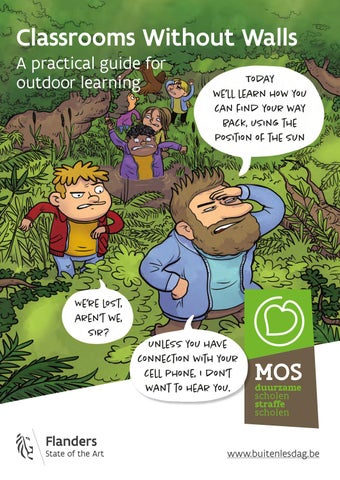
Classrooms Without Walls A practical guide for outdoor learning
www.buitenlesdag.be
Learning, we do outside! So, the subject material will settle better in our heads than in our calves!! Jo Smets
De Vlindertuin
Foreword MOS Pupils spend a lot of time at school, almost a third of it in the playground. Research, mentioned later in this brochure, shows that pupils feel happier on a varied, green playground than on a paved school playground. Green playgrounds have more advantages: trees and shrubs filter polluted air, store CO2 and ensure pleasant cooling in the summer. The non-hardened zones ensure that rainwater can penetrate the soil and so help prevent flooding and support replenishing water reserves. Also, nature benefits: animals and plants are given the opportunity to settle in places they would otherwise not be able to live. Biodiversity will make progress.
In this brochure teachers from primary and secondary schools tell us about their experiences with outdoor learning. What are the benefits? How do you get started? What thresholds can you be confronted with and how do you overcome them? You’ll also find information from scientists who speak about the trumps of outside teaching.
The mere presence of natural features at school also strengthens the pupils’ bond with nature. Its spatial and didactic use makes those effects even stronger. Pupils who have a stronger sense of belonging to nature are more inclined to take care of it.
MOS therefore challenges school principals and teachers to spread their wings and to “fly out” together with their pupils. The school can take part in the “Vlaamse Buitenlesdag”, which takes place every year on the last Thursday of April. On that day we call on teachers to teach outside and to use the outside space as an extension of the classroom.
But ... a varied, green playground also offers a lot of opportunities for outdoor teaching. Outdoor activities and relaxation in the green environment have a positive influence on physical and mental health. A challenging outdoor lesson not only stimulates exercise, but the combination of natural daylight and fresh air also ensures that children can concentrate better in class afterwards.
MOS offers tailored guidance to your school and helps you step by step on your way to outdoor learning. What learning opportunities are hidden in your playground or near your school?
Do you want to know more about the benefits of teaching outside? Be inspired by this brochure or take a look at www.buitenlesdag.be Enjoy reading the brochure!
The MOS coordination team
4
5
MOS is a joint initiative of 7 partners: the Flemish government, the 5 Flemish provinces and the Flemish Community Commission (Brussels). Since 2001, MOS has offered support to primary and secondary schools. MOS makes schools that work on sustainability issues stronger by connecting these issues with the pupils’ living and learning environment. Global themes such as climate change and the decline of biodiversity are connected with environmental and spatial issues that play a role in and around the school. Teachers and pupils who are working on topics that are locally relevant, often feel more involved and more motivated. That is why MOS always works together with them and with the whole school, customized to the school. Together with the school team, the pupils, the neighbourhood and local partners, MOS gets to work in order to make the school a sustainable learning and living environment.
A school that joins forces with MOS can count on:
• Guidance tailored to the school A MOS coach works in coordination with teachers, school principals and the surroundings in order to find out what fits the school. MOS-coaching is tailored to the school’s needs and requests. • Information and inspiration MOS informs and inspires, through newsletters, a website and social media, about the wide range of environmental educational and sustainable initiatives in Flanders and Brussels. • Professionalism MOS organizes network meetings in order to give schools the opportunity to exchange experiences. Regularly, general trainings and trainings tailored to individual schools take place. • MOS travel pass In order to reach an environmental educational destination the schools want to visit, MOS schools can get for free a MOS travel pass for bus and tram from “De Lijn” (Flemish Transport Company).
Register as a MOS school
Would you like to benefit from the MOS coaching and all MOS has to offer? Register your school as MOS school on the green map you can find on www.mosvlaanderen.be. You will also find the contact details of your local MOS coach who surely will be very happy to visit your school.
TABLE OF CONTENTS
• • • • • • • • • • • • • • • • •
Learning is easier and more fun! - De Bergop Primary School in Tiegem Bad weather does not exist, only bad clothing! - De STEMpel Primary School De Pannebeke in Brugge Parents and pupils take care of De Bostorie, a shared outdoor classroom area in Drongen Go and explore! - Pedagogical Counselling Service of the IVA Urban Education Ghent A fresh nose is good for concentration! - actress and comedian Veerle Malschaert Focus on secondary education Unwind and learn! - Atheneum MXM in Merksem Thresholds and answers Entitled to hurt yourself - Peter De Keyser, Child & Society What does research say about the effects? Does “outside” make a difference? Annelore Blondeel and Jan Allegaert, VIVES University of Applied Sciences Well-being grows, also among teachers. Gorik Van Helleputte and Danielle Cools, UCLL University of Applied Sciences Step-by-step towards an outdoor classroom. Steven Totté, BuSO school Berkenbeek in Wuustwezel Different kinds of outdoor learning Before you go outside, a few topics of attention and concern How do you set up an outdoor activity? Choosing for outdoor learning, why?
p. 6-7 p. 8-9 p. 10-11 p. 12-13 p. 15 p. 16-17 p. 18-19 p. 20-23 p. 24-25 p. 26-29 p. 30-31 p. 32-33 p. 34-35 p. 36 p. 37 p. 38 p. 39
COLOPHON Text: Jan De Mets Design: team communicatie, Departement Omgeving Editors: MOS sustainable schools, strong schools Cover: cartoonist Floris De Smedt Thanks to the schools for submitting/ sending the quotes. Wettelijk depot: D/2021/3241/084 R.P. Peter Cabus, Departement Omgeving, Koning Albert II-laan 20 bus 8, 1000 Brussel
Shutterstock: Chinnapong
MOS? What is it?
6
7
“Learning is easier and … more fun” “When I first attended a presentation about outdoor education, I immediately understood: this is something for our school!” An Dubuquoy, school principal of “De Bergop” Primary School in Tiegem was sold right away. She discussed the idea with the entire team and everyone instantly agreed: “That just suits us. And at the end of that school year, 2014-15, we decided: let’s go for it”
The initial phase
“There was hardly any resistance in our school. We started experimenting with trial and error. We put “Outdoor School” in front of our school’s name on the street side sign. That also meant: “There is no way back, we won’t return”. No one has been forced by me. No guidelines like: “You have to go out with your class at least so many times or so many minutes”. Every teacher was allowed to grow at his/her own pace. Not everyone is equally fast. It must fit you. As a teacher you must like to do it. Your enthusiasm as a teacher affects the children. From the beginning we tried to work according to the curriculum, real “outdoor lessons”: mathematical activities, French vocabulary, W.O. themes ... The creative challenge is to find the appropriate working method for outside. We have received a lot of inspiring information from MOS and from the VIVES and UCLL colleges. We have bundled these working methods under the name “outdoor games”. You can use the same games or methods with very different lesson contents. It does require some walk-in time. Using a workbook is easy, but for outdoor learning you have to create your own material and that takes time. The teachers turn into highly creative coaches. They can already rely on material they have worked out in previous years, their lessons stock is expanding. But we can still use inspiration. That is why we have joined a European Erasmus project to learn from abroad. We’re the requesting party to have access to a didactic database of outdoor games made in our own country. In many of those outdoor games, children are supposed to work together. They are encouraged to tackle the assignments together and to help each other. Therefore, social skills are more often stimulated during an outdoor lesson than in the classroom. Basically, it means that you treat the children differently, not the way you treat them in a classroom situation. In a classroom you stand in front, the children who sit down and look at you. You often react and say: “Sit still,” “Your sheet of paper has fallen to the floor again,” “Sit up straight.” The children cannot sit still outdoors, because they have to move constantly in order to carry out
their assignment. All those minor corrections and comments are no longer needed. ADHD children are less conspicuous. It’s that simple.
Effects on teachers
“The teachers love doing it. They see the effect on the children and that gives them a lot of satisfaction. They also stimulate each other. They use the school blogs to inspire one another, for example by posting a small report of an activity. It all happens fairly informally. They are also often aware of what someone else is doing, because sometimes they are outside with several groups at the same time. After all, we do not make agreements about who should or may go outside and when.
THE TEACHERS LOVE DOING IT. THEY SEE THE EFFECT ON THE CHILDREN AND THAT GIVES THEM A LOT OF SATISFACTION. Teachers themselves bring up that their interaction with the children has changed. They deal with them more confidentially. They feel a greater connection. The teachers who have been teaching here for many years are also satisfied with the change. That is reassuring, because they can compare with how it used to be. More and more schools are joining, so within a few years we may be able to exchange more in-depth ideas. “
Effects on pupils
In the beginning we had some uncertainties: won’t the pupis be distracted faster, aren’t they going to be absentminded and notice every butterfly pass by and then walk away? But that’s really not the case. They learn to be very involved, focused and concentrated. Only the very small
toddlers in the entry class are still quickly distracted, but from the second kindergarten on, they are already used to it. We notice that children interact better and show more respect for each other. There are fewer arguments, and above all: outdoor learning makes them want to learn more due to the active work forms. Learning is more fun, and why shouldn’t that be allowed? For us it is clear: the ability to learn, the concentration, the well-being and the involvement have increased. Can we prove that with undeniable figures? No, and that means in particular that we need more scientific research that can confirm this. We constantly receive signals from the children that they are very satisfied. They keep asking to do more outdoor activities. When they change classes and the new teacher doesn’t go out with them as much as the previous one, he or she may hear, “when are we going outside?” According to our kindergarten teacher the children are less likely to get ill. It is striking according to our physical education teacher that our pupils appear to have a better condition during after-school sports activities. They also walk a lot more here. These signals are hard to substantiate but being outside and moving a lot can’t but have a healthy effect! If you have been able to experience something firsthand, you will remember that much better. That practical knowledge and being touched by something are very important.
Learning to deal with risks
“We are also expanding the outdoor activities, and so causing more risk “. We started for instance adjusting our garden. At the back of the garden you can see the children play with sticks and branches, with tires and tree trunks. By and large, accidents can happen there, but they are having such a good time. They are completely dirty every day. Plus: we’ve realized how little it rains. The children are not cold, they move all the time. It is usually the teacher who gets cold by standing still. Parents know by now. At every registration and every information day I explain our vision on outdoor learning thoroughly so that the parents know what they have chosen or are going to choose. They know that their children cannot come to school in their Sunday clothes and better bring their boots. Parents also deliberately choose this school. You can sense that there is a tendency among families to stay away from the screens. Let them move outside and at school again.”
Some recommendations for starters
“You cannot force or impose anything. Do it slowly, at ease, give him or her some freedom. Provide sufficient information and give examples of good and workable material. At the same time, it is important to find a way so that the entire team can participate. I’d like to see this evolve nicely to more and more activities and lessons outside. More research is necessary, so that it can clearly be proved that it has a positive effect on the children. Some former pupils who are now in the first year of secondary education, have recently visited our school. I asked them “What’s the most difficult for you now?” The answer: “That we have much less outdoor activities.”
8
9 of the teacher is therefore shifting more to coaching: the pupils have to do much more themselves and are guided through this. And the best learning place is “outside”. And that, of course, includes training and in-service training for teachers..” Charlotte: “We are also a STEM school. That already indicates what we stand for. We are focusing, among other things, on “programming” which can also be tackled outdoors. With “live programming”, for example, you draw a field with squares. The assignment is to go in steps from one box to another and to describe those steps well, as if you were a robot: two steps forward, turn left, one step forward ... The pupils draw the field, so they have to measure and count. They lay the cards with the instructions for the “robot.”
Did some colleagues, almost literally, have threshold fears? Charlotte: “Initially they had some concerns:” “I have the curriculum goals I want to reach, I fear this is extra ... “. Meantime we have learned that it has more to do with a different mindset. It’s not something extra, it’s just doing the same things differently”
When did it start itching so much that you wanted to begin outdoor learning?
Charlotte: “Two years ago I heard about outdoor education for the first time at an Erasmus meeting about STEM (Science, Technology, Engineering and Mathematics) in Greece. That immediately appealed to me. I started looking for an in-service training and found one at the Pedagogical Counselling Service of the City of Ghent. The subject was also discussed in the MOS café. Together with other teachers, I started looking for practices and approaches in order to create outdoor activities. Now I am working in different classes and go outside regularly, that is at least once a week. Even though it can be windy and snowy and the pupils’ jackets are not always watertight, I still want to go outside, if only for a moment.
Charlotte: “Once you’ve started thinking about what you can do outside, you get more and more creative. An example from the language lesson: divide into groups of four. Together they hold one piece of string. Hand out cards with words like e.g. “house”. Then try to find on the playground a word that rhymes with the one on the card. Because the pupils are not allowed to release the rope, they are obliged to work together. The pupil who does not know the answer, picks it up from his friends.” Cindy: “Sound agreements make good friends: children are not supposed to crawl on toys during an outdoor lesson. They’re not allowed to walk away. They have to put on their fluorescent jackets when they’re on the street, they do not walk ahead ... This is how they learn to take responsibility. We have also introduced a “slipper policy”: slippers in the classroom, boots outside. By the way, the cleaning personnel are also satisfied!”
Do you have some recommendations for beginners and enthusiasts? Charlotte: “Make sure you know why and when you want to go outside. Make sure the parents agree with you. Make sure your material is OK and that there are rain clothing and boots. Start small and expand it slowly so that you and the children find a kind of routine. Make clear agreements together with the children. Have a broad view: the environment is more than the playground and the park. If you go watch a play, you also go outside.”
De STEMpel Primary School - De Pannebeke in Brugge. The school has gradually overcome the initial hesitation for outdoor lessons. With small experiments teachers are starting to believe in it more and more. “You have to take the time and stimulate their creativity,” say teacher Charlotte Vanlancker and principal Cindy Cottenjé.
I think it’s an appropriate slogan: “Bad weather does not exist, only bad clothing.” The children are really looking forward to going outside. When they see me, they ask: “When will we go outside again?”
Does the school have to create a vision on outdoor learning? Cindy: “Our vision is: you have to combine playing and learning. Learning by doing. What we know about “learning”, we’ll have that covered in the classroom too. But only “listening” to learning content will be less remembered than “doing”. By trying things out, you learn a lot more. The role
“The cleaning personnel are satisfied too”
Foto: De Bergop in Tiegem
“Bad weather does not exist, only bad clothing!”
Cindy: “We refer to scientific research to substantiate this. Children need more oxygen and movement, sit still too much, they are too close to each other... And so you see that teachers begin to inspire each other; even the doubters start participating. There are many examples from other schools. Those examples together with our own experiments on language, mathematics and other content really help. You should also explain this consistently to the parents: do not dress your children like on Sundays. And they all agree
with us. We organized for example, an outdoor search on the occasion of the grandparent party. And everyone was very enthusiastic.”
10
11 01
Parents and pupils take care of the outdoor classroom area ‘De Bostorie’. The pupils of the schools in Drongen chose that name for the outdoor class area that will still be set up this year. It was a few mothers’ initiative who saw that the schools - and by extension all of Drongen’s children - were missing some outdoor space. They made a decision after careful deliberation: they started a search, they questioned the children and the parents and they negotiated with owners, authorities and potential users. MOS talked with Cherline De Maeght, one of the three initiators, mom of Filemon, Suzette and Lucile, and employed at the Education Magazine Klasse. Eva, Jona and Cherline, three neighbouring women from Veerstraat in Drongen, came up with the idea of creating a play zone with outdoor class in the village. They also have children in one of the three centre schools in Drongen (Milestone, Klaverdries and De Vuurtoren). They submitted a project to the Ghent Citizen Budget - with success! “Drongen lacks a piece of green where children, parents and grandparents, neighbours, residents and passers-by can relax and chat a bit,” says Cherline. “But the primary schools here also lack a green, wooded place to go to with their pupils. An outdoor class is a logical extension of the classical classroom. We went on a search to various locations. The nearby forest behind the parsonage, partially walled but completely fenced, proved to be the perfect location for our outdoor class.” Who is involved in the project? The church factory and the Drongen’s deanery, the three centre schools, the library as ‘nearest neighbour’ of the site, and last but not least: the children. After all, the project applicants felt it was important to closely involve the children themselves in the planning and implementation. Cherline: “We held a survey with Drongen’s youngest residents, their parents and local inhabitants. This made clear what elements they wanted at the meeting place. We used the different icons of Child and Society. The result was an impressive list of ideas: a barefoot path, a maze, tree trunks with letters or numbers, material to build camps, chalk boards, an open-air stage, a high chair for the teachers, a covered classroom, benches / small logs for a campfire, etc.”
And the parents, teachers, principals and neighbours added to the wish list: a stage with arena, a few chalkboards to work on standing up and in corner work, a tree trunk path with numbers and letters on it, three carts to transport material... “Everyone was enthusiastic,” Cherline says. “All schools are fundamentally interested in the outdoor class and would like to implement this renewed form of education in their school policy. The parents are also involved through the parents’ councils. They are willing to take care of the maintenance of the outdoor class and its implementation.” The project is close to the implementation phase. Everyone receives the latest news through open workgroup meetings, social media and newsletters. The meetings with the landscape agency are currently going on. There is cooperation with: “Fris in het Landschap” (Fresh in the Landscape), an organization with expertise in natural and ecological play and study environments, with the landscape architect of the City of Ghent, with the executive partners “Atelier Ikke, Nester en Speelbomen”. The Real Estate Agency is also involved, because the parsonage forest is a protected area. The meetings are a search for a good balance: how far will you go in shaping such an outdoor classroom area? Do you install toy devices that have a definitive shape or do you only offer constructions that stimulate learning incentives? How far do you go in arranging your outdoor space? “Cherline: “Taking into account all comments, wishes and concerns, we have prepared a development plan.
08
02 04
02
09 03
06
05
10
07
The total cost hovers around 67,000 euros, including a training budget and an online platform to exchange teaching concepts between the three schools. The outdoor class opened its doors in April 2019. The first target groups: the toddlers, the pupils and the teachers of the three schools. But also the crèche, socio-cultural associations and the library are able to use it on request.
NESTER - PLATTEGROND BOSTORIE
More information: https://ookmijn.stad.gent/burgerbudget/ voorstellen/groene-ontmoetingsplek-met-openbare-speelzone-en-buitenklas-drongen 1 Pic2School, see https://k-s.be/inspraak-participatie/pic2school-inspraaktool-voor-de-schoolspeelplaats/pic2school-handleiding-en-iconenboekje/Grondplan: © Nester
12
13
“For us, outdoor learning is learning on a regular basis in, from and with the (school) surroundings. Where, after all, can you get to know reality better than in reality itself? Outdoor learning offers a lot of opportunities for inquisitive and sensory learning, focusing on experience.
“Go and explore” Katlyne De Leye and Nele Le Loup, who work at the Pedagogical Counselling Service of the IVA Stedelijk Onderwijs Gent (Municipal Education Ghent), bring together enthusiastic teachers during training sessions and colleague groups in order to inspire each other about outdoor learning. “The teachers do not only come from Ghent but from the wider area. We notice that interest is increasing, that schools are looking for working methods, exchanges and good practices. Teachers love to learn from each other. ”For Katlyne and Nele, outdoor learning is more than going outside now and then”.
As a Pedagogical Counselling Service, we incorporate this because it fits in with the pedagogical project of the IVA Municipal Education Ghent and because it encourages more sustainability and citizenship. By moving, learning and playing outside, for example, the pupils are confronted with waste and other things that are not attractive. In this way you teach children that we must take care of our environment and nature. Outdoor learning therefore means much more than “measuring outside, practising or filling in workbooks”, “being in nature” or “doing your indoor activities outside”. Teachers often still experience some thresholds: ‘I don’t know anything about nature’, ‘The children will be too distracted outside’, ‘I’m not allowed to go out in the streets alone’, ‘I don’t have time for that because we have to deal with so much learning material’... We try to encourage them with concrete ideas. We provide immediately usable fiches with activities in connection with all kinds of lesson contents. Those sheets are meant to give teachers some extra support. In this way they get to know the concept of outdoor learning and discover the added value for their classroom practice. Once they are launched, they quickly come up with new ideas themselves: look for shapes on the playground, measure depth and circumference of a well in the sandbox ... One of the teachers starts with a neighbourhood walk every week. They then have a circle discussion and the children’s questions are collected: what has struck you, what have you seen? This material will be worked with throughout the week.
Outdoor learning offers many opportunities for inquisitive and sensory learning, focusing on experience. In addition to all the practical tips, we provide information about the reasons why leaving the classroom is so important, according to scientific research. In this way teachers also get deeper background understanding to search for allies in their school and learn to persuade the doubters. As a teacher you don’t have to know everything to give a good outdoor lesson. Go and explore together with the children the playground, the neighbourhood or a park. Let the children surprise you with what they see, hear, smell, feel and ask. First time for everything! Just start and do it regularly, give it the chance to grow.”
14
15
“A fresh nose is good for concentration” Comedian and actress Veerle Malschaert provided an activity for MOS during “The Outdoor Education Day” two years in a row. And this year she is present again! What does she find entertaining and interesting about such a day? She likes telling that herself. “The first time in KTA Handelsschool in Aalst I introduced the pupils in an outdoor lesson to improvisation theatre. That means: practising play and improvisation techniques, learning to express emotions, using voice and body, full moving, real word drama! You may also be able to do that within four classroom walls, but to really speak your mind, you have to go outside. They were not used to that, they really had to leave their comfort zone. But I must say that went very well, they really tried their hand at it. Most of them even thought it was a nice and fresh variety. At the SIGO ASO school in Gistel, they had already had several years of experience with outdoor education. They had constructed a beautiful green playground and space had been created to organize outdoor lessons.
© Hendrik Moeremans
All schools told me that outdoor teaching activities also make other characteristics of children and young people visible. I can’t remember having experienced any outdoor teaching in my school days. We were way too much inside. The teacher in the front filled us up with plenty of information. Maybe it’s still like that in a lot of places. But you can also tackle the curriculum in a different way. Moreover, getting some fresh air seems to be perfect for concentration. We must raise awareness in connection with outdoor learning. Explaining mathematical issues in the outdoor area can be done as well or even better than in a classroom. But I am optimistic, the trend has been set. Crèches also participate and let the children play outside, crawl, sleep ... Winter and summer!”
16 16
17
Focus on secundary education
Being creative and alert
Our French teacher lets the pupils walk outside and name the things they see. A third of the applied biology lessons are in any case happening outdoors, in search of biodiver-
We regularly use the outdoor class as a base camp for nature exploration: research work on the plants and vegetables that we have grown, studying ecological wood species ... The Integrated General Social Education teacher sometimes reads a book there for the pupils. We have noticed that an outdoor lesson creates a very different class atmosphere. If some tensions arise in a class, “going outside” can be a means to bring back peace. Bart Roets, stedelijke BuSO-school Bert Carlier Gent
It doesn’t feel like a ‘scholarly” lesson
For the geography repeat lessons, I try to go to the outdoor classroom every trimester. I have laminated large A3 sheets. With the help of these, we play a game with the teaching material. If they answer a question correctly, they must indicate a country on the map of Europe or on the map of the world, on the respective laminated sheet. When they have both the answer and the country right, they can continue and move their pawn on the game of geese board that is in the middle of the outdoor classroom. For natural sciences I always try to go outside when the weather is good. Of course, on condition the outdoor class is not occupied and it fits well with the subject. I often do this with the topics about breathing. Two pupils have to run back-and-forth on the sports field. The other pupils watch from the outdoor classroom. Then we discuss the external and internal characteristics of the respiratory system. When I discuss the organs,
ges
I must admit that it is easier to go outside with the pupils of the first grade secondary than with those of the higher stages. But little by little that’s also coming. Some teachers look for the lesson that is best suited to do outside. It can even be only a moment of correction. Liesbeth Van Laer, teacher ‘ecology seminar’, free SO-school Maris Stella Institute, Oostmalle
We have made an outdoor class in a semi-open construction. The pupils of the carpenter study field constructed the house. Also a scale model was made together with the Crea teacher.
ess Ima
The garden has grown together with the outside class. One year a group of pupils made the plan for the garden and had it implemented by a technical school. We then installed and planted everything. Now we have a wooden circle in which discussions and lectures take place. And this year the students want to expand the already existing outdoor class with picnic tables so that the classes can also work in small groups and get some space to write and use books. We also want to plant trees so that we have shade in the summer months.
Unwind
The first times, I must admit, it’s pure chaos. The reason is that some colleagues do not really like to do this because they consider it “a thrown away lesson.” As regards the concentration, I always give the students two chances. If they don’t pay attention, one chance is lost. If, after that, someone from the class is still inattentive, we go back to the subject classroom and I continue teaching there. It is remarkable that I almost never have to go back to the subject room. Pupils enjoy the outdoor classroom and don’t experience it as a ‘lesson’. Even if it is. Michelle Van der Veken, teacher of geography, natural sciences and ‘leefsleutels’, Maris Stella Institute Oostmalle
y Busin
After a survey among the pupils about what they want or what bothers them, I’ve tried to set up projects about those issues. During some weeks, we have measured the air quality of the classes with CO2 meters, first with the windows closed and later with the windows open. The difference is impressive. We’ve tried to find out the limit for a healthy CO2 concentration. It is immediately clear that in a classroom with closed windows the tolerable limit is already exceeded after half an hour. I also ask them to make a nice video to inform teachers, other pupils and the whole school about our project. That too has encouraged us to start the outdoor class.
We have set up various open-air classes on our school ground, as an open offer for every class. We have of course the advantage that a lot of our courses can take place outdoors. But it still requires an alertness to make sufficient connections with ‘outside’ for general subjects too. David Vander Haeghen, GO! Tuinbouwschool Melle
I take a big doll with me to the outdoor classroom. I’ve also made cards with the pictures and names of the different organs. They must try to make the right combinations.
Monke
In the fifth and sixth year classes are parted once a week and the pupils can choose a ‘seminar’ such as: music, crea, medication development, bee breeding, pupil participation ... I mentor the seminar ecology in the fifth year, during the first lesson every Wednesday. Then we tackle all kinds of ecological projects. For example, a few years ago we designed an outdoor classroom and a corresponding garden. We are going to clean up litter and are participating in projects to determine the air quality ...
sity and focused on biotope study. During mathematics we do surface measurement outside. As you can see, if you are creative, an outdoor lesson is always possible.
rstock:
Pupils draw up and realize outdoor class and garden
Shutte
Would it be ‘easier’ to organize outdoor lessons in primary education? It seems that way, but appearances are deceptive. A lot of secondary schools are starting to get a taste for it. We hereby huddle some teachers’ practices.
19
18
Unwind and learn Four rabbits, five guinea pigs, two ducks, two goats and five chickens live together behind the school building of Merksem MXM Atheneum in a piece of green area. Two students help green teacher Jordy Willemot clean up the animal cages and paths. “I mainly come here with the pupils from the B-stream who sometimes really need to be outdoors,” says Jordy. (The B-stream is destined for pupils without a certificate of primary education or for pupils who are less apt at predominantly theoretical education.) “But every child actually needs outside air. Moreover, in this green area, we can have the wonder of nature come to life again. “
Meanwhile the school has also developed a real Roman garden, filled with plants from the Roman era only. The Latin teacher always makes the connection between plants described in Latin texts and the plants we grow in our Roman garden.
Effects
“I see effects especially on a socio-emotional level,” Jordy observes. “Some pupils really open up thanks to working here in the garden. There are pupils who barely spoke in class but who got enthusiastic here. The idea is that they can all go outside when they want, that they can come and help here voluntarily or relax for a while in a stressful period. Especially on Wednesday afternoons they will be able to come and help. I also notice that if you like doing it yourself, you directly ‘infect’ the children. ”
Jordy is a Technology teacher in the B-stream and regularly pays visits with the animals in primary school and kindergarten classes. Those children, at their turn, also come to our outdoor area. Some children barely know that an egg is laid by a chicken. I always give a word of explanation. ”Every week he spends several hours outside with pupils from the B-stream. Time and again he notices some special things happen. “The pupils really get a bond with the animals they care for. We’ve recently had a rabbit here that died, the whole class was heavily affected. Then you notice and realize: it’s not just an animal, they have a deep bond with them.” Caring for the animals and stroking them is fun, but they also have to work in the garden, and that sometimes requires some perseverance. “When the leaves have fallen or when it has rained hard, there is a lot of work to be done. The cages and stables of the animals have to be cleaned, the paths cleared ... But that is part of it.
In addition, in a class where pupils find it difficult to work together, Jordy has noticed that tensions diminished when the children often went to the garden in small groups. “The sphere has improved a lot and other teachers have noticed that too. If they come from my outdoor lessons, they are much calmer in the other lessons. But yes, what would you be like? Anyway, if I had to sit inside for a whole day without even getting out ... “
Appoint someone for the job is a policy choice
Real nature experience
We have the ambition to create a green belt around the entire campus of the Atheneum - kindergarten, primary and secondary - with a vegetable garden, an outdoor lessons zone, a cultural wall, a care farm with dwarf sheep and goats ... “Step by step we are finding resources through grants and other support, ”says Eddy Marchand, headmaster. He thinks it is important to give enthusiastic teachers enough room to do their thing. “The school is growing, so I can exempt Jordy for a few hours. That is a structural policy choice we are making as a school. This exemption also gives a person wings. Jordy has green fingers, he loves it very much and constantly sends me emails with suggestions and ideas ... ”
According to Jordy, there are numerous possibilities for incorporating the nature area in the subjects of primary and secondary. “Instead of looking at a nature photo in class, they can just come here. They can watch the seed grow until it becomes a radish. ”Pupils from the technical classes have made a new run for the chickens and rabbits, using recycled wood from pallets. “Technology, woodworking and mathematics are involved: they first have to draw, design, calculate the run… They are much more motivated for this than for an assignment from a book. These are lifelike assignments, they know what the things they make are used for. “
Shutterstock: BaracaPix
Numerous activities have already taken place here for the biology and natural sciences lessons: an insect hotel with a green roof, aquaponics in barrels (a system of aquaculture in which the waste produced by farmed fish is used by the vegetables on top), a biological study from frogspawn to frogs, a biotope study ... “Those who are motivated will always find a fun, outdoor project for the subject they teach,” says Jordy, “or are able to work out lessons meant for going outside. If they can see it, I think the pupils will learn it much easier.”
We hope that in the future the entire campus, from kindergarten to secondary, will regularly use the green zone, integrated into the lessons. Eddy: “We have also received a grant to purchase outdoor accommodation for the zone we want to use for outdoor lessons. We will put there a large plastic box, with chairs, tables and a kind of board. The teacher can use these things to make an outdoor classroom in 2 minutes. If you provide such a basic infrastructure, the threshold for teachers is lowered.” For the teachers, the garden also has an additional benefit and effect. There are the purely educational or didactic purposes, of course, but in a very short time, a teacher can relax here, away from the hustle and bustle of a full day.
20
21
Thresholds and answers Sometimes teachers need a little push to go outside. What could that push be? We asked the teachers and they came with answers in massive numbers. With these answers we can convince even the biggest doubters.
“It rains a lot, doesn’t it?”” •
“There are a lot of days you can teach outside. Periods of heavy rain day after day are exceptional. ” Eddy Marchand, Atheneum Merksem
•
“A slogan I often use is: “There is no bad weather, only bad and unsuited clothing.” Charlotte Vanlancker, primary school De STEMpel Brugge
•
“Let go of those thoughts and enjoy the way they enjoy it!” Ria Vandevelde, primary school De Valke Lichtervelde
“I don’t have a blackboard outside, and certainly no smartboard!” “Providing a basic infrastructure is important. Then the class can go outside any time and the teacher has a basic comfort to teach his subject. Teaching outside creates the opportunity to try out alternative group configurations. A sense of getting lessons together grows. “The roundtable session” seems to be very popular. Eddy Marchand, Atheneum Merksem
“The pupils won’t be able to concentrate and will easily be distracted!” •
“During your first outdoor lessons, they will have seen every fly slip by. But after a few lessons outside this will surely disappear! My tip: persist and don’t give up after the first time! Daniella Kegels, primary school De Knipoog Vilvoorde
•
“In the beginning they might be slightly more distracted by the ambient noises, but after some time, they are just more concentrated at work. There is always enough fresh air to be able to concentrate properly. Karen Fastré, primary school Momentum Sint-Truiden
•
“Despite of all the noises in the background “(birds, wind, leaves, branches ...) all the pupils are motivated and they work very concentrated!” Saskia Steegmans, MPI Zonnebos Schilde
•
“I observe a higher motivation among the children, a higher concentration and well-being.” Veerle Claeys, primary school (BuO) Sint-Gregorius Gentbrugge
•
“Nature is so fascinating that attention remains focused with only a few necessary triggers.” And why shouldn’t you stop teaching when a squirrel moves through the trees or a family of tail-tits silence the teacher…...” ;-).” David Vander Haeghen, horticultural school Melle
“They go wild, there is going to be more arguing.” •
“We are working in a very relaxed way. Not being in between the four class walls causes the feeling of having more room and that brings peace. Kathelijn Jacobs, primary school Sint-Maarteninstituut Aalst
•
“In the beginning the children are wilder, but the more you go out with them, the more they get used to it. We make good agreements and visualize them. We stay consistent and repeat again and again.” Céline Duyvejonck, primary school Windekind Zonhoven
•
“We teach in multiple classes at different outside locations on our campus. Oxygen clearly has a positive effect on the pupils’ creative power. A megapositive class atmosphere has been created in each of the class groups that clearly enjoyed the outdoor lessons.” Eddy Marchand, Atheneum Merksem
•
“They learn to work together well. No matter how different the children are, everyone benefits from learning outside. So, busy children calm down in nature and withdrawn children come out of their shell. The best classroom is roofed only by the sky!” Sanne Housen, kindergarten Beverburcht Wurfeld-Maaseik
•
“Learning, exercise, social skills and fresh air = the perfect teaching quartet!” Greet Van Moer, De Sterappel Sint-Gillis-Waas
22
23
“Do they even come to learning?” •
“The pupils are more motivated to work in a different environment. We often go outside to practise dynamic learning: practising lesson subjects actively, such as multiplying tables, spelling lessons, math lessons ... Doing this and actively applying the knowledge, the children remember the teaching material better and are more concentrated in the classroom afterwards. Karen Fastré, primary school Momentum Sint-Truiden
•
Basically, it’s simple: use your surroundings to turn your books’ goals into your lessons out of nowhere. It makes children so much richer.” Nathalie Meremans, primary school Vijverbeek Asse
•
“You don’t have to take educational material into the classroom. You’re in the middle of all possible didactic material!” Natalie De Schepper, Technical horticultural school Merchtem
•
The outdoor activities’ added value is that pupils are more involved. We weeded the nettles at the back of the school grounds and made them into delicious nettle soup. Be sure that all our pupils now know that we pull out nettles with root and all and that the leaves from the stem of the nettle sting. Daniella Kegels, primary school De Knipoog Vilvoorde
•
“The outdoor classes stand out more in terms of enthusiasm. Exercising proverbs, digital and analogue clock, search for adjectives, create quartets with numbers up to 10,000, daily mile, ...” Greet Van Moer, Leefschool De Sterappel Sint-Gillis-Waas
•
Experiencing summer by climbing the trees and picking cherries. Feeling autumn by kite flying in the field. Feel winter by gliding on frozen pools and listening to the birds in spring. Only after this experience children can give input about seasons and changes in nature.” Sil Van Geel, Steinerschool Anderlecht
•
The more informal character which gives you the opportunity to get to know the pupils in a different way. You’re often amazed how playful and childlike they can still be. I certainly don’t mean to offend them. The creative side often comes up as well.” Hilde Van Hauwermeiren, Lyceum Ghent
24
25
Entitled to hurt yourself Not every school has a large domain, a nearby park or a garden in the green to play and learn in. However, every school has at least one playground whose features can be changed. “Breaking out tiles from a traditional courtyard is the first step towards a playable and high-quality playground, which in turn is a step towards outdoor lesson activities,” says Peter Dekeyser, staff member at Child and Society. According to him, it starts with thinking about playing and learning, and how the two are inseparably linked.
Types of play in the playground
“Playing provides such a wealth of experiences and behaviours that it does not match with an empty surface,” says Dekeyser. “The youngest children even use the teacher as a “a part of the playground” to hide behind. The least square meter with a different colour will already provide extra playing fun.” How do you handle that, such a structurally different playground, as a step up to more outdoor lessons? It helps to gain insight into children’s types of “playing”. You have the “rule games”, such as playing football and playing tag. Usually it are the first kind of games you have in mind when you think of the word “playing.” There is also the “fantasy game”, which is the “pretending game”, e.g. replaying adventures that occur in daily life. The “construction games” include everything that has to do with crafting and dismantling. And furthermore “challenge games” like the “exploratory game” ... Those kinds of games can also influence each other. A good playground creates opportunities for as many kinds of games as possible.” The richer and more varied that playground gets, the easier the children (and also young people) can exercise social skills and the more playful, learning and social opportunities arise. According to Dekeyser it is almost predictable what will happen then: “There will be more to experience and therefore less reason to quarrel or displeasure, living together becomes more harmonious ... So the further we deviate from that empty space, the better.”
Schools can appeal to “de medewerkers van Kind en Samenleving (the Child and Society staff) in the structural approach of the playground and in the organization of pupils’ participation. www.k-s.be
Children and young people think along
Dekeyser argues in favour of a far-reaching pupil participation. “First, it is tactically interesting to let them think along, because the chance the playroom’s quality will increase is real. Children are well capable to express needs
and requirements.” According to him, you first have to make a thorough assessment of the pupils’ needs and requirements.” Start with questions like ‘what and how do you like playing, here and in other places. Tell me about it?” When they mention certain kinds of playing you ask deeper questions like: ‘Would that be realizable in the outdoor space? Why can’t that be done now?’ And then: “What do we need in order to convert these play needs into concrete ideas?”
Safety
On the job, enthusiastic outdoor space and playground reformers clash with practical objections and ... the safety advisor. “Regularly, that turns out to be a bottleneck,” Dekeyser agrees. “Often, people who want to develop playing opportunities and set up dynamic projects, cope with resistance from a safety adviser. “Safety” is a very loaded word, but if you compare with traffic and sports, there will hardly be any incidents in play areas. “It is better to involve people with safety and prevention authority from the very beginning of the process. In this way they develop together with you in your arguments and educational objectives. They are challenged to think in a creative and positive way.” According to Dekeyser, safety thinking can be somewhat overhauled. “You are actually entitled to “hurt yourself.” That should not be a taboo while playing. Climbing scratches through the bark is part of climbing the tree. In this way you discover how life and nature work together.” also see: https://k-s.be/kindgerichte-publieke-ruimte/de-schatkist/ tijd-voor-de-speeltijd/ https://k-s.be/de-wereld-volgens-kinderen/vrije-tijd-en-spelen/de-speeltijd-maak-er-spel-van/
26
27
Pull-factors
What does research say about the effects?
When push factors give us evidence to leave the classroom, pull factors pull us out for enthusiastic reasons. We consulted a number of researchers who went through the entire science literature and summarised the decisions. For example, Eva Creve has screened national and international research for her master’s thesis in the Pedagogical Sciences. She has summarized the described effects as follows.
Anyone who follows the issue of outdoor education and learning with interest will look with jealousy at the Scandinavian and Anglo-Saxon countries. There, outside lessons are not eccentric, but often an integrated part of the educational approach and curriculum and the effects on children and young people have already been studied for a long time. However, more and more Flemish researchers are rolling up their sleeves and putting the feet up in their boots. What answers come from research into obvious questions such as: ‘Why should we actually have to go outside?’ ‘Does it benefit the pupils?’
Push-factors
A fairly shocking study is that of neurologist Manfred Spitzer who investigated the effect of looking at a lot of (or few) screens. More than two thousand five-year-old children were asked to simply draw a doll. Watching TV on a daily basis appears to leave a clear mark on the type of drawing. The first row of drawings shows the dolls of children who watch TV less than an hour every day, below that you see the drawings of children who watch TV three or more hours a day. Shutterstock: Petr Bonek
Outdoor education offers an answer to two aspects you can describe as the push and pull factors. With the push factors there are good reasons that literally push you out of the classroom, with the pull factors the effects are coming up by being “thoughtful outside”.
A great deal of attention is paid to obesity. It is a fact that our children and young people do not exercise enough and are too often glued to their screens. We do not know whether research has been conducted into the number of hours that pupils (have to) sit still between four walls, but it must be particularly high. So, there are enough good reasons to leave the school building and the seat at home and go playing and learning outside.
1. Physical health Outdoor education makes children and youngsters more active again. It provides more physical activity and greater fitness. Stress, anxiety, depression and fatigue disappear into the background because contact with nature helps you to relax and makes you forget your worries. Symptoms of ADHD decrease because in the open-air children have a place to release tension. 2. Cognitive effects Still unexplored territory. Certain, in any case, is that critical thinking, the decision-making process and problem-solving evolve positively. The pupils look at the learning material as more relevant because learning is often more active and there is a greater chance of observation and experimentation. This eventually has a more sustainable effect. 3. Well-being and personal development Concentration increases and that in turn promotes learning. It leads to more self-confidence and a higher awareness of one’s own identity. 4. Interpersonal skills The opportunity of mutual social interaction is growing. Pupils experience how they can work together and how to communicate effectively and build good relationships with each other. Bullying is reduced or has disappeared. 5. Motivation Outdoor education plays a major role in motivating students to perform better and generates a higher level of involvement. 6. Sustainability Pupils are more consciously dealing with their environment and with nature in general, precisely because they come into contact with it so often. They take more responsibility towards nature. quoted in this downloadable article from Josephine Kay, along with the illustration www.bedrock.nl/hoe-digitalisering-onze-kinderen-ziek-dom-en-ongelukkig-maakt 2 “Qualitative research into factors that influence the success of outdoor education.” Eva Creve. Supervisor: Prof. dr. Johan van Braak. Ghent University, 2016-17 1
28
29
Children are not made to be sitting on a chair all day. Adults may not, either. Who likes sitting still all day listening to the same person all the time? Numerous studies indicate that “green” has already a positive and sometimes healing effect on people, even if it is only the green poster hanging in the doctor’s waiting room. You can imagine what outdoor learning can achieve then!
This is really an added value in all sorts of areas for the children. An important question is: does outdoor learning also have positive effects on learning performance? That is, of course, not easy to measure. However, we could measure well-being and involvement with the instruments of CEGO , and they both seem to be generally very high among all pupils. ” An Dubuquoy, director of primary school De Bergop in Tiegem 1 CEGO, KU Leuven, has developed measuring tools for this, see https://vorming.cego.be/
The more depth with regard to environmental education, the more motivated the pupils are
University of Antwerp researchers Jelle Boeve-De Pauw and Peter Van Petegem investigated for the Department of the Environment, Nature and Energy (the current Environment Department) the impact of the MOS project on pupils’ values, knowledge and motivation, In other words: does nature and environmental education have influence on the environmentally friendly attitude of young people? They interviewed 2,200 pupils and 1,400 teachers in a hundred primary and secondary schools. Their conclusion? The more “progress” in the MOS process, the greater the educational impact. The pupils are also more motivated to learn. The results also show the importance of a good didactic approach regarding environmental education, a well-developed policy in this regard and the presence and use of “natural green elements” in the school areas. According to the researchers, there can certainly be an educational impact if the nature that is present is used in the learning process and not only serves as a decoration. There are clear cognitive effects of the Eco-School project. Jelle Boeve-de Pauw & Peter Van Petegem (2018) “Eco-school evaluation beyond labels: the impact of environmental policy, didactics and nature at school on student outcomes.” Environmental Education Research 24:9, 1250-1267.
In an active position you are more likely to become intelligent than in a passive Michel Serres
30
31
Does ‘outside’ make a difference? In their own country, Annelore Blondeel and Jan Allegaert, who work at VIVES University of Applied Sciences, have been active for several years in researching and setting up all kinds of initiatives, such as School@Platteland “We are currently conducting research into the impact of outdoor learning on children’s well-being and on STEM subjects,” says Blondeel. “We are really aiming at the visible evolution in what are sometimes called the ‘hard’ subjects, such as W.O. (World Orientation) and mathematics. If there is a real difference, we can support the plea for open-air education even more strongly.”
School@Platteland (School@Countryside) Jan Allegaert is one of the initiators of the “School@Platteland” campaign. Together with the host / hostess and teachers, the activities and learning objectives are fixed with an eye for a wide variety of subject areas. Allegaert: “For example, we pay attention to world orientation, arithmetic, economy, technology, movement ... We link these contents to certain jobs and assignments.”
“It is about values such as self-confidence, cooperation and perseverance,” Allegaert says. “Care for nature and animals is also important. We deliberately do not restrict it to a one-off activity. It is precisely through the repetition of the outdoor activities that the pupils build up a bond with nature. They learn to love the animals and the land and also experience the origins of basic needs such as food and open space.” The pupils are offered all kinds of challenges: “heavy” work in the mini-field, pruning trees, bringing in manure, feeding and caring for animals ... Allegaert: “Sometimes it’s hard work in the mud or cycling against the wind.” It is good that children get to know their own limits. He is mainly interested in giving them a valuable incentive, an authentic initial experience the teacher can build on in the classroom. It is hopeful that both teachers and parents are wildly enthusiastic. Parents are involved in the project from the start. “The parents’ evening, where the concept and vision of School@Platteland are explained, is a very important link,” Allegaert says. “Parents cycle along and the children treat them during the closing event with their knowledge, experiences and with snacks, made of ingredients they have grown themselves.” The children also turn out to tell a lot about it at home. “Parents also tell us that their children help more, deal with food more consciously, develop new interests and are more enthusiastic about school.” School has become cool!
1
a cooperation between the province of West Flanders, VIVES and Inagro (research and advice in agriculture and gardening)
Research results
The researchers at VIVES University of Applied Sciences wanted to know whether this kind of long-term outdoor projects makes a difference for the pupils. Annelore Blondeel did a survey with 260 pupils (control group: 88 pupils), in addition to the teachers and farmers involved. In the course of this school year the research will be continued and deepened. And also the parents will be questioned about the effect of the project on their child. Annelore has already been able to give us the preliminary results (data from December 2017 - November 2018). 1. Effect on pupils’ interest in technology, science and mathematics The pupils who participated in School@Platteland did not score higher for their attitudes towards technology, science and mathematics (post-test in comparison with pre-test). Compared to the control group, there is also no difference. Boys do have better attitudes towards technology and science than girls. According to the teachers and farmers pupils are more interested and enthusiastic in learning about technology, science and mathematics, because, they say, the learning content is more practical and less abstract. The farm is an educational environment where children can gain concrete experiences. 2. Effect on the classroom atmosphere Pupils indicate that they do not feel more positive or negative towards their classmates after the project than before the project. However, teachers and agricultural workers unanimously indicate that pupils cooperate better with each other thanks to the project. Pupils get to know each other better and get to know each other in a different way. 3. Effect on self-efficacy The confidence someone has in displaying a certain behaviour in a certain situation/context in order to achieve the intended results. Again, the researchers found no significant differences between the pre- and post-measurement and between the pupils who participated in School@Platteland and the control group. Teachers and farmers indicate that children are pushing their limits and dare more. It is striking that especially those pupils who cognitively perform less in the classroom, flourish. Pupils who hardly take a chance to speak in the classroom are now given more time to explain something, are an example to their peers and their self-confidence is growing. 4. Learning effects Pupils - especially boys - achieve better scores on the cognitive test after the project compared to the test before the project. Teachers indicate that pupils understand the learning material better because they are actively working and the material is offered in an authentic context. More concrete examples are used and teachers can put more variety in their lessons. Teachers do not notice a different effect of the project on boys or girls.
32
33
Well-being grows, also among teachers The subject of outdoor learning in teacher training? At the UCLL University of Applied Sciences, outdoor learning is compulsory for students in the second year Bachelor in Kindergarten Education. In the third year Bachelor in Primary Education it is optional. At the same time Gorik Van Helleputte and Danielle Cools, who both teach at the UCLL university of Applied Sciences, organize in-service training for teachers. In the “OutdAre Teaching” project, they want to provide teachers with tools to play their role in outdoor learning and by extension in the challenges of 21st-century education Gorik: “In 2014, we were given carte blanche at Group T (which is now included in UCLL) to find out what outdoor learning could mean for teacher training. The motive was the question about our role as teacher educators in this century’s education. Crucial question: how does learning actually come about? Through the practices in the Scandinavian countries and the English-language literature, we discovered well-founded scientific findings regarding outdoor learning. Those countries are very committed to “going out to learn”, or “going out from a basic sense of well-being.” After all, this seems to be part of the answer. We searched further and found links with the UNESCO pillars for learning. What turned out to be? UNESCO had also listed some strategies for the future, one of them regarding learning outside the
classroom. That was an eye-opener.” Danielle: “Little was known about outdoor learning in our country. A strong vision and a well-considered approach were still missing: what can it mean for teachers? As a teacher, how can you make children’s learning more dynamic and authentic? That is how our focus came about: combining the benefits of outdoor learning with the needs of education..
You use the term OutdAre Teaching, why? Danielle: “It has a double meaning: out there, outside the classroom, is a very challenging world that fascinates children, a world they want to learn and live in. And then dare: dare to go outside, dare to take that step. Challenge yourself to discover, starting from the world of children and young people, some entry gates to the curriculum. This is a ‘learning opportunity’ to look at the world. We believe in the teacher’s central role. He or she is actually the first person who has to look and ask the question: what can I do beyond my mathematics, language and musical education manuals in order to teach children to learn?” Gorik: “Educational researcher Hattie comes to the following conclusion in a big study about what works in education: the teacher makes the difference! The teacher should stop teaching in a traditional way but should start very authentically from the question: what’s the objective to be achieved with my children and how can I take them with me? We think it is important for the teacher to work in a meaningful existing context, precisely because so the children will also learn more.” Danielle: “For us, OutdAre Teaching is not a new method. It’s a pair of glasses the teacher puts on, an attitude that allows learning to take place in the child’s environment. This can
be done in the classroom, but also outside. Why should you learn about ‘forms’ inside when there are so many ‘forms’ outside that have much more meaning for children, forms they can deal with much more actively? So, in addition to your professional goals, OutdAre Teaching also allows you to work on other 21st-century skills such as cooperation, communication, creativity, etc.”
How do you take up the challenge with the students? Danielle: “In coordination with our training schools, students get practice opportunities, for example: go into the woods with the pre-schoolers and focus on mathematics and linguistic activities. Observe how children react, then evaluate what went well and how you could have approached it better. Students indicate that the great involvement of the children is striking. They also thought of themselves they were very enthusiastic. We ask students after such a lesson: sum up the learning goals that you’ve touched with this activity? Then they list up to 20 goals, several of them they will even never reach in the classroom.” Gorik: “We feel that both students and teachers are fundamentally very convinced of this story. It is not so much about believing in the opportunities but rather about the uncertainty of accountability towards different parties: what about inspection, legislation, safety ...? In some training schools, our students are not allowed to go outside the school walls with the children, not even in the playground, because “they will be making too much noise!” Danielle: “At the same time you notice that this uncertainty dissolves once you’re trying things out. We are impressed by the involvement of the students, precisely because they are given free space, much more than in a traditional classroom.”
What impact on the pupils do you notice? Gorik: “We know from research that children with certain learning difficulties who regularly get outdoor lessons, show fewer symptoms and are more focused and involved. For children with a more difficult linguistic background outdoor learning creates lots of visual incentives that are also audibly supported. Since they are focusing on experience, linguistic diversity plays a less important role, so the language problems are less relevant.”
Danielle: “We also notice that well-being is growing, also among the teachers. We see they take a different role, more authentic. That alone is worth it and it certainly makes a difference in the children’s experience. Learning is not necessarily getting much better, but it will happen in a context that is meaningful. At the same time, you invest much more in encouraging creative and critical thinking, which are important skills.”
What tips can you give to the schools?
Danielle: “When you ask students “what is your finest memory from primary school”, they usually mention those moments they went out of the school, moments when they did something different than filling in booklets in the classroom. Learning is then linked to the living surroundings, a meaningful context. The children show a greater involvement and the learning effect is deeper. Teachers can use that and at the same time set goals.” Gorik: “So, dear teacher, get inspired by other teachers and start small. Slowly push back boundaries, the more you feel comfortable about it. Feel inspired by each other!” More information: www.outdareteaching.be
34
35
Step-by-step towards an outdoor classroom Steven Totté is technical advisor-coordinator at Berkenbeek, a BuSO-school in Wuustwezel (with children who need special help). The school has a primary and secondary department and is beautifully situated between meadows and forests. But there is always room for improvement and more greening. New ambition: to create an outdoor classroom area in the piece of forest they have recently bought. Steven talks about the plans that are being drawn up. “A few years ago, we bought a pine tree forest behind the school. That was a great incentive to deal even more with nature and greening, both for primary and secondary schools. We are now in the process of drawing up a forest management plan to realise our ambitions. We want to create a mixed forest with also deciduous trees. In time, we want to eliminate the non-indigenous plants and replace them with native varieties. And we will provide a defined space for an outdoor classroom. The school is, of course, already very nicely situated, in the middle of meadows, close to nature reserves ... But we haven’t often taught outdoors yet. That’s why we’ve (the two MOS work groups) started thinking about what we could do. On an educational study day, we had an expert who told us about the added value of playing and learning outdoors. Afterwards everyone could come up with their own ideas during a brainstorming session. In this way we arrived at enthusiastic and realistic actions and ideas, including an outdoor classroom. The MOS work groups now have started to make preparatory plans. We want to lower as many thresholds as possible to teaching outside the classroom. In this regard material and the infrastructure are very important: teachers really want to teach outside, but they want good learning material and a solid setting. Things will be so much easier with a sitting area, workbenches, some things to experience nature such as bird nests, equipment to make observations ... In the meantime, we have not sat still. We have slanted a part along the brook bank. Because of the steep banks, animals couldn’t drink there. Now the pupils can go and see if they can find any tracks there. We’ve placed small cameras at feeding places and have already made beautiful discoveries: a squirrel or birds that come to eat there. We communicate this to the whole school: ‘Long-eared owl spotted in Berkenbeek!’. My tips for starting an outdoor learning area: make sure you have a good basic infrastructure and a team that continues to pull the cart. Work step by step, small steps make it more manageable for the team. Ensure good cooperation
1. outdoor classroom: slope in grassy area, sitting wall with cupboard 2. work benches, with a view on the outdoor classroom 3. lounge corner with butterfly nest box 4. willow tunnel 5. slalom course 6. slope with insect tower and bird feeder
6
with external partners - in our case: MOS, Regional Landscapes, the associations of forest owners (De Bosgroep), regional nature centres where you can borrow cases with learning material ... Also think about how pupils (and the fields of study) can carry certain tasks on their shoulders: border planting (gardening), making benches and painting (timber construction, training as a maintenance assistant) ... And finally: greening the classrooms themselves, think of houseplants!”
1
5
2 3 4
Use the whole surrounding area, including nature, as a classroom! Richard Louv
36
37
Different kinds of outdoor learning •
Environmental education learning in, from and about your own surrounding area, usually outside the school
•
Nature classes learning in, from and about nature during a several-day course.
•
Outdoor game playing outside: individually or collectively/The ‘real’ game = a game without conditions
•
Open air education => 3 components of outdoor education • Physical development • Social and personal development • Education
Before you go outside, a few topics of attention and concern •
On tour or at school? Outdoor lessons are possible in the school grounds but also in the neighbourhood of the school or in the immediate vicinity. You can find more information on www.omgevingsonderwijs.be.
•
Weather conditions Provide suitable clothing and shoes.
•
Keep it simple Not far, not exceptional, no sensation.
•
Regularity Gradually turn outdoor lessons into a ritual. This way students and teachers get familiar with it.
•
Multi-usable working methods They ensure that you can use the fresh air for every subject. Share your experiences with other teachers.
•
Less is more You don’t need much. Use natural materials.
38
39
HOW do you set up an outdoor activity? From the didactic framework of “Flow Learning” (Joseph Cornell) Flow Learning is a simple method in order to structure learning and to let children and adults experience nature first-hand, which leads to a profound sense of belonging and solidarity. It has been developed by Joseph Cornell, teacher and author of the Sharing Nature books and game forms. Teachers and trainers from all over the world now use the Flow Learning teaching method and praise it for its user-friendliness, effectiveness and ability to stimulate and inspire pupils and students. The playful activities encourage the curiosity of the participants and make them enthusiastic. Learning is fun, dynamic and experiential, resulting in a better understanding of nature and respect for it. Cornell distinguishes four phases within Flow Learning: each phase leads to a more intense experience of nature:
Choosing for outdoor learning, WHY? 1.
Health and well-being Children who learn outside in the fresh air can make use of their high energy level and become physically stronger.
2.
Better learning improvement By being ‘in motion’, the concentration increases. The subject matter sticks around longer and better and tension is removed in a healthy way. Not only the intellectual, but also the emotional intelligence is addressed. Outdoor learning offers opportunities for investigative learning and increases knowledge.
1.
Encourage enthusiasm You start with playful activities which make the energy flow and turn you into an enthusiast
2.
Focus your attention Then you organize activities that make you focus on things through the senses (see, hear, smell, feel)
3.
Direct (nature) experiences In this third phase the individual experience of nature is emphasised. By being absorbed in a certain aspect of nature, you experience your connection with all living organisms;
3.
Sharing inspiration Back in the group the cycle is completed by exchanging experiences and inspiration with each other.
More awareness of space Using the space outside the school ensures a better spatial sense of direction.
4.
Learning from and with each other The pupils show greater involvement. They listen more to each other, interact more and feel more connected. By working and co-creating in groups or in pairs, they get a stronger group feeling and sense of belonging.
4.
5. Respect for the environment By going outside very often, respect for nature is created and that increases environmental awareness.
40
www.buitenlesdag.be www.mosvlaanderen.be www.omgevingvlaanderen.be