Flanders Region in Belgium
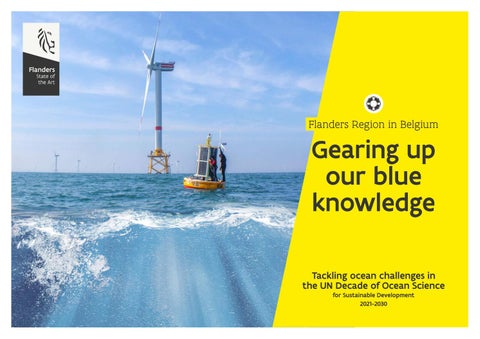
Gearing up our blue knowledge Tackling ocean challenges in the UN Decade of Ocean Science for Sustainable Development 2021-2030
© Shutterstock
Content
Together we tackle ocean challenges in the UN Decade of Ocean Science for Sustainable Development 2021-2030
Flemish Government Department of Economy, Science and Innovation Koning Albert II-laan 35, box 10, B-1030 BRUSSELS
This brochure is a joint publication by: - Flanders Department Economy, Science and Innovation (EWI) - Flanders Marine Institute - Vlaams Instituut voor de Zee vzw - Flanders' Blue Cluster - De Blauwe Cluster vzw Responsible editor Johan Hanssens, Secretary-General Department of Economy, Science and Innovation
Acknowledgements The co-editors gratefully acknowledge assistance of following contributors and reviewers: Bart de Smet; Nancy Fockedey; Bart Hillewaert; Edward Knapp; Ann-Katrien Lescrauwaet; Chantal Martens; Jan Mees; Stefaan Mensaert; Ann Overmeire; Hans Pirlet; Marijn Rabaut; Steven Vandenborre; Gert Verreet; Kristien Veys. Concept and creation The Oval Office
Editorial
4
OUR MARITIME SETTING
6
22
OUR FOCUS AREAS
Less well-known region with a truly maritime identity
7
24
Access to science and technology to harness smart ocean solutions
Flanders: open to the world, connected by the sea, in the heart of Europe
8
26
Science and technology to harness smart ocean solutions
Powerful research and innovation environment
10
28
Smart innovations to harness smart ocean solutions
Moving forward together
14 30
Solutions-oriented research and development
Ocean energy research and innovation
16 32
The wind is the limit
Multi-stakeholder cooperation
18 34
Development and sharing of marine research infrastructure
Drivers of new technology and societal innovation
20 36
Working with ecosystems for a sustainable blue economy
38
Working with ecosystems for a sustainable blue economy
40
Working with ecosystems for a sustainable blue economy
Cover image The Oval Office. Photo: Operators on a VLIZ ICOS buoy © VLIZ – Bart De Smet D/2021/3241/054
x The numbered symbol in the text refers to numbered references on pages 42-43.
42
Footnote references
3
UN DECADE OF OCEAN SCIENCE
Editorial The Government of Flanders is committed to supporting the blue knowledge and innovation ecosystem.
“The new blue industrial revolution needs to contribute to sustainable development and rely on solid scientific evidence and support.” Mrs Hilde CREVITS
2020 was a remarkable year for Flanders’ ocean community: we celebrated the first anniversary of the sixth and youngest Flemish industrial spearhead cluster, the Blue Cluster of maritime industries. The first stone of the new InnovOcean Campus in Ostend was laid, which will host the Flanders Research Institute for agriculture, fisheries and food (ILVO) as well as the Flanders Marine Institute (VLIZ) and its international partners. In addition, a new chapter was added to the successful cooperation between research, development and entrepreneurship, by launching the Ostend Science Park. As a high-tech knowledge hub, it gathers researchers and businesses to develop and implement innovative sustainable economic use of the North Sea and the ocean. The creation of Flanders’ Blue Cluster in alignment with the European Blue Growth Strategy is starting to bear fruit. The blue economy in Flanders accounts for almost 154 000 fulltime jobs, representing no less than 5.2% of Flanders’ GDP, which means it is comparable in size to the Flemish food industry or the Flemish chemical and life sciences cluster. Innovation opportunities for businesses are growing both in traditional maritime economic activities and in emerging or developing sectors. All these activities are in evidence in the relatively small Belgian part of the North Sea, one of the world’s busiest maritime areas. Good overall governance of co-existing uses is ensured by the federal Belgian marine spatial plan. Now that Flanders’ blue economy is booming and contributing to a blue industrial revolution, we need to be fearless and raise our ambition
towards the horizon. And the possibilities are endless! Think of new forms of offshore energy, such as floating solar panels that can withstand the high sea waves and are resistant to salt, or new sustainable breeding techniques for seaweed or shrimp. Training and capacity building embrace new approaches, such as the Blue Growth Summer School. Supported by the Government of Flanders it provides international students with shop floor experience in the Blue Economy. The new blue industrial revolution needs to contribute to sustainable development and rely on solid scientific evidence and support. The online Compendium for Coast and Sea of VLIZ documents the vibrant marine research community in Belgium. It consists of many research groups spread over a large number of university faculties and governmental scientific institutes throughout the country. VLIZ provides services to this ‘archipelago’ of marine researchers. It is also mandated to support the blue economy development through scientific knowledge, infrastructure, data and information. The historic port city of Ostend is rapidly becoming a hub and catalyst for international knowledge-based blue innovation. Teaming up with Blue Cluster, VLIZ and ILVO are key players linked to the wider world in various co-housed international initiatives (the European Commission’s EMODNet, the global OBIS and other activities of the IODE Project Office of IOC-UNESCO, etc.). Researchers from our internationally renowned academic faculties find modern high-tech research infrastructure at Ostend Science Park, the neighbouring Flanders Hydraulics Research ‘Coastal and Ocean Basin’, and the VLIZ Marine Robotics Centre at Marine Station Ostend. The Government of Flanders gladly supports this favourable wind through operating and project resources. The impact of this Blue Research and Innovation system in the coming years will largely depend on the strength of its cooperation and impactful partnerships. By being complementary, by using each other’s strengths and by joining forces, the impact on our blue economy and on society will be huge.
The COVID-19 pandemic puts in sharp relief the importance of science for society. Technology creates opportunities for fast scientific advances, so science and innovation have to go hand in hand. Research and innovation policy are legitimately expected to address today’s societal needs and challenges. Policy and research must, more than ever, have an impact. Scientists are increasingly expected to open up their research results to share with peers and other stakeholders worldwide (Open Science). Research and entrepreneurial projects must make a concrete contribution to societal challenges such as competitiveness and sustainable job creation. The UN has declared a Decade of Ocean Science for Sustainable Development from 2021 to 2030. It urges us to reconcile our way of life with the limits of the Earth, in particular those of the ocean and the seas, which have so much to offer. Let’s make the Decade a joint learning experience on how the ocean helps us achieve the Sustainable Development Goals. With this publication, we invite you to explore the Flanders Blue Research and Innovation system. As Flemish Minister for Economy, Innovation, Work, Social economy and Agriculture, I am truly proud to see so many strong shoulders enthusiastically supporting so many promising projects as a concrete contribution to the UN Ocean Decade of Ocean Science for Sustainable Development and the Agenda 2030 goals. We join the global efforts towards an Ocean we need for the Future we want – and invite you to explore possibilities to join forces with us in the spirit of the Decade. Mrs Hilde Crevits VICE-MINISTER-PRESIDENT OF THE GOVERNMENT OF FLANDERS, FLEMISH MINISTER FOR ECONOMY, INNOVATION, WORK, SOCIAL ECONOMY AND AGRICULTURE
© Cabinet of the Vice-Minister-President of the Government of Flanders, Flemish Minister for Economy, Innovation, Work, Social economy and Agriculture
5
OUR MARITIME SETTING
Less well-known region with a truly maritime identity Meet Flanders, a region bordering the southern Bight of the North Sea, which has been shaped by many interactions with the sea. For centuries, this region and its people have largely benefitted from their proximity to the ocean, be it for food, shelter, cultural exchange and trade, defence or even the continuous struggle to claim the low-lying land from the sea. This relationship has proven fertile ground for the development of maritime competences and a maritime identity that continues to this day and is present in cuttingedge marine sciences and bold innovations for a maritime economy. Today, on the eve of the UN Decade of Ocean Science for Sustainable Development (2021-2030), Flanders takes stock of its true maritime identity, its broad expertise, long-standing traditions, maritime skills and capacities. It reaches out to share these and shape strong and far-reaching collaborations based on ocean science, knowledge and innovative approaches. Flanders grasps the unique opportunity of the Ocean Decade to join forces in a decade of open international collaboration that will guide us in the transition to the ocean we need for the future we want p.8-9
•O ur maritime space is a busy place! A myriad of coastal and maritime users have high stakes in this densely used maritime area in the North Sea. The high density and diversity of demands for space requires a strong and forward-looking vision that guides us in the constant search for synergies. Belgium’s maritime spatial planning generates opportunities, allowing all actors to move forward together to achieve the societal outcomes we need. p.14-15 • I n preparing for the Ocean Decade, Flanders’ ocean science community actively participated in the discovery of our main strengths and prominent opportunities, which we intend to explore and shape further as solid contributions from Flanders to the Ocean Decade. Our tradition in open science, sharing data and infrastructures, our taste for working in a multidisciplinary environment and our commitment to supporting capacity development for more equitable access to the ocean are the cross-cutting principles in our future contribution. p.16-17
Going forward into the Ocean Decade, our preferred model is that of multi-stakeholder cooperation across different actors, with strong connections between education opportunities, basic research, facilitating access to knowledge and fostering innovation for improved societal outcomes. p.18-19 We see the infrastructures for marine research and innovation as key enablers that trigger the societal and technological innovation we need for a sustainable use of the ocean. p.20-21
And … the science we need for the ocean we want. Take a bird’s eye view of our marine science and innovation landscape, its roots and dense connections in society: • F landers’ Science, Technology, and Innovation (STI) system embeds and feeds a strong marine and maritime STI system. Discover its key features p.10-11 , and where it stands in a broader international perspective. p.12-13
Take a deep breath and enjoy an exciting dive into marine and maritime research in Flanders. Accept our invitation and get in touch if you wish to share more ideas and explore new collaborations!
7 © Shutterstock
UN DECADE OF OCEAN SCIENCE HAMBURG BREMERHAVEN
Flanders: open to the world, connected by the sea, in the heart of Europe
ROTTERDAM
ZEEBRUGGE
BERLIN 1h AMSTERDAM 1h52 ANTWERP
LE HAVRE
BRUSSELS
Small but well connected PARIS 1h22
Flanders has always acknowledged the importance of working with its neighbours in trade, culture, politics, or science. Today the region is a model for an open society with a knowledge-based economy. It is a ‘living lab’ with a densely populated coastal area and a challenging demand for space both on land and at sea. Technology and societal innovation help address the challenges these low-lying lands are facing, as well as drive new sustainable development.
OPEN INVITATION Flanders’ marine research and innovation community welcomes the ‘UN Ocean Decade’ as part of its tradition of open collaboration.
Cargo in transit in the Western Scheldt © Shutterstock
FLANDERS IS: Strategic location in the heart of Europe Excellent transport infrastructure Tailored incentives for companies
ART AND INNOVATION IN THE MARITIME SECTOR
Havenhuis, Port of Antwerp © Peter Knoop
EARLY CASE OF ‘BLUE INNOVATION' Science in an oyster-tasting centre, 1843. When Belgian zoologist Pierre-Joseph van Beneden settled his marine station in an oyster farm in Ostend in 1843, he was unlikely to think of himself as an early adopter of the ‘co-design’ principles. The saltwater basins and continuous supply of fresh specimens provided an innovative environment for his research and solved the challenge of obtaining fresh samples for his students’ seminars.
Port of Antwerp’s headquarters is a 19th-century building renovated with bold use of glass, metal and concrete in the design of a diamond-shaped superstructure, proudly symbolising its dynamism, ambition and innovative nature.
FLANDERS’ PORTS, GATEWAYS TO A GLOBAL WORLD With over 150 000 ships a year crossing its navigation ways, Flanders is situated at one of the busiest shipping routes in the world and seaports are the engine of its economy. The market share of the Flemish sea ports (Ostend, Zeebrugge, Ghent-Terneuzen, Antwerp) represents 25 % of the total transhipment of goods in the Le Havre-Hamburg range. 2
World-class maritime companies State-of-the-art research centres Highly skilled work force High quality of life
Marine Station Oostende, VLIZ © Els Verhaeghe
HORSEBACK SHRIMP FISHING: UNESCO CULTURAL HERITAGE LONG-STANDING TRADITION IN MARINE SCIENCE This Marine Station soon put Ostend on the map, as renowned researchers from all over Europe gathered in a multi-disciplinary think tank to discuss innovative ideas about the functioning of living organisms in their marine environments. Today it is an open lab for science collaboration.
1
Horseback shrimp fishermen sit in wooden saddles on their Brabant draught horses, dragging large bottom trawl nets. Flanders is the only place left in the world where this 500-year-old tradition of shrimp fishing is still in practice. Thousands of visitors enjoy the ‘open air classes’, learning about local marine biodiversity and traditional and current fishing practices. 3
Horseback shrimp fishermen © Westtoer
Oostende oyster farm Valcke-Deknuyt. Source: Hamoir, G. (2002). VLIZ.
9
Redrawn from Department of Foreign Affairs, Flanders © The Oval Office
LONDON 1h51
UN DECADE OF OCEAN SCIENCE
Powerful research and innovation environment
FLANDERS’ MARINE ANDI MARITIME STI SYSTEMI
Flanders invests in Science, Technology and Innovation (STI) with a substantial contribution to ocean science
a
Marine and maritime research and innovation are firmly embedded in a broader and stimulating environment. ‘Connectors’, such as clusters and hubs, ensure that knowledge and expertise are broadly available to all interested parties.
In
no
v
n,
Fla
n
Th e
19
nc
ci e my ,S
ANTWERP VITO 6 KMSKA 7 University association Antwerp
5
E co
no
EAST FLANDERS
of
VIB imec ILVO 4 University association Ghent
e nt
1
2
19
8
Bruges
6 7
Antwerp
5
COASTAL PROTECTION & MINERAL RECOURSES
RENEWABLE ENERGY & FRESH WATER
The backbone of Flanders’ research output is shaped by the five universities and university college associations (Antwerp, Brussels, Ghent, Hasselt, Leuven), the four strategic research centres (Flanders Make, Imec, VIB, VITO), and knowledge institutes that focus on domains such as marine sciences (VLIZ), tropical health (ITM), agriculture, fisheries and food (ILVO), nature and forests (INBO), hydraulics and engineering (Flanders Hydraulics) as well as in various collective research institutes active in specific fields.
4
2
Hasselt
3 14 18
AOE 17 INBO 18 University association Brussels
An open-source data system informs on all publicly funded research in Flanders. It is a gateway to find researchers, projects, infrastructures, etc. and supports open science production in Flanders. 5
OCEAN POLUTION
Ocean science for a sustainable blue economy
Ghent 1
16
FLANDERS RESEARCH INFORMATION SPACE
BLUE TOURISM
10
16 17
12
11
13 Leuven 15
LIMBURG
Strategic research centers Scientific institutes University associations Other knowledge centers
FLEMISH BRABANT imec 13 University association KULeuven 14 Botanic Garden Meise 15 Flanders Make 12
10 11
Flanders Make University association Limburg
Blue Cluster is the sixth spearhead cluster. It took off to a flying start in 2019 as an innovation platform for a sustainable blue economy. It is a partnership of nearly 200 members: private companies (ranging from SMEs to major industrial players), the seaports, the relevant authorities and knowledge institutions. It stimulates and organises cooperation between companies, science and policy. Blue Cluster supports innovation projects throughout the value chain in six areas of the blue economy. An ecosystem-based approach and smart digital solutions are cross-cutting priorities. 6
(non-exhaustive)
Strong basis in education and science
SUBTAINABLE SEAFOOD & BLUE BIOTECH
© De Blauwe Cluster
9
BRUSSELS
Compendium for Coast and Sea
ITM 9 Nuclear Energy Center (SCK)
8
3
r tm
More than 1600 marine experts across a very diverse range of disciplines are actively involved in marine and coastal research. Around 75% of the marine research is situated in marine waters and coastal areas abroad.
MARITIME CONNECTION
O f f i ce
VLIZ ILVO
Depa
Re drawn from
Flanders Marine Institute (VLIZ) is the coordination platform for marine, coastal and estuarine research in Flanders, and has a complementary research strategy. Most marine research is carried out by the five university associations, the strategic research centres and research performing organisations in specific fields of expertise such as water management, engineering and hydraulics, fisheries and aquaculture, and ecosystem and biodiversity research. Discover marine research groups (MRG) and explore their fields of expertise in the national reporting Compendium for Coast and Sea. 4
O v al
SMART SEA
WEST FLANDERS
e
Key players in the distributed network of coastal and marine research
nd
io at
s© der
ECOSYSTEMBASED APPROACH
FLANDERS’I STI SYSTEMI CLUSTERS The Flanders Agency for Innovation and Entrepreneurship (VLAIO) supports six Spearhead Clusters in the domains in which industries intensify collaborative innovation: sustainable chemistry and synthetics (Catalisti), materials (SIM), logistics and transport (VIL), agrofood (Flanders’ Food), energy (Smart Grids), and blue growth (Blue Cluster). There are fourteen smaller, more focused innovative business networks (IBN). 7
Flanders, centre of innovation Public sector policy for innovation is strongly developed, with pride of place for a recently renewed cluster policy. A detailed description of this whole ecosystem is updated in the STI in Flanders. 8
11
UN DECADE OF OCEAN SCIENCE
© IOC-UNESCO. 2017. Global Ocean Science Report The current status of ocean science around the world. L. Valdés et al. (eds), Paris, UNESCO Publishing.
Science_Metrix no. citations No info 1 - 10.000 10.000 - 50.000 50.000 - 100.000 100.000 - 200.000 200.000 - 400.000 400.000 - 900.000
Powerful research and innovation environment
FLANDERS’ MARINE ANDI MARITIME STI SYSTEMI
Strong international position of Flanders’ STI and ocean science
Flanders is a research partner in the Ocean Decade
Flanders’ (Belgium’s) marine researchers score far above average in terms of international cooperation, and are strongly embedded in international marine networks. Their knowledge is applied widely, from the navigability of the Panama canal, over understanding environmental effects of deep-sea mining in the Pacific, to monitoring structural health in offshore infrastructures.
NL DK GB SG SE NU HK E NZ IT FR AT DE CA IL PT FI ES ZA GR CZ CL IR PL TR
JP
TH
KR CN EG
MY
FUST supports projects on IOC priority objectives:
OCEAN ECONOMY NO
AR
BR
FLANDERS UNESCO SCIENCE TRUST FUND (FUST)
MX
RU BELOW <-- WORLD LEVEL --> ABOV SIE
Scientific impact (Average relative citation score (ARC), vertical) versus specialisation index (SI, horizontal) for the top 40 most publishing countries in ocean science (2012-2017). Circles are proportional to number of publications. 9
The Ocean Economy Group of the OECD-STI promotes the exchange of knowledge to improve the research and innovation policy mix for sustainable ocean management. 13 Flanders is an active member of this group, which provides decision-makers with evidence on industries, science and innovation in the economy to harness the ocean economy’s potential in a responsible and sustainable way.
© OECD, 2016. The Ocean Economy in 203O, OECD Publishing, Paris.
ARC BELOW <-- WORLD LEVEL --> ABOV
Blue Cluster is open to joining forces with similar clusters and consortia from abroad. Blue Cluster is already actively engaged in international partnerships. To stimulate innovation and market development, Blue Cluster also takes its members and partners on inspiring site visits abroad. Blue Cluster welcomes international delegations in Flanders and is a strategic partner of Flanders Investment and Trade (FIT), the Flemish Agency that facilitates investment projects in Flanders and supports Flemish export companies.
Flanders in UNESCO – Flanders hosts and supports the International Ocean Data and Information Exchange (IODE) Project Office of the IOC/UNESCO in Ostend. It is a worldwide reference for ocean data and information management. Flanders also co-chairs the Global Ocean Science Report of the IOC/ UNESCO. 11
CH BELGIUM
Flemish innovation for globally sustainable blue economy
Citation map of the world: the area of each country is scaled and resized according to number of citations received 12
- Capacity development. The IOC Ocean Teacher Global Academy (OTGA-2) project will further enable regional training centres in several continents. They provide quality- controlled training in the context of IOC programmes and systems. 14 - Access to marine technology. The IOC Ocean InfoHub project aims for an openly accessible web-based platform designed to network stakeholders according to their interests, needs and capacities. It matches providers of marine technology and know-how with those in need of such capacities. It links with existing hubs operating across scales and themes, including private sector and NGO resources. The Ocean InfoHub presents itself as the platform for transfer of marine technology supporting the Ocean Decade. 15
© Redrawn from IOC-UNESCO. 2017. Global Ocean Science Report The current status of ocean science around the world. L. Valdés et al. (eds), Paris, UNESCO Publishing.
Flanders tops the Long history of innovative academic excellence Flanders comes in at fourth place in the world for outstanding higher education and training. Flanders’ universities are third in management education and third in math and science education. They rank in the European top 3 as far as the number of scientific papers published per 10000 inhabitants goes. 10
3rd-most innovative economy in the world
7th-most innovative university in the world: KU Leuven
FLANDERS’I STI SYSTEMI
innovation charts Best University business accelerator in Europe, 5th worldwide: Imec.istart
3 Biotech incubators from Flanders in European top 20
Flanders’ reputation as innovation region At the top of the charts in R&D, innovation and collaboration between industry, academic and governmental institutions: first in Europe when it comes to the proportion of enterprises with innovation activities and for cooperation between science and SMEs third-best innovative system in the world n inth worldwide for collaboration between industries and universities.
16
13
UN DECADE OF OCEAN SCIENCE
Interconnecting the societal outcomes:
From constraint to opportunity The limited area of the Belgian marine waters (3454 km2) creates a challenge to meet demand by old and new users, public and private. This constraint is the ingredient for a new systemic approach: integrating usage in all dimensions through marine spatial planning, innovative users’ agreements and new economic opportunities. 17
Moving forward together A living lab in the Belgian part of the North Sea An early adopter of integrated coastal area management (2002) and pioneer of the first marine spatial planning initiative globally (2003), Geïntegreerde kaart Belgium has a legally binding marine spatial plan (MSP), which is updated every six years (2014, 2020).
JOIN US IN EXPLORING EXAMPLES IN OUR MARINE WATERS:
SAFETY PREVAILS
© pu Ma b l rin ic e s e Sp rv a i ce t ia H e l Pl al an th B , F elg o o iu d m Ch ( 2 ai 02 n 0 Sa -20 fe 2 t y 6) a n co d ur En te v ir s y on B e m lgi e n an t
In 2017, new shipping routes were set out in Belgian and Dutch waters to take account of the current and future development of wind farms without compromising safety at sea.
THE RAPID DEVELOPMENT OF OFFSHORE RENEWABLE ENERGY... fe
de
ra
l
SEAFLOOR DISTURBANCE… AND RESTORATION
... has boosted innovation in the energy and construction industries, unlocking wider societal innovation, has led to new cross-border infrastructures for energy transport and drives combined use of space.
Joining strengths in transdisciplinary approach Designing solutions in a systemic way requires a deep understanding of ecosystem functioning and insights on effects of human interventions. Transdisciplinary and sustainability science support this transition.
In ‘navigating the future’, the European marine science community calls for moving beyond an integrated interdisciplinary approach by including different stakeholders as co-designers, knowledge producers and users. This practice is coined ’sustainability science’. 18 © European Marine Board (2019) Navigating the Future V: Marine Science for a Sustainable Future. Position Paper 24 of the European Marine Board, Ostend, Belgium.
Five zones receive dumped dredged materials and are subject to a regulating and monitoring framework to mitigate impact on habitats, species and ecosystem functioning. In other areas, the negative impacts from unsustainable sea floor disturbance in the past (sand and gravel extraction, bottom trawl fishing, etc.) are mitigated by restoring biogenic and geogenic reefs such as gravel beds and through innovations to lower impact of fishing. Innovative coastal engineering techniques are explored to strengthen resilience of coastal zones and mitigate impact of climate change.
AREAS FOR SCIENCE AND TECHNOLOGICAL INNOVATION Pilots for tidal and wave energy, coastal protection experiments, calibration of acoustic equipment, a test island for coastal resilience and mitigating climate change impact, and five areas for commercial and industrial activities.
NATURE...
BLUE TOURISM
... can go hand in hand with activities that may seem in conflict. Have a second look: military training activities are allowed outside seasons when protected seabirds dwell and feed in the area. Windfarm substrates provide ‘artificial reefs’ for biological d iversity.
New economic developments and investments create innovative opportunities for tourists, such as visiting aquaculture sites, boarding coastal vessels for shrimp fishing and tasting, and diving on shipwrecks to appreciate their heritage value. MARINE SPATIAL PLAN BELGIUM (2020-2026)
Integrated planning needs breakthrough technologies as well as innovation in governance approaches. ThinkTankNorthSea.be is an independent and multi-sector body aiming for sustainable use of the Belgian part of the North Sea. Stakeholders from the quadruple helix (policy, industry, science and citizens) work on science-based advice and solutions. Think Tank North Sea is co-chaired by scientific bodies at federal (RBINS) and Flanders’ level (VLIZ). 19 © ThinkTank North Sea
Flanders is ready for ocean action in the Ocean Decade
United Nations Decade of Ocean Science for Sustainable Development
20
15
UN DECADE OF OCEAN SCIENCE
Creating impact for society:
Solutions-oriented research and development
The Decade will mobilise resources and technological innovation in ocean science needed to deliver key societal outcomes:
The Ocean Decade calls to connect science with societal needs: a contribution from Flanders-Belgium Throughout 2018-2020, representatives from public and private bodies, young scientists and the wider marine research community voiced their interest to contribute to the UN Ocean Decade. Through interviews, surveys and participative working sessions, we identified key actionsDecade in cross-cutting and thematic areas that we will foster United Nations The ocean of Ocean Science throughout the Decade. 25 we want for Sustainable Development
A CLEAN OCEAN
A HEALTHY & RESILIENT OCEAN
A PRODUCTIVE OCEAN
A PREDICTED OCEAN
A SAFE OCEAN
AN ACCESSIBLE OCEAN
AN INSPIRING & ENGAGING OCEAN
UN Decade Ocean Science for Sustainable Development 2021-2030 © UNESCO Intergovernmental Oceanographic Commission
Flanders has set 48 sustainability goals to be achieved in 2030. These are the focus of the ‘Vizier2030 – Flanders’ 2030 target framework’ strategy to implement the UN Agenda 2030 and SDGs. 21 The ocean-related targets on climate, food, energy, economy and safety are addressed in the UN Ocean Decade. The seven societal outcomes of the Ocean Decade are interconnected and require joint actions by society at large. Flanders’ marine research & innovation community initiated a participative process to disseminate the objectives of the Ocean Decade and create opportunities for collaborative and solutionsoriented research. Flanders sets capacity development, training and equitable access to science and technology at the heart of an inclusive approach to the Ocean Decade. Two flagship projects aim to support the Ocean Decade: the Ocean Teacher Global Academy 22 and the Ocean InfoHub. 23
Address pollution through ocean action Flanders ‘Integrated Action Plan on Marine Litter’ 24 and broad research expertise on marine (micro)plastics
Make the transition to sustainable food from the ocean • Develop sustainable and fair food production systems, away from wild stocks, and upscale aquaculture of saltwater species including macro-algae • Adapt seafood consumption towards lower trophic level and commit to traceability and transparency for the seafood consumer • Develop technology for multitrophic aquaculture in open waters, implement multiple use of space, e.g. aquaculture in offshore windfarms • Innovative pilots for aquaculture of saltwater fish species on land • In Flanders, ILVO is the designated research institute to foster research and innovation in the fields of sustainable fishing and marine aquaculture
Promote blue carbon capture Incorporate blue carbon capture & storage in the design phase of large-scale projects and interventions, as a precondition for public funding and approval of concessions
Research infrastructures (RIs) are hubs in the Decade Roadmap • Crucial platforms for acquiring new knowledge and instrumental for connecting research communities • Flanders is a key player in European marine RI (biological observations, marine robotics, physical and digital biological collections, digital hubs and data systems) • Co-designed and co-developed by the research and business communities
More nature-based solutions for improved coastal resilience. Flanders strengthens its role and knowledge base • Key industrial players and scientific experts collaborate in a community of practice • Applied research & innovation in close alliance with public strategies and plans (coastal safety and protection) • Co-design of coastal protection and mitigation measures that address the sea level rise • Pioneer in tide-controlled areas for safety against flooding and in estuarine restoration ecology • International collaboration and expertise, e.g. in tropical mangroves and coral reefs FUST Ocean 2018 © Jürgen De Witte
Decade outlook participation workshop © Els Verhaeghe
Ocean literacy and public awareness • Apply technology (robotics, virtual reality) for new visitor experiences and develop story-telling to connect humans and the ocean in a holistic way (nature, health, economy, jobs, wellbeing, art) • Citizen science initiatives for Blue Tourism • Reference marine training course for high school/(pre) graduate students • Mobilise new funding and resources: SeaWatch- BE citizen science volunteers sponsored through philanthropy
The Ocean Decade as a catalyst for transdisciplinary approach in Flanders. Life sciences, human and social science communities, research and business networks collaborate, e.g. in • Assessing the impact of the ocean on human health • Geophysical research, mapping maritime underwater heritage in view of conservation of the natural environment (e.g. shipwrecks as places of refuge for key/protected species) • Introducing the ecosystem-based approach in sectors with a weaker tradition in ‘sustainability thinking’ (economy, health, insurance sectors)
Decade outlook participation workshop © Els Verhaeghe
17
UN DECADE OF OCEAN SCIENCE
Flanders organises
multi-stakeholder cooperation to leverage knowledge application
INDUSTRY & BUSINESS
Quadruple helix redrawn from UNESCO & UNU, 2016. Knowledge Societies Policy Handbook
ACADEMIA & UNIVERSITIES
Societal outcomes
GOVERNMENT & PUBLIC SECTOR
CIVIL SOCIETY
Curiosity Flanders harbours many initiatives that allow people to learn more about the sea in an easy way. Whether through oneday campaigns or longer ‘citizen science’ projects, knowledge outreach to citizens is a key part of our strategy.
Research & education
Knowledge brokerage
In a multi-faceted and rich research landscape, Flanders Marine Institute (VLIZ) acts as the hub that supports the entire field. Each university or research institute can benefit from its services. It also conducts its own research.
VLIZ and Blue Cluster cooperate intensively to ‘broker’ knowledge creation and application.
MARINE SCIENCE MEETS MARITIME INDUSTRY – THE “BLUE ECONOMY SCIENCE SUMMIT"
MARINETRAINING.EU
Citizen Science for ocean sampling © Nick Decombel
Ghent University’s MarineTraining.eu, part of the European Marine Biological Resource Centre (EMBRC ERIC), offers its services to all those seeking marine education and those organising it. 26
‘Marine Science Meets Maritime Industry’ is an annual event co-organised by Blue Cluster and the Flanders Marine Institute since 2015. At this event, companies and research performing organisations are invited to come up with innovative ideas about cooperation between science and maritime industry. From 2021, this event will be organised under the new name ‘Blue Economy Science Summit (BESS)'. 27
Innovation Blue Cluster is a spearhead cluster where innovative companies from a wide range of sectors join forces to foster novel maritime products and services. The organisation is dedicated to developing and promoting economic activities that are linked to the sea.
A BROAD PORTFOLIO OF INNOVATIVE PROJECTS
Graphic © IStockPhoto
19
UN DECADE OF OCEAN SCIENCE
Development and sharing of marine research infrastructure
A COASTAL AND OCEAN BASIN The Coastal and Ocean Basin will support engineering of coastal, offshore and ocean renewable energies. 30
A sample of recent highlights:
INNOVOCEAN CAMPUS The InnovOcean Campus (2022) and Ostend Science Park (2020), both in Ostend, co-house institutions such as ILVO and VLIZ, as well as organisations and companies dealing with marine sciences and innovation. Physical proximity and clustering of all these actors help optimise the use of all infrastructures.
Flanders’ marine & maritime research and innovation ecosystem actively develops infrastructures and promotes their optimal use within the appropriate networks in Flanders, Belgium, Europe and the world.
Wave Basin © THVSignum+Technum
InnovOcean Campus © Groep Van Roey
Marine robot AUV Barabas © VLIZ
Blue Accelerator platform © NEMOS
BLUE ACCELERATOR
RV BELGICA
This infrastructure is a test platform for the blue economy where projects can develop, test and demonstrate innovations in real-life sea conditions. 31
The Belgian federal government has commissioned a new RV “Belgica”, due to be operational early 2021. It will have a much larger study area than its predecessor: from Spitsbergen to latitude 28° north, west from the midAtlantic ridge to longitude 36° in the east and including the Mediterranean. 28
RV Belgica © Belgian Science Policy Office RV Simon Stevin © Hans Hillewaert
RV SIMON STEVIN The Flemish Government and VLIZ have operated the RV Simon Stevin since 2012. This vessel is active in the Southern North Sea. 29
MARINE ROBOTICS CENTRE Since 2019, VLIZ has operated a Robotics Centre with several robotic devices, greatly enhancing the marine research community’s capabilities. 33
GLOBAL REFERENCE DATABASES The LifeWatch Species Information Backbone, maintained within the context of LifeWatch ERIC, is consulted worldwide by thousands of users daily and is used in over 800 scientific publications each year. It powers the World Register of Marine Species. 32
21
OUR FOCUS AREAS
Marine science and innovation communities gear up for a sustainable blue economy The maritime sectors in Flanders represent at least 154 000 full-time jobs (FTE) and 5% of the total economy. Flanders puts forward excellence in marine science and innovation to develop its blue economy potential in a sustainable way. We see the ocean as part of the solution to tackle our many societal challenges. Driven by the research and business communities and supported by a strong policy framework, blue innovation contributes to the transition towards sustainability. This is our response to the UN Ocean Decade’s global call to apply all relevant knowledge for sustainable development. Flanders has developed important expertise contributing to the SDGs. Discover some of the remarkable developments in the focus areas of ‘smart sea’ solutions, offshore energy, and ecosystem- and nature-based solutions below. We actively pursue close cooperation between different sectors and disciplines to improve interoperability and integration of data and models, and share knowledge that can harness innovation and create smart solutions. p.24-25 Scientists and technology developers have access to the (data) infrastructures to experiment with their wildest ideas. p.26-27 A smart approach improves our capacity to understand and protect complex ocean ecosystems, while offshore operations benefit from increased efficiency, resilience and safety. p.28-29 . Flanders invests successfully in innovative approaches in the energy transition. Flanders-based operators have been pioneers in the installation of wind farms further offshore, stimulating innovation, boosting the export potential of different value chains and co-developing Flanders’ knowledge-based economy. p.30-31 The upscaling to supersized wind turbines is the driver of innovative approaches with public and private sectors investing in a ‘triple helix’ collaboration model (e.g. the
offshore plug, multiple use applications in offshore wind farms and structural health monitoring). p.32-33 . Co-design includes public participation to scrutinise new developments from different users’ perspectives. This leads us to using the scarce available maritime space for new technological and societal innovation, including renewable energy production, food production, blue tourism, nature restoration and coastal protection. p.34-35 Fully acknowledging that healthy ecosystem functioning needs to be at the heart of a thriving and sustainable ocean economy, strengthening knowledge is the foundation on which to build. Flanders invests in globally connected platforms to unravel marine genetic, species and habitat diversity, and ecosystem modelling, with the aim of unlocking their potential and co-creating shared benefits. p.36-37 Researchers and industry are working together to design nature-based solutions for a range of purposes such as coastal protection, blue carbon capture and sustainable large-scale seafood production. p.38-39 Ultimately, a sustainable blue economy must fully incorporate biodiversity values and ecosystem services in national accounting and reporting — this includes the value of the ocean for human health. p.40-41
. These focus areas illustrate how knowledge generation at the heart of the ocean research and innovation community in Flanders can go hand-inhand with a sustainable blue economy. It is part of Flanders’ contribution to the Ocean Decade’s societal objectives with a strong commitment to open and international collaboration.
Note: this chapter refers to expertise in Flanders without explicitly referring to individual companies or research performing institutions. We invite you to contact Blue Cluster, which brings together companies involved in the focus areas mentioned in this section and in other domains of the blue economy (blauwecluster.be), and the Flanders Marine Institute (VLIZ) for marine and maritime research expertise.
23 © Konsta Punkka
UN DECADE OF OCEAN SCIENCE
Access to science and technology to harness smart ocean solutions Research and technological development
Never before has there been a better time to gain affordable and valuable insights based on marine data and observations
A digital twin aids in the management of an asset and in de-risking operations. 38 Large processes and systems can also be twinned. Steps are being taken towards a digital model of the BPNS. The Decade incentivises currently unconnected modelling groups and the private sector to co-design a future ocean observation and prediction system.
Shipwreck side scan sonar image © VLIZ
Products, tools and services
The Belgian part of the North Sea (BPNS) is one of the most data- and information-dense marine areas in the world. Energised by rapidly evolving technologies, we transition towards a coherent and smart observation system. Close cooperation between different sectors and disciplines enhances our ability to make data interoperable and share knowledge. Ocean data and observations underpin the science and smart technologies that are at the basis of a sustainable and innovative blue economy.
Societal and market applications
TOWARDS THE INTERNET OF THINGS UNDERWATER (IoTU) FOR THE BPNS
OPEN AND FAIR DATA AS A DRIVER FOR RESEARCH, INNOVATION AND BENEFIT SHARING The Flemish Open Science Board unites stakeholders in a shared vision for Open Science and to join forces in the implementation of the European Open Science Cloud (EOSC). The Flanders Marine Data Centre (VMDC) 34 and the Belgian Marine Data Centre (BMDC) 35 are accredited National Oceanographic Data Centres (NODCs) that have adopted the FAIR Data Principles. 36 Graphic Blu Open Access Benefits © Danny Kingsley & Sarah Brown e Cloud project
DIGITAL TWIN
Graphic Blue Cloud project
Marine Robotics control room © VLIZ
A future system of underwater sensors, autonomous and unmanned platforms or robotics aims to communicate seamlessly and send the information to networks above the water. The IoTU ideally includes remote sensing and sensors, on-site surface and depth buoys, offshore marine stations, unmanned vehicles, swarms, underwater drones as well as smartphone users. Applications range from unmanned expeditions and remote monitoring of marine environmental parameters to surveying study sites, remote objects and artificial infrastructures. 39
DIGITAL INFORMATION SERVICES MORE EXPOSURE FOR YOUR WORK
RESEARCHERS IN DEVELOPING COUNTRIES CAN SEE YOUR WORK
PRACTITIONERS CAN APPLY YOUR FINDINGS
TAXPAYERS GET VALUE FOR MONEY
HIGHER CITATION RATES
COMPLIANT WITH GRANT RULES
YOUR RESEARCH CAN INFLUENCE POLICY
THE PUBLIC CAN ACCESS YOUR FINDINGS
INTEGRATING STANDARDS AND ADVANCING INTEROPERABILITY Advancing the ecosystem approach requires integrating data on bio-geochemical properties and human activities. The EOSC Blue Cloud project offers an environment for FAIR data storage, management, analysis and reuse across diciplines. It connects research infrastructures both horizontally and thematically, to applications that can harness innovation and create smart solutions. 37
Marine robot AUV Barabas © VLIZ
The marine services sector is rapidly advancing through Big Data solutions, data mining techniques and AI as well as blockchains; e-collaboration services to share knowledge and ideas, facilitating shared protocols and common workflows; and e-learning services. AI capabilities help make sense of the collected data. The industry invests in systems to make complex and challenging marine operations more efficient and safer. Data originating from asset monitoring can become part of environmental monitoring systems; an example is marine mammal detection with Distributed Acoustic Sensing (DAS) technology used for monitoring cables. 40
25
UN DECADE OF OCEAN SCIENCE
Science and technology to harness smart ocean solutions Public and private sectors work together to develop and implement technologies across the entire value chain
From smart sensors and sampling…
Mr J. Hanssens, Secretary-General EWI Mr K. Vella, European Commissioner DGMARE © EMODNet
federated and interoperable standards and data systems…
to a coherent and integrated ocean observation system and smart ocean solutions
SENSORS AND SMART APPLICATIONS A Video Plankton Recorder (VPR) is an underwater microscope that records images of plankton to determine its distribution, abundance and diversity. The VPR is towed behind a research vessel mounted with a real-time high-resolution underwater video camera that transmits the images of plankton directly to the deck unit. Zooplankton is used as an indicator for ecological quality. Visual identification of zooplankton is time-consuming and expensive, but digital ‘zooscan’ images make it possible to process and analyse in a semi-automated way. Through machine learning, the zooscan is trained in image recognition, optimising the processing of phytoplankton samples by a factor of ten or more and reducing the cost of analysis substantially. The VPR can carry other sensors to link plankton distribution with abiotic factors, e.g. temperature, turbidity and conductivity. 41
Video Plankton Recorder © VLIZ
EUROPEAN MARINE RESEARCH INFRASTRUCTURES The ICOS Ocean Thematic Centre, EMBRC and LIFEWATCH host data systems and research services that support pilot applications which are useful for the blue economy, and broader marine knowledge agendas. Flanders’ institutions are partner to these pioneering initiatives for integrating standards and advancing interoperability. These ESFRIs contribute to, and integrate with, global systems to develop a systemic understanding of globally connected processes that inform local interventions and policies. 42
THE EUROPEAN MARINE OBSERVATION AND DATA NETWORK
Flanders Integrated Carbon Observation System in Flanders
www.icos-belgium.be
ES Brasschaat
ICOS Objectives ICOS, the Integrated Carbon Observation System, is a European Research Infrastructure that provides long-term Smart sensors on surfboards observations for better understanding the carbon cycle and© Smartfin.org greenhouse gas emissions above Europe. ICOS enables prediction of the future climate and the evaluation of activities aimed at the mitigation of climate change.
INNOVATIVE SAMPLING
EMODnet applies the ‘collect once and use many times’ philosophy to the benefit of marine data users, policy makers, scientists, private industry and the public. 43 Such an integrated European marine centralarole forwhile the University Antwerp data policy saves at least one billionA euros year, openingofup The growth. University of Antwerp plays centralof role in new opportunities for innovation and EMODnet is aa part the ICOS Research Infrastructure by coordinating the EU’s ‘Marine Knowledge 2020’ initiative of the integrated maritime the ecosystem network. It forms the Ecosystem policy. The Flemish government andThematic VLIZ have an agreement with the of Centre together with the University Tuscia in Viterbo (IT) and the INRA in Bordeaux (FR). European Commission regarding financial support for the EMODnet The University of Antwerp also acts as the national secretariat and the central portal. EMODnet opens its services for Focal Point, representing and coordinating the business opportunities through Open Seaand Labs, hackatons, Flemish Belgian network of ICOS partners. workshops and associated business memberships.
Efforts to expand and upscale new
ICOS Flanders Partners
ICOS Research Infrastructure technologies are supported by the
many platforms of opportunity that are active in the ocean: cargo and ferry Atmosphere Network: more than 30 atmospheric tall lines, cruise ships, recreational boats towers measuring greenhouse gas concentrations. and even seabirds. Telemetry, acoustic Ecosystem Network: more than 60 monitoring stations trackingof greenhouse devices, self-contained measuring exchanges gases and energy ES Maasmechelen between terrestrial ecosystems and atmosphere, and and dataloggers (such as T-PODs) ecosystem variables. echodrones are just a few examples of Ocean Network: more than 20 observation platforms innovative technologies for measuring carbon exchangesensor between sea surface and Each network is coordinated by its Thematic atmosphere,monitoring and water characteristics. (micro-)plastics, acoustic Centre responsible for data collection and processing, standardization of measurement contamination, species distribution protocols and support and training of the ICOS The data collected through thesediment monitoring transport, etc. and migration, community.
An extensive network of standardized and integrated atmosphere, ecosystem and ocean monitoring stations forms the backbone of the ICOS Research Infrastructure.
networks are available via the Carbon Portal (www.icos-cp.eu) as open source, quality-controlled ICOS data.
ICOS is coordinated centrally by the Head Office in Finland.
info@icos-belgium.eu
EMODNet Ocean Science Lab hackaton © EMODnet
www.icos-belgium.be www.icos-ri.eu
27
UN DECADE OF OCEAN SCIENCE
Smart innovations to harness ocean solutions Innovation programmes as promoted by VLAIO through Blue Cluster bring solutions in many shapes and forms, which are not necessarily technological by nature or generated in a lab or traditional research environment. The positive impacts of these innovations are strengthened by smart solutions. Data, analytics and digital tools offer a myriad of opportunities to protect the ocean, while offshore operations can benefit from increased efficiency, resilience and safety. They offer support to businesses and investors to make better-informed decisions and to improve understanding of their impact on ocean ecosystems.
SSAVE (SHARED SITUATIONAL AWARENESS FOR VESSELS) PROJECT This project aims for compatibility of different forms of autonomous operating systems by developing methods and technologies for safe and quality-assured connectivity. The focus is on sharing real-time data on ‘situational awareness’ of vessels between assets of different manufacturers and operators. The goal is increased safety and optimised operations. 44
This project seeks sustainable and ‘soft’ measures for coastal protection and improved resilience against storm-related sand loss. It combines monitoring techniques with machine learning and probabilistic modelling for disruptive innovation in the design of ‘soft’ coastal protection. Distributed Temperature Sensing (DTS) monitors sand volumes, and a ‘CoastSnap-station’ involves the public (citizen science) to map the position of the high-water mark in the timeframe of weeks/months. 45
Smart monitoring requires a deepened understanding of a ‘healthy ocean’ and a ‘predicted ocean’. A smart approach helps build the foundations for technologies that allow equitable and transparent access to and sustainable use of ocean resources.
DataBeach project–CoastSnap © VLIZ Jelle Rondelez
Software platforms and digital services
Data connectivity and offshore communication networks The industry invests in systems supporting the complex and challenging planning in order to make marine operations more efficient and safer. Live risk assessments make use of probabilistic digital twin technology to avoid costly and/or dangerous live testing at sea.
DATABEACH PROJECT
Autonomous maritime operations and marine robotics Ocean mapping, monitoring, and inspections as well as offshore infrastructure and port security interventions become safer and more cost-effective through automation. Innovative public procurement by the Flemish government helps in bringing public applications to the market.
To gain knowledge from the mass of available data, we develop advanced data services such as data mining techniques and machine learning algorithms. In-situ observations in combination with numerical models contribute significantly to our understanding of the aquatic environment
Marine litter © VLIZ Leontien De Wulf
PLUXIN PROJECT A critical knowledge gap exists on the whereabouts of plastics and about their flux towards the marine environment. This information is crucial to fast track cost-efficient plastic remediation measures. Pluxin develops a two-dimensional-horizontal (2DH) plastic dispersal model. Marine plastics are identified from remote sensing reflectance data through image recognition algorithms (‘Machine Learning’), resulting in an automated plastic detection method. Combined with in-situ sampling, this information will validate the 2DH model. 46
AN AQUATIC DRONE...
Echodrone © Port of Antwerp
... measures the water depth of berths for ships in the Port of Antwerp to address the high occupancy rate of the berths as well as the difficulty or danger to reach these spots. This unmanned electrically powered catamaran sails autonomously based on data collected in the cloud that is transmitted to a navigation unit in near real-time. The platform thus navigates on data and not on its own sensors, while (dynamic) objects are avoided. 47
29
UN DECADE OF OCEAN SCIENCE
Ocean energy: research and innovation for the sustainable energy transition
BUILD A KNOWLEDGE BASELINE OW contributes to sustainable development and helps develop Flanders’ knowledge-based economy. Environmental impact assessments, surveys and monitoring of the (geo-)physical and biological offshore environment generate an enormous amount of detailed data, leading to new insights and knowledge. Strategic collaboration between the industry, government and research to unlock this new knowledge in the public arena has a knock-on effect for innovation in products and services. Engineering services for the processing and analysis of monitoring and metocean data, increased efficiency and longevity of the technical monitoring infrastructures are all part of the knowhow offered by Flanders’ renowned consultancy agencies and offshore sector. 50
Our future requires carbon-neutral ocean or ‘blue’ energy technologies. Belgium has been a pioneer in offshore wind energy (OWE), a cornerstone of the sustainable energy transition. OWE has developed at a fast pace in recent years based on the interplay of governments, industry, research & innovation and society to achieve national targets in renewable energy and emissions reductions. This covers the planning, licensing, monitoring, research and innovation, and public funding for innovative approaches and assessment. Technology has allowed a reduction in production costs, resulting in upscaling and increased investment. INNOVATIVE PROJECT DEVELOPMENT Generating knowledge baseline
INSURANCE AND RISK ASSESSMENT
SUPERSIZED TURBINES
GEOTECHNICAL AND SITE INVESTIGATION
Upscaling and innovating turbines
MULTIPLE USE OF SPACE INSTALLATION AND DECOMMISSIONING
INSURANCE AND RISK ASSESSMENT
MULTI-USE ISLAND
The presence of unexploded ordnances (UXO) on or in the seabed is challenging for public safety and environmental health. Prior to any offshore construction or intervention, a detailed risk assessment is thus required. There are several projects in this area 51 and a growing interest in internationally coordinated efforts. Through Public Innovative Procurement (PIP) the Flemish government engages in de-risking future offshore interventions. A recent PIP aims to determine whether techniques exist on the market for safe and cost-effective removal of UXO in the context of a larger nearshore UXO dump. 52 This requires precision surveying and monitoring of environmental concentrations, robot technology, magneto-surveys, knowledge on explosives, historical data, etc.
OPPORTUNITIES FOR BIODIVERSITY
PLUG AT SEA INNOVATIVE MATERIALS
Drivers of innovation
STRUCTURAL HEALTH MONITORING
OCEAN RENEWABLE ENERGY
PORT REGENERATION
Vole au Vent © Jan De Nul Group
GEOTECHNICAL AND SITE INVESTIGATION © Belgian Offshore Platform (BOP)
Starting from an installed capacity of 30 MW in 2009, 8 OW farms with an installed capacity of 2262 MW will be operational by the end of 2020 (see figure). This will provide about half of the residential electricity consumption in Belgium (or 2 200 000 households; 8 TWh/year). The current marine spatial plan 20202026 provides for new zones to the west (B, C, D) for the development of an additional capacity of 2000 MW. 48
PIONEERS OF INNOVATIVE PROJECT DEVELOPMENT
C-Power wind farm © C-Power nv
Flanders’ industry has pioneered in expertise on far- shore renewables, developing unique know-how on foundation construction, cable laying, wind turbine installation and operations and maintenance. The high ambition to continue investing in new (inter)national projects requires strong partners to Develop, Build, Finance and Manage OW farms. Several companies in Belgium offer and export these highly specialised DBFM services. 49
Preliminary geotechnical site investigation covers a wide range of geophysical and geotechnical activities. Site studies provide a detailed view of the seabed conditions prior to construction. Several companies specialise in hydrographic, geophysical and geotechnical surveys: from cable route surveys, scour monitoring and ROV inspections to specialised logistics. The SOIL-TWIN project aims to improve the soilstructure interaction models by updating them based on lab experiments at the Coastal and Ocean Basin (COB) and in-situ measurements on OW turbines. The ultimate goal is to optimise the design of offshore monopiles and potentially expand the application of large-diameter monopile foundations. SOIL-TWIN is a ‘triple-helix’ collaboration initiative by Blue Cluster with funding from the Flemish government. 53
Geotechnical campaign © IMDC
31
UN DECADE OF OCEAN SCIENCE
The wind is the limit: upscaling and innovating the transition to offshore renewables Flanders is pioneering the upscaling to supersized wind turbines. In practice, this means an increased size and capacity of the wind turbines, a transition from gravity-based and jacketfoundations to XL monopile wind turbines, and moving to waters further offshore. Top innovations contribute to increased performance, safety and predictability of operations, but also to decreasing environmental risks. Operators invest in research and innovation contributing to sustainable development: new sensors, corrosion protection and remote control, structural health monitoring systems of turbines and monitoring of power cables. INNOVATIVE PROJECT DEVELOPMENT Generating knowledge baseline
SUPERSIZED TURBINES
GEOTECHNICAL AND SITE INVESTIGATION
INSURANCE AND RISK ASSESSMENT
Upscaling and innovating turbines
MULTIPLE USE OF SPACE INSTALLATION AND DECOMMISSIONING
MULTI-USE ISLAND
STRUCTURAL HEALTH MONITORING
OCEAN RENEWABLE ENERGY
PORT REGENERATION
INSTALLATION The fast development of economies of scale in OW goes hand in hand with an upscaling of the necessary logistics. World-leading companies located in Flanders offer a high-tech fleet, including high-end innovations for cleaner exhaust: multipurpose installation vessels can execute trenching and subsea rock installations, while cable-laying vessels are equipped with a turntable to install high-voltage cables. The offshore jack-up installation vessels are specifically built to install OW farms. They are among the largest of their kind in the world, with a large cargo deck space, payload and a lifting capacity of up to 3000 tonnes. Floating offshore heavy lift vessels are floating crane ships that can lay foundations in deeper waters and in more challenging substrates. 54
Featuring two wind farms with 8.5-9.5 MW OW turbines, the Belgian part of the North Sea hosts leaders in the field of ‘new generation’ parks of supersized wind turbines. These supersized wind turbines pose extra challenges in terms of performance and maintenance. Besides SHM, the Supersized 4.0 project gathers innovative forces in academia, private sector and public funding to implement sophisticated operation and maintenance strategies. Scalable IoT sensor networks, 5G, and scalable data storage and processing will result in a better understanding of machine behaviour and prediction of performance and health degradation of the turbines. This ‘digital twin’ monitoring not only reduces costs and risks but also enhances safety and efficiency in the generation of renewable energy. 55
OPPORTUNITIES FOR BIODIVERSITY
PLUG AT SEA INNOVATIVE MATERIALS
Drivers of innovation
SUPERSIZED
PLUG AT SEA While wind farms tend to increase in size and are located further away from the existing electricity networks, traditional alternating current (AC) technology is no longer suitable to transport offshore energy to shore. The NEPTUNE research project prepares the power system for the future development of these offshore grids and helps to increase the understanding of operating such grids. NEPTUNE provides crucial knowledge in support of the European ambition to create an integrated and hence more sustainable electricity market. The NEMO interconnector, which transports electricity between the UK and Belgium, is a best practice example of transboundary collaboration in offshore energy. 56
Flanders/Belgium hosts world-class companies and research expertise in the field of SHM. Data acquisition systems, dedicated sensors and analysis services are instrumental to monitor the state of the OW turbine supporting structure and foundation as well as the offshore power cables. They reduce the costs of construction, installations, operation and maintenance and extend the lifetime of offshore structures. SHM covers scour and resonance behaviour as well as early indication of possible structural damages, and offers corrosion and cracks assessment as well as structural assessment after extreme events (storms). SHM builds on expertise in specialised software and (big) data analysis to optimise new concepts and design. 57
INNOVATIVE MATERIALS
Sea Installer © DEME Group
DECOMMISSIONING Many offshore installations around the world are reaching the end of their lifecycle. This presents a major challenge from a safety, environmental, technological as well as an economic perspective. In recent years, several Flemish companies have developed expertise in the decommissioning of offshore structures in the North Sea, deploying a versatile fleet of installation vessels, such as jack-up vessels. Each vessel and project has specific requirements, for which in-house design and engineering solutions aim for the best innovations for sustainable blue development. Service companies specialised in complex cutting and lifting operations are equally vital for executing decommissioning projects in a safe way. 54
STRUCTURAL HEALTH MONITORING (SHM)
Sea Cable © Marlinks
The offshore environment is challenging for built infrastructures and their foundations. Researchers are turning concrete into a high-tech material with the right properties during its life cycle. The SmartCast project explores the use of responsive polymers that can respond to electromagnetic signals to adjust concrete liquidity during casting. Innovative and unique research has resulted in the development of self-healing concrete using microorganisms and polymers. These innovate materials save on maintenance and repair, while reducing risks and increasing the safety of offshore operations. 58
33
UN DECADE OF OCEAN SCIENCE
Drivers of new technology and societal innovation Offshore renewable energy production increasingly enables downstream energy-consuming activities such as desalination or the conversion of electricity to gas. It has wider effects on coastal development. The logistic needs of the offshore energy sector has enabled coastal port regeneration and creates new opportunities for blue tourism. Explore our approaches:
INNOVATIVE PROJECT DEVELOPMENT Generating knowledge baseline
SUPERSIZED TURBINES
GEOTECHNICAL AND SITE INVESTIGATION
INSURANCE AND RISK ASSESSMENT
Upscaling and innovating turbines
MULTIPLE USE OF SPACE INSTALLATION AND DECOMMISSIONING
MULTI-USE ISLAND
OPPORTUNITIES FOR BIODIVERSITY
PLUG AT SEA INNOVATIVE MATERIALS
Drivers of innovation
STRUCTURAL HEALTH MONITORING
OCEAN RENEWABLE ENERGY
PORT REGENERATION
MULTIPLE USE OF SPACE Offshore wind (OW) farms in Belgian waters allow for cooperation with other key players in developing a sustainable blue economy in areas such as desalination, blue tourism, passive fisheries and aquaculture. Several pilot projects show promising opportunities for multiple use of space in the future design of concessions. AQUACULTURE - Projects that develop mariculture of mussels, seaweed production and passive fisheries within OW farms or nearshore require innovative solutions to tackle safe and sustainable harvesting of the ocean. DESALINATION – Optimising the water-hydrogen coupling and exploring economic alternatives for the salt flows in aquaculture and the chemical sectors can lead to the first offshore desalination pilot. This can optimise the use of peak surpluses in OW and solar energy, integrated with multifunctional platforms at sea. DESIGN FOR PUBLIC VALUE – The D4PV@SEA project explores how to integrate different societal functions in the design phase of so-called MMLIs (Marine Multifunctional Landscape Infrastructures). It is all about co-creating and connecting science with societal needs. The MPVAqua project develops innovative approaches for marine floating solar panels that resist wave impact and salt water corrosion. It looks at the connection to the power grid and the impact on marine ecosystems. The aim is to install commercial floating solar parks in synergy with OW farms to increase energy production per area. 59
MULTI-USE ISLAND The issue of creating ‘new land’ in front of the Belgian coast is the subject of different views among the public, many of whom consider it at odds with the traditional values of an undisturbed ‘seascape’. A group of economic actors has examined whether the combination of different functions (such as energy production and storage, aquaculture, desalination, coastal protection, nature development for ecosystem services) on a multi-use island can provide new services, synergies and benefits. Modelling the optimal configuration of the various functions based on the combination of economic, spatial and ecological requirements is a necessary first step towards the realisation of innovative maritime structures. The follow-up study will assess the feasibility of the development of a multifunctional island in the North Sea, generate new ideas and raise awareness on ocean and climate change through public campaigns and broad societal consultation. 61
PORT REGENERATION After decades of decline as a fishing port, the Port of Ostend has reoriented its business model and expertise towards renewable energy. The Rebo Terminal creates a new pole of economic development as well as jobs and serves as a logistics hub for supply services and new offshore and nearshore blue tourism activities. 62
FROM ELECTRON TO MOLECULE: NEW RENEWABLES In this unique concept, an offshore platform is equipped to generate environmentally friendly ‘green’ hydrogen using offshore energy. The platform accommodates the technical components required for production – including electrolysis units, desalination plants, and storage. The stored energy provides an alternative for energy transport when demand is low, and will play an important role as part of the ancillary services for stabilising the grid. Ships can also bunker alternative green fuels such as hydrogen or methanol at the offshore location. With low to zero exhaust and shorter sailing times, this can contribute to cleaner shipping. The shipping industry is yet to decide on the choice for a specific green fuel, but the cooperation looks promising. 60
Blue tourism to wind farms © Captain Blue
OPPORTUNITIES FOR BIODIVERSITY
Floating panels © MPVAqua
The federal RBINS is in charge of monitoring the environmental impacts of the construction and operational phases of wind farms as well as the effects on biodiversity. The information collected now offers a baseline for an in-depth understanding of long-term effects on ecosystem components, from benthic invertebrates and fish to birds and marine mammals. It assesses whether OW farms create opportunities for new biodiversity. This is a cooperation between federal and Flemish research institutes such as ILVO and INBO and Flemish universities. 63
35
UN DECADE OF OCEAN SCIENCE
Working with ecosystems for a sustainable blue economy Unraveling and unlocking the potential of marine biological diversity for sustainable development – Biodiversity, ecosystem functioning and the development of human activities in a healthy and productive sea are all intertwined in a global and connected ocean. In Flanders, we co-develop knowledge systems on genetic, species and habitat diversity as well as their health conditions in an open and strongly collaborative international environment. We share standards, data and methodological approaches as a basis for a common understanding and fair and equitable access to these ‘commons’. This large scientific knowledge base is an important enabler for international data-driven research and a driver for innovative and sustainable developments towards a sustainable blue economy. It supports advanced modelling of the marine ecosystem and the complex functional relations.
Shared understanding of ecosystem functioning
Shared benefits: co-creating sustainable use
Our understanding of marine ecosystems and how species traits, interactions and evolution contribute to ecosystem functioning is fragmented. Natural ecosystems are complex and work at too large a scale to replicate under controlled laboratory conditions. We need to combine disciplines to gain better insights. Connecting ocean observing and ocean modelling communities improves predictions on the evolution of ocean eco systems: coupling biogeochemical and ecosystem models forced by modern climate prediction or projection models and verified against standardised in-situ data.
Investing in biodiversity research leads to publicly shared benefits. It creates conditions for fair and equitable access to benefits from ‘global commons’. The aim is to generate benefits while strengthening marine ecosystems’ health. Bioprospecting to unlock the potential of marine biodiversity compounds for new products, developing tools for early detection of harmful species, enhancing seafood production systems by combining favourable species traits, etc. the applications are enormous.
MARINE ECOSYSTEM MODELLING Unraveling marine genetic, species and habitat diversity Flanders supports the global Ocean Biodiversity Information System (OBIS) and coordinates the European component EurOBIS. The OBIS community is expanding to cover genetic, environmental and tracking data on migrating species. Flanders/VLIZ provides the taxonomic backbone WoRMS of this global database with the support of taxonomic editors worldwide. 64
Gobius paganellus, rock goby © Misjel Decleer
Genetic techniques greatly enhance the automated collection of large amounts of species traits. Using this information for models enables us to identify key traits and key species in species-rich ecosystems and to identify ecosystem functions. The use of ‘omics’ data is one of the most important emerging techniques in this area. Understanding how natural systems and processes can be integrated with artificial structures to enhance ecological functions strengthens the ecosystem-based approach. An example is colonisation by ecosystem engineers (mussels and worm reef beds) of shallow natural and artificial habitats for the purpose of coastal protection. 67
PROSPECTION FOR BIOACTIVE COMPOUNDS IN THE NORTH SEA The PROBIO project screens bioactive compounds of local organisms to identify innovative developments in medical applications, naval construction, functional food and other sectors. 68
Ammophila arenaria, marram gras © VLIZ Leontien De Wulf
BERMS 2020 UNLOCKING EUROPEAN MARINE BIODIVERSITY DATA The EMODnet biology portal provides free access to data on marine species and habitats from all European sea basins. The World Register of Introduced Marine Species WRiMS develops distribution maps, catalogues, a GitHub repository, an atlas as well as other tools that can inform monitoring, reporting and policy decisions. 65
This project contributes to the UN Ocean Decade’s societal aim ‘A healthy and resilient ocean’. BERMS2020 focuses on identification of marine species and characterisation of species communities, using state-of-the-art visualisation, sampling and genotyping methods as well as analysis of recent databases. Hypotheses on extinctions, migration of species and shifts in biodiversity, including alien and invasive species, are being tested. The project is intended to update the Belgian Register of Marine Species. 66
Ciona intestinalis, a sea squirt © Y. Fontana, Roscoff Marine Station
ALIEN SPECIES AND BIO-INVASIONS The introduction of non-indigenous species (NIS) and bio-invasions pose a real risk to ecosystems and human health, livelihoods and economic development. IOC’s PacMAN project develops a monitoring network and early-warning decision support tools for Small Island Developing States. The Belgian Tracking Invasive Alien Species (TrIAS) project supports policy and management in the context of a changing climate. 69 © GEANS, Interreg VB North Sea Region Programme
37
UN DECADE OF OCEAN SCIENCE
Sustainable Seafood Production Seas are important food providers, with aquaculture production surpassing wild catch worldwide. However, aquaculture production is still relatively weak in Europe, and the same holds true for Flanders. The solution lies in its integration in multifunctional infrastructures. For environmental reasons, the focus lies on extractive species. Institutions such as UGent and ILVO have built up a large knowledge base leading to the first pilots in Belgian waters. Companies are now starting to develop full-scale projects based on insights gained.
Working with ecosystems for a sustainable blue economy Development of new activities at sea: opportunity to implement the ecosystem approach from the start –There is a clear link between bio diversity, ecosystem functioning and the development of human activities at sea. We aim for an ecosystem approach to make sustainable development happen in the blue economy. In Flanders, the large scientific knowledge base is an important driver for new developments towards a sustainable blue economy in the Belgian part of the North Sea.
TOWARDS THE FISHERIES OF THE FUTURE The Flemish fisheries sector can boast on a longstanding tradition in the North Sea and beyond. In recent years, the sector has significantly invested in innovative technologies to become more sustainable in terms of fuel consumption, seafloor disturbance, ecosystem approach, etc. A telling example of these efforts is the Vistools-project of ILVO where fishing vessels are equipped with sensors and are converted into smart data platforms. These provide real time insight in operational and economic parameters such as high resolution track recording, fuel consumption and revenue. They deliver environmental data such as catch composition and salinity, turbidity and water temperature over a full depth profile. Moreover, this automated collection of fishing data marks the evolution of fishermen towards guardians of the sea.
Nature-based solutions (NBS) In this context, NBS refer to the use of natural systems and processes to provide a service that supports the function of coastal protection measures or systems. Coastal protection schemes that carefully integrate natural systems, landscapes and processes as part of the protection system will be more resilient and sustainable. Examples include sediment-stabilising vegetation and erosion-mitigating mussel beds. Flanders has the required knowledge and R&D capabilities to create realistic solutions to integrate NBS in coastal protection schemes. © Colruyt Group
FOOD PRODUCTION IN WIND FARMS
Reef developed during the Coastbusters project © VLIZ Sven Van Haelst
Recycling ocean resources
COASTBUSTERS PROJECT TOWARDS A REAL TEST CASE New research has started to investigate the use of biodegradable materials in coastal defence projects, including their potential to facilitate growth of organisms. What specific conditions create biogenic reefs and are resilient and sustainable? Biogenic reef evolutions will be monitored. The results will be of great importance to start full-scale tests and implement NBS in our local environment. This makes Flanders a ‘living lab’ for nature-inspired coastal protection design and is establishing a Flemish network of excellence on NBS.
Flemish companies and knowledge institutions (VLIZ and ILVO) work together to develop nature-inspired designs. The project screens the viability of three different naturally occurring sediment-stabilising reef concepts off the Belgian coast. 70
The renewal rate of sand is so low that sand is considered as a non-renewable resource. Demand is nevertheless expected to increase. The recycling of mineral resources, such as dredged material from waterways, has become increasingly important and fits within the ambition of the development of a circular economy in Flanders.
Several projects explore the possibilities to grow food in wind farms. Examples include the production of seaweed and the production of blue mussels. 72
COASTAL MUSSEL PRODUCTION A first commercial large-scale mussel production unit - the first sea farm in the Belgian part of the North Sea is currently being developed by several Flemish companies. 73
SIGMA PLAN
COUPLING AQUACULTURE AND FISHERIES
Within the Sigma Plan for long-term protection against flooding in the Scheldt valley, dredged materials are reused to build dikes around the flood areas such as Vlassenbroek. In the AMORAS project, the sand fraction is separated from the dredged material. Several research initiatives focus on how dredged material can be reused to restore a natural balance and support biodiversity. 71
In the SYMAPA project 74 RBINS, ILVO and Flemish companies aim to achieve synergies between mariculture and passive fisheries. This includes the identification of efficient substrates to catch mussel and oyster larvae and the identification of efficient passive fishing gear in our local marine environment. Harvest methods for bivalves and algae are evaluated and a value chain is being created within the scope of the project.
© Coastbusters
39
UN DECADE OF OCEAN SCIENCE
Working with ecosystems for a sustainable blue economy Healthy and productive marine ecosystems are the basis for sustainable development. Stimulated by the Blue Growth Agendas, human use of the North Sea is increasing and diversifying. This has a positive effect on employment and economic welfare, but also threatens to increase the pressure on the marine environment. Measures are therefore taken to conserve and improve the North Sea ecosystem’s health and resilience. These management measures include mapping, measuring and timely and accurate monitoring of ecosystem health indicators.
Ecosystem goods and services (EGS)
Ocean and Human Health Contact with the ocean potentially promotes human health and wellbeing. Interdisciplinary research on ‘Ocean and Human Health’ improves the understanding of public health benefits from marine and coastal ecosystems, evaluates the ‘Blue Gym hypothesis’ and unravels the complex relation between the health of marine ecosystems and the impact of the ocean on human health and wellbeing 76
The UN Agenda 2030 and the SDGs acknowledge that a sustainable ocean economy builds on healthy and productive ecosystems. The CBD Aichi Biodiversity targets and the EU Biodiversity Strategy targets state that biodiversity values had to be incorporated into national accounting and reporting systems by 2020 at the latest. This requires models to understand, map and monitor ecosystem services.
Healthy and resilient ecosystems Adopting an ecosystem-based approach in management is both crucial and challenging. Belgium has initiated a 4-step process for implementation in policy assessment and planning, such as for the Marine Strategy Framework Directive MSFD and its reporting cycles. This includes the development of an assessment framework, assessment of the status of marine ecosystems and an economic valuation of ecosystem services.
Walk on the beach © Cernades Flickr
BLUE ECONOMY AND ECOSYSTEMS IN NATIONAL ACCOUNTING The OECD develops new approaches to measuring the ocean economy by highlighting the use of satellite accounts. The OECD’s work, in which Flanders actively participates, examines the ocean-based economy, including ocean observations and modelling communities. 78
Mussel reef © Delcroix (Shutterstock)
ECOSYSTEM HEALTH AND GENETIC TOOLS for Ecosystem health Assessment in the North Sea region (GEANS) 75 – In this project, VLIZ, ILVO and others partners use genetic data to investigate trophic interactions, early warnings and system signals of ecosystem health. Applications include environmental impact assessments for human activities and environmental monitoring. The resulting data feed into biotic indicators needed by national authorities to make sound management decisions.
BLUE HEALTH AND THE EFFECT OF LIVING BY THE BELGIAN COAST
SUSTAINABLE MARINE ECOSYSTEM SERVICES (SUMES) PROJECT
Analysis of data from the Belgian Health Survey has revealed that living near the coast is associated with better health, but the underlying pathways remain unclear. Through meta-analysis of health surveys, we want to understand the underlying mechanisms. Our research integrates new technologies (e.g. eye tracking and VR) into a series of experiments to measure stress biomarkers, complemented with a large-scale survey on coastal and inland residents. This research bridges disciplines, working with clinicians, psychologists, economists, biostatisticians and public health authorities to perform innovative sustainability research. 77
This project is developing a model to assess the impact of human-induced changes on ecosystem structure and functioning, and their capacity to provide marine EGS. This knowledge will help plan sustainable use of marine resources and avoid or mitigate adverse effects of human interventions. SUMES builds further on efforts to standardise and identify EGS in Belgium and on habitat mapping. The project integrates long-term data series. 79
Ocean and human health © Nick Decombel
41
UN DECADE OF OCEAN SCIENCE
Footnote references OPEN TO THE WORLD 1.
www.vliz.be/en/marine-station-ostend
2.
http://flanders-waytogo.be
3.
https://ich.unesco.org/en/RL/shrimp-fishing-on-horseback-in-oostduinkerke-00673
POWERFUL R&I 4.
www.compendiumcoastandsea.be
31.
www.blueaccelerator.be
32.
www.marinespecies.org
33.
www.vliz.be/en/marine-robotics-centre
SMART 34.
www.vliz.be/en/request-data
35.
www.bmdc.be/NODC/index.xhtml
36.
FAIR principles: stands for ‘Findable, Accessible, Interoperable and Reusable’
5.
www.researchportal.be/en
6.
www.blauwecluster.be/about
37.
7.
www.vlaio.be/nl/andere-doelgroepen/flanders-innovationentrepreneurship/innovation-clusters-flanders/spearhead
38.
SOIL-TWIN project: www.blauwecluster.be/project/soil-twin
39.
European Tracking Network array of (passive) acoustic receivers: www.europeantrackingnetwork.org; VLIZ marine robotics centre MRC: www.vliz.be/en/marine-robotics-centre; 5G network (nCentric)
www.ewi-vlaanderen.be/en/sti-flanders
9.
https://en.unesco.org/gosr
10.
www.flandersinvestmentandtrade.com/invest/en/investing-inflanders/how-flanders-blazes-rd-and-innovation-trail-in-europe
11.
https://en.unesco.org/gosr
12.
https://en.unesco.org/gosr
41.
www.lifewatch.be/en/flowcam
13.
www.oecd.org/ocean/topics/ocean-economy
42.
14.
www.oceanteacher.org
15.
www.iode.org/oih
16.
www.ewi-vlaanderen.be/sites/default/files/bestanden/sti_in_flanders.pdf
ICOS: https://otc.icos-cp.eu and www.icos-belgium.be; EMBRC: www.embrc.eu and www.embrc.be; LIFEWATCH: www.lifewatch.eu and www.lifewatch.be; ESFRI: www.esfri.eu; www.eurobis.org; MarineRegions: www.marineregions.org; https://www.vlaanderen.be/publicaties/large-scale-researchinfrastructures-in-flanders-flemish-participation-in-internationalresearch-infrastructures-2020
INTERCONNECTING SOCIETAL OUTCOMES 17.
www.marineatlas.be/en/marine-spatial-plan
18.
www.marineboard.eu/navigating-future
19.
www.thinktanknorthsea.be
20.
www.marineatlas.be/en/marine-spatial-plan
CREATING IMPACT 21.
http://financeflanders.be/sustainability
22.
www.oceanteacher.org
23.
www.iode.org/oih
24.
www.ovam.be/marien-zwerfvuil
25.
www.vliz.be/en/event/2019-scientific-guidance-committee-vliz-coastal-treasures
MULTI-STAKEHOLDER 26.
www.marinetraining.org
27.
www.vliz.be/en/event/2020-blue-economy-science-summit-BESS; www.blauwecluster.be/about
SHARING INFRASTRUCTURE 28.
https://www.belspo.be/belspo/NewRV/index_en.stm#home
29.
www.vliz.be/en/rv-simon-stevin
30.
www.ugent.be/ea/civil-engineering/en/research/coastalbridges-roads/coastal-engineering/cob-ugent
43.
PIP: https://innovatieveoverheidsopdrachten.be/en; (scroll down for English) https://innovatieveoverheidsopdrachten.be/evenementen/ marktconsultatie-opruiming-gedumpte-oorlogsmunitie-de-noordzee
53.
SOIL-TWIN project: www.blauwecluster.be/project/soil-twin
54.
www.jandenul.com/expertise/offshore-services; www.deme-group.com/activities/offshore; Herbosch-Kiere: www.herbosch-kiere.be/content/activities
55.
www.deme-group.com/activities/offshore#paragraph-66; www.deco-subsea.be/en/projects/decommissioning/leman-bhplatform-souther/NjQ-/MTky/MTA3Mw; www.jandenul.com/expertise/offshore-services/dismantling-and-hoisting; See Offshore Wind farms in Belgium: Belgian Offshore Platform: www.belgianoffshoreplatform.be/en/projects; SuperSized4.0 project: www.blauwecluster.be/project/supersized-40
www.lifewatch.be/en/lifewatch-maritime-industry-advisory-board; DAS technology: https://www.marlinks.com/distributed-sensing-ofmicroseisms-and-teleseisms-with-submarine-dark-fibers/ 56.
57.
www.emodnet.eu; https://ec.europa.eu/maritimeaffairs/policy/ marine_knowledge_2020_en
44.
SSAVE project: www.blauwecluster.be/project/ssave-sharedsituational-awareness-vessels
45.
Databeach project: www.blauwecluster.be/project/databeach
46.
Pluxin project: www.blauwecluster.be/project/pluxin
47.
Aquatic drone: www.dotocean.eu/products/autonomous-systems; Port of Antwerp: www.portofantwerp.com/en/news/first-portantwerp-innovative-autonomous-sounding-boat-unique-technology
58.
59.
OFFSHORE 48.
Belgian Offshore Platform (BOP): www.belgianoffshoreplatform.be/en/faq
49.
DBFM services: Norther: www.norther.be/; Parkwind: http://parkwind.be/; Otary: otary.be/en; C-Power: www.c-power.be/, and other offshore wind farms
50.
IMDC: https://imdc.be/en/field/blue-energy; Cathie Associates: cathiegroup.com; Tractebel-engie: https://tractebel-engie.be/en/solutions/energy#renewables-energies; Haedes: www.haedes.be/services; Witteveen+Bos: www.witteveenbos.com/areas-of-expertise/ energy-water-and-environment/expertises/energy
JPI-Oceans: http://jpi-oceans.eu/munitions-sea; BASTA project: www.basta-munition.eu; UXSOLUTIONS: www.uxsolutions.be; ADEDE: www.adede.com; Bom-Be: www.bom-be.be/
52.
www.blue-cloud.org/about
8.
40.
51.
60.
Energyville: www.energyville.be/en; CORDOBA project: www.blauwecluster.be/project/cordoba; NEMO Interconnector: www.elia.be/en/infrastructure-and-projects/ infrastructure-projects/nemo 24SEA: www.24sea.eu; Marlinks: www.marlinks.com; OWI-Lab: www.owi-lab.be; SuperSized4.0 project: www.blauwecluster.be/project/supersized-40; BOPTIC project: www.blauwecluster.be/project/boptic-monitoring-offshore-powercables-and-foundations-distributed-fiber-optic-sensing; SMART GBF: www.blauwecluster.be/project/smart-gbf Magnel Laboratory (UGent) and SmartCast project: www.ugent.be/ea/structural-engineering/en/research/magnel/ research/smartcasting/smartcasting.htm Edulis project in Belgian offshore wind farms: www.aqua.ugent.be/edulis; SYMAPA project: www.blauwecluster.be/project/symapa-synergy-betweenmariculture-passive-fisheries; SEACONOMY project: www.blauwecluster.be/project/seaconomy; Design4PublicValue project: www.blauwecluster.be/project/d4pvsea-design-public-value; SWEET H2(0) project: www.blauwecluster.be/project/sweet-h2o; MPVAqua project: www.blauwecluster.be/project/mpvaqua-marine-floating-pv Tractebel - Offshore Hydrogen production: https://tractebel-engie.be/nl/nieuws/2019/400-mw-offshorehydrogen-production-takes-system-to-new-levels; BeHydro Joint Venture: www.behydro.be/en/home.html; HYPORT project: www.cfe.be/en/hyport%C2%AE-green-hydrogen-plant-ostend; Hyoffwind: www.colruytgroup.com/wps/portal/cg/en/home/press/press-releases /Belangrijke%20stap%20in%20uitbouw%20waterstofeconomie
61.
MFiland project: www.blauwecluster.be/project/mfiland-multifunctional-island;
62.
Port regeneration: REBO: www.reboostende.be; Captain Blue-North Sea Tourism: www.captainblue.be/en
63.
WinMon cooperation between RBINS, INBO, ILVO, UGhent, monitoring reports: http://odnature.naturalsciences.be/mumm/en/windfarms
WORKING WITH ECOSYSTEMS 64.
OBIS: www.obis.org; Aphia and WoRMS/WRiMS: www.marinespecies.org; LifeWatch: www.lifewatch.eu
65.
EMODnet-Biology builds on the World Register of Marine Species (WoRMS/WRIMS) and the European Ocean Biodiversity Information. VLIZ coordinates.
66.
BeRMS: www.marinespecies.org/berms; Alien species in the Belgian part of the North Sea: www.vliz.be/en/non-indigenous-species
67.
GEANS project: https://northsearegion.eu/geans; CREST project: http://crestproject.be/en; COASTBUSTERS project: www.blauwecluster.be/project/coastbusters
68.
PROBIO project: www.blauwecluster.be/project/probio-prospection-bioactivecompounds-north-sea
69.
PACMAN project (FUST): www.iode.org, ‘global activities’; TrIAS project: www.adapt2climate.be/casestudy/tracking-invasive-alien-speciestrias/?lang=en
70.
COASTBUSTERS project: www.blauwecluster.be/project/coastbusters
71.
SmartSediment project: https://smartsediment.eu/english; USAR project: www.interreg2seas.eu/en/usar; Polder2C’s project: https://polder2cs.eu; AMORAS project: www.maritiemetoegang.be/amoras
72.
INTERREG project ‘Wier en Wind’: https://keep.eu/projects/22090; Edulis project in several Belgian offshore wind farms: www.aqua.ugent.be/edulis
73.
www.blauwecluster.be/project/noordzee-aquacultuur
74.
SYMAPA project: www.blauwecluster.be/project/symapa-synergy-betweenmariculture-passive-fisheries
75.
GEANS project: northsearegion.eu/geans
76.
Research topics on Ocean and Human Health at VLIZ: www.vliz.be/en/research-topic-ocean-human-health; SOPHIE project: https://sophie2020.eu; European Marine Board activities on Ocean and Human Health: www.marineboard.eu/ocean-and-human-health
77.
BluePsychology project: http://vliz.be/imis?module=project&proid=5048
78.
OECD Ocean economy resources: www.oecd.org/ocean/topics/ocean-economy
79.
SUMES project: www.blauwecluster.be/project/sumes; Biological Valuation Map of marine ecosystems-BWZee: www.vliz.be/projects/bwzee
43
Economy, Science and Innovation are the ideal mix to send Flanders to the top of European regions. The department of Economy, Science and Innovation seeks to achieve this through the correct preparation, monitoring and evaluation of policy. www.ewi-vlaanderen.be/en
VLIZ strengthens our marine knowledge base and promotes excellence in marine science through sound interdisciplinary research about the ocean, seas, coast and tidal estuaries. We do this in close collaboration with other research groups, citizens, policy makers and industrial partners in Flanders, Belgium, and through international collaboration. VLIZ provides scientific services to the marine research community, educators, the public at large, policymakers and the industry. Discover the interdisciplinary marine research world in the broadest sense of the word on our website: www.vliz.be/en
Blue Cluster, a membership organisation of innovative private companies active in a wide range of maritime sectors in Flanders, is dedicated to developing and promoting economic activities that are linked to the sea. We believe that enhanced cross-sector partnerships and better cooperation with knowledge centres and government institutions, leads to new and innovative investments and projects, ultimately developing solutions for a number of global challenges. Apart from the infrastructural benefits, these solutions create economic return for Flanders by creating new industries, opening up new markets and improving the competitiveness of the companies involved. Explore the BC services and projects: www.blauwecluster.be
Koning Albert II-laan 35 bus 10 1030 Brussels info.ewi@vlaanderen.be ewi-vlaanderen.be