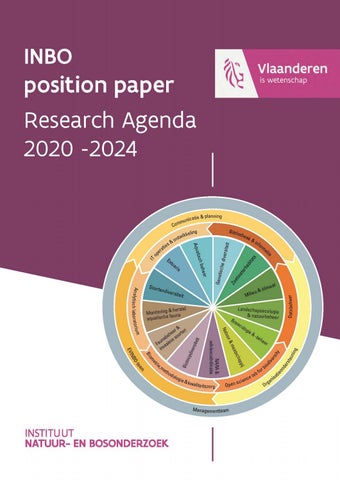
Authors: Maurice Hoffmann, Lymke Janssens, Daniel De Charleroy, Irina De Landtsheer, Gerald Louette, Ann Milbau, Johan Peymen, Marc Pollet, Sarah Van Thienen, Sandra Van Waeyenberge Research Institute for Nature and Forest INBO is the independent research institute of the Flemish government that supports and evaluates biodiversity policy and management through applied scientific research and by opening up access to data and knowledge. Office: INBO Havenlaan 88 bus 73, 1000 Brussels www.inbo.be email: maurice.hoffmann@inbo.be Translation of: Hoffmann M., Janssens L., De Charleroy D., De Landtsheer I., Louette G., Milbau A., Peymen J., Pollet M., Van Thienen S., Van Waeyenberge S. (2019). INBO position paper. Onderzoeksagenda voor 20202024. Mededelingen van het Instituut voor Natuur- en Bosonderzoek 2019 (2). Instituut voor Natuuren Bosonderzoek, Brussel. doi.org/10.21436/inbom.19088557 D/2020/3241/266 Communications of the Research Institute for Nature and Forest 2020 (3) ISBN: 9789040304248 Responsible publisher: Maurice Hoffmann Cover image: Nicole De Groof
Š 2020, Research Institute for Nature and Forest
INBO POSITION PAPER Research agenda for 2020-2024
www.inbo.be
Contents Contents ......................................................................................................................................... 2 1 Introduction ........................................................................................................................... 3 1.1 What INBO is all about: Science for Nature .................................................................. 3 1.1.1 Mission ................................................................................................................... 3 1.1.2 Vision ...................................................................................................................... 3 1.2 Dialogue for a new research agenda ............................................................................. 3 2 WHY conduct research into biodiversity and ecosystem services?....................................... 5 2.1 Policy for biodiversity and ecosystem services .............................................................. 5 2.2 Working together to reverse the trend ......................................................................... 6 3 HOW will we conduct our research? ..................................................................................... 8 3.1 Transparent, targeted and accessible research ............................................................. 8 3.2 Efficient monitoring ....................................................................................................... 8 3.3 Scientific insight for solution-oriented advice ............................................................... 9 3.4 Open dialogue and co-creation...................................................................................... 9 3.5 Future scenarios ........................................................................................................... 10 4 WHAT are our priorities for 2020-2024? ............................................................................. 11 4.1 What are continuing areas of focus for INBO? ............................................................ 11 4.1.1 Protected flora and fauna .................................................................................... 12 4.1.2 The aquatic environment ..................................................................................... 12 4.1.3 The terrestrial environment................................................................................. 13 4.1.4 Forests and the forest environment .................................................................... 14 4.1.5 Wildlife management........................................................................................... 15 4.2 New research challenges for nature policy and society .............................................. 16 4.2.1 Climate change and biodiversity .......................................................................... 16 4.2.2 Invasive species .................................................................................................... 17 4.2.3 Multifunctional open space ................................................................................. 18 4.2.4 Agriculture and biodiversity ................................................................................. 18 4.2.5 Nature in the city ................................................................................................. 19 4.2.6 Natural capital accounting (NCA) ......................................................................... 20 4.3 Approach to the new research themes ....................................................................... 21
///////////////////////////////////////////////////////////////////////////////////////////////////////////////////////////////////////// Page 2 of 21
INBO POSITION PAPER
www.inbo.be
1 INTRODUCTION Over the past year, the Research Institute for Nature and Forest (INBO) has examined the research requirements for nature policy in Flanders. A number of INBO’s roles are laid down in decrees and implementing orders. In addition to these, we wish to pay attention to new themes that are crucial to the provision of policy support. In doing so we also look outside the areas characterised by high biodiversity and take the multifunctional use of the environment into account.
1.1
WHAT INBO IS ALL ABOUT: SCIENCE FOR NATURE
1.1.1
Mission
INBO is the independent research institute of the Flemish government that supports and evaluates biodiversity policy and management through applied scientific research and by opening up access to data and knowledge.
1.1.2
Vision
INBO aims to be the key point of contact in Flanders for the provision of evidence-based support for nature policy and its implementation. It describes the status and trends of biodiversity and ecosystem services, investigates the causes of changes and develops directly applicable tools. It develops scenario studies that underpin nature policy in the longer term. All research is conducted in dialogue with partners from society, the world of science, policymaking and management.
1.2 DIALOGUE FOR A NEW RESEARCH AGENDA In our strategic exercise, we conducted an extensive consultation of our internal and external stakeholders. Our aim in doing so was to ensure that our research agenda reflects the needs of policymakers and field managers and new social developments as closely as possible. The views of 160 representatives – and 75 different organisations – from government, civil society and academia were received. A total of 120 INBO staff members participated. The exercise consisted of several different steps: ● ● ●
June 2018: study day and discussion in which internal and external1 experts stated their views on the direction research should take autumn 2018: internal working groups on research themes in order to define priorities autumn 2018 - spring 2019: internal consultation with the teams on the research prospects for the next five years
1 Prof.
Henk Siepel (Radboud University, the Netherlands; Chair of INBO Scientific Advisory Committee), Luc Bas (Director of IUCN-Brussels Office), Ben ten Brink (PBL - Netherlands Environmental Assessment Agency) and Ignace Schops (Director of the Kempen & Maasland Regional Landscape, President of the Council of Europarc Federation, member of the EU chapter of the Club of Rome, and one of the initiators of the Hoge Kempen National Park).
///////////////////////////////////////////////////////////////////////////////////////////////////////////////////////////////////////// www.inbo.be
INBO POSITION PAPER
Page 3 of 21
● ●
spring 2019: workshops with stakeholders on their expectations concerning the research themes May 2019: feedback from INBO’s Scientific Advisory Committee
This is the process by which we developed this position paper setting out a research agenda for the period 2020-2024. The document is structured around WHY INBO’s research is needed, HOW we plan to approach that research and WHAT exactly INBO plans to research during the next legislative period.
///////////////////////////////////////////////////////////////////////////////////////////////////////////////////////////////////////// Page 4 of 21
INBO POSITION PAPER
www.inbo.be
2 WHY CONDUCT RESEARCH INTO BIODIVERSITY AND ECOSYSTEM SERVICES? 2.1
POLICY FOR BIODIVERSITY AND ECOSYSTEM SERVICES
The International Convention on Biological Diversity came into force in 1993 in order to ensure the conservation and sustainable use of biodiversity. Since then, various studies have indicated that biodiversity is decreasing ever more rapidly and that the limit value2 is being exceeded even more seriously than that for climate change. The Intergovernmental Science-Policy Platform for Biodiversity and Ecosystem Services (IPBES) confirmed this trend in its regional assessment for Europe and Central Asia in 20183 and in its global assessment in May 20194. The regional assessment is based on around 4,750 scientific publications and other sources. More than 250 experts contributed to it. It too states that ecosystem services5 continue to decline and that supply and demand are completely out of balance. Moreover, IPBES unambiguously states that people are dependent on biodiversity: human well-being is deteriorating as a result of loss of biodiversity. Biodiversity loss has reached the point where it represents at least as great a threat to our well-being as climate change. The United Nations Sustainable Development Goals (SDGs) 6 also make the link between biodiversity and human well-being. Goal 14 (aquatic life) and Goal 15 (terrestrial life) directly relate to biodiversity, and many other goals are linked to ecosystem services. Goal 15 is about halting the loss of biodiversity on land: ‘Protect, restore and promote sustainable use of terrestrial ecosystems, sustainably manage forests, combat desertification, and halt and reverse land degradation and halt biodiversity loss’.
2 Rockström,
J. et al., A safe operating space for humanity. Nature 461, 472–475 (2009). doi: 10.1038/461472a. Steffen, W., et al., 2015. Planetary boundaries: Guiding human development on a changing planet. Science 347 (6223), 736, 1259855, DOI: 10.1126/science.1259855. 3 IPBES (2018). Summary for policymakers of the regional assessment report on biodiversity and ecosystem services for Europe and Central Asia of the Intergovernmental Science-Policy Platform on Biodiversity and Ecosystem Services, 48 pp. 4 IPBES (2019). Summary for policymakers of the global assessment report on biodiversity and ecosystem services of the Intergovernmental Science-Policy Platform on Biodiversity and Ecosystem Services, 6th May 2019, 39 pp. 5 Services and products that nature provides to people, such as drinking water, wood production, pollination and recreation. 6 United Nations, 2015. UN resolution ‘Transforming our world: the 2030 Agenda for Sustainable Development’.
///////////////////////////////////////////////////////////////////////////////////////////////////////////////////////////////////////// www.inbo.be
INBO POSITION PAPER
Page 5 of 21
The Flemish Government turned the SDGs into 49 concrete goals in its vision document Vizier 20307. SDG 15 was translated into four goals: 41. By 2030, ecosystems and their services and biodiversity have at least been conserved8, natural habitat degradation has been restricted and endangered species are protected. 42. By 2030, it is guaranteed and demonstrably true that all public forests and 50% of private forests are managed according to the new integrated nature management criteria and that Flanders is making an increased contribution to the promotion of sustainable forestry and the reduction of deforestation worldwide. 43. By 2030, no further net addition of degraded land in Flanders is permitted. 44. By 2030, new invasive species have no opportunity to establish themselves and invasive alien species are being tackled or kept under control in order to prevent or limit their impact.
2.2
WORKING TOGETHER TO REVERSE THE TREND
As well as pointing to the decline in biodiversity and ecosystem services, IPBES (2018) also shows how to reverse the trends. This can be done by addressing the main causes, such as changes in land use, climate change, invasive alien species, pollution and consumption, and by changing policies, e.g. by focusing on regional sustainability and global sustainable development. Policy alone cannot reverse the trend: a change of mentality is also needed. Nature’s capacity is limited, and this sets limits on growth for humanity, the economy and society. The awareness of this is growing in society, as we can see from the attention being paid to climate change. A basic requirement for the provision of the necessary solutions is that there should be cooperation between all social stakeholders, policymakers and research institutions. In this way we can start to use nature in a way that is widely supported and multifunctional. As an independent scientific institution, INBO has an important role to play in this. The Flemish Government’s vision document, Vizier 2030, demonstrates the political commitment to take measures to preserve and restore biodiversity. It is essential for the measures to have a strong scientific underpinning. In the 2017 white paper on ‘Open and flexible government’9, one of the five focuses is ‘Substantiated policy in order to explain government measures and as a means of building knowledge’. The Flemish government places emphasis here on scientific research ‘to support, adjust and evaluate policy’. The importance of cooperation for the achievement of more integrated solutions is stressed: ‘We are committed to multidisciplinarity that provides scientific support for the cross-connections in policy’. Through its commitment to cooperation, scientific integrity, citizen science and open science, INBO will provide optimal support to the Flemish government in this regard.
7 Vizier
2030. Een 2030-doelstellingenkader voor Vlaanderen. 2018. Flemish Government, 19 pp. and ecosystem restoration are thus also part of the goal, in line with Target 2 of the EU 2020 biodiversity strategy. 9 Witboek open en wendbare overheid. 2017. Flemish Government, 40 pp. 8 Biodiversity
///////////////////////////////////////////////////////////////////////////////////////////////////////////////////////////////////////// Page 6 of 21
INBO POSITION PAPER
www.inbo.be
In the vision document of Minister-President Geert Bourgeois on ‘Investing in strategic scenarios within Flanders’ 10, the Flemish Government stressed the importance of scenario studies for long-term policy. INBO already has experience and expertise in this type of exercise11 and plans to maintain a clear focus on it in the future.
10 Flemish
Government, 2019. Visienota aan de Vlaamse Regering. Betreft: Investeren in strategische toekomstverkenningen binnen Vlaanderen.VR_2019_2203_DOC.0363/1BIS, 10 pp. 11 Dumortier M., De Bruyn L., Hens M., Peymen J., Schneiders A., Van Daele T. & Van Reeth W. (eds.) (2009) . Natuurverkenning 2030. Natuurrapport Vlaanderen, NARA 2009. Communication of the Research Institute for Nature and Forest INBO.M.2009.7, Brussels. Michels H., Alaerts K., Schneiders A., Stevens M., Van Gossum P., Van Reeth W., Vught I. (2018). Nature outlook 2050: Inspiration for the nature of tomorrow. Synthesis report. Communications of the Research Institute for Nature and Forest 2018 (3). Brussels.
///////////////////////////////////////////////////////////////////////////////////////////////////////////////////////////////////////// www.inbo.be
INBO POSITION PAPER
Page 7 of 21
3 WHAT IS OUR APPROACH? INBO conducts research in order to provide an answer to society-wide issues relating to biodiversity and ecosystem services. Among institutions in Flanders, we have a unique strength in descriptive long-term research into status and trends of species and ecosystems; we intend to maintain this strength. In the years ahead, in order to provide optimal support to policymakers and field managers, we plan to step up our engagement in explanatory research, scenario studies and accessible and applicable research findings and tools. We also plan to pay extra attention to the impact of our research through close interaction with the stakeholders who make use of our research findings.
3.1
TRANSPARENT, TARGETED AND ACCESSIBLE RESEARCH
In preparing for our research, we take the time to clarify our research questions in close consultation with our partners and customers. In line with the ambition set out in ‘Vision 2050. A long-term strategy for Flanders’12, we embrace the open science model. This means making our data and information accessible and reproducible and being open about our methods. We continue to develop high-level scientific quality and reinforce our researchers’ knowledge of statistics, modelling, systems theory, scenario analyses and studies and communication.
3.2
EFFICIENT MONITORING
INBO continues to monitor the state of nature based on its statutory obligations. With our long-term monitoring, we occupy a unique niche in Flemish biodiversity research. The data from this research are indispensable for many stakeholders. To make more explanatory and application-oriented research possible, we are starting to conduct our descriptive research differently. INBO lays stress on coordination: we develop easy-to-use monitoring methods and check the quality of data. In this context, we seek synergies with partners and funding for monitoring by partners and the provision of the data. We also practise citizen science, calling on citizens to provide data under expert INBO guidance. INBO analyses the collected data in order to formulate policy and management recommendations. In this way we seek to work more efficiently and strengthen public support.
12 Visie
2050. Een langetermijnstrategie voor Vlaanderen. 2016. Flemish Government, 105 pp.
///////////////////////////////////////////////////////////////////////////////////////////////////////////////////////////////////////// Page 8 of 21
INBO POSITION PAPER
www.inbo.be
At the same time, we analyse our own monitoring efforts. In order to make our monitoring more efficient and effective, we develop monitoring strategies and rationalise measurement networks. We are continuing to expand the LTER network13. We use innovative techniques such as environmental DNA and remote sensing.
3.3
SCIENTIFIC INSIGHT FOR SOLUTION-ORIENTED ADVICE
The description of status and trends is not enough to provide a scientific underpinning for government policy. We also need to understand why developments occur so that we can formulate solution-oriented recommendations. We start by taking existing knowledge into account. If existing knowledge is insufficient, for example because it does not apply to Flanders, we conduct our own research into the causes of a current status or trend. For example, we investigate ● ● ● ● ● ●
the impact of management and policy public support for measures the functioning of ecosystems the life cycles of species the adaptability of species and populations to climate, agriculture, the city and other factors the importance of biodiversity for ecosystem services and for society.
In addition to our commitment to sound research methods and scientific integrity, we also plan to broaden our focus and start working in a multidisciplinary manner. This involves working closely with other research institutions and stakeholders. We use socio-ecology and systems theory to reflect current social realities. Our research enables us to provide recommendations and applications suitable for policymaking and management. These range from scientific reports and peer-reviewed publications to interactive applications and databases.
3.4
OPEN DIALOGUE AND CO-CREATION
INBO is a practice-oriented expertise centre that combines policy, management and research. It coordinates applied research into biodiversity and ecosystem services in Flanders. Through cooperation and open dialogue, we deliver concretely applicable recommendations, models and scenarios to policymakers and administrators. By doing so, we put biodiversity on the agenda for all policymakers and policy decisions.
13 LTER:
Long-Term Ecosystem Research: a network of sites where universities and research institutions are conducting long-term ecological research and seeking to gain insight into the functioning of ecosystems and their components in an ever-changing environment. Researchers from outside INBO can make full use of the data that are continuously collected on a standardised basis on the sites.
///////////////////////////////////////////////////////////////////////////////////////////////////////////////////////////////////////// www.inbo.be
INBO POSITION PAPER
Page 9 of 21
Cooperation and exchange of knowledge with government, civil society and research partners are essential. Internationally, we engage in cooperation through LTER-Europe, ICP Forests14, LifeWatch15, IUFRO16, EFI17, ALTER-Net18 and other long-term initiatives. Through co-creation we come up with integrated and applicable solutions. We engage in solution-oriented and proactive communication that is tailored to our target groups.
3.5
SCENARIO STUDIES
In order to support policymaking, INBO continues to attach great importance to scenario studies19 about nature, ecosystem services and the environment. To this end, it continues to develop its modelling capability and statistical expertise and to expand its stakeholder networks. We use an objective, scientific approach and test the effect of different policy scenarios, management scenarios, environmental scenarios, climate scenarios etc. on biodiversity and ecosystem services. The vision document of Minister-President Geert Bourgeois on ‘Investing in strategic scenario studies within Flanders’ 20 clearly points to the need for scenario studies. Cooperation with other government agencies such as Statistics Flanders, the Department for the Environment, ILVO, VITO and the federal planning offices is obviously important in this context.
14 ICP-Forests:
International Co-operative Programme on Assessment and Monitoring of Air Pollution Effects on Forests. 15 LifeWatch is a European Infrastructure Consortium providing e-Science research facilities to scientists seeking to increase our knowledge and deepen our understanding of Biodiversity organisation and Ecosystem functions and services in order to support civil society in addressing key planetary challenges. 16 International Union of Forest Research Organizations. 17 European Forest Institute. 18 ALTER-Net brings together leading institutes from 17 European countries. They share the goal of integrating their research capability to: assess changes in biodiversity, analyse the effect of those changes on ecosystem services and inform the public and policy makers about this at a European scale. 19 Such as Natuurverkenning 2030 (Dumortier et al., 2009) and Nature outlook 2050 (Michels et al., 2018). 20 Flemish Government, 2019. Visienota aan de Vlaamse Regering. Betreft: Investeren in strategische toekomstverkenningen binnen Vlaanderen. VR_2019_2203_DOC.0363/1BIS, 10 pp.
///////////////////////////////////////////////////////////////////////////////////////////////////////////////////////////////////////// Page 10 of 21
INBO POSITION PAPER
www.inbo.be
4 WHAT ARE OUR PRIORITIES FOR 2020-2024? 4.1
WHAT ARE CONTINUING AREAS OF FOCUS FOR INBO?
There are a number of ongoing statutory obligations and roles that are listed in European regulations and implementing orders of the Flemish Government: ❖ ❖ ❖ ❖ ❖ ❖ ❖
❖ ❖ ❖
❖
❖ ❖
❖
Nature reporting - Decree on nature conservation and the natural environment (21 October 1997) Provision of advice - Decree on nature conservation and the natural environment (21 October 1997) and elsewhere Biological assessment map - Decree on nature conservation and the natural environment (October 21, 1997) and various other orders and decrees Monitoring of data from recognised game management units regarding spring population numbers and the culling of game species - The hunting decree (24 July 1991) and other orders and decrees Monitoring of licensed hunting in specific domains - Order on the implementation of a pilot licensed hunting project in the Gewestbos Ravels and Hoge Vijvers Arendonk domain forests (2 February 2009) Coordination of Natura 2000 monitoring and reporting - based on the EU Habitats and Birds Directives, in the Decree on nature conservation and the natural environment (21 October 1997) Scientific support and database development in connection with the Programmatic Approach to Nitrogen (PAS) and the Platform for Appropriate Assessment (PPB) - Designation orders of the Flemish Government applying the Habitats Directive with respect to Special Areas of Conservation Coordination of species monitoring - Flemish Government Decree on species protection and species management (15 May 2009) Coordination of the monitoring of invasive alien species - based on EU Regulation No. 1143/2014 and originating in the Flemish Government Order on species protection and species management (15 May 2009) Monitoring and reporting of ichthyofauna - based on the EU Water Framework Directive and originating in the Flemish Government Order establishing the updated water status monitoring programme in implementation of Articles 67 and 69 of the Decree of 18 July 2003 on integrated water policy (26 April 2013) Monitoring of the Marine Strategy Framework Directive - Directive 2008/56/EC of the European Parliament and of the Council of 17 June 2008 establishing a framework for community action in the field of marine environmental policy (Marine Strategy Framework Directive) Monitoring in the context of the Eel Regulation - Council Regulation (EC) No 1100/2007 of 18 September 2007 establishing measures for the recovery of the stock of European eel. Monitoring of forest reserves - Flemish Government Order establishing rules on the designation or recognition and management of forest reserves (20 January 1993) and Decree on nature conservation and the natural environment (21 October 1997) Overseeing the recognition of forest genetic resources - Flemish Government Order on the procedure for the recognition of forest genetic resources and the marketing of forest genetic resources (3 October 2003)
INBO has also entered into three framework agreements with: De Vlaamse Waterweg nv (DVW - the Flemish Waterways Agency), the Maritime Access section of the Department of Mobility and Public Works (aMT) and the Flemish Environment Agency (VMM). These clients determine the tasks we perform, in close consultation with our researchers. Here too we want to increase our efficiency and focus more on explanatory research and impact. ///////////////////////////////////////////////////////////////////////////////////////////////////////////////////////////////////////// Page 12 of 21
INBO POSITION PAPER
www.inbo.be
INBO also continues to focus on tasks based on the order establishing INBO21. We can divide this research into five major themes (see below). New research topics are also addressed within these themes.
4.1.1
Protected flora and fauna
Status and trend monitoring for protected flora and fauna is an essential and legally required element of policy evaluation at the Flemish, Belgian, European and OSPAR22 levels. INBO reports on this by means of indicators. We make as much use as possible of cooperation with external parties for the field work. Species, habitats and areas interact intensely with people, landscape and the environment. Ecological research into the functioning of protected flora and fauna is crucial to their sustainable conservation, restoration and management. With this research, INBO provides scientific support for nature policy. The research findings are also useful in other areas such as spatial planning policy, environmental policy, alien species policy, forest and agricultural policy, etc. In this research, we examine what trends are occurring and look for explanations for them. We use modelling to predict what developments we can expect in a constantly changing environment. We investigate causes, pressures and relations that affect the status and development of species and ecosystems. Based on our findings, INBO provides practical management solutions for practical use by policymakers, managers, consultancies and landscape planners. We continue to breed endangered fish and amphibians and develop (re)introduction plans to support species protection plans and achieve conservation goals.
4.1.2
The aquatic environment
INBO conducts research into the sustainable use and restoration of water-based ecosystems and their services in light of considerations such as climate change, flooding risk, shipping, port development, agriculture, pollution, fishing and alien species. In this way it supports various policy tools: the Water Framework Directive, the Marine Strategy Framework Directive, OSPAR, the Habitats and Birds Directives, the European Eel Regulation, the Long-Term vision for the Scheldt Estuary, the Ramsar Convention, the Nature Decree, the Sigma Plan Update, species protection programmes, etc. This research is partly carried out under the framework agreement with aMT, VMM and DVW, and is conducted in close consultation with the clients. With regard to coastal waters, among other activities we are developing a strategic plan for monitoring seabirds in the Belgian part of the North Sea. We dissect stranded seabirds to find out 21
Flemish Government Order establishing the internal autonomous agency without legal personality Research Institute for Nature and Forest (23 December 2005). 22 The Convention for the Protection of the Marine Environment of the North-East Atlantic or OSPAR Convention aims to protect the maritime environment in the north-east Atlantic, including the North Sea, through international cooperation.
///////////////////////////////////////////////////////////////////////////////////////////////////////////////////////////////////////// Page 12 of 21
INBO POSITION PAPER
www.inbo.be
why they died and how healthy they were. We also determine how much plastic and oil is in the birds’ stomachs. For transitional waters, INBO contributes to the scientific underpinning of management and policy for the Zeeschelde and its tidal tributaries, the Yser estuary and the Zwin. We draw up assessment frameworks, for example for goals, indicators or measures, for habitats, species and biological quality factors. INBO monitors the status and evolution of systems in order to gain insight into causes, establishes the basic requirements for species and habitats and develops predictive models relating to matters such as climate impact, planned interventions and changes in land use. We provide information about basic ecological requirements for shipping, port design and flood risk management and formulate management and recovery measures and compensation and mitigation proposals. We evaluate landscaping projects and management measures to improve design and management. INBO collects data in standing waters to monitor the current status and developments. This is done for Natura2000 reporting purposes and to answer specific questions from policymakers or management teams. In collaboration with Leuven University and the Royal Belgian Institute of Natural Sciences, we investigate the relation between vegetation and land use. In addition, we use our own data to work out the basic abiotic conditions required for a favourable conservation status. In running waters, INBO investigates species and habitats to support the sustainable use, management and restoration of ecosystems under pressure from factors such as climate change, rising sea levels, port development, agriculture and urbanisation. INBO draws up ecological goals and assessment frameworks to evaluate ecological status and provides information about recovery and other measures and the basic conditions for design and management. We develop models of the interactions between organisms and their environment and among organisms. These models predict the outcome of development without any interventions, of planned interventions and of changes in management.
4.1.3
The terrestrial environment
INBO investigates stocks, cycles and flows of nutrients and chemicals in and between the air, soil, water (including groundwater) and vegetation. This is mainly done by means of long-term monitoring, largely in research sites that are part of the European eLTER research infrastructure. Knowledge of the status and trends of nutrient stocks and cycles is of great importance for estimating the impact of environmental pressures (e.g. eutrophication, pollutants, climate change, land use changes) on forests and wildlife, and for proposing measures. Data on air concentrations and deposits contribute to reporting on the effects of air pollution on ecosystems (NEC guideline23). We are continuing this research into stocks and cycles. INBO is also building further on its knowledge of the basic abiotic conditions for habitats and of the relation between nutrient reserves and their availability. It is starting additional research into the effects of recovery measures (e.g. liming) on the nutrient balance, and plans to work on the development of bio- and other indicators, expert systems and signal maps. By intensifying cooperation with university partners
23 National
emission ceilings, 2001/81/EC.
///////////////////////////////////////////////////////////////////////////////////////////////////////////////////////////////////////// www.inbo.be
INBO POSITION PAPER
Page 13 of 21
we are placing more emphasis on ecosystem modelling, such as the development of balance models for chemicals and for water (including groundwater). For the investigation of soil life, we are developing biological indicators that monitor the status and evolution of soil quality and biodiversity in the main habitat types. The effect of management measures on soil quality will also be a research topic. In the area of groundwater and ecohydrology, we describe ecohydrological processes. We rely for this purpose on existing data sets, specifically collected measurement data and long-term monitoring initiatives, including in the LTER sites. We advise on ecological goals for the sustainable conservation and restoration of groundwater-related ecosystems. We also develop assessment frameworks and indicators to critically evaluate the status and trend of and goals in relation to groundwater-related ecosystems and to estimate the potential of nature. INBO continues to support the management and restoration of groundwater-related ecosystems by means of specific advice. Research into the risk of groundwater depletion in nature reserves is becoming an important theme. For this purpose we are developing drought indexes and water balance models, in cooperation with universities and other research institutions. Despite emission-reducing measures over the past few decades, ecosystems in Flanders are still under great pressure from processes such as acidification and eutrophication. INBO is continuing its long-term monitoring of the effects of air and soil pollution on forests and open habitats, with an emphasis on analysing and making effective use of the measurement series.
4.1.4
Forests and the forest environment
Forest research at INBO focuses on understanding the functioning of forest ecosystems. We look at the role of biodiversity, abiotics, climate, environmental pressure and recovery processes. In addition, we continue to focus on genetic research into native trees and shrubs and the climate robustness of native tree species. Based on our ecosystem research, we provide policy- and management-relevant advice and tools such as: -
reference, target and threshold values for habitat quality, environmental pressures and sustainable use tools for sustainable nature-based solutions: decision support models, map layers, collections of forest genetic resources and recommended provenances, genetic data in support of the concept of ‘sustainable conservation status’, etc.
INBO prides itself on its continuity and multidisciplinarity in this respect. We achieve longterm measurement series, databases and collections through permanent measurement networks. INBO employees carry out coordinatory roles in international networks such as ICP Forests. In 2017, INBO initiated an extensive dialogue with stakeholders to jointly determine priorities for forest research. Researchers from universities and representatives from all parts of the forestry sector (policy, management, industry) helped organise the Forest Symposium24.
24 www.inbo.be/nl/bossymposium-2017
///////////////////////////////////////////////////////////////////////////////////////////////////////////////////////////////////////// Page 14 of 21
INBO POSITION PAPER
www.inbo.be
After the symposium, INBO and the universities together used the outcomes of the dialogue process to draw up a knowledge agenda25. In order to implement the knowledge agenda and continue the dialogue, INBO is starting up two consultation structures: ●
●
A forest research users’ platform, which ensures interaction and coordination between all forest actors (policymakers, stakeholders and researchers) by identifying the main knowledge needs and paying attention to the transfer of knowledge to practitioners. Complementing this, a forest researchers’ platform will agree on a suitable strategic approach to the identified knowledge needs. In addition, the researchers’ platform aims to promote cooperation across research institutions and to position Flemish forest research internationally.
By coordinating the forest research users’ and researchers’ platforms, INBO, together with the universities, plans to ensure that forest research in Flanders reflects the needs of policymakers and stakeholders and that research findings are communicated.
4.1.5
Wildlife management
How can our society manage wildlife sustainably? Open space in Flanders is limited and different stakeholders have different expectations of wildlife management. Large mammals such as wild boar, roe deer, beavers and wolves need large habitats, but our countryside is highly fragmented. To provide space for animals, we need to manage them in a targeted manner, in dialogue with all stakeholders involved. INBO develops knowledge about the management of large mammals, game species and alien species. By doing so we support government agencies such as ANB, VMM and VLM that prepare policy and carry out management for certain species. INBO monitors the numbers and distribution of the animals and tracks their use and management. INBO also evaluates management techniques, develops new techniques and provides practical advice. We consult intensively with different societal stakeholders in order to take their wishes into account. We use population modelling to predict the influence of human and other factors on populations of large mammals, game species and alien species in Flanders. Thanks to these models, we are able to form more rapid estimates of the impact of ‘new’ species such as wolves and raccoons. We develop new methods such as uniform monitoring protocols, environmental DNA, camera traps, citizen science and automation of data processing.
25 Quataert
P., Vandekerkhove K., De Vos B., Simoens I., Verheyen K., Ceulemans R., Muys B., Van Acker J. (2018). Het bosonderzoek in Vlaanderen. Stand van zaken en toekomstverkenning. Conclusies en aanbevelingen naar aanleiding van het Bossymposium “Kennis voor het bos van de toekomst” op 12 mei 2017 in Brussel. Communications of the Research Institute for Nature and Forest 2018 (2). Research Institute for Nature and Forest, Brussels.
///////////////////////////////////////////////////////////////////////////////////////////////////////////////////////////////////////// www.inbo.be
INBO POSITION PAPER
Page 15 of 21
4.2
NEW RESEARCH CHALLENGES FOR NATURE POLICY AND SOCIETY
INBO has selected a number of challenges on which it wishes to intensify its focus. We are extending our research into areas characterised by a high degree of human influence such as cities and farmland. We investigate how landscapes can be designed multifunctionally so that different functions can coexist in a sustainable manner. We study pressures that affect people, nature and biodiversity, focusing on climate, invasive species, agriculture and urbanisation, in line with IPBES (2018). In order to include the value of nature and ecosystem services in economic calculations, we are developing natural capital accounting as a policy tool.
4.2.1
Climate change and biodiversity
INBO investigates the effects of climate change on ecosystems. We do this through long-term research in a selection of European protected forests and open habitats in the international context of LTER (Long-Term Ecosystem Research). In the context of climate adaptation, we investigate how the resilience of biodiversity and ecosystem services can be increased. By combining ecological knowledge of species and ecosystems with climate change and land use scenarios, we produce projections of future biodiversity and species distribution. With this information, policymakers can set about the task of protecting biodiversity as much as possible. With regard to climate mitigation, INBO is investigating the possibilities of capturing greenhouse gases in ecosystems and thus reducing net emissions. To do this, we are studying the geographical distribution of carbon stocks above and below ground, their extent, and how they change over time. We are also examining the effects of management, land use and climate change on carbon storage in ecosystems. In particular, we are paying attention to nature and forest areas with high carbon concentrations, known as carbon hotspots. On 1 December 2016, Flanders decided to implement the Paris Climate Agreement in the Flemish Climate and Energy Pact26. The government has drawn up a list of various actions in consultation with the public, some of which are already being carried out. INBO contributes to the following commitments in the pact: ● ● ● ● ● ● ●
Building knowledge about the climate robustness of the Natura 2000 network in Flanders Building knowledge in order to substantiate tools for managers Building knowledge of nature’s contribution to carbon sequestration LTER-Flanders as a research infrastructure for researching and monitoring climate impacts Using the measurement network of unmanaged reference forests (forest reserve measurement network) for particular climate issues Research into the impact of climate change on ecosystem services Research into tree origins as a function of adaptation
26 Annex
1 to the Flemish Climate and Energy Pact. Commitments of the members of the Flemish Government.
///////////////////////////////////////////////////////////////////////////////////////////////////////////////////////////////////////// Page 16 of 21
INBO POSITION PAPER
www.inbo.be
4.2.2
Invasive species
Invasive alien species often have a negative impact on humans and their environment. Wellknown examples include the box tree moth, the Asian hornet, the tiger mosquito and Japanese knotweed. Their socio-economic impact is huge. The annual economic cost to Europe was estimated at EUR 12 billion in 2014. As a logistical and economic hub in north-west Europe, Flanders is also a hotspot for invasions. Recent European legislation (EU regulation no. 1143/2014)27 aims to limit the introduction, spread and impact of invasive alien species in Europe. Of the 49 invasive species listed in the EU regulation, 37 have already been observed in Flanders. In Flanders, the Agency for Nature and Forests (ANB) is responsible for preventing the introduction and spread of species, the management of established species, and reporting on these matters. INBO coordinates the monitoring of the status of invasive or potentially invasive species and supports the ANB. More and more species are reaching Flanders. Little is known about their impact on our biodiversity and our society, and about the specific approach that is needed, with the result that INBO’s task grows ever larger. We therefore prioritise focusing on species about which knowledge is already available, such as birds, carnivores, plants and insects. However, we also want to pay more attention to aquatic species, using new detection techniques such as eDNA in close cooperation with the Flemish Environment Agency. There are five important pillars within this theme. The first and most priority pillar is monitoring, surveillance and open data. This refers to various actions to detect introductions, monitor their spread and make the data accessible. European Union member states are developing oversight systems for this. These include area-wide monitoring and targeted surveillance, which is confined to risk areas. INBO is developing a monitoring framework and methods for this purpose and sharing its knowledge with the other actors. The Invasive Alien Species portal28 ensures access to data on invasive alien species in Belgium. Each species needs a specific approach. as is shown by Vespawatch29, a citizen science project about the Asian hornet. INBO is responsible for coordination in Flanders: we supply the portal with data, knowledge and information, which we collect ourselves or in conjunction with external actors, and we optimise the data flows. INBO reports to Europe on the spread of invasive species. Risk management and management evaluation (Pillar 2) is also a high priority. Managers need feasible and meaningful management measures that are evidence-based. The management approach depends on the species, but must also take the context of the ecosystem into account. INBO integrates knowledge in this context through a scenario approach, based on clear goals, rigorous management monitoring and alignment with the expectations of the different stakeholders. Knowledge about the effectiveness of management measures is exchanged in networks in which management, policymakers and the world of science are represented. A third important pillar, impact and risk analysis, is closely linked to the two previous pillars. This involves detecting trends and predicting which species we can expect in Belgium over the next 10 years and what impact they will have. INBO implements this pillar through the provision of ad hoc advice based on knowledge integration. 27
In implementation of the Convention on Biological Diversity and the European Biodiversity Strategy.
28 http://ias.biodiversity.be/ 29 https://vespawatch.be/
///////////////////////////////////////////////////////////////////////////////////////////////////////////////////////////////////////// www.inbo.be
INBO POSITION PAPER
Page 17 of 21
The fourth pillar is in-depth systems-oriented research into the resilience of ecosystems. We are looking to work with universities for this pillar (e.g. doctoral research). We are also committed to working with external parties on the human dimensions of biological invasions (Pillar 5).
4.2.3
Multifunctional open space
The conservation and sustainable management of high-quality, multifunctional open space is high on the Flemish policy agenda. Open space is essential for numerous socially important functions: ‘ecosystem services’ such as food and wood production, soil fertility conservation, regulation of water and water flows, and recreation and tourism. Multifunctional landscapes in which different functions exist side by side (e.g. enjoying nature in addition to food and wood production) are important for prosperity and social well-being. They must be designed and used in a sustainable and resilient manner, in the pursuit of a low-carbon and circular economy and in the context of climate change. INBO is developing a socio-ecological research framework in which changes in the landscape and ecosystem services are linked to causes and their underlying socio-economic context and policy frameworks. INBO’s starting point here is an ecosystem management approach, in which we seek to conserve or restore ecosystems sustainably over the long term. With this in mind, we are developing a vision for the future together with all stakeholders, bringing together ecological and socio-economic perspectives in order to apply them to the geographical and ecological situation. INBO uses innovative methods such as participatory action research that help to reconcile societal needs with the biophysical possibilities of landscapes. We conduct research into and support participatory processes that lead to a multidisciplinary understanding of the environment and its users. We issue advice that presents scenarios for a sustainable, resilient and supported multifunctional design, and measures that can enhance the possibilities for biodiversity in multifunctional landscapes. In this way, INBO aims to participate in widely supported and sustainable local development schemes in Flanders.
4.2.4
Agriculture and biodiversity
In agricultural areas, a number of typical arable and pasture species are continuing to decline, despite all the measures that have been taken. We only know about a small proportion of the biodiversity in our agricultural areas. Europe requires us to monitor and report on that biodiversity. INBO regularly receives parliamentary questions and requests for advice on possible policy options and on policy follow-up. INBO reports on the status and trend of biodiversity and ecosystem services in agricultural areas. It does so on the basis of existing measurement networks and indicators and by estimating the biological value of the agricultural ecosystem using the Biological Assessment Map (BWK). We optimise existing indicators and develop new ones, such as a multi-species indicator, a ‘minor landscape features’ indicator and an indicator on the ‘potential delivery of ecosystem services by the agricultural ecosystem’. Good insect and soil biodiversity is essential for food production. To determine these, we are developing two indicators. The taxonomic biodiversity indicator reflects the species richness and structure of the insect and soil fauna as a possible gauge of authenticity and nature conservation value. The functional biodiversity indicator measures whether the agricultural ecosystem still has all the functional
///////////////////////////////////////////////////////////////////////////////////////////////////////////////////////////////////////// Page 18 of 21
INBO POSITION PAPER
www.inbo.be
groups necessary to deliver ecosystem services sustainably. INBO is devising an efficient and generally applicable methodology for monitoring and identifying species. In conjunction with the Institute for Agricultural, Fisheries and Food Research (ILVO) and other research institutes, we are setting up an Agricultural Biodiversity Measurement Network. From this network we can come up with a workable set of indicators to keep track of the situation, examine the effect of management measures and study pressures. For the network, we are defining the baseline biodiversity in the agricultural areas. For this, habitats also have to be mapped in the agricultural areas (BWK). Nature outside the special areas of conservation is also very important for maintaining nature and ecosystem services in Flanders. For the mapping, we are working with innovative monitoring methods such as smart image recognition of aerial photos and satellite images, and DNA barcoding of soil biodiversity. We are committed to working with volunteers, with INBO providing coordination, training and quality control. We are looking for additional funding for the use of the volunteer network. INBO investigates the effectiveness of management measures in the agricultural areas. We combine new knowledge together with the literature and transform our insights into made-tomeasure applications for policymaking and management. We disseminate our knowledge through specific channels such as Ecopedia. We study the impact of pressures such as fragmentation, pesticide use, nitrogen deposition and climate change on biodiversity. We focus on trial plots where we test measures in an experimental environment. This enables us to evaluate existing measures and develop new ones. To this end, we consult intensively with stakeholders such as policy implementers, practice centres and farmers, to bring the research as closely into line with policy and practice as possible. Overall, we are strengthening our partnership with ILVO for our research in agricultural areas.
4.2.5
Nature in the city
A complex spatial structure has arisen in Flanders, in which the traditional boundaries between built-up areas and open space are becoming blurred, nature is fragmented and more and more people are living in the city or in urban areas. By stepping up research into nature in the city, INBO aims to help improve the quality of life in cities and bring city-dwellers closer to nature. A first research component involves looking at urban nature from an ecological perspective: protected species, indicator species that tell us about the quality of life in the city, urban nature reserves, specific habitats such as brownfields, wall vegetation and green roofs, the importance of nature corridors in urbanised areas or the effects of ecological vegetation management. We also want to add further depth to the concept of ‘ecosystem services in the city’, or the benefits of nature in the city. Such benefits include the enjoyment of nature, combating heat islands and local food production. In a third research component, we are investigating the social aspects of urban nature, such as the diversity in the way people think about nature and perceptions of ecological vegetation management. Given that everything in cities is primarily there for people, it is important to redefine the concept of nature in a way that takes city-dwellers’ views into account. The term ‘urban nature’ can therefore cover a wide range of forms that make cities better places for plants, animals and people.
///////////////////////////////////////////////////////////////////////////////////////////////////////////////////////////////////////// www.inbo.be
INBO POSITION PAPER
Page 19 of 21
4.2.6
Natural capital accounting (NCA)
Our society is intimately bound up with the natural system in which it functions. We make use of the natural capital that our environment offers: raw materials such as water, wood, food and minerals, regulatory functions such as water purification and air purification, and cultural services such as recreation and inspiration. Natural capital is the basis for our economy, prosperity and well-being, but the methods we use to identify our economic activity do not reflect the link between economy and natural capital. Natural capital accounting (NCA) is a framework that offers an integrated approach. It measures how stocks of natural capital change and integrates the value of the ecosystem services that natural capital provides into the country’s economic accounts. INBO can use NCA to provide policymakers with comparable information about (1) changes in the composition and quality of ecosystems and biodiversity and (2) changes in ecosystem services for different economic units such as households, economic sectors and society as a whole. This is done by bringing existing data and new data together in a single central accounting system. INBO wants to put NCA on the map for Flanders in order to give natural capital a more central place in society and ensure that it plays a bigger role in policy decisions. We will work closely with partners to come up with a widely applicable policy tool. When NCA has been developed as a policy tool, it has a wide range of applications, for example for cost-benefit analyses and impact assessments of projects and programmes (socalled ecosystem service impact reports), scenario analyses and studies, economic modelling, international reports, indicator reports and policy evaluations. NCA can be used to draw up an integrated budget and to map the economic value of individual ecosystem services. NCA does not aim to express the value of nature in monetary terms, but to ensure that it is clearly included in policy decisions. The framework also makes it possible to meet the five major challenges of IPBES3030: ● ● ● ● ●
monitoring and describing the status and trend of ecosystem services monitoring and describing the status and trend of biodiversity analysing the impact of land use changes and other pressures developing and calculating scenarios, and exploring policy options.
INBO also uses NCA for nature reporting. We regularly report on the state and importance of our natural capital, interpret and explain trends and make specific policy recommendations. We also create derivative applications at the request of users. By working with the standards for NCA, we can tackle this efficiently and consistently.
30 IPBES
(2018). Summary for policymakers of the regional assessment report on biodiversity and ecosystem services for Europe and Central Asia of the Intergovernmental Science-Policy Platform on Biodiversity and Ecosystem Services, 48 pp.
///////////////////////////////////////////////////////////////////////////////////////////////////////////////////////////////////////// Page 20 of 21
INBO POSITION PAPER
www.inbo.be
4.3
APPROACH TO THE NEW RESEARCH THEMES
INBO creates space for new research themes by focusing on more efficient ways of working, e.g. for monitoring. We also seek closer cooperation with other partners. We do this on the basis of specific opportunities and by further developing structural partnerships and networks. Doctoral research is an important pillar of our cooperation with universities. We focus research conducted using our own resources on INBO’s new priorities as far as possible. We are also looking at how we can tailor our research to customers’ requests. In addition, INBO needs extra people and resources to be able to focus intensively on the new themes. Only in this way can scientific research substantiate policy and support customised management for current social issues.
///////////////////////////////////////////////////////////////////////////////////////////////////////////////////////////////////////// www.inbo.be
INBO POSITION PAPER
Page 21 of 21