B’Nai B’rith m
a
g
a
z
i
n
e
PUBLISHED SINCE 1886
Winter 2007
Israel’s Water Deficit: Shortages Threaten Economy, Security
Poland’s Chief Rabbi: Former New Yorker Toils to Revive Polish Jewry
After 70-Year Dormancy, B’nai B’rith Poland Reborn IsraAID
Traveling the World for Tikkun Olam
winter 2007
B’nai B’rith M a g a z i n e COVER STORIES
12
B’nai B’rith Poland Reborn
Nearly 70 years after the closings of B’nai B’rith’s 10 lodges in Poland, in an event 10 years in the planning, B’nai B’rith International revived its lodge in Warsaw with a moving ceremony on September 9, 2007. By Hiram M. Reisner
16
Poland’s Chief Rabbi
In 1973, Michael Schudrich, a New York City native, took a high school trip to Poland, his ancestral homeland. In 2000, he became the spiritual leader of the Nozyk Synagogue—the only synagogue in Warsaw that survived the war—and, in 2004, the chief rabbi of Poland. By Hiram M. Reisner
20
30
It started in 1998 as a simple 8thgrade project and evolved into an endeavor gaining worldwide attention. The Paper Clips Project is the effort of middle school students from the small southeastern Tennessee town of Whitwell who created a monument for the Holocaust victims in Nazi Germany. By Rich Bindell
36Water Deficit
Clips Project
IsraAID
Around the World
In the summer of 2007, Israeli medical and disaster relief personnel lent their expertise to Peru, where hundreds had died or been injured in the communities in and around Pisco following an earthquake registering 8.0 on the Richter scale. The urgent undertaking was spearheaded by IsraAID; B’nai B’rith International was one of the founders of this Tel Aviv-based organization. By Janet Lubman Rathner
page four
24 Student Paper
My One-Year Annual Review: What’s My Grade? By Moishe Smith, President, B’nai B’rith International
DEPARTMENTS Editor’s Note 6 Point of View 8
Aging in Place Trend Matures
With the knowledge that 1.2 million people will be over the age of 65 in the year 2030, baby boomers are embracing a growing phenomenon that will allow them to maintain quality-of-life without excessive aid from others. The concept is known as Aging in Place. By Alison Goldstein
Israel’s
The lower Jordan looks like most of Israel’s other rivers: toxic streams choked by pollution, soiled by unfettered industrial dumping, and desiccated by insufficient rainfall and heavy water use. Israel’s waterways are perhaps the most salient example of the country’s environmental record. By Uriel Heilman
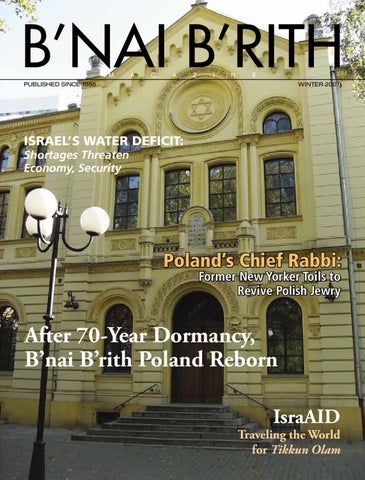
Cover: The Nozyk Synagogue—the only synagogue in Warsaw that survived the war.
Up Front 10 Healthy Living 34
Book Review 53 The Last Word 54
Photo courtesy Shmuel Ben Eliezer
My One-Year Annual Review
B’nai B’rith Staff Photo
Point of View
What’s My Grade? By Moishe Smith, President, B’nai B’rith International
E
veryone in life gets a review. We are all judged by our performance and graded. Teachers evaluate students and send home report cards. Employers evaluate employees and file performance reviews. Scouts rank players to provide for the team’s best. Clerics counsel parishioners to determine redemption. Peer groups judge peer groups and determine who belongs and who doesn’t. Doctors assess patients, who then judge their bedside manner. Companies create focus groups to help determine customer satisfaction. Who among us hasn’t completed a survey to rate performance? No one in life escapes their review, your B’nai B’rith International president included. In this column I will attempt to provide you with a realistic one-year self-assessment of my performance; of my strengths and weaknesses; my accomplishments and disappointments; and my short-term and long-term goals for the betterment of the global Jewish community. Before my one-year anniversary, I was asked to complete a presidential exercise to determine my standing with regard to our organization’s agenda and mandate. The exercise was thought-provoking, reflective— at times easy, and at times most difficult, if I was to be honest with my answers, and my conscience, as your volunteer leader. I humbly share with you my one-year annual review and ask you, the B’nai B’rith
4 Winter 2007
reader, to evaluate my performance and give me my grade. 1. What three things over the past 12 months do you consider your greatest accomplishments? • Keeping the Best: I was able to help retain B’nai B’rith’s most valuable and trusted asset, our Executive Vice President Daniel S. Mariaschin. It is no secret that Dan was courted, and indeed enticed, to consider a career move. To our credit and the excellent working and personal relationship that Dan and I have developed over the years (not to mention his 20-year commitment to the B’nai B’rith family), Dan chose to remain with us. He continues to help guide us on the course that he, in consultation with lay leadership, has set for our praiseworthy organization. I am very grateful for Dan’s decision to remain as our beacon, and I look forward to continue serving the global Jewish community with him. • Interaction with Other Organizations: Because of how competitive Jewish organizations are with each other, I have tried diligently to reach out to many of these organizations, developing personal relationships with their key leadership and, wherever appropriate and possible, encouraging joint projects for the benefit of the entire community.
• The Merging of the B’nai B’rith Political Program: Since serving as chair of the International Council, I developed a fond interest in Latin America. When attending a B’nai B’rith Argentinean conference on antiterrorism in the wake of the Amia and Israeli embassy bombings in Buenos Aires, I had my first opportunity to make a B’nai B’rith presentation. I witnessed first-hand the work being done in partnership between Latin American volunteers and senior B’nai B’rith lay leadership. It was my dream to duplicate this process, delivering the B’nai B’rith message to Jews around the world. In my opinion, Latin America is the model of B’nai B’rith partnership in the field. Today, I believe I am successfully delivering our message, loud and clear, at the United Nations in New York and the European Union in Geneva. I encourage and applaud the work being done by B’nai B’rith Canada, Australia, New Zealand; at our World Center in Jerusalem; at Mercosur, the Organization of American States, the Organization for Security and Cooperation in Europe; and now through our newly opened office in Brussels. Together, we are all working to protect human rights and freedoms, human dignities and values.
B’nai B’rith
M a g a z ine Winter 2007
2. What three things have you not accomplished but still want to? • Community Building: To spread the B’nai B’rith message, we need to bring programming back to the individual communities, as this model proved to be our strength for so many years. The concept is a s-l-o-w work in progress, a concept that is shared by our Chairman of the Executive Dennis Glick, and our two senior vice presidents, Harold Steinberg and John Rofel. John serves as inspiration on the community level by the successes he has shown in developing B’nai B’rith in Detroit. Other community examples include Omaha, Youngstown, Seattle, St. Louis, and Denver, just to name a few. The United States is vast, and there is much territory to cover to continue to deliver programming at the community level. • Marketing & Communications: For whatever the reason, the hardest thing to do in most nonprofits that work with limited budgets is to get their message out to the community. B’nai B’rith is no different. We have improved our communication model by leaps and bounds, and our press coverage has grown immensely. However, we cannot rest on our laurels. We need to continue to build on these media advancements, develop personal relationships with newspaper and magazine personnel, and never be afraid to take on the tough issues in print. In addition, we need to provide our professionals with timely marketing materials to better promote our mission and tell our story. • Break down the Barrier Between Professional and Volunteer: The relationship between professional and volunteer still needs to be better defined to best serve the community. I would like to help forge relationships that have the potential to become real partnerships in delivering and serving our programs to our constituents. We need to create well-defined descriptions of each other’s roles and responsibilities, to enhance existing relationships and to develop lasting partnerships.
3. What three phrases would the staff best use to describe you? The staff and I have gradually begun to understand each other better to move our agenda forward. Perhaps more time spent in Washington, D.C., will lead to a better rapport and the development of a set of protocols that will make us more mobile and responsive to the ever-increasing needs of the Jewish community. I humbly acknowledge I am not the easiest of individuals with whom to work. Ergo, I believe the staff might find me… 3 Harsh but fair 3 Impatient 3 Demanding 4. What three words would the Board of Governors best use to describe you? I think some board members may find me a little unresponsive to daily minutia, a little bit too involved in the bigger picture, and a little too focused on fundraising, as I think they are not quite ready to fully embrace the need for a major culture change from the lodge model to the fundraising model. Perhaps the words they would use to best describe me are: 3 Unattached 3 Aloof 3 Motivated 5. What three words would donors best use to describe you? There is no greater feeling of satisfaction than when I connect with a donor. I truly enjoy every interaction I have had, to date, in meeting with potential donors and our “investors” alike, the result of which has been a tremendous boost to our development and bottom-line fundraising structure. I will continue to develop relationships and fundraise around the globe to help offset the growing expenses of our organization. I have been told that donors find me: 3 Engaging 3 Earnest 3 Committed 6. What three words would you use to best describe yourself? 3 Charismatic 3 Impatient 3 Hard-working 7. If you could change one thing in the last 12 months, what would it be?
Vol 121, no. 4
Moishe Smith President, B’nai B’rith International Daniel S. Mariaschin Executive Vice President Deborah Auerbach-Deutsch Vice President, Communications Hiram M. Reisner Editorial Director Janet Lubman Rathner Senior Editor Alison Goldstein Assistant Editor Simeon Montesa Art Director Vivian Hayward Graphic Designer Ruth E. Thaler-Carter Copy Editor Harvey Berk Production and Advertising Manager R.R. Donnelley Prepress & Printing Editorial Offices: 2020 K St., NW, 7th Floor, Washington, DC 20006 (202) 857-6534 or Email: bbmag@bnaibrith.org Readership: Approximately 175,000 Signed articles represent the opinions of their authors and are not necessarily the view of B’nai B’rith or B’nai B’rith Magazine. Return postage must accompany unsolicited material, for which no responsibility is assumed. Contents ©2007 by B’nai B’rith. All rights reserved. Printed in U.S.A. The B’nai B’rith Magazine (ISSN 1549-4799) is published quarterly (Spring, Summer, Fall, Winter) by B’nai B’rith, 2020 K St., NW, 7th Floor, Washington, DC 20006, and is indexed in the Index to Jewish Periodicals. Subscription rates: U.S. and possessions, one year, non-member, $12; Canadian member, $12; Canada non-member, $17; overseas member (outside U.S. and Canada), $36; overseas non-member (outside U.S. and Canada), $48. Members of Hillel and BBYO, $7.50. $5 of member dues goes toward B’nai B’rith Magazine. Periodicals postage paid at Washington, D.C., and additional mailing offices. Notification of address change should be sent to Circulation, 2020 K St., NW, 7th Floor, Washington, DC 20006, or call 888-3884224. Please allow six to eight weeks for change. Postmaster: Send address changes to B’nai B’rith Magazine, 2020 K St., NW, 7th Floor, Washington, DC 20006. B’Nai B’rith 5
Point of View I doubt I would make any changes or wish for things to be different. When I come to a fork in the road, I have the option of going left or right. The direction I choose is usually made by what motivated me that particular day. Once decided, I do not retrace my steps, nor will I ever have the opportunity to make that turn again. I am best with a decision made at the moment, and I let my decision take me where it may. For me, it’s an evolutionary process, always bringing me to the next fork in the road. I rarely second-guess myself. If one continues to second-guess oneself, you end up in a morass of process instead of being on a path to progress. 8. If your term as president ended at midnight tonight, what would you tell the next president his first order of business should be? To continue to build and strengthen the fundraising structure and department because fundraising is the lifeblood, the fuel for the delivery system, for every nonprofit organization. 9. As president, how do you want to be remembered? I would like to be remembered as the president who helped to change the culture of B’nai B’rith International by making it a respected household name globally; who showed our membership and investors the value of investing in our mission; and who provided an on-the-ground delivery system of programming to communities around
the world. And…let’s not forget, as the best-dressed! 10. If you found the bottle with the genie, and she granted you three wishes, what would they be? • As much as this is not the reality of the day, I would like B’nai B’rith to become a mass membership organization again, because so many of our members are stuck in that time and, for whatever reason, cannot or will not move forward. Many of our members want to continually lament the changing times instead of rejoicing in them and helping the organization wend its way through the necessary changes that will keep us vibrant, relevant, and state-of-the-art, so we can best serve the needs of today’s Jewish community. • My second wish (in the interest of not wanting to be greedy) is for B’nai B’rith to become a leader in the fundraising arena, raising an additional $5 million dollars per year. Why only $5 million? Because B’nai B’rith as a nonprofit organization knows how to make a ton of impact with a small amount of dynamite. • Peace in the Middle East between Israelis and Palestinians, and, indeed, between Israelis and all of their moderate Arab neighbors. For peace in the Middle East cannot remain an elusive dream forever.
The exercise complete, the hardest thing in the world to do is mark your own scorecard. For it is much easier to have others critique you (as many of you are wont to do on a daily basis). One of the most difficult things a president has to endure is the criticism that comes from his own constituents. Does anyone really have all the answers? I have watched successive presidents undergo this endurance test from their own constituents, and now it is my turn. I know for a fact that no one has all the answers. I certainly do not. Yet, at day’s end, it is my responsibility to guide us through this piece of the B’nai B’rith evolutionary process in preserving and growing our legacy. Three years of our 164 years is miniscule. We need to all get on the same page. We need to all celebrate the positive impact our organization has on the global community. We need to stop lamenting the things we cannot change. We need to embrace, together, the things we can. Along with the next generation, we need to ensure the B’nai B’rith legacy for another 164 years. For no dream is too big or too small to ensure the future of the chosen people. I am honored to serve as your president, and I will continue to do so to the best of my ability every day until my term ends. I welcome your comments and suggestions, and I readily await your grade of my oneyear annual review.
Editor’s Note
I
had been to Poland before—almost 20 years ago, just as communism was beginning to wane in most of Sovietdominated Eastern Europe. People were still standing in line for daily commodities, and most of the capital city of Warsaw bore the dank façades of a decaying political and economic system. The fact that I was Jewish held no significance to the itinerary or to other members of our tour. When I noticed that an old building that housed a bakery had a Magen David engraved on the wall of its upper
6 Winter 2007
floors, it was shrugged off. Twenty years later, I returned to Warsaw with a strictly Jewish purpose in mind. After 70 years, B’nai B’rith Poland was being reborn, in a city that had suffered from, and had been a microcosm of, all the horrors that the Holocaust bred. In this issue of the magazine, we describe the resurgence and the ceremony that brought B’nai B’rith back to Poland and the importance of the revival of the lodge to the Polish Jewish community. During my trip to Poland, I had the
privilege and pleasure to meet the chief rabbi of Poland, Michael Schudrich. The rabbi is New York City-born and has a unique perspective on the importance of the Polish Jewish community. We include an interview with the distinguished rabbi in which he explains the distinctive challenges facing Jews as they rebuild what was once a devastated culture. The magazine also focuses on several other B’nai B’rith-related issues that we hope will be of interest to our readers. (continued on pg. 9)
Point of View B’nai B’rith Staff Photo
Our Mission at the United Nations By Daniel S. Mariaschin Executive Vice President, B’nai B’rith International
A
s I write this, the first of my new quarterly columns for B’nai B’rith Magazine, the U.N. General Assembly is in session. B’nai B’rith International (BBI) is once again making its positions known to the Human Rights Council (HRC) in Geneva and UNESCO in Paris, as well as to friends and foes at U.N. headquarters in New York City. In September alone, BBI leaders met with more than 20 heads of state and foreign ministers, including some of Israel’s Arab neighbors, such as Egypt and Jordan. I am often asked what we do in the course of so many U.N. meetings and why we bother to spend so much time talking to what can often serve as a platform of enmity toward Israel. Being the only Jewish nongovernmental organization (NGO) with an office exclusively dedicated to United Nations affairs, we at BBI believe it is our duty to press the U.N. to consider long-term strategies for promoting and protecting Jewish and Israeli causes and rights. In the course of our deliberations, we consider the big picture for Jews in the world today. In this year’s meetings, we discussed the global threat of Iran; the Israeli-Palestinian conflict; Israel’s status at the U.N.; antisemitism and the upcoming review of the Durban World Conference Against Racism; and the situation in Darfur with respect to genocide prevention.
8 Winter 2007
Here’s a review of our current advocacy agenda.
ment and close down—once and for all—all terrorist organizations.
Iran
The HRC as Symbol of Israel’s Beleaguered Status at the U.N.
Iran remains one of the most severe threats, not only to regional stability but to the entire world. Based on its statements that it is now capable of industrial-scale uranium enrichment, Iran is defying two Security Council resolutions demanding that it suspend such programs. It’s important that we welcome all Security Council efforts to tighten sanctions against Iran, because it shows that we believe the U.N. system was created for a reason. On the flip side, if the Security Council is to remain a credible source of authority on matters of collective security, a clear, swift response to this threat must be sustained.
Israeli-Palestinian Conflict Any legitimate Palestinian government must renounce violence and end incitement, recognize Israel, and accept previous agreements and obligations, as stated in the principles of the Middle East Quartet—the U.N., European Union, Russian Federation, and United States. BBI believes the Palestinians have long been ill-served by their leadership. While Israel has its obligations as well, they can only be met in a dialogue with Palestinians who are willing to consider Israel’s fundamental rights and needs and who must end incite-
The decision to include a permanent item on the question of Palestine, thus placing Israel on the agenda as the only countryspecific agenda item, is damaging to the HRC’s credibility and its ability to promote and protect human rights. For several years, the Commission on Human Rights, the HRC’s predecessor, allowed this biased treatment toward Israel; we had hoped instituting this new human rights body would stop that trend. Compounding this problem is the council’s decision to reiterate the former commission’s perpetual mandate of John Dugard, the special rapporteur on the Palestinian territories, who focuses exclusively on alleged Israeli violations. This is in sharp contrast with the mandates of more than 40 other human rights experts.
Antisemitism/Durban Review Conference The 2001 World Conference Against Racism, Racial Discrimination, and Xenophobia in Durban provided a platform for extreme manifestations of antisemitism, both visible and physical, as outlined in the text of an NGO-adopted declaration, and beyond.
B’NAI B’RITH INTERNATIONAL The decision recently taken by member states to convene a Durban review conference bears great risk of repeating that shameful experience. Without official acknowledgement by the U.N. and its member states of the hatred spawned at the conference, in the absence of a review of lessons to be learned and a commitment to prevent similar manifestations through practical steps, an additional conference threatens to perpetuate the same hatred. This is why we have joined nearly 30 other NGOs in committing to a set of core operating principles for the 2009 Durban Review Conference. We are calling on other NGOs to join us in committing to promote international human rights standards and to prevent U.N. sessions from serving as a vehicle for antisemitism and any other form of racism.
Darfur and Genocide Prevention We welcome the creation of a hybrid peacekeeping force—a joint African Union-U.N. operation—and hope the recently adopted resolution in the Security Council is implemented in a timely fashion. The credibility of the U.N. remains at stake in Darfur, where the Sudanese government remains intransigent.
We also welcome the appointment of international scholar and former Sudanese diplomat Francis Deng as the fulltime special adviser to the secretary-general on genocide prevention. This is an important step in guaranteeing future efforts to uphold its goals as laid forth in the U.N. Charter and the Convention on the Prevention and Punishment of the Crime of Genocide. So, again, why do we bother making our presence known to the U.N. and its commissions? We bother because the prestige that so many accord the U.N.—no matter how undeserved it may be—is impossible to ignore. We bother because someone needs to point out, for example, that the HRC has betrayed its ideals and is coddling dictators, even as it perverts the human rights agenda by maligning Israel. We bother every year in the hope of fostering a fairer U.N., one where the language of human rights is not invoked to mask cold-blooded power plays. The vocal participation of the Jewish community is more necessary than ever before, even though its task seems evermore thankless.
International President Moishe Smith Honorary Presidents Gerald Kraft Seymour D. Reich Kent E. Schiner Tommy P. Baer Richard D. Heideman Joel S. Kaplan Executive Vice President Daniel S. Mariaschin Honorary Executive Vice President Dr. Sidney M. Clearfield Chairman of the Executive Dennis W. Glick Senior Vice Presidents John R. Rofel Seymour G. Saideman Harold I. Steinberg Jacobo Wolkowicz Treasurer Harold Shulman International Vice Presidents Pablo Sergio Grinstein Argentina Dr. Peter Schiff Australia and New Zealand
Editor’s Note
Edda Bergmann z”l Brazil Rochelle Wilner Canada
(continued from pg. 6) We take a look at the Israel-based humanitarian umbrella organization IsraAID, and the work the B’nai B’rith World Center— a founding member—and other nonprofit groups have done to apply the principles of Tikkun Olam, while bolstering Israel’s positive worldwide image. We examine the phenomenon known as “Aging in Place,” a focus of B’nai B’rith’s Office of Senior Services, whose representatives travel the country discussing how older people can live nearly self-sufficient lives and not disrupt their everyday lives as they age. The magazine also examines a literally
monumental effort taken by schoolchildren in tiny Whitwell, Tenn. As part of a class on the Holocaust studies, middle-school children in the town of 1,600 collected millions of paper clips—24 million at last count—to represent those who died at the hands of the Nazis and have constructed lasting memorials on the Whitwell Middle School grounds. We hope you are having a Happy Chanukah season and that 2008 will bring only happiness, success, and peace to all within the B’nai B’rith International family. Hiram M. Reisner Editorial Director B’nai B’rith International
Leon Cohen Chile, Bolivia, and Peru John Manheim Europe John P. Reeves Europe Arie Bar Zion Israel Leon Birbragher Northern Latin America and the Caribbean Daniel Mermelstein Uruguay and Paraguay
B’Nai B’rith 9
Up Front Davening Green
In addition to typical Rebbe hangouts, Rabbi Nachum Shifren’s car, slapped with the bumper sticker “Forgive me, Rabbi, for I have surfed,” can be found at the beach. There, the “surfing rabbi” takes in some waves, passes on the craft to budding surfers, and maintains a strong connection to his spirituality. Shifren, an Orthodox rabbi and surf instructor who is based in Southern California, has been surfing for 45 years, and sees the ocean as an ultimate way to get closer to God. “Surfing is the only thing in the physical world that can really remind you [of ], and show you, the hand of God,” he says, “The ocean was the first thing Hashem created, and it represents the greatest amount of power and force in the world. It’s a unique thing.” Lecturing on topics like “Can I Be Jewish and a Pro Surfer?” and “What Is the Connection Between Torah, Mysticism, and Surfing?” the rabbi offers completely kosher surfing excursions to places like Hawaii, Costa Rica, and Mexico. His students run the gamut and include intercity youth from his Surf and Soul Youth Program, which reaches out to children in the Los Angeles Unified School District. Instructor of the spirit and the surf, Shifren says one of his goals is to “get people interested in the ocean, in themselves, and [in] understanding the big picture of what we’re doing.”
It’s not easy being green, but the Jewish Reconstructionist Synagogue (JRC) in Evanston, Ill., is taking on the task. Claiming to be the first certified “green synagogue” in the United States, the shul will give automobile hybrids preferred parking at its new $6-million dollar facility, set to open in early 2008. The 500-member congregation’s new synagogue is designed to meet the Leadership in Energy and Environmental Design (LEED) Platinum certification of the U.S. Green Building Council. It fuses technology with environmental ideals: photocells control artificial lighting in the sanctuary, lights in the classrooms are dictated by occupancy sensors, and low-flow toilets maximize water efficiency. Energy-efficient heating aims to reduce fossil fuels, and drywall, ceiling tiles, carpet, and countertops are all made from recycled materials. The JRC hopes to finish the building this winter. Going beyond meeting the standards, the new building will incorporate debris from the demolition of the original building that stood on the same site—salvaged cypress wood will cover the exterior of the synagogue, for example. “Building the most sustainable facility possible was, for us, a religious act,” says JRC Rabbi Brant Rosen. “In the end, we have learned that how we construct our building is actually more important than the building itself.” Jennifer Spelkoman
Tem Photo courtesy
ima Shifren
Jennifer Spelkoman
10 Winter 2007
Rendering courtesy Ross Barney Architects and dPict Visualization, Inc.
Beyond the Surf
Christmas Eve = Jewish Date Night For most Americans, Christmas Eve is an occasion to anticipate good times to come— unless one happens to be Jewish. In that case, Christmas Eve can be the ultimate bore, and never more so than when one is single. “There’s literally nothing to do,” says Andy Rudnick, now 42 and happily married, recalling his young bachelor days. Rudnick’s realization led to the Matzo Ball, a ritzy Christmas Eve event for Jewish singles. Then a newly minted college graduate, he threw his first Matzo Ball on Christmas Eve of 1987, at a swanky Boston nightclub. When 2,000 people showed up, Rudnick realized he was on to something. Today, 21 years later, there are Matzo Balls in Chicago, New York City, Miami, and Washington, D.C., in addition to Boston, as well as several locations in and around Boca Raton, Fla., where Rudnick now lives and runs a medical spa operation. Matzo Ball’s target audience is the young Jewish professional, aged 21-49, interested in mingling, noshing, and dancing with other like-minded singles. “It serves a purpose and that is why I continue to do it,” says Rudnick. “Hundreds have met at these events and gotten married.” That includes Rudnick. “I met her at a 1997 Matzo Ball,” Rudnick says of his wife. “And that was it.” Information about this year’s Matzo Balls can be found at matzoball.org, by contacting info@matzoball.org, or by calling 888-633-5326. Janet Lubman Rathner
After 70 Years of Dormancy,
B’nai B’rith Poland is Reborn Photos courtesy Hiram M. Reisner
By Hiram M. Reisner
From left to right: BBI Executive Vice President Daniel S. Mariaschin; BBI UNESCO Representative Witold Zyss; BBI President Moishe Smith; BB Poland President Andrzej Friedman; and B’nai B’rith Europe President Reinold Simon.
W
ARSAW, Poland—It was on the eve of the Holocaust in Poland that the president of the republic released a decree forcing B’nai B’rith to shutter its 10 lodges there, which had flourished since the late 1880s. The decision had less to do with the antisemitism that bred World War II’s upcoming horrors than with the Polish government’s designation of B’nai B’rith as a Masonic group. Poland had targeted the Masons in 1938 and, despite efforts of B’nai B’rith’s leadership to prove the organization was not a Masonic movement, the decision stood—and a strong voice of the Jewish community was silenced. Nearly 70 years after the closings, in an event 10 years in the planning, B’nai B’rith International revived its lodge in Warsaw, Poland, with a moving ceremony on September 9. “Once again, we are leading the way and 12 Winter 2007
helping the proud Jewish community in Poland to deliver service in the tradition of B’nai B’rith, as it has been doing for more than 164 years around the world,” says B’nai B’rith International President Moishe Smith, who attended the packed lodge installation ceremony in Warsaw. “That a group of committed Jews, in Poland of all places, are so delighted to associate themselves with B’nai B’rith is a tribute to both our legacy and our future.” Dr. Andrzej Friedman, the new president of B’nai B’rith Poland, outlined the objectives of the revived lodge, noting the long history of the organization in the Eastern European country. “Although we are a new lodge of B’nai B’rith, in fact, our tradition in Poland is quite long. We will try to act according to BB philosophy,” Friedman says. “Our main goals will include defense of human rights wherever they are violated; actions against antisemitism
and against unjustified anti-Israeli attacks; importance of B’nai B’rith’s mission, and support for development of Jewish culture how the organization has “become today and science in Poland; and help for Jews in one of the most important international Eastern European countries, such as Belarus organizations fighting racism, antisemitism, and Moldava.” and xenophobia.” Friedman, B’nai B’rith Poland’s Secre“At a time when the relations between tary-General Malka Kafka, and others in Poland and Israel are among the best in Poland, Europe, and worldwide planned Europe, we should strive at a constant and long and hard to revive the lodge—and mutual development of Polish-Jewish relatheir delight in reaching that goal was contions,” she says. “This requires a continuous tagious to those attending the installation effort and readiness for compromise. This ceremony, including the 37 new members. is not easy, but I believe that it is precisely “The pride emanating from the crowd of your commitment that will have a signifi37 new brothers and sisters as they became cant influence on the mutual understanding part of our worldwide family was exhilaratof Poles and of Jews.” ing,” says Smith. “It was a proud and honorable moment for me personally and for all of Historical Roots B’nai B’rith.” B’nai Brith’s history in Poland has early Leaders and members of B’nai B’rith organizational roots. Europe and B’nai B’rith International, The first B’nai B’rith lodges on Polish including Executive Vice President Daniel territory were created toward the end of S. Mariaschin and invited guests, attended the 19th century, in areas then belonging to the installation and reception that followed. Prussia and to Austria. These lodges were Mariaschin emphasizes how crucial it is to part of Germany or Austria-Hungary. In the organization—and to the world Jewish the territories which, before the First World community on the whole—that B’nai B’rith War, were a part of Russia, lodges were is reviving its Polish presence. created only after Poland recovered its in“The launch of our new lodge in Warsaw dependence (Warsaw 1922, Łódź 1926). A carries great significance,” Mariaschin says. separate Polish district was created in 1924 “Given B’nai B’rith’s long but interrupted in Krakow. history in Poland, the country’s relationship B’nai B’rith membership in pre-war to both the U.S. and Israel bilaterally, and Poland consisted of the elite of Jewish as a member of the European Union—with society, composed largely of factory owners, the revival of Jewish life there, the new businessmen, bankers, managers of corporalodge can act as an important participant tions, lawyers, and doctors. Among them, in a wide range of issues on the B’nai B’rith there were also a number of well-known and broader Jewish agenda.” personalities, as well as several senators and Noting the import of the occasion, Polish deputies to the Polish parliament. President Lech Kaczynski sent a message According to entries in the “Address welcoming B’nai B’rith’s return through Book” of the B’nai B’rith members, which his representative, Undersecretary of State was published in Krakow in 1937, at Ewa Junczyk-Ziomecka, who attended the that time there were 10 lodges in Poland reception that followed the installation with some 934 members. There were also ceremony (see accompanying letter). “Nearly 70 years ago, in 1938, a decree of the president of the Republic of Poland, as a result of absurd fears, misunderstandings, and misleading correlations, declared illegal the Polish section of B’nai B’rith,” said JunczykZiomecka. “It should therefore be considered as a symbolic gesture that I am now here in front of you, as representative of the president of the Republic, in order to welcome you and your organization that opens for the second time its activities in Poland.” BBI President Moishe Smith at the installation ceremony for Junczyk-Ziomecka spoke of the B’nai B’rith Poland.
women’s lodges and youth associations. When the Polish government closed the lodges in 1938, there was one positive consequence: Municipal authorities confiscated all the files and archives of B’nai B’rith located in Krakow. The archives are incomplete (the library was never found) and some parts are not in very good condition, but they do exist. Today, they are part of the State Archives of Krakow, where they have been compiled and catalogued.
A General Jewish Resurgence The lodge’s installation coincided with a week of Jewish festival activities, which ranged from concerts from an international array of musicians, to Yiddish theater and silent movies, to cooking classes. It was the festival’s fourth year. Although there are only an estimated few thousand Jews in Warsaw, and maybe 40,000 in the country as a whole, the I.B. Singer’s Warsaw festival was well-attended because of what one organizer says was “a new interest in all things Jewish.” Many younger Poles long for a national and cultural history beyond the legacy of the Nazis and communist rule; in many cases, that history surrounds what was once Poland’s flourishing Jewish community and has led to growing interest from non-Jews. B’nai B’rith Europe (BBE) President Reinold Simon noted the significance of the timing of the lodge’s reopening. “As president of BBE, I think this event taking place at the same time as the Jewish week celebrations in Warsaw, attracting thousands of visitors, shows, joyfully, that Jewish life in Poland is present and growing,” says Simon. “The presence of a B’nai B’rith lodge is also, for BBE, an important fact,” he says. “We in BBE have been working on this for more than 10 years. The new board members are ready to enlarge their presence, and we hope to see in the future new lodges throughout Poland.”
A ‘Neutral’ Jewish Presence Activities celebrating the revival of B’nai B’rith Poland began Sept. 7 with Friday night services at Nozyk Synagogue, Warsaw’s only synagogue to survive the war. The synagogue was named for the couple who B’Nai B’rith 13
founded it in 1902, Zalman Nozyk, and his Zyss, who was instrumental in the revival of before the war. wife Rivka. B’nai B’rith in Warsaw. “B’nai B’rith seems “Maybe one of the reasons why I attached to be a good mechanism for this purpose. such importance to the rebirth of BB in The house of worship was used by the B’nai B’rith is also important as it is one of Poland is the fact that Poland is so special in Nazis as a stable and as a storehouse for food the links to what the Jewish community was Jewish history.” for their horses. Despite damage during the war, the Nozyk synagogue reopened in 1945. It was restored between 1977 and 1983, and opened again on April A Message from the polish President 18, 1983. (Unofficial translation from Polish) Friday’s services were led by Chief Rabbi of Poland Michael Schudrich, a native New Yorker who has lived and worked in Warsaw, 9 September 2007 Poland since 1990. He has been rabbi of Warsaw and Lodz since Ewa Junczyk-Ziomecka 2000 and since 2004 has also Undersecretary of State served as chief rabbi of Poland. Office of the President of the Republic of Poland Schudrich is also recognized by the government as the de facto Ladies and Gentlemen, religious representative of Polish Nearly 70 years ago, in 1938, a decree of the president of the Republic of Poland, as a result Jewry (see page 17). of absurd fears, misunderstandings, and misleading correlations, declared illegal the Polish Schudrich noted the special section of B’nai B’rith. It should therefore be considered as a symbolic gesture that I am now significance of having a B’nai here in front of you, as representative of the President of the Republic, in order to welcome B’rith presence in Poland. “B’nai you and your organization that opens for the second time its activities in Poland. B’rith is creating in Poland what The opening of a B’nai B’rith Lodge in the Republic of Poland, after so many years of I call a ‘neutral Jewish space’ absence, is also particularly important in another respect. This is because this organization, where Jews of all kinds can meet together, and that’s a wonderful created 164 years ago in a small New York café by a dozen Jewish immigrants from Germany, thing,” the rabbi says. has become today one of the most important international organizations fighting racism, “In other words, if you don’t antisemitism, and xenophobia. Poland is grateful for the action of the Anti-Defamation League feel that you are somebody who established by B’nai B’rith which, together with American Jewish Congress, supported our wants to pray, but you still want efforts to obtain a change of the name of the Auschwitz camp and objected most strongly to to have some connection with the the use of the expression “Polish concentration camps.” community, B’nai B’rith offers I am glad that, as was the case before the war, members of B’nai B’rith are eminent Polish this opportunity,” Schudrich says. citizens—scientists, writers, persons involved in social activities. At a time when the relations “Obviously, you can always meet between Poland and Israel are among the best in Europe, we should strive at a constant and in the synagogue, but the creation mutual development of Polish-Jewish relations. This requires a continuous effort and readiness of a truly neutral Jewish space is for compromise. This is not easy, but I believe that it is precisely your commitment that will what is needed, and it is a very have a significant influence on the mutual understanding of Poles and of Jews. important need, and B’nai B’rith In this connection I should like to recall the Statutes of your Association which refer to Poland has begun to play, and “the spirit of tolerance and harmony” and to perpetuating “the memory of the Holocaust in will blossom and fill, that role.” the society.” I hope that, as a part of the implementation of this item of your statutes, you Witold Zyss, BBI’s United will help us to fight against untrue and harmful views that emerge in the world, for example Nations Educational, Scienthe opinion about the responsibility of Poland for the creation of concentration camps. I tific and Cultural Organization also hope that, in spite of the fact that your statutes make no provision “to perpetuate the (UNESCO) representative and memories about the life and achievements of Polish Jews,” this eventful history stretching a native Pole, concurs that it is important for Polish Jews to feel over more than 800 years will be perpetuated by you in the awareness of the society in part of the Jewish community, Poland and in the world. both in Poland and worldwide. Please let me conclude by quoting the words of His Holiness the Pope Benedict XVI who “I continue to believe that it is said in December 2006 when receiving representatives of B’nai B’rith: “Our tormented world important for the Jews in Poland needs the testimony of people of good will, inspired by the conviction that all of us, created in to feel and to act as members of the image of God, possess inalienable dignity and value. Jews and Christians are called upon the worldwide Jewish comto cooperate in healing the world by promoting spiritual and moral values based on our faith. munity, without in any manner We shall become increasingly convincing by setting an example of our fruitful cooperation.” jeopardizing their feeling of belonging to the Polish society Ladies and Gentlemen, thank you. and their loyalty to Poland,” says
14 Winter 2007
Judith and Cheese We’ll have cheddar on our latkes By Janet Lubman Rathner
Judith’s heroics took place during the same period in which Judah Maccabee and his followers crushed the Assyrian army in Jerusalem, reclaimed the Holy Temple, and observed the miracle of Chanukah: a day’s worth of oil lasting for eight, just long enough for more supplies to arrive. The timing of these events enshrines the Maccabees and dispatches Judith to obscurity. Except for Chanukah observances during the Middle Ages—when cheese, not latkes, was the choice of North African Jews—followed by a moment in 1914 when she was the subject of a silent movie directed by D.W. Griffith, Judith has been relegated to a footnote; undone by her fellow freedom-fighters and, according to some modern-day Jewish scholars, her sex. “We know about the Maccabees because they were a pivotally important group. They saved the Jewish people from going out of existence, and then they ruled,” says Rabbi Bruce E. Kahn, executive director of The Equal Rights Center, a nonprofit civil rights organization based in Washington, D.C. “Also, they’re guys. The Middle East has never been a hotbed of
feminism; not today, not 2,000 years ago,” he says. Unlike the story of the Maccabees, where children learn that the enemy is destroyed but not specifically how, there’s no way to whitewash Judith’s acts. Louise Jacobsen Fisher, an international kosher food consultant and historian based in Rockville, Md., says the nitty-gritty makes Judith’s tale a difficult one to share. “It’s not a pretty, light-hearted story to tell Hebrew school children,” says Fisher. “To save her Judean city of Bethulia, Judith serves evil Holoforenes salty cheese, making him so thirsty [that] he drinks too much and passes out drunk. Then she sneaks into his tent and slashes his throat.”
However, while Judith’s exploits may have faded into oblivion, we’re still eating the foods connected to their commemoration. “For many Jews, Chanukah means latkes topped with sour cream, with cheese blintzes on the side, “ Fisher says. “They expect these dishes with Chanukah; they just may not know where we get this tradition of eating foods with cheese.” That may be changing, thanks to a growing interest in resurrecting Chag haBonot, the Festival of Daughters, the holiday within the holiday that once was observed by North African Jews on the seventh night of Chanukah. “Chanukah is the only Jewish holiday that always straddles two months, and the Rosh Chodesh [the new moon that typically appears on Chanukah’s seventh night] is associated with women,” says Lori Lefkovitz, director of Kolot: Center for Jewish Women’s & Gender Studies. “This made it a woman’s night of Chanukah. Girls would get special gifts and, in some communities, there would be a feast to honor Judith. They’d eat salty cheese.” Based near Philadelphia, Kolot seeks to promote and enrich women’s roles in Judaism, making Chag haBonot and its cheese component an ideal focus, Lefkovitz says. “I love the idea of recovering a text that features a heroine,” says Lefkovitz. “This is a tradition to be revived.” So here’s to Judith this Chanukah season—always a Big Cheese, just long overlooked. Judith with the Head of Halophernes, by Christophano Allori, 1613 (Pitti Palace, Florence)
A
Chanukah story: Judith, a beautiful Jewish widow, saves her people from the Assyrians by plying evil general Holofornes with cheese and wine, and then lopping off his head—with his own sword, no less—when he becomes too inebriated to defend himself.
B’Nai B’rith 15
Poland’s Chief Rabbi: Former New Yorker Toils to Revive Polish Jewry By Hiram M. Reisner
Photos courtesy Shmuel Ben Eliezer
WARSAW,
Warsaw’s Nozyk Synagogue
Poland—In 1973, Michael Schudrich, a New York City native, took a high school trip to Poland, his ancestral homeland. He learned of Poland and the horrors of the Holocaust from family and concentrationcamp survivors, who also instilled in the youth the notion that the once-vibrant Polish-Jewish culture had ceased to exist and could not be revived. Schudrich was told there was nothing left of the Jews of Poland, but after meeting several young people there who claimed to be Jewish, he refused to accept that all that remained of the pre-World War II community, to which nearly two-thirds of American Jews could trace their family roots, were several hundred aged Jews. The dogged Schudrich returned several times in the 1970s and 1980s, studied Polish, and received rabbinic ordination. He served a stint as the rabbi of the Jewish Community of Japan in the 1980s. But the call of Polish Jewry was strong; he returned to Poland to work for the Ronald S. Lauder Foundation. In 2000, he became the spiritual leader of the Nozyk Synagogue—the only synagogue in Warsaw that survived the war—and, in 2004, the chief rabbi of Poland. While Poland’s Jewish community is small (estimates vary wildly), it is growing—a growth sparked by the end of communism in 1989 and a resurgence of the need to understand the community’s difficult history. Many Jews in the decades that preceded communism’s fall hid their Jewish heritage and, as a result, many of the younger generation are now just discovering their Jewish roots. These efforts to nurture the Jewish cultural revival are not only precipitated by Jews. Schudrich, 52, notes that between the end of World War II and the fall of communism, an active Jewish community was nonexistent; neither were Polish-Jewish relations. But now, the Jewish traditions of Poland, which many say defined the dominant culture of the Eastern European country for decades—if not centuries—is being revisited by many Poles, who view it as a journey of discovery into a time when the country was not dominated by aggressive interlopers. Schudrich, who participated Sept. 9 in the revival ceremony of B’nai B’rith Poland, bringing the lodge back to life after 70 years of dormancy, spoke with B’nai B’rith Magazine about the status of Jews in Poland, the state of PolishJewish relations, and the importance of B’nai B’rith Poland.
How many Jews are there in Poland? No one has any idea. Because of the nature of what it is to be a Jew in Poland and because of the processes needed to find out, and the [pending] results from the investigations that are still going on, there’s no way of knowing, but I would say at least 40,000.
16 Winter 2007
Rabbi Michael Schudrich bringing a Torah scroll into Yeshivat Chachmei Lublin.
B’Nai B’rith 17
What does it feel like these days to be a Jew in Poland, and what is currently happening to Jews living in Poland?
it becomes another subject that one can talk about, it is of interest. Second, again, are the teachings of Pope John Paul II, which had a significant impact on Polish-Jewish relations. And the third reason is that often people will sense the presence of something that’s no longer there more than when they actually have it. You miss a loved one after they’re dead; when they pass away or they’re taken away from you, then all of a sudden we sense that, ah, we miss something. That very much also explains the relationship of Poles to Jewish culture. Now that it’s gone, there’s a sense of loss.
to reach out to those who have Jewish roots. It’s not about preservation of buildings. It’s not just about preservation of a culture. But it is about reaching out to the people who haven’t had the chance to learn about their Jewish heritage for 50 years. That’s the most important thing. But along with that, what’s also important is to give a chance for non-Jews who haven’t had the chance to learn about anything Jewish for 50 years, to give them an opportunity if they’re so interested. We Jews, through our long, not always happy history, have learned unfortunately in a very necessary way how to identify and help to fight antisemitism. And Jews unfortunately are not as good at identifying friends and potential allies in nurturing that relationship. We need to learn to use the amount of energy and resources in identifying antisemitism and fighting antisemitism to nurture friends and potential allies and to empower them.
In the last five to 10 years things have changed. What happened in Poland between 1939 and 1989 made it very difficult to be a Jew. After the war, it was still difficult to be a Jew in Poland, as it was a negative under the Soviet occupation of communist Poland. So the reaction of Jews was not to talk about their Jewish identity. Since 1989, those seeking their Jewish roots have been experiencing a new situation: the problem, the challenges, [and] the dangers of being Jewish apparently no longer exist. And many things since 1989 have happened here [that make it easier] to be Jewish. Poland’s is an abnormal Jewish history, a powerful Jewish history, but in terms of the situation today, Poland is just a normal country like anywhere else where a person can be a Jew. You can openly talk about being Jewish in front of people; people can openly practice their Judaism. What does it mean to be a Jew in a normal country? It means that you have people who hate you, and people who like you, and a whole lot of people who After morning prayers, Rabbi Michael Schudrich gives a daily don’t think about you. class on practical Jewish law.
What about antisemitism? The antisemitism that has infected Western Europe has not had any significant impact on Poland. And, as a matter of fact, the papacy of John Paul II [a Pole] has made a huge difference in the way many Poles relate to Jews. John Paul II taught very strongly against antisemitism. That has had a huge impact on the way that Poles think; not all Poles, but many Poles. John Paul II said that if you don’t understand Judaism, you can’t understand Christianity. It was a very important statement.
Can you explain the resurgence of Jewish culture even among those who do not claim to be Jewish? And why do non-Jews seem to be so interested? Three reasons: First, when you’re denied access to something for several decades, it becomes something interesting. And certainly, under the communists, Jewish culture was not an open subject to be discussed, so when 18 Winter 2007
How do the Poles face their recent history with the Jews, particularly during World War II? [To] whatever extent Poles collaborated with the Nazi occupation, and we’ve had a huge discussion with [Polish authorities on] how many people collaborated, whatever the number is, most people think it’s much smaller than it was. So the popular belief is that very few Poles collaborated; therefore, trying to wipe out the memory of Poles’ collaboration [comes] only after the realization that it existed. You can only deny something if you believe in it.
Can you tell me how you and other Jewish leaders are working to preserve Jewish heritage in Poland? There’s a lot of multi-tasking and multilevel work that goes on when it comes to preserving Jewish heritage in Poland. The first challenge for the Jewish community is
Can you tell me how you communicate with the government?
There very much is now an open line of communication between myself and the Polish government. There is an ever-increasing sensitivity that they want to understand Jewish needs and sensitivities. For years, there were no normal relations between Poles and Jews. Since 1989, only 18 years ago, there have been tremendous changes. And really people, many in government—not all, but certainly as high up as the prime minister and president—very much want to understand what are Jewish sensitivities and sensibilities on issues.
Can you tell me the importance of having a strong Jewish presence in Poland, where most Ashkenazim can trace their roots, for the rest of world Jewry and the world at large? Anywhere in the world where people discover their Jewish roots, and the community where they live is not yet developed sufficiently to handle it themselves, it becomes the obligation of world Jewry. How much more simple in Poland? It all developed here in Poland—from Zionism, to Hassidism, to secularism, to nationalism; all these expressions of how one expresses their Jewish heritage today. Pretty much it
all…was created in Poland. It was nurtured and blossomed in Poland. And today, we in world Jewry have the unique opportunity to give back to the descendants of those people who created the way we practice and express our Judaism today.
How do you view the importance of the revival of B’nai B’rith Poland? The revival of B’nai B’rith Poland is extremely important. In 1989, with the collapse of communism, basically one could say there was no functioning Jewish community. There were Jewish organizations that were created by the communists…they were Jews, but they really had no place… to express their Judaism in an open, creative way. What has happened since 1989 is that a variety of different organizations has been created and they’ve been doing wonderful work in the Jewish community, in the synagogue and other places. But what also has happened is that there is, in a certain way, a lack of what I would call neutral Jewish space. What do I mean? I mean, if a person wants to express… Judaism in a more traditional fashion, they become a member of the Jewish community of Warsaw or join with the synagogue. Not that we don’t let anyone join…but some people don’t want to go to synagogue, don’t necessarily want to express their Judaism in that way, and don’t have a place where they can meet other Jews who do want to go to the synagogue. The creation of a truly neutral Jewish space is what is needed; [it is] a very important need, which B’nai B’rith Poland has begun to play, and will blossom and fill that role. B’nai B’rith is creating neutral Jewish space where Jews of all kinds can meet together, and that’s a wonderful thing. I really wish the synagogue could do that, but by definition it can’t.
with the spiritual and infrastructure destruction, there was also a destruction of a huge amount of material wealth and, frankly, it was stolen. And slowly we’ve been getting some of it back, but we are really missing the natural material wealth that one Jewish generation passes on to another, and that’s one kind of help that the West and the Diaspora is providing. But along with that is a tremendous need for healing that comes when you discover you’re a Jew and that it was denied to you by your parents. There’s a great sense of loneliness, of alienation. And when someone from abroad who really doesn’t have to think about it says, “You know, I care about you being Jewish and I want to help you in your return to the Jewish people,” and [help in] the rebuilding and strengthening
‘While Poland’s Jewish community is small (estimates vary wildly), it is growing—a growth sparked by the end of communism in 1989 and a resurgence of the need to understand the community’s difficult history.’
of your Jewish community, it has not only material benefits, but it has important and deep spiritual benefits. In a more practical way, you know you’re not alone.
Do you find any resentment in the world community about trying to put efforts into Poland? Are there any elements that are saying, “Enough with Poland already, we’re finished with Poland, why are you even trying?” There is no human situation where you will not hear some individuals who state incorrect views. They’re simply wrong. Some people believe that, and I fully support the right to be absolutely wrong. If you’re going to tell me that a person whose grandparents hid their Jewish identity from them, and the Nazis tried to kill them or their ancestors, and the communists wanted them to forget…they were ever Jewish; if you want to tell me such a person doesn’t deserve our support, that this person doesn’t have a right to be Jewish, then I think that [as a Diaspora Jew] that is just wrong. We have the most basic obligation; our obligation—not for them, for us—to be able to provide these people with a way back to the Jewish people.
How important to Polish Jewry is moral and financial assistance from the Diaspora? Well, it was the Jewish community that was destroyed, in terms of communal life. And then this great miracle of democracy happened; the miracle of Solidarity and the fall of communism. And then, all of a sudden, Jews can be Jews again in Poland. Now that’s a challenge in and of itself, of a spiritual nature. But also what was lacking is that, along
Chief Rabbi of Poland Michael Shudrich meets with the Archbishop of Lublin Josef Zycinski at the opening of the Lublin Yeshiva in February. B’Nai B’rith 19
IsraAID Traveling the World for Tikkun Olam
Photos courtesy IsraAID
By Janet Lubman Rathner
From the 2004 tsunami in Southeast Asia, to the 2007 earthquake in Peru, IsraAID provides aid to those in crisis. 20 Winter 2007
If you would like to help B’nai B’rith in its disaster relief efforts, including programs operated through IsraAID, you can send contributions to the address below. For additional information or to make a contribution online, visit us at www.bnaibrith.org. Simply click on the link to Disaster Relief.
B’nai B’rith Disaster Relief Fund 2020 K St., NW, 7th floor Washington, DC 20006 e-mail: cca@bnaibrith.org
I
n the summer of 2007, Israeli medical and disaster relief personnel lent their expertise to Peru, where hundreds had died or been injured in the communities in and around Pisco following an earthquake registering 8.0 on the Richter scale. The urgent undertaking was spearheaded by IsraAID, a coordinating body of more than 35 Israeli and Jewish nongovernmental organizations whose focus runs the gamut from humanitarian aid to student and youth movements; entities that are active in development, relief work, and other global issues. B’nai B’rith International was one of the founders of this Tel Aviv-based organization.
IsraAID serves as the umbrella and administers the financial support needed to bring millions of dollars to worldwide empowerment, humanitarian, and relief projects. Alan Schneider, director of the B’nai B’rith International World Center in Jerusalem, brought the concept of IsraAID to his colleagues in Israel, believing that there was a need to create international awareness of Israel’s abilities to deliver assistance worldwide. “We have the capabilities here, because a significant amount of the population has done army service. They’re used to living by the seat of their pants and [are] trained in emergency medicine, disaster relief, search, and rescue,” Schneider says.
telephone: 212-490-3290
The Concept “IsraAID does not undertake projects on its own. It does not undertake the activities. It’s a catalyst. It’s a motivator,” says Schneider. “It seeks out its member organizations when a certain disaster hits. It tries to access the most appropriate one or more when there’s a need to respond.” Schneider says the umbrella organization then provides the funding for the affiliates selected to respond to the crisis. Through IsraAID, there is a way to channel assorted Israeli know-how to where it can best be put to use, and to also showcase the country. “IsraAID turns out to be an incredibly
B’Nai B’rith 21
IsraAID’s mission. These include Shachar Zahavi, chairperson of IsraAID. “Our three main goals are coordination, education, and advocacy,” says Zahavi. “That’s our idea, and all these three goals help the members improve their knowledge, build partnerships, and eventually be able to do larger programs.
A mother in a Kenyan refugee camp immediately dresses her baby in new clothes given her by IsraAID relief workers.
B’nai B’rith raises nearly $900,000 and, through IsraAID, ships over 200 containers of food and supplies, to areas in Southeast Asia affected by the tsunami.
efficient and reliable program, and has proven to be a place where B’nai B’rith can channel its disaster relief funds for immediate assistance in affected areas,” says Joel Kaplan, BBI’s chair for disaster relief. “B’nai B’rith always takes time to vet appropriate places to give funds, and proposals 22 Winter 2007
submitted by IsraAID hasten the process. “IsraAID also demonstrates the ability of the State of Israel to help people and to do the job that has to be done for the welfare and health of people worldwide, Jews and non-Jews alike,” Kaplan says. An army of like-minded Israelis fulfills
‘IsraAID turns out to be an incredibly efficient and reliable program, and has proven to be a place where B’nai B’rith can channel its disaster relief funds for immediate assistance in affected areas,’ says Joel Kaplan, BBI’s chair for disaster relief. ‘B’nai B’rith always takes time to vet appropriate places to give funds, and proposals submitted by IsraAID hasten the process.’ “Most [IsraAID] members are small and have small programs abroad, and, unfortunately, they don’t get enough media attention and don’t get enough funds to continue to enhance their programs. The concept of IsraAID was to bring all these groups together…to help each other and leverage their activities.” Schneider summarizes: “[Before] you didn’t have a marrying of the different pieces. [Now] we have a cadre of nonprofits… each organization has its strengths, [and provides] its expertise, as needed. The additional value is that we expand the scope of Israeli aid abroad.”
Israel in a Good Light “The need to highlight Israel’s compassion is critical in today’s world,” says BBI Program Director Rhonda Love. “Israel wants to be a good neighbor, and IsraAID provides the world with a very positive view of Israel. When a disaster happens [the Peru
IsraAID in Peru
Director of BBI World Center Alan Schneider (right), a member of the 2007 IsraAID mission to Kenya, with a box full of clothing for flood victims and refugees in Kenya.
earthquake, the South Asia Tsunami in 2004, Hurricane Katrina in 2005], there’s an opportunity for Israel to respond with boots on the ground. B’nai B’rith believes this shows Israel in the best light.” The first major joint project undertaken by IsraAID and B’nai B’rith was Israel’s civilian aid to Sri Lanka following the tsunami. This was done with assistance from the Israel National Council for Volunteerism during the first six months after the tsunami. IsraAID involved other entities, including the Negev Institute for Strategies of Peace and Development (NISPED). Development and rehabilitation projects continue today in and around the Sri Lankan city of Galle. Additionally, NISPED—through its IsraAid /BBI World Center connection—supplies the Sri Lankan population with the tools to compete more successfully in national and global economies. It is through IsraAID that the Hebrew Immigrant Aid Society [HIAS] today provides a psychosocial program to refugees in Kenya, Darfur, and Chad. “These programs are designed to ensure that refugees can live in safety and dignity while in exile, with the ultimate goal of preparing them to rebuild their lives,” says Mark Hetfield, senior vice president for policy and programs at HIAS. For Israel, the benefits derived from these very visible hands-on mitzvahs are enormous, which makes BBI’s Schneider proud. “You have the Israeli flag [flying above],” says Schneider of what accompanies IsraAID teams to these across-the-globe projects. “It shows Israelis care, they are [generous], and that they want to help.”
When a massive earthquake devastated Peru this past summer, BBI, as part of IsraAID, joined with the American Jewish Committee, Israeli Embassy in Lima, B’nai B’rith Peru, and Lima Jewish community in picking up the $10,000 transportation tab to send a six-member team of Israeli doctors and nurses to the stricken country. The medical personnel came from the Fast Israel Rescue and Search Team (FIRST). According to news reports, the earthquake destroyed more than 34,000 residences, leaving more than 100,000 Peruvians homeless. Within hours of arriving, the Israelis treated hundreds of victims suffering from injuries and exposure. “We [opened] temporary medical clinics…and we gave treatment to the populations that were living outside in tents or in the streets,” recalls Dror Sinai, a lieutenant colonel in the Israeli army and head of the six-member FIRST delegation: two doctors, three nurse/paramedics, and a supervisor. Sinai says the group treated an array of ailments, ranging from sprains and broken bones to asthma attacks aggravated from “living outside on the streets.” He says IsraAID and B’nai B’rith were key to the success of the operation. “Without this donation, we could not send this assistance,” Sinai says. “The IsraAID team relied on B’nai B’rith… and the Jewish community in Peru to form some kind of relationship with [a Christian organization on the ground] that took the IsraAID team to the small villages that were hit by the earthquake, and they went from village to village in the outlying areas where there were no other medical teams,” Schneider says.
A view of Peru’s devastation after the earthquake.
B’Nai B’rith 23
Student Paper Clips
Fastening Memories of Holocaust
I
t’s difficult to picture 6 million of anything. America’s top athletes can earn salaries with astronomical numbers, but Sandra Roberts says they probably can’t fathom what multiple millions truly mean. It is a rare occasion to see that many of anything in one place at one time, she notes. Roberts is a teacher at Whitwell Middle School in tiny Whitwell, Tenn. In 1998, her eighth-graders in the town of some 1,600 were studying the Holocaust, part of an after-school program designed to teach tolerance and respect for cultural diversity and to demonstrate the negative effects of prejudice. Attendance was not mandatory, but if a pupil volunteered, a parent was required to join in because of the nature of the issue. Her students couldn’t grasp the enormity of 6 million Jewish World War II deaths. To better comprehend the number of Jews who perished, the class asked Roberts and Whitwell Principal Linda Hooper if they could collect something to represent each life that was lost. Hooper asked them to choose something symbolic. They chose paper clips. The students decided on paper clips because these items were thought to be invented by a Jew in Norway. Since the Nazis forbade Norwegians from displaying any national symbol, they wore paper clips to bind together in solidarity. Paper clips on clothing became a protest against the Nazi occupation of their homeland. The students started a letter-writing campaign, asking people, including celebrities, to mail them paper clips, along with explanations of their personal reasons for doing so. At first, the project went virtually unnoticed. But after receiving some publicity, the collection grew rapidly. The original goal was 6 million, but the eighth graders were soon inundated with so many paper clips they decided to aim for 11 million, to represent not only the Jews killed but the 5 million others who perished at Nazi hands; they got that and much more.
A Monumental Effort
“In a six-week period, my students processed about 24 million paper clips,” Roberts estimates. “That’s about one halfmillion per day.”
24 Winter 2007
To date, more than 30 million paper clips have been sent to Whitwell Middle School, along with thousands of letters, documents, and artifacts, all of which were catalogued by the students. Pupils counted the paper clips by hand. According to Roberts, they started collecting in the fall of 1999. By March 2001, they had more than 2.5 million paper clips. Shortly after, they received 24 million in six weeks, due to increased publicity. Students would meet at the school at 5 a.m. for breakfast and hand-counting. They would open letters, dump the clips into a barrel, log in the letters by state and individual names, and count the clips by hand. This would continue until 6:30 a.m., when the children would break for school. After school, they would meet at families’ houses and count until 5 p.m. “People came in from the community to help us count,” says Roberts. “I wouldn’t even begin to estimate how many. But I think that it is safe to say that at least 75 percent of the community has been involved in one way or another.” The project has succeeded in making the abstract very real. “Trying to understand such a huge quantity would be difficult for anyone.” Roberts explains. “My
Project:
Fallen
By Rich Bindell
students know that, to get to 11 million, it’s one plus one, plus one plus one, etc.”
An Unusual Venue
Photos courtesy Sandra Roberts
The Paper Clips Project’s 11 million paper clips, each one representing a victim of the Nazis, are now displayed in the Children’s Holocaust Memorial, an authentic German transport car surrounded by a small park on school grounds. An additional 11 million paper clips were used to create a monument honoring children who died in Terezín, a fortress town in Czechoslovakia that housed Jews before they were sent to extermination camps. Many died there due to harsh conditions. None of Whitwell’s residents has a personal connection to the Holocaust. “Well, I believe we have one Jewish person in Whitwell,” Roberts says. For Roberts and her students, though, the lack of personal connection is not important. “The goal is about education and telling the story of this event in history. The U.S. made the promise—Never again will we stand idly by while populations are murdered—yet we still have Rwanda, Darfur, and Bosnia.” Since the establishment of the Children’s Holocaust Museum, Roberts and her students have become rather popular. They have toured the United States, giving special presentations about the project. Their work is the subject of an HBO documentary film called “Paper Clips.” Dr. Steven Smiga, a Pittsburgh dentist and vice president of B’nai B’rith International’s (BBI’s) AOV region, became familiar with the Paper Clips Project through the HBO program. Smiga’s parents were both Holocaust survivors, so the program had a large impact on him. When Roberts was invited to come to Pittsburgh, he reached out to area schools, synagogues, churches, and even supermarkets to help promote her appearance. “The documentary was so well-received that the community was well aware of the project. When I mentioned that she [Roberts] was coming, people were floored,” Smiga says. “Whether you’re Jewish
or not, you want to listen to her [Roberts]. We made a tremendous impact in the community because of this program.” In September 2007, BBI invited Roberts and two of her students to Pittsburgh, to speak to audiences at Carnegie Mellon University and Beth El Congregation of the South Hills, as part of its Henry J. Goldstein B’nai B’rith Speaker Series. Hundreds of members of the community—Jews and non-Jews, students and non-students—came to screen the documentary and hear the inspirational story. BBI Honorary President Joel S. Kaplan, who attended the event, praised Roberts’ commitment to tolerance and diversity, and spoke about other B’nai B’rith programs, such as the Diverse Minds Youth Writing Challenge and Enlighten America, that promote similar essential messages to young people. “Holocaust education has reached a level of importance greater than before, because we are down to the last remaining survivors,” Kaplan says. “Therefore, after losing first-person accounts, I think the Paper Clips Project and programs like it will become an essential teaching tool, specifically for children.”
Dedicated Students
Roberts gives all the credit to her students. “When an educated child stands up in front of a room full of adults, everyone will be silent and listen,” she says. Roberts works with 16 students and 16 parents at a time, and they work hard to stay involved with the project. They are required to log in 40 hours of Holocaust education and 24 hours of community service, including volunteering at their local churches, civic clubs, bible school, and hospitals—for no credit. “They participate because they are interested,” she says. What do they do with the extra paper clips? “Every child leaves our school with six paper clips,” says Roberts. “Their assignment is to pass five of them along to individuals they meet and spread the message.” More than 200 Whitwell students have participated in the project so far, connected to each other by a shared task and bound to the victims whose stories they will continue to tell after those victims are all gone. Photos: The Children’s Holocaust Memorial sits on the grounds of Whitwell Middle School. The memorial includes an authentic German transport car containing 11 million paper clips and is surrounded by a small park. Next to the rail car sits a sculpture which symbolizes the 1.5 million children who were murdered by Nazis. The sculpture was created by using an additional 11 million paper clips.
B’Nai B’rith 25
educationmart
26 Winter 2007
educationmart
B’Nai B’rith 27
educationmart
28 Winter 2007
letters
Taking Aim at Gun Control Dear Editor, I agree with Mark Olshan’s position on the need for sensibly strict gun control— views well-expressed in his fall 2007 article, “Sense, Sensibility, and the Second Amendment.” His prideful recollection of having had “one of the highest scores on the shooting range” during Army service brought to mind my own prideful certification as Sharpshooter with the pistol (the heavy Colt .45, as I recall) in U.S. Army basic training during World War II. Responding to his assertion, however, that the Second Amendment to the U.S. Constitution could be amended to keep its declared protection of the “right of the people to keep and bear arms” from preventing the enactment of strict gun laws, I see no acceptable reason to feel that the Second Amendment, properly interpreted, poses any obstacle to enforcement of even the strictest gun laws. The Second Amendment’s declared purpose was to ensure the availability of privately armed citizens for service in a “well-regulated militia…necessary to the security of a free State.” When this amendment was added to the Constitution in 1791, there was no such entity as the National Guard. National Guard militias—all of their guns provided by government itself—came into existence over 100 years ago to serve the security purpose envisaged in the Second Amendment. Citizens owning guns are therefore no longer needed for arming the well-regulated militias the Founding Fathers had in mind. So, the Second Amendment, long outdated, poses no obstacle to whatever gun regulation any branch of government considers essential (continued on pg. 47) B’Nai B’rith 29
Photo courtesy Bill Aron Photography
Staying ‘Home’: Aging in Place Trend Matures By Alison Goldstein
W
ith the knowledge that 1.2 million people will be over the age of 65 in the year 2030, baby boomers are embracing a growing phenomenon that will allow them to maintain qualityof-life without excessive aid from others. The concept is known as Aging in Place. The National Aging in Place Council (NAIPC) defines the term as “the ability to continue to live in one’s home safely, independently, and comfortably—regardless of age, income, or ability level.” And you can “age in place” anywhere you choose to live. “Aging in place is not about where you choose to be sick,” but where you plan to spend your golden years, says Rachel Goldberg, B’nai B’rith International (BBI) deputy director of the Center for Senior Services. With a much more dynamic definition than commonly perceived, and a consistently increasing demand for services, aging in place communities have popped up all over the country. The communities are anchored by the common principle that the first wave of baby boomers—now approaching their senior years—doesn’t want to be institution-
30 Winter 2007
alized in nursing homes. “Baby boomers saw what their parents did [in retirement] and they didn’t like it, so they looked ahead and made things happen,” says Gail Kohn, executive director of Capitol Hill Village (CHV), a newly formed community in Washington, D.C., where members have incorporated everyday services to ease the challenges associated with getting older while remaining at home.
Planning Ahead Boomers are proving their planning aptitude as they look forward to various retirement options. Peter Bell, president of NAIPC and a 54-year old boomer himself, says that his generation’s penchant for prep just makes sense. “As we deal with our parents aging while we are in our 50s and 60s, it raises our consciousness about our futures, so we’re embracing the change and planning for ourselves as well.” With life expectancy higher than it has ever been, “Boomers expect to age healthy, they expect an active retirement, and they demand
to stay in their homes,” adds Goldberg. CHV gives its members the tools to do just that. It’s located in the Capitol Hill/ Eastern Market neighborhood recently named one of the nation’s 10 great neighborhoods by the American Planning Association, and the average age of a member is about 50. Capitol Hill Village didn’t have to be built—the homes, and their residents, were already there. “This is [a] motivated group of people who just want to stay in their homes. They had the energy and the drive to take this process a long way, and they created this out of a dream,” says Kohn, the only professional employee associated with the nonprofit organization. For $500 dollars per person per year, and $750 per year per household, the group’s 82 members, all of whom live within a 2.5-square-mile range of CHV, have access to services provided by volunteers, running the gamut from garden maintenance and pet-feeding to transportation to doctors’ appointments. If a volunteer is not available to perform the service, CHV has relationships with
local vendors who can step in, which also helps to bolster Capitol Hill/Eastern Market commerce. With nearly half of CHV’s members doubling as volunteers, the recipe for success in this community is simple: Be a neighbor. Help out. It is ideal to need and be needed. “Social engagement is an essential tenet of healthy aging in place, but the opportunities and the infrastructure, such as transportation, have to be there,” says Bell. CHV activities are crafted by the organization with the neighborhood in mind, notes Harriet Rogers, a CHV charter member and volunteer, as well as a longtime resident of the Capitol Hill neighborhood. CHV offered six events during the month of October that were locally based, focused on arts and culture in the neighborhood, and free of charge to members. On October 19, for instance, Mike Canning, a movie critic for a local paper the Hill Rag, spoke at a member’s home. If members want to attend activities and do not have transportation, they need only request a ride in advance—that’s part of their yearly dues. The basis of CHV is built on tapping into resources in the community. “The entire idea behind Capitol Hill Village is neighbors helping neighbors. We encourage every member, regardless of their abilities or how busy they are, to do things for one another,” says Kohn. Civic engagement within CHV is also natural because members are connected to the Capitol Hill community. Kohn hypothesizes, “these people are linked together by their neighborhood, and they want it to succeed. When Eastern Market [the neighborhood’s iconic public market] burned, all of these people contributed to revive and rebuild a place that they love. That, in and of itself, is civic engagement.” According to Kohn, CHV is one of 16 such communities in the Washington, D.C., area, many of which are modeled on Beacon Hill Village, an award-winning, over-50 community in the Boston area.
BBI Creates Place Called ‘Home’ While tapping into an established, naturally aging community to incorporate services is a current trend, it is most certainly not the only way for older Americans to stay in their homes. A residential facility designed specifically for older Americans that has a deep sense of
community is the B’nai B’rith Homecrest House in Silver Spring, Md. Goldberg asserts that one of BBI’s goals is for people to call a place “home” while retaining social and cultural ties. Oftentimes, those who have reached the age of retirement no longer feel comfortable in homes they’ve been in for decades. “Older Americans may begin to feel isolated, depressed, worried about their kids, or unsafe in their neighborhoods. Staying put is not for everyone,” says BBI Associate Executive Vice President Mark Olshan. Money can also be a concern that comes with retirement, which is why BBI’s senior housing is subsidized, targeting those with low-to-moderate incomes. When seniors enter a community like Homecrest House, “their definition of ‘home’ changes,” Olshan points out. The fears that were prohibiting their enjoyment of daily activities wane over time, and the newly minted citizens become engaged in the activities uniquely associated with these communities, such as communal meals.
Safety Key Regardless of whether older Americans remain in original residences or relocate, there is one principle of “home” that is a non-negotiable—safety. B’nai B’rith’s Center for Senior Services is traveling the country with its Solving the Aging in Place Puzzle program, which provides health and safety ideas from local and regional experts for prolonging independent living. The program encourages the tenets of the universal-design movement, which means that a home is designed incorporating the needs of the disabled—even if no one is disabled in the home. “There are parts of [such a] home that are very inconvenient, such as step-up showers, and it is possible to build without them,” says Morgan Gable, BBI’s assistant director of grassroots advocacy. The key is to be proactive, so that a precipitating or tragic incident doesn’t warrant the update. “Universal design targets the sandwich generation, who may be building new homes, adding onto existing homes for the future, or helping their parents make their houses feel safer,” Gable notes. Modifications include grab bars in showers, more lights, and easier-to-turn doorknobs— changes that are neither expensive nor difficult to commission.
“The overall goal is to create an environment at home that is conducive to wellness, because there is a direct correlation between the comfort of your home and your health. It is important for boomers to educate themselves on universal design to anticipate needs for the future,” says NAIPC’s Bell. Majd Alwan, director of the Center for Aging Services Technologies (CAST), supports the same proactive approach to home safety. CAST is a coalition of 400 companies and university researchers who share the belief that technologies can solve the aging crisis by reducing caregiver burden and allowing older Americans to age in a dignified manner at home. With ideas like incorporating healthcare records into a nationwide repository, CAST seeks to eliminate incidents that can lead to healthcare problems before they surface. Alwan notes: “Seniors and any other group are receptive to technology if it answers a need, is easy to use, and has proven valuable.” Innovations CAST evaluates include everything from a “smart pillbox” that alerts users with an alarm when it is time to take medicine, to motion detectors that evaluate lack or frequency of activity in seniors’ homes. The technologies creating the most buzz are what Alwan dubs “therapeu-tainment,” or devices that combine functional/cognitive stimulation with entertainment, such as Nintendo’s Wii. The devices maintain mind fitness and help keep seniors on their toes. But for someone aging alone in his or her home, seeking out these tools—whether they’re essential or for entertainment—can be tough. The issue, as Bell sees it, is that there just aren’t enough resources for the ballooning population of older Americans. That is why NAIPC’s goal is to create a number of networks where there is “one-stop shopping” for products and services associated with geriatric care. “With so many people approaching the age where they need aging in place services, there are huge entrepreneurial opportunities in the market. If we rely on philanthropy alone, it will be hard to fulfill the needs of so many older Americans,” he says. Bell makes the point that services providing geriatric care are quite interrelated. NAIPC wants to incorporate these services so that businesses follow an accountability system, with a common ethics policy for treating seniors with dignity and respect. “This would be good for business and good for older Americans,” he says. B’Nai B’rith 31
O W n ee ly k a s F Le ew ft !
An Important Tax Notice From B’nai B’rith
The Pension Protection Act of 2006 provides a valuable potential tax benefit for B’nai B’rith members and supporters. You can withdraw cash from your Individual Retirement Account for charitable purposes and not have to report the withdrawal as income for tax purposes.
Until the end of this calendar year, if you are older than 70 1/2, you may withdraw up to $100,000 from your IRA and distribute it directly to B’nai B’rith.* The distribution is tax free, and it is not included in your gross income. However, you will not be entitled to a charitable income tax deduction for your gift. This can be a wonderful opportunity to satisfy minimum withdrawal requirements, complete a pledge, pay your membership, or make a cash gift in any amount – small or large. You can help B’nai B’rith become an even more powerful Global Voice of the Jewish Community. For additional information, contact the trained professionals in the B’nai B’rith Planned Giving Department, by calling 1-800-656-5561 or e-mailing plannedgiving@bnaibrith.org. Remember, this law expires December 31, 2007. Even if you are not affected by this Act, you can still help B’nai B’rith with a Planned Gift, gain valuable tax benefits, and be comfortable supporting the causes that you hold dear. It is a way of saying, “My Time Here Has Mattered.” Simply send in the attached postcard or call for confidential information. *Please check with your IRA Trustee or your professional advisor for details on how to make the distribution. The distribution must come DIRECTLY from the IRA Trustee to B’nai B’rith.
Sharon Metro Roll Washington, D.C. Director, Planned Giving 1-800-656-5561
Marna Schoen New York City Associate Director, Planned Giving 1-800-656-5561
Denise Herschberg Boca Raton Associate Director, Planned Giving Florida Region (561) 620-8177
Planned Giving: Ensuring a Jewish Future B’nai B’rith Foundation of the United States 2020 K Street NW, Washington, DC 20006 • 1-800-656-5561
Please note that B’nai B’rith is not engaged in providing legal or tax advice. Please consult your professional advisor.
Daniel Heckelman Washington, D.C. Deputy Executive, Vice President (202) 857-6548
Bernadette Richardson Washington, D.C. Development Assistant, (202) 857-2757
Planned Giving
Charitable Giving and Ballroom Dancing
P
Photo courtesy Roberta Robins
By Janet Lubman Rathner
racticality, assuaging the acting itch, and making the world a better place define Roberta Robins’ days. The performing arts enthusiast—she devoted many years to working behind the scenes in Broadway productions—recently set up a charitable gift annuity (CGA) through B’nai B’rith International. “I’ve had an interesting life, and I’m giving back,” says Robins, 71, a former producers’ assistant, who today enjoys an active retirement as a competitive ballroom dancer. “B’nai B’rith fights antisemitism and bigotry, and fights for human rights. It also contributes to disasters around the world like Katrina and the tsunami, and it has youth activities,” says Robins in explaining what led her to the organization when she was looking to donate. “I’m not religious, but I have a strong sense of Jewish identity. This is a good investment for me,” Robins says. Robins has never been one to walk away from a challenge. Her life illustrates that, with flexibility and ingenuity, one’s dreams are seldom out of reach. “My hope was to be a performer in theater or a director, but I wasn’t good enough [to be on stage] and, to be a director, I
needed financial backing and I had none,” says Robins, who has spent her life living within a 10-block radius of her current Manhattan address. And so she did the next best thing: she
embarked on a career as an assistant to Broadway producers. Roger L. Stevens (“The Best Man”) and Claire Nichtern (“Luv”) are just two of the theatrical giants whose award-winning productions were helped along by Robins’ expertise. “I lived vicariously. My foot was in the door,” says Robins. She made a good living behindthe-scenes, but theater’s unpredictability led Robins to seek professional environs that were more reliable and would still allow her to exercise her creative leanings. She went on to work in administration at the venerable American Academy of Dramatic Arts, followed by stints in the advertising and marketing fields. “I made a good living. I did well,” she says. This made it possible for her to indulge her passion for ballroom dancing, which, now that she is retired, she pursues on the competitive level. “I was always a social dancer, and in 1978, I answered an ad to learn the Hustle. I was hooked,” Robins says. Today, her dance repertoire includes the waltz, fox trot, and tango. Robins devotes four hours a week to practice and trips the light fantastic at various dance venues up and down the East Coast.
Planned Giving, continued on pg. 35
B’Nai B’rith 33
* healthy living What My Grandparents Taught Me: Universal Healthcare is an Aging Issue By Rachel Goldberg, Ph.D.
W
hen I was a child, I was very close to my grandparents, spending weeks on end visiting them in Silver Spring, Md., during the summers. I loved them and they are probably what first made me interested in “old people.” When my grandfather died in October 1976, I cried in the hallway of my school. I was five. He was 64. He was not old. He was not even eligible for Medicare. He had a heart attack— not his first. As an adult, I’ve always thought how sad it is that he would have lived another 20 years if he’d had access to the medical advances (statins, blood pressure medications, bypass surgery, angioplasty, or even just better diagnosis) that we have now. If only the advances had come sooner, or he had been born later. I think the same thing about my grandmother, who died from complications of diabetes at age 69. With today’s better prevention, management, and treatment, she wouldn’t have been blind from diabetic retinopathy by age 60, nor had massive kidney failure before she was 70. I miss my grandparents. I am 36 years old. If my grandfather had had access to today’s medicine, he would have taken statins (for the high cholesterol), had angioplasty and bypass surgery (for the blockages), and probably eaten better (for overall better health). He could have seen me graduate from high school in 1988. Maybe college in 1992. He might have read the dissertation I dedicated to him, or even met my husband. Today, he would be 95. Maybe, with better prevention and management, my grandmother would
34 Winter 2007
not have gone blind before teaching me to crochet, or would have lived long enough to see the blankets I made after someone else taught me. It’s reassuring that we have these advances now. But for many millions of Americans, it just isn’t real. Recently released Census Bureau figures revealed that one out of three Americans went without health insurance at some point over the preceding two years. All of our medical advances do nothing for those who don’t have access to them— and millions of Americans don’t. The heart disease and diabetes that killed my grandparents are both excellent examples of diseases we now have the ability to prevent (or detect early), treat, and manage early on to prevent complications. Healthy aging is a goal we all are beginning to share and understand. But, as my grandfather’s case makes clear, you need medical diagnosis and care before age 65 to make that goal a possibility. And despite all the science we have now that we didn’t have in 1976, millions of Americans with heart disease and other conditions go unnoticed and untreated. There are other good reasons to support some kind of universal healthcare access plan—it would save money in the Medicare system; it could help control costs in general (prevention often being cheaper than crisis treatment, surgery, and chronic management). Disability (which
can result from heart attacks, strokes, kidney failure, etc.) costs the economy more than having healthy workers. And we are just beginning to understand the secondary costs of chronic illness, including the time and productivity lost not just by the worker, but by the family caregivers. Some presidential candidates are already coming forward with plans to increase access to affordable healthcare for more Americans. Meanwhile, B’nai B’rith will try
to engage our members on the issue—and look for answers to the difficult questions. Achieving universal access is nowhere near as easy as recognizing the need for it, which B’nai B’rith and others have done. Ideas range from Medicare-for-all to mandatory private insurance, with subsidies for low-income people. How involved should employers be, and how can they be encouraged to participate? Those employees with good coverage don’t want to lose it, so we have to factor preservation into any plan for expansion, too. Universal access means not only that everyone is insured, but that everyone can afford to go to the doctor—so we need to make sure that, whatever we do, we don’t price the people with health problems out of the market. There may be no perfect plan, but that is no excuse for abandoning the goal, or pretending that aging well begins at 65. I accept that my grandparents would likely have been gone by now, no matter what. I accept that they lived, and died, too soon for modern medicine. What I can’t accept is that millions of Americans will die young and suffer long not because science hasn’t caught up (although there is still much more to do). These millions will die because they can’t afford the doctor’s visit that would notice the high cholesterol or high blood-sugar levels that would lead to changes in diet or other early interventions. These millions won’t live to see Medicare coverage because they aren’t poor enough for government assistance but can’t quite afford the co-pays, deductibles, or even premiumsharing of employer-sponsored coverage. They will suffer because they are selfemployed and can’t afford self-insurance. I can’t accept that, and I don’t think you can either. To learn more about Age Well: Start Early, BBI’s Universal Health Access advocacy project, contact us at 202-857-6542 or senioradvocacy@bnaibrith.org.
Planned Giving, continued from pg. 33 “I don’t just want to take lessons. I want to prove you can compete. Plus, I’m still a frustrated actress. This is an outlet,” says Robins. “I dance with a professional—my teacher—and I am the amateur.” She’s not the only senior cutting a rug, either. “I dance in the 60-to-death group,” Robins says with a laugh. Robins also can be found at a nearby elementary school, helping youngsters polish their reading skills or reading aloud to the visually impaired through an organization that also offers a charitable gift annuity program, which is where she became familiar with the concept and where she took out her first CGA. When a charitable gift annuity is established, the donor agrees to make a gift of cash, securities, or other assets, with the organization paying a fixed sum (based on the donor’s age at the time the CGA is created) for life to one or two annuitants
selected by the donor. The donor also gains from this arrangement. Benefits include: 1. A federal income-tax deduction in the year the gift is established, which may be spread out over five years. 2. Taxes on only part of the gain for the donor if the annuity is funded with an appreciated asset; if the donor is the annuitant, this tax will be spread out over many years. 3. Reduced probate costs and estate taxes. 4. High-rate fixed income for life or a term of years, part of which is tax-free. Robins was so pleased with the benefits offered by her first CGA that she decided to establish another, this time through the lens of Jewish philanthropy, which is how she came to B’nai B’rith. “I thought, ‘What other organization do I feel strongly about, where I can put my money as a Jew?’” Robins says. “I called [B’nai B’rith] and found out.”
For more information, including a no-obligation calculation of your B’nai B’rith Charitable Gift Annuity, please contact the B’nai B’rith Foundation of the U.S. by phone at 800-656-5561, by e-mail at plannedgiving@bnaibrith.org, or by mail at B’nai B’rith International, 2020 K Street NW, Washington, DC 20006.
(In memory of Ruth and Bill Procuniar)
B’Nai B’rith 35
Israel’s
Water
Deficit Shortages Threaten By Uriel Heilman
36 Winter 2007
W
hen tourists travel to Israel and find their way to the historic Jordan River, their reaction invariably is the same. Their jaws drop. Expecting to see the raging river described in the Bible, they come upon a sewage-laden trickle. Though savvy Israeli tour guides have learned to carefully steer their charges to spots where the Jordan appears deeper and cleaner, the river remains a microcosm for the dismal state of Israel’s waterways, nearly 60 years after the founding of the Jewish state. The tributaries that feed into the upper Jordan River, north of the Sea of Galilee, or the Kinneret—Israel’s most important sources of fresh water—are clean and drinkable. But the exploitation of this water for domestic, agricultural, and industrial consumption has left the lower Jordan River nearly bone dry. Where there was once an annual flow of about 1.4 billion cubic meters of water, there is now a paltry 100 million—
some 7 percent of the original total. Much of this is contaminated with sewage. The lower Jordan looks like most of Israel’s other rivers: toxic streams choked by pollution, soiled by unfettered industrial dumping, and desiccated by insufficient rainfall and heavy water use. Israel’s waterways are perhaps the most salient example of the country’s environmental record. “Israel’s rivers have essentially turned into open sewers,” says Yariv Abramovich, managing director of Zalul, an Israeli environmental group dedicated to protecting Israel’s rivers and seas. “Industry and municipal sewage-treatment plants use these streams as an outlet for their waste, and the pollution fills the streams and arrives at the sea, contaminating the sea,” Abramovich says. “There is a problem of [perception] here: Viewing a river as something that you can use as a channel for sewage is sick. This is gross negligence. We are years behind when it comes to the environment.”
Economy, Security B’Nai B’rith 37
Photos courtesy Uriel Heilman
This makes negotiating any future peace deal with Syria or Lebanon only more difficult, experts say. One thing is clear: Israel cannot afford to squander water. And reversing damage already done will take time, as evidenced by efforts to rehabilitate the country’s rivers. Israel has about 40 rivers, all of which once supported diverse aquatic species and wetland ecosystems. In recent years, the country’s growing water needs, urban sprawl, and rapid industrialization have depleted and devastated most waterways. Some parts of rivers have disappeared entirely. “By the beginning of the 1990s, pretty much every Israeli river did not have water flow,” says Gil Yaniv, deputy minister of infrastructure for the Environmental Ministry, referring to the fact that rivers either were stagnant or had dried up. “The rivers of Israel had become sewage channels.”
These sinkholes are generated by the retreating sea.
A 2004 report by Israel’s Environmental Ministry concludes: “It may be said that Israel’s rivers still constitute ecological and aesthetic nuisances [that] pollute the environment, groundwater, and open space.”
The Problem The contamination of Israel’s water sources threatens far more than the country’s rivers, some of which have zero water flow. At stake is the health of the country’s massive agricultural sector; the availability (and cost) of drinking water in Israel; broad government policy goals, such as settlement of the Negev Desert, which has virtually no water of its own; and even national security. At points along Israel’s only major freshwater lake, the Kinneret, beach-goers clamber over large rocks exposed by retreating waters to reach an area deep enough for a swim. If the water table drops much more, experts warn the silt at the bottom could rise and contaminate the entire lake, rendering it saline and making Israel’s main source of drinking water virtually useless. This would constitute not only an environmental catastrophe, but an economic and political one: Israel shares its fresh water with Jordan and the Palestinian Authority, in keeping with peace treaties signed in the mid1990s. Were Israel to lose the Kinneret as a source of fresh water, Jordan and the West 38 Winter 2007
Bank also would find themselves in crisis. What’s more, in years past Israel has threatened to send fighter jets into Lebanon to bomb even seemingly small-scale efforts to divert waters from the tributaries that flow into the Jordan River and, hence, the Kinneret. If Israel were to lose its main source of fresh water, the government might come under increased pressure to secure alternative water sources beyond Israel’s borders.
Of the more than 2 billion cubic meters of water Israel consumes every year, approximately 60 percent goes to agricultural needs, 33 percent to domestic consumption, and 7 percent to industrial use. Only recently did Israel pass a law guaranteeing nature a share—about 4 percent annually.
Cleaning up, and the case of the Yarkon Early last decade, the government made two key decisions that started the process of rehabilitating Israel’s waterways. First, the government adopted new sewage controls, investing some $1.5 billion since 1993 in building wastewater treatment plants and channels. Where there were seven such water-treatment facilities in the early 1990s, there are now 56. Second, Israel increased its water reuse, recycling 80 percent of its treated sewage water for agricultural operations. From 1994 to 2003, organic carbon pollutants in Israel’s rivers dropped by 77 percent, nitrogen pollutants declined by 52 percent, and phosphorus pollutants were reduced by 83 percent. These changes significantly slowed the deterioration of Israel’s rivers. A decade after river restoration began in earnest, many waterways show improvement, but challenges remain. Israel’s halting progress is best illustrated by the case of the Yarkon River, which flows through metropolitan Tel Aviv and is Israel’s largest coastal river.
Perhaps the single most important event in bringing water pollution to public attention was when a bridge over this river collapsed during the 1997 Maccabiah Games. The accident killed two Australian athletes. At first, Israelis chalked the tragedy up to poor construction. But soon a different picture emerged. Within weeks, two more Australian athletes who had plunged into the river died; investigators concluded they were killed by pollution. Ten years later, the Yarkon is considered a relative success story: Fish species and plant life have returned to some parts, bike paths and parks have been built along its banks, and the pollutant discharge has been significantly reduced.
But you still wouldn’t want to risk a swim. “The river is improving; it has improved greatly in the past 10 years,” says the Yarkon River Authority’s director, David Pargament. But “we are trying to solve decades of problems. And that takes time.” Before it was tapped as a major water source, the Yarkon was one of Israel’s largest rivers, with a flow of 220 million cubic meters per year—more than any other besides the Jordan—and meandered for some 17 miles. As early as 1955, Israel began diverting water from the Yarkon to irrigate Israel’s Negev Desert. Decades of heavy use, compounded by inadequate rainfall, reduced the river’s flow to a trickle, and pollution discharge left it all but destroyed.
Waterfalls in the Golan Heights like this one have less water flow.
Recognizing the river’s abysmal state, Israel started the Yarkon River Authority in 1988. Greenery was replanted along its banks, hundreds of tons of garbage were removed, and authorities tightened discharge restrictions. Local municipalities have built parks, bicycle paths, and fishing docks along parts of the river. But the Yarkon continued to suffer from Israel’s most pressing environmental challenge: the scarcity of fresh water. As a result, environmentalists formulated a new strategy; authorities allowed treated effluents to enter the Yarkon to ensure water flow. “There are two things that need to happen to rehabilitate a river: Stop polluting it and secure its water sources,” says Pargament, who since 1993 has been charged with cleaning up the Yarkon. “Rehabilitating each section of the river is a massive operation. The goal here is sustainability. At the end of the day, the public wants to use this area.” The Yarkon River Authority has ended the daily dumping of more than 25,000 cubic meters of polluted effluents. The job of the Yarkon’s rehabilitation, however, remains unfinished. That will require more money, work, enforcement, and—no small matter in this part of the world—rain. “The fact remains that the wheel cannot be turned back; that the continuing impact of humankind on rivers cannot be totally nullified,” says Yeshayahu Bar-On, chief scientist at the Environmental Ministry and former head of its Department of Water and Rivers. “Restoration objectives are therefore formulated in more moderate terms, which focus on minimizing damage and conserving the dynamic ecosystem in the river.” Critics say environmental regulations are too lenient and enforcement is lax, due to powerful industrial and agricultural lobbies. Despite government regulations, it’s up to local municipalities to restore their own rivers. As a result, some waterways have improved while others remain neglected. The Kishon, located in the Haifa area, is an environmental disaster.
Challenges Remain Perhaps the greatest challenge to restoring Israel’s rivers is that there’s simply not enough water. Of the more than 2 billion cubic meters of water Israel consumes every year, approximately 60 percent goes to agricultural needs, 33 percent to domestic consumption, and 7 Water Deficit, continued on pg. 41 B’Nai B’rith 39
The Slow Death of the Dead Sea By Uriel Heilman
T
he Ein Gedi Spa at the Dead Sea seems like an ideal place for a little R&R amidst the frenzy of modern Israel. It is set in the quiet of the desert, has stunning views of the Jordanian mountains, and its therapeutic waters reputedly do wonders. There’s only one problem: The sea is gone. In its place are empty lifeguard towers and abandoned beach umbrellas lodged in the parched earth, which mock the Dead Sea’s quiet demise. The sea still exists, but it’s smaller, shallower, and more distant—some 160 feet from the original beach. Following decades of heavy water use from the freshwater tributaries that feed into the sea by farmers, industrial enterprises, and cities, the lowest point on Earth is drying up. “Over the last 50 years, every source of water for the Dead Sea has been removed,” says Gidon Bromberg, Israel director of Friends of the Earth Middle East, an international environmental group. “This is a completely manmade disaster.” A tram shuttles visitors from the abandoned beach at Ein Gedi to the new one, at more than 1,300 feet below sea level. Thirty years ago, this beach lay in deep water. In 10 years, this beach likely also will be dry, and the visitors’ ramp will have to be extended to reach retreating waters. By 2025, the Dead Sea is expected to be at 1,440 feet below sea level. The shrinkage of the sea is just part of an environmental disaster that, if left unchecked, could devastate this region, environmentalists warn. Havoc extends up the Jordan River, the Dead Sea’s main source of water, and has affected Israel’s rivers and streams. In the southern Jordan Valley, thousands of sinkholes have appeared near the sea as retreating groundwater shifted the earth, washing away deposits that held up the sand. As a result, beaches, nature reserves, and agricultural fields have been forced to close; future development in the northern part of the Dead Sea has been suspended. The shifting groundwater also has altered 40 Winter 2007
natural oases and springs near the sea, leaving some dry and shifting others. Unable to move with the water, some natural habitats have been destroyed and with them the feeding grounds of indigenous wildlife. Ornithologists say the annual migration of birds to this area—the third-largest in the world—is tapering off. Perhaps most significantly for the few thousand people that live nearby, the economic consequences of the sea’s retreat have been staggering.
evaporation. If not for this artificial pool, the hotels would be in the desert. At the time of Israel’s founding, about 1.4 billion cubic meters of water annually flowed into the Dead Sea. Today, that total has sunk to a mere 100 million cubic meters, much of it polluted. Short of a major change in policy—which environmentalists say is imperative—the Dead Sea will continue to shrink at its current rate of 3.5 feet per year until the sea levels out in 100 to 200 years at some 1,800
“There is economic loss, there is potential human-life loss, and there is the demise of the environment,” Bromberg says. Locals say they’re afraid tourism will dry up. “This has cost us more than $25 million since 1995, when the sinkholes started opening up,” says Merav Ayalon, spokeswoman for Kibbutz Ein Gedi, the largest Israeli town at the Dead Sea. Farther south, at the cluster of hotels on the Israeli side, hoteliers have preserved beaches by creating an artificial pool maintained by Dead Sea Works, the massive mineral extraction plant whose work has accelerated the sea’s disappearance through
feet below sea level. By then the sea will be but a fraction of its current size, and its composition could be quite different. The Israeli government is not ignorant of the problem, but stabilizing the Dead Sea would require new international agreements—including between enemy states— on water use in the Jordan River and its tributaries, as well as a sharp reduction in the quantity allotted to Jordan Valley agriculture. As an alternative to restoring the natural flow of the Jordan River, some have suggested building a “Red-to-Dead” canal, which would bring water to the Dead Sea from the
Red Sea, some 125 miles south. President Shimon Peres is the plan’s most visible champion, casting the channel as part of a “Peace Valley” that would strengthen ties between Israel, Jordan, and the Palestinian Authority—all having a vested interest in the project’s success. Notwithstanding the enormous financial costs of such an enterprise—between $3 billion and $5 billion—scientists say bringing salt water to a sea that has been fed only fresh water could forever alter, or ruin, the Dead Sea. “A decision like this cannot be made without checking the ecological impact on the environment,” says Noam Goldstein, project manager at Dead Sea Works, which has made a fortune extracting potash, magnesium, table salt, and bromide. “It’s possible that with a canal the sea will turn brown, or red. It’s possible it will stink because of the introduction of new chemical and biological substances into the water.” So far, the governments that use water which would otherwise flow into the Dead Sea have done little about the problem, partly because of powerful local agricultural lobbies. Israel’s Agriculture and Tourism Ministries declined to respond to requests for comment on this story. Meanwhile, the problem has worsened. Route 90, the Israeli highway that runs north–south along the Dead Sea’s western shore, has been rebuilt several times because of sinkholes. “The public at large and the region as a whole are the big losers,” Bromberg says. “There are some small stakeholders that are clearly gaining—industrial zones in the south and agriculture in the valley—but the key issue needs to be striking a fair balance.” Bromberg says Israel needs to help the towns in the Jordan Valley move away from reliance on agriculture, which uses excessive quantities of water, to more sustainable economic models, such as tourism. “It doesn’t make sense that the desert is a major export of food products, which, in reality, is water,” Bromberg says. “We’re exporting the little water that we have.” Scientists estimate that the Dead Sea needs at least 650 million cubic meters of water per year to stabilize over the next two decades. Unless this somehow happens, experts say, the Dead Sea will continue dying.
Water Deficit, continued from pg. 39 percent to industrial use. Only recently did Israel pass a law guaranteeing nature a share— about 4 percent annually. Because there isn’t enough fresh water to replenish the rivers, the government has changed its strategy for maintaining river flow. It abandoned a zero-tolerance approach toward introduction of effluents into the rivers and instead allowed treated wastewater to be released into rivers, as with the Yarkon. Though not as clean as fresh water, without the effluent, the rivers would run dry and ecological and marine life would die. “Human intervention is considered an inseparable part of this system,” Bar-On says. Climate change apparently has only made matters worse. The problem is not just Israel’s declining annual rainfall totals, but the form the rain takes. “It’s not so much that we’re getting less rain—we’re actually getting more rain in certain parts of the country—but the way that rain falls,” says Gidon Bromberg, Israel director of Friends of the Earth Middle East. Rather than experiencing intermittent showers throughout the winter that enable the ground to absorb the rainfall and groundwater sources to be replenished,
Israel in recent years has seen more wintertime dry spells followed by torrential rains. The dryer ground cannot absorb the overwhelming rains, and so the rainwater tends to run off the soil rather than sink into it. This both reduces the benefit of any rain that does fall and contributes to the pollution of rivers that absorb runoff laden with oils and other pollutants. The flipside to Israel’s depletion of water resources is that the country has become a leader in maximizing use. Certain irrigation techniques pioneered by Israel maximize the value of limited water quantities. Rather than let Israel’s Mediterranean-bound rivers empty out into the sea, coastal factories have begun capturing the sea-bound water for agricultural reuse. “We cannot afford to be wasteful here in Israel,” says Noam Gressel, CEO of Assif Strategies, a corporate environmental consulting company. “We have to be much more vigilant about the environment than most Western countries. “We don’t have reserves. We don’t have a lot of water. We don’t have a lot of other natural resources. We don’t have a lot of renewable resources, like wood. We don’t have oil to sell. “We have some dust to sell, but that’s about it.”
B’Nai B’rith 41
marketplace
44 Winter 2007
marketplace
B’Nai B’rith 45
marketplace
46 Winter 2007
travelmart
letters (continued from pg. 29)
for public safety. To the extent that gun laws may be unreasonable, such situations can and should be addressed by legislation to correct such inequities. They cannot be unconstitutional unless found to embody racial or other objectionable discrimination. Sincerely, David J. Steinberg P.S. I was executive director of the nation’s first national organization devoted to reasonably strict gun control—the National Council for a Responsible Firearms Policy— from 1968 to 1989. ****
Advertising Offices: For display advertising, call (888) 897-6140. To advertise your business in our Mart Sections, call (866) 937-5961. Readership: Approximately 175,000 B’nai B’rith Magazine cannot guarantee the veracity of advertisements nor accept responsibility for them. B’nai B’rith Magazine does not screen advertisements for compliance with the laws of kashrut. We do attempt to avoid advertisements that would be blatantly offensive to all who observe kashrut. Advertisement in B’nai B’rith Magazine does ot imply endorsement by the magazine or B’nai B’rith International.
Dear Editor, I’d like to respond to Mark Olshan’s editorial concerning firearm ownership and usage; “Sense, Sensibilities, and the Second Amendment.” Let me first state that I am very much in favor of the right to own and carry firearms. Olshan made a few comments that need to be addressed. The comparison by Olshan of a right as granted by the Bill of Rights (and, yes, the right to own a firearm is an individual right, not a collective right, as recently affirmed by the Washington, D.C., courts) versus a privilege such as driving is not equivalent. A right is something we all have and is not doled out by a government. A privilege is something one has to earn and maintain. Therefore a right, by definition, is one that does not require individuals to pass tests, be taxed, nor get licensed, such as one has to do to obtain a driver’s license. Olshan implies that there is no red tape in obtaining a firearm. That couldn’t be further from the truth. First of all, most states do require a waiting period after an individual fills out all the appropriate paperwork and is subjected to an instant credit check, as well as paying fees/taxes for this “right.” The instant credit check, which was initiated under Bill Clinton’s presidency, was supposed to prevent unqualified/unstable people and felons from obtaining firearms and eliminate waiting periods. Here in California, as in other states, we even have to take and pass a basic safety test. “Guns can be fun,” says Olshan. But fun isn’t the reason most of us own firearms. (continued on pg. 49) B’Nai B’rith 47
Grab Your Yarmulke: We’re Going to Camp! How Jewish Camps Ensure Religious Continuity By Alison Goldstein
S
tefan Teodosic, director of B’nai B’rith Beber Camp in Mukwanago, Wis., contends that a “single, defining moment” made him identify as Jewish. It was the summer his mother, a Jew, and his father, a non-Jew, divorced. He says it was the best thing that has ever happened to him because his mother decided to send him to a Jewish overnight camp. “I look at the kind of person I am, the values I have, the kind of leader Sammi Soren (right) of Highland Park, Ill., takes a break from I am, and the kind of Jew I strive to swimming in Lake Beulah to pose with Stefan Teodosic, the director of B’nai B’rith Beber Camp in Mukwanago, Wis. be, and I see it comes from camp,” he says. “My connection to my JewBar-Tura says, campers have transformative ish identity, or even the religious practices experiences that allow them to approach I engage in, whether it’s Shabbat dinner Judaism from a different perspective as they or going to services, all come from my grow up. connection to camping.” “The same kids who sit in shul really And Teodosic, 33, who has been with bored [during the year] sit and do a Shabbat Beber for three years, is not the only one service out by a lake [in the summer]. They who can trace the origin of his Jewish have this intense experience that gives the identity back to camp. synagogue another shot,” she says. “UltiAccording to recent studies collected by mately, [camp] sparks and strengthens the the Foundation for Jewish Camping, the primary advocate for nonprofit Jewish over- opportunities that other Jewish institutions have to engage these kids and their families.” night camps, “Jewish camp alumni are 50 percent more likely to join a synagogue; 90 Being Observant Not Required percent more likely to join a JCC [Jewish Camp experiences affect kids, regardless of Community Center]; and twice as likely to how relatively observant or unobservant their give $100 or more to their local federation, families might be. Joe Finkelstein, director than Jewish adults who never went to of B’nai B’rith Perlman Camp in Starlight, Jewish camp.” Pa., notes, “We provide a pluralistic experiMaggie Bar-Tura, the foundation’s chief ence. Whether campers come from reform, operating officer, says that camp can be the conservative, orthodox, or even unaffiliated only place where kids have the opportunity backgrounds, there are meaningful practices to “live Jewishly”—that is, to find their or customs at camp that translate into somepersonal sense of Judaism in everyday life. thing of value at home.” “If it’s Hebrew school, it’s three days a But living “Jewishly” means more than week. If it’s synagogue, it’s certain times of just attending Shabbat services or an evening certain days of certain weeks of your life. of Jewish folk-dancing. The goal is to infuse “At camp, kids make ‘Jewish’ an adverb,” Judaism into all activities, to keep religion says Bar-Tura. feeling fresh and exciting to campers. In this non-threatening environment,
48 Winter 2007
At Beber Camp, Teodosic and Assistant Director Aaron Hadley started an “artist-in-residence” program. “We use ‘artist’ as a broad term. Whether they are musicians or sports figures, there are really exciting young, Jewish role models that we wanted to get up to camp to be a part of the community to show the kids what amazing things a young Jewish person can do,” says Teodosic. Bar-Tura emphasizes the importance of a “multi-generational community,” like the one Beber intentionally created, where campers make informal mentors out of young adults at camp “who are avowedly and proudly Jewish.” Counselors are the foremost mentors and leaders at camp. “The role models that I had were these iconic counselors, and everyone who has been to camp knows the power of the Jewish role model” says Teodosic. Powerful role models indeed: Teodosic spent 15 summers at camp, as both a camper and on staff, until he went to do international strategy work for American Express in New York City. But as he watched from the World Trade Center lobby as the first airplane flew into the tower on September 11, 2001, Teodosic rethought his priorities. “At that point, I decided to make my way back to Jewish camping, which was always a passion of mine because of how [much it affected] me.” Beber and Perlman are the two camps run by B’nai B’rith International. For more information about B’nai B’rith Perlman Camp, visit www.perlmancamp. org, or contact Director Joe Finkelstein at 1-800-270-PERL, the Perlman Camp office. To learn more about B’nai B’rith Beber Camp, visit www.bebercamp.com, or call the Beber Camp office directly, at 1-800-803-CAMP, to speak to Teodosic.
Publisher’s Statement Title of Publication: B’nai B’rith Magazine Frequency of Issues: Quarterly Publisher: B’nai B’rith International, 2020 K St., NW, 7th floor, Washington, DC 20006 Editor: Hiram Reisner Owner: B’nai B’rith Inc. (non-profit organization) 2020 K St., NW, 7th floor, Washington, DC 20006 Known Bondholders, Mortgages, and Other Security Holders Owning or Holding 1 percent or more of Total Amount of Bonds, Mortgages, or Other Securities: None Total Number of Copies (net press run) Paid/Requested Outside-County Mail Subscriptions Paid In-County Subscriptions Sales Through Dealers and Carriers Other Classes Mailed Through The USPS Total Paid and/or Requested Circulation Free Distribution by Mail Outside-County Free Distribution by Mail Free Distribution Outside The Mail Total Free Distribution Total Distribution Copies not Distributed Total Percent paid and/or requested Circulation
Average No. copies each issue during preceding 12 months
No. copies single issue published nearest to filing date
96475 92433 0 0 333 92766 0 0 642 642 93408 3067 96475 99%
102230 98277 0 0 407 98684 0 0 684 684 99368 2862 102230 99%
Join B’nai B’rith International for two special missions… Argentina/Uruguay Adventure March 11 – 22, 2008 Explore this beautiful region, its culture, and its people and get a unique perspective on the history and presentday life of Jews in this region from B’nai B’rith and Jewish community leaders. For details and to reserve your space for the Argentina/Uruguay Adventure, call 877-222-9590.
Israel at 60! May 18 – June 1, 2008 Explore the marvel that is modern-day Israel. See 60 years of struggle and progress, thousands of years of history and culture. Meet with B’nai B’rith members and government leaders. For details and to reserve your space for Israel at 60!, call 305-898-1827 or 877-222-9590.
Both tours are fully escorted and all-inclusive, and accommodations are in four or five-star hotels. Group size is limited so don’t delay!
letters (continued from pg. 47)
We own them to protect ourselves from the crazy and violent individuals in our society. As we make it harder for the average citizen to own a firearm, and as the criminals obtain firearms illegally, outside of controlled channels, we make it easier for them to control us. As we give up our rights for safety, for which Olshan is willing to “drink to these inconveniences…or good faith efforts,” we will eventually get what we deserve; a society which is not only unsafe, but also not free. I, like most others, want to live in a safe and polite society, but reality dictates that sometimes the individual needs to be able to protect himself. The government and police shouldn’t and can’t possibly be there to protect you 24/7. During those lapses, you need to have the means to protect yourself and there is no better tool at equalizing the odds than a firearm. Mr. A. Kadish Los Angeles, Calif.
B’Nai B’rith 49
SNAPSHOTS of the B’nai B’rith International Policy Conference
BBI Policy Conference 2007 photos courtesy Joe Shymanski
October 29-31, 2007 • Washington, D.C.
From left, Pearl Cohen and Maureen Reeves, both of London, head to Capitol Hill.
United States Secretary of Homeland Security Michael Chertoff stresses the threat of extremists in his keynote address.
BBI Chairman of the Executive Dennis Glick greets ambassador to the U.S. from the Czech Republic Petr Kolar.
BBI Executive Vice President Daniel S. Mariaschin evaluates the prospects for peace in the Middle East and the threat of Iran.
Above, Senior Vice President Harold “Hesch” Steinberg expresses his own views during a conference session.
50 Winter 2007
point/Counterpoint Divergent Views on Today’s Pressing News
B’nai B’rith International leaders from around the world gathered in Washington, D.C., from October 29–31, 2007, for the organization’s 2007 Policy Conference, entitled, “Point/Counterpoint, Divergent Views on Today’s Pressing News.” A one-day young leadership conference preceded the three-day conference. Throughout the course of the conference, renowned speakers and subject-area experts shared their ideas and inspired participants to seek creative solutions to the pressing issues facing Jews around the globe today.
Gaia Sciaky, a young leader from Milan, Italy, shares ideas on young leadership at the Policy Conference, which was preceded by a special BBI Young Leadership Conference.
John Heffernan, director of the Genocide Prevention Initiative of the U.S. Holocaust Museum, speaks on Jewish involvement in Darfur.
John Reeves of London speaks with U.S. State Department Special Envoy to Monitor and Combat AntiSemitism Gregg Rickman.
Panelist Hillary Shelton, NAACP Washington, D.C., bureau director, answers questions as young leader Adam Rowe of Louisville, Ky., listens intently.
Photo above: Jacobo Wolkowicz (left) of Montevideo, Uruguay, and Paolo Foa of Milan, Italy, are two international leaders drawn to the conference. Photo on right: BBI President Moishe Smith listens to experts at the Policy Conference.
B’Nai B’rith 51
Book Review
The Zookeeper’s Wife, A War Story By Diane Ackerman (W.W. Norton & Company, September 2007) 368 Pages, $24.95 By Jennifer Spelkoman
“H
ow many humans will die like this in the coming months?” Antonia Zabinski wrote in 1939. Her words came amid piercing gunshots, which left animals dead in their cages at the Warsaw Zoo during a New Year’s Eve shooting spree fueled by intoxicated Nazis. As the zookeeper’s wife, Antonia had raised and cared for many of the animals, injured and abandoned newborns—a lion cub, wolf cub, and “monkey toddler” lived with her in her home—and bottle-fed some as needed. Antonia’s introspective voice is gleaned from her personal diaries and recalled in Diane Ackerman’s illuminating tale “The Zookeeper’s Wife, A War Story.” The book is the true story of how Antonia and her husband Jan cleverly rescued Jews during World War II, hiding them in, among other places, the lion house and the pheasant house; the latter had a secret underground passage that led to the zookeeper’s home. In their home, “a way station” that people passed through “en route to the rest of their nomadic lives,” the Zabinskis sheltered more than 300 people—as many as 50 at a time— in the Warsaw Zoo. Several spent years there. Jews were smuggled in by Jan, who had turned the zoo into a pig farm as a front. He went into the ghetto, with Nazi permission, to pick up loose scraps as feed, but also brought in food for residents and trafficked people out. The Polish underground and resistance provided money to keep the operation going. As a lieutenant in the secret Polish army, Jan stored explosives in the zoo’s animal hospital and was also a professor in the Warsaw ghetto’s “flying university,” an
underground educational institution. It was Antonia who tended to the refugees or “guests,” on a daily basis—forming bonds, and giving them animal code names to ensure secrecy. Antonia’s “strength stemmed from her love of animals.” Jan is quoted as saying, “It wasn’t that she just identified with them, but from time to time she seemed to shed her own human traits and become a panther or a hyena. Then, able to adopt their fighting instinct, she arose as a fearless defender of her kind.” Through this innate connection to animals, Antonia’s diary entries convey sensitive notions on how war can produce the most animalistic intentions of survival. “This is how a hunted animal feels, not like a heroine, just madly driven to get home safely at any cost,” she wrote of her journeying back to the Warsaw Zoo, endangering her life to check on the safety of the animals while the city was under Nazi attack. In the end, “The Zookeeper’s Wife” is a war story, and it gives intricate particulars of the German occupation of Poland, the Warsaw ghetto, the Jewish uprising, and the Polish underground. A powerful component of the book is Ackerman’s methodical research, which describes less-known, though equally astonishing, elements of the Third Reich. The regime had a nationalistic infatuation with resurrecting extinct animals, such as the forest bison and the wild cow, and eliminating plants and animals they deemed unimportant. Ackerman introduces Nazi zoologist Lutz Heck, sweet on Antonia; he raided the Warsaw Zoo of its finest animals and hauled them off to Germany for Nazis private zoos.
Other voices that bring a wealth of personality to the story include noted sculptor Magdalena Gross, who was amongst those hiding at the zoo, and Polish rescuers Dr. Mada Walter and her husband, who gave lessons to Jewish women on how to appear gentile and wear their hair “Aryan style,” and taught ways to cook pork. Ackerman did part of her research in Poland and draws imagery from conversations with Antonia and Jan’s son Ryszard, and photographs of the couple and the zoo, some of which are included in the book. Jan is quoted from his own writings and newspaper interviews, and Ackerman cites books on Warsaw and World War II. Through these facets of information, the two seem to write in tandem. Ackerman executes delicate lyricism, and Antonia has a poetic voice. “I feel like I’m drowning in a grey sea, like they’re flooding the whole city, washing away our past and people, dashing everything from the face of the earth,” Antonia noted on the destruction of her beloved Warsaw. It is through Antonia’s observations and intuitiveness that the book comes alive. With an array of captivating information, the detail can run into excess, but Antonia’s thoughts tie together the various tangents of this story. In all, Ackerman makes Antonia likeable, and her delicate actions and insights are engaging, as is this revealing take on what we know as an appalling tale.
B’Nai B’rith 53
The Last Word
Beating the Census Odds on Marriage By Ari L. Goldman
“A
re you still married to Shira?” The question came over the phone from Andrea, a friend I hadn’t spoken with in years. “Of course,” I said. “Twenty-four years.” I paused, still astounded by the question. “Andrea,” I said, “what kind of question is that?” “Well,” she said, “I’m from Denver, and the way the people around me are splitting up I can’t assume anything.” As awkward and maddening as Andrea’s question was, she was definitely onto something. A new analysis of U.S. Census Bureau data finds that fewer couples are staying together, let alone reaching their 25th anniversaries. In fact, the statistical odds are against Shira and me actually making it to year 25. More couples fail to make it to the quartercentury mark, the census says, than actually make it. “Don’t stock up on those silver anniversary cards,” the New York Times’ Sam Roberts quipped in reporting the story. Contrast the recent census data with the reports from the 1950s. Back then, couples had a 70-percent chance of making it to 25 years; now it is less than 50 percent. The reasons for the decline are many: People have more options in life, thanks, in part, to feminism, the sexual revolution, more liberal divorce laws, and maybe even the Internet. Jews, being among society’s most affluent and best-educated members, also are among its most divorced. According to the Barna Research Group, a national polling organization, Jews top the list of divorcees. When asked, “Have you been divorced?” 30 percent of Jewish adults say yes, compared with 27 percent of
54 Winter 2007
born-again Christians and 24 percent of other Christians. I find the divorce trend alarming, and it’s not because I think marriage is a long-distance marathon. There’s no sense in just stacking up the years, but there is much sense in working through problems and holding a family together, especially if you’re Jewish. As I see it, all of the healthy indicators of Jewish life are at risk with divorce: family, continuity, synagogue membership, stability, Jewish education, and philanthropic giving. Divorce is a seismic change in the life of a couple and in the lives of their children. Routines are shattered, plans are rerouted, and, in many cases, Judaism gets sidetracked. Sometimes Judaism even becomes a battleground, especially among the Orthodox, where the religious divorce can become a weapon. What can we as a Jewish community do about this? I would like to see premarital counseling instituted in our synagogues as a required course for engaged couples. Rabbis will often spend most of their time worrying that both partners are Jewish. That is no small matter, but they should also worry about whether the man and woman before them are capable of a long-term commitment and relationship. Our community is very good at celebrating weddings. And we’ll go to first, second, and even third chuppahs at the drop of a hat. But how much do we do as a community to support couples through times of hardship? How much do we do to lessen the financial burdens of married couples in
our community? Financial pressures squeeze some of our Jewish families, sometimes to the breaking point. And for the Orthodox and some other observant Jews, there are the added burdens of the high costs of kosher meat, parochial school tuition, and even temple membership. The Catholic church is way ahead of us: Parochial school tuition is heavily subsidized and there is no membership per se for churches, just a collection plate. Furthermore, Catholic priests will not marry a couple until the couple submits to a pre-marriage course, often six weeks long. The courses—often led by a priest or deacon with the support of a married Catholic couple—deal with issues of conflict resolution, financial planning, sexual relationship, and compatibility. Now, many in the Jewish community will argue vociferously that “we’re not Catholic,” a denomination that still—officially— prohibits divorce. After all, these Jews argue, the Torah makes explicit provision for divorcing couples. But I would argue that the imagery of a long-term, sustained marriage is far more dominant in Judaism than the Biblical provisions for divorce. In the Bible and in our liturgy, God’s relationship to the people of Israel is constantly likened to the relationship of a husband and wife. “And I will betroth thee to me forever,” God says of Israel (Hosea 2:20). So yes, Andrea, Shira and I are still married. And we intend to challenge the census findings and celebrate our 25th anniversary next year, and many, many more beyond that, too.