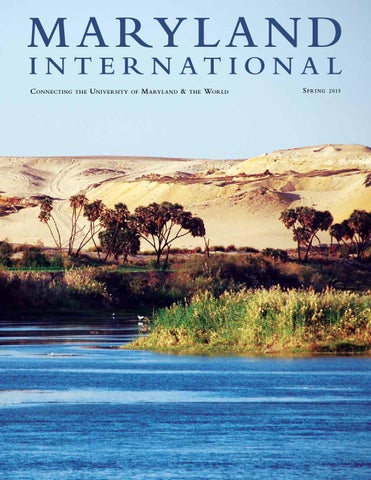
M A RY L A N D I N T E R NAT IONA L c onnecting
the
university
of
m aryland &
the
world
Spr ing
2015
M A RY L A N D I N T E R N AT I O N A L Spring 2015
EDITOR/DESIGNER
Vivian Hayward
OFFICE OF INTER NATIONAL AFFAIRS 3101 Susquehanna Hall College Park, MD 20742 301-405-4312 phone 301-405-4773 fax globalmaryland.umd.edu/oia Director: Ross Lewin
INTERNATIONAL STUDENT & SCHOLAR SERVICES
F
3109 Susquehanna Hall College Park, MD 20742 301-314-7740 phone 301-314-3280 fax isss.umd.edu Director: Susan-Ellis Dougherty
EDUCATION ABROAD
F
3122 Susquehanna Hall College Park, MD 20742 301-314-7746 phone 301-314-9135 fax www.umd.edu/studyabroad Director: Moira Rogers
MARYLAND
F
CHINA INITIATIVE
0124 Taliaferro Hall College Park, MD 20742 301-405-0208 phone 301-405-0219 fax
globalmaryland.umd.edu/mci Director: Nathaniel Ahrens
View along the Nile River, by Michael GwytherJones (front cover). UMD students Kalani and Owen teach the class how to play “Simon Says” in English and Spanish using body parts, courtesy of To-Vi Nguyen (inside cover). The Nile Project’s first concert in Cairo at the Azhar Park, by Matjaz Kacicnik (back cover).
inside this issue 10
4 This January, a group of Maryland students, led by Dr. Paula Beckman, lived in Caca-
Immigration and Migration from a Global Perspective
huatal with families in simple shelters made of adobe or cinderblock, who primarily rely
Established as a hub for studying immigration and migration
on subsistence farming to survive. While there, the UMD group worked in an education
from a global perspective, the Center for the History of the
center launched by previous UMD Education Abroad groups in collaboration with a local
New America provides a distinctive home for interdisciplinary
NGO, International Partners.
and transnational research, training faculty and students, and
Living and Working in a Remote Salvadoran Village
documenting and publicizing the stories of local immigrants.
12
AL SO IN THIS ISSUE : 7
STUDY ABROAD: UMD Students Increasingly Take Advantage of Exchange Program Options
8
GLOBAL PARTNERSHIPS: The Nile Project Sparks Cultural Curiosity through Music
12 CAMPUS NEWS: Global Semester Alumni are Positioning Themselves for International Careers 14 CIVIC ENGAGEMENT: ‘Turikumwe’ – An Introduction to Global Health Corps 15
GLOBAL RESEARCH: UMD and Tel Aviv Language Science Researchers Re-imagine the Academic Workshop
M A R Y L A N D I N T E R N A T I O N A L is the newsletter of the Office of International Affairs. Issues are published once during the fall and spring semesters. To submit story ideas and/or photos, please contact the editor, Vivian Hayward, at vhayward@umd.edu or 301-405-4312.
Civic Engagement
UMD students Sean and Karen teach children how to draw and sketch different bridge structures for Sean’s engineering bridge building lesson. Paola, one of the children in the class, smiles at the camera. Photo courtesy of To-Vi Nguyen.
4
Maryland International
Living & Working in a Remote Salvadoran Village
B
efore dawn, in the rural village of Cacahuatal, the roosters begin crowing and the village is waking up. Perched on a steep hillside, Cacahuatal is home to 100 families in the Department of Cabanas. In this small village, education is the best hope for children to escape another generation of poverty. For many, the only other alternative is to find a “coyote” who will help them migrate to the United States where they hope to find work so that they can send money home to their families. This January, a group of Maryland students, led by Dr. Paula Beckman, lived in Cacahuatal with families in simple shelters made of adobe or cinderblock, who primarily rely on subsistence farming to survive. Most importantly, the students witnessed firsthand what it means to live in a post-war, low-consumption society and how children’s lives are affected by the economic, social, and political factors surrounding them. “I never realized just how much we take for granted in the United States,” said UMD student To-Vi Nguyen. The community welcomed the students with open arms, telling them about their history and introducing them to the bibliotheca (library), which they started in collaboration with previous University of Maryland groups. The volunteers from the community explained how their philosophy of active, hands-on learning was different from the public schools. The library serves a total of about 125 children, youth, and adults, and gives the whole village access to computers
SPRING 2015
5
low-consumption society and how children’s lives are affected by the economic, social, and political factors surrounding them.
as well as more than 1,200 books and other didactic materials— all donated by UMD students and International Partners. While there, the UMD group worked in an education center launched by previous UMD Education Abroad groups in collaboration with a local NGO, International Partners. Without this education center, which is a 30-minute walk from the main paved road, children would have no access to books and computers. Each day, dozens of excited and eager children met with the students to attend classes in math, reading, computers, and “cultural expression.” Fatima, the facilitator in the education center, found ways to integrate the interests and skills of the diverse group of Maryland students, with majors as wide-ranging as engineering, criminal justice, biology/premed, marketing, journalism, and education, into their lessons. On any given day you could find the group engaged in a variety of activities—from teaching children about the structure of bridges by building models, learning about germs and the spread of disease, to learning how to write poetry. Students also participated in home visits to identify children with disabilities who had never attended school because they were too young or physically impaired to manage the narrow, rocky paths. Some of the participants were fortunate enough to meet Ernesto, a six-year-old boy missing half of his brain. During a visit by Dr. Beckman and some of the students, they noticed that he had exposed cerebral tissue on the top of his head, which put him at risk for an infection. Travelling to the hospital is too difficult for
Second and third graders on stage are excited to be playing a game on their first day of school. Photo courtesy of To-Vi Nguyen.
6
Maryland International
[
[
The students witnessed firsthand what it means to live in a post-war,
the family, and if they do make it to the nearest hospital, they can expect a long wait in a crowded corridor, getting little attention, and no advice from doctors. When asked what the family needed in order to help Ernesto, his father replied, “work,” as the family currently has no income. Students also heard personal stories from a survivor of the Salvadoran Armed Conflict (1979-1992). Rojelio survived a massacre at Copapayo, in which he lost his entire family except for his grandparents. At 9 years old, he had to deliver the news to them. The same army that killed Rojelio’s family along with 75,000 other Salvadorans was largely funded and trained by the United States. “Every story made me feel a countless number of emotions; confused, hurt, inspired, confident, courageous, scared, sorry, uneducated, and more…” observed Allie Friedman, a UMD marketing major. UMD student Chanel Viator summed it up: “To say my visit to El Salvador was one of the best trips of my life almost feels like an understatement… There is just so much insight and information I learned from them as well as they helped me learn an incredible amount about myself.” She added, “El Salvador was an amazing experience that you can’t really describe well enough to anyone in the United States without them personally going and seeing for themselves how impactful it is.” v By Paula Beckman (program director) and Emily Daubert (UMD student)
Study Abroad
UMD Students Increasingly Take Advantage of Exchange Program Options
I
Julie Stevens, a Psychology and Computer Science double major, spent a semester at the University of Western Australia in Perth. Photo courtesy of Julie Stevens.
n the past two years, Education Abroad has doubled the number of UMD students choosing an exchange program to study abroad. Currently, Education Abroad offers 86 exchange programs in 17 countries. As UMD students increasingly look to more immersive and academically rigorous study abroad experiences, UMD has pursued ties to more international partners and joined global partnerships, such as Universitas 21, which connects top ranked research universities. Just this year, Education Abroad has added seven new programs and is on track to add four more by the start of the fall 2015 term. Exchange programs are appealing because they offer students an affordable way to have a true immersion experience at world-class universities around the globe. Students enroll at a partner university while paying their UMD tuition and fees and any out-of-pocket living expenses. In addition, UMD students enrolled in an exchange program any semester during the 2015 academic year will receive a guaranteed tuition waiver of up to $1,000. In return, UMD hosts students from partner universities, who pay their home university tuition while enrolling in classes at UMD. Lauren Ruszczyk, assistant director for advising and outreach in Education Abroad, attributes the growing interest in exchanges to a number of factors. New exchange partners offer a variety of coursework in English which make them appealing to UMD students. Increased outreach efforts for curriculum review have also made transferring credits earned on exchange programs easier. “Exchanges offer UMD students a unique opportunity to grow their peer network and engage with faculty in their discipline at top tier institutions around the globe,” says Ruszczyk. “We want students to be active participants in their study abroad experience, moving out of their comfort zone and seizing the oppor-
tunity to grow personally, academically, and professionally. Exchanges offer a solid balance of challenge and support to allow students to so.” Students attest to the unique advantages offered by exchange programs. Julia Stevens, a Psychology and Computer Science double major who spent one semester at the University of Western Australia in Perth, needed a program that fit her unique academic pursuits. “For me, an important reason for choosing an exchange over another type of study abroad program was the flexibility that exchanges allow. I was able to take classes from any department and could fulfill requirements for both of my majors while abroad.” Chris Quach, a Sociology major who studied at the University of Surrey in the United Kingdom, explains, “I chose Surrey’s exchange program because I knew it would be a much more immersive and focused program than what other study abroad programs would have to offer.” Quach adds, “I got to study sociology in a British and European context, enroll in classes and live among British students, and experience the wonders of British culture at a quality university just 45 minutes by train from London. Ultimately, I returned to the U.S. with an extensive global network of friends and mentors, a heightened sense of independence, and an enduring love for British culture!” With increasing numbers of UMD students participating in exchange programs, the Education Abroad office anticipates that UMD exchange programs will continue to fulfill a crucial need in providing access to students who wish to challenge themselves with rigorous academics and full immersion experiences. For more information on exchange options at UMD, visit http://ter.ps/exchanges. v By Krista Uhrig, Education Abroad SPRING 2015
7
The Nile Project Sparks Cultural
T
he Nile basin is a complex region. Riddled by poverty and shared by 11 countries, it has become the subject of numerous resource conflicts. To encourage dialogue about sustainability in the Nile basin, Egyptian ethnomusicologist and music producer Mina Girgis and Ethiopian-American singer Meklit Hadero founded The Nile Project in 2011. The collective brings together 27 musicians from all of the countries along the Nile basin. “We’re trying to change the nature of the conversation around water, to allow audiences to see what is their shared knowledge,” says Girgis. “Once we’ve reached that level of collective identity, we can have a more productive conversation about the issues facing the Nile.” The Nile Project aims to raise awareness and inspire action about the problems facing the Nile river basin by sparking cultural curiosity through music. “That spark of cultural curiosity drives environmental curiosity, drives becoming more interested in the Nile as a river basin,” he says. “So you start seeing the Nile as an organism, as an ecosystem.” The collective holds periodic two-week residencies, where musicians from a variety of Nile basin countries gather to teach each other their musical styles. The musicians collaborate to compose songs that speak to their relationship with the Nile and with each other, combining a variety of languages, tonal systems, and rhythmic systems. “We really pay attention to the way we combine these musical elements to create something that is not superficial, but really deep together, touching on the connections that we share in these different countries,” explains Girgis.
8
Maryland International
The Nile Project’s UMD residency at The Clarice Smith Performing Arts Center, presented by the Artist Partner Program, includes a concert and workshops addressing food sustainability in the Nile basin. One panel will discuss the role of musicians in peace and environmental movements and will feature Girgis; American University Professor Ken Conca, a world expert on trans-boundary water conflict; and University of Maryland Professor Jen Shaffer. The Nile Project will also hold a workshop about the role women play in the Nile basin. Six of the 13 musicians on their North American tour are women, many of whom are actively challenging gender roles through music as some of the only women to play their instrument. “We consider gender issues to be really existential issues when it comes to water sustainability especially in East Africa,” says Girgis. Ultimately, The Nile Project will mount a fellowship program along the Nile and launch university chapters that will work to promote not only environmental but political, social, and cultural sustainability of the Nile. Girgis stresses that the performance isn’t a variety show—it’s a true collaborative effort. While it can be difficult to coordinate cross-cultural musicians who speak so many different languages, the experience is a “really important paradigm for the water conversation we need to have,” he says. “It’s a conversation that is not defined by one person’s priorities…but is an opportunity for every member to voice their concerns.” For more information on the Nile Project, visit http://theclarice.umd.edu/events/2015/ nile-project. v By Emily Schweich
During their Africa tour, the musicians were in Zanzibar to perform at the Sauti Za Busara festival. Photo courtesy of Peter Stanley.
Global Partnerships
Curiosity through Music
SPRING 2015
9
Immigration and Migration from a
Global Perspective P
eople of the world are on the move, by choice or by necessity. Migration is one of the constants of world history, and human movement is a global enterprise. In the United States, millions of newcomers have transformed the work we do, the languages we speak, the food we eat, and the music to which we listen. Such dramatic changes—national and global—naturally inform politics, as people try to understand the new world that massive movement has created. Not surprisingly, they look to the past. Established in 2011 at the University of Maryland as a hub for studying immigration and migration from a global perspective, the Center for the History of the New America provides a distinctive home for interdisciplinary and transnational research, training faculty and students, and documenting and publicizing the stories of local immigrants. By connecting immigrant communities to the University and other local organizations, it empowers them as well as informs the larger public about the immigrant experience. The Center thus combines scholarship and pedagogy with public outreach and informed dialogue. “No single organization has advanced the study of migration, by connecting immigrant communities to the University,” says Alan Kraut, the recent president of the Organization of American Historians. Working across campus in collaboration with many academic departments on campus, with community organizations, and with governmental institutions in Washington, the Center for the History of the New America is pioneering new ways
10 Maryland International
of producing and sharing knowledge about the processes of migration. As a model of interdisciplinary scholarship and teaching on the topic of migration, the Center bridges the humanities, public policy, and social sciences. Its emphasis on global and transnational connections fo r under standing migration is undergirded by the University’s remarkable strength in the study of migration and the allied subjects of race and ethnicity studies. That faculty cohort has been strengthened by a cluster hire that brought five leading scholars, representing different disciplines but united in their transnational and diasporic research on migration and immigration, to the University. This cluster hire has had a transformative impact on migration studies at the University of Maryland, and has enabled the Center to emerge as a leading university in the world for the study of migration. The Center sponsors international conferences, forums, and seminars; hosts lectures and f ilm series; and creates databases and archives. These projects address, among other matters, the diverse and changing nature of citizenship; the complex relations of labor, immigration,
Campus News
which collects the stories of the and post-1965 generation disease; and of immigrants. In a variety the troubling increase in of University courses, Maryland violence against the newly arrived. students are interviewing newly The Center also produces new knowl- arrived members of their families and edge of immigration and migration. communities and building an online Along with the National Museum archive of oral histories. Meanwhile of American History (Smithsonian the Center is working on a pioneerInstitution), the Center is researching ing digital humanities project that K-12 education standards on issues will illuminate the lives of tens of of immigration and migration, and thousands of Afro-Caribbeans as they recommending new national Social migrated across the Americas. Thanks Studies frameworks. Among the to funding from the National EndowCenter’s most innovative programs ment for the Humanities, and in partis the Archive of Immigrant Voices, nership with the Maryland Institute
for Technology in the Humanities, the project will digitize and analyze personnel records, ship manifests, and other sources that allow us to chart in unprecedented detail the social, cultural, and occupational experiences of Caribbean workers as they journeyed to work on the Panama Canal. “This project,” explained UMD Professor Julie Greene, “will be a major resource for scholars, students, and teachers, providing a new way to understand one of the most important migrations in the history of the Western hemisphere.” v By Katarina Keane, Center for the History of the New America
SPRING 2015
11
Campus News
Global Semester Alumni are Positioning
W
hile many students look to study abroad to gain international experience during their college career, an increasing number are discovering that they can also gain an international perspective without leaving the Washington metropolitan area. Global Semester in Washington, D.C. is an innovative, new, high-impact UMD program that combines fall seminar courses, professional development workshops, field trips, conversations with policy leaders, and spring internship experiences in the D.C. metropolitan area. The fall seminar courses are taught by expert practitioners and this year included courses on Responses to Global Challenges, U.S. Diplomacy & Policymaking, and Science Diplomacy. An aim of the program is to develop informed global citizens and leaders. In its second year, the program has grown to include more than 60 students, drawn from a diverse mix of majors and backgrounds. The program is also developing reciprocal relationships with foreign embassies, the Department of State, the Department of Defense, and other international partners. For example, two Global Semester students are currently interning at the Embassy of Bangladesh, and this year, Global
Semester staff attended an event at the Embassy in celebration of International Mother Language Day, a day of great importance in the history of Bangladesh. Program director Dr. Joan Burton delivered the keynote speech at the event. As the program looks to expand its international partnerships, so do its first year alumni. Three alums in particular have taken great steps to broaden their global perspectives since graduating. After graduating in May 2014, prog ram alumnus Patrick Niceforo spent the summer in Wonju, South Korea studying the Korean language with the support of a U.S. Department of State Critical Language Scholarship. This experience helped him to meet his birth family for the f irst time. Since August he has been studying Korean at Yonsei University in Seoul, with the support of a Boren Scholarship. Niceforo credits the Global Semester program as instrumental in helping him obtain this scholarship. “Dr.
Burton and Starsky Cheng were both huge helps with my…scholarship essays. Since the granting of a Boren Award partially depends on one’s ability to demonstrate commitment to government service, I think that my Global Semester internship with the American Foreign Service Association certainly helped.” He hopes to one day become a Foreign Service Officer and was recently accepted into a Master’s program in International Policy and Develop-
“The Global Semester program is a useful starting-point for a career in international affairs. [The program provides students with] a pool of knowledge on global issues that you can use for the rest of your life.” — Alexandra Walsh
12 Maryland International
Themselves for International Careers
Photo on left: Christina Neidlinger (front center, in white pants) and her United Nations team in Ecuador. Photo courtesy of Christina Neidlinger. Photo on top right: Patrick Niceforo with his Yonsei University language partner. Photo courtesy of Patrick Niceforo. Photo on bottom right: Alexandra Walsh at U.S. Africa Leaders Summit at State last summer. Photo courtesy of Alexandra Walsh.
parlayed her volunteer internship with the State Department into the possibility of full-time employment. Last spring, during the Global Semester program, she interned with the U.S. Department of State’s Bureau of Near Eastern Affairs, in the Office of Maghreb Affairs, and was quickly able to leverage that volunteer position into a year-long, paid internship in the same office through the Pathways program. “The Global Semester program is a useful starting-point for a career in international affairs,” said Walsh. The program provides students with “a pool of knowledge on global issues that you can use for the rest of your life.” Her spring internship helped her realize that she wants to pursue a career with the federal government, and she looks forward to the possibility of conversion into a full-time employee at the State Department through her Pathways position. She also has plans to take the Foreign Service Officer test, and she dreams of possibly one day serving the U.S. government abroad. As it continues to f lourish at the University of Maryland and throughout the Washington metropolitan area, the Global Semester in Washington, D.C. program looks forward to producing many more global citizens, leaders, and future change-makers. v
ment at the Monterey Institute of in international development and International Studies. food security in Latin America. She Ch r i st i n a Neid l i nger, who credits her Global Semester experiinterned at the Embassy of Spain in ence with helping to prepare her for the Office of Agriculture, Food, and her professional experience abroad: Environment during the program last “In the Global Semester program I year, graduated from UMD and went learned about a multitude of career to live in Quito, Ecuador, where she paths in international issues… [and obtained an internship with the Food my internship at the Embassy of and Agriculture Organization (FAO) Spain] prepared me professionally for By Brendan Butler, Graduate Assistant of the United Nations. She wants to my current internship at FAO.” make a career out of addressing issues Alumna Alexandra Walsh has for Global Semester in Washington, D.C.
SPRING 2015
13
Civic Engagement
‘ T u r i k u mwe’ An Introduction to Global Health Corps
O
ne of the first of many things my Global Health Corps (GHC) co-fellow taught me is the word “turikumwe” (tur-wee-koom-way). In Rwanda’s native tongue, turikumwe means “all together.” The word is emblazoned on billboards in the capital city; you hear it repeated in the mantras of NGOs, and feel it in the passionate murmurs of community leaders. Turikumwe. All together. What a wonderful introduction to the spirit of community that is central to GHC. Global Health Corps is a yearlong paid fellowship that places change-makers under 30 in leadership positions within organizations working towards health equity worldwide. Each year the GHC begins with a myriad of ambitious and dedicated young leaders— architects, community mobilizers,
14 Maryland International
Photo on left: Co-Fellows, Jean Claude Muhire and Meagan Hawes, at the launch of Health Poverty Action’s Rwandan Girls’ Education & Advancement Programme. Photo on right: Health Poverty Action’s Community Mobilization Officers gather the community in Nyaruguru District to celebrate World Water Day. Photos courtesy of Meagan Hawes.
public health specialists, doctors, nurses, researchers, and writers. What the class grows into—far more powerful—is a community of global activists, working all together towards health as a human right worldwide. GHC fellows work in two-person “co-fellow” teams, where one international fellow is paired with one national fellow. The team is placed within an organization in one of six countries: Burundi, Rwanda, Uganda, Malawi, Zambia, and the United States, where fellows work to support existing programs and build local capacity. My co-fellow Jean Claude Muhire and I were placed in Kibeho, a town in rural Rwanda,
where we served our fellowship year working as field officers for the British-based nonprofit Health Poverty Action. As GHC fellows, we worked to build the capacity of our organization’s local staff and strengthen systems that would endure beyond our fellowship tenure. We worked on girls’ education campaigns, the repair of broken wells, and advocacy efforts for those subjected to sexual and gender-based violence. Moreover, we learned from one another—Claude taught me to ride a motorcycle and sprinklings of local culture and language; I helped him with computer skills and English. There is an African proverb that
Global Research
UMD and Tel Aviv Language Science Researchers Re-imagine the Academic Workshop reads, “If you want to go fast, go alone. If you want to go far, go together.” This is true both for GHC and for the communities it serves. In Rwanda, where many face resource scarcities, this mantra is present in daily routines and lifestyles. On a site visit to a hygiene club, an elderly man told us of his house, made of unf ired earthen bricks being washed away in the rainy season storms. Then he led us up the hill, passed a newly dug pit latrine, to a one-story home with a sturdy banana leaf, thatch roof, explaining that the club members had come together to help him rebuild. As we walked back to the field office, Claude and I marveled at human resilience, the power of community, and the luck we had to hear this man share part of his story. “Never a dull day as a fellow,” Claude laughed. I agreed. Global Health Corps believes that great ideas don’t change the world, great people do, and GHC is always looking for passionate individuals interested in working on the frontlines of the movement towards global health equity. To find out more information about Global Health Corps, please visit www.ghcorps.org. v By UMD student Meagan Hawes and Jean Claude Muhire, Global Health Corps Co-Fellow
W
hat would happen if a group of faculty members and their graduate students got together for an academic meeting—and no one gave a paper? Five faculty members and three graduate students from the UMD Language Science Center and more than 20 of their colleagues at Tel Aviv University (TAU) found out when they got together at TAU in December. Their ostensible goal was to identify exciting, innovative new research areas on which they could build a sustained collaboration that leveraged UMD and TAU’s combined talent and resources. In the process, however, they may also have found a better way to do an academic workshop. Supported by a $15,000 grant from the new TAU-UMD Joint Research Workshop program, the UMD delegation and their TAU counterparts organized a series of interactions focused on two areas of particular interest to multiple researchers at both institutions: phonological learning and memory mechanisms in language processing. UMD workshop leader, Professor Colin Phillips, pronounced the gathering “a great success” involving “an intensive three days of collaboration.” Their creative thinking involved more than just new directions for language science, however. “Inspired by the success of a workshop that we ran at the Maryland Study Centre at Kiplin Hall in North Yorkshire, UK this past September,” says Phillips, “we followed an ‘un-program.’ We had no scheduled talks. Instead, we used a looser structure in which two main teams worked collaboratively on putting together interdisciplinary research proposals, while multiple people ‘live blogged’ the discussions as they unfolded.” In addition to producing several concrete proposals for new collaborations, says Phillips, “all involved came away feeling energized.” Their energy carried over to the much larger language science workshop held at UMD in January. Dubbed Winter Storm, it took place over two weeks and involved 10 UMD departments and more than 100 participants. A delegation from TAU was among them, drawn from those who took part in the December workshop. v By Joseph Scholten, OIA
SPRING 2015
15
NON PROFIT ORG. 3101 Susquehanna Hall College Park, Maryland, 20742-5610 U.S.A.
U.S. POSTAGE PAID MVPRINT
To submit story ideas and photos, please contact the editor, Vivian Hayward, at vhayward@umd.edu or 301-405-4312.