M A RY L A N D I N T E R NAT IONA L c onnecting
the
university
of
m aryland &
the
world
S p r i n g 2017
M A RY L A N D I N T E R N AT I O N A L Spring 2017
EDITOR/DESIGNER
Vivian Hayward
OFFICE OF INTER NATIONAL AFFAIRS 2110 HJ Patterson Hall College Park, MD 20742 301-405-4312 phone 301-405-4773 fax globalmaryland.umd.edu/oia Director: Ross Lewin
INTERNATIONAL STUDENT & SCHOLAR SERVICES
F
1126 HJ Patterson Hall College Park, MD 20742 301-314-7740 phone 301-314-3280 fax isss.umd.edu Director: Susan-Ellis Dougherty
EDUCATION ABROAD
F
1118 HJ Patterson Hall College Park, MD 20742 301-314-7746 phone 301-314-9135 fax www.umd.edu/studyabroad Director: Moira Rogers
OFFICE OF
F
CHINA AFFAIRS
0124 Taliaferro Hall College Park, MD 20742 301-405-0208 phone 301-405-0219 fax
china.umd.edu Director: Nathaniel Ahrens
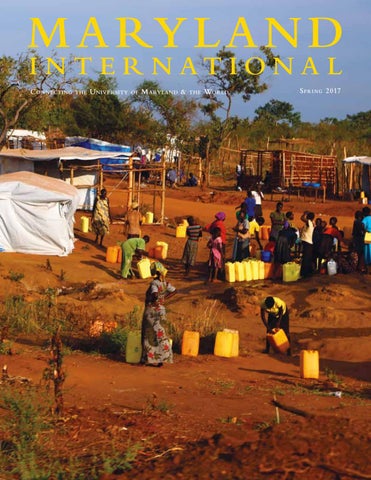
One of the water collection points in Bidi-Bidi, photo courtesy of Catherine Nakalembe (front cover). A neighborhood street in Cuba, photo courtesy of Abbey McEwen (inside cover). Children fetching water from one of the water tanks installed by UNICEF in Bidi-Bidi, photo courtesy of Catherine Nakalembe (back cover).
inside this issue 10
4 Catherine Nakalembe is a faculty research associate and doctoral candidate at the
UMD Professors Reflect on New Opportunities with Cuba
University of Maryland in the department of geographical sciences, and has recently
If relations between the United States and Cuba further
returned from her native Uganda, where she is pioneering the repurposing of remote
normalize over the coming years, one of the most significant
sensing by unmanned aerial vehicles (UAVs) from agricultural monitoring, to the survey
opportunities for building cultural understanding and long-term
of major refugee camps.
ties beneficial to the people of both countries may come
Mapping Uganda’s Refugees, One Camp at a Time
through collaborations in higher education.
14
AL SO IN THIS ISSUE : 8
CAMPUS NEWS: ‘Let Girls Learn’ Teaches Inspiration at UMD
12 CIVIC ENGAGEMENT: Mechanical Engineering Department Helps Its Students ‘Do Good’ in Sierra Leone 14 CAMPUS NEWS: Student Bridges Her Education and Culture to Help Others
M A R Y L A N D I N T E R N A T I O N A L is the newsletter of the Office of International Affairs. To submit story ideas and/or photos, please contact the editor, Vivian Hayward, at vhayward@umd.edu or 301-405-4312.
Civic Engagement
Mapping Uganda’s Refugees ONE CAMP AT A TIME
Unmanned aerial vehicle (UAV) image showing a settlement in Bidi-Bidi. Photo courtesy of Catherine Nakalembe.
4
Maryland International
C
atherine Nakalembe appears After spending two years moving ing she earned a scholarship to Johns excited and energetic as she walks between Tanzania, Uganda, and the Hopkins for a masters in geography and into the room. Nakalembe is a United States developing this agrienvironmental engineering. Nakafaculty research associate and doctoral cultural monitoring program, she lembe then entered UMD as a doctoral candidate at the University of Marywas drawn back home to increase the candidate. Early on, she attended a land in the department of geographical scope of the project. Her work there lunch for students and faculty where sciences, and has recently returned initially focused on food security and she met the head of the department of from her native Uganda, where she is agricultural monitoring in the northgeographical sciences, Professor Chris pioneering the repurposing of remote east region of Karamoja, particularly Justice. “I told him I’m from Uganda, sensing by unmanned aerial vehicles drought and its impacts on land use and I’m very interested in … basically (UAVs) from agricultural monitoring, and livelihoods. getting all the knowledge I could get to the survey of major refugee camps. “The reason I was in Uganda has through my education and apply [it] Nakalembe’s passion about her work nothing to do with refugees,” says to a problem back home,” says Nakaextends from her childhood desire to Nakalembe. But it soon became apparlembe. Things moved quickly after help her country. Growing up in the ent from the Ugandan authorities’ that, and soon she was on her way back low-income neighborhood of Makinsevere lack of information with which to East Africa to participate in a project dye in Kampala and attending school to make decisions that the applications in Tanzania and Uganda to develop in the shantytown of Katwe, Nakaof drone mapping could be extended agricultural monitoring programs. lembe was focused not on science but beyond agricultural monitoring. Funded by the Gates Foundation, the on sports, particularly badminton: “All Nakalembe’s first test was at the capacity building initiative is called my sisters played badminton; we all did Oruchinga refugee camp in southern STARS (“Spurring a Transformareally, really well. My sister was the Uganda, a trial that grew almost incition for Agriculture through Remote [national] women’s champion, and I dentally out of her work using UAV’s Sensing”) and aims to increase crop was under 18 champion for three, four to monitor subsistence agriculture yields through monitoring subsistence years straight...In school they actually and vegetative health. “I thought it agricultural systems in developing used to call me ‘badminton,’ Cathy would be interesting to map Oruchcountries. “Within the…STARS badminton.” inga [which] is eight square kilometers project, one of the components was As she describes it, Nakalembe gradso it’s a reasonable kind of place to the use of UAV—drone mapping—for uated college with a degree in envimap. [When] I visited Oruchinga agricultural sites, so we were using it at ronmental science, quite by accident with [United Nations Development experimental sites where we would fly and through badminton. When she Project (UNDP) Uganda Disaster every two weeks,” says Nakalembe. applied to Makerere Risk ManageUniversity in Kampament Specialla, one of Africa’s i st ] Stephen top institutions, her [Goldfinch]…it preferred program was very obviwas sports science. ous that it was After that program easy to map,” became unavailable, says Nakalembe. a friend of her family “At the time I who also played had one of the badminton told her drones with me about another option. because we did “They were advertissome mapping in ing environmental Karamoja for an science for the first area frame.” time at the bachelor’s Nakalembe’s level so that’s the work has special program that I got.” significance Catherine reviews the new Oruchinga settlement map with Oruchinga settlement Commandant Amos Kirya and leadership. Photo courtesy of Catherine Nakalembe. Soon after graduatin Uganda. In
SPRING 2017
5
2006, that country developed a policy that makes it one of the few places in the world that not only accepts refugees and political asylum seekers, but actively works to bring them into the country and resettle them. According to a report by the United Nations High Commission for Refugees (UNHCR), “Uganda has declared lands as ‘officially gazetted’ for refugees in some of the districts, and such lands are protected whether or not refugees reside on it.” This means that refugees are free to move for work and own land. According to the World Bank, “Uganda’s 2006 Refugee Act … empowers refugees to become gainfully employed, self-sufficient, and to live in dignity.” Currently there are more than 600,000 refugees in the country; some have been there for as long as 25 years. Many fled countries that in recent decades were torn apart by war, genocide and mass killings, such as Rwanda and Burundi in the 1990s. In the last 3 years more than 200,000 have come from South Sudan. As Nakalembe explains it, refugees are now a part of Uganda’s demographic landscape, and are likely to remain there. “There are people in Oruchinga [refugee camp] who are second generation, there are kids that are in high school. They were born there; they have semi-permanent houses; they have fields where they grow their crops. They’re like every other Ugandan, maybe even better because they own land,” she says. But this altruistic policy comes with its own set of problems, such as the environmental impact of refugee populations in areas that are already at climate risk. Nakalembe’s work is proving effective in mitigating these risks. As the refugee population in Uganda has settled and stabilized, the lead on humanitarian activity there has shifted from UNHCR to the UNDP, which
6
Maryland International
focuses on development and local capacity building projects. In order for UNDP to plan the kinds of development activities necessary to allow the refugees to stay in Uganda, mapping the range and effects of their activity is crucial. “[Government authorities] had no mapping of the settlements. It was very obvious that they had no useful data that they could use on a daily basis,” says Nakalembe. “All the infrastructure in the camps, they don’t know where it is. I mean they know [in that] you walk to a school or a medical center and you know what it is, but in relation to everything else they didn’t.” Tying together agricultural monitoring, climate change initiatives, and refugee resettlement using UAV’s is complex. At its heart is a repurposing of technology used in agricultural monitoring, where the UAV can provide more detailed data to train satellites to look for particular kinds of information on a broader scale. It took time to get Ugandan authorities on board with this plan, a common problem researchers face in developing countries, where the political leadership can be fractious and where the capacity to deploy high tech data mechanisms may not exist. “We’re lucky that we’re involved with a department that has a very good leader, who’s open to using available tools,” says Nakalembe. But it is also clear that her insight as a Ugandan are a tremendous advantage. “The way Ugandan’s relate to other people is not the same as how Americans relate to other people,” she says. “It’s not that we speak a different language when we have meetings, but I think I see things differently because [of ] being educated here, having grown up there and having access to all these tools and people.” I don’t think I would have the same opportunity if I were born here as an American because I wouldn’t know how to
approach the problems the way I do. I think I approach them differently,” she explains. “We had discussions with the commandant [of Oruchinga], and I explained to him…that we would come up with a very, very clear map of…all the infrastructure within the settlement. They [authorities] do love having maps. With Stephen we put together a mission.” On her most recent trip, Nakalembe and her team attempted to map the Bidi Bidi refugee camp, one of the largest in Uganda. Bidi Bidi has more than 200,000 people, many of whom arrived in the last two or three years because of the extended civil war and unrest in neighboring South Sudan. A situation that is so fluid, with changes almost daily as more people arrive and are settled, creates a chronic information gap, Nakalembe says. “When you go to Bidi Bidi (and) walk into the commandant’s office, they have these [print] maps that are being updated every day and it’s great that they have those. But what those maps basically say is: ‘this is here;’ ‘there are this many plots here;’ ‘we’ve created this road, this road, that road that road.’ We would like to have additional information in an interactive way, whereby it’s not only print but [also] we have an online GIS [Geographic Information System] based system where you can see the data uploading, updating every time there’s a new thing,” says Nakalembe. “We also want to show land cover change information. For example, we want to have data from before the settlement was set up. If we get this data, you can see that it was probably all shrub-land before the settlement. Then you can see what’s happening in terms of changes—do the changes stick to within the settlement,” says Nakalembe. “One of the biggest problems they have now [in Bidi Bidi] is fuel for
cooking, and when I say fuel, I mean firewood. You have 200,000 more people who need to cook. What’s going to happen to the neighboring shrub-land?” says Nakalembe. With UAV maps of refugee settlements and their surrounding areas, governments like Uganda’s can accurately assess the impact of settlements on the local population and environment, ensure security inside the camps, and generate timely information on the supplies needed to ensure basic quality of life. They can also position facilities to ensure better access. “The maps [also] allow us to gain insight into how land is being used, its potential for harvesting crops, and [its] risk from climate change.
[Understanding] the areas at risk from drought [will allow] us to work with communities to manage the land [to minimize] the potential risk of environmental degradation and to enhance soil fertility,” said Charlie Yaxley, an officer at UNHCR. The other side of the equation is creating local analytical capacity so that governments have the tools to act independently and build their own data mechanisms. Lack of monitoring capacity has left the Ugandan government dependent on the World Food Program [WFP] or FAO to collect data and present it, making coordination and timeliness difficult. “When there is a disaster, the government has to request funds from the finance minis-
try and make a case in parliament to get them to release the funds,” explains Nakalembe. The lack of coherent, real time data often makes the process too little, too late. “[This program] is a unique alternative whereby we have satellite information, you can present it, it’s very clear, it tells the story about what’s going on but then there’s ground evidence that people understand. The fact that this data is happening now makes it different. We’re trying to change [the paradigm by giving] them ownership of the data.” v By Changez Ali, Office of International Affairs
Catherine Nakalembe leads discussions on the location and quality of assets/infrastructures in Oruchinga during a community mapping exercise. Photo courtesy of Catherine Nakalembe.
SPRING 2017
7
‘Let Girls Learn’ Teaches Inspiration at UMD
Photo courtesy of International Student & Scholar Services
T
he University of Maryland was honored recently to host 14 girls from Liberia and Morocco who visited campus as part of the “Let Girls Learn” initiative, a combined effort by a variety of U.S. government agencies to increase the numbers of girls and young women receiving education around the globe. Education for adolescent girls and young women worldwide, and access to educational facilities, has become a central issue in recent years. Globally conspicuous events, such as the kidnapping of 273 school girls by Boko Haram militants in Nigeria, the attempted assassination of Pakastani activist, Malala Yusufzai, by the Taliban, and attacks on girls’ education and opportunities by violent groups in various other countries, have given momentum to a number of initiatives in response. In the face of this challenge to the value of universal education, Michelle Obama has taken a prominent stance, first by raising her voice during the “Bring Back Our Girls”
8
Maryland International
campaign. More recently, she helped organize, solicit funding, and promote around the world the “Let Girls Learn” initiative. President and Mrs. Obama launched “Let Girls Learn” in March of 2015, bringing together the U.S. Agency for International Development (USAID), the State Department, the Peace Corps, and other agencies and programs to “address the range of challenges preventing adolescent girls from attaining a quality education that empowers them to reach their full potential.” “The ability to read, write, and analyze; the confidence to stand up and demand justice and equality; the qualifications and connections to get your foot in that door and take your seat at that table—all of that starts with education,” said Mrs. Obama. The initiative aims—through workshops, outreach, travel, and cross-cultural interaction—to empower girls and young women by altering perceptions about the value of educating girls and young women. It leverages existing partnerships
Campus News
and also aims to create new public-private cooperation to invest in increasing educational opportunities in areas with limited capacity and/or cultural barriers to girls’ education, or in conflict zones where education has become a luxury. The focus of the initiative is on community-led solutions that empower women by giving them a voice in their own communities, allowing them to experience firsthand the life changing effects of education and explore the opportunities available to them. By helping girls and young women to challenge the cultural and mental barriers that are often raised against their education, the program hopes to empower them to bring about change themselves in the communities they know best. The 14 girls and young women who visited UMD were part of a group of 44 chosen to be part of a travel program to the United States. During June visits to their countries, Mrs. Obama met the participants in their homes as part of the CNN documentary, “We Will Rise: Michelle Obama’s Mission to Educate Girls Around the World.” She then welcomed them to the White House for a special viewing of the documentary as part of a week spent in Washington, D.C. While in Washington, the visitors separated into smaller groups that visited a variety of universities and colleges in the D.C. area, including the University of Maryland. “An important objective we wanted to achieve was to introduce the girls to college in the United States and show the variety of opportunities and educational experiences available across the country. For many of them, this was their first time leaving their village or country, let alone taking a flight across the Atlantic Ocean to see the United States,” said Titania Jizyenka, assistant program officer with Meridian International, which helped implement the program. The UMD group ranged in age from 13 to 23 and spent the better part of the morning on the UMD campus where they were met by Chief Diversity Officer Kumea ShorterGooden. After being shown around campus and visiting some of the facilities available to students, the girls met with a group of UMD international students from Morocco and Liberia as well as UMD students returning from and travelling to Morocco for study abroad programs. Tables were organized with students and staff for rotating discussions with the girls on future educational and career options, challenges and how to overcome them, and what support is available for their aspirations and in overcoming the challenges that they face. “After the visit, the girls raved about their experience and how inspired they were to really pursue a university educa-
tion in the U.S. or in their home country. They were blown away by the beauty of the campus and the warm welcome they received from UMD staff and students, including Liberian and Moroccan international students, who were overjoyed to share their school with other young women from their home countries. We at Meridian truly appreciate the visit organized by the University of Maryland as an experience that the “Let Girls Learn” participants will remember as they forge on their academic paths,” said Jizyenka.
“The ability to read, write, and analyze; the confidence to stand up and demand justice and equality; the qualifications and connections to get your foot in that door and take your seat at that table—all of that starts with education.” —Michelle Obama “What an amazing morning we had with the girls of the ‘Let Girls Learn’ Initiative. The 14 girls who visited our campus were brave, motivated, and smart! They are ready to learn and ready to fight the multiple challenges they face pursuing an education in their countries. The program provided current UMD students the opportunity to answer questions from the girls about what it’s like to attend a University in the United States,” said Jody Heckman-Bose, PDSO at the office of International Student and Scholar Services. “I feel lucky to have a campus so close to the nation’s capital so that we can take part in such meaningful White House initiatives.” Inspired by their experiences, many of the girls are now forging ahead with their dreams. Whether it’s by volunteering in national elections or taking their first college entrance exams, they are shaping their paths and working to overcome the challenges they face. In July, USAID and the UK’s Department for International Development (DFID) announced $25 million in funding for the initiative; on October 11—International Day of the Girl—“Let Girls Learn” announced a further $5 million to address the cultural barriers that prevent girls from being educated. v By Changez Ali, Office of International Affairs
SPRING 2017
9
UMD Professors Reflect on New
I
f relations between the United States and Cuba further normalize over the coming years, one of the most significant opportunities for building cultural understanding and long-term ties beneficial to the people of both countries may come through collaborations in higher education. In the world of diplomatic relations, educational exchange can be a crucial avenue for change. The mutual respect that academics from the same discipline may have for each other can often create camaraderie beyond the boundaries imposed by ideology or politics. Cuba as a country has long fascinated many academics in the United States. Cold War adversaries since soon after Fidel Castro’s 1959 revolution, and in a relationship marked by mistrust and bellicosity since the end of the Cold War, the island nation and its much larger neighbor are now entering an era in which more open ties could lead to increased prosperity and opportunity. Having Cubans travel to the U.S. and gain insights into the American education system is part of the envisaged benefit of better ties between the two countries. UMD History Professor David Sartorius, who specializes in colonial Latin America with a focus on the Caribbean, has traveled regularly to Cuba since 1996 for archival research and has numerous friends on the island. “It would mean a lot for Cuban scholars to come to the U.S. and interact with our physicists and engineers—if I want to be generous and look beyond the humanities,” he says with a laugh. “Teachers and students in Cuba stand to benefit from increased access to international scholarship, to books, and other resources that have not been available on the island,” added Abigail
10 Maryland International
Photo courtesy of Abbey McEwen
McEwen, an associate professor of Art History at UMD, who specializes in modern and contemporary Latin America with an emphasis on twentieth-century Cuba. “As everywhere, including the U.S., greater exposure to a plurality of views and to people from a variety of backgrounds should stimulate new discussions and awareness.” Before the recent diplomatic thaw, policies on both sides of the Straits of Florida made finding educational and archival opportunities very difficult for researchers and students. In the 1990s under the Clinton administration, travel restrictions eased slightly even while the long-running U.S. economic embargo on Cuba tightened. But under the Bush II administration there was a significant re-tightening of these restrictions, severely limiting academic exchange. “The Institute of Electrical and Electronics Engineers (IEEE) was sanctioned by the U.S. government for commenting on the
work of Cuban scientists,” recalled Sartorius. Incidents like this led to significant mistrust. “There remain restrictions on freedoms of speech and of the press in Cuba, and more outspoken dissidents may continue to face obstacles in traveling and working there,” said McEwen. For public universities like UMD, one challenge in building programmatic relationships with Cuban higher education institutions is not overburdening Cuba’s limited resources. A number of American universities have established programs to bring students to Cuba, some of which have been in place for 15 or more years. These raise a strong concern from academics like Sartorius that Cuban teachers may abandon teaching native Cuban students in favor of the larger money rewards associated with teaching visiting American students. As Sartorius noted, one prerequisite for these academic relationships must
Global Partnerships
Opportunities with Cuba be reciprocity so that Cuban students benefit from them, as well. Similarly, McEwen noted that “traveling exhibitions of Cuban art to the U.S. will be difficult so long as the question of restitution remains unresolved.” In part these challenges are the result of the speed of change. “The past two years have seen extraordinary interest in Cuban art in the U.S. Major exhibitions are opening and in the works at important U.S. venues … this kind of institutional support was unimaginable, and in many cases impolitic, years ago,” said McEwen. And the cultural disparities are still significant. “There is a collaborative mentality across much contemporary Cuban art that feels productive and creative. Aspiring artists benefit from significant institutional support through the National Art Schools and beyond and are often able to find a market at a young age—through the backing, it must be said, of the many art collectors who travel regularly to Havana.
The public support for the arts in Cuba—not least, the knowledge about art—far exceeds what we have in the U.S.,” said McEwen. “I would like to see a patient, sustained commitment to engaging Cuba and its history, not only toward commercial ends and without excessive ideological posturing. Ideally, travel in both directions will become easier and more frequent.” With Donald Trump’s victory in the 2016 national elections, many scholars fear that the thaw in the relationship will now have an adversary in the White House: Trump has made his hawkish views on Cuba well known. But, according to Rafael Lorente, associate dean at the UMD College of Journalism and a Cuban-American himself, there is likely to be more talk than action. “Honestly I don’t expect a big change and wouldn’t have expected a big change if Clinton had won either.” The ongoing U.S. economic embargo means that, “there are certain barriers naturally in place. The American
embargo is codified in law so it would take Congress to pass a law undoing the embargo and a president to sign it,” to open the U.S.-Cuban relationship further, said Lorente. On the other hand, he said, “the fact that [Trump] wants a tougher deal doesn’t change the fact that both republican and democratic members of congress from almost every state in the country, have constituents, mainly farmers but also healthcare companies, travel companies, hotel companies, etc. that want to do business in Cuba, so his calling for a tougher deal is not likely to get a great response from people whose constituents are saying no we want to keep doing business.” And American colleges and universities, which play important roles in their states’ economies, will likely continue to push for expanded educational interaction with institutions in Cuba. v By Changez Ali, Office of International Affairs
Photo courtesy of Abbey McEwen
SPRING 2017
11
Civic Engagement
Mechanical Engineering Department Helps
T
he Department of Mechanical Engineering (ENME) has found that its students were so immersed in the complicated and time-consuming work of engineering that they had only a tenuous grasp of how globally important their work may be in social terms. Certainly they did not have time to learn the practical ins and outs of bringing their inventions, innovations, and products to market, or to the attention of developers and manufacturers. ENME’s response was to create an innovative new educational experience that ties social welfare to core engineering concepts. ENME 467, “Engineering for Social Change,” has been offered since spring 2015 and has already had a tremendous international impact. The course allows students to evaluate the social impact of different real-world engineering projects, and then debate and decide which project to fund. The process takes an entire semester, during which students choose a topic, receive proposals from, and categorize a number of real-world organizations that require project funding around that topic. They vote and narrow down the proposals to a group of three finalists, from which they select one to receive $10,000 of funding. The fall 2015 class chose to look at access to clean water as their topic. After examining a number of different proposals for the social good each would do in its community, they chose to fund a water-well project in Free Town, the capital of Sierra Leone, through Bread and Water for Africa, an organization based in Alexandria, Virginia. According to Dylan Hazelwood, assistant director at the Center for Engineering Concepts Development
12 Maryland International
(CECD), which developed ENME 467, “not only was the organization matching some of the funds, they had a history of successes with other well projects, they were able to show some of the projects they’d done in the past that were still functioning after many years. They [the students] wanted longevity, they didn’t just want a brief impact they wanted something that would last over time. It would affect 2,500 people, in the local community, a lot of the school children, so I think that really hit home for a lot of the students in our class.” The course is the brainchild of Dr. Davinder Anand, the director of the CECD, whose Neilom Foundation (named in memory of his son Dilip Anil “Neil” Anand, BBA ’87) provided the grant for the projects. The course is meant to teach engineering students the social value of the work they do and to evaluate the projects in a way that balances the head and the heart. “He wanted to make engineers think more broadly, to think about the social aspects of engineering,” said Hazelwood. That meant “both thinking internationally as well as thinking about the social impacts of engineering.” The number of students in the class has increased steadily in the three semesters since it began, from 22 in the Spring 2015 semester, to 44 this past Fall semester. Feedback has been very positive. Said one student, “I finally understood the message behind the lectures and the projects. The message was this: that engineering is not just plugging in formulas or building things. It is about thoughtful decision-making. That was it. As engineers our decisions have the potential to have huge effects
on how the general public lives and interacts. This means that the decisions we make every day can create social change, and it is our responsibility to ensure that this change is the change we want to see in the world. In essence, responsible engineering is unintentional philanthropy.” “Not everyone goes into mechani-
Through the organization Bread and Water for Africa, the fall 2015 students in “Engineering for Social Change” funded a water-well project in Free Town, Sierra Leone. Photo courtesy of Dylan Hazelwood.
Its Students ‘Do Good’ in Sierra Leone cal engineering to change the world, but mechanical engineers change the world whether we like it or not. Just like the effects of climate change, our decisions as engineers can make either a positive or a negative effect on our world. This class taught me that,” wrote another. Hazelwood said that another
student described the process as “humanizing my engineering education,” noting that independence was one of the most important things the course teaches. “We don’t make the decision for them. We simply provide the framework for them to make the decision.” Last year’s students did not travel
to Sierra Leone because of budget constraints, but the hope is that future years will be able to take the international experience further as the course develops over time. v By Changez Ali, Office of International Affairs
SPRING 2017
13
Campus News
Student Bridges Her Education and Culture to Help Others
S
alam Aref was studying architecture at a five-year university program in Damascus, Syria, when the revolution began there in 2011. The escalating civil unrest that followed forced Aref to abandon her plans of completing her degree, a dream she would not complete until years later and halfway around the world, at the University of Maryland. Aref’s immigrant-as-student story is reminiscent of many—despite having completed a large portion of her degree while in Syria, upon arriving in the United States academic red tape required her to start from scratch. But Aref is nothing if not determined. Now, in her final year pursuing her B.S. Architecture degree at UMD, she is planning for a future that includes graduate school, developing the preschool she launched this year with her family, and growing her fledgling company—Siwarbox—a subscription box of global accessories with a social bent. Below, Aref talks about her journey to the United States, the harbinger of pink luggage, and combining her passions to help women around the world, one box at a time. How did your journey to the U.S. begin? I was born in Syria but raised mainly in Kuwait by my parents. I returned to Damascus to study design and architecture, a passion I had discovered in primary school. I was in an intense five-year program; students started studio work right away freshman year. Then the revolution began, and it was increasingly dangerous to live in Syria. It was difficult for me to cancel my admission and leave school. I went back to Kuwait, where my parents were, to regroup. At that point, I had met my husband (then fiancé), who is an American but born in Aleppo. I eventually joined him in the United States, excited to finally finish
14 Maryland International
my degree, only to find out that none of my credits would transfer from my university in Damascus. I had to start over.
began applying all the new techniques and approaches she was learning with Shaamel. He just blossomed—he’s very talkative, can read some simple words, and is counting. When we started seeing that development, we knew she had to start something. So, along with my mom, husband, and brother, I opened a Montessori school in Elkridge in August, called Aya Montessori. Aya means “role model” in Arabic. It also means “to fly” in Hebrew. My architecture education really helped me transform the space that houses the school. I was responsible for the interior design, installing the flooring, creating the graphic design elements, etc. When you finally get to apply what you’ve been studying for years, it is thrilling.
Were you or your family apprehensive about you coming to the United States? When the revolution first began, my brother had left for the United States on a Fulbright scholarship to study in Ohio. I thought it would make sense for me to join him, so I applied to transfer to a university there and was accepted. I went out and bought this bright pink travel suitcase and was ready to go, only to find out [that studying at the school in Ohio] would be too costly. So, my pink luggage and I went home to Kuwait. My parents knew I wanted to go to the United States; when my now-husband proposed, they were already accustomed to You started a venture called Siwarbox the idea and knew there was no stopping this past year, which directly benefits me; I mean, I had the luggage already! women’s causes, starting with one in your home country. How did you get Why UMD? started? It’s because of luck, to be honest. We lived It all started when I was 12, living in Kuwait. in New Jersey at first, and I took some I entered a web design competition and that electives—I couldn’t stay out of school. My really kick-started my passion for design husband was able to transfer to Maryland work. When I first came to the United States, for work, and I was lucky enough to come when I was not in school I was helping nonhere. This time I was able to transfer my profits with their graphic design to create credits and didn’t have to start over yet a better image. I am also very passionate again. It was just two years to get my bachabout my headscarf; it’s part of my identity elors of science degree. and a symbol of my strength and femininity. A series of serendipitous events led I wanted to find a way to combine these you to design and open a preschool passions—graphic design, my culture, and this past summer in Elkridge, Mary- my love of architecture and art history— land, the first being the birth of your and the box was created! I’ve been working on launching Siwarbox for over six months. son two years ago. We held a crowdsourcing campaign in the Yes! When Shaamel was born, we needed a good solution for him. Both of my parents spring that raised enough to launch the first are educators, and so my mom left every- box, which highlights the city of Damascus. thing in Kuwait and came here to take care I’m launching a Lahore, Pakistan, box next. of him. Shortly after she arrived, she started This project holds a special meaning to me; her education in Montessori schooling— I see it as an expression of love, art, and a despite having her B.S. in Education—and statement for united humanity, particularly
Photo courtesy of Salam Aref.
in a time of division. Boxes can be purchased one at a time, every three months or as a year subscription. Each box comes with a cashmere scarf that features a design indigenous to the region, a piece of jewelry and a beauty product from that country. It also holds a postcard highlighting a cultural site or architecture, complete with its history and meaning. Siwar means bracelet in Arabic and “to travel” in Urdu—it’s like you’re traveling to a different country every three months. Most importantly, 25 percent of the proceeds go to a different women’s cause, either internationally or locally. What do you miss about Syria? I try not to think about Syria, except for how I can help Syrians and, particularly, refugees. Our whole family is involved with volunteer work to help the Syrian refugees living in this area. There are quite a few in Baltimore. So many of them have been through so much trauma. I am from a very specific part of Syria where there is a pocket of the Circassian culture—I miss that. I miss the special Circassian dancing. I miss the old streets of Damascus, which I think got me interested in art history. It’s always good to study the past. But this is my home now—my son was born here. I don’t imagine going anywhere else. What’s next? I’m going to go for my masters and, hopefully, Ph.D. I’d love to stay here for my masters because it’s an excellent school, and I’m very comfortable here. The faculty at UMD are amazing; they have excellent experience, and we are so lucky to be here. I hope someday to follow in their footsteps. v By Maggie Haslam, School Planning and Preservation
of
Architecture,
SPRING 2017
15
NON PROFIT ORG. 2110 HJ Patterson Hall College Park, Maryland, 20742-5610 U.S.A.
To submit story ideas and photos, please contact the editor, Vivian Hayward, at vhayward@umd.edu or 301-405-4312.
U.S. POSTAGE PAID MVPRINT