M A RY L A N D I N T E R NAT IONA L c onnecting
the
university
of
m aryland &
the
world
Spr ing
2014
M A RY L A N D I N T E R N AT I O N A L Spring 2014
EDITOR/DESIGNER
Vivian Hayward
Office of INTER NATIONAL Affairs 3101 Susquehanna Hall College Park, MD 20742 301-405-4312 phone 301-405-4773 fax www.international.umd.edu Director: Ross Lewin
International Student & Scholar Services
f
3109 Susquehanna Hall College Park, MD 20742 301-314-7740 phone 301-314-3280 fax www.international.umd.edu/ies Director: Susan-Ellis Dougherty
EDUCATION ABROAD
f
3122 Susquehanna Hall College Park, MD 20742 301-314-7746 phone 301-314-9135 fax www.umd.edu/studyabroad Director: Moira Rogers
Maryland
f
cHIna initiative
0124 Taliaferro Hall College Park, MD 20742 301-405-0208 phone 301-405-0219 fax www.international.umd.edu/igca Associate Director: Jeannette Dai-Wang
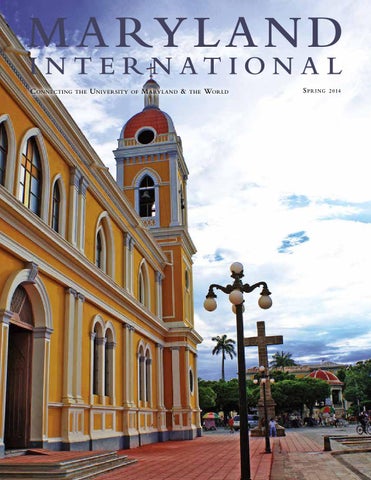
Cathedral of Granada in Nicaragua (front cover). A rural community in the Andean mountains of southern Peru where UMD students and faculty travelled to install a chlorine water disinfection unit, courtesy of the School of Public Health (inside cover). Winter term study abroad students explore the “labyrinth” in Paestum, Italy, by Joseph Scholten (back cover).
inside this issue 4
9
Maryland Social Entrepreneur Corps: Empowering a Generation of Change-makers
Virtual Teams, Real Impact: The Global Classrooms Initiative
Maryland undergraduates will spend eight weeks this summer working directly with impoverished
Twenty students from UMD and Tel Aviv University
communities to expand existing and start new micro-businesses and to promote sustainable entrepreneurial solutions to development challenges. In the process, this experiential program will prepare students to become global citizens, committed to improving the common good of the world with optimism, passion, and innovation.
10
are addressing international development issues in conflict areas around the world together, as part of the pilot Global Classroom in International Development and Conflict Management.
Also in this issue : 7
Study Abroad: Professor’s Gifts Will Support First-Time Student International Travel
8
Civic Engagement: UMD Named Top 25 Peace Corps Volunteer Producer
10
CIVIC ENGAGEMENT: Public Health Without Borders Team Partners with Engineers Without Borders to Improve Water Sanitation in Peru
12
Campus news: University of Maryland’s DC Internship Program Goes Global
14
Campus News: UMD’s Department of Classics Awarded Niaf Pellegri Grant
15
Global Research: Brazilian Undergraduates Enjoy Scientific Mobility at UMD
M A R Y L A N D IN T E R N A T ION A L is the newsletter of the Office of International Affairs. Issues are published twice during the fall and spring semesters. To submit story ideas and/or photos, please contact the editor, Vivian Hayward, at vhayward@umd.edu or 301-405-4312.
Study Abroad
Maryland Social Entrepreneur Corps: T he Maryland Social Entrepreneur Corps (MSEC) was so successful last summer that it will be offered in two locations this year: Nicaragua and the Dominican Republic. Once again, Maryland undergraduates will spend eight weeks working directly with impoverished communities to expand
existing structures, to start new micro-businesses, and to promote sustainable entrepreneurial solutions to development challenges. In the process, this experiential program will prepare our students to become global citizens, committed to improving the common good of the world with optimism, passion, and
innovation. The Maryland Social Entrepreneur Corps is quickly becoming a signature study abroad program at the University of Maryland on account of its ability to engage our students in real-world problem solving. Participants are required to draw on their own areas of expertise, as
“In these underserved communities, MSEC students are helping to develop critical, sustainable services and solutions that never existed before. From helping a family get a cook stove so that they no longer need to cook on the floor, to teaching entrepreneurial skills to a woman who has just become an owner of her own business, to finding solutions for community-focused organizations so they can better serve their beneficiaries, Maryland students are making a profound difference that will endure long after they have left.� — Greg Van Kirk
4
Maryland International
Empowering a Generation of Change-Makers well as to acquire new knowledge and skills, to help identify and implement solutions to complex issues affecting actual communities. As Ashoka fellow Greg Van Kirk, co-founder of Community Enterprise Solutions, the organization with which Maryland partners
on this program, says: “In these underserved communities, MSEC students are helping to develop critical, sustainable services and solutions that never existed before. From helping a family get a cook stove so that they no longer need to cook on the f loor, to teaching entrepreneurial skills to a woman who has
just become an owner of her own business, to f inding solutions for community-focused organizations so they can better serve their beneficiaries, Maryland students are making a profound difference that will endure long after they have left.� Intentionally designed to encourage cross-disciplinary interaction, MSEC is attracting a diverse applicant pool from across UMD’s school s a nd colleges including Business, This past summer, students in the Maryland Social Entrepreneur Corps program spent eight weeks working with impoverished communities in the Dominican Republic and Nicaragua. Photos courtesy of MSEC.
Spring 2014
5
Study Abroad
Engineering, Behavioral and Social Sciences, Arts and Humanities, and Public Health. Combining students from all different majors in a single program creates a rich dynamic ideal for learning and mentoring. During the fieldwork portion of the course, Maryland students are organized into multi-disciplinary teams, much like they would encounter in today’s globalized workplace. Success on a
6
Maryland International
project requires individuals to collaborate and communicate effectively with other members of the team, whose cultures, viewpoints, skillsets, and levels of experience may differ widely from their own. In order to facilitate a richer learning experience, the eight-week social entrepreneurship work in-country is integrated through pre- and postprogramming. This year’s cohort of
students will enroll in a course on campus both before and after their practicum in the Dominican Republic and Nicaragua. The pre-course, taught by Finance Professor Susan White, will introduce students to the principles of social entrepreneurship through lectures, guest speakers, case studies, and service. Students will also have the opportunity to engage with a local non-profit organization,
Study Abroad
Casa de Maryland, to develop programs for a Young Entrepreneurs Club. Principles learned will be put into action in-country during the summer program. In the fall, students will come together again to present at a symposium showcasing their achievements, and to follow up with their clients at Casa de Maryland. “This program structure allows students to actively participate in social entrepreneurship both at home and abroad,” says White. The Maryland Social Entrepreneur Corps program was developed by the Office of International Affairs (OIA) and Education Abroad in collaboration with various academic units at UMD that share the vision of developing student leaders who are prepared to address the challenges and issues of a globalized society. “The Center for Social Value Creation is proud to partner [with OIA] on this program in service to our mission of creating a better world through business principles. The MSEC program provides students with the opportunity to connect community needs with business solutions,” says Melissa Carrier, assistant dean in the Smith School’s Office of Global Initiatives and Center for Social Value Creation. Sixty thousand dollars in funds have been raised to support student scholarships, ensuring that all Maryland students have access to this type of experiential learning program without creating financial hardship. v By Jennifer Precht, Education Abroad
Professor’s Gifts Will Support First-Time Student International Travel
I
t comes as no surprise that Dr. Ian Mather’s lifelong passion for travel and education is the impetus for establishing the Mather Family International Travel Scholarship. He grew up in the United Kingdom and credits his high school (From left to right) Fran, his late wife, Elizabeth, Dr. Mather, and Stephen in geography teacher with Heidelberg during his sabbatical in 1989-1990. giving him the travel bug. Now a professor emeritus, Mather started his 37-year tenure in the Department of Animal and Avian Sciences in 1975. His time included many research meetings and sabbaticals in the United States and internationally in Germany, Italy, Denmark, Holland, China, Russia, and Australia. His late wife Frances and their children Stephen and Elizabeth accompanied him on some of his travels. Mather saw firsthand how the experience enriched his young children’s minds and life perspectives. “Travel and education go hand in hand. We become much better people by traveling, living abroad, and being in the minority,” says Mather, who always encourages students to go abroad for their junior year. The endowed scholarship, created in 2011, will provide travel stipends for students traveling outside North America for the first time to participate in international internships, volunteer programs, or educational opportunities abroad. Mather’s generous commitment is a five-year pledge, augmented by a bequest in his will. His plan of a cash gift during his lifetime and a planned gift through his will allows him to enjoy the benefits of helping students travel abroad. “The University has been very good to me in my career and life, with my interests and research … and opportunities to go on sabbatical,” he says. “This is a way for me to give back to Maryland.” v
Article originally published in Fall 2013 Insights Newsletter of Gift Planning.
Spring 2014
7
Civiv Engagement
UMD Named Top 25 Peace Corps Volunteer Producer
T
he University of Maryland has continued to climb for the third straight year in the Peace Corps’ annual list of the 25 top volunteerproducing colleges in the large school category—with 38 alumni currently serving as volunteers worldwide. Currently ranked No. 23, UMD has risen from No. 24 in 2013 and No. 25 in 2012. Since the Peace Corps’ inception in 1961, nearly 1,170 UMD graduates have traveled abroad to serve as volunteers. “Maryland challenged me to be both socially aware as well as willing to act on behalf of others. Furthermore, I realized that my course work provided me with a solid foundation on which to base my Peace Corps projects,” says UMD alumnus Patrick Williams ‘11. Williams worked in Burkina Faso for two years as a health volunteer and organized community support to send two local youths to a four-day youth development conference. Funds for the project were raised in part through the Peace Corps Partnership Program (PCPP), which helps support Peace Corps community projects worldwide. The two participants from Williams’ community joined participants from the villages of 12 other Peace Corps volunteers. There they discussed topics like gender norms, professionalism, HIV/ AIDS, family planning, and community resources and mobilization. “By the end of this conference, we hope to have successfully trained 24 host country national youth volunteers and local individuals on the knowledge and skills necessary to affect positive development in their communities,” Williams said. Even after his official service had ended, Williams extended his stay to monitor and evaluate the projects of health and education volunteers.
8
Maryland International
UMD alumna Michelle Jiyun Kim ‘09 is a community development volunteer in Thailand working on youth development projects, teacher trainings, and an HIV prevention manual. Kim also hopes to raise funds through the PCPP to launch a sexual health and gender empowerment training camp for high school students in her community. The camp will include 200 students from eighth through eleventh grade. Teachers from the school and various guest speakers will discuss the topics of HIV/AIDS, sexual health, LGBT awareness, nutrition, gender empowerment, and teen pregnancy. “Comprehensive sexual education is commonplace in the United States, but it is lacking in Thailand,” says Kim, who has been living and working in Thailand since 2012. “HIV/ AIDS education, especially, is glossed over when introducing safe sex habits to students. Many still believe that one can ‘catch’ HIV/AIDS through normal conventional means of daily interactions with someone who is infected. Once stigma is reduced around sexual relations, then students will become more empowered to look after their bodies. This camp will improve
student’s understanding of safe sex habits, promote gender empowerment, and the overall well-being of one’s body and mind.” These alumni are just two of the nearly forty active Peace Corps volunteers who cultivated their passion for service at the University of Maryland. Opportunities to volunteer on campus and abroad are widely available to students, faculty, staff, and alumni alike. The Peace Corps has eight regional recruitment offices across the United States that work closely with prospective volunteers to ensure that all Americans who want to serve have the opportunity to do so. The Mid-Atlantic regional recruitment office serves UMD, and Peace Corps recruiters are based throughout the region. Skyler Dobert is the Peace Corps recruiter for UMD. To contact Skyler, call (202) 692-1048 or e-mail sdobert@ peacecorps.gov. v Adapted from materials provided by the Peace Corps. UMD alumna Michelle Jiyun Kim ‘09 (left photo), and UMD alumnus Patrick Williams ‘11 (right photo). Photos courtesy of Peace Corps.
Campus News
Virtual Teams, Real Impact: The Global Classrooms Initiative
T
wenty students from the University of Maryland (UMD) and Tel Aviv University (TAU) are addressing international development issues in conflict areas around the world together, as part of the pilot Global Classroom in International Development and Conflict Management. Digital technology blends instruction at UMD and TAU into a joint Global Classroom, in which students from both universities now connect, share, and learn together while working to address global problems and design solutions with real-world applicability. Five mixed teams of UMD and TAU students focus on researching, analyzing, and providing solutions to international development challenges—from the gender gap in employment in Ethiopia, to the lack of full-time educational opportunities for Syrian children in refugee camps in Jordan, to food insecurity and extreme poverty in Colombia. For Dr. Stacy Kosko, the UMD faculty member leading the course, the initiative provided new insights into international educational collaboration: “One aspect of this course that I find particularly interesting and rewarding comes from what might be a surprising angle on the ‘cross-cultural’ nature of the course. One might expect that a Global Classrooms course between our two institutions would bring together a group of Israelis and a group of Americans to bridge cultural divides and work to generate solutions to issues in a third location. But in fact […] the only Israeli-born student is a UMD student, and several of the Americans are TAU students. The remaining […] students are each from different countries, mostly in the developing world.” The Global Classrooms mirror the professional experiences— project-based, international, and virtual—students will encounter after graduation. “Because of the hands-on, trial-and-error way in which they are approaching the material, they are also figuring
out how to apply some of their own projects’ lessons-learned to other projects,” notes Kosko. “For example, today we were all working through some challenges posed by the group that is tackling school attendance of Palestinian refugee children in a camp in Lebanon. A student whose group is working on a water and sanitation project in post-conflict Sri Lanka shared insights on the role of sex-segregated toilets in improving female school attendance, while another student who had personally visited one of Lebanon’s Palestinian refugee camps to study refugee education shared some of the particular economic barriers families face in sending their children regularly to school. This kind of cross-pollination between groups, and the give-and-take we get out of these ‘workshop’ sessions, is really helping students to move beyond the academic literature on drivers of and solutions to development challenges, and get into the sticky territory of how-and-when, really dig into the details and the mechanics of problem identification and project design.” This course is part of the Office of International Affairs’ Global Classrooms Initiative, an ambitious project seeking to leverage the strength of UMD’s global partnerships and the increasing availability of digital technology in order to provide project-based, reciprocal, and impactful international experiences to students on and off campus. A call for proposals was launched this January, and six new courses have been awarded seed funds. The resulting courses will augment the scale and range of Global Classrooms offerings and contribute to the outline of a new standard for international higher education in the 21st century. v B y R aluca Nahorniac, OIA
Spring 2014
9
Civic Engagement
Public Health Without Borders Team Partners Without Borders to Improve Water Sanitation
C
ontinuing work that began more than a year ago, a team of University of Maryland students and faculty members from the Schools of Engineering and Public Health has been conducting field water quality testing, health needs assessments, and educational programming in a traditional farming community in Southern Peru. The innovative project addresses the crosscutting issue of health through an interdisciplinary approach. This year’s work used data collected from previous interviews and field tests to create educational curricula and innovative water purification systems for the community. Engineers without Borders (EWB) has been involved in water system and purification efforts in Compone since 2008, and they began engaging with Public Health without Borders (PHWB) in 2013. The first phase of the project was an assessment to examine health issues and priorities among residents and to evaluate the local water supply for contamination. The public health team developed a qualitative questionnaire and conducted interviews with health clinic staff, school personnel, community leaders, and community members. The teams also worked together to conduct field tests of 10 Maryland International
the local water supply at various points in the distribution system. The interviews conducted provided a representative sample of community leaders, community members, and providers of health services and education. In the interviews, community leaders expressed interest in chlorination of the existing water supply system, and community members prioritized water supply quantity and reliability. Residents identified common health problems and other issues like nutrition, general hygiene, and disorganization within the community resulting from poor access to water. Although the interviews revealed the residents’ priority of water quantity, the field tests indicated that quality should perhaps gain precedence. The analyses revealed that the water supply is heavily contaminated with high fecal coliform and E. coli. This past January, both teams returned to conduct health education and install a chlorine water disinfection unit. In the fall leading up to the trip, EWB students and faculty worked to design and test a solution for the water disinfection system, and PHWB students created health education activities to improve hygiene and prevent disease using data collected in phase one of the project.
with Engineers in Peru Volunteers carried sand and gravel, more than 200 cinder blocks, several 100-pound bags of cement, and an enormous water tank up to the site (top photo). The team also worked with the adult community to sanitize water, prevent water-borne disease, and prepare oral rehydration therapy (ORT) recipes to combat diarrhea (below photo). Photos courtesy of the School of Public Health.
Eleven students and faculty members (five from Public Health and six from Engineering) traveled to Peru. The group included sophomore Global Public Health Scholars Stephanie Olcese and Priya Parikh, who co-founded the PHWB student group; Public Health graduate students Graciela Jaschek and Greg Raspanti; and Dr. Stephanie Grutzmacher, one of the faculty advisors for the public health team. Dr. Lis Maring, the PHWB faculty advisor, served as mentor for the first collaborative trip last year. Upon arrival in Peru, the Public Health team used community organization strategies to establish rapport, build a reciprocal relationship, and enlist help with the water disinfection project. The results exceeded expectations. Graciela Jaschek, doctoral candidate in epidemiology, organized a workday of 47 volunteers, and people young and old carried sand and gravel, more than 200 cinder blocks, several 100-pound bags of cement, and an enormous water tank up to the site. The next day, the engineering team was able to pour a concrete pad. The successful workday culminated with the second of several community meetings that forged a committed workforce of volun-
teers to help the team with future construction. By the end of the project, the community had a functional chlorine water disinfection unit and the training to use it effectively. An important goal of the trip was educating children and adults on hygiene, clean water, and water conservation. The PHWB team organized children’s health education activities and facilitated workshops that used songs, games, and hands-on practice to teach children to properly wash their hands and brush their teeth. The team also worked with the adult community to sanitize water, prevent water-borne disease, and prepare oral rehydration therapy (ORT) recipes to combat diarrhea. The interdisciplinary work of the PHWB team, spanning more than a year, illustrates the dedication and innovation of these students and faculty to creating social change through technological and educational collaboration. Both teams remain in contact with the community, and plan on returning to monitor the purification systems and community supports. v By The School of Public Health Spring 2014
11
Campus News
University of Maryland’s DC Internship
G
lobal Semester in Washington, DC launched this fall, giving 45 of UMD’s most talented students an intensive international experience—without leaving home. Global Semester in Washington, DC, developed jointly by the Division of Undergraduate Studies and the Office of International Affairs, takes the model, the highly successful Federal Semester, and extends the range of internship opportunities to Washington, DC’s vast array of embassies and international organizations. “It’s a great joy to work with students to help them achieve their dreams of becoming global leaders and policy
makers,” says Program Director Dr. Joan Burton. In addition to attending a set of workshops designed to help them compete and succeed in an internship of their choice, students admitted into the Global Semester enrolled in the fall for one of two special Global Semesters: Seminar on either Foreign and Security Policy in the Developing World or Science Diplomacy: Foreign Policy and Science, Technology, and Innovation. Instructors for these seminars included the U.S. Department of State’s Acting Assistant Secretary and the Senior Climate Change Program Manager in the Bureau of Oceans and International Environmental and
Scientific Affairs, as well as specialists from the Foreign Affairs, Defense and Trade Division in the Congressional Research Service. These teachers found working with Global Semester students so enriching that they have already committed to the program again in Fall 2014. As Burton notes: “It is extraordinary to have such distinguished professionals share their expertise and practitioner experience with our students.” The UMD cohort is both academically diverse and talented. They represent 31 majors, 13 minors, and ten colleges; are fluent or proficient in 19 different languages; have an average GPA of
Global Semester student Christina Neidlinger (left) with Isabel Artime, Counselor of Agriculture, Food and Environment. Photo courtesy of Christina Neidlinger.
12 Maryland International
Program Goes Global 3.68; include 23 Honors College and five College Park Scholars students; and ten Banneker-Key Scholars and five President’s Scholars. Roxanne Oroxom, who is majoring in Economics and minoring in the Global Poverty track of the UMD Global Studies Program, is interning at the Potomac Institute for Policy Studies. Her experience and reaction are shared by her peers. “[It’s] very reassuring to know that you have people in your corner like Dr. Burton, and her assistants, Starsky Cheng, Megan Monserez, and Max Grossman, who care when you’re applying to your dream internship. They also have excellent insight and tips for how to handle new situations. I did a couple of practice interviews with Megan, and by the end I was actually excited to go to my interviews.” She adds: “The program’s value to the university is that it provides students with the unique opportunity to engage with foreign policy professionals through the classroom and an internship, all while in college. I am incredibly grateful for the opportunity to participate in this program.” Senior Christina Neidlinger, whose Individual Studies major is Cross Cultural Communication in Agricultural Development, is interning at the Embassy of Spain in the Office of Agriculture, Food, and Environment. “My initial impressions of the office and the embassy were, ‘Wow!’ because this is my first internship, and the embassy is decked with marble and dark-grain wood,” she says. “The work I do at the embassy in regards to U.S. agricultural policy is a wonderful extension of my studies. The experience I am gaining is going to be invaluable in my preparation to work in an inter-cultural professional environment in my second language.” Yaqi Liu, a junior majoring in Journal-
ism with minors in French and Public Leadership, brings a unique perspective to her work at the International Child Art Foundation. “As an international student coming from China for college and also a French speaker, the program pushed me several steps ahead into the international field.” Many members of this first Global Semester cohort are already making plans for the next step in their international careers. Some have already obtained Critical Language Scholarships from the Department of State for fully funded studies abroad in South Korea and Turkey. Others are seeking prestigious national awards such as the Boren Scholarship or applying to the Peace Corps. Others still are seeking to hone particular skills, through organizations such the Arabic Flagship Program in Morocco. v By Joseph Scholten, OIA
Yaqi Liu, Global Semester student, with Dr. Ishaq, the founder of International Child Art Foundation, where she is interning. Photo courtesy of Yaqi Liu.
2013-2014 Global Semester in Washington, DC participants have sought and secured internships in a variety of agencies and organizations, including: • The embassies of Spain, Brazil, and Bangladesh • The Foreign Trade Division, U.S. Census Bureau • The U.S. Helsinki Commission/ Commission on Security and Cooperation in Europe • The Foundation for Defense of Democracies • The U.S. Department of State (7) • The White House Office of Science and Technology Policy • The American Foreign Service Association • The Middle East Institute • The Division of International Health Security, U.S. Department of Health and Human Services • Foreign Service Institute • International Child Art Foundation • U.S. Citizenship and Immigration Services • Financial Crimes Enforcement Network, Department of Treasury (including financing of terrorism) • Influenza and Emerging Diseases Division, Biomedical Advanced Research and Development Authority, Department of Health and Human Services • The National Institutes of Health • The Genetic Alliance • One.org • Space Division, Aerospace Industries Association
Spring 2014
13
Campus News
UMD’s Department of Classics Awarded Niaf
A
merica’s founding fathers had no doubts about the links between their new country and ancient Rome. Now UMD students, the greater DC area, and the world at large can fully appreciate these connections as well, thanks to a five-year, $500,000 grant from the National Italian American Foundation (NIAF) to the University of Maryland Department of Classics. “Between Washington and Ancient Rome: The Pellegri Program on Roman Antiquity and Its Legacy in America” is the largest grant ever given by NIAF, and is named in honor of its donor, the late Ernest L. Pellegri. The grant’s lead author, Professor Jorge Bravo III notes, “We are situated only miles from our nation’s capital, so our department simultaneously looks eastward to Italy and the Roman past and westward to a city that bears the clear stamp of Roman antiquity as a reflection of the profound effects of
classical tradition upon our nation. It is from this special vantage point that we offered our proposal for the Pellegri Grant.” Gregory Staley, professor and director of Honors Humanities, noted one obvious example: the resemblance between the Pantheon in Rome and the Jefferson Memorial. “The Pantheon was Jefferson’s favorite building. It is distinctly Roman in that it has a dome… made possible by the Romans’ discovery of concrete.” (The Washington Post, March 18, 2014). The grant will bring distinguished visiting scholars to speak in College Park, create a website highlighting classical influences on Washington, and develop a mobile app to provide translations of the Latin inscriptions on Washington’s public buildings and monuments. “We want to create something people can use to see the connections themselves,” Staley says. The bulk of the grant, however, will be used to support UMD students’
travel to Italy. “Our department firmly believes in the value of having our students study abroad in classical lands, a mission that is consonant with the aim of UMD’s College of Arts and Humanities to promote global engagement,” says grant co-author and Classics Department Chair, Professor Lillian Dougherty. “Funds from the Pellegri Grant will support student participation in our existing Winter Term course in Italy, and create new opportunities for UMD students in Italy.” Four UMD undergraduates and a graduate student teaching assistant will receive full-support scholarships to participate in the annual January course to explore how a variety of ancient peoples and cultures came together in Central Italy to produce the civilization of the Romans, and its subsequent influence. Students will also be able to participate in a new Spring Break “Pellegri Traveling Seminar.” The theme of the seminar
UMD students in the East Garden Court of the National Gallery in Washington, DC (left photo). Photo courtesy of Lillian Doherty. Participants in the January 2013 winter term study abroad course listen to a presentation by one of their fellow students at the Temple of Neptune in Paestum, Italy (right photo). Photo courtesy of Joseph Scholten.
14 Maryland International
Global Research
Pellegri Grant will be tied to an upper-level Classics course in Latin, or in Roman culture, to be offered each Spring semester, and will develop students’ understanding of texts and ideas by grounding them in the material remains found in Italy. Up to seven student fellowships—covering airfare and the cost of the course—will be offered. The grant will also fund new projects to continue UMD’s leading role at the archaeological site of Stabiae, where Rome’s elite built massive seaside “Power Villas” fronting on the Bay of Naples. Art History and Archaeology Professor Maryl Gensheimer will document, photograph, and study previously excavated materials at Stabiae in order to prepare them (and associated material from the site and throughout the Roman world) for publication. She will also begin a new campaign of excavations, to yield new materials to complement the emerging picture of daily life in ancient Stabiae and to continue to illuminate our understanding of Roman art, architecture, and infrastructure along the Bay of Naples. Up to four graduate students per year will receive full support to join in this new archival and archaeological research at Stabiae. These new opportunities for student travel and experiential learning “…will build upon our capacity to both draw current high school teachers to our programs and grow the next generation of teachers from among our students,” says classics graduate program director and grant co-author, Professor Judith Hallett. “This last goal is particularly important to us, as it is consonant with the University of Maryland’s mission as a public, landgrant university to actively pursue ways of engaging the University in serving all citizens of the state of Maryland.” v By Joseph Scholten, OIA
Brazilian Undergraduates Enjoy Scientific Mobility at UMD
I
n response to a comment by President Obama about the 100,000 Strong Initiative to send U.S. students to China in June 2012, President Dilma Rousseff of Brazil launched the Brazil Scientific Mobility Program—initially known as Ciência Sem Fronteiras, or Science without Borders. Bringing together the Brazilian Agency for Support and Evaluation of Graduate Education (CAPES) and the National Council for Scientific and Technological Development (CNPq), the program aims to send 100,000 of Brazil’s best undergraduate students, graduate students, and post-docs in STEM fields to study abroad at the world’s best universities from one semester to several years. To date, 14 Brazilian undergraduates have come to UMD with support from the BSMP to study in the College of Computer, Mathematical and Natural Sciences; and the A. James Clark School of Engineering. The team worked to register UMD as a host institution with the Institute for International Education, the U.S. administrator for the undergraduate portion of the program. Barbara Varsa, associate director of UMD’s International Student and Scholar Services (ISSS), with help from Undergraduate Admissions and Resident Life, has taken on the task of providing support and guidance to these students, and she pronounces them “an absolute delight.” The BSMP students have proven to be “among our most academically successful and personally engaged international students,” she says. “We can’t wait to welcome the 2014-2015 BSMP cadre to campus.” v By Joseph Scholten, OIA
Spring 2014
15
NON PROFIT ORG. 3101 Susquehanna Hall College Park, Maryland, 20742-5610 U.S.A.
U.S. POSTAGE PAID MVPRINT
To submit story ideas and photos, please contact the editor, Vivian Hayward, at vhayward@umd.edu or 301-405-4312.