M A RY L A N D I N T E R NAT IONA L c onnecting
the
university
of
m aryland &
the
world
Spr ing
2013 , vo l . i i
M A RY L A N D I N T E R N AT I O N A L S p r i n g 2 0 1 3 , Vo l . I I
EDITOR/DESIGNER
Vivian Hayward
Office of INTER NATIONAL Affairs 1122 Holzapfel Hall College Park, MD 20742 301-405-4772 phone 301-405-4773 fax www.international.umd.edu Director: Ross Lewin
OFFICE OF International Services f
2111 Holzapfel Hall College Park, MD 20742 301-314-7740 phone 301-314-3280 fax www.international.umd.edu/ies Director: Susan-Ellis Dougherty
EDUCATION ABROAD
f
1125 Holzapfel Hall College Park, MD 20742 301-314-7746 phone 301-314-9135 fax www.umd.edu/studyabroad Director: Graham Hettlinger
Maryland
f
cHIna initiative
0124 Taliaferro Hall College Park, MD 20742 301-405-0208 phone 301-405-0219 fax www.international.umd.edu/igca Director: Robert Daly
Confucius institute at maryland f
0134 Holzapfel Hall College Park, MD 20742 301-405-0208 phone 301-405-0219 fax www.international.umd.edu/cim Director: Donna Wiseman
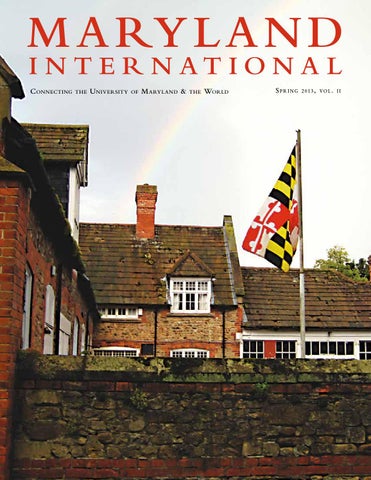
Kiplin Hall in North Yorkshire, England (front cover). San Ignacio Miní Jesuit mission ruins found in Misiones Province, Argentina (inside cover). Trento, Italy (back cover).
inside this issue 13
4 Kiplin Hall: Preserving Maryland’s Birthplace Kiplin Hall offers a unique international experience for hundreds of UMD students. In addition to the
UMD Ranks First Nationally in Boren Scholarships
annual program for architecture students, the Study Centre has welcomed courses led by faculty from
For the second consecutive year, UMD leads
the UMD English department, Landscape Architecture and Historic Preservation programs. Discussions
the nation in Boren Scholarships, with 10
have also recently begun for joint UMD programming in historical archaeology and heritage studies, in
undergraduate students receiving awards for
conjunction with the internationally recognized archaeology program at nearby York University.
long-term intensive international language study.
8
Also in this issue : 7
global research: UMD’s Gates Cambridge Scholar Researches Virus-Fighting Strategies
8
Civic Engagement: Winners of Do Good Challenge Provide Legal Aid in Buenos Aires Slums
11
Economic development: UMD’s Social Entrepreneurs Compete for Top Prize in No Limits Social Impact Pitch Competition
12
campus news: Roald Sagdeev: Celebrating the Legacy of a Distinguished Professor
12
campus news: The University of Maryand and NASA Establish Joint Global Carbon Cycle Center
14
global research: UMD-Trento Partnership Yields Graduate Student Exchange
14
International News in brief: Maryland Social Entrepreneur Corps; New Global Semester in D.C.; New Scholarship for Global Experiences; BSOS Global Scholars Program
15
campus news: Mohammad Zia Selected for Prestigious Truman Scholarship
M A R Y L A N D I N T E R N A T I O N A L is the newsletter of the Office of International Affairs. Issues are published twice during the fall and spring semesters. To submit story ideas and/or photos, please contact the editor, Vivian Hayward, at vhayward@umd.edu or 301-405-4312.
Study Abroad
Kiplin Hall: Preserving
M
aryland fans of the hit BBCPBS historical melodrama, Downton Abbey, were treated in February to a local connection, when Maryland Public Television broadcast its new documentary, “Kiplin Hall: Birthplace of Maryland.” Produced through a grant from UMD, the film tells the story of the country home built in the 1620s by George Calvert, who became the first Lord Baltimore in recognition of his services as Secretary of State to King James I. After his retirement from
4
Maryland International
court, Calvert convinced the king and his son Charles I to grant him lands in the Americas north of the Potomac River, where Calvert could create a religiously free zone open to Catholics such as himself. Those lands became, of course, the Maryland Colony. Downton devotees were quick to note that, while series author Julian Fellows chose Victorian-era Highclere Castle as the stand-in for the domicile of the fictional Crawley family, he located that estate not in its native west Berkshire but in
the North Yorkshire countryside where Kiplin Hall lies. Some even see echoes of Kiplin’s historical relationship with nearby Richmond in the frequent visits of Downton denizens to the nearby village. The link seems more tenuous, though, if you compare the respective fates of the estates. For while Downton’s aristocratic owners were, at the close of the most recent season, on the verge of saving the estate by adapting to the economic realities of the 20 th century, Kiplin Hall was not
Maryland’s Birthplace
so fortunate. Instead, as with so many other large English country houses, its lands were sold off to pay other expenses so that, by the time its last owner, Bridget Talbot, gained possession, what had been an estate of 5,000 acres at its peak had been reduced to a mere 120 acres. Talbot capped a lifetime of preservation efforts by establishing a private trust to take over the estate after her, and over the past four decades, its leaders have put Kiplin on sound financial footing and restored the Hall to its late 19th-century heyday.
Spring 2013, Vol. II
5
Study Abroad
As recounted in the documentary, their efforts were aided by a serendipitous renewal of the Kiplin-Maryland connection. While on a trip to North Yorkshire in search of new business opportunities, Baltimore industrialist Leonard C. Crewe Jr. was brought to Kiplin Hall by his hosts because he was also President of the Maryland Historical Society. Crewe and his wife Betty immediately joined forces with the Kiplin Trustees—soon becoming one of them. In addition to helping fund needed restorations of the Hall, Crewe also brought onto the scene UMD Architecture Professor David Fogle who initiated an annual study program at Kiplin for UMD students in 1986. Buildings from the Kiplin home farm were converted for use as the Maryland Study Centre at Kiplin Hall. Crewe subsequently established the Maryland Foundation for Kiplin Hall as a non-profit support group for the Study Centre, its programs and students, whose generous efforts continue today under the leadership of Baltimore civic leader Jay Griswold. The Kiplin cause has found additional support over the years from Maryland leaders such as State Senator Thomas V. “Mike” Miller and USM Chancellor and former UMD President William E. “Brit” Kirwan. The result has been a unique international experience for hundreds of UMD students. In addition to the annual program for architecture students—long led by Fogle, and currently hosting 10 students for spring semester under the guidance of Professor Karl Du Puy—the Study Centre has also welcomed courses led by faculty from the UMD English department, Landscape Architecture and Historic Preservation programs. Other higher education institutions both within and outside Maryland have also established their own annual study tours working from the Centre. Discussions have recently begun for joint UMD programming at the Study Centre in historical archaeology and heritage studies, in conjunction with the internationally recognized archaeology program at nearby York University. And, most recently, Arundel High School near Odenton is piloting the use of the Study Centre for its students in the Anne Arundel County Advanced Studies Program. As it enters the next stage in its development, the Maryland Study Centre at Kiplin Hall looks to continue and broaden its role of reconnecting the people of North Yorkshire with their American colonial cousins, both in Maryland and beyond. v By Joe Scholten, OIA
6
Maryland International
The Maryland Study Centre at Kiplin Hall The Maryland Study Centre at Kiplin Hall is located just east of Richmond in the beautiful North Yorkshire countryside, between the North Yorkshire Moorland and Yorkshire Dales national parks. Historic York, the Lakes District, Durham and the North Sea coast all lie about an hour away, Glasgow and Edinburgh just over two hours north. The Centre, recently renovated, has lodgings for up to 20 students, a library, dining room, classroom and fully equipped kitchen. It also has a separated, fully equipped faculty apartment and bedsit. Faculty, staff or alumni of UMD (or other institutions) who are interested in using the Study Centre—as the base for an educational program, a haven for sabbatical research or more—should contact the Centre’s Director Joe Scholten at scholten@umd.edu. v UMD students at Kiplin Hall. Photo courtesy of Joe Scholten.
Global Research
UMD’s Gates Cambridge Scholar Researches Virus-Fighting Strategies
T
he University of Maryland’s first winner of the prestigious Gates Cambridge Scholarship is Krzysztof Franaszek, a recent graduate who focused on lab research that could lead to new virusfighting strategies. This competitive international scholarship, which covers all costs for a year of post-graduate study at the University of Cambridge, was established in 2001 by a $210 million donation from the Bill & Melinda Gates Foundation. This year, scholarships were awarded to 39 U.S. seniors and recent graduates who combine academic excellence with a commitment to improving the lives of others. Franaszek graduated this year with degrees in biology and economics. While on campus, he conducted research at the department of cell biology and molecular genetics, looking for hidden points of vulnerability in the ways some viruses, like HIV and SARS, encode the proteins that give them structure and potency. Combining science at the molecular level and hands-on care for patients helped the 20-year-old Maryland resident stay focused on his ultimate goal: “to make a humane contribution.” “Intellectual pursuits are a goal in themselves,” he explained. But “trying to make something to help other people, I guess that’s what drives me.” Franaszek, who was born in Krakow, Poland, is the son of a physicist and a pharmacologist. The family came to the United States soon after the fall of Communism in Eastern Europe. While still in high school, Franaszek worked in a laboratory at the National Institutes of Standards and Technology and took 17 advanced placement courses. After graduation, he did summer work at the National Institutes of Health, and arrived at the University with nearly two-thirds the credits needed to graduate. Since his freshman year, he worked in the molecular biology laboratory of UMD
Krzysztof Franaszek, first winner of the prestigious Gates Cambridge Scholarship. Photo courtesy of John Consoli.
Professor Jonathan Dinman. “He’s got wonderful biological insight,” said Dinman, Franaszek’s academic advisor. Just as a jazz musician intuitively knows where a musical improvisation is headed, Franaszek intuitively understands the behavior of tiny biological molecules, the professor said. Dinman’s laboratory focuses on ribosomes, the molecular machines found within all living cells that link amino acids together to form proteins. Dinman’s team works with viruses and yeast because their simplicity makes it easy to spot peculiarities in their ribosomes, which follow the commands of messenger RNA (mRNA) to assemble proteins in a specific sequence so the cells can reproduce and function. Scientists studying mRNA initially thought each mRNA only encodes one protein, but there are exceptions. Franaszek’s undergraduate research focuses on a phenomenon known as programmed ribosomal frameshifting, in which one mRNA can encode more than one protein. “Imagine reading a sentence. You have
spaces in order to know where one word ends and another begins. That tells you what frame you’re reading in,” explained Franaszek. Just as a writer can change the meaning of a sentence by altering the spaces between words, some ribosomes can slip along the mRNA template that guides their protein synthesis, changing the proteins they synthesize. This doesn’t happen with all types of mRNA, but it can occur with mRNAs encoded by the HIV virus, the SARS coronavirus and some mammalian genes, perhaps including those associated with liver cancer in humans. Researchers hope their work will lead to drugs that interfere with frameshifting, disrupting the viruses’ ability to reproduce. In Dinman’s laboratory, Franaszek studied the results of frameshifting experiments, looking for patterns that might show where the process is vulnerable to outside interference. At Cambridge, he’ll do handson work with viruses and human cells in the laboratory of virologist Ian Brierley. v By Heather Dewar, CMNS
Spring 2013, Vol. II
7
Civic Engagement
Winners of Do Good Provide Legal Aid in During the competition, Juan Bellocq (speaking), co-founder of Argentine Terps (left photo), had five minutes to pitch his cause to a panel of judges—Fran Drescher, Carl Lewis and Melanie Schnoll Begun (middle photo). All five teams who reached the finals received cash prizes (right photo). Photos courtesy of Mike Morgan Photography.
A
cclaimed actress Fran Drescher, who charmed viewers with her performance in television’s “The Nanny,” captivated a cheering audience at the University of Maryland this spring as she led the celebrity panel of judges at the second-annual Do Good Challenge. With lead sponsorship from Morgan Stanley Private Wealth Management, student teams participating in the UMD philanthropy pitch competition—modeled after “American Idol”—organized volunteers and raised money and awareness for charitable causes, with the winners receiving $5,000 to support their cause.
8
Maryland International
Drescher, a philanthropist and cancer-awareness activist, encouraged all of the students to continue acting on their passion. “The more good I give, the more I get,” she said, before announcing the top three winning teams alongside her fellow judges— nine-time Olympic gold medalist Carl Lewis and Melanie Schnoll Begun, managing director and head of philanthropy management at Morgan Stanley Private Wealth Management. In first place was Argentine Terps, which organized the first fundraising and awareness campaign for Fundacion Microjusticia Argentina, a group
co-founded by a UMD student and composed of dedicated young lawyers who provide legal aid to residents in the slums of Buenos Aires, Argentina. Second place went to R.I.S.E. (Rally. Inspire. Smile. Entertain.), a new student group that connects various homeless shelters and rehabilitation centers with student entertainment groups to improve conditions and raise awareness about homelessness. In third place, a group founded by a UMD student who co-authored a book for children in military families (The Little Champs) launched Operation CHAMPS to create corporate,
Challenge Buenos Aires Slums
community and campus partnerships that provide a number of free services for military families. Argentine Terps founder Juan Bellocq beamed as he took the stage to accept first prize, while text after text from friends in Argentina filled his phone. “Everyone at home wants to know how we did,” he said. Bellocq, a master’s student at the UMD School of Public Policy, developed the Argentine Terps communications campaign, called Making the Invisible Visible, to expand Microjusticia Argentina. He and fellow Argentinian Fernando Saltiel, who graduated from
the public policy master’s program in 2012, built a website and raised awareness and more than $8,758 through social media and word of mouth, by leveraging support from the Argentinian community in the Washington, D.C., area and from individuals in Argentina. Bellocq emphasized that they raised a substantial amount of money from individuals in Argentina even though the country doesn’t have tax incentives for giving or the same culture of philanthropy as in the United States. Microjusticia Argentina is dedicated to giving a voice to residents
of Buenos Aires’s slums. “It’s about getting rid of that prejudice that if you are in the slum you are a drug dealer or a criminal,” he said. The reward is “seeing that you need them and they need you—and that you are members of the same society.” He hopes to use the $5,000 award to expand the program. Drescher said the group’s growth potential helped convince her to award it the top prize. “It seemed like it was a good model that could be duplicated in inner cities throughout the world, wherever there is need,” she said. “Morgan Stanley Private Wealth
Spring 2013, Vol. II
9
Economic Development
As on “American Idol,” the audience members voted for the winners by texting in their picks. Photo courtesy of Mike Morgan Photography.
Management is a strong believer in the mission of the Challenge—to unleash the entrepreneurial spirit of young people and develop future citizens and leaders committed to improving our world,” Schnoll Begun said. “That’s what Argentine Terps are doing, and I’m so proud of the work they’ve already accomplished. This competition is helping drive meaningful change and innovative ideas. It was a thrill to join the panel of judges and be a part of this fun and novel event. And I’m so proud of how all of the teams ‘did good.’” This competition is part of an innovative new approach to encouraging social innovation and entrepreneurship and fostering a culture of philanthropy on campus. UMD President Wallace Loh is proud of how successful the program has become in just
10 Maryland International
a year. “This competition and the growing philanthropic curriculum behind it are at the very heart of an important lesson we are committed to teaching our students: Use your skills, talent, passion and education to give back to others,” Loh expressed. “My goal is to have every student have an innovation or social entrepreneurship experience before graduating from the university. I am deeply proud of the fine, caring work of all the students who took part in this marvelous competition.” Professor Robert T. Grimm, Jr., director of the Center for Philanthropy and Nonprof it Leadership, echoed Loh’s statement. “The Do Good Challenge is part of making philanthropy a pillar of the Maryland experience. No other university includes Maryland’s extensive and
innovative hands-on philanthropic experiences.” Grimm explained that while the celebrity judges added excitement and intensity to the contest, they were also important role models for the students: “Our judges demonstrate that philanthropy can be both fun and serious business. All three of them are a driving force for innovative and high-impact efforts that literally change lives.” In addition to the School of Public Policy’s Center for Philanthropy and Nonprofit Leadership, Morgan Stanley Private Wealth Management and Drescher’s Cancer Schmancer Movement, the Do Good Challenge was sponsored by the UMD Colonnade Society, the Center for Social Value Creation and Pepsi. v By The UMD School of Public Policy
Economic Development
UMD’s Social Entrepreneurs Compete for Top Prize in No Limits Social Impact Pitch Competition
A
n international and recess) delivery. mobi le money Since Payvius and transfer service KidFit tied for first place, Payvius and a school the judges decided to fitness program KidFit offer additional money shared first place in the and award $3,000 of annual No Limits Social start-up capital to each Impact Pitch Competicompa ny. In add ition, co-sponsored by the tion to the cash prizes, Smith School’s Center the winners will also for Social Value Creation benef it from in-kind (CSVC) and the School mentoring services from of Public Policy’s Center CSVC’s entrepreneurship for Philanthropy and network. The winners Nonprofit Leadership. An were among five finalNo Limits Social Impact Pitch Competition finalists. off icial UMD Fearless ists who pitched their Photo courtesy of Robert H. Smith School of Business. Ideas event and a highlight ideas to improve their of the Social Enterprise communities and the Symposium, the competiworld before a panel of tion was a platform to help judges and a live audiaspiring change-makers ence. The “No Limits” harness the resources finalists also represented they need. As the CSVC UMD’s diverse student website explains, “With population passionate in today’s complex chalsocial value creation and lenges, we don’t have the using business principles luxury to sit and wait for to create a better world. solutions. Problem solving Other finalists in the begins with each of us, competition included whether as individuals or Microjusticia, a nonprofit organizations, and it must offering pro bono legal begin now.” services to NGOs in Mondiu Ladejobi, an Argentina (see article executive MBA student, “Winners of Do Good launched Payvius. The Ch a l len g e P rov id e low-cost mobile money Legal Aid in Buenos transfer service enables Aires Slums” on page 8); secu re i nter n at ion a l Destinalo.com, a website money transfers from a that connects local and sender in the United States to any mobile phone in sub- family-owned tourism businesses with independent travelSaharan Africa, and provides recipients with the oppor- ers; and ProCity, a network for donating unwanted items tunity to build credit in developing economies. Maggie that benefits charities. v Croushore, a master’s of public policy student, runs KidFit. She is currently working with schools to improve By the Smith School of Business their active education (traditionally physical education
With today’s complex challenges, we don’t have the luxury to sit and wait for solutions. Problem solving begins with each of us, whether as individuals or organizations, and it must begin now.
Spring 2013, Vol. II
11
Campus News
Roald Sagdeev: Celebrating the Legacy of a Distinguished Professor
I
n the final days of the Soviet Union, University of Maryland Physics Distinguished Professor Roald Sagdeev took a risk. In the face of having his tires slashed and apartment robbed, he pioneered U.S.Soviet cooperation in space and was heavily involved in disarmament talks—establishing himself as a major 20th century force for peace and scientific cooperation. Marking Sagdeev’s 80th birthday this spring, the university has recognized his lifetime of contributions and the impact he has made on modern science in the fields of plasma and space physics, scientific policy and global security. UMD’s Department of Physics hosted a special event in honor of Sagdeev, which included a public interview titled “The Day I Said ‘Nyet!’ to Gorbachev... and Other Life Tales of a Famous Soviet Scientist” and a Q&A with
Dan Zwerdling, an award-winning correspondent and investigative journalist with National Public Radio. Prior to his move to the United States in 1990, Sagdeev was director of the Soviet Union’s Institute of Space Research. He also led efforts for the first U.S.-Soviet joint space mission in 1975 and served as a science advisor to former Soviet President Mikhail Gorbachev. Among his many awards and accolades, Sagdeev was awarded the Lenin Prize in 1984 for his outstanding achievements in the foundations of the neoclassical theory of transport processes in toroidal plasma. In 2003, he received the Carl Sagan Memorial Award and was recently honored with the highest award in his native Tatarstan. v
Roald Sagdeev
By Neil Tickner, University Communications
The University of Maryland and NASA Establish Joint Global Carbon Cycle Center
R
ecently, researchers and officials from the University of Maryland’s Department of Geographical Sciences and NASA’s Goddard Space Flight Center (GSFC) formally launched the Joint Global Carbon Cycle Center—the latest in a 30-year history of collaborations between NASA and UMD. The College of Behavioral and Social Sciences, which houses the Department of Geographical Sciences, is committed to advancing global sustainability by supporting innovative and active endeavors such as this new center. “This
center will explore how carbon moves through the Earth system, initially focusing on the land, to understand human and natural drivers, impacts and mitigation options using field methods, satellite imagery, and advanced computer models,” says Dean John Townshend. The center was established through a NASA Space Act Agreement, designed to foster external partnerships with the agency. “This formalizes existing relationships between the earth science community here and the geographical sciences department at Maryland, and opens up new opportunities for broader collaborations,” says GSFC Senior Biospheric Scientist Compton Tucker. The center provides the necessary framework for the effective interaction and collaboration of researchers concentrating on global carbon cycle studies and builds on the strengths of GSFC and UMD to become a world-leading center for studies of the global carbon cycle. v By the College of Behavioral and Social Sciences Photo from left to right: Piers Sellers, John Townshend, Wallace Loh, Chris Scolese and George Hurtt. Photo courtesy of Andrew Roberts.
12 Maryland International
Campus News
UMD Ranks First Nationally in Boren Scholarships
F
or the second consecutive year, the University of Maryland leads the nation in Boren Scholarships, with 10 undergraduate students receiving awards for long-term intensive international language study. This year’s recipients will be studying in Brazil, Egypt, Nigeria, Tanzania, Turkey and Russia. In 2012, UMD ranked first with eight recipients and was the third highest recipient institution in 2011 and 2010. The Boren Scholarship, a Department of Defense award funded by the National Security Education Program, provides up to $20,000 for undergraduate students pursuing language study in regions important to U.S. national interests. Nationally, more than 1,000 students applied for a total 160 Boren scholarships this year. “We are committed to graduating students who are internationally aware and globally skilled, and these outstanding scholars are among the most successful,” says UMD President Wallace Loh. “We are proud of their achievements, and look forward to their contributions to Maryland and our nation.” This year, five of UMD’s Boren Scholars are members of Maryland’s Flagship language programs in Arabic and Persian. The program helps students develop professional-level language skills along with a deep knowledge about the many cultures of the modern Middle East and of the Persianspeaking nations of Iran, Afghanistan and Tajikistan. v
UMD’s 2013 Undergraduate Boren Scholars Chineme Ezekwenna (Igbo in Nigeria) —Ezekwenna is a senior majoring in government with a minor in international development and conflict management. She is also a member of the Global Communities living-learning program and the Language House French Cluster. Erin Hylton (Portuguese in Brazil) —Hylton is a senior majoring in Civil Engineering. She is also a member of the Honors College University Honors program. Alanna Jordan (Persian in Turkey) —A senior at UMD, Jordan majors in international business and Persian studies and is a member of the Honors College University Honors and Persian Flagship programs. Shawn Letourneau (Arabic in Egypt) —Letourneau is a senior majoring in Arabic studies and central European, Russian and Eurasian studies. He is a member of the Arabic Flagship program and a U.S. Army veteran. Katherine Martin (Russian in Russia) —A junior at UMD, Martin is a Russian major and global terrorism minor. Rachel Mayer (Arabic in Egypt) —Mayer is a senior majoring in Arabic studies and government with a minor in Middle Eastern studies. She is also a member of the Arabic Flagship program. Ryan Murphy (Arabic in Egypt) —Murphy is a senior majoring in operations management and Arabic studies. He is also a member of the CIVICUS living-learning program, as well as the Arabic Flagship program. Yael Nagar (Swahili in Tanzania) —A sophomore majoring in government and economics with a minor in international development and conflict management, Nagar is also a member of the Honors College Honors Humanities. Jacob Stanfill (Arabic in Egypt) —Stanfill is a senior majoring in Arabic studies. He is a member of the Arabic Flagship program and the Language House Arabic Cluster. Elizabeth Teoman (Turkish in Turkey) —Teoman is a senior majoring in anthropology with minors in global terrorism and international development & conflict management. She is also a member of the Global Communities living-learning program.
Spring 2013, Vol. II
13
Global Research
UMD-Trento Partnership Yields Graduate Student Exchange
A
Ph.D. student working with Professor William cells are designed to interact with each other and with Bentley’s Biomolecular and Metabolic Engineering bacteria through quorum sensing, a form of intercellular Laboratories is one of the first exchange students communication based on the release and detection of signalto travel to Trento, Italy under an agreement between the ing molecules. For the past several years, the Bentley Group University of Maryland and the University of Trento. The has explored how manipulating this chemical language could agreement is part of a broader partnership facilitated by prevent bacteria from engaging in pathogenic activity or the Institute for Systems Research (ISR) and cemented in could encourage them to take a positive action. 2011 that also includes the University System of Maryland, “This project is groundbreaking because it changes the the State of Maryland, the Autonomous Province of way we can program living cells,” says Bentley. The Trento, the Consiglio Nazionale delle Ricerche and technology, he adds, has far-reaching implications. Fondazione Bruno Kessler. “[It] could lead to the treatment of infections without In the bi-directional student exchange, Maryland antibiotics and improved tissue regeneration for graduate student Jessica Terrell is spending two people with serious injuries.” months working in Professor Sheref Mansy’s The exchange is part of “Control of Living Cells research group at the University of Trento’s Centre Through Communication with Artificial Cells,” for Integrative Biology. Prior to Terrell’s visit, an ongoing collaboration between the Bentley Mansy sent his advisee, University of Trento and Mansy Groups. The project is one of graduate student Roberta Lentini, to work three funded by the Autonomous Province with the Bentley Group in College Park. The of Trento as part of the Maryland-Trento two students’ research is complimentary. partnership. v Terrell will build artificial cells and the cellular By Faye L evine, Department of Bioengineering machinery required to transcribe and translate genes into functional proteins. The synthetic << UMD graduate student Jessica Terrell.
international news Study Abroad with the Maryland Social Entrepreneur Corps By generating and supporting communitybased, self-sustaining small businesses, the Social Entrepreneur Corps (SEC) has proven remarkably effective in combating thirdworld poverty. This summer, Maryland students are partnering with students from Georgetown and Duke as part of this program
initiated and run by SEC co-founder Greg Van Kirk. This unique eightweek study and internship program enables UMD students to learn the basic principles of social entrepreneurship through lectures, discussions and handson, practical experience as they work side-by-side with SEC professionals develop-
14 Maryland International
ing micro-consignment businesses in Nicaragua. Through this program, students not only make a tangible difference in people’s lives but also gain the knowledge, skills and perspectives necessary to become development professionals. For more information, go to http://ter.ps/ umdsecorps. v
Introducing the New Global Semester in Washington, D.C. This fall, the Office of International Affairs and the Office of Undergraduate Studies are launching the new Global Semester in Washington, D.C. program. This innovative internship program combines a fall seminar taught by expert practitioners with a spring internship in the Washington, D.C. area. The program is open to talented undergraduate students from all majors and will equip them with the knowledge, skills and experience to become leaders in an increasingly globalized society. The internship placements are with international organizations, agencies, embassies and more. Visit globalsemesterdc.umd. edu for more details. v
Campus News
Mohammad Zia Selected for Prestigious Truman Scholarship
M
ohammad Zia, a junior majoring in individual studies, is Mar yland’s newest Truman Scholar. The Truman Scholarship is the nation’s most selective and prestigious award for underclassmen with exceptional leadership potential and a commitment to careers in government, the nonprofit or advocacy sectors, education or elsewhere in the public service. Each new Truman Scholar receives up to $30,000 for graduate study. Scholars also receive priority admission and supplemental financial aid at some premier graduate institutions, leadership training, career and graduate school counseling, and special internship opportunities within the federal government. This year, 62 Truman Scholars were selected from a pool of 629 students nominated by 293 universities nationwide. “Mr. Zia has earned this elite honor through his unrelenting commitment to public service and the educational
opportunities that have given him an inside, firsthand look at government agencies,” says UMD President Wallace Loh. “All of us at the university are deeply proud of Mohammad’s accomplishments and dedication to serving the public. That is the very essence of the Terp spirit.” Zia has extensive leadership and community service accomplishments. He has been coordinator for the Darfur Dream Team Sister Schools Program and has volunteered at orphanages and youth service centers in Tanzania, Morocco and Senegal. He has held federal government internships with the Department of Justice and USAID, and is currently interning at the U.S. Embassy in Paris, France. Last summer, he participated in the Rangel International Affairs Summer Enrichment Program, a six-week program designed to provide undergraduate students with a deeper appreciation of current issues and trends in international affairs.
Mohammad Zia
As part of UMD’s Individual Studies Program, Zia has self-designed his major, Global Diplomacy & Development. His long-term goal is to work on improving diplomatic and economic relations between the United States and Muslim majority nations. v By Beth Cavanaugh, University Communications
in brief Scholarship Commemorates Dean’s Dedication to Global Experiences Dean G. “Anand” Anandalingam’s commitment to widening students’ horizons has become recognized as part of his legacy as he prepares to step down at the end of his five-year term. The Dean Anandalingam Global Experience Scholarship Fund, announced during a gathering to bid farewell to the dean, will provide scholarships for
the Smith School’s study abroad programs. “While all top business schools talk about the importance of providing students with a global perspective, Dean Anand pushed very hard to expand opportunities for students to understand and experience global aspects of business across several dimensions,” said Michael
Ball, associate dean for faculty and research and the Dean’s Chair in Management Science. “The Smith School now has a rich set of semester abroad experiences, global study trips and international consulting projects.” For more information, visit rhsmith.umd.edu/ global. v
BSOS Global Scholars Program New this Fall For students who enjoy collaborating with others from diverse backgrounds and are passionate about resolving global problems, the College of Behavioral and Social Sciences has recently launched a new Global Scholars program. In this program, students will improve their public speaking, leadership and cross-cultural communication skills. For more information, visit www.bsos.umd.edu/for-students/bsosglobal-scholars.aspx. v
Spring 2013, Vol. II
15
1122 Holzapfel Hall College Park, Maryland, 20742-5610 U.S.A.
To submit story ideas and photos, please contact the editor, Vivian Hayward, at vhayward@umd.edu or 301-405-4312.
We’re Moving! As of July 1, the Office of International Affairs, as well as the Office of International Services, Education Abroad and the Confucius Institute, will be relocating to Susquehanna Hall.