M A RY L A N D I N T E R NAT IONA L c onnecting
the
university
of
m aryland &
the
world
Fa l l
2013 , vo l . i i
M A RY L A N D I N T E R N AT I O N A L F a l l 2 0 1 3 , Vo l . I I
EDITOR/DESIGNER
Vivian Hayward
Office of INTER NATIONAL Affairs 3101 Susquehanna Hall College Park, MD 20742 301-405-4312 phone 301-405-4773 fax www.international.umd.edu Director: Ross Lewin
International Student & Scholar Services
f
3109 Susquehanna Hall College Park, MD 20742 301-314-7740 phone 301-314-3280 fax www.international.umd.edu/ies Director: Susan-Ellis Dougherty
EDUCATION ABROAD
f
3122 Susquehanna Hall College Park, MD 20742 301-314-7746 phone 301-314-9135 fax www.umd.edu/studyabroad Associate Director: Leanne Johnson
Maryland
f
cHIna initiative
0124 Taliaferro Hall College Park, MD 20742 301-405-0208 phone 301-405-0219 fax www.international.umd.edu/igca Associate Director: Jeannette Dai-Wang
Confucius institute at maryland f
4131 Susquehanna Hall College Park, MD 20742 301-405-0213 phone 301-405-0219 fax www.international.umd.edu/cim Director: Donna Wiseman
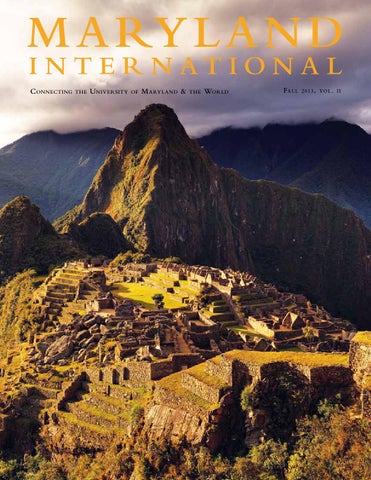
A view of Machu Picchu in Peru (front cover). UMD students in the Terrapin Take Off program in Norway (inside cover). Newari women in the ancient city of Bhaktapur located in the Kathmandu Valley in Nepal, by UMD student Ashwini Sebastian (back cover).
inside this issue 4
9
UMD Students Respond to Global Hunger Challenge This past spring, students were challenged to form a team and produce a robust project proposal
International Scholarship Honors Roberta Ma’s Legacy
that presented an unexpected and out-of-the-box solution to the global challenge of feeding nine
The Roberta Ma Scholarship—named after
billion people by 2050. 14 UMD students responded—one of the largest turnouts from a single
Dr. Roberta Ma who first opened her home to international students attending UMD in
U.S. university.
1960—is awarded annually to international students meeting specific academic and financial qualifications.
14
Also in this issue : 6
Study Abroad: UMD Senior Named Marshall Scholar
7
Study Abroad: Expanding Horizons with Terrapin Take Off
8
Campus News: School of Public Policy Hosts Peruvian Military and Civilian Government Officials
10
Campus news: The Humphrey Fellowship Program Brings Fulbrighters to UMD
12
Campus News: UMD Builds New International Linkages in Bioscience, Biotech, and Biosecurity
12
Global Research: UMD to Solve Global Language Problems at New Language Science Research Center
13
Campus News: UMD Professor Awarded “Order Of Cultural Merit”
14
Global Research: Villagers’ Land Uses Help People and Tigers in Nepal
15
Campus News: A Busy Fall for Maryland Global Leaders Lecture Series
M A R Y L A N D I N T E R N A T I O N A L is the newsletter of the Office of International Affairs. Issues are published twice during the fall and spring semesters. To submit story ideas and/or photos, please contact the editor, Vivian Hayward, at vhayward@umd.edu or 301-405-4312.
Civic Engagement
UMD Students Respond to Global
T
his past spring, students were challenged to form a team and produce a robust project proposal that presented an unexpected and out-of-the-box solution to the global challenge of feeding nine billion people by 2050. And to make things a little harder, they were asked to do this over the course of only six weeks, amid the other preoccupations of a typical college student. This was the international Thought for Food Challenge to which 14 UMD students recently responded—one of the largest turnouts from a single U.S. university. Team CIVICUS—which included UMD students Heather Moldofsky, Vanessa Jarnes, Ben Jaffe, Ryan Greenstein, and Javier Scott from the eponymous BSOS-sponsored Living and Learning Program—developed the W.I.T.S. proposal, for “Water Is The Solution.” Team MEGA— which included UMD students in the Gemstone Living and Learning Program Jessica Lu, Kevin Li, Adam W. Louie, Kelly Misner, and Luke O’Connor—proposed “Maximizing Efficiency of Greenhouses Using Aquaponics.” Team University of Maryland—which included UMD students Alex Krefetz, Gabrielle Rovegno, Leah Schleifer, and Jessica Rupprecht—had the idea to “reFarm” through “an educational extension program that aims to inspire young adults to consider a career in agriculture.” Between mid-March and May 1, each team was tasked with four missions, supported by the Challenge’s sponsoring organizations—Ashoka Changemakers, Syngenta corporation, and the Sandbox Network, the foremost global network of social entrepreneurs aged 20 to 30. Mission One: Research & Understand Global Food Issues, with educational background materials provided by Thought for Food. Mission Two: Brainstorm Ideas, with
the help of a kit designed to spark creativity and unleash great ideas. Mission Three: Create and Publish the Project Proposal, assisted by mentors ready to provide advice and input on any team needs by utilizing a web-based publishing platform developed by Thought for Food. Mission Four: Conquer Social Media, with expert tips, tricks, and support that enhance the team’s ability to garner support among voters. Those voters’ support—a sign of a proposal’s ability to create mass awareness, to stand out and get noticed—was one of four criteria used by judges to choose five finalists from among 74 participating teams around the globe. Proposals were also rated on their likelihood to incite social change—to challenge people to think, act, and behave differently on a daily basis—to last beyond the duration of the competition and disrupt the status quo through a breakthrough approach. None of the UMD teams made this top cut, to pitch their idea before the annual Thought for Food conference in Berlin this past fall, where first or second place awards were $10,000 and $ 5,000, respectively, to support the further development of their proposal. Team MEGA, however, garnered nearly 1,500 votes in online balloting, and was given a special invitation to attend, present, and observe—all at the expense of Syngenta. Team member Jessica Lu commented, “It was an incredible experience. There was so much energy at the conference, and we met so many innovative young thinkers from all over the world. We’re so grateful to have the opportunity to share our project in Berlin—it was definitely a once in a lifetime experience!” v By Joe Scholten, Office of International A ffairs
“It was an incredible experience. There was so much energy at the conference, and we met so many innovative young thinkers from all over the world.” —UMD student Jessica Lu 4
Maryland International
Hunger Challenge
PHOTO ABOVE: Although Team MEGA wasn’t a finalist in the 2013 Thought for Food Challenge, the UMD team received a special invitation to attend, present, and observe at the conference in Berlin. PHOTO TO RIGHT: Team MEGA prepares their application for the Thought for Food Challenge. Photos courtesy of Team MEGA.
Fall 2013, Vol. II
5
Study Abroad
UMD Senior Named Marshall Scholar
U
niversity of Maryland Senior Erin Hylton, a civil engineering major, has been named a 2014 Marshall Scholar. Selected from a pool of more than 900 nominees nationwide, she is one of approximately 40 recipients of the scholarship, which fully supports two years of graduate study in the United Kingdom. “Erin’s achievement places her in the front ranks of aspiring global leaders and reminds us all of the outstanding caliber of Maryland’s students,” says Professor Richard Bell, UMD’s faculty advisor for U.K. postgraduate fellowships. Founded by a 1953 Act of the United Kingdom Parliament, and named in honor of U.S. Secretary of State George C. Marshall, the
Marshall Scholarships commemorate the humane ideals of the Marshall Plan, which contributed vitally to the reconstruction of Europe following World War II, and they express the continuing gratitude of the British people to their American counterparts. Hylton, who is currently studying in Rio de Janeiro, Brazil, has focused her academic and future professional pursuits on water resource engineering and aims to devote her career to improving water resource access and quality in the developing world. With the support of the Marshall Scholarship program, Hylton will f irst pursue a master’s degree in hydrology and sustainable development at Imperial College London, followed by a master’s degree in water science, policy and management at the University of Oxford. According to Hylton, “Water is our most basic and precious natural resource, and its allocation must be balanced across a variety of conflicting uses, from irrigation and energy to sanitation and consumption. As a Marshall Scholar, my studies will prepare me to design and execute context-sensitive water management practices that will help propel us toward a sustainable hydrologic future.” At U M D, Hylton h a s s e r ve d as president of Engineers
<< 6
Maryland International
Without Borders and co-founder and president of Maryland Sustainability Engineering. A member of the University Honors Program and a Federal Semester participant, Hylton has held internships with the Environmental Protection Agency and with ICLEI-Local Governments for Sustainability USA. She has conducted research on the robustness of mathematical models used to estimate the magnitude of extreme flooding events. After her junior year, she carried out an independent summer research project in Sao Paulo, Brazil, analyzing the social and ecological impacts of the Belo Monte dam project. During her senior year she studied abroad in Denmark, where she took graduate-level coursework in civil engineering. Hylton has received numerous awards and citations for academic excellence and civic contributions from the Clark School and the Department of Civil and Environmental Engineering. She is a previous winner of two national scholarships—a 2012 Udall Scholarship recognizing her environmental leadership and a 2013 Boren Scholarship to pursue advanced Portuguese language studies in Brazil. Students interested in learning about the Marshall Scholarships and other national scholarship opportunities should contact the National Scholarships Off ice at www.scholarships. umd.edu. v By Francis DuVinage, National Scholarships Office and Maryland Center for Undergraduate Research
Erin Hylton, UMD senior and 2014 Marshall Scholar. Photo courtesy of Leslie Brice.
Study Abroad
Expanding Horizons with Terrapin Take Off
P
repa r i ng for college is often the main focus after graduating from high school, but some Terps break the mold and do something extraordinary—they study abroad through Terrapin Take Off. Terrapin Take Off is a group of shortterm study abroad prog ra m s led by University of Maryland faculty and open to students accepted to UMD. Before they even set foot onto campus for their first semester, st udents come together over the summer to participate in three-credit courses taught in Italy, China, Norway, or the United Kingdom. Subject areas range from adventure leadership to grand challenges in engineering. UMD Sophomore Naya Frazier is one of these extraordinary students. As an inter nationa l business major and international development and conflict management minor, she knew that studying abroad would be an important part of her undergraduate career at UMD. Terrapin Take Off offered her a great way to start school and a chance to get to know people before coming to campus. Frazier participated in the Terrapin Take Off Norway adventure leadership program. For her, Norway
“
presented a completely d i f ferent ex per ience UMD student Naya where she was able to Frazier in Nicaragua push herself and get out this past summer. of her comfort zone. Not only was she able to expand her horizons while hiking up a mountainside, but also meet new challenges and develop her leadership skills working in a team. The opportunity to participate in diverse experiences in study abroad continues to support her academic goals. Si nce pa r t icipat i ng in Terrapin Take Off, Frazier has not only been able to connect with people across campus but she also participated in the Maryland Social E nt repreneu r C or p s program in Nicaragua. “Studying abroad not only allows you to grow, but make connections and network with people f rom d if ferent back— UMD student Naya Frazier grounds and viewpoints. You get transferable skills for academics and life,” says Frazier. Before graduating, she hopes to do a full semester abroad to continue her studies and assist with her future career development. To learn more about Terrapin Take Off, visit ter.ps/takeoff. v
Studying abroad not only allows you to
grow, but make connections and network
with people from different backgrounds and viewpoints. You get transferable skills
”
for academics and life.
By Deborah Lake, Education Abroad
Fall 2013, Vol. II
7
Campus News
School of Public Policy Hosts Peruvian Military and Civilian Government Officials
F
or the third year in a row, the University of Maryland School of Public Policy played host to two groups of high-ranking Peruvian military and civilian government officials this past September. The two one-week programs—one on the defense and homeland security policies of the United States and the other on public finance and performance management—were administered in partnership with Universidad ESAN in Lima. The programs are two of a growing number of international programs the School operates to help train foreign government officials in everything from international security to ethical leadership.
8
Maryland International
“Our mission is to reach out to international clients with programs that relate to the real world issues they face,” says Tom Kennedy, director of the School’s Executive Programs. The School is actively growing its international programs in recognition of the fact that public professionals across the globe must be equipped with the knowledge and skills to address 21st century challenges in a more diverse and connected world. Peruvian off icials, for example, want to learn more about how the United States and other nations respond to significant policy questions and public management challenges. Working with Professor
Sofia Valencia of Universidad ESAN, the School developed a program of seminars, lectures, case studies, and site visits for the Peruvian officials. This fall’s lecturers included Nobel Laureate Professor Thomas Schelling, who discussed nuclear terrorism and proliferation; Dr. Catherine Kelleher, who spoke on the Obama Administration and the Future of Foreign Policy; Professor Phil Joyce, who presented on public budgeting; and Professor Kenneth Apfel, who discussed performance management systems. The program also stressed the overarching themes of leadership and ethics in power, which are critical to good governance.
Campus News
The School has similar relationships with other foreign universities and governments abroad. In partnership with the Copenhagen Business School, the School hosts a program in performance management and good governance for public executives from Denmark; this summer, the School concluded its second year of executive programming with the Lee Kuan Yew School in Singapore; and in collaboration with Peking University in Beijing, the School provided a public leadership program for private and public sector officials from China. v
UMD student Dienabou Diallo, one of the 2013 recipients of the Robert Ma Scholarship. Photo courtesy of Dienabou Diallo.
International Student Scholarship Honors Roberta Ma’s Legacy
I
n 1960, Dr. Roberta Ma first opened her home to international students attending the University of Maryland. She provided these students a place to gather, share meals, and celebrate. This evolving international group soon transformed into a non-profit organization named Koinonia Agapes, Inc., which is Greek for “Fellowship of Love.” As the number of participants grew, it became apparent that a larger meeting site was needed. In 1966, Ma purchased property in College Park with the intention of building an international fellowship hall. Unfortunately, she passed away before the center could become a reality. Following her passing, the board members of Koinonia Agapes, Inc. funded an international student scholarship to fulfill Ma’s dream of building international understanding and assisting international students. The Roberta Ma Scholarship is awarded annually to international students meeting the academic qualifications and possessing a demonstrated financial need. This year, the Ma Scholarship awarded a grant to Dienabou Diallo, a communications studies student from the Republic of Guinea. “There are no words to express the joy and gratitude I felt when I was awarded the Roberta Ma Scholarship. I was facing serious financial difficulties and was at the verge of not being able to graduate and go out of status. Since F1 students are supposed to have all funds available for their education, I thought no one would help,” she explains. “When everything is grim and I am slacking off, the award reminds me that not long ago, some people believed in me and gave me a little push. That drives me to move forward and push through obstacles.” To learn more about the Robert Ma Scholarship, contact International Student & Scholar Services at isss.umd.edu. v Adapted from materials gathered by Doug Reardon
Fall 2013, Vol. II
9
Campus News
The Hubert H. Humphrey Fellowship Prog
Kashif Alam
T
Masimba Biriwasha
Eva Flomo
he University of Maryland’s most recent cohort of Humphrey Fellows arrived at the Philip Merrill College of Journalism in August eager to begin a year of academic study and professional development activities. This year there are ten Fellows from around the world with expertise in fields such as journalism, communication, women’s rights advocacy, and law enforcement. The Humphrey Fellowship Program was initiated in 1978 in honor of the late senator and vice president Hubert H. Humphrey, a longtime advocate of international cooperation and understanding. As one of the oldest standing exchange programs on campus, this year marks the 21st year of the program for the College of Journalism. In the 2013-2014 academic year, 180 Humphrey Fellows from 93 countries were placed at 17 universities in the United States. The Hubert H. Humphrey Fellowship Program is a Fulbright Exchange activity with primary funding from the U.S. Department of State’s Bureau of Educational and Cultural Affairs. The Institute of International Education (IIE) assists the U.S. Department of State in administering the program. Humphrey Fellows are selected based on their potential for leadership and their commitment to public service in either the public or the private sector. The program fosters a mutual exchange of knowledge and understanding about issues of common concern in the United States and the Fellows’ home countries and offers Fellows valuable opportunities for leadership development and professional engagement with Americans and their counterparts from many nations.
10 Maryland International
Audace Machado
Thu Ha Nguyen
2013-2014 Humphrey Fellows Kashif Alam (Pakistan) is a course commander and senior superintendent of police with the Police Service of Pakistan. During his Humphrey year, he would like to focus on public policy analysis, national and international security issues, and leading and managing change. Masimba Biriwasha (Zimbabwe) is the global editor-at-large of AfroFutures.com, an online site dedicated to music, arts, fashion, business, and politics. During his Fellowship year, he would like to focus on digital media entrepreneurship, digital journalism and content management, data visualization, and infographics. Eva Flomo (Liberia) is a radio producer for UN Mission in Liberia. She is interested in efforts to increase women’s advancement by focusing on empowerment, health, and political participation. During her Humphrey year, she would like to identify partners with whom she can collaborate to work on these issues, as well as focus on development communication, investigative journalism, and community development efforts. Audace Machado (Burundi) is a producer for the Isanganiro Radio Station where his programs focus on issues of good gover-
gram Brings Fulbrighters to UMD
Tahira Noor
Mohammad Mahabubur Rahman
nance, anti-corruption, and tolerance. As a journalist and a blogger in his country, he worked as a correspondent for international media organizations and traveled widely. He won the “Comesa Media Award” in 2011 and 2012. During his Fellowship year, he would like to focus on best practices in radio program production and communication strategies.
Vanessa Carolina Sanchez
station in Venezuela where she covers governmental affairs. During her Fellowship, she would like to focus on international politics with an emphasis on the relationship between the United States and Latin American countries.
Ajla Terzic
Hussein Zaky
al relations and the role of printed media in online community programs.
Hussein Zaky (Egypt) is deputy chief of foreign news desk at the Al-Akhbar newspaper. He was a Middle East Fellow at International Journalists’ Programmes in Ajla Terzic (Bosnia and Herzegovina) Berlin in 2011 and served as a mentor and works as the foreign policy editor at the trainer at “Media Neighborhood Project” Oslobodjenje. She is the author of three organized by BBC Media Action and the Thu Ha Nguyen (Vietnam) is a senior books, several essays, and many op-eds European Union in 2012. He would like editor at VietNamnet where she also and columns for political and cultural maga- to focus on the role of local media in the covers politics. During her Humphrey year, zines. She won the Central European Initia- public’s participation in social and political she is interested in improving her skills as a tive Fellowship for Writers in Residence issues and its ability to encourage democpolitical editor and political analyst. Award in 2012. Throughout her Humphrey racy and rule of law. v year, she would like to focus on internationTahira Noor (Pakistan) is a civil rights activist and a manager at the National Commission on the Status of Women/UN WOMEN in Pakistan. She would like to study effective communication methods for advocacy and change in order to elevate the role of women in the decision-making process and develop public education programs. Mohammad Mahabubur Rahman (Bangladesh) works for WorldFish, an international non-profit research organization, as a communication specialist. He is interested in learning about behavior change communication as a tool for development, which he hopes to use for climate change adaptation and public health programming. Vanessa Carolina Sanchez (Venezuela) is a reporter for Venevision television
2013-2014 Humphrey Fellows sailing on the Chesapeake Bay.
Fall 2013, Vol. II
11
Campus News
UMD Builds New International Linkages in Bioscience, Biotech, and Biosecurity
T
his year, UMD continued to build its linkages to international peer institutions in the fields of bioscience, biotechnology, and biosecurity. This summer, Cell Biology and Molecular Genetics Professor Dr. Rita Colwell and the UM Institute for Advanced Computer Studies (UMIACS) represented the university at a workshop on Antimicrobial Resistance held in Tbilisi, Georgia. The Georgian National Center for Disease Control and Public Health (NCDC&PH) sponsored the workshop, which hosted international guests from countries like Norway, the UK, Russia, Armenia, and Bulgaria. One of the aims of the workshop was to identify competitive research projects addressing public and animal health, bio surveillance systems, and laboratory capabilities. During the workshop, Dr. Colwell signed a Memorandum of Understanding with the Georgian NCDC&PH. This agreement will pave the way for joint biological research, education, and training activities to be conducted at a campus of the NCDC&PH. It will also facilitate staff and student exchanges between the two institutions, wider cooperation on a range of projects, and institutional capacity development in Georgia. NCDC&PH signed a similar agreement at the workshop with the University of Oslo’s Centre for Ecological and Evolutionary Synthesis (CEES). Dr. Colwell serves as chair of the CEES external Scientific Advisory Board, and an existing MOU between UMD and CEES will allow the institutions to better collaborate with the Lugar Center in Tbilisi. v By Joe Scholten, Office of International Affairs
12 Maryland International
UMD to Solve Global Language Problems at New Research Center
T
he creation of the Maryland Language Science Center represents a major commitment to language science as a strategic priority for the university. This new campus-wide, interdisciplinary research center will connect language scientists across the university to answer deep scientific problems—such as understanding how our brains make the richness of human languages possible—with solutions to real-world problems involving language in education, technology, health, and security. The center is a collaborative effort involving more than 200 language scientists, drawn from 16 departments and centers in six colleges across UMD. “Language is the foundation of what makes humans distinctive as a species. Without it, society, culture, and technology would simply not be possible,” says Colin Phillips, a UMD professor of linguistics and director of the center. “The formation of this new center will help us solve a variety of complex research problems that require the diverse expertise of faculty and students across the entire university.” Building on the established work of language scientists at the university, the research center will solve a variety of pressing global problems including early identification of language disorders in infants, narrowing education achievement gaps caused by ‘language poverty,’ and building technology for information extraction and for real-time translation systems. “With the creation of the new Maryland Language Science Center, we are focusing on an innovative, interdisciplinary approach to language science and making it one of the university’s strategic priorities,” says Mary Ann Rankin, UMD’s senior vice president and provost. “Through this unique collaborative model between the humanities and sciences, we will be able to create connections across campus between traditionally disparate areas and secure our spot at a global leader in language science research.” The Language Science Center will also serve as an incubator for development of new research areas that intersect with language, such as culture, genetics, automatic speech recognition, and K-12 language education. To learn more about the Maryland Language Science Center, visit www.languagescience.umd.edu/launch. v By Alana Carchedi, University Communications & Marketing
Campus News
UMD Professor Awarded “Order Of Cultural Merit”
R
obert Ramsey, professor and chair of UMD’s Department of East Asian Languages and Cultures, has been awarded “The Precious Crown Medal of the Order of Cultural Merit” from Korean Prime Minister Jung Hong-won, who presented on behalf of President Park Geun-hye. Ramsey, the only westerner honored in the ceremony, was awarded the medal “according to the Constitution of the Republic of Korea for great achievements and contributions to the advancement of Hangul research and promulgation.” In 1998, Ramsey also received the Presidential Award and Medal for Contributions to Korean Language from the Republic of Korea. He has received teaching awards from the Korean Student Association, the Asian Student Union, and the Center for Teaching Excellence at the University of Maryland. Ramsey does primary research on the historical development of Japanese and Korean languages and the historical
relationships between the two. He is known for his work on Korean dialects and the reconstruction of prehistoric stages of Korean. Along with his many achievements, Ramsey is credited for the first book on the subject written in English, entitled “A History of the Korean Language.” He has also authored three other books and several dozen articles, written extensively on sociolinguistics, and lectured widely on various linguistic topics in Japan, Korea, Europe, and the United States. He is also known for his broader writings on East Asia, and especially his book “The Languages of China.” The awards ceremony—held in Seoul, South Korea— celebrated the return of Hangul Day to the full status of a national holiday. The Embassy of the Republic of Korea in Washington, DC, also honored Ramsey as part of its own celebration of Hangul Day. v By Nicky Everette, College of Arts & Humanities
Korean Prime Minister Jung Hong-won (on left) presents UMD Professor Robert Ramsey with “The Precious Crown Medal of the Order of Cultural Merit.” Photo courtesy of Ministry of Culture, Sports, and Tourism of the Republic of Korea.
Fall 2013, Vol. II
13
Gloabl Research
Villagers’ Land Uses Help People and
H
opeful signs that humans and tigers can coexist are emerging in rural Nepal, where the government has committed to doubling populations of the critically endangered big cat by 2022. A new study by conservation scientist Neil Carter, a postdoctoral research fellow at the National Socio-Environmental Synthesis Center (SESYNC) at the University of Maryland, provides evidence that when Nepalese villagers are empowered to make local land management decisions, the resulting landscape changes can benefit both people and tigers. Few wildlife species face more potential conflicts with humankind than tigers, which require large areas for hunting and raising their young and inhabit some of the most densely populated regions of the world. Carter studies the interactions between humans and tigers in Nepal’s Chitwan National Park and its environs. In his latest research, Carter and his colleagues showed that in areas near the national park border where local people were permitted to harvest some of the natural resources they needed, such as timber and grass, the amount of tigers’ preferred type of habitat increased. Within the park, where local resource harvests are prohibited, the amount of suitable habitat declined. Chitwan National Park was established in 1973 to protect tigers and other keystones of the area’s biodiversity, but it has had significant costs for people living in the area. Recognizing the potential for resource conf licts, in 1996 the Nepalese
<<
14 Maryland International
Neil Carter checks one of many camera traps— motion-sensitive cameras mounted along animal trails. Photo courtesy of Sue Nichols, Michigan State University.
Campus News
Tigers in Nepal government added a buffer zone next to the park, where people have more access to the forest’s resources and more say in its management. “In Nepal, we’re finding that there is this middle ground where you can have people using the land and still not only keep land from degrading, but improve habitat quality,” says Carter. “Policies in Chitwan’s buffer zone, such as prohibiting livestock from freely grazing in the forests and community-based forest management, improved habitat quality.” In July 2013, the Nepalese government announced the nation’s tiger population had jumped 63 percent in four years, with an estimated 198 tigers now living in the wild—many of them in and around Chitwan National Park. As Nepal and other countries work to pull tigers back from the brink of extinction, Carter says “the next step is to model how tiger habitat and human livelihood strategies will interact and change in the future under different conservation policy scenarios.” v By Melissa Andreychek, National Socio-Environmental Synthesis Center
A tiger caught on a motion-detecting camera trap in Nepal. Photo courtesy of Neil Carter, SESYNC.
A Busy Fall for Maryland Global Leaders Lecture Series
T
his fall saw three new events in the ongoing Maryland Global Leaders lecture series, which is a joint effort of the Office of International Affairs and the School of Public Policy. In October, Maryland Global Leaders joined the Center for International Business Education and Research (CIBER) in welcoming to campus Professor Moisés Naím, senior associate in the International Economics Program at the Carnegie Endowment for International Peace, best-selling author, and long-time editor of the journal Foreign Policy. CIBER Director Professor Kislaya Prasad engaged Naím in a lively but informal evening of discussion of his latest book, “The End of Power: From Boardrooms to Battlefields and Churches to States, Why Being in Charge Isn’t What It Used To Be.” Later that same week, Felipe Larraín Bascuñán, Chile’s Minister of Finance, spoke to an audience about the Alianza del Pacífico (“Pacific Alliance”) that now links his country to Colombia, Costa Rica, Mexico, and Peru in a trade bloc whose $2 billion GDP now surpasses that of India. The Center for International and Security Studies at Maryland (CISSM), the Smith School, and the Department of Economics co-sponsored his visit. And in November, the Representative to the U.S. of the Palestine Liberation Organization, Ambassador Maen Rashid Areikat, keynoted the campus-wide calendar of events in celebration of International Education Week with a discussion of the impact of the Arab Spring and its aftermath on the ongoing Israel-Palestinian conflict. His talk was co-sponsored by the Center for International Development and Conflict Management, and the Joseph and Alma Gildenhorn Institute for Israel Studies.
Planning on bringing someone of global prominence to campus, or thinking about it? Contact Joe Scholten (scholten@umd.edu) about featuring your guest in the lecture series. v B y Joe Scholten, Office of International A ffairs
Fall 2013, Vol. II
15
NON PROFIT ORG. 3101 Susquehanna Hall College Park, Maryland, 20742-5610 U.S.A.
To submit story ideas and photos, please contact the editor, Vivian Hayward, at vhayward@umd.edu or 301-405-4312.
U.S. POSTAGE PAID MVPRINT