® An open-label, multicenter study of long-term Mucinex use in
stable chronic bronchitis: Analyses of exacerbation risks & rates Selwyn Spangenthal, MD1, Connie Divel, BS1, Alasdair Fellows, MSc2, Samuel Llewellyn, MPH2 1American Health Research, Inc., Charlotte, NC, USA, 2Vitaccess, London, UK
BACKGROUND •
•
RESULTS
Chronic bronchitis (CB) is defined as a mucus-producing cough on most days lasting at least three months for two consecutive years and is commonly a consequence of chronic airway irritation from smoking or environmental exposures. CB imposes significant symptom burden and negatively impacts health-related quality of life.
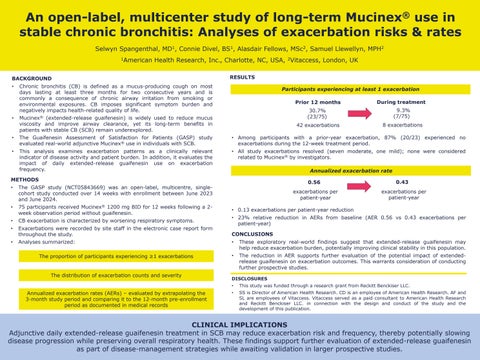
Participants experiencing at least 1 exacerbation
Mucinex® (extended-release guaifenesin) is widely used to reduce mucus viscosity and improve airway clearance, yet its long-term benefits in patients with stable CB (SCB) remain underexplored.
Prior 12 months
During treatment
30.7% (23/75)
9.3% (7/75)
42 exacerbations
8 exacerbations
•
The Guaifenesin Assessment of Satisfaction for Patients (GASP) study evaluated real-world adjunctive Mucinex® use in individuals with SCB.
• Among participants with a prior-year exacerbation, 87% (20/23) experienced no exacerbations during the 12-week treatment period.
•
This analysis examines exacerbation patterns as a clinically relevant indicator of disease activity and patient burden. In addition, it evaluates the impact of daily extended-release guaifenesin use on exacerbation frequency.
• All study exacerbations resolved (seven moderate, one mild); none were considered related to Mucinex® by investigators. Annualized exacerbation rate
METHODS •
The GASP study (NCT05843669) was an open-label, multicentre, singlecohort study conducted over 14 weeks with enrollment between June 2023 and June 2024.
•
75 participants received Mucinex® 1200 mg BID for 12 weeks following a 2week observation period without guaifenesin.
•
CB exacerbation is characterized by worsening respiratory symptoms.
•
Exacerbations were recorded by site staff in the electronic case report form throughout the study.
•
Analyses summarized: The proportion of participants experiencing ≥1 exacerbations
The distribution of exacerbation counts and severity
Annualized exacerbation rates (AERs) – evaluated by extrapolating the 3-month study period and comparing it to the 12-month pre-enrollment period as documented in medical records
0.56
0.43
exacerbations per patient-year
exacerbations per patient-year
• 0.13 exacerbations per patient-year reduction • 23% relative reduction in AERs from baseline (AER 0.56 vs 0.43 exacerbations per patient-year) CONCLUSIONS •
These exploratory real-world findings suggest that extended-release guaifenesin may help reduce exacerbation burden, potentially improving clinical stability in this population.
•
The reduction in AER supports further evaluation of the potential impact of extendedrelease guaifenesin on exacerbation outcomes. This warrants consideration of conducting further prospective studies.
DISCLOSURES •
This study was funded through a research grant from Reckitt Benckiser LLC.
•
SS is Director of American Health Research. CD is an employee of American Health Research. AF and SL are employees of Vitaccess. Vitaccess served as a paid consultant to American Health Research and Reckitt Benckiser LLC. in connection with the design and conduct of the study and the development of this publication.
CLINICAL IMPLICATIONS Adjunctive daily extended-release guaifenesin treatment in SCB may reduce exacerbation risk and frequency, thereby potentially slowing disease progression while preserving overall respiratory health. These findings support further evaluation of extended-release guaifenesin as part of disease-management strategies while awaiting validation in larger prospective studies.