v
• Rimegepant is a small-molecule calcitonin gene-related peptide (CGRP) antagonist indicated for the acute treatment of migraine and prevention of episodic migraine in adults. • Efficacy, safety and tolerability in acute treatment of migraine has been demonstrated across six double-blind clinical trials.1-6 • Real-world effectiveness across multiple attacks over 4 weeks has been assessed with current rimegepant users in the US CONFIDENCE study (NCT06467370)7. • CORRELATE-UK (NCT06898047) aims to further evaluate real-world effectiveness across multiple attacks, inclusive of new rimegepant users, over 12 weeks in the United Kingdom.
RESULTS
PARTICIPANT CHARACTERISTICS
• Among the first 30 participants, 29 met the interim analysis criteria. • Most study participants were female (93.1%), most were White (86.2%), and the mean (SD) age was 42.3 (14.45) years (Table 1). • Most participants had chronic migraine (86.2%) and used preventive medication (51.7%). The mean (SD) number of headache days in the past 28 days prior to enrollment was 15.6 (7.99) days (Table 2). • A median 7 unique migraine attacks and a median 4 unique rimegepant-treated attacks were reported per participant (Table 2). Table 1: Baseline demographics
OBJECTIVE
• To present interim findings from the first 4 weeks of data collection from the first 30 participants in CORRELATE-UK, investigating real-world effectiveness of rimegepant for the acute treatment of migraine over multiple attacks in adults.
METHODS
RECRUITMENT
• CORRELATE is a 12-week prospective, observational, non-interventional, real-world cohort study involving 15 UK healthcare institutions. • Participants were identified by participating institutions and directed to enroll via the Vitaccess Real digital platform. • Eligible participants were aged ≥18 years, had ≥4 headache days in the previous 28 days, were prescribed rimegepant for acute treatment, and planned to treat some of their migraine attacks with rimegepant over the next 12 weeks. • Stable use of non-rimegepant migraine preventives was permitted, including oral therapies, monthly injectables (most recent dose within 3 weeks), or quarterly injectables (most recent dose within 2 months).
DATA COLLECTION
• Following registration, participants complete a baseline demographic and clinical survey via the platform. • Over the next 12 weeks, participants receive a daily single-item SMS survey asking whether they have experienced migraine symptoms in the past 24 h. If responses are affirmative, participants receive a link to complete a digital diary capturing acute medication use, time to meaningful pain relief, restoration of function, and treatment satisfaction. Responses can be submitted within a 96-h window. • This interim analysis included data from the first 30 enrolled participants during the initial 4 weeks of their 12-week data collection period.
INTERIM ANALYSIS CRITERIA
• For the interim analysis, participants (target N=30) who completed ≥21 of 28 daily diaries and treated ≥2 migraine attacks with rimegepant during the first 28 days were included.
REFERENCES
1. Lipton R, et al. J Pain Research 2024;17:2431-41. 2. Lipton R, et al. N Engl J Med 2019;381:142-9. 3. Croop R, et al. Lancet 2019;394:737-45. 4. Yu S, et al. Lancet Neurol 2023;22:476-484. 5. Ikeda K, et al. Headache 2025;65:1811-20. 6. Ashina M, et al. Cephalalgia 2025;45(11):1-12. 7. Abraham L, et al. Cephalalgia 2025;45(1S):271-2.
Table 2: Baseline clinical characteristics
All participants N=29 Age, mean (SD), y
42.3 (14.45)
Sex, n (%) Female
27 (93.1)
Male
2 (6.9)
Ethnicity, n (%)
All participants N=29 Migraine type, n (%) Episodic migraine
4 (13.8)
Chronic migraine
25 (86.2)
Time since migraine diagnosis, mean (SD), y
18.9 (13.26)
Headache days in the past 28 days, mean (SD), days
15.6 (7.99)
Medication overuse in the past 28 days, n (%)
7 (24.1)
Number of unique migraine attacks per participant, median (IQR)
7 (5–12)
Rimegepant-treated unique migraine attacks per participant
4 (4–6)
Any preventive medication, n (%) Oral
15 (51.7) 9 (60.0)
Beta-blockers
1 (6.7)
Tricyclic antidepressants
3 (20.0)
Anticonvulsants
2 (13.3)
SSRIs/SNRIs
1 (6.7)
White
25 (86.2)
Black
1 (3.4)
Oral CGRP inhibitors (atogepant)
3 (20.0)
Mixed/multiple
1 (3.4)
Other oral preventive medication
2 (13.3)
Other ethnic group
2 (6.9)
MIGRAINE BURDEN AND TREATMENT USE • 357 attacks were recorded in the Vitaccess Real digital platform during the first 4 study weeks; rimegepant was used to treat 229 (64.1%) of the attacks. • 253 of the migraine attacks could be characterized as unique attacks, defined as either new or recurrent migraine attacks; 162 (64.0%) unique migraine attacks were treated with rimegepant. • Of the unique rimegepant-treated migraine attacks (n=162), rimegepant was administered after the pain had started in 59 (36.4%) attacks, at the first sign of headache pain in 53 (32.7%) attacks, at the first sign of the migraine (before the pain started) in 38 (23.5%) attacks, and after another drug had not provided enough relief in 12 (7.4%) attacks (Table 3). • In the unique rimegepant-treated migraine attacks treated after the pain started (n=124), rimegepant was administered 31–60 min after pain began in 34 (27.4%) attacks, and >1 and ≤2 h in 39 (31.5%) attacks (Table 3). • No headache pain was experienced in 7 (4.3%) attacks, and no functional disability was experienced in 15 (9.3%) attacks.
CONSISTENCY OF RESPONSE
• Across unique rimegepant-treated attacks (n=162), 92 (56.8%) achieved meaningful pain relief within ≤2 h of treatment and 124 (76.5%) within ≤4 h (Figure 1). • Meaningful return to function was achieved in 71 (43.8%) attacks within ≤2 h of treatment and 106 (65.4%) attacks within ≤4 h (Figure 1). • 76.0% and 96.0% of participants with ≥3 rimegepant-treated migraine attacks achieved meaningful pain relief within 2 and 4 h, respectively, in ≥2 of their 3 attacks; 50.0% and 84.6% of participants achieved return to normal function within 2 and 4 h, respectively, for ≥2 of their 3 attacks (Figure 2).
DISCLOSURES
GO, LA, KN, MCJ: Employees of and hold stock/options in Pfizer. CC, AF, CP, SL: Employees of Vitaccess, which was commissioned by Pfizer to run this study and prepare this poster. GL: Consulting fees from Pfizer.
Injectable
9 (60.0)
Injectable CGRP inhibitors (CGRP antibodies)
3 (20.0)
OnabotulinumtoxinA
4 (26.7)
Other injectable preventive medication
2 (13.3)
First prescription for rimegepant for acute treatment of migraine was received, n (%) Within the last 3 mo
12 (41.4)
Within the last 3 to 12 mo
5 (17.2)
>1 year ago
12 (41.4)
Previous acute migraine treatment prescription(s) Triptans, n (%) Number of previous triptans used, mean (SD)
26 (89.7) 3.0 (1.36)
New York, NY, USA; 4Vitaccess Ltd, London, UK; 5The Headache and Facial Pain Service, Guy’s and St. Thomas’ NHS Foundation Trust, London, UK
Table 3: Timing and stage of rimegepant administration during unique rimegepant-treated migraine attacks Stage of unique rimegepant-treated migraine attack at time of rimegepant administration, n (%)
Migraine attacks n=162
At the first sign of the migraine attack (before the pain started)
38 (23.5)
At the first sign of headache pain
53 (32.7)
After the pain has started
59 (36.4)
After another drug had not provided enough relief
12 (7.4)
Timing of rimegepant administration after the pain had started in unique rimegepant-treated migraine attacks, n (%)
27 (21.8)
31–60 min
34 (27.4)
>1 h to 2 h
39 (31.5)
>2 h
24 (19.4)
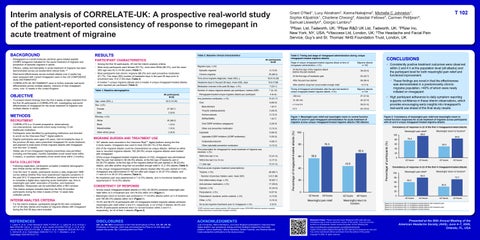
Figure 1: Meaningful pain relief and meaningful return to normal function within 2 h and 4 h post rimegepant administration for acute treatment of migraine across unique rimegepant-treated migraine attacks (162 attacks)
− These findings are novel in that the effectiveness was demonstrated in a predominantly chronic migraine population, >40% of whom were newly initiated on rimegepant. • High participant adherence to daily symptom reporting supports confidence in these interim observations, which provides encouraging early insights into rimegepant's real-world use ahead of the final study results. Figure 2: Consistency of meaningful pain relief and meaningful return to normal function responses for acute treatment of migraine across participants with ≥3 and 4 unique rimegepant-treated migraine attacks Consistency of response in ≥2 of the first 3 rimegepant-treated attacks
100
100 80
76.5
80
65.4 60
56.8 43.8
40
20
18 (62.1)
Anti-sickness medication, n (%)
17 (58.6)
Opioids, n (%)
10 (34.5)
Paracetamol, n (%)
8 (27.6)
Paracetamol, buclizine, and/or codeine, n (%)
4 (13.8)
≤2 hours
Other, n (%)
3 (10.3)
Meaningful pain relief
No acute migraine treatments prior to rimegepant, n (%)
0 (0.0)
Meaningful pain reliefa 96.0
0
Meaningful return to functionb 84.6
76.0
60
50.0
40 20 0
≤2 hours
≤4 hours
≤2 hours
≤4 hours
Consistency of response in ≥3 of the first 4 rimegepant-treated attacks 100 80 60
Meaningful pain reliefc
Meaningful return to functiond
80.0
72.7
60.0 40.9
40 20
≤4 hours
≤2 hours
≤4 hours
Meaningful return to function
0
≤2 hours
≤4 hours
≤2 hours
≤4 hours
a Based on 25 participants with ≥3 rimegepant-treated attacks with headache pain. b Based on 26 participants with ≥3 rimegepant-treated attacks.
c Based on 20 participants with ≥4 rimegepant-treated attacks with headache pain.
CGRP=calcitonin gene-related peptide; IQR-interquartile range; SSRI/SNRI=selective serotonin reuptake inhibitors/serotonin-noradrenaline reuptake inhibitors
Juan Fernandez, Marius Munteanu, and Ciara Ringland participated in Vitaccess Real digital platform user acceptance testing and their feedback shaped the final study platform. Karina Kauffmann, Marius Munteanu, Robert Pawinski, and Rowena Randall made substantial contributions to the study protocol.
• Consistently positive treatment outcomes were observed within 2 and 4 h at the population level (all attacks) and the participant level for both meaningful pain relief and functional improvement.
Migraine attacks n=124
≤30 min
Anti-inflammatory drugs, n (%)
ACKNOWLEDGMENTS
CONCLUSIONS
Percentage of participants (%)
BACKGROUND
1Pfizer, Ltd, Tadworth, UK; 2Pfizer R&D UK Ltd, Tadworth, UK; 3Pfizer Inc,
Percentage of rimegepant-treated attacks (%)
Interim analysis of CORRELATE-UK: A prospective real-world study of the patient-reported consistency of response to rimegepant in acute treatment of migraine
T 102
Grant O’Neil1, Lucy Abraham2, Karina Nakajima3, Michelle C Johnston1, Sophie Kilpatrick1, Charlene Cheong4, Alasdair Fellows4, Carmen Petitjean4, Samuel Llewellyn4, Giorgio Lambru5
d Based on 22 participants with ≥4 rimegepant-treated attacks.
Electronic Poster: Please scan this Quick Response (QR) code with your smartphone app to view an electronic version of this poster. If you do not have access to a smartphone, please access the poster via the following link: https://scientificpubs.congressposter.com/p/8krty0nq9vtzndhj Copies of this poster obtained through the QR code are for personal use only and may not be reproduced without permission from the authors of this poster. Copyright © 2026. Al rights reserved.
Presented at the 68th Annual Meeting of the American Headache Society (AHS), June 4–7, 2026, Orlando, FL, USA