v
CORRELATE-UK Interim analysis: reported consistency of response to rimegepant in acute treatment of migraine in the first four attacks of a prospective real-world study 1 2 3 2 Karina Nakajima , Grant O’Neil , Lucy Abraham , Michelle C Johnston , Sophie 4 4 4 2 Kilpatrick , Charlene Cheong , Alasdair Fellows , Carmen Petitjean , Samuel 4 7 5 6 Llewellyn , Marc Randall , Rebecca Walker , Giorgio Lambru 1Pfizer, Inc., New York, NY, US; 2Pfizer, Ltd, Tadworth, UK; 3Pfizer R&D UK Ltd, 4 5 Tadworth, UK; Vitaccess Ltd, London, UK; The Leeds Teaching Hospitals NHS Trust, 6 7 Leeds, UK; The National Migraine Centre, London, UK; The Headache and Facial Pain
Service, Guy’s and St. Thomas’ NHS Foundation Trust, London, UK
OBJECTIVE • This interim analysis aims to describe the consistency of meaningful pain relief and return to function over the first four migraine attacks treated with rimegepant in the CORRELATE study. • Outcomes were assessed during participants’ first 28 days in the study. • A further objective was to describe the reasons why not all migraine attacks experienced during the first 28 days were treated with rimegepant.
METHODS RECRUITMENT • CORRELATE-UK is a 12-week prospective, observational, non-interventional, real-world cohort study involving 14 UK healthcare institutions. • Adults (n=30) with at least 4 migraine attacks per month and current prescription of rimegepant for acute treatment of migraine were eligible for the study. • Preventive migraine medications were allowed, except rimegepant as preventive treatment.
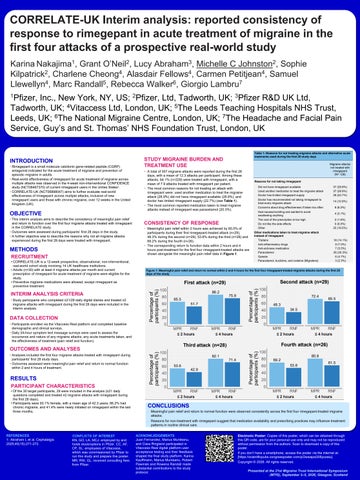
• A total of 357 migraine attacks were reported during the first 28 days, with a mean of 12.3 attacks per participant. Among these attacks, 64.1% (n=229) were treated with rimegepant, with a mean of 7.9 attacks treated with rimegepant per patient. • The most common reasons for not treating an attack with rimegepant were: used another medication to treat the migraine attack (28.9%) did not have rimegepant available (28.9%), and doctor has limited rimegepant supply (22.7%) (see Table 1). • The most common reported medication taken to treat migraine attacks instead of rimegepant was paracetamol (20.3%).
• Meaningful pain relief within 2 hours was achieved by 65.5% of participants during their first rimegepant-treated attack (n=29), 48.3% during the second (n=29), 53.6% during the third (n=28) and 69.2% during the fourth (n=26). • The corresponding return to function data within 2 hours and 4 hours post-treatment for the first four rimegepant-treated attacks are shown alongside the meaningful pain relief data in Figure 1.
ercentage of participants (
DATA COLLECTION • Participants enrolled via the Vitaccess Real platform and completed baseline demographic and clinical surveys. • Daily 24-hour symptom text message surveys were used to assess the occurrence and nature of any migraine attacks, any acute treatments taken, and the effectiveness of treatment (pain relief and function).
OUTCOMES AND ANALYSES ercentage of participants (
• Analyses included the first four migraine attacks treated with rimegepant during participants' first 28 study days. • Outcomes assessed were meaningful pain relief and return to normal function within 2 and 4 hours of treatment.
RESULTS PARTICIPANT CHARACTERISTICS
37 (28.9%) 37 (28.9%) 29 (22.7%)
Doctor has recommended not taking rimegepant to treat every migraine attack
14 (10.9%)
Concerns about drug effectiveness if taken too often
8 (6.2%)
Had nausea/vomiting and wanted to avoid swallowing anything
4 (3.1%)
The cost of the prescription is too high Do not like the side effects Other
2 (1.6%) 0 (0.0%) 25 (19.5%)
Other medications taken to treat migraine attack instead of rimegepant Triptans Anti-inflammatory drugs Anti-sickness medication Paracetamol Opioids Paracetamol, buclizine, and codeine (Migraleve)
18 (14.1%) 9 (7.0%) 7 (5.5%) 26 (20.3%) 6 (4.7%) 3 (2.3%)
100 80
8 .2 .
0
.9
1.
0 20 0
N
100 0
3.
0
1.
2.9
20 0
N
80 0
2.
N
.
8.3 3 .
0 20 0
N
N
82.1
80
100
100 80 0
N
80.8
9.2 3.8
1.
0 20 0
N
N
CONCLUSIONS •
•
CONFLICTS OF INTEREST KN, GO, LA, MCJ: employed by and holds stock/options in Pfizer. CC, AF, CP, SL: employees of Vitaccess, which was commissioned by Pfizer to run this study and prepare this poster. MR, RW, GL: received consulting fees from Pfizer.
Did not have rimegepant available Used another medication to treat the migraine attack Doctor has limited rimegepant supply
Figure 1: Meaningful pain relief and return to normal within 2 and 4 hours for the first four rimegepant-treated migraine attacks during the first 28 days of the study
• Study participants who completed ≥21/28 daily digital diaries and treated ≥2 migraine attacks with rimegepant during the first 28 days were included in the interim analysis.
REFERENCES 1: Abraham L et al. Cephalalgia 2025;45(1S):271-272.
Reasons for not taking rimegepant
CONSISTENCY OF RESPONSE
INTERIM ANALYSIS CRITERIA
• Of the 30 target participants, 29 were included in the analysis (≥21 daily questions completed and treated ≥2 migraine attacks with rimegepant during the first 28 days). • Participants were 93.1% female, with a mean age of 42.3 years; 86.2% had chronic migraine, and 41.4% were newly initiated on rimegepant within the last three months.
Migraine attacks not treated with rimegepant (N= 128)
ercentage of participants (
• Rimegepant is a small molecule calcitonin gene-related peptide (CGRP) antagonist indicated for the acute treatment of migraine and prevention of episodic migraine in adults. • Real-world effectiveness of rimegepant for acute treatment of migraine across multiple attacks was observed in the 4-week non-interventional CONFIDENCE study (NCT06467370) of current rimegepant users in the Unites States1. • CORRELATE-UK (NCT06898047) aims to further evaluate real-world effectiveness of rimegepant across multiple attacks, inclusive of new rimegepant users and those with chronic migraine, over 12 weeks in the United Kingdom (UK).
STUDY MIGRAINE BURDEN AND TREATMENT USE
ercentage of participants (
INTRODUCTION
Table 1: Reasons for not treating migraine attacks and alternative acute treatments used during the first 28 study days
Meaningful pain relief and return to normal function were observed consistently across the first four rimegepant-treated migraine attacks. Reasons for non-treatment with rimegepant suggest that medication availability and prescribing practices may influence treatment patterns in routine clinical care.
ACKNOWLEDGEMENTS Juan Fernandez, Marius Munteanu, and Ciara Ringland participated in Vitaccess Real digital platform user acceptance testing and their feedback shaped the final study platform. Karina Kauffmann, Marius Munteanu, Robert Pawinski and Rowena Randall made substantial contributions to the study protocol.
Electronic Poster: Copies of this poster, which can be obtained through this QR code, are for your personal use only and may not be reproduced without permission from the authors. Scan to download a copy of this poster. If you don’t have a smartphone, access the poster via the internet at: [https://scientificpubs.congressposter.com/p/2wwajsa306yozalu]. Copyright © 2026. All rights reserved. Presented at the 21st Migraine Trust International Symposium (MTIS), September 3–5, 2026, Glasgow, Scotland