Poster no. 20
Use of PLEX, IVIg, and SCIg as maintenance therapy in myasthenia gravis: unmet evidence needs and real-world data from the Vitaccess Real MG Registry Mark Larkin1*, Fatemeh Amini1, Alasdair Fellows1, Emma Bagshaw1, Amanda Hayes2, Emma Ward2 1. Vitaccess, London, UK; 2. Independent myasthenia gravis patient representative, London, UK
Background Plasma exchange (plasmapheresis; PLEX), intravenous immunoglobulin (IVIg) and subcutaneous immunoglobulin (SCIg) are myasthenia gravis (MG) treatments that are typically used to manage exacerbations. They are not commonly recommended in the routine or maintenance therapy setting. However, there is some indication that a small proportion of individuals with MG, especially those with disease that is refractory to standard maintenance therapies, do receive PLEX, IVIg, or SCIg in the maintenance setting. Anecdotally, these patients tend to be those treated in specialist centers, in countries/regions where innovative treatments are not approved or readily available. Robust data on the clinical value and usage rates of PLEX, IVIg, and SCIg in the maintenance setting are currently limited, but would be valuable in understanding the scale of unmet need in MG patients with disease that is refractory to standard maintenance therapies.
Objective The objective of this analysis was to collect real-world data on maintenance use of PLEX, IVIg, and SCIg, to better understand the treatment landscape and the needs of patients with refractory MG.
Methods The Vitaccess Real MG (VRMG) Registry is an international MG patient registry collecting patient-reported and clinical data. Data from registry participants who had been enrolled via healthcare sites were analyzed to identify those receiving maintenance PLEX, IVIg, or SCIg at the time of registry enrolment. Baseline characteristics of these participants were explored.
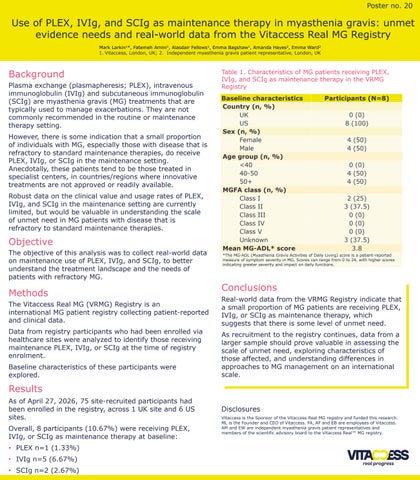
Table 1. Characteristics of MG patients receiving PLEX, IVIg, and SCIg as maintenance therapy in the VRMG Registry
Baseline characteristics Country (n, %) UK US Sex (n, %) Female Male Age group (n, %) <40 40-50 50+ MGFA class (n, %) Class I Class II Class III Class IV Class V Unknown Mean MG-ADL* score
Participants (N=8) 0 (0) 8 (100) 4 (50) 4 (50) 0 (0) 4 (50) 4 (50) 2 (25) 3 (37.5) 0 (0) 0 (0) 0 (0) 3 (37.5) 3.8
*The MG-ADL (Myasthenia Gravis Activities of Daily Living) score is a patient-reported measure of symptom severity in MG. Scores can range from 0 to 24, with higher scores indicating greater severity and impact on daily functions.
Conclusions Real-world data from the VRMG Registry indicate that a small proportion of MG patients are receiving PLEX, IVIg, or SCIg as maintenance therapy, which suggests that there is some level of unmet need.
As recruitment to the registry continues, data from a larger sample should prove valuable in assessing the scale of unmet need, exploring characteristics of those affected, and understanding differences in approaches to MG management on an international scale.
Results As of April 27, 2026, 75 site-recruited participants had been enrolled in the registry, across 1 UK site and 6 US sites. Overall, 8 participants (10.67%) were receiving PLEX, IVIg, or SCIg as maintenance therapy at baseline: • PLEX n=1 (1.33%) • IVIg n=5 (6.67%) • SCIg n=2 (2.67%)
Disclosures Vitaccess is the Sponsor of the Vitaccess Real MG registry and funded this research. ML is the Founder and CEO of Vitaccess. FA, AF and EB are employees of Vitaccess. AM and EW are independent myasthenia gravis patient representatives and members of the scientific advisory board to the Vitaccess Real MG registry.