SA26
Recruitment Pathways in a Real-World Myasthenia Gravis Registry: Differences in Patient Characteristics and Severity Profiles and Their Implications for Evidence Use Petitjean C, Cheong C, Fellows A, Clift AK, Amini F, Larkin M Vitaccess, London, UK
Background & Objectives Real-world registries often employ diverse recruitment pathways to maximize scale, reach and representativeness.
Differences in recruitment pathways could introduce variation and affect interpretation.1
Research question: Are there differences in participant profiles between the Vitaccess Real Myasthenia Gravis registry’s recruitment pathways and what are their implications for evidence use?
Methods Vitaccess Real Myasthenia Gravis (VRMG) Registry
Statistical Analysis
VRMG employs two distinct recruitment pathways:
Descriptive comparison of demographics, myasthenia gravis (MG) characteristics and patient-reported MG Activities of Daily Living (MG-ADL) scores over the first 12 months of follow-up.
Site-based participants complete demographic and monthly patient-reported outcome (PRO) questionnaire. Clinical, diagnostic and care data are provided by clinicians using electronic case report forms.
A Mixed Model for Repeated Measures (MMRM) was fitted to evaluate differences in monthly MG-ADL scores over the first 12 months of follow-up, adjusting for age, sex, recruitment pathway and study timepoints. This method assumes missing outcomes are missing at random.
Direct-to-patient participants complete the same demographic and monthly PRO questionnaires as sitebased participants. Clinical, diagnostic and care data are collected through electronic medical record aggregation.
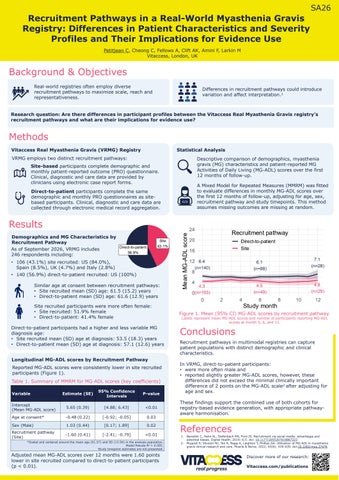
Results Demographics and MG Characteristics by Recruitment Pathway As of September 2026, VRMG includes 246 respondents including: • 106 (43.1%) site recruited: US (84.0%), Spain (8.5%), UK (4.7%) and Italy (2.8%) • 140 (56.9%) direct-to-patient recruited: US (100%) Similar age at consent between recruitment pathways: • Site recruited mean (SD) age: 61.5 (15.2) years • Direct-to-patient mean (SD) age: 61.6 (12.9) years Site recruited participants were more often female: • Site recruited: 51.9% female • Direct-to-patient: 41.4% female Direct-to-patient participants had a higher and less variable MG diagnosis age: • Site recruited mean (SD) age at diagnosis: 53.5 (18.3) years • Direct-to-patient mean (SD) age at diagnosis: 57.1 (12.6) years Longitudinal MG-ADL scores by Recruitment Pathway Reported MG-ADL scores were consistently lower in site recruited participants (Figure 1). Table 1. Summary of MMRM for MG-ADL scores (key coefficients) Variable
Estimate (SE)
95% Confidence Intervals
P-value
Intercept (Mean MG-ADL score)
5.65 (0.39)
[4.88; 6.43]
<0.01
Age at consent*
-0.48 (0.22)
[-0.92; -0.05]
0.03
Sex (Male)
1.03 (0.44)
[0.17; 1.89]
0.02
Recruitment pathway (Site)
-1.60 (0.41)
[-2.41; -0.79]
<0.01
*Scaled and centered around the mean age (61.57) and SD (13.94) in the analysis population. Model Pseudo-R2 = 0.095. Study timepoint estimates are not presented.
Adjusted mean MG-ADL scores over 12 months were 1.60 points lower in site recruited compared to direct-to-patient participants (p < 0.01).
Figure 1. Mean (95% CI) MG-ADL scores by recruitment pathway. Labels represent mean MG-ADL scores and number of participants reporting MG-ADL scores at month 0, 6, and 12.
Conclusions Recruitment pathways in multimodal registries can capture patient populations with distinct demographic and clinical characteristics. In VRMG, direct-to-patient participants: • were more often male and • reported slightly greater MG-ADL scores, however, these differences did not exceed the minimal clinically important difference of 2 points on the MG-ADL scale2 after adjusting for age and sex. These findings support the combined use of both cohorts for registry-based evidence generation, with appropriate pathwayaware harmonisation.
References 1. 2.
Benedict C, Hahn AL, Diefenbach MA, Ford JS. Recruitment via social media: advantages and potential biases. Digital Health. 2019; 6;5. doi: 10.1177/2055207619867223 Muppidi S, Silvestri NJ, Tan R, Riggs K, Leighton T, Phillips GA. Utilization of MG-ADL in myasthenia gravis clinical research and care. Muscle & Nerve. 2022; 65(6): 630-639. doi:10.1002/mus.27476
Discover more of our research: Vitaccess.com/publications