PCR15
Adherence to Data Collection in Real-World Studies: The Impact of Compensation and Engagement Strategies Ofori A, Llewellyn S Vitaccess, London, UK
Adherence to data collection activities in real-world studies is key for interpretability and use of real-world data. Missing data, however, is more common in real-world studies. Engagement techniques such as reminders and emphasizing the benefits of engaging with the study have been shown to sustain participation and reduce missing data1. Offering financial incentives for participation has also been associated with higher retention rates in healthcare research2. A previous review of adherence rates in real-world studies using digital technologies found that adherence to data capture activities is impacted by the duration of the study and the frequency of data capture activities3. This review builds on this, to evaluate how adherence to real-world data collection activities varies according to compensation, engagement strategies, and study design.
Methods A targeted literature review was conducted in PubMed and Google Scholar, using key words to identify longitudinal or observational studies that used web or mobile surveys for data collection (published from 2012-2022). Results from this review have been previously published3. Studies that did not report or offer compensation (n=8) or that were conducted before June 2016 (n=2) were excluded from the current review. The eligible studies from the 2022 review (n=4) were supplemented by additional studies that were identified based on their use of compensation in real-world studies between 2016 and 2026. The data extracted included study design, compensation type and value, engagement strategies, and adherence outcomes.
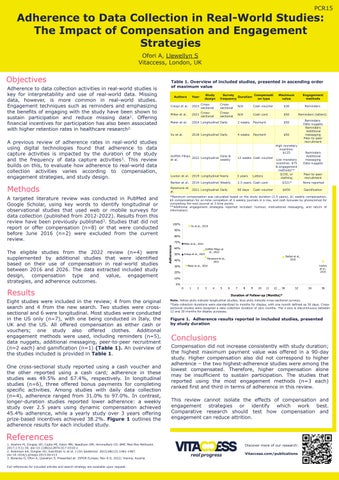
Results Eight studies were included in the review; 4 from the original search and 4 from the new search. Two studies were crosssectional and 6 were longitudinal. Most studies were conducted in the US only (n=7), with one being conducted in Italy, the UK and the US. All offered compensation as either cash or vouchers; one study also offered clothes. Additional engagement methods were used, including reminders (n=5), data nuggets, additional messaging, peer-to-peer recruitment (n=2 each) and gamification (n=1) (Table 1). An overview of the studies included is provided in Table 1. One cross-sectional study reported using a cash voucher and the other reported using a cash card; adherence in these studies was 49.5% and 67.4%, respectively. In longitudinal studies (n=6), three offered bonus payments for completing specific activities. Among studies with daily data collection (n=4), adherence ranged from 31.0% to 97.0%. In contrast, longer-duration studies reported lower adherence: a weekly study over 2.5 years using dynamic compensation achieved 45.4% adherence, while a yearly study over 3 years offering prize-based incentives achieved 38.2%. Figure 1 outlines the adherence results for each included study.
Table 1. Overview of included studies, presented in ascending order of maximum value Authors
Year
Study design
Crespi et al.
2023
Crosssectional
Crosssectional
N/A
Millar et al.
2021
Crosssectional
Crosssectional
Meier et al.
Xu et al.
Survey Compensati Duration frequency on type
Maximum value
Engagement methods
Cash voucher
$30
Reminders
N/A
Cash card
$50
Reminders (letters)
2024 Longitudinal Daily
2 weeks
Payment
$50
2018 Longitudinal Daily
4 weeks
Payment
$50
Reminders Data nuggets Reminders Additional messaging Peer-to-peer recruitment
High monetary incentive: $125 12 weeks Cash voucher
Loxton et al. 2019 Longitudinal Yearly
3 years
Barber et al.
2016 Longitudinal Weekly
2.5 years Cash card
$321*
None reported
Paramore et al.
2021 Longitudinal Daily
90 days
$450
Gamification
Lottery
Low monetary incentive: $75 & engagement methods** $150, or clothing
Cash voucher
Full references for included articles and search strategy are available upon request.
Peer-to-peer recruitment
*Maximum compensation was calculated based on the study duration (2.5 years), $1 weekly compensation, $5 compensation for on-time completion of 5 weekly journals in a row, and cash bonuses by phone/email for completing the next journal at 3 time points. **Additional engagement strategies reported included: humour, motivational messaging, and return of information)
100%
Xu et al., 2018
90% 80% 70%
Millar et al., 2021
60% 50%
Crespi et al., 2023
Griffith Fillipo et al., 2022 Barber et al., 2016
Paramore et al., 2021
40%
Loxton et al., 2019
Meier et al., 2024
30% 20% 10% 0%
0
1
2
3
4
5
6
7
8
9
10
11
12 ... 30
32
34
36
Duration of Follow-up (Months)* Note. Yellow plots indicate longitudinal studies; blue plots indicate cross-sectional surveys. *Data collection durations were standardized to months for display, with one month defined as 30 days. Crosssectional studies were assigned a data collection duration of zero months. The x-axis is discontinuous between 12 and 30 months for display purposes.
Figure 1. Adherence results reported in included studies, presented by study duration
Conclusions Compensation did not increase consistently with study duration; the highest maximum payment value was offered in a 90-day study. Higher compensation also did not correspond to higher adherence – the two highest-adherence studies were among the lowest compensated. Therefore, higher compensation alone may be insufficient to sustain participation. The studies that reported using the most engagement methods (n=3 each) ranked first and third in terms of adherence in this review. This review cannot isolate the effects of compensation and engagement strategies or identify which work best. Comparative research should test how compensation and engagement can reduce attrition.
References 1. Abshire M, Dinglas VD, Cajita MI, Eakin MN, Needham DM, Himmelfarb CD. BMC Med Res Methodol. 2017;17(1):30. doi:10.1186/s12874-017-0310-z 2. Robinson KA, Dinglas VD, Sukrithan V, et al. J Clin Epidemiol. 2015;68(12):1481-1487. doi:10.1016/j.jclinepi.2015.04.013 3. Borecka O, Ofori A, Llewellyn S. Presented at: ISPOR Europe; Nov 6-9, 2022; Vienna, Austria.
Reminders Additional messaging Data nuggets
Griffith Fillipo Daily & 2022 Longitudinal et al. weekly
Adherence
Objectives
Discover more of our research: Vitaccess.com/publications