MSR135
Strengthening Diagnostic Validity in Community-Recruited Digital Real-World Studies: A Methodological Review Ringland C, Ofori A, Llewellyn S Vitaccess, London, UK
Objectives Community-recruited, patient and caregiver studies often rely on selfreported diagnoses to determine eligibility. Validating diagnoses can improve confidence in participant authenticity and data accuracy, particularly in digital studies using broad online recruitment methods (e.g., social media). Despite rapid growth in this area, the extent and consistency of diagnostic validation remain unclear. This study synthesizes recent literature to assess whether and how diagnoses are validated in community-recruited digital real-world studies.
Methods
Diagnosis validation methods (n=60)
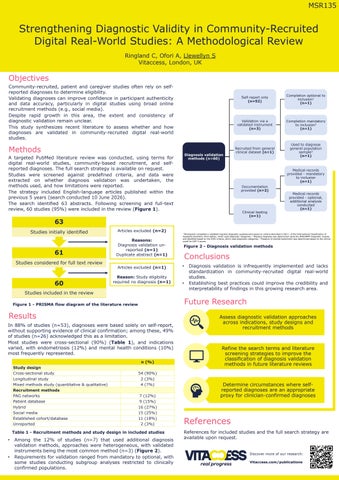
A targeted PubMed literature review was conducted, using terms for digital real-world studies, community-based recruitment, and selfreported diagnoses. The full search strategy is available on request. Studies were screened against predefined criteria, and data were extracted on whether diagnosis validation was undertaken, the methods used, and how limitations were reported. The strategy included English-language articles published within the previous 5 years (search conducted 10 June 2026). The search identified 63 abstracts. Following screening and full-text review, 60 studies (95%) were included in the review (Figure 1).
61 Studies considered for full text review
60
Articles excluded (n=2) Reasons: Diagnosis validation unreported (n=1) Duplicate abstract (n=1)
Headache Disorders, third edition, which used diagnostic categories; 2 Migraine diagnosis was determined using the AMS/AMPP diagnostic module, and identified based on the ICHD criteria, which used diagnostic categories; 3 Presence of erectile dysfunction was determined based on the clinical cutoff for IIEF-5 scores
Figure 2 - Diagnosis validation methods
Conclusions
•
Diagnosis validation is infrequently implemented and lacks standardization in community-recruited digital real-world studies. Establishing best practices could improve the credibility and interpretability of findings in this growing research area.
Future Research
In 88% of studies (n=53), diagnoses were based solely on self-report, without supporting evidence of clinical confirmation; among these, 49% of studies (n=26) acknowledged this as a limitation. Most studies were cross-sectional (90%) (Table 1), and indications varied, with endometriosis (12%) and mental health conditions (10%) most frequently represented. n (%) 54 (90%) 2 (3%) 4 (7%) 7 (12%) 9 (15%) 16 (27%) 15 (25%) 11 (18%) 2 (3%)
Table 1 - Recruitment methods and study design in included studies
•
Medical records provided - optional, additional analysis conducted (n=1)
1 Participants completed a validated migraine diagnostic questionnaire based on criteria described in Part 1 of the International Classification of
Reason: Study eligibility required no diagnosis (n=1)
Results
•
Recruited from general clinical dataset (n=1)
Used to diagnose general population sample3 (n=1)
Clinical testing (n=1)
•
Figure 1 - PRISMA flow diagram of the literature review
Study design Cross-sectional study Longitudinal study Mixed methods study (quantitative & qualitative) Recruitment methods PAG networks Patient database Hybrid Social media Established cohort/database Unreported
Completion mandatory to inclusion2 (n=1)
Documentation provided (n=2)
Articles excluded (n=1)
Studies included in the review
Validation via a validated instrument (n=3)
Medical records provided - mandatory to inclusion (n=1)
63 Studies initially identified
Self-report only (n=52)
Completion optional to inclusion1 (n=1)
Among the 12% of studies (n=7) that used additional diagnosis validation methods, approaches were heterogeneous, with validated instruments being the most common method (n=3) (Figure 2). Requirements for validation ranged from mandatory to optional, with some studies conducting subgroup analyses restricted to clinically confirmed populations.
Assess diagnostic validation approaches across indications, study designs and recruitment methods
Refine the search terms and literature screening strategies to improve the classification of diagnosis validation methods in future literature reviews
Determine circumstances where selfreported diagnoses are an appropriate proxy for clinician-confirmed diagnoses
References References for included studies and the full search strategy are available upon request.
Discover more of our research: Vitaccess.com/publications