PCR73
The Impact Of Caregiving For People With Autoimmune Neuromuscular Disorders (ANMD): A Literature Review Reaney M, Singh P, Robins V, Skrobanski H Vitaccess, London, UK
Background & Objectives
Methods
• Autoimmune neuromuscular disorders (ANMDs) such as myasthenia gravis (MG), inclusion body myositis (IBM), chronic inflammatory demyelinating polyradiculoneuropathy (CIDP) and dermatomyositis are individually rare but collectively impose a substantial disease burden
• A search strategy was run in PubMed using terms for ANMD and associated disorders, paired with CG terms, burden terms, and research terms. The full search strategy is available on request • The strategy included English language articles describing primary research published between 2016 and 2026 (search run 22 May, 2026)
➢ People with ANMDs frequently experience symptoms which impact on their day-to-day functioning1
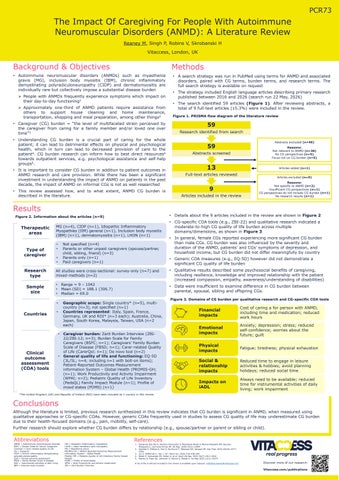
• The search identified 59 articles (Figure 1). After reviewing abstracts, a total of 9 full-text articles (15.3%) were included in the review.
➢ Approximately one-third of ANMD patients require assistance from others to support house cleaning and home maintenance, transportation, shopping and meal preparation, among other things2
Figure 1. PRISMA flow diagram of the literature review
59
• Caregiver (CG) burden = “the level of multifaceted strain perceived by the caregiver from caring for a family member and/or loved one over time”3
Research identified from search
• Understanding CG burden is a crucial part of caring for the whole patient; it can lead to detrimental effects on physical and psychological health, which in turn can lead to decreased provision of care to the patient4. CG burden research can inform how to best direct resources4 towards outpatient services, e.g. psychological assistance and self-help groups5.
Abstracts excluded (n=46)
59
• It is important to consider CG burden in addition to patient outcomes in ANMD research and care provision. While there has been a significant investment in understanding the impact of ANMD on patients in the past decade, the impact of ANMD on informal CGs is not as well researched
Abstracts screened
Reasons: Not relevant to ANMD (n=36) No CG perspectives (n=5) Focus not on CG burden (n=5)
13
Articles added (n=1)
Full-text articles reviewed
Articles excluded (n=5)
9
• This review assessed how, and to what extent, ANMD CG burden is described in the literature.
Articles included in the review
Reasons: Not specific to ANMD (n=2) Insufficient CG perspectives (n=1) CG perspectives do not include CG burden (n=1) No research results (n=1)
Results • Details about the 9 articles included in the review are shown in Figure 2
Figure 2. Information about the articles (n=9)
Therapeutic areas
Type of caregiver
MG (n=4), CIDP (n=1), Idiopathic Inflammatory Myopathies (IIM) general (n=1), Inclusion body myositis (IBM) (n=1), dermatomyositis (n=1), LHON (n=1)
• •
All studies were cross-sectional: survey-only (n=7) and mixed-methods (n=2)
Sample size
• • •
• Generic COA measures (e.g., EQ-5D) however did not demonstrate a significant CG quality of life burden • Qualitative results described some psychosocial benefits of caregiving, including resilience, knowledge and improved relationship with the patient (increased compassion, empathy, awareness/understanding of disabilities)
Range = 9 – 1042 Mean (SD) = 188.1 (306.7) Median = 69.0
• Data were insufficient to examine difference in CG burden between parental, spousal, sibling and offspring CGs. Figure 3. Domains of CG burden per qualitative research and CG-specific COA tools
Geographic scope: Single country* (n=5), multicountry (n=3), not specified (n=1) Countries represented: Italy, Spain, France, Germany, UK and ROI* (n=3 each); Australia, China, Japan, South Korea, Malaysia, Taiwan, USA (n=2 each)
• •
•
Clinical outcome assessment (COA) tools
• In general, female CGs reported experiencing more significant CG burden than male CGs. CG burden was also influenced by the severity and duration of the ANMD, patients’ and CGs’ symptoms of depression, and household income, but CG burden did not differ meaningfully by country
Not specified (n=4) Parents or other unpaid caregivers (spouse/partner, child, sibling, friend) (n=3) Parents only (n=1) Paid caregivers (n=1)
• •
Research type
Countries
• CG-specific COA tools (e.g., ZBI-22) and qualitative research indicated a moderate-to-high CG quality of life burden across multiple domains/dimensions, as shown in Figure 3
•
Caregiver burden: Zarit Burden Interview (ZBI22/ZBI-12; n=3); Burden Scale for Family Caregivers (BSFC; n=1); Caregivers’ Family Burden Scale of Disease (FBSD; n=1); Carer-related Quality of Life (CarerQol; n=1); De novo tool (n=2) General quality of life and functioning: EQ-5D (3L/5L; n=4; including n=1 with bolt-on items); Patient-Reported Outcomes Measurement information System – Global Health (PROMIS-GH; (n=1); Work Productivity and Activity Impairment (WPAI; n=2); Pediatric Quality of Life Inventory (PedsQL) Family Impact Module (n=1); Profile of mood states (POMS) (n=1)
Financial impacts
Cost of caring a for person with ANMD, including time and medication; reduced work hours
Emotional impacts
Anxiety; depression; stress; reduced self-confidence; worries about the future; guilt
Physical impacts
Fatigue; tiredness; physical exhaustion
Social & relationship impacts
Reduced time to engage in leisure activities & hobbies; avoid planning holidays; reduced social time
Impacts on iADL
Always need to be available; reduced time for instrumental activities of daily living; work impairment
*The United Kingdom (UK) and Republic of Ireland (ROI) have been included as 1 country in this review.
Conclusions Although the literature is limited, previous research synthesized in this review indicates that CG burden is significant in ANMD, when measured using qualitative approaches or CG-specific COAs. However, generic COAs frequently used in studies to assess CG quality of life may underestimate CG burden due to their health-focused domains (e.g., pain, mobility, self-care). Further research should explore whether CG burden differs by relationship (e.g., spouse/partner or parent or sibling or child).
Abbreviations ANMD = Autoimmune neuromuscular disorder BSFC = Burden Scale for Family Caregivers CarerQol = Carer-related Quality of Life CG = Caregiver CIDP = Chronic inflammatory demyelinating polyradiculoneuropathy COA = Clinical outcome assessment FBSD = Family Burden Scale of Disease iADL = Instrumental activities of daily living IBM = Inclusion body myositis
IIM = Idiopathic inflammatory myopathies LHON = Leber hereditary optic neuropathy MG = Myasthenia gravis PROMIS-GH = Patient-Reported Outcomes Measurement information System – Global Health PedsQL FIM = Pediatric Quality of Life Inventory Family Impact Module POMS = Profile of mood states WPAI = Work Productivity and Activity Impairment ZBI = Zarit Burden Interview
References 1. Gutierrez-Del-Val G, Serrano-Fernandez V, Mazoteras-Pardo V, Molina-Madueño RM, BouzasMosquera C, Carmona-Torres JM. Sci Rep. 2026;16(1):12004 2. Dewilde S, Phillips G, Paci S, De Ruyck F, Tollenaar NH, Janssen MF. Adv Ther. 2023;40(10):43774394 3. Liu Z, Heffernan C, Tan J. Int J Nurs Sci. 2020;7(4):438-445 4. Brady P, Hernandez RS, Salter A, et al. Qual Life Res. 2025;34(7):1913-1924 5. Marbin D, Piper SK, Lehnerer S, Harms U, Meisel A. Sci Rep 2022;12(1):19275 A list of the 9 articles included in the review is available upon request: matthew.reaney@vitaccess.com
Discover more of our research: Vitaccess.com/publications
,