PCR237
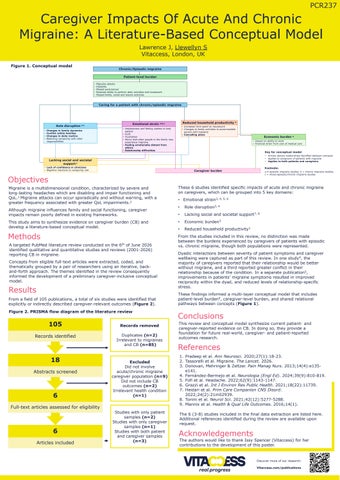
Caregiver Impacts Of Acute And Chronic Migraine: A Literature-Based Conceptual Model Lawrence J, Llewellyn S Vitaccess, London, UK Figure 1. Conceptual model
Chronic/Episodic migraine Patient-level burden • Migraine attacks • Disability • Missed work/school • Reduced ability to perform daily activities and housework • Missed family, social and leisure activities
Caring for a patient with chronic/episodic migraine
Role disruption a,c • Changes in family dynamics • Conflict within families • Changes in daily routine • Balancing caregiving with other responsibilities
Reduced household productivity a
Emotional strain a,b,c
• Increased time spent on housework • Changes to family activities to accommodate person with migraine • Cancelling plans
• Helplessness and feeling useless to help patient • Guilt • Frustration • Worry that other people in the family may experience migraine • Feeling emotionally distant from others • Relationship difficulties
Economic burden a • Impact on ability to work • Financial strain from cost of medical care
Key for conceptual model • • •
Lacking social and societal support c • Lack of confidence in clinicians • Negative reactions to caregiving role
Footnote:
Caregiver burden
a = episodic migraine studies, b = chronic migraine studies, c = mixed episodic/chronic migraine studies
Objectives Migraine is a multidimensional condition, characterized by severe and long-lasting headaches which are disabling and impair functioning and QoL.1 Migraine attacks can occur sporadically and without warning, with a greater frequency associated with greater QoL impairments.2 Although migraine influences family and social functioning, caregiver impacts remain poorly defined in existing frameworks. This study aims to synthesize evidence on caregiver burden (CB) and develop a literature-based conceptual model.
Methods A targeted PubMed literature review conducted on the 6th of June 2026 identified qualitative and quantitative studies and reviews (2001-2026) reporting CB in migraine. Concepts from eligible full-text articles were extracted, coded, and thematically grouped by a pair of researchers using an iterative, backand-forth approach. The themes identified in the review consequently informed the development of a preliminary caregiver-inclusive conceptual model.
Results From a field of 105 publications, a total of six studies were identified that explicitly or indirectly described caregiver-relevant outcomes (Figure 2). Figure 2. PRISMA flow diagram of the literature review
105 Records identified
18 Abstracts screened
6 Full-text articles assessed for eligibility
6 Articles included
Records removed Duplicates (n=2) Irrelevant to migraines and CB (n=85)
Excluded Did not involve acute/chronic migraine caregiver population (n=9) Did not include CB outcomes (n=2) Irrelevant health condition (n=1)
Studies with only patient samples (n=2) Studies with only caregiver samples (n=1) Studies with both patient and caregiver samples (n=3)
Arrows denote relationships identified between concepts Applies to caregivers of patients with migraine Applies to both patients and caregivers
These 6 studies identified specific impacts of acute and chronic migraine on caregivers, which can be grouped into 5 key domains: • Emotional strain3, 4, 5, 6 •
Role disruption3, 4
•
Lacking social and societal support7, 8
•
Economic burden3
•
Reduced household productivity3
From the studies included in this review, no distinction was made between the burdens experienced by caregivers of patients with episodic vs. chronic migraine, though both populations were represented. Dyadic interactions between severity of patient symptoms and caregiver wellbeing were captured as part of this review. In one study4, the majority of caregivers reported that their relationship would be better without migraine, and a third reported greater conflict in their relationship because of the condition. In a separate publication5, improvements in patients’ migraine symptoms resulted in improved reciprocity within the dyad, and reduced levels of relationship-specific stress. These findings informed a multi-layer conceptual model that includes patient-level burden9, caregiver-level burden, and shared relational pathways between concepts (Figure 1).
Conclusions This review and conceptual model synthesize current patient- and caregiver-reported evidence on CB. In doing so, they provide a foundation for future real-world, caregiver- and patient-reported outcomes research.
References 1. Pradeep et al. Ann Neurosci. 2020;27(1):18-23. 2. Tassorelli et al. Migraine. The Lancet. 2026. 3. Donovan, Mehringer & Zeltzer. Pain Manag Nurs. 2013;14(4):e135e141. 4. Fernández-Bermejo et al. Neurologia (Engl Ed). 2024;39(9):810-819. 5. Fofi et al. Headache. 2022;62(9):1143-1147. 6. Grazzi et al. Int J Environ Res Public Health. 2021;18(22):11739. 7. Heidari et al. Prim Care Companion CNS Disord. 2022;24(2):21m02939. 8. Tonini et al. Neurol Sci. 2021;42(12):5277-5288. 9. Mannix et al. Health & Qual Life Outcomes. 2016;14(1). The 6 (3-8) studies included in the final data extraction are listed here. Additional references identified during the review are available upon request.
Acknowledgements
The authors would like to thank Issy Spencer (Vitaccess) for her contributions to the development of this poster.
Discover more of our research: Vitaccess.com/publications