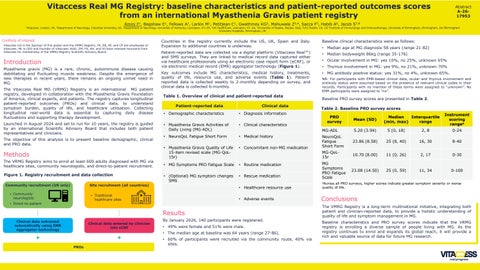
Vitaccess Real MG Registry: baseline characteristics and patient-reported outcomes scores from an international Myasthenia Gravis patient registry
Abstract A-2617953
Amini F1, Bagshaw E1, Fellows A1, Larkin M1, Petitjean C1, Gwathmey KG2, Mahuwala Z3,4, Sacca F5, Habib A6, Jacob S7,8
1Vitaccess, London, UK, 2Department of Neurology, Columbia University, US, 3Department of Neurology, University of Kentucky, Lexington, KY, US, 4UK HealthCare, Lexington, KY, US, 5University of Naples, Naples, Italy, 6UCI Health, CA, US 7Institute of Immunology and Immunotherapy, University of Birmingham, Birmingham, UK,8Birmingham
University Hospitals, Birmingham, UK
Conflicts of interest Vitaccess Ltd is the Sponsor of this poster and the VRMG Registry. FA, EB, AF, and CP are employees of Vitaccess. ML is CEO and Founder of Vitaccess. KGG, ZM, FS, AH, and SJ have received honoraria from Vitaccess for membership of the VMRG Registry Scientific Advisory Board..
Introduction Myasthenia gravis (MG) is a rare, chronic, autoimmune disease causing debilitating and fluctuating muscle weakness. Despite the emergence of new therapies in recent years, there remains an ongoing unmet need in MG. The Vitaccess Real MG (VRMG) Registry is an international MG patient registry, developed in collaboration with the Myasthenia Gravis Foundation of America, clinical experts, and patients. The registry captures longitudinal patient-reported outcomes (PROs) and clinical data, to understand symptom burden, quality of life, and healthcare utilisation. Collecting longitudinal real-world data is essential to capturing daily disease fluctuations and supporting therapy development. Launched in August 2024 and set to run for 10 years, the registry is guided by an international Scientific Advisory Board that includes both patient representatives and clinicians. The objective of this analysis is to present baseline demographic, clinical and PRO data.
Methods The VRMG Registry aims to enrol at least 600 adults diagnosed with MG via healthcare sites, community neurologists, and direct-to-patient recruitment. Figure 1. Registry recruitment and data collection
Countries in the registry currently include the US, UK, Spain and Italy. Expansion to additional countries is underway.
Baseline clinical characteristics were as follows:
Patient-reported data are collected via a digital platform (Vitaccess Real ) and SMS surveys. They are linked to medical record data captured either via healthcare professionals using an electronic case report form (eCRF), or via electronic medical record (EMR) aggregator technology (Figure 1).
• Median bodyweight 86kg (range 35-176)
Key outcomes include MG characteristics, medical history, treatments, quality of life, resource use, and adverse events (Table 1). Patientreported data is collected weekly to 2-monthly depending on survey, and clinical data is collected 6-monthly. Table 1. Overview of clinical and patient-reported data Patient-reported data
Clinical data
• Demographic characteristics
• Diagnosis information
• Myasthenia Gravis Activities of Daily Living (MG-ADL)
• Clinical characteristics
• NeuroQoL Fatigue Short Form
• Medical history
• Myasthenia Gravis Quality of Life 15-item revised scale (MG-QoL15r)
• Concomitant non-MG medication
• MG Symptoms PRO Fatigue Scale
• Routine medication
• (Optional) MG symptom changes SMS
• Rescue medication • Healthcare resource use • Adverse events
Results By January 2026, 140 participants were registered. • 49% were female and 51% were male.
• The median age at baseline was 64 years (range 27-86). • 60% of participants were recruited via the community route, 40% via sites.
• Median age at MG diagnosis 58 years (range 21-82) • Ocular involvement in MG: yes 10%, no 25%, unknown 65% • Thymus involvement in MG: yes 9%, no 21%, unknown 70% • MG antibody positive status: yes 31%, no 4%, unknown 65%. NB: For participants with EMR-based clinical data, ocular and thymus involvement and antibody status were assumed based on the presence of relevant clinical codes in their records. Participants with no mention of these terms were assigned to “unknown”. No EMR participants were assigned to “no”.
Baseline PRO survey scores are presented in Table 2. Table 2. Baseline PRO survey scores PRO survey
Mean (SD)
Median Interquartile (min, max) range
Instrument scoring rangea
MG-ADL
5.20 (3.94)
5 (0, 18)
2, 8
0-24
NeuroQoL Fatigue Short Form
23.86 (8.58)
25 (8, 40)
16, 30
8-40
MG-QoL15r
10.70 (8.00)
11 (0, 26)
2, 17
0-30
MG Symptoms PRO Fatigue Scale
23.08 (14.50)
25 (0, 59)
11, 34
0-100
aAcross all PRO surveys, higher scores indicate greater symptom severity or worse
quality of life.
Conclusions The VMRG Registry is a long-term multinational initiative, integrating both patient and clinician-reported data, to provide a holistic understanding of quality of life and symptom management in MG.
Baseline characteristics and PRO survey scores indicate that the VRMG registry is enrolling a diverse sample of people living with MG. As the registry continues to enrol and expands its global reach, it will provide a rich and valuable source of data for future MG research.