AR ON I I ST
RT ST A
Featuring interviews with Sabita Huang (Page 07), Gretchen Alexandra (Page 12), Naomie Desilier (Page 21), Amber Dacanay (Page 26), Tonia Tao (Page 33), Jikang Liu (Page 38), Lal Diltemiz (Page 47) & Talus Pinto (Page 54)
AR O T N I I ST RT ST A
TEAM
Editor-in-Chief
Nandinie Andlay
Managing Editor
Elisabed Dushuashvili
Design Editor
Brooks Orich
Editor-in-Chief Intern
Jianshen Wu
Managing Editor Intern
Malia Eugenio
Design Editor Intern
Gottfried Reyes Retana
Staff Advisor
Maria Rovira-McCune
EDITOR’S NOTE
In a world where we don’t even feel confident to write our own emails and depend on grammar checkers to set the “right tone” for our messages, where we need chatbots to validate our feelings, or where our phones’ artificial intelligence assistants offer to sum up texts from our friends and family, it is increasingly necessary to have direct, honest, raw communication with each other. The exchange of our ideas is the spark that lights up the experience of human connection. As artists, we have strong visions for our work and sharing our ideas and opinions creates conversations that are dying to be had.
For this issue of Visual Opinion, we paired eight artists and asked them to interview each other—face to face, question to answer— and here is what they said.
— Nandinie Andlay
Page 07
SABITA HUANG
Page 12
GRETCHEN ALEXANDRA
by Sabita Huang
Page 21
NAOMIE DESILIER
Interview by Amber Dacanay
Page 26
AMBER DACANAY
Interview by Naomie Desilier
Interview by Gretchen Alexandra
Interview
33
TONIA TAO
Interview by Jikang Liu
Page 38
Interview by Tonia Tao
Page 47
Interview by Talus Pinto
Page 54
TALUS PINTO
Interview by Lal Diltemiz
BFA Illustration 2029
SA H B U I A T N A
Interview by Gretchen Alexandra
I know you mentioned in your artist statement that you were interested in form, movement, and stimulation. Do you have a specific subject in mind when you work, or is it more of an emotion you feel? Where does your inspiration come from?
It comes from strong emotions, but I also have a psychology background, so I know something about how the human mind works — what it does when it sees symbols, when it sees specific patterns, how that happens in the mind. I have some knowledge about that. So when I get hit by an emotion, I put it into pictures. It becomes like a mood board of editorial photographs, and I read it in an ironic way. So placing things in these forms answers my need to feed that sense. Most of the visual variations come from that field of emotions — like tensions in the mind. It doesn’t have to be happiness or sadness; it can be something more philosophical.
Do you feel like you’re embodying a specific philosophical question when you create, or is it more that you’re satirizing an issue? Is there anything tied to reality that you enjoy making work about, or is it purely your own emotion and human emotion?
It’s something I tried to figure out, because our work ultimately has to connect with some social needs — like a book needs us to design covers, or an article about a concept needs us to give it a visualized outcome. But right now, most of what I make is purely personal; it doesn’t have a clear destination or a particular place to land.
I notice there’s a lot of fragmentation in your work. Is that a stylistic choice, or is it just your train of thought working itself out on the page?
It can be both. The way I feel about my work — I give it a lot of random stimulation. Before I finished most of my works totally digitally, I did a lot of digital collage, and I know how to place random elements in it. When I look at them, I can find these sweet accidents and I just grab onto them. That’s why there’s so much fragmentation — but it can also be something purely about visual pleasure. Every time I see those colors, I’m just happy. It really does feel like an explosion when looking at your pieces. I also didn’t notice the collage element when I first opened the file — that’s really interesting to me. Your layering techniques are fascinating. Is there anything that guides your mind as to what you want to keep, what you want to dis-
tort? Knowing now that you take digital collage and then distort it afterward, I’m wondering why you chose to outline certain forms, or why you kept something versus destroyed something else — what’s behind your decision-making when working over the collage?
Intuition, yes — intuition. I didn’t really fully figure it out. The whole project, I think, can be catalogued in fine art fields, so there’s no clear illustration destination. When I create, I don’t plan what it should look like. The reasons behind my choices mostly come from just looking at it and knowing something feels off — a little messy, or a little too overwhelming. Then I’ll choose techniques like covering something, giving a layer some opacity to bring it out, or adding bright colors to push it forward. That’s what causes the modulation, and I always find the most layered, striking patterns in my works from that process. I noticed that at least with these two pieces [Opium, pg. 10 & Map, unpublished], they reminded me of natural forms. Do you ever try to render natural forms in your work, or is it mainly digital references and images? Everything has at least one real image source — meaning none of these shapes are created purely from my mind. They all have a root. But the root can be different. In this piece, all the shapes are actually maps from different things. I find that using things that already exist and reorganizing them makes it feel more meaningful to me.
I see what looks like paint — is that all digital, or is that by hand? By hand.
How does that complicate things for you as an illustrator? Between choosing what to paint and what to draw digitally — do you find difficulty in balancing your practice?
I’m still in my early years, so I haven’t been trained as a professional illustrator yet. But I can answer it this way: if I want to make something heavier, I’ll choose to paint. If I want to bring in more randomness,
I’ll put everything into a digital pot. Right now though, all my work is drawn by hand — the digital elements are just resources layered in. Does texture matter to you? Is it important for your work to have dimension and texture, or do you enjoy the chaotic flattening?
I’ve had experience rendering things very realistically — like how characters look — but that just doesn’t really speak to my mind. I organize my work a little more like design, so everything can be flat, and I even consider lighting as a product of texture.
You mentioned when you asked me about technology that you were considering adding some sort of three-dimensional aspect to your work. Would that be physical 3D, or more like two-and-a-half-dimensional? Would you use software to render your work three-dimensionally, or do you want to create an actual three-dimensional object from your work?
I’m not really interested in making physical three-dimensional ob-
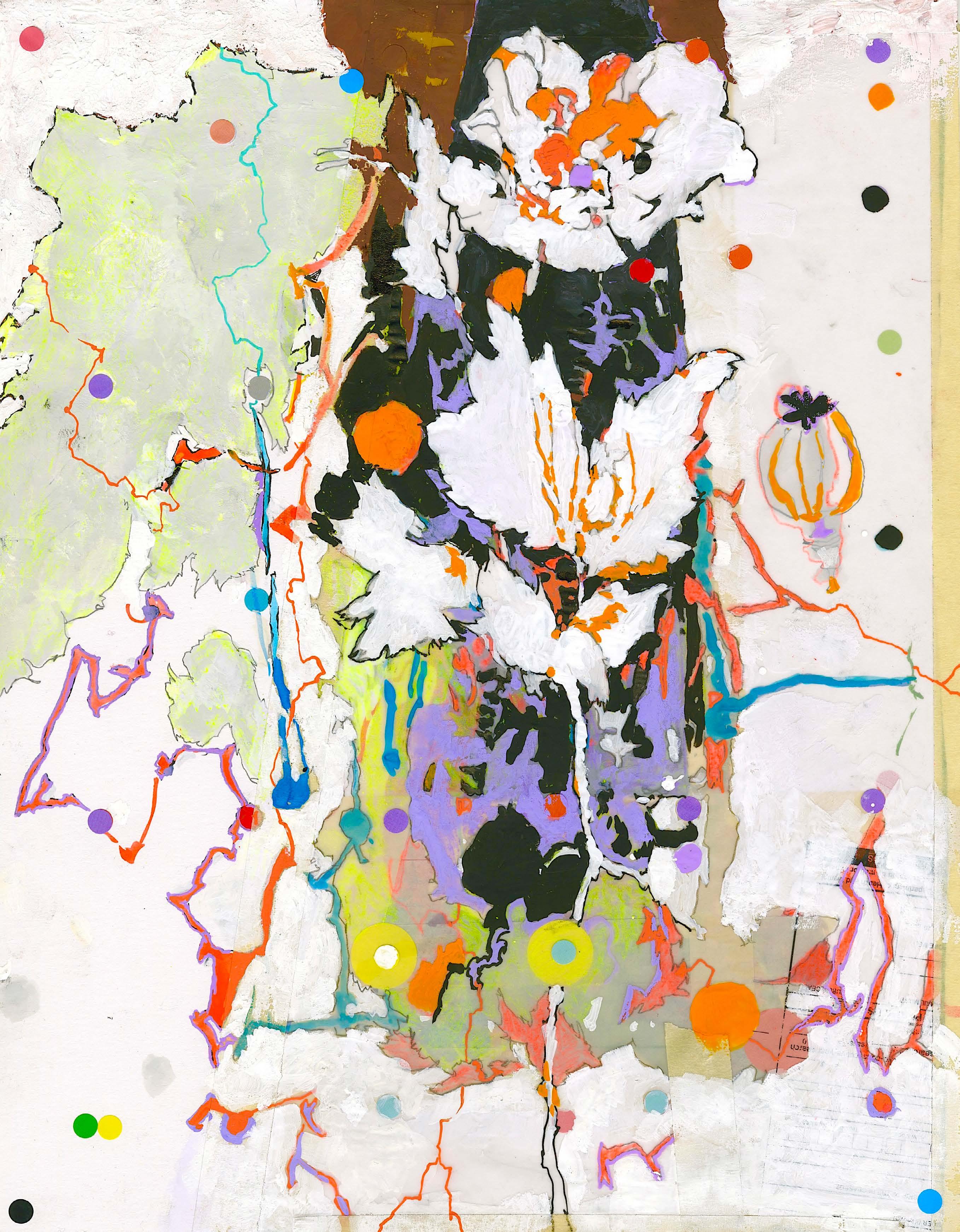
Opium Mixed Media
jects, but I am interested in more three-dimensional visualizations. What I meant was more about connecting my illustrations to other systems. I work with synthesizers and other DAWless devices, and I’ve been thinking about whether their signals or live input could be used to control the visuals. Whether it becomes a 3D visualizer or something more dynamic, that feels really cool.
Do you have a favorite work that stands out in your body of work?
I would say this one [Painting2, unpublished], but unluckily it’s also my professor’s favorite. The reason is it’s just pure visual pleasure — just something I would put up in my room. I gave it some ironic political tension, but it doesn’t really come out that way intentionally. Is it important for you that people understand some sort of political message in the work, or would you rather separate the art from the artist?
I’ve made several attempts at things that come out very clearly political, non-political, or somewhere in between — maybe storytelling. Most of my illustrated work deals with that tension, but I think I have to separate my technique from the stories behind it. Because most of the time, the forms don’t always reflect the stories. That’s how illustration works, right? You have to deal with other people’s opinions and transform ideas into visual form. So you can’t be as free as a fine art artist can be.
Is that frustrating for you? Do you find that illustration as a major makes it difficult to create something without needing to market it? Are you satisfied with the direction the major is taking you, or do you feel more like you’re in a creative prison?
In my perspective, the first priority is to be able to create things while also having bread on the table. I don’t think that a major, or learning technical skills, is inherently destructive — that destruction only happens in your mind. The skills themselves are not the problem; the problem is when you give up trying to think about other possibilities. I really want to say that the skills I’m learning in the illustration department have helped me build my foundations, because some things are hard to do, and stronger fundamentals make your process easier and allow you to build more. And actually, the definition of illustration — I know some people think it’s just drawing stuff for others — I don’t see it that way. In literature, people do translation. If you ask different people to translate the same masterpiece, they’ll all come out with completely different things and different qualities. I think the same thing happens in illustration: you are the translator, you have your own voice and your own language. You translate other people’s ideas, and that becomes something more like a collaboration. So yeah, I do like it — it’s just a bit narrow.
Interview
by
Sabita Huang
After reading your personal statement, I found that you’re pretty deeply invested in social responsibilities and intense social issues — but that feels more like a personal reading. Looking at your other work, I find it harder to see. So how do you handle misinterpretations? If an audience loves how your art looks visually but misses the political meaning, do you think about that — and do you still consider it a success?
I would say yes, I would still consider it successful. I don’t necessarily think — I mean, the work is so intentionally biographical that I’ve embedded myself into it, and I don’t necessarily expect people to pick that up just from looking at it. I do think it’s up to people to interpret whatever they want. I think the title kind of leads people in the right direction; if they want to do the research, they can. But it really is up to the viewer. My work is definitely more conceptual. I work with a lot of materiality, and I think the labor comes through in my work, which is the most important part to me. I don’t necessarily want to push the political nature on people, because they’re not going to understand it if they don’t want to. But my job as an artist — as a fine artist — is to educate through a medium as best I can. And if they’re interested, if they look at the materiality and understand that there’s this intersection between nature, labor, time, and hand work, then they’ve already done the interpreting I needed them to do to get where they need to be.
I really love how your work performs visually. When you’re creating, because I’m guessing most of your work begins with political ideas like eco-feminism — when you’re creating, do you have a very clear form or direction in mind, or do you prefer to give it freedom to explore?
It’s actually funny because I know you have an illustration background, and I know that for illustration there’s a lot of sketching and planning and thought that goes into the work. I started off as a premed student, then switched into illustration, then graphic design. So I do know how to plan — but the plans never go the way they need to. I usually start off with some sort of clear vision, something tied to a social issue I care about, and then I kind of branch off from
there. Whatever the work tells me it needs to become, or if I feel like I’m overworking a section, I let it become more conceptual and then I let go of my plan. That’s not always easy — I’m sure you understand, perfectionism is so deeply rooted. But I think that letting go is a huge part of my practice. You don’t necessarily have to follow exactly what’s in your sketchbook; it’s more of a guideline, a way to map out my brain. I map it all out on paper first, and then the work just turns into whatever I can make of it.
Since you deal with social issues, does that become draining — does it cause some kind of emotional burnout?
I don’t necessarily think so. At least for me, politics is so rooted in my personality that I’m unable to separate it from myself. I tend to embed myself into my pieces — my entire life revolves around the way I make art, between collecting materials and my political beliefs. I live very similarly to how I create. I think for some people that bothers them, but for me it doesn’t. I have gotten critiques that my work is too political, or people have tried to censor certain aspects of it. I don’t think that should be a thing. Honestly, I think my work isn’t political enough. But no, it doesn’t bother me personally.
What kind of activist approach do you take when gathering materials, or when finding your inspirations?
I would say lately — I’ve never worked with large-scale fibers until this year because I never had a studio. So I was just experimenting with as much as I could up until now. I had this collection of wrappers, cereal boxes, acorns from natural collecting days with a friend at Central Park. I’m also collecting — and I know this is going to sound gross — but I collect my tampon applicators, wax strips, just anything I can find that I could use in an assemblage, because I really like to tap into my imagination. Whatever you don’t think can go on a wall, I just want to put it there. Sometimes it just happens in the moment — I see a weird-looking bottle cap on the street and I’m going to take it, sanitize it, and use it.
Do you enjoy putting everything together?
Yeah, I do. It starts off as a really complicated puzzle that drives me crazy, and then it kind of works its way together naturally. Going off what you asked me before — I have a general idea of where I want to start, a form in my head, maybe a narrative sketch where there’s a subject and a feeling I’m trying to project. But I don’t follow that. As I’m making, I follow the form. I enjoy it. It’s like when you’re making music — I’m a very detail-oriented person, so I can just sit there for hours and weave or put things together bit by bit. I love it. It really does feel like the question just grows by itself and you solve all the pieces. Yeah — it’s like a disorganized organized chaos.
Gretchen Alexandra
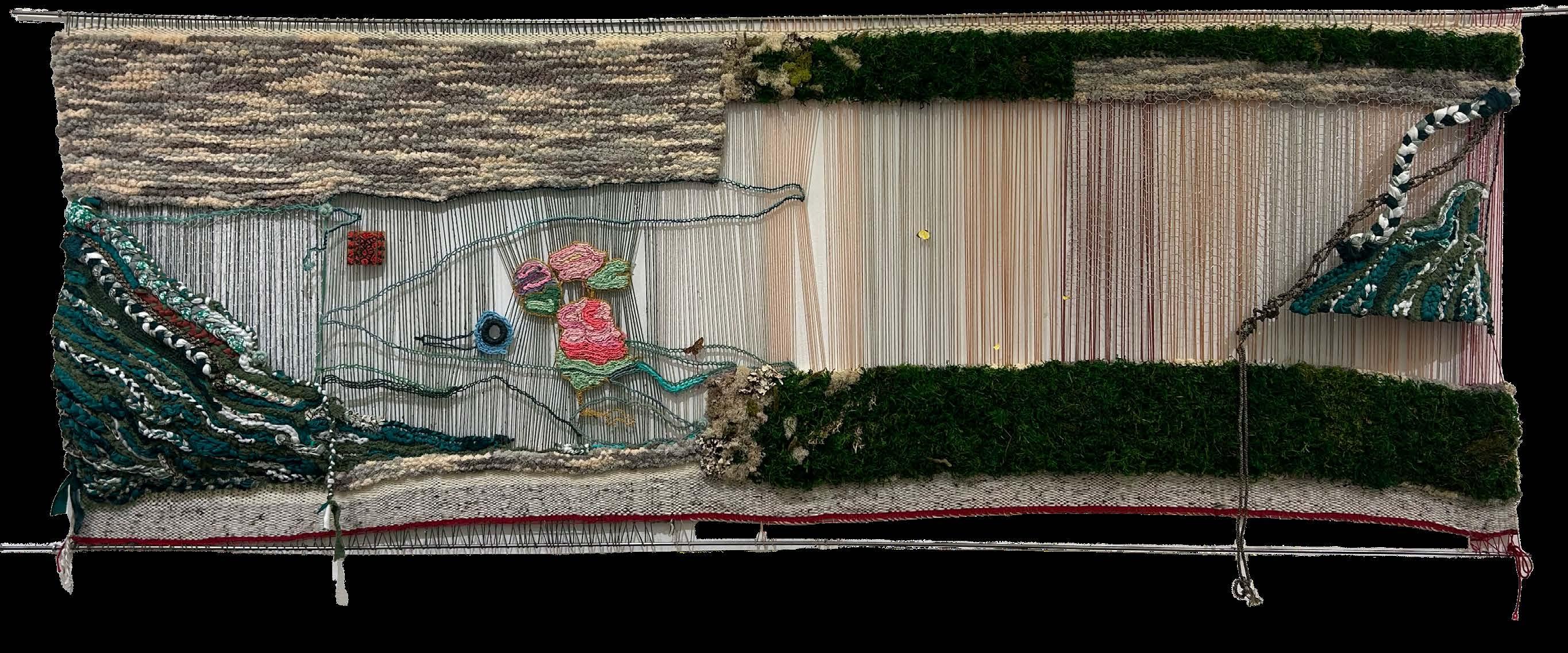
Fratele cel mare te supraveghează (Big brother is watching you) Flowers, butterflies, SCOBY, twigs, moss, wire, fabric, and fibers
What things from another area or field of art would you want to incorporate into your future work?
I’m toying with the idea of incorporating a bit more technology. I’m not a technologically savvy person, so I don’t really know how I’m going to do it yet. But with one piece I’m working on, I did this investigation where there was a camera in my studio that recorded everyone who walked in during an open studios last semester — for about three hours. The people knew they were being watched; it was projected on a back wall in a special box, and as people walked by, they didn’t notice it until they reached the back. So if they just interacted with the front piece, they didn’t know about the camera. I have audio and visual footage of people walking through, not realizing, then feeling shock — or seeing it and not caring, or talking — and all of that is preserved. I’ve watched it a number of times. What made me interested is that it was a little voyeuristic, but I think it was a jumping-off point because I realized surveillance wasn’t just about whether or not you can see it, but whether or not you can interact with it. Now for a piece I’m working on, I want to incorporate cameras and make them more interactive — I want my piece to be more of a performance piece rather than just a visual one. I want people to interact with the camera, send me information in real time, and then I use that information and code it live — not computer coding, but my own binary code made out of physical materials, translated as they’re watching me. So I demystify the computer. In terms of technology, I’d want to add it — but I’d want to perform it and become it without necessarily using it, because I’m kind of anti-tech.
When it comes to critiques, what kind of criticism has hurt you the most? I had this one senior reviewer come in last semester and he was pretty rude. He insinuated that I don’t know what feminism is because my interpretation didn’t align with his, and I didn’t know many of the artists he was referencing since they weren’t from a generation I’m particularly interested in. I think he wanted to belittle me and say, ‘You don’t know what you’re talking about,’ just because he didn’t understand the work. And that really got to me — because I do consider myself a conceptual artist over a fiber artist, and I don’t think people respect fibers enough, or respect me as a woman making that
kind of work. They want to reduce it, call it crafts, or just say ‘oh it’s just fiber art’ or ‘it’s just a feminist work.’ And then they ask things like, ‘Why don’t you put your body parts in it?’ or ‘Do you talk about sex in your work?’ — and it’s really annoying, because I don’t feel like I should have to answer those questions. A lot of my peers don’t. The way people see fiber work, or work made with many mediums — they lack the understanding to engage with it respectfully. It should be a dialogue. Instead, they’re applying too many categorical standards to other people’s work, even when that work stands on its own. And what made it worse is that I actually looked him up afterward and I liked his work. That’s what really got to me the most — that someone I had respected decided, instead of offering me the same respect or speaking to me as an equal or giving me actual guidance, to belittle me. That’s a huge problem in fine art in general, at least for me. It’s hard to connect with a lot of people because so many people paint, and I don’t. My studio is full of buckets of fish skin and stuff I found on the street — and when people see that, they think I’m just a tinkerer. I don’t think they want to ask questions.
What is your definition of success as an artist?
I’ve had this question come up — or not this exact question, but versions of it — where a reviewer comes and says, ‘Your work isn’t marketable.’ I don’t view success in terms of capitalism. For me, success is more like: if I’ve done my job and at least made the viewer think — they don’t have to think exactly what I’m thinking, but if they get somewhere, I’ve done my job. That’s success to me. If I’m able to educate in some way through my work and shed light on broader issues that don’t often get talked about, that’s the success of an artist. I think an artist should question the establishment — and it’s really up to us, because we are so visual and so embedded within the establishment. We don’t necessarily have to follow the same social rules as a doctor or a lawyer; we have the freedom to deviate. I think it’s really up to us to question, take all of those questions, and try to improve the system — not just perpetuate it.
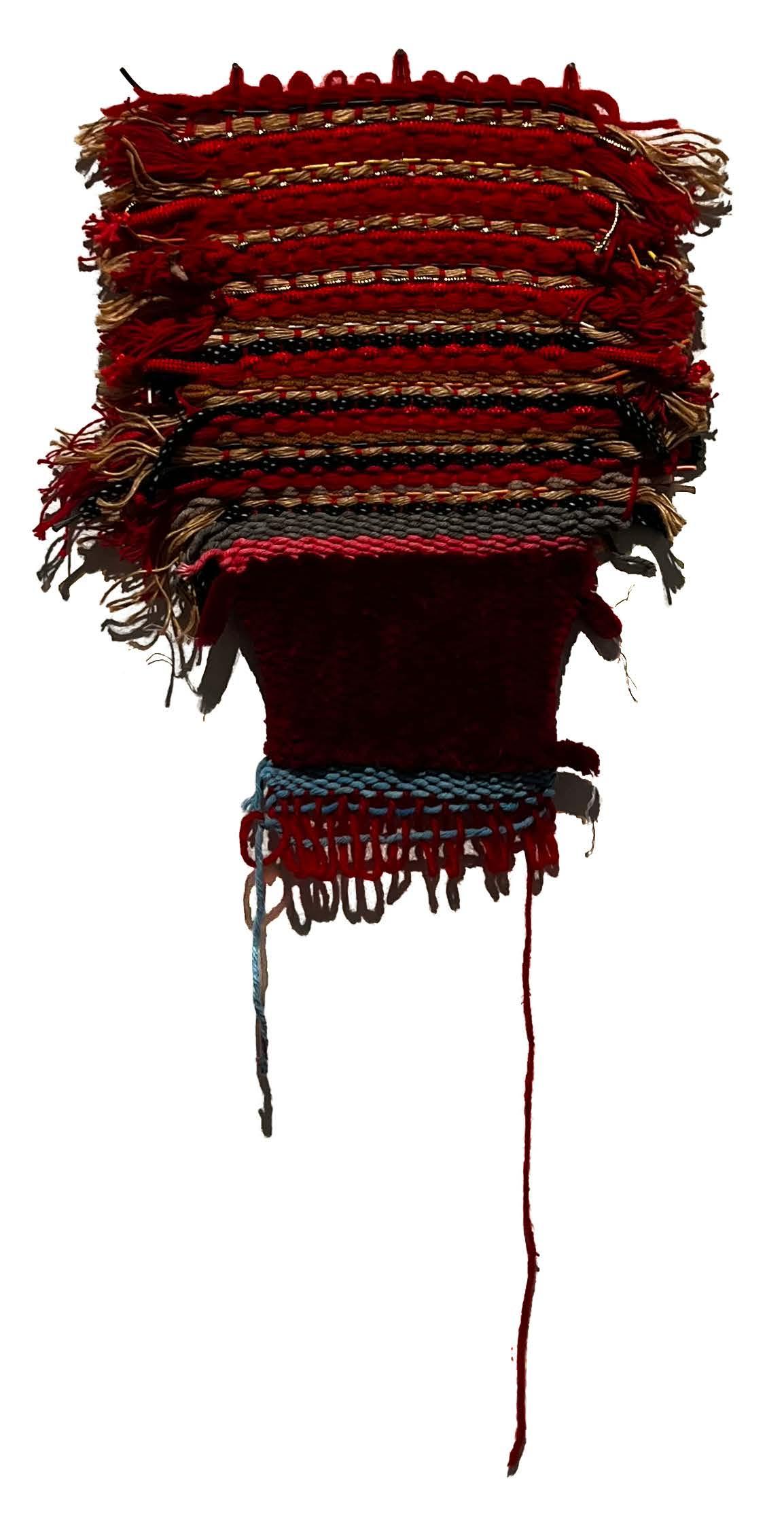
Mama Stella’s Carpet electrical wires, shoe laces, and fibers
BFA Illustration 2026
@monyekee
Interview by Amber Dacanay
Hi, Naomie, very nice to meet you. Within your creative practice, do you find there are specific habits, rituals, or routines that help you get into a creative mode?
Listening to music is a big part of it. There are certain artists and songs that trigger specific emotions in me, and when I can access that, I just want to keep creating. It’s all very media-based — movies and TV shows that I watch. Do you find there are certain themes you want to pull from and emulate in your work?
Definitely personal relationships. I think about family and friends, and I try to connect those relationships to nature and the outside world. I’m always looking for personal connections in my work. Can you talk me through your relationship with art before coming to SVA, and do you think it’s shifted over these past four years?
My relationship with art has just always been there for me. Growing up, my favorite things were cartoons and anime, which I connected with a lot. Because it was always there, it came naturally for me to start creating, and to see how far I could go with it. When I realized it was something I could pursue, I just kept with it — I couldn’t see myself doing anything else. Now I think much harder about my process. Before, there wasn’t really much thought going into it, just effort. But now there are specific rhythms I look for, along with color and texture. I’ve become more intentional with what I do and I want to keep nurturing that.
You touched on how it was only relatively recently that you started to see art as a viable career. There’s a prevailing sentiment that it’s a precarious path. How do you balance the practical realities with the more idealistic side of yourself that just wants to get as much as you can out of this?
That’s actually one of the reasons I pursued illustration in the first place — I went in thinking about how I could actually live off of this, how I could make money from it. There are moments where I have a reality check and remind myself that I need to understand the rules of the industry. I feel like if I’m making work that’s personal enough and interesting enough, I can move forward with it. I’m hoping I have enough to do that.
Naomie Desilier
Can you tell me about anything you have in the works, or future directions you’re excited about?
I’ve done some digital work over the past couple of years, but I’m always drawn to things that are more hands-on. I love painting — I don’t do as much of it anymore, but I love working with my hands that way. I definitely want to find a better balance between digital and traditional work, and do more mixed media. I love doing murals, I’d love to do book covers. I want to make work that encourages people to reach out to me for more of that kind of thing. If it were totally up to you — money’s no object, industry pressure aside — what would be your dream scenario for your art?
I’d like to get the “being well known in the industry” part out of the way first — ads, magazine covers, editorial spots, just to get myself established. After that, I’d just love to have a huge studio and the freedom to create without worrying about material things. I want the freedom to explore — maybe do a residency in another country. I don’t think I have a specific career path in mind. I just want people to want to see more of my work.
You mentioned sometimes worrying about material aspects and having doubts, as I’m sure all artists do. Is there a particular narrative you tell yourself that you feel is limiting your progress or keeping you from reaching your full potential?
The most obvious one is AI. I don’t think art will ever be replaced — ever — but it is scary the way it’s being pushed, especially with how fast it’s progressed. Beyond that, I don’t want to be pushed into doing a certain type of work. As a Black woman, as a woman of color, there are certain expectations placed on you. And I don’t particularly want to do those things unless it’s genuinely my choice. I don’t want to be pushed into a certain style just because it’s the only way someone would exhibit me.
What is something that’s currently bringing you joy — just in general? It was 70 degrees the other day! I like that it’s not dark at 5 p.m. anymore — that always gets to me. I watched the Oscars last night, which was really fun. I’m also trying to explore more books, movies, and TV. And the BTS album is coming out in a couple of days, which I’m really excited about.
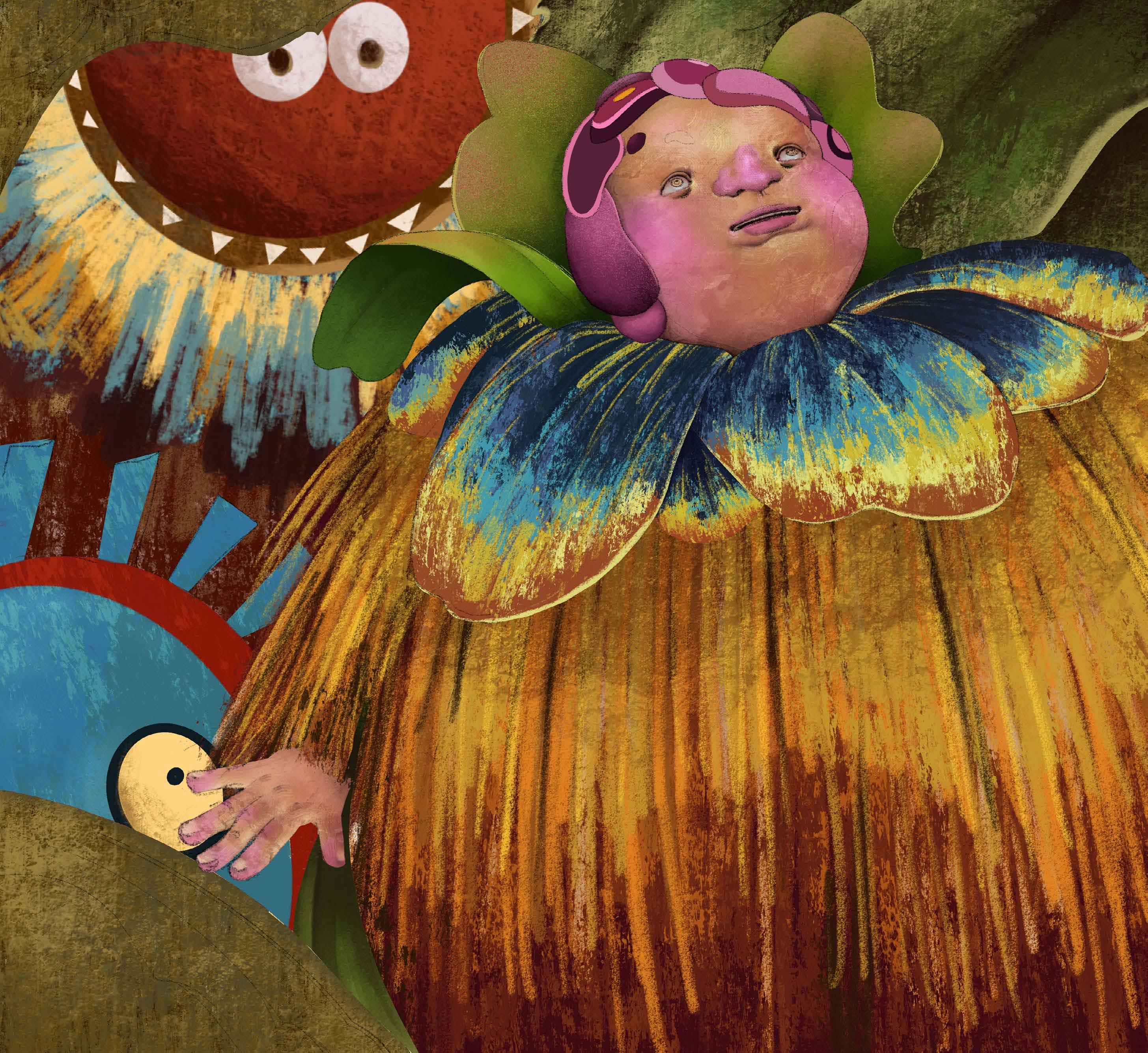
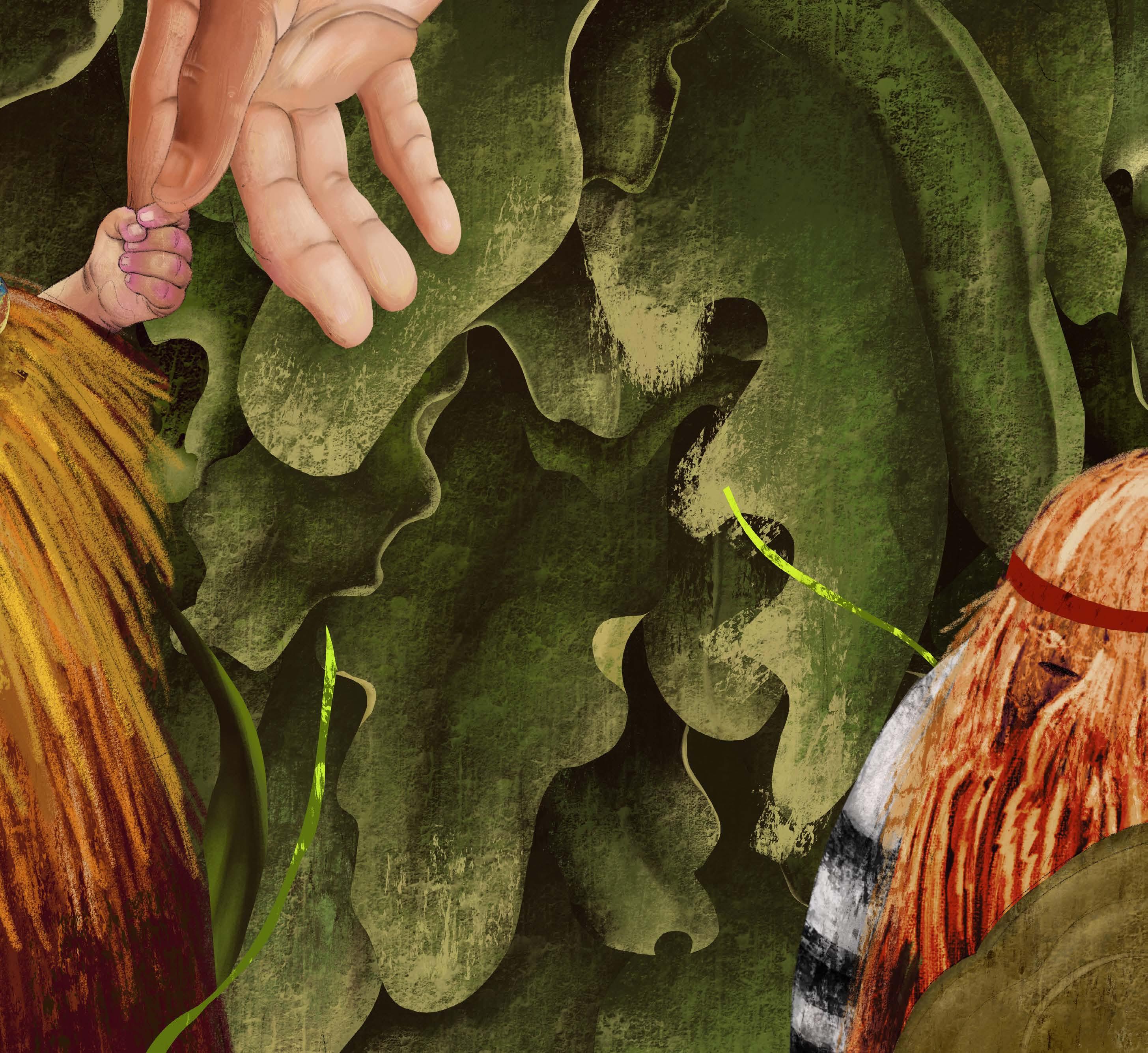
BFA Fine Arts 2026
@amberdacanay
Interview by Naomie Desilier
First, I want to compliment your work — I love painting, but I find it really hard personally, and you do it so well. When I first saw it, I immediately thought of Edward Hopper. I felt that connection right away. So one of the first things I wanted to ask is: what is your source of inspiration? How do you come up with these ideas?
It’s funny you mention Edward Hopper, because he actually is one of my main painting inspirations. I’ve always loved how his work evokes this interesting presence in modern life — that sense of alienation, but also a kind of quiet boredom in the everyday that feels really relevant to where we are now. I’m also drawn to classical painters — Vermeer, Rembrandt, that era. A lot of the inspiration for this body of work came from 17th century Dutch painting. The way they use light and perspective, that mastery of craft — I find it really impressive, and I want to emulate that sensibility in my own work. That actually leads into something I was curious about. In your artist statement, you talk about taking formal elements and twisting them to create a strange, unsettling atmosphere. Do you feel it’s important to know the rules in order to break them?
Definitely. Painting has such a comprehensive history behind it, and I do think there’s some level of responsibility — or at least benefit — in being aware of that. Knowing what you want to pull from it, and knowing what you want to reject and make your own. That knowledge doesn’t need to be the whole of your practice, but it’s a really useful thing to have in your back pocket.
I’m also curious about the colors you use in your work. How do you develop your color palette?
Color has always felt like a relatively intuitive decision for me. But as I’ve made more of these paintings, I’ve realized I don’t really choose color in isolation — it works in tandem with everything else in the image. For instance, in this piece here, you have this warm, vibrant interior with rich reds, yellows, and oranges, but the outer frame is much cooler and blue. There’s a coldness to it because it’s the outside — it’s also the plane you occupy as a viewer looking in. I’ve found that color carries emotional associations that shape how the overall image reads.
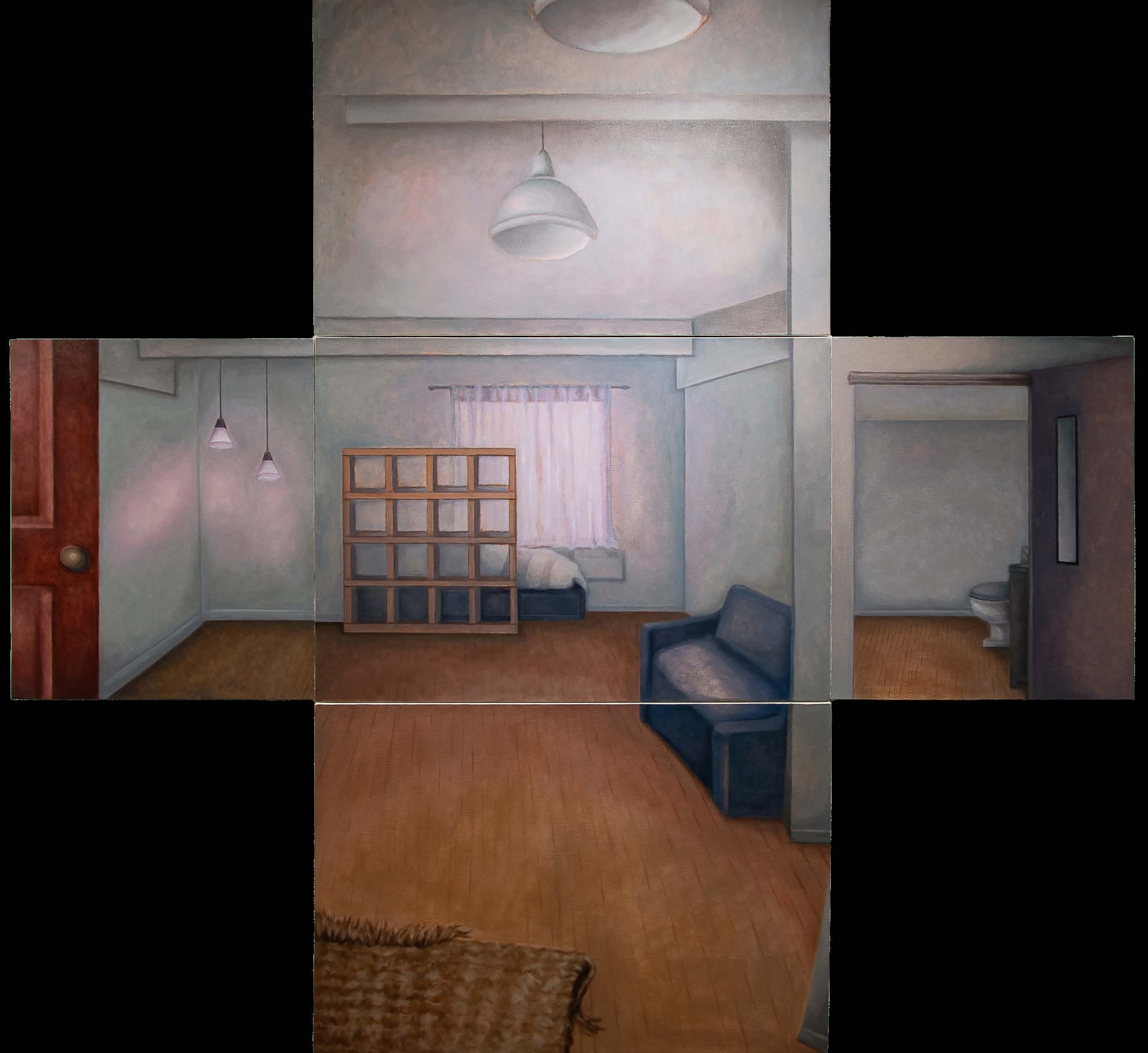
Configuration (after van Hoogstraten) Oil on Canvas
How do you want people to feel when they look at your work?
I like to create scenes that feel as though they could be entered into. But there’s also this element of maintained distance — in my statement, I talk about how some of my compositions offer the viewer a sense that they could move further into the depicted space. But by virtue of being a painting, a still image, you’re ultimately left standing there, seeing it for what it is. There’s a possibility of immersion, but also a level of denial at the same time.
How did your journey with art begin, and how has your work changed over the past four years?
My journey really started in high school. I was lucky to have access to resources in my hometown that helped me develop a pretty strong vision coming into my undergraduate years. My early work was very different — a lot of self-portraiture, much more narrative. The biggest shift is that I’ve been able to think more broadly about the conditions and themes I see in how we live today, and to respond to those with my art. It began as something very personal — though I was hesitant to admit that to myself at the time. Now I’ve been able to step back a little, and think of my work as offering more of an overarching perspective, rather than being so focused on things that were more self-serving.
How has that evolved specifically in recent years?
One of the main themes I’m working with in this new body of work is isolation — this very individualized existence that feels so prevalent in how we live today. Being in New York has really influenced that. I came from the suburbs, where everyone is in their own little home unit, and then moved to a city where that sense of individualism is even more pronounced — people segmented into their little apartments, even the studio spaces in the fine arts building are basically cubicles. The compartmentalization of our lives has become a really interesting theme for me. This focus on interiors and architectural spaces has been the way I’ve been exploring it so far.
What’s unique about the fine arts major that people might not know?
Fine arts at this school is very much a choose-your-own-adventure. You have access to a wide range of facilities. You start foundation year with a general foundation — just learning core skills — but as you progress, you have a lot of choice based on what mediums you want to work with. You can be as focused or as varied as you like. I was very set on painting throughout, but some people jump around and end up forming their own visual language through different mediums. It’s very customizable.
Is there a medium you’d want to explore outside of painting?
I’ve briefly dabbled in sculpture a couple of times, and I think it could
be a really interesting expansion point for the work I’m doing now — especially since I’m already working with space, architecture, and built environments. If it felt right to go that direction in the future, it would be fascinating to see how I could translate the visual language of my painting into something more three-dimensional, like a sculpture or installation.
In the future, is there something you want to be known for as a painter? I don’t really think in terms of having a defined style, at least not in a super conscious way. With my practice, I make the paintings, and sure, they share a lot of formal characteristics — but eventually I’ll find a thread emerging that lends itself to a whole other body of work. It’s less about having a rigid, “this is my thing” identity, and more about having a body of work where you can tell it all came from the same person.
Dream scenario — everything else aside. What do you want to do in the future?
In some ways, I feel like I’m already living the dream. Just the fact that I get to be here in New York City, dedicating my time to my practice — waking up knowing I’m going to the studio to paint — that’s already practically everything. Obviously there are career milestones I’d love to reach: a solo show eventually, maybe gallery representation. But the basic unit of satisfaction — just being here, making work — already feels so rewarding that everything else has felt like a little bonus. Sprinkles on the cake.
If you could live in any era of art history, when would you choose?
I’ve never really thought about that. I don’t think I’d necessarily want to live there, but I’d be fascinated to time travel and see what New York was like in the ’80s and ’90s — when the art scene was scrappier, more DIY, more grassroots. In the decades since, the art world has taken on a much more systematized, corporate-driven atmosphere. Authenticity is a lot harder to parse out now than it probably was back then. It would be really interesting to experience that atmosphere and see how different the attitudes toward art-making were from how they are today.
BFA Illustration 2026
TONI
TA AO
@tonia_77o.7
Interview by Jikang Liu
I really like your work, and I feel like I see a lot of religious influence in it. I don’t know if that’s right, like Buddhist influence. And I’m just wondering what about it interests you, and how those ideas influence your work.
Oh. My inspiration is from humanity, the people I’ve met, and I hope that those who abuse animals receive the same punishment as in my drawings, just like in Dante’s Inferno.
Can you point out where the motifs are, maybe the animals and the other parts? Are they in these pieces [The City of Seven Sins, p. 37]?
Oh, no, actually. But those animals were the idea that inspired me when I was in high school, but now it’s mostly about humanity. Because those pages are all about the seven sins.
So this one is gluttony.
Yeah.
And this is greed.
Mm-hmm.
These seven sins are very Christian. Are they Christian ideas? So you’re combining them with a Buddhist interpretation?
Kind of, but I don’t have religious beliefs. No, me neither.
But, I really love the movie Seven. It is about the seven sins. What about that movie is inspiring?
There’s a serial murder. People are killed for different sins. There’s a lawyer, and he died because he eats too much. There’s also a girl killed because she’s a hooker, and the murderer just killed her because the murderer thinks she’s full of desire.
So it’s the guilt and sin in it that draws you in?
Yeah.
I’m the same. I think it’s really interesting, because I’m also totally non-religious, but a lot of religious motifs are in my work too. But I don’t really know that much about Buddhism. So a lot of the things are just about Christianity, because I see that in the media more. So, I’m curious how you got into Buddhist philosophy and how you learned about it.
I feel like I’m naturally drawn to Buddhism—it feels very mysterious to me. I haven’t studied it in great detail, but I think I’ve absorbed bits and pieces of information from different sources, and they somehow come together and appear smoothly in my work.
That’s cool, and I feel like you have a very distinctive style, and I’m wondering, has it always looked like this, or did it develop from something else? Yes, it developed from the idea about abuse. But before, I drew only really simple lines, but now I try to make it more three-dimensional. I think it’s still very graphic, though, and I like that aspect. But do you ever use color in your work?
I try to, but I love black and white the most, so… I mostly use pencils. And for those artworks, they are on rice paper. They’re really big, and they can connect into an accordion book, like a really large panel.
Have you ever tried digital art, or have you made the conscious decision to stay traditional?
I tried digital work, but I’m more into pencil. So you don’t work with anything else. It’s just graphite on paper. Just that? For now, mostly. But before, I tried a lot, and I think those materials are my favorite.
And what about this medium draws you in, that you just want to stick with it?
I like how pencils can make texture on the rice paper. And it’s really different from how I use ink on regular watercolor paper. Okay, I guess I’m curious about your hopes for maybe, like, where do you see yourself in five years? Do you want to be in a gallery, like a fine artist? Or, because I feel your work is so distinct, I almost don’t see it in editorial magazines. But I don’t know if you want to go in that direction. I’m just curious what you want to do in the future with this work.
I want to become an artist, but I’m kind of worried because most of my works are not really mainstream, and also not really business illustration work. So maybe I will become an underground artist, but I will keep doing those artworks.
I love that, yeah. Thank you. I feel that very much too. There’s this pull between commercial appeal and staying true to yourself. How do you grapple with that? What are your thoughts on that? Balancing finding a job, being commercially viable, and having a distinct, true-to-yourself style.
I think I will keep doing both. I will try to get money. Maybe I would do some work I’m not really interested in, but I will also work on my own artwork.
What kind of criticism hurts you the most?
“Your work looks similar to other people’s work.” Yeah. It hurts because I think I try really hard to be special and different from others’ artwork, but if some people say that, I will be really hurt. I would feel my work is not really special.
I understand that, but I think I have never seen something like this before, so there’s that. Whose work do people say this looks like?
But they’re really famous, like Dalí. People will see anything abstract and they’re like, this is Dalí. Would you say that he’s one of your influences, or no?
Yeah. In high school, I imitated his artwork a lot. I think his work is also an inspiration for me.
Do you have any other influences?
Mostly from movies. I see something interesting, and I want to draw it into my work, like the movie Seven, A Clockwork Orange, and Pink Flamingos.
Do you like David Lynch? I feel like your vibe is very similar to the vibe I get from his works.
Yeah, like Eraserhead.
Oh, I’ve never seen that movie, but do you like it?
I just watched half of the movie, but it’s really cool. And I also watched Blue Velvet.
What activities do you like to engage in to find inspiration? Movies for the most part.
What would it mean for you to be a successful artist? Do you want to be famous, or do you want to be published somewhere, or what is it? What does success look like to you?
I want to be an artist like a drifter—just doing whatever I feel like doing. But I know that kind of freedom actually requires money, which sounds a bit contradictory, but that’s honestly how I feel. I’m not really interested in becoming a ‘successful’ artist in the conventional sense. I think I just want people to see and understand what I’m trying to express—that would be enough for me.
Hold up. So if you have money, how are you homeless? Are you living on the street, or are you just floating in different places?
Yeah, like floating in different places, in different countries, maybe. But I really don’t want to become really famous, just doing what I want. I don’t know.
Oh, that’s okay. Thank you. I feel like that’s the ideal state for a lot of artists. You want to travel and you don’t want the pressure of fame, but you still want to be able to do what you love. And I think that’s a good way to think about it. All right, thank you.
Thank you.
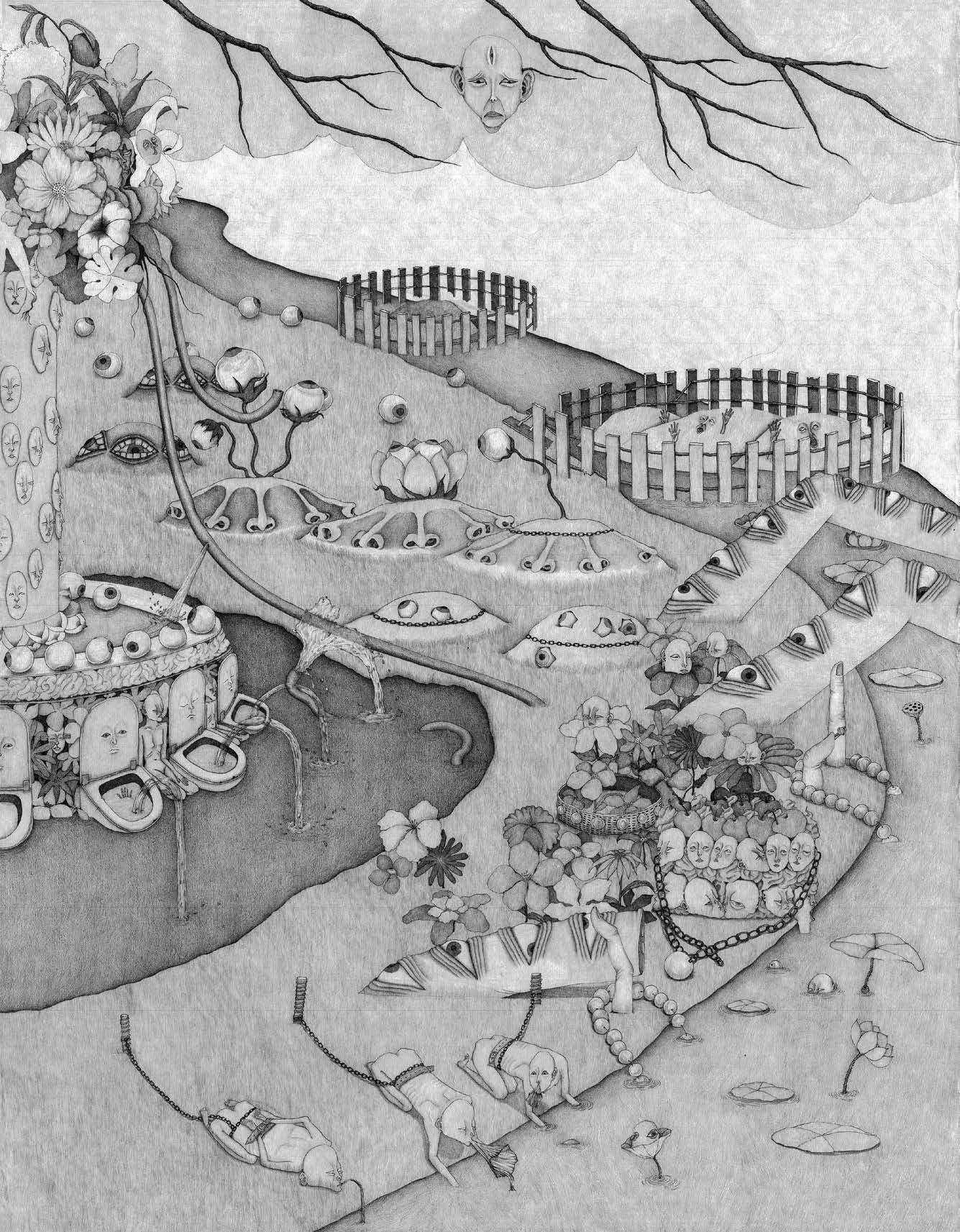
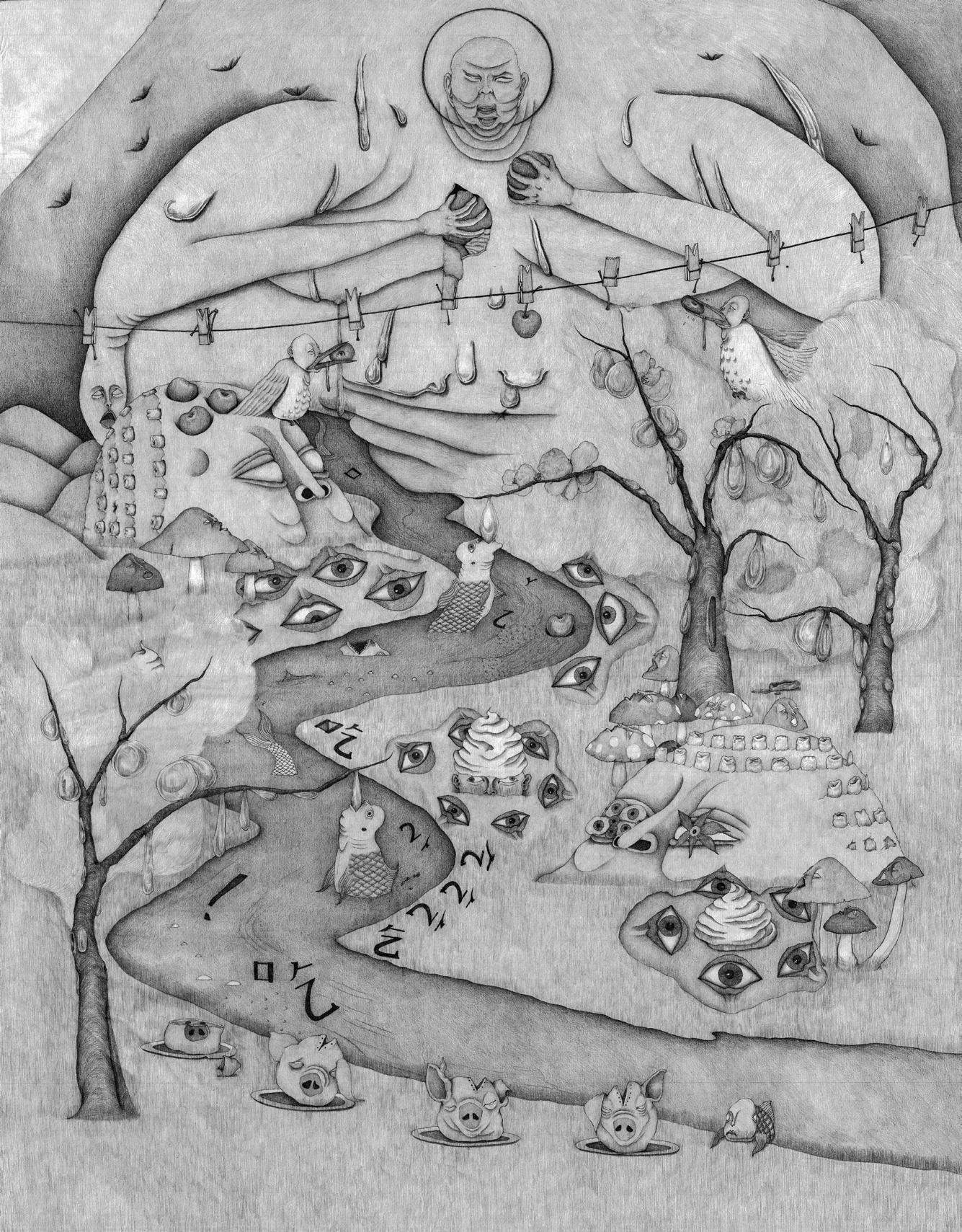
The City of Seven Sins-Gluttony Pencil on rice paper
The City of Seven Sins-Greed Pencil on rice paper
MFA Computer Arts
2027
JIK
U AN G L
Interview by Tonia Tao
Hi. I saw all your artwork. They are really fantastic. What’s your inspiration for them?
I think I touched on it a little bit earlier, but I’m really into Catholicism and Christianity. Even though I grew up in China too, I am totally non-religious. But I just feel like there’s something about Catholic art, Gothic architecture, churches, and also religious paintings. I’m just really drawn in by them. And I just feel like they go really hard, you know, like the paintings of Jesus with the thorn crown around his head and him bleeding. And that’s hard metal. And I just really enjoy that. So these pieces are kind of my more medieval, dark fantasy ones. I’m really into dark fantasy. And also video games, like Elden Ring, Bloodborne, FromSoftware games, these are heavily inspiring to me.
That’s really cool. Thank you. And how do you decide a pose? Like, how does the character in your artwork pose that way?
Yeah, for sure. It’s definitely a very intentional choice because you model them in an A-pose or a T-pose, like this. And then I have to design how to pose them, and I feel like when I design my characters, I have an idea of who they are as a person, and their personality. For example, this is a vicar character, and she’s filled with guilt, and I’m not entirely sure of her story yet, but I just feel like I wanted to convey that sense of repentance, you know? So she’s kind of in a prayer pose, and for this, I mostly wanted to highlight, I think, the highlight of the design is the three swords in the back. ’Cause the main concept for this design is the Three of Swords tarot card. And so I wanted to highlight that, so I made her pose like she’s pulling one of the swords out. I think the way I think about posing is, first, who is this character and what is their personality? And then second, what is the design element that I want to highlight? So that’s how I think about it.
And I think all of your artwork, the color is also very interesting. So how can I also decide color, like, in a different way, and still have some highlights, you know, in a really realistic way? I mean, it’s realistic because it’s physically rendered, right? Because it’s 3D.
Yeah, these are all 3D renders. But I actually really like to incorporate
very 2D techniques, like matte painting techniques, into 3D, because I feel like when the light reflection and everything is too perfect, it just looks really fake and kind of soulless. And that’s what people don’t like about AI, right? Because everything is too exact, too perfect, and too smooth and greasy. I don’t like that. So I try to bring it back in my colors and textures. So, I mean, with this one [Dame Valentin, p. 42], the way you think about it is, you’re painting on top of the 3D model. So I did a lot of hand painting, and I would pick the colors myself. And for this one [Dame Valentin Deconstructed, p. 42], the way I thought about the colors is that I wanted to bring attention to the heart, because that’s the center of my design. So that’s the most saturated color. And then the rest are kind of just there to complement it. But I can’t take credit for the rendering for this piece, because this is just ZBrush’s default material. But yeah, I try to be intentional with the colors when I’m doing the 2D concept design.
Yeah. So does a creative flow state exist in your practice?
It’s hard to say. I feel like it does. It does when there are no technical problems. I feel like because in 3D, there are just so many technical problems that you encounter at every step, but I feel like I reach a flow state more naturally when I’m in the more creative parts, like when I’m sculpting, because then you have your stylus, and you’re sculpting on the tablet, and it’s like drawing. And then you get into the zone, and you don’t get cloth simulation flying everywhere, and you’re trying to figure out which setting, which number, to change. And I feel like that’s, I really don’t like that part, but I like the more creative parts where you just sit down with a pen, and then you’re just sculpting, or you’re painting the textures. I think that’s when I really get into the flow state.
Yeah. That’s really cool. Thank you. So what’s one of the stereotypes that people outside your major in art think of 3D art? What is your own impression of people in 3D? My freshman year was also 3D Animation. It was so hard for me, so I transferred into illustration. Yeah, so what are your thoughts and opinions on it?
Maybe I have a different perspective, yeah. It’s like, I have to learn how to smile. And it’s already made me feel like it’s really hard for
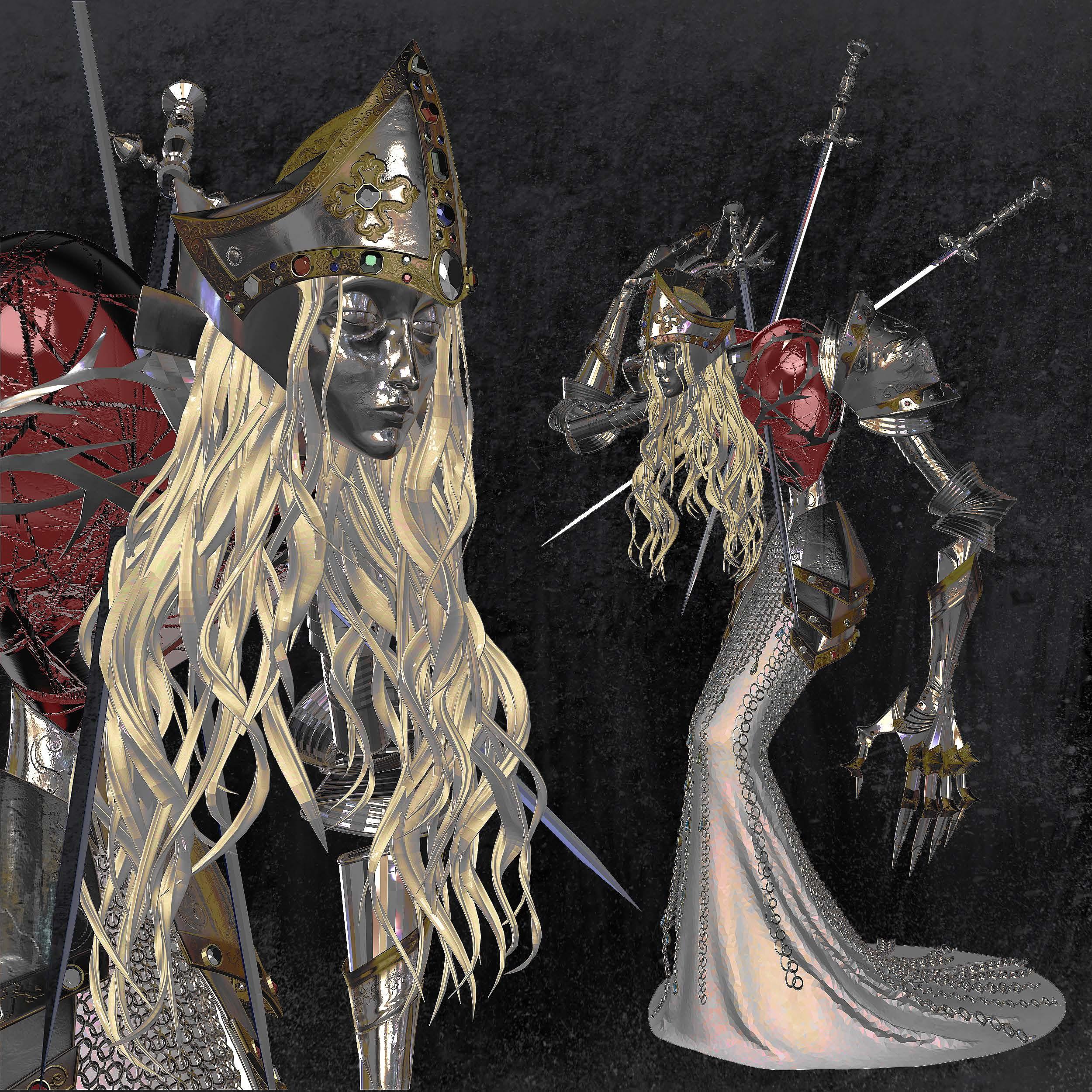
Dame Valentin
ZBrush Digital Sculpture
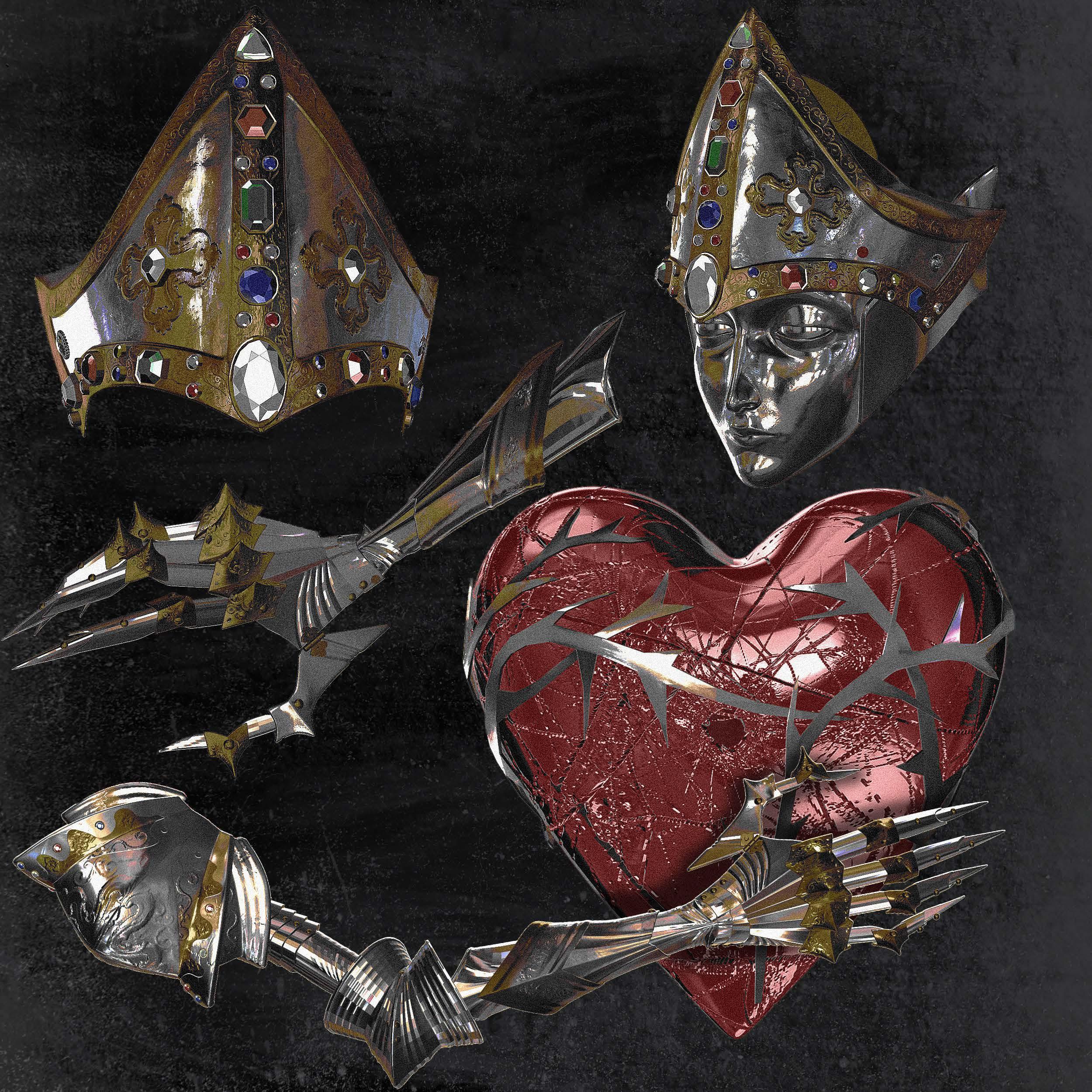
Dame Valentin Deconstructed ZBrush Digital Sculpture
me to learn that. And for my classmates, in freshman year, some of my classmates were doing some really cartoonish or cute characters. But not me. I feel like there is a stereotype of, you know, people see, ’cause the dominant mainstream art style in 3D right now is Pixar, Disney. I feel like right now the only major mainstream studio that’s doing something different is Sony. But even though it’s palatable to the masses, like Spider-Verse, K-pop Demon Hunters, it’s still in that commercial bubble. I feel like it stays in that cutesy, cartoonish kind of style. So I definitely see that stereotype, but I feel like when you look at independent artists, a lot of people are doing really cool things. But I think it’s the same thing with you and your art, that it’s not really highlighted or appreciated monetarily. And it’s not put in the spotlight. So no, I definitely get that. And I also feel like there’s another type of 3D stereotype, which is straight men and video games making big-booby women. That’s the other stereotype. We’re not all like that. I am not like that. So I think it’s just really interesting. I feel like it’s definitely very true that in the 3D industry, the proportion of straight men versus other groups, there’s a higher concentration of them, definitely, because it’s more technical, and they gatekeep. They’re like, oh, we know how to code, and we know how to write shaders and programs, and you can’t, you don’t know anything. You just know how to model and sculpt. It’s not real 3D. And so there is that, but I’m just trying to do my own thing, and not pay attention to any of that.
Yeah. So how do you think your work is different from others? What makes your work special?
I don’t know. I think I’m like you, I want to be special. But then at the same time, I’m afraid of being too special and not employable. I feel like we all have that struggle. But I think I kind of have a certain sense of aesthetics, and I try to stay true to that in my work. I focus a lot on Gothic stuff, and I really like punk, subculture, emo stuff. You don’t see that here, but that’s my other major influence. So it’s like I have all of these interests, and then the combination of them is different from everyone else’s interests. Yeah, well, because I feel like your work is an amalgamation of what you like, and what you like is different from what other people like. Because I think your style is really unique, and it’s, I think it already has a good bal-
ance between the mass and the niche. Yeah, like you’re in the middle, and it’s very, like, great, great work.
Thank you. That was really reassuring to hear, because I’m always afraid that no one wants to hire me. I actually recently had an interview for a summer internship, and the interviewer told me he looked at my work, and he said, “Oh, it’s so dark.” It’s so different from what we do. I was like, oh, no. So yeah, it’s definitely a struggle. A lot of bigger companies still find it a little bit too out there, I feel like. So you think, hopefully, a job is more important than having your own style?
That’s a really good question, because I just really want to be able to support myself, but also I want to do that while doing something that I’m interested in, at least, if not passionate about, because I was also talking to the editors here that I used to work in finance, and I left that job. If I wanted only to make money, I could have stayed there. So I feel like my mindset is, I do really want a job, but I also want to make sure that it’s not something soulless that I absolutely hate. I think it needs to be something that I’m interested in. So it’s a very hard question to answer. Finding a job is very important to me, but I would like to find one where I’m not completely miserable and doing something that’s totally not me. So right now, the way I think about it is, I’ll just keep making cool stuff and posting it online, and if people see it, and they like it, and they want to give me a job, then that’s great.
Yeah. I agree. Yeah. So where do you see yourself with your artwork in 10 years from now?
I think my ultimate goal is to be an art director. That’s my dream. Maybe for, I don’t know, an indie game or film or TV project. Like in 3D animation. ’Cause I used to think that I wanted to just be a character artist, like 3D modeling and making characters, but now I feel like I’m drifting more towards the art direction part of it, and look development, figuring out what the color, the feeling, and the atmosphere I’m going for are, and then trying to figure out the whole production pipeline based on that visual goal. I think that’s very interesting to me. So, I would say, in the ideal world, in 10 years, I want to be art directing a project.
Yeah. So, what kind of work don’t you want to do?
I think I would hate the kind of work where there is a 2D concept, and then they feed it into AI to give me a 3D model, and then I just go in and fix the parts that the AI couldn’t get right. And that’s my entire job. I think that’s miserable. And that’s actually, I think, the state of a lot of 3D jobs right now. And it’s really scary.
All right, yeah. Thank you so much.
BFA Illustration 2026
LA L
D T I E I L M Z
by Talus Pinto
@rubinrubis_
Interview
Lal Diltemiz
What’s the creative process behind making these works? Can you say specifically for these two thesis pieces?
I started off because I just wanted to learn how to etch. I used my senior thesis as a way to learn it even more and get better at it. But I really like overlaying my artworks with different types of line art or different types of techniques. So I started with just overlaying different colored acetates, but then I came up with the silk screen process so that the composition is even more complicated and even more chaotic, because I want it to come more from my subconscious rather than something realistic.
What are your main inspirations for creating this type of art?
Mostly, I take inspiration from graveyards, from photos that I take outside, of my friends. And, I generally take a lot of inspiration from old religious art. Yeah, mostly like Old Bible arts, the ones that are so elegant, but I try to make them more contemporary and fit them into modern society.
Is there any other art practice, or like any other type of art media that you would want to incorporate more into your work in the future, as you said with etching, is there any other media that you want to practice on?
I definitely need to get better at photographing stuff. Because in all of my inspiration, I use my photos to draw and reference from. And so I should get better at photographing. But I also want to start making video art with my etchings. I started making little animations of all my copies of my etchings. I want to get better at that, and make it even more complicated so that they resemble my paintings and my drawing work.
What do you want people to take away when they look at your work in person, like in a gallery?
Me making them look elegant and very pleasant to look at is just to keep the attention on the work. But generally, my intention behind it is to make the audience uncomfortable and bring out something from inside of them, from their subconscious. That’s why I like to make it even more chaotic than it normally is. All of my process comes from symbolism in general, and everything I do is intentional. I feel like I want people to feel whatever they want to feel when they look at it. But also to think more about it and try to understand the context.
Yes, yes, there’s definitely is a lot of religious context in here. And you mentioned, in your artist statement, how religion and spirituality shape culture and influence the way we understand the world. This one is really beautiful. I want to know the meaning behind all of this. I would see a lot of drawings and paintings like this at churches and stuff like that. I wonder what the meaning behind this specific work [Politics of Flesh, pg. 51] is?
That one I really had fun with because I used the bio arts lab and I made kombucha leather. And when I first made the kombucha leather, I felt that it looked like skin. So I wanted to make a piece that incorporated the themes of skin and flesh. So I thought about religion and Christianity, and how there are different types of iconographies for different types of cultures. Like, this one is European Jesus and Mary. This one is Chinese Jesus and Mary. This one is Ethiopian Jesus and Mary, and this one is the Ottoman version. And this one is the first photography of Jesus. Everyone thinks about Jesus differently from what they were raised with and what their lives were shaped around their culture. So I wanted to show people that there’s not only one way of thinking about religion, one way of thinking about an icon that you pray to, there are a lot of different people in this world, a lot of different backgrounds, and a lot of different cultural differences.
Oh, yeah. Okay, now that you mention it, yeah, I can really see that now. That’s really a beautiful way to present that. Is there anything that you’re ever afraid of when it comes to creating this type of religious art? Like maybe Christians being offended, or like other religions and cultures being presented in different ways? Do you ever have a fear of what you’re doing with your art?
Oh, definitely, definitely, I do. And that’s why I think I lean more towards something that’s more vague so that people don’t get offended immediately. But when they read my statements, they generally do, and I have seen people get offended. Also, I was raised Muslim. I was never raised Christian. I didn’t know much about Christianity,
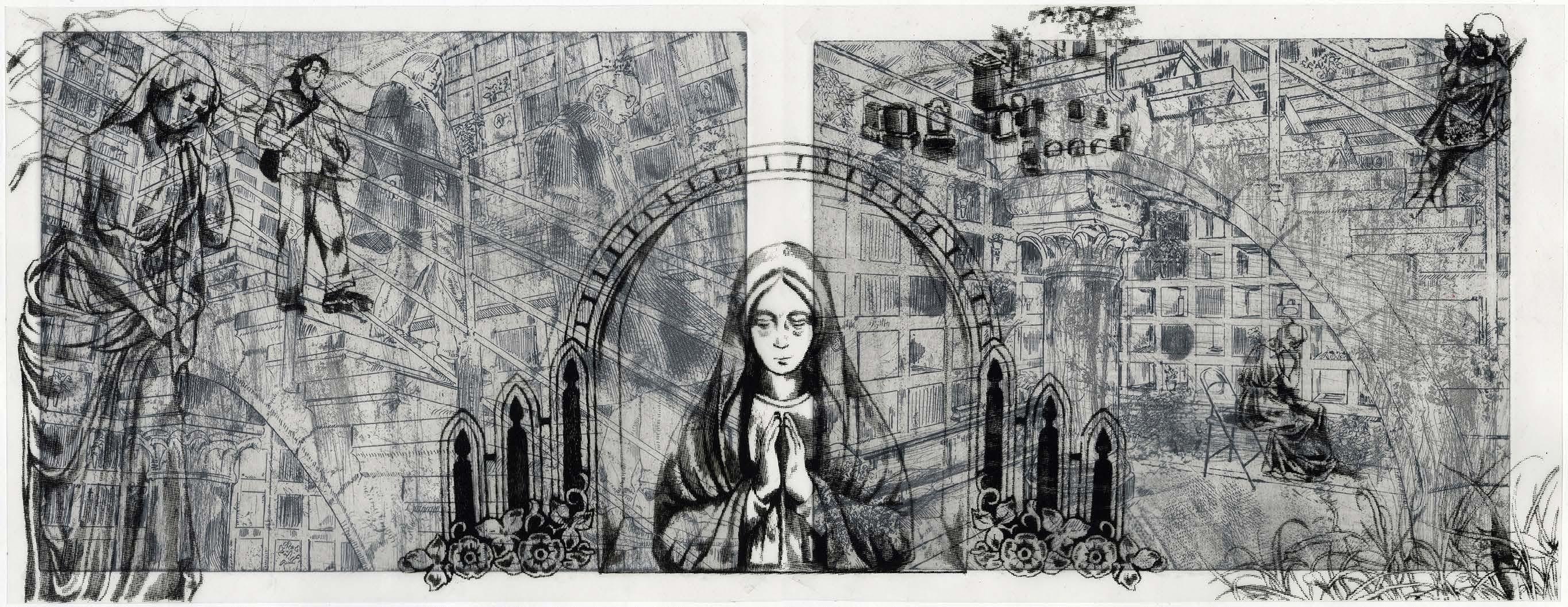
The Ache of Being Handbound Japanese stitch book spread, zinc plate etchings overlaid with silkscreen acetate layers
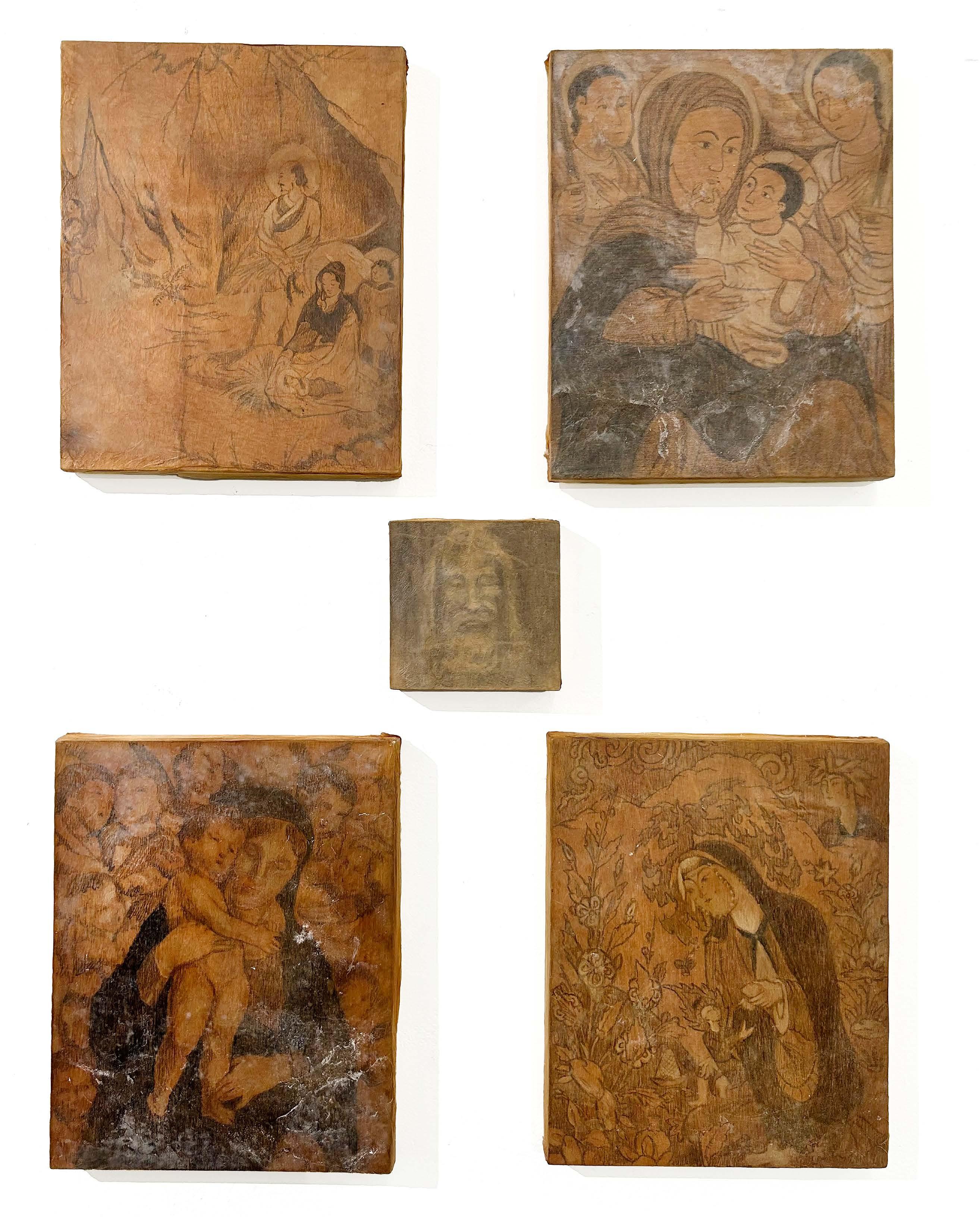
Politics of Flesh
Colored pencil on wood panel embedded in kombucha leather
but the reason why I started doing Christian iconography was because, in Islam, you can’t depict any of the icons or, like, any of the religious prophets or anyone like that. But I feel like a lot of religions are similar in some ways, in a lot of ways, actually. So, me depicting Christianity even though I was raised Muslim, I feel like it shouldn’t offend people. But if it does offend people, I do understand it. My main intention is to offend people in some ways. Like, I want people to think about it more, think about the cultural consequences of how they were raised, and why they believe in this so deeply now. Do your own personal beliefs influence your work also?
Definitely. I mostly started off doing more political work, and I think this is also very political. So, yeah, the politics of religion, the politics of culture, that’s the thing that drives me to make stuff like this. Yeah, this is definitely very important, and during this time. So this is very beautiful.
Thank you.
Where do you see yourself in the art world with your art practice within the next ten years?
That’s a good question. I’m just trying to survive right now, but I want to continue printmaking, and I want to explore more with the bio arts. I am also working with a lot of textiles and fiber arts. I do want to continue that, too. I’m the type of person who wants to learn everything and be the master of everything. So I know I’m gonna experiment a lot in my career and change a lot of different career paths. But yeah, I just want to start off by working at a print shop and continuing learning the techniques of printing.
Out of all of these works, which one hits closest to home?
Oh, I think my senior thesis, definitely, because I spent, like, six months on it. But I already had a plan for it from last year, after I did my junior thesis, because it had similar concepts. But my teacher and I, while we were talking about my arts, decided to go with something simpler than my idea because I always have really complex ideas that take a long time to actually come into reality. So I just took those
ideas, and then I brought them to my senior year, and I polished them to the point where I liked them so much, and I am really proud of it, so, yeah, that one is definitely my favorite.
Yeah, it’s really cool. Did you, like, go outside, and I don’t know what it’s called? It’s like when you sketch out places while you’re in public. Is this [The Ache of Being, pg. 50] a sketch of a background, and then a bunch of religious paintings and stuff mixed behind? It’s really beautiful, honestly. It’s a really beautiful one.
Yeah, most of them, they’re the overlays. The silkscreen overlays are mostly from my sketches, me going to graveyards and sketching the sculptures. The etchings in the background, though, are all pictures that I’ve taken in France when I was visiting my friends. They took me to famous graveyards or, like, famous places. Every time I visit another country, I always go to a famous person’s graveyard, just to see their beautiful sculptures. They have such beautiful stuff. Yeah, no, you definitely see some beautiful things in graveyards. This is amazing.
Thank you.
I want to know more about this piece [Disconnected, unpublished], because it’s very interesting. It’s definitely different from these three works specifically. I want to know more about this green piece right here.
So, I took digital embroidery classes, and I really fell in love with digital embroidery because I feel like it’s easy but also complicated at the same time. It’s easy to make the design. It’s complicated to sew it out. And when I was doing that one, my intention wasn’t to make it this messy and this weird, but I was doing it on paper, and the machine kept on recalibrating, and I was getting frustrated. I kept coming back to the machine. I kept on changing machines, but it was never calibrating the way I wanted it to. So, this also represents my struggle with my technique. Yeah, but that one took me like 5 to 6 hours, I think, on the machine. It was making me really angry. I also really like feeling complicated emotions while I’m doing my artwork. I feel like it adds on to it.
Yeah, I can definitely tell the frustration behind with the scribbles and everything. It’s a really great piece.
Thank you.
Okay, last question, what would it mean for you to be a successful artist? Ooh, um... I want to bring attention to these problems. I want people to actually think about them and actually add to the ways of thinking. And I wanted to make a difference in someone’s life in some way, subconsciously, or, like, inside you, like, some type of feeling that is evoked when you look at my stuff. If I can do that with my art then I think I’m successful enough.
BFA Photography and Video 2026
TAL NT O US PI
@ikilledtwobirdswith22stones
Interview by Lal Diltemiz
The hardcore scene’s live music is chaotic and fast, from what we know. How do you decide what moment is worth capturing when everything is happening at once?
There’ll be specific parts of songs where people will scream in unison to it 'cause when you hear it in the song, it sounds so much like a collective call out that everybody is kind of subconsciously invited into to join in with the passion of yelling that specific part in the song. For example, there is a band called Ted Williams, and there’s a specific part in the song where they scream out, “I can touch the sky.” Everybody in that part is kind of all together running up against the stage, you know, screaming the same part in unison. And that’s where I believe is the perfect part. The perfect timing to capture it because it’s such a beautiful moment where everybody, like a community in unison, just comes in together and just screams that same lyric. You can see in everybody, the way that their facial expression is, you can catch them singing the vowel or the word altogether, and I feel like that’s where you can capture that perfect moment in hardcore. Yeah, definitely. You can feel that everyone is all together in a community, and it’s beautiful. Your photos show the relationship between the crowd and the band. Do you intend to document the scene as it is or shape how people understand the hardcore community?
Kind of both in a sense. Like, with documenting the scene, I really just want to be able to have, not only some form of archive in a sense, where it’s just like: Hey, this is what happened at this time and stuff like that. Like, there are photos from 20 years ago, back in like 2002 or something, and there’s not a lot of photographs from that time, but a lot of people will figure out about these bands and will kind of revive them in a sense. Where it’s like: Oh, my God, this song sounds so great from 2002. But you never see any photos of them or any stuff. Like, there’s this one band called Hayworth. There’s not a lot known about them, but they released an EP back in 2008, and there are only limited amounts of videos and photos of them that you can barely see. And so that’s one inspiration of mine, where it’s like, I want to document it. I want to know that this is what happened, and that, like, because these were the bands that played, and showing how much fun it is. While also showing newcomers and people who don’t know a lot about the scene how the youth all comes together for a weekend night, or even a weekday night, 'cause some still happen on weekdays, just, like, coming together and being a part of the community, and moshing, having a really great time, screaming along with the lyrics, you know? So I definitely want to show that it’s not just a violent mosh pit. It’s the unity and the appreciation that come with said violent mosh pit.
Yeah. I also don’t think it’s their violence. They always help each other come back up, and that’s beautiful. Like, that shows community. Yeah, I try to photograph a lot of people trying to help each other up off the ground at moments, because a lot of that happens. Obviously, of course, there are some other parts where people don’t usually do that. You know, it just kind of varies in each scene. There’s a lot of different subgenres within the hardcore punk scene. It’s very diverse in a sense. I get what you mean, though, yeah.
Do you ever feel like you are a part of the performance rather than just documenting it?
Definitely. You’ll never see me just have the camera in hand for the entire set of bands. There’s times when I put the camera down, and I shout, hence why my voice right now is so shot. Or there are times where I’ll jump off stage, I’ll mosh, just have fun with friends and stuff. I’ll never limit myself to just being a photographer, just standing there, and just photographing. Like, I’ll definitely join in with the crowd. But I also feel like, when I’m photographing these, like I’m still kind of joining the performance in a sense. Because, here [Sevencrimsonsuns at Market Hotel, unpublished] was a venue at the Market Hotel, and this was one of the hardcore bands I shot. And I was in a little corner between the staircase and the speaker. So it was kind of a little bit of protection, but I was still being hit regardless, I was still being pushed on, but I was definitely still enjoying that moment with everybody. As I said, everybody likes screaming in unison. And I was also screaming in unison. Because I know what song was being played while this photo was taken. So I definitely agree that I participate in the show, in the performance while I’m photographing. In your artist statements, you describe your camera as your paintbrush. Do you approach photographing shows the same way a painter approaches composition and emotion in a painting?
Yes, I’d say I agree. I definitely do. I always try to focus on the composition whenever I photograph a show. Like, this person, this is the singer, it’s kind of, like, how he’s positioned like this, and the other hand’s position like this. And the crowd’s kind of, like, sweeping in
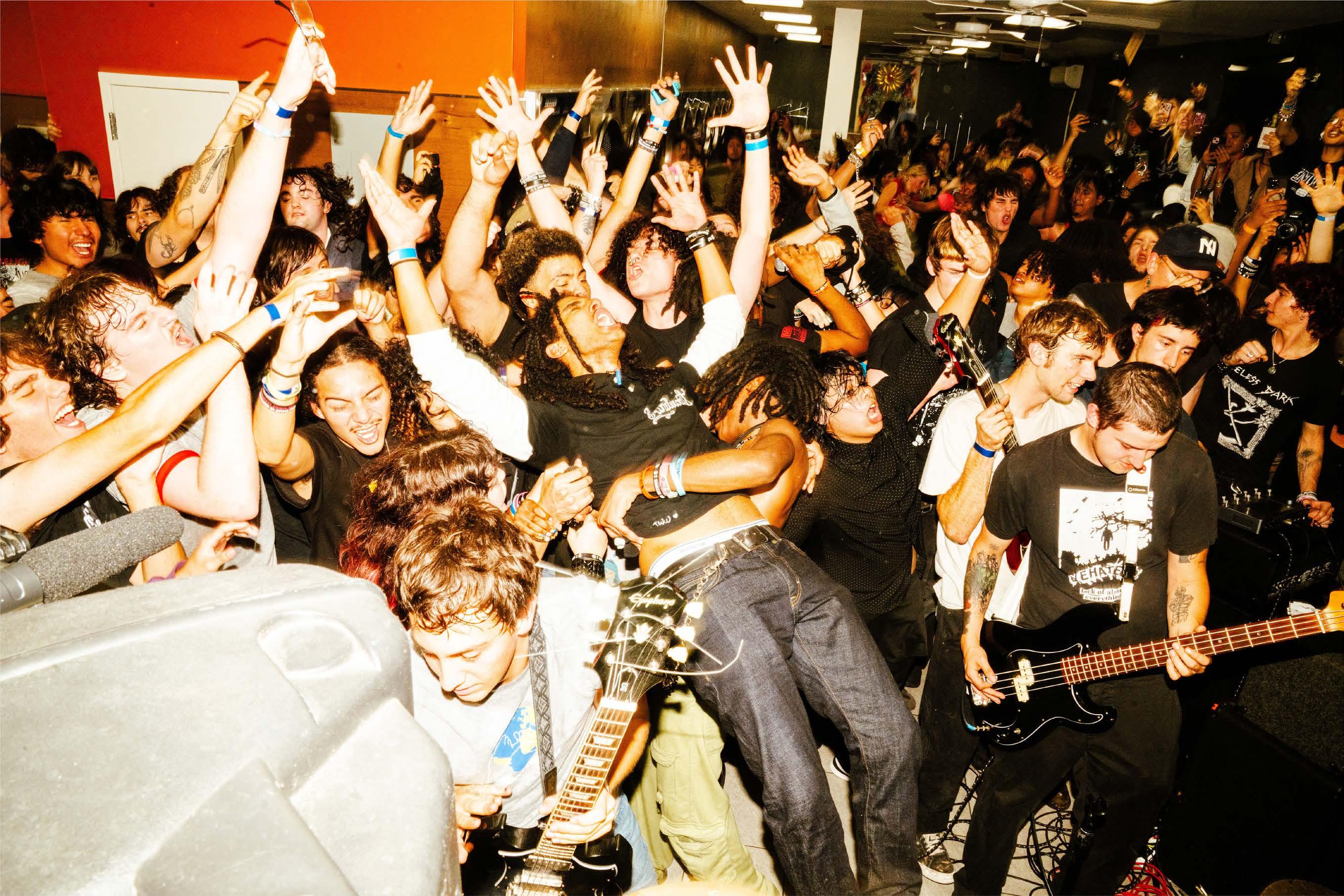
Ted Williams at Blursday DIY Digital Photograph
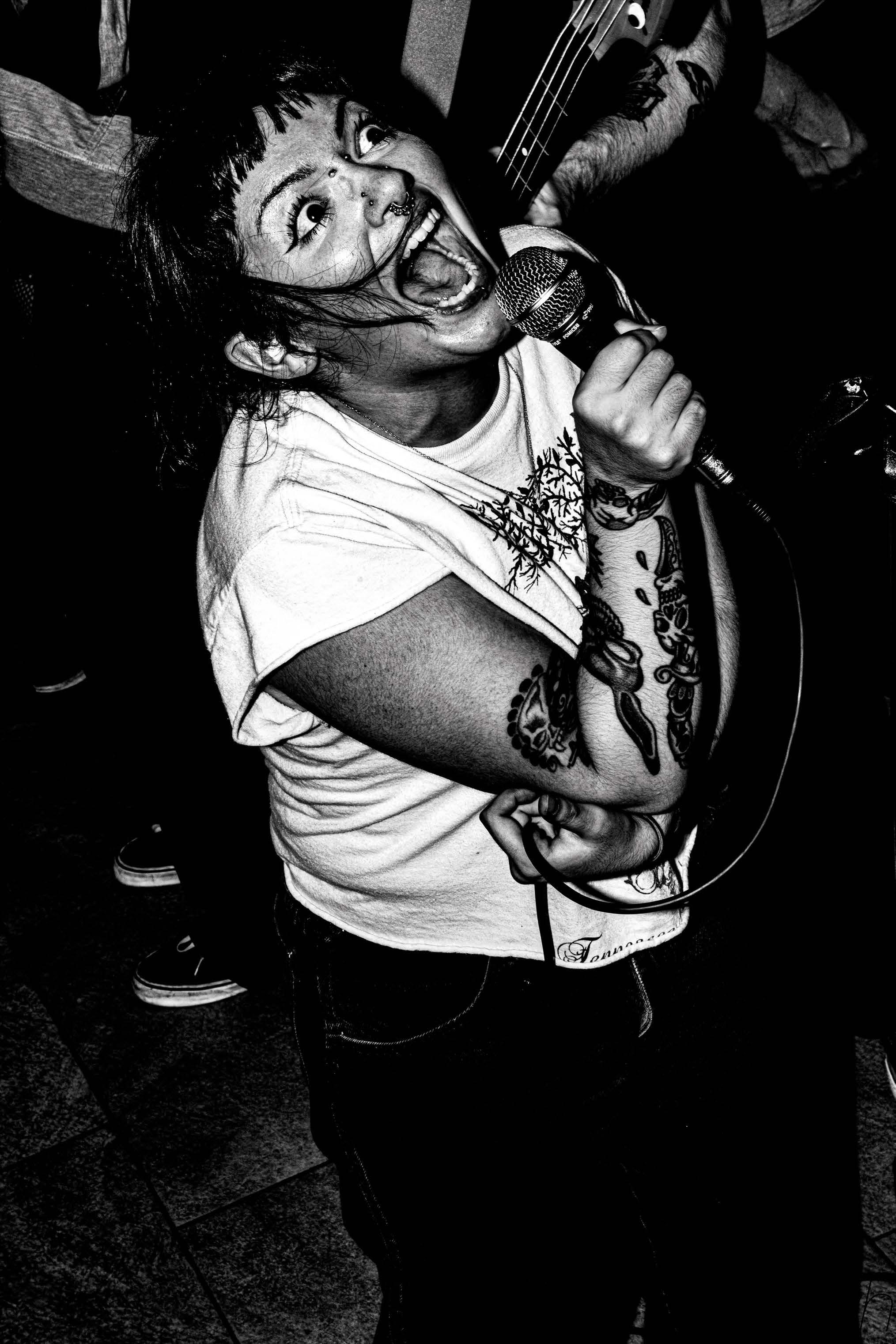
I Have No Mouth at Blursday DIY Digital Photograph
like this. That’s the way I describe it! Or also, it’s just like this entire row of people right here, you can see a little bit of the ceilings still, still separated from it a little bit. Or, like, the portrait of the girl, like, sitting on the, on the thing, just directly in the middle of the photo. So, I definitely agree. I focus a lot on what goes where, even though I can’t really technically control a person’s movement, the only thing I can control with my camera is positioning it in a way to capture as right as the composition can be.
Yeah, the lighting is beautiful. This one especially looks so painterly. Thank you.
Yeah. The sharpness of everything, the little lines–it’s beautiful. What do you hope someone who has never been to a hardcore show feels when they see your photos?
Like I said, cause a lot of people, it’ll be a lot of... I have seen this a lot where elderly people always come up to me, and they’re like, “Oh, like, why are these, like, so violent? Like, I couldn’t breathe in this shit for any minute.” I’m like, that’s fair, but I definitely want people to kind of understand that this scene is all about community. It’s all about, like, coming together. It’s all about helping each other out. It’s also about coming to benefit shows, 'cause a lot of benefit shows happen. Like, I work as one of the managers for the radio station here at SVA. And we are making a benefit show that helps VASA’s mutual defense aid fund, which helps out any students if they ever get caught in a situation with ICE, or they’re taken away or kidnapped. A common factor in the scene is definitely benefit shows, where people will raise money for a certain thing, whether it be someone’s surgery, whether it be someone’s immigration lawyer fees, whether it be helping out with a death in the family, helping out with their funeral—shows happen for them, in the memory of. It’s stuff like that that is very important to the scene. It’s not just about pushing each other, or jumping off the stage and jumping on a lot of people and stuff like that. It’s also just coming together for one night. To hop out, not only giving recognition to the bands in the scene, but also helping others out, and making sure that everybody is helped out and focused upon in a certain way, in the scene, when it comes to having troubles like that. And it happens in everyday lives. So we always try to help out with everybody’s needs, the best way we can. That’s really beautiful—community. Community is so beautiful. It reminds
me of how I was talking about politics, and everything is political. And community is something to help us survive in this world right now, and all of these photos resemble that, and I love it so much.
Thank you, I appreciate it.
Is there a moment you captured that felt especially meaningful or unforgettable for you?
There’s a million. There’s, like, a million pieces I’ve made, where I feel that way. But I’d say it’s definitely this band, it’s called Grimlitter. They play it at a venue called Gold Sounds in Brooklyn. And this photo means a lot to me in a sense. As someone who’s trans, it really means a lot whenever I see women or femme-led bands, or queer or non-binary bands, any frontwoman that leads the band or leads the scene, because the hardcore scene, in the beginning, in the 80s, it’s always been, like, male-dominated. They’re always trying to be the tough guy, hardcore, like, the tough guy persona, like macho type shit. But I always love it whenever I see femmes running the scene, and always putting on their best performance and stuff like that. It’s definitely ones that hit close to me, 'cause they definitely give off a way more meaningful performance. As much as I like seeing, you know, men scream into the mic, I see it all the time. But this is definitely so, so beautiful, and it’s still got that very chaotic energy, but just, as someone that’s trans, it definitely hits way closer to home, I’d say.
Yeah, I can tell that these two are, like, the strongest pictures, for me, like, the strongest feelings, and these ones are very community-based, very wholesome, but these two, they make me feel something different, definitely. What would it mean for you to be a successful artist?
I definitely want to grow from this, but I also don’t want to leave the scene. Because I have so many opportunities for me out there, like to be in a music magazine, like Rolling Stone, or something like that. To think about myself being a successful artist, I definitely would want my works to be more in the gallery, the fine arts aspect of it. And also the music magazine publishing aspect of it, because I really want to let people know about the hardcore screamo scene in New York. Well, not just in New York, but throughout America, and also, there’s different types of hardcore all throughout the world, actually. Hardcore is worldwide. Yeah, I definitely would love to have my work out in galleries and magazines. It definitely feels like what it would be for me to be successful. I’d try to get more attention to the hardcore scene throughout the whole world and try to make it more available for everybody, because it’s not just limited to the same, like, 50 people that I see at shows. I’d definitely love to see just more people coming to the shows.
Artist on Artist
Printed in an edition of 500 copies for the School of Visual Arts in New York City. Published by Visual Opinion, the student publication of the School of Visual Arts.