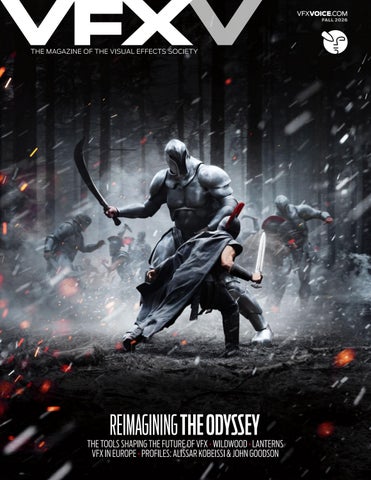
VFXVOICE.COM FALL 2026
REIMAGINING THE ODYSSEY
THE TOOLS SHAPING THE FUTURE OF VFX • WILDWOOD • LANTERNS VFX IN EUROPE • PROFILES: ALISSAR KOBEISSI & JOHN GOODSON
[ EXECUTIVE NOTE ]
Welcome to the Fall 2026 issue of VFX Voice! Thank you for reading VFX Voice and being a part of the global community dedicated to all things visual effects. In our cover story, we talk to the SFX and VFX supervisors steering The Odyssey to discover how Christopher Nolan masterfully fused practical and digital effects to realize his bold vision, turning Greek mythology inside out along the way. In another Fall issue highlight, our robust roundtable of VFX artists, supervisors, technologists and others illuminate the breakthrough tools unleashing the creativity of storytellers around the world. In addition to The Odyssey, we join director Travis Knight on his personal odyssey to make the stop-motion animated film Wildwood (Knight’s live-action Masters of the Universe was released earlier this year) and how it has changed LAIKA Studios’ animation style. We also shine a light on the VFX for Lanterns, a live-action spinoff of DC Comics’ Green Lantern franchise, produced by DC Studios for HBO. Then we stop to explore the Bathhouse Battle sequence in the VES Award-winning KPop Demon Hunters to dissect what makes a prizewinner and how it was achieved. For our Special Focus, we traverse the U.K., Ireland, France, Germany, Poland, Romania and Greece to survey the landscape of VFX across Europe, where incentives play a decisive role. Then we delve further into tax incentives, their benefits and limitations in our feature on the “new economics” of VFX. We also profile Sony Pictures Imageworks Senior Animator Alissar Kobeissi and trailblazing ILM modelmaker/designer/artist John Goodson. And in keeping with our “something for everybody” philosophy, you can follow the pathway of VFX studios from vendor to creative partner, listen to the voices of next-generation artists new to the VFX industry, and find out why independent filmmakers believe that there has never been a better time to make a movie or a show. Now dive in and meet the innovators pushing the boundaries of visual storytelling.
Cheers!
Kim Davidson, Chair, VES Board of Directors
Nancy Ward, VES Executive Director
P.S. You can continue to catch exclusive stories between issues only available at VFXVoice.com. You can also get VFX Voice and VES updates by following us on X at @VFXSociety and vfx_society on Instagram.
2 • VFXVOICE.COM FALL 2026
[ CONTENTS ] FEATURES 8 VFX TRENDS: NEXT-GENERATION VOICES How Gen Z artists are making their mark on the industry.
VFXVOICE.COM
DEPARTMENTS 2 EXECUTIVE NOTE 90 THE VES HANDBOOK
14 VFX TRENDS: VENDORS BREAK THROUGH VFX studios evolve from hired hands to creative partners. 20 COVER: THE ODYSSEY Christopher Nolan’s hybrid methodology aces an epic test. 26 PROFILE: ALISSAR KOBEISSI Multimedia artist aims to break down the walls of animation. 30 INDUSTRY: THE NEW ECONOMICS In 2026, tax geography is just as critical as creative capability. 36 PROFILE: JOHN GOODSON ILM master modelmaker relives the closure of the Model Shop. 42 ANIMATION: WILDWOOD Behind LAIKA’s stop-motion animated film 16 years in the making. 48 ROUNDTABLE: TOOLS THAT SHAPE THE FUTURE A panel of experts convenes to identify what comes next in VFX. 56 SPECIAL FOCUS: VFX IN EUROPE Unifying studios across Europe is an enthusiasm for storytelling. 66 AWARD WINNERS: KPOP DEMON HUNTERS How a film about a K-pop girl group won hearts – and awards. 72 TELEVISION/STREAMING: LANTERNS Designing ancient alien technology that feels timeless and advanced. 78 VFX TRENDS: INDIE FILMMAKERS FLOURISH The seismic shift in crafting digital effects on a shoestring budget. 84 VR/MR/AR TRENDS: MIXED REALITY ADVANCES MR is gaining traction through innovation and a growing library.
4 • VFXVOICE.COM FALL 2026
92 VES SECTION SPOTLIGHT – MONTREAL 94 VES NEWS 96 FINAL FRAME – TOOLS OF REVOLUTION
ON THE COVER: The heavily armored, sword-wielding giants in The Odyssey are a creative adaptation of the Laestrygonians from Homer. (Photo: Melinda Sue Gordon. Courtesy of Universal Pictures)
FALL 2026 • VOL. 10, NO. 4
WINNER OF FOUR FOLIO AWARDS FOR PUBLISHING EXCELLENCE.
VFXVOICE
Visit us online at vfxvoice.com PUBLISHER Jim McCullaugh publisher@vfxvoice.com
VISUAL EFFECTS SOCIETY Nancy Ward, Executive Director VES BOARD OF DIRECTORS
EDITOR Ed Ochs editor@vfxvoice.com CREATIVE Alpanian Design Group alan@alpanian.com ADVERTISING Arlene Hansen arlene.hansen@vfxvoice.com SUPERVISOR Ross Auerbach EDITORIAL ASSISTANT Desiree Bowie CONTRIBUTING WRITERS Trevor Hogg Katie Kasperson Chris McGowan Barbara Robertson ADVISORY COMMITTEE David Bloom Andrew Bly Rob Bredow Mike Chambers, VES Lisa Cooke, VES Neil Corbould, VES Irena Cronin Kim Davidson Paul Debevec, VES Debbie Denise Karen Dufilho Paul Franklin Barbara Ford Grant, VES David Johnson, VES Jim Morris, VES Dennis Muren, ASC, VES Sam Nicholson, ASC Lori H. Schwartz Eric Roth
OFFICERS Kim Davidson, Chair David Tanaka, VES, 1st Vice Chair Brooke Lyndon-Stanford, 2nd Vice Chair Frederick Lissau, Secretary Jeffrey A. Okun, VES, Treasurer DIRECTORS Fatima Anes, Laura Barbera, Alan Boucek Kathryn Brillhart, Colin Campbell, VES Mary Carr, Christina Caspers, Emma Clifton Perry Rachel Copp, Dayne Cowan, Laurence Cymet Dave Gouge, Kay Hoddy, Dennis Hoffman Thomas Knop, VES, Karen Murphy, Maggie Oh Joel Pennington, Robin Prybil, Christine Resch Lopsie Schwartz, Agon Ushaku, Sean Varney Sam Winkler, Philipp Wolf ALTERNATES Klaudija Cermak, Fred Chapman, Aladino Debert Jess Loren, William Mesa Visual Effects Society 5000 Van Nuys Blvd. Suite 310 Sherman Oaks, CA 91403 Phone: (818) 981-7861 vesglobal.org VES STAFF Elvia Gonzalez, Associate Director Jim Sullivan, Director of Operations Ben Schneider, Director of Membership Services Wayne Watkins, Donor Relations Manager Kate Bonifas, Marketing & Communication Manager Charles Mesa, Media & Content Manager Ross Auerbach, Program Manager Colleen Kelly, Office Manager Shannon Cassidy, Global Manager Adrienne Morse, Operations Coordinator P.J. Schumacher, Controller Caryn Drake, Sections Finance Lead Dylan Ring, Administrative Assistant
Tom Atkin, Founder Allen Battino, VES Logo Design Follow us on social media
6 • VFXVOICE.COM FALL 2026
VFX Voice is published quarterly by the Visual Effects Society. Subscriptions: $50 annually plus shipping rates. See vfxvoice.com Advertising: Rate card upon request from publisher@vfxvoice.com or VFXVoiceAds@gmail.com Comments: Write us at comments@vfxvoice.com Postmaster: Send address change to VES, 5000 Van Nuys Blvd., Suite 310, Sherman Oaks, CA 91403. Copyright © 2026 The Visual Effects Society. Printed in the U.S.A.
VFX TRENDS
THE NEXT GENERATION SPEAKS: WHAT YOUNG VFX ARTISTS ARE DOING DIFFERENTLY By KATIE KASPERSON
Everyone loves to hate Gen Z – I can say this; I’m one of them. Born between 1997 and 2012, Generation Z is making its mark on the workforce, prioritizing flexibility, work-life balance and job satisfaction and largely doing away with tradition. At least, that’s how the story goes. In the VFX industry, young artists are shaking things up – but not as much as you might think. Some denounce artificial intelligence; others tout its efficiency. Some are wary of burnout, of being women in a male-dominated sector, of allowing themselves to log off and – to use their lingo – touch grass, but in general, they’re finding the industry both welcoming and creatively rewarding. We catch up with seven young artists, working around the world, to explore the employee experience from their POV. WHEN I GROW UP
TOP: ILM is one of the primary VFX providers on Supergirl, sharing the action with Digital Domain and Framestore. (Image courtesy of Warner Bros. Pictures) OPPOSITE TOP AND MIDDLE: Wētā FX and Sony Pictures Imageworks served as the primary vendors for A Minecraft Movie. Wētā FX was responsible for adapting the iconic blocky geometry into a living environment, alongside designing and animating many of the film’s key characters. Digital Domain also provided VFX support. (Images courtesy of Warner Bros. Pictures) OPPOSITE BOTTOM: ILM handled the wide space exteriors, interstellar environments and spaceship shots for Project Hail Mary. Framestore created the digital animations used to bring the alien character “Rocky” to life, combining VFX with practical puppetry. (Image courtesy of Amazon MGM Studios)
8 • VFXVOICE.COM FALL 2026
When choosing a career, those who end up in VFX don’t just throw a metaphorical dart; they’re driven by a passion for film, animation and shared emotion. Take Jiwon Chun, now a texture artist at ILM, for example. As a kid, she spent her time immersed in sci-fi and fantasy films, watching VFX breakdowns and behind-the-scenes documentaries. “I was so curious,” Chun remembers. “I hadn’t realized, at the time, that I could do it as a career. When I did, it became a goal to work towards: to work in VFX.” Balthazar Bourguignon, FX artist at DNEG, had a similar experience. “When I was 10,” recalls Bourguignon, “I watched Final Fantasy VII: Advent Children. I didn’t understand the movie, but it planted a seed in me. The battles, the magic, the explosions – I loved it. When it came time to choose a professional path, oddly enough, I didn’t hesitate. I knew that if I was determined, one day I could craft images that resonated with people the way they resonated with me.” Francesca Armstrong, Lighting Technical Director at Wētā FX, stumbled into VFX accidentally. While studying computer science,
she found that coding “opened the door to the VFX industry. I’ve always loved art and film,” she shares. “A career that combined science with the creative arts presented a new, exciting world where visually interesting work and technical problem-solving didn’t have to be mutually exclusive.” Max Popovych, compositor at Digital Domain, had a parent in the industry. “I grew up around it,” he recalls. His father, also a compositor, would involve him “in small ways,” such as painting details or visiting studios. “At home, we watched films constantly, and over time, I became more interested in how those images were built. I started experimenting on my own – compositing images in Photoshop and trying to recreate what I’d seen. That early exposure made pursuing VFX feel like a natural direction.” EXPECTATION VERSUS REALITY
Leaving college and entering adulthood is a tough transition for anyone, but for Gen Z, this period was marked by COVID, a stagnant job market, industry uncertainty and environmental, political and societal malaise. “When I graduated,” begins Camille Garlaschi, previs artist at Framestore, “I was confident that I would find a job quickly. I wanted to move to London. I finished school one year after COVID and Brexit, so the timing wasn’t ideal,” she describes. “I faced a recovering industry with very few job offers and even fewer for juniors, plus new visa laws,” which affected her, a French citizen. Though disheartened, Garlaschi didn’t give up and was hired one year later. “I found an amazing team,” she gushes, and she considers herself lucky. “When the strikes happened, I saw a lot of fellow artists lose their jobs – which is especially hard on people who rely on a work visa.” Armstrong, meanwhile, entered the workforce with some hesitation, cautious of the “negative legacies” that tint nearly every facet of Hollywood filmmaking. “The chance to work with top-tier
FALL 2026 VFXVOICE.COM • 9
VFX TRENDS
creative and technical artists on the most cutting-edge projects was exciting, but would I work myself into burnout? Would I be taken seriously as a young woman?” For the most part, Armstrong says, the industry has met her standards. “You need to advocate for yourself, but I’ve been fortunate to work on engaging, successful projects with people who are actively pushing the industry in a more encouraging, respectful direction.” Chun also notes that while the VFX sector can at times feel like a male-dominated space, she feels valued as a young woman in the workforce. ILM offers a comprehensive mentorship program, including those specific to women employees. “I can tell that we value diversity,” she says – a dwindling reality in today’s political climate. A few of our young artists have found that stability can be hard to come by. “It took me by surprise,” Léa Desrozier, environment generalist at DNEG, admits. “Things change, productions shift, and you have to roll with it. That wasn’t something we talked about in school, so I didn’t understand how unpredictable it could be. It was hard at first, but it allowed me to become more flexible over time.” Popovych agrees. “I’ve learned that the industry is dynamic. Contracts are often short-term, and stability isn’t something you can rely on. It’s reinforced that consistency comes from how you show up, adapt and take ownership of your work.” TOP TO BOTTOM: ILM is one of the main VFX companies on Spider-Man: Brand New Day, with Framestore, RISE and Sony Pictures Imageworks also contributing. (Image courtesy of Marvel Studios) The robot character H.E.R.B.I.E., here assisting with laundry, was designed by Digital Domain in collaboration with Marvel for The Fantastic Four: First Steps, featuring retro-futurist 1960s aesthetics. (Image courtesy of Marvel) Wētā FX led the multi-studio VFX pipeline for Predator: Badlands. (Image courtesy of 20th Century Studios)
10 • VFXVOICE.COM FALL 2026
STRIKING A BALANCE
Instability can be a red flag for a generation that prioritizes worklife balance, but most young employees stand their ground when it comes to logging off. For Garlaschi, “it’s never been too complicated to switch off from work at the end of the day. I like doing different activities in the evenings and weekends; that way, I feel like I’m keeping work separate from my personal life.” Older, more seasoned colleagues can also be a source of wisdom.
“I’ve been told by those more senior than me not to overdo it and think of it as a marathon, not a sprint,” Chun says. But work-life balance can be ambitious to achieve when the two begin to blend – a common side effect of remote work. That said, young employees seem to value flexibility, comfort and the ability to focus, which aren’t always given in an office job. For Bourguignon, remote work “is great when you need to fully lock in during a rush, when you’re feeling under the weather or when you’re simply too far from the office,” but “there’s nothing quite like” the social interaction that in-person work affords. “Sharing knowledge, building friendships, having a laugh – all of that comes naturally when someone is just a desk away.” For Tivoli Mu, environment artist at Digital Domain, in-person work also provides valuable face time. “It allows us to receive feedback more quickly and gives us the chance to observe how senior artists approach problems,” she says – an opportunity that junior employees shouldn’t overlook. Young people also express empathy for colleagues with spouses, children and other dependents. “I think it’s better to be flexible because – it doesn’t apply to me,” Chun says, “but if you had a family, that could be a challenge.” Work-life balance isn’t easily quantified, Mu claims. “It’s not only about working a fixed number of hours, avoiding messages after work or making sure we have leisure time every day. Those things can be important, but to me, the deeper meaning is being able to maintain my health, keep growing as a person and take care of important relationships while staying fully committed to my work,” she describes. “I am still learning how to achieve that.” MAN VERSUS MACHINE
Artificial intelligence is everywhere, and the hype has yet to die down. The Writers Guild denounced generative AI; the Academy Awards have banned it. Though unlikely, there’s a genuine fear that it could render VFX roles obsolete, but young people seem confident overall that a human touch will always triumph. There’s a critical distinction between traditional AI – which can boost efficiency – and generative AI, which can mimic creativity. “I see it as a tool that is becoming part of the workflow,” Popovych says, “especially in early stages like look development and iteration. The fundamentals – having a strong eye, understanding light, integration and detail – still define the final result. I see AI as something that will reshape workflows rather than replace artists.” Others take a stronger stance against AI. “While I know that AI can make my life easier,” Armstrong says, “I don’t morally align with its large-scale use. I’m open to being wrong, but the idea of replacing the human touch in cinema with prompt-generated iterations is pretty depressing to me – as an artist and a viewer.” For those like Chun, Mu and Bourguignon, AI is just another tool in the arsenal. “At ILM,” Chun states, “we’re constantly introducing new technology to raise the bar,” like StageCraft, its end-to-end virtual production solution. “In the past 10 years, we’ve developed many artist-driven machine learning tools that our artists use to assist with repetitive technical tasks. These allow us to increase the speed and quality of our work,” she says.
TOP TO BOTTOM: DNEG was the primary VFX vendor for Christopher Nolan’s The Odyssey. (Image courtesy of Universal Pictures) ILM serves as an anchor VFX partner for The Lord of the Rings: The Rings of Power, developing the visual foundations of the series. DNEG is also a lead VFX partner on Season 3 of the show. (Image courtesy of Amazon Prime) DNEG delivered massive environment and FX work to Mortal Kombat II, including Raiden’s Sky Temple, the realm of Edenia and complex lightning/portal simulations. Framestore also contributed VFX. (Image courtesy of Warner Bros. Pictures)
FALL 2026 VFXVOICE.COM • 11
VFX TRENDS
Like some of her peers, Mu agrees that “AI does have a place in VFX” during the conceptual stages and to “support repetitive or time-consuming tasks.” That being said, she takes a positive spin, believing AI “encourages us to think more deeply about our own value as artists.” Bourguignon also chooses to see AI as a potential tool and nothing more. “What is truly useful will naturally stick, and what isn’t will fade. As VFX artists, we already have a strong technical background that pushes us to adapt constantly. AI is no different.” DONE DIFFERENTLY
TOP TO BOTTOM: Digital Domain served as the lead VFX vendor for The Electric State, overseeing the creation of numerous complex robot characters and massive environment shots. ILM provided key visual effects and character animations. (Image courtesy of Netflix) Framestore handled complex climbing and environmental sequences for the Netflix thriller Apex. (Image courtesy of Netflix) Framestore handled the primary digital work on Mad Max: Fury Road, while Method Studios contributed to sequences set in the Wasteland and various action shots. (Image courtesy of Warner Bros. Pictures)
12 • VFXVOICE.COM FALL 2026
So far, the next generation of VFX artists doesn’t seem all that different from those who came before. So, what separates them from the veterans? Popovych believes it’s the amount of visual content they are exposed to from a young age, whether on social media or a TV screen. “People develop an instinct for what looks real much earlier, even outside the industry. Experimenting with images, cameras and online inspiration helped build that foundation early, and now it translates into a more intentional approach in my professional work.” Chun argues it’s a resourcefulness that defines her generation. “Speaking from my own experience, I learned Adobe Substance Painter rather than Mari because it’s more affordable. Being exposed to all the free tutorials on Discord and YouTube also came in handy. I think this habit of self-teaching still carries on in my day-to-day job.” While there are certainly themes – or stereotypes – that characterize Gen Z, Mu doesn’t espouse a strict generational boundary. “No matter when someone enters the field, everyone has to keep learning and adapting,” she says. And for a generation that, by some, has been deemed lazy, these artists are anything but. They’re proud of their work, collecting credits and becoming more confident as they gain experience. “I didn’t go to the best schools or start VFX early,” Bourguignon admits, “so it was no piece of cake.” Their time in the VFX industry thus far can be characterized by nonstop development. “The last few years have given me a basic creative and technical toolkit, but I think the area of growth I’m most proud of is learning to trust in my skills and instincts,” Armstrong shares. “I challenge myself to say ‘yes’ to professional opportunities that I would have previously felt underqualified for.” Garlaschi, meanwhile, is proud of not giving up, despite her early struggles to get her VFX career off the ground. “I’ve managed to keep the spark that first drew me into this industry,” she says, avoiding the post-grad disillusionment altogether. Mu also began her career with a “romantic impression of the industry,” and while she hasn’t lost that rose-tinted view, she’s come to appreciate the practical aspects of the VFX process. “Being part of an exciting film can be a dream and a passion, but the final result also depends on every team member dedicating effort to every single shot. Every person’s contribution is genuinely important,” she argues – whether they’re old guard or junior artist.
VFX TRENDS
THE JOURNEY FROM VENDOR TO CREATIVE PARTNER By TREVOR HOGG
TOP: A heartfelt mother-daughter moment is brought to life by Zoic Studios for The Miniature Wife. (Image courtesy of Peacock) OPPOSITE TOP TO BOTTOM: The expectation of audiences has altered the visual effects workload, especially when it comes to cleaning up shots. BlueBolt contributed to the polish of Nosferatu. (Image courtesy of Focus Features) Zoic Studios worked on Widow’s Bay, which is getting noticed for its blend of comedy and horror. (Image courtesy of Apple TV) Visual effects is not confined to fantasy shows and can be found in the comedy drama series Your Friends and Neighbors. (Image courtesy of Apple TV)
14 • VFXVOICE.COM FALL 2026
As CGI permeates film and television productions, opportunities have increased exponentially for visual effects studios to grow from hired hands to creative partners in the design and execution of shots. On projects that rely on a single vendor, this collaboration can extend to vendor-side VFX supervisors taking on production-level responsibilities. As digital technology has matured over the past three decades, studios and filmmakers have gained extensive experience with the visual effects process and now treat it as a standard part of their creative toolkit. “It’s an incredibly fluid world right now,” Chris Jones, Founder and Executive Creative Director of Zoic Studios, states. “Each show seems to have its own ecosystem. In some scenarios, we are the sole vendor, which is advantageous for a lot of reasons. The show is not being piecemealed out across a ton of different vendors, so you have a much greater view of the overall project and can contribute at a higher level. Also, when you have a vendor-side supervisor, they tend to be involved at an early stage, so they’re helping to shape the creative. That can be advantageous to production because you’re building within a budget to give the show the maximum amount of creative. The other side of it is when you have a production-side visual effects supervisor, you tend to do work that’s in your wheelhouse, which makes it a strong production. This itself is an advantage. A sole vendor isn’t necessarily focused on what it does well, and time-consuming tasks can become distracting. There are a lot of advantages and disadvantages to both ways.” Visual effects have become a necessity, but at the same time, they’re treated as taboo in publicity campaigns. “As far as affecting the creative, it affects the morale of the artists more than anything,” Jones remarks. “We all got into this because we love creating things. As with anything else, whether it’s monitoring comps or full CG shots, every artist goes into it knowing the work they’re putting on the screen is the best it can possibly be, given
“It’s an incredibly fluid world right now. Each show seems to have its own ecosystem. In some scenarios, we are the sole vendor, and that becomes advantageous for a lot of reasons.” —Chris Jones, Founder and Executive Creative Director, Zoic Studios the time and budget. When filmmakers turn around and say, ‘There were no visual effects in it.’ From a company standpoint, you understand that, smile and know deep inside that there were hundreds of visual effects in it. The filmmakers know how valuable our contributions are to the storytelling process. Generally, it’s a very good relationship. You’re always working hand in hand with filmmakers to generate the best possible shots.” Creativity is determined by the context behind the visual effects work. “If we’re creating visual effects that are needed to tell the story, then we are part of the creative braintrust and help to solve how we’re going to bring audiences to different worlds and create various characters,” Christa Tazzeo Morson, Vice President of Global Partnerships and Executive Visual Effects Producer at Rocket Science VFX, states. Filmmaking has shifted from a linear process to a more vertical one. “You have many departments operating a lot earlier on the front end, rather than waiting for each department to move down the line to finish the movie or television show. The pandemic and remote toolsets have helped with that. Editing and sound are starting earlier. Everyone’s trying to push it as early as possible, so that you’re creating a dynamic blueprint of what the finished product is going to look like.” Art departments have become commonplace within visual effects studios. “We work closely with filmmakers at various stages. It depends on the size and scale of the show you’re delivering. If you have heavy R&D and are creating a new effect or look, then it makes sense to have a bigger art department for that at one of the larger vendors. A lot of times the ideas are created on the production side, and visual effects adapts them into the digital world.”
FALL 2026 VFXVOICE.COM • 15
VFX TRENDS
TOP TO BOTTOM: Studios are getting better at integrating visual effects into the process and understanding what to use it for, according to Henry Badgett at BlueBolt, which contributed to Downton Abbey: The Grand Finale. (Image courtesy of Focus Features) Each project is different for BlueBolt, even when working with the same director. A scene from Tom Clancy’s Jack Ryan: Ghost War featuring VFX from BlueBolt. (Image courtesy of Prime Video) A fire breaks out in a dollhouse that serves as the residence of the title character in The Miniature Wife. (Image courtesy of Peacock)
16 • VFXVOICE.COM FALL 2026
Unreal Engine is a powerful tool for previsualization. “Unreal Engine helps to elevate the overall quality and finish,” Morson remarks. “Clients are continually pushing for higher standards. They want to see more advancement and efficiency in the process. Unreal Engine allows us to work in real-time, back and forth with our clients. Also, it sets a stronger foundation for the production. We can develop cameras and blocking and work more collaboratively in real-time within Unreal Engine.” Everything centers around collaboration. “A lot of it is in the management and delivery. You certainly need creative and technical brainpower and the ability to execute. But like much of the world, it’s relationship driven. When you have a shorthand with a particular supervisor, producer or director, there are some advantages there. People like to work with like-minded people, and sometimes people who bring something unique to the table they might not have thought of. The key is for VFX studios and talent to do what they do best and build relationships with their clients. Ultimately, that’s where there will be success.” Partnerships with the other departments need to be forged. “Visual effects is one of the few departments that needs to interact with almost every other department, including post,” Tom Mahoney, Founder and Partner of CoSA VFX, notes. “On big projects, visual effects is involved from the concept stage through to delivery. On a given project, there’s almost no way I’m not in close communication with the stunts supervisor, special effects supervisor, cinematographer, camera operators, wardrobe, makeup, transportation and props. There’s almost no department I don’t talk to at some point to make sure they’re aware of what we need to do and the specific parameters we may need to operate within. Because I want to tell them, ‘If you do this with a certain prop, that’s going to screw us up.’ Or, ‘if you can’t do this with a certain prop, we can fix that and make it work.’ It’s always a reciprocal relationship. I never want to say that visual effects
should do everything. We shouldn’t. Truth be told, if you can do it for real, do it for real. There are three places where visual effects will definitely be needed. If something can’t be done physically, like shooting in space, then visual effects come in. If it’s not safe to do within a reasonable thing, we should try to take it over. If it’s too expensive or logistically prohibitive to do it practically, like one shot of a cruise ship on the horizon on the ocean. Could you shoot that practically? Sure, but it’s going to be a lot cheaper to do a visual effect there.” Finding better ways to communicate is key in any industry. “The biggest waste is miscommunication,” Mahoney states. “It happens internally in companies and in productions. It occurs all the time. A miscommunication can cost hundreds of thousands of dollars in bad cases. Everybody is always trying to improve that. I would also like to see visual effects valued for what it is. It’s neither good nor bad. We can’t use visual effects because it’s bad, or market it by saying we didn’t use visual effects, even though a ton were used. It’s like cinematography, editing or art direction. It’s another part of what’s going on, and I don’t like it being vilified. I don’t understand it.” The actors’ strike caused a major reset in visual effects expenditures. “The pandemic slowed down the productions, but, specifically, all the linear networks were terrified by what was happening with the streamers. As soon as the pandemic ended, they all jumped to: ‘We’ve got to produce as much as possible.’ Especially on the streaming side. There was a lot of work. Then accountants started catching up with the desire to beat Netflix and said, ‘This isn’t working.’ What the actors’ strike did was give every accountant a chance to say, ‘Put the brakes on what you’re doing. We can’t be spending money like crazy as we’ve been doing for the past 10 months.’ Everybody thought that when the strike ended, the industry would go back to where it was before the strike
TOP TO BOTTOM: Unreal Engine allows Rocket Science VFX to go back and forth with clients in real-time, as they did on Season 2 of Wednesday. (Image courtesy of Netflix) The visual effects industry remains relationship driven. A scene from Wednesday Season 2, which involved Rocket Science VFX. (Image courtesy of Netflix) Wednesday is an example of the production visual effects supervisor coming from a vendor that also works on the series, which in this case was Tom Turnbull and Rocket Science VFX. (Image courtesy of Netflix)
FALL 2026 VFXVOICE.COM • 17
VFX TRENDS
TOP TO BOTTOM: Visual effects vendors are creative problem-solvers, believes BlueBolt’s Henry Badgett. BlueBolt contributed VFX to Tom Clancy’s Jack Ryan: Ghost War. (Image courtesy of Prime Video) In most cases, the ideas are created by the production side and visual effects adapts them into the digital world. Rocket Science VFX worked on the movie Ready or Not 2: Here I Come. (Image courtesy of Searchlight Pictures) The filmmaking process has become more vertical than linear to accommodate the tighter production schedules, such as for Season 2 of the show Wednesday. (Image courtesy of Netflix)
18 • VFXVOICE.COM FALL 2026
in March 2025. That didn’t happen. Just now we’re getting to a new equilibrium.” Over the past three decades, digital effects have vastly improved and been adopted as an essential filmmaking tool. “The studios are getting better at integrating visual effects into the process and understanding what to expect and what to use it for,” Henry Badgett, Visual Effects Supervisor and Creative Director at BlueBolt, remarks. “But there are always individuals in the system coming up on the production side where visual effects can be an impenetrable subject because they haven’t come across it before.” Creativity comes in different forms. “We see ourselves as creative problem-solvers rather than the genesis of the creative idea,” Tracy McCreary, Managing Director at BlueBolt, observes. “A filmmaker may make 15 to 20 films if they’re super successful, but it doesn’t mean it’s going to be the same thing over and over again. There’s always going to be a new problem to solve.” Digital tools are not confined to visual effects. “The art department has become more digital, and we slightly speak more of the same language,” Badgett remarks. “I love it when they can isolate something that is clearly easier for us to do, like a poster or billboard that is above the heads of the actors. We are seeing better editorial temp comps these days, and directors get attached to them because they look quite good to start with. A good editor can capture the gist of a shot in a short time, which is often the most important thing. Although we’re doing it again at high resolution, a junior artist typically struggles to reproduce the feel a senior editor has achieved with the timing just right. It’s a useful guide; however, slightly less creative for us.” While visual effects are more accessible than ever, productions continue to rely on specialized VFX studios. “Maybe at the lowest end of indie filmmaking there is somebody in their bedroom who can do it with Blender, and at some point, the visual effects houses are compared to that by somebody,” Badgett notes. “We’re not quite in that realm. The indie films we used to do at MPC 25 years ago would have five to 10 visual effects shots, with a maximum of 20, of which two or three would be big ones. Now the same sort of indie film will come along, and they will have absolutely no limits on what they’re going to ask us to bid on; that might inform what they keep, lose or go out to shoot.” The workload has shifted. “No film can go out there with things that need to be cleaned up remaining on the project,” McCreary states. “They have to find the money for these things because audiences have such different expectations these days. Whereas 15 years ago, the work we did would be comprised of the big visual effects plus a bunch of other smaller stuff; the smaller stuff now ends up happening in a post house.” Accommodating the various needs of filmmakers is a core principle. “Some visionary filmmakers want to control every single aspect of the frame,” McCreary remarks. “That is okay. Being part of that journey is incredibly rewarding. It is mind-blowing how meticulous writer-director Robert Eggers is about everything.” There is also the opposite side of the creative equation. “Other directors come in and ask, ‘What do you have that looks good? What do you have in your toolbox? What do you recommend?’” Badgett observes. “That is fun in a different way. It’s giving them the options and guidelines, then they go off and decide what they’re going to do.”
COVER
CHARTING A NEW COURSE FOR THE ODYSSEY By TREVOR HOGG
Images courtesy of Universal Pictures. TOP: The eye of the cyclops was a real one rotoscoped, composited and timed perfectly with the action.
20 • VFXVOICE.COM FALL 2026
Given that Christopher Nolan has explored cloning in The Prestige, conjured a dream version of Paris that folds into itself in Inception and devoted an entire trilogy to a bat-obsessed billionaire vigilante, the prospect of him venturing into the fantastical world of one-eyed monsters and six-headed creatures hardly feels like a stretch. It was the missed opportunity to direct Troy that laid the foundation for the acclaimed auteur’s eventual adaptation of The Odyssey, an epic tale that echoes a recurring theme in his work: the importance of family. After the Trojan War, Odysseus spends a decade trying to return to his wife Penelope and son Telemachus, enduring a series of island adventures involving gods, monsters and mythical perils that have come to define Greek mythology. “I’ve always enjoyed science fiction because it’s one of the most cinematic of genres,” states Christopher Nolan, Writer and Director of The Odyssey. “We treated The Odyssey like a science fiction film. We look at the world-building and the fact that we have to create everything. We couldn’t do everything from research because very little is known archeologically and historically of the Bronze Age, so you had to do world-building in the manner of a science fiction film and obviously with visual effects and creatures. The same with the methodology. It was not dissimilar. I’ve always enjoyed horror and the chance to try use that language in the storytelling. I got to do that with The Odyssey.” “When it came to the gods and the idea of the divine, what I found in the poem to be the most interesting approach for me
was to look at it from the point of view of the human characters,” Nolan explains. “And the human characters encounter the divine in the world around them, in nature, the state of the sea, the wind blowing the pines, thunder and lightning, these things. And they’re not ambiguous in any way. They are evidence of divinity. That relationship with the gods is part of the world that they live in. That was an interesting approach to me because, in the poem, the real encounters with the gods tend to be through the gods disguising themselves as human beings. I wanted to try to have the audience look from the point of view of somebody at that time who is feeling the gods speaking through nature and is perhaps seeing gods represented in the people around them.” The fantastical elements were embraced visually and narratively. “The challenge for Andrew Jackson [Visual Effects Supervisor] and Scott Fisher [Special Effects Supervisor] and their teams was how to create fantastical imagery within the tone of the rest of the film,” Nolan observes. “That’s the big brass ring of visual effects. That’s when the visual effects and special effects artists are working at their best in creating imagery that is seamless with the rest of the film.” Part of the believability equation is tactility. “Andrew, Scott and I spent a lot of time talking about Ray Harryhausen’s stop-motion or Rick Baker’s makeups or Rob Bottin’s sculptural makeup. The one thing all these different techniques shared is a strong sense of the tactile.” There is also a cinematic truth that needs to be respected. “The audience wants
TOP: Christopher Nolan has a conversation with Visual Effects Supervisor Andrew Jackson. The duo previously worked together on Dunkirk and Tenet. BOTTOM: Christopher Nolan discusses with Matt Damon what he plans to shoot for the next take.
FALL 2026 VFXVOICE.COM • 21
COVER
TOP TWO: Boat-like thrusters were deployed to produce a large-scale surface disturbance in the ocean, while CG water was created for where Charybdis goes down into the water. BOTTOM TWO: Stunts worked closely with special effects to get the proper interaction for the Scylla. OPPOSITE TOP TO BOTTOM: A CG version of the Scylla disappears back into the rocks. A single head was constructed for the Scylla, which was used for all the interactions. Rock formations and mist were added digitally to make the image more mysterious and foreboding.
22 • VFXVOICE.COM FALL 2026
to invest in the story and to believe in The Odyssey. You have to give them a reason to believe.” “We wanted everything to be mythological and fantastical, but grounding it so you weren’t thinking twice,” says Ruth De Jong, Production Designer, The Odyssey. “For instance, when you get to Circe’s stone house, or when you land in the woods with the Laestrygonians in Scotland, you aren’t thinking, ‘Wait, Odysseus is no longer in the Mediterranean.’ The goal was to have the audience so embedded in the journey that they’re not even realizing he’s as far north, south, east or west. The point isn’t even to [define] which direction Odysseus is or isn’t going. Based on the IP, it doesn’t tell us a whole lot. No one can tell us where his journey was. There are so many counter opinions and versions. He never left the Med; that’s based on what? Chris wrote his Odyssey, and that is how we were able to come up with these creative freedoms to free us from any ‘We can’t leave the Med.’ Plus, that look for an entire movie would have gotten boring!” Placing a sunken Trojan Horse on the beach was a deliberate creative choice. “Chris had zero interest in depicting the horse in the common ways you typically saw it on wheels in front of the gate,” De Jong notes. “There was a big interest in him completely rejigging that methodology and [adding] more mystery and happenstance. In terms of the horse’s design, Chris and I leaned into the fact that the Greeks were excellent shipbuilders and woodworkers. They were sea people, and their boats were impeccably built. That’s where the whole concept of building this shiplap Trojan Horse [with] finely tooled head and legs came up. It’s a bit more refined than we’ve seen in the past from various illustrations, books and film interpretations.” Principal photography took place across Morocco, Greece, Italy, Iceland and Scotland. “It’s less even about the name of the country or as we know it today,” De Jong notes. “Chris and I knew that we wanted varying and specific looks. He had this keen idea about these lodgepole-type pines being as high as the sky, but also going right up to the ocean, which is a visually unique look. You don’t find many forests abutting oceans when you think of the Mediterranean. It just so happened that Scotland gave us that look.” An art department was established in every country. “You had to be disciplined. All the departments essentially became one department. Yes, we had our scope of work within each one,
but the crossover with myself, Andrew Jackson, Neil Andrea [Marine Coordinator], Scott Fisher and Hoyte van Hoytema [Cinematography] meant that we were in constant conversation, and all our teams in all those countries were in sync too. That’s the only way I know how to do a film of this scale and scope.” Special Effects Supervisor Scott Fisher states, “It’s fun for us. It’s a different movie experience working on Chris’s movies because you know you’re going to do a lot of things practically, and then he allows us some leeway to try to figure out the best ways to do it. Andrew Jackson and I collaborate and discuss different ideas and things we have done or that have been done, and whether they would be a good fit for this movie. We work our way through each of the things. All the stuff in Troy, Cyclops’ cave, whirlpool and Scylla, you start breaking each one down into elements we can film. Is it going to be visual effects or a combination of the two? Chris doesn’t like throwing everything to a CG solution. It’s always, ‘Let’s see what we can come up with. Where we can get to practically and then we’ll fix or expand or improve it with the CG option.’” This hybrid methodology was utilized for the Cyclops. “We built a big stick figure that was the correct scale, 36 feet tall, and started with that,” Fisher explains. “It was extremely light, so it was easy to puppeteer. In France, they have these gigantic puppets in parade style. We looked at some of the ways they did that. Guys jumping off ropes and using their weight. As soon as you get something that big, weight becomes a factor. We built it in the lightest, simplest form first, got it moving, and then figured out what we could get from that. When we built the one with skin, dimension and size, obviously the weight went up, but we stuck to our core research of how it would move [using] counterweighting, ropes and guides. Then we built a whole hand for picking up people and feet for specialty things. They were all full-sized. They all needed some CGI fixes and repairs.” A single practical head was created for the six-headed Scylla.
FALL 2026 VFXVOICE.COM • 23
COVER
“[I]n the poem, the real encounters with the gods tend to be through the gods disguising themselves as human beings. I wanted to try to have the audience look from the point of view of somebody at that time who is feeling the gods speaking through nature and is perhaps seeing gods represented in the people around them.” —Christopher Nolan, Writer and Director, The Odyssey
TOP: The cave had a hole in the center of the ceiling, which allowed for a stage grid to be built overhead. MIDDLE AND BOTTOM: Sections of the cyclops were constructed for close-up shots.
24 • VFXVOICE.COM FALL 2026
“There was more development on that,” Fisher reveals. “Someone had to figure out what it looked like before we could build the practical thing. Once we built the giant foam puppeteered version, we could work with stunts, use it on wires to grab and pull people, and destroy breakaway items and the boat. We could use that to interact with people because those are the hardest bits to get in CGI.” A practical component was incorporated into the Charybdis, which takes the form of a whirlpool. “It’s all about getting things scaled up to the right proportions for the boat and scene. We did a lot of tests with boats. You see these big ferries and how they churn the water? That’s basically what we did on a bigger scale but in the open ocean. We used a lot of boat-like thrusters to try to get this big disturbance as large-scale as we could in the open ocean.” Water simulations were needed to make the Charybdis look believable. “There are a couple of higher shots where we do see down and how deep the whirlpool is; those were the ones that we affected more with CG.” At one point, the Wrath of Zeus causes a violent storm at sea. “Some of the days, we would go out where there was definitely inclement weather, raining, heavy overcast or rough seas,” Fisher shares. “Then we had fireboats, like the big fireboats you see blasting water in New York. Whenever Matt Damon saw the fireboat, which was the main one, he wasn’t happy!” Some tank work was shot at Falls Lake on the Universal Studios Hollywood lot. “We had a six-axis motion base that was underwater with a big section of ship on it. There was some stuff, like the dropping of the mast and the ship breaking; we had to make sure we were able to hit those moments, and they fit in with everything already shot on the open ocean.” Approximately 400 visual effects shots appear in the final cut of The Odyssey, created by DNEG, with extensive use of postvis. “Because it’s largely 2D work and we have multiple elements, we were experimenting with ways of putting that together to achieve the effects we wanted,” Jackson states. “We do that quite a lot in conjunction with Chris and editorial. It’s more quick versions of the shot. Once we get to the point where Chris is happy, we have to stick exactly to that layout and plan and execute that at a higher level.” Solving the cyclops was the primary concern for the visual effects team. “Early on, it was going to be filmed at the end of schedule in Los Angeles in a cave set,” Jackson explains. “But then during one of the location surveys, Chris found a cave in Greece that he felt was perfect for the cyclops scene. Because Greece was shooting in February, the shooting schedule for building this puppet moved from six to seven months to two. Everyone was freaking out and saying, ‘This couldn’t be done.’ In hindsight,
looking back at it now, that cutting down on the time forced us to cut back on what was possible. It was so lightweight and the joints were very simple. The whole thing moved in a way that would have been quite hard to achieve with a full animatronic version of the same puppet. Some of the action was too complicated for a puppet to do, so we had a person in makeup doing some of that work as well. In some cases, we had to augment the miniature version of the cave to match the full-sized one.” Crowd simulations were not a necessity. “Chris tends to have enough extras so he doesn’t need any crowd simulations,” Jackson remarks. “We did some work, but it was largely in-camera for the Circe scene where all the men turn into pigs. We built faces that were half pig, half man and could transform in-camera. The whole American Werewolf idea was there, but we hadn’t built and tested that because of the time scale for the whole movie. We were working on how to solve that face transition for a long time during the shoot and trying to come up with solutions. But once we found a solution, we were all happy. There were a couple of face replacements for stuntpeople here and there, but not much. It’s like all the other films I’ve done with Chris where we spend a lot of time finding approaches that give us either a finished effect in-camera or something close to finished in-camera.” Nolan is not married to a specific methodology, as demonstrated by how the cyclops sequences were assembled. “When my editor, Jennifer Lame, and I were in the edit suite, we actually needed visual effects to do rough composites for all the dailies so we could cut the sequence as if we were cutting the real beast,” Nolan explains. “That presented huge challenges for Andrew and his team to make those composites fast enough and deal with a massive frame count so we could edit with them. It was an unbelievably complex process!” Visual effects are an indispensable tool. “I’ve been a student of visual effects since I was a small boy. I love it. I know an enormous number of things about it. I’ve used it in my work to great effect. My films have won three Oscars for visual effects, which I’m proud of. I’ve worked with amazing visual effects supervisors. Too often, where the confusion comes in is people these days conflate CG with visual effects. Computer graphics is just one part of the spectrum of visual effects techniques that we use.” “You try not to be self-conscious either about repeating yourself or deliberately not repeating yourself,” Nolan reflects. “You want to do what’s right for each project individually. The relationship between Dunkirk and The Odyssey is interesting because at the end of The Odyssey, it was apparent to me how much I had been influenced in Dunkirk by elements of The Odyssey. Sometimes consciously and sometimes not. For example, the sequence where the guys almost escape and are down in the hull of the ship where everybody is feasting. There’s this ominous sense of them being locked in there. That was specifically me thinking back to the cyclops episode of the poem of The Odyssey. There are commonalities in various points. Not just Dunkirk but in a lot of my work as well. Interstellar, in particular, was another where we were conscious of the parallels with The Odyssey. But one of the things that I love The Odyssey is it embraces all these different stories.”
TOP TWO: The full-sized puppet was shot in an actual cave while a miniature version of the location was constructed with an actor standing in for the cyclops. BOTTOM TWO: A simple marionette was made with hanging strings and ropes, which allowed the cyclops to move in a way that would have been possible with an animatronic.
FALL 2026 VFXVOICE.COM • 25
PROFILE
ALISSAR KOBEISSI BELIEVES IN THE POWER OF STORYTELLING THROUGH ANIMATION By TREVOR HOGG
TOP: Alissar Kobeissi, Senior Animator, Sony Pictures Imageworks.
26 • VFXVOICE.COM FALL 2026
Although animation is not typically the first medium mentioned in relation to the Middle East, Oscar-nominated films such as Persepolis and The Breadwinner illustrate its effectiveness in addressing social issues affecting the region. Among a new generation of artists emerging from the region is Palestinian-Lebanese multimedia animator Alissar Kobeissi, who grew up watching Pokémon, Nobody’s Boy: Remi and Romeo’s Blue Skies dubbed in Arabic on the Pan-Arab television channel Spacetoon, and rewatching Disney and Pixar movies on VHS. “I remember getting Mulan for my birthday, and I was totally obsessed with it,” Alissar Kobeissi, Senior Animator at Sony Pictures Imageworks, states. “Mulan had everything: culture, real-world issues on gender, humor and creativity. It was cinematically beautiful. I would like to make a movie like that one day.” A fascination with animation led Kobeissi to Académie Libanaise des Beaux-Arts in Beirut, where she earned a Bachelor’s in Computer Graphics & Interactive Media. There, she learned gouache painting, JavaScript, art history and typography. After witnessing a donkey rotate in LightWave 3D, Kobeissi took an online course in 3D character animation provided by AnimSchool. A decade later, the former student would have a full-circle moment when she returned as a freelance instructor. At the school’s Gnomon Workshop, Kobeissi conducted a four-hour animation course titled “Animating Characters for Feature Films,” which explored how to achieve natural performances through personality, character specificity and entertainment. “Teaching allows me to put words to things that have become such an intuitive process,” Kobeissi remarks. “Even though that might sound small, it’s not, because it opens up what collaboration can be.” In addition to working at Sony Pictures Imageworks, Kobeissi has contributed to projects produced by Illumination, Skydance Animation and Walt Disney Animation Studios. “On a broad scale, all of those studios had a similar approach to the pipeline,” Kobeissi observes. “Of course, everyone has their own tools and adapts them to the show that is being worked on. Even within Sony Pictures Imageworks, that changes drastically from show to show. A new department was created to bridge layout and animation because, in the previous Spider-Verse, we as animators ended up doing a lot of layout in our shots. This was to take some of that load off and bring layout into animation, but still not have animators do it in production.” Animation styles have become more diverse as artists blend 2D and 3D techniques. “I have never thought of anime being part of the influence towards those new animation styles,” Kobeissi notes. “It definitely has a role to play because animation is connected across the world. You see where things are growing or where people are getting excited. You try to think of how you can [incorporate] some of these elements into the way you make a film. The comic style birthed Spider-Verse, the game style birthed Arcane, and, in a way, they had a similar result with the 2D/3D. Then anime was also growing in parallel, and KPop Demon Hunters inspired [a more modern, cinematic style blending 2D,
3D and anime]. Forgotten Island is also experimenting with that anime 2D-drawn style on top of 3D, which is beautiful. I can’t wait to see what else comes out of this. We have yet to uncover its full potential.” Animation’s growing popularity among older audiences has opened the door to more ambitious forms of storytelling. “The most juice for animation in our generation is that now there is more unpaved road to experiment with different stories that we can tell within animation,” Kobeissi remarks. “We are seeing a rise in audiences that watch animation, but also if you talk to teens and animation students these days, they’re obsessed with things like Spider-Verse and Arcane versus what it used to be when I was growing up, which was more Disney and traditional. Also, the understanding of animation is broadening, and people are realizing it’s not a genre but a medium. Both of these [factors], maturing together, allow for more content and greater diversity in stories. Flee is a great example. There is also The Breadwinner. I love it when animation styles are created to serve the story. Animation has the power to tell a difficult or emotional story or [address] real-world issues in a more digestible way for audiences. The Breadwinner has some simple graphics; however, sometimes the story is hard, but it never feels too hard.” Opportunities to work in animation were limited in the United Arab Emirates, where Kobeissi was born and raised. “For my generation, at the time, I had to leave, and also for personal reasons,” Kobeissi states. “I wanted to live abroad, experience different cultures and work at various studios. However, more and more artists are coming from that region, and more education is happening there as well. I keep up to date with everything through animation festivals. I’m helping to host an animation festival for films made by Lebanese artists called Beirut Animation Nights.
TOP TO BOTTOM: It has become intuitive for Kobeissi to bring natural performances through personality, character specificity and entertainment to projects such as In Your Dreams. (Image courtesy of Netflix) Smallfoot was the first film that Kobeissi worked on for Sony Pictures Imageworks. (Image courtesy of Warner Bros. Pictures) The comic style birthed the visual aesthetic of the Spider-Verse trilogy. (Image courtesy of Sony Pictures Animation)
FALL 2026 VFXVOICE.COM • 27
PROFILE
TOP: A new department was created at Sony Pictures Imageworks to bridge layout and animation for Spider-Man: Across the Spider-Verse. (Image courtesy of Sony Pictures Animation) BOTTOM: A personal treasure is a caricature drawn by Omar Elhindi. (Image courtesy of Alissar Kobeissi) OPPOSITE TOP TO BOTTOM: Kobeissi started her first job at Sony Pictures Imageworks as a character animator in 2018. (Image courtesy of Alissar Kobeissi) Kobeissi says goodbye to Walt Disney Animation Studios after working on Zootopia 2. (Image courtesy of Alissar Kobeissi) Enjoying the outdoors while doing some animating. (Image courtesy of Alissar Kobeissi)
28 • VFXVOICE.COM FALL 2026
There is so much content and such diversity in animation styles, and so many stories and perspectives on what people are thinking about and wanting to express. I’m honestly fascinated by it. Not a lot of that existed when I studied at university in Lebanon.” Her big career break came from perfecting a particular shot that went viral, catching the attention of Kevin Webb, then head animator at Sony Pictures Imageworks (he’s now at Netflix) and Patrick Delage at Illumination. “I came to Sony Pictures Imageworks first to work on Smallfoot in 2018, then I went to Illumination to work on Sing 2, and it flowed from there.” The original interest in animation has evolved into something else. “I used to be drawn to animation styles like 2D, 3D, naturalistic or cartoony. Now I’m into mature storytelling and complex performances.” Reference footage is essential in capturing the essence of movement. “We are not capable of imagining these nuances and creating them from scratch,” Kobeissi remarks. “There’s so much detail in the real world that can inspire us. I am one to learn from real life, stylizing it in animation and using artistic knowledge to pick and choose what you want to keep and how to shape it. Then we get to craft the performance on top of a base that is already original and unique to the moment and character.” While tools and technology constantly change, the need to be creative remains constant. “I use the Wacom tablet because it’s the closest thing to drawing, and I do draw thumbnails. Then I draw over my animation reference and poses to push the stylization, the line of action and the shapes to have them more graphic and readable. Even if you’re not a draftsman, you can bring a lot of the artistic tools into your workflow. It makes the performance look a lot better.” The 2D and 3D techniques feed off each other. “The 3D helps to inform the 2D because it allows you to maintain consistency of proportions across the whole film. There are a lot of benefits in limiting a 3D rig
in a movie, but then it’s our job to push the 3D rig where we need to push them.” Dealing with effects-driven characters is always difficult. “I did a VR short film called Reimagined Volume III: Young Thang, which had a character made out of water,” Kobeissi recalls. “Every single acting choice came with a different way that water moved, and it all had to match the emotion and energy of the character. It was ambitious because everything had to be hand-drawn, but it was a great challenge to know how water would move to match acting like a character.” The effects and animation departments work closely together to ensure the desired silhouette and poses are preserved. “We try to guide that as much as possible in the animation department before it goes to effects, particularly if there’s a specific action happening. In a shot I recently finished animating, one character is yelling at another. In one stylistic acting choice I made, the character being scolded has wind flowing through their hair to emphasize the energy coming at them. This is something I indicated in the animation, and then you make sure to communicate it across departments.” The future is bright for animation. “We are starting to break some of the walls that animation was confined within, whether that be stylistically or the types of stories being told,” Kobeissi states. “In a more general sense, we are getting bolder with the types of stories we’re telling, and we can get even bolder. There are numerous important stories out there to tell. We have not tapped into that enough yet. We should not shy away from incorporating real-world issues in terms of entertainment like The Breadwinner or Arcane; if done well, it can have a powerful impact.” Streaming platforms have been instrumental in expanding storytelling and distribution. “We are seeing the de-monopolizing of animation. More countries can be players in the animation world. Netflix, for example, invests heavily in diverse stories, and skills across different countries are rising. Especially around the time of Arcane, smaller studios found ways of making beautiful 3D animation that also utilizes the artistic hand-drawn skill. Blue Eye Samurai came after that. There continues to be an exploration of artistic styles that trickle down to everywhere in the world. I’m seeing it in the short films from Beirut. It is the blend of this openness to culture as well as a strong identity, which is giving birth to so much of the animation potential I’m seeing now in Lebanon.” Kobeissi adds, “On an artistic level, the skills are rising among the younger generation. Students are getting more of the resources they need and are getting creative in how to use them. They’re making it work!” There is room for improvement. “Something I’m thinking about at this stage of my career is how we can bridge the [gap between the] artist and the story in these big studios a little bit more. As artists, we somehow get disconnected from the big creative decisions made on a movie as well as the story. Breaking out of the animation role into something more creative feels challenging, but there’s something for everyone to benefit from by making some of these barriers more fluid. It is possible. We do it through some of the short-film circuits the big studios have, but unfortunately we are not doing much of that anymore. There is something that we can do in that area.”
FALL 2026 VFXVOICE.COM • 29
INDUSTRY
ACCOUNTING FOR THE NEW ECONOMICS OF VFX By CHRIS McGOWAN
TOP: For Digital Domain, it’s about more than chasing the highest rebate; it’s aligning their global footprint with high-yield regions and tapping into top-tier talent in those locations. Digital Domain was a primary vendor creating digi-doubles and character animation for Supergirl. (Image courtesy of DC Studios and Warner Bros. Pictures) OPPOSITE TOP TO BOTTOM: Tax incentives have become a major factor in bidding and resource planning for Important Looking Pirates in Stockholm, Hamburg and London. ILP contributed unique visual effects work for Jurassic Park: Rebirth, including the head of a giant prehistoric shark caught in a fishing net. (Image courtesy of Universal Pictures) Zoic sees the underlying production challenge as securing top talent. Many countries offer cost savings, but their VFX industry is in its infancy and the talent pool undeveloped. Zoic contributed VFX to the dual-scale world of The Miniature Wife. (Image courtesy of Peacock) Currency exchange rates and cost of living in specific cities can make more of a financial difference to Pitch Black production planners than a rebate. El Ranchito spearheaded the primary environmental extensions and crowd duplications for Death by Lightning, while Rising Sun Pictures provided specialized effects. (Image courtesy of Netflix)
30 • VFXVOICE.COM FALL 2026
The economics of visual effects seem to be changing by the minute. Tax incentives, tech advances, remote pipelines and AI efficiencies have reshaped how VFX work gets bid, staffed and delivered. Margins are thin and the competition is fierce, played out on a global scale. The companies still standing are acutely aware of many factors in flux, including national and state incentives. “In the current landscape, tax incentives are no longer just a ‘bonus’ at the end of a project; they are the financial architecture that determines where and how we work,” comments Sudhir Reddy, President, Global VFX Business at Digital Domain. “Over the last decade, we’ve seen the industry shift from a centralized model to a territory-first strategy. But for a studio to be successful now, it’s about more than just chasing the highest rebate. It’s a balancing act. We have to strategically align our global footprint – utilizing high-yield regions like Canada, the U.K., Australia and India – while ensuring we are still tapped into the top-tier talent pools in those locations.” Ultimately, incentives have reshaped the bidding process. Reddy notes, “We now integrate fiscal logic into the creative conversation from day one. It’s not just about [whether we can] build this creature or environment. But where can we build these most sustainably for the client and the studio? In 2026, tax geography is just as critical as creative capability.” “Incentives have definitely helped to build out the Canadian industry, as the economics of making films is vital to the producers and studios,” says Dave Sauro, Executive Producer at MR. X, based in Toronto. “It’s no secret that the federal and provincial tax credits Canada has offered over the years have been a major draw for international productions, and that’s what allowed us to grow and develop world-class talent here at home. Without those credits, a lot of that investment flows elsewhere. What’s changing now is that the incentive landscape is getting more competitive
globally. The U.K., Australia and European jurisdictions are all actively fighting for the same productions.” “Tax incentives have become a major factor in bidding and resource planning, requiring us to be more strategic about where work is executed and how we leverage regions such as the U.K. and other incentive-friendly territories,” comments Måns Björklund, Senior Executive VFX Producer and Head of Sales at Important Looking Pirates. ILP has offices in Stockholm, Hamburg and London, and is owned by Dream Machine FX, which owns several other studios. “Tax rebates and other incentives have had a major impact on the VFX industry,” says Chris Jones, Founder, ECD and Director of Zoic Studios, based in Los Angeles. “In a world of generating highlevel creative for a price, the studios lean very heavily into areas where they can get more done for less. Canada as a whole, and B.C. in particular, has become a bastion of cost savings, between tax incentives and favorable exchange rates. That, coupled with a large pool of very skilled talent, makes it incredibly viable to move work into these regions. We’ve become a global industry, allowing studios and VFX companies alike to leverage different countries and cities to benefit both ourselves as well as our projects.” “Tax incentives were genuinely transformative for the industry – they reshaped where work was done and accelerated the globalization of VFX production in ways that would have taken decades otherwise. But the landscape has matured,” comments Sébastien Bergeron, Chief Executive Officer of Pitch Black, a global house that brings together FOLKS, Rising Sun Pictures, Square One and El Ranchito in a total of 14 locations. “Most jurisdictions have now converged around similar percentages and conditions, so the gap between them has narrowed considerably. What’s driving financial differentiation today is currency exchange rates and cost of living in specific cities – those variables can move the needle more than a rebate differential.”
“If your strategy is to hold your position and outlast the disruption, the margin picture will keep getting worse. If your strategy is to lead the disruption, the opportunity is significant.” — Sébastien Bergeron, CEO, Pitch Black
FALL 2026 VFXVOICE.COM • 31
INDUSTRY
CALIFORNIA 4.0
TOP: Innovating to meet challenging timelines and budgets is still the focus for Pitch Black, and that means mastering a new set of tools and workflows at an accelerating pace. FOLKS contributed VFX for venues and crowds – and CGI ping-pong balls for Marty Supreme. (Image courtesy of A24) BOTTOM: MR. X in Toronto recognizes the big role tax incentives in Canada have played in attracting international productions and growing and developing world-class homegrown talent. MR. X provided VFX for the Hyde monster in Wednesday Season 2. (Image courtesy of Netflix)
32 • VFXVOICE.COM FALL 2026
Sauro thinks the California Film & Television Tax Credit Program 4.0 – expanded under Assembly Bill 1138 in 2025 – may help the Golden State. “There’s a genuine cultural and creative gravity to L.A. that the industry has missed, and I personally hope they can get back on track to being a leading production hub across all aspects of production,” he says. The film/TV industry in Los Angeles is competing with many locations offering rebates and other incentives, including states such as Georgia, New York and New Jersey, as well as international markets. Jones notes, “The California incentives are having a very positive impact in bringing work back to L.A. Over the past year at Zoic Studios, we have had multiple projects requiring the work be done here [in California]. It’s great because over this time, we have seen a mass migration of artists into other industries, and it’s nice that many of these artists are returning as a more stable flow of work remains within the California community.” Digital Domain’s Reddy comments, “I believe California’s expanded incentive programs could reshape production locations. Early signs suggest it will help bring live-action production back to the state, creating VFX opportunities. We are closely observing how the change will help our U.S. operations and talent strategy.” Jones notes, “The challenge, of course, is talent. Although many countries offer incredible cost savings, these areas are often in an infant stage of creating a vibrant visual effects industry and can get overwhelmed quickly with a large volume of work. After all, it’s relatively easy to create a visual effects company now, but [it] will only be as good as the artists who create the work.” “What’s equally important is that certain regions have built something harder to replicate than a tax credit: a genuine ecosystem,” comments Bergeron. “That means strong schools
feeding into the industry, established networks of artists, cloud rendering infrastructure, scalable workforce models and deep pockets of specialized expertise. The real competitive conversation has shifted away from incentives and toward creative bench strength – the quality of the work, the depth of the talent and the experience of working with a studio day to day.” WORKING FROM ANYWHERE
Remote work is another factor in the new economics. “Remote pipelines were already being explored before the pandemic, but COVID accelerated that adoption by roughly a decade, practically overnight. We proved as an industry that the work can be done from anywhere, and that has genuinely changed how we think about staffing and where talent can live. The flip side is that clients now have a much broader pool to shop work to globally, which only adds to the competitive pressure we’re all feeling,” MR. X’s Sauro notes. “Remote pipelines have matured significantly, giving us access to talent regardless of location and allowing teams to scale more flexibly around project needs,” comments ILP’s Björklund. Reddy explains, “Our remote pipelines, established during COVID, have now become our standard operating procedure and continue to influence our bidding and staffing strategies.” Remote pipelines can also cause complications. “Remote pipelines give a company a great deal of flexibility in hiring the right artist for the job, but it also means that those artists may or may not be located in a tax rebate area,” Jones says. “New York has this challenge. Many artists who would have qualified for the New York tax credit when they were coming into the office now don’t because they actually live outside the area, say in New Jersey, which has a different tax incentive.”
TOP: Important Looking Pirates has traditionally embraced a generalist mindset, which they believe will become even more valuable in an AI-enabled future where artists use the new tools to take greater ownership of their shots. ILP created the massive whale Laboon and complex water simulations for the adventure series One Piece. (Image courtesy of Netflix) BOTTOM: Tax incentives are the “financial architecture” that determines where and how Digital Domain operates, as the industry shifts from a centralized model to territory-first strategy. Digital Domain served as a primary vendor for Avengers: Doomsday. (Image courtesy of Marvel Studios)
FALL 2026 VFXVOICE.COM • 33
INDUSTRY
AI AND VFX
AI is also changing the VFX landscape. “We could spend all day talking about how it is currently impacting production and will eventually impact production going into the future, but the top level is, AI is a powerful tool that will always need true artists to guide the creative process,” Zoic’s Jones says. “Those embracing it now will have an advantage in the future because it will become a larger part of our production workflow, but it won’t replace artists any more than computers did when we started to use them to create CGI. The world evolves, and we all must adapt, but art will always need artists to bring a vision to life.” Reddy comments, “While tools for tasks such as rotoscoping, clean-up and simulation have increased per-artist throughput, we remain committed to ensuring client awareness and approval before these tools are utilized. Because AI usage is determined on a case-by-case basis, we are re-evaluating our bidding process for instances where AI-assisted tools [shorten] timelines. As an industry, we are still navigating how to balance these efficiencies between maintaining margins and providing cost savings to clients.” “Right now, most of our competitors are genuinely scratching their heads on how to bid for AI-driven workflows because those workflows are being invented in real-time,” Bergeron comments. “Clients expect solutions that don’t compromise a filmmaker’s ability to control every detail of the image in service of their story. The most common mistake I see is studios overpromising at a low price point that assumes full AI execution, then having to pivot to traditional CGI mid-production with a fraction of the budget left. That’s a painful and avoidable position to be in.” “AI is beginning to improve efficiency across a range of tasks, helping artists spend less time on repetitive work and more time on creative problem-solving,” Björklund says. “At ILP, we’ve traditionally embraced a generalist mindset, and we believe that approach becomes even more valuable in an AI-enabled future. Rather than moving toward a larger assembly-line model, we see artists taking greater ownership of their shots, using new tools to handle a broader range of tasks and focusing their expertise where it creates the most creative value. The result is a leaner, more agile production model that still prioritizes craftsmanship and quality. AI won’t replace great artists, but it will empower artists who can think holistically, adapt quickly and take greater ownership of their work.” TOP TO BOTTOM: Becoming a global industry has allowed studios and VFX companies like Zoic to leverage different countries and cities to benefit both the company and projects. Zoic provided VFX to Season 1 of Dutton Ranch. (Image courtesy of Paramount+) MR. X believes the studios that are nimble, with manageable overhead to carry them through the lean days, are in a more favorable position today. MR. X created the monster from the Western Woods for the series IT: Welcome to Derry. (Image courtesy of HBO) Digital Domain believes California’s expanded incentive programs could reshape production locations, bringing live-action production back to the state, creating more VFX opportunities, helping the company’s U.S. operations and talent strategy. Digital Domain was part of the collaborative effort on TV series Lanterns. (Image courtesy of HBO)
34 • VFXVOICE.COM FALL 2026
STAYING PROFITABLE
“I feel the studios that are nimble, with manageable overhead to carry them through the lean days, are in a more favorable position,” MR. X’s Sauro notes. “We’ve seen some of the bigger studios unfortunately not find a way through in this post-COVID landscape of smaller shows, fewer productions and more modest budgets. The economics of a sprawling multi-city operation are just harder to justify when the volume isn’t there to fill it. Margins are thin across the board. The studios that are holding up are the ones that right-sized early and kept their fixed costs in check.”
Sauro continues, “Beyond that, it comes down to not overextending. Studios that chased growth aggressively during the boom years found themselves with infrastructure they couldn’t sustain when the market corrected. The quieter, steadier path of building a lean, high-quality operation is a less exciting story to tell, but it’s the one that survives.” “We maintain a disciplined approach to bidding and contract structure, ensuring our capabilities are rigorously defined upfront,” comments Digital Domain’s Reddy. “We leverage our unique technology and legacy to deliver high-quality work that justifies premium rates. The shops getting squeezed are mid-tier facilities without the balance sheet to invest in pipeline infrastructure or the negotiating power with studios to meet budgets,” he explains. “Given the declining production budgets across the studios, which have been under pressure – that’s not a secret. The combination of fixed-bid contracts, work scope increases and the cost of talent in competitive markets has made this a difficult business to run profitably at scale. What’s changed is that the conversation about margins is now happening more openly – with clients and with our own teams.” Pitch Black’s Bergeron notes, “The history of visual effects has always been about innovating to meet challenging timelines and budgets – and that’s still exactly what’s being asked of us today. What’s different is the pace. An entirely new set of tools and workflows are shaping simultaneously, and the acceleration is real. The studios that are winning are the ones moving fast: adapting quickly, mastering new capabilities and staying focused on what has never changed – creating beautiful images that elevate a story. The ones getting squeezed are those waiting for the industry to return to what it looked like five years ago. It won’t. If your strategy is to hold your position and outlast the disruption, the margin picture will keep getting worse. If your strategy is to lead the disruption, the opportunity is significant.” SOMETHING’S GOTTA GIVE
“VFX has historically been a low-margin business, and budget pressure has only increased,” Björklund says. “The reality is that long-term success depends on creating a more sustainable ecosystem for everyone involved – not just vendors, but also studios, VFX producers, supervisors and artists. Better planning, realistic schedules and stronger partnerships between clients and vendors will be critical if we want to maintain the level of creativity and craftsmanship audiences expect. Ultimately, the goal shouldn’t be to extract more from the system, but to build a healthier and more resilient one.” Reddy notes, “The primary challenge in our industry is the growing gap between expectations and reality. There is an expectation of high-end visual effects on lower budgets and tighter schedules, yet the costs for senior talent, technology and infrastructure continue to rise. Something must change. I hope we, as an industry and production partners, have a more honest discussion about the true cost of visual effects and the significant value they contribute to the final product.”
TOP TO BOTTOM: Tax incentives have transformed the industry, reshaping where work is done and accelerating the globalization of VFX production, and Pitch Black continues to adapt as the landscape matures. El Ranchito VFX created the dragon puppet for A Knight of the Seven Kingdoms. (Image courtesy of HBO) Pitch Black approaches bidding for AI-driven workflows cautiously, as clients expect solutions that don’t compromise a filmmaker’s control, and pivoting to traditional CGI mid-production with a fraction of the budget left can be costly. Rising Sun Pictures contributed to the action VFX and simulations for Thunderbolts*. (Image courtesy of Marvel Studios) For Zoic, true artists will always be needed to guide the creative process, but those who embrace AI now will have an advantage as it becomes a larger part of the studio’s production workflow. Zoic corralled VFX for Dutton Ranch. (Image courtesy of Paramount+)
FALL 2026 VFXVOICE.COM • 35
PROFILE
TALKING SHOP WITH MODEL ARTISAN JOHN GOODSON By TREVOR HOGG
TOP: John Goodson, Digital Artist, ILM OPPOSITE TOP: The Light Cruiser gets some touch-ups before shooting. (Image courtesy of ILM) OPPOSITE BOTTOM: Goodson was a concept modelmaker on Star Wars: Episode II - Attack of the Clones. He is shown here working on the Droid Factory Tower. (Image courtesy of Lucasfilm Ltd.)
36 • VFXVOICE.COM FALL 2026
One of the most heartbreaking scenes in the Disney+ documentary series Light & Magic, which explores the history of Industrial Light & Magic, details the closure of the Model Shop. Long the heart of ILM’s practical effects operation, it laid the foundation for the pioneering visual effects studio that George Lucas established to create the space battles in the original Star Wars, which resembled the aerial dogfights of World War II. Among those affected was John Goodson, who rose from practical modelmaker to model project supervisor at the ILM Model Shop before transitioning to the digital realm. “It was really brutal,” John Goodson, Digital Artist at ILM, admits. “The ripples from that are still happening because so many people didn’t make the transition. It is the story of technology. New technology comes in. Older jobs go away. New jobs are created. But for the people caught in the gears, it’s tough.” Goodson transitioned to digital painting. “You get a month’s worth of training, and I was put on the revisions for the special edition of Star Wars: A New Hope. I got to paint Luke Skywalker’s landspeeder. It had been painted in a program I wasn’t trained in. I only knew the one thing they taught me. I had to figure out how to make that work. It was a struggle the whole time I was there, but when we transitioned to a software called Mari, where you could paint in layers of materials, it was better than the real world.” For Goodson, working at ILM was like going to film school. “I joined the Model Shop in 1988 and believed I knew how to paint. I remember looking at the models, which had this dull paint, and thought, ‘God, these things look terrible.’ But it was because that paint would not reflect bluescreen. If you reflected the bluescreen, that would become a hole in the model, so the shot wouldn’t work. In the Model Shop and Digital, I found people were good at sharing techniques or tips, and just by being in the environment you learned and developed your eye.” Goodson’s lifelong passion for visual storytelling began at the age of three when he watched “The Derelict,” an episode of the classic sci-fi series, Lost in Space. “It showed Jupiter II being taken into this giant alien spacecraft, and there were shots of the Jupiter II that were full frame on television,” Goodson recalls. “I was mesmerized. I lived on an Air Force base, and our next-door neighbor was a fighter pilot who got me watching Star Trek. Somebody gave me a copy of The Making of Star Trek book, so I understood that none of it was real, but I was fascinated that this was something you could do. When Star Wars came out, I was 14 and started writing letters to ILM.” A common thread was found in bios published with the Art of Star Wars books. “They tended to be either from industrial arts or architecture. I went to the School of Design at N.C. State [and studied] Product Design; that was as close as I could get to it. The reality was that I was already doing this stuff. I came out to California in 1988 and got hired by ILM for a week on a project called Body Wars, which was like Star Tours, but you get miniaturized and put through the human body. You start learning from the moment you hit the ground. That was the cool thing about the Model Shop. Digital was the same, but it wasn’t as intriguing to me.”
Even with 50 years of experience, there is always something new to learn. “On The Mandalorian and Grogu, we built the two-foot and four-foot Razor Crest and shot in an LED volume, which we’ve never done before,” Goodson reveals. “We got all the interactive light that’s going to be in the plate, which the models were going to be composited into. Here’s something new that works well. It was amazing. We didn’t have that capacity before.” Practical and digital models are intrinsically different. “When you’re building a model and painting it, that’s what you’re going to get. When you’re doing the digital work, you’re working hand in hand with the look development technical director; they take the information you give them in the paint, apply materials to it and massage all those different elements. You can work with one TD and get a completely different result than if you worked with another one. There’s artistry involved in that.” Curveballs have been plentiful, such as during the making of Ghostbusters 2, when Goodson had to make the belts on the hull of the Titanic model thinner while the crew was at lunch. “I wound up putting modeling clay into the low spots between the belts to bring the hull up, took a chip brush and cut it off so I could do a stipple texture on it fast, took pastel and ground it on 60-grit sandpaper and pounded it into it,” Goodson states. “That’s what we shot. But that’s the kind of stuff that you get.” When it comes to practical modelmaking, 3D printing is not Goodson’s preferred method. “I don’t like 3D prints because I don’t trust the material. It’s delicate. But sometimes it is the best solution. I have to get over my bias because on the Razor Crest I work with a guy named Dan
FALL 2026 VFXVOICE.COM • 37
PROFILE
TOP: Visual Effects Supervisor John Knoll talks to Goodson about the helicopter model that was going to be shot for the Chunnel chase in Mission: Impossible. (Image courtesy of ILM) BOTTOM: Goodson contributed to the Transformers franchise as a digital artist. (Image courtesy of ILM)
38 • VFXVOICE.COM FALL 2026
Patrascu, a machinist who does 3D printing. The engines on both the four-foot and two-foot Razor Crest are full-on 3D prints. We get the information from the art department, and Dan remodels the whole thing so it can run on his printer. I built the fuselage by hand, but the engines are so complex. We’ve used it on Moff Gideon’s Light Cruiser for the guns and part of the engine. But for the most part, I tend to try to build it by hand.” Model designs must be altered to accommodate the desired mechanics. “Ahsoka’s ship has the rotating wing,” Goodson explains. “Where that wing comes in contact with the fuselage is maybe an inch and a half long, and that’s a lot of wing to have cantilevered off this three-inch tube. You’d want to put a motor right in the center of the tube because that would be the optimal location to rotate this wing around the fuselage. However, we had a front mount, so we can’t occupy the center of that. The motor was placed to one side. Dan Patrascu had to design and manufacture gears that operated around the periphery of that tube that rotated the wing. It was a huge challenge.” Large and small models are treated differently. “The bigger you get, the easier it is to apply more things, and it’s more natural. Whereas for smaller models, those details may
or may not work that well. It comes down to what the camera is seeing.” Models are often captured with motion-control cameras. “In most cases, you’ve got some storyboards or an animatic. You can look at it and go, ‘We’re going to see the right side of this, so let’s focus all the love on that.’” Despite receiving VES Award nominations for The Mandalorian, Transformers: Age of Extinction, Star Trek Into Darkness, Mission: Impossible – Ghost Protocol and Iron Man 2, Goodson is most proud of a contribution he made to The Day After Tomorrow, where the digital asset of a frozen oil tanker was declared unusable. “There was a guy at ILM who had the digital asset of the tanker, and what I got from him was the angle sticking up out of the ice and the rotation,” Goodson recalls. “I went over to the Model Shop, got a sheet of plywood, cut a section about two feet by seven feet and rounded off the end so it would be the stern of a ship. Then I took an eighth-inch styrene plastic sheet and pin-gunned that to the side. On the bottom of the plywood, I put a hinge with a piece of pine, and another hinge with another board; that way I could open this thing up and tilt it to the correct elevation. I took the sheet of plastic, pin-gunned it to the side of it and forced it to take a curve.
TOP: The benefit of making models for Ghostbusters 2 was that there was no question what the final look was going to be in the frame. (Image courtesy of ILM) BOTTOM: An explosion is set off on a miniature of a Star Destroyer. (Image courtesy of ILM)
FALL 2026 VFXVOICE.COM • 39
TOP TO BOTTOM: Getting to work on Star Trek VI: The Undiscovered Country was a joy as Goodson is a fan of the original television series. (Image courtesy of ILM) Tom Cruise has to dodge a helicopter through the Chunnel chase in Mission: Impossible. (Image courtesy of Paramount Pictures) The journey of creating models began when Goodson saw the Lost in Space episode “The Derelict.” (Image courtesy of ILM) 3D printing is not the preferred method for making models. (Image courtesy of ILM)
40 • VFXVOICE.COM FALL 2026
I cut off a little bit above the plywood, so now I’ve got the hull, and I’ve got the deck. Sunday evening, we had a dinner party with this thing sitting in the middle of the table. After everybody left, I’m tearing the house apart, looking for push pins for the bollards, which is what you tie the mooring lines to. By one o’clock Monday morning, it was all there. I drove it down to ILM and sprayed it with this fake snow stuff. [Master modelmakers] Lorne Peterson and Paul Huston took silicone and Q-tips and did these tiny silicone icicles, because in the film, the wind is blowing so hard that the icicles are horizontal. The shot was finished on Thursday. I got a note from [director] Roland Emmerich saying, ‘I don’t know how you did it, but thank you so much.’” Today, the spirit of the ILM Model Shop lives on in the garages of Goodson, Dan Patrascu and John Knoll. “We laugh and call ourselves Three Garages Productions!” Goodson chuckles. “While John is working on the cameras in his garage, Dan and I are working in our garages. Everybody keeps going, ‘You guys need to get T-shirts.’ We come together on the motion-capture stage over at ILM where we shot some of Razor Crest behind the tech building, outside the ranch. For a model like Moff Gideon’s ship, you’d usually have somewhere between 20 and 40 people involved in it. You got mold makers, pattern makers, electricians, machinists and painters. All these different hands were on it, and that was part of the pipeline in the Model Shop. Now I’m in a two-car garage, and Dan is in a 1,200-square-foot shop. I’m amazed every time we pull it off. But I do miss having several 1,000 square feet and a lot of different people with different expertise coming in and doing the different parts. Then we collectively work toward the goal of getting this thing to be a finished model.” Every part of the process contributes to the end result. “Failures contribute too,” Goodson notes. “When we were working on the first Mission: Impossible film, there was a sequence where the MD 520N helicopter goes into the tunnel and ultimately crashes. John Knoll came to the Model Shop and said, ‘I need a model of a helicopter.’ He wanted to go back to show the animators how a helicopter moves. Artists overall are good observers. You’ve got to study the real world. All that stuff goes into taking these fantasy things – whether it’s a Transformer or a spaceship – and making them realistic enough for people to believe in. If we’ve done our job right, people don’t question it.” An interesting discovery was made while perusing the Model Shop’s warehouse as it was being shut down. “I turn the key, open the door, and this crack of light starts to fill the room,” Goodson remembers. “You look in there and find speeder bikes, minecarts, a full-sized snowspeeder, an arm of a Rancor, the sand skiff, and four-foot-square boxes filled with Ewok and Stormtrooper costumes. It was unbelievable. There was a dividing wall of shelving. On the other side of it were all these wooden patterns from the Model Shop that we wanted to keep. But in the back corner, there was this little cardboard box maybe six inches square with all these letters crammed in it. I thought, ‘I wonder if my letters are in there?’ They said they were on file. And they were in there! I got my letters back.”
WINNER OF THE 2024 FOLIO: OZZIE AWARD
Best Cover Design VFXV Winter 2024 Issue (Association/Nonprofit/Professional/Membership)
HONORABLE MENTIONS FOR THE 2024 FOLIO: EDDIE & OZZIE AWARD Best Cover Design VFXV Fall 2023 Issue and Best Full Issue for Fall 2023 Issue
The Folio: Awards are one of the most prestigious national awards programs in the publishing industry.
Congratulations to the VFXV creative, editorial and publishing team! Thank you, Folio: judges, for making VFXV a multiple Folio: Award winner.
Visual Effects Society ®
ANIMATION
TAKING THE LONGER, MAGICAL WAY HOME TO WILDWOOD By TREVOR HOGG
Images courtesy of LAIKA Studios. TOP: Sixteen years in the making, Travis Knight’s passion project Wildwood finally takes flight.
42 • VFXVOICE.COM FALL 2026
Releasing two movies within the same year is not for the faint of heart. “I’m sure it has taken years and years off my life,” laughs Travis Knight, who directed both Masters of the Universe and Wildwood, an upcoming stop-motion animated fantasy film from LAIKA Studios. “I have been working on it in various forms for 16 years. … It’s happenstance that Wildwood is coming out in the same year that I’ve got my little costume drama.” Adapting the children’s fantasy novel by Colin Meloy, featuring illustrations by his wife, Carson Ellis, proved to be a long and winding journey. The story follows 12-year-old Prue McKeel, who ventures into Wildwood – a magical world inhabited by talking animals and rival factions – to rescue her baby brother, Mac, from a murder of crows. “We got to a point where we had made five movies, and then I thought, ‘We can do it.’ And boy, was I wrong!” Knight admits. “At times, I felt like the universe was conspiring against us. The pandemic hit. These crazy wildfires ripped through
Oregon. There were riots in the streets of Portland. It was one thing after the next when we were trying to make this movie. But we persevered. I’m so happy with how it has come together. However, I have to say it’s the hardest thing I’ve ever done. No question about it.” In addition to doubling the typical number of shots in a LAIKA film to 2,800, the production expanded its VFX team from 90 to 300 members and enlisted external support. “Visual effects have always been an absolutely indispensable part of what we do, and it’s one of the things that actually makes LAIKA unique in that handcrafted, practical, virtual and digital are entwined together,” Knight notes. “Each one of those techniques informs the other; that’s how we ended up with the 3D printing and other things that start life in a digital way and are reborn as a physical thing. It’s weird to even talk about it as if we’re bifurcating everything. Stopmotion animation is effectively a visual effect, and it used to be considered one back in the day. CG and stop-motion – how those things co-mingle – we’ve been doing that since Coraline. But this movie required a lot of handholding between those two things in a way that we hadn’t done before. Actually, it was so challenging that we did have to go outside our own walls for the first time and work with another partner. We wanted to find someone who understood what we were trying to do and felt like a kindred spirit. We worked with Wētā FX, and it was a joy.” The character design shapes the film’s language. “The worldbuilding ‘wraps’ around the characters to create a holistic vision that feels natural and helps to keep the audience focused on the storytelling,” Nelson Lowry, Production Designer, states. Two buildings serve as visual touchstones for Portland and Wildwood. “Prue’s house is at the heart of the McKeel family, and it’s where we are introduced to Prue and her family dynamic. The Pittock Mansion is central to Wildwood’s history. It’s both the home of Alexandra, Grigor and Alexei and, later in its history, a government building that houses a corrupt governing body. These locations act
TOP TO BOTTOM: Forest Park in Portland is reimagined as a fantasy world known as the Impassable Wilderness. Three different puppets were constructed for The General, while 45 puppets were built for Prue, who goes through six costume changes. The General has 3,000 individual feathers and a wingspan of five feet, making it the biggest puppet in the film.
FALL 2026 VFXVOICE.COM • 43
ANIMATION
TOP AND BOTTOM: The environment is expanded upon digitally to increase the scope and magnify the peril.
“We will choose to do things the difficult way because it’s uncomfortable, and other studios flat-out don’t do it; that goes back to the spirit of stop-motion animation. Who would ever be crazy enough to take a week to get three and a half seconds of animation when you can pick up a camera and tell stories at 24 frames per second? We are chasing an art form that welcomes doing things in a difficult way. If we make it too easy on ourselves, then we’re doing it wrong.” —Steve Emerson, Visual Effects Supervisor
44 • VFXVOICE.COM FALL 2026
as an anchor for each side of the story.” Different techniques were used to convey a sense of motion in the forest vegetation. “In some cases, we paint UV reactive paint, which you can’t see until you do an exposure with a black light, and that isolates the leaves. We can add a little shimmer and offset them slightly in the composite. The rigging department came up with a brilliant idea where we slowed the footage way down and hit the trees with an air cannon. The magic of stop-motion and building things practically is those kinds of tricks you feel but may not be aware of them. However, it makes the forest feel alive.” Shooting stop-motion differs significantly from both computer animation and live-action. “In stop-motion, the thing that’s missing is the serendipity of an actor coming in and performing something, then you reacting to that and adjusting yourself,” Caleb Deschanel, Cinematographer, observes. “You have to accept that it’s going to be animated a certain way, and where it goes is going to create its own reality. You have to get into the headspace of doing that movie. The other thing, because everything’s in miniature, depth of field has changed and all sorts of other things. When we were first starting on the movie, I went outside and shot a number of scenes at different light levels and f-stops so I had an understanding of real human beings in a real situation and what the depth of field should feel like. I did a lot of experimenting early on to get my head around how we were going to create that reality in this stop-motion world.” The project changed considerably from its original conception. “You go into a scene where you’re in the kitchen, and you think, ‘We can shoot this scene in the kitchen.’ But we’re looking in one direction. Then, suddenly you get a shot and need a closer shot. We don’t need the whole set, so they tear out the back of the set, move it to another stage, and set it up for another shot with another character looking in the other direction.
You suddenly have this kitchen that’s been blown apart, in four different sets, on four different stages, with different parts of the scene being filmed. It was a shock to me how much splintering went on with all these sets.” The sheer volume of characters altered the puppet fabrication workflow. “We have embraced more digital tools for our design work, yet we are still doing all of our fabrication by hand,” Ollie Jones, Puppet Fabrication Supervisor, explains. “Using Maya, AutoCAD and Inventor to create armatures upfront – as well as rig systems, so we can preview – has enabled us to be able to stack. We can give an avatar to our costume or armature teams so they can design within the constraints of the puppet. At the same time, we can be producing cast elements as well. We produced 236 fully functional puppets for the show. We wouldn’t have been able to do it unless we could have a more parallel fabrication process.” A new wax 3D printer was adopted. “Due to wax’s supreme accuracy, we were using it to produce coyote fur that could be molded and cast in silicone. We soon realized we could 3D model organic shapes that could be printed, melted and investment cast in bronze. This enabled us to make complex, bespoke metal parts for our armatures, character props and wardrobe at lightning speed. The whole process is a fitting metaphor for the studio; an antiquated process being invigorated with 21st century technology.” The biggest puppet to fabricate was the golden eagle known as The General, which featured a five-foot wingspan and 3,000 individual feathers. “Two of the puppets were built solely for flying, gliding and repetitive flap cycles. We used fabric for the feathers, and the poly satin had a little gold thread that modulated against the dawn sky. To keep weight down, we used FDM prints, which are like light, [3D] printed material, and an aluminum armature. Still, we needed some motors in the shoulders for repetitive motion. Then we built
TOP TO BOTTOM: Atmospherics and car headlights height the drama during Prue’s nighttime encounter with The General.
FALL 2026 VFXVOICE.COM • 45
ANIMATION
TOP TO BOTTOM: The McKeel family home was the visual anchor for the Portland section of the story. Full and half-scale miniatures were built for Pittock Mansion. Bluescreen was incorporated into the sets to accommodate what would have to be added digitally later in post.
46 • VFXVOICE.COM FALL 2026
a bird that could fold in its wings, which was probably the hardest thing we did on the show. Nature has done some kooky stuff with birds!” Mac’s kidnapping was intricately executed. “Mac is on a flying rig, so he’s suspended in the back with a series of liners so you can get the x, y and z axis onscreen,” Brad Schiff, Animation Director, explains. “Then we had hooks with monofilament that pulled up his onesie. As he’s standing there on the play structure, if you look at it, as the crows grab him, you’ll see the onesie get pulled first before he comes up with it. The clothes were rigged separate from the puppet so you could get that offset of movement and performance between his onesie and him going up, all the while feeling that it was the crows’ talons that had a hold on his onesie. We put some practical static crows in there to make sure that they fit on the other side of his giant head. We did a block where we had all that stuff put together so visual effects would have a good lighting reference for what the crows should look like and to ensure that the placement would work.” Digital characters had to emulate their practical counterparts. “We go back and forth, and a lot of that is done with Benoit Dubuc, our Facial Animation Supervisor, who’s now the Visual Effects Character Animation Supervisor. We work closely together and make sure what they’re doing jibes with what we’re doing. We talk about all the things I talk to my stop-motion animators about, as far as weight and legs going out to in as a character walks, so that those two worlds mesh together.” Liberties had to be taken with the coyote soldiers. “What was the ankle on a real dog became the heel. It was the only way we could get them to feel strong.” Editor Christopher Murrie-Green says, “We’re at the point with visual effects now, where you can pretty much do anything that you want with time and budget. It’s liberating in that sense from the standpoint of a storyteller. You can unhook yourself from that practical part of it and be purely, ‘Let’s just figure out what are we trying to say visually? What are we trying to say about this character in this moment? What’s the best way to get the emotion across? What’s the best way to get the audience to buy into this moment?’ It doesn’t matter whether it’s 20% practical and 80% visual effects – that math never enters my mind. It’s only when we get into the technical side, when we’re breaking shots down and preparing for the shoot, that you get into the nitty-gritty of how this is going to be achieved in terms of visual effects.” The introduction of the Bandits’ camp went through several iterations. “It ended up being greatly simplified because we found that despite all the different creative ways to portray this idea of what this civilization was, it worked best to strip it all away. It became shots about people, which are fairly simple. It’s easy to shoot people embracing and being happy to see each other. Then you can let the background inform what the civilization is and the logistics of their lives; they live in the woods and are barbarians; that’s the framework around it. The part that matters is, ‘Who are these people?’” Wildwood is a love letter to Portland, Oregon, where LAIKA is based. “The advantage with the Portland side of things is we can travel into [the city], as our art department did, and bring the spirit of it into the work and into those crowds,” Steve Emerson, Visual Effects Supervisor, states. “Ultimately, we’re paying tribute to the
“Visual effects have always been an absolutely indispensable part of what it is we do, and it’s one of the things that makes LAIKA unique in that handcrafted, practical, virtual and digital are entwined together. Each one of those techniques informs the other; that’s how we ended up with the 3D printing and these other things that start life in a digital way and are reborn as a physical thing.” —Travis Knight, Director city itself. When we get into the bigger battle stuff, that becomes something else entirely. That, to me, is much more about an emotional response to the scope of that crowd.” Prue flying on the back of The General is more about chasing emotions. “If you are on an eagle in the sky looking out to the horizon, but you want to express a feeling of danger or excitement, you need the sense of speed. We ended up going in and augmenting the performances with wisps of vapor whipping by the puppets to give the audience a sense of speed in those shots. The best part of being in visual effects here is that the stop-motion animators are giving me something that was so difficult to create, then empowering me with the ability to add to that emotionally, story-wise, and to help beautify it.” Light and shadow were important tools for guiding the viewer’s eye. “That whole forest of trees can be complex and busy, so we’ll cast a shadow over it. Suddenly, everything simplifies, and we’re looking exactly where we want to look. [One] thing that happened a lot on this show is that we’d put a forest behind the characters, and even if we had a sunlit camera move on it, if there wasn’t a sense of life, motion, shadow creeping across, or a little bit of bokeh, Travis would look at it and immediately say, ‘It looks like a picture. It doesn’t look like a living, breathing environment.’ We’re doing a lot of that with the extensions of the forest.” The level of ambition behind the shots far exceeded anything LAIKA had attempted across its previous five films. “On Missing Link, we were 1,450-odd shots,” Emerson notes. “On [Wildwood], we were over 2,800. We were basically going to make two LAIKA films, and beyond that, the complexity and ambition of what’s in those shots were so far beyond anything we had ever imagined before. We knew going into this that it could be a four- or five-plusyear run to finish this movie. I’ve been on it for six years, including pre-production. We didn’t have the luxury of being able to step into a film that we knew was going to take us five years of production and say, ‘We’ve got to lock everything down.’ That’s because we knew technology was going to change, and we would have to adapt or we weren’t flat-out going to be able to make it work. There was an element of flexibility with the underlying pipeline on this film that we didn’t have to deal with nearly as much on past films.” For LAIKA, taking the easy route was never an option. “We will choose to do things the difficult way because it’s uncomfortable, and other studios flat-out don’t do it; that goes back to the spirit of stop-motion animation. Who would ever be crazy enough to take a week to get three and a half seconds of animation when you can pick up a camera and tell stories at 24 frames per second? We are chasing an art form that welcomes doing things in a difficult way. If we make it too easy on ourselves, then we’re doing it wrong. When audiences watch a LAIKA film, they recognize we’re doing that.”
TOP: Animating the scene where Prue runs up the slide to rescue her brother Mac from a murder of crows. BOTTOM: Animators are actors who require extraordinary discipline, focus, planning and skill in bringing the characters and scenes to life.
FALL 2026 VFXVOICE.COM • 47
ROUNDTABLE
THE TOOLS SHAPING THE FUTURE OF VFX By JIM McCULLAUGH
TOP: Wētā FX’s Kora fire simulation toolset – recognized with a VES Emerging Technology Award – powered the physics-based chemical combustion effects at the heart of Avatar: Fire and Ash, which won the Academy Award for Best Visual Effects. (Image courtesy of Wētā FX and 20th Century Studios)
48 • VFXVOICE.COM FALL 2026
The future of visual effects will not hinge on a single breakthrough. It’s being assembled – tool by tool – inside the pipeline. Some of these tools accelerate the work. Others change it entirely. Most do both, often before the industry has time to fully absorb the impact. AI may be the headline, but it’s only part of a broader shift. Realtime engines, virtual production, cloud workflows and increasingly intelligent systems are converging into a new kind of toolkit – one that compresses timelines, expands possibilities and shifts who holds creative control. We asked a group of VFX artists, supervisors, technologists and others in the VFX and AI ecosystem to identify the tools they believe will shape what comes next. Their answers reveal an industry moving faster than its own definitions, where the future is already in use. Elizabeth Willaman, VFX Producer, Los Angeles “As a Producer, regardless of any specific ML/AI tool, what I’m watching for is the time and money that using a tool saves the vendors, which, in turn, also saves the studios. Can it compress the schedule? Can it reduce change orders, or even eliminate the need to reshoot a missing plate? Traditional VFX vendors are already well underway with deepening their hybrid ML/AI pipelines, and this will keep accelerating as tools change. “What’s incredibly interesting to me is that alongside this, a new generation of GenAI-native studios is emerging. They never had our pipelines to begin with, which means they’re using these tools, but answering those same questions about time and money from a completely different starting point. Both are real. I’m paying attention to both.”
Rob Bredow, Senior Vice President, Creative Innovation, Digital Production & Technology, ILM, San Francisco “When I look at where our workflows are heading, I’m most interested in the evolution of art-directable machine learning. When you work with amazing artists, they already have a precise picture in their minds of what they are creating. The best innovations I’m seeing right now are ML tools that act as assistants – filling in the complex details in real-time as an artist draws, driven entirely by artistic choices rather than random generation. By letting these responsive algorithms handle the technical heavy lifting, I hope we can empower teams to do what they do best: focus their energy on storytelling, problem-solving and creative expression.” Mark O. Hammond, VFX Supervisor, MR. X, Toronto “The most meaningful shift I’m seeing is AI reducing friction in the production pipeline. Less time hunting for data or toggling between asset management tools, more time working on shots. Departments like rigging are a good early indicator – as the simpler foundational steps get automated, artists can build more sophisticated rigs faster. What won’t change is the need for creative problem-solvers at the top of whatever toolset comes next.” Kimball Thurston, CTO, Wētā FX, New Zealand “The box office has performed strongly in the first half of the year, with several titles shaking up what will make a successful movie. Premium screens and in-person cinema experiences continue to play strongly, and there appears to be a trend of younger audiences wanting analog, in-person experiences – which is exciting for cinema lovers. “The desire to ‘AI all the things’ will trigger companies to create new features or tout wholesale replacement of workflows. The
TOP: This is what the future of filmmaking looks like from the inside. ILM’s StageCraft LED volume – shown here at full operational scale on Thor: Love and Thunder – has become the defining infrastructure of modern virtual production, with Unreal Engine rendering photorealistic environments in real time as cameras roll. The technology that debuted on The Mandalorian in 2019 is now a permanent fixture of the global production pipeline, and its influence on how stories get told is only accelerating. (Image courtesy of ILM) BOTTOM: The visionaries behind Avatar: Fire and Ash – Kora Fire Toolset, Alexey Dmitrievich Stomakhin, John Edholm, Murali Ramachari and Aleksandr Isakov, accepted the Emerging Technology Award at the 24th Annual VES Awards in February 2026. (Photo courtesy of Moloshok Photography)
FALL 2026 VFXVOICE.COM • 49
ROUNDTABLE
TOP TO BOTTOM: Houdini in action: Increasing the detail and resolution of pyro simulations using proprietary Houdini ML Model. (Image courtesy of SideFX) ILM’s StageCraft technology – seen here on the set of The Creator – represents the most significant shift in how films are physically made since the introduction of digital photography. By wrapping practical sets in photorealistic LED environments powered by Unreal Engine, StageCraft puts the director, the actors and the camera inside the world of the film on the day of shooting – eliminating the creative and logistical gap between production and post that has defined filmmaking for decades. (Image courtesy of ILM) Na’vi warrior in flight through a Kora-built sky – Wētā FX’s physics-based fire simulation toolset transforming the atmosphere of Avatar: Fire and Ash into a world where heat, ash and combustion are as much a part of the environment as water was in The Way of Water, Academy Award winner for Best Visual Effects. (Image courtesy of Wētā FX and 20th Century Studios)
50 • VFXVOICE.COM FALL 2026
challenge is that the AI push is largely driven as a cost-saving mechanism. In the short term, generative AI will likely not be used for final pixels, as governance, quality and token cost issues compound to restrict usage. Instead, the desired financial efficiencies are more likely to be found as AI assistance helps empower artists to collaborate better and iterate more rapidly – AI agents that find and fix errors, integrate with production tracking, or make turnovers between vendors more consistent.” Hoon Kim, CEO, Beeble AI, Seoul “One of the most significant shifts in VFX is the transition from AI as a purely generative tool toward AI as a controllable production system. Early AI workflows prioritized novelty and speed, but professional productions require consistency, continuity across shots and precise creative direction. We are seeing hybrid workflows emerge where traditional compositing intersects with learned systems, allowing artists to relight scenes, transform environments and refine imagery after capture while maintaining creative intent.” Christy Anzelmo, Chief Product Officer, Foundry, London “Cultivating an understanding of the fundamentals of visual storytelling remains as crucial when working with AI as it is for traditional VFX. Artists who understand cinematography, layout, color, lighting and composition can better direct the tools toward a quality result versus being guided by them. When this expertise is coupled with curiosity and problem-solving, artists can combine agentic assistance, fast AI visualization through Griptape, and refinement using traditional tools like Nuke to achieve their creative vision with both speed and control.” Sebastien Bergeron, CEO, Pitch Black, Montreal “AI has been a major focus in VFX for years, but what matters most are the tools that hold up in production. That experience evolved into REVIZE, our production-proven machine-learning capability used across our global studios. Originally developed at Rising Sun Pictures and used on delivered projects since 2022, the value isn’t just the technology itself – it’s how naturally it fits into existing workflows, expanding creative possibilities and giving us the confidence to hit delivery deadlines.” Cristin Barghiel, Vice President, Product Development/R&D, SideFX, Toronto “The most significant shift in recent versions of Houdini is the integration of machine learning into the very fabric of the software. By training neural networks on existing high-quality simulation data, Houdini’s ML tools can enhance the look and feel of physics behaviors in a fraction of the time – including the ability to up-res pyroclastic simulations in near real-time, allowing artists to iterate rapidly and explore many variations of smoke and fire in the time it once took to produce a single result. “Houdini’s procedural approach continues to expand: KineFX brings procedural workflows to character rigging and animation; Solaris extends that philosophy into look development and lighting through OpenUSD; Copernicus introduces procedural image-processing directly inside Houdini. As ML becomes increasingly pervasive, these systems will combine AI-assisted workflows with procedural generation to accelerate creativity and production.”
Gary Mundell, CEO, LOFTAPPS, San Francisco “What feels most impactful is how AI can open up the creative process for artists who are not necessarily technical. With LOFTai, I’m interested in shortening the distance between the idea and the image. The most immediate seismic shift will be in animation – where AI can dramatically change how ideas are developed, iterated and brought to screen at a fraction of traditional cost. The next big opportunity is not just making more images faster but building tools that help people make sense of everything they are creating.” Mathieu Raynault, Founder/Owner, Raynault, Montreal “The future of our industry will be shaped less by VFX tools than by the tools used by directors, editors and cinematographers. AI will soon let them block layouts, animation and concepts directly in the cutting room or on set. But our role as VFX artists won’t fundamentally change – we’ll still be expected to bring creativity and artistic judgment to turn ideas into final imagery. The tools that matter aren’t the ones generating the most buzz. They’re the ones that shorten iteration cycles, reduce technical friction and improve communication with clients.” Chris Barnett, Entrepreneur/ Technologist, Christie Digital/ Virtual Production, Cypress, California “Virtual production is evolving fast, but the right tool depends on the project. Christie’s projection-based approach – Virtual Projection – offers a compelling alternative to LED stages, particularly where budget and image quality both matter. High-quality RGBH projection creates large, seamless backgrounds across curved and unconventional surfaces while preserving color accuracy, eliminating the red-lobster color cast common in LED environments, and removing moiré artifacts entirely. Christie sees projection as part of a broader hybrid virtual production ecosystem – bridging the gap between practical sets and VFX.” Fernando Rivas-Manzaneque, Co-Founder & CEO, Volinga, Los Angeles “The most grounded way to think about AI’s current impact is not as a replacement for production, but as a layer of acceleration on top of it. Where things get genuinely exciting is in 3D Gaussian splatting – ML applied to 3D reconstruction. What used to require expensive photogrammetry pipelines can now be captured and integrated into virtual production workflows in a fraction of the time. Beyond capture, Gaussian splatting is becoming the key that unlocks generative AI in 3D environments – genuine three-dimensional spaces, not flat images or video. When that layer meets generative AI built on top of it, the result won’t just be faster pipelines. It will be a fundamentally different way of building worlds.” Jamie Hearing, DFX Supervisor, Clear Angle Studios, London “The most exciting recent development for us has been the integration of Gaussian splatting and volumetric capture, built on top of our pre-existing Structure from Motion pipelines. For environments, this provides instant realism with a level of spatial awareness that previously required exhausting stages of post-processing – rich, layout-ready spaces delivered directly from capture
TOP TO BOTTOM: ILM’s StageCraft LED volume – seen here on the set of Thor: Love and Thunder – has become one of the defining tools of modern VFX production, placing photorealistic digital environments directly behind actors in real time and eliminating the wall between shooting and post. Powered by Unreal Engine and proprietary camera tracking technology, StageCraft is no longer an emerging technology. It is the new standard – and its influence on how films and series are conceived, budgeted and shot will only deepen through 2026 and beyond. (Image courtesy of ILM) The atmospheric haze, combustion layers and ember behavior in this sequence from Avatar: Fire and Ash are the work of Kora – Wētā FX’s physics-based fire simulation toolset and winner of the VES Emerging Technology Award – which powered more than 1,000 digital fire shots across the film. (Image courtesy of Wētā FX and 20th Century Studios) Beeble Canvas: This is what the future of compositing looks like on a laptop. Beeble Canvas combines AI video models, node-based workflow automation and traditional compositing tools in one browser-based environment – shown here using the SwitchX model to transform liveaction footage with full alpha, prompt and reference control. No render farm required. No cloud upload. Just the shot, the model and the artist’s intent. (Image courtesy of Beeble AI)
FALL 2026 VFXVOICE.COM • 51
ROUNDTABLE
TOP TO BOTTOM: For creators already working on compatible Wacom Cintiq and Intuos Pro models, Wacom’s new Art Pen 2 gives their trusted tablets a fresh creative upgrade, adding more expressive control for drawing, editing, sketching and visual work without having to overhaul the tools they already know. The Wacom Art Pen 2 brings 360-degree barrel rotation to Wacom’s latest pen technology, allowing artists to shift the thickness, character and feel of a line simply by rotating the pen in their hand. (Image courtesy of Wacom) Gaussian splat made in Volinga Suite of a Viking village film set captured in Iceland. (Image courtesy of Volinga) Unreal Engine 5 remained the backbone of virtual production in 2026 – its Nanite virtualized geometry and Lumen global illumination now standard tools on LED volume stages from top-budget streaming series down to broadcast. UE5.7 and 5.8 updates have concentrated on performance, animation pipelines and the demands of large-scale open worlds – while Epic plans to launch Unreal Engine 6 by the end of 2026. (Image courtesy of Epic Games)
52 • VFXVOICE.COM FALL 2026
to the VFX pipeline. For characters, volumetric capture arrays allow for temporally consistent data that remains entirely true to the original performance, providing instant access to spatial performance data without traditional rigging bottlenecks.” Jase Lindgren, Principal User Advocate, Perforce, Minneapolis “I spent more than a decade in VFX before joining Perforce, and what I notice now is how quickly AI tools have moved from novelty to daily use – and how little the asset side of our pipelines has changed to match. It’s the leakiest era of asset management VFX has ever seen. The most impactful innovation of the next phase isn’t another generative model – it’s the layers underneath. The studios that pull ahead won’t be the ones with the best models. They’ll be the ones who treat every output, the one that shipped and the 10 that didn’t, as part of their creative library.” David McGavran, CEO, Maxon, Bad Homburg, Germany/ Thousand Oaks, California “The next phase of VFX will be shaped by tools that make production faster, more connected and more artist-driven. Real-time simulation, faster rendering, smarter asset workflows and more native 3D pipelines are giving artists and smaller teams the ability to take more of a project from concept through final output without losing creative control. AI-assisted tools are becoming valuable where they remove friction – denoising, upscaling, rotoscoping, depth maps, smarter search – rather than where they try to replace the artist. The future is not about pushing creators out of the process; it is about helping them work faster, iterate more freely and preserve creative intent.” Benjamin Field, Co-Founder & CEO, Deep Fusion, Cardiff, Wales “What is VFX, exactly? At its core, it’s a trick – a visual tool designed to immerse an audience in a world or a story. Nothing specifies how that trick has to be done. The craft and skill are human. The technology has always driven the execution. AI is the latest evolution of that relationship, not a break from it. The more consequential shift is economic: if AI can reduce VFX budgets by even a significant fraction, more productions become financially viable – which means more work, not less. The real promise of AI efficiency isn’t replacement – it’s restoration of sustainable margins in an industry that has priced itself out of its own business.” Zeev Farbman, CEO, LTX, Jerusalem “Every major creative tool goes through the same three stages before it becomes part of how an industry works. The first is novelty – early adopters push tools to the extreme, often treating them as separate from the creative process. After years of testing, we’ve reached the adoption phase: industries are shifting their use of AI from demos or brief scenes to entire films, pre- and post-production and visual effects. For AI video to earn a permanent place in production, it has to meet professional standards. Motion needs to be stable across frames, timing and sound need to stay aligned, and outputs need to be usable in post-production environments where artists expect precision. That’s what we’re building at LTX – designing models for production workflows rather than isolated demos.” Dan May, President, Blackmagic Design, Australia, U.S., U.K., Asia “The ability to collaborate and truly work together in real-time across VFX and the rest of post is a game changer that will continue to shape
the future of the VFX industry. With tight timeframes and tighter budgets, linear workflows no longer work for post – different departments need to be able to work together, in the same project, in the same software, at the same time. Whether live-syncing projects across VFX, color, audio and editorial; sharing media globally across different VFX houses; or being able to make changes live while remotely receiving client feedback; cloud-based collaboration is the key to working together in an environment where creativity drives the decisions, not technological limitations. That being said, not all cloud-based collaboration solutions are created equal. To protect their work and IP, it’s important for VFX artists and post houses to select solutions that keep their media private and do not use it for AI training.” Sarah Watling, Co-Founder & CEO of JALI Research, Toronto “As character-driven storytelling expands across film, games and immersive media, one area of growing importance is the ability to deliver high-fidelity character performance – particularly facial animation and multilingual dialogue – at scale, without losing directability. Emerging audience engagement opportunities need expressive, believable characters that can operate consistently across platforms, languages and interactive contexts, often within real-time or near-real-time constraints. This is driving a shift toward more integrated workflows – where capture, creation, animation and interaction increasingly operate as part of a continuous system rather than discrete stages. Within these environments, performance is no longer a downstream output, but a foundational layer that must remain coherent, adaptable and responsive – supporting both authored storytelling and live or participant-driven experiences. As immersive formats evolve, the demand for subtle facial nuance in digital characters and avatars will only grow, reinforcing the need for systems that allow artists to direct performance with precision while sustaining consistency at scale.” Mohsen Mousavi, VP, Visual Pioneering, Eyeline, Vancouver “At Eyeline, we see the future of VFX not in automated prompts, but in pioneering cutting-edge techniques that enhance the artistry of traditional filmmaking. We treat generative AI as a new creative tool, and one that can only be guided by our artists who have been honing their unique expertise for decades. The heart of our philosophy centers on a deep respect for what we call the ‘sacred relationship’ between directors and actors: human performance, emotion and identity remain the centerpiece of every project. So, when we choose to leverage these emerging tools, it’s to enable actors and directors to work together effectively with production-ready AI systems that prioritize high fidelity, reliability and precise creative control.” Neishaw Ali, Founding Partner, CEO & Executive Producer, SPINVFX, Toronto “For decades, our industry has been organized around separate sectors such as film, television, gaming, animation, visual effects, advertising and immersive media. Each had its own workflows, technology, talent and business models. That distinction is rapidly disappearing. We’re entering a screen-based content economy
TOP TO BOTTOM: GSplat generated with Houdini 22: A furry cat, with eye reflections and refractions all properly captured. (Image courtesy of SideFX) A side-by-side comparison of OpenVDB pyro and its GSplat equivalent. Artists can notice how much lighter the GSplat is – yet how closely it matches the quality of the VDB. (Image courtesy of SideFX) A cloud GSplat generated from an OpenVDB asset. (Image courtesy of SideFX) Achieving cinematic quality with Neural Layer in Autodesk Flow Studio. (Image courtesy of Autodesk)
FALL 2026 VFXVOICE.COM • 53
ROUNDTABLE
TOP TO BOTTOM: Houdini in action: ML training for Gaussian splat generation using Houdini’s Karma renderer and Task Operators (TOPs). (Image courtesy of SideFX) Gaussian splatting is one of the five shifts reshaping the VFX industry in 2026 – AI moving from denoising into pipeline-interior tasks, with Gaussian splatting enabling rapid reconstruction of photorealistic 3D environments from captured footage. What used to require expensive photogrammetry pipelines or full CG builds can now be captured, reconstructed and integrated into virtual production workflows in a fraction of the time – and Nuke 17.0 now enables artists to non-destructively mask and manipulate Gaussian splats within volumetric workflow. (Image courtesy of Foundry) Nuke 17: Support for Gaussian splats, enabling artists to import, view, manipulate, render and export Gaussian splats opens up new environment workflows for set extensions and matte painting. Griptape, acquired by Foundry and integrating with Nuke, enables creation and management of secure, programmable AI agents that can support tasks across the entire pipeline – turning AI from an experiment into a controlled production instrument. (Image courtesy of Foundry)
54 • VFXVOICE.COM FALL 2026
where content is no longer defined by where it’s viewed but by how efficiently it can move across platforms. The same characters, environments and digital assets can power a feature film, a streaming series, a game, a live event or an immersive experience. The value is no longer in creating assets once; instead, it’s in creating them once and using them everywhere. “That requires a completely different production model. The traditional linear pipeline where departments work in isolation and hand work off one stage at a time is giving way to a connected ecosystem built on USD, real-time engines, AI tech and cloud collaboration. Production is becoming simultaneous rather than sequential. Artists, supervisors, clients, and technology are all interacting with the same data at the same time. “AI is accelerating this shift, but I don’t believe its greatest impact is replacing artists. Its real value is removing the repetitive work that prevents artists from doing what humans do best: making creative decisions, solving complex problems and telling compelling stories. “I believe the next generation of studios won’t be defined by whether they’re VFX studios, animation studios or game studios. They’ll be content technology companies that combine worldclass artists with intelligent, interoperable pipelines capable of creating content for every screen. The competitive advantage will no longer come from having the most artists or even the newest technology. It will come from how well technology enhances human creativity, how quickly ideas move from concept to screen, and how effectively studios can adapt to a market that is changing faster than ever before. It isn’t an evolution of our business; it is a reinvention of it.” Diana Colella, Executive Vice President of Media & Entertainment, Autodesk “The industry conversation is shifting from ‘if’ we use AI to ‘how’ we can use it responsibly. This is why Autodesk is augmenting the VFX tools creators already use and trust – Maya, 3ds Max, Flame and Flow Studio – with AI-powered capabilities designed to empower artists, not replace them, helping them continue to push creative boundaries and tell more ambitious stories.” Dr. Yanpei Cao, Chief Scientist & Co-Founder, Tripo AI, Shanghai & San Francisco “I believe the future of VFX will be shaped by a shift from editing shots and assets to authoring controllable worlds. Today, VFX already combines many forms of creation and transformation: building assets, modifying images and video, simulating motion, compositing layers and refining shots until they serve the story. The deeper transformation is that these elements will increasingly be created and controlled within dynamic, editable, simulation-ready generated worlds, rather than as disconnected assets or isolated frames. This can change the production process: previs, virtual production, layout, lighting, post and interactive experiences can begin to share the same underlying scene intelligence. That shift will not remove the need for artists; it will raise the importance of taste, direction and supervision. The next generation of VFX tools should help artists explore more ideas, preserve creative intent, and maintain control over geometry,
motion, lighting, physics and style. In my view, the most valuable AI systems in VFX will not be black boxes that generate a final answer. They will be collaborators inside the production pipeline: fast, controllable, interoperable and grounded in the language of filmmaking. The future is not less craft; it’s craft amplified by much more powerful creative infrastructure.” Marco Ragozzino, Writer/Director/Visual Effects Producer, Los Angeles “We’re witnessing the evolution of the VFX industry in, no pun intended, real time! I see the future of VFX as being a more iterative and malleable process thanks to gen AI tools incorporated into pipelines along with real-time rendering. Take Gaussian splats for example; they’re basically 3D environments generated from 2D photographic data and can be turned around quickly. This is exciting to me since I no longer have to re-think writing a scene that takes place in a cost-prohibitive location. G-Splats are like Rosco softdrops on steroids; when used in conjunction with a virtual production volume, I can shoot without the usual restrictions of a complicated location (such as an airport), retain the proper parallax and dynamic lighting, and make reasonable adjustments on the fly. “I also believe that with advancements in performance capture, even more of the actors’ work will translate into the finished film, whether the character is fully digital or a hybrid. Reviewing a take with the actor(s), as their full digital form in real-time, helps not only dial in the performance, but allows more room to improvise, adjust blocking and shot composition, and incorporate new ideas without affecting the production schedule. This is all under the assumption that gen AI tools are incorporated responsibility, like assisting in tedious and repetitive tasks, so the creative teams can jump right into their artistic skill sets faster.” Jon Mason, CEO, Hotspring, U.K. “As certain AI tools designed to do particular tasks get embedded in VFX workflows we will see savings in time and money and a general contraction and realignment of the production and VFX industry. Beyond that, we will see the birth of more AI production companies using AI-generated plates instead of shot material, then enhancing those plates using VFX. We will begin to see more of a mix of both shot content enhanced by AI and VFX alongside fully AI-generated content enhanced by VFX and some live-action elements. There will also be a premium on hand-crafted, human-centric skills like stop-frame animation, some CG work, and anything new and unique created by skilled craftspeople.” Jon Wood, Head of VFX, Untold Studios, U.K. “The most important developments driving the next phase of the industry are the integration of AI into existing VFX toolsets and more controllable, production-ready workflows. These advances will allow artists to work faster while still maintaining the precision and control we require. Rather than standalone or overly simplified ‘one-click’ AI solutions, the real value comes from tools that integrate into established pipelines and preserve the level of control artists are used to in traditional workflows. Clients expect precise, pixel-level control, and simply regenerating the entire image with random results each time is not a viable approach.”
TOP TO BOTTOM: For It: Welcome to Derry, the Live Action team at RodeoFX brought one of the most unsettling creatures to life – the Pickle Monster, a grotesque amalgam of decaying organic matter and writhing appendages that embodies the shapeshifting horror at the heart of Derry’s darkness. Working in close collaboration with the production’s practical effects team, RodeoFX seamlessly blended digital enhancements with on-set elements to create a creature that feels viscerally real and deeply wrong in equal measure. (Image courtesy of RodeoFX and HBO) Fusion Studio 21 now includes more than 100 new motion graphics effects and tools, including updated USD support for 3D matte objects and textures, an integrated Krokodove VFX library, a new Macro Editor for developing custom effects and templates faster, and more. (Image courtesy of Blackmagic Design) Houdini in action: Neural terrain generation using interactive paint brushes in Houdini. (Image courtesy of SideFX)
FALL 2026 VFXVOICE.COM • 55
SPECIAL FOCUS
VFX IN EUROPE: NAVIGATING TALENT, TAX, TECHNOLOGY AND TURBULENCE By GEMMA CREAGH
TOP: The Academy Award contender and Annie Award-nominated Polish film The Peasants blended live-action performances with hand-painted animation, with Juice acting as the primary VFX partner. (Image courtesy of BreakThru Films and Sony Pictures Classics) OPPOSITE TOP TO BOTTOM: StaticVFX contributed to Dongji Rescue, which was recognized by a 2026 VES Award nomination for Outstanding Supporting Visual Effects in a Photoreal Feature. (Image courtesy of Trinity CineAsia) Storm Studios in Norway built a fully digital version of Remmick to help execute the climactic final battle in Sinners. (Image courtesy of Warner Bros. Pictures) Animation house Moetion Films received Creative Europe MEDIA’s slate development funding in 2022 to support developing a slate of animated films and TV series, including The Magic Reindeer: Saving Santa’s Sleigh (also known as Niko: Beyond the Northern Lights), a major European animated co-production. (Image courtesy of Moetion Films)
56 • VFXVOICE.COM FALL 2026
It’s impossible to define anything as distinctly European. On this continent, you can fall asleep on a short-haul flight, one that costs less than your average Los Angeles lunch, and wake up in a country with a different currency, language, legal system and/or dominant religion. In a world of global platforms, local storytelling has become an important differentiator. “Audiences do not just want content they can watch; they want stories that reflect their culture, language and lived experiences,” says Christina Sulebakk, Managing Director of Warner Bros. Discovery in Germany, Switzerland, Austria, Benelux and Nordics, who oversees the company’s streaming, television and content operations. “That is why authentic local stories continue to resonate so strongly, both within their home markets and increasingly around the world.” Unlike the U.S. or China, Europe is not a single market; it’s a patchwork of nations, regulations, systems and identities, often with little in common, bar geography. There are 44 sovereign states entirely in Europe, including three principalities: Monaco, Liechtenstein and Andorra, and two microstates, Vatican City and San Marino. The European Union is a political and economic partnership of 27 of those states that cooperate on trade, laws, travel, environmental policy, security and other key issues. In terms of travel, the European Schengen Area is a border-free zone of 29 countries that includes non-EU nations like Switzerland and Norway, but not actual EU members Cyprus and Ireland. THE BIG THREE
A major catalyst in London’s emergence as a modern VFX powerhouse came in 1977 when Star Wars chose Elstree Studios as a production base. The film, and its sequels, followed by a succession of large-scale Hollywood productions, helped upskill crew
and cement transatlantic production relationships. This laid the foundations that would later be reinforced by the Harry Potter franchise. These days, the U.K. is home to key VFX and animation studios, including global leaders Framestore, DNEG and Industrial Light & Magic. The U.K.’s greatest strength, according to Union VFX Managing Director Lucy Cooper, is the depth of experience that has accumulated across the industry over decades. “Skills have been passed down over time, and we now have a strong global reputation.” Working on productions like Black Mirror: USS Callister and the VFX BAFTA-winning Poor Things, Cooper and the Union VFX team know the value of client collaboration. “Within London, most things are a walk or short tube ride away from each other, allowing for key in-person creative conversations.” Germany’s VFX sector has developed a different identity, leaning toward an industrial, television-focused hub, with major activity spread across Berlin, Munich and several other production centers. Christina Caspers, General Manager and Managing Director of Trixter, shares how German studios continue to attract major international productions. The Marvels, The Sandman, Foundation and The Suicide Squad are just a few of the big titles to which they’ve contributed. “We have major clients from the U.S. who keep coming back to us: Disney, Warner Bros. and the major streaming platforms.” For Caspers, Germany’s competitive advantage lies less in scale than in adaptability. “One thing that makes Germany stand out is that we’re very good at building practical end-to-end solutions with the resources we have.” Paris is arguably the birthplace of visual effects. In 1896, magician and filmmaker Georges Méliès famously discovered the creative possibilities of the stop-trick effect after a camera malfunction during filming. The discovery earned Méliès the
FALL 2026 VFXVOICE.COM • 57
SPECIAL FOCUS
moniker “the father of visual effects.” More than a century later, French studios continue to draw on that tradition of ingenuity. “He invented the idea that cinema could create tricks. And really, that’s still what we do,” says Béatrice Bauwens, Head of Film & Series at The Mill, and Co-President of France VFX, who understands the appeal of French companies that benefit from an ecosystem underpinned by robust public support for local filmmaking, a population with a deep appreciation for cinema, and a steady stream of international productions. “We have decades of experience working on ambitious national productions, strong track records and highly developed workflows. And, compared to some territories, labor costs remain competitive. It’s this combination of incentives, talent, experience, creativity and cost that makes France attractive.” WORKING THE FINE PRINT
TOP TO BOTTOM: Elephant Goldfish in Dublin, Belo in Vancouver and Cinesite in Montreal shared VFX work on Lee Cronin’s The Mummy. (Image courtesy of Warner Bros. Pictures) For the multi-country collaboration The Great Chimera, the team at Yafta in Greece created a CG smoke creature for a dream sequence. (Image courtesy of Foss Productions and Beta Film) Juice in Tokyo contributed visual effects work to the Cannes-winning coming-of-age drama Monster from acclaimed Japanese filmmaker Hirokazu Kore-eda. (Image courtesy of Monster Film Committee)
58 • VFXVOICE.COM FALL 2026
There are structural differences across the region. Rather infamously technocratic, the European Union does, in theory, allow the relatively free movement of goods, services, capital and people between its member states. There are grants, production loans, rebates and tax incentives aplenty for those who know where to look and are not afraid of extensive paperwork. The catch is navigating a handful of crucial details: different languages, legal systems, business customs and tax authorities. Then there’s money and work-life distinctions. While the euro is used across much of the continent, the Eurozone only covers 21 countries. The remaining nations use a variety of currencies – meaning exchange rates, banking fees and plenty of mental arithmetic. Then you might have transatlantic colleagues out of office with automatic replies that likely reflect differing work-life cultures. Across much of Europe, employment protections are
stronger and more formalized than in the U.S., with longer holidays, stricter limits on working hours, extended parental leave and stronger safeguards against dismissal. There’s an upside: healthcare is usually covered by the tax bill, and welfare supports are often provided by the state. France adds a distinctive feature here: its intermittent du spectacle system, which allows film, television and VFX professionals to move between short-term contracts while maintaining access to a dedicated unemployment support scheme between productions, helping companies scale workforces up and down as projects demand. Time zones add a complicated layer to scheduling. Depending on location and daylight-saving schedules, the gap between the U.S. Pacific Time Zone and Europe can range from eight to 11 hours. Deborah Doherty, Managing Director and Executive Producer at Ireland’s Elephant Goldfish, and her team make it work. “Our workdays often stretch to suit U.S. clients, but our people don’t mind. The old nine-to-five model is gone.” Thomas Reppen, Managing Director of Storm Studios, Norway, applies a different approach: “We’ve managed to turn that into an advantage. We take client calls in the evening, when necessary, but then we work while the U.S. sleeps. By the time clients wake up, we’ve already addressed their notes and delivered updated work.” MONEY MATTERS
What do Das Boot, Poor Things and The Hunt have in common? Public money. Each benefited from state-backed funding mechanisms, whether through German and Danish film support schemes or broader European financing structures. Public funding has a long and intertwined history in European film finance, sometimes accounting for a quarter to nearly half of a project’s budget, depending on the territory and financing model. These
TOP TO BOTTOM: Union VFX served as the lead vendor for the Emmy-winning Black Mirror feature-length sequel episode, “USS Callister: Into Infinity,” featured in Season 7. (Image courtesy of Netflix) For Season 2 of the animated Disney+ series I Am Groot, Trixter contributed photorealistic animation and visual effects work to bring Baby Groot’s adventures to TV. (Image courtesy of Disney+ and Marvel Studios) Storm Studios in Norway designed and built a range of CG robots for The Electric State, contributing to the film’s distinctive retro-futurist world. (Image courtesy of Netflix)
FALL 2026 VFXVOICE.COM • 59
SPECIAL FOCUS
TOP TO BOTTOM: The multi-nation co-production of the animated series Klincus received production funding through Creative Europe MEDIA’s TV & Online Content production funding. (Image courtesy of Telegael and ZDF Studios) The Mill/MPC realized key sequences in Ridley Scott’s The Last Duel. (Image courtesy of The Mill/MPC and the Walt Disney Company) Trixter in Germany helped create complex environments, digital effects, compositing and sequences connected to the Time Variance Authority in Loki Season 2. (Image courtesy of Marvel Studios)
60 • VFXVOICE.COM FALL 2026
mechanisms underpin Europe’s healthy co-production ecosystem, helping culturally significant and non-mainstream stories secure the resources needed to go into production and continue beyond. At the European level, Eurimages, the Council of Europe’s co-production fund, has supported more than 2,600 projects since 1989. With Canada also a member, Eurimages can be an especially useful financing route for transatlantic co-productions alongside Creative Europe MEDIA support. European films or series that meet certain criteria can apply to the Creative Europe MEDIA fund, which provides grants for crossborder collaborations and financing for global distribution. Each participating country has on-the-ground support to guide applicants through the rather extensive process. In Ireland, this comes via Jules Ní Chonchobhair at the Creative Europe MEDIA Desk in Galway, who notes, “Rather than simply supporting development or production, these grants are available for distribution, training, innovation and international market access, which, in turn, helps European content compete globally. It’s a rapidly evolving industry, so within each funding round, MEDIA places a heavy emphasis on digital tools and innovative technologies.” At the national level, most countries operate their own combination of grants, tax credits and rebate schemes. This is where a knowledgeable financial producer who excels at building relationships for co-production and knows the ins and outs of finances can play a vital role. Many of these incentives extend beyond principal photography and can also be applied to post-production, animation and VFX work. In the U.K., the tax credit is pre-corporate tax, effectively meaning the rate is lower. The tax credit system completely changed the game in France. For international film and television productions, there is a 30% tax credit. The Mill’s Bauwens adds, “If a production spends more than €2 million on visual effects work in France, there’s an additional 10% bonus.
Once the €2 million VFX threshold is reached, it is applied to all French expenditure, including shooting costs. That means the tax credit can rise to 40%.” However, not everyone on the ground is a fan. Trixter’s Caspers speaks from a German perspective: “If I could wish for one thing, it would be a world without tax incentives. Then we’d all compete on talent, skills and creativity rather than what I call ‘funding tourism.’” “Poland can’t compete with the incentives offered by places like Canada or Switzerland,” notes Adam Tunikowski, CEO and Co-Founder of Juice, which has credits spanning Fallout, films by Hirokazu Kore-eda and work with Oscar-nominated Polish filmmakers. “The worst part is that most incentives don’t actually go to VFX companies. They go to producers and streamers to lower production costs. The VFX companies still end up working on very thin margins. It becomes less about talent and quality, and more about which country can transfer the most taxpayer money into a producer’s pocket.” THE NEW WAVE
Beyond Europe’s established nodes are smaller, emerging markets doing exciting work on the ground. While not as established as the “big three,” they often offer different advantages: competitive labor costs, specialized skills and strong creative traditions. Across the continent, countries such as Spain, Poland, Romania, the Czech Republic and the Baltic states are steadily expanding their influence, while the Nordic region continues to punch above its weight creatively. Some are attracting international productions through competitive incentives and growing infrastructure; others through technical expertise, digital innovation or strong histories of co-production. In Ireland, animation has been thriving since Don Bluth brought All Dogs Go to Heaven and The Land Before Time to the country
TOP TO BOTTOM: A co-production led creatively by StaticVFX, Together as One is a full-CG animated project distinguished by its handcrafted, stop-motion-inspired aesthetic. (Image courtesy of Saga Film, StaticVFX and Raza Studio) Extensive digital set extensions by Juice for the Polish crime drama series Detective Forst helped bring the series’ dramatic mountain environments to life. (Image courtesy of Haka Films and Netflix) For The Great Chimera, the Yafha team in Greece created a full CG ship-in-storm sequence. (Image courtesy of Foss Productions and Beta Film)
FALL 2026 VFXVOICE.COM • 61
SPECIAL FOCUS
“People who left to work in larger markets are coming back, bringing seniority, pipeline experience and studio-level standards with them. That’s the foundation of something real.” —Alin Dumitru, Co-Founder, StaticVFX, Romania
TOP TO BOTTOM: The Mill/MPC Paris brought its award-winning visual effects expertise to sci-fi horror comedy Cold Storage. (Image courtesy of StudioCanal) On the internationally co-produced Greek film Harvest, Yafka served as the sole VFX vendor, delivering all fire, smoke and set extension work. (Image courtesy of Haos Film, Sixteen Films and The Match Factory)
62 • VFXVOICE.COM FALL 2026
in the 1980s. However, it was the regal fantasy world of Game of Thrones (2011-2019) that upskilled crews and infrastructure across the whole island, including VFX. That momentum has seen steady growth in subsequent years. Dubliner Richie Baneham just nabbed his third Oscar for the Avatar franchise; SSVFX celebrated an Emmy win last year for their work on Shōgun; and Elephant Goldfish, founded in 2025 as part of the Molinare Creative Group, spent its first year working on Lee Cronin’s The Mummy, A24’s The Moment and more. “Compared to the U.K. and Canada, we’re still very small,” comments John Kennedy, Managing Director and VFX Supervisor of Elephant Goldfish, on the emerging Irish landscape. Local artists are proving to be the real draw. “A lot of it comes down to people simply liking working here. Everyone who’s had a good experience making a film or television show in Ireland speaks highly of the crews, the work ethic and the passion.” Poland is a fast-growing beacon in Central Europe’s production and post-production markets, combining a skilled technical workforce with already established experience in animation, gaming and visual effects. Now, studios such as Juice and Platige Image have built portfolios collaborating on larger-scale international productions. Juice’s Tunikowski traces that expansion back to Poland’s long-standing role. “We’ve been a service hub since the early 2000s. Because of the wage gap and lower living costs, it was relatively easy to build a business servicing companies around the world.” He also attributes part of that success to a dedication to professionalism: “We’re not afraid of work, and we’re not afraid of extra hours.” StaticVFX Co-Founder Alin Dumitru has seen Romania’s screen industry grow. “People who left to work in larger markets are coming back, bringing seniority, pipeline experience and
studio-level standards with them. That’s the foundation of something real.” Dumitru highlights Romania’s established reputation for co-productions and cross-border partnerships, describing how “Romania can be an agile, creative environment for project development.” For his company, based in Bucharest, this collaborative model has seen Dongji Rescue earn a 2026 VES Award nomination for Outstanding Supportive Visual Effects in a Photoreal Feature. Dumitru observes, “Romania is growing alongside the awareness of what it actually offers: the talent, the facilities, the opportunities.” The Nordic region, comprising Denmark, Finland, Iceland, Norway and Sweden, along with the autonomous territories of the Faroe Islands and Greenland (within the Kingdom of Denmark) and the Åland Islands (an autonomous region of Finland), has a long tradition of collaboration across the screen industries. In Oslo, Storm Studios has built a reputation for delivering visual effects on prestige productions, including Daredevil, Sinners, Invasion and The Last of Us. “Our first major show was Pixels in 2015. We only did about 25 or 30 shots, one small sequence,” recalls Storm Studios’ Reppen. “But that led to more work on Black Panther.” Part of the appeal, Reppen says, is a lifelong affection for American filmmaking. “U.S. culture has always appealed to me. Even when the films aren’t masterpieces in terms of story, they’re fun. They’re popcorn movies. We’re all fanboys too.” Greece’s Yafka is another example of how smaller studios are contributing to large-scale projects. Their professional portfolio includes marquee works like Westworld, The Magicians, Fallout, Castle Rock, Living with Yourself and, more recently, Nine Perfect Strangers and So Long, Marianne. On the latter, they were the sole vendor. “Greece’s relationship with storytelling is impossible to escape,” states Antonis Kotzias, Founder and VFX Supervisor.
TOP TO BOTTOM: Storm Studios in Norway designed and built a range of CG robots for The Electric State, contributing to the film’s distinctive retro-futurist world. (Image courtesy of Netflix) For the Greek historical epic Smyrna, Yafka was the sole VFX vendor, producing CG crowds, large-scale city builds, and destruction sequences. (Image courtesy of Tanweer Productions) Feather and Prowl is an in-house, post-apocalyptic short film produced and released by the visual effects and animation company StaticVFX. (Image courtesy of StaticVFX)
FALL 2026 VFXVOICE.COM • 63
SPECIAL FOCUS
Kotzias weighs in on the importance of getting the storytelling right. “Even though modern artists are influenced by films from all over the world, we grow up surrounded by myths, drama and stories that have survived for thousands of years. That creates a natural respect for narrative, and in VFX, our job is ultimately to support that narrative rather than distract from it.” THE CHANGING LANDSCAPE
TOP TO BOTTOM: Trixter in Germany contributed VFX for Marvel’s cosmic adventure The Marvels, supporting the film’s space-based environments, energy effects and other CG-heavy sequences. (Image courtesy of Marvel Studios) Trixter in Germany delivered extensive creature and character visual effects work, including digital creature animation and photorealistic CG elements for Shang-Chi and the Legend of the Ten Rings. (Image courtesy of Marvel Studios) For the epic Greek period drama series The Witch, Yafka delivered fire effects and a CG creature as part of the film’s visual effects work. (Image courtesy of JK Productions and Antenna Studio)
64 • VFXVOICE.COM FALL 2026
The European VFX sector has spent the past few years adapting to a rapidly changing world, suffering many of the same blows as the global market. COVID, strikes and wider structural pressures have all left their mark, leading many key studios to close their doors in the past year or so. These include Scanline VFX shutting down operations in Germany, the shuttering of the Technicolor Group in Paris, Windmill Lane Pictures in Ireland, Axis Studios in Glasgow and Pixomondo in Germany. In London, several major VFX houses have also shut down or collapsed, including Jellyfish Pictures and Glassworks VFX, which closed in 2025 after nearly three decades in operation. Brexit has also had an impact on the U.K. VFX industry, adding administrative barriers to the movement of goods, people and money. On the island of Ireland, the south is still an EU member, which puts Northern Ireland in the unique position of remaining part of the U.K. while following EU rules for goods. This is where RENDR Festival has been running since 2023. The annual gathering in Belfast focuses on creativity and technology, with past speakers like writer/director Fede Alvarez (Alien: Romulus), VFX supervisor Jay Worth (Fallout, Westworld), producer Mike Reiss (The Simpsons) and Netflix VFX executive Laura Livingstone. Festival Director Michael Weir notes, “Our speakers and also our attendees, many of whom are freelancers, have noted that, structurally, finance models have shifted. It can be administratively more difficult. However, in Northern Ireland we are uniquely placed to access U.K. funding and incentives while retaining privileged access to both the U.K. market and EU single-market rules for goods. Since Game of Thrones, production and post capacity here is strong, particularly with regards to virtual production and the new facilities of Studio Ulster.” Virtual production and AI are set to reshape the industry even further. While many studio leaders see AI less as a threat and more as the next evolution of the production pipeline, Storm Studios’ Reppen believes this will call for a recalibration: “The next few years will be about finding the balance between AI and traditional craft. I believe VFX is changing forever, and changing for the better. AI isn’t 10 times faster than traditional pipelines. In some cases, it’s 50 or 100 times faster.” Elephant Goldfish’s Kennedy notes a similar trend: “What we’re seeing is optimization and efficiency. A lot of repetitive work: data management, media handling, QC, delivery processes, clean-up tasks and rotoscoping.” He notes how areas like look development and concept work are speeding up significantly. “It will change the landscape, but technology always changes the landscape.” One of the biggest potential areas for disruption, however, is
“If I could wish for one thing, it would be a world without tax incentives. Then we’d all compete on talent, skills and creativity rather than what I call ‘funding tourism.’” —Christina Caspers, General Manager and Managing Director, Trixter the prospect of escalating conflict. It’s been a little over four and a half years since Russia’s invasion of Ukraine. The further east you travel on the continent, the more this is felt on the ground. In Estonia, which shares a 300-kilometer border with Russia, preparations for war are now part of everyday life, which includes setting up short-term emergency shelters for 100,000 people, while key workers in kindergartens are receiving crisis training and emergency supplies. Last year, military spending by European NATO members rose faster than at any time since 1953. “At the start of the Russian invasion of Ukraine, many companies across the industry made a conscious effort to help,” notes Juice’s Tunikowski, whose main headquarters are in Wrocław, Poland. “The focus was on supporting Ukrainian artists and their families in relocating and continuing their work safely in Poland.” As a nation, Poland has been supporting Ukraine’s defense, serving as a transit point for over 90% of military and humanitarian aid, mirroring developments in the VFX industry itself. “It was very much a solidarity-driven response. A lot of highly skilled artists relocated, and relationships between Polish and Ukrainian companies became much stronger.” FOR THE LOVE OF CINEMA
Defying the notion that anything can be identified as distinctly European, markets across the continent are evolving at different rates; cultures, languages, histories and politics have contrasting – sometimes conflicting – differences. But these nuances can also provide a rich array of perspectives, each supported by the unique artistry that accompanies them. Reppen and his team at Storm Studios brought a distinctly Norwegian viewpoint to their sequences in The Electric State. “We had the freedom to pitch ideas and be involved creatively,” he notes, still delighted that the film was shortlisted for the Academy Award for Best Visual Effects. “We went up to a lake in Norway to shoot background material for the VR world in the film. We rented a drone, drove out to these beautiful locations and captured material ourselves. Then we recreated and expanded those environments in 3D.” Never underestimate the importance of storytelling – or its power to bring people together. Yafka’s Kotzias notes, “One of the fastest ways to travel, understand a culture and challenge your own stereotypes is through another country’s cinema.” Across all the companies, despite differences, the core motivation is to honor the work itself. Kotzias observes, “Film allows audiences to experience lives and perspectives they might never otherwise encounter, which is why storytelling remains such a powerful way to connect people across borders.” If there’s perhaps one unifying factor across studios in Europe, it’s the enthusiasm and passion for stories, and the drive to support work that is ultimately viewed by audiences around the world.
TOP TO BOTTOM: Greek studio Yafka worked on the TV series Percy Jackson and the Olympians, bringing Greek mythology to a global audience through the work of Greek artists. (Image courtesy of 20th Television and Disney+) Creature work for the character of the zombie cat Mr. Scroggins in sci-fi horror-comedy Cold Storage was created by The Mill/MPC. (Image courtesy of The Mill/MPC and StudioCanal) Trixter in Germany contributed VFX to Predator: Badlands. (Image courtesy of 20th Century Studios)
FALL 2026 VFXVOICE.COM • 65
AWARD WINNERS
KPOP DEMON HUNTERS ENTERS THE WINNER’S CIRCLE WITH THE BATHHOUSE BATTLE By TREVOR HOGG
Images courtesy of Sony Pictures Animation. TOP: Slow motion was utilized for emotional impact rather than showcasing cool action moments. OPPOSITE TOP AND MIDDLE: Storyboard and final still emphasize that Mira and Zoey need the assistance of Rumi to defeat the Water Demons. OPPOSITE BOTTOM: The weapons themselves had to be treated as characters in their own right.
66 • VFXVOICE.COM FALL 2026
Alongside winning three 2026 VES Awards for Outstanding Animation in an Animated Feature, Outstanding Character in an Animated Feature (Rumi) and Outstanding Effects Simulations in an Animated Feature, KPop Demon Hunters conquered the Oscars, Annie Awards, Golden Globes, PGA Awards, Critics’ Choice Awards and joined the prestigious Criterion Collection. To better understand how a film about a K-pop girl group that covertly hunts demons between concert performances and public appearances became a cultural phenomenon, one need only examine the Bathhouse Battle sequence, where action spectacle, visual effects and character development converge. In this sequence, the rival Saja Boys unleash a horde of Water Demons on HUNTR/X, and the relationship between Jinu and Rumi transitions from being adversarial to romantic after he discovers they share demonic heritage. “It was important to me to make sure we channeled the right things in the movie, such as [using] K-dramas, K-pop music videos and big concert performances, like Blackpink’s, as references and picking the camera,” Gary H. Lee, Head of Cinematography Layout for KPop Demon Hunters, states. “We ended up going with an ARRI ALEXA LF because it gives us a big sensor. It allows for a shallow depth of field, which speaks to the K-drama where a lot of times that’s how they romanticize scenes of people out on location by trying to blur everything outside of the subject. We do not shy away from long lenses because they have an Asian cinematic aesthetic. Whenever the Bathhouse Battle goes into action, we [switch] to short lenses for dynamic composition. Even with the steam room, when Rumi is pinning Jinu on the bench, it’s wide. When we go to any of the well-choreographed fighting sequences, like when Zoey is running on the walls and shooting darts, we’re talking about probably 18mm or 14mm. At the beginning of the sequence, there is a lot of centralized composition. To frame the girls, you have that
“We tried to [assign] every demon a different class level and set of rules. Each one has been banished to a deeper level of shame, so the Water Demons are almost animalistic. They’re eerie and creepy but not so scary that they’re alienating. Lucky enough, we learned that no matter how violently you slice things open, if they blow up in pink sparkle glitter, we’re good!” —Joshua Beveridge, Animation Director heroic triangle of Rumi in the middle and the two on the side, then the opposing composition with Jinu and the Saja Boys. It’s like trying to stage it as they’re equal, and then they’re going into this fight. Rumi and Jinu split off to go on their own adventure, while the chaos happens in the bathhouse with the Water Demons.” KPop Demon Hunters is the first film at Sony Pictures Animation to complete its entire layout and previs process in Unreal Engine. “For a cinematographer, Unreal Engine is great because the camera behaves physically to the real world,” Lee remarks. “It means that when we use our large-format camera, set our focus point and f-stop, they are accurate to the real world. We’re able to make those choices even when we’re shooting previs. Before a lot of the other shows, when we did it in Maya, you’re interpreting a depth-of-field quality and hoping the downstream department will remember your intent and continue applying it later. It’s something you have to keep chasing.” Environments were manipulated to get the desired camera angles, such as when Rumi pursues Jinu down a hallway into the sauna. “We totally cheat back into the sauna so that it is right next to the bathhouse for when the wall crumbles down and Jinu and Rumi can see Mira and Zoey through that,” Lee reveals. “The configuration of the rooms was cheated to get the story to come across. In the bathhouse, we were also thinking about the moments that go into slow motion or time
FALL 2026 VFXVOICE.COM • 67
AWARD WINNERS
TOP: KPop Demon Hunters is the first film at Sony Pictures Animation to process the entire layout and previs in Unreal Engine. BOTTOM THREE: Storyboard, concept art and final still for a key moment that takes place in the sauna between Rumi and Jinu.
68 • VFXVOICE.COM FALL 2026
suspension. When Jinu grabbed Rumi and did that 360 spin, or when Mira and Zoey almost saw the pattern on Rumi’s shoulder, those are the moments where we go into time suspension/slow motion. It’s almost like a rule in KPop Demon Hunters that the time suspension/slow motion are for emotional impact rather than showcasing cool action sequences. Worth mentioning is the last shot, when they go into full action mode; the rule in the film when we go into action is we don’t have any rules.” An example of full action mode is when Rumi reunites with Zoey and Mira to clear the bathhouse of Water Demons. “Animator Ryusuke Furuya did a lot of the heavy lifting, from the moment when Rumi forms her sword and throws it out to decapitate the Water Demon, which does a glitter burst all the way down, to slicing the polearm into the floor,” Joshua Beveridge, Animation Director, remarks. “We call that whole area a sandbox. We had to do a lot of solving because we hadn’t quite solved all the rules of the Honmoon magic yet; how weapons get drawn up, how things get sealed, where demons are coming from, especially the Water Demons, and how we’re going to banish them back. We were given this emotional arc where Mira and Zoey had to be overwhelmed because Rumi was on a side mission. To reach a breaking point in the tension, the whole room had to feel as if it was closing in on them. Finally, Rumi disembarks and splits them all in half. All we wanted from there on was this fluid move. We had Rumi draw out her sword, slice someone, and spiral to join Zoey and Mira. The goal was to make it as big a move as it possibly could be in a small space so we have one big impact. If it was sensational and big enough, it resets the audience’s mind, and you get a blank slate. The room has been cleared. We have enough kinetic energy and a wow factor. You don’t need to understand it. You just feel it.” The Water Demons cause chaos. “They are based on actual
Korean folklore characters,” Beveridge notes. “We didn’t know if we wanted them to go through the space as if they were always underwater, or they could only come out from water. We ended up [deciding] they could come from the ceiling, walls or anywhere wet, and there’s enough weakness in the membrane of the Honmoon. We tried to [assign] every demon a different class level and set of rules. Each one has been banished to a deeper level of shame, so the Water Demons are almost animalistic. They’re eerie and creepy but not so scary that they’re alienating. Lucky enough, we learned that no matter how violently you slice things open, if they blow up in pink sparkle glitter, we’re good!” In the sequence, a male bathhouse patron reprimands Rumi, Mira and Zoey. “We wanted the audience to not think about the bathhouse patrons until the end, which has the gag of the unfortunate soul left humming along who shoos the girls out. A funny little anecdote about that guy is we were starting to mock up how he would be scrubbing and cleaning up after he shoos the girls away. One of the leads on the team spoke up and said that the scrub brush we started using wasn’t actually [what was used in a real bathhouse]. There is this fingerless glove that has a pad that your hand slides into. We ended up modeling that.” Treated as characters in their own right were Zoey’s shin-kal daggers, Mira’s gok-do (long-handled polearm) and Rumi’s saingeom (Four Tiger Sword). “We did lots of tests in effects development because the weapons have a formation part, so how the weapons form itself is an effect,” Clara Chan, Co-Visual Effects Supervisor, explains. “The idea is we’re drawing the energy from the Honmoon, so the design was that these Honmoon lines come in and weave themselves into the shape of a sword. That was inspired by Korean knot-tying art (norigae), and we made sure that the lines capture that design element. Once they form a sword,
TOP TO BOTTOM: Among the highlights in KPop Demon Hunters is when Rumi glides through the air during the performance of “Golden.” The Water Demons are based on Korean folklore. The constant challenge was figuring out how to ground story ideas so audience members did not question the method in which it was shot.
FALL 2026 VFXVOICE.COM • 69
AWARD WINNERS
“All the effects are unique. We don’t see them often. The demon design is fun. There are so many things that come together in this short moment, and the almost monochromatic green and orange create such a big visual impact. It has a clarity to it. There are moments of humor as well as a romantic moment between the main characters. There is so much story in this one little sequence.” —Clara Chan, Co-Visual Effects Supervisor
TOP: The ARRI ALEXA LF was the camera of choice because of the big sensor and shallow depth of field that is emblematic of K-dramas. BOTTOM: The color script showcases the distinct looks established for each section of the Bathhouse Battle.
70 • VFXVOICE.COM FALL 2026
there is a swish element. These lines, which conveyed the sword’s action, were specifically designed to incorporate Korean cultural influence and the Honmoon’s design. The weapons were fun.” The teleportation ability of Jinu and dissipating Water Demons followed a color motif. “We always know that pink is the demons’ color. When Jinu teleports, he usually transforms into a pink cloud and then moves away. Whenever the demons are destroyed, we would have a whole bunch of pink glitters that exploded from them.” Stylization was more important than actual physics. “We worked with animation a lot. The CFX department simulates the clothing and hair. Animation has their tools to rig and shape it the way they want, especially in special poses. There are certain moments when you want to see the shape, so animation usually gives us those guides. When CFX simulated it, they would make sure to hit those poses, but on top of it, there is actual physical simulation.” Green and red steam are the prevailing atmospheric. “It’s a collaboration between effects, lighting and compositing,” Chan states. “Effects has some standard steam elements that lighting could move and adjust if necessary. Benjamin Hendricks is the other Visual Effects Supervisor, and he’s in charge of lighting the show. The layering of the steam and where you position the light are important because we always want to see the characters. That is our number one goal and to see the action; to make sure that the light hits where it’s supposed to and let everything fade back. Whenever there are demons in the background, we would usually silhouette them and simplify so you don’t see so many eyes and faces in this one image. You just see what is most important and then let everything of second or third importance fade into silhouettes and have less contrast. We used the steam to hide a lot of detail. We looked at a lot of references for steam rooms and for photography with a lot of smoke and steam. The steam is a fun element to use as a composition tool.” For sweat droplets, 2D effects were used. “We have a 2D effects artist who draws frame by
frame. Those popcorn eyes moments are mostly about swapping the geometry, and animation did the popcorn movement. They did it well, so we didn’t have to simulate it. Then, in lighting, we would try to simplify the lighting and make it slightly more 2D but not exactly flat.” Hair was an extremely scary element. “All the Water Demon hair, plus Rumi’s and Mira’s hair, are basically giant, long rope rings; each strand of that would break most animation departments!” Beveridge laughs. “I am so impressed and grateful for how thoroughly our team took that on. It’s one of those things that folks wouldn’t assume to be as complicated as it is. But every single Water Demon is covered in braids and braids of hair. We had to make it flow and feel like it’s graphic-designed. Then it goes through a simulation pass as well. Those are all heavy lifts.” There are many reasons why the Bathhouse Battle has been so well received. “If you trace back to a lot of Asian gangster films, the action or showdown that takes place in the bathhouse is not uncommon, but in a Western project, there’s something that’s fresh about it,” Lee observes. “I’m not surprised at all that people reacted to it. I give so much credit to directors Maggie Chan and Chris Appelhans, and the creative team. Our job is to land the airplane and make sure that it’s captured visually. At the end of the day, cinema is a visual language.” Gone are the days where action stars have to be men to attract an audience. “People always love action, and it’s rare to see three women fighting demons,” Chan states. “The design of the environment is based on actual Korean bathhouses, so there’s an authentic cultural element to it. All the effects are unique. We don’t see them often. The demon design is fun. There are so many things that come together in this short moment, and the almost monochromatic green and orange create such a big visual impact. It has a clarity to it. There are moments of humor as well as a romantic moment between the main characters. There is so much story in this one little sequence.”
TOP TWO: The benefit of the steam is that the Water Demons can pop out from different places as if they are ghosts. BOTTOM TWO: A lighting progression illustrates how the steam diffuses the light and the weapons serve as a light source.
FALL 2026 VFXVOICE.COM • 71
TELEVISION/STREAMING
BRINGING A RING OF TRUTH TO LANTERNS By TREVOR HOGG
Images courtesy of HBO. TOP: The Power Ring was meant to feel like an ancient high-tech alien technology.
72 • VFXVOICE.COM FALL 2026
Based on DC Comics’ Green Lantern characters, HBO’s new series Lanterns centers on an intergalactic police force made of various sentient lifeforms. While the premise is inherently fantastical, the series, created by Chris Mundy, Damon Lindelof and Tom King, roots its story in the evolving relationship between its two lead superheroes. “We wanted to feel that the season itself was grounded by Hal Jordan and John Stewart’s relationship,” Chris Mundy, Co-Creator, Executive Producer and Showrunner, states. “By the end of the season, they would have a true emotional arc both individually and as a twosome. One of the ways we wanted to accomplish that is to have a firm sense of place and these people’s day-to-day reality, not just their superhero reality.” Having Jordan mentor Stewart while investigating a mass shooting at a high school football game in a small town in Nebraska was a deliberate creative choice. “We got interested in this idea of replacement. It was not something we had ever seen inside the superhero space. Everyone is in their prime, and we thought it was interesting on a human level. What would that look like when you can still do things well but somebody is chomping at the bit to take over?” Designing ancient alien technology that feels both timeless and advanced presented a unique creative challenge. “There is a certain amount of magic in all of this,” Mundy admits. “But at the same time, you want it to be believable, and if you find yourself trying to explain what it is in four sentences, you’ve probably lost people. They want to understand it. People have phones. You can pull it out of your pocket and call someone on the other side of the world.
“[Visual effects] should make you believe more, not less. We always talked about grounding and tactile [qualities] in the things we design and the sets John Paino designed. [Visual Effects Supervisor] Greg Steele is obsessed, in the best way, with making things feel like part of the environment around them, even in their green state. They should be additive. They’re not something on their own. They’re part of the whole picture.” —Chris Mundy, Co-Creator, Executive Producer & Showrunner, Lanterns There is a certain amount of magic that has come into all our lives in the last quarter century. But we always talked about the Power Ring as being [an extension] of the wearer’s imagination. When you can create whatever you want, it becomes a question of, ‘What is my creative thinking on the fly in this situation?’” The green constructs produced by the Power Ring were used as a character device. “We always joked that Hal is going to do everything with a big green fist; that’s his way of solving a problem. He’s going to be like, ‘Boom! Knock it over.’ John is going to be inside the workings of things. If he was going to do a construct, you would practically see the architectural plans overlaid. It was a nice way for us to think about not only visuals but also them as characters.” While Lanterns embraces the imaginative possibilities of the Power Ring, the series never loses sight of the stakes. “We were always aware of keeping things real, but there is a real threat,” Mundy remarks. “Hal has used the ring a couple of times in ways that were funny, like with a bottle opener and the counterfeit dollar bill. But when shit is going to hit the fan, and he needs to save this
TOP AND BOTTOM: The solid light constructs generated by the Power Ring reflect the personality of the wearer.
FALL 2026 VFXVOICE.COM • 73
TELEVISION/STREAMING
TOP AND MIDDLE: Two in-house previs artists worked out the story beats for the destruction of the main street in Rushville. BOTTOM: Concept art for the weapons deployed by Manhunters, an extraterrestrial threat to the Green Lantern Corps and humanity.
74 • VFXVOICE.COM FALL 2026
town, he better be able to do it and in a hurry. You always find if it starts to get too quiet, it probably needs to get loud. And if it gets too funny, then it probably needs to get a little bit tense. We wanted to be aware of keeping that balance.” Visual effects are meant to serve the scene and feel believable. “You want to make them feel as fully integrated into the scenes as possible and not distracting. They should make you believe more, not less. We always talked about grounding and tactile [qualities] in the things we design and the sets John Paino designed. Greg Steele, who does our visual effects, has been incredible, has good ideas, and is obsessed, in the best way, with making things feel like part of the environment around them, even in their green state. They should be additive. They’re not something on their own. They’re part of the whole picture.” Piru, California, doubled as Rushville, Nebraska, where most of the narrative for the eight episodes takes place. “We did a lot of building in the town,” John Paino, Production Designer, reveals. “It also had empty lots where we could put up façades so later when we had destruction, we could destroy them. Stepping off this two-block main street, you’re supposed to be in a prairie. But we are in a valley, and that’s where the visual effects came in and did a lot of replacement work.” The art department created all the concept art for Lanterns. “We did the LiDAR scans of the locations, came up with concept art, and were able to pass it off to our visual effects team. We worked concurrently. It was great that I was able to work more in developing it before visual effects came in.” The story unfolds across different timelines, with the action centered primarily in 2016 and 2026. “Everything was supposed to be at a mid level. We were accurate with things, but the timelines are concurrent. They are within a decade of each other. It’s not like we jumped from the 1940s to the 1960s to the 1970s. We wanted to maintain a general color for Rushville because most of the show takes place there.” Hal Jordan visits an imprisoned Sinestro at a galactic penitentiary. “At the beginning of the show, I reference
Morphosis, an interesting architectural firm. It so happens that Emerson College was one of their only buildings in Los Angeles. Nobody wanted anything to be too fantastical, so it had a good mix of a grounded modern technology that wasn’t specific.” Reaching into a pocket dimension, Stewart pulls out a Power Battery that is literally a lantern. “I became fascinated with Fresnel lenses in lighthouses, and the glass, shape and beveling of it are based on a Fresnel lighthouse structure,” Paino explains. “I was looking back at a lot of incredibly engineered things from the 1930s. But I also have other things that I have to bow to and incorporate. The ring and lantern were the canon of this world, and we tried to find that sweet spot between the canon and something ancient. That’s why the things tend to be simple. We went through so many different things for the container for the lantern, and they felt derivative and not solid. That’s why the portal ends up being simple, because we were worried about something being referential that was outside of our world.” Some of the most fundamental superhero abilities demanded the most scrutiny. “How do we make someone fly so it doesn’t look like he’s yanked up in the air? What kind of contrail would a person have? There was a lot of back and forth with that.” The protective bubble construct Jordan created to contain a detained self-destructing alien had to feel real. “That’s why we have this light cistern that makes this magma, which is the [substance] in the lantern. We didn’t want the bubble in the police station to feel like, ‘It’s a greenscreen bubble. Anything can happen. Magic.’ We built the set with circular cutouts. When they were developing the visual effects for the bubble, we played with smoke. I showed them stop-motion bubbles and atomic blasts. We looked at a lot of stuff.” The sheer volume and diversity of visual effects work required a carefully coordinated approach across multiple studios. “For the series, we had around 2,350 visual effects shots in the final episodes,” Greg Steele, Visual Effects Supervisor, states. “We had a good number of unique challenges, such as multiple large-scale
TOP: John Stewart (Aaron Pierre) carries a Power Battery in the form of a lantern, which was inspired by the Fresnel lenses in lighthouses. BOTTOM THREE: Practical explosions were significantly digitally enhanced to magnify the environmental devastation.
FALL 2026 VFXVOICE.COM • 75
TELEVISION/STREAMING
TOP: Legacy Effects designed and built the Earl puppet that was used on set, but because of the practical limitations of the real-world materials and the internal mechanics it was entirely replaced with a CG version. MIDDLE AND BOTTOM: A parking lot gets turned into a beautiful vista, with the water tower in the foreground subsequently getting destroyed.
76 • VFXVOICE.COM FALL 2026
environment modifications, cosmic powers such as green lantern constructs, portals, multiple laser technologies, darkness effects and holograms. Other visual effects staples, such as CG characters, de-aging, large-scale destruction, set extensions, makeup and gore enhancement, driving shots and production fixes, rounded out the type of shots. Because of the large variation of unique work and the short timeframe to complete the shots, the efforts were spread across 16 vendors. This allowed the vendor teams to focus on specific types of effects, with the intention of avoiding shared assets and shots, or at least keeping them to a minimum. In some cases – like the Hal digital double and the Rushville building extensions – the assets were shared among several vendors for their work. Talented teams at Digital Domain, Fin, Accenture Song, Ghost VFX, Rodeo FX, Image Engine, Refuge VFX, Spin VFX, Distillery VFX, CoSA VFX, Twin Pines, El Ranchito, MAS, Digikore, FutureWorks and Incessant Rain crafted the work. Work was divided up according to the vendor’s historically specialized skills.” Steele reveals that “three main locations served as the alien planet where the foundry island is located: a dry lakebed, a night on a stormy lake in a boat and the forge island. The inhospitable barren surface was shot on a real dry lakebed in Lancaster, outside Los Angeles, in 106-degree heat. For this part of the planet, visual effects removed the distant mountains and added sweeping dust storms across the surface. In the island direction, a lake was created, as were the foreboding clouds of a storm descending on the lake. As John rows across the lake at night through the blowing atmosphere, a storm begins to form. As it rains, John is infected by the hallucinogenic properties of the rain and sees a lake full of apples and people from his past appearing in the boat. The storm builds to a crescendo of rain and emotion. With the intent to capture as much in-camera as possible for this part of the sequence, the Paramount Studios Lake was painted black, filled with water four feet high and surrounded by black duvetyne with LED tracking markers. Special Effects Supervisor Mark Byers and stunts rigged boat movers, wave makers, rain sprayers, and brought in large Ritter fans and fog-making equipment. In post, visual effects augmented all the shots to give the environment more depth, lake-like water, extra rain and heavy atmospherics. The apples and the water during the hallucination part of the sequence were created digitally, and the wide views of the environment were designed and implemented in CG. The shore area where the characters get out of the boat was built on the edge of the Paramount Lake set and further augmented with an expanded island and foundry location created in CG by Fin. The forge interior was built on stage at Warner Bros., and the openings were filled with distant lake views and heavy atmospherics.” Creatures of varying sizes make appearances throughout the series. “During the element shoot, we shot a good deal of reference of a green canary,” Steele remarks. “This footage of the canary was utilized as reference in the creation of a green construct canary that John manifests and keeps ‘alive’ via his willpower once the ring is deactivated. Because the bird would be in John’s hands and on his shoulder, we shot quite a bit of material of the bird on
“The most interesting aspect about Lanterns is the characters’ relationships and the interesting storytelling style across the 40-year time span. If we’ve done our job correctly, everything we’ve done will support the story and not draw attention to itself.” —Greg Steele, Visual Effects Supervisor surfaces that mimicked those shapes. We also shot flight paths and slow motion to capture the incredible high-speed movement of the wings. In post, Image Engine crafted the construct bird, using all the look development that had been done up to this point for the other constructs, to bring the bird to life and interact with John across multiple sequences.” Legacy Effects designed and built a puppet for Earl, a three-foot-tall alien plant creature that Jordan adopted. “It was controlled by two puppeteers for the gross body movement and another for the large petals that made up its head. Having the puppet to work with the actors was invaluable and helped the performances. It gave the actors something to interact with in the long takes. Because of the practical limitations of the real-world materials and mechanics inside the character, it was decided in post to replace Earl with a computer-generated version that gave us a bit more control over the performance and physical mechanics of the petals and writhing nature of the stalk. It also allowed Earl to move around on his pedestal using his tentacle-like roots at its base.” The destruction of Rushville’s main street featured some of the most complex shot sequences in the series. “The shots combined many of the effects we were creating in isolation, but it combined them all into one sequence,” Steele states. “We had Hal flying in and over the main street, massive explosions and walls of atmospherics from the destruction, as well as construct domes being created to protect the citizens against the space lasers, and new ring powers, such as powerful plasma blasts. The shots also required set extensions to extend our town and modify buildings. Ghost VFX and Rodeo FX deftly crafted the destruction of the town.” Most of the visual effects research centered on scientific and real-world phenomena, including molecular biology, radio and sound waves, and the behavior of light. “When Lianna the Guardian transforms from a human to her natural alien form, we referenced butterflies coming out of their cocoons and the unfurling of their wings as they would slide against each other and reveal additional layers below it. We had Lianna’s outer coat break into sheets of cloth that slid away, revealing multiple additional layers of cloth that eventually pulled away to reveal her final form. This type of application of a real-world movement helped the effects work fit into the world Chris was creating.” Supporting the series’ ambitious visual effects work is a talented ensemble that includes Kyle Chandler, Aaron Pierre, Kelly Macdonald, Laura Linney, Nathan Fillion, Ulrich Thomsen and Jason Ritter. “The most interesting aspect about Lanterns,” Steele notes, “is the characters’ relationships and the interesting storytelling style across the 40-year time span. If we’ve done our job correctly, everything we’ve done will support the story and not draw attention to itself.”
TOP TO BOTTOM: The journey across the surface of the alien planet was composed of a dry lakebed, a stormy lake and Foundry Island. Lanterns is grounded in the relationship between John Stewart and Hal Jordan (Kyle Chandler). The inciting incident is a mass murder at a high school football game which Hal Jordan believes was the result of an alien conspiracy.
FALL 2026 VFXVOICE.COM • 77
VFX TRENDS
INDIE FILMMAKERS EMBRACE VISUAL EFFECTS IN CREATIVE WAYS By TREVOR HOGG
TOP: MrBeast did his own version of Squid Game, with the digital augmentation supervised and created by Sam Wickert. (Image courtesy of MrBeast) OPPOSITE TOP TO BOTTOM: Making the CG performance of Bytes even more believable is the live-action acting of B.J. Minor as Tidbits in Friends of Sophia: Tidbits & Bytes. (Image courtesy of Alden Peters) The democratization of filmmaking technology has become a reality, meaning that the only limitation is one’s imagination, prompting SoKrispyMedia’s Chalk Warfare on YouTube. (Image courtesy of SoKrispyMedia) MrBeast has gone from being a YouTuber to having one of the most successful shows on Prime Video. (Image courtesy of MrBeast)
78 • VFXVOICE.COM FALL 2026
During the 1990s, creating visual effects was a cost-prohibitive enterprise. SGI’s high-end graphics supercomputers – priced from $119,000 to more than $600,000 – were often paired with Alias/Wavefront software packages that sold for $7,500 to over $16,000 per seat. Three decades later, the landscape has undergone a seismic shift. An Unreal Engine license is free for creators and studios until they cross the $1 million revenue threshold. The open-source 3D software Blender is free, and computer workstations from Signa Computer Systems range from around $3,000 to $15,000. Now, independent musicians, YouTubers and aspiring filmmakers can craft professional-quality digital effects on shoestring budgets. Friends of Sophia: Tidbits & Bytes – a proof-of-concept, queer sci-fi short film that won the 2024 Silver Collision Award for excellence in animation and visual effects – was expanded into a seven-episode spin-off series with creator Alden Peters collaborating with virtual production company Lightcraft Technology. The character animation is especially challenging because the series, now streaming on YouTube, centers on a love story between a human and a CG robot. “The only reason it remotely works is that B.J. Minor, who plays the human character Tidbits, can look at a light stand on a greenscreen, and you believe that emotion,” Peters, Director and Visual Effects Supervisor, states. “All these social media platforms, when they first start, are excellent for the users and show all the stuff you want to see and connect you with people. But then it becomes, ‘Okay, now we want to sell ads.’ It’s all about the investment and advertisers, which changes the experience and who you’re connecting with. Actually, the name Tidbits & Bytes came because it was conceived as short episodes. It’s done well on TikTok because of that.” Central to the production is the Lightcraft virtual production app Jetset, which does camera tracking. “You can put your 3D scenes in there and record with that. That is why I was able to scale up from the short into the series. It allowed me
“Facial motion capture used to be insanely difficult: the rigging, skinning, getting quality facial animation, and piping it into a 3D program was near impossible. Now, with an iPhone, you can hold it up to your face, post-process it and have it look beautiful with Unreal Engine, and also live-feed it into Unreal Engine so you can see the performance live. You’re also getting real-time feedback, which is insane in and of itself. … There has never been a better time to be making something.” —Sam Wickert, Director & Visual Effects Supervisor to work faster and more efficiently by taking care of the matchmoving step right away.” Seeking to encourage his son Roman’s aptitude and interest in filmmaking, Navaz Dowling established Bad Beetle Entertainment, through which they produced a series of short fan-made films such as SPAWN 1881 and Star Wars Entrenched in their home garage. “One of the biggest problems with film school was, at the end of four years, they’re going to let him intern at one of the big studios, and he was like, ‘I want to make movies now,’” Navaz recalls. “I said, ‘Okay, let’s figure out if we can do everything ourselves from the writing to filming to editing to sound design.’ In the current industry, there are a lot of powerful tools that allow us to do what it is he envisions. What it all comes down to is not having those limits placed upon himself.” The range of environments was restrictive. “I felt like I couldn’t finish anything because I didn’t have sets and needed locations,” Roman Dowling, Founder of Bad Beetle Entertainment, remarks. “It was always hard to find locations without getting permission. I began learning Blender, which my dad had been talking to me about. For a long time, I was like, ‘It’s going to take forever to learn.’ But I finally sat down and started doing it. I remember the first thing I did, I showed him, and said, ‘This might be the way to start doing stuff.’” Smartphone cameras have become an indispensable on-set tool. “We were doing some rehearsals for blocking on a scene the other day, and I was able to
FALL 2026 VFXVOICE.COM • 79
VFX TRENDS
TOP TO BOTTOM: A giant guitar pick from the prop house was played against a C-stand arm to simulate playing a massive guitar string for the Lemon Twigs’ music video. (Image courtesy of the Lemon Twigs and Maxwell Flick) The Lemon Twigs had no idea what the final image was going to look like when they were pretending to be bonked by a hammer for their music video. (Image courtesy of the Lemon Twigs and Maxwell Flick) A work-in-progress still from the short film Galiwango. (Image courtesy of Sowl Studios)
80 • VFXVOICE.COM FALL 2026
just shoot it on my phone,” Roman states. “That is a lot easier than having to pull out the whole camera and do stuff that way.” For nearly two decades, Solomon W. Jagwe has been waiting for technology to catch up with his vision for Galiwango, a 3D-animated fantasy short film about a former poacher-turned-wildlife ranger who interviews a talking mountain gorilla about his life and survival in Uganda’s Bwindi Impenetrable Forest. “I started off with Maya and 3ds Max to create the content, models and environments,” Jagwe, Co-Founder and Creative Director at Sowl Studios, remarks. “But when it came to the animation, it was Wonder Studio before Autodesk bought and transitioned them into their ecosystem as Flow Studio. I’ve been using that for pre-production. In the past, it wasn’t always feasible to get footage of an actor because I sometimes work with people overseas. A major change during the pandemic is that virtual-like productions became a thing. After 2020, you could work with people across the globe. I have a lady who does some of the voice-acting in the U.K. Now with Flow Studio, I’m able to get that footage from her, and it doesn’t even have to be great lighting. I’m able to use Flow Studio to do previs, after which I’m able to take that to Unreal Engine and render in the final setting.” Virtual reality has altered the workflow. “When Peter Jackson was making King Kong, he went away from traditional storyboarding to using 3D storyboards, and that gave me an idea. I’m a concept artist, but I can quickly concept out an environment in virtual reality. When I was working with my team member who made the environments in Maya, I went into my Meta Quest 3, and by using Adobe Medium, I was able to sculpt the environment the way I had it in my mind, even the roads and buildings. Rather than just being a 2D image of the concept, he has a 3D image or file of the concept itself and can rotate it or go into the buildings to see exactly what I have in mind.”
Musicians still recognize the value of visual effects in elevating their music videos and helping them stand out from the plethora of content online. “Visual effects were a fundamental part of the video for ‘Oh No Darling!’” singer-songwriter Sarah Kinsley states. The arcade machine is a central environment. “A lot of our references for the interior of the arcade machine were cavernous and abyss-like images. We had references of intense contemporary museum interiors or dark blue tunnels. We loved picturing the player inside the machine’s world, lit by tiny, bulbous, flickering spheres and walking for hours and hours in nothingness. Some of the visual effects we ended up with also fed into an ‘80s-styled world with the very pixelated background scenery and Pac-Manesque screens.” Storyboards were essential. “Yes, I drew lots and lots in the early stages. It was super necessary for us to move forward.” The entire visual effects process was challenging given the small budget and big ambitions. “We spent most of the shoot using our imaginations for what the final result was going to look like. We wanted the visual effects to captivate in the way any arcade or casino does, where it makes the real world look bland and uninteresting.” Being a visual effects artist and cinematographer influenced Maxwell Flick’s approach to shooting the music video for the Lemon Twigs’ “They Don’t Know How to Fall in Place,” directed by Ambar Navarro. “I try to shoot in a way that will make it easier on myself later on but also will add things to my workload to save time on set if something just isn’t working out as planned on the day,” Flick, artist, filmmaker and cinematographer, explains. “It’s a bit of a blessing and a curse knowing how to fix things in post.” Analog methods still remain important. “Ambar and I spent a lot of time talking through the entire video, watching films together, making a detailed shot list and schedule. There was always a
TOP TO BOTTOM: Taking advantage of the distribution power of YouTube is the web series Chalk Warfare, produced by SoKrispyMedia. (Image courtesy of SoKrispyMedia) Central to the production of Friends of Sophia: Tidbits & Bytes is the Lightcraft virtual production app Jetset, which does camera tracking. (Image courtesy of Alden Peters) Being both the director and visual effects supervisor means that Alden Peters can communicate his vision directly to the visual effects team on Tidbits & Bytes. (Image courtesy of Alden Peters)
FALL 2026 VFXVOICE.COM • 81
VFX TRENDS
“I’m a concept artist, but I can quickly concept out an environment in virtual reality. When I was working with my team member who made the environments in Maya, I went into my Meta Quest 3, and by using Adobe Medium, I was able to sculpt the environment the way I had it in my mind, even the roads and buildings. Rather than just being a 2D image of the concept, he has a 3D image or file of the concept itself and can rotate it or go into the buildings to see exactly what I have in mind.” —Solomon W. Jagwe, Co-Founder & Creative Director, Sowl Studios
TOP: It was important to Sarah Kinsley that the visual effects in her music video for “Oh No Darling!” captivate in a way that an arcade or casino makes the real world appear to be bland and uninteresting. (Image courtesy of Sarah Kinsley) BOTTOM: Solomon W. Jagwe, Co-Founder and Creative Director at Sowl Studios, takes part in a motion capture session. (Image courtesy of Sowl Studios)
82 • VFXVOICE.COM FALL 2026
notepad on the table during our meetings that we passed back and forth to do quick sketches to better understand what each other was imagining. By the time we arrived on set, we had pretty much formed our own language.” The Lemon Twigs were great to work with during a whack-a-mole-style sequence that required them to react to visual effects that would be added later. “They definitely had no idea what that stuff was going to look like in the end but still gave us a great performance – even though it must have seemed so silly to act like they were getting bonked. I ended up drawing out all the shapes and shot the piece of paper on film to keep it from looking digital.” In the video, an oversized love interest literally puts her foot down. “Anastasia from the band Tchotchke stopped by the set to film that shot of Brian D’Addario getting stomped out. It’s relatively simple to shoot those two things on a white cyclorama and composite together when the lighting matches. Then I used the Puppet Tool in Adobe After Effects to make him bend in the few frames where he makes contact with the shoe.” Sam Wickert, who works on both client and personal projects, founded the YouTube channel SoKrispyMedia, home to the web series Chalk Warfare. He also produced visual effects for MrBeast and created previsualization for Season 1 of The Last of Us. “When we started working with MrBeast, he was seen as a YouTuber. Flash-forward five years, and he has one of the more successful shows on Prime Video,” Wickert, director and visual effects supervisor, states. “It’s funny to see how a YouTuber broke that gap and has become a leading figure in creating content.” The democratization of filmmaking technology has become a reality. “There are companies like Epic Games, which are big players in this space. They come from the game side of things, which is even more exciting because it’s driving the democratization of games, which is what we’re currently working on. You have this influx from all these different mediums that people can create content in, and it’s cool. Facial motion capture used to be insanely difficult: the rigging, skinning, getting quality facial animation, and piping it into a 3D program was near impossible. Now, with an iPhone, you can hold it up to your face, post-process it, and have it look beautiful with Unreal Engine, and also live-feed it into Unreal Engine so you can see the performance live. You’re also getting real-time feedback, which is insane in and of itself. This would have influenced the stories I was able to tell because I wanted to tell stories like that years ago. What is cool now is you’re limited by your ideas because you have all these tools available to you and the access to learn them with all the AI tools. There has never been a better time to be making something.”
VR/AR/MR TRENDS
CONNECTING THE DIGITAL AND PHYSICAL WORLDS WITH MIXED REALITY By CHRIS McGOWAN
TOP: Cryptic Cabinet is a mixed-reality escape room experience for Meta Quest headsets, built by Magnopus. (Image courtesy of Magnopus) OPPOSITE TOP TO BOTTOM: At release, Cubism was a simple VR game played with controllers, but as new technologies like hand tracking and passthrough mixed reality started becoming available, it evolved into a game primarily played in MR. (Image courtesy of Thomas Van Bouwel) Retrocade features 13 iconic arcade games from the ‘80s, including Asteroids, Bubble Bobble, Centipede, Galaga, Tetris and more on Apple Arcade. (Image courtesy of Resolution Games) Racket Club, a VR game developed by Resolution Games, features four different racket sports, including tennis and pickleball, and is specifically designed for VR fitness. (Image courtesy of Resolution Games)
84 • VFXVOICE.COM FALL 2026
In the XR world, there’s an up-and-coming medium in town, one that is now gaining traction with technical innovations and an expanding library of titles: Mixed Reality (MR). MR is an immersive technology that falls between augmented reality (which overlays graphics onto your physical surroundings) and virtual reality (which completely immerses you in a digital environment). In MR, users can view their immediate environments, see their friends and interact with virtual objects in real-time. Mixed reality utilizes passthrough, “a headset function that allows users to ‘see through’ the displays and get a view of their physical surroundings while wearing the immersive device,” according to VIVE.com. MR relies on cameras, sensors and spatial computing to map one’s physical environment. Apple Vision Pro, Meta Quest 3 and 3S, Magic Leap 2, Samsung Galaxy XR, HTC VIVE Focus Vision and Microsoft HoloLens 2 are among the XR headsets that are MR-ready. Mixed reality is a home-entertainment medium, an enterprise and training resource and an important element in location-based entertainment (LBE), enabling scalable, immersive experiences that blend physical and digital elements. One high-profile MR release is Star Wars: Beyond Victory – A Mixed Reality Playset, a VR/MR experience developed by Lucasfilm’s Industrial Light & Magic (ILM), published by Disney Electronic Content and released for Meta Quest headsets (Quest 3 and 3S). In the game, the player assumes the role of aspiring podracer Volo Bolus. The Arcade mode, which is in MR, transforms the player’s physical space into a holotable-style racing arena where high-speed podraces are controlled from a top-down view. The Walking Dead: Saints & Sinners – MR Edition (Skydance Interactive), LEGO Bricktales MR (Thunderful Publishing) and Ghostbusters: Rise of the Ghost Lord (Sony Pictures Virtual Reality) are among titles with mixed reality modes. “MR has contextual understanding of the environment, so the
digital elements appear to interact with the physical ones,” Tuong Huy Nguyen, Director Analyst at Gartner, Inc, notes. “[This] makes experiences more dynamic and immersive and creates a seamless digital-physical experience.” “Mixed reality matters because it connects the digital and physical worlds in a way that makes sense for how we live,” Ben Grossmann, CEO and Co-Founder of Magnopus, explains. “For a long time, tech has forced us to choose – look at a screen or look at the room around us. Mixed reality bridges that gap. Digital information and objects are aware of each other and can co-exist, whether they exist visually inside our physical spaces or whether they’re just aware of each other and working together.” Grossmann continues, “As wearables get better and more accessible, mixed reality is starting to reach more people. We’ve moved past the gimmick phase; companies and creators are now using it to solve real-world design problems, build games and create entertainment that wasn’t possible a few years ago.” Founded in 2013, Magnopus is a developer of immersive experiences based in Los Angeles and St. Albans, U.K. The firm has worked on projects such as Mission:ISS: VR Experience. “Whether we’re building for AR, VR, web or mobile, our goal has been to connect the physical and digital worlds and make sure it’s a great experience across all of them.” Magnopus has worked with Meta for more than a decade on experimental projects. Grossmann notes, “We’re often brought in to test and build experiences for their upcoming hardware and features while those core features are still in development, like our early work on hand tracking for Elixir – a virtual reality experience designed to place magic in the hands of the audience. When Meta launched the Presence Platform [a suite of machine perception and AI capabilities to enable MR developers] for the Meta Quest, we were invited to showcase the capabilities to the developer community.”
FALL 2026 VFXVOICE.COM • 85
VR/AR/MR TRENDS
TOP TO BOTTOM: Laser Dance is a game that turns almost any room into a laser obstacle course. Game developer Thomas Van Bouwel created the pioneering MR titles Cubism and Laser Dance, and has been a leader in integrating passthrough and hand tracking in MR. (Image courtesy of Thomas Van Bouwel)
86 • VFXVOICE.COM FALL 2026
Cryptic Cabinet is a mixed-reality escape room experience for Meta Quest headsets, built by Magnopus. “A core challenge with MR is that every user’s physical environment is unique. You can’t design a one-size-fits-all digital world when one person is playing in a small office, and another is in a spacious living room,” Grossmann notes. “We created the MR escape room Cryptic Cabinet to showcase how developers can leverage Meta’s Presence Platform features – like the Scene API, Passthrough and Shared Spatial Anchors – to build immersive experiences tailored to any room.” In terms of spatial computing or the general XR ecosystem, mixed reality is a “super important piece of the puzzle,” according to Mathieu Castelli, Chief Creative Officer of Stockholm-based Resolution Games. “By integrating MR capabilities into several of our existing [VR] games – including Demeo, Angry Birds VR: Isle of Pigs, Spatial Ops and others – MR has greatly enriched player experiences, often resulting in longer play sessions.” Resolution Games has been around since 2015 and has a dozen MR titles. “Apple Vision Pro has been a great medium for really introducing the idea of MR – or spatial computing as Apple calls it – as a more ‘normal’ medium because everything translates so seamlessly,” Castelli explains. “We have had the pleasure of working closely with the Apple Vision Pro to launch several exclusive games like Game Room – one of the first spatial games designed/ developed natively for Apple Vision Pro – as well as Retrocade, Gears & Goo, Spatial Ops: Campaign Edition and Pickle Pro. Game Room takes advantage of visionOS, which features a brand-new 3D user interface and input system controlled entirely by a user’s eyes, hands and voice, ideal for tabletop gameplay and using your hands to pick up game pieces, cards and more.
Thomas Van Bouwel, an XR game developer based in Brussels, created the pioneering MR titles Cubism and Laser Dance, and has been a leader in integrating passthrough and hand tracking in MR. “Purely from an accessibility and onboarding standpoint, mixed reality can add a lot of value to apps/games as users aren’t disconnected from their environment and can still see their hands/ controllers,” Van Bouwel explains. “This is where my first game, Cubism, benefits greatly from MR. It’s not a requirement for the game, but as it aims to be a good experience for first-time VR users, the mixed reality lowers the barrier of entry a bit for new folks to try the game. Beyond that, once you combine the ability to see the world around you with the ability for the headset to understand that environment and the player’s body within it, a lot of interesting new things become possible.” Van Bouwel was inspired to explore mixed reality at Meta Connect, an annual developer conference. He recalls, “Meta showcased a first video of The World Beyond, a short experience where the walls of your living room disappear to reveal a whole environment beyond it. Seeing that made it click for me that mixed reality could be much more than a passthrough background to some VR games [like Cubism] and could enable new types of immersive gameplay that really made use of a player’s space.” Van Bouwel notes, “At release, Cubism was a simple VR game played with controllers, but as new technologies like hand tracking and passthrough mixed reality started becoming available, the game gradually evolved into a game primarily played in mixed reality.” Laser Dance is a game that turns almost any room into a laser obstacle course. A level in Laser Dance consists of a sequence of laser patterns, which adapt to your room’s size and layout. Players move between two buttons on opposite ends of the room, and dance, dodge and crawl their way to the finish line with each button press. Explains Van Bouwel, “Laser Dance came out of the desire to explore what type of gameplay could only be possible in MR. The game is enabled by several technologies that have only become available in the last few years. Color passthrough is the most obvious one, but more essential still is the ability to 3D scan the room you’re playing in, the ability to track the player’s upper body, and the ability to use a live depth map of the room to occlude virtual objects behind furniture and the player’s body.” Puzzling Places is a 3D jigsaw puzzle VR game with a MR mode developed by Realities.io. It allows players to assemble miniatures of beautiful real-world locations from around the Earth and is ideal for multitaskers. “There are some users who can only play the game if there is mixed reality. If you are a parent with a young child or pets around or caring for the elderly or the sick, fully blocking out the environment around you [with VR] is not really an option. But with mixed reality, the user can play the puzzle while keeping an eye on whatever else they need to pay attention to. Since Puzzling Places is a slow-paced game, where the user decides the cognitive load, they can easily play the game in mixed reality while still paying attention to something else,” says Shahriar Shahrabi, Creative Lead at Berlin-based Realities.io Inc., which publishes Puzzling Places. “Another factor is the matter of loneliness. Mixed reality allows
TOP TO BOTTOM: Puzzling Places is a 3D jigsaw puzzle VR game with a MR mode developed by Realities.io. (Image courtesy of Realities.io) Puzzling Places allows players to assemble miniatures of magnificent real-world locations from around the world. (Image courtesy of Realities.io) Puzzling Places features photogrammetry scans of real-world architecture, such as Valdštejn Castle in the Czech Republic. Players use hand tracking to assemble 3D puzzles in a virtual space. (Image courtesy of Realities.io)
FALL 2026 VFXVOICE.COM • 87
VR/AR/MR TRENDS
TOP TO BOTTOM: Game Room, one of the first spatial games designed for Apple Vision Pro, is a collection of classic board and card games on Apple Arcade with crossplay on iPhone and iPad. (Image courtesy of Resolution Games) Spatial Ops: Campaign Edition is one of the first high-quality, mixed reality shooter experiences. (Image courtesy of Resolution Games) Players using Meta Quest 3 headsets can turn their physical environment into a battlefield with mixed reality shooter game Spatial Ops. (Image courtesy of Resolution Games)
88 • VFXVOICE.COM FALL 2026
people to sit next to each other, each doing their own thing while still feeling a connection,” Shahrabi comments. “ The biggest wow factor of MR, as far as the game is concerned, is local multiplayer. Using the platform’s spatial features, we sync the multiplayer experience so that the pieces overlap in the real world for both players. This is a real sci-fi moment for firsttimers. It feels natural to build a 3D model floating in the air, pass models around to each other, and forget about the headset or the interface.” He adds, “Last but not least, MR allows you to sip on a drink while playing. Who doesn’t want that?” “In my opinion, what makes mixed reality so cool is that it stops isolating people. Let’s be honest: VR is like putting a bucket on your head – you are completely alone,” says Marcus Ernst, Creative Project Manager at MACK One (Europa-Park in Rust, Germany is part of the Mack Group). “Which is okay, if it fits the purpose, if the story you want to tell requires people to feel like they are in a totally different location. But this comes with a price: isolation. MR fixes this. It lets you see your hands, your friends and the real surroundings, but injects digital magic right into it – like a digital layer you put on top of it.” YULLBE is a free-roaming VR/MR experience center at Europa-Park in Rust, Germany. “YULLBE introduced an ‘XR-Maze’ in the last edition of the horror experience Traumatica, where guests could walk through in mixed reality and follow two different storylines,” Ernst explains. “With the XR-Maze, we combined a real physical labyrinth with MR. We had the real physical environment, but we could add whatever digital kind of horror we wanted to the experiences. This allowed us to create something entirely new, since we are no longer limited to what a human actor can or cannot do in their horror character.” Ernst says, “MR is the bridge between your physical body and the digital world. We need high-quality passthrough so people do not walk into walls, but we manipulate it. We do not just show the room; we make the real walls rot or let the ceiling collapse. It is a total reality hack, if done right. With devices like the Apple Vision Pro, we can see where the quality is heading when it comes to the passthrough. The industry finally understood that the real value lies in blending worlds, not replacing them.” Nguyen comments, “The biggest challenge [for MR is developing] a comprehensive ecosystem. This includes a broad set of applications, services, devices, standards and protocols to ensure ease of use.” He adds, “New entertainment content will help drive awareness of MR, but it will take at least six more years before MR reaches early majority adoption (16%).” Castelli says, “By combining the real with the imagined, mixed reality offers the best of both worlds. While there will always be experiences tailor-made for VR and AR, mixed reality provides an optimal experience for those keen to bring the magic of games into their homes and beyond. It’s also great for those who prefer to stay aware of their surroundings – and there are plenty of other great reasons to give it a try.”
[ THE VES HANDBOOK ]
Use Cases for Motion Capture for Virtual Production By NATHAN CAMP and TED O’BRIEN Edited for this publication by Ross Auerbach Abstracted from The VES Handbook of Visual Effects, 4th Edition Edited by Jeffrey A. Okun, VES, Susan Zwerman, VES and Susan Thurmond O’Neal
In recent years, a combination of innovative workflows and emerging technologies have broadened the scope of visual storytelling, giving creative leads access to more robust ideation tools and allowing efficiencies and cost savings for a wide range of production scenarios. Many combine traditional filmmaking with advanced VFX technology that have pioneered new and exciting virtual production techniques. These workflows will often rely on motion capture technology to bridge the gap between physical production and computer graphics (CG) content. Considering Virtual Production as a complete pipeline offers a production or a filmmaker access to efficiencies and new approaches to problem-solving. Virtual production is not a silver bullet and is most successful when it is carefully considered and utilized as a targeted problem-solving tool. Thoughtfully integrating with production is paramount to its success. Virtual production relies on its ability to incorporate motion capture technology and CG content with a real-time renderer. Typically requiring a highly capable render engine, visualization must be real-time to get instant feedback from a tracked production camera, virtual camera, CF sets, lights and characters. VP can become both a space to create, communicate and iterate ideas as well as a powerful tool to capture content. As render engines become more and more powerful, so does the quality of real-time assets. Making it possible to achieve in-camera finals, or “final pixel,” with a real-time render engine. The power of the real-time renderer can vary depending on the needs of the shoot. Productions requiring ‘final pixel’ from a real-time solution will have far more to consider for their visualization needs, often partnering with experienced visual effects teams. Access to a robust team of artists and engineers is complemented by a supervisory team that can maintain, align and support the production’s creative vision while delivering usable content. The team will design the infrastructure needed to combine motion capture data with 3D software and render systems used for visualization. The on-set teams will work closely with the art department who develop the CG assets for the shoot, ensuring all content is optimized and functions within the parameters of each sequence and the physical components being used. Purchase your copy here: http://bit.ly/3JnG2yT
90 • VFXVOICE.COM FALL 2026
[ VES SECTION SPOTLIGHT: MONTREAL ]
VES Montreal Connects a World-Class VFX Community By DESIREE BOWIE & ROSS AUERBACH
Montreal has become one of the world’s busiest visual effects communities. Home to both internationally recognized studios and small creative shops, the Section has become a hub for VFX artists, producers, technicians and industry experts to connect, share ideas and support one another. VES Montreal members enjoy yearround educational events, screenings, networking opportunities and social gatherings. The local industry’s peak before the 2023 strikes was followed by a challenging period, shaped in part by changes to Québec’s provincial tax incentives, explained Section Treasurer Gavin Graham. Throughout those shifts, VES Montreal remained focused on bringing people together, and its membership has continued to grow. Partnerships with local VFX meetups and industry organizations, along with a dependable rhythm of monthly events, have helped foster a welcoming community that members know they can count on. Behind the scenes, the current Board of Managers has refreshed the Section’s communications with a new Linktree hub, welcome emails for new members, stronger sponsor engagement and QR codes at every event that make it easy for members to volunteer and get involved. Free screenings and pub nights anchor the VES Montreal’s active social calendar, alongside technical talks, industry mixers, seasonal celebrations and family-friendly events. Thanks to partnerships with the Cinémathèque Québécoise, the National Film Board of Canada and Concordia University, members regularly gather in some of Montreal’s premier venues.
92 • VFXVOICE.COM FALL 2026
Opening-weekend studio screenings continue to be popular among members and their families, with Superman and Avatar: Fire and Ash drawing especially strong attendance. VES members packed the theater for Toy Story 5 with a post-screening virtual Q+A with the filmmakers. Section Board Member Julien Klein is enthusiastic about the open and accessible events VES Montreal hosts: “We’re one of the few true bilingual sections, and we make it a priority to have family-friendly programming and to be inclusive of our francophone members.” With the generous support of host Rodeo FX, VES members joined in-person and virtual panels to vote for this year’s VES Awards nominees and to reconnect with colleagues at the annual VES Awards Nomination Event held in January. Familiar faces return month after month for trivia nights and collaborations with other VFX groups to help build a stronger and broader community. Seasonal gatherings have also become an important part of the calendar, including the annual Summer Picnic along the Lachine Canal. More recent additions, including a Fall Cocktail Member Mixer hosted by Autodesk and a Section bowling night, have quickly found their place on the calendar. The final affair of the calendar year, the aptly named “Xmas Mega Party,” held at the Théâtre Plaza, has become one of VES Montreal’s signature annual events for members and the Section Board to raise a toast to a year full of accomplishments both professionally and community-wide. “Our all-volunteer board runs like a passion project, because it
CLOC out th Hallo
VES T intere Collee Perm
is one – we’re all hugely dedicated to the region, to the industry, and to the mission of the VES,” explains Marine Lelievre, Montreal Screenings Lead. This dedication keeps the Section calendar full of activities into the new year and beyond. Education remains a top priority. In partnership with NAD (L’École des arts numériques, de l’animation et du design de l’Université du Québec à Chicoutimi), VFX Supervisor Peter Nofz of Rodeo FX presented “Intro to AI for Artists,” familiarizing attendees with the fundamentals of neural networks, machine-learning, large language models and generative AI. This fall, the conversation continues with “From LLM to Agentic AI,” featuring practical demonstrations of tools such as Foundry GripTape and ComfyUI. An upcoming panel on “On-Set Work” will also be livestreamed, making the discussion accessible to remote attendees. What makes the VES Montreal Section stand out is its closeknit community. Gavin Graham notes, “Many world-class studios – from large international offices to homegrown boutiques – are within a few blocks of each other, so it’s never a surprise to find that the artist next to you at any of our events works across the street or lives around the corner.” In an industry that has weathered significant change, those connections have become more valuable than ever. Competitors become friends, artists support one another, and the dedicated Board continues to create a welcoming community for visual effects industry members across the region.
BOTT were
OPPOSITE PAGE: Montreal Section Board Meeting. From left: Lee Sullivan, Jean-Paul Rovela, Graeme Marshall, André Brizard, Marine Lelievre, Jen Goldfinch (onscreen), Gavin Graham, Peter Nofz, Tara Donovan, Eric Bourque, Julien Klein. Not pictured: David Bitton. TOP LEFT TO RIGHT: Fall Cocktail Mixer at Autodesk. Peter Nofz at his “AI for Artists” talk in April 2026. VES Montreal May Pub Night. From left: Lee Sullivan, Armando Guerrero, Preeya Kalidas, Carlos Chacin Oviol, Wendel James, Benoit Terminet-Schuppon, Christian Ganea. Michael VIP Screening at the Cineplex Forum, Montreal. From left: Julien Klein, Maureen Klein, Marine Lelievre, Gavin Graham, Becky Graham, Aymeric Perceval. Lee Cronin’s The Mummy Screening and Live Panel. Marine Lelievre at the podium, right.
FALL 2026 VFXVOICE.COM • 93
[ VES NEWS ]
VES Conference Roundup – SIGGRAPH 2026 By ROSS AUERBACH Hundreds of VES members from around the world converged on the Los Angeles Convention Center this past July for SIGGRAPH’s 53rd annual conference on computer graphics and interactive techniques. VES members provided expert insight on the future of the industry during their keynote speeches and panel conversations. Barbara Ford Grant, VES, moderated the panel, “The Perpetual Pipeline – 50 years of Symbiosis in Computer Graphics,” with Rob Bredow, Paul Debevec, VES, Doug Roble, Natalya Tatarchuk and VES Board Chair Kim Davidson. VES member Tara DeMarco presented “The Connective Tissue: VFX Supervision Across Art, Camera and Creatures” on behalf of our Women Who Lead Committee. Other highlights included a Production Session that brought attendees behind the scenes of Avatar with VES Award-winner Richie Baneham and Peter Litvack. VES Los Angeles hosted the SIGGRAPH Mixer on Tuesday, July 21 in partnership with Netflix, Eyeline and CenterGrid at Tom’s Watch Bar. VES members and friends gathered for light bites and cocktails, building relationships and collaborations – and a stronger global community for VES. Many members met in-person after years of Zoom calls from across the world. The sold-out event overflowed with laughter and connections that will continue to deepen. TOP: The SIGGRAPH panel “The Perpetual Pipeline – 50 years of Symbiosis in Computer Graphics” was moderated by Barbara Ford Grant, VES. MIDDLE LEFT: Tara DeMarco presented “The Connective Tissue: VFX Supervision Across Art, Camera and Creatures” on behalf of the VES’s Women Who Lead Committee. MIDDLE RIGHT: VES Members packed the house at the VES LA SIGGRAPH Mixer. BOTTOM LEFT: Kaitlyn Yang and Sarah McGrail show off their SIGGRAPH 2026 badges. BOTTOM RIGHT: VES members are all smiles at the VES LA Mixer.
The Road Ahead for FMX The Visual Effects Society congratulates outgoing FMX Conference Project Manager Mario Müller for 15 years of leadership, growing the conference, and giving space to experts and researchers. VES is delighted to note that Agon Ushaku – Global Director of VES Nomination Events, curator of the Megabrain Masterclass series, and VES Germany Section Chair Emeritus – has stepped into the role of FMX Project Manager and will lead FMX into its 31st year and beyond. We can’t wait to see what the future holds for FMX.
Incoming FMX Project Manager Agon Ushaku, left with Jan Pinkova.
VFX & Animation World Atlas, 2026 Edition VES member Joseph Bell released the 2026 edition of the Visual Effects & Animation World Atlas in August. This free resource provides clear and up-to-date data on the global and local VFX industries. Spotlighting countries in each region of the world, the Atlas highlights studio openings, labor and skillset development, and growing international VFX hubs.
94 • VFXVOICE.COM FALL 2026
Star Wars 50th Anniversary Reunion Event On May 23, 2026, more than two dozen original Industrial Light & Magic (ILM) crewmates reunited to celebrate 50 years since the production of Star Wars. The reunion was held at a small studio in Van Nuys, California, the first workplace of this ragtag group of innovators who launched their careers and changed the future of visual effects. Host and sponsor of the event, Ray Feeney, VES, opened the event stating, “This was the beginning of things that changed VFX forever. The people in this crowd are responsible for changing the industry.” The intimate event brought generations of VFX industry leaders together. John Dykstra, Richard Edlund, VES, Dennis Muren, VES, Rose Duignan and Gene Kozicki, VES, each provided their perspectives on creating the iconic film. John Dykstra looked back at what was created there. “We assembled this team,” he said, “friends of mine and people with whom I’ve worked and shared a shorthand together. The key to it was everybody was more interested in the process and the experience than the paycheck. We shared the desire to tinker, to experiment with photography and all the while to communicate with collegiality.” For Richard Edlund, it all started with a phone call. “I was at Robert Abel & Associates doing commercials with computers. I get this call from John [Dykstra] about this sci-fi picture, and he wanted to talk about it. I hopped in my VW and zoomed right over! John and Gary Kurtz and I got into this in-depth conversation about chemistry and camera systems. We were on the same page right away.” ILM teammates gave tours of the facility. Their joy was contagious as the former colleagues reminisced about their adventures as a young team of innovators determined to create something entirely new. Models and miniatures including the ‘Death Star trench run,’ an X-Wing and a TIE Fighter lined the walls. A replica R2-D2 stood sentry at the end of the tour. Many attendees brought their own Star Wars artifacts, including screen-used matte paintings and photo albums. In his closing remarks, Gene Kozicki spoke directly to the filmmakers: “We all have careers in this business because we saw this little film about 100 times too many when we were kids. You have contributed to so many people’s lives in so many ways, and we are so grateful for that. We know who you are. We know what you’ve worked on. We love you for it.”
TOP TO BOTTOM: More than two dozen Star Wars VFX crew reunited 50 years after the film’s production. Event speakers Richard Edlund, VES, Ray Feeney, VES, Rose Duignan, John Dykstra, Gene Kozicki, VES and Dennis Muren, VES found the droid they were looking for. Sculptor Sean Sides with VES Award winner Gareth Edwards, right. For Richard Edlund, VES, it all started with a phone call from John Dykstra, left. Tour attendees review concept drawings and behind-the-scenes photos of the studio during production. Dennis Muren, VES reminisced about joining the Star Wars crew.
FALL 2026 VFXVOICE.COM • 95
[ FINAL FRAME ]
Tools That Draw the Line Between Before and After
Every generation of visual effects artists has had its defining tool. The one that arrived and divided everything into before and after. In the 1970s, it was the optical printer, bending light and time in ways that felt genuinely impossible. The 1980s brought digital compositing and began reshaping an industry still rooted in the photochemical world. The 1990s saw CGI cross the threshold from novelty to necessity, a moment most people date to a glass of water trembling on a dashboard in 1993. Each of these tools was met with the same mixture of excitement, skepticism and dread that accompanies any technology that threatens to change how the work is done and who gets to do it. Few moments in cinema history rival the impact of the first fully digital dinosaur in Jurassic Park, a shot so convincing that Steven Spielberg reportedly abandoned his original plan to use go-motion puppets after watching the secret 3D test. What ILM’s computer
graphics team delivered that day was both a visual effect and a proof of concept that changed the calculus of what was possible in filmmaking forever. The tool that produced it – an SGI workstation running proprietary ILM software – was, at the time, the most powerful creative instrument the VFX industry had ever held. Every AI pipeline, every real-time engine, every generative model in use today traces a direct line back to its emergence. The tools discussed in this issue (see Roundtable: The Tools Shaping the Future of VFX, page 48) are different in degree but not in kind. Real-time engines, AI-assisted pipelines, Gaussian splatting, virtual production volumes – each one draws its own line between before and after. The artists and technologists in this Roundtable are living on both sides of that line simultaneously, an uncomfortable place to stand and a fascinating one to report from. The future of VFX will be built on tools that are questioned before they become indispensable. That’s the part that never changes. Optical printer operator Jon Alexander at the controls of ILM’s motion-control – or “MC” – printer in the late 1980s. (Image courtesy of Industrial Light & Magic)
96 • VFXVOICE.COM FALL 2026