THE MANDALORIAN AND GROGU
EMMY AWARDS PREVIEW • TOY STORY 5 • ANIMAL FARM PROFILES: SIR RICHARD TAYLOR & JERRY BRUCKHEIMER
Welcome to the Summer 2026 issue of VFX Voice!


It’s been seven years since the last Star Wars film, Episode IX – The Rise of Skywalker, and in our cover feature on The Mandalorian and Grogu producer/director/writer Jon Favreau explains why turning the VFX up a notch was his main mission. Back on Earth, we check in on Buzz Lightyear’s progress with an animated leap over another seven-year gap into Toy Story 5, pushed to the technical-creative limits by Pixar Animation, which first brought Woody, Buzz and Jessie to life 31 years ago. In a most unusual modern ‘sequel,’ we explore how technology and art joined forces to inspire the Andy Serkis-directed reimagination of the 1954 animated classic Animal Farm
Our annual Emmy Awards Preview spotlights some of the strong contenders for the coveted VFX Emmy, and features VFX supervisors offering highlights that illustrate why their shows are in the running for the top award in TV VFX. Elsewhere, we examine how today’s hybrid DP blends traditional cinematography with virtual technology, how both virtual humans and creatures are reaching new levels of realism and emotional nuance, and how machine learning is accelerating real-time workflows, expanding creative choices.
We also celebrate this year’s VES honorees with in-depth profiles of Wētā Workshop Co-Founder and Chief Creative Officer Sir Richard Taylor, recipient of the 2026 VES Visionary Award, and legendary film producer Jerry Bruckheimer, recipient of the 2026 VES Lifetime Achievement Award.
Now dive in and meet the innovators pushing the boundaries of visual storytelling.
Cheers!
Kim Davidson, Chair, VES Board of Directors
Nancy Ward, VES Executive Director
P.S. You can continue to catch exclusive stories between issues only available at VFXVoice.com. You can also get VFX Voice and VES updates by following us on X at @VFXSociety and vfx_society on Instagram.
FEATURES
8 THE VFX EMMY: THE 78TH EMMY AWARDS
Previewing a deep field of contenders for this year’s prize.
24 TECH & TOOLS: VOLUMETRIC HUMANS
Breakthroughs bring virtual humans more accurately to life.
28 VIRTUAL PRODUCTION: REAL-TIME RENAISSANCE
Finding real-time’s future in The Mandalorian and 1899
34 FILM: THE MANDALORIAN AND GROGU
Surpassing the bar to deliver best-in-class, IMAX-scale VFX.
40 PROFILE: SIR RICHARD TAYLOR 2026 VES Visionary Award honoree.
46 CINEMATOGRAPHY: THE HYBRID DP DPs now find themselves at the center of virtual production.
52 PROFILE: JERRY BRUCKHEIMER
2026 VES Lifetime Achievement Award honoree.
58 ANIMATION: TOY STORY 5
Pixar meets technical challenges with a trio of new advances.
64 TECH & TOOLS: CREATURE-BUILDING
Designing intelligent systems for consistent performance.
70 ANIMATION: ANIMAL FARM
Analog filmmaking techniques accent the naturalistic style.
76 THEME PARKS: ENHANCING THE LIVE EXPERIENCE
XR formats are powering the transformation of entertainment.
84 VIDEO GAMES: THE MOVIE/GAME CONNECTION
VP, performance capture and VFX energize crossover surge.
DEPARTMENTS
2 EXECUTIVE NOTE
90 THE VES HANDBOOK
92 VES SECTION SPOTLIGHT – BAY AREA (U.S.)
94 VES NEWS
96 FINAL FRAME – THE SPEED OF PROGRESS
ON THE COVER: In The Mandalorian and Grogu, living on Nal Hutta is an alligator dragon swamp creature named Gatori. (Image courtesy of Lucasfilm Ltd.)

VFXVOICE
Visit us online at vfxvoice.com
PUBLISHER
Jim McCullaugh publisher@vfxvoice.com
EDITOR
Ed Ochs editor@vfxvoice.com
CREATIVE
Alpanian Design Group alan@alpanian.com
ADVERTISING
Arlene Hansen arlene.hansen@vfxvoice.com
SUPERVISOR
Ross Auerbach
EDITORIAL ASSISTANT
Desiree Bowie
CONTRIBUTING WRITERS
Trevor Hogg
Katie Kasperson
Chris McGowan
Barbara Robertson
ADVISORY COMMITTEE
David Bloom
Andrew Bly
Rob Bredow
Mike Chambers, VES
Lisa Cooke, VES
Neil Corbould, VES
Irena Cronin
Kim Davidson
Paul Debevec, VES
Debbie Denise
Karen Dufilho
Paul Franklin
Barbara Ford Grant
David Johnson, VES
Jim Morris, VES
Dennis Muren, ASC, VES
Sam Nicholson, ASC
Lori H. Schwartz
Eric Roth
Tom Atkin, Founder
Allen Battino, VES Logo Design
VISUAL EFFECTS SOCIETY
Nancy Ward, Executive Director
VES BOARD OF DIRECTORS
OFFICERS
Kim Davidson, Chair
David Tanaka, VES, 1st Vice Chair
Brooke Lyndon-Stanford, 2nd Vice Chair
Frederick Lissau, Secretary
Jeffrey A. Okun, VES, Treasurer
DIRECTORS
Fatima Anes, Laura Barbera, Alan Boucek
Kathryn Brillhart, Colin Campbell, VES, Mary Carr
Christina Caspers-Römer, Emma Clifton Perry
Rachel Copp, Dayne Cowan, Laurence Cymet
Dave Gouge, Kay Hoddy, Dennis Hoffman
Thomas Knop, VES, Karen Murphy, Maggie Oh
Joel Pennington, Robin Prybil, Christine Resch
Lopsie Schwartz, Agon Ushaku, Sean Varney
Sam Winkler, Philipp Wolf
ALTERNATES
Klaudija Cermak, Fred Chapman, Aladino Debert
Jess Loren, William Mesa
Visual Effects Society
5000 Van Nuys Blvd. Suite 310
Sherman Oaks, CA 91403
Phone: (818) 981-7861 vesglobal.org
VES STAFF
Elvia Gonzalez, Associate Director
Jim Sullivan, Director of Operations
Ben Schneider, Director of Membership Services
Wayne Watkins, Donor Relations Manager
Charles Mesa, Media & Content Manager
Ross Auerbach, Program Manager
Colleen Kelly, Office Manager
Shannon Cassidy, Global Manager
Adrienne Morse, Operations Coordinator
P.J. Schumacher, Controller
Caryn Drake, Sections Finance Lead
Dylan Ring, Administrative Assistant
VFX EMMY PREVIEW: CONTENDERS STRETCHING THE SMALL SCREEN TO MAKE EPIC TV
By TREVOR HOGG
While the expectations for episodic have grown, the restrictions of time and money continue the usual trend of becoming tighter. Visual effects teams have to be resourceful and selective to ensure that narrative is being served through a runtime that amounts to multiple feature films but within an even shorter production schedule than allotted for a single movie. In order to qualify for the 78th Primetime Emmys taking place at the Peacock Theater in downtown Los Angeles on September 14, 2026, episodes need to be released from June 1, 2025 to May 31, 2026. The number of competitors heavily favors established science fiction and fantasy franchises, though there are some new entrees that may prove impossible to ignore.
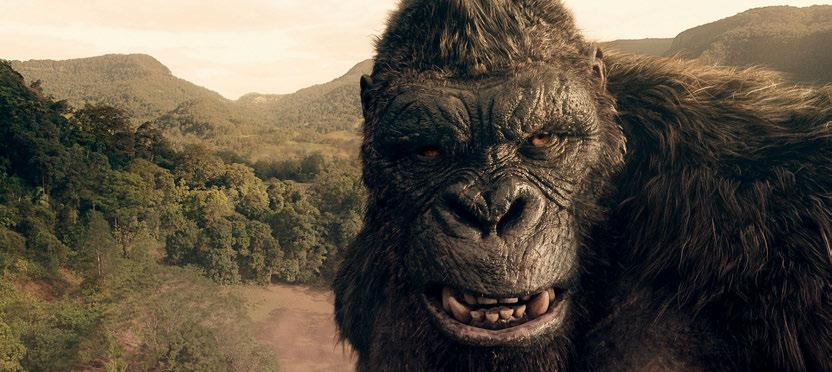
TOP: For Season 2 of Monarch: Legacy of Monsters, different levels of dirt were given to Kong to better integrate him with the environment. (Image courtesy of Apple TV)
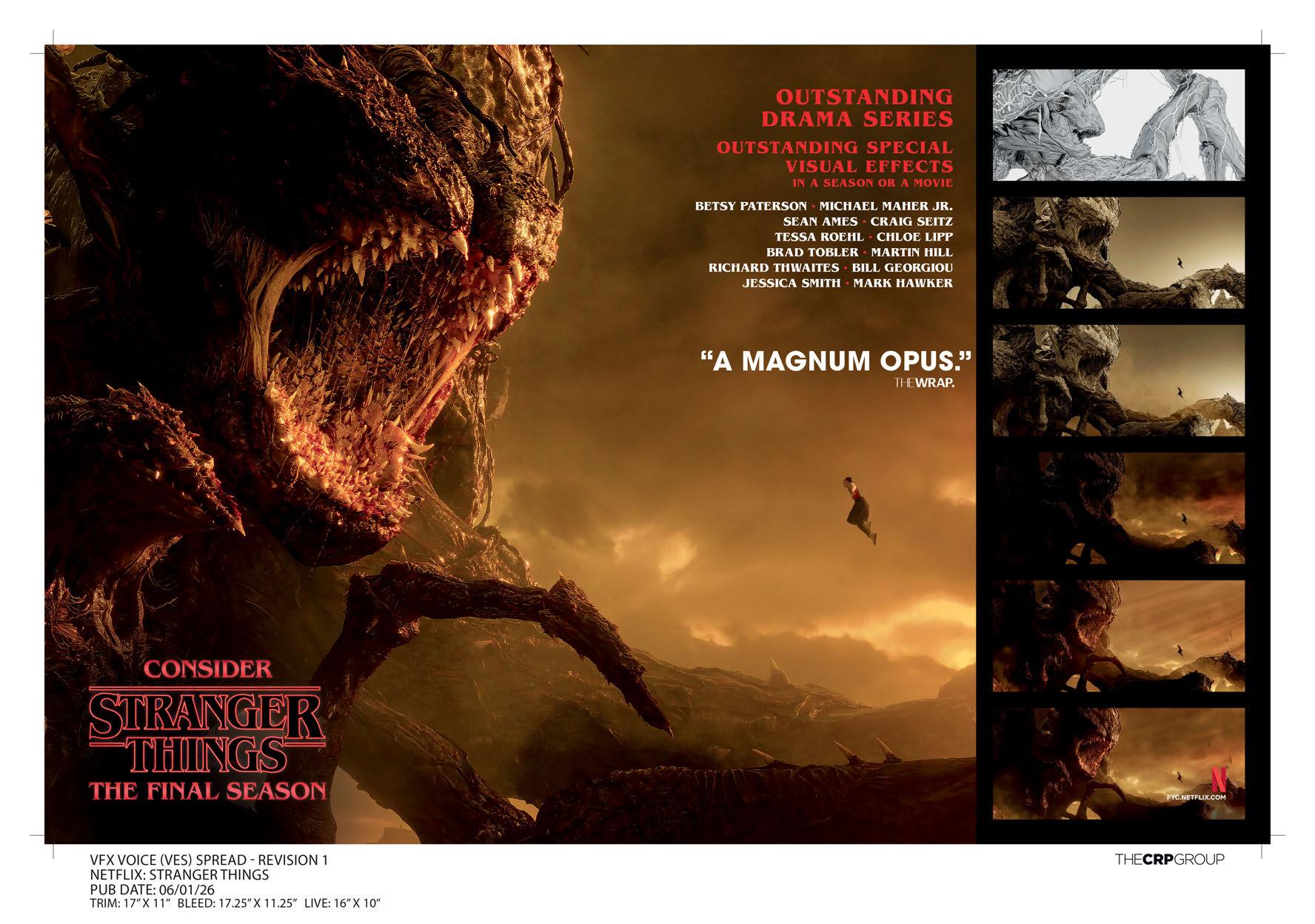
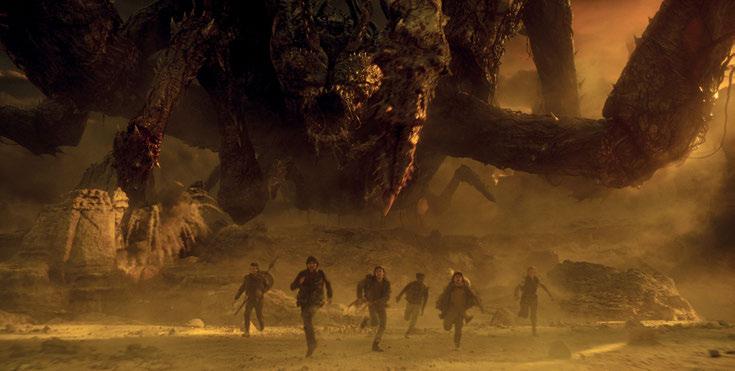
OPPOSITE TOP TO BOTTOM: The battle with the Mind Flayer in Stranger Things Season 5 required extensive previs and techvis to choreograph a fight between a group of teenagers and a huge creature. (Image courtesy of Netflix)
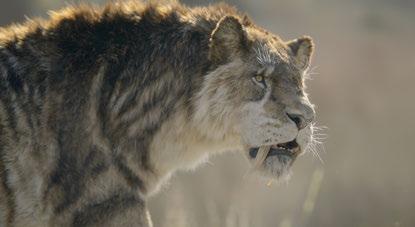
Framestore rebuilt its fat and muscle pipeline just as production of Prehistoric Planet: Ice Age commenced. (Image courtesy of Apple TV)
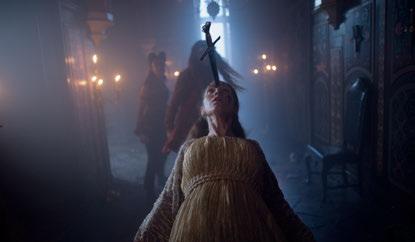
For Production Visual Effects Supervisor Sara Bennett, the hardest part of working on The Witcher Season 4 was joining the project during post-production. (Image courtesy of Netflix)
Apple has four major contenders consisting of Foundation Season 3, Monarch: Legacy of Monsters Season 2, Prehistoric Planet: Ice Age and new addition Pluribus. Fewer locations were visited for Season 3 of Foundation, which caused the shot count to increase by a 1,000, with the grand total of 4,000 supplied by BOT VFX, Crafty Apes, Framestore, Accenture Song, Outpost VFX, Otomo FX, PFX, Rodeo FX and SSVFX. “We did a lot of city extensions for Kalgan across the season,” states Chris MacLean, Visual Effects Supervisor. “This season, we did a lot more environment work than other seasons because we didn’t have the exotic backdrops that we were shooting in. We ended up spending a lot more time on that than anything else on the season.” Some locations had to be substantially altered. “We went and shot the Sacratorium on Mycogen in a location. But as Mycogen developed, the location we shot didn’t fit the aesthetic of the rest of the planet. We wholesale replaced that and actually replaced the Sunmaster-18’s crown, which was a huge undertaking by Framestore in post.”
Upping the creature ante is Monarch: Legacy of Monsters Season 2 over the course of 3,000 visual effects shots with the help of Eyeline,
Rising Sun Pictures, Rodeo FX, Trixter, Distillery VFX, Outpost VFX, Vitality VFX, Crafty Apes and Mist VFX. “Apple wanted a signature creature for the season and to have input on that,” explains Sean Konrad, Visual Effects Supervisor. “We actually started that concept work for Titan X a lot earlier than we started concept work on Season 1 in order to help get us across the line. A lot of our our creatures came as the scripts developed and feedback came in.” An effort was made to shoot on location to reduce environmental work. “One of the things that was tricky about shooting in Tokyo is you have limited location access and limited time windows because you’re shooting at night, and there are noise ordinances. With all of that, it’s a miracle that it works.”
Stepping closer to the dawn of humanity, Prehistoric Planet: Ice Age saw Framestore produce over 700 visual effects shots to recreate the time when mammals became the de facto rulers of the world. “The demands of the show were crazy,” notes Russell Dodgson, Visual Effects Supervisor. “Matthew Thompson showed me a whole bunch of the animatics for the number of furry creatures rolling all over each other and running around in mud, snow, rain and tar. If I hadn’t had the experience of His Dark Materials, it wouldn’t have felt like such an exciting challenge rather than a terrifying one!” Interestingly, two-thirds of the Earth was not covered in snow, and the temperature was constantly fluctuating. “There was a constant cycle where the climate and aridity would change,” observes Matthew Thompson, Series Producer. “Grasslands would expand and forests would expand back. It was a complicated and exciting time for life. Life was being thrown from pillar to post with all of these changes. Various parts of the world were having different experiences. It led to this incredible variety of different animals.”
Needing a wide range of visual effects for approximately 510 shots by Rodeo FX was Pluribus. “One of the more complex visual effects was the destruction of Albuquerque and other cities caused by the Joining,” remarks Ara Khanikian, Visual Effects Supervisor. “We achieved this by enhancing principal photography with 2.5D matte paintings, CG fires, smoke and debris. Additionally, all signs of life were meticulously painted out from plates across the entire season to maintain the narrative’s tone. The Bilbao airport sequence was a significant task. As Air Force One is such an iconic aircraft, it presented a unique build challenge. Production used a real 747 landing gear, a life-size door and adjacent paneling replica, while Rodeo FX created a CG extension of the fuselage and airplane. These scenes were a complex composite of actor plates shot in Albuquerque and background elements captured at the actual Bilbao airport. On-set Visual Effects Supervisor Keith Kolder brilliantly oversaw the visual effects shoot of Season 1.” Seriously stacked is Netflix with Stranger Things Season 5, Wednesday Season 2, Squid Game Season 3 and The Witcher Season 4, as well as first timers Death by Lightning, The Boroughs and Something Very Bad is Going to Happen. Turning the streaming world upside down with their love letter to 1980s cinema and Amblin Entertainment, brothers Matt and Ross Duffer brought Stranger Things to close with Season 5 and a feature-length finale. “The battle with the Mindflayer required extensive previz and tech viz to choreograph a fight between a group of teenagers and such a huge creature,” explains Betsy Paterson, Visual Effects Supervisor. “The environment was also designed during pre-production so that the scripted beats felt seamless. The destruction of the upside down also required extremely complex visual effects. These were some of our greatest design challenges. We needed to show the epic scale of the destruction as well as include minute details recognizable to the audience. All of this required many layers of
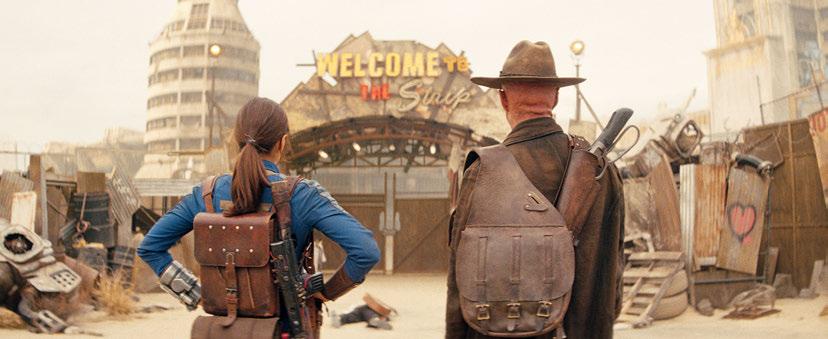
TOP: A major environment for Season 2 of Fallout was New Vegas consisting of the Southern Gate, The Strip and Freeside. (Image courtesy of Prime Video)
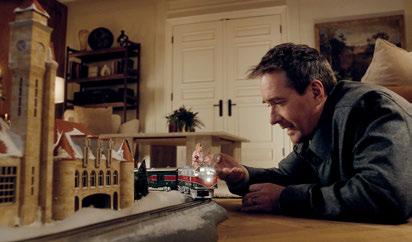
BOTTOM: Multiple scales had to be represented within the same frame to make it look like Lindy was riding a toy train in The Miniature Wife (Image courtesy of NBCUniversal)
effects simulation.” Wētā FX handled the final battle, and ILM was responsible for destroying the parallel dimension known as Upside Down with a total of 5,844 visual effects shots. The biggest achievement was the design and animation of the Mindflayer transforming from a tree to the creature. Paterson notes, “The design and action were created in tandem with the script and stunt choreography to create a seamless whole. The creature and the environment required over two years of work to layer in enough detail for a grounded, realistic feel.”
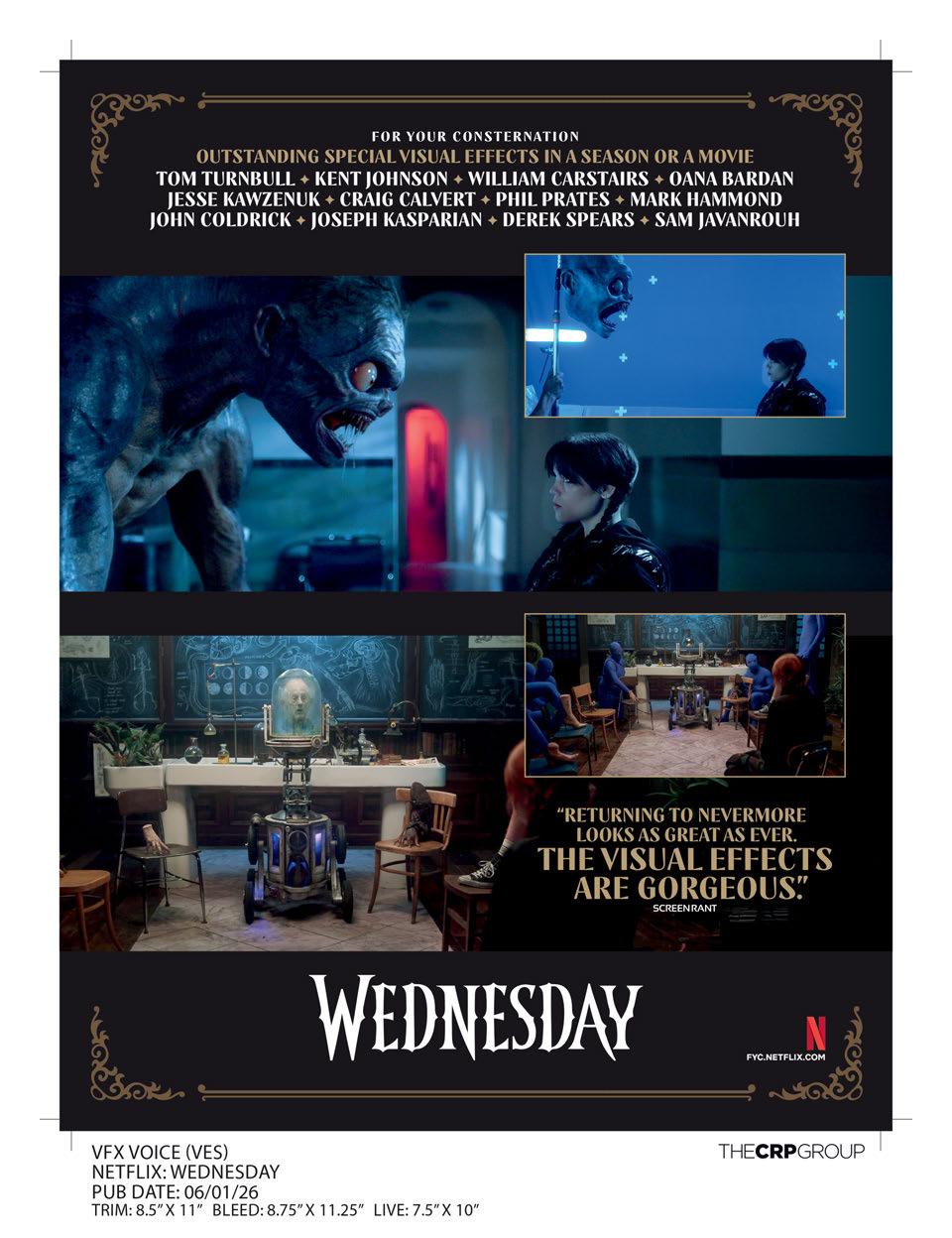
Given the ghoulish, gothic, macabre sensibility of Tim Burton, having a disembodied talking head in a jar of water, or a rotten corpse regenerate itself by eating brains and food, fit in quite nicely with visual aesthetic and narrative of Wednesday Season 2. “Slurp starts as a full-up zombie with a hole in his head, and he’s got no brains inside and a crazy, roving eye,” states Tom Turnbull, Visual Effects Supervisor, who had to deal with an increase of 1,500 visual effects shots, bringing the final tally to 3,700. which were handled by Eyeline, Herne Hill/Mr. X, MPC, Rocket Science VFX, Rodeo FX, WeFX and Folks VFX. “Slurp was driven partially by an actor in makeup, but with a lot of enhancements done to it in visual effects. Then, over the course of the episodes, he becomes more human. The hole in his skull disappears, and Slurp has this long tongue that he uses for eating brains. Slurp was like a work in progress. You would always be adding something new or different every time he showed up in another episode. Professor Orloff was a whole other challenge because he is a floating head in a jar.”
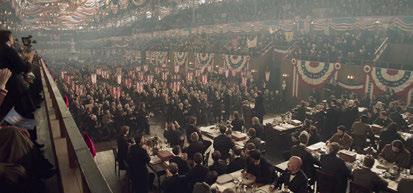
Recounting the assassination of U.S. President James Garflied is Death by Lightning, with the Republican National Convention held in Chicago from June 2 to 8, 1880 being a monumental asset creation. “We had the added benefit of this being an actual historical event, so we had drawings, etchings and even a couple of photographs from the real-world environment,” remarks Steve
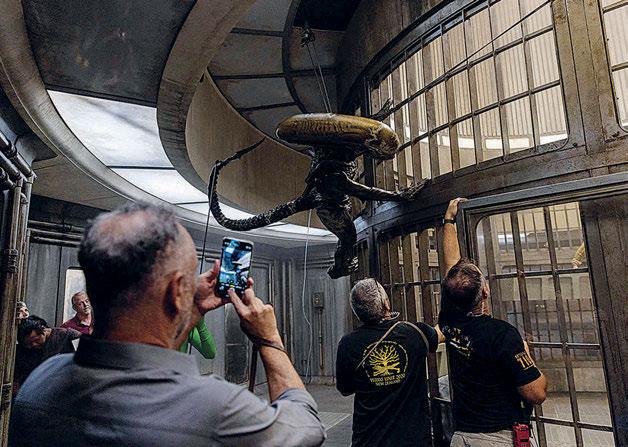
TOP: Helping with the framing of shots and cast interaction for Alien: Earth was a practical xenomorph. (Photo: Patrick Brown. Courtesy of FX)
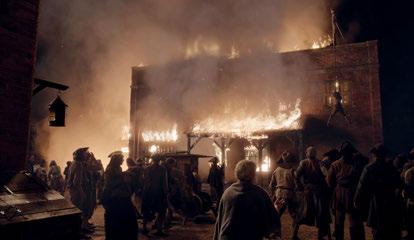
BOTTOM: All the large-scale fire and smoke for the burning print shop in Season 8 of Outlander were created in visual effects and supported by practical effects. (Image courtesy of Starz)

Kullback, Visual Effects Producer. “We discussed at length how to approach this, and it was decided that a set would be built and then extended.” The question was how to make best use of the 500 extras. “We actually photographed some background extras and printed these photographs on cardboards,” reveals Rainer Gombos, Visual Effects Supervisor. “We set them in so we would fill these spaces between the extras to make it even more packed in the foreground.” El Ranchito, Important Looking Pirates and Clearcut FX executed 604 visual effects shots. “For the cities, the Budapest streets looked good, but they were a bit too narrow,” Gombos notes. “We tried to create more open spaces and add grander buildings to it because Chicago didn’t have that many trees.”
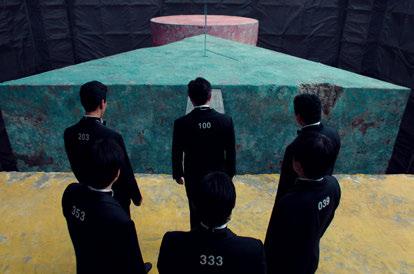
One can never discount the first non-English program to win the category back in 2022 with Squid Game returning for a third season. “The most complex sequences to execute in Season 3 were definitely the scenes set in the massive game arenas, the Hide and Seek,” observes Chegon Jai-Hoon, Visual Effects Supervisor. “The set itself was extremely intricate, so even finding the right filming location and planning the environment expansions was a major challenge. Because the space needed to be expanded vertically, the production design team created a highly detailed virtual spatial map that defined the layout of the entire space. Using that as a foundation, we were able to organically extend the physical set with a digital environment. Sixty-seven per cent of the 2,104 visuals shots were handled by Guilliver Studios with other
TOP: The Kill Mouth of Pennywise has protruding gums, teeth and saliva when he attacks the children in It: Welcome to Derry (Image courtesy of HBO)
BOTTOM: Because Season 3 of Squid Game marks the emotional climax of the series, it was particularly challenging to fine-tune the level of visual effects and performance so the technical execution did not stand in the way of emotional delivery. (Image courtesy of Netflix)
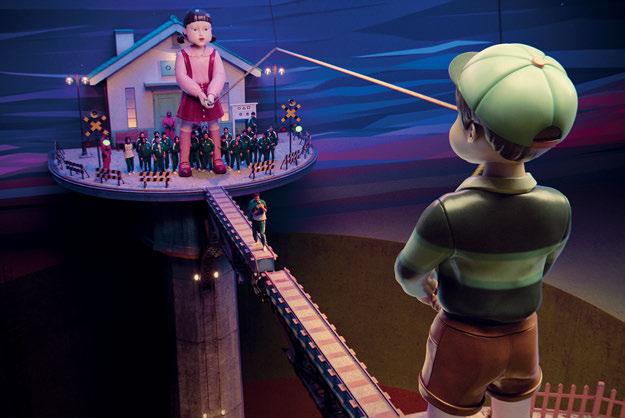
contributions made by NetFX and IMAGEDECA. “I believe our most significant technological achievement was the introduction of AI-based techniques to realize the newborn baby’s facial expressions. The subtle and nuanced facial movements of a newborn cannot be authentically performed by an adult actor, nor can they be captured through conventional motion-capture sessions, making this approach both necessary and transformative.”
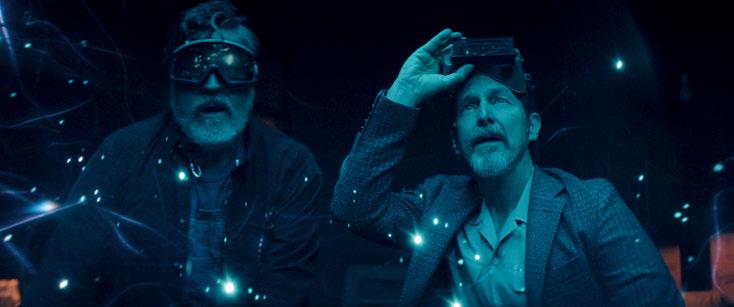
Something Very Bad is Going to Happen features a lot of people bleeding from their eyes, ears, nose and mouth, often in hero close-up. “Showrunner Haley Z. Boston wanted to lean into using practical blood effects where possible, which we fully embraced,” reveals Jo Hughes, Visual Effects Supervisor. “But shooting logistics led to three methodologies: Prosthetic tubing to deploy stage blood, where visual effects then connected blood to orifices and cleaned-up tubes; makeup blood on top of which visual effects added simulated movement; and fully digital VFX blood, sometimes on clean-faced cast members, and sometimes blended with the prosthetic or makeup approaches.” Rocket Science VFX was supported by NetFX to produce 700 visual effects shots. “From prep into production and through post, the curse blood was always top of everyone’s mind as the most important thing to get right. Shooting the finale’s blood scenes was logistically challenging, and ensuring all that hard work paid off was important to visual effects as we took hold of the baton.”
Standing out is the creature work in The Boroughs, with ILM, Framestore, Ghost VFX, Platige, Screen Scene, SDFX and Pixomondo contributing to the 1,200 visual effects shots. “Our
TOP: The most complex sequences to execute in Season 3 of Squid Game were the scenes set in the massive game arenas. (Image courtesy of Netflix)
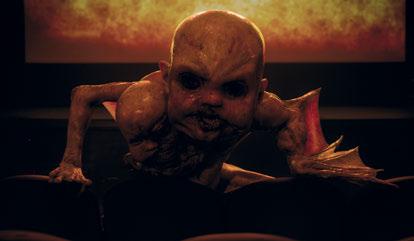
BOTTOM: The biggest challenge for visual effects on It: Welcome to Derry was creating bat-winged Mutant Baby on a shorter timeline, which resulted in jumping from concept art straight to animation. (Image courtesy of HBO)
creature has eight limbs, six of which have four joints, leading to 26 joints in the limb walk cycle,” explains Tara DeMarco, Visual Effects Supervisor. “The filmmakers wanted it to pressure-hold like a mountain climber and move across the ceiling in a non-spidery way. This led to some creative production design and animation for this complicated concept that we dubbed ‘geriatric parkour.’ Additionally, our creature needed to trigger fear at the start of the show and create empathy by the end of the show. The team at ILM put extra care into the expression and blood-flow design of the facial animation to create geriatric, paper-thin tissue where each expression change could be felt with skin wrinkles, dilation and blood movement through tissue and veins. The team developed a dynamic blood flow shader that reacts to skin compression driven by the creature’s animation. Greater tension in the skin, as it gets stretched across the creature’s muscles or bones, would cause restricted blood flow, reducing the amount of blood rendered underneath the skin.”
A frequent contender is HBO, with high hopes for newcomers It: Welcome to Derry and A Knight of Seven Kingdoms, as well as for established series such as The Gilded Age Season 3, Euphoria Season 3 and Peacemaker Season 2. Expanding upon the feature films It and It: Chapter Two, It: Welcome to Derry explores the historical relationship between Derry, Maine and a malevolent entity that preys upon children through their fears. “We had a strong base for any of the creatures or characters we had to do digitally, whether it was a motion performer working through the scene to be used as a starting point for movements or mechanics,

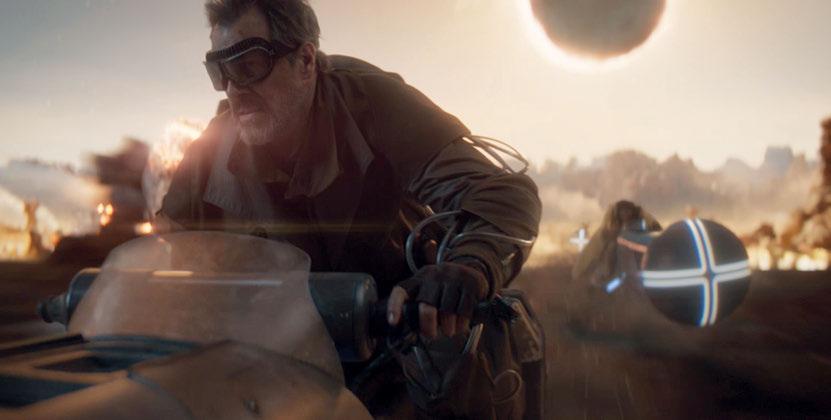
TOP: The Flitter Bike Chase in Foundation Season 3 was initially supposed to utilize virtual production but in the end was shot neutrally against grayscreen. (Images courtesy of Apple TV)
BOTTOM: The Gilded Age opened up the world in Season 3 with Gladys marrying and moving to England to live at Sidmouth Castle. (Image courtesy of HBO)
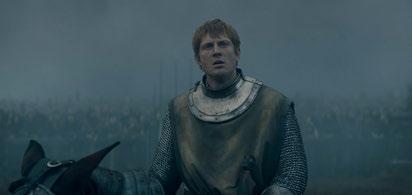
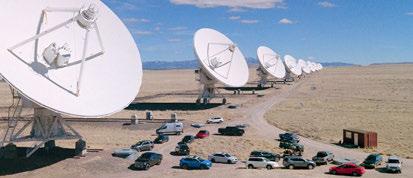
Because of the weather, visual effects had to support the practical mist and fog featured in A Knight of the Seven Kingdoms (Image courtesy of HBO)
One key component in creating invisible visual effects for Pluribus was the amount of research, as it ensured that every digital element was grounded and felt authentic to the world of the show. (Image courtesy of Apple TV)
as well as for lighting reference for what skin might look like in a certain outdoor environment,” explains Daryl Sawchuk, Visual Effects Supervisor. “If we had things that were based off of more effects-type simulations, we would film as much reference as we could and start with real things. Was it more freeing? Probably not because we were still tied to the boundaries of real-world physics, gravity and lighting.” Primary vendors Rodeo FX, Alchemy 24, Folks VFX, DNEG, Crafty Apes and Digital Domain were responsible for just under 2,700 shots with a variety of creatures ranging from a Skeleton Man that moves like a spider, to the Bed Mom, which is a woman shaped like a bed frame, to Pennywise adding batwings to his clown persona.
Crowds, not dragons, were the biggest concern for A Knight of the Seven Kingdoms, with 500 visual effects shots handled entirely by El Ranchito. “CG crowds don’t come cheap,” observes Arron Roebuck, Visual Effects Supervisor. “One thing that made us feel safer committing to that approach was the amazing set build that was in the environment we had in Northern Ireland. Everywhere you look it’s a real set. It was fabulous. We realized that once we stood there and recce’d, if we take care of these slivers of the landscape that need crowd, and if we do that convincingly, no one would know that we were there.” A great partnership was had with special effects, especially when it came to atmospherics. “We would have gusts of wind change direction moment to moment, and credit to Thomas Lloyd, the Special Effects Floor Supervisor, because he worked tirelessly with his team to flood the area with practical atmosphere.”
Approximately 1,826 visual effects were created by Wētā FX, Rodeo FX, Folks VFX, SS VFX, Vitality VFX, Peerless VFX and Mammal Studios for Season 2 of Peacemaker. Dealing with the candy world behind one of the doors in the Quantum Unfolding Chamber was 100 shots of complex visual effects work. “The main challenge with the landscape was to make it look plausible while still staying in the color palette of the world we were in and making
TOP TO BOTTOM: The Boroughs was filmed on Netflix’s brand-new Albuquerque backlot. (Image courtesy of Netflix)
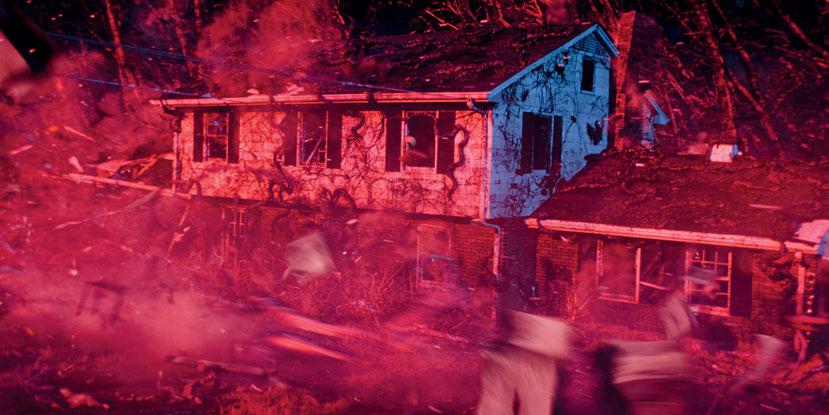
it work with the candy pieces and sky colors from the concepts,” states Mårten Larsson, Visual Effects Supervisor. “It was very easy to make it very monotone or dual tone with the pink/orange grass, purple sky and pink sunlight. So, to combat this we added a lot of warmth to the sunlight in the landscape, made the shadows cooler and added a subtle magenta/blue tone to the haze in the distant landscape, as long as we were not looking too close to the sun when the haze took on the warmer tone of the sun. All of this was used to add color complexity in a world that at first glance looked like a pink/orange world.”
Moving from New York City to Sidmouth Castle in England is Gladys Russell Vere in Season 3 of The Gilded Age, which had 1,453 visual effects shots crafted by beloFX, RVX, Phosphene and Fox & Wizard. “We really opened up the world this season starting out west, with George in Morenci securing copper mine rights, to Gladys marrying her Duke and moving to England to live at Sidmouth Castle,” notes Douglas Purver, Visual Effects Supervisor. Aside from sending a 2nd unit to New Mexico, and an element/ plate unit to the U.K., the shooting company did not travel to capture these scenes. A similar strategy was applied to Sidmouth. There is nothing of that age and scale here in the U.S. I went to scan pieces of castles in the U.K. to build our fictitious Sidmouth. I was also able to film plates of the countryside to build out the environment. I filmed a few angles of a small stone bridge, then we animated a CG version of our Duke’s horses and carriage to put in. The CG castle and its estate grounds is built around the entry of Ochre Court, a practical location we use up in Newport Rhode Island for the comings and goings as well as some of the castle interiors.”
Prime Video has some serious Emmy-offerings as The Boys draws to an end with Season 5 while its spin-off series Gen V continues the superhero mayhem with Season 2, and Fallout returns with Season 2 alongside new live-action Spider-Verse series Spider-Noir. Nicolas Cage reprises his middle-aged gumshoe role
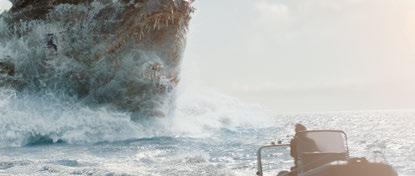
TOP TO BOTTOM: The visual effects in Stranger Things Season 5 ranged from huge battles with CG creatures to full digital environments, epic destruction and subtle effects. (Image courtesy of Netflix)
Apple wanted a signature creature for Season 2 of Monarch: Legacy of Monsters, which led to a test shot of Titan X being rendered and finalized only months before principal photography was finished. (Image courtesy of Apple TV)
By far the biggest environment build for Death by Lightning was recreating the 1880 Republican National Convention held in Chicago at the Interstate Exposition Building. (Image courtesy of Netflix)
(Image
(Image courtesy of Apple TV)
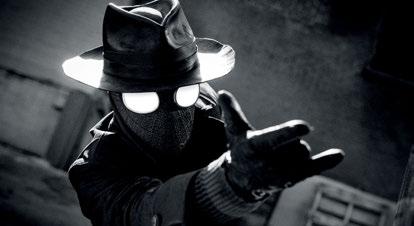
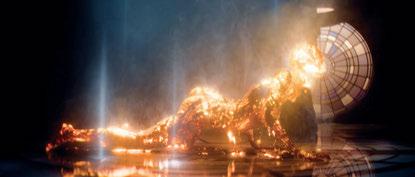
for Spider-Noir, which can be seen in black and white as well as color. “While we had lots of complex visual effects challenges on the shot level, the trickiest one turned out to be our working with two looks [black and white and color],” states Hnedel Maximore, Visual Effects Supervisor. “With the series being presented in both black and white and color, we had to come up with an efficient pipeline with Picture Shop [Color/DI], visual effects vendors and editorial that allowed us to review every shot twice. We also had to support the colorist with more robust mattes to allow for better control in the black-and-white version of the show. In many cases that meant the additive effects on Dirk [Megawatt] had two unique versions versus our usual single version piped through two LUTs.” Approximately 3,200 visual effects shots were the responsibility of Alchemy 24, Barnstorm, BOT VFX, Cinesite, CoSA VFX, Eyeline, ILM, Ingenuity Studios and Version Zero. “Oren Uziel [Creator, Executive Producer, Showrunner] wanted Ben Reilly’s age, lifestyle and salty personality reflected in his web and his movements. As such, the look of Ben’s web is less pristine compared to other Spider characters. The mechanics of his swing is less acrobatic, and his combat style is more opportunistic and messy.”
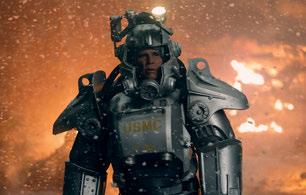
For the Deathclaw in the sophomore outing of Fallout, the video game was used as the starting point. “For the gamers out there, there are some beats that feel exactly like what the Deathclaw does,” states Jay Worth, Visual Effects Supervisor. The movement was the biggest challenge; to get the weight and heft, and to figure out if it runs or walks. It attacks, but because it’s at the top of the food chain in the game, it attacks but doesn’t necessarily run.” ILM, RISE, Important Looking Pirates, Raynault VFX, Refuge VFX, FutureWorks, Haymaker VFX, Curated and CoSA FX produced 3,202 visual effects shots, which included settings like New Vegas. “We worked with Howard Cummings [Production Designer] and the art department to figure out how to build these massive sets that need to represent and feel like the game that don’t need to match exactly.”
Not to be left on the sidelines are Disney+ with Wonder Man, Paramount+ with Star Trek: Strange New Worlds Season 3, FX with Alien: Earth, Starz with Outlander Season 8 and Peacock with The Miniature Wife. Virtual production had a much bigger presence on Star Trek: Strange New Worlds Season 3 compared to previous seasons, which helped to keep the visual effects shot count between 2,000 and 2,500 for Ghost VFX, Storm VFX, Crafty Apes, Pixomondo, Zoic Studios, AB VFX and Cause and FX. “Engineering is a perfect example of that because there is the small practical set, but this entire cavernous virtual set around it, which integrates seamlessly,” remarks Brian Tatosky, Visual Effects Supervisor. “For our side, it has moved the entire schedule of what needs to be delivered much sooner so it could be ready and photoreal for production on day one of shooting. It changes the schedule around quite a bit, but is also incredibly satisfying to see a well-lit and the integrated stage with the actors walking around.”
(Image courtesy of Prime Video)
Concluding with its eighth season is Outlander, and there is no shortage of visual effects shots with BlueBolt creating 3,000, with major undertakings being Savannah Harbor, the print shop fire and Savannah Square. “Although set in 18th century Georgia, the harbor was shot in the U.K.,” reveals Jon Neill, Visual Effects Supervisor. “The base photography was captured at Calke Abbey, where
TOP TO BOTTOM: The age, lifestyle and salty personality of The Spider in Spider-Noir are reflected in his webbing, which incorporates subtle strands of gray/white in the cord and more fraying in the web fibers.
courtesy of Prime Video)
The death of Demerzel in Foundation Season 3 was emotional to watch because she was one of the main characters in the series.
Valorie Curry plays Firecracker in Season 2 of Gen V, where the emphasis was to capture as much of the effects work in-camera.
red-brick buildings provided a period foundation. The location was landlocked and surrounded by countryside, with visible modern infrastructure. We retained the core architecture and removed modern elements, including vehicles, equipment and landscape features. Using on-site photogrammetry and texture capture, we developed modular warehouse assets to extend the port beyond the physical footprint. The surrounding terrain was replaced with a digital waterfront extending to the horizon while keeping as much of the photographed foreground as possible.” Interiors of the print shot fire were also shot at Calke Abbey. “To connect the interior and exterior, we removed one wall of the stage set and filmed it from outside, creating a ‘doll’s house’ view. These passes were used to extend the burning interior into bluescreen windows on location.”
Shrinking a spouse down to doll-house size is The Miniature Wife, which features the work of Mavericks VFX, Zoic Studios, Tippett Studio, Spin VFX, Mr. X and Pixomondo to produce 3,000 visual effects shots. “When miniaturized, Lindy is 12 times smaller than her regular-sized self, so any real-world camera movements made in our big world needed to be scaled up 12 times in the small world in order to maintain our correct scale relationship,” explains Ashley Bernes, Visual Effects Supervisor. “With a moving camera, and, in our case, a moving toy train, that’s 12 times the distance, covering it at the same amount of time.” The shot had to be done as one long continuous take. Bernes says, “Where we landed was using the Bolt system on track to be able to program a camera move in the real world that would not exceed our capabilities in the small world to capture our toy train with our camera, as defined in the previs as what we called a ‘Part A’ with the ‘Part B’ at a later date being Lindy’s performance.” A six-axis programmable turntable increased the capabilities of the Bolt system. Bernes adds, “The data, which came from our techvis to compound the move with the Bolt arm, gave our buck and, in turn, Lindy the appearance of greater speed and distance than we were able to achieve natively.”
As multinational corporations battle each other over turning extraterrestrial threats into biological weapons, the warfare comes crashing down to more familiar surroundings in Alien: Earth. Around 2,000 visual effects shots contributed by Untold VFX, UPP, Zoic Studios, Pixomondo, Fin Design + Effects, Crafty Apes and Cos FX Films. “We have very few ‘effectsy’ effects in the show and even those have tried to downplay them so that they always feel like something that could have been done in late 1970s and early 1980s,” notes Jonathan Rothbart, Visual Effects Supervisor. “Anamorphic lenses always do unique different things, and each one has its own texture and look. These ones have that late 1970s, early 1980s feel to them where everything’s a little bit softer than normal. We did a lot of softening of things to get it to play in the plate. Then we also have the chromatic aberration where you start seeing the different colors split on the edge of the frames. And of course, the flares and the grain level, which is not the lens but the film. We’re trying to emulate the right kind of film stock.” Rothbart adds, “If I had my way, each shot would go by and people would say, ‘That’s really cool.’ But nobody would think about the fact that any of it is CG.”
TOP TO BOTTOM: The Wraith in Season 4 of The Witcher was based on the performance of a real actor. (Image courtesy of Netflix)
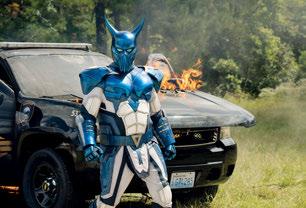
Robert Patrick portrays the Blue Dragon in Season 2 of Peacemaker, which featured about 1,826 visual effects shots. (Image courtesy of HBO)
Walton Goggins in Season 2 of Fallout, where his character of Cooper Howard battles a Deathclaw in a flashback sequence. (Photo: Lorenzo Sisti. Courtesy of Prime Video)

VOLUMETRIC HUMANS CONTINUE TO EVOLVE
By TREVOR HOGG
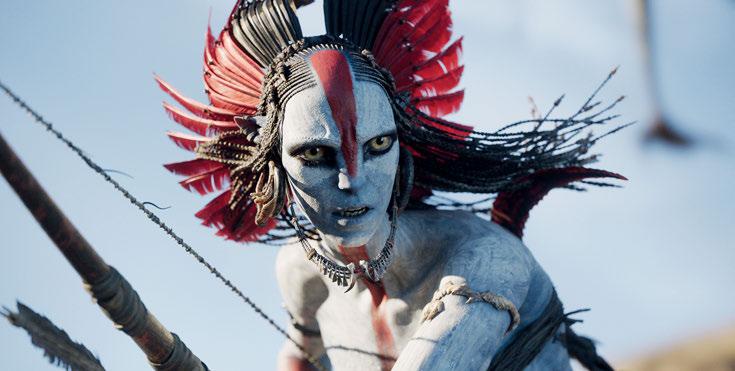
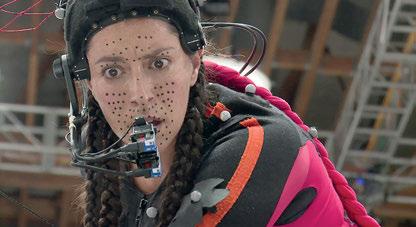
OPPOSITE BOTTOM: The biggest concern is being able to capture the subtle nuances of an actor’s performance, which was the case for Oona Chaplin when she was portraying Varang for Avatar: Fire and Ash. (Image courtesy of Wētā FX and 20th Century Studios)
Reshaping how volumetric humans are brought to life digitally and realistically are NeRFs, multi-camera arrays, AI motion synthesis and dynamic texture systems. These technological advances, among many others, have allowed for more than proxy versions to appear in previs and have elevated the creation of indistinguishable stunt doubles and crowd simulations.
Certain fundamentals have to be kept in mind when producing volumetric humans. “We are most concerned that we are capturing the subtle nuance of the actors’ performances,” states Kimball Thurston, CTO at Wētā FX. “The slight eye twitch, crinkle of a nose, whatever it might be that then allows us to transport the emotion from the actor to the virtual character they are portraying, even if it is themselves in a situation that would be unsafe or impossible. With that, we focus all our work to ensure we have multiple avenues to capture results, not only in real-time while on stage, but also afterwards, with higher-resolution processing that refines the raw images for better detail. That then enables us to represent those details better, more accurately, and allows additional artists to help ensure that the performance is being accurately transported into the final scene.”
Over the years, the methodology, workflow, technology and techniques have changed. “The FACS system still provides a good reference language to talk about human facial performance, which we used for Gollum 25 years ago, but the technology we deploy today can represent fine details not possible with FACS alone,” Thurston remarks. “We are also able to work in a wider variety of environments when filming performance capture. Along with that, it has also become clearer what works and doesn’t in the workflow that assists artists in transforming performances, even down to how we apply reference footage. While facial performance is often
TOP, OPPOSITE TOP AND MIDDLE: While facial performance is often the focus, innovations in capturing the motion of the rest of the body have continued to evolve quickly. (Image courtesy of Wētā FX and 20th Century Studios)
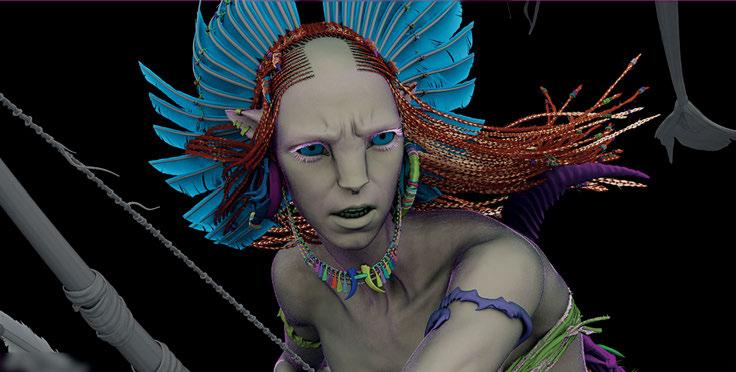
the focus, innovations in capturing motion of the rest of the body also evolve every day as new methods become available, allowing a more comfortable experience for actors. Additionally, the ability to provide better real-time feedback while on set continues to help enable directors to make decisions faster and have confidence in what they have in the can.”
FACS capture of faces was a key moment that occurred a quarter century ago, as well as motion capture innovations over the past three decades. “They resulted in a steady stream of improvements, from the quality of capturing the rest of the body to even integrating costumes,” Thurston notes. “However, more recently, with the use of machine learning for computer vision tasks, the quality of ‘markerless’ capture is approaching film quality. This will truly unlock volumetric humans, where we would no longer be talking just about a face capture and a body rig, but the ability to capture the unique, subtle deformations and skin textures more easily.”
The pipeline is shrinking to help with previs and postvis. Thurston states, “The faster you can create the data you need, the easier it is. For those early-stage portions of the movie-making process, there’s sometimes a decision to sacrifice quality for speed. This results in a pipeline that can capture the data and produce a fast thing fast, with all the data running a slower process trailing behind, so ideally you would try to push the technology to merge the two processes to just be fast.”
When Framestore was approached to create a hologram of Jor-El and Lara Lor-Van talking to their son Kal-El in the Fortress of Solitude for Superman, the decision was made to explore a volume-rendering technique called Gaussian splatting, which generates more complete point clouds to produce highly photorealistic 3D models. “We wanted to shoot a two-minute continuous
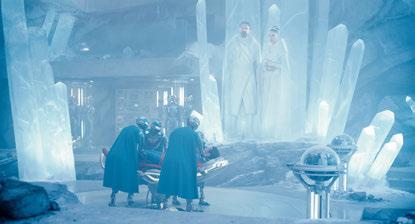
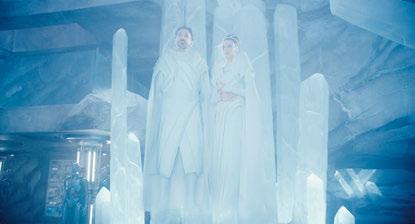
TOP TO BOTTOM: The hologram of Jor-El and Lara Lor-Van in Superman was achieved by Framestore through the volume-rendering technique known as Gaussian splatting.
(Image courtesy of Framestore and Warner Bros. Pictures)
Given that the hologram message in Superman gets played five different times at various scales, Framestore opted to utilize Gaussian splatting. (Image courtesy of Framestore and Warner Bros. Pictures)
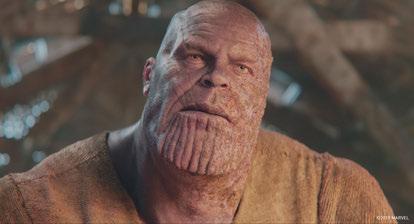
Digital Domain used Masquerade facial capture to bring Thanos to life for Avengers: Endgame.
(Image courtesy of Digital Domain and Marvel Studios)
take of these two parents delivering dialogue to their child in this heartfelt emotional scene,” remarks Kevin Sears, CG Supervisor at Framestore. “We didn’t know from how many different angles and how big these holograms were going to be on set.” The message gets played five different times at various scales. “That could have been done with motion control, but it would have been time-consuming, and it also means that you are locked into exactly what that camera move was. The nature of the film required a lot of wide-angle lenses, so we didn’t want to have to put a big camera in front of the actors’ faces while they delivered this performance. Also, the message had to be corrupt and unfinished. Superman doesn’t know what the second half of the message says until later in the film.”
Framestore partnered with Infinite Realities, a scanning company, which has a rig with 192 cameras. “Instead of a normal photogrammetry rig, where an actor stands and gets captured, now all of those cameras are doing live video feedback rather than just one snapshot,” Sears explains. “They’re capturing the two-minute performance, and every camera that sees a certain pixel on the subject is capturing that one point in space in a multitude of different values and colors from all of these different camera angles.” With the assistance of machine learning, Framestore was able to extrapolate between two different points to rasterize and visualize them at high fidelity. “What ended up happening is we had this dense point cloud per frame that is changing, of the actors doing this dialogue, and we could cut it up in editorial, then scale it and put the camera down here or look up at them, or animate the cameras to swing around their head and change the focal length. At 4K, we could get hologram images that looked like live video footage because they had so much detail. For the glitching and creative exercise of making them stutter, we used phrases like fuzzing and fritzing. We were using a plug-in that was available in Houdini to take this point cloud and slice it into pieces and partition it. Now, we could animate whole sections of the human body and rotate them almost like an anatomy textbook. That was an interesting way to treat a hologram because it was a true 3D representation of a human who was glitching and rotating.”
The ambition of previs is growing larger. “There are virtually no constraints on what can be achieved,” states Jan Philip Cramer, Visual Effects Supervisor at Digital Domain. “While in the past you would shy away from very complicated take-overs or close detail studies of CG to live-action interaction, these can now be done to a higher difficulty level. On a technical side, and if our clients agree to the use of GenAI, we are now incorporating GenAI into post-workflows within our previs/postvis pipeline. This allows us to implement improved lip sync, more realistic digital humans, and achieve much higher fidelity real-time renders. These advancements help us focus on the story, minimizing distracting visual elements that could otherwise take early audiences out of the experience.” AI, machine learning and real-time game engines have influenced the animation process. “In animation, we utilize AI tools for generic motion and help with crowd work, but the hero action is still handcrafted by an artist. For crowd assets, we are able to generate the crowds via AI workflows and leverage pictures to
“If our clients agree... we are now incorporating GenAI into post-workflows within our previs/postvis pipeline. This allows us to implement improved lip sync, more realistic digital humans, and achieve much higher fidelity real-time renders. These advancements help us focus on the story,
distracting visual elements that could otherwise take early audiences
—Jan Philip Cramer, Visual Effects Supervisor, Digital Domain
model tools to speed up the modeling process, but this is not yet possible for hero creatures. On the other hand, Unreal Engine provides a lot of great integration into our pipeline, from planning and scouting to mocap re-targeting.”
“Currently, there is a huge push to use Generative AI in production,” Cramer observes. “This can affect every department and will also heavily impact the creative process over the next few years. The goal for most companies will be to generate and modify designs, implement them with motion in video form, and use tools to convert them into production-ready assets. However, there are also significant restrictions and sensitivities around the use of GenAI, especially from clients who are concerned about data privacy, intellectual property and ethical implications. Navigating these restrictions while still leveraging the power of AI will be a key challenge for the industry moving forward. It will be critical in all this not to lose touch with the creative, artistic input. Curation and artist-driven input will remain essential, as filmmakers and creatives will seek to control details that AI cannot yet master. Positioning yourself as the creative force behind AI will be a critical aspect of this development. No one wants to work with just prompters; they will want to get ideas from animators and lighting artists. Using tools more effectively than ever before allows us to merge technology and artistry.”
There is certainly room for improvement when producing volumetric humans. “The more we can do to get actors out of specialized suits for capture and have them performing in their character’s costume, while still capturing their precise motion and the physics of the cape or other feature they might be wearing, the more natural and engaging the performance we will be in the movie,” Thurston believes. “There is a balance of increasing fidelity, inferring motion with costumes partially obscuring, and increasing the ease of capture, even if that is just setup or prep time in makeup, it would allow for better performances, and that is what we all strive for.” The shifting landscape of media consumption is driving creative and technical trends. Thurston remarks, “With some of the recent investments, you can see experiments where studios are looking to expand what new and shifting media consumption patterns mean and how to provide more immersive worlds. This can enable creatives and artists to create big, giant worlds that inspire entire generations of people, while also allowing everyone to create their own content [UGC] based on that world, contributing a small piece of themselves to that larger world. If this does become a sustaining trend from a creative perspective, some of the volumetric human technology we hint at here will enable that UGC to feel more integrated and less ‘fake.’”
minimizing
out of the experience.”
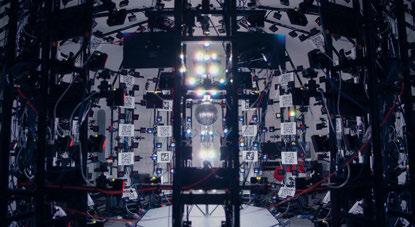
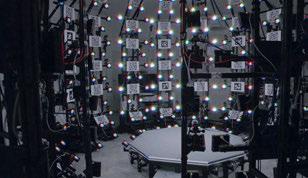
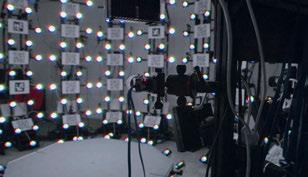
Every camera sees a certain pixel on the subject and captures that one point in space in a multitude of different values and colors from various angles. (Image courtesy of Framestore)
TOP TO BOTTOM: Using a plug-in that was available in Houdini, Framestore was able to take the point cloud generated by the Deus system and slice it in pieces and partition it. (Image courtesy of Framestore)
Infinite Realities’ AeonX full-body motion-scanning system, Deus, utilizes Ximea’s machine-vision cameras and Sony Pregius sensors. (Image courtesy of Framestore)
FROM THEN TO NOW: A REAL-TIME RENAISSANCE
By TREVOR HOGG
OPPOSITE TOP TO BOTTOM:
The sky, not the set, had to be virtually added and extended for The Book of Boba Fett. (Image courtesy of Lucasfilm Ltd.)
The Mandalorian was never solely about StageCraft, but deciding on the best methodologies and tools on a shot-by-shot basis. (Image courtesy of Lucasfilm Ltd.)
Nowadays, real-time filmmaking involves everything from pitchvis to final pixel rendering, with The Mandalorian and 1899 showing how it can be used to achieve the best results. Portability, flexibility and affordability are areas being addressed, and, in doing so, have enabled indie projects to take advantage of the tools, technology and methodologies associated with game engines and virtual production. However, the real-time renaissance is not only occurring in film and television; it has also impacted immersive experiences, concerts and sports broadcasts. To figure out where the future lies, one has to revisit the past, starting with The Mandalorian, where multiple environments had to be created within a limited space and resources and the protagonist was essentially like a chrome ball. Interestingly, the most critical component had nothing to do with technology.
“From a technology standpoint, we knew that the pieces existed,” states Richard Bluff, Visual Effects Supervisor at ILM. “What we all needed was a goal. Whenever we walked on set on Season 1, you could ask me, Greig Fraser [Cinematographer] or Andrew Jones [Production Designer] exactly what it is that we’re trying to execute on this day, and what we were going to get out of using this technology in front of this camera. Every single one of us would say exactly the same thing. It was a massive technology undertaking, but it was a bigger undertaking of communication and understanding between departments, companies and personalities that helped it work.”
Machine learning will have a massive impact. “It’ll be another layer on top,” Bluff notes. “If a director has a casting call and has several people come in to try perform a character or a creature that’s going to be CG ultimately, and they’re still figuring out
TOP: The Mandalorian. AI and machine learning are going to add another creative level on top of what is already possible with real-time filmmaking. (Image courtesy of Lucasfilm Ltd.)
Filmmakers, like Gareth Edwards on The Creator, are not afraid to use technology to make the impossible possible. (Image courtesy of 20th Century Studios)
designs, the idea that you could, in theory, have somebody in real-time walking through a space, be re-skinned as a CG character and, on top of that, in real-time through machine learning drive different styles, looks and weights, puts more choices back in the filmmakers hands earlier in production – that’s where you want to be so they’re more confident going into the show.”
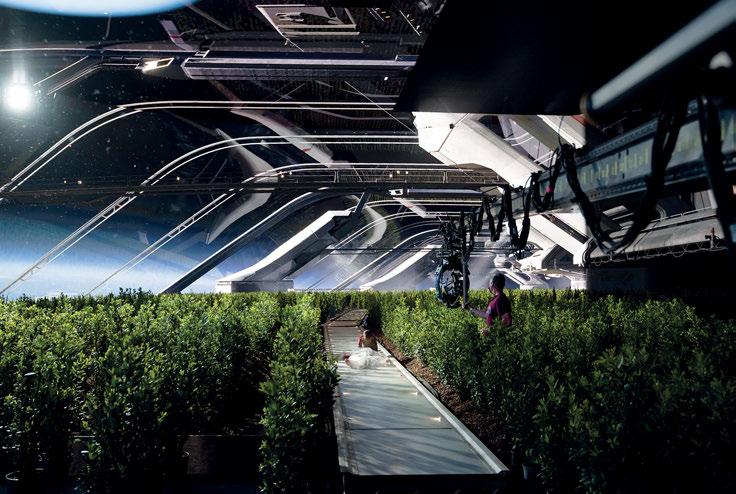
Conceptually, 1899 still holds up. “The goal is always to get as much in-camera for virtual production as you can,” remarks Christian Kaestner, Visual Effects Supervisor at Framestore. “The dining room was probably the one set that I was most surprised by how much we got in-camera and how well it worked. Because you go in and say, ‘Oh, the sky and ocean and that all works.’ There was probably more ocean replacement than we had expected, just for the level of detail. At the same time, we gained a lot of shots in the dining room because we were much tighter and had much more out-of-focus background. That I thought was incredible.” Static skies were brought to life by adding moving clouds from Unreal Engine on top of the HDRI plate photography. “It’s easy to underestimate how much subtlety there is in the sky movement, and the audience would perceive that.” The vast ocean was hard. Kaestner notes, “We managed to get a fair chunk of medium close-ups and defocused water. It was just the right amount of movement and white-water in-camera. But as soon as you hit wide angle, which had a large and long depth of field, the level of detail wasn’t quite there. There’s a complexity to the water movement and surface detail that is probably still challenging.”
In 2014, after working on Interstellar with his brother, Christopher Nolan, Jonathan Nolan was determined to figure out how to use projectors and build backgrounds in game engines for
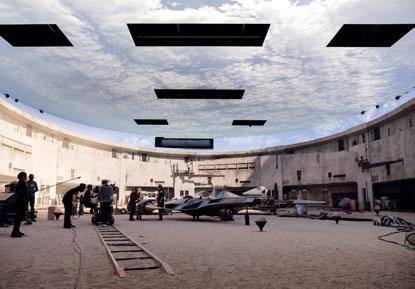
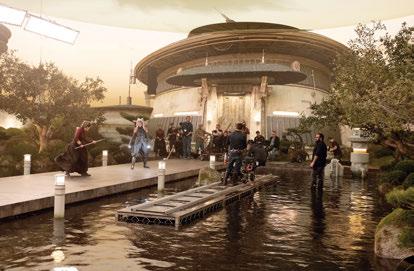
Westworld. Tests were conducted, but the goal remained elusive until a partnership with Magnopus was established. “We figured out what sets we wanted to use and were selective on Season 1 of Fallout,” explains Jay Worth, Visual Effects Supervisor on Westworld and Fallout. “The Vault entrance was by far the most successful set, and the farm, but we didn’t push the technology. While we were doing that, we were working on the final season of Westworld, and we started to play with the idea of, ‘Could we use the assets twice with two different environments that we needed to dress differently?’ The biggest thing we wanted to challenge for Fallout Season 2 that Jonah put on our plates was, ‘Can we start working more with natural light?’ We took our plates from Namibia, where Lucy is exiting the Vault, played with the direct sunlight, and asked ourselves, ‘Do the shadows look right? Does the light temperature look right? Can we get that feeling of if we have our plate and sun, pop out the panels and blast light onto our actors, will it contaminate the set too much, or will it look real?’”
Worth continues, “When we were up on the deck of the Caswennan, we had a nine-camera array out on Dumont Dunes shooting these drifting plates out in the middle of this scorching hot desert. We popped the panels out, blasted our actors with production lights, made sure the temperature felt right, and all we ended up having to do was clean up the panels. The team at Magnopus did a masterful job. I could show you some tests. It was
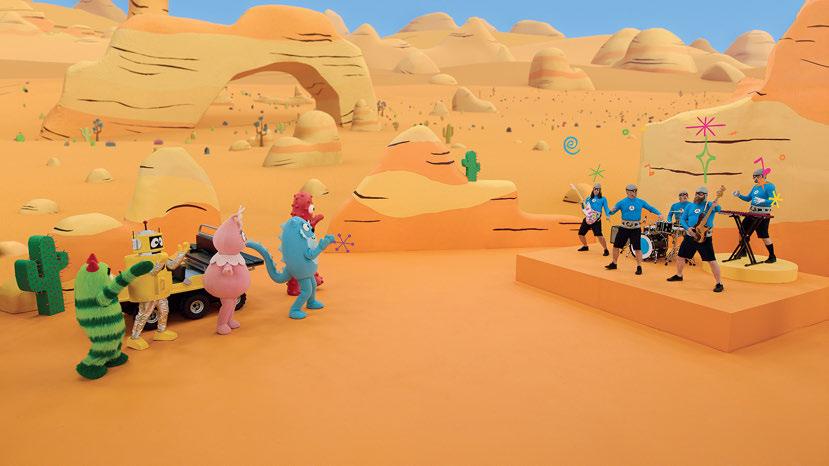
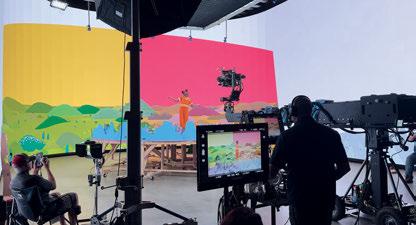
TOP: Not everything has to be photoreal, as demonstrated by the abstract environments found in Yo Gabba GabbaLand! (Image courtesy of Apple TV)
BOTTOM: Jim Geduldick shooting on a LED volume for Season 2 of Yo Gabba GabbaLand! (Image courtesy of Jack Geduldick and Apple TV)
literally here’s our set and digital asset, and they married perfectly in terms of where the decks begin and where the big airship starts and ends. That was one thing we wanted to try to learn from, and push the technology to figure out how we could use the tool in a way that was different from how we had used it in the past.”
Virtual production covers a wide variety of things. “House of the Dragon is not traditional in-camera visual effects via LED,” notes Christopher Cox, Head of PXO Clara (a Sony division folding into the wider Sony ecosystem). “What House of the Dragon did was leverage virtual production for real-time lighting, and then you have driving work with other projects that we do, which are either 3D or 2D driving plates leveraging gsplat, depending on the need. The technology is constantly improving every year with better panels and processing, but the biggest evolution is delivering the agility required for projects.” Technology should not dictate creativity. “It’s our job to find a way to fit within the creative needs of that project and deliver something cost-effective and efficient.
When you build and spend all this money on one thing and think, ‘We must use it because we spend the money,’ that’s not healthy for filmmakers and for the bottom line on a budget. Agile and modular solutions are the best use case of virtual production. I still like the large models for specific projects. For example, last year, Clara operated on four continents at once because we were sending modular kits to different stages. They don’t always need to be at soundstages either. We can deploy panels on any film set. It’s essentially a traveling road show of workstations, processors and LED systems that go up and down quickly. Therefore, you can actually schedule much faster because we’re not shutting down your set to build this massive horseshoe. Modularity is imperative.”
Real-time technology has long been used to produce content for live events and broadcasting. “There was a really funny moment at Coachella last year,” recalls JT Rooney, Partner, Screen Producer and Creative Producer at Silent Partners Studio. “We were doing a performance for the artist, Lisa, and we were getting some technical support from the team at Epic Games. Then we realized the problem wasn’t the software. We were in the middle of the desert at two in the morning, and there was so much sand and dust that it was affecting the machines. The interesting thing about live entertainment, using the same sort of immersive technology as film or games, is that just like in film, you have lighting, set decoration, actors and performers interacting with it, but in a live environment that will change. It will float, and you have to react to it, which is why real-time has been part of live entertainment for a long time. It’s a necessity.”
Rooney adds, “When you think about audio-reactive performances or things that work with ballet or opera or dancers, that’s something which only happens once and in that moment. You need technology to update it in real-time instead of, ‘Let’s do that take again and move your hand this way.’ It’s a long discipline in that space, which is why it made it easy during COVID and the virtual production boom for a lot of live-entertainment people to get into the film industry, but bring some of that discipline in.”
Getting projects greenlit has gotten easier. “Part of the process of even getting the commercial is a director building a pitch deck,”
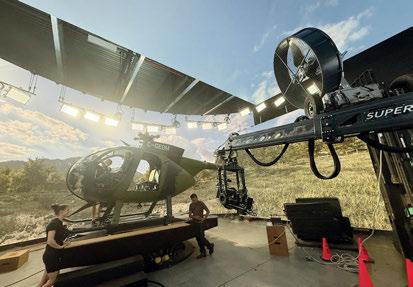
TOP TO BOTTOM: Real-time previs was used to create animated motion paths coupled with an advanced ‘buck’ motion base for HBO’s House of the Dragon This system allowed for real-time lighting and shadows accurate to the previs dragon paths, and integrated into actors’ performances while on the dragon ‘buck’ in an LED volume. (Image courtesy of HBO)
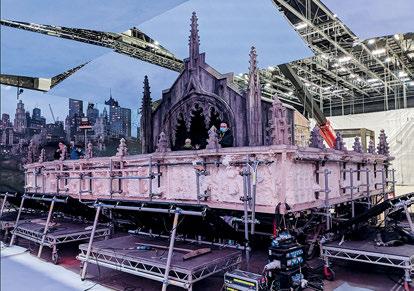
The Batman. Replacing practical lighting sources is not the goal of virtual production, but instead to support whatever the cinematographer needs to achieve the desired visual. (Image courtesy of Warner Bros. Pictures)
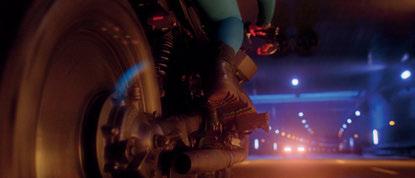
Sony’s “Cut to the Chase” was produced to demonstrate in-camera visual effects. Shot with the Akira advanced motion base platform, Sony Verona LED panel and Unreal Engine 3D real-time driving plates, Akira allows vehicles of any type to be shot in LED volumes with complete creative control, wider ranges of motion, and more shot design options than a traditional vehicle shoot.
(Image courtesy of Sony Pictures Entertainment)
“The goal of it, like visual effects or editorial, is to be invisible. There are a lot of things that have succeeded in virtual production, especially with LED volumes, that it’s discernible where you can’t tell the difference between which shot is on volume and which shot is practically done, if done well.”
—Jim Geduldick, Visual Effects Supervisor, Virtual Production Supervisor & Cinematographer
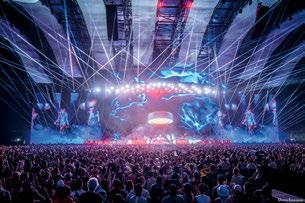
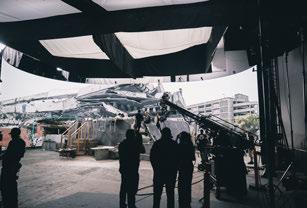
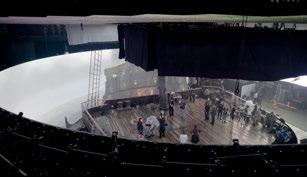
TOP TO BOTTOM: Virtual production has long been associated with live entertainment, with Silent Partners Studios generating screen content for LISA’s performance at Coachella 2025. (Image courtesy of Silent Partners Studios)
Amazon’s “Cada Minuto Cuenta” was shot in Mexico City at Simplemente virtual production stage featuring photorealistic virtual environments created by PXO Clara, leveraging scans of miniature sets and reproduced for in-camera visual effects. (Image courtesy of Prime Video)
A rotating stage was pivotal in speeding up the transition between camera setups for 1899. (Image courtesy of Netflix)
states Christopher Probst, ASC, Co-Founder and Chief Innovation Officer of Synapse Virtual Production. “One of our directing partners, Rich Lee, is actually using the gaming engine to build the deck, so he’s constructing environments, assets and mood boards from a 3D asset. Rich will narrate the Zoom call [with the client] while operating the environment in Unreal Engine. They’ll go, ‘We were imagining it would be nighttime and we’d be facing the other direction.’ He’ll make it night, turn the camera around and say, ‘Oh, you mean something like that?’ Rich can change the focal length of the lens. Now you can shoot those storyboards and lens choices and create an animatic, previs or techvis built on assets created for the pitch deck. If that particular production has a virtual production component, that environment could be plussed up with textures and lighting and become the asset put up on the wall alongside the live-action photography. On top of that, it’s a 3D environment.”
Probst illustrates. “We did a car commercial and created five miles of coastal highway that was bespoke to the needs of the client. They go, ‘This looks incredible. I wish we had an aerial.’ We had the 3D model of the vehicle and could drive it on our asset and program an aerial camera view. Now it’s also in post-production. One level of effort in terms of creating this environment for the pitch can carry all the way through post-production. That is a huge benefit in terms of communicating the potential of this process.”
The gap between high-end physical cinematography and realtime engine performance has not been entirely removed. “There are pain points with any of the traditional digital content creation tools,” remarks Jim Geduldick, Visual Effects Supervisor, Virtual Production Supervisor and Cinematographer. “Your Mayas, Nukes and Blenders have added virtual production tooling into them or virtual production specific workflows. The core focus of Epic Games, Unity and other real-time engines is to make games, and they’ve had to adapt to us in filmmaking. Kim Libreri has brought in other knowledgeable teams to work with the internal Epic Games teams to create filmmaker-centric tools. This has eased some of those pain points.”
Geduldick concludes, “No tool is going to be the one ring to rule them all. It comes down to the right tools for the job at hand. Sometimes you’re going to pick Epic Games and their tools with Unreal Engine. Sometimes you might go, ‘I’ve got more of a car process, plate workflow, image-based lighting.’ You might go totally media server with Nuke Stage, Pixera, disguise or Chaos Arena. You’ve got an à la carte menu these days in virtual production.”
Virtual production has a visual language. “But the goal of it, like visual effects or editorial, is to be invisible. There are a lot of things that have succeeded in virtual production, especially with LED volumes, that it’s discernible where you can’t tell the difference between which shot is on volume and which shot is practically done, if done well.”
THE MANDALORIAN AND GROGU THE WAY IT SHOULD BE SEEN
By TREVOR HOGG
Images courtesy of Lucasfilm Ltd.
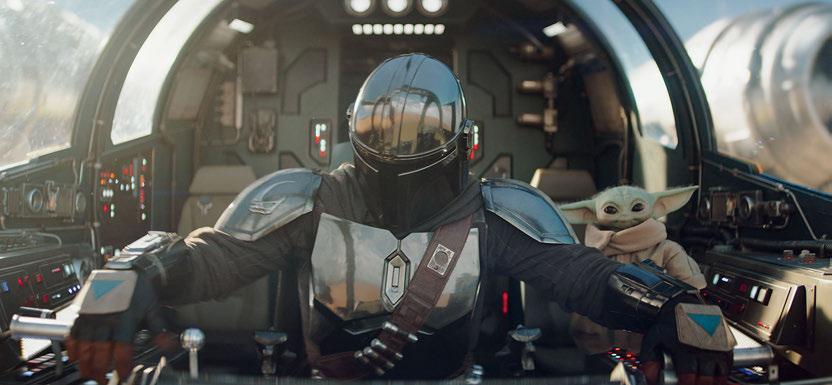
TOP: Virtual production has always been a key component as the main character is essentially a chrome ball.
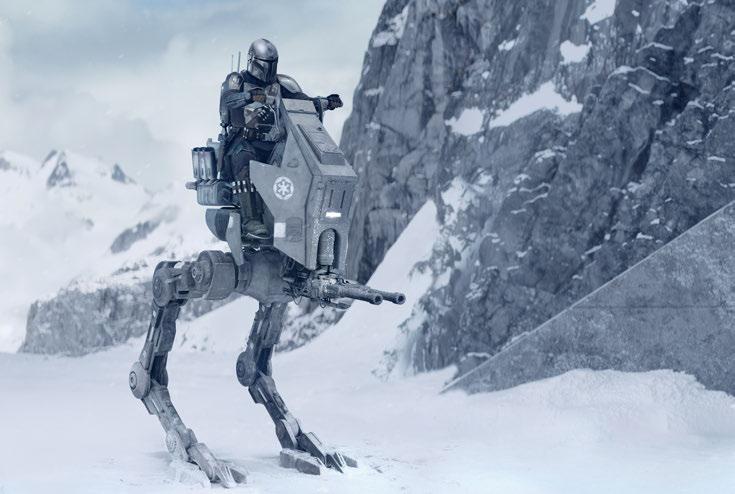
OPPOSITE TOP TO BOTTOM: The Mandalorian (Pedro Pascal) takes control of an Imperial Remnant AT-RT.
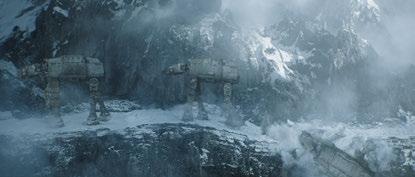
AT-AT Walkers traveling through a mountain pass are part of a major sequence.
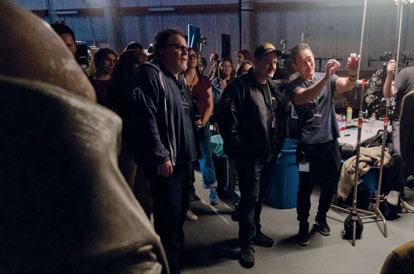
Jon Favreau, Dave Filoni and Doug Chiang have an on-set discussion while shooting The Mandalorian and Grogu
Star Wars began as a cinematic franchise that later adapted to television and streaming, while the Lucasfilm and Disney+ series
The Mandalorian reverses the script to appear on the big screen for the first time with the release of The Mandalorian and Grogu “I had written Season 4 of The Mandalorian before the strike,” recalls Jon Favreau, producer, director and writer of The Mandalorian and Grogu. “Historically, if you’re able to finish writing before a strike, sometimes you move forward with it; that wasn’t the case this time around. When we came back, the discussion was, ‘Do we have a feature film and does that feature need characters?’ I had to start from scratch. We understand the trajectory of the overall story because this time period has a lot of different interweaving narratives, like Ahsoka, The Mandalorian seasons, The Book of Boba Fett and even Skeleton Crew. It had to account for all of this. And to be honest with you, Ahsoka happening after us changes the way that things unfold. There was a lot that had to be shifted quite a bit, but I had to start with a narrative that lent itself to a two-hour movie. Also, a film has to appeal to people beyond those who are familiar with the show.”
The gold bar for the visual effects had already been established and needed to be surpassed. “Part of what people enjoyed about The Mandalorian was that we were delivering cinema-level effects,” Favreau notes. “And when we had projections on the big screen for things like premieres or fan screenings, it would hold up quite well. We had to take that up a notch and deliver bestin-class VFX on a scale that held up to IMAX projection. That meant taking a much longer time. We would turn around a whole season of a show in less than a year. For this, we had several years. We made sure we locked into what we wanted to do early so we
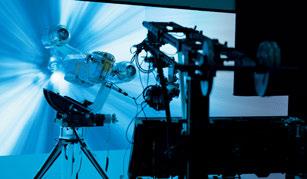
could build sets, create assets and engage with every generation of visual effects that Star Wars has embraced over the decades. On one hand, we have state-of-the-art CGI with beautiful particle, water and fire simulations. But also, we go all the way back to doing motion-control miniatures, building spaceships, and engaging with Phil Tippett for stop-motion sequences in the film as well.”
Apple Vision Pro came in handy during pre-production. “Way back on the early seasons of the streaming show, we started doing virtual set scouts in a VR headset, but one of the different things we were doing was an AR version of that where we were going to do it,” explains John Knoll, Visual Effects Supervisor. “We scouted the SCS Warehouse in downtown Los Angeles for an exterior of the planet Shikari, but we couldn’t use it as it was. We had to dress it with have Star Wars set pieces. We walked it once when we were considering the space. Then [Production Designer] Andrew L. Jones did a virtual build of the set augmentations we were planning, cladding one whole wall, and adding this element here and that piece there. All of this was loaded into the headset so the department heads could walk around the actual location looking at a half-transparent version of what we’re going to build over the top of it. We could say, ‘This is good, but we’re building this wall out too far.’ It was cool. I like that as a use case.”
Among the 2,200 visuals effects shots created by ILM, Image Engine, Hybride Technologies and Important Looking Pirates, nothing significant was altered when it came to technology and methodology. “One of the things that was a little new to Jon is we have a fairly short scene of maybe 10 shots or so of the interior of a U-wing,” Knoll remarks. “We had a U-wing set that built for Rogue One and used again on Andor, but for various reasons, it couldn’t be
shipped to the U.S. So, we built a simple proxy set with blank walls that were about the right color; we shot on that, then replaced the interior with a CG model that was built from photogrammetry of the original set. In the movie, every time you see the U-wing interior, that’s the CG model with the actors shot on the proxy set. That was something we had done on Rogue One for Raddus’ bridge, the Blockade Runner cockpit and the Hammerhead Corvette cockpit. It worked well and saved the production a lot of money because cockpit sets are expensive, with all the seats, control surfaces, display screens and control panels. I’m pleased with how the shots have turned out on this show.”
Animators are cast members. “I speak to animators as I would to actors,” Favreau says. “They’re performers. It’s a slower process, but if you watch an animator work, they’re making acting choices. I also try to give notes from the perspective of story because inevitably I hire people who are much better at what they do than my understanding of their field. I tend to express what I’m looking for from a story or emotional perspective. I’ll often give notes of how we should achieve it, but I find it’s better if I explain what I’m looking for, and they help figure out how to solve it through their expertise.” Proving to be the hardest to animate was Rotta the Hutt. “This is a buff Hutt who can fight, is dangerous and can move quickly,” states Hal Hickel, Animation Supervisor. “What does that look like? Even if he’s just walking from A to B in a scene, what does that look like? Is it a big inchworm or slithery? All of that had to be figured out including fighting moves. Rotta also has the secondmost lines in the film next to Mando; he’s a sympathetic character that we actually need to care about for the film to work. That was nerve-wracking but fun.”
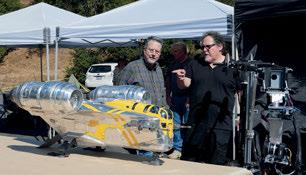
TOP: Some fine-tuning takes place in the backlot.
BOTTOM: In the tradition of the Star Wars franchise, the full menu of visual effects and technologies was used.
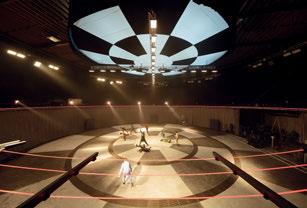
Getting elevated to life-sized are the Dejarik creatures used as holo-chess pieces in the original Star Wars. “It was taking something that had only ever been seen in a simple toy-like form and imagining if the toy represented an actual living, breathing thing out in the universe,” Hickel states. “It’s all about specificity and detail, in terms of the modeling and the texturing; real, definite choices that tell you this is an animal with history, and it’s a species that has various characteristics that you couldn’t see in the little holographic puppets. Does it have scales? No. It has lizard-like skin but fine wrinkles. There are all kinds of weird choices and questions that you have to suddenly start making and asking yourself. Most of them seem like beasts, monsters, creatures or animals, but some of them, like the Mantellians, have a belt and tunic. Does this creature have language? The Monnok has a staff and a weapon. So does Strider, which uses a big stone hammer more like an actual gladiatorial opponent than an animal. But then the K’lor’slug, Houjix and Molator seem like weird alien creatures that are like fighting a tiger or a bear in the ring. We brought up all kinds of conversations and questions about how we animate them and how they act and behave.”
For Hickel, this was a chance to revisit his stop-motion roots. “I put a ton of time into the Tippett Studio stop-motion sequence, and my end of it was helping to beat the sequence into shape,” Hickel remarks. “Initially, we went to Phil Tippett, who did rough boards, which he called his cave paintings. We incorporated those and worked with David Lowery, the head storyboard artist, all the way through The Mandalorian series. We shifted it into a 3D CG previs because, at a certain point, Tippett Studio had built Maya assets of the droids and then 3D printed parts that were attached
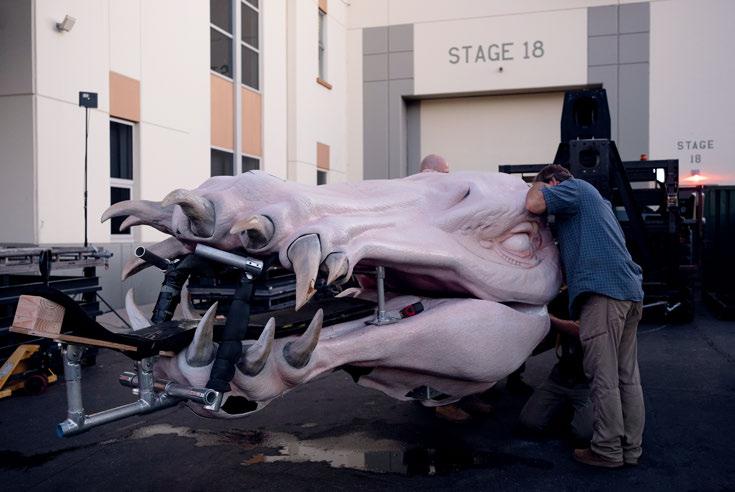
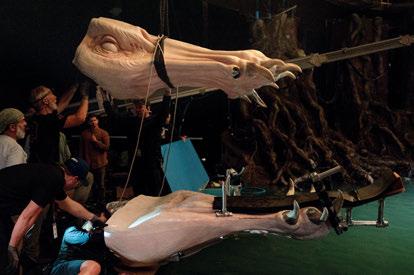
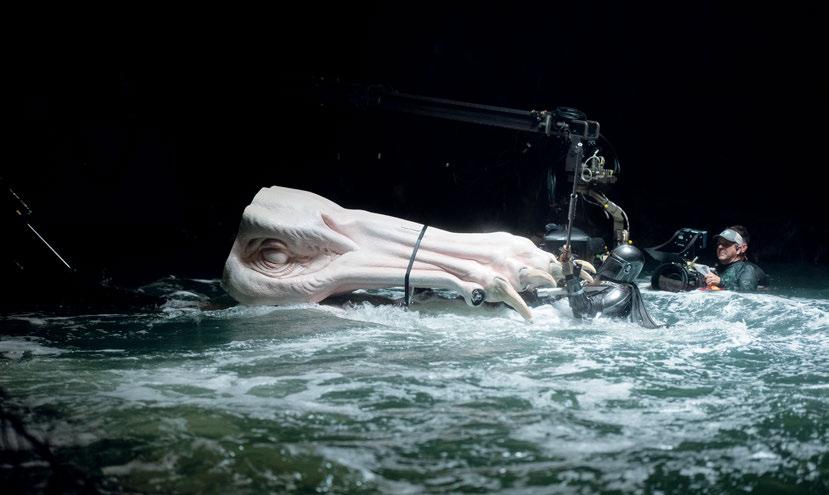
A proxy head of Gatori helps with the framing of shots.
Various puppets of Grogu were constructed for different use cases.
TOP:
BOTTOM:
to the real armature. It proved to be an extraordinarily tough sequence to finesse because it was simple in terms of what toys we had to play with. We had two big droids, one with a club and another with a big gun on its arm, in a relatively confined space, fighting Mando and Grogu. Mando had his disintegrator rifle, but we didn’t want him to use it much because he uses it against Embo in the next scene. We wanted to separate him from the rifle, leaving him with the pistol – which we decided would be ineffective against these big armored droids – and his vibro knife. There was a lot of what I call action math. ‘If we have Mando get in close, maybe this can happen. But if that happens, it would be logical for the other droid to just shoot him.’ I worked closely with editor Dylan Firshein; we would bounce cuts back and forth, play with ideas and show them to Jon, who would give us notes, and then we would go back and reiterate. It warms my heart to see it. I even snuck in there and did one shot!”
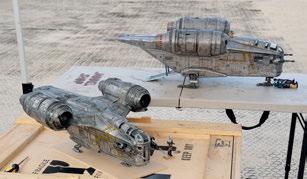
Star Wars fans with a keen eye might notice a nod to franchise history. “We have a scene where part of the New Republic fleet gets involved with an aerial battle, and there are X-wings and Y-wings in that fleet,” Knoll explains. “For various story reasons, the Y-wings that are part of the Adelphi squadron have red stripes on them. John Goodson, our modelmaker, who built the 48-inch Razor Crest, had been doing some work for the Lucas Museum of Narrative Art and mentioned he had done a restoration on the Red Jammer Y-wing model. Apparently, that model was the first Y-wing that ILM built back in 1976 when, in story, they were still Red Squadron and had red stripes on them. They built this model and sent it to England to be the reference for the art department to use to build the full-size exterior cockpit set. The model got damaged on its way back, was partially restored, and recently John Goodson had done a full restore of it. After a lengthy negotiation, George Lucas gave us permission to borrow the model. We shot two motion-control elements of it. It’s in the movie and will go by quickly. Unless somebody points it out, you won’t notice it, but there are two photographed elements of a 1976 original model from Star Wars, which has never been seen onscreen before.”
Figuring prominently is a new and improved Razor Crest.
Every action sequence went through previs, which assisted in determining the movement of the motion control camera.
The real-life Holochess creatures appear in a gladiatorial arena with a floor patterned like a chessboard.
Connecting emotionally with non-human characters is a staple of the Star Wars franchise. “If you look at R2-D2, it’s not a complex design, and yet I felt tremendously for that character,” Favreau recalls. “To me, that’s the big litmus test: if people can care and feel for characters that are either fully CG or puppets or mechanically built or even stop-motion.” Considering this is the first Star Wars movie in seven years, The Mandalorian and Grogu will enable a new generation of audience members to witness the franchise in its original cinematic format for the first time. “You want to deliver something that is exciting, fun, powerful and compelling,” Favreau believes. “Star Wars aside, you have to make a case nowadays for why people should come to the movie theater. There are lots of other things vying for people’s attention. I grew up loving movies. Whether I was an usher, extra, actor or filmmaker, I have always loved movies, so I want to make sure that The Mandalorian and Grogu creates an experience that makes people want to come to the movies and fall in love with them as well.”
TOP TO BOTTOM: John Knoll and Jon Favreau were able to turn their series work on The Mandalorian into the first Star Wars feature film in seven years.
IN CONSTANT PURSUIT OF EXCELLENCE WITH SIR RICHARD TAYLOR
By TREVOR HOGG
Going from being a toilet cleaner on international flights at Auckland Airport to a Knight of the New Zealand Order of Merit for services to film is a remarkable journey that Sir Richard Taylor embarked on with his wife and business partner, Tania Rodger. Despite the awards and accolades and RT Effects transforming into Wētā Workshop, where the employee payroll went from two to 380, the native of Cheshire, U.K., who left one island nation for another as a child, remains grounded and open-minded.
“The term that I used in the interview with our general manager 12 years ago when we put the board together is ‘You must do everything in your power to help us remain as a soft ball of clay. Never allow us to become a hard block of wood,’” recalls Sir Richard Taylor, Co-Founder, Co-CEO, Chief Creative Officer of Wētā Workshop. “Because a hard block of wood gets knocked off its trajectory easily, while a soft ball of clay can absorb the punches.”
Four key principles are needed to remain relevant: love of oneself, love of what you do, love of who you do it with and love of who you do it for. “At its core, you have to have love in the aspiration,” Taylor states. “It’s a word that’s so rarely used by CEOs and business executives. Why are you even bothering to do it if you don’t love it? You see it across all strata of society. If the individual leading it doesn’t have pride and self-love for what they stand for, their ethics and how they handle themselves, how can you expect to look after people and demand that of others? You’ve got to love what you do. Of course, I love what I do. I wouldn’t do anything else in the film industry other than what I do here every day at the workshop. I genuinely love the people I do it with. You occasionally encounter the rare ratbag that you have to deal with, but for the most part, our colleagues around us are our closest friends. We socialize with them in and outside the workshop because we’re united by exactly the same calling. Then you have to love the people that you do it for. That’s such an obvious one. But how many companies don’t respect their market, customers or fans? We’re only in our business because the fanbase has allowed us to do the type of projects that we do. If there’s a fifth one, it’s simply ‘don’t be a jerk.’”
OPPOSITE TOP TO BOTTOM: Taylor oversees the creation of Rivendell for The Lord of the Rings
Intercut with full-size ships were bigatures crafted by Wē tā Workshop for Master and Commander: The Far Side of the World. Richard Taylor and Tania Rodger are life-long partners, personally and professionally.
Receiving the VES Visionary Award was a pleasant surprise. “In all honesty, when I was told about this award, I was caught somewhat on the back foot because I am not a visual effects supervisor,” Taylor notes. “Although I have had a long career working around the visual effects industry through our design, miniatures and creatures. When I consider myself alongside the visionaries of the international film industry, I probably would be a little more circumspect about aligning myself with them, but in my own country and the way I started and what I’ve achieved, we’ve been in business for 38 years. I would like to think that we’ve pioneered some good stuff here. There was a vibrant and dynamic film industry in New Zealand long before The Lord of the Rings was made, and we were certainly operating for many years before. But it is The Lord of the Rings that has really put New Zealand’s film industry on the map, and it required a lot of pioneering by everyone involved to be able to achieve something of that status and scale here in our country.”
A source of inspiration is Richard Pearse, who lacked the
Images courtesy of Wētā Workshop.
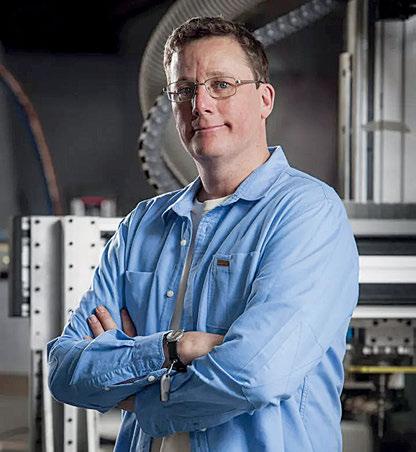
TOP: Sir Richard Taylor, Co-Founder, Co-CEO, Chief Creative Officer, Wētā Workshop. (Photo: Steve Unwin)
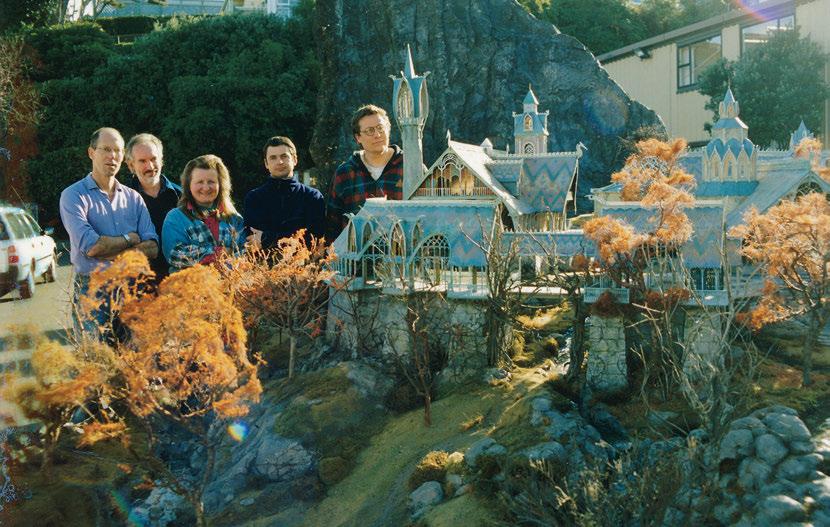
documented evidence to prove he had flown before the Wright Brothers. “This Kiwi farming boy wakes up in the bottom of the South Island of New Zealand, the farthest place you can have from the aeronautical aspirations of the world, decides to build an airplane and achieves it,” Taylor remarks. “I’ve always said that if you wake up on a Monday morning with fantasies in your head and you’re not going to be able to buy them blister-packed from the corner toy store, then you better be able to make them with your hands. That’s really the spirit of the inception of my whole life and career. Growing up on a farm in rural New Zealand, if I wanted to learn to sculpt, I dug clay out of the creek. If I wanted to learn to model make, I model made with anything I could find within my environment. Even though my mum was a science teacher and my father was an aircraft engineer, I knew from about the age of six, when I first started doing paper-mâché and model railroading, that I had to have a life making things. I didn’t even know the film industry existed until I was in my mid-teens. I visualized that I would actually be working in the theater industry. I started doing all of my personal training outside of school and in my art classes at school, in theater, making costumes, learning to sew, doing set building, modelmaking, lighting and makeup. By the time we moved to Wellington at 17 and discovered that there was a film industry, I’d already become adept at doing many of these things, not appreciating at the time that they could adapt to a film industry.”
Stability is the greatest reward. “One of the primary things I always try to think about is how we create stability for our crew,”
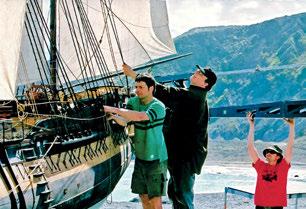
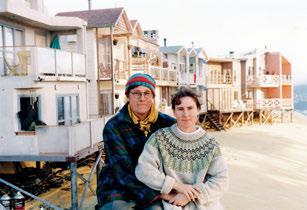
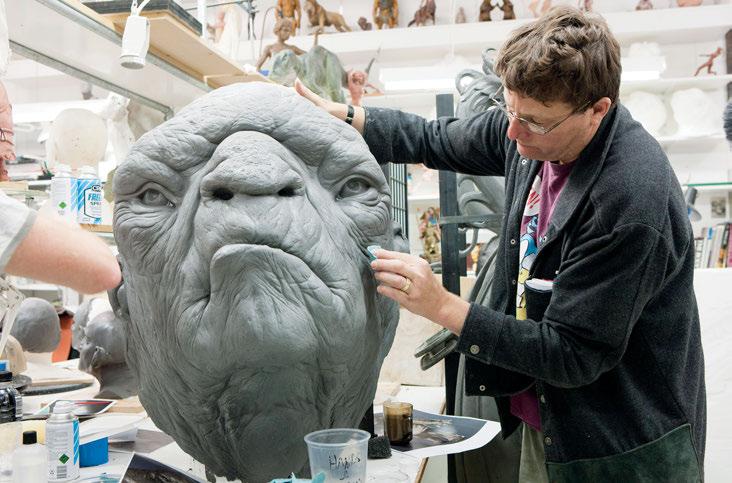
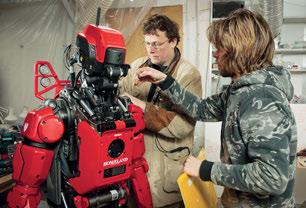
BOTTOM:
OPPOSITE
Taylor notes. “When you measure a blue-collar work environment like ours, what is success. and how is it measured? It’s not measured necessarily in awards won or red carpets trod. It’s measured in the number of babies born to your staff and the number of mortgages owned by your crew because that suggests that you’ve been able to offer enough stability in an otherwise very unstable industry.” Wētā Workshop designs for digital gaming, film and television; manufactures everything from weapons to vehicles for film and television; makes and sells high-end collectibles; and has three tourism offerings. “30% of our work is private and public commissions, things that a billionaire can’t buy anywhere in the world we’ll build it for them. Last year, we built a stargate as a lighting source for the bonnet of 40 supercars in a private garage. We are building 68 points-of-articulation AI-driven robots at the moment as an effort to enter the robotics industry. We have an immersive experience division that numbers about 24 people. It did the largest pavilion for the Dubai Expo, the atrium of the Haikou Duty-Free Shopping Mall and the Traditional Chinese Medicine Cultural Experience Center. We have two retail experiences where we sell our products and have a creative media division that deals with Asia’s largest pop star through AAA games.” Client expectations are open to interpretation. “There’s a metaphor that I used a lot, which is, ‘It’s not a math exam where if
TOP: Taylor adds detail to a life-size sculpture of William the Troll from The Hobbit.
Taylor views himself as a maker of other makers.
TOP: One of the biggest challenges on The Lord of the Rings trilogy was that only 28 of the 158 staff at the time had ever worked on a film or TV show before.
OPPOSITE BOTTOM: The seminal project for Taylor is “Gallipoli: The Scale of Our War” exhibition at the Museum of New Zealand Te Papa Tongarewa (Te Papa). (Photo: Michael Hall)
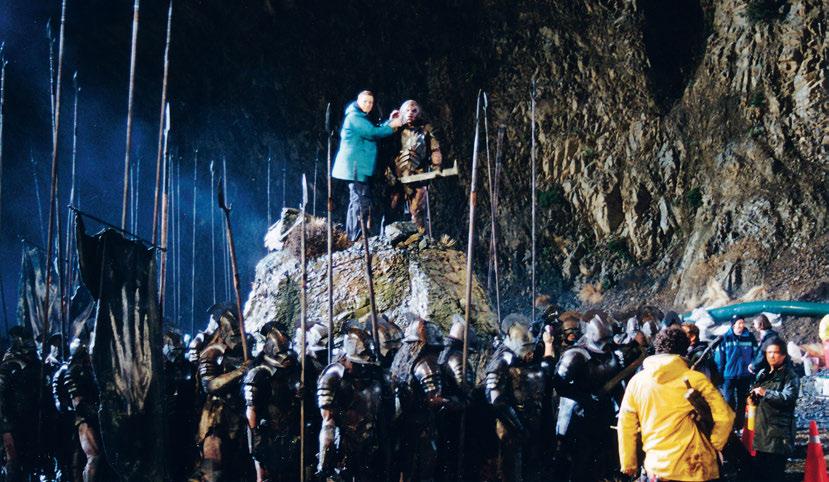
you do it right, you’ll get 100%. But when you sit an English exam, you will never get 100% because it is in the aptitude and understanding of the interpretation of what you’ve done,’” Taylor reveals. “That is very much the career we are in, and even the career we’re in can be bifurcated down to math and English exams. Miniatures are much more like sitting in a math exam. Doing a prosthetic is much more like an English exam. What is critical is understanding quickly, and it’s often even in the first few minutes of a phone call with a director you’ve never met before that you see where they sit in their comfort zone when it comes to communicating their ideas visually. If you can grasp where on the spectrum that is, you can then start feeding into the conversation at a greater or lesser level with your interpretive input. Some directors come with a pure vision, and you are in the process of realizing and physically creating that vision. More commonly, the director is willing to explore with you and allow you to use your own creative knowledge and that of the team around you to try and enhance the written word into something that is greater than what they were imagining. Even a director like James Cameron, who is arguably one of the most visionary humans in the world, you’ll fail if you deliver at expectation. You deliver at a higher level of over-expectation so that you’re surprising him because Jim is not a dictatorial director; he’s a collaborative director who wants the collective

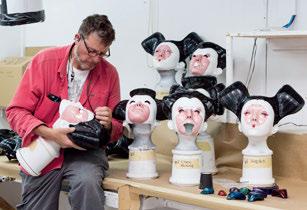
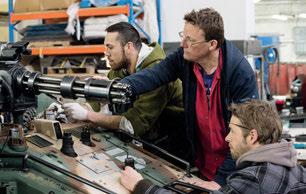
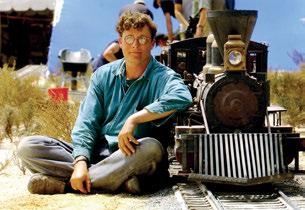
vision to build a bigger, stronger, greater product.”
Even with international name recognition, a proactive approach is still required. “When you live in paradise, but paradise is at the furthest corner in the world, you have to take yourself to the industry,” Taylor notes. “I’m 61 now, and I will never even hesitate for a moment if a client either requests my appearance somewhere in the world or I feel it is a necessity to personalize our approach to a job by getting on a plane and getting up there. We’ve got a team of people, our senior management and sales team, that likewise, will at the drop of a hat do that because we identified early in our careers that if we pretended that we could hide away at the bottom side of the world and reach out when we needed to, that was never going to work.” Being on the cutting edge of technology is critical. “A good example is using over half of the profit that we had made in seven and a half years on The Lord of the Rings to buy the first commercially available 3D printer in the world that I was aware of. I could even see way back here in New Zealand that technology was going to change everything we did. There was a lot of uncertainty from some corners of our staff about putting people out of work, but it’s the exact opposite. We have replaced hand drawing with Photoshop technology; ZBrush came in, and different software programs we now use for our hard surface and sculptural modeling work. I love the fact that we have a full-time leather worker who has been with us almost since the company’s beginning, and every day he uses a tool that can be traced back to Egyptian hieroglyphs. Sitting within 100 meters of that person is someone coding into AI software to allow us to 3D print a hyper-realistic eyeball on an Israeli 3D printer that we partially hacked to achieve the level of results we required.”
When talking to students, a certain point is emphasized. “I always try to impress upon them that the most critical component they need is an inquisitive mind,” Taylor remarks. “Without that, you’re not open-minded enough to the shifts and different states of the technology in the industry you work in, and that to me is an imperative.” As for managing creative talent, a particular philosophy prevails. “Always expect excellence and always ask for excellence. Perfection is a fallacy that a hobbyist can exercise, but not in a commercial environment like ours. We want to be the best we can be in the world.”
For Taylor, one should always ask for and expect excellence, whereas perfection is a fallacy that a hobbyist can exercise, but not in a commercial environment like Wē tā Workshop.
The spectacular train crash in The Legend of Zorro is one of the many contributions that Richard Taylor and the Wētā Workshop have made to cinema.
Taylor’s seminal project is not being part of the Fellowship from Middle-earth. “The seminal project of my career is the Gallipoli war exhibition that we’ve done for our national museum, which has been open for 12 years and has just been extended by another eight years. It has had 4.7 million people from a country with a population of five million pass through it because of the patriotic pride and the subject matter of representing men and women who served our country.”
Taylor declares, “One of my favorite movies is Ridley Scott’s original Blade Runner, so getting to build miniatures for Blade Runner 2049 was beyond belief. My favorite character we have ever created is Lurtz, being practical effects and makeup. Probably one of the most memorable characters we had a part in designing would be Smaug. And that’s a lovely thing to think about. If you could own one animal, maybe you would have Smaug living under your house, which would be cool!”
TOP TO BOTTOM: A real joy for Taylor is getting the opportunity to work on iconic franchises, such as creating animatronic geisha robots for the live-action adaptation of Ghost in the Shell.
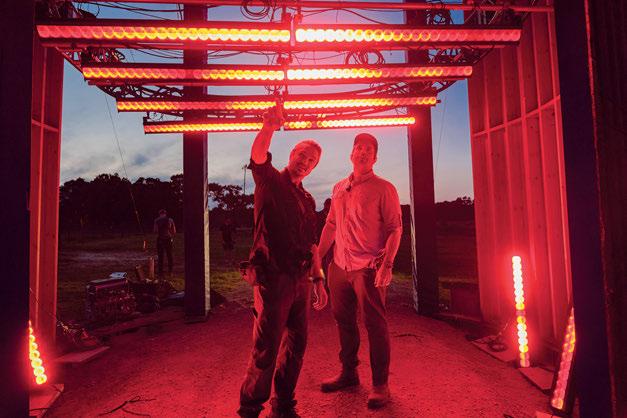
THE FUTURE OF CINEMATOGRAPHY: THE RISE OF THE HYBRID DP
By KATIE KASPERSON
When Industrial Light & Magic (ILM) debuted its StageCraft system on Disney+’s The Mandalorian, the game was afoot: virtual production had officially hit the mainstream. Filming in front of a curved LED screen (dubbed “the volume”), DP Greig Fraser substituted physical locations for virtual environments, rendered instantaneously in Epic Games’ Unreal Engine. These high-resolution backdrops offered the additional benefit of image-based lighting, allowing Fraser to capture visual effects in-camera –something that historically required clever tricks like rear projection or scale models.
In the years that followed, companies raced to build LED stages, develop camera tracking technology, implement Unreal Engine and test the bounds of what this filmmaking method could do. Once sequestered to post, visual effects specialists became a key part of virtual production, their work intertwined with that of cinematographers, set designers and the like.
TOP: Cinematographer Caleb Heymann used Unreal Engine to plan complex, stunt-heavy scenes for Stranger Things Season 5. (Photo: Andrew Cooper. Courtesy of Netflix)
OPPOSITE TOP: Behind the scenes on The Last of Us with Cinematographer Catherine Goldschmidt (kneeling). Once the set was built and the lighting was installed, the crew still needed to set levels and color in the real space. Previsualizing in Unreal Engine allowed Goldschmidt to see ideas ahead of time. (Image courtesy of HBO)
OPPOSITE BOTTOM: Caleb Heymann (with smartphone) consults with the Duffer brothers on the set of Stranger Things Season 5. Despite the post-production required to bring the Upside Down to life, there remained a philosophical commitment to capture as much in-camera as possible. (Photo: Clay Enos. Courtesy of Netflix)
Though unintentional, DPs have found themselves at the center of virtual production – particularly those working in sci-fi, fantasy and other VFX-heavy genres. Today’s hybrid DP blends traditional cinematography with virtual technology, navigating complex tools and increasingly collaborative workflows while maintaining their original goal: to shape a film’s visuals and tell a story.
While The Mandalorian’s success brought virtual production to the fore, this filmmaking technology was arguably overdue. Before spearheading volume work on Percy Jackson and the Olympians, Pierre Gill was experimenting with virtual location scouting on an unreleased Assassin’s Creed game installment. Working under
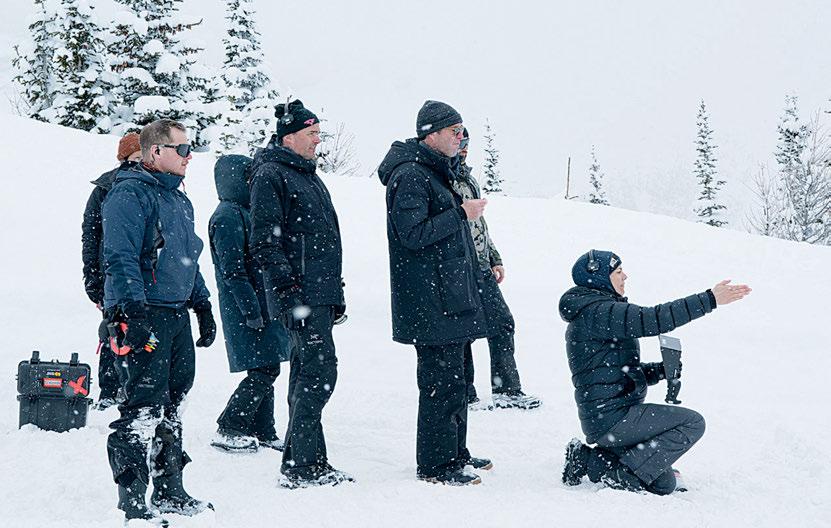
Ubisoft’s direction, Gill explored the video game from within, plucking out assets as he went along. “The goal was to do what we eventually did with the volume,” he says. “We just weren’t there yet.”
Virtual production had come a long way by the time ILM released StageCraft. Oren Soffer, who served as Co-Cinematographer on The Creator, first worked alongside Fraser during pre-production on The Mandalorian. “I was fortunately exposed early to virtual filmmaking,” he begins. “On The Creator, thanks to Greig, we shot two environments on ILM’s StageCraft, using it for both lighting and in-camera background rendering. ILM then enhanced those backgrounds during post-production, which was mostly necessary on wide shots.”
Soffer observed as Fraser liaised with the film’s virtual art department. “Greig prepared them to use ILM’s StageCraft at Pinewood Studios,” where they shot for the final two weeks before wrap. “It taught me so much about virtual production – a skillset I’ve taken with me on a number of projects since,” Soffer says.
Some cinematographers, including Soffer, find virtual production tools relatively easy to understand. “I’ve been a casual gamer my entire life,” he explains. “I found using VR tools to be somewhat akin to playing a video game. From there, picking up the concepts and getting used to the workflow – collaborating with the virtual art department, the on-set VFX department and the physicality of hybrid environments on LED volumes – felt fairly intuitive.”
The same goes for Vanja Černjul, DP on House of the Dragon, its third season slated for release this summer. “As a cinematographer,
virtual production does come instinctively. You don’t necessarily have to understand the nuts and bolts of it; I don’t know how all the tools work, but there’s always somebody who does. As long as I know what looks real and how to judge the background from the foreground, it’s the same thing we always do,” he states.
Joining House of the Dragon on for its sophomore season, Černjul can attest to how far virtual production has come – even in two years. “What we did on Season 2 feels like ancient history compared to what’s available now,” he explains. Using an iPad [dubbed “the Cyclops” by the team] “allowed us to monitor how the real set interacted with the virtual set. We used the Cyclops to orient ourselves in a scene; in Episode 207, the whole set was basically a virtual space.”
On Season 3, Černjul spent large chunks of time in what he
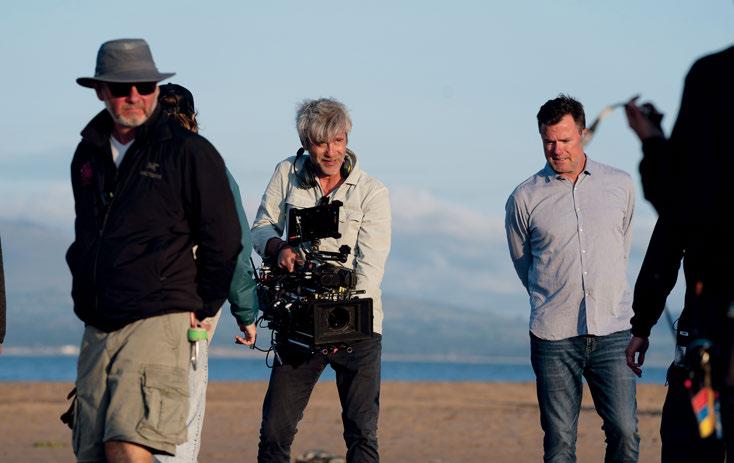
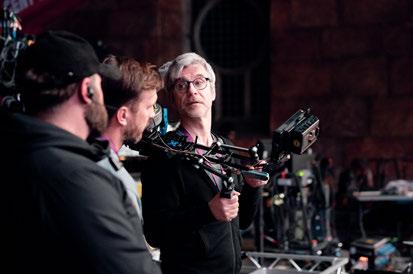
called the “Tech Vis Room,” a space run by the VFX department. “We worked with this previs system, which had every location scanned,” he describes. This included a “big open exterior” where Černjul could use cranes. “I didn’t want to limit the director by putting a large piece of equipment in the way of a potential shot, and there was nowhere to hide. I could go [into the Tech Vis Room] and – knowing which shots we wanted to get – place the camera and therefore determine where the cranes could go and how I needed to move them so they would never get in the way.” Černjul adds, “They couldn’t get me out of that room once I realized what I could do there. It’s amazing how much planning you can do ahead of time and how prepared you can be when you come to set.”
Catherine Goldschmidt, who’s been with House of the Dragon since the beginning, used an LED volume during pickups and reshoots on Season 1. “We had a specific time of day we wanted to hit, in a really long scene as well, that we couldn’t possibly get during the magic hour window,” she recalls. “We used the volume to good effect. On Season 2,” Goldschmidt continues, “the volume stage got torn down, and the sets that had previously been volume sets were turned into greenscreen sets. That decision was pure economics. [Following] a TV schedule, they couldn’t finish the effects in prep. That meant that the whole premise of shooting in-camera was not met. They were spending time and money in prep to attempt to have in-camera effects, and then they were still spending time and money in post to fix those effects.”
Despite her credits on VFX-heavy projects like House of the Dragon, The Last of Us and 3 Body Problem, Goldschmidt works more with green and bluescreens than LED stages. Instead, she primarily uses virtual tools during pre-production and for imagebased lighting. “What we tried to do on 3 Body Problem, which is something that Greig Fraser has been a big proponent of, was use
TOP: Cinematographer Vanja Č ernjul (with camera) on House of the Dragon. Č ernjul doesn’t know how all the VP tools work, but he knows what looks real and how to judge background from foreground, which is consistent with what he’s always done. (Photo: Theo Whiteman. Courtesy of HBO)
BOTTOM: As a casual gamer, Č ernjul (center) found virtual production to be instinctive. (Photo: Theo Whiteman. Courtesy of HBO)
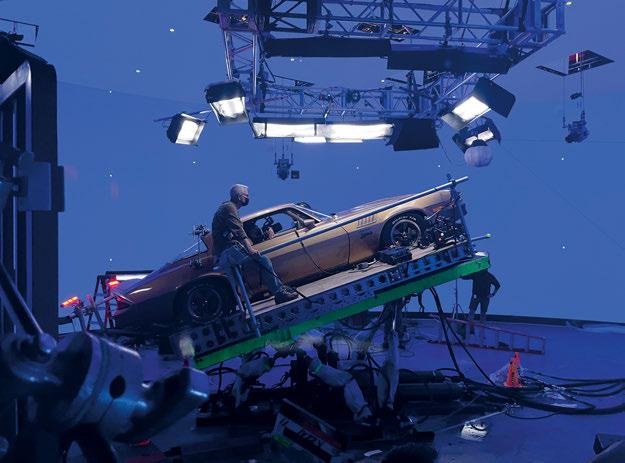
Unreal Engine to previs specifically how the lighting would look on set. We were designing the lighting into the set, and we wanted to make sure we were getting it right,” she says.
“There was some talk in prep that was like, ‘You’re trying to previsualize your lighting in Unreal. Does that mean you won’t need to do any physical pre-lighting on the set?’ Absolutely not,” Goldschmidt clarifies. “Once the set was built and the lighting was installed, we still had to do what we always do – set levels, set color, and all of that had to occur in the real space. It was just a tool for us to see our ideas ahead of time.”
When it came time to light, Goldschmidt considered using LED screens to achieve an interactive effect. “We talked a lot in prep about what would be best to create that light,” she recalls. “The VFX department was pushing for us to get a volume wall. They weren’t trying to finish any effects in-camera, but they wanted –and I wanted – to have that light be as close to the finished thing as possible.” Eventually, Goldschmidt and her gaffers conducted “a comparative test between a volume wall and a Sumosky, which is basically a ladder of long LED strips. We wound up going with the Sumosky because it produced better light and was a lot cheaper.”
On other productions, such as House of the Dragon, image-based lighting is the clear answer. “It was especially important because our characters were all wearing armor, so getting the proper reflections helped create the illusion of reality,” Černjul says. Mostly, though, he used virtual production during prep. “It helped me do my own thing – not integrate visual effects into cinematography, but just to plan. I would basically create virtual storyboards.”
He’s not the only one. Caleb Heymann, Lead Cinematographer on Seasons 4 and 5 of Stranger Things, used Unreal Engine to plan complex, stunt-heavy scenes, such as the ‘oner’ in Episode 504. “One of the biggest sets [on Season 5] was the MAC-Z – the
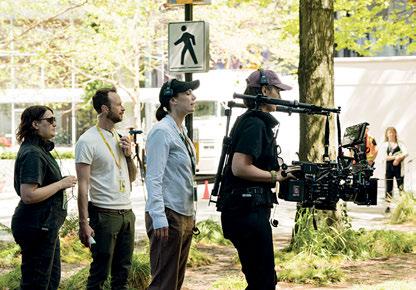
TOP: For Cinematographer Pierre Gill, here on the set of Percy Jackson and the Olympians, having to be the bridge between production, design and effects is the true task of the hybrid DP.
(Image courtesy of Disney+)
BOTTOM: Cinematographer Catherine Goldschmidt (second from right) on The Last of Us. Goldschmidt primarily uses virtual tools during pre-production and for image-based lighting.
(Image courtesy of HBO)
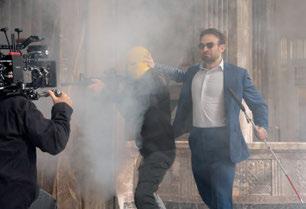
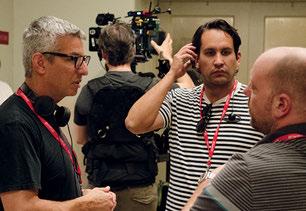
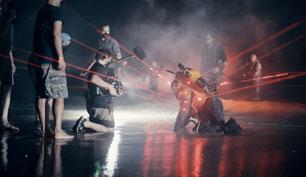
TOP TO BOTTOM: Charlie Cox (right) on the set of Daredevil: Born Again. For Cinematographer Pedro Gómez Millán, the technology can be overwhelming, which is why it’s important to keep the essence of filmmaking alive. (Photo: Giovanni Rufino. Courtesy of Marvel)
Millán (center) sometimes uses mobile apps to turn his smartphone into a virtual camera and take three-dimensional scans of his surroundings – at a substantial savings. (Photo: Giovanni Rufino. Courtesy of Marvel)
Cinematographer Greig Fraser liaised with the virtual art department on The Creator to prepare them to use ILM’s StageCraft at Pinewood Studios, where the final two weeks of the film were shot. (Photo: Glen Milner. Courtesy of 20th Century Studios)
militarized downtown Hawkins,” he begins. “The VFX team created that set as an Unreal Engine asset; that was instrumental in getting everybody on the same page.” Heymann and his camera crew “came together before construction and were able to walk around the set virtually and put on different lenses to see our exact field of view,” he recounts. “We were able to figure out where construction cranes, soft boxes and bluescreens were going to be. It’s amazing what you can do in there.”
During prep, Heymann would consult with the VFX department nearly every day. “On a project like Stranger Things,” he explains, “the line is continually blurred from where our department ends and where VFX begins. It’s something we constantly discussed, and there’s a huge overlap.” Despite the post-production required –particularly on the series’ later seasons – to bring the Upside Down to life, “there’s still a philosophical commitment to doing everything in-camera that we possibly can,” says Heymann – and to do what feels right for each scene.”
Stranger Things combined practical effects with blue, green and LED screens, using the latter for image-based lighting and vehicle work. “Traditionally, you’d either use a process trailer or bluescreens. We started moving more of that work to LED walls and doing in-camera VFX,” Heymann describes. “In Episode 504, Steve drives his BMW through a rift in the Rightside Up, and they go out the other side in the Upside Down. Everything that was done in the car was shot with modular LED screens. “It helped the actors to know where they were,” Heymann continues. “They could see the red rift approaching and time the transition.” While the walls provided interactive lighting, “we supplemented them with LED film lights that had more punch.”
While Heymann considered using an LED volume to film the “Abyss,” an alternate dimension that appears only in the series finale, the ensemble cast threw a wrench in that plan. “Even in the biggest volume in Atlanta, at Trilith, it was going to be overly tedious. There was going to be too much walk-and-talk and too much exploration of the environment,” he explains. “I talked with David Klein, one of the DPs on The Mandalorian, who said that one of the difficult things with the volume is its size. Ultimately, we found a huge quarry that gave us a much bigger playground.”
Virtual production still has its limitations, and most innovations come through trial and error. On Percy Jackson, for instance, Gill tried to blend live motion capture with an LED volume. “There was a guy running around on stilts, and we could see him as the minotaur in the camera, but there was a slight delay. It was almost perfect,” he admits, “but not quite.”
Gill has been around long enough to see “technology start to merge with filmmaking. Percy Jackson was the first time I used the volume,” he recalls. “That was a complex piece of technology; you have to learn it, and then you have to learn how to work with VFX. You have to be the bridge between production, design and effects,” Gill shares. This is the true task of the hybrid DP.
Many cinematographers – even those on sci-fi and fantasy titles – maintain that the camera department should be kept separate from VFX. “Nobody is looking for me to do those people’s jobs, but they are needing to know that I can collaborate with those people,”
“Traditionally, you’d either use a process trailer or bluescreens. We started moving more of that work to LED walls and doing in-camera VFX. In [ Stranger Things ] Episode 504, Steve drives his BMW through a rift in the Rightside Up, and they go out the other side in the Upside Down. Everything that was done in the car was shot with modular LED screens. It helped the actors to know where they were. They could see the red rift approaching and time the transition.”
—Caleb Heymann,
Cinematographer, Stranger Things
Goldschmidt suggests. “It has dawned on me that if I knew how to do anything in Unreal myself, then I could cut out some middlemen, but the learning curve is fairly significant.”
Across the board, our DPs deny being quizzed on virtual production during job interviews. “In my experience, [directors] want you first because of your eye, rather than if you’ve worked on a volume or not,” describes Pedro Gómez Millán, DP on Daredevil: Born Again and The Lincoln Lawyer. “If you’re proficient in technology, even if you haven’t done a volume-heavy job, you’ll be able to adapt quickly,” he believes – a soft skill that goes further than any niche technical expertise.
Soffer argues that virtual technology can be “prohibitively expensive,” leaving DPs on low-budget productions out of the loop. But tools beyond LED volumes and Unreal Engine do exist, such as mobile applications Previs Pro and Polycam. Millán uses both, turning his smartphone into a virtual camera and taking three-dimensional scans of his surroundings – all without breaking the bank.
Those lucky enough to work with high-end equipment recognize how invaluable that experience can be. “It’s exciting to be working in a time when we have this software available to us,” Heymann says. “I want to dig more into Unreal Engine and get more comfortable with all you can do in there. It’s so important that as a DP, you can have a seat at the table.”
Despite the steep learning curve, there’s an undeniable curiosity among today’s cinematographers. “My journey is not finished,” states Gill, who treats every job as a chance to grow – yet knows when to leave it to the experts. “I consider myself a cinematographer, not a technician.” Instead of trying to master every tool out there, “I hire the best people.”
Virtual production was designed to solve a specific problem; it places the actor (and the camera) into any location, real or not, and offers interactive lighting – something blue and greenscreens can’t do. “It’s one more tool we can add to our arsenal,” Heymann argues. “That doesn’t mean it’s going to make sense for the majority of productions.” Goldschmidt agrees. “It’s basically rear projection in the modern era,” she says. “It’s a great tool, but during the pandemic, it was like, ‘This is how we’re going to make films from now on.’ It seemed like location shooting was going to be a thing of the past. Now that it’s over, people are dying to go back on location – and why wouldn’t you? The element of unpredictability is part of the fun.”
No matter the tool – LED volume, Unreal Engine, even artificial intelligence – the cinematographer’s job remains the same. “The technology can be overwhelming sometimes,” Millán observes, “but as the industry changes, it’s important to keep the essence of filmmaking alive.”
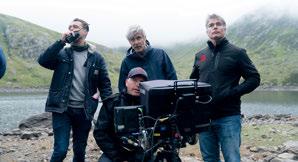
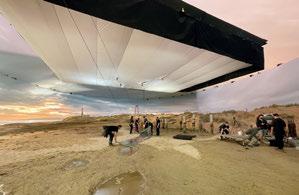
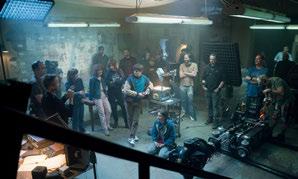
mostly used virtual production during prep for House of the Dragon, not to integrate visual effects into cinematography but as a planning tool to create virtual storyboards. (Photo:
Before leading the volume work on Percy Jackson and the Olympians, Cinematographer Pierre Gill experimented with virtual location scouting on an unreleased Assassin’s Creed game installment. (Image courtesy of Disney+)
Cinematographer Caleb Heymann with the cast and crew of Stranger Things Season 5. The show combined practical effects with blue, green and LED screens, using the latter for image-based lighting and vehicle work.
(Photo:
TOP TO BOTTOM: Vanja Č ernjul (standing center)
Theo Whiteman. Courtesy of HBO)
Atsushi Nishijima. Courtesy of Netflix)
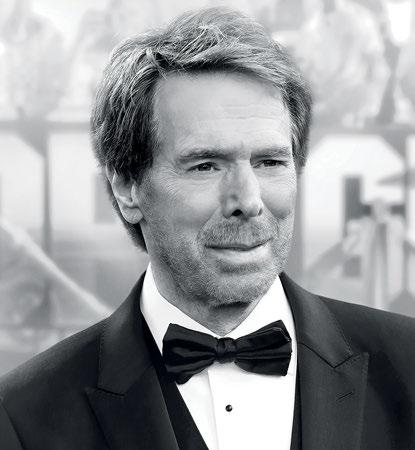
JERRY BRUCKHEIMER
– THE MAVERICK OF BLOCKBUSTERS
By TREVOR HOGG
Brand recognition is not something you usually associate with producers, as their role takes place behind the scenes, initiating projects, securing studio financing and recruiting creative talent, but occasionally certain names enter the public domain, such as David O. Selznick, Robert Evans, Richard D. Zanuck, Joel Silver and Jerry Bruckheimer. Jerry Bruckheimer’s nickname is Mr. Blockbuster, stemming in large part from his partnership with Don Simpson, especially during the 1980s and 1990s. Nothing got more epic and entertaining than Beverly Hills Cop, Top Gun, Bad Boys, The Rock and Armageddon
Currently, a different type of renaissance is taking place with Top Gun: Maverick and F1, resulting in Oscar nominations for Best Picture. “I wish I could tell you because every movie would be an Oscar movie of mine if I knew what it is,” Bruckheimer admits. “Both those movies are big and entertaining with terrific writing, a great cast and great directors. We were fortunate to get Joseph Kosinski on Top Gun: Maverick, and that Tom Cruise wanted to do it. The team that we put together with Christopher McQuarrie and everybody else was the magic on that movie.”
A love of cinema began at an early age. “I became aware of movies early on because I grew up in Detroit, and my folks would drop me off at matinees every Saturday,” Bruckheimer recalls. “I was enamored with that big screen. The Great Escape, Lawrence of Arabia, and some of those big epic movies made in those days by David Lean and others captivated me, and I wanted to be part of that world. I always thought I could never be an actor. That wasn’t my thing. I had to find a way in, and I don’t have the attention span that a director needs. I was always putting things together. Even when I was 10 or 12 years old, I put together a baseball and hockey team. I was always organizing people, so this comes easy to me because I’ve been doing it my whole life.”
A decision was made to follow his father’s advice: “Whatever you do, make sure you do something you really like so you don’t just have your vacation to look forward to.’” “Yeah, it’s so true. I mean, he was always on his feet. My father was a salesman and enjoyed what he did, but what he would have looked forward to was that two-week vacation. That was the thing that they dreamt about every summer, getting those two weeks off. Just the fact that he said, ‘Do something you love and try to find a way into it for yourself.’ I had a cousin who said the same thing.”
TOP: Producer Jerry Bruckheimer.
While producing award-winning Pepsi commercials for advertising firm BBDO, Bruckheimer discovered his way into the film industry. “Dick Richards brought me out from advertising. We did some commercials together and had a good relationship. Dick said, ‘I got this opportunity to make this Western at Fox. I want you to come with me to California. I can’t give you much money.’” I always bet on myself, so I took the $10,000, came to L.A., found a place to live, and I haven’t left. I’m still doing it.” Laurel Canyon was a music mecca during the 1970s. “I rented a house where Jim Morrison of the Doors threw a party in and poured all the pot in the fireplace and lit the place up. It was the Go-Go Years. It was the hippies and the bellbottoms. I lived across the street from Alice Cooper and the Monkees.” The further risk-taking led the up-andcoming producer to make American Gigolo his first independent
OPPOSITE TOP TO BOTTOM: Joseph Kosinski, Damson Idris, Brad Pitt and Bruckheimer in one of the many Formula 1 racetracks featured in F1. (Photo by: Scott Garfield. Courtesy of Apple Films)
Eddie Murphy and Bruckheimer reunite for Beverly Hills Cop: Axel F, the fourth instalment of the franchise that made the former SNL cast member an action-comedy star. (Photo: Andrew Cooper. Courtesy of Netflix)
Christopher McQuarrie, Tom Cruise, Joseph Kosinski and Bruckheimer on the set of Top Gun: Maverick
(Photo: Scott Garfield. Courtesy of Paramount Pictures)
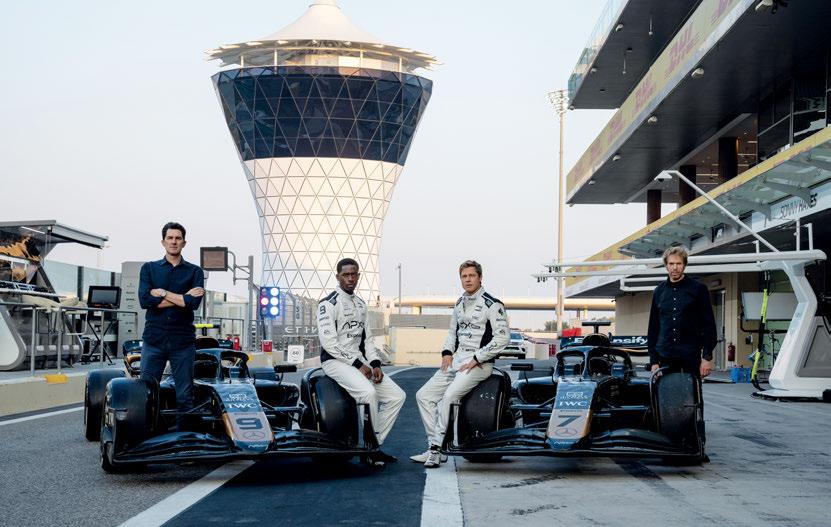
production. “It was a great experience. Paul Schrader is a terrific artist, a great writer and director.”
Bruckheimer and Don Simpson had a yin-and-yang relationship that paid off at the box office with Eddie Murphy and Tom Cruise rocketing into the stratosphere of stardom through their signature roles as Axel Foley and Pete “Maverick” Mitchell. “It certainly gave us the kind of gravitas that hit movies give you. Don was a great storyteller and salesman; he was a brilliant guy. I learned a lot from him. Don was somebody who came up with a lot of the ideas for the films; he was words on pages. Don spent his time working on character and story. He would spend weekends and all nights tearing scripts apart. I’m the one who actually had to go out and make it all work once that was done.”
Another influential partnership was with filmmaker Tony Scott and, currently, Joseph Kosinski, both of whom came from making commercials. “I suppose we have similar visions of what we want to do. But we can certainly tell war stories. We all know what it was like making those commercials and the fun we had doing it. No, I don’t think that really has any bearing, although I lean to some of the directors out of that world, because they’re such visual artists, and you have to tell a story in 30 seconds, and that’s really hard to do and get a unique selling proposition out. Those are things that these directors know how to do to stretch it out to two hours, which is where we’re at for most of our movies.”
The criteria for making movies is straightforward. “It’s got to be interesting, unique characters,” Bruckheimer notes. “You want a theme and an interesting plot. I also want to do something
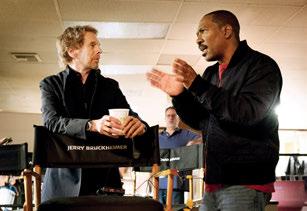
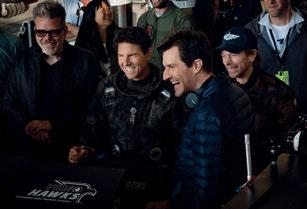
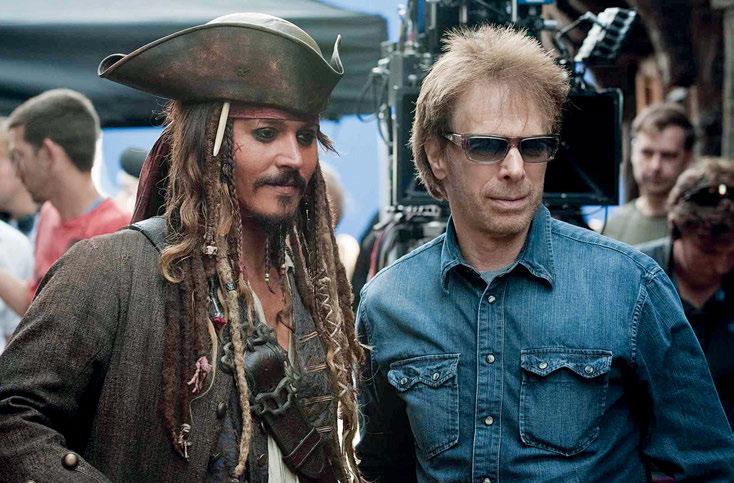
TOP: There is always a way to reinvent a genre, which was what Bruckheimer, Gore
BOTTOM: While making six films with Tony Scott, Bruckheimer got to work with Ridley Scott on Black Hawk Down, noting, “Ridley is the older brother, there’s no doubt about it, and Tony’s the wild younger brother who’s always getting in trouble.” (Image courtesy of RSA Films)
different, fresh, or put a different spin on something they haven’t seen before. F1 is that way. We’ve seen a lot of race-car movies, but the way Joseph Kosinski made it, and the craftsmanship between the visual effects and the live things he shot and how they blended everything together perfectly – it’s flawless. It’s seamless what he’s done.”
The role of producer has not changed. “A producer’s job is to interpret what the filmmaker wants to do and interpret it in the language that the studio will understand and feel comfortable with. It’s our job to get the best script possible, the best directors and actors, then sell it to a studio and get it made. There are different types of producers. There are producers who are brilliant at setting up movies but don’t want to be on the set. They just move on and set up the next movie. We’re the ones who are usually around and make sure that everything goes the way the director and I had planned it.”
Story matters more than trends. “There’s always a way into something, a genre that you can reinvent, and that’s what Gore Verbinski and I did on Pirates of the Caribbean,” Bruckheimer states. “We reinvented that genre in a fun yet edgy way, and that got the audience excited about that particular movie we made.” Getting the cooperation of the U.S. Navy or Formula One is a negotiation. “You know the certain things they definitely don’t
Verbinski and Johnny Depp were able to do with the Pirates of the Caribbean franchise. (Image courtesy of Walt Disney Pictures)
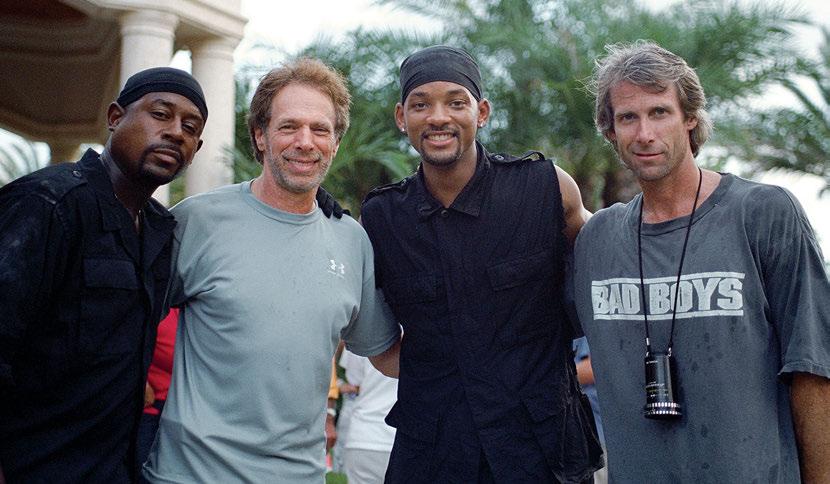
want to happen. You’ve got to make sure that you guide the process away from the things that scare them. The fact is that we’ve been so successful with the Navy and now with F1, and a lot of the stories we’ve told about real people. They still talk to us afterwards and love the movies that we made with them. They’re our partners in it, and we make sure they understand that.”
Success has also been achieved with television, particularly CSI: Crime Scene Investigation and The Amazing Race. “What happened is, it was a cameraman on Cops, and eventually a producer named Bertram van Munster and his wife, Elise Doganieri, came in and gave us this pitch on The Amazing Race, and we thought it was fantastic,” Bruckheimer recalls. “We took it around to the various places, and it was first ABC, then CBS, and God, it’s still going!” Producing television is no different than film. “It’s the same thing. You’re trying to stretch a dollar as far as you can. In movies, you get a few more dollars, but in television, you don’t have much. You’ve got to figure out how to make it work, and the ones that are successful figure it out and get the best people to work with them, then you end up with a hit series.” Certain things need to be taken into consideration. “When you write your screenplays, you have to understand it’s an hour format, and you’re going to have a limited budget.” The viewing environments are not the same for television and film. “People pay to go to the movie, so it’s got to
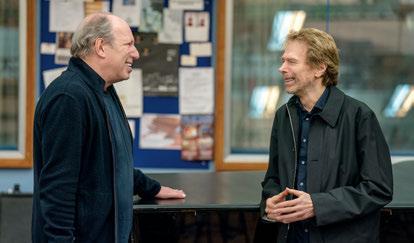
TOP: Bruckheimer, Martin Lawrence, Will Smith and Michael Bay take a breather together while shooting Bad Boys 2.
(Photo: Robert Zuckerman. Courtesy of Columbia Pictures)
BOTTOM: Bruckheimer considers Hans Zimmer to be one of the greatest living composers. (Photo: Ed Miller. Courtesy of Apple Films)
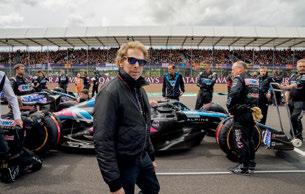
Not afraid to work with new filmmaking talent, Bruckheimer brought on Bilall Fallah and Adil El Arbi to helm Bad Boys for Life
(Photo: Ben Rothstein. Courtesy of Columbia Pictures)
Bruckheimer sees the producer’s role as interpreting what the filmmaker wants to do in a language that the studio will understand and feel comfortable with.
(Image courtesy of Apple Films)
be a little different and special. They can go home, turn on the TV, drink a beer, have a pizza and have their kids running around the house at the same time. It’s a much different way of entertaining an audience.”
Streaming services have had a significant impact. “Yeah, we’re fortunate that Apple leaned in and decided to do a theatrical release on F1,” Bruckheimer remarks. “That is the only way we’d have made it there. We would have had to do it elsewhere if they didn’t want to give us [a theatrical release]. And it worked out great for them. It’s their highest-grossing movie. It’s Brad Pitt’s highest-grossing movie. It’s the highest-grossing sports movie. Everything that we told them we could do, we delivered to them.” IMAX releases are extremely important. “The grosses on IMAX and the experience for an audience, especially on Top Gun: Maverick and F1, that experience in an IMAX theater is spectacular. We make sure that we have a good IMAX release on a lot of our movies.” Social media assists with marketing. “It’s a useful tool. Let’s put it that way. Warner Bros. did a terrific job, and so did Apple, on using the Internet to let people know that there’s an F1 movie and Brad Pitt is in it.”
Social media reactions are immediate. “There’s nothing you can do about that,” Bruckheimer observes. “You try to hold it to a minimum, but the movie has to speak for itself. They’re not going to listen to just one person. Sometimes, I’ve read audience reviews of movies that they said were terrible, then they come out and become huge hits. You can’t predict what’s going to happen.”
AI and machine learning are not going away. “We use it in a certain way, as a selling tool,” Bruckheimer states. “If we want to sell a project, we’ll use AI to do a reel of what the movie is going to feel or look like. We use it in post-production. I’m sure writers use it as a research tool. The visual effects houses use it. Everybody’s using it. It’s a revolution. It’s like a wave that’s coming our way, and I’m not sure we can stop it.”
Visual effects are a crucial part of the storytelling process. “It’s such an amazing tool,” Bruckheimer believes. “We couldn’t make the kind of movies we make without it. The expertise and things they’ve done over the last 10 years are amazing. I mean, just the things we did in Top Gun: Maverick and F1, I’m sure we couldn’t have done that five, six years ago with the quality we’ve achieved. For me, they’re the magic that makes our storytelling all work. They’re the creators of all these wonderful things that we put in our movies or our writers write. They say, ‘We can’t do this.’ And I say, ‘Yeah, we can. We have people who can do this.’ That’s what the visual effects give us; the kind of tools our directors need to create that magic.”
Even after receiving the VES Lifetime Achievement Award, getting the next film made remains a big challenge for Bruckheimer. “I don’t even think about it. I just do what I do, try to keep making entertainment and put one foot in front of the other. It’s nice that they honor me for a lot of the stuff I have done that people enjoyed and still enjoy. I’m just going to keep doing it. As long as they let me do it, I’ll be talking to you.”
TOP TO BOTTOM: Bruckheimer believes in being straight forward when dealing with creative people such as Christopher McQuarrie, Tommy Harper and Joseph Kosinski.
(Photo: Scott Garfield. Courtesy of Paramount Pictures)
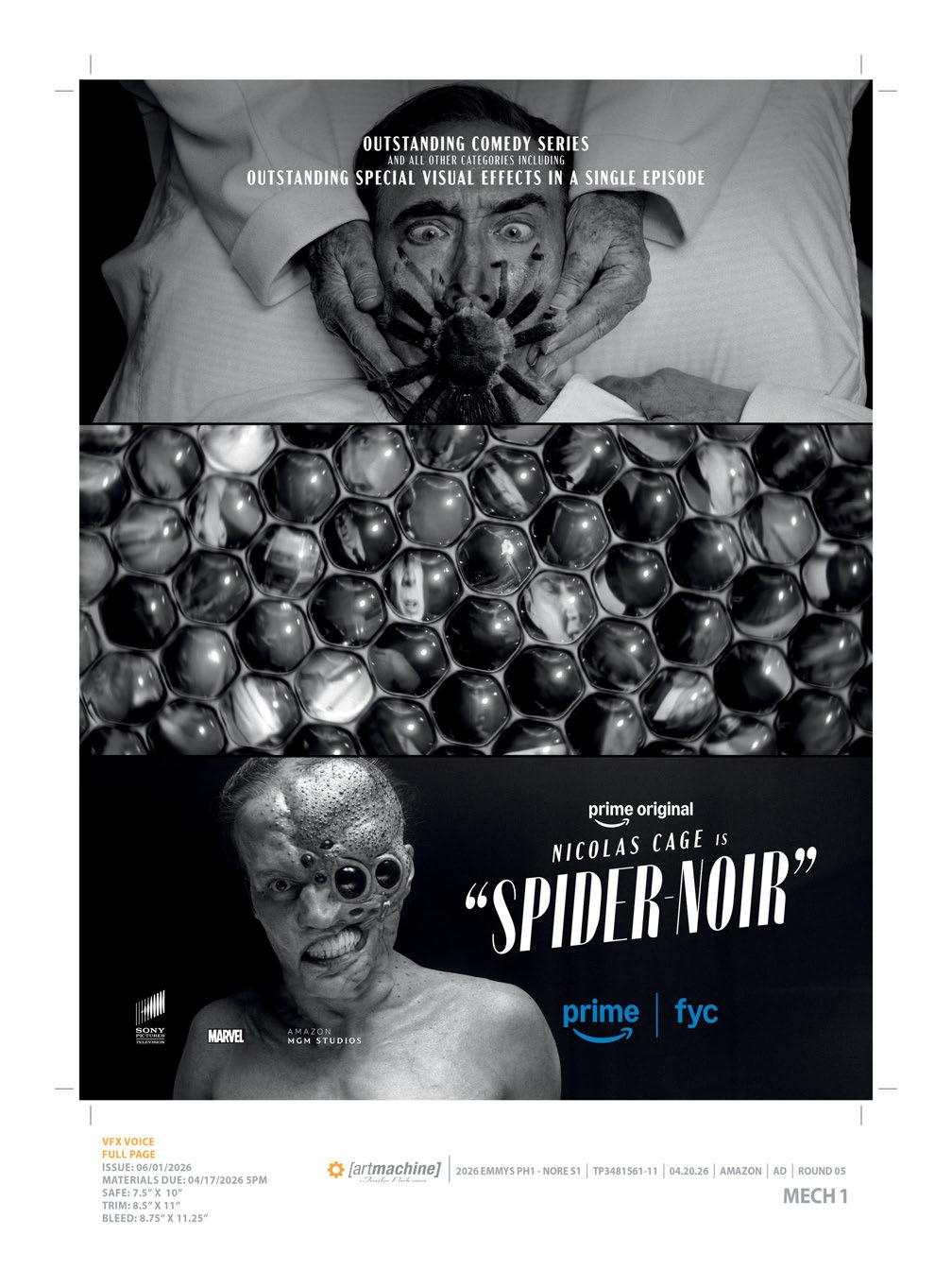
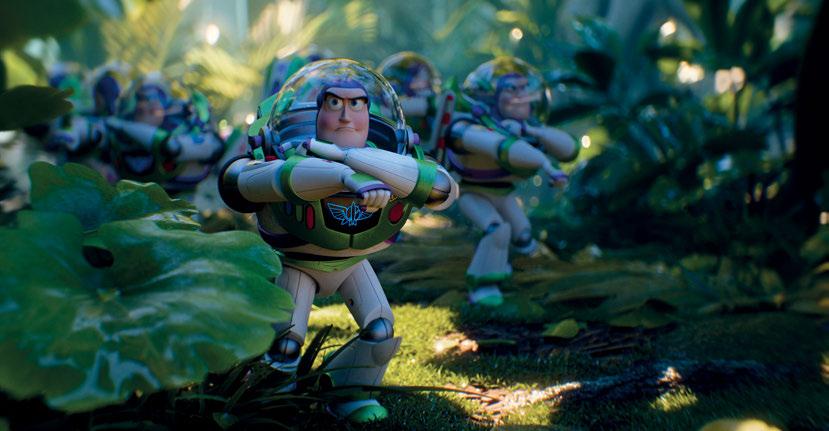
TOY STORY 5 EMBRACES THE PROGRESSION OF TIME AND TECHNOLOGY
By BARBARA ROBERTSON
Toy Story, Pixar Animation Studios’ first feature film, revolutionized the animated film industry. This tale of toys that come alive when humans aren’t around launched one of the highest-earning franchises in film history, with a worldwide gross now exceeding $3.3 billion. Its 1995 release proved that films created by artists using 3D computer graphics could achieve both commercial and critical success. Now, Disney and Pixar have released the fifth installment in the award-winning franchise, Toy Story 5.
In the 31 years since the first Toy Story, the three main toys haven’t changed much. Woody has a bald spot and a new red bandana cape, Buzz Lightyear sports a star sticker, and Jessie dons a sheriff’s badge. The world around them, however, has evolved, both within the film and at Pixar. Time and technology are tightly intertwined throughout Toy Story 5 and reflected in its production.
Images courtesy of Pixar Animation Studios.
TOP: Though the WiFi-connected Buzz Lightyears appear to operate with a hive mind, they are not background characters. These Buzz Lightyears come in and out of the foreground constantly.
OPPOSITE TOP TO BOTTOM: LilyPad, the film’s main antagonist, resembles an iPad, but she’s also a character: a screen encased in a green frog-shaped shell with a face and hands.
The three main toys haven’t changed much in the 31 years since the first Toy Story. However, the world around them has evolved, both within the film and at Pixar.
Art walkthroughs with Production Designer Bob Pauley and Graphics Art Director Laura Meyer at Pixar Animation Studios in Emeryville, California, September 2025. (Photo: Stephanie Martinez-Arndt)
“This film has been a real marker of time and of the progression of technology,” Andrew Stanton, writer and director, explains. Stanton – who earned two Oscars for directing WALL-E and Finding Nemo – has been a writer on all the Toy Story films, receiving two Oscar nominations for Best Screenplay for Toy Story and Toy Story 3. He co-directed the fifth installment with Kenna Harris. “Kenna is about half my age, as are many on the crew,” Stanton says. “So, it’s my job to remind people that what makes the toys interesting is the simple magic that they are alive in their world and not in ours. The children can grow, but the toys don’t. We don’t have to top the last film. We go where the child goes. The thing that’s exciting about the Toy Story world is that we can embrace time.”
Toy Story 5 reunites with Bonnie, first seen as a four-year-old in the third film, now a shy eight-year-old. Enchanted by the film’s antagonist, a computer tablet named LilyPad, Bonnie abandons friends and traditional toys like her rag doll, Jessie. Making Bonnie, LilyPad and the rest of the film possible are artists working with new technology developed at Pixar, a studio founded 40 years
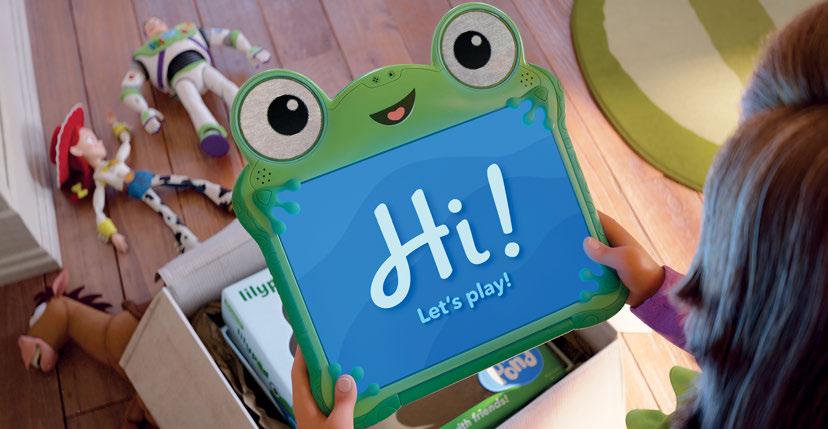
ago by many of the pioneers of computer graphics. “There are interesting parallels in this film to our experiences working on the film,” Harris notes. “Andrew is the established voice of Toy Story. He understands and values tradition. Suddenly, I’m like LilyPad coming into the room. Something new. Flashy. Something that might be entertaining and surprising.”
NEW TECH
Chief Technology Officer Steve May was in graduate school when Toy Story was released. He joined Pixar in 1998. “Toy Story 5 is really cool, and it’s fun that Pixar continues to push new technologies,” he says. “Three big ones came together: the Luna extension for Presto, RenderMan XPU and Invertible rigs. It’s appropriate that we are using a new version of RenderMan for the first time on a Toy Story film because what’s older than Toy Story? RenderMan [introduced in 1988].”
In addition to the three new advances, the film posed a range of technical challenges, including Bonnie’s new friend Blaze’s curly hair, 50 upgraded Buzz Lightyears, 50 plastic horses, Bonnie’s interactions with LilyPad’s onscreen graphics and a stylized fantasy playtime.
LIGHTING AND RENDERING
Pixar first used Luna, the new lighting tool, for a half-dozen interior shots on Hoppers, then expanded its use to two exterior sequences on Toy Story 5. With Luna, lighting artists can work across multiple shots at once. When they adjust the position of the sun in one shot, for example, they immediately see the effect ripple across a grid of shots. “We like to take a measured approach with new technology and give the tools team feedback,” Thomas Jordan, Visual Effects Supervisor, says. Like May, he also joined Pixar in 1998. “We chose one sequence in the epilogue with many characters and another with lots of trees, vegetation, characters
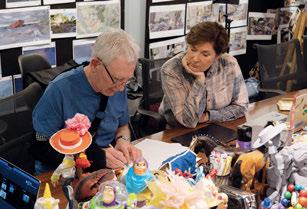
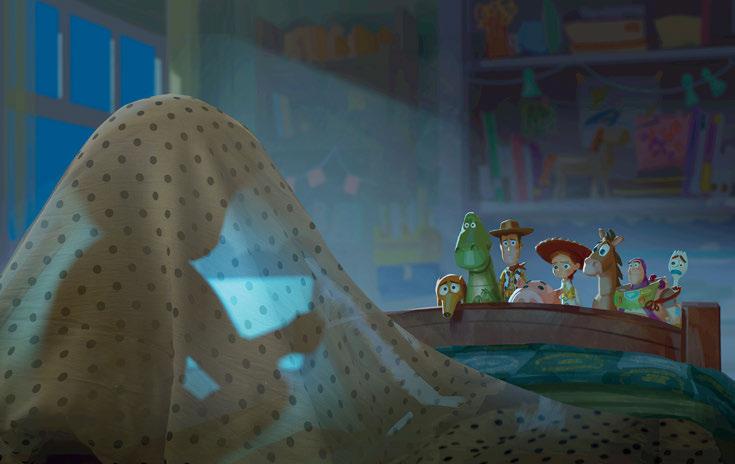
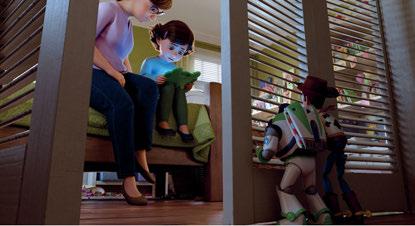
BOTTOM: The glow from Lilypad’s screen “is the light that hypnotizes kids and takes over their world,” describes DP Jean-Claude Kalache.
OPPOSITE TOP TO BOTTOM: Pixar used a new version of RenderMan for the first time on a Toy Story film.
The upgraded new-tech Buzz Lightyears shine compared to the cache of Blaze’s old tech and a weird subculture of toys left outside in a plastic shed, including Smarty Pants, a potty-training device.
Co-director Kenna Harris and writer/director Andrew Stanton at an animation continuity review & dailies session. Stanton believes what makes the toys interesting is the simple magic that they’re alive in their world and not in ours.
with hair and streetlights. Using Luna for the two sequences was a great success.”
Also significant was the first use of RenderMan XPU on a feature film. It marked the first time the crew switched renderers mid-production. “XPU is not a new feature; it’s a new renderer,” Dylan Sisson, Head of RenderMan Creative Engagement, states. “The challenge was to get GPU acceleration implemented in a way that we could produce the final pixels out of whatever hardware. That’s a hard problem to solve. But now we can roll into a production without worrying about whether a GPU render matches the CPU.”
Although Sisson acknowledges there is often hand-waving around rendering times, he says that with a GPU and CPU running concurrently, the team has seen nine times faster speeds for interactive, full-frame rendering – even faster with multiple GPUs. That gain can affect the entire animation pipeline, from layout to lighting. “Once a shot is in memory, we can see full-frame renderings almost in real time,” Renee Tam, Global Technology Supervisor, says. Tam led a team that checked the pixels produced by XPU. “It’s so much faster than RIS, and the pixels that come back are better,” May notes. “The thing about Luna and XPU is that they work well together, and they leverage USD. It’s the culmination of a bunch of hard work.”
RIGGING AND SIMULATION
There are two “real live” animals in the film, a Quarter Horse mare named Daffodil and a pig named Jimmy Dean. Animators working on these quadrupeds relied on a new rigging system called Invertible. May explains, “The idea is that you can do direct manipulation, inverse and forward kinematics, with every control in the character. You can bend a finger or pull it, move the hand, then pull the elbow and shoulder with it, solve the way feet make contact
TOP: In Toy Story, the children can grow, but the toys don’t. Time and technology are tightly intertwined throughout Toy Story 5 and reflected in its production.
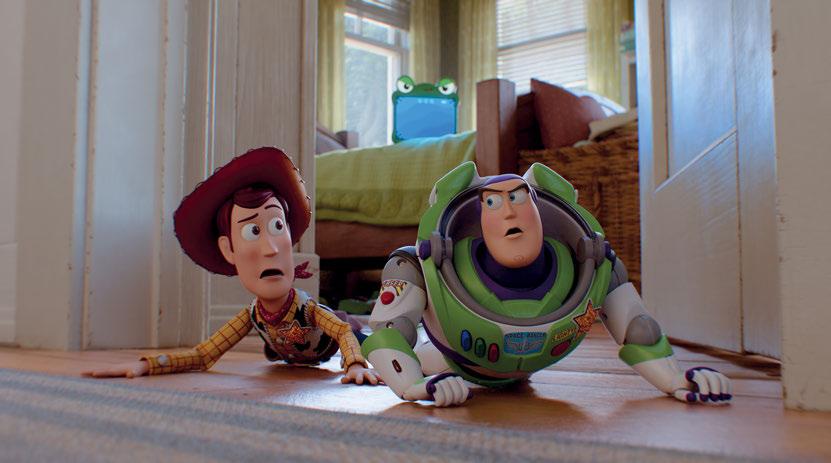
with the ground and make the ankles roll. Riggers no longer need to build unique controls for special manipulation.”
Harris notes that Daffodil took more than a year to build, rig and sim. “We haven’t had a horse character since Brave, and that one was caricatured,” she states. “The people here are wizards. They made every muscle appear under her skin as she moves. It’s mindblowing.” Mariana Galindo, Simulation and Tailoring Supervisor, adds, “From a simulation standpoint, it was intense. Muscles firing with skin dynamics plus mane, tail hair and braids — all these pieces interacting together created a majestic animal. The pig had a larger mass and less muscle articulation. So, his dynamic was more about creating jiggle and weight.”
Blaze’s curly hair presented another challenge for the simulation team. The system originally built for Merida’s wild, curly red hair in Pixar’s Brave required upgrades for Blaze’s locks. Pixar named the new system Fizt Strands. “We built a new toolset to create curly hair using spring-based curves and a new solver,” Galindo reveals. “Merida had flowy hair, but Blaze’s hair has tangled curls that feed into each other. We had procedural workflows that helped the artists groom her hair into shapes and curls that sim’d into place. They can shift the hair around for the right posing and positioning – to have a more creative conversation with the character.”
CROWDS OF HORSES AND BUZZ LIGHTYEARS
As in previous installments, Jessie the rag doll has a toy horse called Bullseye, but in this film, he’s one of many. The 50 or so toy plastic horses on Blaze’s shelves attest to the child’s love of horses. “We learned there’s a whole subculture of plastic horse collecting,” Bob Pauley, Production Designer, says. Pauley has worked on all five Toy Story films. “We have Disney horses, Barbie horses, palominos and other types, sixth-scale and ninth-scale horses.
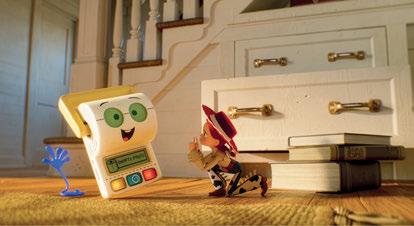
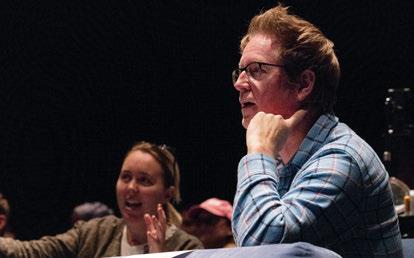

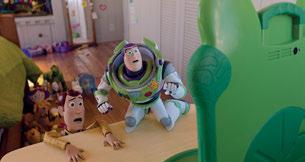
Python scripting was used to automatically figure out which kind of animation applies to which character based on the context.
Writer/director Andrew Stanton feels that artists, animators and software developers have reached a place where if you can think of it, you can do it, which “allows us to be smarter and better storytellers.”
Thirty years ago, Bob Pauley was styling the original Buzz Lightyear. Then, in 2025, he found himself drawing new versions of Buzz, “like what a toy manufacturer might do to upgrade a toy.”
Horses with springy legs and articulated legs. We even have a knight chess piece.”
The horses don’t stay on the shelves, though. Fifty upgraded Buzz Lightyears ride them. “There’s something nostalgic about working on Toy Story 5,” Pauley admits. “Thirty years ago, I was at my desk styling Buzz Lightyear. Then, several months ago, I was drawing new versions of Buzz, like what a toy manufacturer might do to upgrade a toy. There’s always a technical challenge with these films,” he adds. “In this film, it’s the volume. Fifty Lightyears and 50 horses crunch the rendering.” May notes, “It gets crazy. Creating them and animating all of them at the same time was a complicated problem. Hopefully, the audience will be laughing hysterically.”
The first shots loaded with all 100 characters, crashed everything –software and computers. Though the WiFi-connected Buzz Lightyears appear to operate with a hive mind, they are not background characters. “The 50 new Buzzes and the original Buzz are intertwined,” Harris explains. “They feel called on to do something.” Jordan adds, “With background characters, we can do optimizations. But these Buzz Lightyears come in and out of the foreground constantly. The animators needed access to all the controls.”
Working closely with the animation team and directors, Crowds Technical Supervisor Paul Kanyuk’s team wrangled 50 Buzz Lightyears on and off horses using a path-based system for crowd choreography. To avoid drawing 50 separate paths, they created a central guide path that they could bend into other paths using the new Bendolater tool. “We try to start with pre-animated cycles,” Kanyuk says. “Buzz alone, Buzz on toy horses with springy legs, horses with wheels and so forth. The complexity comes from ground adaptation, blending from one clip to another, and intercharacter dependencies. It gets very complicated very quickly. In one sequence, they’re even flying. I did a lot of Python scripting to automatically figure out which kind of animation applies to which character based on the context.”
Once the riders and horses are galloping along, the Crowds team bakes that animation and, via USD, injects it back into the animation system for the layout artists. “It’s almost like an animated cache with bells and whistles,” Kanyuk explains. “We promote the pre-animated cycles to full animation.” At that point, the horse-and-rider unit becomes two units. The upgraded new-tech Buzz Lightyears shine compared to the cache of Blaze’s old tech and a weird subculture of toys left outside in a plastic shed. “They’re weird and adorable,” Pauley says of the old-tech devices. “And existential. They’re approaching the end of their time. We have Smarty Pants, a potty-training device. Snappy, an old digital camera. And, Atlas, a GPS device.”
The film’s main antagonist, however, is a new technological device.
LILYPAD
LilyPad resembles an iPad, but she’s also a character, a screen encased in a green frog-shaped shell with a face and hands. She plays a central role in the story as Bonnie struggles to make friends in real life. Bonnie’s toy, Jessie, wants to help, but LilyPad is having none of that. “It’s fun to see LilyPad get into verbal barbs with Woody and Jessie, but we knew from the beginning we did not want to vilify her,” Harris says. “She had to be a character that would change and be accepted into the rest of the film.”
Animators had to balance the attention-grabbing graphics on
TOP TO BOTTOM: Concept art. One of the technical challenges posed by the film was Bonnie’s interactions with LilyPad’s onscreen graphics.
LilyPad’s screen with her animated face and hands, a challenge that also tested lighting artists. “If you see LilyPad’s point of view, there’s a grid on the image, but if you see her from someone else’s point of view, she’s in shadow,” Jean-Claude Kalache, Director of Photography, says. “We put her in shadow as much as possible. She’s an antagonist, but also, technically, it makes sense to shoot against dark.”
Her screen is always a source of light. Thanks to a script the crew developed that made her screen ignore light shining on it, it is always visible and casting a glow. “It’s the light that hypnotizes kids and takes over their world,” Kalache says. “You literally feel it. It wasn’t hard to research. I could just look at everyone on their phone in the room. There’s blue on their faces.”
For animators, the next challenge was having Bonnie’s finger interact with the animated graphics on the screen. “We’ve never had a screen that’s a character in itself, so we needed a way for the animators to influence the 2D screen graphics,” Jordan says. “The art department creates the onscreen graphics. Animators don’t have tools for that; it’s outside the animation workflow. So, we came up with a system we call SketchPad. An animator can draw as if they were sketching in 2D with a pencil, but they’re drawing in 3D over time. We can use that as a guide for timing. We also used that tool for our fantasy scenes.”
STORY TIME
The characters in Toy Story 5 interact across different time periods, each with its own treatment. “We have different camera setups for shots in the ‘80s than the ‘50s,” Kalache says. “And we added camera artifacts that were fixed over the decades.” As for the imaginary times, Andy’s fantasy sequences were hyper-realistic in previous films. But Pauley explains that in this film, Bonnie and Blaze play differently. They conjure poetic, sweet, pastel, sketchy scenes – more emotional than realistic. “In one moment, they’re in her hallway and in another they’re in a grand ballroom drawn in the style of pastel chalk, like a child making arts and crafts,” Jordan shares.
There’s an homage to Bambi that transforms into something Bambi-esque, then evolves into new spaces, including a wedding chapel and a gazebo. “We had to forget everything about lighting and start over,” Kalache reveals. “It took three months of research, and then, once we put the vision together, more time to figure out the number of tools we needed. The imaginary sequences were difficult because we had to learn what they were. It was very hard.”
They succeeded. Harris notes, “I was talking with Andrew [Stanton] yesterday, and we agreed that working on this film was not easy, but the team was so tight and well-formed that challenges along the way didn’t feel like impossible challenges. We didn’t have a moment like that. Everyone problem-solved along the way.”
Woody, Buzz Lightyear, and Jessie haven’t changed much over the years, but the crew – artists, animators, software developers, and beyond, who create these beloved characters – have perfected their craft. “They are professionals to the point of being the masters of their craft,” Stanton says. “We used to talk about how to execute something; there used to be some technological thing to conquer. Now, I tell experts in their field, this is the mood I want, the result I’m trying for. I feel we’ve reached a place where if you can think of it, you can do it. And that allows us to be smarter and better storytellers.”
Battle-testing XPU
Pixar progressively shifted its rendering method from its original Reyes in the 1980s to a hybrid ray-tracing version of RenderMan, used until Finding Dory. Around a decade ago, the studio made another decisive leap, adopting the Monte Carlo path tracer RenderMan RIS.
“Then we started working on GPU acceleration,” says Dylan Sisson, Head of RenderMan Creative Engagement. Now, the latest version of the venerable software, RenderMan 27 with XPU, can use any idle CPUs or GPUs for rendering without changes to any assets or light shaders. The GPU renders match the CPU renders. “Ten years ago, GPUs didn’t have enough memory to render production frames. But now we can fit a full frame on the most advanced GPUs,” Sisson says. “The new NVIDIA Blackwell can store 99% of the Pixar shots.
That means fast, interactive rendering of full frames. How fast? Sisson says there are many variables when judging speed, but he’s seen speeds nine times faster using the combination of GPU and CPU. And he notes they can use multiple GPUs.
To battle-test XPU on Toy Story 5, the team chose an interior at Bonnie’s new friend Blaze’s ranch. Because they could alternate between RIS and XPU without changing any assets or light shaders, they could compare and evaluate XPU renders in each shot. Renee Tam, a Global Technology Supervisor, led a team that checked the pixels XPU produced.
“XPU renders are sharper a lot of the time because the tessellation is better,” Tam says. “There are edges in the geometry where the calculation is more accurate. But accurate doesn’t always mean good. It means different. If a shot doesn’t look right, we go into every single asset, every single light, and we can have tens of hundreds of lights, to figure out what is happening.”
For example, a large dog pillow on the floor looked much brighter when rendered with XPU than with RIS. When the team zoomed down to a micropixel level on the RIS render, they could see holes; the old algorithm did not make a smooth surface from the geometry tessellates. “The RIS renderer looked through the holes to the dark inside, so the pillow looked darker,” Tam says. “With XPU’s better tessellation, the surface was ‘water tight,’ and the surface was brighter.”
To give the pillow from the better renderer the approved look from the RIS renderer, the team rendered it with XPU and then tweaked the lighting. Similarly, they would soften lighting if a character’s geometry looked too sharp. XPU’s iteration speed made that task easier.
According to Sisson, Renderman 27 with XPU is now available. Pixar plans to release a version of XPU with full-frame rendering and the final features for visual effects feature film production workflows in the fourth quarter of 2026.
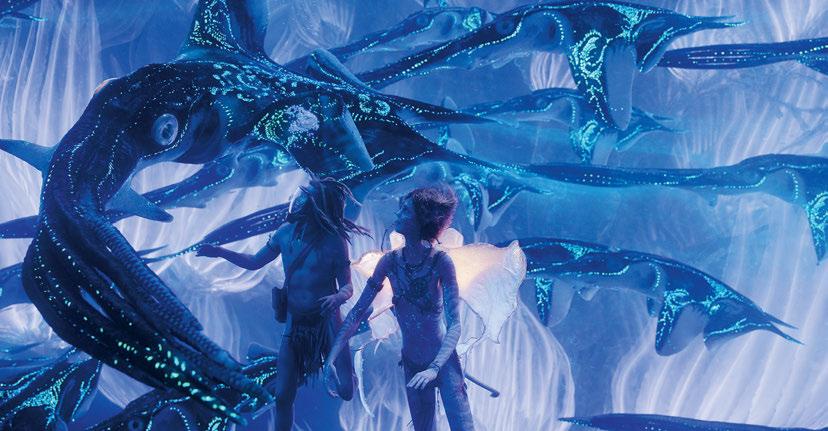
CHANNELING THE INNER BEAST FOR CREATURE EFFECTS
By TREVOR HOGG
Creatures are considered bread-and-butter visual effects work, whether the request is photorealistic or stylized. While the pipeline is updated to accommodate technological advances, such as AI-enhanced motion development or the use of game engines for previs, the fundamentals remain the same: to create something that can believably perform within the world it inhabits.
Every creature needs to have its own history and a reason to exist. “It is important to understand how the creature came about, what life experience it has had so far, and you want to show this story in its details,” remarks Jan Philip Cramer, Visual Effects Supervisor at Digital Domain. “It is essential to have a good muscle/deformation solution. This goes hand in hand with a fur/ hair system. In addition, it helps to have a good understanding of faces. For our creatures, we tend to have simpler facial setups, but it is a big help to be able to utilize our human face setups [Thing and Thanos]. At Digital Domain, all downstream departments, after animation, work in Houdini. This is a great help to integrate the muscle and fur with additional effects for saliva and character-specific ideas, such as fire, acid, or other elements that define the character.”
TOP: When it comes to alien and fantastical creatures, like the Tsynong in Avatar: Fire Ash, Wētā FX will often pull from nature to ensure that the anatomy is functional. (Image courtesy of Wētā FX and 20th Century Studios)
OPPOSITE TOP: Environmental interaction is the secret to integrating a CG creature into a live-action plate for Ted 2 (Image courtesy of Tippett Studio and Universal Pictures)
OPPOSITE BOTTOM: Facial performance is a key component to having a successful creature or character, such as being able to transform Harrison Ford into the Red Hulk for Captain America: Brave New World (Image courtesy of Wētā FX and 20th Century Studios)
Ricardo Gomez, Creature Supervisor at Digital Domain, concurs with Cramer. “The shift to Houdini and Solaris has also helped streamline the process of creating and implementing complex groom and feather systems for creatures, allowing us to achieve the desired look that was more challenging to produce in the past.” Several types of facial rig systems are deployed. “Which one is being used is usually dictated by the type of performance being given,” notes Ron Miller, Asset Supervisor at Digital Domain. “Creatures will usually leverage a traditional FACS rig, as it’s incredibly flexible and art-directable. However, any performance where the actors’ likeness is essential [She-Hulk and Thanos] will use our Masquerade pipeline or a combo of both.”
“For most creatures, clear, well-registered anatomical
structures that make sense are super important,” states Gios Johnston, Head of Creatures and Virtual Art Department at Wētā FX. “We want these structures to be physically functional, whether for animation, articulation, skin deformation, or shading and lighting purposes. For example, we will often go through a few iterations, making sure that the anatomy sits where it needs to be to allow an appropriate range of motion. This includes ‘in-motion’ tests to work through locomotion; how heavy a creature might feel or look. We’ll ensure that the anatomical underpinnings will functionally work. For alien and fantastical creatures, this can be an additional challenge! In these cases, we often need to pull from nature to find aspects of bugs, animals, insects, or even plants that we can use to tie back in and make certain aspects of a creature work functionally.” There is room for improvement. “One space we can improve is to strive to provide animators a closer representation of the final product. Animators often must use stripped-down puppet representations for scene performance reasons. Still, we are getting closer to providing accurate skin deformation and even dynamics, allowing animators to finesse performance with better knowledge of how dynamic elements will behave. Historically, there has been a disconnect between what they see when animating and the ‘final’ result. Closing that gap is important. Accelerated simulations that allow creature artists to achieve realistic results faster will enable faster delivery and potentially higher fidelity as well.”
Scheduling and budgets have to be kept in mind. “We are definitely trying to be smarter these days in terms of how much time and money we invest in building assets ahead of time,” remarks Pierre-Loic Hamon, Head of Creatures at Framestore. “The more information we have for the context, the better because it helps us to tune the functionality and the quality of the build to fill those needs. We have a target for what matters, whether it’s the way you see it move or perform, or the angles or proximity to the camera.
All of that ends up mattering because we constantly reassess the show’s needs, and we’re on the edge of spot-on, slightly more, or a lot more. Overbuilding happens faster than you think. There are so many levels of making good judgments about where effort is most important. It varies literally from creature to creature and show to show, so you have to be able to adapt. In recent years at Framestore, all the teams have been so strong that we have good artists at all levels and specialties, so we tend to be quite well-tuned. We know what is expected, build to a certain level based on our understanding of those needs, and then refine. The most important aspect of creature-building is the ability to refine continuously, and you want to do this efficiently.”
Unreal Engine assisted in choreographing the fight between Harmada and Nemesis in Rebel Moon – Part One: A Child of Fire “It was actually stunts who came and said, ‘We want to try to use
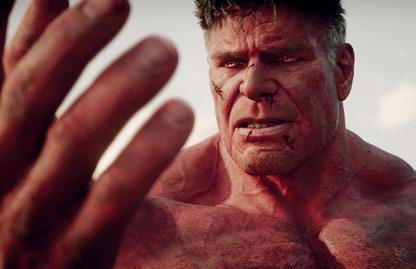
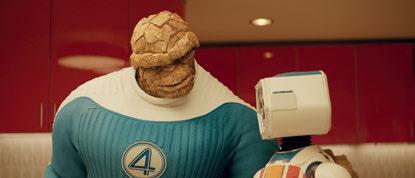

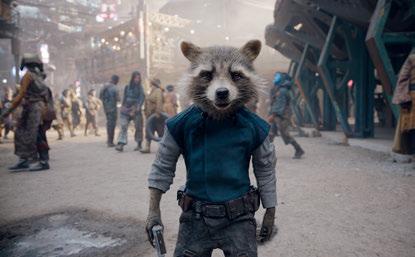
TOP TO BOTTOM: The Thing and robot H.E.R.B.I.E. in Fantastic Four: First Steps. A good creature pipeline is not the easiest to develop, as it needs to cover so many character-specific and simulation-intensive elements. (Image courtesy of Digital Domain and Marvel Studios)
Micro details, such as pores, scars, subtle color variation and surface breakup, give richness and authenticity to close-up shots on It: Welcome to Derry. (Image courtesy of Rodeo FX and HBO)
Rocket in Guardians of the Galaxy Vol. 3. Scheduling and budgets must be kept in mind when constructing creatures. (Image courtesy of Framestore and Marvel Studios)
this in Unreal Engine. How can we accomplish this?’” recalls Marcus Taormina, Visual Effects Supervisor for Rebel Moon – Part One: A Child of Fire. “We actually brought in a couple of artists to help with stunts and put them in the stunt stage with computers. An asset was built, but it was a preliminary asset, obviously, a spider you can only deviate so much from in terms of the body shape. We also scanned Jena Malone upfront, placed her body onto the spider, and gave it off to that team. They were able to use Xsens suits or inertial suits, and bring that back through Unreal Engine. Because the space was so small, I laid out a piece of paper, and said, ‘This is how big the spider is.’ Stunts went back, and we had them constrain it to the 3D model of that space, which was being built. All the performances were driven by a stunt performer and handed off to Jena. But it was also true to the set size. For that, we were able to plot out, ‘Where’s our camera going to be?’ They did a couple of crazy sweeping moves, and we’re like, ’That’s a digital shot because we can’t do that camera move.’ But it really helped because that sequence was shot over three days, plus one second unit. It’s a slim time to shoot that amount of action. Once they got it through Unreal Engine and the editor created a cut, I would go through it shot by shot and put all of the breakdown notes on it so we knew, ‘That’s going to be a swivel rig or the cantilever coming down.’ It was much more efficient.”
Animation requires more flexibility in the creature toolset than live-action, which aims for photorealism rather than stylization. “We actually have a modular rigging system that we use for both, but the needs are different,” states Hank Driskill, Head of CG for Feature Animation at Cinesite. “In animation, your character designs themselves are quite caricatured because there’s a shape language to that movie. Part of the fun of animation is that no movie is a cookie-cutter copy of the one before. Every movie has its own set of challenges. There’s a movement style to the movie as well. We do physically-based things, like cloth and hair simulation, but we do them on characters that don’t move in physically correct ways. In animation, there tends to be more punctuated motion, so characters accelerate from a stop and come to a stop in non-physical, non-realistic ways; that can play havoc with things such as simulation. The characters have a foundation in reality, but if you put them against reality, you see there are distinct differences.”
AI and machine learning help maintain consistency in how characters and creatures are animated. Driskill says, “When I was at Blue Sky Studios, we built out a rigging thing where the riggers built their controls for the characters exactly the same way. There is a set of deformers and a whole bunch of mathematical stuff that warp the character frame by frame as the animators toggle through their controls. The set of controls the animators were presented with was exactly the same. In between those two, an AI was trained to understand how that rig was behaving, so that when you moved a particular control, it knew what it did to that mesh, that character shape, and then the AI replaced the rig. While the individual people’s jobs were exactly the same, the rig was literally 20, 30, 50 times faster.”
Changes are inevitable and can be accommodated with a parallel workflow. “When teams can move forward simultaneously, with the right safeguards and communication in place, it becomes much easier to absorb changes without bringing everything to a halt,” remarks Josée Chapdelaine, Head of Groom and CFX at Rodeo FX. “Timeframes are always tight. You cannot afford to spend a week pushing a small
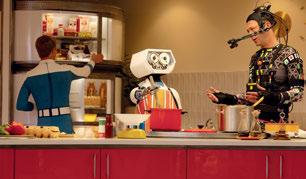



TOP TO BOTTOM: A practical H.E.R.B.I.E. was developed for Fantastic Four: First Steps and driven by a technician to interact with the actors, which enabled visual effects artists to leverage the look and performance when developing the animation for the robotic character. (Image courtesy of Digital Domain and Marvel Studios)
The Mind Flayer in Stranger Things Season 5. Wētā FX focuses on high-quality creature asset builds, which means less work ‘fixing’ the assets in shots. (Images courtesy of Wētā FX and Netflix)
Monster Strike. At Tippett Studio, talking through the character with the director is a better path forward than reading the script. (Image courtesy of Tippett Studio)
Poses and silhouettes always need to be kept in mind when designing a creature, such as for Hitpig! (Image courtesy of Cinesite and Netflix)
modeling change through every stage of the process. A strong creature pipeline is not just about producing beautiful assets; it is about creating a structure that supports collaboration, adaptability and speed while maintaining quality across all departments.” Special effects teams construct physical replicas from the conceptual 3D models, allowing for better integration between practical and digital elements. “This greatly enhances on-set interaction, generating accurate shadows, eye lines and contact points while also serving as a valuable visual reference for the DP to plan lighting better,” states Jean-Sébastien Guillemette, Head of Operations 3D and Assets at Rodeo FX. “The resulting footage then becomes a strong reference for all creature departments, helping to faithfully represent the director’s and DP’s vision as established on set.”
The convergence of physically-based rendering and anatomical simulation effects within a single software package, such as Houdini, has advanced creature work. “This democratization of tools helps us push the creative aspect much further than before,” Guillemette notes. “Our capacity to simulate layered skin, muscles, fat and fur with physically accurate light response has been greatly increased in the past decade. Combined with procedural workflows and more responsive renderers, such as Arnold or Karma, that have shifted creatures from visual spectacles to believable, emotionally-driven characters that integrate seamlessly into live action.”
Performance and facial capture have been a game-changer. “It keeps getting better and better,” notes Mark Dubeau, Senior Art Director at Tippett Studio. “And, as it does, you can preserve more and more of the character of the performer. It does need a lot of post work to nail it, and that needs to be recognized a bit more than it currently is. There’s no way you can map a human performer to a gorilla and have it look natural out of the gate; there’s still a lot of artistry that goes into it. They’re a partner in performance.” Proper rigging provides a solid foundation. “At Tippett, we have developed a robust puppet system in which jiggle and muscle blend shapes that can be activated directly by animators, rather than automatically or through the effects department,” explains Tom Gibbons, Animation Supervisor at Tippett Studio. “This does add time to the animator’s schedule and gives them more responsibility to understand biomechanical and physics-based performance aspects, but it has also allowed us to rely more on artists instead of integrating very expensive software and depending on a technical process that may be more opaque than working directly with a person.”
A current trend involves machine learning-driven deformers. “A creature’s skin responds dynamically based on trained models rather than predefined behaviors,” remarks Bala Murugan, AI Research & Development Supervisor at PhantomFX. “We’re also seeing the rise of digital twins; practical puppets scanned with such precision that the transition between physical and digital becomes nearly imperceptible. More broadly, the industry is shifting from building creatures shotby-shot to designing intelligent systems that allow them to perform consistently across an entire production. In the end, everything is about generating an emotional reaction from the audience.”
“It always starts with story and purpose,” states Anish Sreedhar, Head of CG at PhantomFX. “If you don’t know why the creature exists and what it needs to make the audience feel, the design won’t land. Ultimately, if the audience can describe how the creature feels rather than how it looks, you’ve succeeded.”
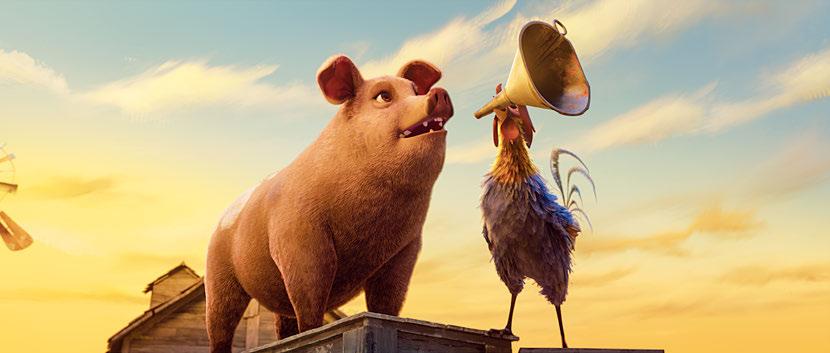
TENDING TO THE ANIMATION AND DESIGN NEEDS OF ANIMAL FARM
By TREVOR HOGG
We don’t know how George Orwell would have reacted to the CIA making his seminal novel about how power corrupts part of their anti-communist propaganda during the height of the Cold War by releasing an animated feature. However, he did not think well of colonialist Rudyard Kipling, who explored the same theme to the point of writing a damning essay about him. Seven decades later, a consortium comprising Aniventure, The Imaginarium Studios, Cinesite and Angel Studios has decided to produce its own animated reinterpretation of Animal Farm under the direction of Andy Serkis and has adopted the tagline “A Cautionary Tail,” which reflects the adaptation’s desired tone.
TOP: Because the animals talk, it was important not to lean into photorealism; Otherwise, it would be
OPPOSITE TOP TO BOTTOM: The color scripting, cinematography and lighting play a significant role in determining the tone for each shot.
Cinesite leveraged Maya as its 3D animation package. The quantity of characters was Production Designer Amos Sussigan’s biggest concern.
“Big, heavy themes are at play here,” states Eamonn Butler, Associate Director of Animal Farm, when discussing the farm animal uprising that leads to their liberation from human subjugation, which then transgresses into a totalitarian dictatorship. “Focusing on trying to make this accessible to the family audience was the key thing. Once we started playing into keyframing characters, and leaning into design and our themes of naturalism versus artificiality, which came out of our initial look development phase. That opened us up to ask, ‘Okay, naturalism. What does that mean?’ That meant leaning into analog filmmaking techniques, such as using real lenses and the look you see in movies like Days of Heaven, The Natural and Field of Dreams. Beautiful, gorgeous films that were shot with real lenses on film. That gave us a strong foundation for the world the animals wanted and believed in. For artificiality, we used anamorphic lenses and much more sterile artificial lighting. We found that it was a great route for us to play into all of the themes. We didn’t want to be pointing the finger at modern political situations, but rather remind people to think about their situations and make sure that they use history as a lesson and even potentially a warning. By using our brains, we
Images courtesy of Cinesite and Angel Studios.
jarring.
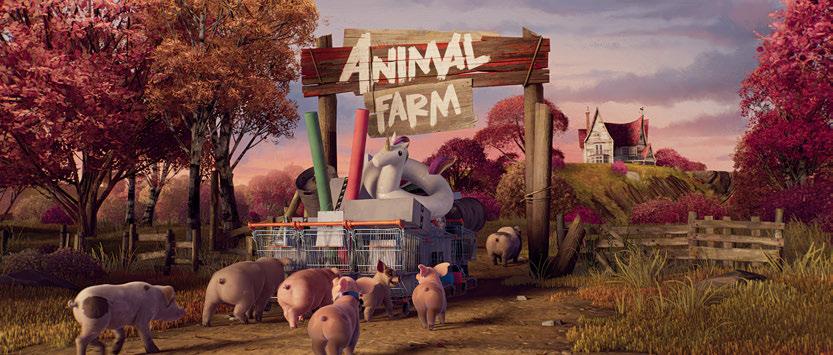
“In the barn where they have these big meetings with all the animals... Whenever the camera turns, you’re always seeing a whole bunch of stuff. That’s where having a library pre-built enabled us to move quickly and populate shots that needed that scope of animals doing their thing without stopping us and slowing us down. Having a pre-made library was a huge plus.”
—Eamonn Butler, Associate Director
can look to the past to help us make decisions about what’s right for us in the future.”
Stylization assists with the suspension of disbelief. “It allows you you to cross that barrier to accept that animals can talk, and eventually pigs can stand on their back legs and do what they need to do in the story,” Butler notes. “We didn’t want to lose their humanity in that, and also their ideology was quite simple. We wanted people to believe that this is exactly the world animals would want to live in. However, there’s a turning point when the animals, particularly the pigs, start to walk on two legs. We looked at that and did some testing. For example, a pig’s leg or an animal’s hind legs: their ankles are quite far from their toes, and if we plop them down like human feet, they start to look like clowns. We pulled it back. They’re still walking on their hooves. They’re still animals trying to behave like humans, but at no point are they actually humans.”
Two separate rigs were created for the pigs. “We tried to create one rig that could do everything, but it became too top-heavy. The more controls you put in a rig, the more sophisticated it becomes, and the slower it is to use. You’re trying to find a balance between providing artists with what I call a sketch mentality or a sketch arena, where they can rough stuff up quickly and come up with an idea. If they’re using heavy or slow tools, it can stop them taking artistic risks and trying out original ideas. Early on, we decided,
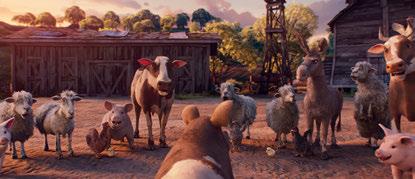
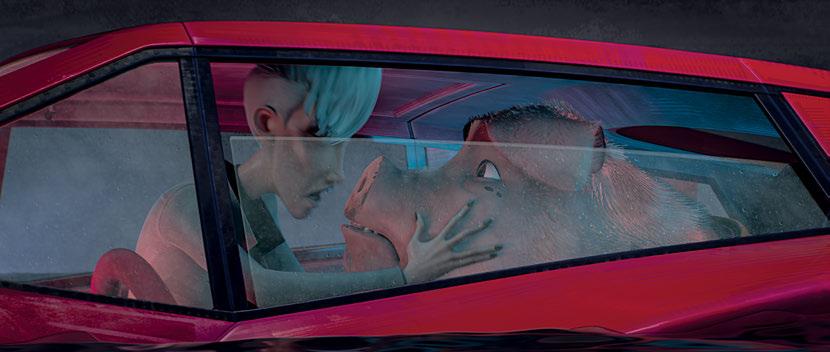

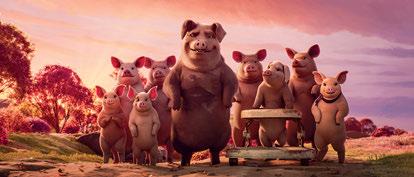
‘Let’s have two separate rigs.’ Then, we fudged when they went from being on fours to being on twos, but we separated them; that was a turning point.”
A unique approach was implemented for the character designs. “We were trying to think in 3D and find that spot between the photorealistic and stylized, as well as find the appeal of the characters,” notes Amos Sussigan, Production Designer. “I gave everybody the same character. David Colman is an amazing character designer who specializes in straight National Geographic animals, but he also has a background in animation, so he adds that appeal and cuteness. David would also do quick sketches to see how they would run on two or four feet. We would take that and give it to Véronique Comeau, an amazing designer who only works in 3D; she would select a group of sketches and cobble them together into a 3D version of the character. We would take those and give them to Adonay Cordero and Sergio Mancinelli. Adonay Cordero is a straight character designer, which means he has an amazing hand. He would draw on top so we could figure out the design of the folds and how the facial expressions would work. Sergio Mancinelli is an impressionistic painter and would do a pass on that. It would come to me, and I would do a pass on top. Then, we would have a character, if Andy liked it.”
Numerous characters had to be created. “There were so many, and they were all different animals,” Sussigan notes. “There are a lot of pigs, but they’re all different. And then crowds. It’s hard especially when you’re working with a smaller budget, and less time handling crowds is hard because it takes an incredible amount of computing and a system that is already set up to create multiples of something. Fur was another thing that worried me because we were trying to find that look that would react to light but was impressionistic, so we did a lot of testing.” Humans make
TOP TO BOTTOM: There is a slightly grotesque nature to some of the human characters.
The character design of Freida Pilkington came together quickly.
Two different rigs were created for the pigs to accommodate their transition from walking on four feet to standing upright on two.
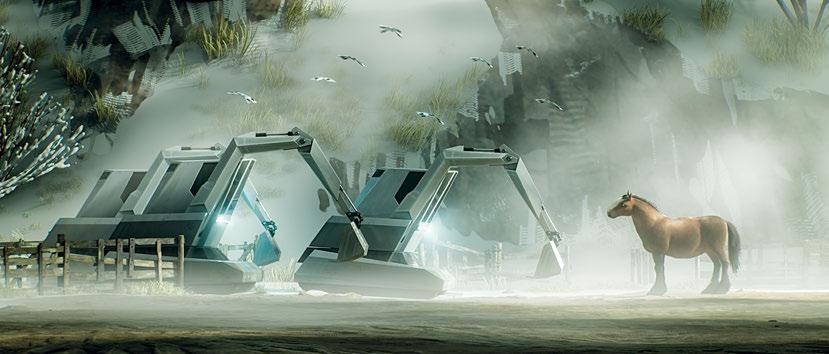
an appearance. “There’s a slightly grotesque nature to some of those characters,” Butler remarks. “Freida is very slim and is a result of the world she has created for herself. The world she lives in is artificial. Her movement came from the design. We always start with the design, and that inspires animators to go, ‘She’s very lean, slim, tight-fitting clothing and very upright.’ You get cues for performance based on Amos Sussigan’s design and all the amazing work they did. Other characters, for example, Mr. Whymper, we had more latitude there; he was broader in terms of physicality but much like his name. He’s a slimmer, weedier kind of character, but we had more room to play with his performance, physically.”
The reliance on natural lighting and the progression through all four seasons had to be taken into account, particularly when developing the color palette. “One of the things I was attracted to from the beginning, from a lighting, cinematography and color standpoint, was that we were going to have the seasons,” Sussigan states. “Since we were going from natural towards artificial, I thought it would be interesting to see the corruption of the seasons as well. We start in spring with the yellows, earthy tones. Then, we go to summer, and it’s this blue-green. It’s the moment when everybody is the happiest on the farm. I also wanted to see a color transition as the pigs get corrupted. When we get to fall, it’s never just red. It’s always a magenta. It’s the introduction of purples and all of these artificial colors. The same thing went for winter. Winter is a dramatic part of the movie, and when I was describing the snow, I said, ‘It’s always greenish acidic or slightly more yellow compared to the bucolic snow that you would have in a movie like Frozen, for example.’”
Given that the story unfolds on a farm, vegetation had to be treated in an efficient, creative, technical and financially sound way. “We used particular techniques where we can take one


The writing on the grain silo indicates how the ideal society for the animals is being corrupted by human influences.
The color palette becomes more magenta as the artificiality of human society spreads through the animal world.
TOP TO BOTTOM: The human world has cleaner surfaces and harder edges to emphasize the theme of artificiality.


particular design and alter it slightly so that you buy that separate piece of vegetation,” Butler reveals. “We ended up with a library of bushes, trees and foliage. Also, you have the set dressing. When they go inside the house, for example, every bottle, can, every item you see has to go through a design phase, be modeled, textured, painted, and then examined rigorously on turntables. I can’t tell you the number of times I’ve sat here and watched a tree go round and round slowly as we examined it from every particular angle. But you have to find smart ways to populate those worlds and focus on what you can see. We were constantly managing the complexity and richness of that environment for the camera. For example, the farm went through a lot of planning. Literally, it looked like an architect’s plan for the entire area where the cameras could look, and what parts of the building you could see. The main house, for example, was well designed from the front, and at the back there are no windows because we never put the camera there. Then, you’ve got the interiors, and the interiors were a little bit of a cheat because once you go inside the farmhouse, it needs to be big enough to allow those scenes to play out. They would often not correlate with the building itself. But overall, the basic layout would match the building.”
The world had to feel populated. “Crowds were the bane of our lives,” Butler laughs. “Andy always wanted to have a sense that the farm was vibrant and there were animals everywhere. We had crowd-heavy shots, so we built a library of animation behaviors and cycles for each animal that was both specific and all-encompassing. They could walk, graze, play, frolic, sit down and enjoy the sun. It was a whole list of stuff. Animators were able to bring in cycles to populate the background and to do more performative work whenever needed. They could break out of that cycle and add those performances on top of what was already there. For example, in the barn where they have these big meetings with all the animals. Whenever the camera turns, you’re always seeing a whole bunch of stuff. That’s where having a library pre-built enabled us to move quickly and populate shots that needed that scope of animals doing their thing without stopping us and slowing us down. Having a library pre-made was a huge plus.”
Cinesite made no major technical alterations. “There’s a lot of scope in this film, especially when you’re outdoors; you can see quite far, so we can figure out how to render and manage those renders to camera when you could see for miles into the distance,” Butler states. “We changed how we manage things, as opposed to the underlying software. We leaned heavily on Houdini for effects, such as water and destruction. That was really helpful and is a tried-and-tested visual effects tool. We definitely were trying new things, but not new in terms of the company as a whole, but in terms of other aspects of our company bringing them in.”
the
Andy Serkis was collaborative. “His direction was clear, but he always left the door open for new ideas,” Sussigan remarks. “I was never afraid of pitching him something new or slightly different from what he pitched and seeing if he liked it. That’s how you get the best work. I personally loved that he was into this live-action type of lighting – often quite theatrical, especially in the second part of the movie. I liked that we could go there. Sometimes, animated movies try to make everything saturated and poppy colors, so Animal Farm was the perfect canvas to experiment with something more restrained and bolder.”
TOP TO BOTTOM: The fate of Boxer the cart-horse is an emotional turning point.
A library of bushes, trees and foliage was created to populate the landscape.
It was difficult balancing
need to address serious social themes while remaining family friendly.
The summer is when the animals are the happiest on the farm, which is reflected by the color palette.
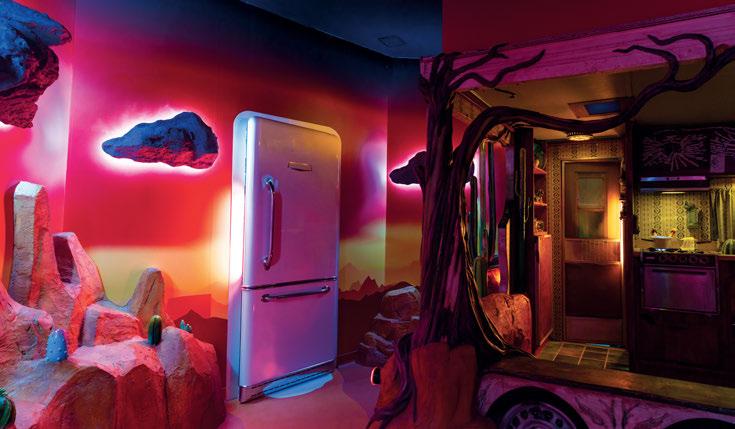
THE LATEST TECH ENRICHING THEME PARKS AND VENUES
By CHRIS McGOWAN
TOP: Meow Wolf Grapevine’s The Real Unreal exhibition near Dallas. (Photo: Paul Torres.
OPPOSITE TOP: Famed astronomer Carl Sagan serves as the “Librarian” for Interstellar Arc, a large-scale, multi-sensory experience at AREA15 in Las Vegas that transports guests far beyond Earth. The late astronomer’s estate approved use of his likeness. (Image courtesy of AREA15)
OPPOSITE BOTTOM: XR and AI can be found in abundance in AREA15, an experiential arts and entertainment complex in Las Vegas. (Image courtesy of AREA15)
Immersion, interactivity and personalization are transforming theme parks and location-based entertainment in malls, museums, observatories and entertainment centers, powered by XR formats – virtual reality, augmented reality, mixed reality and artificial intelligence.
“VR, AR and AI are playing a major role in the evolution of immersive attractions, expanding how guests engage with stories, environments and each other,” says Amy Naples, Chief Marketing Officer for AREA15 in Las Vegas. “These technologies allow location-based entertainment (LBE), including theme parks, to become more personalized, interactive and layered, blending physical spaces with digital storytelling in ways that weren’t previously possible. Rather than replacing traditional experiences, these tools certainly enhance them.”
XR and AI can be found in abundance in AREA15, an experiential arts and entertainment complex in Las Vegas that is anchored by Meow Wolf’s mind-bending Omega Mart, a “supermarket” that sends participants on journeys through surreal worlds and immersive storytelling. One of AREA15’s various other attractions is the VR experience Interstellar Arc, from the Emmy Awardwinning creators at Montreal-based Felix & Paul Studios. Guests are invited to embark on a journey set centuries in the future and light years from Earth. Naples comments, “With next-generation immersive technology, Interstellar Arc propels audiences into humanity’s future among the stars. The experience unfolds inside a 20,000-square-foot, custom-built venue featuring cutting-edge visuals, interactive environments and sensory world-building that push the boundaries of virtual reality storytelling.”
AREA15 incorporates AI in select experiences, including Art Quest, a self-guided journey through the district’s art collection. Naples explains, “While all artwork and original descriptions were created by human artists, Art Quest uses AI through its zany robot guide, Aria-15, to enhance the narrated audio descriptions guests
Courtesy of Meow Wolf)
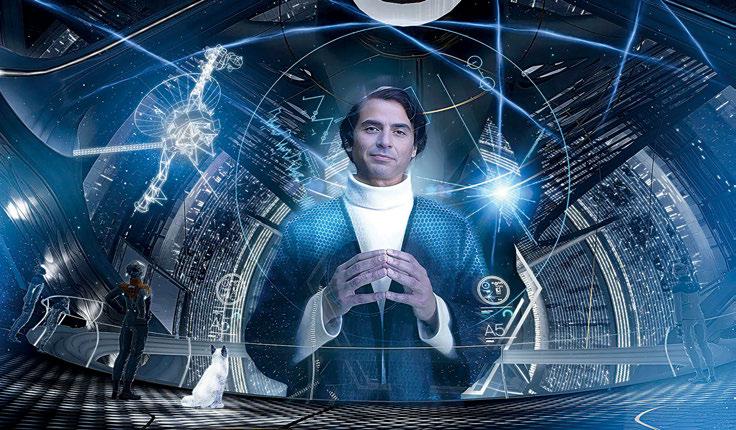
hear during the tour as they explore AREA15’s more than 48 sculptures and 30 murals at their own pace.”
“AREA15’s popularity stems from its ability to meet growing demand for social, interactive and highly visual entertainment that goes beyond passive viewing,” Naples states. “Guests are drawn to experiences where they can actively explore art, technology, live events and attractions all in one destination. By blending elements of nightlife, immersive art, gaming and experiential retail, AREA15 offers a customizable, discovery-driven environment that continues to evolve with guest interests.”
Besides Omega Mart, Meow Wolf’s other exhibitions are House of Eternal Return (Santa Fe), Convergence Station (Denver), Radio Tave (Houston) and The Real Unreal (Grapevine, Texas), with locations due in New York and Los Angeles. Based in Santa Fe, Meow Wolf will soon spread its phantasmagoric realities across the globe via geospatial AR, thanks to a partnership with San Francisco-based Niantic Spatial, in what might be termed omni-location-based entertainment.
“This partnership is about breaking the four walls of the physical exhibition and layering in new experiences that continue to unfold over time,” explains Dennis Hwang, Niantic Spatial Vice President, Visual and Interaction Design. “Meow Wolf has spent years creating incredible, dense narrative universes inside their locations. Our goal at Niantic Spatial is to provide the technological connective tissue that allows those stories to be deeply integrated and present inside and out in the real world. We are combining their maximalist art and lore with our geospatial AI to turn everyday environments into gateways for the surreal.”
Hwang continues, “We’re looking to offer digital Meow Wolf experiences outside in the real world that can in turn unlock new experiences within a Meow Wolf location. We don’t want the Meow Wolf experience to end when you walk out the exit of Convergence Station or Omega Mart,” Hwang says. “Whether it’s

TOP: Jumanji: The Adventure at the Gardaland Resort in Gardaland, Italy, was developed by Sony Pictures and Merlin Entertainments. Merlin involved Framestore from the concept stage of the project. (Image courtesy of Framestore)
BOTTOM: Visit the jungle and run for your life in Far Cry VR: Dive Into Insanity, a free-roam VR experience from Zero Latency. Other Zero Latency VR offerings include Threat: Lethal, Haunted, Outbreak 2: Mall Mayhem and an upcoming Jumanji VR adventure in partnership with Sony Pictures. (Image courtesy of Zero Latency VR)
OPPOSITE TOP TO BOTTOM: Falcon’s Creative Group’s SpectraVerse Game Bay is an immersive, headset-free, group entertainment system designed for social, interactive gaming. (Image courtesy of Falcon’s Creative Group)
Connectopia, Luminary Design Co.’s installation at L.A.’s Intuit Dome, shows how venues can combine AI and connectivity to deliver personalized, shareable, large-scale experiences. (Image courtesy of Luminary Design Co.)
The Alpine Express Coastiality VR roller-coaster ride has been operating at Europa-Park theme park in Rust, Germany, for a decade. (Image courtesy of Europa-Park and Mack Group)
choosing to unlock a digital portal on a city street or discovering hidden lore tucked away in a public square, we’re also making the Meow Wolf universe a persistent layer of the physical world.” The experience is now mobile-based, but it may manifest on AR glasses in the future.
With Niantic’s participation, the collaboration merges AR and VPS. “Our Visual Positioning System (VPS) is the engine under the hood with the capability to provide vision and AI-based localization, that powers centimeter-level precision so that digital and physical elements can interplay intentionally,” Hwang says. “With this creative capability unlocked, there is effectively no limit to where the Meow Wolf team wants to take its storytelling in the real world.”
The collaboration may evolve into a multiplayer platform on a global scale. Hwang states, “That is the North Star. We imagine a massive, multiplayer canvas where users aren’t just consuming a story but participating in community world-building. We want people across the globe to contribute their own art, characters and quests to the Meow Wolf layer of our map. Together, we’re exploring a new way for the world to play and explore together.”
Falcon’s Creative Group is an Orlando-based experience design company that has worked on a wide variety of immersive attractions with AR and VR. In 2025, Falcon’s celebrated its 25th anniversary. “We’ve been collaborating with major IPs, including CD Projekt RED’s Cyberpunk 2077, to help bring their world into the themed experience market,” says Jason Ambler, Chief Content Oficer for Falcon’s Beyond. In terms of VR and AR, Ambler notes, “It’s still operationally challenging to deliver a great experience with a headset. Mario Kart: Bowser’s Challenge at [Universal’s] Epic Universe is a great recent example of an AR attraction done right, because the technology was thoughtfully integrated into
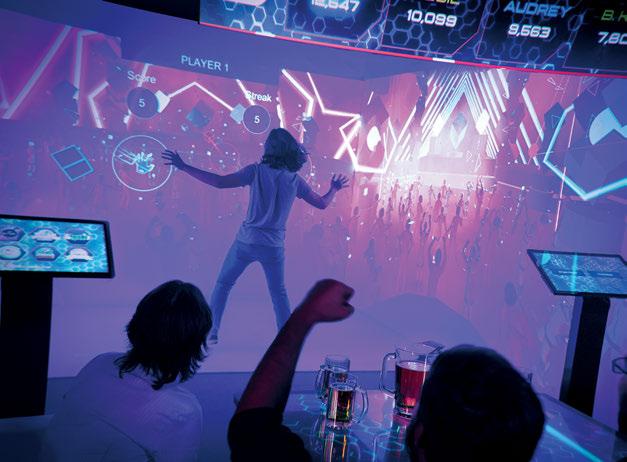
the attraction design and operations. The AR experience is then further elevated by some really clever interplay between the digital and physical content.”
Ambler notes, “On the development side, AR, VR and real-time tools are still very much a part of our daily workflow. They remain central to how we design, test and refine experiences before they’re built.” Ambler adds, “I think we will see a lot more AI coming to theme parks to deliver more personalized, adaptive and predictive experiences. We’re not chasing any one technology. We use whatever works to deliver the best possible experience. That could be AR, MR, multi-view displays, high-frame-rate projection, robotics and proprietary systems. Many times, we need to invent our own tools or interfaces to contend with heavy usage and harsh conditions.”
Ambler continues, “We’re starting to see AI, real-time engines and adaptive systems converge in powerful ways. When you connect those tools, you can create experiences that are genuinely personalized, responsive and different every time someone engages with them. This level of interactivity further suspends our disbelief and exponentially enhances the immersive nature of experiences. It means systems that understand context – who the guest is, where they are, what they’ve done, how they’re interacting – that can then shape a bespoke experience around that, all in real time.”
Framestore has incorporated XR tech into a number of LBE attractions. “The Twilight Saga: Midnight Ride for Lionsgate Entertainment World remains a strong example of a VR attraction that successfully immerses guests in its world,” explains Kevin Young, Creative Technology Director at Framestore. “Beyond that, our team has a long history of leveraging both AR and VR in LBE, including projects like Samsung’s A Moon for All Mankind and
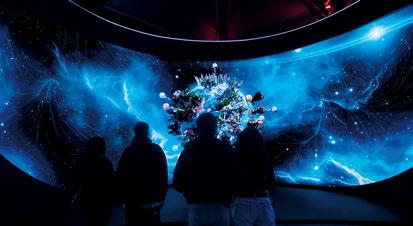
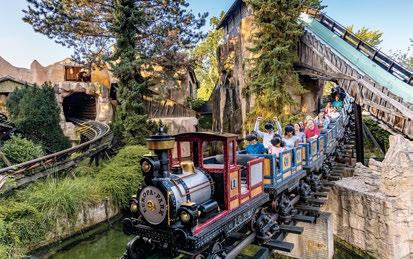
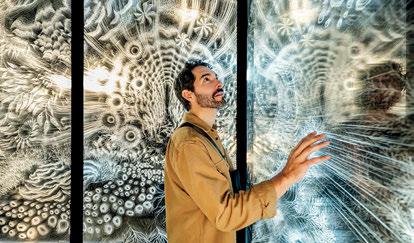
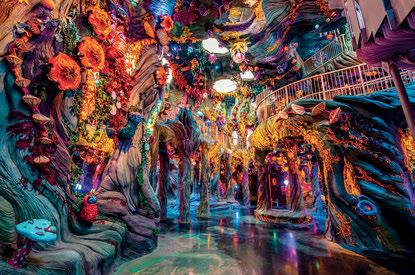
TOP TO BOTTOM: Field Trip to Mars VR experience transforms a classic school bus into an immersive, moving field trip where passengers can see, hear and feel what the surface of Mars is like.
(Image courtesy of Framestore)
“Shoppers” are transported to psychedelic realms of light, color, sound and space at Meow Wolf’s Omega Mart surreal “supermarket” at AREA15 in Las Vegas. (Image courtesy of Meow Wolf)
Meow Wolf’s Convergence Station in Denver, Colorado. (Image courtesy of Meow Wolf)
the One Strange Rock VR experience. These projects demonstrate how immersive technology can complement storytelling, deepen engagement and create memorable interactive moments for audiences.”
Young notes, “We also have some upcoming LBEs that incorporate subtle touches of AI for personalization, which I believe is where it works best, enhancing the guest experience without feeling intrusive. VR and AR play an important role in our creative process. To create compelling spatial experiences, we need to design within space itself. VR and mixed reality allow our teams to prototype and iterate inside environments rather than on a flat screen, which helps us refine scale, composition and interaction early on.”
Rich Hill, Chief Creative Officer for Jacksonville, Florida-based Sally Dark Rides, states, “When it comes to delivering immersive experiences, we have begun to play with non-traditional techniques, like motion-synched media, projection-mapped animated sets and scenery, lifelike animatronics that react to inputs from guests, augmented reality that mixes practical and virtual mediums [and] artificial intelligence that allows guests to create their own stories. With all of the new tech out there, a ride designer has tons of options for wrapping the story around the guest.”
Hill doesn’t favor VR in a commercial setting but feels the format can be highly effective as a storytelling medium. He notes, “I have a couple of VR headsets at home that are great to use for gaming or watching 360-degree animated movies. Those are mainly individual experiences though. Going to a theme park should be an experience shared with family and friends. Augmented Reality can do just that. Sally Dark Rides has developed an AR dark-ride concept that is very exciting. The ‘why’ is obvious: getting away from flat media screens and feeling more immersed in fantastical, real environments. Augmented reality is the key.”
Zero Latency VR, based in Melbourne, is the largest free-roam VR network in the world, with a flexible licensing model for either standalone VR venues or use at a mixed-used entertainment site. There were over 5.4 million plays at more than 150 locations around the world as of the end of 2025, according to Luke Mitchell, PR & Communications Manager for Zero Latency VR. The company has 10 different experiences available, including three new releases. Mitchell notes, “First, we followed up Space Marine VR with Threat: Lethal. We also launched Haunted, a horror experience like no other, and Outbreak 2: Mall Mayhem, a beefed-up zombie survivor adventure. Coming up, we’re excited to work with Sony Pictures to bring Jumanji to our immersive VR platform, later in 2026.”
Zero Latency VR’s Generation 3 (Gen3) is a free-roam VR platform that eliminates backpack PCs for a fully wireless, 5K resolution experience. It utilizes HTC VIVE Focus 3 headsets and Wi-Fi 6E technology, and it supports up to eight players in a 125+ square-meter space with superior tracking.
Universal, Disney and LEGO’s theme parks, meanwhile, are boosting their usage of augmented reality. The aforementioned Mario Kart: Bowser’s Challenge incorporates AR goggles
in Universal’s Epic Universe park and at Universal Studios Hollywood. The LEGOLAND™ Windsor Resort utilizes AR experience for the themed land LEGO Mythica: World of Mythical Creatures. And Disney is working on integrating AR and AI in its theme parks to achieve personalized and immersive experiences for its guests, led by Walt Disney Imagineering and the Office of Technology Enablement.
At the Europa-Park theme park in Rust, Germany, many attractions feature XR. One is YULLBE, a free-roaming VR/MR experience center. “In YULLBE, we introduced an XR maze in the latest edition of Traumatica, where guests could walk through in mixed reality and follow two different storylines,” explains Marcus Ernst, Creative Project Manager for MACK One (Europa-Park is a subsidiary of the Mack Group). “I am convinced that we will see significantly more MR content here in the future. Regarding AR, we are just starting exciting talks with industry innovators like Keiichi Matsuda, Niantic and Snap.
“VR currently remains our strongest asset, simply because of our heritage – we’ve been operating [the Alpenexpress] Coastiality [VR roller-coaster ride] for 10 years and YULLBE since 2019. However, MR and AR are extremely exciting as they enable completely new forms of storytelling by changing how we interact with the physical space. I am curious to see when we will establish our first permanent MR free-roaming attraction. Regarding AR, it is huge, but I believe where it really shines is on dedicated devices like the upcoming Snap Spectacles.”
AI is becoming a game changer in Europa-Park`s production pipeline – it helps its artists create assets faster and prototype ideas. Ernst notes, “Regarding the guest experience, we are working less on a single AI-driven attraction and more on a comprehensive AI Suite. This foundation allows us to derive a whole range of products, services and attractions. AI enables us to tailor experiences specifically to individual guests in ways that were previously impossible. The clear trend here is towards hyper-personalization, which is only made scalable through AI.”
Some cases start with MR and transition to VR. “We right now use pass-through (MR) primarily for safety and seamless onboarding, acting as a comfortable bridge before we switch to full VR,” Ernst says. “But it is clear that every modern and upcoming headset is effectively an MR headset. This global hardware trend shows where the industry is heading and will inevitably be reflected in our future immersive attractions.” Ernst adds, “For location-based entertainment, MR is fantastic because it allows social interaction while wearing the gear. You can see your friends’ real faces but wear digital armor. However, for storytelling that requires a totally different world – like space or fantasy – you still need the full immersion of VR.”
“AI is not only an incredible tool for helping streamline experience production and catalyze creativity, but it can also help drive personalization across themed attractions and location-based experiences to elevate the experience for visitors,” adds Ryan Brett. “From real-time visuals that respond to individuals’ details and preferences to AI-driven digital characters that can help IPs come to life in-park, there are so many opportunities to create

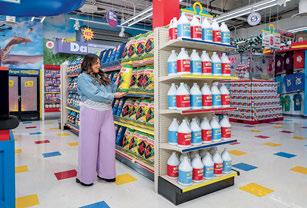
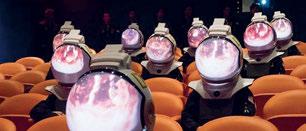
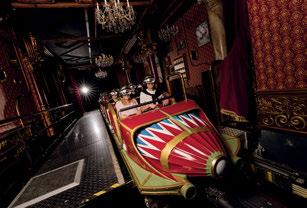
TOP TO BOTTOM: Luminary Design Co., based in Baton Rouge, Louisiana, built the Connectopia installation, with its world-building generative AI display, for AT&T at L.A.’s Intuit Dome. (Image courtesy of Luminary Design Co.)
Meow Wolf’s mind-bending Omega Mart “supermarket” sends participants on journeys through surreal worlds and immersive storytelling. (Image courtesy of Meow Wolf)
Framestore’s Design Studio worked with National Geographic on the immersive VR series One Strange Rock, which uses live-action photography and visual effects to illustrate scientific phenomena from the perspective of astronauts in space. (Image courtesy of Framestore)
Eurosat Coastiality – The Phantom of the Opera at Europe-Park in Rust, Germany, is an immersive VR adventure that brings the famous story to life, set to Andrew Lloyd Webber’s classic musical The Phantom of the Opera. (Image courtesy of Europa-Park and Mack Group)
“We are combining [Meow Wolf’s] maximalist art and lore with our geospatial AI to turn everyday environments into gateways for the surreal.” —Dennis Hwang, Vice President, Visual and Interaction Design, Niantic Spatial

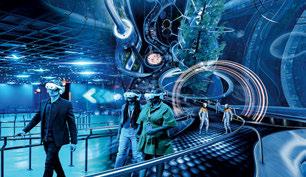
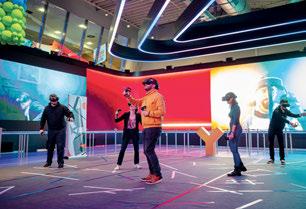
TO
Space travelers enjoy sharing the terrain light years from Earth in the Interstellar Arc VR experience at AREA15 in Las Vegas. (Image courtesy of AREA15)
One of several attractions featuring XR at Europa-Park theme park in Rust, Germany, is YULLBE GO in the blue fire Dome. (Image courtesy of Europa-Park and Mack Group)
customizable and tailored experiences that speak to guests on a deeper level, offering them an experience they’ll never forget.”
To help clients with its Designer software, Disguise offers Ask AId3n. Brett comments, “Ask AId3n is Disguise’s AI-driven workflow assistant for visual experience production. For instance, it can create a series of LED walls for you within Designer, ready to plan and visualize a dark ride, or link the speed of the video layer to an OSC message from show control. The whole purpose of Ask AId3n is so that Designer users can minimize time spent on repetitive tasks and maximize time spent on the creative vision – making the production process more streamlined and enjoyable.”
Luminary Design Co., based in Baton Rouge, built the Connectopia installation, with its world-building generative AI display, for AT&T at L.A.’s Intuit Dome. “Connectopia is the first real-time, large-scale installation of AI generative media and the first public installation to generate and feature cinematic 8K AI videos created in real-time inside a live venue,” says Brian Beyt, Founder, President and CCO of Luminary. “These videos are integrated into a shared, evolving world that’s featured on a 30-footwide parabolic LED display.” Beyt comments, “Connectopia is a living, interactive sculpture that reflects the real-time presence of guests. As AI models grow more powerful and AT&T’s networks become even faster, the system can generate more complex worlds, richer interactivity, and deeper mobile integration. In the future, fans could collaborate across multiple venues in real time, merging their districts into shared global worlds.”
Beyt continues, “Elements of Connectopia are sure to become the new norm for stadiums and live events. Fans now expect to be creators, not just spectators. Connectopia shows how venues can combine AI and connectivity to deliver personalized, shareable, large-scale experiences. As technology advances, these types of installations could become standard features of sports arenas, music festivals and cultural landmarks.”
Beyt adds, “Connectopia’s complex technical system architecture is designed to maximize AI video generation while ensuring stable performance across all elements of the system. Utilizing a network of custom-built servers with [NVIDIA] RTX 4090 and 5090 GPUs, the system produces immersive 8K cinematic experiences near-instantly and integrates them into a shared, evolving world. The system is entirely self-contained with no reliance on cloud connectivity. AT&T’s high-speed fiber and 5G capabilities are the backbone of Connectopia. This infrastructure allows massive amounts of data, including real-time 8K video and AI-generated assets, to move with near-zero latency. Without AT&T’s ability to deliver instantaneous connectivity and data transfer at scale, an activation like Connectopia would not be possible.”
Framestore’s Young feels that AR, VR and AI can be powerful tools for theme parks and LBE. He says, “The future of theme parks and LBE is still the same: creating engaging experiences for the audiences of today; the story and the way you engage with it is still the most important thing. What evolves are the tools we use to tell those stories. And exploring how to apply those tools thoughtfully is the exciting part.”
TOP
BOTTOM: Jumanji: The Adventure park ride in Gardaland, Italy, transports guests into the Jumanji universe with animatronics, immersive screens, projection-mapped environments, holographic illusions and multi-motion ride vehicles. (Image courtesy of Framestore)
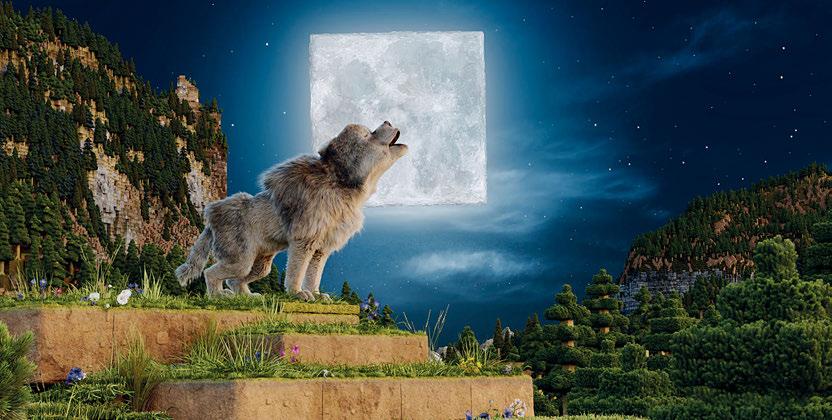
THE HOLLYWOOD GAMING MERGER PRIMES THE PIPELINE
By CHRIS McGOWAN
An unprecedented convergence of the film/TV and video game industries is providing new content for Hollywood, advancing visual effects technology and creating new career paths and workflows.
Dennis the Wolf is Steve the hero’s best friend in A Minecraft Movie, which garnered $958 million at the box office in 2025 and was a massive video hit from Mojang Studios. (Image courtesy of Wētā FX and Warner Bros. Pictures)
OPPOSITE TOP TO BOTTOM: Lucy MacLean (Ella Purnell) visits a post-apocalyptic Las Vegas in Fallout Season 2, based on the Bethesda Game Studios video game. (Photo: Lorenzo Sisti. Courtesy of Prime Video)
Sonic the Hedgehog helped SEGA pioneer the early video game industry and is now part of Hollywood.
(Image courtesy of Rodeo FX, Paramount Pictures and SEGA)
Dungeons & Dragons: Honor Among Thieves, a big-budget movie, was preceded by TSR’s Dungeons & Dragons role-playing game, an animated TV series and numerous video games. (Image courtesy of Paramount Pictures and Hasbro)
HBO’s hit series The Last of Us, a live-action video-game adaptation, launched its first two seasons in 2023 and 2025 and is a recent example of this confluence. It is the first such adaptation to receive major awards consideration, including eight Emmy awards and a nomination for Outstanding Drama Series. The video game was developed by Naughty Dog and published by Sony International Entertainment. Other recent examples of games adapted for series include Netflix’s The Witcher and Arcane, Amazon’s Fallout and Paramount’s Halo. According to IMDb’s Box Office Mojo, other recent movie adaptations of games include Universal’s Five Nights at Freddy’s 2 ($233 million), Paramount’s Sonic the Hedgehog 3 ($463 million), Warner’ Bros.’ Pokémon: Detective Pikachu ($450 million), Sony’s Uncharted ($407 million), Paramount’s Dungeons & Dragons: Honor Among Thieves ($207 million) and Warner Bros.’ Mortal Kombat 2 (set for this year). More movie/series adaptations of games are currently in production.
“Recent years have demonstrated a notable trend of popular games inspiring or directly spawning high-profile television series and feature films. At their core, both games and movies are storytelling mediums, just expressed through different formats. Given this synergy, we anticipate continued growth in adaptations, further blurring the lines between gaming IP and screen content,” says Jason Johnston, VFX Director and Principal Artist at Beyond-FX,
TOP:
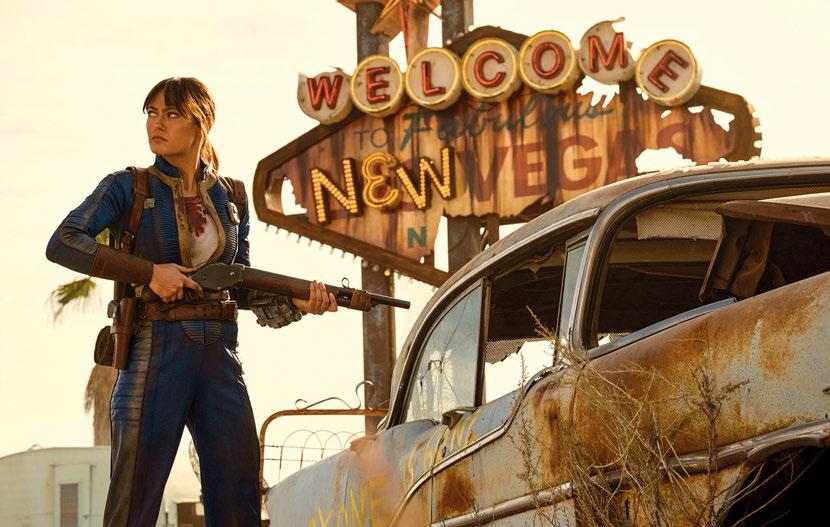
which specializes in real-time visual effects development – most frequently for video games but also for live/interactive exhibits and XR experiences.
“If there’s a good story to tell and an already existing fan base, it just makes sense to tailor it to a broader audience,” according to mocap supervisor/3D animator Eric Leidenroth. “It’s the same logic as adapting a comic book or a novel. The advancements we’ve made in virtual production, performance capture and VFX have made it more achievable while already having an existing visual blueprint to work from.” Leidenroth has worked as a motion capture editor and supervisor on games such as Halo 4, GTA 5 and Red Dead Redemption II, and on movies such as Avengers: Infinity War and Napoleon
“The Last of Us is our first example of this convergence that has been met with universal critical acclaim,” says David Johnson, CEO and Creative Director of Undertone FX, a studio devoted to real-time visual effects for video games and VR/AR. He has worked on games such as Call of Duty: Modern Warfare, Halo 3 and Shadowrun. Johnson says, “Credit to the good folks at Naughty Dog for making a game ripe for this conversion. Because the game leaned so heavily into dramatic character relationships rather than just action, a television conversion was primed to succeed.”
Sonic the Hedgehog is one of the most iconic video game characters of all time and has been featured in three major motion pictures. Sébastien Francoeur, VFX Supervisor at Rodeo FX, worked on Sonic the Hedgehog 3. He notes, “Learning to animate Sonic was a creative challenge in itself: his movement, his attitude,

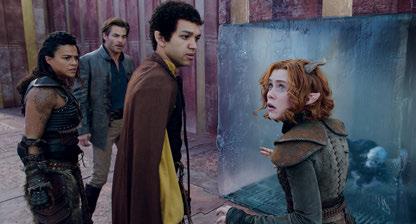

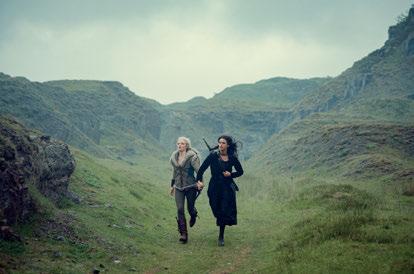
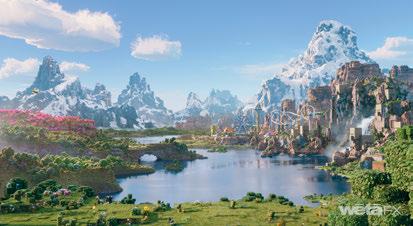
his facial acting; everything had to feel true to the character fans know while still belonging to the more realistic world of the film. We spent a lot of time refining his physicality and expressions so that he remains a stylized icon but feels grounded in live-action shots. That process didn’t only apply to Sonic. Each character has its own personality and animation rules. Understanding the nuances, from how they express emotions to how they interact with their environment, was essential to bringing the whole cast to life authentically.” He adds, “Overall, the Sonic films have evolved into their own universe, one that respects the games without being limited by them. That said, the dynamic and high-speed pacing surrounding Shadow in Sonic 3 definitely takes inspiration from the gameplay experience.”
Wētā FX’s VFX Supervisor for A Minecraft Movie, Sheldon Stopsack, comments, “The biggest challenge by far was adapting the inherently stylized and somewhat simplistic look of Minecraft’s expansive world into a live-action setting – one that would feel like a natural playground [in which] our actors could plausibly exist.” A Minecraft Movie fused the artistry and tech of visual effects for movies and video games. Stopsack explains, “We initially approached world- building much like you would in the game. We created an inventory of building blocks made from various material types, and our basic environmental assets were essentially constructed from these resources – just as you would in Minecraft. In some cases, we even sourced specific creations from a production-provided Minecraft server. On a more technical level, I’d highlight our use of real-time game engines. Unreal Engine was used for pre-visualization, virtual scouting and during principal photography, providing a fast and interactive preview of our world.”
Stopsack adds, “I see a clear trend where the line between the two worlds [movie and game] is increasingly blurred. Technologically, we’re seeing far more crossover, and that shift is also influencing the visual language of both areas. I believe this is a two-way street, though I can only speak from the film perspective. Game cinematics and in-game references are being incorporated into film more frequently than ever before. This is especially true for a project like A Minecraft Movie, but I’ve also seen similar examples in more traditional VFX work for other film productions.”
The Witcher TV series is based on fantasy-RPG video games by CD Projekt RED and was converted into streaming form by Netflix. (Photo: Susan Allnut. Courtesy of Netflix)
The Overworld is an alternate dimension in A Minecraft Movie. (Image courtesy of Wētā FX and Warner Bros. Pictures)
“The overlap between film and games is growing because both industries are now using many of the same tools, technologies and workflows. Game engines like Unreal aren’t just for gameplay anymore; they’re driving real-time characters and environments for previs, performance capture, virtual production stages and even live-camera compositing on film sets,” Leidenroth remarks. “The impact has been transformative [for VFX professionals and studios]. Recent advancements have lowered barriers to entry, empowering artists to produce high-quality, visually compelling content rapidly,” explains Keith Guerrette, Head of VFX & Founder of Beyond-FX. “The convergence of tools used across film, TV and games fosters cross-pollination of techniques and knowledge, ultimately elevating the craft in all areas. Many workflows previously exclusive to offline rendering in film are now
TOP TO BOTTOM: Nintendo’s Mario, Luigi and Princess Peach are video game icons, created by Shigeru Miyamoto, and all appeared in Universal’s The Super Mario Galaxy Movie. (Images courtesy of Nintendo, Illumination and Universal Pictures)
feasible in real-time, opening exciting new possibilities for VFX professionals and studios alike. The industry is moving forward at an accelerated pace, benefiting both creators and audiences.”
Francoeur says, “There’s a clear convergence happening between film VFX pipelines and video game technology. Tools like real-time rendering are moving our industry closer to the fast-feedback processes that games have relied on for years. We’re not fully in real-time rendering yet, but with every new project, we’re making real, measurable progress in that direction. Faster visual feedback means artists can iterate more creatively, take more risks and ultimately deliver better work on screen. It’s something we’re genuinely excited about because the closer these worlds get, the more we unlock new forms of storytelling and visual innovation.”
Johnson notes, “Most recently, with the advent of virtual production, the talents and people of games and film/TV have come ever closer together. Using video game technology, live on set with actors, to create living, changeable locations and lighting conditions has had a large impact on how film and television are made today.” Nick McElmury, VFX Director and Studio VFX Director, explains, “Real-time technologies, including virtual production techniques, are increasingly being integrated into film and television workflows – even if initially as background or supporting elements. Perhaps more importantly, virtual production is driving the evolution of real-time engines like Unreal Engine to become more user-friendly and artist-centric. This shift is streamlining what was once a highly complex process, enabling creators to build intricate scenes and visuals directly within game engines with unprecedented speed and fidelity.”
“Technologies like LED volume stages and real-time rendering, largely driven by game engines like Unreal, are rapidly closing the gap between film/TV VFX and game development,” says Sara Bennett, Production VFX Supervisor at Milk VFX, which worked on The Witcher S3. “These tools can create near-photoreal digital worlds and allow filmmakers to interact with virtual environments almost as if they were physical sets. The result is a more immersive, flexible and efficient creative process.” Leidenroth adds, “When it comes to virtual production, a lot of game VFX techniques are being used because everything has to perform in real-time. Assets need to be optimized and brought into an engine, shaders adapted, lighting created and environmental effects added to breathe life into the scene, all of which is second nature to game environment artists.”
Movies and TV are increasingly impacting games as well. Bennett says, “With game-engine technology becoming a part of the VFX pipeline, the influence now moves in both directions. Real-time tools are helping filmmakers create visuals more quickly and interactively, while the high-end quality and lighting standards of film and episodic VFX are pushing games toward increasingly realistic, cinematic imagery. The two industries are now feeding each other creatively and technologically, raising the visual bar on both sides.” Johnson notes, “For quite a long time, the game industry has tapped the VFX industry for trailers and TV commercials. Essentially, short animated films that set the tone of
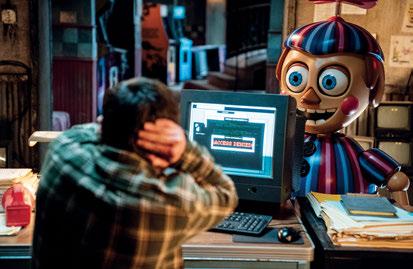
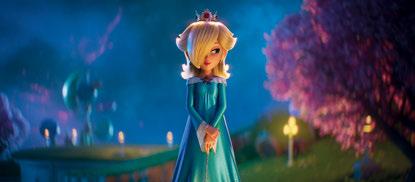
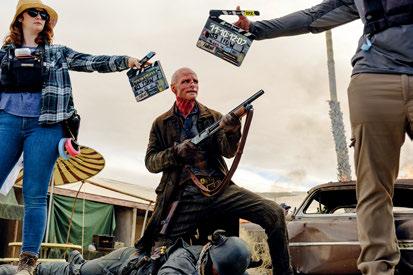
TOP TO BOTTOM: Mike (Josh Hutcherson) and Balloon Boy in Universal’s Five Nights at Freddy’s 2, based on the Scott Cawthon 2014 horror video game. (Photo: Ryan Green. Images courtesy of Universal Pictures)
Rosalina in The Super Mario Galaxy Movie. (Image courtesy of Nintendo, Illumination and Universal Pictures)
Cooper Howard (Walton Goggins) springs into action in Fallout Season 2. (Image courtesy of Prime Video)
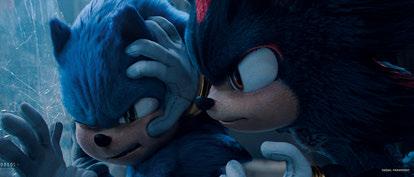
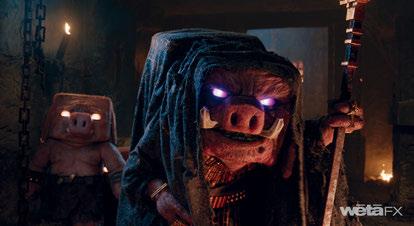
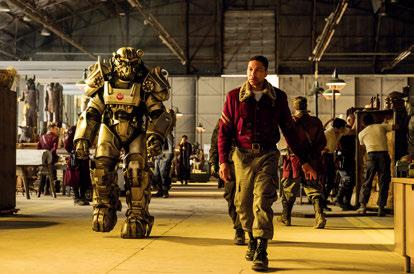
the game are often the game’s introduction and frequently serve as the vehicle to market it. In some games, more animations like this, created by VFX facilities, are sprinkled throughout games to help advance the story.” Leidenroth observes, “The crossover is also happening in motion capture, which is just as technical but in a different way and very much part of my background. Characters’ performances have become much more realistic over the years, appearing more fluid and lifelike. Video games are evolving to feel more cinematic, and game artists are taking cues from film artists.”
The visual effects merger is creating new career paths and/or workflows. Johnson says, “The film/TV industry is certainly creating new jobs and opportunities in the virtual production space for people savvy with Unreal Engine and Unity – people able to code for real-time engines.” Stopsack comments, “The next logical step is the merging of talent pools. More and more artists are now able to service both domains, and that’s where the creative overlap becomes most evident. In addition, we can see a shift that opens up novel use cases. Virtual production on LED stages, immersive scene scouting and real-time visualization on set, just to name a few. I believe we’ll continue to see even greater alignment between the two worlds, both technically and creatively.”
“This convergence is absolutely creating new roles and new ways of working,” Bennett says. “At Milk, we now have a dedicated Unreal team that is collaborating with our traditional VFX departments. And with USD, we can move assets seamlessly between both workflows. It’s opening up hybrid skill sets, new specializations and much more flexible, interconnected workflows.” On the flip side, game cinematics have become so advanced that some studios are hiring camera specialists with traditional film backgrounds to elevate their storytelling. According to Leidenroth, “Even on the performance side, some motion capture stunt performers regularly move between game and film shoots. That crossover is becoming normal, and I think the lines between the two mediums will only get more blurred in the years ahead.”
Leidenroth agrees that a merger of visual effects is creating new career paths and workflows. “Since I started working in motion capture, I’ve been able to work in film and games fairly seamlessly. The core technology has essentially been the same in both mediums for years, even if the tools, pipelines and final outputs differ. With virtual production and real-time engines becoming standard across the board, we’re already seeing new hybrid roles such as real-time artists, virtual camera operators and virtual production TDs who can contribute to both industries. I think that overlap will only continue to grow.”
McElmury notes, “As the technology underpinning both industries evolves, we see an increasing overlap in the tools, workflows and creative approaches used to achieve compelling visuals. The boundary between film and games is becoming more permeable, with VFX artists frequently moving between the two sectors. Additionally, the specialized knowledge of each is cross-contaminating toward a mutually beneficial result, with film pipelines focusing on speed and iteration efficiency, and game pipelines on standardized pipelines and output quality. These new shared standard toolsets of both industry standard DCC software and game engines have made these crossovers more accessible than ever before.” Stopsack concludes, “The two worlds have moved much closer together and continue to do so.”
TOP TO BOTTOM: Rodeo FX respects the Sonic games without being limited by them, while the high-speed pacing of Shadow in Sonic the Hedgehog 3 takes its inspiration directly from the gameplay experience. (Image courtesy of Rodeo FX, Paramount Pictures and SEGA)
The evil Malgosha can be found in A Minecraft Movie, based on the hugely popular Minecraft video game from Mojang Studios. (Image courtesy of Wētā FX and Warner Bros. Pictures)
Maximus (Aaron Moten) next to a power-armor suited comrade of the Brotherhood of Steel in Fallout Season 2. (Image courtesy of Prime Video)
Supervising Motion Control
By MARK H. WEINGARTNER
Edited for this publication by Ross Auerbach
Abstracted from The VES Handbook of Visual Effects, 4th Edition
Edited by Jeffrey A. Okun, VES, Susan Zwerman, VES and Susan Thurmond O’Neal
Motion Control – these two words strike fear in the hearts of ADs and lines on the foreheads of directors. While developments in camera tracking software have reduced the need for motion control on live-action sets, judicious use of motion control can make difficult shots easy and impossible ones possible.
What is Motion Control?
A motion control camera rig uses computercontrolled motors for accurate reproduction of camera movement with respect to time. Motion control rigs range from motorized pan/tilt heads to cranes with eight or more motorized axes of movement. A motion control programmer ope ates the rig with its highly specialized computer – choreographing camera moves that can then be edited in order to smooth out bumps, change timing or adjust framing. In addition to moving the camera, the computer can be used to control lighting effects and movement of models or props. Different types of rigs have different capabilities, strengths and weaknesses.
Four basic uses for motion control are:
1. Precise choreography of camera movement
2. Repeat passes of a camera move
3. Scaling (temporal and/or spatial)
4. Import/export of camera move data
Performance Choreography
Sometimes a shot calls for a camera move that requires either a faster motion or more abrupt acceleration or deceleration that can be achieved with human-powered camera equipment. These shots can often be achieved with motion control rigs because of their powerful motorized axes. The ability to program the various axes separately and to edit the moves on the computer to smooth out problems allows the Director and DP to finetune the shot until they are satisfied.
Multiple-Pass Photography
Obvious examples of multiple-pass live action motion control are twin shots where one actor plays two or more characters within a shot. Less
obvious are soft split shots where actors and animals act in different passes or an actor reacts to a physical effect shot in the second pass. Another use has been shooting clean passes for rig removal. Multiple-pass photography also can be used to duplicate a foreground greenscreen camera move when shooting the background plate or playing back a move to shoot a greenscreen element to be composited into an existing shot.
Scaling
Both temporal and spatial scaling are accomplished by shooting different passes at different speeds. While many people are familiar with the scaling done when combining live-action motion control shots with miniature motion control model work, a less familiar use involves shooting live-action shots of a normal-sized character interacting with a miniature or giant character. Here, a motion control move is scaled up or down and repeated with the other-sized character. The two elements are then composited in post. Software designers have created tools that allow the programmer to scale complex moves by taking into consideration the axes of rig manipulation.
Import/Export of Camera Move Data
The development of camera tracking software packages has greatly simplified and automated the painstaking task of extrapolating camera movement in a shot and applying it to the other elements for the composite. Situations still exist where recording camera positional data against a frame-accurate time base or streaming camera positional data to drive a real or virtual camera’s movement is advisable. It’s important to understand how the data will be used and coordinate formatting and transfer to the visual effects house. A text file full of numerical angle and distance values is mostly useless unless the user knows what they relate to.
Purchase your copy here: http://bit.ly/3JnG2yT

The Future is Bright for VES Bay Area
By ROSS AUERBACH
Founded in 2006, the VES Bay Area Section continues its vibrant role in the visual effects and technology industries. Boasting nearly 550 members, the (San Francisco) Bay Area keeps a busy schedule of events throughout the region. The expert craftspeople who call the Bay Area home led education panels and webinars, hosted screenings and led the field in innovation.
VES Bay Area Board of Managers Chair Jeff A. Johnson credits open communication for the success of the Section: “We’ve made an effort to listen to our members, to push forward with what resonates with them. There’s been a renewed focus on in-person events and social gatherings. And we found inventive and effective ways to offer screenings, outside of the typical professional facilities, so we can continue to provide regular film presentations.”
Home to Pixar Animation Studios, Lucasfilm, ILM and many effects studios and workshops, the Bay Area hosts family-friendly screenings and events nearly every week, bringing colleagues, members and their loved ones together to enjoy films the way they were made to be seen. Highlights included an engaging Q&A session with the filmmakers of Elio following an early screening at Pixar, and a conversation with Wicked: For Good VFX Supervisor Pablo Helman and VES Vice Chair David Tanaka, VES.
The annual Summer BBQ was packed with VES members from the Bay Area and beyond. The Golden Gate Garrison cosplayers arrived fully dressed in handmade Star Wars costumes and props.
Other major events included a full house of volunteer judges and panelists at the Nomination Event for the 24th Annual VES Awards. Pub nights at Pond Farm Brewery in San Rafael and Lost Marbles in San Francisco brought members out for casual evenings of discussion and camaraderie. February 28th saw the members reunite at the annual Winter Party in Oakland. VES Bay Area founding member Rose Duignan loves being a part of the Section. “I really enjoy the Holiday Party and BBQ plus all the great screenings and events.”
VES Bay Area members contribute to the Society and to the industry in many ways, including the 4th Edition of The VES Handbook of Visual Effects: Eric Durst, Florian Kainz, Piotr Stanczyk and Davis Tanaka added to the chapter on Post-Production/Image Manipulation; Francois Chardavoine explained layering fur and feathers to digital creations; Rob Bredow wrote a section in the Complete Animation chapter; and Dan Rosen contributed to Visual Effects Workflows. John Knoll’s expertise was pivotal to three chapters in the Handbook, and his personal essay was included as the Foreword.
Focused on education and innovation, VES Bay Area members represented the Society at media and technology conferences worldwide. The Section also supported the San Francisco-based Game Developers Conference (GDC) by co-sponsoring a VFX mixer, giving attendees an opportunity to network with gaming industry insiders.

Bay Area Vice Treasurer Michael Conte, VES, finds each interaction an opportunity for mentorship: “I love chatting with the members who literally founded the modern VFX industry. The Bay Area Section has several members who worked on the original Star Wars! At the same time, the Bay Area is the world center for developing new technology. Our members are building the hardware and software that we’ll use tomorrow.”
Local filmmakers Matt Jacobs and Ari Rubenstein screened their indie short film in person at the Museum of Art and Digital Entertainment (MADE) and spoke on the creative process and indie production pipeline. Bay Area Board of Managers Chair Jeff A. Johnson introduced the film: “This event celebrates independent filmmakers and studio owners, inspiring our global community with valuable insights into innovative creative pathways and entrepreneurial opportunities that are shaping the future of CGI and animation.”
VFX producer and author Corey Rosen led a workshop co-hosted by VES and PGA in-person at ILM’s Dagobah Theater.

World VFX Day brought VES members together at Pond Farm Brewery.
VES Bay Area held a virtual recap session for the Game Developers Conference.
Bay Area Chair Jeff A. Johnson with guests at a mixer for GDC attendees and VES members.
David Tanaka, VES, moderated a panel with the filmmakers of Elio
Members met to participate in the global 24th VES Awards Nomination Event.
In conversation with Bay Area Vice Chair Daniel Cavey, the author shared practical storytelling tools to help teams align, build trust and navigate complexity in creative environments.
Active in all applications of visual artistry, Bay Area members’ work has innovated game development, VR/AR/MR, software, venue-based projects and aerial cinematography. Bay Area BOM worked with local partners to tour facilities including Ignite Animation Studios, and they recently co-sponsored a demonstration of the AI pipeline tool, Filmspark.ai, at the Video Industry Networking Event (THE VINE).
The future is bright for the Bay Area as the calendar fills with events to educate, inspire and engage members locally and globally.
OPPOSITE PAGE: VES Bay Area members turned out for the Summer BBQ.
TOP LEFT TO RIGHT: Droids and humans mingled as Storm Troopers manned the grill at the Summer BBQ.
VES Joins FMX’s 30th Anniversary Conference
By ROSS AUERBACH
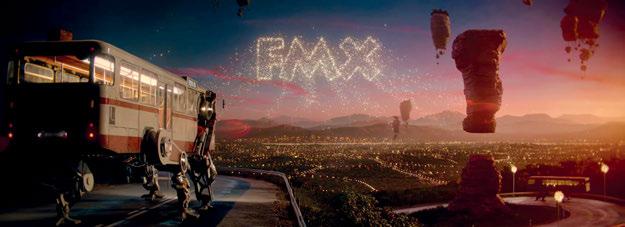
This May, VES members from around the world gathered as attendees and panelists to celebrate the 30th edition of the Film & Media Exchange in Stuttgart, Germany. Europe’s premier conference for the latest in animation, VFX and digital media, the program focused on the future of the industry with this year’s theme, “The Road Ahead.” The long and fruitful partnership between VES and FMX deepened with insightful panels, conversations and meetups.
VES hosted a panel discussion on “Méliès to AI,” which touched on key VFX milestones from the birth of the moving image and how AI marks another step in technical development. Panelists included the VES Board Chair, CEO of SideFX Kim Davidson, with VES Toronto Board Member, Kate Xagoraris, CTO of Milk Visual Effects Steve MacPherson and VFX Producer David Cordon.
VES member Judith Crow, VP Strategic Partnerships at SideFX,
examined VFX careers outside of traditional media in the panel “Beyond Entertainment: How VFX Shapes Other Industries.” Joined by Nfinite’s VP Labs, Martin Enthed; Co-Founder of Another Earth, Felix Geremus; and Pierre Grage, CIO, UNEVIS Ventures, the discussion included medical treatment simulations, climate change impacts, architectural and automotive designs, and much more.
VES Visionary Award honoree Roland Emmerich returned to his hometown to celebrate the 30th anniversary of Independence Day, winner of the Academy Award for Visual Effects, and the impact of the iconic disaster spectacle.
VES Germany Section held a luncheon at Brauhaus Schönbuch open to global membership. Hosted by Agon Ushaku with support from Jonas Kluger and Christine Resch, the event drew a capacity crowd dedicated to building the international VFX community.
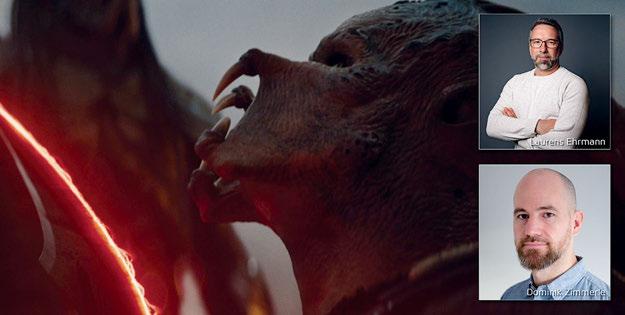
VES members from The Yard VFX and TRIXTER presented an international collaboration on Predator: Badlands as part of the FMX’s VFX for Features track. (Image courtesy of 20th Century Studios)
VES Releases On-Set VFX Data Collection and Usage Guide
This Spring, the VES Technology Committee released a comprehensive guide for On-Set VFX Data, detailing the data types and capture methods overseen by production-side VFX teams and how they can best be used across a project. The guide was designed to establish a common language between onset VFX, production, VFX facilities and technology teams to enable clearer communication, smoother handoffs and better-aligned expectations so every participant understands what information exists and how it can support their work.
In addition to defining data sets, the guide documents both current and emerging workflows and aims to inform stakeholders about potential data sources, highlighting how these choices impact production pipelines, timelines and budgets while also laying the groundwork for future efforts.
The production-side VFX department is the primary custodian for the comprehensive management and tracking of on-set data throughout a project’s lifecycle, ensuring it remains accessible for present workflows and future reference. The guide encourages all teams to engage with and benefit from this shared knowledge, strengthening collective outcomes and production efficiency.
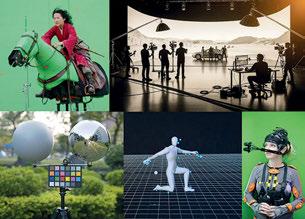
The guide was created for the VES Technology Committee by Sheena Duggal with contributions from Sam Richards, Jim Geduldick and Jake Morrison, and technical support from Jean-Francois Panisset.
Visit the VES website to learn more: https://bit.ly/3OtugFL
‘VFX Women Who Lead’ Initiative Launches
Talent has no gender, but opportunity does. The challenge isn’t capability, it’s access, recognition and opportunity. That is why the VFX Women Who Lead Committee is dedicated to building an industry where every woman in VFX has the support, visibility and resources to rise, whether she is leading today, beginning her journey tomorrow or still dreaming of joining the field.
The Visual Effects Society is proud to announce a global campaign to champion the women who lead the art and industry of visual effects. Chaired by Neishaw Ali, CEO of SPINVFX, the Committee stands for solidarity, visibility, growth and working toward systemic change. This multifaceted campaign will approach the mission on many fronts, including a social media awareness campaign, mentorship, webcasts, speaker series and more.
On September 4th, the first annual VFX Women Who Lead Summit 2026 will create space for VFX women from across the globe to share stories, build power and shape what the future of leadership looks like. Join us in person at the Skirball Cultural Center in Los Angeles, California, or live streamed around the world. Program and speakers to follow.
The future of VFX is diverse. It’s inclusive and transformative. And it will be shaped by the women advancing the craft today and those who will carry it forward tomorrow. Because when VFX women thrive, the entire industry benefits.
Learn more at www.vesglobal.org/vfx-women-who-lead


“[We] are dedicated to building an industry where every woman in VFX has the support, visibility and resources to rise.”
Progress at 24 Frames Per Second
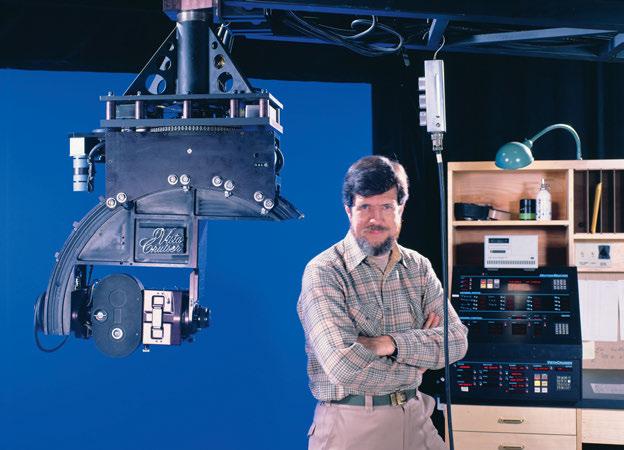
If the Summer issue of VFX Voice proves anything, it’s that visual effects rarely stand still for long. In these pages alone, artists are capturing volumetric humans with astonishing fidelity, reimagining digital creatures with ever more convincing biology and performance, and blending real-time technology with traditional cinematography in ways that would have sounded like science fiction only a decade ago. The tools are evolving rapidly, but they’re also expanding the creative palette for filmmakers who want to build worlds that feel richer, deeper and more immersive than ever.
At the same time, the industry thrives on continuity as much as innovation. Toy Story 5 (see article page 58) continues the CG legacy that began in 1995. The Mandalorian and Grogu (see article page 58) returns to the Star Wars universe nearly 50 years after the original film changed movie history in 1977 and seven years since the last Star Wars film. Even George Orwell’s
Animal Farm (see article, page 34) from director Andy Serkis, last filmed in 1999 as a live-action CGI film with animals created by the Jim Henson Creature Shop, finds new life through modern animation and performance capture. Technologies evolve, pipelines change and render farms get faster, but the mission remains constant: finding better ways to tell stories that audiences will believe.
Behind every breakthrough frame is a team of artists, supervisors and technologists who spent years mastering tools that didn’t exist when they started their careers and who are already figuring out the next ones. That’s what VFX Voice has always been about: not just documenting what the industry has made but understanding how and why it got made that way. If you’re reading this, you already know the difference.
In visual effects, the final frame is rarely the end of the story –it’s usually just the starting point for the next breakthrough.
effects supervisor Richard Edlund,
ILM’s Vista
motion-control
Visual
VES with
Cruiser
camera system during production of Star Wars: Return of the Jedi (1983). (Image courtesy of Industrial Light & Magic)